0022-538X/09/$08.00⫹0 doi:10.1128/JVI.00903-09
Copyright © 2009, American Society for Microbiology. All Rights Reserved.
Systematic Study of the Genetic Response of a Variable Virus to the
Introduction of Deleterious Mutations in a Functional Capsid Region
䌤
Eva Luna, Alicia Rodríguez-Huete, Vero
´nica Rinco
´n, Roberto Mateo,† and Mauricio G. Mateu*
Centro de Biología Molecular Severo Ochoa (CSIC-UAM), Universidad Auto´noma de Madrid, Cantoblanco, 28049 Madrid, Spain
Received 6 May 2009/Accepted 11 July 2009
We have targeted the intersubunit interfaces in the capsid of foot-and-mouth disease virus to investigate the genetic response of a variable virus when individual deleterious mutations are systematically introduced along a functionally defined region of its genome. We had previously found that the individual truncation (by mutation to alanine) of 28 of the 42 amino acid side chains per protomer involved in interactions between capsid pentameric subunits severely impaired infectivity. We have now used viral RNAs individually containing each of those 28 deleterious mutations (or a few others) to carry out a total of 96 transfections of susceptible cells, generally followed by passage(s) of the viral progeny in cell culture. The results revealed a very high frequency of fixation in the capsid of second-site, stereochemically diverse substitutions that compensated for the detrimental effect of primary substitutions at many different positions. Most second-site substitutions occurred at or near the capsid interpentamer interfaces and involved residues that are spatially very close to the originally substituted residue. However, others occurred far from the primary substitution, and even from the interpentamer interfaces. Remarkably, most second-site substitutions involved only a few capsid residues, which acted as “second-site hot spots.” Substitutions at these hot spots compensated for the deleterious effects of many different replacements at diverse positions. The remarkable capacity of the virus to respond to the introduction of deleterious mutations in the capsid with the frequent fixation of diverse second-site mutations, and the existence of second-site hot spots, may have important implications for virus evolution.
The rapid replication, high mutation rates, and large popu-lation sizes of RNA viruses give rise to genetically highly het-erogeneous virus populations, termed viral quasispecies (15– 18). Viral quasispecies may quickly adapt to different environments through the fixation of some of the multiple mutations present in individual genomes in the population. Accordingly, fixation of second-site mutations able to compen-sate for the effect of randomly occurring deleterious mutations could be particularly frequent in RNA virus populations. Com-pensatory mutations have indeed been detected, many times in a fortuitous way, during genetic analyses of different viruses (4, 6, 7, 9, 12, 13, 22, 29, 33, 36–42, 48, 49, 51–54). However, to our knowledge no study has systematically analyzed the frequency, types, and distribution of second-site mutations acquired by a virus in response to many different deleterious mutations in-troduced along a extended, but functionally defined, region of its genome.
The viral capsid provides a particularly interesting target to analyze the fixation of second-site, compensatory mutations in a functional region of a virus. Nonenveloped virus capsids may be subjected to multiple, severe, and even contradictory selec-tive pressures imposed on them to preserve their adapselec-tive physicochemical properties and multiple biological functions (8, 31). Accordingly, accumulating evidence indicates that the
capsids of small, nonenveloped viruses have been exquisitely fine-tuned through evolution, probably to a much larger extent than most cellular proteins or protein complexes. Structure-function analyses almost invariably show that the vast majority of amino acid replacements in nonenveloped viral capsids, even in exposed loops with no known function, significantly decreases viral yields, or at least unfavorably affects viral fitness (see, for example, references 28, 31, 32, and 43 and references therein). Thus, despite the dramatic potential for variation in viral quasispecies, strong negative selection could be expected to lead to very high amino acid sequence conservation in the capsid proteins. In fact, such a high sequence conservation is not observed for many nonenveloped RNA virus capsids. This paradox could be resolved by invoking a frequent fixation in the capsid region of compensatory second-site mutations, which could help the virus to evade the immune response and to adapt to new environments and hosts.
Foot-and-mouth disease virus (FMDV) is a small, icosahe-dral, nonenveloped RNA virus whose structure, function, and evolution have been widely studied (27, 46). FMDV popula-tions are quasispecies (19), and the FMDV capsid may provide a good model for the study of compensatory mutations and their role in virus variation and evolution. In addition, this virus is the causative agent of foot-and-mouth disease (FMD), one of the economically most important animal diseases world-wide. Frequent genetic and antigenic variation in the capsid proteins impose severe difficulties for FMD control (27, 31, 46); thus, a profound knowledge of the dynamics of compen-satory mutations in the FMDV capsid may also contribute to improve current strategies to fight FMD and other diseases caused by highly variable viruses.
The FMDV capsid is formed by 60 copies of each of three * Corresponding author. Mailing address: Centro de Biología
Molec-ular Severo Ochoa, Universidad Auto´noma de Madrid, Cantoblanco, 28049 Madrid, Spain. Phone: 34-91-1964575. Fax: 34-91-1964420. E-mail: [email protected].
† Present address: Microbiology and Immunology Department, Stanford University, Fairchild Science Building, 299 Campus Drive, D-300, Stanford, CA 94305-5124.
䌤Published ahead of print on 22 July 2009.
10140
on November 8, 2019 by guest
http://jvi.asm.org/
proteins (VP1, VP2, and VP3) and a small, internal polypep-tide (VP4). During assembly of FMDV and other picornavi-ruses, one copy of the precursor polyprotein P1 folds and is proteolytically processed to yield a protomeric subunit com-posed of one copy of each capsid protein. Five protomers oligomerize to yield a pentameric subunit, and twelve pentam-ers assemble to form an icosahedral capsid (44) (Fig. 1A). The three-dimensional structure of several FMDV isolates (1, 11, 21, 26), including variant C-S8c1, a biological clone from vac-cine strain C1Santa Pau-Spain/70, is known (26). Based on this structural information, we carried out previously a systematic structure-function study of the capsid interpentamer interfaces in FMDV C-S8c1. The analysis revealed that most interfacial side chains were critically required for viral function and in-fectivity (28). However, partial sequencing fortuitously re-vealed the occasional fixation in the capsid of a few pseudo-reversions and second-site amino acid substitutions that, in some cases, were responsible for restoring the infectivity, thus acting as compensatory mutations (28). These and other ob-servations suggested the possibility that a complex dynamics of compensatory mutations could be operating at the functionally critical intersubunit interfaces during the evolution of FMDV. In the present study we have systematically analyzed the frequency, types, and patterns of second-site amino acid sub-stitutions fixed in the FMDV capsid in response to the intro-duction of intrinsically deleterious substitutions of the func-tionally critical residues at the interpentamer interfaces. The results have revealed a complex dynamics of very frequent and diverse second-site mutations, many of them concentrated in a few capsid hot spots. A working model to integrate the large amount of data obtained on the frequency, type, location and other characteristics of the second-site mutations detected is discussed.
MATERIALS AND METHODS
Site-directed mutagenesis and subcloning.Substitution of amino acid residues on the capsid of FMDV C-S8c1 (47) was carried out by site-directed mutagenesis on plasmid p3242/C-S8c1 (2) using the QuikChange system (Stratagene). The mutations were confirmed by automated DNA sequencing. The mutagenized segments were subcloned in the infectious plasmid pO1K/C-S8c1 essentially as previously described (28, 29). The presence of the engineered mutations and absence of any other mutation in the subcloned segment were confirmed by sequencing.
Transcription of viral RNA and electroporation of eukaryotic cells.FMDV RNA was transcribed from linearized wild-type and mutant pO1K/C-S8c1
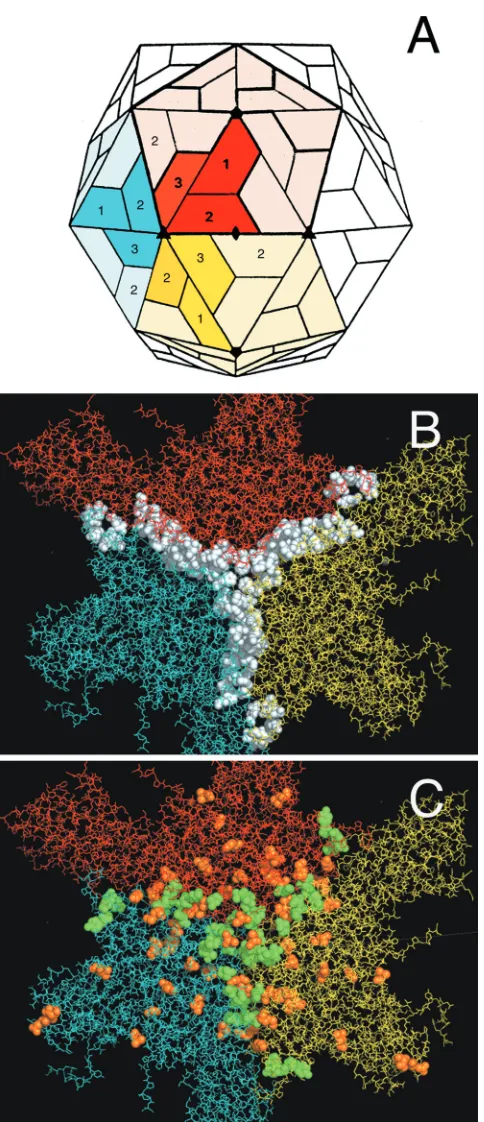
plas-FIG. 1. Primary and second-site substitutions in the FMDV capsid. (A) Schematic quaternary structure of the capsid. Each protein subunit is represented by a trapezoid. The numbers 1, 2, and 3, respectively, denote VP1, VP2, and VP3. The black pentagons, triangles, and ellipses indicate the positions of capsid fivefold, threefold, and twofold sym-metry axes, respectively. Three protomeric subunits around a threefold axis, each of them belonging to a different pentameric subunit, are colored deep red, yellow, or blue. Three adjacent pentamers to which those protomers belong are colored in shades of red, yellow, or blue, respectively. (B and C) Primary and second-site substitutions, mapped
on a partial model of the FMDV C-S8c1 capsid structure (26). The image represents a wireframe atomic model of the three protomers in the scheme shown in panel A that belong to adjacent pentamers and are deep-colored and labeled, plus one additional VP2 subunit (also labeled in panel A) from each of the three pentamers. A threefold axis is located at the center of the image, and the color code is as in panel A. The interfaces between three pentamers are thus defined by the limits between different colors (compare also panel A). In panel B, the interfacial residues subjected to deleterious substitutions are shown as white space-filling models. In panel C, the capsid residues where sec-ond-site substitutions were partially or totally fixed in the viral progeny populations are shown as space-filling models; they are colored either green (residues involved in second-site substitutions that were domi-nant in the population) or orange (residues involved in nondomidomi-nant, “third-site” substitutions).
on November 8, 2019 by guest
http://jvi.asm.org/
[image:2.585.44.286.70.631.2]mids by using the Riboprobe in vitro transcription system (Promega), and used to transfect BHK-21 cells by electroporation, following previously described procedures (28). In each experiment, similar amounts of each mutant RNA and the wild-type RNA (positive control) were used for transfection. A negative control (no RNA) was also included.
Propagation of the progeny viruses in cell culture.The supernatants of trans-fected cell cultures containing progeny viruses were subjected to serial passages in BHK-21 cell monolayers at the highest possible multiplicity of infection to minimize the fixation of random mutations. When no or very few viruses were detected after transfection, at least two serial passages were carried out to allow the amplification of any viable mutant that could have arisen during viral repli-cation. The cytopathic effect (CPE) was compared to that obtained with a nonmutated, control virus under the same conditions. A rough estimation of the CPE was attempted by comparing the time to nearly complete detachment of the monolayer and/or the approximate proportions of detached cells at defined times. More accurate determinations were made by titration of the viral progeny at a defined time after transfection.
Titration of virus infectivity and extraction of viral RNA.Virus titers were determined at least in duplicate in standard plaque assays. RNA derived from the final viral populations obtained after transfection and serial passaging was extracted using TRIzol (Invitrogen) and precipitated with ethanol. The RNA was reverse transcribed to DNA and amplified by PCR as previously described (28). The reverse transcription-PCR products were purified by using a Montage PCR kit (Millipore). In every case, the presence of the engineered mutation and of any other mutation that could have been fixed in the capsid of the progeny virion populations during the multiple replication cycles was determined by sequencing of the entire capsid region.
Structural analyses and molecular modeling.The Protein Data Bank atomic coordinates for the crystal structures of FMDV serotypes C (isolate C-S8c1) (26), O (1, 21), and A (11) were inspected using the programs InsightII (Biosym Technologies), RasMol (45) and/or Pymol (DeLano Scientific, Inc.). Contact and solvent accessibility analysis and modeling of mutations were done with the program Whatif (50).
RESULTS
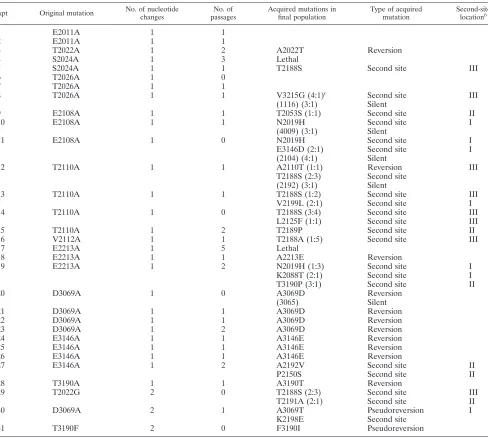
Targeting a functional region for a systematic analysis of the genetic response of a virus to the introduction of deleteri-ous mutations.In a previous study (28) we carried out a sys-tematic alanine scanning of the 42 residues per protomer whose side chain is involved in interpentamer interactions. Single transfections revealed that individual alanine substitu-tions of 28 interfacial residues were particularly deleterious for the virus, since they led to (i) undetectable progeny virus (16 mutants); (ii) very low virus titers (ca. 0.01% that of the pa-rental virus) that, however, increased to some extent at longer times after transfection (7 mutants); or (iii) immediate geno-typic reversion or acquisition of a different mutation at the same codon (pseudoreversion), most likely in response to an intrinsically lethal effect of the original mutation (5 mutants). We have now systematically used a collection of FMDV RNAs individually containing each of these 28 deleterious interfacial mutations (or a few other interfacial mutations, as detailed below) to carry out repeated independent transfections of sus-ceptible cells. The majority of the viral progeny populations obtained were subjected to one to three serial passages in cultured cells; two or three blind passages were done in those cases where no virus was detected after transfection. A total of 96 experiments with 39 different mutants were carried out (see Tables 1 to 3). The rationale was to allow the emergence and eventual dominance in the viral populations of variants that had either reverted genotypically or acquired additional mu-tations able to partially or completely restore virus viability. The presence or absence of the original mutation in the con-sensus sequence of the viral population obtained at the end of each experiment was determined by partial nucleotide
se-quencing. If the original mutation had not reverted to the parental nucleotide, the consensus nucleotide sequence of the entire capsid coding region was determined to identify possible second-site capsid mutation(s) present in the population.
It was important to exclude the possibility that the second-site mutations we could eventually find in the consensus se-quence of the viral populations were neutral mutations fixed by genetic drift during the multiple replication cycles of the viral RNA. To this aim, the RNA derived from the parental FMDV infectious clone was subjected to seven independent transfec-tions, four of them followed by 3, 5, 6 or 18 serial passages in cell culture. At the end of each experiment the entire capsid region was sequenced (except in the experiments that involved 3 or 18 passages, where only one-third or one-fifth, respec-tively, of the capsid region was sequenced). No missense mu-tations and only one silent mutation in one experiment (codon 3115) were found (results not shown). In addition, in other experiments that involved many multiplication cycles of the FMDV C-S8c1 model virus, mutations in the consensus se-quence of the viral progeny populations were found only very rarely or not at all.
Compensatory mutation, and not genotypic reversion, is the preferred mechanism in viral populations to restore the infec-tivity lost by truncation of capsid side chains involved in in-tersubunit interactions. In nature, amino acid substitutions that require a single mutational event (one nucleotide change) are probabilistically much favored over those that require two mutational events. Thus, we first focused on a subset of 11 of the 28 critical residues at the interpentamer interfaces, those whose mutation to alanine required a single nucleotide change. In this situation, the virus could avoid the deleterious effect of the introduced mutation not only through a forward mutation at the same or a different position but also simply by reversion to the original genotype.
We subjected each of these 11 interfacial mutants to re-peated, independent transfections, followed by serial passages in BHK-21 cells (Table 1). Strong CPE comparable to that of the nonmutated control virus was observed in as many as 26 of the 28 experiments carried out with the 11 mutants, even though each original mutation was lethal or strongly unfavor-able. For two mutants (E2213A and S2024A) progeny viruses could not be recovered in one experiment, but they were ob-tained in one or two other experiments. Thus, each of the 11 intrinsically deleterious mutants could regain infectivity and yield high virus titers. Genotypic reversion was not the most frequent occurrence in the virus populations. Recovery of in-fectivity was due to reversion in only 10 of the 26 experiments, involving 5 of 11 different mutants. In 16 experiments corre-sponding to eight different mutants, the primary, deleterious mutation was preserved (in one case only, as a mixture with the revertant genotype). For two of these eight mutants (E2011A and T2026A) no other mutation was found in the entire capsid-coding region (see Discussion). For the remaining six mutants, recovery was associated with the fixation in the population of one (occasionally more than one) second-site substitution in-volving a single mutational event (Table 1). No clear correla-tion between type of primary mutacorrela-tion (transicorrela-tion or transver-sion) and outcome (reversion or compensation) was found. The dominant second-site mutations involved either a transi-tion or a transversion. In summary, even though genotypic
on November 8, 2019 by guest
http://jvi.asm.org/
reversion would have equally required a single mutational event, the fixation of compensatory mutations was the most frequent mechanism that these mutant viruses used to restore function and infectivity. It must be noted here that, in studies with other model viruses, theoretical analysis of fitness changes (6) and an experimental analysis providing a limited data set (35) also revealed that compensation may be more frequent than reversion.
In very rare cases (mutant D3069A), only reversion to the
[image:4.585.50.538.79.517.2]original amino acid was repeatedly found. We wondered whether, even for these specific capsid positions, the fixation of a compensatory mutation was a feasible alternative. We con-structed three mutants with a single amino acid substitution involving two nucleotide changes, at any of three critical posi-tions at the interpentamer interfaces where only genotypic reversion had been observed. In the three new mutants (T2022G, T3190F, and D3069A), reversion to the original amino acid would now require two mutational events at the TABLE 1. Second-site mutations in response to deleterious interfacial amino acid substitutions involving one nucleotide changea
Expt Original mutation No. of nucleotide changes
No. of passages
Acquired mutations in final population
Type of acquired mutation
Second-site locationb
1 E2011A 1 1
2 E2011A 1 1
3 T2022A 1 2 A2022T Reversion
4 S2024A 1 3 Lethal
5 S2024A 1 1 T2188S Second site III
6 T2026A 1 0
7 T2026A 1 1
8 T2026A 1 1 V3215G (4:1)c Second site III
(1116) (3:1) Silent
9 E2108A 1 1 T2053S (1:1) Second site II
10 E2108A 1 1 N2019H Second site I
(4009) (3:1) Silent
11 E2108A 1 0 N2019H Second site I
E3146D (2:1) Second site I
(2104) (4:1) Silent
12 T2110A 1 1 A2110T (1:1) Reversion III
T2188S (2:3) Second site (2192) (3:1) Silent
13 T2110A 1 1 T2188S (1:2) Second site III
V2199L (2:1) Second site I
14 T2110A 1 0 T2188S (3:4) Second site III
L2125F (1:1) Second site III
15 T2110A 1 2 T2189P Second site II
16 V2112A 1 1 T2188A (1:5) Second site III
17 E2213A 1 5 Lethal
18 E2213A 1 1 A2213E Reversion
19 E2213A 1 2 N2019H (1:3) Second site I
K2088T (2:1) Second site I
T3190P (3:1) Second site II
20 D3069A 1 0 A3069D Reversion
(3065) Silent
21 D3069A 1 1 A3069D Reversion
22 D3069A 1 1 A3069D Reversion
23 D3069A 1 2 A3069D Reversion
24 E3146A 1 1 A3146E Reversion
25 E3146A 1 1 A3146E Reversion
26 E3146A 1 1 A3146E Reversion
27 E3146A 1 2 A2192V Second site II
P2150S Second site II
28 T3190A 1 1 A3190T Reversion
29 T2022G 2 0 T2188S (2:3) Second site III
T2191A (2:1) Second site II
30 D3069A 2 1 A3069T Pseudoreversion I
K2198E Second site
31 T3190F 2 0 F3190I Pseudoreversion
a
The corresponding amino acid substitutions in the FMDV capsid are indicated. For each residue, the first digit indicates the protein (1, VP1; 2, VP2; 3, VP3; 4, VP4), and the last three digits indicate the amino acid position according to the normalized FMDV capsid numbering used in the PDB C-S8c1 file 1FMD (26). Relative to this numbering, C-S8c1 has a single amino acid deletion at position 59 in VP3, and a 4-amino-acid deletion at positions 141 to 144 in VP1. Numbers in parentheses indicate that a silent mutation occurred at the specified codon.
b
The second-site location or pattern (I, II, or III) identifies the spatial relationship between the originally substituted residue and the one where a second-site substitution occurred. I, the two residues are very close or in contact with each other; II, the two residues are far apart, but the second-site residue is at or close to the interpentamer interfaces; III, the two residues are far apart, and the second-site residue is also at some distance from the interfaces (compare Fig. 2).
c
The ratio in parenthesis indicates the approximate proportion in the viral population of the original and the substituted residue at that position, as estimated from very clean nucleotide sequence densitograms. For example, “V3215G (4:1)” indicates that the proportions of Val and Gly at position 3215 are, respectively, about 4/5 and 1/5. If no ratio is indicated, the mutation occurred in nearly 100% of the genomes in the population.
on November 8, 2019 by guest
http://jvi.asm.org/
same codon instead of one. After transfection and passaging in cell culture, CPE was observed in all three cases. Sequencing of the entire capsid-coding region showed that no reversion had occurred; in every case, the observed recovery of infectivity was associated to a mutation at the originally mutated codon to yield a different amino acid (pseudoreversion), and/or a sec-ond-site substitutions in the capsid, each involving a single nucleotide change (Table 1). Thus, a genetic barrier to phe-notypic reversion was overcome by using a compensatory mechanism.
Compensatory mutation is a general mechanism frequently occurring in viral populations to restore the infectivity lost by truncation of most side chains involved in intersubunit inter-actions.We evaluated next whether the second-site mutation strategy was potentially accessible to the virus to compensate for the deleterious effects of substitutions at any of the 28 functionally critical positions in the capsid interpentamer in-terfaces. Also, by a thorough analysis of many interfacial po-sitions in repeated experiments, we expected to identify pat-terns in the types of second-site mutations acquired and the capsid locations where they occurred.
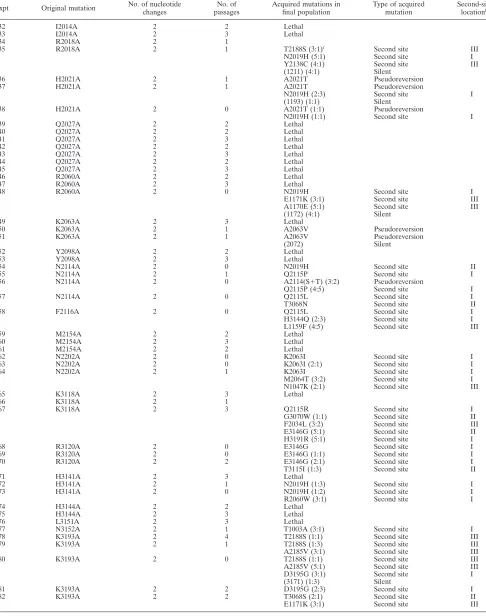
In order to make the analysis more efficient by minimizing genotypic reversion events, we now focused on the subset of the 17 remaining critical residues at the interpentamer inter-faces, whose mutation to alanine required two nucleotide sub-stitutions (as for the T2022G, T3190F, and D3069A mutants above). Unless an adequate mutation in the same codon or a second-site mutation could be selected, the mutant virus would probably face extinction, and no progeny would be recovered. We subjected each of these 17 interfacial mutants (and also a somewhat less deleterious interfacial mutant, R3120A, that also required two nucleotide changes) to several transfections, followed by serial passages (Table 2). Again, unexpected re-sults were obtained. First, a strong CPE comparable to that obtained with the nonmutated control virus was observed in as many as 29 of the 51 experiments carried out with the 18 mutants (57% of the cases), even though each original muta-tion tested was lethal or strongly unfavorable. For most mu-tants, a strong CPE was observed in every experiment (eight mutants) or at least in some experiments (four other mutants). Six of the eighteen mutants did not regain infectivity after serial passaging; however, all but one of these six mutants had been probed in just one or two experiments, whereas most other mutants had been probed in three or more experiments. Thus, the proportion of deleterious interfacial mutations sus-ceptible of compensation could be even higher than that reported here.
Sequencing of the complete capsid region showed that ge-notypic reversion had not occurred in any of the 29 experi-ments that yielded viable viruses; in three cases only, recovery was due to pseudoreversion in the originally mutated codon, involving a single nucleotide substitution and leading to the incorporation of a different amino acid at the same position. In three other cases, both pseudoreversion at the original codon and a second-site substitution occurred. Remarkably, in the vast majority (83%) of the 29 cases, recovery was associated with the fixation in the population of one (sometimes more) second-site compensatory substitution involving a single muta-tional event (Table 2).
Taking into account also the results described above with the
series of 11 single-nucleotide mutations, the deleterious effect of alanine substitutions in at least 80% of the 28 most critical positions at the capsid interpentamer interfaces could be avoided by the virus without any genotypic reversion. In the vast majority (91%) of these cases, the effect was due to the fixation of one (or less frequently, more than one) compensa-tory amino acid replacements in the viral capsid. In summary, compensatory mutations can be used by the virus to restore the infectivity lost by mutation (to alanine) of nearly any critical residue involved in capsid intersubunit interactions.
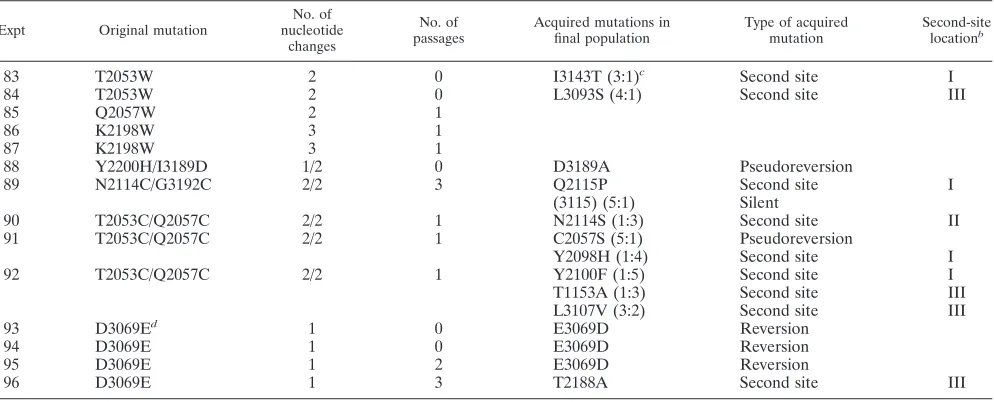
Compensatory mutation is also the preferred mechanism to restore the infectivity lost by nonalanine substitutions at the capsid interfaces.We next sought to determine whether sec-ond-site mutations could restore the infectivity lost by intro-ducing substitutions that not only would remove intersubunit interactions (as in alanine scanning) but that could also steri-cally prevent subunit association. In addition to already tested substitutions T3190F (see above) and D3069E (30), we chose seven interfacial residues that had been shown to functionally tolerate their replacement by alanine (28). Thus, any deleteri-ous effect of nonalanine substitutions at those positions would likely be caused not by the removal of native interactions but by some change in stereochemistry. Virtual mutagenesis on the C-S8c1 structure suggested that substitution of the bulky Trp side chain for those of T2053, Q2057 or K2198 could impair the establishment of native interpentamer interactions by neighboring critical residues and thus reduce virus assembly and infectivity. We also chose three nonalanine double substi-tutions (together involving six alanine-tolerant capsid posi-tions) previously shown to be highly deleterious (30). In all but one case, each single substitution chosen involved at least two nucleotide changes, rendering reversion unlikely. A total of 10 experiments were carried out with those nonalanine mutants (Table 3). Mutations Q2057W and K2198W did reduce the virus titer by about two orders of magnitude. The titer in-creased to wild-type levels at longer times postinfection, but no second site mutations were fixed in the entire capsid region. For one double mutant (Y2200H/I3189D), a pseudoreversion occurred in one of the originally mutated positions (i.e., posi-tion 3189), leading to a different amino acid residue. In all experiments with the remaining mutants, second-site substitu-tions did occur in the capsid (Table 3). To summarize, second-site, compensatory mutation is revealed as a valid strategy used by the virus to restore infectivity even when nonalanine, mul-tiple, and/or stereochemically drastic deleterious substitutions at the capsid interfaces are involved.
Compensatory mutations involve residues that are either spatially very close or distant from the originally mutated interfacial residues and very frequently occur at a few capsid hot spots.In all, 36 single and 3 double deleterious substitu-tions of 35 of the 42 residues per protomer whose side chain is involved in interpentamer interactions were probed in 96 ex-periments (Tables 1 to 3 and Fig. 1B). As many as 73 second-site amino acid substitutions, 45 of them unique, were totally or partially fixed at 39 capsid positions in the consensus sequence of the recovered viral populations. We have mapped these mutations in the three-dimensional structure of the FMDV C-S8c1 virion (Fig. 1C). The majority of the capsid residues where second-site substitutions occurred are located at, or relatively close to the interpentamer interfaces and scattered
on November 8, 2019 by guest
http://jvi.asm.org/
TABLE 2. Second-site mutations in response to deleterious interfacial amino acid substitutions involving two nucleotide changesa
Expt Original mutation No. of nucleotide changes
No. of passages
Acquired mutations in final population
Type of acquired mutation
Second-site locationb
32 I2014A 2 2 Lethal
33 I2014A 2 3 Lethal
34 R2018A 2 1
35 R2018A 2 1 T2188S (3:1)c Second site III
N2019H (5:1) Second site I
Y2138C (4:1) Second site III
(1211) (4:1) Silent
36 H2021A 2 1 A2021T Pseudoreversion
37 H2021A 2 1 A2021T Pseudoreversion
N2019H (2:3) Second site I
(1193) (1:1) Silent
38 H2021A 2 0 A2021T (1:1) Pseudoreversion
N2019H (1:1) Second site I
39 Q2027A 2 2 Lethal
40 Q2027A 2 2 Lethal
41 Q2027A 2 3 Lethal
42 Q2027A 2 2 Lethal
43 Q2027A 2 3 Lethal
44 Q2027A 2 2 Lethal
45 Q2027A 2 3 Lethal
46 R2060A 2 2 Lethal
47 R2060A 2 3 Lethal
48 R2060A 2 0 N2019H Second site I
E1171K (3:1) Second site III
A1170E (5:1) Second site III
(1172) (4:1) Silent
49 K2063A 2 3 Lethal
50 K2063A 2 1 A2063V Pseudoreversion
51 K2063A 2 1 A2063V Pseudoreversion
(2072) Silent
52 Y2098A 2 2 Lethal
53 Y2098A 2 3 Lethal
54 N2114A 2 0 N2019H Second site II
55 N2114A 2 1 Q2115P Second site I
56 N2114A 2 0 A2114(S⫹T) (3:2) Pseudoreversion
Q2115P (4:5) Second site I
57 N2114A 2 0 Q2115L Second site I
T3068N Second site II
58 F2116A 2 0 Q2115L Second site I
H3144Q (2:3) Second site I
L1159F (4:5) Second site III
59 M2154A 2 2 Lethal
60 M2154A 2 3 Lethal
61 M2154A 2 2 Lethal
62 N2202A 2 0 K2063I Second site I
63 N2202A 2 0 K2063I (2:1) Second site I
64 N2202A 2 1 K2063I Second site I
M2064T (3:2) Second site I
N1047K (2:1) Second site III
65 K3118A 2 3 Lethal
66 K3118A 2 1
67 K3118A 2 3 Q2115R Second site I
G3070W (1:1) Second site II
F2034L (3:2) Second site III
E3146G (5:1) Second site II
H3191R (5:1) Second site I
68 R3120A 2 0 E3146G Second site I
69 R3120A 2 0 E3146G (1:1) Second site I
70 R3120A 2 2 E3146G (2:1) Second site I
T3115I (1:3) Second site II
71 H3141A 2 3 Lethal
72 H3141A 2 1 N2019H (1:3) Second site I
73 H3141A 2 0 N2019H (1:2) Second site I
R2060W (3:1) Second site I
74 H3144A 2 2 Lethal
75 H3144A 2 3 Lethal
76 L3151A 2 3 Lethal
77 N3152A 2 1 T1003A (3:1) Second site I
78 K3193A 2 4 T2188S (1:1) Second site III
79 K3193A 2 1 T2188S (1:3) Second site III
A2185V (3:1) Second site III
80 K3193A 2 0 T2188S (1:1) Second site III
A2185V (5:1) Second site III
D3195G (3:1) Second site I
(3171) (1:3) Silent
81 K3193A 2 2 D3195G (2:3) Second site I
82 K3193A 2 2 T3068S (2:1) Second site II
E1171K (3:1) Second site III
aSame as Table 1, footnotea. bSame as Table 1, footnoteb. cSame as Table 1, footnotec.
on November 8, 2019 by guest
http://jvi.asm.org/
along them; only a few substitutions are positioned far away from the interfaces (compare also Fig. 1B, which shows every position at the interfaces where the deleterious primary muta-tions had been introduced).
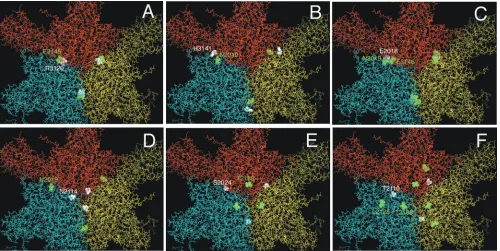
Next, we individually inspected the location in the FMDV C-S8c1 structure of each originally introduced deleterious sub-stitution and the specific second-site subsub-stitution(s) that was(were) partially or completely fixed in the population in re-sponse to the introduced mutation. Three very different pat-terns were revealed (Tables 1 to 3 and Fig. 2). (i) The first pattern (I) includes second-site substitutions of capsid residues either in contact with or located very close to the originally mutated residue (48% of the second-site mutations; see Fig. 2A, B, and C for three examples). (ii) The second pattern (II) includes second-site substitutions of capsid residues away from the originally mutated residue but still at or very close to the interpentamer interfaces (18%; see Fig. 2D for one example). (iii) The third pattern (III) includes second-site substitutions of capsid residues located at some distance from the originally mutated residue, and also from the interpentamer interfaces (34%; see Fig. 2E and F for two examples).
In most cases (57%) only one second-site amino acid sub-stitution occurred in the entire capsid; however, in 25, 16, and 2% of the cases two, three, or five second-site substitutions, respectively, were present. It is important to note that in 92% of the cases where only one second-site mutation occurred, the mutation was dominant in the population, or at least was present in about half the genomes, as deduced from the con-sensus sequence densitograms. In 84% of the cases where two or more second-site substitutions were detected, one substitu-tion was found dominant in the populasubstitu-tion; in sharp contrast, 83% of the additional substitutions occurred only in a minor fraction of the viral genomes in the population. In addition, the vast majority of those nondominant substitutions were not
generally observed in the absence of the dominant substitution (Tables 1 to 3). When mapped in the capsid structure, all dominant second-site substitutions were located at or relatively close to the interpentamer interfaces (Fig. 1C), and most be-longed to pattern I (57%). In contrast, many of the additional substitutions were located at some distance from the interpen-tamer interfaces (Fig. 1C), and most belong to patterns II or III (63%). A model for the fixation of compensatory mutations that attempts to integrate most of the above observations is suggested in the Discussion.
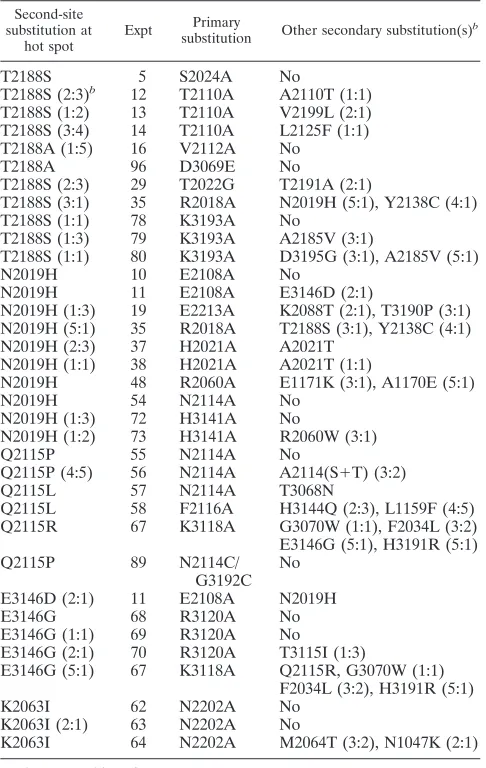
Most remarkably, the frequency and position in the capsid of the different second-site substitutions was far from random. In three-fourths of the experiments where 45 different second-site substitutions occurred at 39 capsid residue positions, as few as 9 different substitutions at 5 positions (T2188, N2019, Q2115, E3146, K2063) were repeatedly observed (Table 4). Two of these positions (T2188 and N2019) accounted for nearly half of all of the cases that involved second-site substitutions. Muta-tion at those “second-site hot spots” in the capsid was some-times accompanied by other second-site mutations elsewhere; however, the former were identified in several experiments as the only second-site substitution in the entire virus capsid, or they were the only dominant second-site mutation, and may be held responsible for the major compensatory effect.
[image:7.585.45.542.81.282.2]Residues N2019, Q2115, E3146, and K2063 are located at different positions in the capsid, but substitutions in all of these second-site hot spots belong to pattern I, since they are located very close to the originally mutated residues. A particularly revealing case is the most frequent second-site replacement, N2019H, which may compensate for the deleterious effects of alanine substitutions of as many as seven different residues, six of them closely surrounding N2019 (Fig. 3A). In most of these cases, and those of the second-site Q2115R and E3146G sub-stitutions (Table 4), a partial or total compensation in charge TABLE 3. Second-site mutations in response to deleterious non-alanine substitutions at the capsid intersubunit interfacesa
Expt Original mutation
No. of nucleotide
changes
No. of passages
Acquired mutations in final population
Type of acquired mutation
Second-site locationb
83 T2053W 2 0 I3143T (3:1)c Second site I
84 T2053W 2 0 L3093S (4:1) Second site III
85 Q2057W 2 1
86 K2198W 3 1
87 K2198W 3 1
88 Y2200H/I3189D 1/2 0 D3189A Pseudoreversion
89 N2114C/G3192C 2/2 3 Q2115P Second site I
(3115) (5:1) Silent
90 T2053C/Q2057C 2/2 1 N2114S (1:3) Second site II
91 T2053C/Q2057C 2/2 1 C2057S (5:1) Pseudoreversion
Y2098H (1:4) Second site I
92 T2053C/Q2057C 2/2 1 Y2100F (1:5) Second site I
T1153A (1:3) Second site III
L3107V (3:2) Second site III
93 D3069Ed 1 0 E3069D Reversion
94 D3069E 1 0 E3069D Reversion
95 D3069E 1 2 E3069D Reversion
96 D3069E 1 3 T2188A Second site III
aSame as Table 1, footnotea. bSame as Table 1, footnoteb. cSame as Table 1, footnotec.
dThe mutations fixed in the D3069E progeny populations were fortuitously identified in a previous study on FMDV stability (30). In the present study we have
completed the capsid sequence of the D3069E progeny populations to confirm that no other mutations were present; this mutant is included here for completeness.
on November 8, 2019 by guest
http://jvi.asm.org/
could contribute to restore the infectivity, as detailed in the Discussion. In sharp contrast to the other recurrent second-site substitutions, the extremely frequent T2188 second-site substi-tutions belong to pattern III, since this residue is located at the interprotomer interfaces within each pentamer, some distance away from the interpentamer interfaces. Figure 3B shows that the T2188 replacements compensated for the deleterious ef-fects of replacements of no less than seven other residues of very different stereochemical character, all of them located away from T2188 and not clustered, but scattered along the interpentamer interfaces. This observation suggests that con-formational rearrangements may mediate the compensatory effect of second site substitutions at the T2188 hot spot.
DISCUSSION
Frequent second-site mutation versus genotypic reversion.
Individual replacement of most amino acid residues at the interpentamer interfaces in the FMDV capsid is highly dele-terious. Most substitutions of amino acid residues in the capsid of FMDV proved generally detrimental, and it has been pro-posed that the capsids of small, nonenveloped viruses have been streamlined through evolution to a point where the vast majority of further substitutions will compromise fitness to some extent (see the introduction). In such a scenario, FMDV could face difficulties finding compensatory mutations able to restore the infectivity lost by the introduction of mutations at the interpentamer interfaces (or at any other functionally crit-ical capsid region). Accordingly, pseudoreversion of the orig-inally mutated residues were only very rarely observed in the
96 experiments we carried out. However, and in contrast to those expectations, the virus was able to frequently and repeat-edly respond to many diverse deleterious amino acid substitu-tions at different posisubstitu-tions in the capsid intersubunit interfaces with the rapid (either partial or complete) fixation in the pop-ulation of compensatory mutations. It could be argued that compensatory mutation could generally provide a fitness-com-promising, emergency solution, which is adequate in cases where simple genotypic reversion is probabilistically disfavored because it would require two nucleotide changes (as in the second series of mutants we analyzed). This cannot be ex-cluded for particular cases, and fitness competition experi-ments are under way to evaluate this possibility. However, it is important to note that for the first series of mutants, back-mutation to the original genotype would have equally required a single event only, and yet compensatory mutations occurred even more frequently than genotypic reversion. This suggests that many compensatory mutations may be able to neutralize the deleterious effects of mutations at the interpentamer interfaces without important fitness losses.
[image:8.585.44.544.69.320.2]The above observations are consistent with (i) the lack of strict conservation of capsid residues at or close to the inter-pentamer interfaces, as observed in a sequence alignment of about 250 natural isolates belonging to any of the seven FMDV serotypes, and (ii) the presence in natural, viable FMDV vari-ants of mutations at the capsid interfaces that were found lethal for the virus strain we used (reference 28 and results not shown). Interestingly, mutations at the identified hot spots were not observed with high frequency among natural FMDV isolates, probably because the types of deleterious mutations FIG. 2. Some representative examples of the spatial relationship between a residue subjected to a deleterious substitution (white space-filling models) and residues where second-site substitutions were fixed in the progeny population (green space-filling models). The capsid partial structure, including the interfaces between three adjacent pentameric subunits, is shown as in Fig. 1B and C. Examples of second-site substitutions belonging to pattern I (A, B, and C), II (D), and III (E and F) are shown. In the examples shown in panels C and F, two different second-site substitutions were fixed in response to the primary mutation. The residues involved in each case are labeled.
on November 8, 2019 by guest
http://jvi.asm.org/
we purposefully introduced at the capsid interfaces did not frequently occur in them either. This provides another example of the vast potentiality of FMDV for adaptation even in the face of infrequent, highly deleterious mutation, without com-promising biological function. The fitness landscape of the virus may provide multiple capsid sequence solutions that are essentially equivalent with regard to viability.
Third-site mutations. In most cases only one second-site mutation was observed in the entire capsid. In one case, which involved the most frequent second-site hot spot (T2188), the entire viral genome was sequenced, and no other mutation was found. The vast majority of the single second-site mutations occurred at or close to the interpentamer interface, the region where the primary, deleterious mutations had been intro-duced. Together, the results leave little doubt that these sec-ond-site mutations alone may compensate for the deleterious effect of the primary mutation. However, other less frequent cases need to be considered. First, in rare cases infectivity was recovered without reversion, but no second-site mutations
[image:9.585.43.286.90.474.2]were found in the entire capsid region; we are exploring the possibility that, in these cases, mutations elsewhere in the ge-nome could indirectly exert a compensatory effect, either at the protein or RNA levels. Second, in a minor and decreasing proportion of cases, an increasing number of second-site sub-stitutions (from two to five), were present. However, in general only one of these multiple second-site mutations was dominant in the population (as when only one second-site mutation oc-curred); the additional substitutions generally occurred in only a minor fraction of the viral progeny genomes. In addition, the vast majority of these nondominant (partially fixed) substitu-tions were not generally observed in the absence of the dom-inant substitution (Tables 1 to 3). The domdom-inant second-site substitutions were located at or close to the interpentamer interfaces and frequently close also to the primary substitution, while the additional substitutions were more frequently located at more distant positions from both the interface and the primary substitution. Importantly, in a previous study (29) we
FIG. 3. Second-site hot spots in the FMDV capsid. The capsid partial structure, including the interfaces between three adjacent pen-tameric subunits, is shown as in Fig. 2. Residues depicted as white space-filling models are those involved in deleterious substitutions that were compensated by a recurrent second-site substitution at either residue N2019 (A) or residue T2188 (B), both shown as green space-filling models. In panel A, residue N2114 is not shown.
TABLE 4. Recurrent second-site amino acid substitutions in the FMDV capsida
Second-site substitution at
hot spot
Expt Primary
substitution Other secondary substitution(s)
b
T2188S 5 S2024A No
T2188S (2:3)b 12 T2110A A2110T (1:1) T2188S (1:2) 13 T2110A V2199L (2:1) T2188S (3:4) 14 T2110A L2125F (1:1) T2188A (1:5) 16 V2112A No
T2188A 96 D3069E No
T2188S (2:3) 29 T2022G T2191A (2:1)
T2188S (3:1) 35 R2018A N2019H (5:1), Y2138C (4:1) T2188S (1:1) 78 K3193A No
T2188S (1:3) 79 K3193A A2185V (3:1)
T2188S (1:1) 80 K3193A D3195G (3:1), A2185V (5:1)
N2019H 10 E2108A No
N2019H 11 E2108A E3146D (2:1)
N2019H (1:3) 19 E2213A K2088T (2:1), T3190P (3:1) N2019H (5:1) 35 R2018A T2188S (3:1), Y2138C (4:1) N2019H (2:3) 37 H2021A A2021T
N2019H (1:1) 38 H2021A A2021T (1:1)
N2019H 48 R2060A E1171K (3:1), A1170E (5:1)
N2019H 54 N2114A No
N2019H (1:3) 72 H3141A No
N2019H (1:2) 73 H3141A R2060W (3:1)
Q2115P 55 N2114A No
Q2115P (4:5) 56 N2114A A2114(S⫹T) (3:2)
Q2115L 57 N2114A T3068N
Q2115L 58 F2116A H3144Q (2:3), L1159F (4:5) Q2115R 67 K3118A G3070W (1:1), F2034L (3:2) E3146G (5:1), H3191R (5:1)
Q2115P 89 N2114C/
G3192C No
E3146D (2:1) 11 E2108A N2019H
E3146G 68 R3120A No
E3146G (1:1) 69 R3120A No E3146G (2:1) 70 R3120A T3115I (1:3)
E3146G (5:1) 67 K3118A Q2115R, G3070W (1:1) F2034L (3:2), H3191R (5:1)
K2063I 62 N2202A No
K2063I (2:1) 63 N2202A No
K2063I 64 N2202A M2064T (3:2), N1047K (2:1)
a
Same as Table 1, footnotea.
b
Same as Table 1, footnotec.
on November 8, 2019 by guest
http://jvi.asm.org/
[image:9.585.301.542.295.660.2]provided evidence for a chain of linked mutational events in response to the introduction of a primary mutation fixed in a different region of the FMDV capsid during a persistent infec-tion. All of these observations together lead us to suggest, as a working hypothesis, that the nondominant “third-site” muta-tions observed in a number of cases may be in the process of fixation in the capsid region as a secondary response to the fixation of the dominant “second-site” substitutions. The dom-inant second-site substitutions, which may also occur alone, would be responsible for the major compensatory effect; the occasional third-site substitutions, which generally do not oc-cur alone, could contribute to a better overall compensation and further fitness increases in a cascade of mutational events (29). Alternatively or additionally, some third-site mutations could represent changes with beneficial effects that are unre-lated to the capsid function affected by the primary deleterious mutation.
Compensatory mutation diversity, second-site mutational hot spots, and possible structural bases for functional com-pensation.The frequency of fixation of second-site mutations in our experiments and their diversity were quite high (45 different second-site substitutions at 39 different capsid posi-tions, in response to deleterious substitutions of 35 interfacial residues). In general, different second-site mutations were fixed even in response to the same primary mutation, although one or two second-site mutation types may tend to predomi-nate in the response to the same primary mutation. This latter observation is consistent with the results of a thorough analysis (51) of the second-site mutation response to a single deleteri-ous mutation that prevented the proteolytic maturation of the capsid in herpes simplex virus (a virus very different from FMDV).
The high frequency and diversity of second-site mutations we found in the FMDV capsid region does not imply, however, that a nearly unlimited number of combinations of intrinsically disadvantageous mutations in this region may be functionally acceptable, and potentially able to restore an infectious viral phenotype. In fact, a minor subset of 9 of those 45 different second-site mutations, which occurred at just five capsid posi-tions, accounts for three-fourths of all cases. The correspond-ing codons are not mutational hot spots, and the mutations fixed in them in response to the introduction of deleterious mutations have not been observed in the absence of the dele-terious mutations. Thus, it appears that the very remarkable ability of FMDV to accommodate deleterious mutations at the capsid intersubunit interfaces relies, in part, on the existence of defined capsid residues (“second-site hot spots”). These ap-pear to be privileged sites for the introduction of mutations able to compensate for the detrimental effects even of stereo-chemically very different substitutions at many different posi-tions scattered along the capsid interfaces.
Our aim in the present study has been to analyze the genetic response of the virus to the systematic introduction of delete-rious mutations at a functionally defined region of its genome. Investigation of the structural basis for the compensatory ef-fects found would nicely complement the present genetic study, and we have started to work along that direction. How-ever, such investigation requires a different type of experimen-tal approach, including biochemical and biophysical studies and possibly the determination of the three-dimensional
struc-tures of at least a few mutant viral particles. Such studies have provided clear insights into the molecular mechanisms of func-tionally compensating effects, but only in a limited number of cases, and most of them involved small cellular proteins and not very large protein complexes (3–5, 7, 14, 23–25, 34). In the case of the FMDV virion, the study will be further complicated because previous observations suggested that the deleterious effect of many of the primary mutations introduced at the capsid interpentamer interfaces, chosen to remove interpen-tamer interactions, may be related to defects in capsid assem-bly and/or stability (28). Thus, it could be expected that the compensatory effect of many second-site mutations would be essentially based on allowing, either directly or indirectly, the introduction of further interpentamer interactions to restore efficient assembly and enough stability. Because most primary mutations are deleterious and few or no virions can be ob-tained, the adequate testing of this hypothesis may require the production of sufficient amounts of recombinant mutant FMDV capsids, still a technically difficult challenge. Alterna-tive methods to test for the effect of these mutations on as-sembly are currently being explored by another group in col-laboration with us. Thus, we will only discuss here a few specific possibilities on the likely structural reasons for some of the frequent compensatory effects observed at the FMDV cap-sid interfaces that we expect to be able to test when the current experimental limitations are overcome.
Consistent with the possibility that many of the compen-satory mutations detected in the present study restore nor-mal assembly and/or stability of the viral particle, nearly all of the many second-site, dominant substitutions and a large proportion of the nondominant, “third-site” substitutions occurred close to the interpentamer interfaces (Fig. 1C; pattern I or II); most were also close to the site of the primary substitution: compensatory mutations at four of the five second-site hot spots (N2019, Q2115, E3146, and K2063) did belong to pattern I.
Infection by FMDV involves the acid-induced disassembly of the viral particle in the endosomes, and there is evidence that this process is facilitated by intersubunit electrostatic re-pulsions that occur between the imidazole of H3141 (which will be charged at acidic pH) and the dipole of a spatially close
␣-helix belonging to a neighboring pentamer (1, 10, 20). Ac-cordingly, when H3141 was replaced by Asp or Phe, the capsid did show increased stability under acidic conditions (20). In-terestingly, the most frequently observed compensatory substi-tution, N2019H, involved the introduction of an imidazole group, occurred spatially close to H3141, and compensated for primary substitutions that involved the loss of the imidazole group of H3141 (H3141A) or of the basic group of other residues located nearby (H2021A, R2018A, and R2060A) (Ta-ble 4 and Fig. 2B). At the acidic pH in which virion disassembly occurs, all of these nearby groups will be positively charged and could participate in interpentamer electrostatic repulsions. Thus, we predict that (i) primary substitutions H3141A, and perhaps also H2021A, will remove electrostatic repulsions at acidic pH and will thus impair capsid dissociation at this pH; (ii) R2018A and R2060A may remove electrostatic repulsions and increase capsid stability at both an acidic and a neutral pH, again impairing disassembly in physiological conditions, i.e., at the acidic pH at the endosomes (in these two cases,
on November 8, 2019 by guest
http://jvi.asm.org/
bly could be also impaired at nonphysiological conditions, such as by heating at neutral pH); and (iii) the introduction of the second-site N2019H compensatory substitution will reduce the increased stability of these four primary mutants at acidic pH to wild-type levels. If confirmed, these predictions would indi-cate that the compensatory effect of the most frequent second-site mutation found, N2019H, may involve a restoration of intersubunit repulsions at acidic pH evolved by FMDV to facilitate uncoating in the endosomes. Compensatory substitu-tions Q2115R and E3146G may also involve some local charge compensation (Table 4).
The structural bases for the compensatory effects of many other second-site mutations are more difficult to predict. For most second-site mutations, the functional compensation may still involve structural changes at the interfaces, which could lead to the establishment of new interpentamer interactions. However, this may hardly provide an explanation for group III substitutions such as those involving T2188, the capsid hot spot where second-site mutations were most frequently fixed (sur-passing even the N2019 hot spot). T2188 is located at the interprotomer interfaces but relatively distant from the inter-pentamer interfaces (Fig. 3B). In addition, second-site muta-tions at position 2188 were able to compensate for the detri-mental effects of stereochemically very different mutations at very different positions of the interpentamer interfaces, and none of these mutations were close to T2188 (Fig. 3B). Sec-ond-site substitutions at this position involved the removal, not the introduction, of chemical groups. Thus, the establishment of new intersubunit interactions involving residue 2188 can be virtually excluded. Interestingly, the T2188A compensatory substitution had by itself no effect on C-S8c1 infectivity; how-ever, it was able to compensate also for the lethal effect of a D3069E mutation, and both mutations together led to an in-crease in the thermal stability of the virion against dissociation into pentameric subunits (30). Thus, one possibility is that the reduced bulk of the side chain at 2188 leads, in a mutant context, to improved packing between subunits, thus increasing capsid stability and reducing infectivity. Another related, spec-ulative possibility is that the reduction in side chain size at position T2188 could sterically favor a local conformational rearrangement of the interprotomer interfaces within each pentamer, which would propagate to the interpentamer inter-faces, located not very far away. This could lead to a rearrange-ment of the capsid electrostatics and/or some interpentamer interactions. These possibilities remain to be evaluated by crys-tallographic and other biophysical studies of some of these FMDV mutants.
Conclusions.We have examined here the use of compensa-tory mutation as a strategy that may be used by FMDV to restore the infectivity lost by truncation of nearly any critical side chain involved in capsid intersubunit interactions. The frequency and diversity of adequate compensatory mutations was quite high. However, part of the ability of the virus to accommodate many deleterious mutations at the capsid inter-subunit interfaces appears to rely on the presence of a few defined capsid positions (second-site hot spots). These were revealed as privileged sites for the introduction of a sort of “general purpose” substitutions able to compensate for the deleterious effects of many different mutations at different positions in the capsid interfaces. The quasispecies structure of
RNA virus populations would make such multiple combina-tions of compensatory mutacombina-tions likely enough to actually oc-cur with high frequency in the viral populations. This possibil-ity may have profound implications for variation and evolution of RNA viruses.
ACKNOWLEDGMENTS
We thank E. Domingo for critical reading of the manuscript. Work in the laboratory is funded by grants from the Spanish Min-isterio de Educacio´n y Ciencia (MEC) (BIO2006-00793), Comunidad de Madrid (S-505/MAT-0303), and FIPSE (36557/06) to M.G.M. and by an institutional grant from Fundacio´n Ramo´n Areces. E.L. and V.R. are the recipients of FPI predoctoral fellowships from MEC. M.G.M. is an associate member of the Instituto de Biocomputa-cio´n y Física de los Sistemas Complejos, Zaragoza, Spain.
REFERENCES
1.Acharya, R., E. Fry, D. Stuart, G. Fox, D. Rowlands, and F. Brown.1989. The three-dimensional structure of foot-and-mouth disease virus at 2.9 Å reso-lution. Nature337:709–716.
2.Baranowski, E., N. Sevilla, N. Verdaguer, C. M. Ruiz-Jarabo, E. Beck, and E. Domingo.1998. Multiple virulence determinants of foot-and-mouth dis-ease virus in cell culture. J. Virol.72:6362–6372.
3.Blacklow, S. C., and J. R. Knowles.1990. How can a catalytic lesion be offset? The energetics of two pseudorevertant triosephosphate isomerases. Biochemistry29:4099–4108.
4.Bouvier, S. E., and A. R. Poteete.1996. Second-site reversion of a structural defect in bacteriophage T4 lysozyme. FASEB J.10:159–163.
5.Brown, K. A., E. E. Howell, and J. Kraut.1993. Long-range structural effects in a second-site revertant of a mutant dihydrofolate reductase. Proc. Natl. Acad. Sci. USA90:11753–11756.
6.Burch, C. L., and L. Chao. 1999. Evolution by small steps and rugged landscapes in the RNA virus phi6. Genetics151:921–927.
7.Chanel-Vos, C., and M. Kielian.2006. Second-site revertants of a Semliki Forest virus fusion-block mutation reveal the dynamics of a class II mem-brane fusion protein. J. Virol.80:6115–6122.
8.Chiu, W., R. M. Burnett, and R. L. Garcea (ed.).1997. Structural biology of viruses. Oxford University Press, Oxford, United Kingdom.
9.Cimarelli, A., S. Sandin, S. Hoglund, and J. Luban.2000. Rescue of multiple viral functions by a second-site suppressor of a human immunodeficiency virus type 1 nucleocapsid mutation. J. Virol.74:4273–4283.
10.Curry, S., C. C. Abrams, E. Fry, J. C. Crowther, G. J. Belsham, D. I. Stuart, and A. M. Q. King.1995. Viral RNA modulates the acid sensitivity of foot-and-mouth disease virus capsids. J. Virol.69:430–438.
11.Curry, S., E. Fry, W. Blakemore, R. Abu-Ghazaleh, T. Jackson, A. King, S. Lea, J. Newman, D. Rowlands, and D. Stuart.1996. Perturbations in the surface structure of A22 Iraq foot-and-mouth disease virus accompanying coupled changes in host cell specificity and antigenicity. Structure4:135–145. 12.Dam, E., R. Quercia, B. Glass, D. Descamps, O. Launay, X. Duval, H.-G. Kra¨usslich, A. J. Hance, F. Clavel, et al.2009. Gag mutations strongly contribute to HIV resistance to protease inhibitors in highly drug-experi-enced patients besides compensating for fitness loss. PLoS Pathog.
5:e1000345.
13.Deom, C. M., and X. Z. He.1997. Second-site reversion of a dysfunctional mutation in a conserved region of the tobacco mosaic tobamovirus move-ment protein. Virology232:13–18.
14.Desai, P., and S. Person.1999. Second-site mutations in the N terminus of the major capsid protein (VP5) overcome a block at the maturation cleavage site of the capsid scaffold proteins of herpes simplex virus type 1. Virology
261:357–366.
15.Domingo, E. (ed.).2006. Quasispecies: concepts and implications for virol-ogy. InCurrent topics in microbiology and immunology series. vol 289. Springer Verlag, Berlin, Germany.
16.Domingo, E., and J. J. Holland.1997. RNA virus mutations and fitness for survival. Annu. Rev. Microbiol.51:151–178.
17.Domingo, E., C. Escarmís, L. Mene´ndez-Arias, and J. J. Holland.1999. Viral quasispecies and fitness variations, p. 141–161.InE. Domingo, R. G. Web-ster, and J. J. Holland (ed.), Origin and evolution of viruses. Academic Press, Inc., San Diego, CA.
18.Domingo, E., C. Biebricher, M. Eigen, and J. J. Holland.2001. Quasispecies and RNA virus evolution: principles and consequences. Landes Bioscience, Austin, TX.
19.Domingo, E., C. M. Ruiz-Jarabo, A. Arias, J. García-Arriaza, and C. Escarmís.2004. Quasispecies dynamics and evolution of foot-and-mouth disease virus, p. 261–304.InF. Sobrino and E. Domingo (ed.), Foot-and-mouth disease. Current perspectives. Horizon Bioscience, Norfolk, United Kingdom.
on November 8, 2019 by guest
http://jvi.asm.org/
20.Ellard, F. M., J. Drew, W. Blakemore, D. I. Stuart, and A. M. Q. King.1999. Evidence for the role of His-142 of protein 1C in the acid-induced disas-sembly of foot-and-mouth disease virus capsids. J. Gen. Virol.80:1911–1918. 21.Fry, E. E., S. M. Lea, T. Jackson, J. W. Newman, F. M. Ellard, W. E. Blakemore, R. Abu-Ghazaleh, A. Samuel, A. M. King, and D. I. Stuart.1999. The structure and function of a foot-and-mouth disease virus-oligosaccha-ride receptor complex. EMBO J.18:543–554.
22.Jarvik, J., and D. Botstein.1975. Conditional-lethal mutations that suppress genetic defects in morphogenesis by altering structural proteins. Proc. Natl. Acad. Sci. USA72:2738–2742.
23.Joerger, A. C., M. D. Allen, and A. R. Fersht.2004. Crystal structure of a superstable mutant of human p53 core domain. Insights into the mechanism of rescuing oncogenic mutations. J. Biol. Chem.279:1291–1296.
24.Kim, H.-W., T. J. Shen, D. P. Sun, N. T. Ho, M. Madrid, M. F. Tam, M. Zou, P. F. Cottam, and C. Ho.1994. Restoring allosterism with compensatory mutations in hemoglobin. Proc. Natl. Acad. Sci. USA91:11547–11551. 25.Klig, L. S., D. L. Oxender, D. L., and C. Yanofsky.1988. Second-site
rever-tants ofEscherichia coli trprepressor mutants. Genetics120:651–655. 26.Lea, S., J. Herna´ndez, W. Blakemore, E. Brocchi, S. Curry, E. Domingo, E.
Fry, R. Abu-Ghazaleh, A. M. Q. King, J. Newman, D. Stuart, and M. G. Mateu.1994. The structure and antigenicity of a serotype C foot-and-mouth disease virus. Structure2:123–139.
27.Mahy, B. W. J. (ed.).2005. Foot-and-mouth disease virus.InCurrent topics in microbiology and immunology series, vol. 288. Springer Verlag, Berlin, Germany.
28.Mateo, R., A. Díaz, E. Baranowski, and M. G. Mateu. 2003. Complete alanine scanning of intersubunit interfaces in a foot-and-mouth disease virus capsid reveals critical contributions of many side chains to particle stability and viral function. J. Biol. Chem.278:41019–41027.
29.Mateo, R., and M. G. Mateu.2007. Deterministic, compensatory mutational events in the capsid of foot-and-mouth disease virus in response to the introduction of mutations found in viruses from persistent infections. J. Vi-rol.81:1879–1887.
30.Mateo, R., E. Luna, V. Rinco´n, and M. G. Mateu.2008. Engineering viable foot-and-mouth disease viruses with increased thermostability as a step in the development of improved vaccines. J. Virol.82:12232–12240. 31.Mateu, M. G.1995. Antibody recognition of picornaviruses and escape from
neutralization: a structural view. Virus Res.38:1–24.
32.Mateu, M. G., and N. Verdaguer.2004. Functional and structural aspects of the interaction of foot-and-mouth disease virus with antibodies, p. 223–260. InF. Sobrino and E. Domingo (ed.), Foot and mouth disease: current perspectives. Horizon Bioscience, Norfolk, United Kingdom.
33.Nijhuis, M., R. Schuurman, D. de Jong, J. Erickson, E. Gustchina, J. Albert, P. Schipper, S. Gulnik, and C. A. Boucher.1999. Increased fitness of drug-resistant HIV-1 protease as a result of acquisition of compensatory muta-tions during suboptimal therapy. AIDS13:2349–2359.
34.Nikolova, P. V., K. B. Wong, B. DeDecker, J. Henckel, and A. R. Fersht.2000. Mechanism of rescue of common p53 cancer mutations by second-site sup-pressor mutations. EMBO J.19:370–378.
35.Novella, I. S., and B. E. Ebendick-Corpus.2004. Molecular basis of fitness losses and fitness recovery in vesicular stomatitis virus. J. Mol. Biol.342:
1423–1430.
36.Olivares, I., V. Sa´nchez-Merino, M. A. Martínez, E. Domingo, C. Lo ´pez-Galíndez, and L. Mene´ndez-Arias.1999. Second-site reversion of a human immunodeficiency virus type 1 reverse transcriptase mutant that restores enzyme function and replication capacity. J. Virol.73:6293–6298. 37.Olivares, I., M. Gutie´rrez-Rivas, C. Lo´pez-Galíndez, and L. Mene
´ndez-Arias.2004. Tryptophan scanning mutagenesis of aromatic residues within
the polymerase domain of HIV-1 reverse transcriptase: critical role of Phe-130 for p51 function and second-site revertant restoring viral replication capacity. Virology324:400–411.
38.Ono, A., M. Huang, and E. O. Freed.1997. Characterization of human immunodeficiency virus type 1 matrix revertants: effects on virus assembly, Gag processing, and Env incorporation into virions. J. Virol.71:4409–4418. 39.Pazhanisamy, S., C. M. Stuver, A. B. Cullinan, N. Margolin, B. G. Rao, and D. J. Livingston.1996. Kinetic characterization of human immunodeficiency virus type-1 protease-resistant variants. J. Biol. Chem.271:17979–17985. 40.Pelemans, H., R. Esnouf, K. L. Min, M. Parniak, E. De Clercq, and J.
Balzarini.2001. Mutations at amino acid positions 63, 189, and 396 of human immunodeficiency virus type 1 reverse transcriptase (RT) partially restore the DNA polymerase activity of a Trp229Tyr mutant RT. Virology287:143– 150.
41.Poon, A., and L. Chao.2005. The rate of compensatory mutation in the DNA bacteriophage⌽X174. Genetics170:989–999.
42.Poteete, A. R., D. Rennell, S. E. Bouvier, and L. W. Hardy.1997. Alteration of T4 lysozyme structure by second-site reversion of deleterious mutations. Protein Sci.6:2418–2425.
43.Reguera, J., A. Carreira, L. Riolobos, J. M. Almendral, and M. G. Mateu.
2004. Role of interfacial amino acid residues in assembly, stability and conformation of a spherical virus capsid. Proc. Natl. Acad. Sci. USA101:
2724–2729.
44.Rueckert, R. R.1996.Picornaviridae: the viruses and their replication, p. 609–654.InB. N. Fields, D. M. Knipe, and P. M. Howley (ed.), Fields virology, 3rd ed. Lippincott-Raven Publishers, Philadelphia, PA. 45.Sayle, R. A., and E. J. Milner-White.1995. RasMol: biomolecular graphics
for all. Trends Biochem. Sci.20:374–376.
46.Sobrino, F., and E. Domingo (ed.).2004. Foot and Mouth Disease: current perspectives. Horizon Bioscience, Norfolk, United Kingdom.
47.Sobrino, F., M. Da´vila, J. Ortín, and E. Domingo.1983. Multiple genetic variants arise in the course of replication of foot-and-mouth disease virus in cell culture. Virology128:310–318.
48.Tachedjian, G., H. E. Aronson, and S. P. Goff.2000. Analysis of mutations and suppressors affecting interactions between the subunits of the HIV type 1 reverse transcriptase. Proc. Natl. Acad. Sci. USA97:6334–6339. 49.Thompson, J. R., S. Doun, and K. L. Perry.2006. Compensatory capsid
protein mutations in cucumber mosaic virus confer systematic infectivity in squash (Cucurbita pepo). J. Virol.80:7740–7743.
50.Vriend, G.1990. Whatif: a molecular modeling and drug design program. J. Mol. Graph.8:52–56.
51.Warner, S. C., P. Desai, and S. Person.2000. Second-site mutations encod-ing residues 34 and 78 of the major capsid protein (VP5) of herpes simplex virus type 1 are important for overcoming a blocked maturation cleavage site of the capsid scaffold proteins. Virology278:217–226.
52.Wray, J. W., W. A. Baase, J. D. Lindstrom, L. H. Weaver, A. R. Poteete, and B. W. Matthews.1999. Structural analysis of a non-contiguous second-site revertant in T4 lysozyme show that increasing the rigidity of a protein can enhance its stability. J. Mol. Biol.292:1111–1120.
53.Wu, T. D., C. A. Schiffer, M. J. Gonzales, J. Taylor, R. Kantor, S. Chou, D. Israelski, A. R. Zolopa, W. F. Fessel, and R. W. Shafer.2003. Mutation patterns and structural correlates in human immunodeficiency virus type 1 protease following different protease inhibitor treatments. J. Virol.77:4836– 4847.
54.Yuan, T. T., and C. Shih.2000. A frequent, naturally occurring mutation (P130T) of human hepatitis B virus core antigen is compensatory for imma-ture secretion phenotype of another frequent variant (I97L). J. Virol.74:
4929–4932.