Adopt or adapt? The rhetoric and reality of the diffusion of
innovation in changing, technology-enhanced learning
environments
Dr Janet Buchan
Blended Learning and Innovation Unit Learning, Teaching and Student Engagement James Cook University
This article reports on a study undertaken at a regional Australian university during a period of major organisational change that included the implementation of a number of core educational technology systems. The research sought to understand how to improve the implementation and uptake of new technology within a changing institutional learning environment.
The findings challenge the existing model of the Diffusion of innovation and the early-to-late adopter paradigm of technology by exploring aspects of individual adaptability and response to change. It is proposed that the model of the adoption of innovation move on from a focus on ‘adopt’, to a focus on ‘adapt’. The adoption and uptake of innovation and technology at an institutional level is related to the adaptability of individuals to change in general while the institution itself can play a significant role in increasing individuals’ adaptability. The metaphor of the Osmosis of innovation is introduced to reconceptualise how agents of change can approach innovation and more specifically the introduction of educational technology.
Keywords: adaptability, diffusion of innovation, technology, change management, learning environment
Introduction
In the twenty years since the development of the World Wide Web there has been significant investment in educational technology by higher education institutions (Bates & Sangra, 2011). Funding for information communication technology (ICT) remains a top institutional issue (Allison, De Blois, & Committee, 2008) and there is pressure on institutional management to be able to demonstrate the value of existing services and investments, as well as the true cost of future decisions (Ingerman, Yang, & 2010 EDUCAUSE Current Issues Committee, 2010). Organisational restructures, the introduction of new, innovative technology and new institutional initiatives, if not a part of actively driving change, are important vehicles for educational change (Bacsich & Pepler, 2009; Conole, 2013; Reushle, McDonald, & Postle, 2009).
However, implementation of new technology, whether it be the large scale introduction of a new learning management system or digital object repository or the small scale introduction of an innovative technology, needs to go further than simply planning and rolling out a new functional system. Successful implementation involves being able to demonstrate reaching the aspirational potential of the technology whereby staff actively use the technology and are able to apply it effectively to their own teaching and students’ learning.
The on-ground force who help to implement educational change in a university are the change agents. In the roll-out of new institutional educational initiatives, including learning technology systems, those who find themselves acting as agents of change for learning technology include educational designers, academic developers, learning technologists, associate deans teaching and learning, managers of learning and teaching systems and practising academics who become self-made ‘champions’ or early-adopters of technology (Uys, 2010). The scope of the duties of these agents of change includes training in technology use, on-ground support, mapping technology within curriculum design and acting as vehicles for learning and teaching innovation and change initiatives. They are often at the forefront or - depending on one’s perspective, in the firing line - of major institutional changes.
technology.
This article reports on a confined aspect of a comprehensive doctoral research study. Evidence is presented to support a shift in the adoption of innovation debate that involves a change in focus from ‘adopt’ to a focus on ‘adapt’. It is put forward that the adoption and uptake of innovation and technology at an institutional level is related to the adaptability of individuals to change in general with the institution itself playing a significant role in increasing adaptability. If institutional initiatives to drive change through technology are to succeed one needs to understand the factors that make someone adaptable to change in general and more specifically to
technological change.
Review of the literature
Rogers’ (2003) seminal work outlines the foundational principles and processes underlying the diffusion of innovation. Diffusion of innovation is defined as the process in which an innovation is communicated through certain channels over time among the members of a social system. Innovation is; ‘An idea, practice, or object that is perceived as new by an individual or other unit of adoption. It matters little, so far as human behaviour is concerned, whether or not an idea is “objectively” new as measured by the lapse of time since its first use or discovery’ (Rogers, 2003, pp. 5, 12). The focus on innovativeness rather than just adoption is significant because ‘…innovativeness indicates overt behavioural change, the ultimate goal of most diffusion programs, rather than just cognitive or attitudinal change. Innovativeness is the bottom-line behaviour in the diffusion process.’ (Rogers, 2003, p. 268). This definition of innovation describes the approach to adoption of educational technology as relative to an individual’s position. Rogers argues that individual innovation adoption rates are normally distributed and that adopters can be divided into five groups: Innovators, Early Adopters, Early Majority, Late Majority, and Laggards.
Supporting the focus on individual capacity is Straub’s work that examined individuals' computing adoption processes through the lenses of three adoption theories: Rogers’ innovation diffusion theory, the Concerns-Based Adoption Model, the Technology Acceptance Model, and the United Theory of Acceptance and Use of Technology. Straub put forward that: ‘Technology adoption is a complex, inherently social, developmental process; individuals construct unique yet malleable perceptions of technology that influence their adoption decisions. Thus, successfully facilitating technology adoption must address cognitive, emotional, and contextual concern’ (Straub, 2009, p. 625).
Wilson and Stacey (2004) researched staff development for online teaching and highlighted that for the institution-wide adoption of new learning technology staff development strategies should focus on achieving a critical mass of competent online teachers. They reported on an approach for staff professional development based on levels of need and stages of individual development. This is ‘...the staging of a change process through which individual staff members progress, supported by delivery of the right mix of skills and knowledge appropriate to staff needs at the time.’
Bringing a student focus to the research on the adoption of technology, Tinkler et al (2012) examined student usage and attitudes towards technologies for learning and teaching in an institution-wide study. A study into pre-service teacher preparedness to use ICTs informed research into supporting academics’ in their adoption of educational technologies in their teaching (Gill & Dalgarno, 2010).
Adopt or adapt?
This article draws heavily on doctoral work that explored new heuristics for understanding and managing changing technology-enhanced learning environments (Buchan, 2014). The source of inspiration was concepts and theoretical frameworks from the field of environmental management, including resilience thinking and the social-ecological systems approach which grounded the research. Within the original environmental context, adaptability is the capacity of the social components in a system to manage resilience (Walker et al., 2006). Resilience is described as the capacity of a system to undergo some change without crossing a threshold, to absorb disturbance and to retain essentially the same structure, function and feedbacks (Walker et al., 2006).
social-ecological systems approach is not to be confused with adaptability related to learning technology, whereby adaptability refers to the ease with which a digital resource can be modified to meet a user’s requirements (Seale, 2007).
The research also introduces aspects of change management relevant to the institutional implementation of learning technology. There is a wealth of research into institutional change management (Bromage, 2006; JISC InfoNet, 2013; Kotter & Cohen, 2002) and more recently the implementation of innovation and new educational technology (Benson & Palaskas, 2006; Buchan, 2014; Pasian & Woodill, 2006; Weller & Anderson, 2013). However, there is little which brings the two areas together. These findings related to adaptability make a significant contribution to change management practices because they provide unique insights into people’s adaptability to technological change and blend this within an institutional management perspective using a systems approach.
The research study
The research involved a single case study situated in a regional Australian university. The data collection took place over a period of five years, from 2007-2011, corresponding to the introduction of a new university Strategy. The period saw a number of major organisational structural changes and the implementation of a number of core learning technology systems. As part of the broader research study one of the scenarios examined was the institution-wide introduction of number of learning technology systems including a new learning management system which was part of a new online learning environment.
Methodology
The research sought to understand the changing institutional learning environment and was premised on the notion that adaptability is an important component of being able to manage change. The following guiding questions probed individual and institutional perspectives on change and technological change;
• How can one understand and measure the adaptability of individuals and how they approach change in
general and educational technology change more specifically?
• What are individuals’ personal understanding of, attitudes towards, and role in change? • What is the ability of individuals to adapt to change?
• What are some of the personal strategies for coping with and managing change? • What is the ability of individuals to adapt to technological change?
• How can the institution contribute to the adaptability of the individual?
The research methods used were primarily qualitative and included the use of ethnography. A variety of data collection methods were employed to explore the adaptability of individuals to change in general and to educational technology change more specifically. Data sources included interviews, Observation and Meeting notes as well as a reflective journal. The adaptability of individuals and how they approach change in general and educational technology change more specifically was examined from two perspectives: that of the
individual and that of the institution. Data examining the institutional view of adaptability was gathered from the perspective of those in leadership positions and those acting as change agents.
Change takes time and a longitudinal approach to gathering data was used to observe the change taking place.
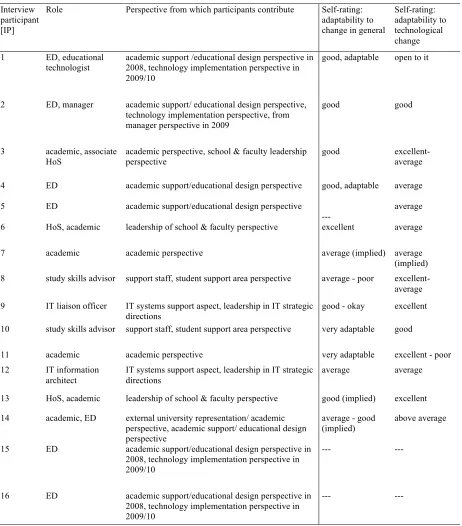
From June 2008 to January 2010 a series of structured interviews were conducted with staff from across the university. The interview participants were representative of a broad cross-section of staff who had been involved in the implementation and/or use of educational technology across the university. A summary of the interview participants, their contribution and some key data is presented in Table 1. The focus of the interviews was to seek an insight into individual perceptions of the learning environment, how individuals adapt to change in general and to educational technology change more specifically. The interviews also explored aspects of educational management in order to identify issues which staff and students faced in their current learning environment and to determine effective strategies that could be used in the successful implementation and support of technology. The term interview participant [abbreviated to IP] has been used to capture the role of those who took part in the research and distinguishes them from other participants in the broader research study (Buchan, 2014).
participants who were not in formal leadership positions. Set 2 was used for academic and support staff in leadership positions. Sets 3a and 3b were used for follow-up interviews with targeted interview participants in academic leadership positions and took place approximately a year after the initial interview. Set 4 of the interview questions was asked of interview participants in the academic support area who had been heavily involved in the implementation of new online systems and other learning technology at the University over the preceding two years and, for some, prior to this.
[image:4.595.63.525.239.765.2]The interview transcriptions and other data sources were coded using NVivo software and then analysed. The interviews were transcribed before coding of other data began and a set of coded themes was developed for the interviews. Once the patterns had begun to emerge from the initial coding, selective coding was then used to identify core categories and to relate those to other categories to confirm and explain emerging relationships.
Table 1: Interview participants’ and their ratings of ability to adapt to change and technological change (adapted from Buchan, 2014)
Interview participant [IP]
Role Perspective from which participants contribute Self-rating: adaptability to change in general
Self-rating: adaptability to technological change
1 ED, educational
technologist academic support /educational design perspective in 2008, technology implementation perspective in 2009/10
good, adaptable open to it
2 ED, manager academic support/ educational design perspective, technology implementation perspective, from manager perspective in 2009
good good
3 academic, associate
HoS academic perspective, school & faculty leadership perspective good excellent-average
4 ED academic support/educational design perspective good, adaptable average
5 ED academic support/educational design perspective
--- average
6 HoS, academic leadership of school & faculty perspective excellent average
7 academic academic perspective average (implied) average (implied) 8 study skills advisor support staff, student support area perspective average - poor excellent-average
9 IT liaison officer IT systems support aspect, leadership in IT strategic
directions good - okay excellent
10 study skills advisor support staff, student support area perspective very adaptable good
11 academic academic perspective very adaptable excellent - poor 12 IT information
architect IT systems support aspect, leadership in IT strategic directions average average
13 HoS, academic leadership of school & faculty perspective good (implied) excellent
14 academic, ED external university representation/ academic perspective, academic support/ educational design perspective
average - good
(implied) above average
15 ED academic support/educational design perspective in 2008, technology implementation perspective in 2009/10
--- ---
16 ED academic support/educational design perspective in 2008, technology implementation perspective in 2009/10
Findings and discussion
Feedback from the interviews and the detailed observation during the study over a number of years revealed some very personal insights into people’s responses to institutional change. The guiding questions probed individual perspectives on change and technological change and frame the reporting of the findings.
Individuals’ personal understanding of, attitudes towards, and role in change
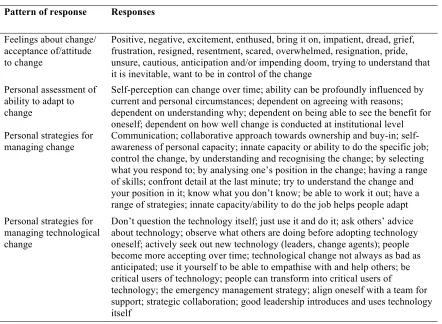
[image:5.595.73.515.228.552.2]At the individual level four distinct patterns of responses to change and adaptability emerged. A selection of those responses illustrating the range of individual attitudes and feelings towards change is presented in Table 2.
Table 2: Summary: Individual responses to change and strategies for managing change and technological change (Adapted from Buchan, 2014. p.208).
Pattern of response Responses
Feelings about change/ acceptance of/attitude to change
Positive, negative, excitement, enthused, bring it on, impatient, dread, grief, frustration, resigned, resentment, scared, overwhelmed, resignation, pride, unsure, cautious, anticipation and/or impending doom, trying to understand that it is inevitable, want to be in control of the change
Personal assessment of ability to adapt to change
Self-perception can change over time; ability can be profoundly influenced by current and personal circumstances; dependent on agreeing with reasons; dependent on understanding why; dependent on being able to see the benefit for oneself; dependent on how well change is conducted at institutional level Personal strategies for
managing change
Communication; collaborative approach towards ownership and buy-in; self-awareness of personal capacity; innate capacity or ability to do the specific job; control the change, by understanding and recognising the change; by selecting what you respond to; by analysing one’s position in the change; having a range of skills; confront detail at the last minute; try to understand the change and your position in it; know what you don’t know; be able to work it out; have a range of strategies; innate capacity/ability to do the job helps people adapt Personal strategies for
managing technological change
Don’t question the technology itself; just use it and do it; ask others’ advice about technology; observe what others are doing before adopting technology oneself; actively seek out new technology (leaders, change agents); people become more accepting over time; technological change not always as bad as anticipated; use it yourself to be able to empathise with and help others; be critical users of technology; people can transform into critical users of
technology; the emergency management strategy; align oneself with a team for support; strategic collaboration; good leadership introduces and uses technology itself
Personal understanding of change varied. Some participants demonstrated an in-depth understanding which drew on professional knowledge and experience to help the individual and to assist others to navigate change. Those with an in-depth understanding of change generally displayed a more positive attitude to change, although they could still be critical of change and did not necessarily agree it. However, a deeper understanding translated into solutions and developing approaches and processes to cope with and manage change. Of those change agents and leaders who participated, none described themselves as not feeling in control of the change. Those in leadership positions or in the role of change agents displayed a mix of positive and negative attitudes to change. Some people displayed a more surface view of change, usually associated with a perception of the change being something over which they had little control and that change was inherently problematic. This was generally associated with a negative attitude.
Some of the wide-ranging attitudes to change included:
Change is such a broad area. It depends on how well the change is conducted and whether the change is something which I agree with. I think that is the bottom line. When we have things imposed on us, which invariably happens…I am not good at adapting. [IP11]
change then I resist it actively.”
In contrast, a number of people suggested that they could accept change if they understood the reason for it.
Even if I do not agree with the reason, if at least I understand where it is coming from…I think the changes which are most difficult to deal with are those that are just dropped [on you] that you don’t know why, that you don’t appreciate where they are going with it or what the next steps are. [IP9]
Some people’s attitude to change, in particular technological change, was to approach it as a personal challenge. One leader noted:
I like to create new challenges for myself, students needed a change so we gave [the new approach to teaching] a go to do something different. We know it may not work perfectly but it was a good learning experience so embracing change in order to develop your own learning is a really good thing. [IP6]
The attitude of any one individual did not necessarily remain the same but was observed to change over time and according to the circumstances. In particular, towards the end of the study, which coincided with the end of a five year implementation of the new University Strategy, there was an observable perception of change overload across the case university. This appeared to translate into negativity and caution towards acceptance of new technology and new university initiatives, in particular amongst leaders and change agents in different areas.
In spite of apparent negativity about technological change, groups of individuals, such as school or work units, were observed to remain receptive to new technology if there was significant leadership and/or assistance from someone in the role of a change agent.
The ability of individuals to adapt to change in general
Interview questions asked participants to rate their own ability to adapt to change in general, and to technological change more specifically (see Buchan, 2014 Appendix 3, p.344) using the broad scale of; excellent, average, poor and other. The results of this are summarised in Table 1. The wide variety of personal strategies described for coping with and managing change and technological change are summarised in Table 2. The data has been grouped according to the patterns of responses that emerged from the data.
Those in leadership positions acknowledged a high level of personal adaptability and willingness to take on new technology and to deal with change. While some leaders admitted to actively seeking out new challenges and the associated change those challenges would bring, others indicated a tendency towards caution in dealing with change but that they were willing and able to step up to lead their staff through a period of change when needed.
Individuals’ self-perception contributed to an understanding of adaptability and approaches to change. The majority of interview participants rated themselves as being adaptable to change in general and technological change more specifically, although some were realistically cautious about their adaptability.
I have [written down] average for me. I could have almost underlined poor, but I think that would be a bit unfair to me actually, to underline poor, because I think I often initially have some resistance in my mind to change in general but I am aware of that and I work through it. [IP8]
I am not quick to jump and run [with change]. Sometimes I don’t even recognise it as change. I need to have a purpose for it [before using it]. I would say I’m average at adapting to change…It depends on the goal and the benefit of the change. [IP12]
My ability to adapt to that I suppose is interesting in that I am more often than not the agent of change not the recipient. So my adaptation to that, one would hope, is okay because I am more often than not the cause. [IP9]
number of factors. These factors included the total amount of change within the institution, personal issues as well as how the change was introduced and managed at the institutional level. In previous publications the author has extensively documented features and processes associated with management and transformation in institutional systems (Buchan, 2010b, 2011, 2012).
The ability and capacity of individuals to adapt to technological change
Individuals described a range of strategies which they used to manage technological change (see Table 2). Study participants who were conservative in their approach to change and to new things in general generally
demonstrated conservatism in their approach to technology (see Table 1). The data revealed some very personal insights into people’s responses to technological and institutional change as staff lived through a five year period of major institutional and technological change observed in the study. People’s feelings about,
acceptance of, and attitude to change and technological change varied from;; overwhelmed, resigned, wanting to be in control of the change to; excited, positive and ‘bring it on’ (see Table 2).
A unique ‘emergency management’ strategy emerged, apparently driven by pressures of lack of time to
adequately learn to use new systems. ‘You do what you have to and you find things [in the new LMS] when you have to rather than learning about them properly and doing them nice and systematically’ [IP7]. Strategic collaboration across institutions and aligning oneself with a team or broader support network for support was suggested by a self-confessed ‘non early adopter’ [IP14] as a way to improve one’s capacity to adapt to technological change and to improve change agents’ capacity with technology.
The innate capacity or professional skills/ability of an individual appeared to affect their ability to take on a particular change in role or requirement to take on a new task. The more capable professionals were observed to compensate for any faculty/unit disruption or disorganisation, brought about by changing processes and institutional restructures, by stretching their personal boundaries and taking their work to a different level. The long term sustainability of this approach, however, should be a concern for Management.
One of the most valuable findings in this study was that personal capacity to adapt to change is a conscious choice. One interview participant’s assessment of his ability to adapt to change gives an insight into the innate ability of individuals to adapt to change.
Excellent if I have to but poor if I don’t. It depends whether it is in my area or not. [IP11]
This is a sobering revelation for change agents, but a valuable insight into attitudes to institutional change and the potential success of the adoption of new technology and diffusion of innovation. This insight supports prior research into individual technology adoption processes (Straub, 2009). The findings are also supported by research into innovation from the field of sociology where it is noted that: ‘Moreover, in some cases, a minority of extremists can have a very important impact on the propagation [of innovation] by polarizing the social value’ (Guillaume Deffuant, Sylvie Huet, & Frédéric Amblard, 2005, p. 1041).
The data discourse included references to adaptability, adaptation and coping and the interview participants used these interchangeably when responding to the questions. The environmental research literature makes a distinction between the human abilities of adaptability and coping in response to changing environmental and social conditions. The distinction between the two appears to be in the temporal dimension. There is a suggestion that adaptation is a longer term measure, whilst coping reflects a short term strategy (Thomas, Twyman, Osbahr, & Hewitson, 2007). Humans use both short and long term measures. For long term institutional success, supporting processes that generate adaptability, rather than relying on innate coping abilities of individuals, will lead to a more sustainable, long term outcome.
What was clear from the research was that after experiencing major changes in the organisation and the introduction of a number of new systems, users were no longer complacent about the quality of technology. They demanded workable systems and the constant implementation of new systems on the back of each other, meant that if prior experiences were not positive then it became more challenging to get acceptance of new systems.
It also has a down side where users become (hopefully constructively) critical of organisation’s efforts around learning technology (sometimes merited).
The institutional contribution to the adaptability of the individual
Individual adaptability and ability to manage change in general and also technological change were shown to be influenced by a number of institutional factors. These factors fell broadly into three areas: 1) Institutional strategies which assist individuals with managing change; 2) Institutional strategies for managing
technological change; and 3) Perceptions/personal assessment of institutional approaches to managing change. A detailed list of strategies is described in the original research (Buchan, 2014, p. 220).
A person’s role in the university with respect to change and the individual’s acceptance of this role appeared to have some correlation with their attitude to change in general and technological change. Where a formal part of a person’s role was to initiate and/or help implement change in some way, people appeared to have embraced the role. The leaders generally accepted their (changing) roles but admitted to having to work hard to be in a position to help others through times of change. Most participants acknowledged some degree of personal responsibility for accepting or acknowledging change even if only between themselves and their students. Where an individual’s role had changed significantly from the original role for which they had been employed, and the role now included responsibility for assisting others through periods of change, there was a degree of resistance and confusion.
Change in one area of the university affected change in another. At the interface of one area of the organisation with another, such as a service division working with a faculty, the impact of change in one area was felt as a disruption in the other area. This in turn flowed on to affect the individual acceptance of technological change.
The data provided a rich source of evidence around appropriate institutional approaches to professional development and support. For change agents such as academic developers, educational designers, and those in leadership positions, some key attributes that were identified as contributing to their adaptability to
technological change included; having the right emotional intelligence, being prepared to learn throughout one’s professional life and being able to synthesise information well. This has implications for managerial decisions around effective professional development, learning and teaching support services and for change agents’ personal choice of strategies. The findings from this research support and extend early work around approaches to staff development (Collom, Dallas, Jong, & Obexer, 2002).
Leadership in the institution emerged as an important part of the change management process and there was a certain degree of faith or expectation, from those depending on the leadership that the leader could deliver. This put pressure on individual leaders to step up to the responsibility. Teamwork and team building was also an important institutional focus during the time period of the study (Bryant, 2008).
The study examined the changes in the institutional system during a transitional period when an online subject outline management system was introduced to replace the production of print copies of subject outlines. During this period policy, processes, people and technology were all changing simultaneously (Buchan, 2010b) . At the institutional level having robust processes and good systems of communication for manually carrying out administrative functions (using minimal technology) appeared to translate into better adaptation to the same functions when carried out using new technology. This supports the notion that facilitating technology adoption needs to address cognitive, emotional, and contextual concerns (Straub, 2009).
Conclusion
This research has developed an original perspective on the adoption of change and innovation. Drawing on the insights gained from the research, the author now challenges some of the rhetoric associated with change management, the adoption of technology and the diffusion of innovation.
Rhetoric – “[Institutional] change management is the application of a structured process and tools to enable individuals or groups to transition from a current state to a future state, such that a desired outcome is achieved” (Prosci, 2013).
Rhetoric – Users of new technology are normally distributed along a continuum of early adopters to late adopters and the measure of adoption is the time taken for an innovation to be adopted (Rogers, 2003).
The reality – Users cannot be normally distributed and there are confounding variables in any system which may impact on an individual’s capacity and the speed with which they can adopt a new technology. An apparently late adopter may simply have more change obstacles in their way, despite their willingness and capacity.
Rhetoric – Innovation can be diffused. Diffusion is the passive movement of molecules or particles
from regions of higher to regions of lower concentration (Biology-Online, 2008a). By association, during the diffusion of innovation the object being adopted has a passive role.
The reality – In today’s technology-rich, complex higher education system the adoption of technology is not a passive process. It is not as simple as the communication of the innovation amongst people in a particular environment. In any particular environment there are many different facets to the environment and individual characteristics which affect the communication and uptake of innovation.
The principle of osmosis may be more valuable than diffusion to describe technology innovation in today’s higher education environment. By definition, osmosis is the movement of solvent molecules (usually water) across a semi-permeable membrane from a region of low to a region of higher solute concentration (Biology-Online, 2008b). The higher the concentration of solute particles in the solution, the more solvent is drawn across the membrane.
[image:9.595.177.419.477.615.2]The Osmosis of Innovation is introduced in Figure 1. Innovation and new technology are represented by the solvent particles (Figure 1, A). The metaphor of a semi- or selectively-permeable barrier (i.e. membrane) (Figure 1, B) represents the adaptability, and thus personal capacity, of people to absorb change, innovation or new technology. Barrier ‘permeability’ is determined by a variety of personal strategies and attributes (see Tables 1 and 2). The solute particles (Particles C) - big molecules and small -in varying concentrations - represent those positive change and innovation factors in the environment into which the innovation/technology is being introduced. These positive change and innovation factors support an individual’s adaptability, and thus capacity, to adopt new technology. These factors are primarily the institutional strategies (see Institutional contributions above). By saturating an environment with positive factors a high concentration is created for the rapid ‘absorption’ or uptake of technology and innovation.
Figure 1: The Osmosis of Innovation. A. Innovation & technology, B. Semi-permeable barrier representing the adaptability of the individual that determine its capacity for absorbing innovation and
new technology, C. Positive institutional strategies which positively affect the uptake of innovation and technology.
factors (positive and negative) which can impact on individual and institutional uptake and use of technology within a constantly changing higher education environment.
References
Allison, D. H., De Blois, P. B., & Committee, E. C. I. (2008). Current Issues Survey Report, 2008. Educause Quarterly, 31(2), 14-30.
Bacsich, P., & Pepler, G. (2009). CAPITAL Horizon scan. Organisational change second report. In P. Bacsich (Ed.). Nottingham: University of Nottingham and Sero Consulting.
Bates, A. W., & Sangra, A. (2011). Managing technology in higher education. Strategies for transforming teaching and learning. San Francisco: Jossey-Bass.
Benson, R., & Palaskas, T. (2006). Introducing a new learning management system: An institutional case study. Australasian Journal of Educational Technology, 22(4), 548-567.
Biology-Online. (2008a). Diffusion. Retrieved from http://www.biology-online.org/dictionary/Diffusion Biology-Online. (2008b). Osmosis. Retrieved from http://www.biology-online.org/dictionary/Osmosis
Bromage, A. (2006). The management of planned change. In L. Hunt, A. Bromage & B. Tomkinson (Eds.), The realities of change in higher education (pp. 1-14). New York: Routledge.
Bryant, H. (2008). A structured approach to workplace productivity, renewal and reform - investing in our people, processes and knowledge. Retrieved from
http://www.csu.edu.au/__data/assets/pdf_file/0007/51919/HEDY-poster-small.pdf
Buchan, J. (2010a). Developing a dynamic and responsive online learning environment: A case study of a large Australian university. International JOurnal of Open Source Software and Processes, 2(1), 32-48.
Buchan, J. (2010b). Putting ourselves in the big picture: A sustainable approach to project management for e-learning. Journal of Distance Education, 24(1), 55-75.
Buchan, J. (2011). The chicken or the egg? Investigating the transformational impact of learning technology. Research in Learning Technology, 19(2), 155-172.
Buchan, J. (2012). Sustaining new approaches to learning and teaching with technology - more than just a Wicked Problem. Paper presented at the ascilite 2012 Conference. Future challenges, sustainable futures, Wellington, NZ.
http://www.ascilite.org.au/conferences/wellington12/2012/images/custom/buchan%2c_janet_-_sustaining.pdf
Buchan, J. (2013). The changing nature of learning and teaching at Charles Sturt University 2008-2011. A paper commissioned for Childs, M., Brown, M., Keppell, M., Nicholas, Z., Hunter, C. & Hard, N. (2012). In M. Childs, Brown, M., Keppell, M., Nicholas, Z., Hunter, C. & Hard, N. (Ed.), Learning leadership in Higher Education: the big and small actions of many people. (pp. 75-77). Armidale: DEHUB.
Buchan, J. (2014). Developing resilience and managing change in technology-enhanced learning environments. (Doctor of Philosophy), University of Southern Queensland, Toowoomba. Retrieved from
http://eprints.usq.edu.au/25684/
Collom, G., Dallas, A., Jong, R., & Obexer, R. (2002). Six months in a leaky boat: framing the knowledge and skills needed to teach well online. Paper presented at the Proceedings ascilite 2002, December 8-11, Auckland. http://www.ascilite.org.au/conferences/auckland02/proceedings/papers/181.pdf
Conole, G. (2013). Designing for learning in an open world. London: Springer Science+Business Media. Gill, L., & Dalgarno, B. (2010). How does pre-service teacher preparedness to use ICTs for learning and
teaching develop during the first two years of teacher training? Paper presented at the Curriculum, technology & transformation for an unknown future. Proceedings ascilite Sydney 2010, Sydney. http://ascilite.org.au/conferences/sydney10/procs/Gill-full.pdf
Guillaume Deffuant, Sylvie Huet, & Frédéric Amblard. (2005). An Individual-‐Based Model of Innovation Diffusion Mixing Social Value and Individual Benefit. American Journal of Sociology, 110(4), 1041-1069. doi: 10.1086/430220
Ingerman, B. L., Yang, C., & 2010 EDUCAUSE Current Issues Committee. (2010, May/June). Top-ten IT issues, 2010. Educause Review, 45, 4-60.
JISC InfoNet. (2013). Infokit. Change management: JISC Infonet.
Kotter, J. P., & Cohen, D. S. (Eds.). (2002). The heart of change. Boston: Harvard Business School Press. Pasian, B. L., & Woodill, G. (Eds.). (2006). Plan to learn: case studies in elearning project management:
Canadian eLearning Enterprise Alliance,.
Prosci. (2013). Change management. Definition. Retrieved from http://www.prosci.com/main/change_definition.html
Transforming higher education through technology-enhanced learning (pp. 58-71). Heslington, York, UK: Higher Education Academy.
Rogers, E. M. (2003). Diffusion of innovation (5th ed.). New York: Free Press.
Seale, J. (Ed.). (2007). Approaches to Developing Accessible Learning Experiences: Conceptualising best practice. Oxon, UK: Routledge.
Straub, E. T. (2009). Understanding Technology Adoption: Theory and Future Directions for Informal Learning. Review of Educational Research, 79(2), 625-649. doi: 10.2307/40469051
Thomas, D. S. G., Twyman, C., Osbahr, H., & Hewitson, B. (2007). Adaptation to climate change and
variability: farmer responses to intra-seasonal precipitation trends in South Africa. Climatic Change, 83(3), 301-322.
Tinkler, J., Uys, P., Dalgarno, B., Carlson, L., & Crampton, A. (2012). A 2010 snapshot of educational technology use by CSU students. Paper presented at the ascilite 2012 Conference. Future challenges, sustainable futures, Wellington, NZ. http://www.ascilite2012.org/images/custom/tinkler,_jacqueline_-_a_2010.pdf
Uys, P. (2010). Implementing an open source learning management system: A critical analysis of change strategies. Australiasian Journal of Educational Technology, 26(7), 980-995.
Walker, B., Gunderson, L. H., Kinzig, A., Folke, C., Carpenter, S. R., & Schultz, L. (2006). A handful of heuristics and some propositions for understanding resilience in social-ecological systems. In B. Walker, A. Anderies, A. Kinzig & P. Ryan (Eds.), Exploring resilience in social-ecological systems. Melbourne: CSIRO Publishing.
Weller, M., & Anderson, T. (2013). Digital resilience in higher education. European Journal of Open, Distance and E-Learning, Online.
Please cite as: Buchan, J. (2014). Adopt or adapt? The rhetoric and reality of the diffusion of innovation in changing, technology-enhanced learning environments. In B. Hegarty, J. McDonald, & S.-K. Loke (Eds.), Rhetoric and Reality: Critical perspectives on educational technology. Proceedings ascilite Dunedin 2014 (pp. 99-109).
Note: All published papers are refereed, having undergone a double-blind peer-review process.