CONfERENCE
PROCEED\ NGS
VOLUME 26
'964
fALL jO\Nl
The ideas and opinions expressed herein are solely those of the authors and are not necessarily representative of or endorsed by the 1964 Fall Joint Cf)mputer Conference Committee or the American Federation of Information Processing Societies.
Library of Congress Catalog Card Number: 55-44701
Copyright
©
1964 by American Federation of Information Processing Societies, P. O. Box 1196, Santa Monica, California. Printed in the United States of America. All rights reserved. This book or parts thereof, may not be reproduced in any form without permission of the publishers.Sole Distributors in Great Britain, the British Commonwealth and the Continent of Europe:
CLEAVER-HUME PRESS 10-15 St. M~irtins Street
London W. C. 2
Preface
PROGRAMMING TECHNIQUES AND SYSTEMS CPSS-A Common Programming Support System Error Correction in CORC
The Compilation of Natural Language Text into Teaching Machine Programs
Method of Control for Re-Entrant Routines XPOP: A Meta-Language Without Metaphysics
EXPANSION OF FUNCTION MEMORIES A 10Mc NDRO BIAX Memory of 1024 Word,
48 Bit per Word Capacity
Associative Memory System Implementation and Characteristics
2Mc, Magnetic Thin Film Memory
A Semi-Permanent Memory Utilizing Correlation Addressing A lOu Bit High Speed Ferrite Memory
System-Design and Operation
NEW COMPUTER ORGANIZATIONS An Associative Processor
A Hardware Integrated General Purpose Computer/Search Memory
A Bit-Access Computer in a Communication System
Very High Speed and Serial-Parallel Computers HITAC 5020 and 5020E IBM System 360 Engineering
iii
Page
D. BORETA 1 D. N. FREEMAN 15
L. E. UHR 35 G. P. BERGIN 45
M. 1. HALPERN 57
W. 1. PYLE 69 R. M. MACINTYRE
T. E. CHAVANNES
J. E. McATEER 81
J. A. CAPOBIANCO R. L.·KoPPEL
E. E. BITTMANN 93 G. G. PICK 107 H. AMEMIYA 123 T. R. MAYHEW
R. L. PRYOR
R. G. EWING 147 P. M. DAVIES
R. G. GALL 159
E. U. COHLER 175 H. RUBINSTEIN
K. MURATA 187 K. NAKAZAWA
J. L. BROWN 205 P. FAGG
D. T.·DoODY
J. W. FAIRCLOUGH
J. GREENE
MANAGEMENT APPLICATIONS OF SIMULATION UNISIM-A Simulation Program for
Communications Networks
The Data Processing System Simulator (DPSS)
The Use of a Job Shop Simulator in the Generation of Production Schedules
DIGITAL SOFTWARE FOR ANALOG COMPUTATION HYTRAN-A Software System to Aid the Analog
Programmer
PACTOLUS-A Digital Analog Simulator Program for the IBM 1620
MIDAS-How It Works and How It's Worked
INPUT AND OUTPUT OF GRAPHICS The RAND Tablet: A Man-machine Communication
Device
A System for Automatic Recognition of Handwritten Words
A Laboratory for the Study of Graphical Man-Machine Communication
Operational Software in a Disc-Oriented System
Image Processing Hardware for a Man-Machine Graphical Communication System
Input/Output Software Capability for a Man-Machine Communication and Image Processing System
A Line Scanning System Controlled from an On-Line Console
MASS MEMORY
A Random Access Disk File with Interchangeable Disk Kits
The Integrated Data Store-A General Purpose Programming System for Random Access Memories
The IBM Hypertape System
Design Considerations of a Random Access Information Storage Device Using Magnetic Tape Loops
iv
L. A. GIMPELSON J. H. WEBER D. D. RUDIE M. 1. YOUCHAH E. J. JOHNSON D. R. TRILLING
W. OCKER S. TEGER
R.
D. BRENNAN H. SANOH. E. PETERSEN
F. J. SANSOM R. T. HARNETT L. M. WARSHAWSKY
M. R. DAVIS T. O. ELLIS P. MERMELSTEIN M. EDEN E. L. JACKS
M. P. COLE P. H. DORN C. R. LEWIS B. HARGREAVES J. D. JOYCE G. L. COLE
E. D. Foss
R. G. GRAY R. A. THORPE E. M. SHARP R. J. SIPPEL T. M. SPELLMAN T. R. ALLEN J. E. FOOTE
F. N. KRULL J. E. FOOTE
E. C. SIMMONS
C. W. BACKMAN S. B. WILLIAMS
B. E. CUNNINGHAM A. GABOR J. T. BARANY L. G. METZGER
E. POUMAKIS
Page
233
251
277
291
299
313
325
333
343
351
363
387
397
411
The Time-Sharing Monitor System
JOSS: A Designer's View of an Experimental On-Line Computing System
Consequent Procedures in Conventional Computers COMPUTATIONS IN SPACE PROGRAMS The Jet Propulsion Laboratory Ephemeris Tape System JPTRAJ (The New JPL Trajectory Monitor)
ACE-S/C Acceptance Checkout Equipment Saturn V Launch Vehicle Digital Computer and
Data Adapter
The 4102-S Space Track Program
HYBRID/ANALOG COMPUTATION-METHODS AND TECHNIQUES
A Hybrid Computer for Adaptive Nonlinear Process Identification
The Negative Gradient Method Extended to the
Computer Programming of Simultaneous Systems of Differential and Finite Equations
Quantizing and Sampling Errors in Hybrid Computation NON-NUMERICAL INFORMATION PROCESSING Real-Time Recognition of Hand-Drawn Characters A Computer Program Which "Understands" A Question-Answering System for High School
Algebra Word Problems
The Unit Preference Strategy in Theorem Proving Comments on Learning and Adaptive Machines
for Pattern Classification
HARDWARE DESIGNS AND DESIGN TECHNIQUES FLODAC-A Pure Fluid Digital Computer
Design Automation Utilizing a Modified Polish Notation
Systematic Design of Cryotron Logic Circuits
Binary-Compatible Signed-Digit Arithmetic HYBRID/ANALOG
COMPUTATION-APPLICATIONS AND HARDWARE A Transfluxor Analog Memory Using Frequency
Modulation
The Use of a Portable Analog Computer for Process Identification, Calculation and Control
Progress of Hybrid Computation at United Aircraft Research Laboratories
A Strobed Analog Data Digitizer with Paper Tape Output
Hybrid Simulation of Lifting Re-Entry Vehicle
v
HOLLIS A. KINSLOW 443 J. C. SHAW 455
D. R. FITZWATER 465 E.J. SCHWEPPE
E. G. OROZCO 477 N. S. NEWHALL 481 R. W. LANZKRON 489 M. M. DICKINSON 501
J.B.JACKSON G. C. RANDA
E. G. GARNER 517 J.OSEAS
B. W. NUTTING 527 R. J. Roy A. I. TALKIN 539
C. R. WALLI 544
W. TEITEL MAN 559 B. RAPHAEL 577 D. G. BOBROW 591
L. Wos 615 D. CARSON
G. ROBINSON
C. H. MAYS 623
R.S.GLUSKIN ff31 M. JACOBY
T. D. READER
W. K. ORR 643 J. M. SPITZE
C. C. YANG 651 J.T.Tou
A. A VIZIENIS 663
W. J. KARPLUS J. A. HOWARD L. H. FRICKE R.A. WALSH G. A. PAQUETTE
R. L. CARBREY
A. A. FREDERICKSON, JR. R. B. BAILEY A. SAINT-PAUL
673
685
695
707
CPSS
A COMMON PROGRAMMING SUPPORT SYSTEM
Dushan Boreta
System Development Corporation, Falls Church, Virginia
INTRODUCTION
Over the years many computer software sys-tems have been developed to serve the program production process. These systems, variously known as "production" systems, "utility" sys-tems, or "support" syssys-tems, are designed and
produced for the same purpose: to provide
pro-grammers the tools required to produce com-puter programs. Beyond this common purpose
these systems have little in common and, in fact, are unique systems individually tailored to a particular application. In each system much of the tailoring occurs because of the par-ticular computer configuraton, operational sys-tem support requirements, computer manufac-turer's software characteristics, experience of the designers, schedule pressures, and style preferences of the programmers producing the system. The tailoring is reflected in the design of each program production system and is evi-dent. in many features, for example, the pro-gramming languages used, the computer oper-ating procedures, the programmer's inputs, the outputs provided to the programmer, and the program organization in the system.
In examining program production systems, most are found to have functional capabilities for generating code, code-checking the object programs, and maintaining magnetic tapes con-taining programs.
In some instances these capabilities are of the most rudimentary sort. In other instances, very sophisticated and complete capabilities exist.
1
What this paper describes is a program duction system, CPSS, that should assist pro-grammers and managers in the performance of their tasks. The principle characteristics of CPSS provide for programmers an efficient and effective means for producing their programs. For managers, CPSS provides for the minimi-zation of costs for producing programs, and a relatively inexpensive means for achieving an effective and efficient program production capa-bility.
The CPSS characteristics that make' these claims a reality are: first, it provides to pro-grammers the attributes of higher order lan-guages in each program production task; sec-ond, that both the functions of CPSS and its computer programs largely are transferable; and third, the totality of functions of a com-prehensive program production system is pro-vided in CPSS. Further, the design features embodied in CPSS should afford the minimiza-tion of its maintenance costs, reducminimiza-tion in the possibility of programmer errors, and simplifi-cation of the programming task itself.
Additionally, the design of CPSS provides for its "common" applicability. It may be used in "open-" or "closed-shop" operations in sup-porting the development and production of sys-tem, non-syssys-tem, and "one-shot" programs.
Effectively, its design characteristics, lan-guage power, scope of applicability, and
trans-ferability make CPSS an off -the-shelf program
CPSS is programmed in a subset of the JO-VIAL language, and in design is compatible with the full JOVIAL language. Currently, CPSS is implemented on an IBM 7090 and is being used to support the development and pro-duction of a computer program system. This installation and continued testing will be the source for refinements to CPSS's design as the system continue& under development.
CPSS DESIGN CRITERIA AND REQUIREMENTS
Providing "off-the-shelf" capability is a dif-ferent type of programming problem than nor-mally is encountered. The problems in providing CPSS with the "off-the-shelf" capability stem from the class of computers on which it may be installed; the nature of the transferability task; some aspects of the programmer training tasks; the CPSS maintenance task; the pro-gramming language it provides; and the scope of its applicability to the operational system development process.
Class of Computers
CPSS is directly applicable to medium- and large-scale computers. The computer configu-ration should have, but need not be restricted to, a word size of 30 bits, a 32K one-instruction-per-word or a 16K two-instruction-one-instruction-per-word core memory, peripheral storage units consist-ing of four tape drives (or three tape drives plus drum or disc units), an on-line printing device, an on-line input device, and some ex-ternal switches or keys.
The computer configuration need not be de-fined explicitly in that there are many possible trade-offs between the computer's characteris-tics, the programming conventions and tech-niques used in CPSS, and the capacity of the system. For example, by altering the labeling convention used in the coding of CPSS~ the class of computers could be expanded to include machines with a word size of 24 bits.
The Transferability Task
The transferability of a program production system is important for many reasons. The cost of installing a program production system is minimized. For applications employing a va-riety of computers, there is a standard system
and methodology that contributes to program-mer transferability. The difficulties and costs inherent in the transition from one computer to another are reduced. And, a bench mark is identifiable from which further technology de-velopment may progress.
The goal, transferability of programs, usually is interpreted as requiring a program coded and operating on one computer to be operable on a different computer and still retain the capability to perform its functions. The trans-fer should be completed at least semi-automati-cally, utilizing clerical or junior personnel and fixed procedures. The current state of the art does not afford 100 per cent transferability. Therefore, we have interpreted this goal to mean that CPSS is to be transferable with only a minimum of known code change. In order that CPSS be transferable, the functions and services provided by CPSS also must be trans-ferable. Additionally, the CPSS documentation, program and system tests, operating proce-dures, transferability techniques, and transfer procedures are designed to be transferable.
It must be emphasized that the transferabil-ity task being discussed is that of getting CPSS to run on another computer, different from its current application (the IBM 7090). CPSS is designed to be transferred as a system. Al-though it is modular, the transferability of any module is a distinctly different task from that of transferring the whole of CPSS.
One natural design feature of a transferable system is its independence from machine char-acteristics. It must be noted that machine in-dependence is a two-way street. Not only is the code of CPSS to be machine-independent, but the functions performed by the code also must be machine-independent. For example, pro-grams making transfers to and from storage should not assume some given unit availability, transfer rate, segmentation of the transferred data, unit positioning, or even that it is the only user of a unit. In CPSS, this example of ma-chine-independence (transferability) is pro-vided by a central I/O program in the CPSS Computer Operations Subsystem (the design of which is discussed later in this 'paper).
CPSS-A COMMON PROGRAMMING SUPPORT SYSTEM 3
across several computers. The system's trans-ferability could be measurable in several di-mensions, for example, in time elapsed from start to installation, in dollar costs for each economic factor involved in the transfer, in amounts and types of computer time required, in the amount of code to be altered per program and per function, and in the number of errors discovered in each phase, including installation and post-installation. Detailed records should be maintained that identify the transfer costs and the factors that influenced the cost. Some of these factors are: the differences in the ma-chine instruction word format and addressing, the types and quality of programs available on the "new" machine, the frequency of occurrence and amount of down-time per occurrence of machine failure, and the location and availabil-ity of the staging and target computers.
'/
Some of the principal technical problems that will arise in transferring CPSS to other com-puters lie in the sophistication of the design embodied in the system, the power of the lan-guage provided by the system, the systerriiza-tion of the CPSS design, and the broad class of computers to which CPSS may be applied. For example, consider the problem of designing CPSS so that it will operate on a four-tape drive computer configuration. The task of com-piling a JOVIAL program can use (1) an input device for the source program, (2) an input device for the library tape, (3) an input device for the system Compool, (4) a temporary stor-age device for the intermediate langustor-age, (5) a permanent storage device for the object pro-gram, (6) an output device for the listings, and
(7) an output device to communicate with the computer operator (as will be noted later, a compilation may require other additional "stor-age devices"). Further complicate the task and allow the programmer to generate a test case and operate his program on the test case, and allow all this to occur in an uninterrupted sin-gle job. This problem is resolved in the design of the CPSS executive and I/O functions (dis-cussed later in the paper). In essence, the I/O problem was resolved by constructing a central I/O program that provided machine-independ-ent I/O functions for the remainder of CPSS. The control problem was resolved by allowing p:ogrammers the freedom of directing CPSS
via control card inputs (functionally oriented to the program production tasks).
All the tasks related to transferability are not involved in subsequent transfers of CPSS. Consider the input card; once we have coded routines to accept floating-field cards and have levied no special format requirements on the card, the card input processing functions are totally independent of the machine. The in-formation processed from card inputs in one application need not appear on cards in another application but could be processed from other input media in a different input form, e.g.
punched paper tape or teletypewriter.
The methods employed in achieving trans-ferability, or machine-independence, vary de-pending on the function being performed in the program. Some of the more commonly applied techniques were: the parameterization of
cer-tain machine characteristics (word length, number of characters per print line, number of print lines per page, etc.) ; the establishment of programming conventions regarding the use of constants and tags; the use of floating-field card formats; and the use of "all-core" indexing to relocate data and to compute addresses. In many instances, special methods were required to achieve transferability. Some of these are discussed later in the paper during the discus-sions of the various CPSS subsystems.
Programmer Training
One of the principal benefits achieved by em-ploying a higher order language and requiring transferability in CPSS is in the potential re-duction of programmer training costs.
When a programmer is transferred from one application to another, a training or learning period is required to familiarize him with the particular computer and the program produc-tion system he will use. This retraining period varies from a week to a month-and-a-half or more. During this period a programmer's ef-fectiveness is almost nil; and thereafter, it is less than it should be until the programmer be-comes expert in the use of the "new" computer and system.
order language. If CPSS achieves a broad patronage, these costs are further reducible since CPSS is designed to reflect a stable form regarding its interfaces with the programmer. In effect, CPSS could become a means for
achieving some level of programmer
transfera-bility.
CPSS Maintenance
In producing CPSS, a primary concern has been maintenance costs. These costs are related to error correction, program improvement, aug-mentation of the system's capability, program and system documentation, and product release.
The design of CPSS provides for the minimi~a
tion of such costs by isolating, identifying and documenting the program- and system-type functions that comprise CPSS.
The system and program documentation are designed to facilitate the maintenance task. A CPSS program's documentation consists of a heavily commented program manuscript, a de-tailed flow chart, a functionally organized flow chart, a program description document contain-ing descriptions of data referenced, each rou-tine coded, each procedure used, the input data formats and structures, the output tables, items and messages, and the function served by the program. Another document describes each machine dependency contained in the program. Also, a system design document describes each program function and the interfaces between programs.
CPSS is designed and documented to facili-tate the maintenance task. Also, the system is capable of maintaining itself or of producing itself.
The Programming Language
Perhaps the most significant decision made in the CPSS project was the selection of a lan-guage for the programming of CPSS. The de-sign of each function contained in a program production system is influenced by the language provided by the system. Therefore, certain de-sign features are required to assure that the program production system is capable of re-sponding to the operational system's program-ming needs. In a sense, a transferable program production system must be "overdesigned". The design must reflect the current capability of the
language being provided, and also needs to pro-vide for logical extensions of the language. Con-sider the situation that exists with CPSS.
There are three levels of JOVIAL represented in CPSS which form a hierarchy of language that is upward compatible in language power and in the language processing algorithms. The formal JOVIAL, J-3, is subset into two levels: J-S, being a subset of J-3; and J-X, being a subset of J-S. The program generation subsys-tem is coded in J-X and processes programs that are written in J-S. All other subsystems are coded in J-S and perform their functions compatibly with J-3.
The decision range as to which level of lan-guage capability is to be provided in the pro-gram production system is bounded on the upper end by the formal definition of the pro-gramming language, and on the lower end by the language capability provided by the pro-gram generation subsystem.
In the program generation subsystem, the language capability to be provided is influenced by such factors as the subsequent use of the language, the design of the compiler, the level of transferability desired, and the expected characteristics of existing languages and com-pilers having the same generic name.
Other factors influencing the decision in CPSS were the transferring procedures and techniques, the testing techniques established to test the system, and the availability of com-puters with JOVIAL compilers.
CPSS-Scope of Applicability
CPSS serves programmers and managers in their performance of several tasks related to
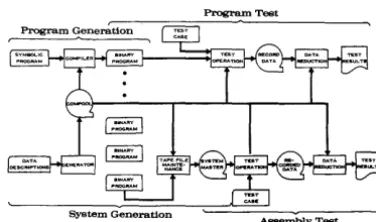
the system development process. Figure 1.
shows a simplified representation of the system development process that has beeen employed for several systems, both large and small. The scope of CPSS is indicated by its applicability to the program production process, which en-compasses parts of the program design,
pro-gram genera~ion, program test, and assembly
test stages.
CPSS-A COMMON PROGRAMMING SUPPORT SYSTEM 5
r - -. - -
PROGRAM PRODUCTION PROCESS- - - - ,PROGRAM PROGRAM ASSEMBLY
I
SYSTEMTEST
SYSTEM OPERATION SYSTEM
DEFINITION
SYSTEM DESIGN
PROGRAM
DESIGN
I
GENERATION TEST TESTI
DEFINE ESTABLISH
I
CODE AND TESTI
OPERATIONAL PROGRAM INDIVIDUAL
MISSION SYSTEM
I
TRANSLATE PROGRAMSDESIGN CODE CHECKING
REQUIREMENT
(OP SPECS) PROGRAMS PARAMETER
I
r
--t--
·w
1
TEST) PROGItAM1
,
INTEGRATIONAND ASSEMLY
SYSTEM ESTABLISH
~
ESTABLISH TEST TURNOY1[R ANDDETERMINE OPERATIONAL DATA BASE DESIGN PRODUCE
--,-
J€}
PERFORMANCE~ ~ INDIVIDUAL
...
rr
SYSTEM SYSTEM DESIGN
PROGRAM ASSEM.LY _ ,.TEST IN THE
REQUIREMENT DESCRIPTIDN AND DATA TESTS TESTS OPERATIONAL
(05D)
I
ACQUISITION MISSION1
1
,
~-~l·-·
-
.J PRODUCEr
SYSTEMI
TESTS,I
ESTABLISH
I
I
DESIGN DESIGNI
DESIGNPROGRAM INDIVIDUAL ASSEM.LY SYSTEM
SYSTEM
II
PROORAMS TESTSREQUIREMENTS
I
I
TESTSII
[image:10.618.207.395.590.701.2]L ___________ ---I
Figure 1. Program Production Process in the System Development ProGess
the production system are designed to assist programmers and managers in their perform-ance of these four tasks: program generation, program test, system· generation, and assembly test.
The principal product derived from the gram production process is the operational pro-gram system master tape. Other products are a system data dictionary (referred to as a Compool) with its documentation and listings, the program system documents, listings, test plans, and test results, and the programs that comprise the program system with their docu-ments, listings, test plans, and test results.
A maj or task, related to the system genera-tion task, is the acquisigenera-tion and management of a data base. This paper will not delve into the data base tasks except where such tasks di-rectly interface with the program production system.
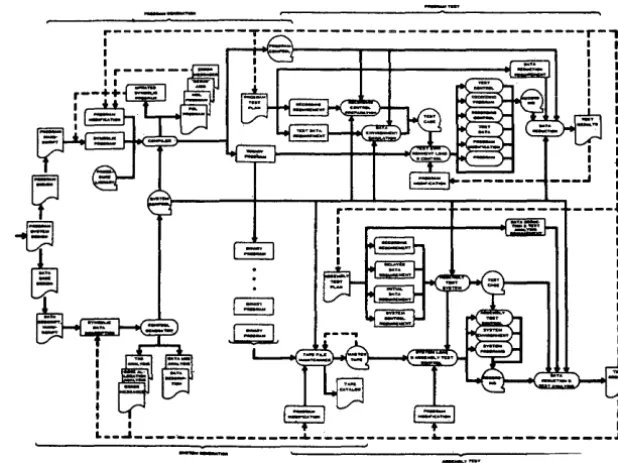
Figure 3. depicts the information and data flow provided for in CPSS. The flow of data
between the various functions is automatic. The execution of the functions is controlled by the programmer. The four program production tasks, program generation, program test, sys-tem generation, and assembly test are served by this data and information flow.
The preceding figures, ,Figure 1., Figure 2., and Figure 3., depict the scope of applicability for CPSS in the system development process.
Program Generation. The programmer, em-ploying the JOVIAL language, encodes a pro-gram to satisfy the propro-gram design specifica-tions. The code, the symbolic programming language statements (the source program), is input to the compiler which translates the code into machine instructions. During the compila-tion, the source program is appropriately aug-mented by routines from the procedure library tape and by system data descriptions from the Compool.
The principal output from the compiler is a binary program (object program). The re~
r---T---=---r-'
I I I
I I
I I
I r--- - I
I I I
r--++ I
I I
I
I
I I I I I I
I
I I I
L __ ..J, _ _ _ _ ... _ _ _ _ _ _ _ _ _ _ _ • _ _ _ _ _ _ _ _ _ _ _ ~ _ _ _ _ _ _ _ _ _ _ _ _ _ _ _ .I
Figure 3. Program Production Process, Information and Data Flow
mainder of the outputs provide information to the programmer (and to other parts of CPSS) that facilitate the testing and correction of the program. The process of compilation in the early phases of program coding sometimes is referred to as "grammar-checking"-where the result of the grammar-checking is a "good" pro-gram; that is, one that is syntactically correct.
Program Test. In order to test a program-that is, validate program-that the program performs its functions correctly-the programmer must de-fine a test case. A test case is comprised of a simulated data environment for the program, recording controls to retrive .data from the pro-gram's environment, and any program modifi-cations required to correct the program as shown by previous tests.
The test Gase is input to CPSS which trans-lates the programmer's inputs into a test en-vironment. When requested, CPSS loads the test environment and the object program into the computer for operation. During the opera-tion of the test, data is recorded as requested by the programmer in the test case. After the operation of the test, the recorded data is proc-essed to provide, as outputs, the hard copy test results.
CPSS appropriately interprets data descrip-tions from the program Compool or the system
Compool to translate the test case inputs and process the recorded data. Essentially, the sys-tem Compool and the program Compool are the significant means through which CPSS affords the programmer the ability to test a program at a language level comparable to a higher order programming language.
This loop, the program test phase, is repeated for as many test cases as are required to satisfy that the program performs its functions cor-rectly.
The two tasks discussed so far, program gen-eration and program test, are common to all program production processes-whether the programs are system programs or independent programs. In this light, the applicability of CPSS is extended to include both system and non-system programming tasks.
[image:11.617.137.446.62.293.2]CPSS-A COMMON PROGRAMMING SUPPORT SYSTEM 7
data organizations, some commentary related to the reasons why the data exists in the system, and a description of the usage of the data. The second form is a binary tape containing infmation describing data structures, and data or-ganizations. The binary Compool, in some cases
(including CPSS) , contains information that is usable in the constructing of the Compool docu-ment. The program production system itself is a principal user of the binary Compool in that it retrieves data descriptions from the Compool during the various phases of the program pro-duction process.
The Compool, being a central collecting point for system data descriptions, serves as an in-tegrating device in the program production process. In this manner the Compool provides to program system managers a means for con-trolling a system's data environment.
CPSS provides both for the building of the binary Compool and for the Compool documen-tation. A programmer employing the appro-priate data descriptors, encodes data descrip-tion statements that des c rib e the data comprising the data base. These statements are interpreted by the Compool generator which produces a binary Compool. Other outputs pro-vided by CPSS are quality analysis aids, and data description listings.
The tape file maintenance function provides the means for building tapes containing pro-grams. Further, the function provides for modi-fying, correcting, cataloguing, and in general maintaining computer tapes.
Assembly Test. The assembly test task, func-tionally, is similar to the program test task. The purpose of the assembly test task is to pro-vide a means for testing a complex of programs that form a system or a logical subset of a sys-tem. In other words, the purpose served in as-sembly testing is to validate that a complex of programs acting in concert perform a system function correctly. Assembly testing can be thought of as a hierarchy of testing-ranging from simple program interface tests to complex full system tests.
Figure 3. depicts an assembly test as being performed in a controlled environment. The system control parameters, initializing data, simulated inputs, and recording controls are
prepared as a test case via an assembly test sys-tem. The test case is run against the appropri-ate complex of programs during which record ing is performed. A'fter operation on the test case, the recorded data is processed via a data reduction and test analysis subsystem which provides the hard copy test results. This loop, assembly testing, is performed for as many test cases and test levels as are required to validate that the program system performs its functions correctly.
Although CPSS is not designed explicitly to serve the assembly test task, it does contain programs that are usable in an assembly test system; for example, the data recording, data reduction, and data generation programs. With very minor modifications to the test environ-ment load and data reduction programs, CPSS further could be used to provide a very sophisti-cated string test (program interface test) capa-bility.
The reason for not explicitly providing an assembly test capability in CPSS is that the higher' levels of assembly testing usually re-quire programs that reflect the design of the operational program.system-(such as height reply message simulators, and radar correla-tion analysis programs) .
CPSS PROGRAM DESIGN
are program-type or system-type functions, which are organized as 22 major programs, 35 library procedures, 10 common executive en-tries, 25 system tables with 330 items, and 53 parameter items. The size of CPSS is approxi-mately 20,000 JOVIAL statements that result in approximately 65,000 IBM 7090 machine in-structions.
Program Generation Subsystem
The program generation function is provided in CPSS by the JOVIAL language and a JOV-IAL compiler. With the development of CPSS, a powerful and comprehensive subset of the JOVIAL language was developed that should be sufficient to produce most computer software systems. This subset, the JOVIAL core-subset language, J-S, is the language employed in the programming of CPSS. The power of J -S is demonstrated by the fact that the programming of CPSS did not require the totality of J -So
The principle reasons for developing J-S, and the goals achieved by this development were:
(1) The definition of a "comprehensive mini-mum" JOVIAL language that is suffici-ent for producing most computer pro-gram systems.
(2) The definition of a JOVIAL subset lan-guage that affords the production of transferable programs.
(3) The design, development, and production of a JOVIAL compiler that can be pro-duced on shorter schedules than more comprehensive J-3 compilers.
( 4) The improvement of the language proc-essing speed of a JOVIAL compiler. (5) The retention of the significant language
and compiler features normally expected of JOVIAL, for example: Compool sen-sitivity, procedure library capability, partitioning of programs into procedures and closed routines, memory allocation, packing of items into tables, processing of packed data, grammar checking, sub-scripting and indexing, bit and byte addressing, machine assembly language coding, logical and arithmetic opera-tions, and program "debug" listings and aids.
In general, the differences between the J-S and J-3 languages should be more than offset by the improvements in the compiler design and its compatibility to CPSS. It should be noted that J-S is a proper subset of JOVIAL, i.e., that the programs coded in J-S are legal and valid inputs to J-3.
Some of the significant design features of the J-S compiler are:
(a) The J-S compiler is a "two-pass" com-piler. That is, a program is processed twice to produce a binary output. First, in the JOVIAL language form; and sec-ond, in an intermediate language form. The principal result of having only two passes is that compiling speed has been significantly increased.
(b) The J-S compiler provides an "alter-mode" of recompilation. That is, the programmer can add modifications to the source program during compilation without altering the original source pro-gram. The compiler will produce an up-dated version of the source program as one of its selectable options.
(c) The J-S compiler produces a program Compool. That is, the J-S compiler pro-duces a Compool containing complete data descriptions of all data and labels referenced or declared by the program. The program Compool is usable inter-changeably with the system Compool throughout CPSS and is compatible in form and structure with the system Compool.
(d) The J-S compiler is capable of being expanded to incorporate additional lan-guage capability. The practical limita-tion on this expandability is the size of core memory.
Additionally, the programmer can select the outputs he wants, override the Compool, specify the Compool he wants used, and in general, ex-ercise those options that specifically control the
CPSS-A COMMON PROGRAMMING SUPPORT SYSTEM 9
Data Environment Simulation Subsystem The data environment simulation function is provided in CPSS by a computer program that processes data assignment statements. The program produces data records containing the programmer specified data, and control infor-mation that is used by the test environment load subsystem.
The programmer specifies his data environ-ment requireenviron-ments in a POL-type language. The program employs either a program Compool or a system Compool as selected by the program-mer. The programmer also may identify the data being produced, thereby affording future selective use of the data. The program is com-patible with the JOVIAL J-3 data forms and data structures.
The data itself can be coded as floating-point, fixed-point, integer, Hollerith, Standard Trans-mission Code, and status-variable, where such data is organized and structured as tables, items, strings, or arrays. Subscripting and in-dexing also is allowed.
The program allows the programmer to set values into any variable defined or referenced by his program if the program Compool is used. If a system Compool is used, the programmer may set values into any variable defined in the system Com pool. The program imposes no limits on the volume of data it processes. It
does perform legality checks on the program-mer's inputs to determine the compatibility of the inputs with the defined data environment. Data Recording Subsystem
The data recording function in CPSS is sep-arated into two parts, where the actual data recording is provided under the CPSS computer operation subsystem. The CPSS data recording preparation function is performed by a com-puter program that processes recording request statements. The program produces a data rec-ord containing control information for use by the computer operation subsystem, the test en-vironment load subsystem, and the data reduc-tion subsystem.
The programmer describes his recording re-quests in a fully symbolic language. The CPSS program employs either a program Compool or a system Compool as selected by the
program-mer. The programmer also may identify the recording that would be performed per his re-quests, thereby affording future selective use of the recording controls produced by the CPSS program.
The programmer may select the data to be recorded under any name defined in the pro-gram Compool or system Compool and/or any block of memory. The location in his program at which recording is to take place can be speci-fied symbolically (if a program Compool is se-lected) .
The programmer may request a memory register change survey, or dumps before, dur-ing, and/or after his program's operation. The dumps may be formatted as octal, machine lan-guage instructions, floating-point, and/or al-phameric.
Data Reduction Subsystem
The data reduction function is provided in CPSS by a SUbsystem of computer programs that process either CPSS recorded data or mis-cellaneous data formats. There are four general classes of printouts produced by CPSS: Com-pool-defined data, memory dumps, survey dumps, and tape dumps.
Compool-defined data is processed and ap-propriately formatted entirely dependent upon the Compool definition. CPSS interrogates either the system Compool or program Compool to determine the appropriate formatting. The information in a printout reflects the page num-ber, table name, recording identity, recording location, table size, entry number, data name, data type, the converted data, and a security classification.
Memory dump processing is performed in any of four formats: octal, machine language in-structions, floating-point, and/or alphameric. A printout contains the page number, security classification, recording location, recording identity, the beginning and ending locations of the dump, the contents of the addressable ma-chine registers, and the contents of the com-puter words dumped. The page formatting is determined by the program and is printed as four or eight words per print line.
dif-ference is that those memory locations which contain changed values are printed. The dumps to be compared are made by the CPSS record-ing program before and after the operation of a program in a test. A printout contains the page number, security classification, the record-ing identity, the beginnrecord-ing and endrecord-ing locations of the survey area, the contents of the addressa-ble machine registers in the "before" and "after" states, and a print-line for each changed computer word containing the address and both values.
In the tape dump function CPSS provides the means to print out any tape. The format of the printout is similar to the memory dump format, except that the addressable machine register print lines are not output.
The programmer can request that his data reduction be performed in either of three modes: recording, general, or binary.
The recording mode is used to process data recorded by CPSS. The programmer can select a subset of the data to be processed, or he can allow CPSS to process the data automatically per his recording requests. Processing selection is performed in exactly the same manner as specifying recording requests.
The binary mode is used to process tape dumps. The programmer can specify the "limits of processing" and the print formats (octal, floating-point, etc.). The limits of processing bounds the range of tape that is to be processed. The general mode is used as a mixture of the recording and binary modes. All the controls available to the programmer under these two modes are available under the general mode. Further, if a tape containing records similar to CPSS-type records is to be processed, the general mode may be used to reduce the data per Compool definitions even though the tape was not built by the CPSS recording program. Test Environment Load Subsystem
The test environment load function is pro-vided in CPSS by a computer program that loads a test case into the computer for opera-tion.
The CPSS test environment load subsystem provides for loading recording patches to a
pro-gram; loading a data environment; loading octal correctors to a program; and loading the program that is to be tested (currently, on the IBM 7090, CPSS is capable of loading and op-erating a 25,000 register test case).
Computer Operation Subsystem
The computer operation function is per-formed in CPSS by a subsystem of programs that provide for the uninterrupted operation of the computer.
The functions performed by the computer op-eration subsystem can be grouped into four classes: system control, operator communica-tion, test control, and I/O monitor.
System Control. The system control function provides for the continuous operation of CPSS. It interrogates programmer supplied control "cards" to determine which function (or sub-system) is required. The system operates on stacks of jobs (usually prestored on tape in the sequence desired) where each job may be com-prised of many dissimilar requests. For ex-ample, a job may be to compile a program, specify several sets of recording controls, specify several data environments, to load and execute the compiled program in various test environments, and to process the data recorded in the several program runs. The sequence of CPSS's operation is specified by the ordering of the programmer supplied control cards. In addition to the sequence control function, sys-tem control provides the normal control-type functions such as position tapes, clear core, job error recovery, loading of octals to cycling sys-tem programs, etc. Essentially, the syssys-tem pro-vides uninterrupted operation as long as there are jobs to be processed, and a test program does not loop or write into "permanent" core. Controls are provided through which the com-puter operator (or the programmer in one spe-cial case) may interrupt the computer's opera-tion.
sys-CPSS-A COMMON PROGRAMMING SUPPORT SYSTEM 11
tem's operation, as appropriate, in any of five ways, (1) skip forward in the job to the next control "card", (2) skip forward to the next job, (3) skip forward to a specified job, (4) reinitialize the system, or (5) continue from the point of interruption. Recovery may be per-formed automatically by CPSS as a result of the operator's request, or the operator manually may enter the system as he desires. While the system is interrupted, the operator. may reas-sign I/O units, list the I/O unit/file allocation, take dumps, position to a particular job, or per-form other similar tasks. The operator may perform his tasks in response to programmer-supplied instructions (as printed by CPSS or otherwise), messages printed by CPSS relating to the system's needs, or recognizable error conditions requiring his actions.
CPSS provides a method .for programmers to '/
"simulate" certain computer operator actions. They may specify I/O allocations, list the I/O unit/file allocations, or perform other operator type tasks. By the judicious use of control cards the programmer may "directly" communicate with the computer operator to effect the job desired.
Program Test Control. The program test con-trol provides for the operation of a test case loaded by the test environment load subsystem. Also, the program test control function exe-cutes the recording program for dumps and sur-veys, and loads system recovery type p~ogram
modifications to the object program. The inter-facing between the test environment load sub-system and other computer operation functions provides to programmers almost complete flexi-bility in the running of tests. CPSS allows any one of its functions to be run independently or in any sequence. Some of the types of computer runs a programmer might make are:
(1) Compile only
(2) Load and execute his program
(3) Compile, load, and execute his program (4) Generate test data
( 5) Specify recording requirements
(6) Load his program, recording controls, test data and execute his program
(7) Reload data and re-execute his program (8) Load a different program, its recording
controls, and execute the "new" program on the "old" data environment
(9) Re-execute his program
Effectively, CPSS imposes no operating re-strictions on the programmer in the generation or testing of a program. In this manner the programmer is able to selectively test subparts of his program, his whole program, or strings of programs all as one job or independent jobs. I/O Monitor. The principle function per-formed by the CPSS central I/O program is to provide machine-independent I/O operations for other programs. The I/O program performs all the I/O operations required by the programs comprising CPSS. The program provides a comprehensive set of I/O operators: Read, Read-search, Write, Position, Position-search, Close, Wait (for a specific file), Wait (on all files), Repeat (the preceding request), Rewind (initialize the file), and File-status (feed back the current status of the file). Additionally, the program provides some elementary data con-version and manipulation functions in conjunc-tion with requested I/O transfers, i.e., transfer to or from packed or unpacked BCD data im-ages, convert data to or from "standard trans-mission code", convert data to or from BCD, and/ or combinations thereof. Also, the pro-gram will transfer data to or from specific lo-cations or standard lolo-cations. The program will either wait for a transfer to be completed or return immediately as requested.
A program requests I/O operations by set-ting items in a CPSS communication table and transferring control to the I/O program. These items specify the name of the file on which the operation is requested, the operation to be per-formed, a wait or no wait condition, and other information related to the operation such as data conversion and manipulation, location of the data to be transfered, amount of data to be transferred, etc.
Upon completing the operation, the I/O pro-gram automatically enters information into the communication table relating to the requested operation and returns control to the requesting program. This information is usable to deter-mine the status of the file, file addressing, status of the requested operation, amount of data transferred, etc.
accumulation), labeling, unit positioning, and other functions to effect a transfer of data to or from memory via an I/O device. The pro-gram monitors each transfer to determine the validity of the transfer and takes whatever corrective action is appropriate. The manner in which these functions are performed pro-vides CPSS programs their independence from a machine's .I/O and yet allows the referencing programs to perform "efficient" I/O.
C ompool Generation Subsystem
The Compool generation function is provided in CPSS by a subsystem of computer programs that build and interpret a Compool. The CPSS Compool subsystem provides for a comprehen-sive definition of data. The inputs to the Com-pool assembler contain the normal type of data definitions, and a variety of supplementary data descriptive information (see Appendix B). Further the Compool assembler provides for assigning data addresses symbolically, and allocates core memory for data or program stor-age. Effectively, the Compool assembler pro-gram provides the ability to define data for sys-tem applications, normal utility type needs, and for the programmer's information needs. It
facilitates the data description task by accept-ing a fully symbolic input. In that the contents of a Compool usually are operational system-dependent, the Compool assembler program provides for the definition of the Compool's con-tent. The program interrogates a series of legality matrices to determine the acceptability of data, the validity of the input, and the com-pleteness of the data definition. In this manner the Compool constructed by CPSS can be tail-ored to the operational system's needs.
Also, the Compool subsystem contains a pro-gram whose function is to retrieve the informa-tion contained in the Compool. This retrieval program provides two levels of information: first, that information which is required for the normal utility type functions, and second, all the information contained in the Compool. In the first case the data is printed in alphabetical order, and in the second case is alphabetized by data class. The third function provided by the CPSS Compool subsystem is a quality analysis of the information contained in the Compool.
The program performs a tag analysis func-tion that checks for duplicated tags and ambigu-ous cross-reference tags. The program also determines the validity of the memory alloca-tion by checking for violaalloca-tions of reserved areas, and overlapped allocations of data. In addition the program performs a capacity anal-ysis by checking for unallocated addresses, and by tallying each data occurrence by data type and amount of memory required. Essentially, CPSS provides a Com pool that is tailored to a system by its content and the tools needed to build, interrogate and provide quality control on a Compool.
Tape File Maintenance SUbsystem
The tape file maintenance function is pro-vided in CPSS by a computer program that performs those functions necessary to maintain tapes produced by or for CPSS. Further, the CPSS program is capable of performing the same set of functions on almost any tape re-gardless of format or structure.
Some of the more significant characteristics of the CPSS program are: it can duplicate, re-format, position, read, write, close, skip, back-space, rewind, compare, list the contents of, and load octals to tapes containing programs, Com-pools, files, records or any combinations thereof.
The CPSS program interrogates control cards containing information that describes the operation to be performed, the units on which the CPSS program will operate, and the struc-ture of the data stored on the unit. The CPSS program provides for labeling of each transfer, and thereby can handle overlaid and inter-spersed files of varying structures.
The CPSS program is designed in modules such that each operator, and each modifier to the operator are procedures or closed routines. With this design the CPSS program easily can be modified to delete, add or modify the tape file maintenance functions as the particular ap-plication requires.
CPSS-A COMMON PROGRAMMING SUPPORT SYSTEM 13
APPENDIX A
CPSS Control
The sequence of the tasks performed by CPSS is dictated by the ordering in the programmer's job deck. A job deck is comprised of system control cards, and data and/or function con-trol cards. Data and function concon-trol cards
im-'ASSIGN, INPUT, unit $
'CLEAR, area to be cleared
$
'COMMENT $ commentary
'COMPILE $
'COMPOOL, ANALYSIS, control informa-tion $
'COMPOOL, ASSEMBLE $
'COMPOOL, AUDIT $
'COMPOOL, DISASSEMBLE, control
infor-mation $
'COMPOOL, LIST, control information $
'ENDJOB
$
'GO, address $
'JOB $
'LOAD, control information $
'OCTAL $
'OPSIM $
'POSN, file name, control information $
'PROCESS, control information $
'RECORD, control information $
'RETURN, address
$
'TABSIM, control information $
'UTILITY
$
'WAIT $
APPENDIX B
CPSS Compool
The CPSS Compool assembler builds a Com-pool from information coded on data declara-tion "cards". The program processes nine data declarator types which are used to define a sys-tem's data base, i.e., Program, Table, Item, String, Array, Free Item, Constant, File, and Task declarations. Also, the program processes four declarator types that are used in the build-ing of a Compool, i.e., Ident, Locate, Reserve, and End declarations.
1. I dent. The Ident declaration is used to
iden-tify the Compool itself.
mediately follow their related system control card in the job deck. The first card in a job deck is the 'JOB card and the last card is an 'ENDJOB card.
The system control cards acceptable to CPSS are listed below and summarize some of the system's capabilities.
Pairs the CPSS INPUT file to the given unit. Clears the given area of core to plus zero. The comment is printed.
Initialize the program generation subsystem. Analyze a Compool as requested.
Assemble a Compool from the data cards. Legality check the Compool data cards.
Format and print the binary Compool specified.
Format, order, and print the Compool specified with commentary added.
The end bracket for a job deck. Transfer control to the given address. The begin bracket for a job deck. Load the environment specified.
Load and save octals for CPSS programs. Initialize the operator "simulation" function. Position the given file as directed.
Format and print the data as directed. Prepare recording parameters as directed. Load a transfer to the CPSS executive at the
given address.
~repare a data environment as directed. Initialize the tape file maintenance subsystem. Stop the system's operation.
2. Locate. The Locate declaration is used to
pair address labels to core memory ad-dresses. These labels are usable in lieu of actual memory addresses. In this manner, the programmer is able to allocate memory and define data addresses in a completely symbolic method.
3. Reserve. The Reserve declaration is used to
prevent the allocation of data to certain core memory areas.
4. End. The End declaration terminates the
program's processing of declarations.
comprehen-sive. For example, a program description may contain the program name, mod, length, mem-ory location status (absolute, relocatable, or dynamically relocatable) , memory location, pro-gram type (closed or open, system propro-gram, parameterless subroutine, or parameterized subroutine), storage location (unit, label, unit addressing) , subsystem name, title, related commentary, and input and output parameters.
BIBLIOGRAPHY
The following represents a collection of gen-eral material on the subject of "program pro-duction" type systems and supplementary ref-erences for CPSS and JOVIAL.
1. BARNETT, N. L., FITZGERALD, A. K., "Op-erating System for the 1410/7010-360 philosophy", Datamation, Vol. 10, No.5, pp. 39-42, May 1964.
2. BLATT, J. M., "Ye Indiscreet Monitor", Communications of the ACM, Vol. 6, No.8, pp. 506-510, September 1963.
3. BORETA, D., "Introduction to CPSS", (soon to be published as a System Development Corporation tech memo, TM-WD-800/ 002/00) .
4. BOUVARD, J., "Operating System for the 800/1800-admiral", Datamation, Vol. 10, No.5, pp. 29-34, May 1964.
5. HOWELL, H. L., The Q-32 JOVIAL Oper-ating System, System Development Cor-poration, TM-1588/000/00, Nove m b e r 1963.
6. OLIPHINT, C., "Operating System for the B5000-Master Control Program", Data-mation, Vol. 10, No.5, pp. 42-45, May 1964.
7. PERSTEIN, M. H., The JOVIAL Manual, Part 2, The JOVIAL Grammar and Lexi-con, System Development Corporation, TM-555/002/02, March 1964.
8. SCHWARTZ, J. 1., COFFMAN, E. G.,
WEISS-MAN, C., A General-Purpose Time-Sharing System, Proceedings Spring Joint Com-puter Conference, Washington, D. C., pp. 397-411, April 21-23, 1964.
9. SHAW, C. J., "A Specification of JOVIAL", Communications of ACM, Vol. 6, No. 12, pp. 721-735, December 1963.
10. SHAW, C. J., The JOVIAL Manual, Part 1, Computers, Programming Languages and JOVIAL, System Development Corpora-tion, TM-555, Part 1, December 1960. 11. SHAW, C. J., The JOVIAL Manual, Part 3,
The JOVIAL Primer, System Development Corporation, TM-555/003/00, December 1961.
12. STEEL, T. B., Jr., "Operating Systems-boon or Systems-boondoggle", Datamation, Vol. 10, No.5, pp. 26-28, May 1964.
13. SUTCLIFFE, W. G., Program Production System User's Manual (1604-A JOVIAL Compiler-OASIS Utility), System De-velopment Corporation, TM-WD-402/000j 00, January 1964.
14. SWANSON, R. W., SPASUR Automatic System Mark 1, Utility System Users Manual, System Development Corporation, TM-WD-28, July 1964.
15. VER STEEG, R. L., "TALK-A High-Level Source Language Debugging Technique with Real-Time Data Extraction", Com-munications of the ACM, Vol. 7, No.7, pp. 418-419, July 1964.
16. CO-OP Manual, Control Data 1604 User's Group, Control Data Corporation, No. 067a, December 1960.
17. Cosmos IV Manual, System Development Corporation, TM-LX-81/001/00, October 1963.
18. H 800 Survey Guide, Honeywell, Elec-tronic Data Processing Division.
19. IBM System/360 Special Support Utility Programs, IBM Corporation, File No. S360-32, Form C28-6505-0, 1964.
20. IBM System/360 Programming Systems Summary, IBM Corporation, File No. S360-30, Form C28-6510-0, 1964.
21. IBM 7090/7094 IBSYS Operating System, System Monitor (lBSYS), IBM Corpora-tion, File No. 7090-36, Form C28-6248-1, 1963.
22. Phil co 2000 Operating System SYS Ver-sion E, Philco Corporation, January 1963. 23. RCA 5Ql Electronic Data Processing
Sys-tem, EDP Methods, Radio Corporation of America, Technical Bulletin No. 16. 24. SCOPE/Reference Manual, CDC 3600,
ERROR CORRECTION IN CORC,
THE CORNELL COMP.UTING LANGUAGE
David N. Freeman
IBM General Products Division Development Laboratory Endicott, New York .
I. INTRODUCTION
CORC, the Cornell Computing Language, is an experimental compiler fanguage developed at Cornell University. Although derived from FORTRAN and ALGOL, CORC has a radically simpler syntax than either of these, since it was designed to serve university students and faculty. Indeed, most of the users of CORC are "laymen programmers," who intermittently write small programs to solve scientific prob-lems. Their programs contain many errors, as often chargeable to fundamental misunder-standings of the syntax as to "mechanical errors." A major objective of CORC is to re-duce the volu~e of these errors. This objective has been achieved to the following extent: the average rate of re-runs for 4500 programs sub-mitted during the fall semester of 1962 was less than 1.1 re-runs/program.
Three features of CORC have enabled it to achieve this low re-run rate:
(1) Inherent simplicity of the syntax; (2) Closed-shop operation of the Cornell
Computing Center on CORC programs, including keypunching, machine opera-tion, and submission/return of card decks;
(3) A novel and extensive set of error-correction procedures in the CORC compiler /monitors.
The CORe language is briefly described be-low; it is more fully documented elsewhere.1
15
The current paper describes the error-correc-tion procedures in greater detail.
II. THE CORC LANGUAGE
CORC was designed by a group of faculty and students in the Department of Industrial Engineering and Operations Research at Cor-nell. This group has coded and tested two similar compiler /monitor systems, one for a medium scale decimal computer an9 the other for a large binary computer.
During the definition of the language, the de-sign group surrendered potency to simplicity whenever the choice arose. Certain redun-dancies have been incl~ded in CORC, serving two functions: to facilitate error-correction dur-ing source-deck scanndur-ing, and to aid novice programmers' grasp of compiler-language syn-tax. Excepting these redundancies, CORC is quite frugal with conventions. For example, all variables and arithmetic expressions are carried in floating-point form, avoiding the confusing notion of "mode." At the same time, program-mers are spared all knowledge of floating-point arithmetic.
Each CORC card deck is divided into three required sub-decks plus an optional sub-deck of data cards:
(b) The dictionary cards declare all varia-bles used in the program, simple as well as subscripted.
(c) Each statement card may have an in-definite number of continuation cards. Statements may bear labels having the same formation rules as variables. Con-tinuation cards may not be labelled. Variables, ,labels, numbers, reserved words, and special characters comprise the symbols of CORC. Each symbol is a certain string of at most eight, non-blank characters. Numbers may have up to twelve digits; decimal points may be leading, trailing, or imbedded in the num-bers. There are forty-three reserved words in CORC, e.g., LET, and ten special characters:
+ -
* /
$ = ( ) ., The character string defin-ing each label, variable, or reserved word is terminated by the first blank space or special character. The character string defining each number is terminated by the first character that is neither a digit nor a decimal point. Each special character is a distinct symbol. There are forty-six legal characters in CORC: letters, digits, and special characters.A subset of the reserved words is the set of fifteen first-words: LET, INCREASE, INC, DECREASE, DEC, GO, STOP, IF, REPEAT, READ, WRITE, TITLE, NOTE, BEGIN, and END. The first symbol in each statement should, if correct, be one of these first-words.
There are eight executable-statement types, plus a NOTE statement for editorial comments on the source-program listing. (NOTE state-ments may be labelled; in this case, they are compiled like FORTRAN "CONTINUE" ments.) To simplify the description of the state-ment types, single letters denote entities of the CORC language:
V ... a variable, simple or subscripted E ... an arithmetic expression, as
de-fined in FORTRAN L ... a statement label
B ... a repeatable-block label (see below) R ... one of the six relational operators:
EQL, NEQ, LSS, LEQ, GTR, and GEQ. A relational expression is a predicate comprising two
arith-metic expressions separated by a relational operator, e.g., 2*X NEQ 0.9.
The statement types are as follows:
(1) LET V = E, and two variants IN-CREASE V BY E and DEIN-CREASE V BY E. (INCREASE may be abbrevi-ated to INC, DECREASE to DEC.)
(2) IF El R E;!
THEN GO TO Ll
ELSE GO TO L:!, and two variants IF Ell Rl El:!
AND E21 R2 E22
AND E~l R~ Ex:! THEN GO TO Ll ELSE GO TO L2 (3) GO TO L.
IF Ell Rl E12 OR E:!l R2 E22
OR E~l R~ EX2 THEN GO TO Ll ELSE GO TO L2.
(4) STOP, terminating execution of a pro-gram.
(5) READ Vl' V2 , • • • , bringing in data cards during the execution phase. Each data card bears a single new value for the corresponding variable.
(6) WRITE VI' V2 , • • • , printing out the variable names, the numerical values of their subscripts for each execution of the WRITE statement, and the numeri-cal values of these variables.
(7) TITLE (message), printing out the re-mainder of the card and the entire state-ment fields of any continuation cards. (8) REPEAT B . . . , comprising four
vari-ants
(8a) REPEAT BETIMES,
(8b) REPEAT B UNTIL Ell Rl E12 AND E2l R2 E22
AND E~l Rx E x2, (8c.) REPEAT B UNTIL Ell Rl E12