Chapter 10
CART: Classification and Regression Trees
Dan Steinberg
Contents
10.1 Antecedents . . . .180
10.2 Overview . . . .181
10.3 A Running Example . . . .181
10.4 The Algorithm Briefly Stated . . . .183
10.5 Splitting Rules . . . .185
10.6 Prior Probabilities and Class Balancing. . . .187
10.7 Missing Value Handling . . . .189
10.8 Attribute Importance . . . .190
10.9 Dynamic Feature Construction . . . .191
10.10 Cost-Sensitive Learning . . . .192
10.11 Stopping Rules, Pruning, Tree Sequences, and Tree Selection . . . .193
10.12 Probability Trees . . . .194
10.13 Theoretical Foundations . . . .196
10.14 Post-CART Related Research . . . .196
10.15 Software Availability . . . .198
10.16 Exercises . . . .198
References . . . .199
via tree-structured vector quantization. This brief account is intended to introduce CART basics, touching on the major themes treated in the CART monograph, and to encourage readers to return to the rich original source for technical details, discus-sions revealing the thought processes of the authors, and examples of their analytical style.
10.1
Antecedents
10.3 A Running Example 181
10.2
Overview
The CART decision tree is a binary recursive partitioning procedure capable of pro-cessing continuous and nominal attributes as targets and predictors. Data are handled in their raw form; no binning is required or recommended. Beginning in the root node, the data are split into two children, and each of the children is in turn split into grandchildren. Trees are grown to a maximal size without the use of a stopping rule; essentially the tree-growing process stops when no further splits are possible due to lack of data. The maximal-sized tree is then pruned back to the root (essentially split by split) via the novel method of cost-complexity pruning. The next split to be pruned is the one contributing least to the overall performance of the tree on training data (and more than one split may be removed at a time). The CART mechanism is intended to produce not one tree, but a sequence of nested pruned trees, each of which is a candidate to be the optimal tree. The “right sized” or “honest” tree is identified by evaluating the predictive performance of every tree in the pruning sequence on inde-pendent test data. Unlike C4.5, CART does not use an internal (training-data-based) performance measure for tree selection. Instead, tree performance is always measured on independent test data (or via cross-validation) and tree selection proceeds only af-ter test-data-based evaluation. If testing or cross-validation has not been performed, CART remains agnostic regarding which tree in the sequence is best. This is in sharp contrast to methods such as C4.5 or classical statistics that generate preferred models on the basis of training data measures.
The CART mechanism includes (optional) automatic class balancing and auto-matic missing value handling, and allows for cost-sensitive learning, dynamic feature construction, and probability tree estimation. The final reports include a novel at-tribute importance ranking. The CART authors also broke new ground in showing how cross-validation can be used to assess performance for every tree in the pruning sequence, given that trees in different cross-validation folds may not align on the number of terminal nodes. It is useful to keep in mind that although BFOS addressed all these topics in the 1970s, in some cases the BFOS treatment remains the state-of-the-art. The literature of the 1990s contains a number of articles that rediscover core insights first introduced in the 1984 CART monograph. Each of these major features is discussed separately below.
10.3
A Running Example
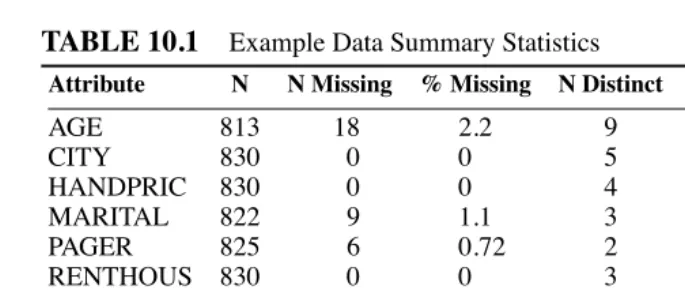
TABLE 10.1
Example Data Summary StatisticsAttribute N N Missing % Missing N Distinct Mean Min Max
AGE 813 18 2.2 9 5.059 1 9
CITY 830 0 0 5 1.769 1 5
HANDPRIC 830 0 0 4 145.3 60 235
MARITAL 822 9 1.1 3 1.9015 1 3
PAGER 825 6 0.72 2 0.076364 0 1
RENTHOUS 830 0 0 3 1.7906 1 3
RESPONSE 830 0 0 2 0.1518 0 1
SEX 819 12 1.4 2 1.4432 1 2
TELEBILC 768 63 7.6 6 54.199 8 116
TRAVTIME 651 180 22 5 2.318 1 5
USEPRICE 830 0 0 4 11.151 10 30
MARITAL=Marital Status (Never Married, Married, Divorced/Widowed) TRAVTIME=estimated commute time to major center of employment AGE is recorded as an integer ranging from 1 to 9
was a new technology at that time, we needed to identify the major drivers of adoption of this then-new technology and to identify demographics that might be related to price sensitivity. The data consisted of a household’s response (yes/no) to a market test offer of a mobile phone package; all prospects were offered an identical package of a handset and service features, with one exception that the pricing for the package was varied randomly according to an experimental design. The only choice open to the households was to accept or reject the offer.
A total of 830 households were approached and 126 of the households agreed to subscribe to the mobile phone service plan. One of our objectives was to learn as much as possible about the differences between subscribers and nonsubscribers. A set of summary statistics for select attributes appear in Table 10.1. HANDPRIC is the price quoted for the mobile handset, USEPRIC is the quoted per-minute charge, and the other attributes are provided with common names.
A CART classification tree was grown on these data to predict the RESPONSE attribute using all the other attributes as predictors. MARITAL and CITY are cate-gorical (nominal) attributes. A decision tree is grown by recursively partitioning the training data using a splitting rule to identify the split to use at each node. Figure 10.1 illustrates this process beginning with the root node splitter at the top of the tree.
10.4 The Algorithm Briefly Stated 183
Figure 10.1 Root node split.
response rates: 21.9% for those quoted lower prices and 9.9% for those quoted the higher prices. Clearly both the root node splitter and the magnitude of the difference between the two child nodes are plausible. Observe that the split always results in two nodes: CART uses only binary splitting.
To generate a complete tree CART simply repeats the splitting process just described in each of the two child nodes to produce grandchildren of the root. Grand-children are split to obtain great-grandGrand-children and so on until further splitting is impossible due to a lack of data. In our example, this growing process results in a “maximal tree” consisting of 81 terminal nodes: nodes at the bottom of the tree that are not split further.
10.4
The Algorithm Briefly Stated
A complete statement of the CART algorithm, including all relevant technical details, is lengthy and complex; there are multiple splitting rules available for both classifica-tion and regression, separate handling of continuous and categorical splitters, special handling for categorical splitters with many levels, and provision for missing value handling. Following the tree-growing procedure there is another complex procedure for pruning the tree, and finally, there is tree selection. In Figure 10.2 a simplified algorithm for tree growing is sketched out. Formal statements of the algorithm are provided in the CART monograph. Here we offer an informal statement that is highly simplified.
BEGIN: Assign all training data to the root node Define the root node as a terminal node SPLIT:
New_splits=0
FOR every terminal node in the tree:
If the terminal node sample size is too small or all instances in the node belong to the same target class goto GETNEXT
Find the attribute that best separates the node into two child nodes using an allowable splitting rule
[image:6.612.62.388.403.566.2]New_splits+1 GETNEXT: NEXT
Figure 10.2 Simplified tree-growing algorithm sketch.
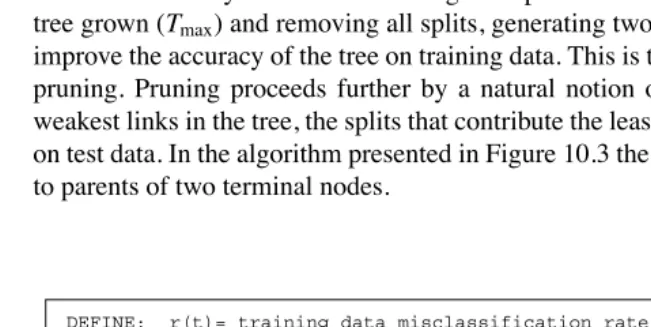
Having grown the tree, CART next generates the nested sequence of pruned sub-trees. A simplified algorithm sketch for pruning follows that ignores priors and costs. This is different from the actual CART pruning algorithm and is included here for the sake of brevity and ease of reading. The procedure begins by taking the largest tree grown (Tmax) and removing all splits, generating two terminal nodes that do not improve the accuracy of the tree on training data. This is the starting point for CART pruning. Pruning proceeds further by a natural notion of iteratively removing the weakest links in the tree, the splits that contribute the least to performance of the tree on test data. In the algorithm presented in Figure 10.3 the pruning action is restricted to parents of two terminal nodes.
DEFINE: r(t)= training data misclassification rate in node t p(t)= fraction of the training data in node t R(t)= r(t)*p(t)
t_left=left child of node t t_right=right child of node t
|T| = number of terminal nodes in tree T BEGIN: Tmax=largest tree grown
Current_Tree=Tmax
For all parents t of two terminal nodes
Remove all splits for which R(t)=R(t_left) + R(t_right) Current_tree=Tmax after pruning
PRUNE: If |Current_tree|=1 then goto DONE For all parents t of two terminal nodes
Remove node(s) t for which R(t)-R(t_left) - R(t_right) is minimum
Current_tree=Current_Tree after pruning
10.5 Splitting Rules 185
The CART pruning algorithm differs from the above in employing a penalty on nodes mechanism that can remove an entire subtree in a single pruning action. The monograph offers a clear and extended statement of the procedure. We now discuss major aspects of CART in greater detail.
10.5
Splitting Rules
CART splitting rules are always couched in the form
An instance goes left if CONDITION, and goes right otherwise
where the CONDITION is expressed as “attribute X i <=C ” for continuous
at-tributes. For categorical or nominal attributes the CONDITION is expressed as mem-bership in a list of values. For example, a split on a variable like CITY might be expressed as
An instance goes left if CITY is in{Chicago, Detroit, Nashville) and goes right
otherwise
The splitter and the split point are both found automatically by CART with the op-timal split selected via one of the splitting rules defined below. Observe that because CART works with unbinned data the optimal splits are always invariant with respect to order-preserving transforms of the attributes (such as log, square root, power trans-forms, and so on). The CART authors argue that binary splits are to be preferred to multiway splits because (1) they fragment the data more slowly than multiway splits and (2) repeated splits on the same attribute are allowed and, if selected, will eventually generate as many partitions for an attribute as required. Any loss of ease in reading the tree is expected to be offset by improved predictive performance.
The CART authors discuss examples using four splitting rules for classification trees (Gini, twoing, ordered twoing, symmetric gini), but the monograph focuses most of its discussion on the Gini, which is similar to the better known entropy (information-gain) criterion. For a binary (0/1) target the “Gini measure of impurity” of a node t is
G(t)=1−p(t)2−(1−p(t))2
where p(t) is the (possibly weighted) relative frequency of class 1 in the node.
Spec-ifying G(t)= −p(t) ln p(t)−(1−p(t)) ln(1−p(t)) instead yields the entropy rule.
The improvement (gain) generated by a split of the parent node P into left and right children L and R is
Here, q is the (possibly weighted) fraction of instances going left. The CART authors favored the Gini over entropy because it can be computed more rapidly, can be readily extended to include symmetrized costs (see below), and is less likely to generate “end cut” splits—splits with one very small (and relatively pure) child and another much larger child. (Later versions of CART have added entropy as an optional splitting rule.) The twoing rule is based on a direct comparison of the target attribute distribution in two child nodes:
I (split)=
.25(q(1−q))u
k
|pL(k)−pR(k)| 2
where k indexes the target classes, pL() and p R() are the probability distributions of the target in the left and right child nodes, respectively. (This splitter is a mod-ified version of Messenger and Mandell, 1972.) The twoing “improvement” mea-sures the difference between the left and right child probability vectors, and the
leading [.25(q(1−q)] term, which has its maximum value at q = .5, implicitly
penalizes splits that generate unequal left and right node sizes. The power term u is user-controllable, allowing a continuum of increasingly heavy penalties on unequal
splits; setting u = 10, for example, is similar to enforcing all splits at the median
value of the split attribute. In our practical experience the twoing criterion is a su-perior performer on multiclass targets as well as on inherently difficult-to-predict (e.g., noisy) binary targets. BFOS also introduce a variant of the twoing split criterion that treats the classes of the target as ordered. Called the ordered twoing splitting rule, it is a classification rule with characteristics of a regression rule as it attempts to separate low-ranked from high-ranked target classes at each split.
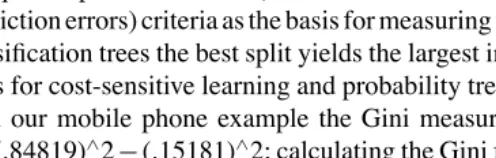
For regression (continuous targets), CART offers a choice of least squares (LS, sum of squared prediction errors) and least absolute deviation (LAD, sum of absolute prediction errors) criteria as the basis for measuring the improvement of a split. As with classification trees the best split yields the largest improvement. Three other splitting rules for cost-sensitive learning and probability trees are discussed separately below. In our mobile phone example the Gini measure of impurity in the root node is
1−(.84819)∧2−(.15181)∧2; calculating the Gini for each child and then subtracting
[image:8.612.103.351.522.601.2]their sample share weighted average from the parent Gini yields an improvement score of .00703 (results may vary slightly depending on the precision used for the calculations and the inputs). CART produces a table listing the best split available using each of the other attributes available. (We show the five top competitors and their improvement scores in Table 10.2.)
TABLE 10.2
Main Splitter Improvement=0.007033646Competitor Split Improvement
1 TELEBILC 50 0.006883
2 USEPRICE 9.85 0.005961
3 CITY 1,4,5 0.002259
4 TRAVTIME 3.5 0.001114
10.6 Prior Probabilities and Class Balancing 187
10.6
Prior Probabilities and Class Balancing
Balancing classes in machine learning is a major issue for practitioners as many data mining methods do not perform well when the training data are highly unbalanced. For example, for most prime lenders, default rates are generally below 5% of all accounts, in credit card transactions fraud is normally well below 1%, and in Internet advertising “click through” rates occur typically for far fewer than 1% of all ads displayed (impressions). Many practitioners routinely confine themselves to training data sets in which the target classes have been sampled to yield approximately equal sample sizes. Clearly, if the class of interest is quite small such sample balancing could leave the analyst with very small overall training samples. For example, in an insurance fraud study the company identified about 70 cases of documented claims fraud. Confining the analysis to a balanced sample would limit the analyst to a total sample of just 140 instances (70 fraud, 70 not fraud).
It is interesting to note that the CART authors addressed this issue explicitly in 1984 and devised a way to free the modeler from any concerns regarding sample balance. Regardless of how extremely unbalanced the training data may be, CART will automatically adjust to the imbalance, requiring no action, preparation, sampling, or weighting by the modeler. The data can be modeled as they are found without any preprocessing.
To provide this flexibility CART makes use of a “priors” mechanism. Priors are akin to target class weights but they are invisible in that they do not affect any counts reported by CART in the tree. Instead, priors are embedded in the calculations undertaken to determine the goodness of splits. In its default classification mode CART always calculates class frequencies in any node relative to the class frequencies in the root. This is equivalent to automatically reweighting the data to balance the classes, and ensures that the tree selected as optimal minimizes balanced class error. The reweighting is implicit in the calculation of all probabilities and improvements and requires no user intervention; the reported sample counts in each node thus reflect the unweighted data. For a binary (0/1) target any node is classified as class 1 if, and only if,
N1(node)
N1(root)
> N0(node)
N0(root)
Observe that this ensures that each class is assigned a working probability of 1/K
TILLABLE
AGE AGE
CITY TILLABLE
[image:10.612.84.370.64.282.2]HANDPRIC PAGER TILLABLE HANDPRIC
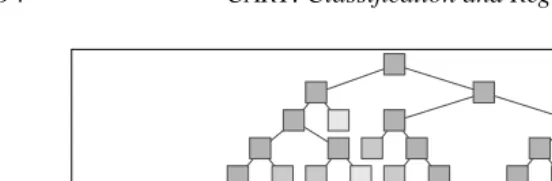
Figure 10.4 Red Terminal Node=Above Average Response. Instances with a value of the splitter greater than a threshold move to the right.
Note: The priors settings are unlike weights in that they do not affect the reported counts in a node or the reported fractions of the sample in each target class. Priors do affect the class any node is assigned to as well as the selection of the splitters in the tree-growing process.
(Being able to rely on priors does not mean that the analyst should ignore the topic of sampling at different rates from different target classes; rather, it gives the analyst a broad range of flexibility regarding when and how to sample.)
We used the “priors equal” settings to generate a CART tree for the mobile phone data to better adapt to the relatively low probability of response and obtained the tree schematic shown in Figure 10.4.
10.7 Missing Value Handling 189
attribute multiple times. Again, looking at the right side of the tree, and considering households with larger landline telephone bills but without a pager service, we see that the HANDPRIC attribute reappears, informing us that this customer segment is willing to pay a somewhat higher price but will resist the highest prices. (The second split on HANDPRIC is at 200.)
10.7
Missing Value Handling
Missing values appear frequently in the real world, especially in business-related databases, and the need to deal with them is a vexing challenge for all modelers. One of the major contributions of CART was to include a fully automated and ef-fective mechanism for handling missing values. Decision trees require a missing value-handling mechanism at three levels: (a) during splitter evaluation, (b) when moving the training data through a node, and (c) when moving test data through a node for final class assignment. (See Quinlan, 1989 for a clear discussion of these points.) Regarding (a), the first version of CART evaluated each splitter strictly on its performance on the subset of data for which the splitter is not missing. Later versions of CART offer a family of penalties that reduce the improvement measure to reflect the degree of missingness. (For example, if a variable is missing in 20% of the records in a node then its improvement score for that node might be reduced by 20%, or alter-natively by half of 20%, and so on.) For (b) and (c), the CART mechanism discovers “surrogate” or substitute splitters for every node of the tree, whether missing values occur in the training data or not. The surrogates are thus available, should a tree trained on complete data be applied to new data that includes missing values. This is in sharp contrast to machines that cannot tolerate missing values in the training data or that can only learn about missing value handling from training data that include missing values. Friedman (1975) suggests moving instances with missing splitter attributes into both left and right child nodes and making a final class assignment by taking a weighted average of all nodes in which an instance appears. Quinlan opts for a variant of Friedman’s approach in his study of alternative missing value-handling methods. Our own assessments of the effectiveness of CART surrogate performance in the presence of missing data are decidedly favorable, while Quinlan remains agnostic on the basis of the approximate surrogates he implements for test purposes (Quinlan). In Friedman, Kohavi, and Yun (1996), Friedman notes that 50% of the CART code was devoted to missing value handling; it is thus unlikely that Quinlan’s experimental version replicated the CART surrogate mechanism.
In CART the missing value handling mechanism is fully automatic and locally adaptive at every node. At each node in the tree the chosen splitter induces a binary
partition of the data (e.g., X 1<=c1 and X 1>c1). A surrogate splitter is a single
attribute Z that can predict this partition where the surrogate itself is in the form of
a binary splitter (e.g., Z <=d and Z >d). In other words, every splitter becomes
TABLE 10.3
Surrogate Splitter Report MainSplitter TELEBILC Improvement=0.023722
Surrogate Split Association Improvement
1 MARITAL 1 0.14 0.001864
2 TRAVTIME 2.5 0.11 0.006068
3 AGE 3.5 0.09 0.000412
4 CITY 2,3,5 0.07 0.004229
ranked by an association score that measures the advantage of the surrogate over the default rule, predicting that all cases go to the larger child node (after adjustments for priors). To qualify as a surrogate, the variable must outperform this default rule (and thus it may not always be possible to find surrogates). When a missing value is encountered in a CART tree the instance is moved to the left or the right according to the top-ranked surrogate. If this surrogate is also missing then the second-ranked surrogate is used instead (and so on). If all surrogates are missing the default rule assigns the instance to the larger child node (after adjusting for priors). Ties are broken by moving an instance to the left.
Returning to the mobile phone example, consider the right child of the root node, which is split on TELEBILC, the landline telephone bill. If the telephone bill data are unavailable (e.g., the household is a new one and has limited history with the company), CART searches for the attributes that can best predict whether the instance belongs to the left or the right side of the split.
In this case (Table 10.3) we see that of all the attributes available the best predictor of whether the landline telephone is high (greater than 50) is marital status (never-married people spend less), followed by the travel time to work, age, and, finally, city of residence. Surrogates can also be seen as akin to synonyms in that they help to interpret a splitter. Here we see that those with lower telephone bills tend to be never married, live closer to the city center, be younger, and be concentrated in three of the five cities studied.
10.8
Attribute Importance
10.9 Dynamic Feature Construction 191
TABLE 10.4
Variable Importance (Including Surrogates) Attribute ScoreTELEBILC 100.00 ||||||||||||||||||||||||||||||||||||||||||
HANDPRIC 68.88 |||||||||||||||||||||||||||||
AGE 55.63 |||||||||||||||||||||||
CITY 39.93 ||||||||||||||||
SEX 37.75 |||||||||||||||
PAGER 34.35 ||||||||||||||
TRAVTIME 33.15 |||||||||||||
USEPRICE 17.89 |||||||
RENTHOUS 11.31 ||||
[image:13.612.104.350.260.335.2]MARITAL 6.98 ||
TABLE 10.5
Variable Importance (Excluding Surrogates)Variable Score
TELEBILC 100.00 ||||||||||||||||||||||||||||||||||||||||||
HANDPRIC 77.92 |||||||||||||||||||||||||||||||||
AGE 51.75 |||||||||||||||||||||
PAGER 22.50 |||||||||
CITY 18.09 |||||||
Observe that the attributes MARITAL, RENTHOUS, TRAVTIME, and SEX in Table 10.4 do not appear as splitters but still appear to have a role in the tree. These attributes have nonzero importance strictly because they appear as surrogates to the other splitting variables. CART will also report importance scores ignoring the sur-rogates on request. That version of the attribute importance ranking for the same tree is shown in Table 10.5.
10.9
Dynamic Feature Construction
Friedman (1975) discusses the automatic construction of new features within each node and, for the binary target, suggests adding the single feature
x×w
where x is the subset of continuous predictor attributes vector andwis a scaled
in the node and using the estimated logit as a predictor. In the CART monograph, the authors discuss the automatic construction of linear combinations that include feature selection; this capability has been available from the first release of the CART soft-ware. BFOS also present a method for constructing Boolean combinations of splitters within each node, a capability that has not been included in the released software. While there are situations in which linear combination splitters are the best way to uncover structure in data (see Olshen’s work in Huang et al., 2004), for the most part we have found that such splitters increase the risk of overfitting due to the large amount of learning they represent in each node, thus leading to inferior models.
10.10
Cost-Sensitive Learning
Costs are central to statistical decision theory but cost-sensitive learning received only modest attention before Domingos (1999). Since then, several conferences have been devoted exclusively to this topic and a large number of research papers have appeared in the subsequent scientific literature. It is therefore useful to note that the CART monograph introduced two strategies for cost-sensitive learning and the entire mathematical machinery describing CART is cast in terms of the costs of
misclassification. The cost of misclassifying an instance of class i as class j is C(i,j )
and is assumed to be equal to 1 unless specified otherwise; C(i,i )=0 for all i . The
complete set of costs is represented in the matrix C containing a row and a column for each target class. Any classification tree can have a total cost computed for its terminal node assignments by summing costs over all misclassifications. The issue in cost-sensitive learning is to induce a tree that takes the costs into account during its growing and pruning phases.
The first and most straightforward method for handling costs makes use of weight-ing: Instances belonging to classes that are costly to misclassify are weighted upward, with a common weight applying to all instances of a given class, a method recently rediscovered by Ting (2002). As implemented in CART, weighting is accomplished transparently so that all node counts are reported in their raw unweighted form. For multiclass problems BFOS suggested that the entries in the misclassification cost ma-trix be summed across each row to obtain relative class weights that approximately reflect costs. This technique ignores the detail within the matrix but has now been widely adopted due to its simplicity. For the Gini splitting rule, the CART authors show that it is possible to embed the entire cost matrix into the splitting rule, but only after it has been symmetrized. The “symGini” splitting rule generates trees sensitive
to the difference in costs C(i,j ) and C(i,k), and is most useful when the symmetrized
10.11 Stopping Rules, Pruning, Tree Sequences, and Tree Selection 193
10.11
Stopping Rules, Pruning, Tree Sequences,
and Tree Selection
The earliest work on decision trees did not allow for pruning. Instead, trees were grown until they encountered some stopping condition and the resulting tree was considered final. In the CART monograph the authors argued that no rule intended to stop tree growth can guarantee that it will not miss important data structure (e.g., consider the two-dimensional XOR problem). They therefore elected to grow trees without stopping. The resulting overly large tree provides the raw material from which a final optimal model is extracted.
The pruning mechanism is based strictly on the training data and begins with a cost-complexity measure defined as
Ra(T )= R(T )+a|T|
where R(T ) is the training sample cost of the tree,|T|is the number of terminal nodes
in the tree and a is a penalty imposed on each node. If a = 0, then the minimum
cost-complexity tree is clearly the largest possible. If a is allowed to progressively increase, the minimum cost-complexity tree will become smaller because the splits at the bottom of the tree that reduce R(T ) the least will be cut away. The parameter a is progressively increased in small steps from 0 to a value sufficient to prune away all splits. BFOS prove that any tree of size Q extracted in this way will exhibit a cost R(Q) that is minimum within the class of all trees with Q terminal nodes. This is practically important because it radically reduces the number of trees that
must be tested in the search for the optimal tree. Suppose a maximal tree has|T|
terminal nodes. Pruning involves removing the split generating two terminal nodes and absorbing the two children into their parent, thereby replacing the two terminal nodes with one. The number of possible subtrees extractable from the maximal tree by such pruning will depend on the specific topology of the tree in question but
will sometimes be greater than .5|T|! But given cost-complexity pruning we need
to examine a much smaller number of trees. In our example we grew a tree with 81 terminal nodes and cost-complexity pruning extracts a sequence of 28 subtrees, but if we had to look at all possible subtrees we might have to examine on the order of
25!=15,511,210,043,330,985,984,000,000 trees.
Figure 10.5 One stage in the CART pruning process: the 17-terminal-node subtree. Highlighted nodes are to be pruned next.
Figure 10.5 shows a CART tree along with highlighting of the split that is to be removed next via cost-complexity pruning.
Table 10.6 contains one row for every pruned subtree obtained starting with the maximal 81-terminal-node tree grown. The pruning sequence continues all the way back to the root because we must allow for the possibility that our tree will demonstrate no predictive power on test data. The best performing subtree on test data is the SE 0 tree with 40 nodes, and the smallest tree within a standard error of the SE 0 tree is the SE 1 tree (with 35 terminal nodes). For simplicity we displayed details of the suboptimal 10-terminal-node tree in the earlier dicussion.
10.12
Probability Trees
10.12 Probability Trees 195
TABLE 10.6
Complete Tree Sequence for CART Model: All Nested Subtrees ReportedTree Nodes Test Cost Train Cost Complexity
1 81 0.635461 +/- 0.046451 0.197939 0
2 78 0.646239 +/- 0.046608 0.200442 0.000438
3 71 0.640309 +/- 0.046406 0.210385 0.00072
4 67 0.638889 +/- 0.046395 0.217487 0.000898
5 66 0.632373 +/- 0.046249 0.219494 0.001013
6 61 0.635214 +/- 0.046271 0.23194 0.001255
7 57 0.643151 +/- 0.046427 0.242131 0.001284
8 50 0.639475 +/- 0.046303 0.262017 0.00143
9 42 0.592442 +/- 0.044947 0.289254 0.001709
10 40 0.584506 +/- 0.044696 0.296356 0.001786
11 35 0.611156 +/- 0.045432 0.317663 0.002141
12 32 0.633049 +/- 0.045407 0.331868 0.002377
13 31 0.635891 +/- 0.045425 0.336963 0.002558
14 30 0.638731 +/- 0.045442 0.342307 0.002682
15 29 0.674738 +/- 0.046296 0.347989 0.002851
16 25 0.677918 +/- 0.045841 0.374143 0.003279
17 24 0.659204 +/- 0.045366 0.381245 0.003561
18 17 0.648764 +/- 0.044401 0.431548 0.003603
19 16 0.692798 +/- 0.044574 0.442911 0.005692
20 15 0.725379 +/- 0.04585 0.455695 0.006402
21 13 0.756539 +/- 0.046819 0.486269 0.007653
22 10 0.785534 +/- 0.046752 0.53975 0.008924
23 9 0.784542 +/- 0.045015 0.563898 0.012084
24 7 0.784542 +/- 0.045015 0.620536 0.014169
25 6 0.784542 +/- 0.045015 0.650253 0.014868
26 4 0.784542 +/- 0.045015 0.71043 0.015054
27 2 0.907265 +/- 0.047939 0.771329 0.015235
28 1 1 +/- 0 1 0.114345
estimates that has rarely been discussed in the literature. Dubbed the “Breiman
ad-justment,” it adjusts the estimated misclassification rate r×(t) of any terminal node
upward by
r×(t)=r (t)+e/(q(t)+S)
10.13
Theoretical Foundations
The earliest work on decision trees was entirely atheoretical. Trees were proposed as methods that appeared to be useful and conclusions regarding their properties were based on observing tree performance on empirical examples. While this approach remains popular in machine learning, the recent tendency in the discipline has been to reach for stronger theoretical foundations. The CART monograph tackles theory with sophistication, offering important technical insights and proofs for key results. For example, the authors derive the expected misclassification rate for the maximal (largest possible) tree, showing that it is bounded from above by twice the Bayes rate. The authors also discuss the bias variance trade-off in trees and show how the bias is affected by the number of attributes. Based largely on the prior work of CART coauthors Richard Olshen and Charles Stone, the final three chapters of the monograph relate CART to theoretical work on nearest neighbors and show that as the sample size tends to infinity the following hold: (1) the estimates of the regression function converge to the true function and (2) the risks of the terminal nodes converge to the risks of the corresponding Bayes rules. In other words, speaking informally, with large enough samples the CART tree will converge to the true function relating the target to its predictors and achieve the smallest cost possible (the Bayes rate). Practically speaking, such results may only be realized with sample sizes far larger than in common use today.
10.14
Post-CART Related Research
10.14 Post-CART Related Research 197
that are readily recognized as regressions on recursively partitioned (and selected) predictors. Stone, with collaborators, extended the spline regression approach to haz-ard modeling (Kooperberg, Stone, and Truong, 1995) and polychotomous regression (1997).
Breiman was active in searching for ways to improve the accuracy, scope of ap-plicability, and compute speed of the CART tree. In 1992 Breiman was the first to introduce the multivariate decision tree (vector dependent variable) in software but did not write any papers on the topic. In 1995, Spector and Breiman implemented a strategy for parallelizing CART across a network of computers using the C-Linda parallel programming environment. In this study the authors observed that the gains from parallelization were primarily achieved for larger data sets using only a few of the available processors. By 1994 Breiman had hit upon “bootstrap aggregation”: creating predictive ensembles by growing a large number of CART trees on boot-strap samples drawn from a fixed training data set. In 1998 Breiman applied the idea of ensembles to online learning and the development of classifiers for very large databases. He then extended the notion of randomly sampling rows in the training data to random sampling columns in each node of the tree to arrive at the idea of the random forest. Breiman devoted the last years of his life to extending random forests with his coauthor Adele Cutler, introducing new methods for missing value imputation, outlier detection, cluster discovery, and innovative ways to visualize data using random forests outputs in a series of papers and Web postings from 2000 to 2004.
Richard Olshen has focused primarily on biomedical applications of decision trees. He developed the first tree-based approach to survival analysis (Gordon and Olshen, 1984), contributed to research on image compression (Cosman et al., 1993), and has recently introduced new linear combination splitters for the analysis of very high dimensional data (the genetics of complex disease).
Friedman introduced stochastic gradient boosting in several papers beginning in 1999 (commercialized as TreeNet software) which appears to be a substantial ad-vance over conventional boosting. Friedman’s approach combines the generation of very small trees, random sampling from the training data at every training cycle, slow learning via very small model updates at each training cycle, selective rejection of training data based on model residuals, and allowing for a variety of objective functions, to arrive at a system that has performed remarkably well in a range of real-world applications. Friedman followed this work with a technique for compressing tree ensembles into models containing considerably fewer trees using novel methods for regularized regression. Friedman showed that postprocessing of tree ensembles to compress them may actually improve their performance on holdout data. Taking this line of research one step further, Friedman then introduced methods for reexpressing tree ensemble models as collections of “rules” that can also radically compress the models and sometimes improve their predictive accuracy.
10.15
Software Availability
CART software is available from Salford Systems, at http://www.salford-systems.com; no-cost evaluation versions may be downloaded on request. Executables for Windows operating systems as well as Linux and UNIX may be obtained in both 32-bit and 64-bit versions. Academic licenses for professors automatically grant no-cost licenses to their registered students. CART source code, written by Jerome Friedman, has remained a trade secret and is available only in compiled binaries from Salford Systems. While popular open-source systems (and other commercial proprietary systems) offer decision trees inspired by the work of Breiman, Friedman, Olshen, and Stone, these systems generate trees that are demonstrably different from those of true CART when applied to real-world complex data sets. CART has been used by Salford Systems to win a number of international data mining competitions; details are available on the company’s Web site.
10.16
Exercises
1. (a) To the decision tree novice the most important variable in a CART tree should be the root node splitter, yet it is not uncommon to see a different variable listed as most important in the CART summary output. How can this be? (b) If you run a CART model for the purpose of ranking the predictor variables in your data set and then you rerun the model excluding all the 0-importance variables, will you get the same tree in the second run? (c) What if you rerun the tree keeping as predictors only variables that appeared as splitters in the first run? Are there conditions that would guarantee that you obtain the same tree? 2. Every internal node in a CART tree contains a primary splitter, competitor
splits, and surrogate splits. In some trees the same variable will appear as both a competitor and a surrogate but using different split points. For example, as a
competitor the variable might split the node with x j <=c, while as a surrogate
the variable might split the node as x j <=d. Explain why this might occur.
3. Among its six different splitting rules CART offers the Gini and twoing splitting rules for growing a tree. Explain why an analyst might prefer the results of the twoing rule even if it yielded a lower accuracy.
4. For a binary target if two CART trees are grown on the same data, the first using the Gini splitting rule and the second using the class probability rule, which one is likely to contain more nodes? Will the two trees exhibit the same accuracy? Will the smaller tree be contained within the larger one? Explain the differences between the two trees.
References 199
PRIORS EQUAL setting. How will the results change if you rerun the model
using a WEIGHT variablewwithw=1 when the target is 0 andw=4 when
the target is 1?
6. When growing CART trees on larger data sets containing tens of thousands of records or more, one often finds that tree accuracy declines only slightly as the tree is grown much larger than its optimal size. In other words, on large data sets a too-large CART tree appears to overfit only slightly. Why is this the case? 7. A CART model is not just a single tree but a collection of nested trees, each of which has its own performance characteristics (accuracy, area under the ROC curve). Why do the CART authors suggest that the best tree is not necessarily the most accurate tree but could well be the smallest tree in the tree sequence within some tolerance interval of the most accurate tree? How is the tolerance interval calculated?
8. For cost-sensitive learning, when different mistakes are associated with differ-ent costs, the CART authors adjust the priors to reflect costs, which is essdiffer-entially a form of reweighting the data. When do adjusted priors perfectly reflect costs and when do they only approximate the costs? How does the symmetric gini splitting rule help to reflect costs of misclassification?
9. The CART authors decided on a grow-then-prune strategy for the selection of an optimal decision tree rather than following an apparently simpler stopping rule method. Explain how XOR-type problems can be used to defeat any stopping rule based on a goodness of split criterion for one or more splits.
10. If a training data set is complete (contains no missing values in any predictor), how can a CART tree grown on such data guarantee that it can handle missing values encountered in future data?
References
Bloch, D.A., Olshen, R.A., and Walker M.G. (2002) Risk estimation for classification trees. Journal of Computational & Graphical Statistics, 11, 263–288.
Breiman, L. (1995) Current research in the mathematics of generalization. Proceed-ings of the Santa Fe Institute CNLS Workshop on Formal Approaches to Supervised Learning. David Wolpert, Ed. Addison-Wesley, 361–368.
Breiman, L. (1998) Pasting Small Votes for Classification in Large Databases and On-Line. Statistics Department, University of California, Berkeley.
Breiman, L., Friedman, J.H., Olshen, R.A., and Stone, C.J. (1984) Classification and Regression Trees, Wadsworth, Belmont, CA. Republished by CRC Press.
Breiman, L. and Stone, J. (1978) Parsimonious Binary Classification Trees, Technical Report, Technology Services Corp., Los Angeles.
Cosman, P.C., Tseng, C., Gray, R.M., Olshen, R.A., et al. (1993) Tree-structured vector quantization of CT chest scans: Image quality and diagnostic accuracy. IEEE Transactions on Medical Imaging, 12, 727–739.
Cover, T. and Hart, P. (1967) Nearest neighbor pattern classification, IEEE Trans Information Theory 13, page(s): 21–27.
Domingos, P. (1999) MetaCost: A general method for making classifiers cost-sensitive. In Proceedings of the Fifth International Conference on Knowledge Dis-covery and Data Mining, pp. 155–164.
Doyle, P. (1973) The use of automatic interaction detector and similar search proce-dures. Operational Research Quarterly, 24, 465–467.
Einhorn, H. (1972) Alchemy in the behavioral sciences. Public Opinion Quarterly, 36, 367–378.
Friedman, J.H. (1977) A recursive partitioning decision rule for nonparametric clas-sification. IEEE Trans. Computers, C-26, 404. Also available as Stanford Linear Accelerator Center Rep. SLAC-PUB-1373 (Rev. 1975).
Friedman, J.H. (1999) Stochastic Gradient Boosting. Statistics Department, Stanford University.
Friedman, J.H., Bentley, J.L., and Finkel, R.A. (1977) An algorithm for finding best matches in logarithmic time. ACM Trans. Math. Software, 3, 209. Also available as Stanford Linear Accelerator Center Rep. SIX-PUB-1549, Feb. 1975.
Friedman, J.H., Kohavi, R., and Yun, Y. (1996) Lazy decision trees. In Proceedings of the Thirteenth National Conference on Artificial Intelligence, pp. 717–724, AAAI Press/MIT Press, San Francisco, CA.
Gordon, L., and Olshen, R.A. (1985) Tree-structured survival analysis (with discus-sion). Cancer Treatment Reports, 69, 1065–1068.
Gordon, L., and Olshen, R.A. (1984) Almost surely consistent nonparametric regres-sion from recursive partitioning schemes. Journal of Multivariate Analysis, 15, 147–163.
Hastie and Tibshirani’s Generalized Additive Models. (1986) Statistical Science. 1, 297–318.
References 201
Kooperberg, C., Bose, S., and Stone, C.J. (1997) Polychotomous regression. Journal of the American Statistical Association, 92, 117–127.
Kooperberg, C., Stone, C.J., and Truong, Y.K. (1995) Hazard regression. Journal of the American Statistical Association, 90, 78–94.
Messenger, R.C., and Mandell, M.L. (1972) A model search technique for predictive nominal scale multivariate analysis. Journal of the American Statistical Associa-tion, 67, 768–772.
Morgan, J.N., and Sonquist, J.A. (1963) Problems in the analysis of survey data, and a proposal. Journal of the American Statistical Association, 58, 415–435.
Provost, F., and Domingos, P. (2002) Tree induction for probability-based ranking. Machine Learning, 52, 199–215.
Quinlan, R. (1989) Unknown attribute values in induction. In Proceedings of the Sixth International Workshop on Machine Learning, pp. 164–168.
Stone, C.J. (1977) Consistent nonparametric regression (with discussion). Annals of Statistics, 5, 595–645.
Stone, C. (1985) Additive regression and other non-parametric models, Annal. Statist., 13, 689–705.