and coherent destruction of tunneling
.
White Rose Research Online URL for this paper:
http://eprints.whiterose.ac.uk/1368/
Article:
Schatzer, Laro and Weigert, S. orcid.org/0000-0002-6647-3252 (1998) Solvable
three-state model of a driven double-well potential and coherent destruction of tunneling.
Physical Review A. pp. 68-78. ISSN 1094-1622
https://doi.org/10.1103/PhysRevA.57.68
[email protected] https://eprints.whiterose.ac.uk/ Reuse
Items deposited in White Rose Research Online are protected by copyright, with all rights reserved unless indicated otherwise. They may be downloaded and/or printed for private study, or other acts as permitted by national copyright laws. The publisher or other rights holders may allow further reproduction and re-use of the full text version. This is indicated by the licence information on the White Rose Research Online record for the item.
Takedown
If you consider content in White Rose Research Online to be in breach of UK law, please notify us by
Solvable three-state model of a driven double-well potential
and coherent destruction of tunneling
Laro Schatzer and Stefan Weigert
Departement fu¨r Physik und Astronomie der Universita¨t Basel, Klingelbergstrasse 82, CH-4056 Basel, Switzerland
~Received 10 July 1997!
A simple model for a particle in a double well is derived from discretizing its configuration space. The model contains as many free parameters as the original system and it respects all the existing symmetries. In the presence of an external periodic force both the continuous system and the discrete model are shown to possess a generalized time-reversal symmetry in addition to the known generalized parity. The impact of the driving force on the spectrum of the Floquet operator is studied. In particular, the occurrence of degenerate quasienergies causing coherent destruction of tunneling is discussed—to a large extent analytically—for arbi-trary driving frequencies and barrier heights.@S1050-2947~98!00301-1#
PACS number~s!: 03.65.2w, 73.40.Gk, 33.80.Be
I. INTRODUCTION
Tunneling of a particle in a symmetric double-well poten-tial on the real line is well understood, at least qualitatively. For a large barrier separating the minima, semiclassical cal-culations @1# provide reliable estimates of the system’s eigenstates and energy eigenvalues near the bottom of the spectrum. In another approach, path integrals are used to obtain approximate solutions@2,3#. In this framework instan-tons are crucial; they are the solutions of the classical equa-tions of motion of a particle in the inverted potential. For low barriers, one can resort to the supersymmetric partner of the original potential in order to determine the low lying energy eigenvalues@4–6#. The partner potential possesses the same spectrum as the original one except for the ground state but, fortunately, it is a single-well potential. The approximate evaluation of the spectrum is then straightforward using again semiclassical approximations or, for example, a varia-tional principle.
If an external driving force is added to the system it be-comes more difficult to gain insight into its quantum me-chanical properties. Even a coupling linear in the particle’s coordinate leads to qualitative changes which are not easily discussed in the familiar language of tunneling phenomena
@7–10#. To a large extent, this is related to the fact that generically classical systems with one degree of freedom be-come nonintegrable as a driving force is turned on.
In this paper, an elementary model to describe a particle in a driven double-well system is introduced. The basic idea is to discretize the continuous configuration space of the original system while preserving its essential features. In this way, a three-level system is obtained which has both the same number of free parameters and the same symmetries as its continuous ancestor, contrary to existing two-level ap-proximations of a double well @11–14#. Many calculations can be performed analytically in this model. The discussion of the undriven system shows that the drastic approximation provides a reasonable qualitative description of the particle’s behavior in a double well. On this basis, the dynamics of the driven system is investigated. Mutatis mutandis, the results obtained here apply to the continuous system the study of
which often requires extensive numerical work.
The paper is organized as follows. First, we briefly review the behavior of a particle in a double well, followed by the derivation of the model to be investigated in this work. The next section discusses the symmetries of the system, formu-lated in terms of the Floquet description. Then, the properties of the undriven model are compared with those of the con-tinuous system. The driven system is studied in detail, the focus being on degeneracies of quasienergies. Finally, the effective Hamiltonian for time translation over one period is determined approximatively in the high-frequency limit. The summary collects the results and draws conclusions.
II. MODEL OF A DRIVEN DOUBLE WELL
A. Continuous system
The quantal dynamics of a particle in a symmetric double-well potential on the real line,
VDW~x!52
A
2x
2 1
B
4x
4, A,B
.0 ~1!
is governed by Schro¨dinger’s equation
i\ ]
]tuc~t!
&
5Hˆ~t!uc~t!&
, ~2!where the Hamiltonian reads
Hˆ~t!5
pˆ2
2m1VDW~xˆ!1g~t!xˆ, g~t1T!5g~t!. ~3! Here a periodic driving force g(t) acting on the particle has been added. The shape of the potential
V~x,t!5VDW~x!1g~t!x ~4!
at time t depends on the parameters A, B, and g(t). Equiva-lently, one can describe it in terms of the mean energy VGof
57
the potential minima, located at L6(t), the time-dependent asymmetryDV(t), and the barrier height VB ~cf. Fig. 1!.
The impact of the driving force on the tunneling behavior of the particle has been studied in @7# for sinusoidal time dependence
g~t!5S sinvt, v52p/T. ~5!
For small and large values of the driving frequency v, the force has been found to enhance the tunneling rate while the system evolves in a complex manner for intermediate fre-quencies. In addition, coherent destruction of tunneling has been observed @15# for specific parameter values: a wave packet localized initially in one of the wells periodically re-covers its shape, even for very long times. This phenomenon can be attributed to a crossing of quasienergies of the Flo-quet operator. A related phenomenon has been observed in time-independent systems: tunneling is suppressed if energy eigenvalues are forced to fall onto each other as is possible for systems with nontrivial topology in the presence of gauge fields @16,17#.
To a large extent, results for a particle in the driven double well are based on numerically obtained solutions of Schro¨dinger’s equation. It seems desirable to have available a model, as simple as possible, which reproduces the features mentioned above at least qualitatively. In the following, an apparently crude approximation of the system described by Eqs. ~3! and~5! is introduced. The model is required to re-spect the qualitative structure of the potential landscape, the number of free parameters in the original system, as well as its symmetries. The resulting model allows one to approach many questions analytically for all parameter values. In spite of the drastic simplification involved in its derivation, it is found to provide a reasonable description of tunneling in a driven double-well potential.
B. Discrete system
Let us revert Feynman’s ‘‘derivation’’ of Schro¨dinger’s equation @18#: the configuration space R of the system
de-scribed by the Hamiltonian Hˆ (t) is replaced by an equidis-tant set of points, xk5kL, with integers k, and the lengthL
is yet to be determined. In the position representation the wave functionc(x)5
^x
uc&
now takes on values at xkonly,c~x!→ck5c~kL !, ~6!
and the kinetic energy is proportional to the discretized La-placian in one dimension@19#:
]2
]x2c~x!→D
2c k5
1
L2~ck1122ck1ck21!. ~7!
As long as the index k runs over all integers, not much has been gained. A further simplification is motivated by looking at the qualitative shape of the potential landscape. A particu-larly simple, qualitatively correct description of VDW(x) re-fers only to the presence of the two minima, separated by a barrier at the origin, and to the steep increase for x→6`. Therefore the choiceL5L5uL6(0)uallows one to correctly represent the overall structure of VDW(x) if for x050 and
x656L one defines
V~x0,t!5VG1VB, V~x6,t!5VG6DV~t!/2. ~8!
This approximation does not take into account that the loca-tions of the minima at x5L6(t) are slightly shifted due to the position-dependent driving force.
For simplicity, the boundary conditionc(x)→0 for x→`
is modeled by the requirement that the wave function vanish for k562, orc6250, corresponding to an infinitely strong potential VDW(x62) at these points. Thus the wave function
is different from zero at three points only, and the discretized version of the Hamiltonian Hˆ (t) becomes a (333) matrix:
H~t!5H01H1~t!, ~9!
where the time-independent partH0 reads
H05~2h1VG!11
S
0 2h 0
2h VB 2h
0 2h 0
D
, ~10!
with1being the (333) unit matrix, andh5\2/2mL2. Here
and below, operators acting on the Hilbert space C3 of the
three-state model are denoted by sans-serif symbols. The driving term is
H1~t!5 DV~t!
2 diag~21,0,1!, ~11! with a periodically varying asymmetry@cf. Eq.~5!#
DV~t!5Lg~t!. ~12!
Further, the sinusoidal time dependence of the driving term is replaced by a function taking two values only, being constant during both the first and the second half of the in-terval of periodicity T52p/v:
DV~t!5
H
1DV, 0<t mod T,T/2
2DV, T/2<t mod T,T. ~13!
[image:3.612.74.252.62.180.2]This simplification retains the relevant features of the con-tinuously varying time dependence, as is known, for ex-ample, from investigations of parametric resonance@20,21#. Let us check the number of parameters in the discrete model of the periodically driven double well. The Hamil-tonian H(t) in Eq. ~9! depends on four parameters, namely
FIG. 1. The double-well potential VDW(t) at time t is
the barrier height VB, the kinetic parameter h5\2/2mL2,
the period T of the driving, and its amplitudeDV, matching
thus the number of parameters of the continuous system. If the double-well potential is described by a system with two states~instead of three!, the number of parameters is reduced by one, since the model now depends on a combination
V(h,VB) of the barrier height VB and the parameterhonly.
In this sense, the three-state model introduced here is more realistic than two-level models known to reproduce qualita-tively various aspects of the continuous system @14#.
Nevertheless, it is useful to eliminate the kinetic param-eter hby rescaling
T→hT, DV→DV/h, VB→VB/h, ~14!
leaving us with a system depending effectively only on the three~rescaled!parameters VB, T, and“V.
The HamiltonianH(t) obtained as an approximation to a particle system also has an interpretation as a Hamiltonian for a spin of length s51 in a crystal field under the influence of a time-dependent external magnetic field along the z axis:
H~t!52VBSz 2
2gmBB~t!•S, ~15!
where a term proportional to the unit matrix has been dropped, and
gmBB~t!5
h
& ex1DV~t!ez. ~16!
The vector S has three components, each of which is a (2s
115) three-dimensional matrix such that
@Sj,Sk#5i«j klSl. ~17!
The extrema of the double-well potential correspond to the stationary configurations of the classical spin. The off-diagonal elements of H(t) couple the stationary states.
III. SYMMETRIES
Before investigating the dynamics of either Hˆ (t) orH(t) in detail, a careful search for symmetry transformations is useful. For the class of systems studied here, three indepen-dent discrete transformations can be iindepen-dentified which leave the Hamiltonian invariant. Two of them are immediately rec-ognized, namely, the time periodicity and a generalized par-ity transformation. The third one, a generalization of time-reversal invariance, has not yet been pointed out. The existence of these symmetries implies that the solutions of the driven system have specific features, and each of the invariances simplifies its study.
A. Time periodicity
Due to Eq.~5!or Eq.~13!the Hamilton operator Hˆ (t) is invariant under the discrete transformation
J:t→t1T. ~18!
The long-time properties of a system with period T are con-veniently extracted from a description in terms of its Floquet operator@22#. Mathematically, the description of electrons in
a spatially periodic potential and the Floquet formalism are closely related. Physically, it can be thought of as a strobo-scopic observation of the system at times t50,T,2T,..., say. The details of the time evolution for intermediate times are not determined. This approach comes down to studying the properties of the propagator over one time interval
Fˆ5Uˆ~T,0!
5lim
N→`
e2~i/\ !Hˆ~tN!Dt...e2~i/\ !Hˆ~t2!Dte2~i/\ !Hˆ~t1!Dt, ~19!
where N is the number of time intervals of length Dt
5T/N, and tn5(n21/2)Dt. Formally, the propagator can
be written as
Fˆ5t exp
S
2\iE
0T
dt Hˆ~t!
D
, ~20!wheretdenotes time ordering. The Floquet operatorFˆ maps
a state uc~0!&over one time interval:
Fˆ uc~0!
&
5uc~T!&
, ~21!corresponding to an integration of Schro¨dinger’s equation from t50 to t5T. The N-fold application ofFˆ to uc(0)
&
results in the stateuc(NT)
&
. Obviously, the eigenstates ofFplay an important role,
Fˆ uw~j!
&
5e2i«juw~j!
&
, j50,1, . . . . ~22!
The eigenvalues exp(2i«j) are complex numbers of modulus
one, and the real quasienergies«jare defined modulo 2p. In
general, the nature of the spectrum of quasienergies, be it finite, countable, or continuous, reflects the complexity of the system’s dynamics@23#. If the Hamiltonian does not explic-itly depend on time, the eigenstates uw( j)
&
of the FloquetoperatorFˆ coincide with those of the Hamilton operator Hˆ,
that is, uw( j )
&
5uc( j )
&
, while the energy eigenvalues arere-lated to the quasienergies by«j5(EjT/\)mod 2p. This
as-sociation will continue to hold for a weak time-dependent driving force, and the statesuw( j )
&
can be ordered by sortingthem according to the size of the expectation value of the energy averaged over one period T:
^H
ˆ&
j51T
E
0 Tdt^w~j!uUˆ~t,0!†Hˆ~t!Uˆ~t,0!uw~j!
&
. ~23!As a matter of fact, it is the invariance of the Hamiltonian
Hˆ (t) under the time translation Jwhich leads to the
exis-tence of quasienergies defined according to Eq.~22!.
B. Generalized parity
For potentials symmetric under spatial reflection, that is,
VDW(2x)5VDW(x), the Hamiltonian Hˆ (t) in Eq.~3!is
in-variant under a simultaneous transformation of space and time,
known as generalized parity @24#. Here, the property of the driving force g(t1T/2)52g(t) is crucial.
The invariance of the Hamiltonian under the transforma-tion in Eq.~24!has an important consequence for the explicit form of the Floquet operatorFˆ . The symmetryPmeans that
Hˆ~t1T/2!5Pˆ Hˆ~t!Pˆ , ~25!
where reflection at the origin is described by the parity op-erator Pˆ ,
Pˆc~x!5c~2x!, Pˆ251, Pˆ5Pˆ†, ~26!
andPcn5c2n for the discrete model. Equation~25!implies
that the propagator over the second half of a period T can be expressed by the propagator over its first half:
Uˆ~T,T/2!5Pˆ Uˆ~T/2,0!Pˆ . ~27!
Hence the propagation over a full period of time can be written as a square,
Uˆ~T,0!5Uˆ~T,T/2!Uˆ~T/2,0!
5Pˆ Uˆ~T/2,0!Pˆ Uˆ~T/2,0! ~28!
or, in terms of the Floquet operator
Fˆ5Sˆ2, Sˆ5Pˆ Uˆ~T/2,0!. ~29!
Thus the action of the Floquet operator is given as a twofold application of its ‘‘root’’Sˆ , being a simple product of
propa-gation over half the period T and a reflection at the origin. This decomposition has not been observed before.
In the following, the eigenequation of Sˆ ,
Sˆuw~j!
&
5e2isjuw~j!&
, ~30!will be studied instead of Eq. ~22!. The eigenstates of the operators Sˆ and Fˆ coincide, and the relation between their
eigenvalues is governed by
«j52sj mod 2p. ~31!
This relation is important for the discussion of degenerate quasienergies «j.
C. Generalized time reversal
The third symmetry transformation again involves both space and time:
Q:x→2x and t→2t. ~32!
It will be called generalized time reversal. The symmetry is a consequence of the property g(2t)52g(t) of the driving
force.
In Hilbert space, the transformation Qis represented by an antilinear operator Aˆ , not a linear one. There is no con-served quantity associated with it. However, it is possible to construct a symmetry-adapted basis such that the ~Floquet!
eigenfunctions do have a particular structure. This property is a generalization of the possibility to choose purely real eigenfunctions if a system is invariant under time reversal,
leading to a real symmetric Hamiltonian. Let us introduce the antilinear operator Kˆ which has the properties
Kˆ251, Kˆ5Kˆ†, Kˆ OˆKˆ5Oˆ*, ~33!
where Oˆ is any operator~expressed in the position represen-tation!or a complex number, and the star*denotes complex conjugation. Schro¨dinger’s equation ~2! is invariant under the application of the antiunitary operator Pˆ Kˆ combined with the reflection of the time parameter
Pˆ Kˆ^~t→2t!. ~34!
This follows from the properties of Kˆ in Eq.~33!, the sym-metry Q, and the fact that Hˆ (t) is real. Hence, if the state uc(t)
&
is a solution of the time-dependent Schro¨dinger equa-tion, then the transformed state Pˆ Kˆuc(2t)& is a solution, too. Similarly, ifuw( j)&
is an eigenstate of the Floquetopera-tor Fˆ ~or the operator Sˆ! according to Eq. ~22!, then the transformed state Pˆ Kˆuw( j )
&
is also an eigenstate. This is seenfrom combining the time periodicity J of the Hamiltonian with the symmetryQimplying that
Hˆ~T2t!5Pˆ Hˆ~t!Pˆ . ~35!
Therefore applying parity to the Floquet operator Fˆ 5Uˆ (T,0) corresponds to a reversed time ordering. Since the
Hamiltonian is real symmetric, Hˆ5(Hˆ†)*5HˆT, this is iden-tical to a transposition:
PˆFˆ Pˆ5 lim
N→`
e2~i/\ !Pˆ Hˆ~tN!PˆDt...e~2i/\ !Pˆ Hˆ~t1!PˆDt
5 lim
N→`
e2~i/\ !Hˆ~t1!Dt...e2~i/\ !Hˆ~tN!Dt 5FˆT,
using Eqs.~19!and~35!; the superscript T denotes the trans-pose. This property is also shared by the operatorSˆ ,
PˆSˆ Pˆ5SˆT. ~36!
As a consequence one has
Sˆ~Pˆ Kˆuw~j!
&
)5PˆSˆTKˆuw~j!
&
5Pˆ KˆSˆ†uw~j!
&
5Pˆ Kˆe1isjuw~j!
&
5e2isj~Pˆ Kˆuw~j!
&
), ~37!where the antilinearity of Kˆ , the unitarity ofSˆ , and Eq.~36!
have been used. Thus the statesuw( j )
&
and Pˆ Kˆuw( j)&
are botheigenstates of Sˆ with the same eigenvalue. They represent
the same physical state if the eigenvalues $e2isj% are not
degenerate.
Now the definition of a symmetry-adapted basis emerges naturally for systems being invariant under generalized time reversal. Starting with an arbitrary orthonormal basis$uwn
&
%,the symmetry-adapted basis$uFn
&
% is obtained from a linearuFn
&
5H
c~uwn
&
1Pˆ Kˆuwn&
! if Pˆ Kˆuwn&
Þ2uwn&
c~uwn
&
1i Pˆ Kˆuwn&
! if Pˆ Kˆuwn&
52uwn&
, ~38!where c is a real normalization constant. The orthonormal basis states uFn
&
have the important property that they areinvariant under the application of the antiunitary operator Pˆ Kˆ:
Pˆ KˆuFn
&
5uFn&
, ~39!using ( Pˆ Kˆ)251. This construction of the normal form ~38!
is equivalent to Wigner’s general treatment of anti-unitary operators @25#, as shown in Appendix A. Expressed in the basis~38!both the rootSˆ and the Floquet operatorFˆ turn out
to be symmetric,
Skl5
^
FkuSˆFl&
5^
Pˆ KˆFkuPˆ KˆSˆFl&*
5^P
ˆ KˆFkuSˆ†Pˆ KˆF l&*
5
^
FkuSˆ †Fl
&
*5Slk, ~40!where the antiunitarity of Pˆ Kˆ and Eqs. ~36! and ~39! have been used. Hence, the operator Sˆ belongs to the orthogonal
ensemble of symmetric unitary matrices @26,23#obeying
Sˆ5SˆT, ~41!
when expressed in the symmetry-adapted basis. This result holds generally for systems having an antiunitary symmetry
Aˆ provided Lˆ5Aˆ2
51. It has to be emphasized that the re-lations ~36! and ~41! are equivalent. However, this equiva-lence is not a trivial one, since the construction of the symmetry-adapted basis explicitly involves the transforma-tion ~38!which is neither unitary nor antiunitary.
Relation~37!and definition~38!lead to the normal form of a Floquet eigenstate uF( j)
&
in the sense that it is also aneigenstate of the operator associated with generalized time reversal:
Pˆ KˆuF~j!
&
5uF~j!
&
. ~42!Hence, the corresponding wave functions satisfy
F~j!~x!
5@F~j!~
2x!#*, xPR, ~43!
which, in the discrete model, reads
Fn
~j!
5@F2n
~j!
#*, n50,61. ~44!
The time-independent functions in Eqs. ~43! and ~44!, re-spectively, are identical to their complex conjugate reflected at the origin and thus they have the form
q~x!eiu~x!, q~x!5q~2x! and u~x!52u~2x! ~45!
and
S
1& e
if sina,cosa, 1
& e
2if sina
D
, a,fP@0,2p!,
~46!
respectively. These relations have an analog in the well known case of systems being invariant under~standard!time reversal, where wave functions can be chosen real.
IV. DISCRETE DOUBLE WELL
First, the exact solution of the undriven discrete double well is presented, including a time-independent asymmetry of the well. Various properties of the discrete model are shown to agree qualitatively with those of the continuous one. Then, the discretized version of the driven double well is investigated, the focus being on crossings of quasiener-gies.
A. Undriven system
The discrete system with time-independent asymmetric potential is described by the Hamiltonian
H5H01D2Vdiag~21,0,1!, ~47!
with H0 from Eq. ~10!. The energy eigenvalues Ej in the
time-independent Schro¨dinger equation
Huc~j!
&
5Ejuc~j!
&
, ~48!are obtained from the roots of the characteristic polynomial of the matrixH:
Ej51
3 TrH012
A
p cosS
w12~j11!p
3
D
, ~49! where j50,1,2, andw51
3 arccos~q p
23/2!,
p51
3
S
VB2
3 1
~ DV!2
4 12h
2
D
,q5V3B
S
VB2
9 2
~ DV!2
4 1h
2
D
. ~50!The term (TrH0)/3 can be removed by shifting the origin of
the energy axis by an amount VG52(6h1VB)/3, and the new Hamiltonian is given by a traceless matrix. Even for the three-level system, the dependence of the eigenvalues on the barrier height VB and the asymmetry DV is far from trivial.
The dependence on DV is quadratic throughout since the
eigenvalues cannot be sensitive to the transformation DV→ 2DV.
The splitting of the two ground states,
DE5E12E052
A
3 p sin w, ~51!is approximately given by
DE5
A
~ DV!214~h2/V
B!21O„~h2/VB!2…. ~52!
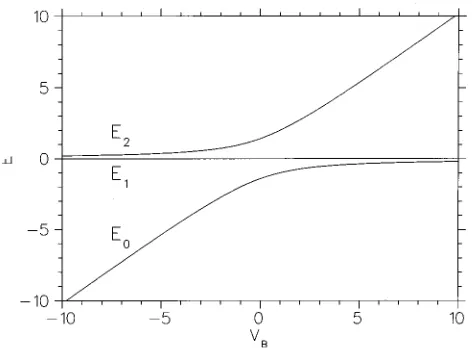
expres-sion similar to Eq. ~52!: the main difference is that the barrier-dependent term under the root decreases exponen-tially with VB, not algebraically. Nevertheless, the overall
behavior of the eigenvalues is correct. In Fig. 2, the spectrum is shown for a wide range of values of the barrier height VB. For VB→`, the wells decouple and the energy splitting
equals the potential asymmetry DE5DV. The eigenstates
c(0)andc(1)are now localized on the left and on the right of
the barrier, respectively ~provided that DVÞ0!, as can be seen from the ‘‘spatial’’ structure of the three-component eigenfunctions ofH,
c0~j!
5h21
F
h221S
VB3 2
DV
2 1Ej
D
22
1
S
VB3 21
DV
2 1Ej
D
22
G
1/2,
c~6j1!
52h
S
1 3VB7
DV
2 1Ej
D
21
c0~j!
. ~53!
For finite VB and a slight asymmetryDV, the eigenstates of
H are almost symmetric and antisymmetric under reflection at the origin, as illustrated in Fig. 3. For vanishingDV,
par-ity Pˆ is a conserved quantity and the states are~anti! symmet-ric under spatial inversion, also following from Eq.~53! by taking the limitDV→0.
The physical meaning of the splitting DE easily emerges
from looking at the time evolution of statescL,R(t) initially
localized in a well: uckL(0)u2
5d21,k @or uck R(0)u2
5d11,k#.
For small DV the initial states cL,R(0) are well
approxi-mated by a superposition of the two first eigenstates
cL,R~0!' 1 &~c
~0!
6c~1!!. ~54!
The time evolution of this state reads
cL~t!' 1 &~c
~0!e2iE0t/\
1c~1!e2iE1t/\!
5
1
&~c
~0!
1c~1!e2iDEt/\!e2iE0t/\. ~55!
Upon comparison with Eq. ~54!the localized states are seen to evolve into each other:cL→cR→cL, with a
characteris-tic tunneling frequencyDE/\, apart from a physically irrel-evant phase.
While the states at the bottom, c(0) andc(1), agree well
with those of the continuous system, the state c(2) is
cen-tered about the saddle at the origin, k50. This indicates that the present approach is closely related to the method of tight
binding@28#: the states of an atomic lattice are approximated by superposing wave functions localized at individual atoms. In this sense, the discrete potential should be thought of as providing three local minima at k561 and k50 instead of two wells and a saddle in between. Apart from this discrep-ancy, the discrete approximation of a double well indeed reproduces qualitatively the important features of the states at the bottom of the continuous system.
FIG. 2. Eigenvalues of the discrete system as a function of the barrier height VB for the symmetric double well,DV50. The en-ergy axis has been shifted by an amount VG522h so that the barrier-independent eigenvalue is zero, E150; units are such that
[image:7.612.57.293.58.232.2]h51.
FIG. 3. Eigenstates of the discrete double-well model:~a!symmetricDV50, and~b! asym-metric case DV50.2. The dashed lines are for easy comparison with the wave functions of the continuous double well. Note the large value of
B. Driven system
This section deals with the eigenvalue equation of the operatorS,
Suw~j!
&
5e2isjuw~j!
&
, j50,1,2 ~56!replacing the Floquet equation~22!sinceF5S2. Explicitly,
S5Pexp~2iHT/2\ !, ~57!
where H is the Hamiltonian with a fixed time-independent asymmetry according to Eq. ~47!, since the piecewise con-stant approximation~13!of the driving forceDV(t) has been
used. Since the operators P andH do not commute for an asymmetryDVÞ0, there is no common basis to diagonalize them simultaneously. Only then is the product ~57! easily transformed into a single exponential. The operatorScan be understood as a product of two finite transformations in the group U~3!. Unfortunately, a general Baker-Campbell-Hausdorff formula seems not to be available for this group, although results to disentangle exponents have been obtained
@29#. This situation is in contrast to the group SU~2!where a closed form for the product is known@30#. Nevertheless, the eigenvalues and the eigenstates ofScan be determined ana-lytically, as indicated in Appendix B, since the characteristic polynomial ofSis of third order for the discrete model. To this end it is convenient to introduce the operator S˜ which differs fromSby a factor,
S˜5eisS, eis5~detS!21/3
5ei~ s01s11s2!/3. ~58!
It has unit determinant
detS˜5e3is detS51, ~59!
so thatS˜ is an element of the group SU~3!. The new phases s
˜j are shifted with respect to the old ones by the amounts,
s
˜j5~sj1s! mod 2p, ~60!
having the property s
˜01s˜11˜s250 mod 2p. ~61!
Explicitly, in terms of S˜, one obtains the characteristic polynomial:
l3
2~TrS˜ )l2
1xl2detS˜50. ~62!
The coefficient x is easily determined: It follows from the unitarity of S˜ that its eigenvalues are complex numbers of modulus one, hence the inverse oflequals its complex con-jugate, l21
5l*. When taking into account Eq. ~59! one finds that the characteristic polynomial is invariant under a multiplication with2l23and subsequent complex
conjuga-tion. A comparison of coefficients then reveals that x
5(TrS˜)*. Thus the characteristic polynomial reads
l3
2~Tr S˜!l2
1~TrS˜!*l2150. ~63!
A simple expression for the trace ofS˜ follows if it is evalu-ated in the eigenbasis of the HamiltonianHin Eq.~47!of the undriven system:
TrS˜5
(
j51 3^
c~j!ueisPexp~2iHT/2\ !uc~j!
&
5
(
j51 3
e2i~EjT/2\2s !
^
c~j!uPuc~j!&
, ~64! containing the expectation values of the parity operator. Its modulus obviously has the property uTrS˜u<3. Explicit ex-pressions of the eigenphasess˜jofS˜ are not illuminating due
to their involved dependence on the parameters of S˜ via its trace in Eq. ~64!. In Fig. 4, the eigenphases s˜
j and the
quasienergies«j, respectively, are plotted as functions of the
strength of the asymmetry while keeping the period T and the barrier height fixed. The quantitiess˜jvary with a degree
of complexity as a function of DV which is surprising in
light of the simplicity of the underlying model. They do not cross each other which, however, does not exclude the de-generacy of quasienergies. Before turning to the discussion of degenerate quasienergies, a geometric interpretation of the condition
TrS˜5e2is˜
11e2is˜21e2is˜35z ~65!
will be given. Consider z5Reia as a vector in the complex plane with lengthuzu,3. For a solution of Eq.~65!one has to find three unit vectors$e2is˜
j%which must combine to give
the vector z. This is always possible for a one-parameter family of angles $s˜
j%. Then one has to select that particular
solution which leads to the correct value of detS˜51.
C. Coherent destruction of tunneling
In this section we focus our interest on crossings of quasienergies. They are related to the effect of coherent de-struction of tunneling @15#, corresponding to the relocaliza-tion of a tunneling state in a potential well at stroboscopic times t5T,2T,... . As seen in Fig. 4, the quasienergies«j
may degenerate for specific values of the asymmetry without a crossing of the phases s˜j ~or sj!. More precisely, the
re-lation betweensj and«j implies that quasienergies do cross
if one of the following conditions is fulfilled: ~a! s˜
j 5s˜k mod 2p, or ~b! s˜j5(s˜k1p) mod 2p. These
conditions also apply to the original phasessj. Generically,
in order to realize condition~a!, which means to have a de-generate eigenvalue exp(2is˜
j), the variation of two system
parameters is required. This follows from the fact that the matrix S˜ belongs to the orthogonal ensemble of symmetric unitary matrices according to Eq.~41! and a comparison of the number of free parameters for orthogonal matrices in the nondegenerate and degenerate case@31#, respectively. A geo-metric interpretation of the realization of condition~a!is ob-tained from looking at the corresponding expression for the trace ofS˜,
TrS˜5e2is˜j12e2is˜j. ~66!
The right-hand side of Eq.~66!describes a one-dimensional curve in the complex plane, shown in Fig. 5. In the generic case, the complex number z5TrS˜ is confined to remain inside the region defined by Eq.~66!.
In order to realize condition ~b! the variation of a single parameter is sufficient. In this case the difference between two phases˜s
0 ands˜1, say, has to be an odd multiple ofp.
In terms of the trace of the root operator this implies that Tr S˜5exp(2is˜
2) or
uTrSu5uTr S˜u51, ~67!
describing the unit circle in the complex plane~cf. Fig. 5!. In fact, a realization of Eq.~67!is already sufficient in order to fulfill condition ~b!as follows from writting down explicitly the roots lj of Eq.~63!,
$lj%5$TrS˜,6
A
2~TrS˜!*%. ~68!Therefore condition~67!determines the locus of degenerate quasienergies. Variation of a single parameter, 0<T<3, in-deed leads to such crossings as shown by the dashed line in Fig. 5, intersecting repeatedly the unit circle.
It is straightforward to obtain a global picture of the pres-ence of crossings in the parameter plane (DV,T), say. Figure
6~a!shows the contours of Tr S˜ with modulus equal to unity. Obviously, variation of a single parameter in the (DV,T)
[image:9.612.109.269.59.216.2]plane will generically result in a crossing, as has been argued before. The arrangement of lines in Fig. 6~a!for not too large
FIG. 5. The behavior of TrS˜ in the complex plane for fixed asymmetry (DV50.2) and varying period T is depicted by the dashed line. The quasienergies «jdo cross if~a!˜sj5s˜kmod 2p, TrS˜ falls on the threefold cycloid z5exp(2if)12 exp(2if), f
[image:9.612.321.556.61.399.2]P@0,2p), or if ~b! s˜j5s˜k1p mod 2p, TrS˜ falls on the unit circle, uzu51. The dashed line does not touch the cycloid since crossings of the phasess˜jare generically avoided.
FIG. 6. ~a! Contour plot of uTrS˜u51 for the parameters 0
<DV<12 and 0<T<10, showing the parameter values where a crossing of quasienergies occurs. ~b! Same as~a!restricted to the points where the degenerate Floquet eigenstates uw( j)&,uw(k)& are
values ofDV is a consequence of condition~b!. In the sym-metric case,DV50, the operatorPis diagonal in the eigen-basisuw( j )
&
of the nondriven system. For smallDV, theFlo-quet eigenstates uw( j )
&
are well approximated by the states uc( j )&
. Using Eqs. ~48!,~56!, and the definition ofP from Eq.~26!, one obtains approximate values of the eigenphases,
s
˜
j'
H
1
2 EjT/\1s1
S
0, j even
p, j odd
D
J
mod 2p. ~69!This equation together with condition~b!approximately re-produces the equidistant lines visible in Fig. 6~a!. However, a crossing of these contour lines is avoided, because it would imply a realization of condition~a!. The lines almost parallel to theDV axis correspond to the~alternating!realizations of condition ~b!, s˜j5(s˜k1p) mod 2p for ( j,k)5(0,2) and
( j,k)5(1,2). The ‘‘hyperbolic’’ branches correspond to the realizations of the same condition for ( j,k)5(0,1). From s
˜12s˜
0'DET/2\1p one finds the estimate
T'4pn\
DE , nPZ. ~70!
This reproduces the quasihyperbolic behavior T}DV21 vis-ible in Fig. 6, sinceDE'DV for sufficiently large
asymme-tryDV.
Another interesting feature appearing in Fig. 6 is the com-plete disappearance of quasi-energy crossings for large driv-ing amplitudeDV*VB. This effect is a consequence of the few-level discrete approximation scheme and it has no ana-log in the continuous system. From Eq. ~64! one estimates uTrS˜u< (u
^
P&
ju, where^
P&
j is the expectation value of theparity operator for the jth eigenstate of the asymmetric double well@cf. Eq.~53!#. For nonvanishing asymmetryDV
the modulus of
^
P&
j is less than unity since parity is not aconserved quantity in this case. At some threshold value uTrS˜ubecomes strictly smaller than one, hence the condition
~67! necessary for degenerate quasienergies cannot hold for large driving amplitude.
Being mainly interested in the tunneling behavior of states being localized in the wells, we now focus our attention on the quasienergy crossings of these states. Figure 6~b!shows an appropriately modified version of Fig. 6~a!, containing only crossings with sufficiently large localization of the cor-responding Floquet eigenstates in the wells: the localization probability of the~degenerate!eigenstatesuw( j)
&
,uw(k)&
isre-quired to be greater than that of the third eigenstateuw(l)
&
,uw61
~j! u2,uw
61
~k! u2>uw
61
~l!
u2. ~71!
For 4&DV&10.5, not only the ‘‘hyperbolic’’ branches in Fig. 6~b! ~associated with the resonances T54pn/DE in the
undriven system!induce crossings of quasienergies, but the other branches contribute as well. It appears that a crossing of quasienergies enhances the localization probability of the corresponding Floquet eigenstates in the wells.
D. The effective Hamiltonian
In this section we give an alternative physical interpreta-tion of the effect of the time-dependent driving term in the
discrete model. To this end we introduce an effective, time-independent Hamiltonian Heff producing the same strobo-scopic dynamics of the driven system as does the Hamil-tonian H(t) in Eq.~9!, i.e.,
F5exp
S
2 i\ H
effT
D
. ~72!Knowledge of a Baker-Campbell-Hausdorff relation for SU~3!would explicitly provide the operatorHeffin terms of
H0 andP. SinceHeffis the logarithm ofF, it is not uniquely
defined in general. However, a natural choice of Heff is to have it coincide with the symmetric Hamiltonian H0 in Eq. ~10!in the nondriven case for vanishing asymmetry DV,
Heff
5H01DH, ~73!
where DH50 if DV50. Because of its invariance under generalized time reversal, the effective Hamiltonian com-mutes with the antiunitary operator PK,
@Heff,PK#50. ~74!
In this picture, the eigenvalues Eeffj are related to the quasien-ergies by «j5(Ej
eff
T/\) mod 2p, and a crossing corre-sponds to a resonance
~Ejeff2Ekeff!T/\52pn, jÞk,nPZ. ~75!
Express the effective Hamiltonian in the basis of the fun-damental representation@32#of SU~3!,
Heff
5a011
(
k51 8
aklk ~ak real!, ~76!
with the traceless Gell-Mann (333) matriceslk, the
gen-erators of the group. Due to the invariance under generalized time reversal~74!the nine real coefficients ak are not
inde-pendent:
a15a6, a25a7, and a352)a8. ~77!
Thus six parametersak completely characterize both the
ef-fective Hamiltonian Heff and the Floquet matrix F. In the
nondriven case, Heff5H0, the coefficients ak are related to
the system parameters by a052h1VG1VB/3, a152h,
a352h/21VB, a25a45a550.
Let us determine the explicit form of the effective Hamil-tonian in the high-frequency limit T→0. From Eq.~27!and
the driving approximation~13!we have that
exp
S
2i
\ H
effT
D
5exp
S
2i
2\ PHPT
D
expS
2i
2\ HT
D
, ~78!withHfrom Eq.~47!. Using the Baker-Campbell-Hausdorff formula @33#
eAeB5eA1B1~1/2!@A,B#2~1/12!~†A,@A,B#‡1†@A,B#,B‡!1•••
~79!
DH5h D
VT
8\ ~ l21l7!1h
~ DV T!2
48\2 ~ l11l6!
1O„~ DVT/\ !3…, ~80!
which respects the antiunitary symmetry ~77!. An explicit calculation of the energy eigenvalues of the effective Hamil-tonian ~along the same lines as in Sec. IV A! results in an expression for the tunnel splitting DE similar to Eq. ~51!: one only has to replace
h2→~heff!2
5h2@11~ DVT!2/40\2#
1O„~ DVT/\ !3…. ~81!
Consequently, in the limit of high frequency (T→0) the driving force effectively decreases the height of the potential barrier,
VB eff'
VB@12~ DVT!2/40\2#,VB, T→0. ~82!
A decrease of the effective potential barrier in the high-frequency limit is also found for the continuous system@7#.
V. SUMMARY
In this paper, we have studied a simple discrete model of a periodically driven particle in a double-well potential. Tak-ing into account all the relevant symmetries, time periodic-ity, generalized parperiodic-ity, and generalized time reversal, a natu-ral decomposition of the Floquet operator and an associated normal form of its eigenfunctions has been presented. A dis-cussion of quasienergy crossings, motivated by the effect of coherent destruction of tunneling, has revealed that they are closely related to the resonances of the non-driven asymmet-ric double-well system. The results qualitatively agree to a large extent with those of the continuous model, as far as they are known.
ACKNOWLEDGMENTS
This work was supported by Schweizerischer National-fonds. Discussions with H. Thomas related to the physical interpretation of the discrete model are acknowledged.
APPENDIX A: NORMAL FORM OF ANTIUNITARY OPERATORS
Any antiunitary operator Aˆ can be written as
Aˆ5Uˆ Kˆ, ~A1!
where Kˆ is complex conjugation ~in some basis! and Uˆ is unitary @25#. Eigenstates of Aˆ are constructed from those of the unitary operator Lˆ5Aˆ2
5Uˆ Uˆ*. Ifuv0
&
is an eigenstateof Lˆ with eigenvalue 1,
Lˆuv0
&
5uv0&
, ~A2!then the state
uv
&
5H
c~uv0
&
1Aˆuv0&
! if Aˆuv0&
Þ2uv0&
c~uv0&
1iAˆuv0&
! if Aˆuv0&
52uv0&
~A3!
is obviously an eigenstate of the operator Aˆ . In the context of this paper, the operator Uˆ in Eq.~A1!is to be identified@cf. Eq.~34!#with spatial reflection Pˆ , and the operatorLˆ equals
the identity. If the eigenvalue of the eigenstate uv0
&
of Lˆ isdifferent from one, the operator Aˆ does not have eigenstates—instead a set of ‘‘characteristic vectors’’ @25#
can be associated with it.
APPENDIX B: ANALYTICAL DETERMINATION OFSAND ITS EIGENVALUES
The knowledge of the eigenbasis and eigenvalues of the time-independent asymmetric Hamiltonian H in Eq. ~9! al-lows one to explicitly calculate the matrix Sdefined in Eq.
~57!:
S5PUdiag~e2iE0T/2\,e2iE1T/2\,e2iE2T/2\!U†. ~B1!
Here, the unitary transformationUis composed of the eigen-basis ofH, Eq.~53!:Ujk5ck22
( j21)
, j,k51,2,3. The eigenval-ues EjofHare inserted from Eq.~49!. In principle, one can
obtain the eigenvalues exp(2isj) and eigenstates in closed
form, since the characteristic polynomial ofS˜ in Eq.~63!is of third order. However, we refrain from presenting the ex-plicit results because the rather involved expressions do not offer much insight.
@1#W. H. Miller, J. Phys. Chem. 83, 960~1979!.
@2#C. G. Callan and S. Coleman, Phys. Rev. D 16, 1762~1977!.
@3#H. Kleinert, Pfadintegrale in Quantenmechanik, Statistik und Polymerphysik~BI-Wissenschaftsverlag, Mannheim, 1993!.
@4#H. Kalka and G. Soff, Supersymmetrie ~Teubner, Stuttgart, 1997!.
@5#W. Y. Keung, E. Kovacs, and U. P. Sukhatme, Phys. Rev. Lett.
60, 41~1988!.
@6#A. Gangopadhyaya, P. K. Panigrahi, and U. P. Sukhatme, Phys. Rev. A 47, 2720~1993!.
@7#F. Grobmann, P. Jung, T. Dittrich, and P. Ha¨nggi, Z. Phys. B
84, 315~1991!.
@8#W. A. Lin and L. E. Ballentine, Phys. Rev. A 45, 3637~1992!.
@9#R. Bavli and H. Metiu, Phys. Rev. Lett. 69, 1986~1992!.
@10#D. Farrelly and J. A. Milligan, Phys. Rev. E 47, R2225~1993!.
@12#F. Grobmann and P. Ha¨nggi, Europhys. Lett. 18, 571~1992!.
@13#L. Wang and J. Shao, Phys. Rev. A 49, R637~1994!.
@14#Y. Kayanuma, Phys. Rev. A 50, 843~1994!.
@15#F. Grobmann, T. Dittrich, P. Jung, and P. Ha¨nggi, Phys. Rev. Lett. 67, 516~1991!.
@16#A. Garg, Europhys. Lett. 22, 205~1993!.
@17#S. Weigert, Phys. Rev. A 50, 4572~1994!.
@18#R. P. Feynman, The Feynman Lectures on Physics~ Addison-Wesley, Reading, MA, 1965!, Vol. III, Chap. 13–1.
@19#Pocketbook of Mathematical Functions, edited by M. Abramowitz and I. A. Stegun~Harri Deutsch, Thun, 1984!.
@20#V. I. Arnold, Mathematical Methods of Classical Mechanics
~Springer, Berlin, 1991!, Sec. 5.4.
@21#E. D. Yorke, Am. J. Phys. 46, 285~1978!.
@22#G. Casati and L. Molinari, Prog. Theor. Phys. Suppl. 98, 287
~1989!.
@23#O. Bohigas, in Chaos and Quantum Physics, edited by M.-J. Giannoni, A. Voros, and J. Zinn-Justin~North-Holland,
Am-sterdam, 1991!, p. 87.
@24#H. P. Breuer, K. Dietz, and M. Holthaus, Z. Phys. D 8, 349
~1988!.
@25#E. Wigner, J. Math. Phys. 1, 409~1960!.
@26#M. L. Mehta, Random Matrices and the Statistical Theory of Energy Levels~Academic Press, New York, 1967!.
@27#D. Boyanovsky, R. Wiley, and R. Holman, Nucl. Phys. B 376, 599~1992!.
@28#N. W. Ashcroft and N. D. Mermin, Solid State Physics~ Saun-ders College, Philadelphia, 1976!, Chap. 10.
@29#K. Rhagunathan, M. Seetharaman, and S. S. Vasan, J. Phys. A
22, L1089~1989!.
@30#R. Gilmore, Lie Groups, Lie Algebras, and Some of Their Ap-plications~John Wiley & Sons, New York, 1974!, Sec. 5.VI.1.
@31#J. v. Neumann and E. Wigner, Phys. Z. 30, 467~1929!.
@32#M. Gell-Mann and Y. Ne’eman, The Eightfold Way, Frontiers in Physics Vol. 17~Benjamin, New York, 1964!.