This is a repository copy of
Density-functional theory and the v-representability problem for
model strongly correlated electron-systems
.
White Rose Research Online URL for this paper:
http://eprints.whiterose.ac.uk/3993/
Article:
Godby, R.W. orcid.org/0000-0002-1012-4176 and Schindlmayr, A. (1995)
Density-functional theory and the v-representability problem for model strongly correlated
electron-systems. Physical Review B. pp. 10427-10435. ISSN 2469-9969
https://doi.org/10.1103/PhysRevB.51.10427
[email protected] https://eprints.whiterose.ac.uk/ Reuse
Items deposited in White Rose Research Online are protected by copyright, with all rights reserved unless indicated otherwise. They may be downloaded and/or printed for private study, or other acts as permitted by national copyright laws. The publisher or other rights holders may allow further reproduction and re-use of the full text version. This is indicated by the licence information on the White Rose Research Online record for the item.
Takedown
If you consider content in White Rose Research Online to be in breach of UK law, please notify us by
promoting access to White Rose research papers
Universities of Leeds, Sheffield and York
http://eprints.whiterose.ac.uk/
White Rose Research Online URL for this paper:
http://eprints.whiterose.ac.uk/3993
Published paper
Schindlmayr, A, Godby, RW (1995) Density-functional theory and the
v-representability problem for model strongly correlated electron-systems
Physical Review B 51 (10427-10435)
arXiv:cond-mat/9709266v1 [cond-mat.str-el] 24 Sep 1997
Density-functional theory and the
v
-representability problem for model strongly
correlated electron systems
Arno Schindlmayr and R. W. Godby
Cavendish Laboratory, University of Cambridge, Madingley Road, Cambridge CB3 0HE, United Kingdom
(Received 28 November 1994)
Inspired by earlier work on the band-gap problem in insulators, we reexamine the treatment of strongly correlated Hubbard-type models within density-functional theory. In contrast to previous studies, the density is fully parametrized by occupation numbersand overlap of orbitals centered at neighboring atomic sites, as is the local potential by the hopping matrix. This corresponds to a good formal agreement between density-functional theory in real space and second quantization. It is shown that density-functional theory is formally applicable to such systems and the theoretical framework is provided. The question of noninteractingv representability is studied numerically for finite one-dimensional clusters, for which exact results are available, and qualitatively for infinite systems. This leads to the conclusion that the electron density corresponding to interacting sys-tems of the type studied here is in factnotnoninteractingvrepresentable because the Kohn-Sham electrons are unable to reproduce the correlation-induced localization correctly.
I. INTRODUCTION
Originally formulated in the 1960s, density-functional theory (DFT) has since become the most widely used method for electronic-structure and total-energy calcula-tions. It is a general theory that is applicable to finite molecular systems as well as to bulk solids and, unlike other computational methods, it has the distinct advan-tage of being in principle an exact theory that takes the electronic interaction fully into account. Density-functional theory is based on the observation that the total energy and other characteristic ground-state prop-erties of a system of interacting electrons in an external potential can be considered as unique functionals of the one-particle density n(r), which then replaces the wave
functions as the basic variable.
Although potentially powerful, the original Hohen-berg-Kohn theorem1 does not provide a simple recipe
to calculate the ground-state density of the interacting electron system, so that practical applications of density-functional theory rely on the Kohn-Sham scheme,2 in
which the interacting system is replaced by a fictitious system of noninteracting electrons with the same spa-tial density moving in an effective potenspa-tial. The central
assumption is that such an equivalent system of nonin-teracting electrons always exists, i. e., that all innonin-teracting
vrepresentable densities are also noninteractingv repre-sentable.
In the Kohn-Sham scheme, the total energy is split into several contributing functionals, all but one of which are either known explicitly or can be replaced by other well-known terms. The essential unknown quantity is the exchange-correlation energyExc[n], a universal
func-tional of the density, and its funcfunc-tional derivative, the exchange-correlation potentialVxc([n];r).
Although, unfortunately, the exact analytic expression for the exchange-correlation energy remains unknown,
many properties of the functional have been cataloged.3 One of the more surprising features is a finite disconti-nuity in the exchange-correlation potential with respect to particle number,4 which has the effect that even
ex-act density-functional theory will underestimate the band gap of semiconductors. The question whether the poor agreement between density-functional calculations and the true band gap is indeed mainly due to this discon-tinuity or rather to additional approximations such as the local-density approximation (LDA) is known in the literature as the band-gap problem.
The Hubbard model, a simple second-quantization model for strongly correlated electrons, may be solved exactly for small clusters and so could be used to explore the properties of exact density-functional theory. This was done by Gunnarsson and Sch¨onhammer in a study of the band-gap problem5 and subsequently for comparing
the Kohn-Sham Fermi surface with the exact quasiparti-cle Fermi surface.6 In their second-quantization version
of density-functional theory, the density is replaced by the occupation numbers only and the place of the exter-nal potential is taken by the diagoexter-nal on-site energies, whereas all nondiagonal hopping parameters are treated as constants. This is a consistent approach to correlated systems, but it does not follow the second quantization of the operators in question.
under the Kohn-Sham scheme. These findings should be of particular interest since the results of the above-mentioned model calculations have often been cited in connection with the properties of real-space function-als, especially the band-gap problem:7 Gunnarsson and
Sch¨onhammer found that the discrepancy between the true band gap and the energy-eigenvalue gap derived by density-functional theory using the LDA was mainly due to the LDA itself rather than to the discontinuity in the exchange-correlation potential; the opposite was found in a study of more realistic semiconductor models by Godby, Schl¨uter and Sham.8
In Section II we will establish a formulation of density-functional theory appropriate for the Hubbard model and prove the fundamental theorems. In Section III we will examine the influence of correlation and the external po-tential on the density and highlight the importance of overlap between orbitals centered at different sites. In Section IV we will discuss the question ofv representabil-ity and demonstrate that the ground-state densrepresentabil-ity of the interacting Hubbard model and of related models is not
noninteractingvrepresentable.
II. FORMALISM
A. The Hubbard model
The Hubbard Hamiltonian9 is given by
ˆ
H=X
hiji
X
σ
tijc†iσcjσ+U
X
i
ˆ
ni↑ˆni↓. (1)
The index i labels the atomic sites and the summation overhijiincludes all pairs up to nearest neighbors. σ∈ {↑,↓}denotes the two spin orientations.
The first part of the Hamiltonian represents the con-tribution due to the kinetic energy and the external (pseudo)potentialVext(r) and is responsible for the
elec-trons hopping between the atomic sites. c†iσ and ciσ are
the creation and annihilation operators for an electron at site i with spin σ, respectively. The hopping-matrix elementstij are real and satisfy the symmetry condition tij = tji. They are the representation of the external
potential in second quantization and are related to it by
tij=
Z
φ∗(r−Ri)
− ¯h
2
2me
∇2+Vext(r)
φ(r−Rj)dr,
(2) whereφ(r−Ri) is the Wannier-type orbital centered at Ri of the system in question. The existence of these
orbitals underlies second quantization, but their actual analytic form is of no consequence for the numerical work presented below.
The second contribution to the Hamiltonian represents the on-site Coulomb repulsion, which acts between two
electrons occupying the same atomic site. ˆniσ≡c†iσciσ is
the particle-number operator for sitei and spin σ. The interaction parameter U is real andU > 0. Its value is given by
U = 1 2
Z Z e2
4πε0
|φ(r)|2|φ(r′)|2
|r−r′| drdr
′. (3)
When discussing the adjusted density-functional for-malism in this section, we will always refer to the Hub-bard Hamiltonian in the general form (1) without spec-ifying the dimensionality or configuration of the system. In particular, no spatial symmetries are assumed, so the formalism holds for lattices as well as for finite or dis-ordered systems. In the latter case, the occurence of different Wannier orbitals may lead to a site-dependent interaction parameter, but this is not in conflict with the general formalism. M denotes the number of sites and
N is the number of electrons.
As a prerequisite of density-functional theory, it is es-sential to define the density in a proper way. As for the Hamiltonian, we assumed that overlap of the Wannier orbitals was negligible except between neighboring sites, and this assumption must be retained for consistency. The density corresponding to some state|Ψiwill there-fore be of the general form
n(r) =hΨ|nˆ(r)|Ψi=X
hiji
nijφ∗(r−Ri)φ(r−Rj). (4)
The density operator ˆn(r) is given by
ˆ
n(r) =X
hiji
X
σ
φ∗(r−Ri)φ(r−Rj)c†
iσcjσ (5)
in second quantization and the density is thus parame-trized by the coefficients
nij =
X
σ
hΨ|c†iσcjσ|Ψi. (6)
The diagonal elements ni ≡nii are just the orbital
oc-cupation numbers, but we are also left with off-diagonal elements. Strictly speaking, the dependence of the total energy on the density coefficients is that of a function rather than a functional, but for clarity, we will con-tinue talking about density functionals. It should then be borne in mind that all densities to be considered are of the form (4).
B. The Hohenberg-Kohn theorem
The analog of the Hohenberg-Kohn theorem in this formalism incorporates three important statements.
(i) The ground-state expectation value of any observ-able ˆOis a unique functionalO[nGS] of the ground-state
electron densitynGS.
(ii) The ground-state densitynGSminimizes the
total-energy functionalE[n].
(iii) The total-energy functional can be written in the form
E[n] =F[n] +X
hiji
tijnij (7)
whereF[n] is auniversal functional of the density. In proving these statements, we have largely followed the procedure given by Levy.10Throughout, the ground
state is assumed to be nondegenerate, but the formalism can be extended to cover degenerate ground states in much the same way as conventional density-functional theory.11First, we define the energy functional by
E[n] := min
|Ψi→nhΨ|
ˆ
H|Ψi. (8)
The constraint|Ψi →nmarks all antisymmetricN-body wave functions that yield the densitynas defined above. This functional is properly defined for allN-representable densities, i. e., all densities that can be constructed from
N-fermion wave functions. In particular, this includes all ground-state densities studied here. The variational principle then guarantees that the ground-state density indeed minimizesE[n].
At the same time, the definition (8) constitutes a map
nGS 7→ |Ψ[nGS]i, where |Ψ[nGS]i denotes the N-body
wave function that yields the ground-state density nGS
of a particular system and minimizes the energy. We can therefore properly define the ground-state expecta-tion value of an arbitrary observable ˆOas a functional of the ground-state density by
O[nGS] :=hΨ[nGS]|Oˆ|Ψ[nGS]i. (9)
The single-particle contribution to the functionalE[n], which we will henceforth term the hopping energy, can be essentially simplified. Using the explicit form of the Hubbard Hamiltonian and the definition of the density coefficients, (8) can be transformed into the expression
E[n] =X
hiji
tijnij+ min
|Ψi→n
* Ψ UX i ˆ
ni↑nˆi↓
Ψ + . (10)
We can now define the observable ˆF by ˆ
F :=UX i
ˆ
ni↑ˆni↓ (11)
and thereby obtain the form (7). F[n] is universal in the sense that it is independent of the particle number and the external potential. The upper limit in the sum overi
need not be specified because the number of sites enters through the constrained search over the wave functions that yield the density n. Finally, the interaction U is fixed through its definition (3). This completes the proof of the Hohenberg-Kohn theorem.
C. The Kohn-Sham scheme
The second part of the Hohenberg-Kohn theorem sug-gests that if we knew the exact analytic form ofE[n], we could find the ground-state energy by a variational prin-ciple that minimizes the functional under the constraint of particle conservation, but it does not provide a prac-tical procedure to do so. Rather, the constrained search over the wave functions leaves us with another compli-catedN-body theory.
The essential simplification is obtained by the Kohn-Sham scheme, whichassumes that the ground-state den-sitynGSof the Hamiltonian (1) can alternatively be
gen-erated by the ground state of a fictitious system of nonin-teracting electrons moving in an effective potential. This is known as the assumption of noninteracting v repre-sentability. The equivalent system can be used to calcu-late the exact ground-state energy and the mathematical expense is reduced to an effective one-particle problem. This one-particle Hamiltonian is given by
ˆ
Hs=
X
hiji
X
σ
teffijc†iσcjσ. (12)
TheN-body ground state is supposed to be nondegene-rate. Following the central assumption stated above, the hopping parameters are chosen so that the ground-state density matches that of the interacting system. In this case, the density coefficients are given by
nGS ij = N X γ=1 X σ
hψγ|c†iσcjσ|ψγi (13)
in terms of the one-particle wave functions that corre-spond to theN lowest energy eigenvaluesǫγ of ˆHs. The
ground-state energy of the noninteracting system is a functional ofnGSand can be written directly as
Es[nGS] = N
X
γ=1 ǫγ=
X
hiji
teffijnGSij . (14)
Due to the Hohenberg-Kohn theorem, this functional has to be stationary under infinitesimal density variationsδn
within the domain of validN-fermion densities: 0 =δEs=
X
hiji
teffijδnij. (15)
In order to map the interacting electrons onto the non-interacting system, we start by separating a Hartree term out of the total-energy functional (8):
E[n] =X
hiji
tijnij+ U
2
X
i
n2i +Exc[n]. (16)
The exchange-correlation functionalExc[n] incorporates
Exc[n] :=F[n]− U
2
X
i
n2i. (17)
At the ground-state density,E[n] must also be stationary under infinitesimal variationsδn that correspond to N -fermion densities:
0 =δE=X
hiji
tij+U δijnGSi +vxcij[nGS]
δnij, (18)
where vxc
ij[nGS] denotes the elements of the
exchange-correlation matrix, which is defined by
vxc
ij[nGS] :=
∂Exc[n] ∂nij
n=nGS
. (19)
By comparison with (15), the effective hopping-matrix elements can now be uniquely defined as
teffij :=tij+U δijniGS+vxcij[nGS]. (20)
This expression for the effective potential can be used to calculate the ground-state electron density in a self-consistent manner. The total energy can eventually be calculated from (16). As usual, it is possible to replace the term that contains the kinetic energy using the eigen-values ǫγ of the one-particle Schr¨odinger equation, but
this is not advisable here because the hopping term is already of the simplest possible form.
In principle, splittings of the total energy other than (16) are possible. In Ref. 5 the hopping term is treated much like the kinetic energy in the conventional formal-ism. Hence the functional E[n] splits into the hopping energy of the corresponding system with U = 0, the Hartree term, and an exchange-correlation energy defined in a different way from the one used here. However, only the formulation introduced here shows the distinct fea-ture that the termF[n] is auniversalfunctional indepen-dent of the external potential, in practice a prerequisite for any systematic application of density-functional the-ory, and a feature of density-functional theory for real systems. We therefore believe that our formulation of density-functional theory is the natural counterpart of that used forab initio calculations.
D. The problem ofv representability
The conceptual idea of the Kohn-Sham scheme, con-structing the ground-state density by means of a system of noninteracting electrons, ultimately leads to the ques-tion ofvrepresentability. As a definition, we call a den-sity interacting v representable if it corresponds to the ground state of a Hamiltonian of the form (1), which in-cludes a specified on-site interaction term. On the other hand, a density that corresponds to the ground state of a one-particle Hamiltonian of the form (12) is called non-interactingvrepresentable.
The functionals in second quantization differ from those in the continuum formulation and we cannot hope to transfer any previous findings on the question ofv rep-resentability. The constrained search guarantees that all functionals are well defined for arbitraryN-representable densities, which includes both interacting and noninter-actingvrepresentable densities, but the crucial question is whether the ground-state density of a given interacting system indeed minimizes a corresponding Kohn-Sham en-ergy functionalEs[n]. As there is no obvious indication
whether the two domains of interacting and noninter-actingvrepresentable densities overlap or even coincide, we have investigated this question by means of numeri-cal simulations and we have come to the conclusion that they are in fact largely distinct.
III. CORRELATION AND THE OVERLAP COEFFICIENTS
A. The effect of correlation
We consider a finite one-dimensional Hubbard chain at half-filling, which we solve numerically by exact diag-onalization. We assume the on-site energiesei ≡tii to
be zero and the other hopping parameters to be identical between all nearest neighbors:
ˆ
H =−t M−1
X
i=1
X
σ
c†iσc(i+1)σ+c†(i+1)σciσ
+U M
X
i=1
ˆ
ni↑nˆi↓
(21) witht >0. We give results for an eight-site chain here, a configuration that has a nondegenerate ground state for all choices oft and U. Calculations performed for other chain lengths have produced very similar results.
To visualize the effect of correlation, we fixt= 1 and calculate the ground-state energy and the density coef-ficients for different U. The results are shown in Table I. The total energyE(U) is the lowest eigenvalue of the Hamiltonian matrix,T(U) =−tPM−1
i=1 (ni(i+1)+n(i+1)i)
denotes the hopping energy andEH(U) = UPMi=1n2i/2
is the Hartree energy. The exchange-correlation energy is calculated fromExc(U) =E(U)−T(U)−EH(U).
We find that the occupation numbers ni = 1 exactly,
independent of U: the electrons are distributed evenly. On the other hand, the interaction obviously reduces the overlap between orbitals centered at different sites. The underlying physical reason is that the on-site Coulomb repulsion opposes the hopping of electrons to a site that is already occupied. The correlation thus reduces the electron fluctuations. For increasingU, the electrons be-come eventually localized on the atomic sites and the hopping energy approaches zero.
The localization effect that we have visualized here is just the mechanism that is responsible for the Mott
TABLE I. Energy and density coefficients of the eight-site Hubbard chain for t= 1 and selected values of U. The
in-creasing correlation reduces the overlap and thus leads to a strong localization of the electrons. In the limitU → ∞, the
orbital overlap reaches zero and the electrons are completely localized.
U = 0 U = 2 U = 4 U= 8 U → ∞
E(U) -9.52 -6.23 -4.24 -2.42 0.00 T(U) -9.52 -8.82 -7.19 -4.59 0.00
EH(U) 0.00 8.00 16.00 32.00 ∞
Exc(U) 0.00 -5.41 -13.05 -29.83 −∞
n1=n8 1 1 1 1 1
n2=n7 1 1 1 1 1
n3=n6 1 1 1 1 1
n4=n5 1 1 1 1 1
n12=n78 0.862 0.793 0.641 0.408 0.000
n23=n67 0.495 0.455 0.370 0.238 0.000
n34=n56 0.758 0.714 0.589 0.376 0.000
n45 0.529 0.484 0.391 0.249 0.000
metal-insulator transition,12 although it has been shown
that a true phase transition does not occur for finite U: the half-filled Hubbard chain is a conductor for U = 0 and a Mott insulator otherwise.13
B. The importance of the overlap parameters
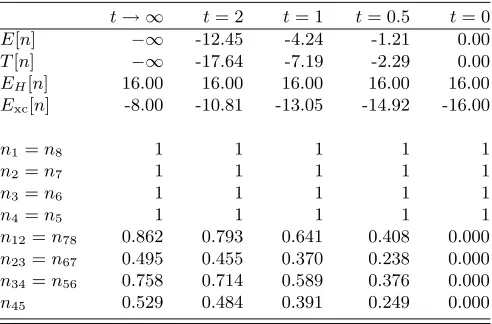
The possibility of electrons hopping between neighbing atomic sites requires a significant overlap of the or-bitals. On the mathematical side, this overlap explicitly enters the expression for the hopping parameters (2). It is therefore both qualitatively and quantitatively an im-portant feature of the system. For reasons of consistency, one must use overlap coefficients as well as occupation numbers to parametrize the density. On the other hand, it might be argued that the overlap contribution to the density in real space was negligible due to the strong lo-calization of the Wannier-type orbitals. Although this argument might seem plausible if the Wannier states are chosen to resemble the localizeddorbitals found in tran-sition metals, there is more to be said: the energy as a functional of the density depends very sensitively on the overlap coefficients and it is therefore essential to include those in all practical applications. To clarify this point, we now hold the parameter U = 4 fixed and varyt. Re-sults are given in Table II. The density coefficients are the same as in Table I, because they depend on the ratio
t/U only.
As the interaction is now specified by fixingU, all en-ergy expectation values are unique functionals of the den-sity due to the Hohenberg-Kohn theorem. The important point to note is that for this particular configuration, the occupation numbers are identical regardless of the exter-nal potential represented byt,but the overlap coefficients are not, which allows us to identify their influence. As
for the hopping energy, the dependence on the overlap is known explicitly:
T[n] =−t M−1
X
i=1
ni(i+1)+n(i+1)i
. (22)
The exchange-correlation energy Exc[n] also varies, but
its dependence on the overlap is much more subtle. When applying the Kohn-Sham scheme, whether in exact or ap-proximate density-functional theory, we must thus make sure to reproduce both the exact occupation numbersand
overlap coefficients of the interacting system.
In the formalism used in Ref. 5, T[n] is equal to the hopping energy of the corresponding system with zero interaction and would therefore be proportional to t, whereas the Hartree term is constant if the occupation numbers are. The sum of both then changes linearly witht. However, from the values given in Table II, it is clear that the total energy is not linear. The exchange-correlation energy must therefore depend sensitively on
t, which is treated as a parameter. If an analytic approxi-mation is used rather than the exact functional, it should definitely show this feature. It is then clear that an ap-proximation such as the “local-density apap-proximation” defined by Eq. (2) in Ref. 5, which depends only onU
and on the occupation numbers and so is independent of
t, has a fundamental flaw not shared by the normal LDA for real systems. Results that depend on making a con-nection between such an approximation and the LDA for real systems, such as the conclusions of Ref. 5 regarding the LDA band-gap error, are therefore questionable.
TABLE II. Energy and density coefficients of the eight-site Hubbard chain forU = 4 and selected values oft. As the
oc-cupation numbers remain constant, the change in the energy values reflects the dependence of the functionals on the non-diagonal density coefficients.
t→ ∞ t= 2 t= 1 t= 0.5 t= 0
E[n] −∞ -12.45 -4.24 -1.21 0.00
T[n] −∞ -17.64 -7.19 -2.29 0.00
EH[n] 16.00 16.00 16.00 16.00 16.00 Exc[n] -8.00 -10.81 -13.05 -14.92 -16.00
n1=n8 1 1 1 1 1
n2=n7 1 1 1 1 1
n3=n6 1 1 1 1 1
n4=n5 1 1 1 1 1
n12=n78 0.862 0.793 0.641 0.408 0.000
n23=n67 0.495 0.455 0.370 0.238 0.000
n34=n56 0.758 0.714 0.589 0.376 0.000
[image:7.612.317.563.550.712.2]IV. RESULTS AND DISCUSSION
A. Numerical studies for small M
In order to test the existence of effective hopping pa-rameters and thereby decide the question of noninteract-ingvrepresentability, we set up a trial Hamiltonian ma-trix and use iterative nonlinear optimization techniques to vary the effective on-site energies and nearest-neighbor hopping parameters so as to reproduce as closely as pos-sible the density coefficients of the interacting electron system. Occupation numbers and nearest-neighbor over-lap coefficients are taken into account. Both the potential and the density are thus characterized by two parameters per site. Considering the complete Hamiltonian (21), we can obtain an initial guess by setting U = 0. Table I indicates that the corresponding densities are relatively close and we can therefore safely assume this to be a good starting point. The eigenstates of the one-particle Hamiltonian ˆHsare calculated by exact diagonalization.
We have checked that the optimization is stable and in-sensitive to any reasonable choice of the initial guess.
We judge the quality of an approximation to the true density by summing the squared deviations between the approximate and the true density coefficients. Only the
M independent coefficients are considered; the rest is de-termined by the intrinsic symmetry nij = nji and the
spatial symmetry with respect the center of the chain. As the hopping parameters satisfy the same symmetry conditions, onlyM are in fact independent.
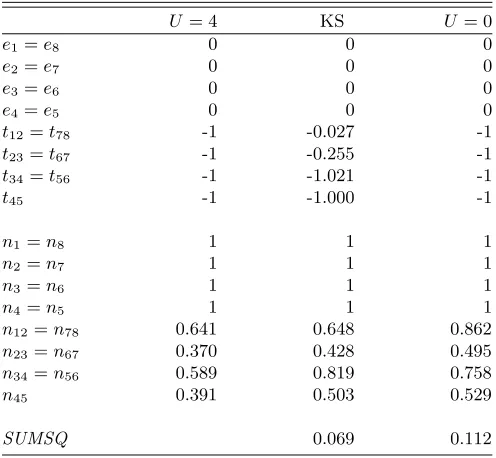
The results of the optimization for the half-filled eight-site chain witht= 1 and U = 4 are shown in Table III, where we give the respective on-site energies and hop-ping parameters and compare the density of the best-fit Kohn-Sham system with the true density of the interact-ing system and that of the initial trial Hamiltonian with
t= 1 andU= 0. Although the Kohn-Sham system gives the correct occupation numbersni, it is evidentlyunable
to reproduce the correct overlap coefficients and thereby simulate the localization effect: the density is not non-interacting v representable. In fact, the overall quality of the approximation to the density, given by the sum of the deviation squaresSUMSQ, is only little better than the approximation that is obtained by simply neglecting the interaction in the first place and settingU = 0.
It is interesting to note that the Kohn-Sham system approaches the true density best at the ends of the chain, whereas towards the center, it is little different from the density of theU = 0 system. This fact is reflected by the effective hopping parameters: towards the ends of the chain, they drop substantially to approach the atomic limit, which effectively reduces the overlap. It is this con-tribution that is responsible for the decrease ofSUMSQ
in the first place. In the center of the chain, however, the hopping parameters are almost constant and the density resembles that of theU = 0 system.
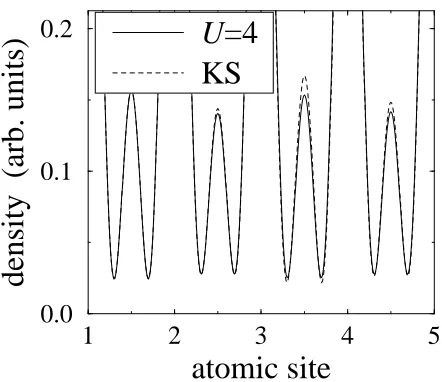
[image:8.612.316.564.136.365.2]In Fig. 1 we compare the real-space density of the
TABLE III. Hopping parameters, scaled so thatt45=−1,
and density of the Kohn-Sham system (KS) compared with the original system with (U= 4) and without (U= 0)
interac-tion for the eight-site Hubbard chain. The nonzero deviainterac-tion between the overlap coefficients corresponding toU = 4 and
KS, also represented bySUMSQ, indicates that the density of the interacting electron system isnot noninteractingv rep-resentable.
U = 4 KS U = 0
e1=e8 0 0 0
e2=e7 0 0 0
e3=e6 0 0 0
e4=e5 0 0 0
t12=t78 -1 -0.027 -1
t23=t67 -1 -0.255 -1
t34=t56 -1 -1.021 -1
t45 -1 -1.000 -1
n1=n8 1 1 1
n2=n7 1 1 1
n3=n6 1 1 1
n4=n5 1 1 1
n12=n78 0.641 0.648 0.862
n23=n67 0.370 0.428 0.495
n34=n56 0.589 0.819 0.758
n45 0.391 0.503 0.529
SUMSQ 0.069 0.112
Kohn-Sham system with that of the interacting system. The increasing deviation towards the center of the chain is clearly visible. We have used real symmetric orbitals based on trigonometric functions for the purpose of this visualization only. These assume a maximum at the posi-tion of the atom, have one zero at either side, and extend to the nearest-neighbor atom. The main numerical work is, of course, independent of a specific choice of orbitals. Although we are using a nonlinear optimization rou-tine, the chances of finding a solution will depend on the ratio of independent variables to residual functions. Multiplying the Hamiltonian by an arbitrary factor or adding a constant to the on-site energies only affects the eigenvalues but leaves the eigenstates and thereby the density coefficients unchanged. For this reason, the over-lap throughout the chain cannot be lowered by generally choosing smaller hopping parameters. Also, because of these two degrees of freedom in the hopping matrix, the number of relevant variables is in fact justM−2 instead ofM. As for the target density coefficients, one is triv-ially determined by the requirement that the occupation numbers ni add up to N. Besides, the density must be
constructable from the wave function of N interacting electrons, but this imposes complicated nonlinear rela-tions that can be expected to be of no relevance for the optimization procedure. The number of effectively in-dependent residual functions is therefore reduced by just one toM−1 and so exceeds the number of free variables.
1
2
3
4
5
atomic site
0.0
0.1
0.2
density (arb. units)
U=4
[image:9.612.55.276.62.253.2]KS
FIG. 1. Electron density of the eight-site Hubbard chain (U = 4) together with that of the Kohn-Sham system that
reproduces it as closely as possible (KS), visualized by as-suming a particular form of orbitals (see the text). There is good agreement at the ends of the chain (site 1), but in-creasing deviation towards the center (site 5). The deviation illustrates the fact that the density of the interacting system isnot noninteractingvrepresentable.
From a purely mathematical point of view, the nonexis-tence of an effective potential is thus not surprising.
We have performed calculations for different chain lengths and always obtained similar results. In conclu-sion, we note that in the case of small M, the density of the one-dimensional Hubbard chain is not noninter-actingvrepresentable because the Kohn-Sham system is unable to simulate the increased localization of the elec-trons. This is a systematic feature and will hold for all nonzeroU.
B. The limitM → ∞
The infinite chain is translationally invariant. The Hamiltonian of the interacting electron system must therefore be of the form
ˆ
H =−t
∞
X
i=−∞
X
σ
c†iσc(i+1)σ+c†(i+1)σciσ
+U
∞
X
i=−∞
ˆ
ni↑nˆi↓. (23)
Without performing numerical calculations, we can con-clude from our previous studies that the interaction will lead to a certain reduction of the overlap and to an in-creased localization of the electrons. In any case, the density of the interacting system will be different from
the density that we obtain after dropping the interaction term in the Hamiltonian.
As for the noninteracting Kohn-Sham system, the translational invariance requires that the effective on-site energies and hopping parameters are constant through-out the chain. This leaves just two variables, a uniform
eeff andteff. However, these are related to the two
triv-ial transformations described above that leave the eigen-states unchanged; their values do not affect the density and may be scaled to zero and −t. As a consequence, the electron density of the Kohn-Sham system must nec-essarily be identical to that of the U = 0 system and it must then be different from the density of the original system. Again, the Kohn-Sham system proves incapable of simulating the reduction of the overlap.
C. Discussion
So far, we have proved that for smallM as well as in the limitM → ∞, the density of the interacting Hubbard chain is not noninteracting v representable. Although translational invariance is not strictly satisfied in the case of a finite chain length, from a physical point of view, the situation of an atom far from the ends, where surface effects have little influence, is no different from that of an atom in an infinite chain. It is thus not surprising that the Kohn-Sham system should approach theU = 0 system in the central region of the chain. In fact, this effect is already visible in the case ofM = 8 and it should become even more dominant for greaterM.
The argument concerning the limitM → ∞ does not rely on the value ofU and holds for any nonzero interac-tion. We have thus conclusively shown that the density of the interacting Hubbard chain isnot noninteractingv
representable for all values of M and U. Furthermore, the same argument can be used for regular lattices with nearest-neighbor hopping in dimensions other than one.
D. A semiconductor model
Another generalized model “with parameters more ap-propriate for a semiconductor” has been studied in Ref. 5. The eigenvalue gap obtained by density-functional theory that reproduced the occupation numbers correctly was shown to be in good agreement with the true band gap, whereas the value obtained by a LDA within that frame-work was much smaller. It was therefore concluded that the LDA rather than the discontinuity in the exchange-correlation potential seemed to be responsible for the nu-merical deviation found in DFT calculations, but doubts have been raised concerning the implications for the orig-inal formulation of density-functional theory.14
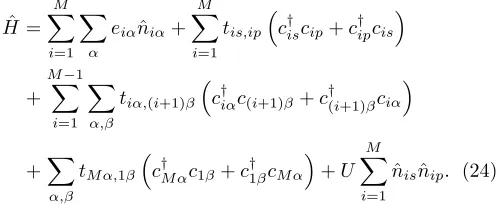
flip-ping. It features two nondegenerate orbitals, each of which forms its own energy band. The electrons can move within these bands as well as change from one to the other. The model is understood to represent a semi-conductor without magnetic properties. Therefore, the electrons are regarded as spinless fermions and the energy levels are interpreted as a low-lyingsband and apband. All orbitals are considered localized, so that overlap is negligible except on the same site and between nearest neighbors. The two levels are labeled by α, β ∈ {s, p}. For a finite one-dimensional chain, the Hamiltonian is given by ˆ H = M X i=1 X α
eiαnˆiα+ M
X
i=1 tis,ip
c†iscip+c†ipcis
+
M−1
X
i=1
X
α,β
tiα,(i+1)β
c†iαc(i+1)β+c†(i+1)βciα
+X
α,β tM α,1β
c†M αc1β+c†1βcM α
+U M X i=1 ˆ
nisˆnip. (24)
The first term contains the on-site energieseiα, the
sec-ond and third govern the hopping between orbitals at the same site and between nearest neighbors. Likewise, the following term has been introduced to connect the end sites. As the orbitals are no longer degenerate, all hop-ping parameters must depend both on spatial position and the energy bands involved. The last contribution to the Hamiltonian is the on-site Coulomb interaction.
The density-functional formalism derived for the Hub-bard Hamiltonian can be applied with minor changes, which account for the fact that the two orbitals differ. In particular, we have to consider occupation numbers and overlap coefficients for each pair of orbitals separately:
niα,jβ=hΨ|c†iαcjβ|Ψi or niα,jβ = N
X
γ=1
hψγ|c†iαcjβ|ψγi.
(25) We take parameters for the interacting system from Ref. 5. The energy levels areeis=−4.0 andeip= 0.0. At
the end points, thesstate is raised by 1.0 and thepstate is lowered by 0.4 to simulate surface effects. There is no hopping between bands on the same site; the sign and the magnitude of the other hopping parameters are consis-tent with a picture of real symmetricsand antisymmet-ricporbitals and set totis,(i+1)s=−1.8,tip,(i+1)p = 1.0,
and tis,(i+1)p = −tip,(i+1)s = 1.2. The end points are
joined only bytM s,1p =−tM p,1s = 1.2. Finally, the
in-teraction parameter isU = 4.0.
The symmetries of the chain are more subtle than in the Hubbard case. When varying the effective param-eters in the one-particle Hamiltonian ˆHs, we constrain eeff
iα = eeff(M+1−i)α. Due to the different signs of the
[image:10.612.53.301.202.307.2]or-bital lobes, the hopping parameters are related byteff is,ip=
TABLE IV. Deviation between the independent density co-efficients of the nine-site semiconductor chain and those of the Kohn-Sham system (KS), the noninteracting system with the same occupation numbers (niα exact), and the original
sys-tem with interaction set to zero (U = 0), expressed through
SUMSQper site. Although the approximation becomes
bet-ter with increasingM, the density of the interacting system
isnot noninteractingvrepresentable.
M KS niαexact U = 0
3 0.477×10⁻⁴ 2.331×10⁻⁴ 0.0379 5 0.118×10⁻⁴ 1.335×10⁻⁴ 0.0616 7 0.049×10⁻⁴ 1.006×10⁻⁴ 0.0759 9 0.034×10⁻⁴ 0.812×10⁻⁴ 0.0826
−teff
(M+1−i)s,(M+1−i)pandt eff
iα,(i+1)β=∓t eff
(M−i)β,(M−i+1)α
with − for α 6= β and + otherwise. Likewise, at the end points, teff
M α,1β = −teffM β,1α for α6= β. The density
coefficients are related by the very same symmetries. A measure for the accuracy of an approximation to the den-sity is again given by the sum of squaresSUMSQtaken over the deviations of all independent coefficients.
Calculated values of SUMSQ divided by the chain length M are listed in Table IV. The columns corre-spond to (i) the best-fit Kohn-Sham system, (ii) the sys-tem studied in Ref. 5, in which merely the on-site energies are varied so as to reproduce the occupation numbers of the original system exactly, and (iii) the noninteracting system with the same hopping parameters as the original interacting chain, which is used as the starting point for the numerical optimization.
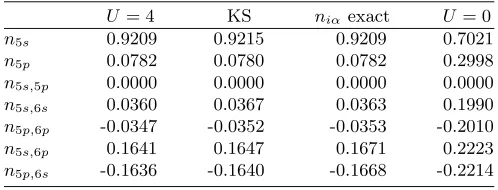
Although SUMSQ assumes significantly lower values than it did for the Hubbard model, despite the seven-fold increase in density coefficients, it is still far from zero. For the chain lengths studied here, the density of this interacting semiconductor model is thereforenot
noninteractingvrepresentable. To give an impression of the numerical deviations, Table V lists the density coef-ficients for the central site of the nine-site chain.
It seems that the approximation becomes better for in-creasingM, but the data are not sufficient for a reliable extrapolation. A formal repetition of our earlier argu-ment regarding the limit M → ∞ fails because trans-lationally invariant systems will still retain five relevant hopping parameters that determine the density. On the other hand, particle conservation only helps to reduce the number of effectively independent density coefficients to six, so it seems probable that even in this limit the density is not noninteracting v representable. We have performed calculations for closed, translationally invari-ant ring chains up toM = 9 that are governed by the same ratio of significant hopping parameters and den-sity coefficients. None of these systems was found to be noninteractingvrepresentable.
To double-check these findings, we have also taken a completely different approach by varying the eigenvec-tors of the Hamiltonian matrix directly and without
TABLE V. Density coefficients for the central site in a nine-site semiconductor chain. The columns correspond to the true interacting system (U = 4), the Kohn-Sham system
(KS), the noninteracting system with the correct occupation numbers (niα exact), and the initial-guess system with
inter-action set to zero (U = 0).
U= 4 KS niα exact U = 0
n5s 0.9209 0.9215 0.9209 0.7021
n5p 0.0782 0.0780 0.0782 0.2998
n5s,5p 0.0000 0.0000 0.0000 0.0000 n5s,6s 0.0360 0.0367 0.0363 0.1990 n5p,6p -0.0347 -0.0352 -0.0353 -0.2010 n5s,6p 0.1641 0.1647 0.1671 0.2223 n5p,6s -0.1636 -0.1640 -0.1668 -0.2214
ther constraints. A Hamiltonian constructed in this way corresponds to the unphysical case of hopping not being restricted by distance. But although the number of vari-able hopping parameters grows exponentially with M, even the overlap between nearest neighbors cannot be reproduced accurately forM ≤7. The formal inclusion of next-nearest-neighbor hopping in the Kohn-Sham sys-tem is therefore no solution.
V. CONCLUSION
We have reexamined the treatment of strongly cor-related Hubbard-type models within density-functional theory. A formulation of the basic theorems that is re-lated as closely as possible to the conventional scheme through second quantization of the external potential and the density has been provided. Numerical calculations and qualitative arguments have shown that the electron density of the original Hubbard model with nonzero in-teraction isnotnoninteractingvrepresentable. The same result was found for a related semiconductor model that has been used in a study of the band-gap problem.
ACKNOWLEDGMENTS
We wish to thank P. H. Dederichs, O. Gunnarsson, and K. Sch¨onhammer for helpful comments. This work was supported by The Royal Society, the Science and Engineering Council, and the European Community pro-gram Human Capital and Mobility through Contract No. CHRX-CT93-0337. One of us (A.S.) wishes to thank the Studienstiftung des Deutschen Volkes and the Deutscher Akademischer Austauschdienst for financial support.
1
P. Hohenberg and W. Kohn, Phys. Rev.136, B864 (1964).
2
W. Kohn and L. J. Sham, Phys. Rev.140, A1133 (1965).
3
M. Levy and J. P. Perdew, Int. J. Quantum Chem.49, 539 (1994).
4
L. J. Sham and M. Schl¨uter, Phys. Rev. Lett. 51, 1888 (1983); J. P. Perdew and M. Levy,ibid.51, 1884 (1983).
5
O. Gunnarsson and K. Sch¨onhammer, Phys. Rev. Lett.56, 1968 (1986); K. Sch¨onhammer and O. Gunnarsson, J. Phys. C20, 3675 (1987).
6
K. Sch¨onhammer and O. Gunnarsson, Phys. Rev. B 37, 3128 (1988).
7
Such as in R. M. Dreizler and E. K. U. Gross, Density
Functional Theory(Springer, Berlin, 1990).
8
R. W. Godby, M. Schl¨uter, and L. J. Sham, Phys. Rev. Lett. 56, 2415 (1986); Phys. Rev. B36, 3497 (1987); 37, 10 159 (1988).
9
J. Hubbard, Proc. R. Soc. London Ser. A276, 238 (1963).
10
M. Levy, Proc. Natl. Acad. Sci. U.S.A.76, 6062 (1979).
11
W. Kohn, inHighlights of Condensed Matter Theory, edited by F. Bassani, F. Fumi, and M. P. Tosi (North-Holland, Amsterdam, 1985).
12
N. F. Mott, Proc. R. Soc. London Ser. A62, 416 (1949).
13
E. H. Lieb and F. Y. Wu, Phys. Rev. Lett.20, 1445 (1968).
14