White Rose Research Online URL for this paper: http://eprints.whiterose.ac.uk/122286/
Version: Accepted Version
Article:
Huo, Y, Liu, T, Wang, XZ et al. (2 more authors) (2017) Online Detection of Particle
Agglomeration during Solution Crystallization by Microscopic Double-View Image Analysis. Industrial & Engineering Chemistry Research, 56 (39). pp. 11257-11269. ISSN 0888-5885 https://doi.org/10.1021/acs.iecr.7b02439
© 2017 American Chemical Society. This document is the Accepted Manuscript version of a Published Work that appeared in final form in Industrial and Engineering Chemistry Research, copyright © American Chemical Society after peer review and technical editing by the publisher. To access the final edited and published work see
https://doi.org/10.1021/acs.iecr.7b02439
[email protected] https://eprints.whiterose.ac.uk/
Reuse
Items deposited in White Rose Research Online are protected by copyright, with all rights reserved unless indicated otherwise. They may be downloaded and/or printed for private study, or other acts as permitted by national copyright laws. The publisher or other rights holders may allow further reproduction and re-use of the full text version. This is indicated by the licence information on the White Rose Research Online record for the item.
Takedown
If you consider content in White Rose Research Online to be in breach of UK law, please notify us by
On-line detection of particle agglomeration during solution crystallization
by microscopic double-view image analysis
Yan Huo a, Tao Liu a,*, Xue Z. Wang b, c, Cai Y. Ma b, Xiongwei Ni d
a
Institute of Advanced Control Technology, Dalian University of Technology, Dalian, China
b School of Chemical and Process Engineering, University of Leeds, Leeds, LS2 9JT, UK c
School of Chemistry and Chemical Engineering, South China University of Technology, Guangzhou, China
d School of Engineering and Physical Science, Heriot-Watt University, Edinburgh, UK
* Corresponding author. Tel: + 86-411-84706465; Fax: + 86-411-84706706; E-mail: [email protected]
Abstract: To detect the particle agglomeration degree for assessing crystal growth quality during a
crystallization process, an in-situ image analysis method is proposed based on a microscopic
double-view imaging system. Firstly, a fast image preprocessing approach is adopted for segmenting raw
images taken simultaneously from two cameras installed at different angles, to reduce the influence
from uneven illumination background and solution turbulence. By defining an index of the inner
distance based curvature for different particle shapes, a preliminary sieving algorithm is then used to
identify candidate agglomerates. By introducing two texture descriptors for pattern recognition, a
feature matching algorithm is subsequently developed to recognize pseudo agglomerates in each pair
of the double-view images. Finally, a fast algorithm is proposed to count the number of recognized
particles in these agglomerates, besides the unagglomerated particles. Experimental results from the
potassium dihydrogen phosphate (KDP) crystallization process demonstrate good accuracy for
recognizing pseudo agglomeration and counting the primary particles in these agglomerates by using
the proposed method.
Keywords: particle agglomeration; pseudo agglomerate; double-view image analysis; feature
1. Introduction
On-line imaging systems have been increasingly applied to monitor industrial crystallization
processes at the micro-scale in the last two decades 1-5, offering on-line observation of the crystal
shapes related to crystal morphology and growth rate. By using high-speed microscopic camera sensors,
e.g., the particle vision and measurement (PVM) instrument 6, 7 and the non-invasive imaging system8,
a small number of image analysis methods were explored in the recent references 9-13 for on-line
measurement of crystal size distribution (CSD) during a crystallization process. However, the influence
from uneven illumination background and solution turbulence on in-situ imaging in a continuously
stirred crystallizer was not fully considered in literature. Such influence may provoke significant
misestimate of crystal morphology or CSD by using the existing image processing methods, as studied
in the recent paper 14. Development of advanced in-situ image analysis methods has been eagerly
appealed for on-line monitoring, control and optimization of various crystallization processes 3, 15.
Particle agglomeration is commonly associated with crystallization processes due to particle
collisions in the stirred crystal suspension, which has a considerable impact on the crystal properties
such as the dissolution rate, precipitation, filtration, drying, milling and grinding. It is one of the main
tasks to control the agglomeration degree for industrial crystallization processes 16. Image-based
detection of particle agglomeration has therefore been increasingly studied for on-line control and
optimization. In the early study 17, detecting agglomerates from crystal images was performed off-line
by using a statistical principal component analysis (PCA) approach. Ferreira et al. 18 presented an
automatic classification tree to distinguish different classes of sucrose crystals and the agglomeration
degree. Terdenge et al. 19 developed an image processing method based on a discriminant factorial
analysis to evaluate the agglomeration degree of crystalline products. Ochsenbein et al. 20 presented a
machine learning method to identify the agglomeration of needle-like crystals together with the
primary particles involved in these agglomerates. Borchert et al. 21 developed an image-based
identification method for monitoring the growth rate of crystals such as the potassium dihydrogen
phosphate (KDP) that is a typical case of morphology evolution for multi-dimensional CSD
measurement and verification.
crystallization process, due to overlapped particles which have different distances to the camera lens.
These pseudo agglomerates inevitably affect image-based measurement accuracy of CSD and the true
agglomeration degree. To solve the problem, it was suggested to adopt double-view images for
recognizing pseudo agglomerates 20, but how to realize exact feature matching for overlapped particles
in each pair of view images remains open. Regarding feature matching between the
double-view images taken for the same object, a widely recognized matching algorithm is the scale invariant
feature transform (SIFT) 22, where a 128-dimensional descriptor was established from a
three-dimensional (3D) histogram of gradient locations and orientations, while using a weighting function
of the gradient magnitude for each location bin to ensure efficient matching. An alternative interest
point descriptor was proposed to construct another matching algorithm named ASIFT 23 which may
procure improved matching effect in some cases, but at the cost of larger computation effort. To
alleviate the computation load of SIFT, Bay et al. 24 developed a fast algorithm so called speeded up
robust features (SURF), which computed the Haar wavelet responses via the integral images instead
of the gradient information. By comparison, Rublee et al. 25 proposed a faster matching algorithm
called ORB by using the binary descriptors, which demonstrated good robustness to
rotational variation and measurement noise.
Note that particles in microscopic double-view images taken from a crystallization process
typically have high similarity in the feature properties, thus bringing difficulty to feature distinction by
using the aforementioned matching methods. To efficiently address the problem of feature similarity
among these images, texture statistical analysis was adopted as an alternative descriptor for image
matching in literature. By defining the local binary pattern (LBP) 26, both the statistical and structural
characteristics of image texture were used for double-view image matching. A few modified LBP
descriptors have been developed in the reference 27 for better texture classification and image
recognition. To enhance the performance of LBP, a completed LBP modeling was developed for texture
classification 28, which extracted the local gray levels and magnitude features among these images,
respectively. The approach was further extended by defining the LBP variance (LBPV) to characterize
the local contrast information in a one-dimensional LBP histogram for matching 29. By comparison,
distributions to represent consistent patterns. However, it remains open for implementing the above
methods for on-line recognition of particle agglomeration in engineering applications, in particular for
poor imaging conditions during a crystallization process.
In this paper, an in-situ double-view image analysis method is proposed for recognizing pseudo
particle agglomeration during a crystallization process, by establishing a double-view image matching
algorithm based on feature analysis. Firstly, an image preprocessing strategy is used to reduce the
influence from uneven illumination background, solution turbulence, and measurement noise. Then a
preliminary sieving algorithm is given to screen out candidate agglomerates for mitigating the
subsequent computation load, by defining an index to distinguish candidate agglomerates from all
particles. By introducing two new texture descriptors for pattern recognition, a feature matching
algorithm is proposed to recognize pseudo agglomeration. The number of primary particles involved
in these agglomerates is counted by establishing a fast algorithm. The rock-like crystals of KDP as
studied in the references 21, 31 for image analysis are used for experimental tests to demonstrate the
effectiveness of the proposed method for on-line detection.
For clarity, the paper is organized as follows. Section 2 briefly states the problem of detecting
particle agglomeration. In Section 3, an image preprocessing method is presented to alleviate the
influence from in-situ imaging conditions during the process operation. In Section 4, a preliminary
sieving algorithm is given to screen out candidate agglomerates. A feature matching algorithm is
proposed to recognize pseudo agglomerates in Section 5, along with an illustration on the advantage
of the proposed texture descriptors compared to the existing image feature matching algorithms.
Section 6 presents a fast algorithm to count the primary particles involved in the agglomerates.
Experimental results are shown in Section 7 to demonstrate the effectiveness and advantage of the
proposed method. Some conclusions are drawn in the last Section 8.
2. Problem of detecting particle agglomerates during crystallization
2.1 Double-view imaging system for monitoring a crystallizer
A non-invasive microscopic imaging system for monitoring industrial crystallization processes
high-speed cameras made by Hainan Six Sigma Intelligent Systems Ltd was used to capture crystal
images synchronously during the cooling crystallization process. The two cameras (UI-2280SE-C-HQ)
with USB Video Class standard were made by IDS Imaging Development Systems GmbH, including
two micro telescope lenses. The angle between these camera optic axes was set about 18 degrees to
capture double-view images with two LED lights.
As shown in Figure 1, the crystallizer was composed of a 4-liter glass vessel, a 4-paddle agitator
(PTFE), a thermostatic circulator (Julabo-CF41), and a temperature probe (PT100). Chemical
compound used for the experiments was KDP (KH2PO4) with distilled water (H2O) as solvent. The
crystal suspension was monitored by the non-invasive microscopic double-view imaging system
installed outside the vessel.
2.2 In-situ detection of particle agglomeration
In-situ image monitoring of particles in the suspension brings much more complexity compared
to off-line image analysis of particles by using an optic microscopy. The major challenge lies in the
fact that particle motion and solution turbulence in a stirred crystallizer provoke image blurring and
additional noise. Secondly, the uneven light effect and time-varying hydrodynamics in the crystallizer
interferes with the uniformity and intensity of the image background. In addition, there may be
different gray scales between double-view images captured for the same particles, due to unequal
distances from two camera lenses to the same particles. A typical scenario of double-view images is
shown in Figure 2 by using the above imaging system.
It can be seen from the left view of Figure 2 that there possibly exists particle agglomeration. In
fact, it can be verified from the right view of Figure 2 that the visual agglomerates were caused by
particles overlapping in the left view. The phenomenon has been recognized as pseudo agglomeration
in the literature. Herein the overlapped particles are defined by pseudo agglomerate for analysis. It is
obvious that a single-view image, subject to lots of pseudo agglomerates, could mislead counting the
crystal number and size, and thus affects on-line control and optimization of the crystal growth and
product quality. Therefore, the recognition of pseudo agglomeration should be envisaged for on-line
literature, since the emergence of in-situ microscopic imaging technology for monitoring
crystallization processes in the recent years 3, 8.
To cope with the above problems, an in-situ image analysis method is proposed in this paper for
detecting particle agglomeration during a crystallization process. The key idea is to recognize pseudo
agglomerates by particle sieving and feature matching between double-view images. Correspondingly,
the number of agglomerated particles can be efficiently counted. The agglomeration degree is
evaluated by using the following specification 32,
A Ap p
100% N
P N
(1)
where NAp is the number of primary particles involved in the agglomerates, Np is the total number
of valid particles counted in the image. Note that the primary particles means the recognized particles
in these agglomerates, which originate from unagglomerated particles during the crystallization
process. Correspondingly, the valid particles include these primary particles and unagglomerated
particles detected in the captured image.
A flowchart of the proposed double-view image analysis method is shown in Figure 3.It can be
seen that there are four steps for on-line implementation, including image preprocessing, preliminary
sieving, feature matching, and particle counting, as detailed in the following sections, respectively.
3. Image preprocessing
3.1 Image reduction
For using a microscopic imaging system, the size of an image depends on the system resolution
and the magnification of camera lens. A larger image size corresponds to a longer time delay for
on-line analysis. An efficient image reduction method is therefore adopted to shrink the size of a captured
image while maintaining fundamental image features to facilitate on-line analysis. Considering that
the method has the advantage of high reduction ratio and good denoising ability, a two-dimensional
discrete wavelet transform algorithm with the bi-orthogonal wavelet function 33 is constructed for a
captured image denoted by I x y with a size of M N( , ) . Denoting by m the row, by n the
wavelet transform for I x y is defined as ( , ) , , 1 1 1 ( , , ) ( , ) ( , ) M N
j m n
x y
A j m n I x y x y
MN
(2)where
/2
, , ( , ) 2 (2 , 2 )
j j j
j m n x y x m y m
(3)
Then the low frequency component A j m n( , , ) is used to approximate the original image I x y( , ).
As a result, a reduction image f x y( , ) is constructed from the low frequency component.
3.2 Image segmentation
To alleviate the influence from uneven image background, morphology processing is considered
as an efficient approach based on the crystal shape characteristics. The uneven background is extracted
by using an opening operation algorithm with the structuring element 34.
To properly parameterize the structuring element, a watershed transform algorithm 33 is used for
computation. The watershed transform algorithm classifies catchment basins and watershed ridge lines
in an image by treating it as a surface where light and dark pixels correspond to high and low values,
respectively. The averaged distance between the watershed ridge lines is taken as a parameter of the
structuring element. Then the uneven background is extracted by using the above algorithm.
Subsequently, the raw image is subtracted by the above uneven background. The segmentation
threshold t* is computed by using the Otsu thresholding function 33 as
* 2
arg max ( )
t
t t (4)
where 2( )t is the variance between two gray level classes with a threshold value of t[1, ]L and
L is the maximum gray level.
Finally, the segmented image is obtained by
* *
0, ( , )
( , )
1, ( , )
f x y t
q x y
f x y t
(5)
After the segmentation, morphological region filling is performed to fill up all the holes inside
the segmented image q x y( , ), such that the resulting image only remains all the particle regions while
4. Preliminary sieving
This step is to screen out candidate agglomerates by using the particle shape features from the
segmented double-view images, in order to save computation time for specifically recognizing pseudo
agglomerates among these candidate agglomerates, while counting the number of valid particles in
these images.
In fact, it remains open to describe the shape feature of particle agglomeration, though a few
features describing particle shapes were explored in the literature 8, 20. In this work, the inner distance
descriptor recently proposed in the reference 14 is further extended to describe the agglomeration
feature so as to sieve out the candidate agglomerates efficiently. The coordinates of particle boundary
are denoted by ( ,x y , n n) n1, 2, ,N, and the centroid coordinate ( ,x y is denoted by c c)
1 c 0 1 c 0 1 1 N n n N n n x x N y y N
(6)The distances from the particle centroid to its boundary points are defined as
2 2
c c
( ) ( )
n n n
d x x y y (7)
A deviation distance is defined by
n dn d
(8)
where d is the mean value of d . n
The curvature of n is computed by
2 3/2 ''
(1 ' )
n n n c (9)
An index of the inner distance based curvature (IDC) is therefore proposed as
1 IDC N n n c N
(10)For illustration, Figure 4shows a few simplified round-like shapes of an unagglomerated particle
and three agglomerates involved with two, three, and four particles, respectively. It is found that the
candidate agglomerates. Note that for rod-like and needle-like particle shapes, the corresponding IDC
indices may be similar to those of the involved agglomerates, due to a relatively large length-width
ratio of such a particle or agglomerate. Additional shape features, e.g., the specific elongation ratios
and perimeters of different crystals, Fourier descriptors, and geometric moments as studied in the
reference 14, may be adopted to further recognize candidate agglomerates.
Based on collecting typical shapes of individual particles and agglomerates in a crystallization
process, the corresponding IDC indices are constructed as a training set for preliminary sieving. By
classifying all the IDC indices into two groups, one for candidate agglomerates and the other for
unagglomerated particles, a linear classification algorithm is established below.
Denote by a and 1 a for the IDC index groups of candidate agglomerates and unagglomerated 2
particles, respectively. The central value u of i a (i i1, 2) is computed by
2
arg min || || , 1, 2
i
i i i
u
u
a u i (11)The threshold t for classification is determined by 0
1 2
0 2
u u
t (12)
To determine whether a segmented image region with an IDC index of b belongs to an
agglomerate, a classification rule is proposed as follows:
0 0
CA1, ;
CA2, .
if b t b
if b t
(13)
where CA1 denotes the candidate agglomerate set and CA2 indicates the unagglomerated particle
set.
5. Feature matching
To further recognize the pseudo agglomerates from the candidate agglomerates, an enhanced
feature matching algorithm is proposed to procure accurate recognition, by establishing the image
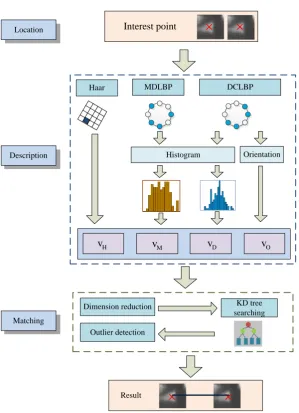
interest point location and its feature descriptors as developed in the references 22-25. For clarity, Figure
5 shows the flowchart of the feature matching process. Note that the raw surfaces of particles in the
segmented double-view images are wholly stuffed within their contours before proceeding with the
5.1 Interest point location
The Hessian matrix studied in SURF 24 is used for detecting the interest point location. Given an
image point Q x y( , ), the Hessian matrix H Q( , ) in X is defined as
( , ) ( , )
( , )
( , ) ( , )
xx xy
xy yy
L Q L Q
H Q
L Q L Q
(14)
where L Qxx( , ) is the convolution of the Gaussian second order derivative
2
2 g( )
x
with respect
to the image point Q, and so is for L Qxy( , ) and Lyy( , )Q , is a parameter of the Gaussian
function g( ) , which denotes the image scale 22.
To simplify the above computation, box filters are used instead of the Gaussian second order
derivatives. Denoting D , xx Dyy and Dxy as the approximations of the Gaussian second order
derivatives for each image by using the box filters, respectively, an approximation determinant of the
Hessian matrix can be written as
2
Det( )H D Dxx yy(0.9Dxy) (15)
The scale space is described as an image pyramid, which is divided into 4 octaves, and each octave
includes 4 levels together with box filters of different window sizes denoted by L . By using the
integral image, the local maxima as a candidate interest point may be selected in a 3 3 3
neighborhood in the scale space, such that the convolution computation could be accelerated 24.
For using the box filters, the parameters cannot be chosen arbitrarily. Following the guideline in
the reference 35, it is preferred to take
2 1 1.2 = 3 o L i L (16)
where o{1, 2, 3, 4} is the octave index and i{1, 2, 3, 4} is the level index.
Moreover, a distance constraint is additionally imposed in the same scale to avoid the interest
points over dense in a local area, because the density affects the matching efficiency. For example,
denoting as the interest point set, a distance-constrained rule is defined for two interest points
1 1
( , )
X x y and X x y as ( ,2 2)
1 1 1 1 2 2
2 2 1 1 2 2
1 1 2 2
( , ) , < and ( , ) ( , ) 0
( , ) , < and ( , ) ( , ) 0
( , ) and ( , ) ,
X x y if Dis R x y R x y
X x y if Dis R x y R x y
X x y X x y if Dis
where Dis(x1x2)2(y1y2)2 , R x y( ,1 1) and R x y( ,2 2) denote gray levels, and is a
distance threshold similar to the parameter of the structuring element in Section 3.2.
5.2 Feature descriptor
The Haar wavelet responses in SURF 24, which can be quickly computed via integral images, are
used to construct a feature descriptor. Firstly, the dominant orientation of the Haar descriptor for the
interest point is computed by detecting the longest vector of the summed Gaussian weighted Haar
wavelet responses under a sliding sector window of / 3.
To determine the descriptor, a square region is chosen around the interest point. The region is split
into smaller 4 4 square sub-regions. For each sub-region, the Haar wavelet response dx
perpendicular to the dominant orientation and the Haar wavelet response dy in the dominant
orientation are computed. Hence, a four-dimensional (4D) Haar descriptor,
(
dx, dx,
dy, dy), is established for each sub-region. Given 4 4 square sub-regions foreach interest point, a Haar descriptor of 64 dimensions denoted by v is subsequently constructed H
after normalization.
To compensate for the deficiency of the above descriptor in dealing with image noise and uneven
illumination background, two texture descriptors are supplemented to enhance the matching accuracy
for double-view images with high feature similarity. Inspired by the LBP approach developed in the
references 27-30, a deviation compensated LBP (DCLBP) descriptor and a magnitude difference based
LBP (MDLBP) descriptor are proposed to improve the accuracy of describing the interest region in the
presence of uneven illumination while mitigating the computation effort.
Denoting g as the gray value of the center pixel c ( , )i j in a local region, and gp
(p0,...,P1) as the gray values of equally spaced P pixels in a circle of radius R with respect
to the center pixel ( , )i j , the location parameter g is defined as a
c , c c
1 a
c , c c
1
, 1 / (P 1) ( );
, 1 / (P 1) ( ).
P
P R p
p P
P R p
p
g std if g g g
g
g std if g g g
(18)Thus, the DCLBP for G i j( , ) is obtained as
, a 1
( , ) ( )2
P
p
P R p
p
DCLBP i j s g g
(19)where a a a 1, ; ( ) 0, . p p p
if g g T
s g g
if g g T
(20)
where T is a practically specified difference threshold, e.g., -3 e .
Considering that the magnitude information is also important for local texture structure
description 28, we define the magnitude difference by
c
| |
p p
m g g . Note that the vector
0 1 1
[m m, ,...,mP ] is less sensitive to uneven illumination, which is therefore transformed into the
binary pattern for analysis. Correspondingly, the MDLBP is obtained as
,
1
( , ) ( ) 2
P
p
P R p p
p
M D L B P i j s m m
(21)where m is the averaged value for p [m m0, 1,...,mP1], and
1, ( ) 0, p p p p p p
if m m T
s m m
if m m T
(22)
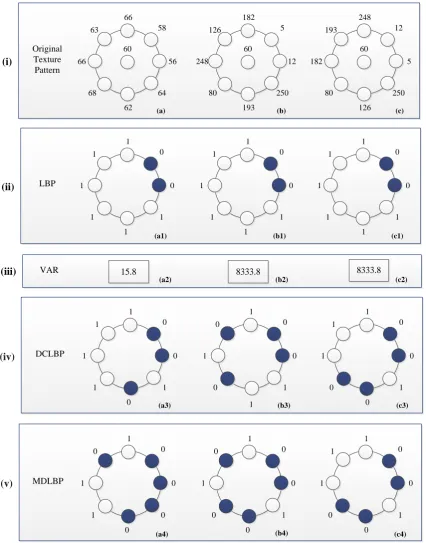
For illustration, a numerical example studied in the reference 30 is performed here to demonstrate
the proposed texture recognition of image micro-structure. Figure 6 shows three texture patterns with
different features to classify and each of the patterns has the same center pixel with 8 neighbors. It is
obvious that LBP and the proposed DCLBP have different thresholds in terms of the same P 8. The
three patterns(a, b, c) are classified into the same pattern by using LBP, due to the oversimplified local
structure recognized by LBP. By introducing a complementary feature, called VAR, which could reflect
the local contrast of each pattern, The reference 26 proposed the combination of VAR and LBP for
recognition, as shown in Figure 6 (ii) and (iii). It can be seen that the patterns (a) and (b) can be
distinguished but the patterns (b) and (c) are still regarded as the same texture, due to neglecting the
differences between the center and each neighbor. In contrast, both of the proposed DCLBP and
MDLBP have effectively recognized different binary patterns for these three texture patterns, as shown
in Figure 6 (iv) and (v), owing to further detailed description of local texture feature in the interest
Moreover, taking into account the rotation invariance of LBP 26, we denote Ri
, ( , ) P R
DCLBP i j and
Ri , ( , ) P R
MDLBP i j as the rotation invariants of DCLBP and MDLBP, respectively. Distribution
histograms of the DCLBP and MDLBP values are taken as two dimensions in the feature descriptor.
The property of the histogram may facilitate analyzing the statistical region characteristics and
reducing the pattern dimension 29. Take the DCLBP as an example, in the interest region N N for
the interest point, the DCLBP value of each pixel point G i j( , ) is computed to generate the DCLBP
spectrogram composed of DCLBPP RRi, ( , )i j , i j, 1, 2, ,N . Therefore, the interest region is
represented by a one-dimensional pattern histogram 29 as
Ri ,
1 1
( ) ( ( , ), ), [0, ]
N N
P R
i j
h k f DCLBP i j k k K
(23)where K is the maximal DCLBP pattern value, and
Ri , Ri
, Ri
,
1, ( , ) ;
( ( , ), )
0, ( , ) .
P R P R
P R
if DCLBP i j k
f DCLBP i j k
if DCLBP i j k
(24)
Then, the texture feature vector v is determined by normalizing D h k( ), k[0,K]. Note that
the dimension of v is determined by the interest region size, which is suggested to be D 2N based
on numerical computation. Similar to v , the MDLBP feature vector denoted by D v can be M
determined.
Besides, the feature of dominant orientation 25 is also considered in the DCLBP spectrogram,
which is denoted by L i j . Define the main orientation being from the interest point to the centroid ( , )
(i
i L i j ( , ) /
L i j( , ), j
j L i j ( , ) /
L i j( , )). Denoting by mo all the point set in themain orientation, L m n (( , ) m n, mo) is decomposed by the discrete Fourier transform. A weighted
amplitude vaw( , )m n is defined by
aw( , ) ( , ) a( , )
v m n m n v m n (25)
where vam( , )m n is the amplitude of L m n in the Fourier transform, and ( , )
2 2 2 2
1
( , ) e
2
r
m n
(26)
where r is the distance between the pixel DCLBPP RRi, ( , )m n and the interest point, and is the
image scale of the interest point.
Correspondingly, the feature of dominant orientation v is taken as the mean of O v after am
To sum up, the interest point descriptor is composed of v[v v vH D M vO].
5.3 Descriptor matching
The above interest point descriptor generally has high dimension, which may be inefficient and
computationally intensive for matching. Hence, dimension reduction is adopted to improve
computation efficiency. The idea of linear graph embedding (LGE) with locality preserving projection
(LPP) 36 is adopted herein to extract the geometric features and local region characteristics. For a pair
of double-view images, the interest point descriptor set is defined by V{ ,..., },v1 vn viRm, where
m is the dimension of the interest point descriptor and n is the number of the interest point. The
interest point descriptor is depicted by an undirected graph G with n vertices, while each vertex
indicates an interest point denoted by v . To evaluate the similar degree of different interest points, a i
symmetric matrix W is defined with the elements denoted by wi j which is the weight of the edge
from the vertex v to the vertex i vj.
2 2 || || /
e , ( ) or ( );
0, ( ) and ( ).
i j v v
i k j j k i
ij
i k j j k i
if v N v v N v
w
if v N v v N v
(27)
where N v denotes the set of the k-nearest neighbors of k( )i v with a choice of i k5 herein for
computation, and is the averaged Euclidean distance among these points.
Let [ ,...,1 ]
T n
b b
be a map from the graph to a real line. The optimal is determined by
2 ,
min ( i j) ij
i j
b b w
(28)It can be derived from (28) that
2 , 1 ( ) 2 T
i j ij
i j
b b w B LB
(29)where L D W is the graph Laplacian, D a diagonal matrix whose entries are column (or row)
sums of W, dii
jwji.A minimization programming is established for solving (29) by
arg min B LB s t B DBT . . T 1 (30)
The LGE is used to establish a linear approximation for the nonlinear relationship, biT v UiT ,
where U is a projection matrix. After simplification, the optimal U is given by the minimum eigenvalue of the generalized eigenvector for the following equation,
T T
Note that if the number of descriptor samples is small for dimension reduction, the matrix T
V LV
may be singular. It is therefore proposed to project the sample set into the PCA space 36 in advance.
However, the computation load could become very heavy if using the global nearest neighbor
searching method 24 to reduce the descriptor dimension for the interest points between the double-view
images. It is therefore proposed to use the approximately nearest neighbor searching algorithm via the
K-dimension (KD) tree 37 to save the computation effort.
Meanwhile, considering that the interest point descriptors could be mismatched if the scale
difference is large, it is proposed to limit the scale difference for feature matching, that is, the scale
difference S of interest point pairs should satisfy di
Sdi S Ws (32)
where S is the averaged scale value for all the interest points, and W is the scale standard deviation. s
To ensure the matching accuracy and stability, an outlier detection algorithm is proposed to
remove outliers in the matching points. By denoting ( ,x y and 1 1) ( ,x y as two matching points, 2 2)
the angle a between them is defined as
2 1
2 1
arctan y y
a
x x
(33)
Denoting A{ ( ) |a i i1, 2, , }m as the angle set, where m is the number of matching points,
( )
N j as the number in the cluster j , and ( )j , j1, ,k as the cluster centroids computed from
A , where j is the cluster index number, the k-means clustering algorithm 38 is performed by
iterating the following two steps until ( )j converges to the optimum, with an initially random
choice of ( )j within A.
Firstly, assign ( )a i into the nearest cluster of ( )c i defined by
2 ( ) arg min || ( ) ( ) ||
j
c i a i j (34)
Secondly, update the cluster centroids ( ) j ( j1, ,k) of A by
1
1
1{ ( ) } ( )
( ) 1, ,
1{ ( ) }
m
i m
i
c i j a i
j j k
c i j
(35)After clustering, the minimum number of j is obtained as
= arg min ( ), 1, ,
j
Then all the matching points within the corresponding angle cluster of j are classified as
candidate outliers. Let u be the mean value of the original angle set and o u the mean value of the r
angle set excluding j. If |uruo| / 60, the optimized matching is selected by deleting the
candidate outliers. Otherwise, these candidate outliers should be remained.
After outlier detection, a label processing is proposed to recognize pseudo agglomerates. Firstly,
all particles in the segmented images are labeled. If there is one-to-one relationship between two
matching labels respectively in the double-view images, they should be recognized as agglomerated
particles. Otherwise, the candidate agglomerates should be viewed as pseudo agglomerates.
6. Particle counting
For pseudo agglomerates, the corresponding particles can be easily counted by using the
one-to-many relationship of label processing. However, for true agglomerates, it remains difficult to count the
number of primary particles involved in these agglomerates. By virtue of the analysis on IDC as shown
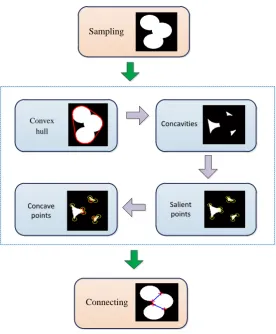
in Figure 4, it is proposed to use the concave points of the agglomerate contours to count the primary
round-like particles in these agglomerates. A fast algorithm is therefore given as illustrated in Figure
7, based on the morphology mask as follows.
Step 1. A toolbox algorithm 33 is used to figure out the convex hull (S ) for a true agglomerate, ch
while the contour of S is entirely stuffed. ch
Step 2. The concavities (S ) are computed as the difference between the convex hull (co S ) and ch
the agglomerate (Sag), i.e., Sco SchSag.
Step 3. The value of saliency Sal b is calculated for the boundary point ( ) b in the contour
image by
ci
( ) Mb
Sal b M
(37)
where M is the pixel number of the circle mask centered on the boundary ci b, and M is the b
number of pixels in the maximum background block in the circle mask M . The mask center b scans
over the boundary of the contour by using a circle mask M with radius Rp. Salience points are
located in terms of Sal b( )0.7. If several continuous points comply with the condition, the point
Step 4. A concave point on the agglomerate boundary is determined if all the connecting lines
between the concave point and its adjacent salience points are inside the agglomerate.
Step 5. By drawing the nearest connecting lines between the determined concave points in
different concavities while avoiding any closed loop possibly constructed by the connecting lines, the
number of primary particles involved in these agglomerates is counted as the number of these
connecting lines plus one.
7. Experimental results
A seeded KDP cooling crystallization experiment was performed to verify the effectiveness of the
proposed image analysis method for recognizing pseudo agglomerates. The KDP solution was firstly
heated up to 40 °C and maintained at the temperature for an hour to ensure complete dissolution of the
solute. Then the solution was cooled down with a cooling rate of 0.3°C/min. The crystal seeds were
added shortly after the solution went into the supersaturated zone. The agitator was operated at a speed
of 150 rpm to keep all particles in suspension during the cooling crystallization process for image
monitoring. The aforementioned non-invasive microscopic imaging system was applied for in-situ
imaging, by using two LED lights with an illumination level of 400lux. In the double-view imaging
system, each image was taken at the pixel resolution of 2448×2048 per second. Note that 30 particles
were chosen from the previously captured images as the IDC training set to establish the classification
rule of preliminary sieving in advance.
Considering the in-situ captured double-view images shown in Figure 2, the image analysis
method is illustrated in Figure 8. Firstly, the preprocessed images are shown in Figure 8 (a) by using
the reduction approach presented in Section 3. Then Figure 8 (b) shows the result by removing the
image background. Figure 8 (c) shows the segmented double-view image where the particle intensity
and the background are denoted by 1 and 0, respectively. Note that each pairs of double-view images
were simultaneously processed throughout the proposed analysis procedure. Figure 8 (d) shows the
candidate agglomerate recognized by the preliminary sieving using the IDC indices as listed in the
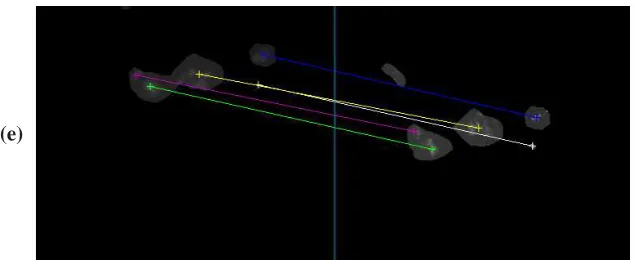
figure. Subsequently, Figure 8 (e) shows the pseudo agglomerate recognized by using the proposed
2
R . Note that all the valid particles and interest points were rightly matched between the
double-view images.
To compare the matching performance for the in-situ double-view images captured during the
crystallization process, the developed algorithms, SIFT 22, ASIFT 23, SURF 24 and ORB 25, were also
performed for Figure 2 based on the above image preprocessing and preliminary sieving. The
parameter of Gaussian function in SIFT and ASIFT was taken as 1.6, the parameters of SURF were
computed in terms of (16) in Section 5, and the parameters of ORB were chosen with the radius of
neighborhood being 3 and the edge threshold being 31, according to the guidelines given therein. Note
that the proposed outlier detection algorithm was performed beforehand to perform these algorithms
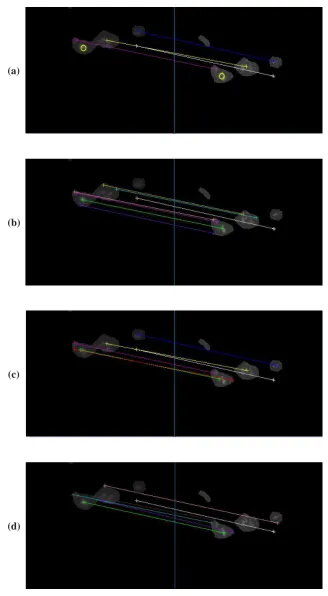
for fair comparison. The matching results are shown in Figure 9. It is seen that none of these algorithms
could give perfect matching for all the particles including the agglomerate. Figure 9 (a) shows that
SIFT gives correct matching for most of the interest points as shown in Figure 8 (e), but a prominent
interest point was overlooked as indicated by the yellow circle. In Figure 9 (b), it is obvious that a valid
particle was not matched in the double-view images by using ASIFT. Figure 9 (c) shows that there is
a mismatch of an interest point by using SURF, as indicated by the red line. Figure 9 (d) shows that a
valid particle is not matched while there exists a mismatch of an interest point (indicated by the purple
line) by using ORB.
To further demonstrate the effectiveness of the proposed algorithm for recognizing particle
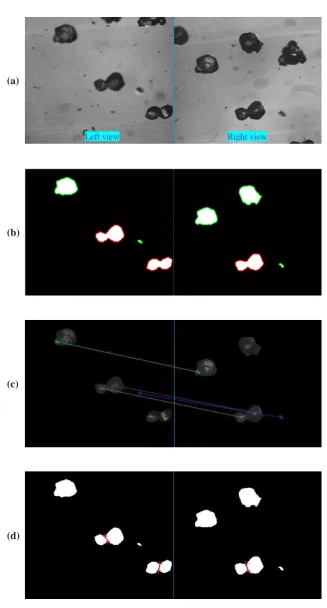
agglomeration and counting the number of primary particles, Figure 10 shows the imaging analysis
results for another pair of double-view images captured from the crystallization process, which
includes true agglomeration. It is seen from Figure 10 (b) that the candidate agglomerates were
recognized by using the preliminary sieving step, as indicated by the red contours. Then it is verified
in Figure 10 (c) by using the proposed feature matching algorithm that there are two agglomerates in
the left view. From Figure 10 (d) it is seen that the number of the primary particles involved in the
agglomerates is properly counted by the proposed algorithm.
Table 1 lists the recognition results for two different cases shown in Figure 8 and Figure 10,
respectively, for pseudo and true agglomerates. It can be seen that the proposed image analysis method
number of unagglomerated particles and the number of primary particles involved in the agglomerates
are rightly counted, respectively.
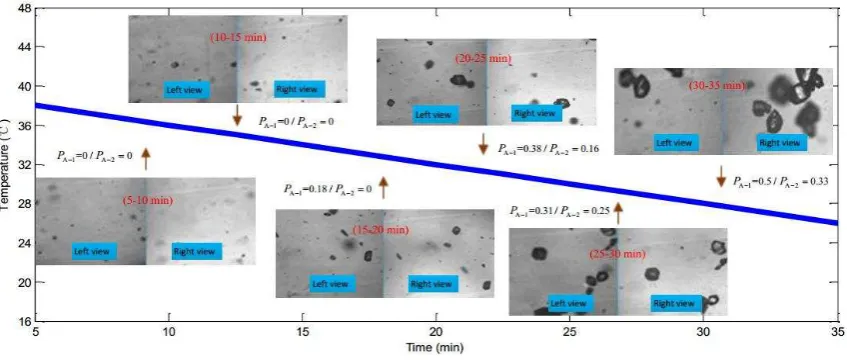
In addition, to demonstrate the effectiveness of the proposed method for on-line monitoring the
crystallization process, thirty pairs of double-view images including more than 200 particles captured
from the crystallization experiment, as illustrated in Figure 11 (including 6 representative pairs of
double-view images taken at different time instants), were taken to verify the proposed feature
matching algorithm in comparison with the above algorithms. For 6 representative pairs of these
images, the agglomeration degree defined in (1) is evaluated by using the proposed double-view
analysis, which is denoted by PA 2 in Figure 11. For comparison, the corresponding result given by
using the single-view analysis method 18, 20 is denoted by
A 1
P in Figure 11. It is seen that the proposed
double-view analysis gives proper assessment of the agglomeration degree in real time (made per 5
minutes during the crystallization process), compared to the single-view analysis that gives obvious
misestimate such as the result for the image taken at the moment denoted by (15-20min). In other
words, the real-time estimation error arising from particle overlapping is significantly reduced by using
the proposed double-view analysis.
To evaluate the matching effect, the particle recall ratio Ppr is defined by
pa pr
pa pm
N P
N N
(38)
where Npa is the number of matched particles and Npm is the number of unmatched particles.
The matching accuracy of interest points is defined by
a pm
t N P
N
(39)
where N is the number of correct point matches and a N is the total number of point matches. Note t
that a valid particle is recognized if the point matching for two double-view images of the particle is
over 80%.
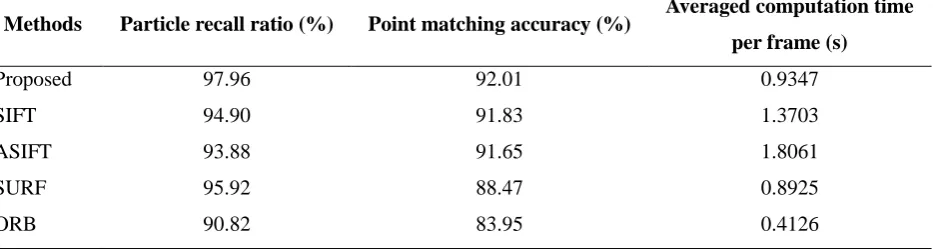
Three indices including point matching accuracy, particle recall ratio and averaged computation
time per frame were computed for comparison as listed in Table 2. Note that all of the above algorithms
used the same global nearest neighbor searching method 24 for computation. It is seen in Table 2 that
using a moderate computation time for each frame of double-view images. In contrast, SIFT and
ASIFT gave similar point matching accuracy close to that of the proposed algorithm. However, they
required an evidently longer computation time compared to the proposed algorithm, due to the use of
high-dimensional feature descriptors. Although ORB spent the shortest computation time in these
algorithms, the resulting point matching accuracy and particle recall ratio were the lowest compared
to the other algorithms, due to insufficient description of local features. By using a computation time
similar to the proposed algorithm, SURF gave inferior point matching accuracy, by using less local
texture features compared to the proposed algorithm. Note that for monitoring the crystallization
process, the particle recall ratio reflecting particle matching is more important than the other two
indices for agglomerate recognition. The result in Table 2 well demonstrates that the proposed
algorithm can give good matching and recognition for on-line monitoring particle agglomeration.
8. Conclusions
Based on an in-situ installed double-view imaging system, a synthetic image analysis method has
been proposed in this paper for monitoring particle agglomeration during a crystallization process. A
fast image segmentation approach based on image reduction is firstly adopted to perform image
preprocessing so as to reduce the influence from uneven illumination background and solution
turbulence. By defining an IDC index to detect possible agglomeration, a preliminary sieving
algorithm is given to screen out candidate agglomerates from preprocessed images, effectively
mitigating the on-line computation load. Then by introducing two texture descriptors, DCLBP and
MDLBP, for pattern recognition, a fast feature matching algorithm is developed to recognize pseudo
agglomerates with good accuracy. Subsequently, an efficient particle counting algorithm is established
to assess the agglomeration degree, by which both the unagglomerated particles and the primary
particles involved in agglomerates can be precisely counted, respectively. Experimental tests on
monitoring the KDP crystallization process well demonstrate that the proposed strategy can be more
effectively used for monitoring the crystal agglomeration degree in comparison with the existing
single-view analysis, along with obvious superiority for particle matching between double-view
Acknowledgment
This work was supported in part by the NSF China Grant 61633006 and the National Thousand
References
(1) Li, M.; Wilkinson, D.; Patchigolla, K., Determination of non-spherical particle size distribution from chord length measurements. Part 2: Experimental validation. Chemical Engineering Science 2005, 60, (18), 4992-5003.
(2) Yu, Z.; Chew, J.; Chow, P.; Tan, R., Recent advances in crystallization control: an industrial perspective. Chemical Engineering Research and Design 2007, 85, (7), 893-905.
(3) Nagy, Z. K.; Fevotte, G.; Kramer, H.; Simon, L. L., Recent advances in the monitoring, modelling and control of crystallization systems. Chemical Engineering Research and Design 2013, 91, (10), 1903-1922. (4) Zhang, B.; Willis, R.; Romagnoli, J. A.; Fois, C.; Tronci, S.; Baratti, R., Image-based multiresolution-ANN approach for online particle size characterization. Industrial & Engineering Chemistry Research 2014, 53, (17), 7008-7018.
(5) Schorsch, S.; Ochsenbein, D. R.; Vetter, T.; Morari, M.; Mazzotti, M., High accuracy online measurement of multidimensional particle size distributions during crystallization. Chemical Engineering Science 2014, 105, (2), 155-168.
(6) Zhou, Y.; Srinivasan, R.; Lakshminarayanan, S., Critical evaluation of image processing approaches for real-time crystal size measurements. Computers & Chemical Engineering 2009, 33, (5), 1022-1035.
(7) Li, P.; He, G.; Lu, D.; Xu, X.; Chen, S.; Jiang, X., Crystal size distribution and aspect ratio control for rodlike urea crystal via two-dimensional growth evaluation. Industrial & Engineering Chemistry Research 2017, 56, (9), 2573-2581.
(8) Wang, X. Z.; Roberts, K. J.; Ma, C., Crystal growth measurement using 2D and 3D imaging and the perspectives for shape control. Chemical Engineering Science 2008, 63, (5), 1173-1184.
(9) Zhou, Y.; Lakshminarayanan, S.; Srinivasan, R., Optimization of image processing parameters for large sets of in-process video microscopy images acquired from batch crystallization processes: Integration of uniform design and simplex search. Chemometrics & Intelligent Laboratory Systems 2011, 107, (2), 290-302.
(10) Schorsch, S.; Vetter, T.; Mazzotti, M., Measuring multidimensional particle size distributions during crystallization. Chemical Engineering Science 2012, 77, (1), 130-142.
(11) Chen, X.; Zhou, W.; Cai, X.; Su, M.; Liu, H., In-line imaging measurements of particle size, velocity and concentration in a particulate two-phase flow. Particuology 2014, 13, (2), 106-113.
(12) Zhang, R.; Ma, C. Y.; Liu, J. J.; Wang, X. Z., On-line measurement of the real size and shape of crystals in stirred tank crystalliser using non-invasive stereo vision imaging. Chemical Engineering Science 2015, 137, (10), 9-21.
(13) Larsen, P. A.; Rawlings, J. B., The potential of current high-resolution imaging-based particle size distribution measurements for crystallization monitoring. AIche Journal 2009, 55, (4), 896-905.
(14) Huo, Y.; Liu, T.; Liu, H.; Ma, C. Y.; Wang, X. Z., In-situ crystal morphology identification using imaging analysis with application to the L-glutamic acid crystallization. Chemical Engineering Science 2016, 148, (12), 126-139.
(15) Zhang, R.; Ma, C. Y.; Liu, J. J.; Zhang, Y.; Liu, Y. J.; Wang, X. Z., Stereo imaging camera model for 3D shape reconstruction of complex crystals and estimation of facet growth kinetics. Chemical Engineering Science
2017, 160, 171-182.
(16) Ulrich, J.; Frohberg, P., Problems, potentials and future of industrial crystallization. Frontiers of Chemical Science and Engineering 2013, 7, (1), 1-8.
(17) Ålander, E. M.; Uusi-Penttilä, M. S.; Rasmuson, Å. C., Characterization of paracetamol agglomerates by image analysis and strength measurement. Powder Technology 2003, 130, (1), 298-306.
(19) Terdenge, L. M.; Heisel, S.; Schembecker, G.; Wohlgemuth, K., Agglomeration degree distribution as quality criterion to evaluate crystalline products. Chemical Engineering Science 2015, 133, (8), 157-169. (20) Ochsenbein, D. R.; Vetter, T.; Schorsch, S.; Morari, M.; Mazzotti, M., Agglomeration of needle-like crystals in suspension: I. Measurements. Crystal Growth & Design 2015, 15, (4), 1923-1933.
(21) Borchert, C.; Temmel, E.; Eisenschmidt, H.; Lorenz, H.; Seidelmorgenstern, A.; Kai, S., Image-based in situ identification of face specific crystal growth rates from crystal populations. Crystal Growth & Design 2014, 14, (3), 952–971.
(22) Lowe, D. G., Distinctive image features from scale-invariant keypoints. International Journal of Computer Vision 2004, 60, (2), 91-110.
(23) Morel, J. M.; Yu, G., ASIFT: A new framework for fully affine invariant image comparison. Siam Journal on Imaging Sciences 2009, 2, (2), 438-469.
(24) Bay, H.; Ess, A.; Tuytelaars, T.; Gool, L. V., Speeded-up robust features (SURF). Computer Vision & Image Understanding 2008, 110, (3), 346-359.
(25) Rublee, E.; Rabaud, V.; Konolige, K.; Bradski, G. In ORB: An efficient alternative to SIFT or SURF, International Conference on Computer Vision, 2011; 2011; pp 2564-2571.
(26) Ojala, T.; Pietikäinen, M.; Mäenpää, T., Multiresolution gray-scale and rotation invariant texture classification with local binary patterns. IEEE Transactions on Pattern Analysis & Machine Intelligence 2002, 24, (7), 971-987.
(27) Liu, L.; Fieguth, P.; Guo, Y.; Wang, X.; Pietikäinen, M., Local binary features for texture classification: Taxonomy and experimental study. Pattern Recognition 2017, 62, 135-160.
(28) Guo, Z.; Zhang, L.; Zhang, D., A completed modeling of local binary pattern operator for texture classification. IEEE Transactions on Image Processing 2010, 19, (6), 1657-63.
(29) Guo, Z.; Zhang, L.; Zhang, D., Rotation invariant texture classification using LBP variance (LBPV) with global matching. Pattern Recognition 2010, 43, (3), 706-719.
(30) Liu, L.; Zhao, L.; Long, Y.; Kuang, G.; Fieguth, P., Extended local binary patterns for texture classification. Image & Vision Computing 2012, 30, (2), 86-99.
(31) Yang, G.; Kubota, N.; Sha, Z.; Louhi-kultanen, M.; Wang, J., Crystal shape control by manipulating supersaturation in batch cooling crystallization. Crystal Growth & Design 2006, 6, (12), 2799-2803.
(32) Nývlt, J.; Karel, M., Crystal agglomeration. Crystal Research and Technology 1985, 20, (2), 173-178. (33) Gonzales, R. C.; Woods, R. E.; Eddins, S. L., Digital image processing using MATLAB. Pearson Prentice Hall: Upper Saddle River, NJ, 2004.
(34) Chen, J.; Wang, X. Z., A wavelet method for analysis of droplet and particle images for monitoring heterogeneous processes. Chemical Engineering Communications 2005, 192, (4), 499-515.
(35) Oyallon, E.; Rabin, J., An analysis of the SURF method. Image Processing On Line 2015, 5, (337), 176-218.
(36) Cai, D.; He, X.; Han, J. In Spectral regression for efficient regularized subspace learning, International Conference on Computer Vision, 2007; 2007; pp 1-8.
(37) Arya, S.; Mount, D. M.; Netanyahu, N. S.; Silverman, R.; Wu, A. In An optimal algorithm for approximate nearest neighbor searching, Acm-Siam Symposium on Discrete Algorithms. 23-25 January 1994, Arlington, Virginia, 1994; 1994; pp 573-582.
List of Table and Figure Captions
Table 1. Recognition results for two different cases
Table 2. Comparison of matching results by using different algorithms
Figure 1. (a) Schematic of a microscopic image monitoring system for crystallization monitoring;
(b) Experimental set-up of a non-invasive microscopic double-view imaging system
Figure 2. In-situ double-view images captured by a microscopic imaging system
Figure 3. Flowchart of the proposed method for agglomeration detection
Figure 4. Illustration of IDC: (a) an unagglomerated particle; (b) agglomerate of two particles;
(c) agglomerate of three particles; (d) agglomerate of four particles
Figure 5. Flowchart of the proposed feature matching algorithm
Figure 6. Comparison of texture recognition: (i) three different texture patterns (a, b, c); (ii) LBP
(a1, b1, c1); (iii) VAR values (a2, b2, c2); (iv) DCLBP (a3, b3, c3); (v) MDLBP (a4, b4,
c4)
Figure 7. Schematic of the proposed counting algorithm for particle agglomeration
Figure 8. Double-view image processing for in-situ captured images: (a) preprocessed images; (b)
result after removing the background; (c) segmented result; (d) preliminary sieving with
IDC (a candidate agglomerate is labeled in red contour); (e) feature matching (the
candidate agglomerate in the left view corresponds to two particles in the right view)
Figure 9. Comparison of matching results: (a) SIFT; (b) ASIFT; (c) SURF; (d) ORB
Figure 10. Agglomerate recognition and particle counting results: (a) in-situ captured double-view
images; (b) preliminary sieving (candidate agglomerates are labeled with red contour);
(c) feature matching; (d) counting primary particles in the agglomerates (the connecting
lines indicating four primary particles in the two agglomerates in the left view)
Table 1. Recognition results for two different cases
Target parameters in the double-view images Case 1 Case 2
The number of pseudo agglomerates 1 0
The number of true agglomerates 0 2
The number of unagglomerated particles 5 3
The number of primary particles involved in the agglomerates 0 4
The total number of all the primary particles 5 7
The agglomeration degree 0% 57.14%
Table 2. Comparison of matching results by using different algorithms
Methods Particle recall ratio (%) Point matching accuracy (%) Averaged computation time per frame (s)
Proposed 97.96 92.01 0.9347
SIFT 94.90 91.83 1.3703
ASIFT 93.88 91.65 1.8061
SURF 95.92 88.47 0.8925
[image:26.595.69.536.352.477.2](a) (b)
Figure 1. (a) Schematic of a microscopic image monitoring system for crystallization monitoring; (b)
Experimental set-up of a non-invasive microscopic double-view imaging system
(a) Left view (b) Right view
Figure 2. In-situ double-view images captured by a microscopic imaging system
[image:27.595.149.448.382.507.2]In-situ double-view imaging
Real-time assessment of agglomeration degree
Image preprocessing
Preliminary sieving
Feature matching
Particle counting Step 1
Step 2
Step 3
[image:28.595.216.391.55.279.2]Step 4
Figure 3. Flowchart of the proposed method for agglomeration detection
IDC=0.3522 IDC=0.3061 IDC=0.3028 IDC=0.2901
(a) (b) (c) (d)
Figure 4. Illustration of IDC: (a) an unagglomerated particle; (b) agglomerate of two particles; (c) agglomerate of
[image:28.595.80.522.446.584.2]Interest point
Haar MDLBP DCLBP
Location
Histogram Orientation Description
Matching
×
Dimension reduction KD tree
searching Outlier detection
Result × ×
×
H
[image:29.595.151.451.65.479.2]v vM vD vO
(i) 66 58 56 64 62 68 66 63 60 182 5 12 250 193 80 248 126 60 248 12 5 250 126 80 182 193 60 Original Texture Pattern
(a) (b) (c)
(ii) 1 0 0 1 1 1 1 1 1 0 0 1 1 1 1 1 1 0 0 1 1 1 1 1 LBP
(a1) (b1) (c1)
(iii) VAR 15.8 8333.8 8333.8
(a2) (b2) (c2)
(iv) 1 0 0 1 0 1 1 1 1 0 0 1 1 0 1 0 1 0 0 1 0 0 1 1 DCLBP
(a3) (b3) (c3)
(v) 1
1 0 0 0 0 1 1 0 1 0 0 1 0 0 1 0 1 0 0 1 0 0 1 1 MDLBP
(a4) (b4) (c4)
[image:30.595.85.512.73.617.2]Sampling
Convex
hull Concavities
Concavities
Salient points
Salient points
Concave points
Concave points
[image:31.595.159.436.70.405.2]Connecting
(a)
(b)
(c)
(e)
Figure 8. Double-view image processing for in-situ captured images: (a) preprocessed images; (b) result after
removing the background; (c) segmented result; (d) preliminary sieving with IDC (a candidate agglomerate is labeled in red contour); (e) feature matching (the candidate agglomerate in the left view corresponds to two
(a)
(b)
(c)
[image:34.595.132.461.68.665.2](d)
(a)
(b)
(c)
[image:35.595.133.461.58.667.2](d)
Figure 10. Agglomerate recognition and particle counting results: (a) in-situ captured double-view images;
(b) preliminary sieving (candidate agglomerates are labeled with red contour); (c) feature matching; (d) counting primary particles in the agglomerates (the connecting lines indicating four primary particles in the two
agglomerates in the left view)