This is a repository copy of Dental neglect in children. White Rose Research Online URL for this paper: http://eprints.whiterose.ac.uk/102462/
Version: Accepted Version
Article:
Harris, J.C. and Whittington, A. (2016) Dental neglect in children. Paediatrics and Child Health, 26 (11). pp. 478-484. ISSN 1751-7222
https://doi.org/10.1016/j.paed.2016.07.003
Article available under the terms of the CC-BY-NC-ND licence (https://creativecommons.org/licenses/by-nc-nd/4.0/)
Reuse
This article is distributed under the terms of the Creative Commons Attribution-NonCommercial-NoDerivs (CC BY-NC-ND) licence. This licence only allows you to download this work and share it with others as long as you credit the authors, but you can’t change the article in any way or use it commercially. More
information and the full terms of the licence here: https://creativecommons.org/licenses/
Takedown
If you consider content in White Rose Research Online to be in breach of UK law, please notify us by
10.1016/j.paed.2016.07.003
Journal: Paediatrics and Child Heath
Symposium: Safeguarding Children
Title: Dental neglect in children
Jenny Harris BDS, FDS RCS, MSc, FDS (Paed Dent) is a Consultant in Community
Paediatric Dentistry in Community and Special Care Dentistry and Paediatric
Dentistry, Charles Clifford Dental Services, Sheffield Teaching Hospitals NHS Trust
and Honorary Senior Clinical Lecturer in Paediatric Dentistry, University of Sheffield,
UK
Anne Whittington MBChB, MRCPCH is a speciality trainee (ST3) in Paediatrics and
Clinical Fellow in Leadership & Management in Safeguarding, Sheffield Children's
Hospital, UK
Abstract
Untreated dental diseases, particularly dental caries, can lead to a range of adverse
impacts on children, including pain and infection. Yet caries is preventable if a childÕs
basic oral health needs are met. Dental neglect occurs when there is persistent failure
to meet those needs. Dentists and paediatricians can work together with other health
and social care professionals to identify children with dental neglect and to intervene
to safeguard their oral and general health and development.
Keywords
dental caries; dental decay; dental care for children; child abuse; child neglect; child
INTRODUCTION
Dental caries (or decay) is one of the commonest diseases of childhood both in the
UK and worldwide. In the USA it is five times more common than asthma. Since it is
both preventable and treatable and, in the UK, children have free-of-charge access to
dental care, good oral health should be attainable for every child. However, the Child
Dental Health Survey 2013 reported:
¥ 31% of 5-year-olds had obvious caries experience in primary teeth
¥ 46% of 15-year olds had obvious caries experience in permanent teeth.
Furthermore, dental disease was the commonest reason for a child aged 5 to 9 years to
be admitted to hospital in England in 2012/13 and, by the age of 15, ten percent of
children had had a general anaesthetic for dental treatment. Dental extractions cost the
NHS 30 million pounds a year.
Educating parents and children in how to prevent dental disease is an essential
part of any course of dental treatment. However only recently has the dental
profession in the UK begun to understand fully the safeguarding implications of
untreated dental disease. Rather than simply preventing and treating disease, the
importance of promoting childrenÕs general health and wellbeing is now increasingly
recognised. Identifying children with dental neglect presents an opportunity to
intervene early to safeguard them, including considering child protection referral to
childrenÕs social care. At the present time this remains a developing area of dental
practice with a small, but growing, supporting literature.
Definition of dental neglect
Dental neglect was defined in 2009 by the British Society of Paediatric Dentistry as
Òthe persistent failure to meet a childÕs basic oral health needs, likely to result in the
serious impairment of a childÕs oral or general health or developmentÓ. Drawing on
international perspectives, the Cardiff Child Protection Systematic Review GroupÕs
alternative definition Òrefers to the failure of a parent or guardian to meet a childÕs
basic oral health needs, such that the child enjoys adequate function and freedom from
pain and infection, where reasonable resources are available to the family or
To understand dental neglect requires first an understanding of dental
development, dental diseases (particularly dental caries) and dental treatment
provision. The aim of this article is to provide a review of current thinking on dental
neglect together with sufficient background information on common oral conditions
and their treatment to enable paediatricians and other health professionals to work
with dental colleagues to jointly plan appropriate interventions and, when necessary,
to interpret whether a child is at risk of significant harm. A glossary of common
dental terms is provided in Table 1.
DENTAL DEVELOPMENT
Normal development
Development of the dentition follows a typical sequence but with some variation in
the age at which teeth erupt. The primary (or deciduous) dentition is composed of 20
teeth which usually emerge between the ages of seven months and three years (Figure
1). Permanent incisors and first molars usually start to erupt at age 6, heralding the
start of the mixed dentition. Parents are sometimes surprised that their six-year old
children have permanent molar teeth, which will not be replaced if extracted, present
alongside primary molars which will in due course be replaced by permanent
successors. The permanent dentition is established once all primary teeth have
exfoliated, usually around the age of 12. Third molars, or Ôwisdom teethÕ, erupt in
early adulthood.
Developmental anomalies
Teeth can be affected by inherited or acquired anomalies of number, form, structure
and eruption. Examples are:
¥ number: missing teeth (hypodontia) or extra (supernumerary) teeth
¥ form: tooth size (microdont, macrodont) or shape (double teeth, invaginated teeth)
¥ structure: dental enamel (molar-incisor hypomineralisation, amelogenesis
imperfecta), dentine (dentinogenesis imperfecta) or combinations of dental hard
tissues (dilaceration following dental trauma)
Dental anomalies show wide variation in severity. Some of these conditions are
readily treatable, others result in tooth loss or require lengthy and complex treatment
and lifelong maintenance.
COMMON ORAL CONDITIONS AND TREATMENT
Dental caries
Dental caries is a multifactorial disease of the dental hard tissues resulting
from interactions over time between acidogenic bacteria (predominantly mutans
streptococci) and a dietary sugar substrate, modified by many host factors including
the components of saliva. It usually progresses slowly over months or years from a
white spot to a brown spot, then forms a cavity in the tooth surface. If there are
overwhelming risk factors, for example the frequent or night-time consumption of
juice from a bottle, it may progress more rapidly. This pattern of disease in preschool
children is known as severe early childhood caries (S-ECC) and affects smooth tooth
surfaces not usually prone to decay (Figures 2 and 3).
Diagnosis of dental caries is by careful visual inspection under good lighting
supplemented when necessary by intraoral radiographs. Early disease is asymptomatic
and can remain undetected, especially in children who are unable to cooperate fully
with dental examination, yet early diagnosis is important because it offers the
opportunity to prevent progression or ÔarrestÕ caries (Figure 3). Remineralisation can
occur in a favourable environment in the presence of fluoride.
As caries progresses from enamel into dentine, symptoms of pulpitis may
cause intermittent sensitivity or mild toothache. These symptoms can be reversed by
restoration of the tooth. Left untreated, progression to irreversible pulpitis typically
results in severe toothache which keeps children awake at night and is only partly
relieved by analgesics. Necrosis of the dental pulp follows and, after a variable
interval, a dental abscess may develop with further pain and the risk of spreading
infection. Antibiotics and analgesia are used in emergency care but are never a
permanent treatment for a dental abscess: endodontic treatment or extraction are then
the only remaining definitive treatment options. If left untreated, spontaneous
to continue causing intermittent discomfort. Ultimately the retained roots of a severely
broken down primary tooth may occasionally exfoliate spontaneously.
There is a strong association between caries experience and sociodemographic
factors, with children living in lower income families having more disease: in 2013,
21% of 5-year-olds who were eligible for free school meals had severe or extensive
tooth decay, compared to 11% of other children. There are also marked regional
inequalities in oral health. In 12 year olds surveyed in 2008/09 the range between
children living in the ÔbestÕ and ÔworstÕ areas in England was for caries prevalence
13% to 56% and for decay severity 0.2 to 1.59 D3MFT (obvious decayed, missing,
filled permanent teeth Ð a measure of mean lifetime caries experience).
Treatment:
Early carious lesions
¥ dietary counselling and oral hygiene advice
¥ fluoride varnish application, two or more times per year
¥ fissure sealants (see glossary)
Established cavitated lesions
¥ restorations or extractions, usually provided under local analgesia (Figure 3)
¥ often requiring multiple visits since it is rarely practical to restore more than one
quadrant at a visit
¥ anxious children may require referral for anxiety management, including
inhalation sedation
¥ multiple extractions in a young child may require referral to hospital for general
anaesthesia (GA).
It is generally agreed that permanent teeth should be restored promptly on
diagnosis but there is professional controversy regarding the best treatment for carious
primary teeth. Specialists tend to advocate early intervention to prevent symptoms but
it is sometimes appropriate to monitor carious teeth if they are asymptomatic and
exfoliation is anticipated shortly
Extraction of permanent teeth does not invariably have a long-term adverse
effect on the dentition. Many children have crowded teeth and can lose a permanent
tooth in each quadrant, particularly if extractions are optimally timed, without long
term adverse impact. Additional non-diseased teeth are sometimes extracted in
Periodontal and oral soft tissue diseases
Plaque-induced gingivitis is common in children but is reversed by effective oral
hygiene. Chronic periodontitis tends to start during adolescence in susceptible young
people with early attachment loss detectable in 37% of 16-year-olds. Signs include
poor oral hygiene, calculus, swollen red bleeding gums and halitosis but are often not
noticed by the child or parent. The usual course of these diseases is slow, painless
progression over decades with the risk of tooth loss only occurring in later life. In
contrast, aggressive forms of periodontitis only affect 0.1-2.6% of children.
Painful oral soft tissue conditions include ulcers, commonly due to minor soft
trauma or recurrent aphthous stomatitis. Children may also present with a wide range
of oral soft tissue manifestations of systemic disease, infections and drug-reactions.
Treatment:
Prevention of gingivitis and periodontitis is by regular effective oral hygiene.
Children need help with toothbrushing until they are at least 7 years old. Treatment
for periodontitis involves scaling to remove calculus deposits, motivation in self-care
and regular monitoring. Painful oral mucosal conditions can be managed with Ôover
the counterÕ topical analgesic sprays or gels but some conditions require referral for
specialist investigation and treatment.
Dental trauma
Traumatic dental injuries are common, affecting 25% of school children. Types of
injury fall into two groups: fractures and luxation injuries. Some injuries, particularly
minor injuries to the primary dentition, may go unnoticed at the time and only be
diagnosed when the child presents with late complications, such as a discoloured
tooth.
Treatment:
Treatment is dependent on the type and severity of injury, varying from simple
reassurance and review to complex multi-visit treatment. Specialist care may be
required, particularly for combinations of injury type or multiple tooth involvement.
Malocclusion
A malocclusion is a deviation from the normal arrangement or position of the teeth,
jaws and face. Surveys indicate that a third of 12-year-old children have
malocclusions that would Ôbenefit greatlyÕ from treatment. These include severe
crowding, prominent teeth and missing teeth. Malocclusion can be a focus for teasing
and may have an adverse impact on self-esteem and social interaction.
Treatment:
Orthodontic appliance therapy, or treatment with Ôbraces,Õ aims to improve
appearance and function and can also improve emotional and social wellbeing.
However it demands a commitment to frequent appointments, usually over a period of
2 years. Most children require considerable parental support and encouragement to
attend appointments and to maintain the exemplary standard of oral hygiene required
to avoid concomitant damage to oral health when wearing an appliance. Children who
move house frequently, such as homeless or looked after children, face particular
difficulties accessing orthodontic services.
DENTAL CARE PROVISION
Dental care providers
In the UK, routine dental care for children is:
¥ mainly provided by NHS general dental practitioners, with 70% of the child
population receiving dental care in any two year period
¥ available free-of-charge (but a small minority of families choose to attend private
practitioners)
¥ available to those without their own dentist from NHS access and out-of-hours
services, or from community or salaried services (local arrangements may vary)
¥ provided by a dentist-led team which may include dental therapists, hygienists and
oral health educators
Specialist dental care is:
¥ estimated to be needed by 1% of the child population in any one year
¥ available on referral to hospital-based or community-based paediatric dental
specialist paediatric dentists can be identified using the General Dental CouncilÕs
online specialist register
Recommended dental attendance
It is recommended that all children should see a dentist by the age of one. The
recommended interval between dental Ôcheck-upsÕ, or oral health reviews, is
determined specifically for each child, decided by assessing risk of future dental
disease. Three-monthly recall is advocated for those at highest risk of oral disease,
those whose general health may be at risk if they develop dental disease, such as
children with complex medical conditions or disabilities, and those who find it
difficult to accept dental treatment due to anxiety or behavioural disorders.
Six-monthly recall is advised for most children, extended to 12-months for those at lowest
risk.
DENTAL NEGLECT
ChildrenÕs oral health needs
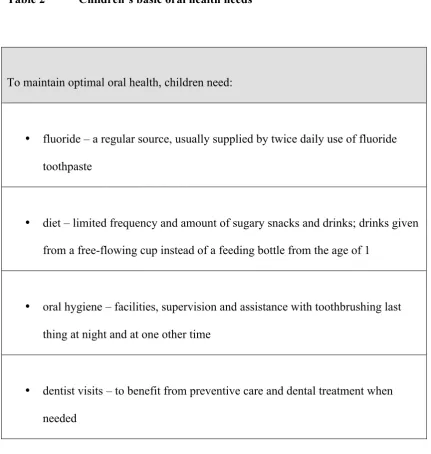
For optimal oral health, children have a number of basic oral health needs (Table 2).
Poor oral health may indicate that these needs have been neglected. Paediatric dentists
perceive dental neglect to be a common problem and 60% report seeing children with
neglected dentitions once daily or more often.
Impact of untreated dental disease
Untreated dental disease can lead to pain, infection and loss of function. This can
adversely affect learning, communication, nutrition and other activities necessary for
normal growth and development. Repeated symptoms from a single carious tooth can
cause as great an impact on the child as problems related to multiple diseased teeth.
Severe untreated dental disease can cause:
¥ toothache
¥ disturbed sleep
¥ lower body-weight, growth and quality of life
¥ absence from school and interference with play and socialisation
and may put a child at risk of:
¥ being teased because of poor dental appearance
¥ needing repeated antibiotics
¥ chronic localised infection which may affect underlying developing teeth
¥ severe acute infection which can cause life-threatening systemic illness
¥ repeated general anaesthesia for tooth extraction
Diagnosis
History
Assessment for dental neglect requires a comprehensive history, including:
¥ current and previous symptoms, including duration, frequency and severity
¥ parental awareness of dental disease
¥ previous dental attendance
¥ any difficulty accessing dental care
¥ medical history, with specific reference to conditions affecting dental care
¥ learning, behaviour or communication difficulties or dental anxiety affecting
dental treatment provision
¥ the child or young personÕs views
¥ other health and social care professionals involved with the family
¥ other markers of vulnerability
Examination
Clinical examination of the mouth and its associated hard and soft tissues is carried
out by a dentist using good lighting, sharp eyes and a blunt probe. The findings are
recorded on a dental chart and mouth map, supplemented as necessary by written
description.
Investigations
Good quality intra-oral radiographs increase the accuracy of caries diagnosis when the
childÕs cooperation permits. Panoramic tomography is used to assess dental
flow rate and buffering capacity or oral microbiological tests are occasionally
requested. The use of a Dental Neglect Scale is described in epidemiological research
but has not been widely adopted for individual assessment.
Features of concern
While dental research has led to a well-developed understanding of the aetiology,
pathogenesis, epidemiology and evidence-based treatment of dental diseases it has
proved difficult to establish clear diagnostic criteria for dental neglect. However there
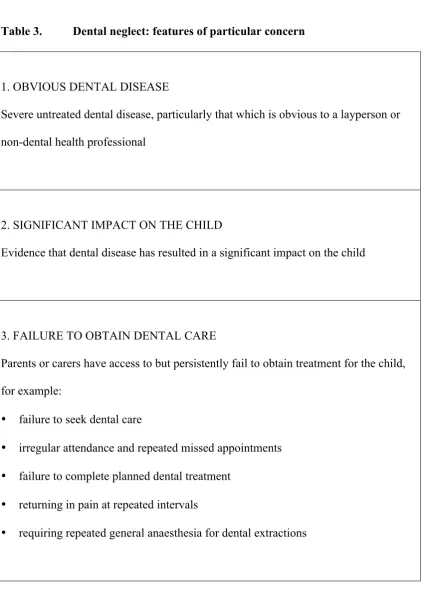
is consensus on features of particular concern (see Table 3), based on expert opinion
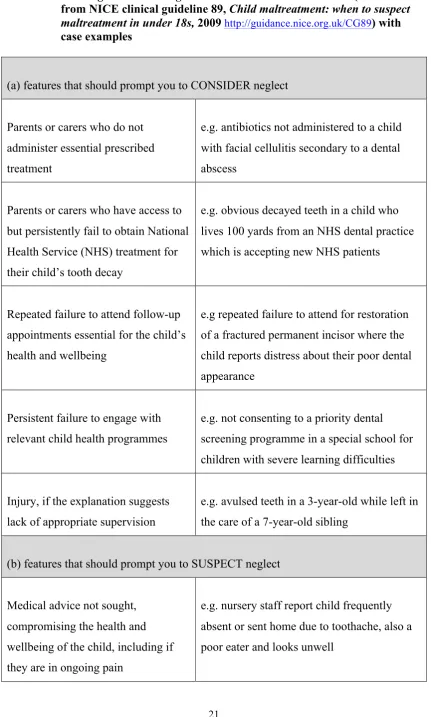
confirmed by recent systematic review findings. Furthermore, NICE guidance advises
when health professionals should ÔconsiderÕ child maltreatment and when they should
ÔsuspectÕ it (Table 4).
Differential diagnosis
Dental fear and anxiety
¥ where dental attendance has been avoided
¥ where dental care has been sought but the child has not been offered appropriate
anxiety management (behavioural, conscious sedation or general anaesthesia)
Conditions that cause unexpectedly severe dental caries
¥ dry mouth (Figure 4), for example due to congenital aplasia of salivary glands,
radiotherapy, infection, drug-induced (Figure 5), malnutrition,
syndrome-associated
¥ children taking frequent sugary medication or dietary supplements where there is
no sugar-free alternative
¥ children who require very frequent meals for essential management of a medical
condition, for example some rare inherited metabolic disorders
Conditions that cause severe problems with oral cleanliness, plaque and calculus
accumulation
¥ gastrostomy-fed children, particularly those at risk of aspirating
¥ orally defensive children who strongly resist toothbrushing, for example some
Vulnerable children
Some groups of children may be particularly vulnerable to dental neglect remaining
undetected:
¥ pre-school children with limited contacts outside the home
¥ children whose lifestyles make access to regular dental care difficult, for example
homeless families, travellers, asylum seekers, children whose parents have mental
health or alcohol/substance abuse problems (Figure 5)
¥ children with disabilities are known to face additional barriers to obtaining dental
care
¥ looked after children may have a range of unmet health needs, including dental
healthcare needs.
Children with certain medical problems, such as congenital heart disease or
immunodeficiencies, may be more likely to experience Ôserious impairment of health
or developmentÕ as a result of coexistent untreated dental disease.
Management of dental neglect
The doctorÕs role
Doctors should routinely look at the mouth and teeth when examining a child,
particularly when there are wider child protection concerns or during a child
protection medical. When dental neglect is suspected, concerns should be raised with
the parents or carers. The health benefits of seeking dental care should be stressed and
advice given to:
¥ make an appointment with the childÕs general practice dentist, if they have one
or
¥ telephone the local NHS dental helpline to enquire which practices are accepting
new patients, if they have no dentist
Referral by letter is preferable, especially if the child has pain or signs of infection,
and details of any relevant medical history should be included. If there are other
community-based specialist or consultant-led paediatric dental care. Options may vary
according to local circumstances and established care pathways.
If the dental signs are severe or accompanied by signs of general neglect the
doctor must, alongside making the dental referral, follow usual child protection
procedures for neglect.
The dentistÕs role
Three stages of intervention are advocated, implemented according to the level of
concern:
Stage 1. Preventive dental team management
Stage 2. Preventive multi-agency management
Stage 3. Child protection referral
Preventive dental team management
This involves raising concerns with parents, offering support to meet the childÕs oral
health needs, setting targets, keeping records and monitoring progress.
Comprehensive dental treatment is arranged with an initial focus on relief of pain and
provision of preventive care. In order to overcome problems of poor attendance,
dental treatment planning must be realistic, achievable and negotiated with the family.
If concerns remain, management should progress to the next stage.
Preventive multi-agency management
The dentist then liaises with other professionals, such as the health visitor or school
nurse, general medical practitioner or social worker, in order to share information, to
ask if concerns are shared and to clarify what further steps are needed. It should be
checked whether the child is subject to a child protection plan. A joint plan of action
should be agreed and documented, with a date specified for review.
Child protection referral
If the situation is found to be too complex or deteriorating, and there is concern that
the child is suffering significant harm, a child protection referral should be made
according to local procedures.
It must be emphasised that child protection referral should not be delayed
response described above is appropriate. Dentists do not usually make a diagnosis of
dental neglect until families have had the opportunity to respond to the offer of
accessible dental care. The past decade has seen an increase in professional
confidence in referring concerns about child maltreatment but for many dental
professionals this is a new area of practice in which they need advice and support
from experienced child protection professionals.
Whilst health professionalsÕ opinion supports considering untreated dental
caries in itself as a marker of possible general neglect, meriting prompt early
intervention to safeguard children, an unequivocal evidence-base is lacking. Studies
reporting dramatically increased caries experience in maltreated children are prone to
selection bias but new evidence has confirmed moderately increased caries experience
and more untreated disease, particularly in the primary dentition.
Follow-up
All children with dental neglect, whatever its severity, should receive regular dental
follow-up and preventive care. This is often a challenge to achieve in practice because
missed appointments are frequently a feature of the problem. Hospital and
community-based audits of attendance report 12-32% of childrenÕs dental
appointments missed. Even after dental extractions under GA, as few as 13% of
children attend for follow-up dental care despite its importance being routinely
stressed.
Working together
There is great potential for improvements in working together between the dental,
medical and nursing professions to safeguard vulnerable children with dental neglect.
This will require all parties to communicate better with each other. Examples of
recently reported initiatives are:
¥ paediatric liaison nurses to support information sharing
¥ projects to routinely include dental examination in child protection medical
assessments
Practice points
¥ dental caries is a very common but preventable disease
¥ neglect of a childÕs oral health needs is often a factor in severe untreated dental
caries
¥ diagnosis of dental caries and dental neglect requires examination by a dentist
¥ management of dental neglect requires health and social care professionals to
work together effectively
WhatÕs new
This update draws on a growing evidence-base and reports increasing professional
confidence in diagnosing dental neglect. Further development of communication
pathways between doctors, dentists and other healthcare professionals is required to
reduce the burden of oral disease in childhood and to ensure childrenÕs oral health
needs are met.
Conflict of interest statement
Further reading
Bhatia SK, Maguire SA, Chadwick BL, Hunter ML, Harris JC, Tempest V, Mann MK,
Kemp AM. Characteristics of child dental neglect: a systematic review. J Dent 2014;
42: 229-239. http://dx.doi.org/10.1016/j.jdent.2013.10.010
Department of Health, British Association for the Study of Community Dentistry.
Delivering Better Oral Health: an evidence based toolkit for prevention. 3rd edn.
London: Public Health England, 2014. Publication no. 2014126. www.dh.gov.uk
Harris J, Sidebotham P, Welbury R et al. Child protection and the dental team: an
introduction to safeguarding children in dental practice. Sheffield: Committee of
Postgraduate Dental Deans and Directors (COPDEND), 2006. Updated Online 2013.
www.cpdt.org.uk
Harris JC, Balmer RC, Sidebotham PD. British Society of Paediatric Dentistry: a
policy document on dental neglect in children. IntJ Paed Dent 2009. Published
Online: May 14 2009. DOI: 10.1111/j.1365-263X.2009.00996.x www.bspd.co.uk
Harris JC, Elcock C, Sidebotham PD, Welbury RR. Safeguarding children in
dentistry: 2. Do paediatric dentists neglect child dental neglect? Br Dent J 2009; 206:
465-470.
Harris JC, Welbury R. Safeguarding children. In: Welbury R, Duggal M, Hosey
MT,eds. Paediatric Dentistry. 4th edn. Oxford: Oxford University Press, 2012;
371-388.
Health and Social Care Information Centre. ChildrenÕs Dental Health Survey 2013.
Executive Summary: England, Wales and Northern Ireland. www.hscic.gov.uk
Keene EJ, Skelton R, Day PF, Munyombwe T, Balmer RC. The dental health of
Park CM, Welbury R, Herbison J, Cairns A. Establishing comprehensive oral
assessments for children with safeguarding concerns. Br Dent J 2015; 219: 231Ð236.
doi:10.1038/sj.bdj.2015.689
Rooney E, Davies G, Neville J, Robinson M, Perkins C, Bellis MA. NHS Dental
Epidemiology Programme for England. Oral Health Survey of 12 year old Children
2008 2009. Summary of caries prevalence and severity results. North West Public
Health Observatory, 2010. www.nwph.net
Scottish Dental Clinical Effectiveness Programme. Prevention and Management of
Caries in Children. 2010. www.scottishdental.org/cep
Selwitz RH, Ismail AI, Pitts NB. Dental caries. Lancet 2007; 369: 51-59.
Sheiham A. Dental caries affects body weight, growth and quality of life in pre-school
Table 1. Glossary of common dental terms
Development
eruption emergence of a new tooth through the gingiva (gum)
exfoliation spontaneous loss of a tooth, usually when a primary (baby)
tooth is replaced by its permanent (adult) successor
quadrant the teeth in one half of a dental arch e.g. the upper right
quadrant extends from the midline to the most distal upper
right molar
dental tissues enamel, dentine, pulp, cementum, gingiva, periodontal
ligament
Diagnoses
dental caries destruction (decay) of dental hard tissues by acidic
by-products from bacterial fermentation of dietary carbohydrates
dental plaque bacterial biofilm on the tooth surface, removed by
toothbrushing
gingivitis inflammation of the gingival margin, usually plaque-related
due to poor oral hygiene
periodontitis progressive destruction of the supporting tissues of the tooth
(Ôgum diseaseÕ); rare before puberty
calculus hard deposit of mineralised plaque; gross deposits are
uncommon except in children with complex disabilities,
especially if non-orally-fed
pulpitis painful inflammation of the dental pulp (nerve); acute or
dental abscess abscess in the periapical tissues (at the root apex); acute with
severe pain and risk of spreading infection or chronic
discharging sinus with intermittent discomfort
dental trauma injuries to teeth: (a) fractures - defined by the tissues affected
e.g. enamel, dentine, pulp and (b) luxation injuries - defined
by the degree of loosening and the direction of movement
tooth surface loss toothwear due to erosion (e.g. from acidic drinks or gastric
reflux), attrition (e.g. from tooth grinding) or abrasion (e.g.
from abrasive foodstuffs), alone or in combination
Treatment
preventive care use of fluorides (e.g. as toothpaste or varnish), fissure sealants,
oral hygiene instruction and dietary counselling
fissure sealants resin coating applied to molar teeth to prevent caries
scaling calculus removal by scraping it off with a metal or ultrasonic
tipped instrument
restoration removal of decayed or damaged tooth tissue and repair with a
suitable material (a filling) or custom-made replacement (e.g.
crown, inlay, veneer)
endodontic treatment treatment for the diseased or injured dental pulp (Ôroot fillingÕ)
Table 2 ChildrenÕs basic oral health needs
To maintain optimal oral health, children need:
¥ fluoride Ð a regular source, usually supplied by twice daily use of fluoride
toothpaste
¥ diet Ð limited frequency and amount of sugary snacks and drinks; drinks given
from a free-flowing cup instead of a feeding bottle from the age of 1
¥ oral hygiene Ð facilities, supervision and assistance with toothbrushing last
thing at night and at one other time
¥ dentist visits Ð to benefit from preventive care and dental treatment when
Table 3. Dental neglect: features of particular concern
1. OBVIOUS DENTAL DISEASE
Severe untreated dental disease, particularly that which is obvious to a layperson or
non-dental health professional
2. SIGNIFICANT IMPACT ON THE CHILD
Evidence that dental disease has resulted in a significant impact on the child
3. FAILURE TO OBTAIN DENTAL CARE
Parents or carers have access to but persistently fail to obtain treatment for the child,
for example:
¥ failure to seek dental care
¥ irregular attendance and repeated missed appointments
¥ failure to complete planned dental treatment
¥ returning in pain at repeated intervals
Table 4 Alerting features of neglect of relevance to dental disease (summarised from NICE clinical guideline 89, Child maltreatment: when to suspect maltreatment in under 18s, 2009 http://guidance.nice.org.uk/CG89) with case examples
(a) features that should prompt you to CONSIDER neglect
Parents or carers who do not
administer essential prescribed
treatment
e.g. antibiotics not administered to a child
with facial cellulitis secondary to a dental
abscess
Parents or carers who have access to
but persistently fail to obtain National
Health Service (NHS) treatment for
their childÕs tooth decay
e.g. obvious decayed teeth in a child who
lives 100 yards from an NHS dental practice
which is accepting new NHS patients
Repeated failure to attend follow-up
appointments essential for the childÕs
health and wellbeing
e.g repeated failure to attend for restoration
of a fractured permanent incisor where the
child reports distress about their poor dental
appearance
Persistent failure to engage with
relevant child health programmes
e.g. not consenting to a priority dental
screening programme in a special school for
children with severe learning difficulties
Injury, if the explanation suggests
lack of appropriate supervision
e.g. avulsed teeth in a 3-year-old while left in
the care of a 7-year-old sibling
(b) features that should prompt you to SUSPECT neglect
Medical advice not sought,
compromising the health and
wellbeing of the child, including if
they are in ongoing pain
e.g. nursery staff report child frequently
absent or sent home due to toothache, also a
Figure captions
Figure 1. Five-year-old boy with a healthy primary dentition.
Figure 2. Four-year-old girl with severe untreated dental caries who has missed appointments for a dental clearance (extraction of all her teeth) under GA. (© Oxford University Press. Reproduced with permission from Harris J, Welbury R. In: Paediatric Dentistry, 4th edn. Edited by Welbury, Duggal & Hosey, 2012)
Figure 3. Four-year-old boy on completion of treatment for S-ECC associated with prolonged night-time bottle feeding. The primary upper incisors were extracted and the molars restored with preformed metal crowns. There has been a good response to oral hygiene instruction and dietary advice such that multiple white (1) and brown (2) spot carious lesions have now arrested. This child has high past caries experience but no active caries and there are no concerns about dental neglect.
Figure 4. Dental caries and tooth surface loss affecting smooth surfaces of incisor teeth (surfaces usually resistant to decay). This was initially misdiagnosed as dental neglect but further investigation revealed severe dry mouth (stimulated saliva flow rate 0.16 ml/min).