This is a repository copy of Does Money Impede Convergence?.
White Rose Research Online URL for this paper:
http://eprints.whiterose.ac.uk/118633/
Version: Accepted Version
Article:
Hey, John Denis orcid.org/0000-0001-6692-1484 and Di Cagno, Daniela (2016) Does
Money Impede Convergence? EXPERIMENTAL ECONOMICS. pp. 595-612. ISSN
1386-4157
https://doi.org/10.1007/s10683-015-9456-x
[email protected] https://eprints.whiterose.ac.uk/
Reuse
Items deposited in White Rose Research Online are protected by copyright, with all rights reserved unless indicated otherwise. They may be downloaded and/or printed for private study, or other acts as permitted by national copyright laws. The publisher or other rights holders may allow further reproduction and re-use of the full text version. This is indicated by the licence information on the White Rose Research Online record for the item.
Takedown
If you consider content in White Rose Research Online to be in breach of UK law, please notify us by
1
Does Money Impede Convergence?
John D Hey1 and Daniela Di Cagno2
Abstract
I C conjecture that the necessity of trading through money in monetised economies might hinder convergence to competitive equilibrium, and hence, for example, cause unemployment, we experimentally investigate behaviour in markets where trading has to be done through money. In order to evaluate the properties of these markets, we compare their behaviour to behaviour in markets without money, where money cannot intervene. As the trading mechanism might be a compounding factor, we investigate two kinds of market mechanism: the double auction, where bids, asks and trades take place in continuous time throughout a trading period; and the clearing house, where bids and asks are placed once in a trading period, and which are then cleared by an aggregating device. We thus have four treatments, the pairwise combinations of non-monetised/monetised trading with double auction/clearing house. We find that: convergence is faster under non-monetised trading, implying that the necessity of using money to facilitate trade hinders convergence; that monetised trading is noisier than non-monetised trading; and that the volume of trade and realised surpluses are higher with the double auction than the clearing house. As far as efficiency is concerned, monetised trading lowers both informational and allocational efficiency, and while the double auction outperforms the clearing house in terms of allocational efficiency, the clearing house is marginally better than the double auction in terms of informational efficiency when trade is through money. Crucially we confirm the conjecture that inspired these experiments: that the necessity to use money in trading hinders convergence to competitive equilibrium, lowers realised trades and surpluses, and hence may cause unemployment.
JEL Classifications: C92, D40, E24
Keywords: clearing house mechanism, double auction mechanism, experimental markets, money, monetised trading, non-monetised trading.
Acknowledgements: The authors would like to express their gratitude to Andrea Lombardo for writing the software in Visual Studio for these experiments. We also thank LUISS for use of their purpose-built laboratory, run under the auspices of CESARE. Finally we would like to thank the Editor and three referees for invaluable comments which led to significant changes in the paper.
Corresponding author: Hey, Department of Economics and Related Studies, University of York, Heslington, York YO10 5DD, UK, [email protected]
1
University of York, UK
2
2
1. IntroductionAs Clower famously said in 1967, as part of the then on- K ‘ (partly initiated
by Leijonhufvud, 1968): M .
This aphorism seemed to have been forgotten as part of the demise of Keynes ideas, but is now
coming back into econo The key idea is that, in
money-based economies, goods cannot be bartered directly for each other; instead money has to be
used as a go-between. This may interfere with convergence to equilibrium, particularly, as Clower
thought, in the labour market: firms do not employ workers as they cannot see the extra sales
generated by them doing so. Involuntary unemployment may result.
I H D C C
monetised trading market with the double auction trading mechanism. We did indeed see a
departure from convergence to the competitive equilibrium, but that experiment was partial in that
it did not compare the monetised trading outcome with the non-monetised trading outcome. Other
factors may have been influencing our results.
One possibility is that the results may have been the consequence of the objective function imposed
on our subjects (that of a utility function rather than through the use of reservation prices). Indeed
our objective function (maximising a function of two variables, rather than simply maximising
surplus as is usually the case) may be perceived as being more complicated for subjects to
understand, and it may have been that, rather than having to trade through money, that caused the
lack of convergence.
Moreover we felt that the lack of convergence might have resulted from the trading mechanism that
we used, rather than from the trading through money. While, as we note later, there is a general
acceptance that the double auction mechanism is robustly efficient, there are studies that show
greater efficiency with other mechanisms. For example, Goeree and Lindsay (2012b) show that with
in which subjects enter effectively a demand schedule
3
implemented additional treatments with a second mechanism that of the clearing house3 in
which subjects enter effectively a (price,quantity) pair which are then aggregated to clear the market
by the experimenter. Hence the present experiment, in which we have four treatments, with each of
non-monetised trading and monetised trading paired with each of two trading mechanisms double
auction and clearing house. By monetised trading we mean trading where one good is singled out
as the medium of exchange, and also where this good does not enter into the subjects payoff
functions. We shall see that our conjecture about the two market mechanisms is not confirmed by
C conjecture is for both mechanisms.
The paper is organised as follows: in section 2, C
literature that explored his conjecture; in section 3, we discuss the issues of efficiency in markets; in
section 4, we describe our experimental design; in section 5, we describe our results. Section 6
concludes.
2. C
C the necessity of monetised trading might
cause a lack of convergence to the competitive equilibrium. The publication of his paper sparked off
a flurry of theoretical work aimed at investigating his conjecture. There is one clear and repeated
conclusion from this literature: that convergence to the competitive equilibrium might not be
attained. Moreover, there might be several possible equilibria, and expectations might be important.
The various theoretical contributions differ in their assumptions about the market and about
trading. We cannot cover all the contributions, and so concentrate on those that are relevant for our
experimental design. This was as follows (we give more detail later): we had two goods in our
experiment and two kinds of agents, both of which started trading with stocks of just one of the two
goods. They are motivated to trade through a payoff function, which is a Cobb-Douglas function
defined over the amounts of the two goods that they hold at the end of trading. In the monetised
3W G L
4
treatments they had to trade through money which is worthless at the end of the experiment.
Because of this feature, and to facilitate trade, we implemented a random stopping mechanism, for
otherwise subjects might backwardly induct with, as a consequence, no trade resulting.
One of the earlier papers C was that of Barro and Grossman
(1971) which adopted a framework similar to ours, and
money. However for most of the analysis prices are fixed and the
T
should be considered as equilibrium with fixed prices. Similarly Benassy (1975) talks about
Neo-Keynesian Equilibrium (or K-equilibrium) though once again prices are fixed finding the existence
of some equilibria where the level of trade and economic activity are depressed because of the
wrong exchange rate. Both these papers have centralised trading. In contrast, Kiyotaki and Wright
(1989) talk about equilibria with random matching and conclude that the equilibria are not
generally Pareto optimal and that when multiple equilibria coexist they are not generally Pareto
comparable. Lucas (1980), like Barro and Grossman (1971), models an economy with two goods
and money, but with uncertainty (here about preferences). He
equilibrium Ostroy and Starr (1974) start with a barter economy and then
introduce money. They conclude that in the absence of double coincidence such a trading rule [one
essentially satisfying double coincidence of wants] will achieve an inefficient allocation far from
competitive equilibrium . Moreover,
trading rules (that is, rules which place limits on the ingenuity or computational capacity of traders).
Shapley and Shubik (1977) adopt a game-theoretic analysis and consider the various possible
non-cooperative equilibria. They conclude a striking feature of this kind of equilibrium is its
non-. This result is echoed throughout this literaturenon-.
Some recent papers consider the adjustment process of prices in this kind of framework; so their
analyses are dynamic. Of particular relevance are the papers by Crockett et al (2011), Gjerstad
5
between the four treatments, but dynamics obviously play a role since trading is repeated over a
random number of trading days. If the price adjustment process is unstable, then we have to be
careful about interpreting our results. We will have more to say about this later.
3. Efficiency and market mechanisms
We implement two different market mechanisms: the double auction and the clearing house. We
wanted to see if the deterioration moving from non-monetised trading to monetised trading was a
B .
Here we are referring to efficiency. There are several definitions of market efficiency, but we
concentrate on two: informational efficiency and allocational efficiency. The former concerns
convergence to the competitive price, and the latter refers to the realised gains from trade.
Friedman (1993) provides an early experimental study comparing the double auction and the
clearing house, though in the context of non-monetised trading4 H
markets are as informationally efficient as double auction markets and almost as allocationally
C F alth of experimental evidence by
“CM
[clearing house], while CDA As we have already noted these
results pertain to non-monetised trading. We are interested in seeing whether they carry over to
monetised trading.
Our focus on different market mechanisms and trading rules is also relevant for policy concerns
since actual financial markets are organised in such a way as implying that both trading through
money and trading directly (without money) can occur. Moreover, there are institutions which use a
clearing house mechanism (such as the MTS Electronic Government Bond market), whereas Stock
Exchanges generally implement a double auction mechanism.
4
6
4. The ExperimentWe now give more detail on the experimental design. The environment is as simple as possible, yet
staying C T X and Y. There are two types of traders:
Type X and Type Y and there are n of each type5. Trading is divided up into trading days. In each day,
Type X traders are endowed with a quantity x of Good X, but none of Good Y; mutatis mutandis Type
Y traders are endowed with none of Good X but a quantity y of Good Y. Trade takes place through
the day and the payment to each subject depends upon the amounts of the two goods they end up
with at the end of the day. To be specific if a trader of either type ends the day with x of Good X and
y of Good Y their payment for that day will be in euro cents6. Clearly if either type of agent
does not trade in any day, they end up with zero payment for that day. Goods cannot be carried over
from day to day.
We had four treatments, namely each of non-monetised (N) trading and monetised (M) trading
paired with each of double auction (D) and clearing house (C). We had three different parameter
sets within each treatment, and each of these was duplicated, giving a grand total of 24 groups of
experimental subjects. We use the following notation7 for the parameter sets:
double auction trading (D) clearing house trading (C) non-monetised trading (N) ND40,40, ND60,30, ND30,60 NC40,40, NC60,30, NC30,60
monetised trading (M) MD40,40, MD60,30, MD30,60 MC40,40, MC60,30, MC30,60
In the non-monetised (N) treatments, each trading day is independent of all the others and there is
no money. In the monetised (M) treatments, however, there is (experimental) money and trade
must be carried out using this (experimental) money. Accordingly, in the monetised treatments, we
divided up each trading day into a morning, an afternoon and an evening: in the morning the market
5
In the experiment we put n equal to 5. We deliberately made the numbers of each type the same, and made the total number of subjects in each session sufficiently high to avoid any monopolistic possibilities.
6
The experiment was conducted in Italy and subjects were paid in euros. There are 100 centesimi in a euro. A euro is currently worth about £0.74 or $1.13.
7
The notation ABa,b indicates an experimental session using the AB trading mechanism with parameters x=a
7
for Good X was open and agents could buy and sell Good X using (experimental) money; in the
afternoon the market for Good Y was open and agents could buy and sell Good Y using
(experimental) money; in the evening accounting was done and the agents informed as to how much
real money they had earned for that day. The experimental money used in the trading process had
no value, however; all agents were endowed with a stock of experimental money at the beginning of
the experimental session but it was worthless at the end.
There is a potential problem here however: if the subjects knew the number of trading days that the
experiment would last, and if they could perform backward induction, no trade would ever take
place. Since experimental money is worthless at the end of the experiment, no Type Y would want to
accept any experimental money on the afternoon of the final day; as a consequence no Type X
would accept any money in the morning of the final day, and so on backwards. To solve this
problem, we made the number of days that the experiment lasted random. Ideally we would have
preferred to have had a stationary mechanism so that the probability of any day being the final day,
given that the experiment had lasted to that day, would be a fixed number, but there are two
problems with this: first, subjects seem to have difficulty in understanding the mechanism (if we say
the probability of the experimental session finishing at the end of any day is 0.1, they get
increasingly nervous at and after day 10, even though there is no need to be); second if we
implement it honestly, we could end up with a an experimental session having very few days, thus
giving us very few observations. We adopted a compromise: we said that the experiment would last
at least 18 days, and that then and thereafter the probability would be one-half that the experiment
would finish at the end of any day. In practice, 13 of the 24 experimental sessions lasted 18 periods,
9 lasted 19 periods and 2 lasted 20 periods.
As we have already noted, we had three different parameter sets within each treatment, and each
of these were duplicated. These sets differed in terms of the parameters x and y. To be specific: 8 of
8
parameters x = 30 and y = 60. In some of the data analysis that follows we aggregate the data for the
duplicated three experimental sessions of each treatment.
Now let us investigate the stationary equilibrium implied by this setup. We consider each day as a
whole. Let us denote by p and q the (absolute) prices of Good X and Good Y. Type X subjects want to
maximise subject to px = px + qy; the solution to this is x* = x/2 and y* = (px)/(2q). Type Y
subjects want to maximise subject to qy = px + qy; the solution to this is x* = (qy)/(2p) and y*
= y/2. Given that there are equal numbers of each type, equilibrium implies that, (px)/(2q) = y/2, and
x/2 = (qy)/(2p), and hence that the relative price of Good Y in the stationary equilibrium, q/p, is
equal to x/y. Thus the good relatively lower in supply is relatively higher priced. With our three
parameter sets, this stationary equilibrium relative price of Good Y is 1 with parameter set 1, 2 with
parameter set 2, and 0.5 with parameter set 3. Our experiment is partly to see if actual relative
prices converge to these. We note that in this static competitive equilibrium, the payment to any
subject on any given day is given by x y).
One might also be interested in a dynamic equilibrium, if the experiment is considered as dynamic8.
Clearly, in such an equilibrium, both types of agent have to end each day with the same amount of
money as they started (for otherwise one Type would be increasing their stock at the expense of the
other). Now consider a subject of Type X, starting each day with an amount x of Good X (the same
analysis, mutatis mutandis, applies to the Type Y). Let us denote by Vt(x) the total expected earnings
for such a subject over the lifetime of the experiment as viewed from period t. Then we have that
Vt(x) = max{ -p)Vt+1(x) + p0} subject to px = px + qy (since when the experiment finishes no
further earnings are possible). It follows that if Vt(x) = V(x) for all t, then V(x) = max{ }
subject to px = px + qy, and hence we get the same objective function as in the one-shot problem
and the solution is identical. The random stopping mechanism makes no difference to this
equilibrium, though there may well be others.
8
9
We now give some practical detail. The experiment was carried out in the purpose-built CESARE9
laboratory at LUISS in Rome. It was run using software written in Visual Studio by Andrea Lombardo.
Subjects were recruited from a register using ORSEE (Greiner 2004). Instructions were in Italian; an
English translation can be found in the Appendix (not to be published) and online where there is
further detail. The software included a calculator which enables subjects to see the real money
earnings for any end-of-day holdings of the two goods. There were a total of 24 sessions, 6 of each
treatment, with 10 subjects in each experimental session. In any one treatment, all parameters were
fixed. No communication was allowed between the subjects. After subjects arrived they were given
written instructions and any questions were answered. Subjects were aware only of their
endowments of the two goods and not the endowments of the other subjects in the experimental
session. The experiment then started and continued until the computer randomly determined when
it was over. Subjects were paid in cash and, after signing a receipt, were free to go. No subject
participated in more than one session. S . Different treatments
lasted different amounts of time, with the monetised treatments taking longer.
A brief comment should be made about the calculation of the clearing price in the non-monetised
clearing house treatment, as it differs from the usual case where trading is with money. In the usual
context all buyers state a (price, quantity) pair; sellers likewise. These are aggregated into step
functions in (price, quantity) space and a market-clearing price found where the step functions
intersect. However, in our setup, where we have two goods, the mechanism is somewhat different:
X Y T I
is (x,y) this means that he/she is willing to exchange up to x units of X in exchange for
at least y units of Y. The same applies, mutatis mutandis, for the sellers. How do we find the
equilibrium relative price? We cannot use step functions as neither good is money and we want to
find an equilibrium relative price of Y (or of X which is the inverse). For example if 2 units of X are
exchanged for 3 units of Y, then the relative price of Y is 2/3 or the relative price of X is 3/2. How do
9
10
we find this? There are two ways which give the same answer. The first is to draw a graph with the
quantity of X along the horizontal axis and the relative price of X on the vertical axis. In this space the
supply curve is the usual kind of step function, but the demand function is different: between the
horizontal steps the demand curve takes the form of a rectangular hyperbola. The same is true,
mutatis mutandis, if one does the analysis with the quantity of Y on the horizontal axis and the
relative price of Y on the vertical axis. With either analysis one finds the relative price of X (or of Y
its inverse) and the quantities of the two goods exchanged in equilibrium. Of course, we did not
explain, or need to explain, this to the subjects, though we did show them a graph of the implied
demand and supply functions.
5. Results
5.1 Prices and Volumes
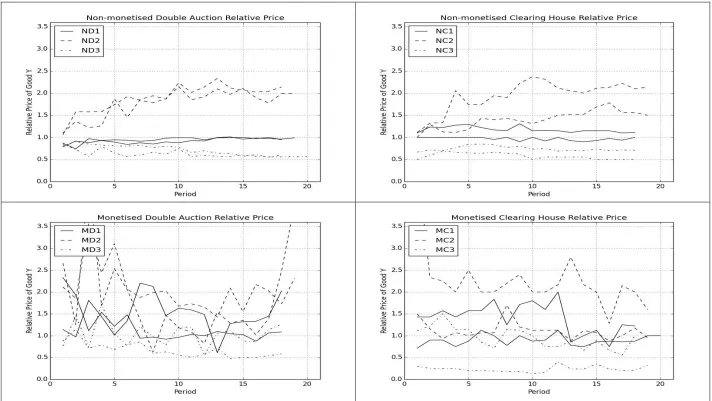
The key results concerning the pattern of prices during the periods of the experiment can be found
in Figure 1. We should note that for each treatment and each parameter set, there are two lines,
corresponding to the duplicated experimental sessions. Overall means and standard deviations can
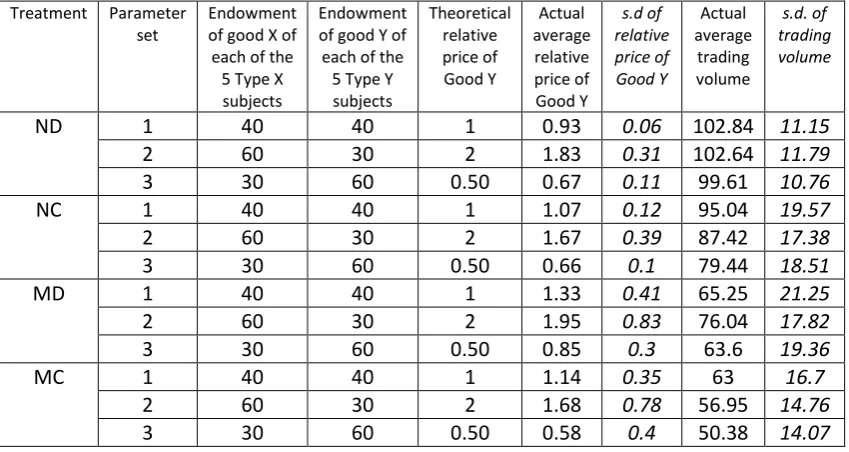
be found in Table 1. If we start with the conventional treatment the non-monetised double
auction, ND we see from the top left hand graph that the relative price of Good Y converges rapidly
to the theoretical predictions (1 for ND40,40, 2 for ND60,30 and 0.5 for ND30,60). The first of these is
particularly rapid, but this may be because of some kind of focal point effect (equality of prices). This
may also account for the initial stages of ND60,30 and ND30,60 starting off around 1 before almost
converging to their theoretical values; ND30,60 is slightly high at the end. The non-monetised clearing
house, NC, in the top-right, is almost as good, though here one of the NC60,30 sessions is slightly
above and one slightly below its theoretical value, while one of the NC30,60 is also above its
theoretical value.
When we get on to the monetised sessions things change. The bottom-lower graph in Figure 1
11
mean price in MD60,30 and MD30,60, as it should be, but the mean prices in MD60,30 and MD30,60 are
somewhat away from their theoretical values, and the variances are high indicating that the
trading through money is hindering convergence to equilibrium. Interestingly the monetised
clearing house (in the bottom-right) is somewhat less erratic and the average price in MC40,40 is close
to its theoretical value, while in MC60,30 the relative price of Good Y is below what it should be and in
MC30,60 it is slightly above.
We suspect that the sharp upturn in the relative price of Good Y in the monetised double auction
may have been a consequence of subjects getting apprehensive about the end of the experiment,
and, in particular, with Type Y subjects getting increasingly reluctant to sell (in exchange for probably
worthless experimental money).
One feature that we would expect from prices being away from equilibrium is that trading volumes
are different from those that we would expect. Figure 2 shows total trading volumes, expressed as a
percentage of the volume in the static competitive equilibrium. Means and standard deviations are,
once again, shown in Table 1. We should note that there is no reason why this measure might not be
above 100% -
Looking at Figure 2, we see that in the non-monetised double auction treatment, volumes are
generally close to 100%. The same is true for the non-monetised clearing house, though it takes
somewhat longer to get close to 100%. Things change dramatically, though, with the monetised
treatments, where trading volumes are well below 100%, both for the double auction and the
clearing house, though the latter is more erratic.
5.2 Dynamics
In order to shed some light on the dynamics of the price adjustment process, we present in Figure 3,
scatters of the change in the relative price of Good Y (pt-pt-1) against the departure in the previous
12
sessions of each treatment. We have 102 observations for each treatment. The fitted relationships
are as follows:
non-monetised double auction: (pt-pt-1) = -0.0014 + .3334(p*-pt-1) R=.461 monetised double auction: (pt-pt-1) = 0.1231 + .6616(p*-pt-1) R=.578 non-monetised clearing house: (pt-pt-1) = 0.0000 + .1452(p*-pt-1) R=.295 monetised clearing house: (pt-pt-1) = -0.297 + .3461(p*-pt-1) R=.3461
All these indicate stability in the adjustment process for all treatments.
5.3 Payments
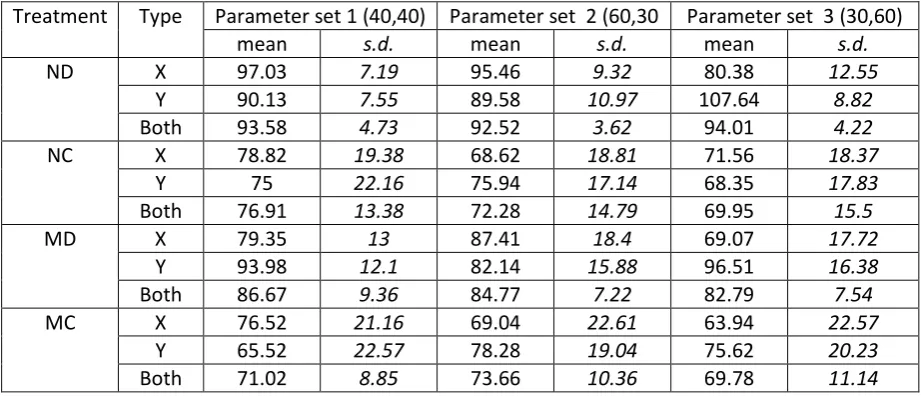
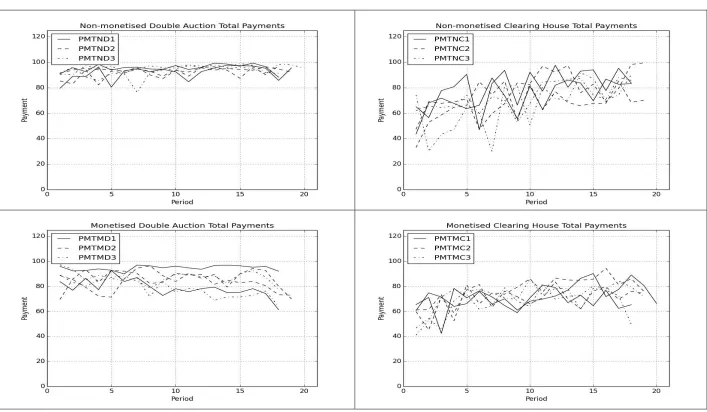
Average payments to subjects per period are shown in Figure 4. Summaries are also presented in
Table 2. In both the Figure and the Table, we present actual payments as a percentage of the
with parameter set 1 (40,40),
10
with parameter sets 2 (60,30) and parameter set 3 (30,60). It follows from the definition
of these variables that the maximum the average can be in all cases is 100.
In Figure 4 it is clear that in the non-monetised double auction sessions payments to subjects are
around what they should be in the static competitive equilibrium. In the non-monetised clearing
house sessions payments in general were a lot lower than in the non-monetised double auction,
though they were approaching the latter at the end. The same is true in the monetised treatments,
where payments on average to the subjects in the clearing house treatment were lower than in the
double auction. We note that payments were also slightly more erratic in the monetised double
auction as compared with the non-monetised double auction. Going from non-monetised trading to
monetised trading with the double auction sees a decrease in average payments to subjects, while
there was only a small decrease in the average payments to subjects with the clearing house.
However this analysis ignores a trend effect: with the non-monetised clearing house the trend is
upwards throughout the periods of trading, almost reaching 100 by the end, while the monetised
clearing house starts higher but ends up below 100 at the end.
10
13
5.4 EfficiencyFinally we present some results on efficiency in the four treatments. As we remarked in section 3,
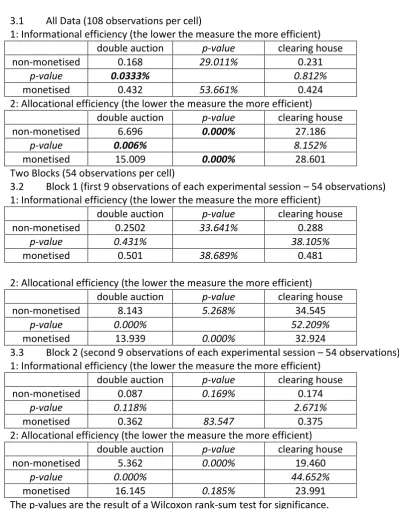
we use two measures informational efficiency and allocational efficiency. Table 3 shows the
results: 3.1 presents the results on all the data over the first 1811 periods of all six sessions (where
we have 108 observations in each treatment); 3.2 and 3.3 disaggregate the results into the first half
and the second half of each data set (108 observations in each treatment). If we concentrate on all
the data12 3.1 we see that monetised trading lowers the informational and allocational efficiency
for both market mechanisms, with the difference being particularly significant for allocational
efficiency for the double auction. Interestingly the clearing house is marginally but not significantly
more informationally efficient than the double auction in the monetised treatment. The breakdown
of the data into the two halves Tables 3.2 and 3.3 shows that informational efficiency increases
for both trading types as time passes, as one would hope, but allocational efficiency falls for the
double auction.
6. Conclusions
One clear message emerges from these experiments: money hinders convergence to equilibrium. As
a consequence, realised trading volumes in the monetised treatments are lower than they would be
in the static competitive equilibrium, and, of necessity, realised payments/surpluses are lower.
Moreover, switching to a clearing house mechanism does not remove the inefficiencies resulting
from monetised trading. However, we should note that the reduction in payments in the clearing
house is much smaller than the reduction for the double auction, but mainly because the clearing
house starts from a lower base. Indeed, we see markedly lower payments in the clearing house
treatment than in the double auction treatment a result different from that reported by Friedman
(1993). It is not clear what caused these differences, thou F
11
Different sessions had different lengths and the shortest length was 18.
12
14
experiments, trading was always between a good (with a stated value) and cash; in contrast we have
trading between two goods (either directly or indirectly) the value of which depended upon the
combinations of the two goods. Moreover in Fr trading for cash,
the price of the trade was always explicit, while in ours the price was implicit in terms of the ratio of
the quantities.
One difficulty facing the subjects in the monetised treatments, and one which is highlighted in the
theoretical literature to which we have referred in section 2, is the question of expectations, crucially
about the value of money. It has a zero value at the (random) end of the experiment, but while the
experiment is continuing, it has a value in that it facilitates the implementation of future trades. All
bidding and asking in the monetised treatments had to be done in money terms, and the whole issue
of absolute prices for the two goods is crucial. So far, we have avoided any discussion of absolute
prices framing all our analyses in terms of relative prices of the two goods but clearly this is a
A perceived end of the experiment draws
nearer both sides of the market would get increasingly nervous about holding money. However, the
effect of this is not clear, though it may be the case that buyers would be increasingly happy to pay
more, and the sellers would be increasingly happy to ask more. Indeed we notice an increase in the
absolute prices of the two goods as periods pass. But the key issue is on expectations and these
may be driven by the past behaviour of absolute prices. Thus the results that we have found may
just be conseque future prices. But this in turn
is linked to the uncertainty about future trades C
conjecture.
The bottom line of our experiment is the finding that trading volumes, and payments, in the
monetised treatments are lower than in the non-monetised treatments, and hence lower than they
could/should be in the competitive equilibrium. This finding C
necessity of monetised trading may cause lack of trade, and hence, in particular, create involuntary
15
ReferencesB ‘ J G H I A G D M I
E American Economic Review, 61, 82-93.
Benassy, J.-P. (1975), Neo-K D T M E , Review of
Economic Studies, 42, 203-220.
C T M F D A C M I Handbook of
Experimental Economics Results, volume 1, Elsevier.
Clower, R.W. (1967), A ‘ M ofoundations of Monetary Theory , Economic
Inquiry, 6, 1 8.
Crockett, S., Oprea, R. and Plott, C. R. E W D T G E
L American Economic Review, 101, 3196-3220.
Friedman, D. (1993), H T I A F M P e: Some
L E Economic Inquiry, 31, 410-435.
Gjerstad, S. (2013), "Price dynamics in an exchange economy", Economic Theory, 52, 461-500.
Goeree, J.K. and Lindsay, L D P M E E ‘
University of Zurich Working Paper 71.
Goeree, J.K. and Lindsay, L “ E M D G
E U versity of Zurich Working Paper.
G B The Online Recruitment System ORSEE 2.0 - A Guide for the Organization of
Experiments in Economics . University of Cologne, Working Paper Series in Economics 10.
Hey, J. D. and Di Cagno, D. (1998) “ M A E I C
D D H Experimental Economics, 1, 63-87.
K N W ‘ O M M E Journal of Political
Economy, 97, 927-954.
Leijonhufvud, A. (1968), On Keynesian Economics and the Economics of Keynes. Oxford: Oxford
16
Lucas Jr., R. E. E P M E Economic Inquiry, 18, 203-220.
Ostroy, J.M. and Starr, R.M. M D E Econometrica,
42, 1093-1113.
“ L “ M T U O C M P Journal of
17
Table 1: Summary statistics on prices and volumes (actual and theoretic)
Treatment Parameter set
Endowment of good X of each of the 5 Type X subjects
Endowment of good Y of each of the 5 Type Y subjects Theoretical relative price of Good Y Actual average relative price of Good Y s.d of relative price of Good Y Actual average trading volume s.d. of trading volume
ND 1 40 40 1 0.93 0.06 102.84 11.15
2 60 30 2 1.83 0.31 102.64 11.79
3 30 60 0.50 0.67 0.11 99.61 10.76
NC 1 40 40 1 1.07 0.12 95.04 19.57
2 60 30 2 1.67 0.39 87.42 17.38
3 30 60 0.50 0.66 0.1 79.44 18.51
MD 1 40 40 1 1.33 0.41 65.25 21.25
2 60 30 2 1.95 0.83 76.04 17.82
3 30 60 0.50 0.85 0.3 63.6 19.36
MC 1 40 40 1 1.14 0.35 63 16.7
2 60 30 2 1.68 0.78 56.95 14.76
3 30 60 0.50 0.58 0.4 50.38 14.07
Key: i is the parameter set number
double auction (D) clearing house (C)
non-monetised trading (N) NDi NCi
18
Table 2: Means and standard deviations of average payments to subjects expressed as a percentage of the payments in the static equilibrium
Key: i is the parameter set number
double auction (D) clearing house (C)
non-monetised trading (N) NDi NCi
monetised trading (M) MDi MCi
Treatment Type Parameter set 1 (40,40) Parameter set 2 (60,30 Parameter set 3 (30,60)
mean s.d. mean s.d. mean s.d.
ND X 97.03 7.19 95.46 9.32 80.38 12.55
Y 90.13 7.55 89.58 10.97 107.64 8.82
Both 93.58 4.73 92.52 3.62 94.01 4.22
NC X 78.82 19.38 68.62 18.81 71.56 18.37
Y 75 22.16 75.94 17.14 68.35 17.83
Both 76.91 13.38 72.28 14.79 69.95 15.5
MD X 79.35 13 87.41 18.4 69.07 17.72
Y 93.98 12.1 82.14 15.88 96.51 16.38
Both 86.67 9.36 84.77 7.22 82.79 7.54
MC X 76.52 21.16 69.04 22.61 63.94 22.57
Y 65.52 22.57 78.28 19.04 75.62 20.23
19
Table 3: Efficiency measures and tests
3.1 All Data (108 observations per cell)
1: Informational efficiency (the lower the measure the more efficient) double auction p-value clearing house
non-monetised 0.168 29.011% 0.231
p-value 0.0333% 0.812%
monetised 0.432 53.661% 0.424
2: Allocational efficiency (the lower the measure the more efficient) double auction p-value clearing house
non-monetised 6.696 0.000% 27.186
p-value 0.006% 8.152%
monetised 15.009 0.000% 28.601
Two Blocks (54 observations per cell)
3.2 Block 1 (first 9 observations of each experimental session 54 observations) 1: Informational efficiency (the lower the measure the more efficient)
double auction p-value clearing house
non-monetised 0.2502 33.641% 0.288
p-value 0.431% 38.105%
monetised 0.501 38.689% 0.481
2: Allocational efficiency (the lower the measure the more efficient) double auction p-value clearing house
non-monetised 8.143 5.268% 34.545
p-value 0.000% 52.209%
monetised 13.939 0.000% 32.924
3.3 Block 2 (second 9 observations of each experimental session 54 observations) 1: Informational efficiency (the lower the measure the more efficient)
double auction p-value clearing house
non-monetised 0.087 0.169% 0.174
p-value 0.118% 2.671%
monetised 0.362 83.547 0.375
2: Allocational efficiency (the lower the measure the more efficient) double auction p-value clearing house
non-monetised 5.362 0.000% 19.460
p-value 0.000% 44.652%
monetised 16.145 0.185% 23.991
20
21
22
Figure 3: scatters of change in relative price against departure from equilibrium (51 observations in each treatment)
non-monetised trading monetised trading
d
o
u
b
le
au
cti
o
n
cl
e
ar
in
g
h
o
u
se
23
Appendix: not to be published: Instructions for the non-monetised trading double auction
CESARE
Centro di Economia Sperimentale a Roma Est
Welcome to this experiment on the economics of market decision making. The Italian Ministry of Education, MIUR, has provided the funds for the experiment. The instructions are simple, and if you follow them carefully and make good decisions, you might earn a considerable amount of money which will be paid to you in cash immediately after the end of the experiment.
INTRODUCTION
In this experiment we are going to simulate a market in which you can trade two goods Good X and Good Y in a sequence of (experimental) market days. Each (experimental) market day consists of a morning and an evening: in the morning the market is open and you can trade Good X for Good Y; in the evening, book-keeping is done and the amount of real money that you have earned for that particular day is calculated. Your earnings for any particular day of the experiment depend upon the amounts of the two goods with which you end up in that day. Your earnings for the entire experiment consist of the sum of the earnings on each and every day.
THE NUMBER OF DAYS THAT THE EXPERIMENT WILL LAST
The actual number of market days that the experiment will last will be determined by chance. However, there will definitely be at least 18 days in the experiment. After that point, at the end of every day that the experiment continues, the computer will generate at random a number which is either zero or one, each with probability one-half. If the number is 0 the experiment will stop at that point; if the number is 1 the experiment will continue for a further day. So the experiment will definitely last at least 18 days, but it may last for 19, or 20, or 21, or 22, ... days. The number of days that it will last is thus determined at random by the computer.
THE SUBJECTS
There are two types of subjects in this experiment: Type X subjects who are endowed with Good X each day but not with Good Y; Type Y subjects who are endowed with Good Y each day but not with Good X. Your daily endowment will be the same on each day that the experiment lasts and you will be told your daily endowment before the experiment starts.
THE MARKET
In the morning the market is open. In this market, Type X subjects (those who are endowed with Good X) are potential sellers of Good X and potential buyers of Good Y, while Type Y subjects (those who are endowed with Good Y) are potential buyers of Good X and potential sellers of Good Y.
YOUR PAYMENT
Please note that you cannot carry stocks of the goods over from one day to the next.
THE TRADING MECHANISM
The trading mechanism used in this experiment is what is called the double auction mechanism. Do not worry if you have not encountered this before it is easy to understand. It is a continuous process, with trading taking place continuously throughout the trading period. At any time during the trading period Type X subjects (those endowed with Good X) can make a bid consisting of a quantity of Good X and a quantity of Good Y (qX,qY), while Type Y subjects (those endowed with Good Y) can similarly make a bid consisting of a quantity of Good X and a quantity of Good Y (qX,qY). While these look the same, the interpretation is different. For a Type X subject abid (qX,qY) means that that subject is willing to offer up to qX units of Good X in exchange for at least qY units of Good Y. For a Type Y subject abid (qX,qY) means that that subject is willing to offer up to qY units of Good Y in exchange for at least qX units of Good X. We note that only integer values are allowed for the quantities in the bids. Obviously sellers must hold the number of units that they wish to sell. Any such bids will be posted on all screens for all subjects to see. At any time, subjects can accept all or part of any posted bid. Partial acceptance by a Type Y subject of a bid (qX,qY) posted by a Type X subject means that the Type Y subject is willing to supply up to qY units of Good Y accepting in exchange units of Good X at the rate qX/qY. Similarly, partial acceptance by a Type X subject of a bid (qX,qY) posted by a Type Y subject means that the Type X subject is willing to supply up to qX units of Good X accepting in exchange units of Good Y at the rate qY/qX. After acceptance or partial acceptance, the good is traded and accounts adjusted by the computer. This bidding, asking and acceptance process continues throughout the trading period, which lasts for 4 minutes each day.
ACCOUNTING
As we have already noted: each subject will be told how many units of the two goods that they have traded; the computer will carry out the appropriate book-keeping. At the end of each day you will be told how many units of the two goods you have ended up with and the earnings implied by these amounts.
PRACTICE SESSIONS
In order that you fully understand the experiment, you will be allowed two practice days before the experiment proper starts. The earnings you get in these practice days will not count towards your earnings.
TIMEKEEPING
Each market session will last four minutes. A clock on all subjects' screens in the top right hand corner of the screen will display the time left (in minutes and seconds) to the end of that particular session. You will always know how much time is left at any point.
OTHER
Appendix: not to be published: Instructions for the non-monetised trading clearing house
CESARE
Centro di Economia Sperimentale a Roma Est
Welcome to this experiment on the economics of market decision making. The Italian Ministry of Education, MIUR, has provided the funds for the experiment. The instructions are simple, and if you follow them carefully and make good decisions, you might earn a considerable amount of money which will be paid to you in cash immediately after the end of the experiment.
INTRODUCTION
In this experiment we are going to simulate a market in which you can trade two goods Good X and Good Y in a sequence of (experimental) market days. Each (experimental) market day consists of a morning and an evening: in the morning the market is open and you can trade Good X for Good Y; in the afternoon, book-keeping is done and the amount of real money that you have earned for that particular day is calculated. Your earnings for any particular day of the experiment depend upon the amounts of the two goods with which you end up in that day. Your earnings for the entire experiment consist of the sum of the earnings on each and every day.
THE NUMBER OF DAYS THAT THE EXPERIMENT WILL LAST
The actual number of market days that the experiment will last will be determined by chance. However, there will definitely be at least 18 days in the experiment. After that point, at the end of every day that the experiment continues, the computer will generate at random a number which is either zero or one, each with probability one-half. If the number is 0 the experiment will stop at that point; if the number is 1 the experiment will continue for a further day. So the experiment will definitely last at least 18 days, but it may last for 19, or 20, or 21, or 22, ... days. The number of days that it will last is thus determined at random by the computer.
THE SUBJECTS
There are two types of subjects in this experiment: Type X subjects who are endowed with Good X each day but not with Good Y; Type Y subjects who are endowed with Good Y each day but not with Good X. Your daily endowment will be the same on each day that the experiment lasts. You will be told your Type and your daily endowment before the experiment starts.
THE MARKET
In the morning the market is open. In this morning market, Type X subjects (those who are endowed with Good X) are potential sellers of Good X and potential buyers of Good Y, while Type Y subjects (those who are endowed with Good Y) are potential buyers of Good X and potential sellers of Good Y.
YOUR PAYMENT
Please note that you cannot carry stocks of the goods over from one day to the next.
THE TRADING MECHANISM
The trading mechanism used in this experiment is what is called the clearing house mechanism. Do not worry if you have not encountered this before it is easy to understand. Type X subjects those who are endowed with Good X are asked to make a bid consisting of a quantity of Good X and a quantity of Good Y (qX ,qY). Similarly Type Y subjects those who are endowed with Good Y are asked to make a bid consisting of a quantity of Good X and a quantity of Good Y (qX ,qY)T T X mean that this subject is willing to trade at most qX units of Good X in exchange for at least qY units of Good
Y T X T T Y
interpreted to mean that this subject is willing to trade at most qY units of Good Y in exchange for at least qX units of Good X; if a Type Y subject does not want to trade, then no bid should be entered. We note that only integer values are allowed for the quantities in the bids. Of course, sellers must actually have the units of the good they are intending to sell. There is a pre-determined time for entering bids and asks, and the computer will display the remaining time. If a subject does not enter a bid, the computer will interpret this as the subject not wanting to trade. When the time has elapsed, the computer will calculate the equilibrium exchange rate between the two goods and the traded quantities in the market. The equilibrium exchange rate will be determined as the exchange rate at which the quantities offered for sale are equal to the quantities demanded for purchase, for both goods. The computer will then inform each subject of the amounts they have bought and the amounts of the other good that they have sold. It is important to note: (1) that a buyer may not be able to buy all the quantity he or she bid for if the implicit exchange rate in the bid is lower than the equilibrium exchange rate or the quantity offered by the sellers is not sufficiently high; (2) that a buyer may pay less than the number of units offered if the equilibrium exchange rate is lower than the exchange rate in the bid; (3) that a seller may not be able to sell all the quantity he or she offered if the exchange rate implicit in the bid is higher than the equilibrium exchange rate or if the quantity demanded by the buyers is not sufficiently high; (4) that a seller may get more than the number of units asked for if the equilibrium exchange rate is higher than the exchange rate implicit in the bid. We note that the equilibrium prices and quantities will be integers.
ACCOUNTING
As we have already noted: each subject will be told how many units of the two goods that they have traded. The computer will carry out the appropriate book-keeping. At the end of each day you will be told how many units of the two goods you have ended up with and the earnings implied by these amounts.
PRACTICE SESSIONS
In order that you fully understand the experiment, you will be allowed two practice days before the experiment proper starts. The earnings you get in these practice days will not count towards your earnings.
TIMEKEEPING
Each market session will last four minutes. A clock on all subjects' screens in the top right hand corner of the screen will display the time left (in minutes and seconds) to the end of that particular session. You will always know how much time is left at any point. If you do not enter a bid during the time allowed, your bid will be taken to be zero.
OTHER
If you are unsure about any aspect of this experiment please ask one of the experimenters. We hope you find it fruitful.
Appendix: not to be published: Instructions for the monetised trading double auction
CESARE
Centro di Economia Sperimentale a Roma Est
Welcome to this experiment on the economics of market decision making. The Italian Ministry of Education, MIUR, has provided the funds for the experiment. The instructions are simple, and if you follow them carefully and make good decisions, you might earn a considerable amount of money which will be paid to you in cash immediately after the end of the experiment.
INTRODUCTION
In this experiment we are going to simulate two markets in which you can buy or sell two goods Good X and Good Y in a sequence of (experimental) market days. Each (experimental) market day consists of a morning, an afternoon and an evening: in the morning the market for Good X is open and you can buy or sell Good X using (experimental) money; in the afternoon the market for Good Y is open and you may buy or sell Good Y using (experimental) money; in the evening, book-keeping is done and the amount of real money that you have earned for that particular day is calculated. Your earnings for any particular (experimental) day of the experiment depend upon the amounts of the two goods with which you end up in that day. Your earnings for the entire experiment consist of the sum of the earnings on each and every day. The actual experimental money used to facilitate trade during the experiment becomes worthless at the end of it.
THE NUMBER OF DAYS THAT THE EXPERIMENT WILL LAST
The actual number of market days that the experiment will last will be determined by chance. However, there will definitely be at least 18 days in the experiment. After that point, at the end of every day that the experiment continues, the computer will generate at random a number which is either zero or one, each with probability one-half. If the number is 0 the experiment will stop at that point; if the number is 1 the experiment will continue for a further day. So the experiment will definitely last at least 18 days, but it may last for 19, or 20, or 21, or 22, ... days. The number of days that it will last is thus determined at random by the computer.
THE SUBJECTS
There are two types of subjects in this experiment: Type X subjects who are endowed with Good X each day but not with Good Y; Type Y subjects who are endowed with Good Y each day but not with Good X. Your daily endowment will be the same on each day that the experiment lasts and you will be told your daily endowment before the experiment starts. In addition all subjects are endowed at the beginning of the experiment with some experimental money: this is to facilitate trade only and becomes worthless at the end of the experiment.
THE MARKETS
In the morning the market for Good X is open. In this morning market, Type X subjects (those who are endowed with Good X) are potential sellers of the good while Type Y subjects (those who are endowed with Good Y) are potential buyers of the good. In the afternoon the market for Good Y is open. In this afternoon market, Type X subjects (those who are endowed with Good X) are potential buyers of the good while Type Y subjects (those who are endowed with Good Y) are potential sellers of the good. The trading rules are described below.
Your payment for each day of the experiment is determined by the amounts of the two goods with which you end up at the end of that day. More precisely, if you end up with a quantity x of Good X and a quantity y of Good Y you will be paid 10 pence. (The symbol indicates the square root.) For example, if you end up with 10 of Good X and 10 of Good Y you will be paid 100 pence = 100 pence = 1. 00. If you end up with 8 of Good X and 18 of Good Y you will be paid 144 pence = 120 pence = 1.20. Note that if you end up with zero of either good you will be paid nothing. As noted already, your payment for the experiment as a whole is the sum of the payments for each of the days that the experiment has lasted.
Please note that you cannot carry stocks of the goods over from one day to the next - experimental money alone can be held from one day to the next.
THE TRADING MECHANISM
The trading mechanism used in this experiment is what is called the double auction mechanism. Do not worry if you have not encountered this before it is easy to understand. It is a continuous process, with trading taking place continuously throughout the trading period. At any time during the trading period potential buyers can make a bid consisting of a price and a quantity (p,q) and potential sellers can make an ask consisting also of a price and a quantity (p,q). A bid (p,q) means that that buyer is willing to pay up to a price p for up to q units of the good. Likewise, an ask (p,q) means that the seller is willing to accept any price down to p for up to q units of the good. We note that only integer values are allowed for the prices and quantities in the bids and asks. Obviously sellers must hold the number of units that they wish to sell and buyers must have the experimental money necessary to pay for the bid (namely pq). Any such bids and asks will be posted on all screens for all traders to see. At any time, buyers can accept all or part of any posted ask and sellers can accept all or part of any posted bid. Partial acceptance of a bid (p,q) by some seller means that the seller will sell up to q units of the good at the price p. Similarly partial acceptance of an ask (p,q) by some buyer means that the buyer will buy up to q units of the good at the price p. After acceptance or partial acceptance, the good is traded and accounts adjusted by the computer. This bidding, asking and acceptance process continues throughout the trading period.
ACCOUNTING
As we have already noted: each buyer will be told how many units they have bought and the prices that they paid at the end of each market; each seller will be told how many units they have sold and the prices that they received at the end of each market; The computer will carry out the appropriate book-keeping. At the end of each day you will be told how many units of the two goods you have ended up with and the earnings implied by these amounts, and the amount of experimental money with which you end up the day.
PRACTICE SESSIONS
In order that you fully understand the experiment, you will be allowed two practice days before the experiment proper starts. The earnings you get in these practice days will not count towards your earnings. Your endowment of experimental money will be put back to its original amount at the end of the practice days and before the experiment proper starts.
TIMEKEEPING
Each market session (morning and afternoon) will last four minutes. A clock on all subjects' screens in the top right hand corner of the screen will display the time left (in minutes and seconds) to the end of that particular session. You will always know how much time is left at any point.
OTHER
Appendix: not to be published: Instructions for the monetised trading clearing house
CESARE
Centro di Economia Sperimentale a Roma Est
Welcome to this experiment on the economics of market decision making. The Italian Ministry of Education, MIUR, has provided the funds for the experiment. The instructions are simple, and if you follow them carefully and make good decisions, you might earn a considerable amount of money which will be paid to you in cash immediately after the end of the experiment.
INTRODUCTION
In this experiment we are going to simulate two markets in which you can buy or sell two goods Good X and Good Y in a sequence of market days. Each market day consists of a morning, an afternoon and an evening: in the morning the market for Good X is open and you can buy or sell Good X using (experimental) money; in the afternoon the market for Good Y is open and you may buy or sell Good Y using (experimental) money; in the evening, book-keeping is done and the amount of real money that you have earned for that particular day is calculated. Your earnings for any particular day of the experiment depend upon the amounts of the two goods with which you end up in that day. Your earnings for the entire experiment consist of the sum of the earnings on each and every day. The actual experimental money used to facilitate trade during the experiment becomes worthless at the end of it.
THE NUMBER OF DAYS THAT THE EXPERIMENT WILL LAST
The actual number of market days that the experiment will last will be determined by chance. However, there will definitely be at least 18 days in the experiment. After that point, at the end of every day that the experiment continues, the computer will generate at random a number which is either zero or one, each with probability one-half. If the number is 0 the experiment will stop at that point; if the number is 1 the experiment will continue for a further day. So the experiment will definitely last at least 18 days, but it may last for 19, or 20, or 21, or 22, ... days. The number of days that it will last is thus determined at random by the computer.
THE SUBJECTS
There are two types of subjects in this experiment: Type X subjects who are endowed with Good X each day but not with Good Y; Type Y subjects who are endowed with Good Y each day but not with Good X. Your daily endowment will be the same on each day that the experiment lasts. You will be told your Type and your daily endowment before the experiment starts. In addition all subjects are endowed at the beginning of the experiment with some experimental money: this is to facilitate trade only and becomes worthless at the end of the experiment.
THE MARKETS
In the morning the market for Good X is open. In this morning market, Type X subjects (those who are endowed with Good X) are potential sellers of the good while Type Y subjects (those who are endowed with Good Y) are potential buyers of the good. In the afternoon the market for Good Y is open. In this afternoon market, Type X subjects (those who are endowed with Good X) are potential buyers of the good while Type Y subjects (those who are endowed with Good Y) are potential sellers of the good. The trading rules are described below.
Your payment for each day of the experiment is determined by the amounts of the two goods with which you end up at the end of that day. More precisely, if you end up with a quantity x of Good X and a quantity y of Good Y you will be paid 10 pence. (The symbol indicates the square root.) For example, if you end up with 10 of Good X and 10 of Good Y you will be paid 100 pence = 100 pence = 1.00. If you end up with 8 of Good X and 18 of Good Y you will be paid 144 pence = 120 pence = 1.20. Note that if you end up with zero of either good you will be paid nothing. As noted already, your payment for the experiment as a whole is the sum of the payments for each of the days that the experiment has lasted.
Please note that you cannot carry stocks of the goods over from one day to the next - experimental money alone can be held from one day to the next.
THE TRADING MECHANISM
The trading mechanism used in this experiment is what is called the clearing house mechanism. Do not worry if you have not encountered this before it is easy to understand. Buyers are asked to make a bid consisting of a price and a quantity (p,q). Sellers are asked to make an ask consisting also of a price
and a quantity (p,q) T the buyer is willing to buy up to the
stated quantity at no more than the stated price; if a buyer does not want to buy at any price, then no bid
T
stated quantity at no less than the stated price; if a seller does not want to sell at any price, no ask should be entered. We note that only integer values are allowed for the prices and quantities in the bids and asks. Of course, buyers must have the (experimental) money with which to finance the purchase; likewise sellers must actually have the units of the good they are intending to sell. There is a pre-determined time for entering bids and asks, and the computer will display the remaining time. If a buyer does not enter a bid, the computer will interpret this as the buyer being unwilling to buy at any price. If a seller does not enter an ask, the computer will interpret this as the seller being unwilling to sell at any price. When the time has elapsed, the computer will calculate the equilibrium price and the traded quantity in the market. The equilibrium price will be determined as the price at which the quantities offered for sale are equal to the quantities demanded for purchase. The computer will then inform each buyer of the amounts they have bought and the price which they paid and will inform each seller of the amounts they have sold and the price which they received. It is important to note: (1) that a buyer may not be able to buy all the quantity he or she bid for if the price in the bid is lower than the equilibrium price or the quantity offered by the sellers is not sufficient; (2) that a buyer may pay less than the price in the bid if the equilibrium price is lower than the price in the bid; (3) that a seller may not be able to sell all the quantity he or she asked for if the price in the ask is higher than the equilibrium price or the quantity demanded by the buyers is not sufficient; (4) that a seller may get more than the price in the ask if the equilibrium price is higher than the price in the ask. We note that the equilibrium prices and quantities will be integers. Occasionally there will be more than one equilibrium price; in such cases the computer will chose one of these at random.
ACCOUNTING
As we have already noted: each buyer will be told how many units they have bought and the price that they paid at the end of each market; each seller will be told how many units they have sold and the price that they received at the end of each market. The computer will carry out the appropriate book-keeping. At the end of each day you will be told how many units of the two goods you have ended up with and the earnings implied by these amounts, and the amount of experimental money with which you end up the day.
PRACTICE SESSIONS
Your endowment of experimental money will be put back to its original amount at the end of the practice days.
TIMEKEEPING
Each market session (morning and afternoon) will last four minutes. A clock on all subjects' screens in the top right hand corner of the screen will display the time left (in minutes and seconds) to the end of that particular session. You will always know how much time is left at any point. If you do not enter a bid or ask during the time allowed, your bid or ask will be taken to be zero
OTHER
If you are unsure about any aspect of this experiment please ask one of the experimenters. We hope you find it fruitful.