of Fingers via Surface EMG within a Unified Bayesian Framework
.
White Rose Research Online URL for this paper:
http://eprints.whiterose.ac.uk/126926/
Version: Published Version
Article:
Baldacchino, T., Jacobs, W.R., Anderson, S.R. et al. (2 more authors) (2018) Simultaneous
Force Regression and Movement Classification of Fingers via Surface EMG within a
Unified Bayesian Framework. Frontiers in Bioengineering and Biotechnology. ISSN
2296-4185
https://doi.org/10.3389/fbioe.2018.00013
[email protected] https://eprints.whiterose.ac.uk/ Reuse
This article is distributed under the terms of the Creative Commons Attribution (CC BY) licence. This licence allows you to distribute, remix, tweak, and build upon the work, even commercially, as long as you credit the authors for the original work. More information and the full terms of the licence here:
https://creativecommons.org/licenses/
Takedown
If you consider content in White Rose Research Online to be in breach of UK law, please notify us by
Edited by:
Marie-Christine Ho Ba Tho, University of Technology of Compiègne, France
Reviewed by:
Jason Luck, Duke University, United States Ahmed Samet, Institut National des Sciences Appliquées de Strasbourg, France
*Correspondence:
Tara Baldacchino [email protected]
Specialty section:
This article was submitted to Biomechanics, a section of the journal Frontiers in Bioengineering and Biotechnology
Received:07 August 2017
Accepted:23 January 2018
Published:26 February 2018
Citation:
Baldacchino T, Jacobs WR, Anderson SR, Worden K and Rowson J (2018) Simultaneous Force Regression and Movement Classification of Fingers via Surface EMG within a Unified Bayesian Framework. Front. Bioeng. Biotechnol. 6:13. doi: 10.3389/fbioe.2018.00013
Simultaneous Force Regression and
Movement Classification of Fingers
via
Surface EMG within a Unified
Bayesian Framework
Tara Baldacchino1*, William R. Jacobs1, Sean R. Anderson1, Keith Worden2and Jennifer Rowson2,3
1Department of Automatic Control and Systems Engineering, University of Sheffield, Sheffield, United Kingdom,2Dynamics Research Group, Department of Mechanical Engineering, University of Sheffield, Sheffield, United Kingdom,3Insigneo Institute for in silico Medicine, University of Sheffield, Sheffield, United Kingdom
This contribution presents a novel methodology for myolectric-based control using sur-face electromyographic (sEMG) signals recorded during finger movements. A multivariate Bayesian mixture of experts (MoE) model is introduced which provides a powerful method for modeling force regression at the fingertips, while also performing finger movement classification as a by-product of the modeling algorithm. Bayesian inference of the model allows uncertainties to be naturally incorporated into the model structure. This method is tested using data from the publicly released NinaPro database which consists of sEMG recordings for 6 degree-of-freedom force activations for 40 intact subjects. The results demonstrate that the MoE model achieves similar performance compared to the benchmark set by the authors of NinaPro for finger force regression. Additionally, inherent to the Bayesian framework is the inclusion of uncertainty in the model parameters, naturally providing confidence bounds on the force regression predictions. Furthermore, the integrated clustering step allows a detailed investigation into classification of the finger movements, without incurring any extra computational effort. Subsequently, a systematic approach to assessing the importance of the number of electrodes needed for accurate control is performedviasensitivity analysis techniques. A slight degradation in regression performance is observed for a reduced number of electrodes, while classification performance is unaffected.
Keywords: sEMG signals, finger force regression, finger movement classification, variational Bayes, multivariate mixture of experts, prosthetic hand
1. INTRODUCTION
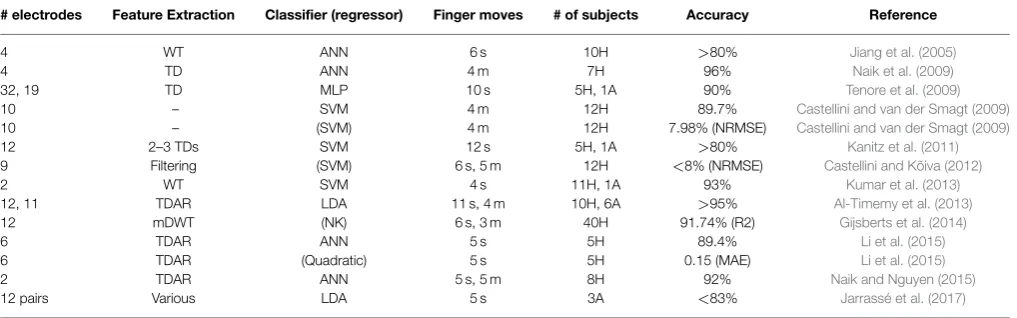
TABLE 1|A table of related work found in the literature for both finger movement classification and force regression.
# electrodes Feature Extraction Classifier (regressor) Finger moves # of subjects Accuracy Reference
4 WT ANN 6 s 10H >80% Jiang et al. (2005)
4 TD ANN 4 m 7H 96% Naik et al. (2009)
32, 19 TD MLP 10 s 5H, 1A 90% Tenore et al. (2009)
10 – SVM 4 m 12H 89.7% Castellini and van der Smagt (2009)
10 – (SVM) 4 m 12H 7.98% (NRMSE) Castellini and van der Smagt (2009)
12 2–3 TDs SVM 12 s 5H, 1A >80% Kanitz et al. (2011)
9 Filtering (SVM) 6 s, 5 m 12H <8% (NRMSE) Castellini and Kõiva (2012)
2 WT SVM 4 s 11H, 1A 93% Kumar et al. (2013)
12, 11 TDAR LDA 11 s, 4 m 10H, 6A >95% Al-Timemy et al. (2013)
12 mDWT (NK) 6 s, 3 m 40H 91.74% (R2) Gijsberts et al. (2014)
6 TDAR ANN 5 s 5H 89.4% Li et al. (2015)
6 TDAR (Quadratic) 5 s 5H 0.15 (MAE) Li et al. (2015)
2 TDAR ANN 5 s, 5 m 8H 92% Naik and Nguyen (2015)
12 pairs Various LDA 5 s 3A <83% Jarrassé et al. (2017)
“# electrodes” gives the number of electrodes for healthy, amputee. The type of feature extraction used is given in the second column: WT (wavelet transform), TD (time domain), TDAR (time domain autoregressive), and mDWT (marginal discrete wavelet transform). The classifiers/regressors are given by: ANN (artificial neural network), MLP (multilayer perceptron), SVM (support vector machine), LDA (linear discriminant analysis), and NK (nonlinear kernel). In “Finger Moves” column, “s”=single and “m”=multiple. H and A in the “# of subjects” column correspond to healthy and amputee subjects, respectively. Classifier accuracy is the percentage of correct predictions, and regressor performance uses NRMSE (normalized root mean square error), R2, or MAE (mean absolute error).
In order to achieve highly dexterous control of prosthetic arms, control schemes are used that combine classification of movement-type with regression for proportional force control (Castellini and van der Smagt, 2009). Classification of hand/wrist movements (including grasping) has been tackled successfully (Ferguson and Dunlop, 2002;Farrell and Weir, 2008;Atzori et al., 2012). Performing finger movement classification is a more diffi-cult task: first, sEMG signals are smaller in amplitude for finger movements, and second, muscles responsible for finger activa-tions lie deep beneath the skin surface and so the signals recorded at the skin are subject to nonlinear transformations by forearm tissues (Al-Timemy et al., 2013). Several authors have tackled single and multiple finger movement classification using a variety of combinations of sEMG feature extractions (FE) and classifiers, with varying degrees of success (Jiang et al., 2005;Castellini and van der Smagt, 2009;Naik et al., 2009;Tenore et al., 2009;Kanitz et al., 2011;Al-Timemy et al., 2013;Kumar et al., 2013;Li et al., 2015;Naik and Nguyen, 2015;Jarrassé et al., 2017) (refer toTable 1 for a comprehensive list).
Recently, regression between the user’s intent,viasEMG sig-nals, and the force applied at the fingertips has been performed (Castellini and van der Smagt, 2009;Castellini and Kõiva, 2012;
Gijsberts et al., 2014; Li et al., 2015) (refer toTable 1 for ref-erences). Regression for proportional force control is a natural and accurate form of control since sEMG signals are related to the force a muscle is applying (Luca, 1997). The whole control scheme, consisting of a classifier coupled with a regressor, is hence capable of predicting the movement being performed along with how much force the subject is exerting.
Movement dynamics of a patient observedviasEMG can vary substantially over time due to, e.g., the fatiguing of muscle, motor unit noise, and electrode movement (Luca, 1997). Due to this variability, dynamic models of movement would be improved by intrinsic characterization of uncertainty within the modeling framework to aid robust control design. To date, this aspect of user intention estimation has generally been neglected. In order to address this gap, the authors propose a new method for classifying
movement-type and regressing force based on a mixture of experts (MoE) model, identified within a Bayesian framework which intrinsically characterizes model uncertainty. Further advantages of this approach are: (i) the method simultaneously performs classification and regression, which simplifies the model represen-tation and estimation process, (ii) the model can represent both linear and nonlinear dynamics, and (iii) the estimation algorithm consists of an iterative sequence of closed form expressions, which are computationally simple to execute.
The MoE model used in this work probabilistically divides the input space of a system by means ofgates, while individual regressionexpertsspecialize on certain regions of the input space. Thus the adoption of a MoE model exploits the linear relationship between the sEMG signals and the force for each finger movement, giving rise to a more natural modeling description. Additionally, classification is also performed since it is a by-product of the MoE structure which is integral to the model. Thus force regression and movement classification of fingers are implemented within a single unified framework.
Bayesian inference naturally incorporates uncertainty into the training of the model by specifying distributions over the parame-ters. A useful by-product is the evaluation of confidence bounds of model predictions, hence providing a natural check on the model’s predictive capabilities. Due to the Bayesian setting, overfitting is avoided and a metric naturally arises for choosing the appropriate number of experts. Bayesian inference also opens up the possi-bility of performing patient-specific modeling by incorporating patient-specific heuristics to guide the model building process in order to provide much more accurate predictions for clinical applications. One such approach, for example, is to instruct the Bayesian model averaging process in clinical applications, which has been successfully applied to sepsis and heart failure clinical datasets (Visweswaran et al., 2010).
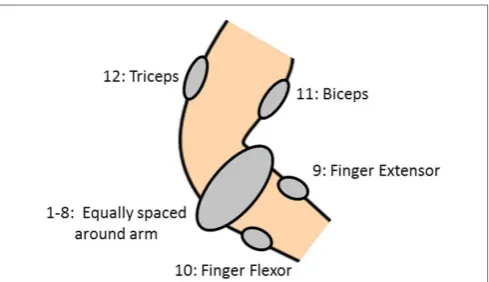
FIGURE 1|Location of the 12 sEMG electrodes on the arm.
by applying sensitivity analysis (SA) techniques in order to pro-vide a methodical framework for assessing the importance of the individual and grouped sEMG signals on the output force DoF. SA allows an increased understanding of the relationships between the input and output variables of a system/model and has been used extensively within the biomechanics literature, see for example,Batterbee et al. (2011)andBecker et al. (2011).
In this study, the authors build on previous analytical and computational work (Baldacchino et al., 2016) and demonstrate that the proposed multivariate Bayesian MoE model is a suitable candidate for finger force regression and finger classification using sEMG signals since accurate performance, comparable to that found in the literature, was achieved for both regression and clas-sification. The novel work presented in this article provides a pow-erful method for actively controlling highly dexterous prosthetic and robotic hands for rehabilitation purposes.
The rest of the article is structured as follows. Section 2 describes the sEMG/force dataset used in this article, along with preprocessing methods for the sEMG signals. This section also summarizes the main analysis approaches. The multivariate MoE model is introduced in Section 2.2, and the Bayesian parameter update equations are given in Section 2.3. Section 2.6 gives details of the SA framework used in this work. The results are presented collectively in Section 3. An in-depth discussion regarding the results obtained is given in Section 4. Finally, conclusions on the work presented are drawn in Section 5.
2. THE DATA AND THE METHODOLOGY
2.1. NinaPro Data
The dataset analyzed in this article is comprised of the second version of the publicly released NinaPro (Non-invasive Adaptive Prosthetics) database (Atzori et al., 2012;Gijsberts et al., 2014). The NinaPro database contains sEMG recordings collected from 40 intact subjects while performing a large number of common hand/finger movements and grasping actions. Of particular inter-est is the dataset containing measurements of the sEMG and the corresponding applied forces at the fingertips for different finger and thumb movements.
Each subject had 12 electrodes attached to their forearm and upper arm in order to measure sEMG signals. The 12 electrodes were placed in such a way that some electrodes provided dense
TABLE 2|Description of the 9 force patterns.
# Movement description
F1–F4 Flexion of little through to index fingers. F5/F6 Abduction/Flexion of the thumb. F7 Flexion of the index and little finger. F8 Flexion of the ring and middle finger. F9 Flexion of the index finger and the thumb.
sampling while others targeted specific muscles. Eight electrodes (1–8) were equally spaced around the forearm at the height of the radio-humeral joint, one electrode each was placed on the finger extensor (9) and flexor (10) muscles, and on the biceps (11) and triceps (12), seeFigure 1. Six DoF force measurements were considered: flexion of the five digits (little, ring, middle, index and thumb) along with abduction of the thumb. These force signals were collected by way of a Finger-Force Linear Sensor (FFLS) (Kõiva et al., 2012). Each subject was asked to produce a set of nine force patterns, given inTable 2, by pressing down with one or more digits of the dominant hand in response to an external stimulus. Each force pattern was repeated six times, and a rest period was enforced in between each movement and each repetition in order to prevent muscle fatigue. More information and detail regarding the setup and data collection can be found in
Gijsberts et al. (2014),Nin (2014).
The data preprocessing steps employed in this article follow the steps proposed inGijsberts et al. (2014), since a benchmark for force regression on the NinaPro data has been set. The data was first split into a training and testing set based on the repetition of movements; the second and fifth repetition for each movement were used for testing and the four remaining repetitions were used for training. All the data were then standardized to be zero mean and unit variance, using statistics calculated solely from the training set.
A common practice used in smoothing sEMG signals is to first segment the signal into overlapping windows, and features are then extracted from each window. The sEMG signals were sampled at 2,000 Hz, and following on fromGijsberts et al. (2014)
windows of 400 ms (800 samples) with a sliding window incre-ment of 10 ms (20 samples) were used. For computational feasi-bility the training set was subsampled by a factor of 10 (at regular intervals) resulting in approximately 3,000 data points for training. The subsample rate used here is slightly higher than that used byGijsberts et al. (2014)for regression analysis but preliminary analysis indicated that a higher subsample rate achieved a better performance. The MoE model is trained using the extracted sEMG features as inputs to the modeling algorithm.
[image:4.595.302.553.71.145.2]TABLE 3|A table showing the different FEs, used on each channel of the sEMG data, analyzed in this article.
Feature extraction (FE) Definition (per channel) References
Mean absolute value (MAV) x=Nw1 ∑Nw
n=1|˜xn| Hudgins et al. (1993),Hargrove et al. (2008),Artemiadis and Kyriakopoulos (2011),
andKuzborskij et al. (2012)
Waveform length (WL) x=∑Nw
n=2|˜xn−˜xn−1| Hudgins et al. (1993),Hargrove et al. (2008),Artemiadis and Kyriakopoulos (2011), andKuzborskij et al. (2012)
Root mean square (RMS) x=(Nw1 ∑Nw
n=1˜x2n
)12
Gijsberts et al. (2014)andHahne et al. (2014)
Butterworth filter (FILT) See text Atzori et al. (2012)andLenzi et al. (2012)
The extracted features are denoted by x which are computed from the windowed sEMG signal˜xof lengthNw. The “References” column provides references from the biomedical,
robotics and exoskeletons literature where the different types of FEs have been implemented.
to obtain a similar number of data points to the other FE datasets, this dataset was subsampled at regular intervals of 200 samples.
2.2. Multivariate Bayesian Mixture of
Experts
The only instance of an MoE model applied to myoprosthetic control appears in Hahne et al. (2014) for regression analysis of wrist movements. The model was limited to two experts and trained using iterative reweighted least squares separately for each DoF. In Section 2.2.1, a sophisticated MoE is defined which is capable of accommodating unlimited DoFs and achieving ana-lytical update solutions. The MoE model structure used in this article follows the work ofUeda and Ghahramani (2002), and further developed inBaldacchino et al. (2016). This particular choice of MoE model was adopted for two reasons; tractable closed form update equations for the parameters are obtained, and it is easily extended to accommodate multivariate outputs. These two characteristics reduce the computational effort during the training phase resulting in fast training times. The model used in this article is thus referred to as the multivariate Bayesian MoE model. Since a Bayesian approach to training the model is employed, prior distributions for the random variables need to be specified and these are given in Section 2.2.2.
2.2.1. Multivariate MoE Regression Model
ThedyDoF force signal,y
n= [y1n, . . . ,ydny], at time instantn, can
be represented by a MoE model withMregression experts, given by
yn= M ∑
i=1 gi(
xn, θig)fi(xn,Wi), (1)
wherexn = [x1n, . . . ,xdnx] is the dx dimensional input vector
consisting of the extracted sEMG features. Theith gating function,
gi(·), is anormalized Gaussianfunction, given by
gi(
xn, πi, θig)=
πiN(xn|µi,Λ−i 1) ∑M
l=1 πlN (
xn|µl,Λ−l 1), (2)
whereθgi = [µi,Λi]; µ = {µi}Mi=1is the mean andΛ
−1 =
{Λ−1
i }Mi=1is the covariance matrix.π = {πi}Mi=1are the mixing
coefficients satisfyingπi≥0 and∑Mi=1 πi = 1.gi(xn, πi, θ g i)is
the posterior conditional probability thatxn is assigned to the
partition corresponding to theithexpert.
The ith parametric expert function, fi(xn,Wi) describes the
relationship between the sEMG signals and the force applied at
the fingertips. This function is restricted to be a linear vector such that fi(xn,Wi) = W⊤
i [xn 1] (1 represents a bias term)
andWiis a(dx+1)×dymatrix corresponding to the weights associated with each sEMG signals and each DoF force signal. The probability distribution,p(yn|xn, θie), of theithexpert is taken to be
a multivariate Gaussian distribution having meanfi(xn,Wi) and
covarianceχ−i 1, given by
p(
yn|xn, θei)=N (
yn|W′i[xn1], χ−i 1 )
, (3)
whereθie = [Wi, χi];W = {Wi}Mi=1is the multidimensional
parameter weight matrix, andχ−1={χ−1
i }Mi=1is the covariance
matrix.
The set of unknown model parameters for the model expressed in (1) is given by [π,Θ]=[π,θg,θe]. Given thatNtraining data points are available, then the joint likelihood of the finger force and sEMG signals is expressed as
p(Y,X|π,Θ) = N ∏
n=1 M ∑
i=1
πiN(xn|µi,Λ−i 1)
| {z }
˜ gi
× N(yn|W′i[xn1], χ−i 1), (4)
whereX = [x1, . . . ,xN] ∈ RN×dx, andY = [y1, . . . ,yN] ∈
RN×dy
. The gating network ˜gi is a Gaussian mixture model
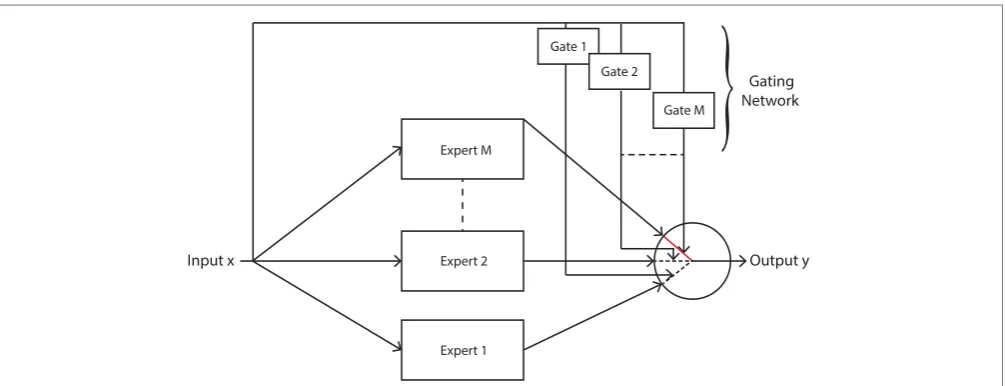
(GMM) and it divides the sEMG input space into separate Gaus-sian clusters. Hence, clustering (unsupervised classification) is performed using GMMs, and GMMs have been previously applied to hand movements as a means of performing classification with minimal computational complexity when compared to supervised learning classifiers (Chan and Englehart, 2003). The form of this gate results in singularities when maximum likelihood is used due to an ill-defined likelihood function (this causes a mixture component to collapse onto a single data point (Bishop, 2006)), hence further justifying the use of a Bayesian approach in this article. Expressing the likelihood as in equation (4) enforces soft competition between the experts such that only one expert will be dominant in a certain region of the input space (Jacobs et al., 1991), seeFigure 2.
Discrete latent indicator variables,Z={zni}M,N
i=1,n=1∈ R N×M
, are introduced such that if (xn,yn) was generated from theith
expert thenzni=1, else it is 0. Latent variables are introduced in
Gate M
}
Gating Network
Expert 1 Expert M
Expert 2
Input x Output y
Gate 1
[image:6.595.48.551.56.249.2]Gate 2
FIGURE 2|Mixture of experts model with soft competition, whereby only one expert is active at any given time. This expert is chosen probabilisticallyviathe gating function.
changed to a product overM. Thus the complete-data likelihood can be written as
p(X,Y,Z|π,Θ) = N ∏
n=1 M ∏
i=1 (
πiN(xn|µi,Λ−i 1)
×N(yn|Wi′
[xn1], χ−i 1))zni, (5)
which is an equivalent representation of (4) incorporating an explicit latent variable.
2.2.2. Priors
Conjugate priors are assigned to all the parameters except for the mixing coefficients π (which are treated as non-random variables). The priors used here follow on from the Bayesian literature.
The Gaussian-Wishart prior is used for the mean, µ, and precision,Λ, of the gating GMM, given by
p(µ,Λ) =p(µ|Λ)p(Λ)
= M ∏
i=1
N(µi|m0,(β0Λi)−1)W(Λi|B0, ν0), (6)
whereB0 is adx xdx symmetric, positive definite matrix, and v0>dx–1 is the number of degrees of freedom of the Wishart distribution. Similarly, the prior distribution of the joint sEMG weights, W, and precision matrix, χ, for the linear regres-sor experts is given by a matrix-Normal-Wishart distribution expressed as
p(W,χ|a) = M ∏
i=1
MN(Wi|0,A−i 1, χ−i 1)
× W(χi|Q0, λ0), (7)
whereMNis the matrix-Normal distribution. The matrixAi =
diag(ai,1, . . . ,ai,dx+1)and it is assigned the following hyperprior
distribution
p(ai,j) =Ga(ai,j|c0,d0). (8)
The parameterAiincorporates automatic relevance determina-tion (ARD) since each input sEMG signal has an associatedai,jthat forms part of the variance of theith expert weights’ distribution (MacKay, 1995). ARD automatically imposes conditions such that ifa−1
i,j =0 then the corresponding sEMG signalx
jwill have little
effect on the force.
The joint distribution of all the random variables can be expressed hierarchically as,
p(Y,X,Z,µ,Λ,W,χ,a|π)
=p(Y,X|Z,π,Θ)p(Z|π)p(µ,Λ)p(W,χ|a)p(a), (9)
where a=(a1,. . .,aM). In order to simplify the assignment of
hyperparameter values for the prior distributions, the extracted feature dataset was again standardized to zero mean and unit vari-ance. This alleviates the issue of assigning hyperparameter values, removing the need to perform hyperparameter optimization. The hyperparameter values were set accordingly so as to define broad priors:m0is set using K-means,β0=0.01,B0=I, andv0=dxfor
the gates; andQ0=I,λ0=dy,c0=0.01, andd0=0.0001 for the
experts.
2.3. Variational Bayesian Framework
algorithm can be found inBeal (2003)andBeal and Ghahramani (2003).
Since conjugate priors for the model parameters were used, the functional form of the variational distributions will thus be the same as the priors. The optimal variational distributions are noted below, and expressed asq*(·). The VBM-step update equations are given in (10)-(16) while the VBE equations for the latent variables
Zare shown in equatios (17)–(19). The equations given here are similar to the ones detailed inBaldacchino et al. (2016), however, some equations have been modified to cater for the multivariate output force signals.
The joint variational posterior distribution of the gates’ mean and covariance is a Gaussian-Wishart distribution, given by
q∗
(µi,Λi) =N(µi|mi,(βiΛi)−1)W(Λi|Bi, νi), (10)
where
mi= β0m0+ ∑N
n=1 rnixn
βi , βi=β0+Ni,
B−1
i =B−01+ N ∑
n=1
rnixnx′n+β0m0m′0−βimim′i
νi=ν0+Ni, Ni= N ∑
n=1
rni, rni=E[zni]. (11)
The joint variational posterior distribution of the expert func-tions’ mean and covariance is a matrix-Normal-Wishart distribu-tion having the following form
q∗
(Wi, χi) =MN(Wi|Wiˆ , χ−1 i ,Li
)
W(χi|λi,Qi), (12)
where
ˆ
Wi=Li[X1N×1] ′
ViY Li=([X1N×1]
′
Vi[X1N×1] + Υi )−1
Vi=diag(E[z1i], . . . ,E[zNi]) λi=λ0+Ni
Q−1
i =Q−01+Y′ViY−Wˆ′i(X′ViX+ Υi) ˆWi. (13)
The termΥi=E[Ai]is defined in equation (16). The
varia-tional distribution for the ARD parameters is
q∗
(ai,j) =Ga(ai,j|ci,di,j), (14)
where
ci=c0+0.5dy, di,j=d0+0.5ξi,j ξi,j=d
y(Li)
j,j+λiwˆi,jQiwˆ ′
i,j, (15)
where (Li)j,j is thejth diagonal element ofLi, andwˆi,j ∈ R 1×dy is thejth row ofWiˆ . Using the statistic of a mean from a Gamma
distribution, then
Υi=E[Ai] =diag (
ci di,1
, . . . , ci di,dx+1
)
. (16)
The VBE-step consists of updating the variational distribution ofZand the relevant equations are listed below. The variational distribution for the latent indicator variables follows a multino-mial distribution, such that
lnq∗
(Z) =∑N n=1
M ∑
i=1
znilnrni and rni= ∑Mγni l=1γnl
, (17)
γni=πiexp {1
2
(
lnΛˆi+lnχˆi−ϖni−ξni)}. (18)
The terms required in equation (18) are,
lnΛ˜i=E[ln|Λi|]
= dx ∑
j=1
ψ (
νi+1−j 2
)
+dxln 2+ln|Bi|,
lnχ˜i=E[ln|χi|]
= dy ∑
j=1
ψ (
λi+1−j 2
)
+dyln 2+ln|Qi|, (19)
ϖni=Tr(E[Λi]E[(xn−µi)(xn−µi)′])
=νi(xn−mi)Bi(xn−mi)′+β−i 1dx,
ξni=Tr(E[χi]E[(yn−[xn 1]Wi)(yn−[xn1]Wi)′])
=λi(yn−[xn1] ˆWi)Qi(yn−[xn1] ˆWi)′
+dy[xn1]′Li[xn1].
whereψ(·) is the digamma function.
The update equation for the mixing coefficients is obtained by maximizing the variational lower bound with respect to the mixing coefficients. The update equation is given by
πi= 1 N
N ∑
n=1
rni. (20)
The equation given above was used to determine the number of mixtures in GMMs (Corduneanu and Bishop, 2001), and it was later extended to a MoE framework inBaldacchino et al. (2016). Using (20), any surplus experts will have theirπidriven to zero,
effectively removing them from the model. This equation needs to be interleaved into the iterative procedure since (18) depends onπ. Following on from previous authors the mixing coefficients are updated after a pass of the variational posterior distribution update equations. The equations presented in this section are summarized inAlgorithm 1.
2.4. Posterior Predictive Distribution
ALGORITHM 1|Multivariate VBEM MoE.
Initialize the hyperparameters: -GMM gates,m0,β0,B0andν0,
-Linear expertsρ0,λ0,c0,d0andΥ(i0)= c0 d0Idx∀i.
-Initializeγni(0)∼ U[0,1]∀i,n.
fork=0:stopping criteria
VBM-step:
-Evaluate mixing coefficientsπ(k+1)using (20)
-Update the gate parameters using (11).
-Update the expert parameters using (13), (15) and (16).
VBE-step:
-Update for latent variablesZusing (17)–(19).
end for
whereD=[Y,X], and n′ = N+1 is the new data point. For
the mixture of experts described in this article, the predictive distribution is given by,
p(yn′|xn′,D) = M ∑
i=1 Ωi,n′T
(
yn′
[xn′ 1] ˆWi, κiΣi, κi )
(21)
where {Ωi,n′} M
i=1 take value 1 with probabilities {
gMAP i,n′
}M i=1,
respectively.gMAP
i,n′ = gi(xn′, πi, θ g
iMAP)using (2) at the maximum a posteriori(MAP) estimatesθgMAP = {µMAP,ΛMAP}obtained
from the posterior distribution (10), and the final value forπ. At any given time n′
only one {Ωi,n′} M
i=1 can be 1 (the rest
are zero) corresponding to the gate with the largest probability. T([xn′ 1] ˆWi, κiΣi, κi)is a multivariate Student-t distribution
with κi=λi−dy+1 degrees of freedom, mean [xn′ 1] ˆWi and
scale matrixκiΣi, whereΣi = Qi(1+ [xn′1] ′
Li[xn′ 1]) −1
. The relevant statistics for prediction are
E[yn′] = M ∑
i=1
Ωi,n′[xn′1] ˆWi,
cov[yn′] = M ∑
i=1 Ωi,n′
Σ−1 i
κi−2. (22)
2.5. Implementation
The multivariate VBEM MoE algorithm, given inAlgorithm 1, was trained on the sEMG/force data from all 40 subjects, and all the 6 force signals were trained together. The gate divisions on the input space are common to all the outputs. Since 9 movements and a rest period between repetitions and movements are considered here, the algorithm is initialized with 10 experts. The algorithm was run 100 times with random initialization forγandm0so as to avoid the local maxima problem. The model with the largest lower bound was chosen as being the best model to represent the data. The algorithm was run for all the FE representations listed inTable 3, and a comparison between them is considered in Section 3.
2.6. Sensitivity Analysis
In this article, the authors apply SA techniques with the intention of assessing the importance of the number of electrodes to the performance of the modeling framework. Interested readers are
referred toSaltelli et al. (2000, 2008)for an in-depth exploration of SA. Here, the regression-based global SA technique developed in
Xu and Gertner (2008)is applied since this method accommodates correlated input signals. The contribution of an individual sEMG signal to the variance of the model force output,Vj, is decomposed into two parts: the uncorrelated contributionVUj, which describes variations unique to a sEMG inputxjwhich are independent of
the other sEMG inputs, and correlated contributionVCj, which explains variations of an sEMG inputxjwhich are correlated with
other sEMG signals (Xu and Gertner, 2008)
Vj=VUj+VCj. (23)
This discrimination between uncorrelated and correlated con-tributions highlights, respectively, if the sEMG input itself domi-nates or if the correlated variations among the sEMG signals dom-inate. The three indices found in equation (23) can be calculated using the regression-based SA equations found inXu and Gertner (2008). The final indices of interest are the first-order sensitivity indices given by the totalSj, uncorrelatedSUjand correlatedSCj
contributions of sEMG inputxjsuch that
Sj= Vj
V, SUj= VUj
V , SCj=
VCj
V , (24)
whereV = N1 lhs
∑
n (yn−¯y)2is the estimated variance of the
force output, and ¯y is the mean of the force signal. A Latin
hypercube sampling (LHS) procedure is used to generate Nlhs
rank-correlated samples for X from which the output {y}Nlhs n=1
can be generated using the final MoE model. The LHS strategy used here follows that given inIman and Conover (1982)since it takes into account the correlations between the inputs when generating samples. Using the sensitivity indices given in equation (24), examination of spurious sEMG signals is possible since they will affect the force output only due to their strong correlations with other significant sEMG inputs (that is, they will have a very low SUj compared to SCj). The regression-based SA approach relies on an approximate linear relationship between the sEMG signals and the force. This is not a bad assumption for the data used in this article since inGijsberts et al. (2014), an averageR2=60% was achieved for a linear model using RMS FE.
3. RESULTS
The multivariate Bayesian MoE algorithm for simultaneous regression/classification was applied to the problem of predicting finger force dynamics and classifying finger movements from the Ninapro dataset. The results are reported here with a compar-ative evaluation against previous results (Gijsberts et al., 2014): firstly the results of finger force regression are presented and secondly classification. Lastly, SA is performed in order to assess the importance of the electrodes’ contribution to the output force signals.
3.1. Finger Force Regression Using Test
Data
given by
NRMSE=
√
(1/N)∑Nn=1 (yn−ˆyn)2
ymax−ymin , (25)
and the coefficient of determination (R2), given by
R2=1−
∑
n(yn−ˆyn)2 ∑
n(yn−¯y)2
. (26)
whereˆyn is the model predicted output at time instancen, and ¯yis the mean ofyThese two statistics were chosen because of
their wide use by the bio-robotics and rehabilitation/prosthetics communities in assessing the quality of their models.
Force DoF
NRMSE (%)
0 1 2 3 4 5 6 7 8
Little Ring Middle Index Thumb Abduction
Thumb Flexion MAV WL RMS FILT
FIGURE 3|A plot of NRMSE averaged over the 40 subjects for the 6 DoF. The error bars indicate unit SD.
[image:9.595.48.551.290.679.2]The average normalized root mean square error (NRMSE) for each force DoF across all subjects, is plotted for all the different FEs inFigure 3. All FEs perform similarly and low NRMSE values are recorded. The multivariate VBEM MoE algorithm performs consistently well across all subjects since the SDs associated with each DoF are small compared to their mean values (i.e., the coefficients of variation are overall less than 30%). Focusing on the FILT FE as being fairly typical, the best results are obtained for the thumb abduction force signal (3.6±1.2%), while the worst result is for the thumb flexion force signal (4.96±1.5%). Prediction of little, ring, middle and index flexion force signals have similar performance.
Figure 4shows the average NRMSE for all subjects (averaged over the 6 DoF force activations) for each FE, including unit SD (given by the black vertical lines). The performance of the algorithm is fairly consistent across all subjects, with most subjects achieving a level of NRMSE below 5%. Subject 37 for MAV has the worst overall NRMSE of 9.61±1.76% while Subject 36 performs the worst for the other FEs. The best results were achieved by Subject 8 for WL and Subject 33 for MAV having an NRMSE of 2.64±0.46 and 2.64±0.22%, respectively (Subject 33 has the worst NRMSE for RMS and FILT). The mean (over all DoF and all subjects) and corresponding unit SD for both NRMSE (given by red and black horizontal lines inFigure 4) andR2are reported in Table 4. Overall, the FILT FE has the best performance with the other FEs having very similar performance.
TABLE 4|AverageR2and NRMSE including 1 SD.
Feature type AverageR2 Average NRMSE
MAV 90.54±6.93% 4.22±1.33% WL 90.75±5.07% 4.20±1.08% RMS 89.81±5.00% 4.44±1.06% FILT 90.91±4.50% 4.14±0.92%
F1 F2 F3 F4 F5 F6 F7 F8 F9
NRM
SE (%)
0 1 2 3 4 5 6
MAV WL RMS FILT
[image:10.595.47.291.55.245.2]Force Pattern
FIGURE 5|A plot of the average NRMSE for each individual force pattern. The error bars indicate unit SD.
To investigate the performance of the models on each of the 9 force patterns, the average NRMSE per pattern is shown in Figure 5. Similar to that reported inGijsberts et al. (2014), patterns involving the individual activation of the four fingers (F1-F4) are all characterized by slightly better performance overall (i.e., by NRMSE values around 3%). The remaining movements (F5–F9) have a slightly worse performance (between 3.5 and 5%), espe-cially those movements involving flexion of the thumb (F6 and F9); this is consistent with the results shown inFigure 3, where thumb flexion shows the worst NRMSE result.
3.1.1. Results for Subject 1
The results reported in this section concern Subject 1 (so as to compare toGijsberts et al. (2014)) and the model obtained with the RMS FE is used since this model has the lowest NRMSE for this particular subject.
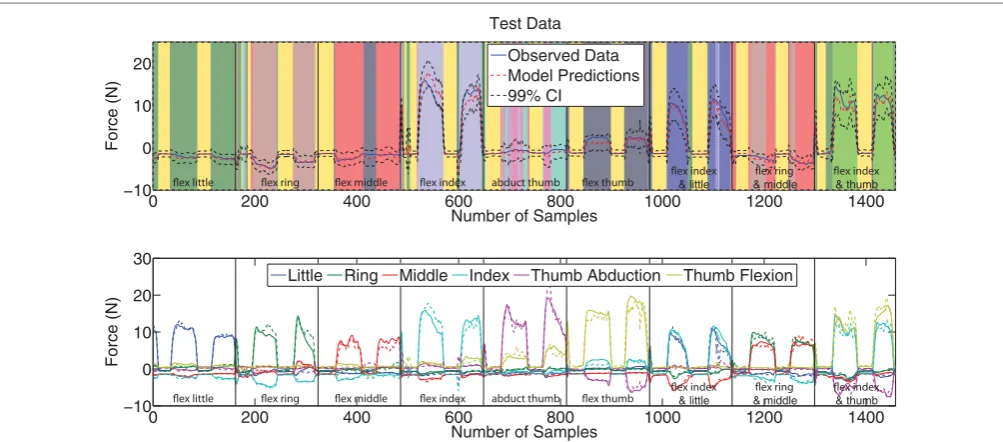
The top plot ofFigure 6shows the predictions (red) obtained on the test data (blue) for the fourth force DoF (index flexion). The signals are plotted on a background of colors where each color corresponds to a particular expert. The black dashed lines repre-sent the 99%confidence intervals which are calculated using (22) hence arising naturally from the Bayesian inference framework. The confidence intervals visibly enclose most of the observed data (blue). The model predictions of the force closely follow the measured data indicating that the multivariate MoE model is a suitable model for performing force regression from sEMG signals; at least so far as Subject 1 is concerned.
An equally interesting result is the assignment of experts to the data points. The different movements are immediately identified as being separate due to being allocated a different expert (denoted by a different color in Figure 6). The experts allotted to the different movements in the training set are also the same ones used in the test set for corresponding movements. Details of expert assignment are discussed further in Section 3.2.
The predictions for all 6 DOF force measurements on the test data is shown in the bottom plot ofFigure 6. All the force measurement signals and force patterns are predicted well, with
the predicted and measured data visibly following the same overall trends. The model even learned the involuntary negative forces, which was also observed by Gijsberts et al. (2014) and they attribute these forces to synergistic or compensatory mechanisms.
3.2. Finger Movement Classification
Classification can be seen as a natural by-product of the VBEM MoE algorithm presented in this article. The learning algorithm consists of soft competition among the experts, such that only one expert dominates in different regions of the input space. The dominant expert is probabilistically chosen by assessing the gates using (2).
Insight into the relation between the different force movements and the sEMG signals is obtainedviaprincipal component analy-sis (PCA). Using PCA on the sEMG signals, the first two principal components can be plotted against each other, with the different force patterns each taking on a unique color, as shown inFigure 7. In this plot, the columns indicate 4 and 10 (9 movements plus rest) force patterns, respectively, while the rows show the effect of increasing the number of subjects. Even when just one subject is considered, increasing the number of movements results in the force patterns having lots of overlap, hence making it harder to distinguish between the different movements. Similarly, increas-ing the number of subjects also results in a large overlap. This figure also highlights the high variability in the recorded sEMG signals between subjects, and it is expected that this variability will be reflected in large deviations in classification performance. High variability among subjects was also observed byAtzori et al. (2012)
for different hand movements.
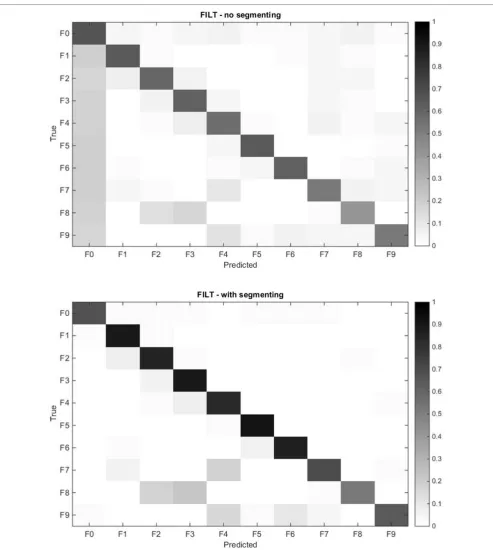
A common metric for assessing the quality of the classifier is the classification accuracy, which is the proportion of correctly classified instances to the total number of instances. The left-hand plot inFigure 8shows the average classification accuracy for each force pattern where F0 is the rest position, for all the FEs. All FEs achieve similar performance, and multifinger movements have a lower accuracy; more information can be obtained by analyzing the confusion matrix given in the top plot ofFigure 9.
0 200 400 600 800 1000 1200 1400 −10
0 10 20
Number of Samples
Force (N)
Test Data
Observed Data Model Predictions 99% CI
0 200 400 600 800 1000 1200 1400
−10 0 10 20 30
& little & middle & thumb
Force (N)
Number of Samples
Little Ring Middle Index Thumb Abduction Thumb Flexion
[image:11.595.47.549.57.278.2]& little & middle & thumb
FIGURE 6|Top plot: Predictions (red) versus observed data (blue) including 99% confidence intervals (dashed black) on the test data of the fourth DoF force activation. The background of colors represents the individual experts, and black vertical line indicates when a movement starts. Bottom plot: A plot of observed (solid) and predicted (dashed) forces for the second and fifth repetitions of all nine force patterns. Each box represents a force pattern, and each color corresponds to a force measurement.
FIGURE 7|Two principal components of the filtered sEMG signals, showing the effects of increasing the number of subjects and force patterns. Each color represents a different force pattern.
would not be able to respond to transitory misclassifications. In the literature regarding finger movements classification, the rest position is either ignored or the sEMG data stream is segmented in such a way that regions of ambiguity are removed from the training set.
The right hand plot ofFigure 8and the bottom plot ofFigure 9 show the results when only sections of the data set are considered when calculating classification accuracy, that is, each movement is divided into three equally sized segments and only labels from the center segment were retained (no retraining was performed). A higher accuracy is now attainable: single finger movements and
multi-finger movements have an average accuracy of 87.89% and 62.39%, respectively.
[image:11.595.50.551.334.535.2]FIGURE 8|Average classification accuracy for each individual force pattern, including rest, for each of the FEs: left, using the continuous data, right, using the segmented data.
3.3. Reducing the Number of Electrodes
via
SA
The SA procedure outlined in Section 2.6 is applied to the dataset using the final MoE model obtained with the FILT FE (similar results were obtained using the other models, so only the results of one FE are shown here). All 12 sEMG signals are treated as indi-vidual inputs, and the SA results revealed that the contributions of all the sEMG input signals to the variance of the force outputs are mainly due to the correlations with other inputs, since all inputs had a lowSUindex compared toSCindex.
The SA is performed again but this time the sEMG input signals are grouped according to their electrode location. Thus the groups comprise of electrodes 1–8 (forearm), 9–10 (finger extensor and flexor), and 10–11 (biceps and triceps)—refer toFigure 1. The three sensitivity indices, averaged over all 40 subjects, for all the output force signals for these groups of inputs are shown in Figure 10. The SU index for electrodes 1–8 is now significant (and comparable to theSCindex) for most outputs. Hence, the sEMG electrodes located around the forearm are necessary for describing the relationship between force at the fingertips and the sEMG signals because this group of inputs’ individual contribu-tion is important. The other 2 groups of inputs are almost entirely dominated by their correlated effect, and so their individual contribution is low.
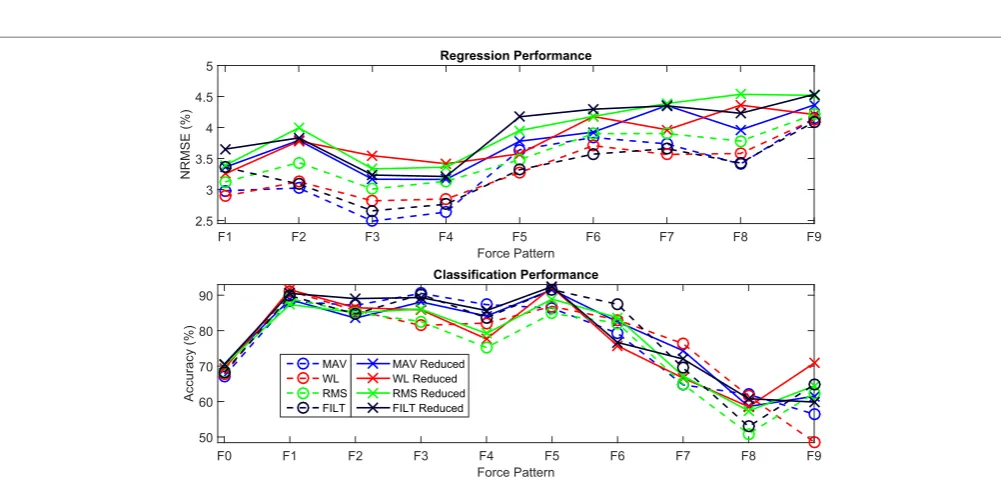
The multivariate VBEM MoE algorithm was run again but this time only the 8 electrodes around the forearm were used as inputs to the model. The plot shown in Figure 11 shows the performance of the models on the reduced input set (solid lines) versus that of the full input set (dashed lines) for both regression and classification over the different force patterns. The
top plot shows the quality of the models for the force regression given by the average NRMSE for the different force activations considered. A slight degradation in NRMSE is observed for the reduced input set (across all FEs), however, the models are still performing exceptionally well. The bottom plot demonstrates the quality of classifying the different finger movements including the rest position using the average classification accuracy. In this case, the reduced set and full set models have similar performance, with no clear winner.
4. DISCUSSION
4.1. Regression
The results and observations obtained for the force regression using the multivariate VBEM MoE are comparable to those reported in the literature, for example (Castellini and Kõiva, 2012;
Gijsberts et al., 2014). Predictions of thumb movements are worse than for the other fingers due to no sEMG activity being recorded from the majority of the thumb muscles since these are located at the wrist (and hence are not usually available on the amputee’s stump) (Kõiva et al., 2012;Gijsberts et al., 2014).
FIGURE 9|Confusion matrix for the models obtained with the FILT FE averaged over all 40 subjects for all force patterns including rest. The rows represent the true class, and each cell corresponds to the prediction accuracy of each class. The top plot corresponds to the continuous data, while the bottom plot corresponds to the segmented data.
for faster feature computation of the windowed sEMG signals compared to the mDWT in the preprocessing stage. Faster train-ing times are also achieved when a smaller input dimension is used in any algorithm. It has also been shown that TD features
performed better than frequency domain and WTs in real-time applications (Englehart and Hudgins, 2003).
1−8 9−10 11−12 0 5 10 15 20 25 30 35 40 45 50 55 Contribution % Input signal Little
1−8 9−10 11−12
0 5 10 15 20 25 30 35 40 45 50 55 Contribution % Input signal Ring
1−8 9−10 11−12
0 5 10 15 20 25 30 35 40 45 50 55 Contribution % Input signal Middle
1−8 9−10 11−12
0 5 10 15 20 25 30 35 40 45 50 55 Contribution % Input signal Index
1−8 9−10 11−12
0 5 10 15 20 25 30 35 40 45 50 55 Contribution % Input signal Thumb Abduction
1−8 9−10 11−12
[image:14.595.45.558.57.336.2]0 5 10 15 20 25 30 35 40 45 50 55 Contribution % Input signal Thumb Flexion Total S Uncorrelated SU Correlated SC
FIGURE 10|Variance contribution for the six force signals using regression-based sensitivity analysis for correlated inputs (using the MoE model obtained with FILT FE) for grouped sEMG input signals, averaged over all 40 subjects. The large SU values (green) indicate that the group of inputs 1–8 is influential.
Force Pattern
F0 F1 F2 F3 F4 F5 F6 F7 F8 F9
Accu ra cy (% ) 50 60 70 80 90 Classification Performance MAV Reduced WL Reduced RMS Reduced FILT Reduced Force Pattern
F1 F2 F3 F4 F5 F6 F7 F8 F9
N R M SE (% ) 2.5 3 3.5 4 4.5
5 Regression Performance
MAV WL RMS FILT
FIGURE 11|Comparison between the models obtained using all the electrodes (dashed) and using the 8 electrodes around the forearm only (solid) for 4 FEs (MAV, WL, RMS, and FILT). Top: Average NRMSE for each force pattern for assessing the quality of the force regression. Bottom: Average classification accuracy for each force pattern, including rest (F0), for assessing the quality of classification.
2012;Gijsberts et al., 2014). TheR2 values are not reported for the individual force patterns since the sum of error over each force pattern is not necessarily 0, and so theR2 value can go negative although the model provides a good fit. Therefore, it
[image:14.595.47.548.369.610.2]have established: force signals from single finger movements are easier to predict than from multiple finger movements and thumb movements.
4.2. Classification
The misclassification of multiple finger movements reported in this article tends to be represented by the corresponding indi-vidual finger movements. This result seems to suggest that mul-tiple finger movements can be accurately represented by their corresponding individual finger movements implying that the sEMG signals of the multiple finger movements can be decom-posed into the individual sEMG signals. This outcome appears to give weight to the hypothesis presented inCastellini and Kõiva (2012)whereby the authors suggested that for example flexion of ring+middle would be statistically similar to flexion of
lit-tle+ring+middle. To the best of the authors’ knowledge, this
phenomenon of sEMG signals of some multiple finger movements being similar to the sEMG signals of the individual fingers has not been analyzed in the literature. Possible explanations for this could be that similar finger movements have not been tackled (some articles do not specify which multiple finger movements are being analyzed), and confusion matrices are not reported hence by-passing the opportunity to assess in detail how the classifier is misclassifying movements.
The classification accuracy reported in this article is similar to that found in the literature, refer toTable 1. The algorithm presented here is capable of classifying finger movements which is the result of a by-product from regression analysis—no extra computational expense is incurred. Another important point to note is that this is the first instance of simultaneous regression and classification of finger movementsviasEMG signals using MoE models.
4.3. SA
The initial SA investigation indicated that the contribution to the force variance was a result of correlated contributions of all the sEMG signals. This result seems to suggest that the VBEM MoE learning algorithm is not sensitive to the nominal place-ment of electrodes since the uncorrelated contribution of all the electrodes was low suggesting that individual contribution of the electrodes themselves are not important. This result supports the research performed inHargrove et al. (2008), where the authors report that the pattern recognition framework is insensitive to nominal electrode placements, however, it is sensitive to electrode displacement during the training/testing phase. Hence, the same locations need to be used for training and testing in order for a classifier/regressor to have a high accuracy.
Good force regression and movement classification was achieved by the VBEM MoE model on a reduced input set which consists of a dense sampling of electrodes around the forearm. This setup in which no relevant muscles are targeted was consid-ered byCastellini and Kõiva (2012)such that 9 electrodes were uniformly positioned around the forearm. The regression results obtained here are comparable to those reported byCastellini and Kõiva (2012). Reducing the number of electrodes reduces the overall cost in terms of both physical cost (less electrodes) and
computational cost (training the model). With a training dataset of around 3,000 samples, an average training time of 114 s for the full input set and an average of 93 s for the reduced input set was achieved. Therefore, SA techniques provide a structured methodology for reducing the number of electrodes needed for clinical application.
5. CONCLUSION
Following on from preliminary work, this article provides an in-depth analysis of the use of multivariate Bayesian mixture of experts models using sEMG signals for refined control of prosthet-ics with multiple DoF. Bayesian inference is a novel concept within the sEMG community and it allows uncertainties to be naturally incorporated into the model structure, supporting a fuller descrip-tion of the model. The use of a MoE model provides simultaneous finger force regression and finger movement classification at no extra computational cost. The MoE model favors a more natural interpretation between the sEMG and force signals by automat-ically separating out the data into individual finger movements. This feature relates the model with the underlying biological and physical properties of the data. The MoE model is mathematically and (potentially) computationally demanding compared to other regression and classification methods; however, this is balanced by the extra capability that is obtained.
The method described in this work achieves high perfor-mance using low-dimensional feature extraction techniques for the sEMG signal. Accurate force predictions and movement clas-sification were obtained for several finger movements, across all 6 DoF force activations and all 40 subjects. Examination into the effects of a reduced set of sEMG inputs using SA techniques enabled a structured investigation into the influence of the sEMG inputs on the force regression/movement classification perfor-mance. It was concluded that the dense sampling of electrodes around the forearm had the greatest influence on the output force DoF. Retraining the models on a reduced input set resulted in similar performance for both the force regression and movement classification when compared to the full input set models.
The next phase of research is to apply this framework to fin-ger force data collected from transradial amputees, and compare performance to that obtained by healthy subjects. It is foreseen that the algorithm will achieve high accuracy, thus providing an exciting novel method of controlling state-of-the-art dexterous myoprosthetics.
AUTHOR CONTRIBUTIONS
TB ran simulations and wrote up most of the article. WJ and SA were involved with the literature review and introduced TB to the NinaPro database. WJ, SA, KW, and JR were involved in discussions regarding machine learning algorithm. JR was PI.
ACKNOWLEDGMENTS
REFERENCES
Al-Timemy, A. H., Bugmann, G., Escudero, J., and Outram, N. (2013). Classification of finger movements for the dexterous hand prosthesis control with surface electromyography.IEEE J. Biomed. Health Inform.17, 608–618. doi:10.1109/ JBHI.2013.2249590
Artemiadis, P. K., and Kyriakopoulos, K. J. (2011). A switching regime model for the EMG-based control of a robot arm.IEEE Trans. Syst. Man Cybernet. B41, 53–63. doi:10.1109/TSMCB.2010.2045120
Atzori, M., Gijsberts, A., Heynen, S., Hager, A.-G. M., Deriaz, O., van der Smagt, P., et al. (2012). “Building the NINAPRO database: A resource for the biorobotics community,” in The Fourth IEEE RAS/EMBS International Conference on Biomedical Robotics and Biomechatronics, Roma.
Baldacchino, T., Cross, E. J., Worden, K., and Rowson, J. (2016). Variational Bayesian mixture of experts models and sensitivity analysis for nonlinear dynamical systems.Mech. Syst. Sig. Process.66, 178–200. doi:10.1016/j.ymssp. 2015.05.009
Baldacchino, T., Jacobs, W., Anderson, S. R., Worden, K., and Rowson, J. (2015). “Estimation of fingertip force from surface EMG: a multivariate Bayesian mix-ture of experts approach,” inBIOSIGNALS 2015, Lisbon.
Batterbee, D. C., Sims, N. D., Becker, W., Worden, K., and Rowson, J. (2011). Computational model of an infant brain subjected to periodic motion simpli-fied modelling and Bayesian sensitivy analysis.Proc. Inst. Mech. Eng. H225, 1036–1049. doi:10.1177/0954411911420002
Beal, M. J. (2003).Variational Algorithms for Approximate Bayesian Inference. PhD thesis, Gatsby Computational Neuroscience Unit, University College London. Beal, M. J., and Ghahramani, Z. (2003). “The variational Bayesian EM
algo-rithm for incomplete data: with application to scoring graphical model struc-tures,” inBayesian Statistics 7, eds J. M. Bernardo, M. J. Bayarri, A. P. Dawid, J. O. Berger, D. Heckerman, A. F. M. Smith, and M. West (New York: Oxford University Press), 453–464.
Becker, W., Rowson, J., Oakley, J. E., Yoxall, A., Manson, G., and Worden, K. (2011). Bayesian sensitivity analysis of a model of the aortic valve.J. Biomech.
44, 1499–1506. doi:10.1016/j.jbiomech.2011.03.008
Bishop, C. M. (2006). Pattern Recognition and Machine Learning. Singapore: Springer.
Castellini, C., and Kõiva, R. (2012). “Using surface electromyography to predict single finger forces,” inThe Fourth IEEE RAS/EMBS International Conference on Biomedical Robotics and Biomechatronics, Roma, 1266–1272.
Castellini, C., and van der Smagt, P. (2009). Surface EMG in advanced hand prosthetics.Biol. Cybern.100, 35–47. doi:10.1007/s00422-008-0278-1 Chan, A., and Englehart, K. (2003). “Continuous classification of myoelectric
signals for powered prostheses using Gaussian mixture models,” inProceedings of the 25’ Annual Intemational Conference of the IEEE EMBS, Cancun, 2841–2844. Corduneanu, A., and Bishop, C. M. (2001). “Variational Bayesian model selection for mixture distributions,” inProceedings of the Eighth International Confer-ence on Artificial IntelligConfer-ence and Statistics, eds T. Jaakkola, and T. Richardson (Morgan Kaufmann), 27–34.
Englehart, K., and Hudgins, B. (2003). A robust, real time control scheme for multifunction myoelectric control.IEEE Trans. Biomed. Eng. 50, 848–854. doi:10.1109/TBME.2003.813539
Farrell, T. R., and Weir, R. F. (2008). A comparison of the effects of electrode implantation and targeting on pattern classification accuracy for prosthesis control.IEEE Trans. Biomed. Electron.55, 2198–2211. doi:10.1109/TBME.2008. 923917
Ferguson, S., and Dunlop, G. (2002). “Grasp recognition from myoelectric signals,” in Proceedings of the Australasian Conference on Robotics and Automation, Aukland, NZ, 83–87.
Gijsberts, A., Atzori, M., Castellini, C., Müller, H., and Caputo, B. (2014). The movement error rate for evaluation of machine learning methods for sEMG-based hand movement classification.IEEE Trans. Neural Syst. Rehabil. Eng.22, 735–744. doi:10.1109/TNSRE.2014.2303394
Hahne, J. M., Mann, F. B., Jiang, N., Rehbaum, H., Farina, D., Müller, F. C. M. K.-R., et al. (2014). Linear and non-linear regression techniques for simultaneous and proportional myoelectric control.IEEE Trans. Neural Syst. Rehabil. Eng.22, 269–279. doi:10.1109/TNSRE.2014.2305520
Hargrove, L., Englehart, K., and Hudgins, B. (2008). A training strategy to reduce classification degredation due to electrode displacements in pattern recognition based myoelectric control. Biomed. Signal Process. Control 3, 175–180. doi:10.1016/j.bspc.2007.11.005
Hudgins, B., Parker, P., and Scott, R. N. (1993). A new strategy for multifunc-tion myoelectric control.IEEE Trans. Biomed. Eng.40, 82–94. doi:10.1109/10. 204774
Iman, R., and Conover, W. (1982). A distribution-free approach to inducing rank correlation among input variables.Commun. Stat. Simul. Comput.11, 311–334. doi:10.1080/03610918208812265
Jacobs, R. A., Jordan, M. I., Nowlan, S. J., and Hinton, G. E. (1991). Adaptive mixtures of local experts.Neural. Comput.3, 79–87. doi:10.1162/neco.1991.3. 1.79
Jarrassé, N., Nicol, C., Touillet, A., Richer, F., Martinet, N., Paysant, J., et al. (2017). Classification of phantom finger, hand, wrist, and elbow voluntary gestures in transhumeral amputees with sEMG.IEEE Trans. Neural Syst. Rehabil. Eng.25, 68–77. doi:10.1109/TNSRE.2016.2563222
Jiang, M. W., Wang, R. C., Wang, J. Z., and Jin, D. W. (2005). “A method of recognizing finger motion using wavelet transform of surface EMG signal,” in
Proceedings of the 2005 IEEE Engineering in Medicine and Biology 27th Annual Conference, Shanghai, 2672–2674.
Kanitz, G. R., Antfolk, C., Cipriani, C., Sebelius, F., and Carrozza, M. C. (2011). “Decoding of individuated finger movements using surface EMG and input opti-mization applying a genetic algorithm,” in33rd Annual International Conference of the IEEE EMBS, Boston, MA, 1608–1611.
Kõiva, R., Hilsenbeck, B., and Castellini, C. (2012). “FFLS: an accurate linear device for measuring synergistic finger contractions,” in34th Annual International Conference of the IEEE Engineering in Medicine and Biology Society (EMBS), San Diego, CA, 531–534.
Kumar, D. K., Arjunan, S. P., and Singh, V. P. (2013). Towards identification of finger flexions using single channel surface electromyography – able bodied and amputee subjects.J. Neuroeng. Rehabil.10, 50. doi:10.1186/1743-0003-10-50
Kuzborskij, I., Gijsberts, A., and Caputo, B. (2012). “On the challenge of clas-sifying 52 hand movements from surface electromyography,” in34th Annual International Conference of the IEEE Engineering in Medicine and Biology Society (EMBS), Osaka, 4931–4937.
Lenzi, T., Rossi, S. M. M. D., Vitiello, N., and Carrozza, M. C. (2012). Intention-based EMG control for powered exoskeletons.IEEE Trans. Biomed. Eng.59, 2180–2190. doi:10.1109/TBME.2012.2198821
Li, X., Fu, J., Xiong, L., Shi, Y., Davoodi, R., and Li, Y. (2015). “Identification of finger force and motion from forearm surface electromyography,” inIEEE International Conference on Multisensor Fusion and lntegration for Intelligent Systems (MFI)
(San Diego, CA, USA).
Luca, C. J. D. (1997). The use of surface electromyography in biomechanics.J. Appl. Biomech.13, 135–163. doi:10.1123/jab.13.2.135
MacKay, D. J. C. (1995). Probable networks and plausible predicitons – a review of practical Bayesian methods for supervised neural networks.Network6, 469–505. doi:10.1088/0954-898X_6_3_011
Naik, G. R., Kumar, D. K., and Arjunan, S. (2009). “Use of sEMG in identification of low level muscle activities: features based on ICA and fractal dimension,” in31st Annual International Conference of the IEEE EMBS, Minneapolis, MA, 364–367. Naik, G. R., and Nguyen, H. T. (2015). Nonnegative matrix factorization for the identification of EMG finger movements: Evaluation using matrix analysis.IEEE J. Biomed. Health Inform.19, 478–485. doi:10.1109/JBHI.2014.2326660 Nin. (2014).Ninapro –Non-Invasive Adaptive Hand Prosthetics. Available from: http:
//www.idiap.ch/en
Saltelli, A., Chan, K., and Scott, E. M. (2000).Sensitivity Analysis. Chichester, UK: Wiley.
Saltelli, A., Ratto, M., Andres, T., Campolongo, F., Cariboni, J., Gatelli, D., et al. (2008).Global Sensitivity Analysis. The Primer. Chichester, UK: Wiley. Saridis, G. N., and Gootee, T. P. (1982). EMG pattern analysis and classification
for a prosthetic arm.IEEE Trans. Biomed. Eng.29, 403–412. doi:10.1109/TBME. 1982.324954
Tenore, F. V. G., Ramos, A., Fahmy, A., Acharya, S., Etienne-Cummings, R., and Thakor, N. V. (2009). Decoding of individuated finger movements using surface electromyography.IEEE Trans. Biomed. Eng.56, 1427–1434. doi:10.1109/TBME. 2008.2005485
Ueda, N., and Ghahramani, Z. (2002). Bayesian model search for mixture mod-els based on optimizing variational bounds.Neural Networks15, 1223–1241. doi:10.1016/S0893-6080(02)00040-0
Xu, C., and Gertner, G. Z. (2008). Uncertainty and sensitivty analysis for models with correlated parameters.Reliab. Eng. Syst. Safety93, 1563–1573. doi:10.1016/ j.ress.2007.06.003
Conflict of Interest Statement:The authors declare that the research was con-ducted in the absence of any commercial or financial relationships that could be construed as a potential conflict of interest.