
Numbers
.
White Rose Research Online URL for this paper:
http://eprints.whiterose.ac.uk/135578/
Version: Accepted Version
Proceedings Paper:
Alsubai, S. and North, S.D. orcid.org/0000-0002-8478-8960 (2018) TwigStackPrime: A
Novel Twig Join Algorithm Based on Prime Numbers. In: Web Information Systems and
Technologies. 13th International Conference on Web Information Systems and
Technologies, 25-27 Apr 2017, Porto, Portugal. Lecture Notes in Business Information
Processing, 322 . Springer Verlag . ISBN 978-3-319-93526-3
https://doi.org/10.1007/978-3-319-93527-0_1
[email protected] https://eprints.whiterose.ac.uk/ Reuse
Items deposited in White Rose Research Online are protected by copyright, with all rights reserved unless indicated otherwise. They may be downloaded and/or printed for private study, or other acts as permitted by national copyright laws. The publisher or other rights holders may allow further reproduction and re-use of the full text version. This is indicated by the licence information on the White Rose Research Online record for the item.
Takedown
If you consider content in White Rose Research Online to be in breach of UK law, please notify us by
Based on Prime Numbers
Shtwai Alsubai and Siobh´an North
Department of Computer Science, the University of Sheffield, Sheffield, UK {safalsubai1,s.north}@sheffield.ac.uk
Abstract. The growing number of XML documents leads to the need for appropriate XML querying algorithms which are able to utilize the specific characteristics of XML documents. A labelling scheme is funda-mental to processing XML queries efficiently. They are used to deter-mine structural relationships between elements corresponding to query nodes in twig pattern queries (TPQs). This article presents a design and implementation of a new indexing technique which exploits the prop-erty of prime numbers to identify Parent-Child (P-C) relationships in TPQs during query evaluation. The Child Prime Label (CPL, for short) approach can be efficiently incorporated within the existing labelling schemes. Here, we propose a novel twig matching algorithm based on the well known TwigStack algorithm [3], which applies the CPL ap-proach and focuses on reducing the overhead of storing useless elements and performing unnecessary join operations. Our performance evalua-tion demonstrates that the new algorithm significantly outperforms the previous approaches.
Key words: XML Databases, Holistic Twig Join Algorithm, Node La-belling, Twig Pattern Query
1 Introduction
As enterprises and businesses produce and exchange XML-formatted informa-tion more frequently, consequently, there is an growing requirement for effective handling of queries on data which conforms to an XML format [17, 15, 16]. Re-cently, several approaches have been proposed in the literature to process XML queries [14, 3, 10, 20, 9, 17, 7, 12, 8, 11]. Due to the definition of relationships in XML as nested tags, data in XML documents are self-describing and flexibly organized [16, 8]. Therefore, the basic XML data model is a labelled and ordered tree.
(a)
e
a
a
x y
x
y y
[image:3.612.213.423.115.252.2](b)
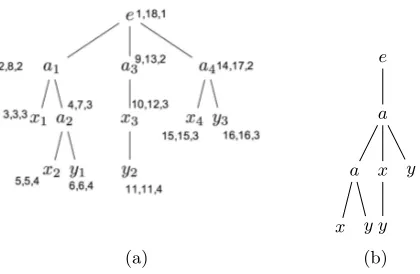
Fig. 1. (a) Range-based labelling scheme and (b) itsDataGuide
core operation in processing of an XML query [2, 10, 9, 17, 4] since tree patterns are the basis for querying structured tree-based data model such as XML.
Generally, the purpose of XML indexing is to improve the efficiency and scalability of query processing by reducing the search space. Without an index, XML retrieval algorithms have to scan all the data. Most existing XML query processing algorithms [20, 22, 12, 9, 8, 21] rely on XML indexing techniques to scan only the XML data relevant to XML queries, therefore, XML query performance is improved.
In XML, there are two basic type of indices. The first one is to index each node in an XML document by recording its positional information [13, 15]. This group is well-known as node label or labelling schemes. In this group of in-dices, every node in an XML document is assigned an unique label to record its position within the original XML document. The labelling scheme should enable determination of the structural information, i.e., Parent-Child (P-C) and Ancestor-Descendant (A-D) relationships. As a result, for any given two ele-ments in an XML document, the relationship between them (if it exists) can be computed in constant time. A well-known example of node labelling is the containment labelling scheme proposed in [13]. In this approach, each node is assigned with a tuple of three values as< start, end, level >.Start andend con-tain values of positions corresponding to the opening tag< tag−name > and the closing tag< /tag−name >. Level represents the depth of the node within its XML tree. The two basic relationships Ancestor-Descendant and Parent-Child can be determined efficiently. Given two nodes u and v, u is an ances-tor of v if and only if u.start < v.star < v.end < u.end. A Parent-Child relationship is defined as node u is the parent of node v if and only if
u.start < v.star < v.end < u.end, v.level = u.level+ 1.. by way of explanation, theu node is in the range of nodev.
or path indexing). Because an XML document can be modelled as rooted, or-dered, labelled tree, a labelled path is defined as a sequence of tag names in the form oftag1/tag2/ . . . /tagn from the root represented bytag1 to noden tagged
bytagn. For illustration, consider the XML tree in Figure 1, elements tagged by
acan be stored in different storage structures according to their unique labelled paths. Consequently, elements corresponding to the path e/a are {a1, a3, a4},
whilea2 is stored alone in its distinct labelled pathe/a/a. A classic example of
a path index isDataGuide [18]. The main drawback of this approach is that it only supports a simple path queries. There exist some graph indices that cover twig path queries as [19] but one of the limitations with these indices is that they are very large [20].
Both node and graph indexing are essential to XML query processing algo-rithms, they play important role in providing efficient evaluation of queries with respect to CPU complexity and memory consumption overhead [22, 2]. Accord-ing to [23], a labellAccord-ing scheme has to guarantee uniqueness and order preservation of node labels, thus the hierarchical relationships between a pair of nodes can be determined efficiently. The labelling scheme should enable checking all XPath re-lationships by computations only. To better understand the mechanisms of node indexing methods and their properties, [15] classified node indexing into four distinct types; range-based, prefix-based, multiplicative and hybrid labelling. A range-based labelling scheme will be adopted in this article to explore the effect of the new indexing mechanism. For sake of simplicity the following example 1 aims to explain the use of labels in the determination of hierarchical relationships in XML trees.
Example 1.Consider Figure 1, the structural relationships between the ele-ments can be determined according to the properties for ancestor-descendant and parent-child relationships, respectively. Consider the relationship between node a1 and y1, as the elements are labelled based on containment labelling
scheme proposed in [13]. a1 is an ancestor of y1 because 2 < 6 < 8. Also,
a1 is a parent node of a2 because the parent-child conditions are satisfied as
2<4<8and2 + 1 = 3.
Organization. The rest of this article is organised as follows. Section 2 shows the related work. The new indexing technique will be introduced in Section 3. In Section 4, we present a holistic twig join matching algorithm TwigStackPrime. Section 5 presents thorough experimental studies about the performance be-tween the new algorithm and the previous approaches. We conclude the paper in Section 6
2 Related Work
is due to the fact that labelling schemes where nodes are considered as the ba-sic unit of a query provides great flexibility in performing any structural query matching efficiently. The information gained from labels varies according to the chosen labelling scheme. To determine the effects of the range-based labelling scheme, [13] proposed multi-predict merge-join algorithm based on the positional information of the XML tree. An alternative representation, a prefix scheme, of labels of an XML tree can be seen in [10]. In this sort of labelling scheme, each node is associated with a sequence of integers that represents the node-ID path from the root to the node. This approach can be exemplified by the Dewey system used by librarians, the sequence of components in a Dewey label is sep-arated by ”.” where the last component is called the self label (i.e., the local order of the node) and the rest of the components are called the parent label. For instance,{1.2.3}is the parent of{1.2.3.1}. Another approach, [1] addressed the limitations of information encoded within labels produced by existing la-belling schemes. It focus on performing join operations earlier, at leaf levels, where the selectivity of query nodes is at its peak for data-centric XML docu-ments. The significance of the proposed approach stems from a comprehensive labelling scheme that encodes additional structural information, called Nearest Common Ancestor, NCA for short rather than the basic relationships among elements of XML documents. None of the previous approaches have taken the breadth of every node into account. In this paper, we propose a novel approach to overcome the previous limitations.
One of the most important problems in XML query processing is tree pattern matching. Generally, tree pattern matching is defined as mapping function M
between a given tree pattern query Q and an XML document D, M : Q →
D that maps nodes of Q into nodes of D where structural relationships are preserved and the predicates ofQ are satisfied. Formally, tree pattern matching must find all matches of a given tree pattern queryQ on an XML documentD. Early work on processing twig pattern matching decomposed twigs into a set of binary structures, then performed structural joins to obtain individual binary matchings. The final solution of the twig query is computed by stitching together the binary matches. In [3], the authors introduced the first holistic twig join algorithm for matching an XML twig pattern, calledTwigStack. It works in two phases. Firstly, twig patterns are decomposed into a set of root-to-leaf paths queries and the solutions to these individual paths are computed from the data tree. Then, the intermediate paths are merge joined to form the final result. The authors of [3] proposed a novel prefix filtering technique to reduce the number of irrelevant elements in the intermediate paths.
The authors of [9] proposed the first refined version of TwigStack. They intro-duced a new buffering technique to process twig queries withP-C relationships more efficiently by looking ahead some elements with P-C relationships in lists to eliminate redundant path solutions. TwigStackList guarantees every single path generated is a part of the final result if twig queries do not have P-C un-der branching query nodes. Subsequently, TwigStackList ensures optimal CPU and I/O cost when twig queries contain only Ancestor-Descendant edges below branching nodes and allows the occurrence of Parent-Child elsewhere [9]. The authors of [6] have proven that theTwigStack algorithm and its variants which depend on a single sequential scan of the input lists can not be optimal for evalua-tion of tree pattern query with any arbitrary combinaevalua-tion of ancestor-descendant and parent-child relationships.
The approach to examine XML queries against document elements in post-order was first introduced by [4], T wig2Stack. The decomposition of twigs into
a set of single paths and enumeration of these paths is not necessary to process twig pattern queries. The key idea of their approach is based on the proposition that when visiting document elements in post-order, it can then be determined whether or not they contribute to the final result before storing them in inter-mediate storage which is trees of stacks to ensure linear processing. TwigList
[11] replaced the complex intermediate storage proposed in T wig2Stack with
lists (one for every query node) and pointers with simple intervals to capture structural relationships. The authors in [7] proposed a new storage scheme, level vector split which splits the list connected to its parent list with P-C edge to a number of levels bounded by the maximum depth of the XML tree. A combi-nation of pre-order and post-order filtering methods is adopted to develop two algorithms, namely: TJStrictPre and TJStrictPost. Although, they can prune irrelevant elements when P-C edges exist, they still perform unnecessary com-putations and store useless elements corresponding to leaf query nodes.
3 Child Prime Label
We present a new indexing technique which can be applied to the existing la-belling schemes to skip scanning useless elements in the streams during the processing of twig pattern queries with Parent-Child edges. The key idea of our work is to find an appropriate, refined labelling scheme such that, for any given query node in the TPQ, the set of its child query nodes in the XML document, this forms the major bottleneck in determining structural relationship because Parent-Child can be resolved efficiently. This novel approach results in consid-erably fewer single paths stored than existing algorithm. It also increases the overall performance and reduces the memory overhead, and the result is shown clearly in our experiments.
parent elements) are assigned CPLs. During depth-first scanning, an element is assigned the next available prime number if its tag has not been examined. After that, we check the CPL parameter of its parent element to see whether it is divisible by the assigned prime number or not. If it is, we process the next element, otherwise the product of parent element’s CPL is multiplied by the new prime number. We index tags for each XML tree intag indexing to create a mapping from an element tag to a prime number as in Equation 1. The tag indexing is implemented by a mean of hash table. For illustration, consider an elemente, with all distinct names of children,C={c1, c2, . . . , cm}and a list of prime numbersP ={p1, p2, . . . , pn}. The bijective mapping functionf :C→P for all elementp∈P, there is a unique elementc∈Csuch thatf(c) =p. Then, the CPL for element e can be computed as follows:
CP L(e) =
m
Q
i=1
f(ci), ifm≥1
∅, otherwise
(1)
Proposition 1 (Uniqueness). There is only one unique set of prime factors for any number.
To explore the effect of CPL approach, we extend the original range-based la-belling scheme to incorporate the CPL information. Each range-based label with CPL is presented as quadruple =(start,end,level,CPL). The first three attributes remain the same as in the original labelling scheme see Section 1. According to Proposition 1, all distinct names of immediate child elements for a particular element in the XML tree can be obtained from having the corresponding prime numbers associated with tag names of its children.
Definition 1.(Child Prime Label) A child prime label is assigned to each element in an XML document as an extra parameter into the range-based label. A child prime label indicates the multiplication of distinct prime numbers for every internal elements within the document. For example, node u is encoded quadruple =(startu, endu, levelu, CP Lu).
Property 1.In any XML labelling scheme that is augmented with Child Prime Label, for any nodes x,y and z in an XML document, x has at least one or more child nodes of tag(y) and tag(z) if CP Lx mod keytag(y)×keytag(z) = 0where keytag(y)and keytag(z) are unique prime numbers.
(a)
Tagname Key
e 3
a 5
x 7
y 11
[image:8.612.195.441.89.251.2](b)
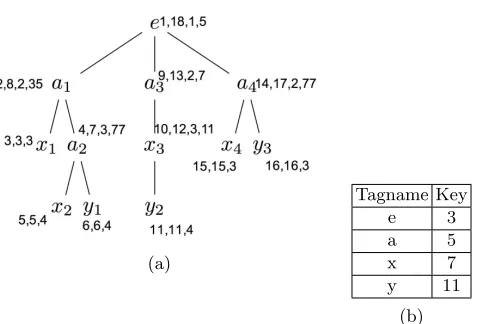
Fig. 2.(a) a sample of an XML tree labelled with the original range-based augmented with CPL parameters and (b) its corresponding tag indexing.
4 Twig Join Algorithm
4.1 Notation
There is abstract data type called a stream, which is a set of elements with the same tag name, where the elements are sorted in ascending document order. Each query nodeqin a twig pattern is associated with an element stream, named
Tq which has a cursorCq which initially points to the first element in Tq at the beginning of a query processing. To ensure the linear processing in the filtering phase of holistic algorithms, only the first element is accessible and the rest of the elements are unseen by the algorithms. There are also some auxiliary opera-tions on streams and TPQ and its nodes to facilitate the twig matching process. Supported operations are as follows:getStart(Cq) returns the start attribute of the first element ofq.getEnd(Cq)returns the end attribute of the first element of
q.getLevel(Cq) returns the level attribute of the first element ofq.getCPL(Cq) returns the CPL attribute of the head element corresponding to query node q.
tagPrime(q)returns the unique prime number associated withqfromtag index-ing.advance(Cq) forward the cursor ofq to the next element. eof(Tq) to judge whetherCq points to the end of stream ofTq.children(q) returns all child nodes of q. subtree(q) returns all child nodes which are in the subtree rooted at q.
childrenAD(q) returns all child nodes which have A-D relationship withq. chil-drenPC(q) returns all child nodes which have P-C relationship withq.isRoot(q)
returns boolean values to see whetherqis the root or not.getRoot(TPQ)returns the query root of the input TPQ.parent(q) returns the parent query node ofq.
4.2 TwigStackPrime
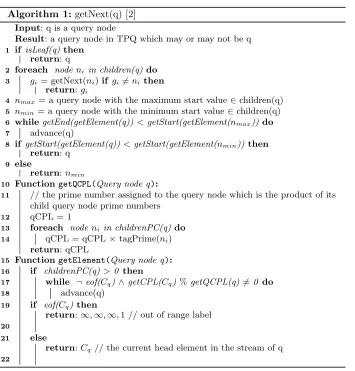
In this section, we present a new holistic twig join algorithm, called TwigStack-Prime. It can be seen as an alternative to TwigStack algorithm. The structure of the main algorithm,TwigStackPrime presented in Algorithm 2 is not much different from the original holistic twig join algorithmTwigStack [3] which uses two phases to compute answers to a TPQ. In the first phase, solutions to root-to-leaf paths in a TPQ are found and stored in output arrays (Lines 1-11). It repeatedly calls the getNext algorithm (see Algorithm 1) with the query root as the parameter to return the next query node for processing. In the second phase (Line 12), solutions in the output arrays are merge-joined based on their common branching query nodes and query matches are returned as the query result. The number of output arrays is equal to the number of leaf query nodes (i.e., the number of individual root-to-leaf paths in a TPQ).
getNext is a fundamental function which is called by the main algorithm to decide the next query node to be processed. It is used to guarantee that the current element associated with the query node returned is part of the final output since all the basic structural relationships are thoroughly checked by
getNext or its supporting subroutinegetElement.getNext(q)returns an element
eq of a query nodeq∈T P Q with three properties:
i eq has a descendant elementeqi in each of the streams corresponding to its
child elements whereeqi is the first element of a query nodeqi=children(q)
(this property is checked in Lines 9-11).
ii each of its child elements satisfies recursively the first property (this property is checked in Lines 4-5).
iii if q has Parent-Child edge(s) with its child query nodes, theneq has a child
eqi inTqi for each query nodeqqi = childrenPC(q) (this property is checked
in Lines 21-23 ofgetElement function).
In the function getElement(q), if q does not have P-C edges, the first ele-ment of q is returned. Otherwise, Line 22 checks CPL relationship for all child query nodes with P-C relationships. If the first element does not satisfy the CPL relationship (the third property), the function skips all elements which do not satisfy the CPL relationship. Otherwise, the first element is found to satisfy the CPL relationship, then it is returned in Line 26 if the stream is unfinished. In case the stream reaches the end, Line 24 returns virtual end element labelled with infinity values as (∞,∞,∞) to complete the query processing.
Compared to the originalTwigStackwhich does not apply CPL relationships, the effect ofTwigStackPrime can be illustrated in the following example.
Example 2.Consider the XML tree of Fig. 3 and Q1 = a[//x]/y. Assume the
tree is labelled with range-based labelling and CPL approach as in Fig. 2. Ini-tially, the cursors point at the first elements in streams. getNext(a) is called since a is the root query node. The first call ofgetNext(a) inTwigStack returns
a1 because it satisfies the descendant extension condition, butTwigStackPrime
Algorithm 1: getNext(q) [2]
Input: q is a query node
Result: a query node in TPQ which may or may not be q 1 if isLeaf(q)then
return: q
2 foreach nodeniin children(q) do 3 gi = getNext(ni)if gi6=ni then
return:gi
4 nmax= a query node with the maximum start value∈children(q) 5 nmin= a query node with the minimum start value∈children(q) 6 whilegetEnd(getElement(q))<getStart(getElement(nmax)) do 7 advance(q)
8 if getStart(getElement(q))<getStart(getElement(nmin))then return: q
9 else
return:nmin
10 FunctiongetQCPL(Query node q):
11 // the prime number assigned to the query node which is the product of its child query node prime numbers
12 qCPL = 1
13 foreach nodeni in childrenPC(q)do 14 qCPL = qCPL×tagPrime(ni)
return: qCPL
15 FunctiongetElement(Query node q):
16 if childrenPC(q)>0 then
17 while ¬eof(Cq)∧getCPL(Cq)%getQCPL(q)6=0 do 18 advance(q)
19 if eof(Cq)then
return:∞,∞,∞,1 // out of range label 20
21 else
return:Cq // the current head element in the stream of q 22
divisible by the prime number associated with the tag name y. The algorithm has to skip n elements with tag x since they are useless to the first elementa2.
e
a1
x1 xn a2
[image:10.612.135.490.92.463.2]xn+1 y1
Algorithm 2: TwigStackPrime [2]
Input: TPQ Q
1 while¬end(getRoot(Q))do
2 qact= getNext(getRoot(Q)) // see Algorithm 3 if ¬isRoot(q)then
4 cleanStack(getElement(qact), parent(qact)) 5 if isRoot(q)∨ ¬empty(Sparent(q
act))then
6 cleanStack(getElement(qact),qact) 7 moveToStack(qact)
8 if isLeaf(qact)then
9 outPathSolution(qact) // Blocked solutions
10 else
11 advance(qact)
12 MergeAllPathSolutions() // Phase 2
13 FunctioncleanStack(Query nodeqact,Query node q):
14 // pop any element inSq which is not the ancestor of getElement(qact) 15 while¬empty(Sq)∧getEnd(top(Sq))< getStart(getElement(qact))do 16 pop(Sq)
17 FunctionmoveToStack(Query node q):
18 // p is a pointer to the top parent stack if q is the root p is null 19 // p = top(Sparent(q))
20 push(Cq, p)to Sq
21 Functionend(Query node q):
return:∀ni∈subtree(q) :isLeaf(ni) ∧ eof(Cni)
After this,TwigStackPrime can ensure thata2satisfies the three properties and
thus is pushed into the stack for query node a. For instance, CP L(a1) → 35
mod tagP rime(y) → 11 is not equal to zero. The algorithm terminates after performing one recursive calls ofgetNext(a). On the other hand,TwigStack has to iteraten+1 times to answer match toQ1.TwigStack also generatesnuseless
paths forQ1over the given XML tree.
4.3 Analysis of TwigStackPrime
In this section, we show the correctness of our algorithms. The correctness of
TwigStackPrime algorithm can be shown analogously toTwigStack due to the fact that they both use the same stack mechanism. In other words, the correct-ness of Algorithm 2 follows from the correctcorrect-ness ofTwigStack [3].
Definition 2 (Head element).For each query node q in a TPQ Q, the element indicated by the cursorCq is the head element of q.
Definition 3 (Child and Descendant Extension). A query node q has the child and descendant extension if the following properties hold:
–∀ ni ∈ childrenP C(q), there is an element eq which is the head of Tq and
its CPL parameter is divisible by tagPrime(ni).
–∀ni∈children(q),ni must have the child and descendant extension. The above definition is a key for establishing the correctness of the following lemmas:
Lemma 1.For any arbitrary query nodeq′ which is returned by getNext(q), the
following properties hold:
1.q′ has the child and descendant extension.
2. Eitherq==q′ orq′ violates the child and descendant extension of the head
elementeq of its parent(q′).
Proof. (Induction on the number of child and descendants of q). If q is a leaf query node, it is returned in Line 2 because it verifies all the properties 1 and 2a in Lemma 1. Otherwise, the algorithm recursively getsgi = getNext(ni) for each child of q in Line 4. If for some i, there is gi 6= ni, and it is known by inductive hypothesis thatgiverifies the properties 1 and 2b with respect toq, so the algorithm returnsgi in Line 6. Otherwise, by inductive hypothesis that all
q’s child nodes satisfy properties 1 and 2a with their corresponding sub-queries. AtgetElement(q)(Lines 21-25),getNext advances fromTq all segments that do not satisfy the divisibility by the product of prime numbers in childrenP C(q) returned from getQCPL. After that, the algorithm advances from Tq (Lines 9-10) all segments that are beyond the maximum start value of ni ∈children(q). Then, if q satisfies properties 1 and 2a, it is returned at Line 12. Otherwise, Line 13 guarantees that ni ∈children(q) with the smallest start value satisfies properties 1 and 2b with respect to start value ofq’s head elementeqis returned.
Lemma 2.Suppose getN ext(q) returns a query node q′ and q 6= q′ at either
Line 4 or 13 of getNext. Then there is no new solution involving top element of the parent stack of q′ denoted as p which has end value less than the start value
of the head element of q′ or some elements which are in children(p).
Proof. Suppose that on contrary, there is a new solution using some elements of p = parent(q′) inSp denoted aseS
p for which getEnd(eSp) ¡ getStart(q′). Using
range-based property, it will be known that all elements from children(p) in some solutions must have end values less than the end value ofeSp, therefore less than
the start value of the head element ofq′. SincegetN ext(q) =q′ and from Line 3
ofgetNext for each child node ni of p (includingq′), it is getNext(ni) = ni and getStart(q′)≤getStart(ni). Using Lemma 1, it will be known that eachn
ihas a child and descendant extension, and thus all elements of children(ni) have start values greater than getStart(ni), therefore greater than getStart(q′), which is a
contradiction.
Proof. In AlgorithmTwigStackPrime,getNext(root)is repeatedly invoked to de-termine the next query node to be processed. Using lemma 1, it is known that all elements returned byqact=getNext(root)have the child and descendant ex-tension. Ifqact6=root, Line 4, the algorithm pops fromSparent(qact)all elements
that are not ancestors of the head element ofqact by Lemma 2. After that, it is already known qact has a child and descendant extension so that Line 5 checks whether Sparent(qact) is empty or not. If so, it indicates that it does not have
the ancestor extension, and it can be discarded safely to continue with the next iteration. Otherwise, the current head element ofqacthas both the ancestor and child and descendant extensions which guarantee its participation in at least one root-to-leaf path. Then, Sqact is cleaned by popping elements which do not
contain the head of qact. Then, the item in the stack is used to maintain point-ers from itself to the query root. Finally, if qact is a leaf node, we compute all possible combinations of single paths with respect toqact, line 8-9.
The correctness holds for TPQs with both A-D and P-C relationships, it can be shown that TwigStackPrime algorithm is optimal when P-C axes exist only in the deepest level of a twig query. The intuition is simple since the CPL relationship can detect hidden immediate child elements only in two streams related by P-C relationships. Henceforth, we can conclude the following result.
Theorem 2.Consider a twig pattern query Q with n query nodes, and only Ancestor-Descendant edges or there are Parent-Child edges to connect leaf query nodes, and an XML document D. TwigStackPrime has worst-case I/O and CPU time complexities linear in the sum of the size of the n input lists and the output list.
e
a1
x1 a2
x2 y1
f1 y2
a4
x4 y3
(a) an XML tree.
Tagname Key
e 3
a 5
x 7
y 11 f 13
[image:13.612.201.418.420.593.2](b) tag indexing.
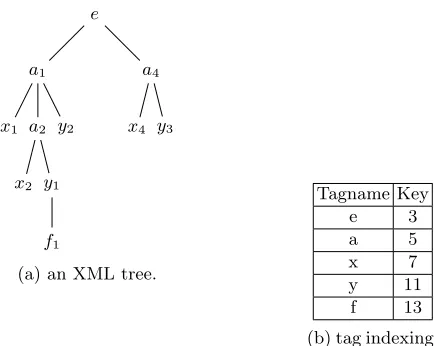
Example 3.Consider the XML tree of Fig. 4 and Q2 = a[/x]/y/f, the head
el-ements in their streams are a → a1, x → x1, y → y1 and f → f1. The first
call ofgetNext(root)inside the main algorithm will returna→a1because it has
A-D relationship with all head elements and satisfiesCPLwithx andy, and its descendanty→y1also satisfies the child and descendant extension with respect
to f. However, TwigStackPrime produces the useless path (a1, x1) because y2
does not have child of f-node [2].
5 Experimental Evaluation
In this section we present the performance comparison of twig join algorithms, namely: TwigStackPrime the new algorithm based on Child Prime Label ap-proach, along withTwigStack [3]. The original twig join algorithm that was re-ported to have optimal worst-case processing with A-D relationship in all edges, and TwigStackList is the first refined version of TwigStack to process P-C ef-ficiently [9]. TwigStackList was chosen in this experiment because it utilizes a simple buffering technique to prune irrelevant elements from streams. We eval-uated the performance of these algorithms against both real-world and artificial datasets. The performance comparison of these algorithms was based on the following metrics:
1. Number of intermediate solutions: the individual root-to-leaf paths generated by each algorithm.
2. Processing time: the main-memory running time without counting I/O costs. All twig pattern queries were executed 103 times and the first three runs were excluded for cold cache issues. We did not count the I/O cost for tag indexing files forTwigStackPrime algorithm because it is negligible, and the cost to read the tag indexing is constant over a series of twig pattern queries.
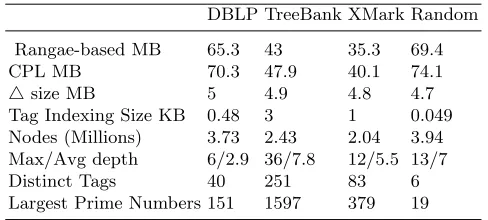
5.1 Experimental Settings
dataset was created to test the performance where the XML document combines features of DBLP and TreeBank, being structured and deeply-recursive at the same time.
Table 1.Characteristics of XML datasets used in the experiments.
DBLP TreeBank XMark Random
Rangae-based MB 65.3 43 35.3 69.4 CPL MB 70.3 47.9 40.1 74.1
△size MB 5 4.9 4.8 4.7
Tag Indexing Size KB 0.48 3 1 0.049 Nodes (Millions) 3.73 2.43 2.04 3.94 Max/Avg depth 6/2.9 36/7.8 12/5.5 13/7 Distinct Tags 40 251 83 6 Largest Prime Numbers 151 1597 379 19
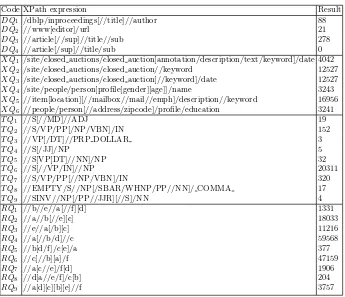
The XML structured queries for evaluation over these dataset were chosen specifically because it is not common for queries, which contain both ’//’ and ’/’, to have a significant difference in performance for tightly-structured document such as DBLP and XMark. TreeBank twig queries were obtained from [9] and [7]. Twig patten queries over the random data set were also randomly generated. Table 2 shows the XPath expressions for the chosen twig patterns. The code indicates the data set and its twig query, for instance, TQ2 refers to the second query issued over TreeBank dataset.
5.2 Experimental Result
We compared TwigStackPrime algorithm with TwigStack and TwigStackList
over the above mentioned twig pattern queries against the data sets selected. The Kruskal-Wallis test is a non-parametric statistical procedure was carried out on processing time, the p-value turns out to be nearly zero (p-value less than 2.2−16), it strongly suggests that there is a difference in processing time
between two algorithms at least as shown in Fig. 5.
TwigStackPrime vs. TwigStack We compare the performance between
TwigStackPrime and TwigStack. Table 3 shows that TwigStackPrime always generates fewer root-to-leaf paths than TwigStack. This is because TwigStack-Prime uses CPL relationships to prune irrelevant elements. For instance, in
T Q6, TwigStackPrime produced only 22 565 useful paths, whereas the number
(a) DBLP (b) XMark
[image:16.612.154.462.98.364.2](c) Random (d) TreeBank
Fig. 5. Processing time for twig pattern queries against DBLP in 5a and XMark in 5b. 5c and 5d shows processing time for TPQs on Random and TreeBank datasets, respectively [2].
[image:16.612.236.381.417.529.2]Table 2.Experimental TPQs.
Code XPath expression Result
DQ1 /dblp/inproceedings[//title]//author 88
DQ2 //www[editor]/url 21
DQ3 //article[//sup]//title//sub 278
DQ4 //article[/sup]//title/sub 0
XQ1 /site/closed auctions/closed auction[annotation/description/text/keyword]/date 4042
XQ2 /site/closed auctions/closed auction//keyword 12527
XQ3 /site/closed auctions/closed auction[//keyword]/date 12527
XQ4 /site/people/person[profile[gender][age]]/name 3243
XQ5 //item[location][//mailbox//mail//emph]/description//keyword 16956
XQ6 //people/person[//address/zipcode]/profile/education 3241
T Q1 //S[//MD]//ADJ 19
T Q2 //S/VP/PP[/NP/VBN]/IN 152
T Q3 //VP[/DT]//PRP DOLLAR 3
T Q4 //S[/JJ]/NP 5
T Q5 //S[VP[DT]//NN]/NP 32
T Q6 //S[//VP/IN]//NP 20311
T Q7 //S/VP/PP[//NP/VBN]/IN 320
T Q8 //EMPTY/S//NP[/SBAR/WHNP/PP//NN]/ COMMA 17
T Q9 //SINV//NP[/PP//JJR][//S]/NN 4
RQ1 //b//e//a[//f][d] 1331
RQ2 //a//b[//e][c] 18033
RQ3 //e//a[/b][c] 11216
RQ4 //a[//b/d]//c 59568
RQ5 //b[d/f]/c[e]/a 377
RQ6 //c[//b][a]/f 47159
RQ7 //a[c//e]/f[d] 1906
RQ8 //d[a//e/f]/c[b] 204
RQ9 //a[d][c][b][e]//f 3757
on Manny-Whitney test which showed that in most test twig queries TwigStack-Prime outperformed TwigStack as depicted in Fig. 5. In our experiments, we usedT Q6 andRQ6because they touch very large portions of their datasets and
produce quite huge results. ForT Q6andRQ6,TwigStackPrimewere more than
40 and 5 time faster thanTwigStack, respectively.
TwigStackPrime vs. TwigStackList We now compare the performance be-tweenTwigStackPrime andTwigStackList. For highly structured datasets, both
TwigStackPrime andTwigStackList are optimal as presented in Table 3. How-ever, none of the algorithms are optimal in the other datasets because they have redundant paths and many tags are deeply recursive. In most queries,
TwigStackPrime generated relatively fewer paths than TwigStackList. This is becauseTwigStackPrimeuses CPL relationships to prune useless elements while
TwigStackList utilises a simple buffering technique bounded by the number of elements in the longest path of the queried XML dataset. For example, RQ9
17 328 useless paths. Even thoughRQ4 is optimal forTwigStackList because it
does not have P-C in branching axes,TwigStackPrimeevaluatedRQ4efficiently
see Fig. 5 and Table 3.
Since there was a difference in performance, we ran pairwise comparison based on Manny-Whitney test which showed that in most twig queries tested
TwigStackPrime outperformed TwigStackList, however, they showed same per-formance in XQ2 , XQ3 and XQ6 see Fig. 5. For expensive queries,
pair-wise comparison based on Manny-Whitney test between TwigStackPrime and
TwigStackList resulted inp−value <0.001 which suggests a significant differ-ence and TwigStackPrime has the best performance. When evaluating RQ6, TwigStackPrime has the best performance, it is roughly twice as fast than
TwigStackList.
Summary It can be seen in Fig. 5 the only twig queries whereTwigStackPrime
has slower performance comparing to the others isT Q3and T Q9 because they
touch very little of the dataset. According to the experimental results, we can draw the following two conclusions:
1. The CPL approach is a new source of improvement for holistic twig matching algorithms since it can reduce the number of elements processed and the size of intermediate result when TPQs contain Parent-Child edges.
2. TwigStackPrime significantly outperformed TwigStack and TwigStackList
[image:18.612.212.400.445.641.2]for different types of XML documents in terms of their structures including shallow and deep datasets.TwigStackPrime showed a superior performance in avoiding the storage of unnecessary paths while processing time is im-proved.
Table 3.Single paths produced by each algorithm [2].
Code TwigStack TwigStackList TwigStackPrime
DQ1 147 139 139
DQ4 98 0 0
XQ1 9414 6701 6701
T Q2 2236 388 441
T Q3 10663 11 5
T Q4 70988 30 10
T Q6 702391 22565 22565
T Q8 58 27 26
T Q9 29 17 8
RQ1 2076 1843 1795
RQ2 29914 24235 23057
RQ3 20558 16102 15505
RQ4 67005 57753 57753
RQ5 3765 901 1093
RQ6 201835 98600 72084
RQ7 6880 2791 3219
RQ8 746 322 406
6 Conclusion and Future Work
In this paper, we proposed the CPL approach to improve the pre-filtering strat-egy in twig join algorithms when P-C edges are involved in TPQs. The key to the TwigStackPrime is the use of the CPL approach as the labelling scheme and of the advanced preorder filtering functiongetNext, which both enable fast determination of P-C relationships between elements of XML documents while scanning them in preorder traversal. This property is exploited to reduce stor-age space by skipping irrelevant elements from the streams and to improve the overall performance.
Compared to the previous labelling schemes, the CPL approach can be used to derive a set of the tag names of child elements associated with their inner elements. P-C edges, hence, can be solved in very efficient way.TwigStackPrime
algorithm shows the general framework we use for introducing the CPL approach into existing twig matching algorithms, extending algorithm likeTwigStack.
Existing research revolves around improving the efficiency of twig matching algorithms and extending querying algorithms to make them more able to handle positional predicates and order axes in XPath expressions. A promising approach for speeding up the query processing would be to combine our approach with the previous orthogonal algorithms to propose a new one-phase twig matching algorithm that we hope will be superior to the previous approaches. The current preliminary idea is to examine processing ordered twig patterns and positional predicate in a way that would consume less time and memory than the existing approaches. We will consider one-phase and ordered twig matching algorithms as our future work.
References
1. S Alireza Aghili, Li Hua-Gang, Divyakant Agrawal and Amr El Abbadi. TWIX: twig structure and content matching of selective queries using. InfoScale ’06: Proceedings of the 1st international conference on, page 42, 2006.
2. Shtwai Alsubai and Siobh´an North. A Prime Number Approach to Matching an XML Twig Pattern including Parent-Child Edges. In The 13th International Conference on Web Information Systems and Technologies (WEBIST 2017), pages 204–211, Porto, 2017. SCITEPRESS Science and Technology Publications, Lda. 3. Nicolas Bruno, Nick Koudas, and Divesh Srivastava. Holistic twig joins: optimal
XML pattern matching. InProceedings of the 2002 ACM SIGMOD international conference on Management of data, pages 310–321, Madison, Wisconsin, 2002. ACM.
4. Songting Chen, Hua-Gang Li, Junichi Tatemura, Wang-Pin Hsiung, Divyakant Agrawal, K Sel, #231, uk Candan, and K Sel¸cuk Candan. Twig2Stack: bottom-up processing of generalized-tree-pattern queries over XML documents, 2006. 5. Ting Chen, Jiaheng Lu, and Tok Wang Ling. On Boosting Holism in XML Twig
Pattern Matching Using Structural Indexing Techniques. Science, pages 455–466, 2005.
7. Nils Grimsmo, Truls Amundsen Bjørklund, and Magnus Lie Hetland. Fast optimal twig joins. VLDB, 3(1-2):894–905, sep 2010.
8. Jiang Li and Junhu Wang. Fast Matching of Twig Patterns. Lecture Notes in Computer Science (including subseries Lecture Notes in Artificial Intelligence and Lecture Notes in Bioinformatics), 5181 LNCS:523–536, 2008.
9. Jiaheng Lu, Ting Chen, and Tok Wang T.W. Ling. Efficient Processing of XML Twig Patterns with Parent Child Edges : A Look-ahead Approach. In Proceed-ings of the thirteenth ACM international conference on Information and knowledge management, number i, pages 533–542, Washington, D.C., USA, 2004. ACM. 10. Jiaheng Lu, Xiaofeng Meng, and Tok Wang Ling. Indexing and querying XML
using extended Dewey labeling scheme. Data & Knowledge Engineering, 70(1):35– 59, 2011.
11. Lu Qin, Jeffrey Xu Yu, and Bolin Ding. TwigList: Make Twig Pattern Match-ing Fast. In Ramamohanarao Kotagiri, P Radha Krishna, Mukesh Mohania, and Ekawit Nantajeewarawat, editors,Advances in Databases: Concepts, Systems and Applications: 12th International Conference on Database Systems for Advanced Applications, DASFAA 2007, Bangkok, Thailand, April 9-12, 2007. Proceedings, pages 850–862. Springer Berlin Heidelberg, Berlin, Heidelberg, 2007.
12. Huayu Wu, Chunbin Lin, Tok Wang Ling, and Jiaheng Lu. Processing XML twig pattern query with wildcards. Lecture Notes in Computer Science (including sub-series Lecture Notes in Artificial Intelligence and Lecture Notes in Bioinformatics), 7446 LNCS:326–341, 2012.
13. Chun Zhang, Jeffrey Naughton, David DeWitt, Qiong Luo, and Guy Lohman. On supporting containment queries in relational database management systems.ACM SIGMOD Record, 30:425–436, 2001.
14. S Al-Khalifa, H V Jagadish, N Koudas, J M Patel, D Srivastava, and Wu Yuqing. Structural joins: a primitive for efficient XML query pattern matching. In Data Engineering, 2002. Proceedings. 18th International Conference on, pages 141–152, 2002.
15. Haw, S.-C. and Lee, C.-S. (2011). Data storage practices and query processing in XML databases: A survey. Knowledge-Based Systems, 24(8):1317–1340.
16. Gang, G. and Chirkova, R. (2007). Efficiently Querying Large XML Data Repos-itories: A Survey. Knowledge and Data Engineering, IEEE Transactions on, 19(10):1381–1403.
17. Lu, J., Ling, T. W., Bao, Z., and Wang, C. (2011a). Extended XML tree pattern matching: Theories and algorithms. IEEE Transactions on Knowledge and Data Engineering, 23(3):402–416.
18. R. Goldman and J. Widom, Dataguides: Enabling query formulation and opti-mization in semistructured databases, Proc. Int. Conf. Very Large Data Bases, pp. 436445, 1997.
19. R. Kaushik, P. Bohannon, J. F. Naughton, and H. F. Korth, Covering indexes for branching path queries, Proc. 2002 ACM SIGMOD Int. Conf. Manag. data -SIGMOD 02, p. 133, 2002.
20. T. Chen, J. Lu, and T. W. Ling, On Boosting Holism in XML Twig Pattern Matching Using Structural Indexing Techniques, Science (80-. )., pp. 455466, 2005. 21. R. Baˇca, M. Kr´atk´y, T. W. Ling, and J. Lu, Optimal and efficient generalized twig pattern processing: a combination of preorder and postorder filterings, VLDB J., vol. 22, no. 3, pp. 369393, Oct. 2012.
23. C. Mathis, T. H¨arder, K. Schmidt, and S. B¨achle, XML indexing and storage: fulfilling the wish list, Comput. Sci. - Res. Dev., pp. 118, 2012.
24. A. Schmidt, F. Waas, M. Kersten, R. Busse, M. J. Carey, and G. B. Amsterdam, XMark : A Benchmark for XML Data Management, in VLDB 02 Proceedings of the 28th international conference on Very Large Data Bases, 2002, pp. 974985. 25. G. Miklau, UW XMLData Repository. [Online]. Available:
![Fig. 5. Processing time for twig pattern queries against DBLP in 5a and XMark in5b. 5c and 5d shows processing time for TPQs on Random and TreeBank datasets,respectively [2].](https://thumb-us.123doks.com/thumbv2/123dok_us/1890832.146696/16.612.236.381.417.529/processing-pattern-queries-processing-random-treebank-datasets-respectively.webp)
![Table 3. Single paths produced by each algorithm [2].](https://thumb-us.123doks.com/thumbv2/123dok_us/1890832.146696/18.612.212.400.445.641/table-single-paths-produced-algorithm.webp)
