ERRATA
A bstract• p. ix, 1. 7 -“...low-complexity multiuser detectors...” should be read as “...low-complexity multiuser detector...”
• p. x, 1. 20 -“...Guassian...” should be replaced by “...Gaussian...”
C hapter 1
• p. 3,1. 1 2 -“...1960’s...” should be replaced by “...1980’s...”. It should also be noted that Qualcomm was the first company to actually produce a system [87]. Previously, only military systems had been developed.
• p. 6,1. 12 The squared minimum Euclidean distance is defined as
d mi n = >k = ! > • • • > K ,
where df k is given by (3.34) and (3.35) for synchronous and asynchronous systems respec tively.
C hapter 2
• p.10,1. 9 -“third generation spread spectrum systems” should be replaced by “third generation mobile and personal communications systems”.
• p. 10,1. 14 -“IS-54” should be replaced by “IS-136”.
• p. 11,1. 1 - Remark: It should be noted that virtually all cellular radio standards call for the use of sectored antennas. CDMA does not gain capacity because of this, rather it gains through the use of voice activity detection and the soft degradation as the interference levels increase.
• p. 11,1. 18 and p. 12,1. 7 - Include references [87] and [88] after “... shown in Fig. ...”. • p. 13, Section 2.4 - Design Methodology and Implications
It should be noted that one advantage of long spreading codes is that they avoid a number of synchronisation problems, particularly in coherent systems. Long codes have the advantage that they do not exhibit short term periodicities that can cause spurious locking of the phase locked loops used for carrier and timing recovery.
• p. 20 - Following equation (2.11), R j (m) should be replaced by R,:(0). • p. 20 - R i ( 0 ) k’k' should be replaced by Ri ( m ) k’k' .
• p. 22, Section 2.7.1
-Solution to the near far problem - Note that multiuser detection (MUD) only provides resis tance to the near far problem in any practical context, although in theory it solves it.
• p. 25-26, 1. 6 - Note that the decorrelating detector causes noise enhancement only if 7Z^lk > 1. The structure of this detector is analogous to zero forcing equalisation. This
detector completely eliminates MAI if 1Z is invertible.
Chapter 3
• p. 34,1. 6 - “...followed” should be replaced by “...reproduced”.
• p. 35 - p(ck) is the probability that the encoder chooses the path Ck to send.
• p. 37 - Remark: When we calculate a distance spectrum line with df, we need to find all
error events of different lengths L, that share this distance, df. The lengths normally have a
large range. Note that it is not possible to compute the infinite set of all distances, hence we propose to truncate the computation of the spectrum after a sufficiently large L. A sa rule of
thumb we have used the cut off threshold to be T = 2.5 times the squared minimum distance.
• p.37 - The partial distance spectrum can be defined as the set of all pairs {df, Ad2}, where
df < Td'2mtn i, T is the cut off threshold.
• p. 46 1. 4 - The sentence “Any finite .. irregular” should be deleted. Note that in general to obtain the complete distance spectrum requires an exhaustive search. This is due to the irregularity of the finite state machine structure of a multiuser system.
• p.47 1 . 3 - The following reference should be included.
[Benedetto] Benedetto S, Mondin M, Montorsi G, “ Performance evaluation of trellis-coded
modulation schemes”, Proceedings of the IEEE, vol.82, no.6, June 1994, pp.833-55.
The sentence “The synchronous algorithm can thus be written as follows:” should be replaced by “Knowing the distances and multiplicities, the algorithm in [Benedetto] has been modified to allow the partial distance spectrum to be computed for the multiuser case.”
• p .4 7 ,1. 26 - The words “(say 31)” should be removed. Historically, a processing gain of 31 is not considered large in spread spectrum signalling. Note that IS-95, which is a narrow band spread spectrum system has a processing gain o f approximately 128.
* *
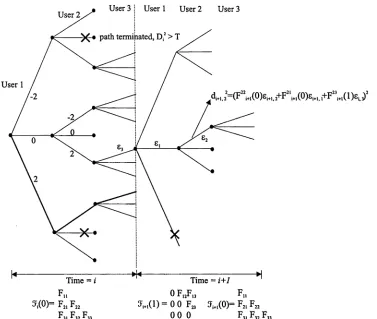
• p.48 - In fig. 3.7 £i,£'2 and £ 3 should be replaced by £t,i. e*,2 and £^3 respectively.
• p.50 - In fig. 3.8 £i, £ 2 and e3 should be replaced by £»+1,1, f i+1,2 and 3 respectively.
• p .5 1 1. 3 - P (e) should be replaced by P (e).
• p .5 1 1. 4 - The words “normalised error” should read as “normalised squared estimation error probability”. W' should also be replaced by W ' .
• p.51, 3.7.1 no. 5 - “normalised variance” should read as “normalised standard deviation”. • p .5 2 1. 9 - Replace “(SNR)” by “( S N R = ^ ) ”. In the remainder of the thesis SNR is also
• p.54 last line - Remark: In general there is no guarantee that the fading processes of all users on the down link are identical. In fact in reality this is hardly the case. In accordance with the previous statements, the last line should be deleted or justified for only hypothetical cases. • p.55, Condition 2 - {e < e, e" < e) is satisfied if (*) | < |ej(i)| for all j = 1, * - *, K and
i = - M , ■■■, M.
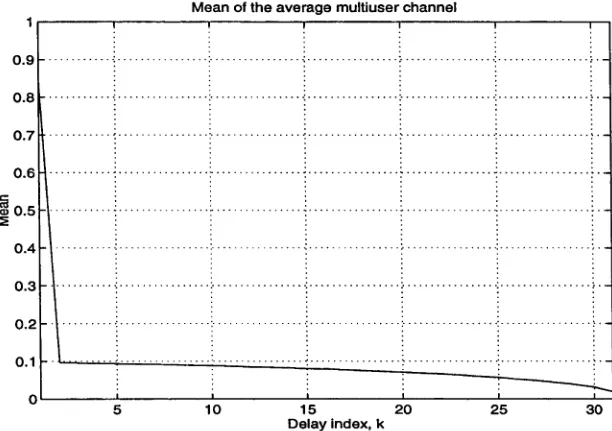
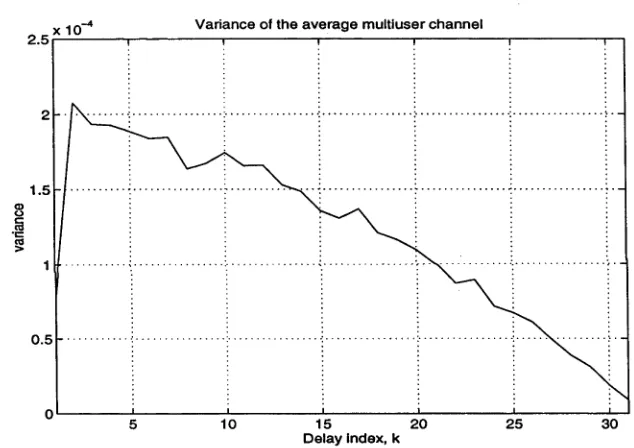
• p.61, - Fig 3.18 should be labelled as follows, x-axis - User index, k, y-axis - User index, k and z-axis - Average Variance of MAI.
• Remark - The complexity of the distance spectrum calculations has been reported separately in the following two references.
1) Schlegel C and Wei L, “A simple way to compute the minimum distance in multiuser CDMA systems”, IEEE Transactions on Communications, vol.45, no.5, May 1997, pp.532- 5.
2) Jana R and Wei L, “Performance bounds for optimum coded multiuser DS-CDMA sys tems”, in. Proc. of IEEE International Conference on Communications Systems, Singapore, Nov. 1996.
Chapter 4
• p. 65,1. 3 - This reference should be included. “Boudreau GD, Falconer DD, Mahmoud SA. A comparison of trellis coded versus convolutionally coded spread-spectrum multiple-access systems IEEE Journal on Selected Areas in Communications, vol.8, no.4, pp.628-40, May 1990.”
Throughout the majority of chapter 4 the author has dealt only with convolutional codes. Towards the end of the chapter, numerical results are presented on the complexity of the tree search for rate 2/3 Ungerboeck 8-PSK trellis codes.
• p. 71, Eqn. (4.18) - T is the total number of output symbols in the multiuser joint trellis. • p. 71,1. 2 - D ( E) = eTTim+L£ is the distance matrix, where e = {eq, £2, • • •, Ek} represents
the error vector for all users and n m +L the correlation matrix given by (4.19). • p.83 - The numerator in the second term in equation (4.67) should read as c f A ,cp
• Part I - Remark: In this thesis, an information theoretic approach for the capacity of mul tiuser systems has not been pursued. For the benefit of the reader, two references are included namely,
1) S.V. Hanly and D.N.Tse, “Multi-access, fading channels: Part II: Delay limited capacities,” IEEE Transactions on Information Theory, vol. 44, No. 7, pp. 2816-2831, Nov. 1998. 2) S.V. Hanly, “Capacity and power control on spread spectrum macrodiversity radio net works,” IEEE Transactions on Communications, Vol. 44, No. 2, pp. 247-256, Feb. 1996.
• p. 95, 1. 10 - The sentence “Diffraction...impenetrable body.” should read as “Diffraction occurs when the radio path between the transmitter and receiver is obstructed by a surface that has sharp irregularities (edges). The secondary waves resulting from the obstructing surface are present throughout the space and even behind the obstacle, giving rise to a bending of waves around the obstacle, even when a line-of-sight path does not exist between transmitter and receiver, (see page 78, [91]).”
• p. 96 last line - Remark: It should be noted that WSSUS is a special case arising from more general definitions of Bello’s work, [14].
• p. 98 section 5.5 - Replace f c ( r , t ) c * ( t ' ,t') ( ^j ^ ^ ) 6 y P c (r,t)c * (< ',T ') (^> t t t ) •
• p. 102 section 5.9 - The sentence “Physically, (5.4) represents a ...” should be changed to “Physically, (5.4) may be modelled as a densely tapped transversal filter.”.
• p. 105 - Remark: It should be noted that the model of [120] and Jake’s model correspond to isotropic scattering in the vicinity of the receive antenna of the mobile terminal. In general this model will not apply at a base station.
• p. 111,113- The captions of figures 5.12 and 5.14 should be interchanged.
• p. 116 - It should be noted that the Viterbi algorithm may be effectively applied whenever a recursively additive metric can be defined. This is in fact the motivation for using the log-likelihood in receiver and decoder design. In the more general context of dynamic pro gramming many other metrics are possible.
Chapter 6
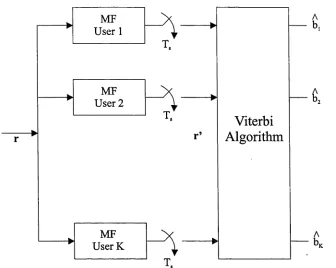
• p. 122 - Remark: The RAKE receiver used in CDMA systems utilizes the large bandwidth of spread spectrum signalling waveforms to achieve multipath diversity. The conventional RAKE receiver is optimal for slow fading frequency selective scenarios, and is implicitly based on a time-invariant channel model. In fact, practical implementations rely on slow fad ing to obtain accurate channel estimates by averaging over several symbols. Indeed, the errors incurred in channel estimation are primarily responsible for the performance degradation of the RAKE receiver under fast fading. The fast fading channel is an inherently time-varying system. Figure 6.1 shows a multiuser RAKE receiver that employs jo in t tim e — frequency representations (TFRs) of the time-varying mobile wireless channel. In the absence of MAI, corresponding to the single user case, the optimal receiver for each user is the TF RAKE receiver with maximal-ratio-combining (MRC), which coherently combines the differ ent multipath-Doppler shifted signal. Note that MRC requires the knowledge of the channel coefficients H^, which may be estimated through a pilot transmission. The optimal multiuser detector essentially augments the single user receiver by suppressing MAI. The multiuser sep aration is followed by a whitening operation to decorrelate the noise in the estimates. Finally, MRC is applied to the different multipath-Doppler components of each user.
• p. 134 - Equation (6.43), the first factor to be differentiated should be (( - pi)n‘. • p.136 - The second paragraph should refer to figure 6.6.
Chapter 7
• p. 145 - 146 - Remark: For the sake of clarity it was shown that the E { y m|B ,
y m-
1} is the minimum mean squared error estimate of ym. This result is also shown in [81]. It is sufficient to assert this well known result. Similarly, we assert that (7.19) is the Innovations process (see reference [81]). A brief note on innovations sequence is provided for the benefit of the reader. Suppose {ym } is a sequence of Gaussian vectors.Define ym — ym~E{y™ \ Then { ym} is an innovations sequence. 1) {ym } is a linear combination of y0, t/t, • • •, ym
2) By the orthogonality principle, {ym} is orthogonal to y0, yi, • ■ •, ym and all linear combi nations of these variables.
Conditions 1) and 2) imply E { y myn } = 0, rn f n. Furthermore, ym is independent of yn, m j ^ n .
If {ym } is NOT a Gaussian sequence, then E { y m \ B , y m_ i } is constructed as the best non linear prediction. In general E { y my'n } = 0 and {ym } is an independent Gaussian sequence (see [Kailath]).
[Kailath] T. Kailath, “The innovations approach to detection and estimation theory”, Pro ceedings of the IEEE, vol. 58, no. 5, May 1970.
• p. 150 - Remark: The algorithm in section 7.3 is closely related to the work of Hart and Taylor [49]. However, it also investigates the effect of multiple access interference (MAI) in a CDMA environment. Furthermore, ideas on the decomposition of (Cholesky factorisation) 7 were explored.
Performance Evaluation Of Single
User and Multiuser CDMA Systems
Rittwik Jana
B.E. (Hon I), The University of Adelaide
A thesis submitted for the degree of
Doctor of Philosophy at
The Australian National University
To my parents, Sukumar and Rina for their love and support.
To my wife and sister, Jaya and Sanjukta for their inspiration and love.
© Rittwik Jana
Except where otherwise indicated, this thesis is my own original work.
Rittwik Jana
• ••• ’
Contents
Acknowledgments viii
Abstract ix
List of Publications x
List of Figures xii
List of Acronyms xvii
Notation xix
1 Introduction 1
1.1 Research A ccount...
5
1.2 Thesis C ontributions...
8
2 Introduction to CDMA Multiuser Detection 10
2.1 Direct Sequence Spread Spectrum...
10
2.2 CDMA Forward L in k ...
11
2.3 CDMA Reverse L i n k ...
12
2.4 Design Methodology and Implications...
13
2.5 Basic DS-CDMA System M o d el...
14
2.5.1
Synchronous AWGN CDMA Channel M odel...
17
2.5.2
Asynchronous AWGN CDMA Channel M odel...
19
2.6 Interference Rejection...
21
2.7 The Multiuser Detection Problem
212.7.1
Advantages of Multiuser Detection ...
22
2.7.2 Disadvantages of Multiuser Detection...
23
2.8 Optimum Multiuser Detection ...
23
2.9 Suboptimal Receivers...
24
2.9.1
Linear Complexity R eceivers...
25
2.10 Nonlinear Receivers ...
26
2.11 Adaptive Multiuser Detection...
28
2.12 Summary...
30
3 Performance Evaluation of Optimum Multiuser DS-CDMA Systems 32
3.1 Introduction...
32
3.2 Bit Error Probability Bounds...
33
3.3 Bit Error Probability Bounds for Multiuser DS-CDMA...
38
3.4 System M o d e l...
41
3.5 Procedure to Compute The Near Ideal Noise Whitening F ilte r ...
45
3.6 The Partial Distance Spectrum Calculation ...
46
3.6.1
Synchronous C a s e ...
46
3.6.2
Asynchronous...
47
3.7 Average BEP for Random C o d e s ...
50
3.7.1 Procedure to estimate the BEP ...
51
3.8 Numerical Results...
52
3.9 Sum m ary...
57
4 Performance Evaluation of Trellis Coded Multiuser CDMA 63
4.2 System M o d e l ... 67
4.3 Normalised Minimum Squared Euclidean D i s t a n c e ... 70
4.4 Properties of for Coded Multiuser C D M A ... 74
4.4.1 U pper Bound on Squared Minimum Euclidean D is ta n c e ... 74
4.4.2 Effect of 7Z on ... 78
4.4.3 Asymptotic efficiency for coded C D M A ... 82
4.5 Numerical R esu lts... 85
4.6 S u m m a ry ... 88
5 The Transmitter, Multipath Channel and Receiver 91 5.1 In tr o d u c tio n ... 92
5.2 The T ra n s m itte r... 92
5.3 Radio Propagation and Mother N a tu re ... 94
5.4 Channel - Linear Time Varying F ilte r ... 96
5.5 Channel - Random Time Varying F ilte r... 98
5.6 Complex Gaussian D is trib u tio n s ... 98
5.7 Wide Sense Stationary Uncorrelated Scattering (W S S U S )... 100
5.8 Delay Spread and Doppler S p r e a d ... 100
5.9 Discrete Delay and Discrete Time Channel M o d e llin g ... 102
5.10 Simulating the Channel ... 104
5.11 The Time and Frequency Selective C h a n n e l... 106
5.12 The Time Selective C h a n n e l ... 107
5.13 The Frequency Selective C h a n n e l... 108
5.14 The Receiver Front E n d ... 109
5.15 Received Signal M o d e l... I l l
5.17 M ultiuser Detection in M ultipath Fading C h an n els... 117
5.18 MLSE Receiver A n a ly s is ... 118
5.19 S u m m ary ... 119
Optimum Multiuser Detection for Known Time Varying, Frequency Selective Rayleigh Channels 120 6.1 In tro d u c tio n ... 121
6.2 MUKCIR Receiver D e riv a tio n ... 123
6.2.1 White N o i s e ... 126
6.2.2 The Time Invariant Frequency Selective C h an n e l... 127
6.2.3 The Time Selective Frequency Flat C h a n n e l... 128
6.2.4 The Time Invariant Frequency Flat C h an n e l... 129
6.3 Receiver O p e r a tio n ... 130
6.4 Receiver A n a ly s is ... 130
6.5 Numerical R esu lts... 134
6.6 S u m m a ry ... 138
Predictor Based Multiuser Detection for Time Varying, Frequency Selective Rayleigh Channels 140 7.1 In tr o d u c tio n ... 141
7.2 MUKCA Receiver D e r iv a tio n ... 143
7.3 SUKCA Receiver D eriv atio n ... 148
7.3.1 The SUKCIR Receiver D erivation... 150
7.4 Receiver O p e r a tio n ... 151
7.5 Receiver A n a ly s is ... 151
7.6 Numerical R esu lts... 154
8 Conclusion 160
8.1 A c h iev e m e n ts... 160
8.2 Future R e se a rc h ... 162
A A Suboptim al M ultiuser CDMA Receiver Using Sequential D ecoding 164 A .l In tr o d u c tio n ... 164
A.2 Metric Functions for Sequential D e te c tio n ... 165
A.3 Numerical R esu lts... 169
A.4 C o n clu sio n ... 169
A. 5 Appendix ... 169
B Change D etection in Teletraffic M odels 173 B. l Abstract ... 173
B.2 In tro d u c tio n ... 173
B.3 Signal M o d e l s ... 175
B.3.1 Markov M odulated Poisson Process (M M PP)... 175
B.3.2 Long Memory P ro cesses... 176
B.3.2.1 Fractional A R IM A ... 176
B.4 On-Line Change D etectio n ... 178
B.4.1 M M P P ... 179
B.4.2 Gaussian F A R IM A ... 179
B.4.2.1 Gaussian FARIMA(0, d, 0) ... 180
B.4.2 . 2 Gaussian FARIMA(1, d, 0) and FARIMA(0, d, 1 ) ... 181
B.5 S im u la tio n ... 182
B ibliography 190
Acknowledgements
While I was a research student at the Australian National University I was fortunate to
have Dr. Lei Wei, Dr. Brian D. Hart and Dr. Rodney A. Kennedy as my supervisors.
My initial education in the area of multiuser communications was under the perceptive
direction of Dr. Lei Wei, Dr. Christian Schlegel and Dr. Lars Rasmussen. Lei has helped
and guided me towards the completion of this thesis with much helpful criticisms and
many valuable suggestions. His family and friends have been most supportive during
the "not so good" times and I am deeply indebted.
Dr. Brian D. Hart (and his little red pen) has spent many hours discussing the details
of the CDMA channel with me. His support and encouragement has made a significant
difference to the state of my mind and I cherish our continuing friendship. For this,
and for the way in which his enthusiasm has inspired and encouraged me, I express my
sincerest gratitude. Cheerio mate!
Dr. Rodney Kennedy deserves many thanks for his guidance and insight. 1 thank him
especially for the scholarship and the financial help he provided. Rod is still somewhat
of a mentor to me and I regard his suggestions/criticisms very highly.
Many thanks to the wine connoisseur Dr. Subhrakanti Dey with whom I have spent
many hours talking about everything from CDMA to life in general. To date I still wonder
why our discussions get vague towards the end of the bottle!! Here's to you mate! Salut!
I am most thankful to my family, the most caring people in this world. They have
been behind me through thick and thin and it is not possible to thank them enough for
their continuous encouragement and support. Special thanks to my wife Jaya, for all her
support and care. Thanks petal. By now I am convinced she knows how Trellis Coded
Modulation works!!
The support that I have received from the CRC for Robust Systems in the form of a
scholarship and various professional development programs is gratefully acknowledged
also. Last but not least I thank all the staff and students especially Ms. Maria Davern,
Mr. Deva Borah and Dr. Predrag Rapajic in the Telecommunications Engineering Group
who have been extremely supportive through their friendship and stimulating discus
sions. My colleagues at the Defence Science and Technology Organisation deserve a spe
cial mention. Doing a full-time job and studying part-time is very demanding and I am
grateful to each and everyone who has supported me through this phase of my life.
Abstract
The work in this thesis addresses a variety of issues relating to single user and multiuser
detection schemes in the context of broadband wireless communications.
These studies present a simple and effective technique to evaluate the performance of
Direct Sequence - Code Division Multiple Access systems using multiuser detectors over
additive white Gaussian noise channels and mobile fading channels; the development
of optimum multiuser receiver architectures to combat the fading channel's time varia
tion and frequency selectivity; and the design of a low-complexity multiuser detectors to
achieve near optimum performance.
Spread spectrum communication is a well known technique which has found enor
mous utility in mobile communication systems. In a cellular environment where there
are a large number of users simultaneously active, it is an extremely difficult task to char
acterise the performance of such a system. Much work has been done in the recent past
and is still underway to develop computationally attractive algorithms to evaluate such
complex systems. In the first part of the thesis we utilise analytic or semi-analytic meth
ods to evaluate the system performance over AWGN and fading channels through the
computation of some key parameters:
• Squared minimum Euclidean distance
d2min>• Number of nearest neighbours,
• Partial distance spectrum,
• Bit error probability (BEP) bounds.
Though this technique relies on already published contributions such as the union bound
and other statistical tools like importance sampling, we recognize its importance and
usefulness in many system environments. With the use of this method it is now possible
to obtain upper and lower bounds on the BEP for an uncoded multiuser CDMA system
in complex channels and high system load.
The use of error control coding and the addition of redundant bits allows for the detec
tion and / or correction of errors. Accordingly, we show how to evaluate a Trellis-Coded
Modulated (TCM) multiuser CDMA system. In particular, three properties of the squared
minimum Euclidean distance,
measure are studied. The significance of this param
eter stems from the fact that it determines the asymptotic performance of the system.
The author derives an upper bound on (Pmin for a m ultiuser system using error control
coding, studies how is affected by non-orthogonal spreading sequences and shows
the relationship between in coded and uncoded synchronous m ultiuser systems for
certain special cases.
In the second half of the thesis, we focus on the developm ent of more sophisticated receivers to combat the harsh nature of the wireless environment. In particular, the w ire less channel is modelled as a time varying, frequency selective Rayleigh fading channel. Four receivers are proposed namely the 1) M ultiuser Known Channel Impulse Response Receiver (MUKCIR), 2) Multiuser Known Channel Autocovariance Receiver (MUKCA), 3) Single User Known Channel Impulse Response Receiver (SUKCIR) and 4) Single User Known Channel Autocovariance Receiver (SUKCA). The MUKCIR receiver assumes per fect knowledge of the channel impulse response. The MUKCA receiver however, relies on the channel's second order statistics only. Simulations and analysis show that both the optimal receivers are capable of exploiting joint Doppler and delay spreads to achieve substantial gains. Due to the overwhelming exponential complexity of the optimal re ceivers, two linear complexity receivers are also proposed. Both receivers provide a use
ful tradeoff between a priori information, performance and complexity.
List of Publications
1. Lei Wei and Rittwik Jana, "Performance Bounds for Optim um M ultiuser DS-CDMA Systems," IEEE Transactions on Communications, accepted for publication, in Press. 2. Rittwik Jana, Brian D. H art and Ben D. Benison, "Optimal m ultiuser and single user
detection for time varying frequency selective CDMA channel," subm itted to IEEE
Journal of Selected Areas on Communications, May '99.
3. Rittwik Jana and Subhrakanti Dey, "Change detection for teletraffic data," subm it ted to IEEE Transactions on Signal Processing, February '99.
4. Rittwik Jana, Lars K. Rasmussen and Lei Wei, "Upper Bounds on the minim um
Euclidean distance for Coded Multiuser CDMA," in Proc. oflEE 2nd Bi-annual mobile
communications conference, South Australia, April '95.
5. Rittwik Jana and Lei Wei, "Robust multiuser CDMA receiver using sequential de tector," in Proc. of IEE International Symposium on Signal Processing and its Applica tions, Brisbane, August '96.
6. Rittwik Jana and Lei Wei, "Properties on minimum Euclidean distance for Coded M ultiuser CDMA systems," in Proc. of IEEE International Symposium on Spread Spec trum and its Applications, Mainz, Germany, September '96.
7. Rittwik Jana and Lei Wei, "Performance bounds for optim um multisuer DS-CDMA systems," in Proc. of IEEE Personal Indoor Mobile Radio Communications Conference, (PIMRC), Taiwan, October 96.
8. Rittwik Jana and Lei Wei, "Performance bounds for optim um coded m ultiuser DS- CDMA systems," in Proc. of IEEE International Conference on Communications Sys tems, Singapore, November 96.
9. Brian D. H art and Rittwik Jana, "Optimal M ultiuser Detection of Bandlimited DS- CDMA signals, distorted by Time-Varying Frequency Selective M ultipath Chan nels," in Proc. of IEEE Vehicular Technology Conference, Canada, May '98.
10. Rittwik Jana, Brian D. H art and Ben D. Benison, "Optimal m ultiuser and single user
detection for time varying frequency selective CDMA channel," subm itted to IEEE
Globecom '99 Conference, Brazil, Jan. '99.
11. Rittwik Jana and Subhrakanti Dey, "Change detection for teletraffic data", subm it ted to Conference of Decision and Control (CDC), Phoenix, Feb' 99.
12. Rittwik Jana, "Multiuser DS-CDMA Case Studies,"
Technical Report,
Telecom Aus
tralia/Mobile Communications Research Centre, University of South Australia, May
'94.
13. Rittwik Jana, "Minimum Euclidean Distance of multiuser coded CDMA,"
Technical
Report,
Telecom Australia/Mobile Communications Research Centre, University of
South Australia, Aug. '94.
The following papers are not related to this thesis, however, they were also produced
during the thesis.
1. Richard Taylor and Rittwik Jana, "An analysis of transmission and storage gains
from sliding checksum methods," submitted to
IEEE Transactions of Knowledge and
Data Engineering,
Jan. '99.
2. T. Andrew Au , W. D. Blair and Rittwik Jana, "Exploiting CORBA in a military
tactical environment," submitted to
Journal of Battlefield Technology,
April '99.
3. RD. Coddington, K.A. Hawick, K.E. Kerry, J.A. Matthews, A.J. Silis, D.L. Webb,
P.J. Whitbread, C.G. Irving, M.W. Grigg, R. Jana and K. Tang, "Implementation of
a Geospatial Digital Library using Java and CORBA," in
Proc. of Tools Pacific,
Mel
bourne '98.
4. M.W. Grigg, P.J. Whitbread, C.G. Irving, A.K. Lui, R. Jana, "Component based ar
chitecture for a distributed imagery library system," accepted for
Sixth International
Conference on Distributed Multimedia Systems (DMS-99),
Japan, July '99.
5. William. D. Blair and Rittwik Jana, "A Transmission Availability Forecast Service
for Internet Protocol Networks," accepted for
IEEE International Conference on Net
works (ICON'99),
Brisbane, September '99.
6. Richard Taylor and Rittwik Jana, "Checksum Testing of Remote Synchronisation
Tool,"
Defence Science and Technology Organisation technical report,
DSTO-TR-0627,
March '98.
7. Richard Taylor and Rittwik Jana, "An analysis of transmission and storage gains
from sliding checksum methods,"
Defence Science and Technology Organisation tech
nical report,
DSTO-TR-0743, November '98.
8. William. D. Blair and Rittwik Jana, "A Transmission Availability Forecast Service
for Internet Protocol Networks,"
Defence Science and Technology Organisation technical
report,
DSTO-RR-0146, April '99.
9. William. D. Blair and Rittwik Jana, "Voice Services Options for the Battlespace
(Land) Communications System,"
Defence Science and Technology Organisation tech
List of Figures
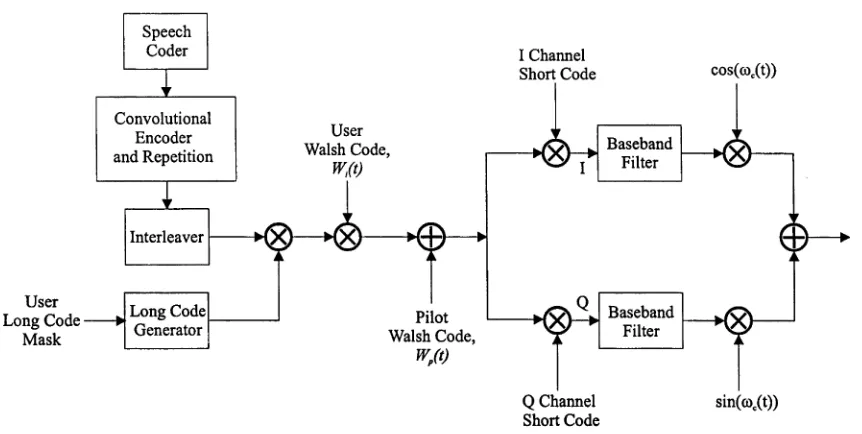
2.1 IS-95 CDMA forward l i n k ...
12
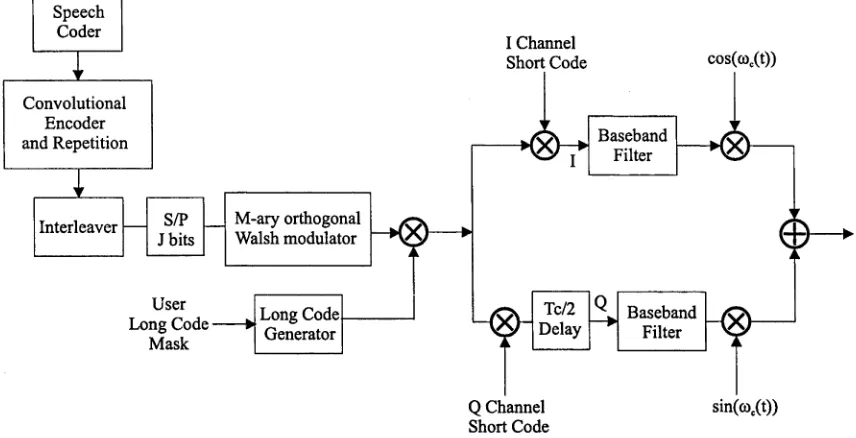
2.2 IS-95 CDMA reverse lin k ...
13
2.3 DS-CDMA System M o d e l...
16
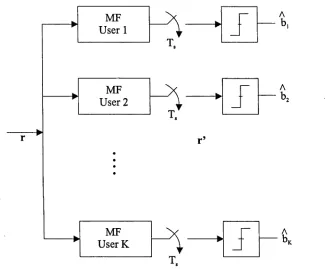
2.4 Conventional DS-CDMA D e te c to r...
19
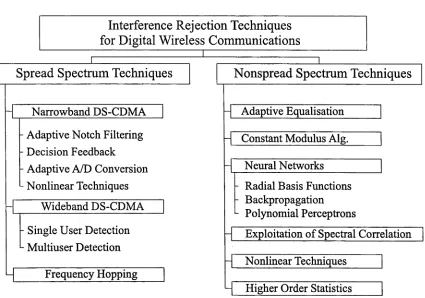
2.5 Interference rejection (IR) techniques for wireless digital communications
[61] ... 222.6 Optimum multiuser detector ...
25
2.7 Organisational chart for multiuser interference rejection in DS-CDMA [61]
26
2.8 Adaptive "single-user" receiver...
29
3.1 Correct path and an error path in a trellis of length
L...
34
3.2 Correct path and an error path in a trellis of length
L...
35
3.3 Distance Spectrum and Bound C o m p u tatio n ...
37
3.4 State Diagram and Error Events for a 3-user Synchronous s y s te m ...
39
3.5 State Diagram and Error Events for a 3-user Asynchronous system . . . .
40
3.6 Baseband equivalent model of a multiuser CDMA system ...
44
3.7 Distance computation for a synchronous t r e e ...
48
3.8 Distance computation for an asynchronous tre e ...
50
3.9 Comparison of union bounds for different thresholds T, synchronous CDMA
with binary random spreading codes of length 31,1 = 31...
52
3.10 Synchronous system partial distance sp ectru m ...
53
3.11 Asynchronous system partial distance sp e ctru m ...
53
3.12 Synchronous system - Average upper and lower bounds for a 31-user
DS-CDMA system with binary random spreading codes, N =31...
58
3.13 Asynchronous system -Average upper and lower bounds for a 31-user
DS-CDMA system with binary random spreading codes, N =31...
58
3.14 BEP bounds as a function of the number of users I for
Eb/No
= 7dB with
binary random signature waveforms of length 31...
59
3.15 BEP versus the number of users for slow Rayleigh fading channel,
Eb/No
= 34dB, cosine pulse shaping ...
59
3.16 Comparison of Verdü and Forney bound ...
60
3.17 Mean of
T
for synchronous systems, Mean MAI = 0.1491...
60
3.18 Variance of
T
for synchronous systems, average variance of MAI for 10000
sets = 0.0225 ...
61
3.19 Mean of
T
for asynchronous systems...
61
3.20 Variance of
T
for asynchronous system s...
62
4.1 Multistage DFE multiuser equalisation followed by Soft Viterbi algorithm
65
4.2 Baseband equivalent model for coded CDMA and SU receiver...
66
4.3 Baseband equivalent model for coded CDMA...
69
4.4 Equivalent discrete model of the sy stem ...
70
4.5 Trellis diagram and arbitrary mapping format of a 4 state and a 2 state code 72
4.6 Linear processing filter
V
before sp re a d in g ...
78
4.7 Amjn(7£™+L) and Amax(7£™4'L) as a function of
L
for the best and worst cases 86
4-8 Amax(Hj)//) as a function of
L
for the best and worst cases...
87
4.9 Lower bounds and exact values of
for 100 sets of 7
Z
...
88
4.10 Number of paths kept vs time in terv al...
89
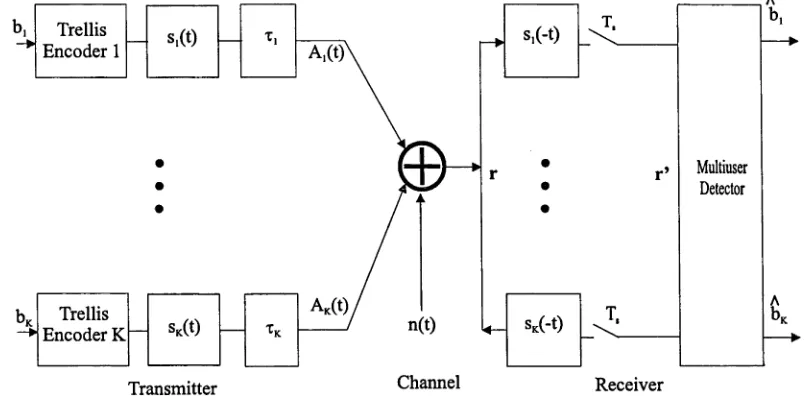
5.1 Multiuser CDMA communication sy ste m ...
92
5.4 The Mobile communications environment
96
5.5 Typical delay power profile,
rp =first arrival delay, rrms = rms delay,
LrTs = tl — tf
maximum excess delay,
tl=final arrival d elay ... 101
5.6 Channel impulse response represented as a tapped delay l i n e ... 103
5.7 Polar plot of a fading process generated by filtering complex white noise
by the truncated and windowed impulse response of (5.37). This process
evolves smoothly... 106
5.8 Logarithmic plot of fading amplitude vs tim e ... 107
5.9 Plot of channel tap phase (radians) vs time. Large phase shifts occur dur
ing deep fa d e s ... 108
5.10 Power spectral density of a sample windowed and truncated fading process 109
5.11 Plot of the amplitude of the time and frequency selective channel's ampli
tude transfer function as a function of time and frequency ... 110
5.12 Plot of the amplitude of the time selective channel's transfer function as a
function of time and freq u en cy ... Ill
5.13 Tapped delay line model of frequency selective ch an n el... 112
5.14 Plot of the amplitude of the frequency selective channel's transfer function
as a function of time and frequency... 113
5.15 A basic receiver front e n d ... 114
6.1 Time-frequency RAKE rec eiv e r... 122
6.2 MUKCIR receiver block d ia g ra m ... 130
6.3 BER-SNR curves for different union bounds: all one symbol error events;
and all one and two symbol error events... 135
6.4 BER-SNR curves for root raised cosine chip pulse shaping with varying
excess bandwidth,
xfor 1 user ... 136
6.5 BER-SNR curves for root raised cosine chip pulse shaping truncated to
different lengths... 137
6.7 Effect on the MUKCIR receiver's BER of varying the num ber of indepen dent paths, P, K = 1, LtTs = 0.5TS, /dTs = 0 . 0 1 ... 139 6.8 Effect on the MUKCIR receiver's BER of varying the Doppler and delay
spreads, r=2, N=4, P = 2 ... 139
7.1 Different detector re a lisa tio n s ... 142
7.2 Branch metric c o m p u ta tio n ... 152
7.3 BER-SNR curves of the MUKCA receiver for a fast time varying frequency selective channel where f o T s = 0.1, LtTs = 0.5TS r = 2 , N = 5 , P = 2. . . 156 7.4 Effect on the MUKCA receiver's BER of varying the num ber of indepen
dent paths, P, where r = 2, N = 4, L rTs = 0.5Ts/ /dTs = 0.01 ... 157
7.5 Effect on the MUKCA receiver's BER for varying delay spreads, where
f DTs = 0.01 and P = 2 ... 157 7.6 Effect on the MUKCA receiver's BER for varying Doppler spreads, where
LtTs = 0.5Ts/ P = 2 ... 158
7.7 Effect of the single user and MUKCA receiver's BER for varying the num ber of users, where LtTs = 0.5TS, f o T s = 0.01, S N R = 2 5 d B... 158 7.8 Effect of the MUKCA receiver's BER for different predictor lengths, W ,
where K = 2 ... 159
A.l Exact pd f of po{yi) for 10 u s e r s ... 171 A.2 Pdf of the approximation error for 10 u s e r s ... 171
A. 3 BER-SNR curves for 10 users ... 172
B. l Change detection for a MMPP p r o c e s s ... 184
B.2 Delay in detection for a MMPP process, Plot of Average delay-Threshold . 184
B.3 Change detection for ARIMA(0, d, 0) process, dn = 0.1 (t = 0..999), dK = 0.3 (t = 1000..1999) and dH = 0.1 (t = 2000..2999)... 185 B.4 Change detection for ARIMA(l,d, 0) process, dn = 0.1, 0 = 0.2 (t =
0..999); dK = 0.3, 0 = 0.4 (t = 1000..1999); dH = 0.1, 0 = 0.2 (t = 2000..2999) 185 B.5 Change detection for ARIMA(0,d, 1) process, dn = 0.1, 0 = 0.2 (t =
B.6 Delay in detection for ARIMA(0, d, 0) process, du = 0.1, (t = 0..999); d x =
0.3, 9 = 0.4 (t = 1000..1999); dH = 0. 1, 9 = 0.2 (t = 2000..2999)... 186 B.7 Change detection for ARIMA(0, d, 0) process, Tested d K = 0.20, Actual
d K = 0 . 3 ... 187 B.8 Change detection for ARIMA(0, d, 0) process, Tested d K = 0.25, Actual
d K = 0 . 3 ... 187
B.9 Change detection for ARIMA(0,d, 0) process, Tested d K = 0.3, Actual
d K = 0 . 3 ... 188 B.10 Change detection for ARIMA(0,d, 0) process, Tested d K = 0.35, Actual
d K = 0 . 3 ... 188 B .ll Change detection for ARIMA(0,d, 0) process, Tested d K = 0.40, Actual
List of Acronyms
Term Definitions
A R M A A u to reg ressiv e M o ving A verage A W G N A d d itiv e W hite G au ssian N o ise
B-CD M A B ro ad b an d C ode D ivisio n M u ltip le Access BEP Bit E rro r P robability
BPSK B inary P hase Shift K eying
b p s Bits p e r second
CIR C h an n el Im p u lse R esp o n se C D M A C o d e D ivision M u ltip le A ccess
dB D ecibel
D C D eco rrelato r
D D FD D eco rrelating D ecision F eed b ack D etecto r DFE D ecision F eedback E q u aliser
D PD D ifferential P hase D etection
DS D irect Sequence
FARIM A F ractio nal A u to reg ressiv e In te g ra te d M o v in g A verage F H F req u en cy H o p p in g
FD M A F req u en cy D ivision M u ltip le A ccess
FSM F inite State M achine
G A G a u ssia n A p p ro x im atio n G Q F G a u ssia n Q u ad ratic F u n ctio n G SM G lobal S ystem for M obile
iid In d e p e n d e n t an d id en tically d is trib u te d ISI In te rsy m b o l In terference
IS-95 In te rim S ta n d a rd 95
K C A K n o w n C h an n el A u to co v arian ce KCIR K n o w n C h an n el Im p u lse R esp o n se
LOS Line O f Sight
L N A L ow n o ise am plifier
M A I M u ltip le access in terferen ce
M A PSD M ax im u m A P o s te rio ri S equence D etecto r
M F M atch e d Filter
M LSD M ax im u m L ikelihood S equence D etecto r M M P P M ark o v m o d u la te d P o isso n pro cess
M U M u ltiu se r
M U K C IR M u ltiu se r K n o w n C h a n n e l Im p u lse R espo nse
M U K C A M u ltiu se r K n o w n C h an n el A u to co v arian ce N W M F N o ise W h iten in g M atch e d Filter
OCIS O p tim a l C o n d itio n al Im p o rta n c e S am p lin g p d f P ro b ab ility d en sity fu n ctio n
PSD P o w e r S pectral D ensities
Q A M Q u a d ra tu re A m p litu d e M o d u la tio n Q PSK Q u a d ra tu re P h ase Shift K eying rm s R o o t m e a n sq u are
RN F R o o t N y q u is t Filter SNR sig n al to noise ratio
SSM A S p read S p ectru m M u ltip le A ccess
SU Single U ser
SUKCIR Single U se r K n o w n C h a n n e l Im p u lse R espo nse SU K CA S ingle U se r K n o w n C h a n n e l A u to co v arian ce TD M A Tim e D ivision M u ltip le Access
US U n c o rre la te d S cattering VA V iterbi A lg o rith m
Notation
Variable
bi,k ^i,kb
B
B
Ck(t,r)
C'c(C)
d‘2
Vek
e
Ek
I
df i , i ' ,k,k'
T
Fi
G
g
h{t)
I IK
K
K
X
LL
Lh
Ls
Lr^ m i n i• )
^ i
M
Meaning
information bit for zth symbol and
kth.
user
hypothesised bit for ith symbol and /cth user
vector containing transmitted symbols for all users, all symbol intervals, Part I
matrix containing transmitted symbols for all users, all symbol intervals, Part II
matrix containing hypothesised symbols for all users all symbol intervals, Part II
channel impulse response for
kth.
user
characteristic function of pdf, p(«;)(/t), Part II
squared Euclidean distance
minimum squared Euclidean distance
set of all possible squared Euclidean distances
error event of user
k
set of all error events
kth
user's energy scale factor
Doppler frequency
ISI term in sequence metric between symbols and users, Part II
Cholesky factor of correlation matrix
1Z
path metric in trellis for symbol
i
kernel of a Gaussian quadratic function, Part II
column vector composed of h and n to define
n,
Part II
signature convolved with channel sequence
total transmission interval, Part II
identity matrix
number of users
total number of input bits in error control code for all users, Part I
Gaussian quadratic function
excess bandwidth
length of an error event, Part I
intersymbol interference length, Part II
length of received pulse, Part II
signature waveform length, Part II
maximum delay spread, Part II
minimum eigenvalue of (.)
maximum eigenvalue of (.)
branch metric in trellis for symbol
i
^i,k N N0 n{t)
n
r)k PP(0
Pi Qk,m n R r{t) r r'(t)$ k
(^)
°i
CTm ( B )
T Tc Ts Ok
w ( £ )
Wm,l
w
w
y
y
Vmy m-1
Y Ck %i,k
Functions
Q(x)
[a, 6]
(a, 6)
(a, 6]
[a, 6)
a e A
x
- 1
XT
X H
matched filter term in sequence metric for zth symbol and
kthuser, Part II
chips per spreading sequence
noise power spectral density
AWGN process
total transmission interval, Part I
asymptotic efficiency of user
knumber of multipaths, Part II
pdf of (.)
poles of a characteristic function, Part II
output symbol for
kthuser and mth branch in trellis, Part I
correlation matrix of spreading codes
error control code rate
received waveform, Part I
fractional chip sampling rate, Part II
matched filter output
spreading code of
kth.user
state of trellis for symbol
i,Part II
variance of prediction error, Part II
distance computation cut off threshold
chip waveform duration
symbol duration
carrier phase of
kthuser
Hamming weight of error event
£Zth coefficient for the ML predictor
ymK
x
Kdiagonal matrix of user energies, Part I
predictor filter length, Part II
whitened matched filter output vector, Part I
received waveform vector, Part II
mth sample of received waveform vector
by,Part II
all received samples up to symbol interval
m —1
total number of data bearing received samples, Part II
time delay of
k-th user for asynchronous CDMA
matched filter noise output for ith symbol and
kthuser
complementary error function
an inclusive integer range between a and b
an exclusive integer range between a and b
integer range from a to and including b
integer range from and including a to b
a is in A
inverse of matrix X
transpose of matrix X
Hermitian of matrix X
complex conjugate of
xRe{.}
Real part of {.}
Im{.}
Imaginary part of {.}
diag(-)
diagonal of a square matrix
e i g { . )
eigenvalue of {.}
Chapter 1
Introduction
Mobile communications has had a significant impact on today's society. The various
forms of wireless communications - mobile telephones, cordless phones and radio pagers
- continue to experience growth, showing a large increase in the number of users.
On one level the mobile communication system appears as several independent users
transmitting to a single base station. Due to the uncoordinated nature of the users' trans
missions, the uplink (mobiles to base station) is more difficult to manage than the down
link (base station to mobiles). This is because the downlink is effectively synchronized
since it comes from one source.
In wireless communication the precious transfer medium (commonly known as the
channel) can be visualized as a region of the time frequency plane. For example a partic
ular user may transmit at a particular time
t
with a particular frequency /. Space may also
be used as another dimension, where directional antennae may be required. The way in
which the users utilise the channel resource is determined by the accessing scheme used
in the communications system.
Conventional multiple access schemes simply partition the time frequency plane into
K
slices, one for each user. The users then employ their own particular slice for com
munication, and the receiver examines the corresponding portion of the time frequency
plane for the signal transmitted by the user. Signalling in such a way implies that the
users transmit over orthogonal channels where there is no interference from one user's
channel to another's. In Time-Division-Multiple-Access the partitioning is in time, so
that each user utilises the entire frequency spectrum available but at different times. In
Frequency-Division-Multiple-Access the partitioning is in frequency, and the users
2
mit data at the same time but in different frequency slots. The advantages of each scheme
over the other have been thoroughly debated and the best of the two probably depends
on implementation issues such as complexity, protocols, bandwidth and power limita
tions [54] [63]. The most popular digital standard for multiple access communications in
Europe and Australia is the Global System for Mobile Communications (GSM) which is
based on TDMA [91] [54].
Spread-Spectrum-Multiple-Access (SSMA) is a well known technique which has also
found numerous applications in cellular communications [54] [127]. Each user employs
the entire channel resource to transmit a particular symbol. Specifically, the users trans
mit at the same time using the same bandwidth. Consequently the channels over which
the users communicate to the receiver are not necessarily orthogonal to one another and
co-channel (multiuser) interference results [135]. Co-channel interference also arises in
FDMA and TDMA, but between users that occupy different cells [62]. That is why fre
quency planning is so important in GSM. Detection of data transmitted using the SSMA
scheme may seem hopeless. An analogy which indicates that this is not so is our ability
to discern different musical instruments in an orchestral piece of music. SSMA works via
knowledge of the waveform that makes each user (instrument) unique. So although each
user transmits at the same time using the same bandwidth the actual waveforms or chip
sequences (pitch/timbre) are sufficiently different to allow the receiver (ear) to determine
the data (notes) that each user transmits.
SSMA gained popularity initially in the 1960's for military reasons. The waveforms
used for transmission were constructed to appear as noise. The original motivation was
both to conceal transmission and to combat intentional jamming [112].
In spread-spectrum technology a modulated waveform is modulated (spread) a sec
ond time in such a way as to generate an expanded bandwidth or wideband signal. In
such a system, each user's signal is identified by its unique spreading waveform. Some
applications and potential advantages of spread spectrum systems include [85]:
• Improved interference rejection,
• Low-density power spectra for signal hiding,
3
• Antijam capability,
• Secure communications
To the naive observer, the spread spectrum signal looks like noise. It is true however,
that the same noise-like signal will appear over and over on the channel allowing covert
reception. Spread spectrum systems come in many flavours. The most commonly used
techniques are the following
• Direct-sequence (DS) CDMA
• Frequency hopping (FH) CDMA
• Carrier sense multiple access (CSMA) spread spectrum (for wireline communica
tions)
• Hybrid spread spectrum methods
Several companies made substantial investments in SSMA in the early 1960's, Qual
comm being the first [87][881. Control over the waveform transmitted by a particular
user can be achieved using spreading codes and a chip waveform. The resulting access
scheme is termed Direct Sequence SSMA or simply DS-Code Division Multiple Access
(DS-CDMA). Another commonly employed SS modulation technique is Frequency Hop
ping Multiple Access (FH). The FH subsystem produces a spreading effect by pseudo
randomly hopping the radio frequency (RF) carrier frequency over the available RF fre
quencies [91] [86]. This thesis will focus on DS-CDMA systems only.
In a cellular system, a number of mobiles communicate with one base station. Each
mobile is concerned only with its own signal while the base station must detect all signals.
Thus, the mobile has the knowledge of only its own chip sequence while the base station
has information of all the chip sequences. As the handset complexity must be minimal
(where size, weight and cost are critical), and because a CDMA system could potentially
have a large number of users (a few hundreds in practice), multiuser detection can only
be feasibly realised at the base station.
CDMA systems with single-user detection suffer two major drawbacks: the near-far
con-4
ventional receiver demodulates each signal using the corresponding single-user detector
(matched filter followed by a threshold decision device) thereby treating the multiple ac
cess interference as white Gaussian noise, or equivalently, ignoring the cross-correlations
between the modulating signals of different users [127]. Since the matched filter contains
a component which is linear in the amplitude of each of the interfering user, the strongest
user often severely interferes with the other users. This effect can very often swamp the
desired user's signal strength. Consequently, the anti jamming capability of the weakest
user is severely tested and its BER degrades substantially. This imbalance in the received
powers is referred to as the near-far problem. Thus in order to maintain an acceptable
BER for all users, the DS-CDMA system requires strict power control for each user. Even
with perfect power control the interference limits the number of users to only 10% of the
maximum capacity [87]. It is not surprising that reliable performance from the conven
tional detector has been possible only for low bandwidth efficiencies [24], The capacity is
calculated for Gaussian (thermal) noise only, but single user receivers treat interference
as noise also. Thus even when the noise is removed, there is still MAI and thus there are
still errors. The system is therefore interference limited.
These drawbacks of single-user detection have initiated recent interest into more so
phisticated receiver structures such as joint multiuser detection, in which the multiuser
interference is treated as part of the information rather than noise. The study of the
optimum demodulator by Verdü [121] [122] [124] shows that while significantly superior
performance over the conventional detector is possible, it requires a marked increase in
computational complexity which is exponential in the number of users. Thus when the
number of users is large the optimum detector becomes too expensive to implement.
Therefore, detectors are sought which can closely approximate the performance of the
optimum receiver, yet whose complexity is more comparable to the complexity of the
conventional single user receiver. In this thesis we will study both optimum and sub
optimum receivers. In particular, multiuser receivers are designed that are optimum for
§1.1 Research Account 5
1.1 Research Account
This thesis is organised in two parts. Part I investigates performance evaluation tech
niques for both uncoded and coded m ultiuser DS-CDMA systems in Gaussian and slow
fading channels. Part II is devoted to the study of receiver designs for m ultiuser DS-
CDMA systems in the presence of time varying frequency selective Rayleigh fading chan
nels.
C hapter 2 provides the necessary background information on spread spectrum sys
tems. A specific CDMA communication system model (IS-95) is discussed in some detail
w hich helps us to identify some of the design methodologies and implications. A basic
DS-CDMA system model is constructed which will be augm ented as the need arises from
chapter to chapter. Finally, a comprehensive literature survey is provided on CDMA and
m ultiuser detection in particular. It is beyond the scope of this thesis to cover all the
background of DS-CDMA; however, the reader will quickly establish a strong CDMA
foundation and thus appreciate some of the potential enhancements currently being pro
posed.
C hapter 3 focuses on the performance evaluation of DS-CDMA systems over Gaus
sian and slow Rayleigh fading channels. The performance evaluation of CDMA systems
is a complicated task, even on Gaussian channels [91]. The optimal m ultiuser detector
is not only too complicated to implement bu t accurate analysis of its error performance
is even more complicated, having a complexity of 0 ( 3 K) [124]. Most of the w ork to date
has focussed on the concept of asymptotic efficiency. The asymptotic efficiency indicates
that the logarithm of the error probability goes to zero w ith the same slope as the sin gle user bit error rate. In this chapter a simple and efficient m ethod is proposed and
investigated to evaluate the bit error performance for synchronous and asynchronous
m ultiuser DS-CDMA systems. A generalisation of the work in [102] is used to compute
up p er and lower bounds on the bit error probability of optimal m ultiuser detection w ith
out error control coding. A 31 user system using random binary signature sequences of
length 31 is modelled. Recently, Monte-Carlo simulations w ith Importance Sampling (IS)
techniques have been proposed and studied [104] [78] [79][139]. Importance sampling bi
ases (scaling/shifting) the noise distribution such that more samples are taken from the