from serial recall and recognition.
White Rose Research Online URL for this paper: http://eprints.whiterose.ac.uk/126949/
Version: Accepted Version
Article:
Allen, RJ orcid.org/0000-0002-1887-3016, Hitch, GJ and Baddeley, AD (2018) Exploring the sentence advantage in working memory: Insights from serial recall and recognition. The Quarterly Journal of Experimental Psychology, 71 (12). pp. 2571-2585. ISSN 1747-0218
https://doi.org/10.1177/1747021817746929
(c) 2017, Experimental Psychology Society. This is an author produced version of a paper published in the Quarterly Journal of Experimental Psychology. Uploaded in accordance with the publisher's self-archiving policy.
[email protected] https://eprints.whiterose.ac.uk/
Reuse
Items deposited in White Rose Research Online are protected by copyright, with all rights reserved unless indicated otherwise. They may be downloaded and/or printed for private study, or other acts as permitted by national copyright laws. The publisher or other rights holders may allow further reproduction and re-use of the full text version. This is indicated by the licence information on the White Rose Research Online record for the item.
Takedown
If you consider content in White Rose Research Online to be in breach of UK law, please notify us by
Exploring the sentence advantage in working memory: Insights from serial recall and recognition
Richard J. Allen1, Graham J. Hitch2 & Alan D. Baddeley2
1. School of Psychology, University of Leeds, UK
2. Department of Psychology, University of York, UK
IN PRESS, QJEP
Correspondence concerning this article should be addressed to Richard Allen, School of
Abstract
Immediate serial recall of sentences has been shown to be superior to that of unrelated words. The
present study was designed to further explore how this effect might emerge in recall, and to
establish whether it also extends to serial recognition, a different form of response task that has
relatively reduced output requirements. Using auditory or visual presentation of sequences, we
found a substantial advantage for sentences over lists in serial recall, an effect shown on measures
of recall accuracy, order, intrusion, and omission errors and reflected in transposition gradients. In
contrast however, recognition memory based on a standard change detection paradigm gave only
weak and inconsistent evidence for a sentence superiority effect. However, when a more sensitive
staircase procedure imported from psychophysics was used, a clear sentence advantage was found
although the effect sizes were smaller than those observed in serial recall. These findings suggest
that sentence recall benefits from automatic processes that utilise long-term knowledge across
encoding, storage, and retrieval.
Exploring the sentence advantage in working memory: Insights from serial recall and recognition
Since its introduction by Jacobs (1887), immediate serial recall has continued to feature, both as a
measure of individual cognitive differences as initially proposed, and because of its theoretical
relevance. This stems from its potential to throw light on two fundamental questions of human
memory, namely how serial order is stored, together with the question of the mechanisms
underlying chunking, the capacity to increase span by combining items into larger stored units.
These two questions have tended to generate separate literatures. Studies focused on
explanations of maintaining serial order, have tended to use a limited pool of isolated items, digits,
letters or individual words (see Hurlstone, Hitch & Baddeley, 2014, for a review). When words are
used, it is their phonological characteristics that dominate recall, in contrast to long-term serial
learning where semantic features are more important (Baddeley, 1966a, 1966b). The role of
chunking is most clearly seen using sentences, typically tested using an open set in which sentences
are not repeated. This can lead to a substantial increase in span, for example from five unrelated
words to around 15 words within a sentence (Brener, 1940; Baddeley, Allen & Hitch, 2009).
Sentence recall has been extensively explored by Potter and colleagues (Lombardi & Potter, 1992;
Potter & Lombardi, 1990, 1998) who propose a “regeneration of the sentence from a conceptual
representation using words that have recently been activated” (Potter & Lombardi, 1998, p.633).
They (Potter & Lombardi, 1990) observed that potentially disruptive synonyms presented along
with the sentence intrude only when they are consistent with the underlying theme of the sentence,
proposing that recall will be verbatim only when the right set of words is activated. Following this,
effects of syntactic (Potter & Lombardi, 1998) and phonological priming (Schweppe, Rummer,
Bormann, & Martin, 2011; see also Rummer & Engelkamp, 2001, 2003) at retrieval have also been
observed in certain contexts, while Schweppe and Rummer (2007) suggested that morphosyntactic
representations may also contribute. Thus, within this approach, a sentence is primarily represented
via its meaning or gist, extracted during comprehension, and this propositional representation drives
levels. List memory, in contrast, depends on the storage and preservation of a surface phonological
representation.
Stored language knowledge has also been suggested to impact on immediate memory tasks
via a process of redintegration. This term has been proposed to refer to the influence of existing
knowledge on the capacity to recall a word or letter sequence (Schweickert, 1993). There are
however two possible modes within which such knowledge can be used. One form of redintegration
is more akin to pattern completion and is likely to operate in a bottom-up manner at the lexical level
on recall of individual items. The other may represent an explicit, top-down, conceptually-driven
strategy to utilise such knowledge, and may be closer in nature to the conceptually-based
regeneration proposed by Potter and Lombardi (1998). However, unlike Potter’s approach, which
assumes different types of representation underlying sentences and lists, processes of redintegration
may primarily operate during recall. Under the retrieval-based redintegration hypothesis
(Saint-Aubin & Poirier, 2000), for example, items are held in short-term memory until recall, at which
point they are repaired by comparison with long-term knowledge. This kind of process, applied in a
top-down manner via conceptual and syntactic knowledge, might provide an additional account of
sentence superiority effects in immediate serial recall.
One problem in comparing span for unrelated items with sentence span concerns the
substantial difference between them in length, typically five words versus around 15. To study the
influence of a concurrent attentional load on memory for lists and sentences, Baddeley et al. (2009;
Allen & Baddeley, 2008) devised what they termed constrained sentences. These were a halfway
house between lists and sentences in that they repeatedly used a limited set of words but combined
them into meaningful sentences, a process that involved both consistent syntactic structure and a
conceptual structure that was impoverished. For example, one sentence might be, tall soldier
follows waiter and old sad teacher, followed by, teacher or tall sad bishop meets fat waiter. Under
these conditions, span was reduced to about two words beyond span for the equivalent words in
Baddeley et al. (2009) compared immediate recall of lists and sentences under a range of
conditions selected to limit the use of the various proposed components of working memory. We
proposed that if the sentence advantage was attributable to attentionally driven forms of chunking
or redintegration, then the sentence advantage should be reduced. Recall for both sequence types
exhibited a small effect of concurrent visual processing, a larger effect of articulatory suppression,
preventing verbal rehearsal, with the largest effect occurring when rehearsal was prevented by an
attentionally demanding task. However, there was no suggestion of an interaction between
concurrent task and sequence type. These patterns emerged across auditory and visual presentation
modalities, indicating that, for recall at least, the nature of the perceptual input does not mediate the
sentence effect. While these findings are also broadly consistent with theoretical approaches such as
the conceptual regeneration hypothesis (e.g. Potter & Lombardi, 1990), we concluded that the
sentence advantage was an automatic feature of the involvement of long-term language structure,
resulting in more effective binding of information within the episodic buffer (Baddeley, 2000;
Baddeley, Allen, & Hitch, 2011).
The experiments that follow focus on establishing the generality of previously observed
sentence superiority effects. A primary question is whether the sentence advantage operates at the
level of retrieval, or at some other stage of processing. This was prompted by several studies
concerned with the effects of lexicality on immediate serial recall and recognition. When the item
retrieval process is minimised by using recognition memory paradigms (in which the sequence is
re-presented and participants decide whether a change has occurred), lexicality effects appear to be
reduced or absent (Gathercole. Pickering, Hall, & Peaker, 2001, Hulme, Roodenrys, Schweickert,
Brown, Martin, & Stuart, 1997; Jefferies et al., 2006; Macken, Taylor, & Jones, 2014). The present
experimental series therefore examines whether the sentence effect is also diminished or removed
when moving to a recognition task that places relatively reduced demands on retrieval processes. In
addition, there is evidence that the presence or absence of a lexicality effect in recognition may
attenuated following auditory presentation, with Macken et al. attributing this to the use of
speech-based pattern-matching during the recognition phase. We therefore use our constrained sentences
and lists to compare performance on immediate recall and recognition using both auditory
(Experiments 1-2) and visual (Experiments 3-4) presentation.
Experiment 1
Memory for aurally presented short sequences of words that differed only in the presence or
absence of a meaningful structure was assessed, using immediate serial recall and recognition of
constrained sentences and word lists. Constrained sentences provide a tightly controlled comparison
with word lists as both sets of materials are derived from the same small pool of nouns, verbs,
adjectives and function words. In constrained sentences a subset of items from the pool are
presented in a grammatical order whereas in word lists, items selected using the same constraints
are presented in an ungrammatical order. Constrained sentences are meaningful, despite being
somewhat unnatural, and lead to a highly reliable sentence superiority effect in immediate serial
recall (Baddeley et al. (2009). Using such well-controlled materials allowed us to compare detailed
aspects of serial recall such as serial position curves and transposition gradients (e.g. Hurlstone et
al., 2014; Nairne, 1992). These details of performance are of interest because an episodic buffer
account generates an expectation of similarities between sentences and word lists given a common
binding and the suggestion that one of its functions concerns serial ordering (Burgess & Hitch,
2005). If on the other hand sentence and list recall depend on fundamentally different
representations, as envisaged by the conceptual regeneration hypothesis, we might expect more
substantial differences in the details of serial recall between these sequence types.
To assess serial recognition, we used a version of the task in which change trials featured
switches in word position within sequences that maintained the meaningful grammatical structure
of sentences (i.e. noun switched with noun, adjective with adjective, and verb with function word).
changed sequence, with participants simply asked to detect whether a change in order had occurred.
This was assumed to reduce the explicit retrieval demands placed by the more complex response
phase required by immediate serial recall. Our assumption was that if the sentence advantage
emerges through processes operating during encoding and storage, substantial effects over list recall
should be observed in both recall and recognition measures. However, if we adopt a strict
retrieval-based account and assume that this effect is solely due to processes (such as redintegration)
operating exclusively during overt recall, then little or no impact of sequence type should be
observed in recognition.
Method
Participants
Twenty undergraduate and postgraduate students (12 female) from the University of York took part,
in return for course credit or financial payment. All participants in this and subsequent experiments
were native English speakers.
Materials
Testing was controlled on a Macintosh computer using a SuperCard program, with stimuli
presented through headphones and a 15” monitor. A single set of 15 words, consisting of four nouns
(bishop, soldier, teacher, waiter), four adjectives (fat, old, sad, tall), four verbs (follows, helps,
insults, meets), and three function words (and, not, or) was used in each of the conditions, in all
reported experiments. From this set, two sets of 2 practice sequences and 12 test sequences were
each constructed for the sentence and list conditions. Each sequence consisted of 8 words (3 nouns,
3 adjectives, 1 verb, 1 function word). The order of words within sentences was grammatically
correct (e.g. FAT WAITER HELPS TALL SOLDIER NOT OLD BISHOP), whereas the order of
words within lists was always at least two positional switches removed from being correct (e.g.
TALL HELPS NOT WAITER BISHOP FAT OLD SOLDIER). The absolute positional constraints
sequence was always a noun or adjective, the penultimate word was never a noun, and the final
word was always a noun.
Each of the words in the experiment were individually recorded and digitized by a male
English speaker. The same individual audio files were used in all conditions, meaning that
sequences contained no speech cues such as prosody or co-articulation.
Design and Procedure
Each participant performed all four conditions in turn (serial recall vs. serial recognition; sentence
vs. list), with order counter-balanced across the experiment. The two sets of sentences and lists
were presented equally often in recall and recognition conditions. Participants were informed at the
start of each condition whether the sequences would consist of meaningful sentences or random
lists. The 12 test trials were performed following completion of 2 practice sequences.
Each sequence was presented through headphones, at one word per second. To signal
sequence completion, an abstract visual pattern and a non-verbal audio signal were presented
following the last word in the sequence. In the recall conditions, participants were instructed to
immediately recall as much of the sequence as possible, in the order in which it was presented.
Responses were digitally recorded for transcription.
In the serial order recognition task, the cues at the end of the sequence were immediately
followed by presentation of a test sequence, again at a rate of one word per second. In half the trials,
the test sequence was identical to the first, whereas in the other half the sequence was altered so that
two constituent words changed positions. Any word type at any serial position (except the first)
could change, and positional changes always maintained meaningful grammatical structure (i.e.
noun switched with noun, adjective with adjective, and verb with function word). Mean ‘swap
distance’ (i.e. the number of positions across which the two words were exchanged) was equivalent
for the sentence (3.21, SE = .21) and list (3.15, SE = .39) sets. Same order and different order trials
Participants were instructed to judge whether the words in the re-presented sequence were in
the same order as in the original sequence or if the order had changed, having been informed of the
nature of the possible order change beforehand. Following completion of the second sequence, a
same/different key press response was made. On responding ‘same’, the program moved on to the
next trial. On responding ‘different’, the eight test words were vertically displayed on screen in the
order of re-presentation, with a check box next to each word. Participants used the mouse to select
the check boxes next to the two words they deemed to have switched positions, with the program
automatically moving on when two were selected. No feedback was provided at any point.
Results
Data were analysed using standard and Bayesian repeated measures ANOVA and paired samples
t-tests where appropriate, using JASP (JASP Team, 2017). For each analysis, we report the outcomes
from the standard analyses, and the Bayes Factors (BF) indicating the strength of evidence for the
inclusion of each effect within the relevant model, relative to the model without that effect. Finally,
an analysis of chunking patterns in serial recall was also carried out (for this experiment, and
Experiment 3), though for the sake of concision, these analyses are reported in an appendix.
Immediate Serial Recall
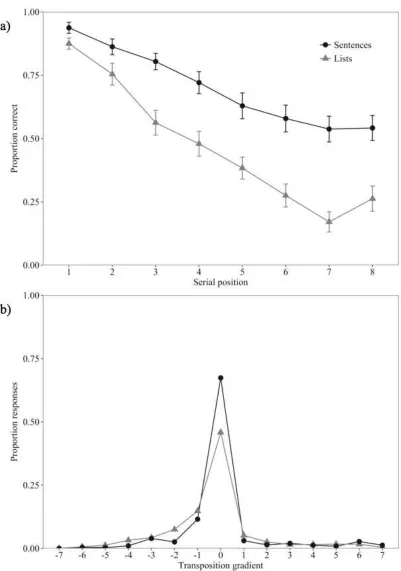
Each response was scored as correct if it was produced in the appropriate serial position1. Correct
recall (as a proportion of the total presented sequence) of sentences and lists at each serial position
is displayed in Figure 1a.
<Figure 1 about here>
A 2x8 repeated measures ANOVA revealed significant effects of sequence type, F (1,19) =
101.39, MSE = .04, p < .001, 2 = .84, serial position (Greenhouse-Geisser corrected), F
(3.75,71.27) = 87.24, MSE = .02, p < .001, 2 = .82, and the interaction, F (7,133) = 6.52, MSE
= .02, p < .001, 2 = .26. Further analysis (Bonferroni-Holm corrected) revealed the sequence type
effect to be significant at every serial position, though it was smaller at the first and second
and the interaction (BF > 1000 vs. the null model), with Bayes Factors of >1000 supporting both
main effects and the interaction.
Transposition Gradients and Error Analysis
Transposition gradients (e.g. Hurlstone et al., 2014; Nairne, 1992) were calculated to illustrate
where in relation to the target position each item was recalled. These gradients are set out in Figure
1b, for sentences and lists, as a proportion of all responses, with target position centred at 0,
anticipation errors at positions -7 to -1, and perseveration errors at positions 1-7. Examination of
these gradients indicates that the sequence type manipulation impacted not only on correct
responses, but also on the probability of producing words in incorrect positions in the response
sequence. Increased positional uncertainty was apparent for list recall, with a relatively greater
tendency for participants to erroneously recall words particularly just before their appropriate
sequence position.
Examining order errors (i.e. recall of an item from the sequence in an incorrect sequence
position) produced mean proportional rates of .19 (SE = .02) for sentences and .32 (.02) for lists,
indicating a significantly higher order error rate for lists, t (19) = 6.12, p < .001, BF > 1000
(Cohen’s d = 1.37). For omissions (i.e. failure to produce any response), we observed mean
proportional rates of .05 (.01) for sentences and .13 (.02) for lists, a significant difference, t (19) =
5.43, p < .001, BF = 798 (d = 1.21). Finally, rates of intra-experiment intrusion errors (i.e. recall of
an item from the experimental set that was not present on that trial) were .06 (.01) for sentences and
.09 (.01) for lists, again a meaningful and significant difference, t (19) = 3.68, p = .002, BF = 25 (d
= .82). Thus, sentential context led to improved recall order, and reductions in omissions and
intrusions from the wider experimental set.
Serial recognition
Performance in the serial recognition task can be examined in terms of accuracy on the initial
change detection task (combining change and no-change trials), and for those trials in which an
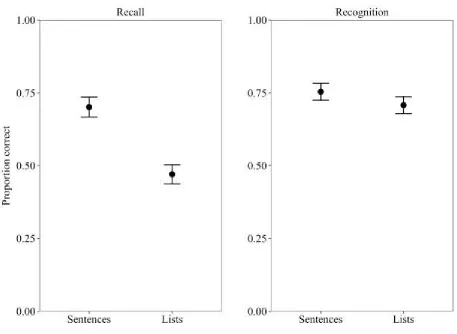
switched positions. Firstly, there was no significant difference in change detection accuracy (see
Figure 2) for sentences and lists, t (19) = 1.07, p = .30, BF = .38, or 2.6 in favour of the null, (d
= .24). However, accuracy in the identification of the words that had changed positions (following
correct change detection) was .78 (.05) for sentences, and .60 (.05) for lists, a significant difference,
t (19) = 3.25, p = .004, BF = 11 (d = .73). Therefore, while sentential structure only had a small and
non-significant effect on the ability to detect changes in order, it did have a larger and significant
effect on the accuracy of identifying precisely which words had changed positions in a sequence
between presentations.
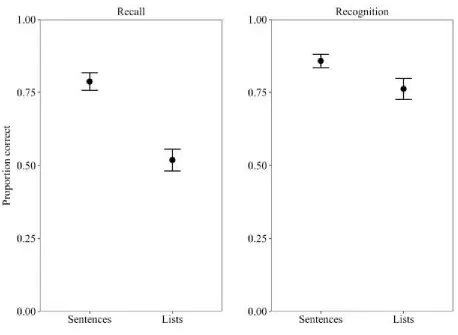
<Figure 3 about here>
Finally, and acknowledging the issues associated with such an analysis (e.g. differing
chance rates), we directly compared recall and change detection recognition within a 2x2 repeated
measures ANOVA (see Figure 2). There were significant effects of sequence type, F (1,19) = 31.70,
MSE = .01, p < .001, 2 = .63, and task, F (1,19) = 24.26, MSE = .02, p < .001, 2 = .56, with mean
recognition accuracy superior to recall. There was also an interaction between sequence type and
task, F (1,19) = 14.80, MSE = .01, p = .001, 2 = .44, with a substantially larger sentence superiority
effect in recall (d = 2.25), relative to recognition (d = .24). A Bayesian ANOVA indicated the best
model to contain sequence type, task, and the interaction (BF > 1000 vs. the null model), with
Bayes Factors of >1000 supporting both main effects, and of 41 to 1 in support of the interaction.
Discussion
The recall advantage for constrained sentences over word lists found in previous studies (e.g.
Baddeley et al., 2009) was again observed in this experiment. The consistency of this effect across
recall accuracy, order errors, omissions, and intra-experiment intrusions suggests that the sentence
advantage influences both item and order memory. We also report, for the first time, transposition
gradients for sentences and lists. These illustrate how order errors tend to cluster around the correct
serial position (Henson, Norris, Page, & Baddeley, 1996; Hurlstone et al., 2014), and appear
postponements. The similarities between the shapes of the serial position curves and the gradients
of transposition errors are surprising, and suggest that serial ordering mechanisms exert a similar
effect on recall for both sentences and lists, consistent with a common underlying process or storage
capacity (e.g. the episodic buffer).
In contrast to the large sentence effect in recall, we failed to find a significant sentence
effect in the change detection phase of serial order recognition, with a Bayes Factor favouring the
null model (i.e. without the inclusion of a sentence effect) by a factor of 2.6 to 1. This relative
absence of an effect on aurally presented serial recognition is in line with outcomes of studies
examining the effects of language knowledge at the individual word level (e.g. Gathercole et al.,
2001; Macken et al., 2014). It might indicate that the sentence advantage as observed in serial recall
emerges primarily during the retrieval process at output. These retrieval processes might also have
been responsible for the sentence advantage that did emerge in the second stage of the recognition
task, in which precise identification of the changed words was required. Alternatively, the absence
of an effect might reflect the ability to make recognition judgments concerning auditory sequences
using perceptual-based sequence matching (Macken et al., 2014), which could attenuate any effects
that arise from stored language knowledge.
A possible alternative explanation of the apparent discrepancy between the substantial
sentence effects observed in serial recall, and evidence supporting the absence of an effect in serial
recognition, is that this reflects the relative insensitivity of the serial recognition methodology. The
relatively meagre amount of data (1 data point per trial) that this binary correct/incorrect measure
provides contrasts with the more data-rich method of serial recall. This discrepancy in potential
sensitivity between response tasks may well have reduced our capacity to detect a genuine
difference in recognition memory between sentences and lists. This may be particularly problematic
when implemented within a limited number of trials all of which use the same sequence length for
all participants, thus not allowing for intra-individual variation in performance levels.
This experiment further explored whether the sentence effect emerges in serial recognition of
aurally presented sequences. The methodology implemented in Experiment 1 may be potentially
insensitive to the sequence-type (or indeed, any) manipulation, due to the relative paucity of data
that two-alternative responses provide. This problem is often addressed in sensory psychophysics
using the “staircase” or transformed up-down procedure (Levitt, 1971), a method that involves
increasing the difficulty of the discrimination by one step whenever two successive correct
responses are made and reducing it by the same amount following an error. In the case of serial
recognition memory, each step corresponds to a change in list length. The reliability of the
threshold can be increased by requiring more of these directional switches before terminating the
trial, with each switch effectively serving as a within-trial replication. Experiment 2 therefore
compared sentence and list recognition using the ‘staircase’ or transformed up-down span
procedure. This method enables a focus on the sequence length at which each participant is accurate
at an approximate rate of 70% (see Levitt, 1971), and provides a more sensitive measure of
performance. If our previous failure to detect a sentence-list difference with auditory presentation is
indeed due to lack of power or sensitivity using a simple change detection task within a limited
number of set-length trials, then a replication using the staircase method should produce a reliable
sentence advantage. In contrast, if the absence of a sentence advantage in Experiment 1 is genuine,
evidence for the null effect should be observed again.
Method
Participants
Twenty undergraduate and postgraduate students (13 female) from the University of York took part,
in return for course credit or financial payment.
Materials
Sequences were constructed using the item set, positional and order constraints, and audio files
outlined in Experiment 1. Two sets of sentences and two sets of lists were created for each of the
sentences and lists at each sequence length are provided in the appendix. Of the 18 sequences at
each length, 9 were selected for order change trials and 9 for no change trials.
Design and Procedure
All participants performed two blocks of each sequence condition. Blocks alternated between the
two sequence types (e.g. sentences-lists-sentences-lists), with order counterbalanced across the
experiment. Participants were informed at the start of each condition whether the sequences would
consist of meaningful sentences or random word lists.
Each block started with 2 practice trials using sequences of 6 words, followed by the test set,
which also started at length 6. Subsequent sequence length was then determined by change
detection accuracy, using a transformed up-down procedure. Two successive correct responses led
to sequence length increasing by 1 word on the following trial. Conversely, a single incorrect
change detection response led to a reduction in sequence length by 1 word. A series of steps in one
direction (constituting either a series of incorrect responses, or a series of correct responses) is
termed a ‘run’. A ‘switch’ is defined as a change in step direction, caused by two consecutive
correct responses after an incorrect response (thus terminating a downward run), or an incorrect
response after two correct responses (thus ending an upward run). The trial block continued until 8
‘switches’ in staircase direction were recorded. As such, the total number of trials varied between
participants. If an incorrect detection response was made at length 6, condition difficulty remained
at this level until two correct responses were made. At the upper length limit, sequence length
remained at 11 words until an incorrect response was made.
The presentation and testing procedure within each trial was identical to the recognition
method used in Experiment 1. Thus, each trial consisted of change detection followed (in the case
of a “different” judgement) by change identification3. Sequences were randomly selected from the
pool of 18 at each length, with each sequence only used once for each participant. There was an
equal probability of change and no change trials being selected. Mean swap distance was equivalent
Results
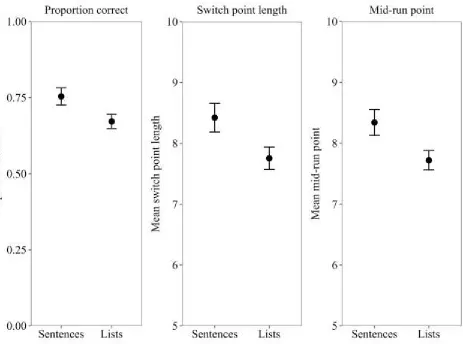
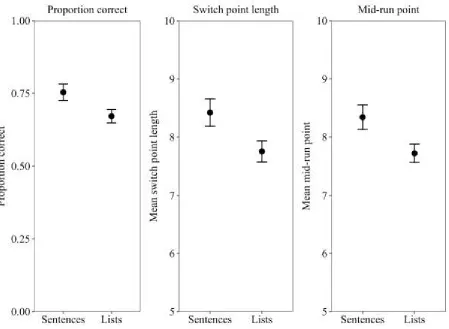
Three measures of change detection accuracy were examined; proportion correct, mean sequence
length at each switch point, and mean mid-run point (see Figure 3).
<Figure 3 about here>
For change detection proportion correct, change detection performance at length 11 was at
chance (< .5) in both sequence conditions, and so was excluded from analysis. For lengths 6-10,
mean proportion correct was .76 (SE = .04) for sentences and .66 (.04) for lists, a significant
difference, t (19) = 3.32, p = .004, BF = 12 (d = .74).
The mean sequence length at each switch point represents the mean length of sequence that
elicited each ‘switch’ (i.e. a run of two correct responses, or one incorrect response), with a longer
mean length illustrating that participants had made more correct responses and advanced on to
longer sequences within the staircase paradigm. Mean length per switch point was longer for
sentences (8.48, SE = .23) than lists (7.82, SE = .17), a significant difference, t (19) = 4.02, p < .001,
BF = 43 (d = .90).
Mean mid-run point score was calculated by taking the 8 switch points in a block, and for
each one, obtaining the mean sequence length at which that switch occurred and the mean length of
the switch preceding it (Levitt, 1971). For example, if a participant was incorrect at sequence
lengths 10 and 9, and then produced two correct responses at length 8 (i.e. a ‘switch’), this response
‘run’ would cover length 10 to length 8, with a ‘mid-run point’ score for this run of 9. By then
averaging across the 8 switches, we can obtain a measure of the average midpoint in each run of
responses (thus determining the sequence length at which participants were performing at
approximately 70% correct). The mean mid-run point for sentences was 8.34 (SE = .21) while for
lists it was 7.72 (.16), a significant difference, t (19) = 3.66, p = .002, BF = 23 (d = .82). The
average mid-point of a run of responses (and therefore the sequence length at which detection was
at 70%) occurred at a longer sequence length for sentences than lists, further indicating a sentence
Discussion
A sentence advantage was observed in the primary change detection measure of serial recognition
in this experiment. This effect also emerged on the additional dependent variables that the staircase
procedure provides (mean length per switch point and mean mid-point run). These findings contrast
with evidence supporting a null sequence type effect from Experiment 1, and underlines the
importance of optimizing task sensitivity when exploring whether different manipulations have a
genuine effect on memory performance, thus minimising the probability of type 2 error. On this
broader note, we would suggest that the staircase procedure appears to have substantial utility in a
working memory context.
Based on this methodology, Experiment 2 suggests that the factors underlying the sentence
advantage in memory are in fact not limited to response output, and are not due solely to processes
such as redintegration operating during recall. Instead, the structure provided within meaningful
sequences appears to be utilized earlier in the memory task, with impacts then emerging on
subsequent memory judgments in tasks that do not have an explicit recall element.
Experiment 3
It was of interest to examine whether the patterns of findings using auditory presentation replicate
when sequence presentation is visual. In our earlier serial recall experiments (Baddeley et al., 2009),
comparable sentence effects were observed following both auditory and visual presentation of
sequences. We would therefore predict such an effect to again emerge in the present study, and
potentially show similar patterns across measures of accuracy, errors, and position uncertainty
gradients as were observed in Experiment 1.
However, no previous studies have examined whether and how the sentence effect might
emerge on serial recognition when sequences are encountered in the visual modality. Indeed, few
studies have explored serial recognition using visual presentation. Macken et al. (2014) observed a
lexicality effect on recognition when presentation was visual, in contrast to the absence of such
serial recognition when presentation is auditory versus visual in nature, and that we should establish
whether the same kind of effects emerge across modalities. Experiment 3 is therefore a replication
of Experiment 1, extending to visual presentation. Immediate serial recall of constrained sentences
and lists was assessed, with explorations of accuracy, error types, transposition gradients.
Immediate serial recognition was implemented using a set number of trials and a single sequence
length, as in Experiment 13.
Method
Participants
Twenty undergraduate and postgraduate students (13 female) from the University of York took part,
receiving course credit or financial payment.
Materials
Sequences of 7 words were used in this experiment. Each sequence contained three nouns, two
adjectives, one verb, and one function word. The sequence construction rules from the previous
experiment were again implemented here.
Design and Procedure
The design and procedure was almost identical to that used in Experiment 1, with two exceptions.
Firstly, all presentation was visual rather than auditory. Secondly, sequence length was reduced
from 8 to 7 words. Each participant performed all 4 conditions (sentences vs. lists; recall vs.
recognition), with 2 practice and 12 test sequences in each condition. Within the serial recognition
task, mean swap distance was 2.57 (SE = .25) for sentences and 2.92 (.34) for lists.
Across all conditions, words were presented sequentially just above the centre of the screen
in Arial 28-point font. As with auditory presentation in Experiment 1, presentation occurred at a
Results
Immediate Serial Recall
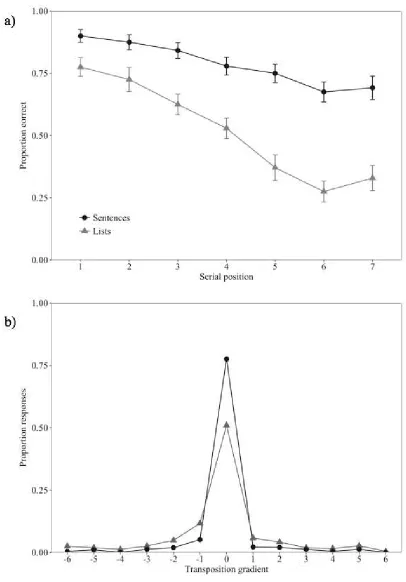
Proportion correct4 for each serial position is shown in Figure 4a. A 2x7 repeated measures
ANOVA revealed significant effects of sequence type, F (1,19) = 78.43, MSE = .07, p < .001, 2
= .81, serial position (Greenhouse-Geisser corrected), F (2.61,49.49) = 59.67, MSE = .03, p < .001,
2 = 76, and the interaction, F (6,114) = 11.75, MSE = .01, p < .001, 2 = .38. Further analysis
(Bonferroni-Holm corrected) revealed the sequence type effect to be significant at every serial
position, though it was smaller at the earlier positions. A Bayesian ANOVA indicated strongest
support for the model containing both main effects and the interaction (BF > 1000 vs. the null).
<Figure 4 about here>
Transposition Gradients and Error Analysis
Transposition gradients were again calculated (centred with the target position at 0, and running
from -6 to 6), and are illustrated in Figure 4b. As in Experiment 1, examination of these gradients
clearly indicates that the sequence type manipulation impacted on correct responses, and on the
probability of producing words in incorrect sequence positions.
Examination of order errors produced mean proportional rates of .10 (SE = .02) for
sentences and .25 (.02) for lists, indicating a significantly higher order error rate for lists, t (19) =
6.37, p < .001, BF > 1000 (d = 1.42). For omissions, we observed mean proportional rates of .02
(.01) for sentences and .09 (.02) for lists, a significant difference, t (19) = 4.95, p < .001, BF = 309
(d = 1.11). Finally, rates of intra-experiment intrusion errors (i.e. recall of an item from the
experimental set that was not present on that trial) were .09 (.01) for sentences and .13 (.02) for
lists, a significant difference, t (19) = 2.20, p = .040, BF = 1.7 (d = .49). Thus, sentential context led
to improved recall order, and reductions in omissions and intrusions from the wider experimental
set (though the Bayes Factor for this latter outcome only indicates weak evidence for the effect).
Change detection accuracy averaged at .86 (.02) for sentences, and .76 (.04) for word lists (see
Figure 5). This difference was significant, t (19) = 2.47, p = .023, BF = 2.6, (d = .55). Accuracy in
the identification of the words that had changed positions (following correct change detection)
was .93 (.02) for sentences, and .77 (.05) for lists, a significant difference, t (19) = 3.92, p < .001,
BF = 39, (d = .88). Thus, sentential structure had significant effects on the ability to detect changes
in order, and the accuracy to identify the nature of these changes.
<Figure 5 about here>
Finally, we again directly compared recall and change detection recognition within a 2x2
repeated measures ANOVA (see Figure 5). There were significant effects of sequence type, F
(1,19) = 50.80, MSE = .01, p < .001, 2 = .73, and task, F (1,19) = 31.68, MSE = .02, p < .001, 2
= .63, with mean recognition accuracy superior to recall. There was also an interaction between
sequence type and task, F (1,19) = 13.38, MSE = .01, p = .002, 2 = .41, indicating that the sentence
advantage was larger for recall (d = 1.98) than for recognition (d = .55). A Bayesian ANOVA
indicated the best model to contain sequence type, task, and the interaction (BF > 1000 vs. the null
model), with Bayes Factors of >1000 supporting both main effects, and of 22 to 1 in support of the
interaction.
Discussion
A large sentence advantage was again observed in immediate serial recall, this time using sequential
visual presentation of each constituent word. As in previous studies, this effect appears to be both
item- and order-based, with more order errors, omissions, and intra-experiment intrusions during
recall of lists than sentences. Patterns of transposition gradients resembled those observed with
auditory presentation in Experiment 1, with a higher rate of accurate responses for sentences at each
point in the sequence, and position errors for both sequence types broadly indicating a locality
constraint (Henson et al., 1996). As in Experiment 1, the similarities between serial position curves
and transposition gradients point to the involvement of a common serial ordering mechanism in
A sentence advantage was also observed in both initial change detection and subsequent
change identification. This contrasts with Experiment 1 using auditory presentation, where some
evidence for a null effect of sequence type was observed, and is more in line with the outcomes
using the Staircase method in Experiment 2. However, Bayes Factor analysis in the present
experiment still only indicated ‘anecdotal’ evidence for a sentence advantage in serial recognition
change detection (BF = 2.6). Therefore, a final experiment was carried out, implementing the
Staircase method with serial recognition of visually presented sequences.
Experiment 4
The aims and methodology of the final experiment closely correspond to those of Experiment 2, but
with sequence presentation changed to the visual modality. We wanted to examine whether the
relatively weak evidence for a sentence advantage that was observed on the change detection
measure of serial recognition in Experiment 3 using visual presentation is extended and
strengthened using a more sensitive transformed up-down span methodology.
Method
Participants
There were 22 (7 male and 15 female) undergraduate and postgraduate students in this experiment,
receiving course credit or financial payment for their participation.
Materials, Design, and Procedure
This experiment was essentially a replication of the staircase span method from Experiment 2, using
the same materials from that study, but with visual presentation during encoding and test (see
Experiment 3).
Results
Three measures of change detection accuracy were again examined; proportion correct, mean
sequence length at each switch point, and mean mid-run point (see Figure 6). For proportion correct,
as in Experiment 2, change detection performance on sequences of 11 words was at chance in both
6-10 was .76 (SE = .04) for sentences and .67 (.02) for lists (d = 1.05), a significant difference t (21)
= 4.91, p < .001, BF = 357. For mean length per switch point, this was 8.19 (SE = .17) for sentences
and 7.52 (.17) for lists (d = .89), a significant difference t (21) = 4.15, p < .001, BF = 72, (d = .81).
Finally, the mean mid-run point for sentences was 8.19 (.17) while for lists it was 7.52 (.17), again a
significant difference, t (21) = 4.13, p < .001, BF = 69 (d = .88).
<Figure 6 about here>
Cross-experiment comparison
Aside from presentation modality, identical methodologies were implemented in Experiments 2 and
4. It was therefore appropriate to combine the data from these experiments in a series of mixed 2x2
ANOVA, to identify whether the magnitude of the sentence advantage varied with modality of
presentation at encoding and test. This produced large and significant effects of sentence type, but
no effect of modality or interaction with sequence type, for all three outcome measures: Change
detection (sequence type F (1,40) = 31.73, MSE = .01, p < .001, 2 = .44; modality F (1,40) = .003,
MSE = .01, p = .96, 2 = .00; interaction F (1,40) = .03, MSE = .01, p = .86, 2 = .00); Mean length
per switch point (sequence type F (1,40) = 33.29, MSE = .03, p < .001, 2 = .45; modality F (1,40)
= .12, MSE = .02, p = .73, 2 = .00; interaction F (1,40) = .003, MSE = .03, p = .96, 2 = .00); Mean
mid-run point (sequence type F (1,40) = 30.22, MSE = .03, p < .001, 2 = .43; modality F (1,40)
= .62, MSE = 1.04, p = .43, 2 = .02; interaction F (1,40) = .03, MSE = .03, p = .86, 2 = .00).
Bayesian ANOVA in each case indicated the preferred model to contain sequence type only (BF >
1000 vs. null), with BF < 1 for modality and the interaction for all outcome measures.
Discussion
Experiment 4 outcomes resemble those of Experiment 2, showing a clear sentence advantage in the
recognition task for proportion correct, length per switch point and mid-run point, this time with
visual rather than auditory presentation. Thus, in contrast to the inconsistent and ‘anecdotal’
more sensitive staircase methodology used in Experiments 2 and 4 gives consistent results across
modalities. Direct comparison of these effects across the two staircase experiments further
illustrated the consistency of these effects, while indicating no variation as a function of
presentation modality.
General Discussion
Across four experiments we provide new insights concerning how structured and unstructured
verbal sequences might be handled in working memory. Examination of immediate serial recall in
Experiments 1 (auditory presentation) and 3 (visual presentation) demonstrated a clear sentence
advantage in terms of correct performance and positional certainty across sequence positions, item
and order error rates, as well as chunk size and order. In contrast, these experiments produced
mixed and equivocal impacts of sequence structure on serial recognition performance. However,
when recognition was examined using a staircase or transformed up-down procedure in Experiment
2 and 4, consistent and reliable sentence effects then emerged, across auditory and visual
modalities.
Effects of sentence structure previously observed on immediate serial recall (Baddeley et al.,
2009) were replicated and extended in the present study. This effect appears to impact on both item
and order information. Examination of transposition gradients shed further light on how items are
recalled across the different sequence positions. For both the auditory and visual modalities,
sentential structure appears to reduce positional uncertainty and facilitate the recall of each
presented item in its appropriate position. Both sentences and lists show something of a locality
constraint (Henson et al. 1996) with reduced probability of displacement of list items to more
distant output positions. List recall appears to be less precise in its positional certainty, and it is
primarily at these adjacent positions that order errors (either representing anticipations or
perseverations) can be observed. Thus, despite large differences in absolute levels of recall, serial
position curves and distributions of transposition errors for sentences and word lists have very
underpinning performance in both cases, as in the episodic buffer account (Baddeley et al., 2009,
2011), than with the idea that memory for sentences and lists involves fundamentally different
representations, as in the conceptual regeneration account (Potter & Lombardi, 1998). However,
such an interpretation must be viewed with caution as serial order may be a common problem
solved in the same way within different systems, and it is also possible that our use of constrained
sentences exaggerates similarities with word lists.
We also considered whether sentential structure might provide a useful source of support for
processes of retrieval-based redintegration (Saint-Aubin & Poirier, 2000) that could operate at both
the single-word and multi-word sequential level. Thus, when words are embedded into sentences at
presentation, the structure and redundancy this provides might prove useful in cueing appropriate
responses and inhibiting incorrect responses that might be grammatically or conceptually incorrect.
We therefore extended the current exploration to serial recognition, a task that places relatively
reduced demands on active output, and in which selection and redintegration of items in memory
for retrieval is unlikely to play a major role. The equivocal outcomes observed using a more
traditional methodological approach, with anecdotal evidence for the null model in Experiment 1
(auditory presentation) and for the presence of an effect in Experiment 3 (visual presentation) might
lead us to conclude that the sentence advantage in serial recall is primarily output-based.
Alternatively, these results at least somewhat parallel the findings of Macken et al. (2014), who
observed lexicality effects in the visual but not the auditory modality, and attributed this to the
application of global-level perceptual matching in the auditory modality and item segmentation
arising from verbal recoding in the visual. Our observations of somewhat contrasting
sequence-level linguistic effects (i.e. the sentence advantage) in Experiments 1 and 3 would on the face of it
fit with these claims, although the strength of evidence (as indicated by Bayes Factor analysis) is
weak in each case.
However, these possible explanations are undermined by stronger and more consistent
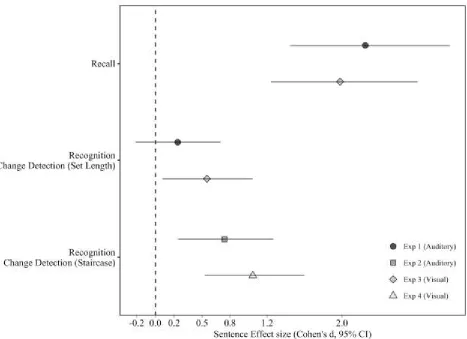
measure (Experiments 2 and 4; see Figure 7 for a comparison of effect sizes). These outcomes
highlight the importance of optimising task sensitivity to avoid type 2 errors. The simple change
detection method (using a set length and a limited number of trials) used in Experiments 1 and 3 is
widely featured in memory studies, but has the drawback that each present-absent decision trial
conveys limited information, thus requiring a larger number of data points for reliable results. The
insensitivity of this task has also been commented upon by Jefferies et al. (2006) whose evidence
suggested this might account for the apparent discrepancy between their own findings of a small
lexicality effect and those of Gathercole et al. (2001) reporting none. Thus, the staircase method,
used extensively in sensory psychophysics, should perhaps be employed more frequently in
working memory research. If each switch provides a within-trial replication, reliability can
therefore be increased by specifying a greater number of reversals before concluding a trial. The
task is also useful in identifying the optimal level of sensitivity at an individual participant level,
thus providing more data points at sensitive performance levels and reducing trial redundancy. It is
thus likely to prove a more robust and reliable measure of the underlying memory function, and
might be adopted more widely in working memory research.
<Figure 7 about here>
Given the emergence of strong evidence for a sentence superiority effect using this
methodology, we suggest that sentence structure benefits both recognition and recall through
strengthening of representations during encoding and storage. How might these processes be
captured within working memory? When verbal sequences are initially encountered, this input
interacts with different levels (e.g. conceptual, lexical, syntactic and grammatical) of stored
language knowledge held in long-term memory, thus activating representations of meaning and
structure. Different theoretical perspectives would then provide distinct accounts for how the
sentence superiority effect manifests. One possibility is that syntactic and conceptual binding
processes stabilise the representation of information about individual words and word order in
phonological representations of items (see also Majerus, 2013 for a similar proposal). The outputs
of this processing might then be represented as bound elements in a modality-general storage
capacity such as the episodic buffer (Baddeley, 2000). As with simple forms of visual binding
(Allen, Baddeley, & Hitch, 2006, 2014), or the utilisation of meaningful verbal-spatial associations
(Calia, Darling, Havelka, & Allen, under review), this would appear to operate in a relatively
automatic fashion (Baddeley et al., 2009).
While this approach is intended to capture a range of phenomena, other theoretical accounts
have been proposed to more specifically handle mnemonic processing of meaning and linguistic
structure. For example, Potter and Lombardi (1990, 1998; Lombardi & Potter, 1992; see also
Rummer & Engelkamp, 2001, 2003; Schweppe et al., 2011) propose that sentence meaning is
extracted at a conceptual level during comprehension, which then drives regeneration of the
sequence via persisting lexical, syntactic, and phonological priming. This extraction of conceptual
information from the point of encoding might predict a sentence superiority effect across different
tasks, as unstructured list memory, in contrast, is dependent on preservation of a surface
phonological representation. Alternatively, the sentence superiority effect may reflect more
effective storage within activated long-term memory. For example, MacDonald (2016) has recently
described how utterance planning might underlie maintenance and ordering in verbal memory tasks
using either structured sentences or random word lists, characterising these utterance action plans as
activated portions of long-term memory under the focus of attention (Cowan, 2005). Taking a
different approach, Ericsson and Kintsch (1995) developed the concept of ‘long-term working
memory’, suggesting that long-term memory can be used as a form of temporary storage, provided
retrieval cues are actively retained within ‘short-term working memory’ itself. In the case of text
comprehension, incoming text is processed via interactions between working and long-term
memory, with the end products of this multi-level construction and segment integration process
effects to emerge across serial recall and recognition tasks. It would be useful for future work to
examine which might provide the most parsimonious explanation for such effects.
It is also worth noting that the sentence superiority effect, while somewhat larger and more
consistent using the staircase methodology in Experiments 2 and 4, was nevertheless substantially
smaller than that observed in serial recall (see Figure 7). Regardless of presentation modality, serial
recall yields sentence superiority effect sizes of d ≈ 2,0, classed by Sawilowsky (2009) as ‘huge’. In
contrast, recognition measures produce small-medium effects (d ≈ 0.2-0.5) using set length, and
large effects (d ≈0 .8) within the up-down staircase procedure. Notwithstanding broader
measurement differences between these tasks, these disparate effect sizes might indicate the
sentence superiority effect to have an output-based component. Candidate mechanisms that might
capture this include redintegrative processes operating on degraded representations at recall,
regeneration of the sequence via lexical, syntactic, and phonological priming, based on conceptual
representations formed during encoding (Potter & Lombardi, 1990, 1998), or the implementation of
utterance plans for recall (MacDonald, 2016). In each case, such processing would be assumed to
be qualitatively or quantitatively superior for structured sequences, relative to word lists, and would
be emphasized in serial recall and minimized in serial recognition. It is possible, furthermore, that
such retrieval-based processing may also explain outcomes observed in recognition. Indeed, it is
likely that recall and recognition lie on a continuum regarding the retrieval demands involved in
each task, with recognition reducing but not eliminating the impacts of retrieval-based processing. It
could be argued that the change detection task might involve an initial stage of covertly recalling
the remembered sequence for comparison with the test sequence. While it is not possible to strongly
rule out such an explanation based on the current work, it is perhaps unlikely to be an effective
strategy given that re-presentation of the sequence immediately followed completion of the original
sequence. Furthermore, if covert recall were an obligatory stage in decision phase of the recognition
task, we would expect recall accuracy to be at least as high as recognition, when in fact we
argue that retrieval-based effects of sentence structure emerge in addition to those occurring
upstream, during initial encoding.
In conclusion, it is apparent that sentence superiority effects in immediate serial recall
emerge across multiple forms of analysis, including item recall accuracy, ordering, and
transposition gradients. We also show that it produces sizeable effects in serial recognition, a task
that minimizes explicit recall/output demands, though observation of such effects on this form of
task are partly dependent on using a sufficiently sensitive paradigm. The magnitude of such effects,
however, remains substantially larger in recall, relative to recognition. These outcomes generally
remain consistent across presentation modality. Overall, the results indicate that sentence structure
beneficially impacts across encoding, storage, and retrieval, rather than being localized at any one
phase of the task.
References
Allen, R. J., & Baddeley, A. D. (2008). Working memory and sentence recall. In A. Thorn, & M.
Page (Eds.), Interactions between short-term and long-term memory in the verbal domain
(pp. 63–85). Hove: Psychology Press.
Allen, R. J., Baddeley, A. D., & Hitch, G. J. (2006). Is the binding of visual features in working
memory resource-demanding? Journal of Experimental Psychology: General, 135(2),
298-313.
Allen, R. J., Baddeley, A. D., & Hitch, G. J. (2014). Evidence for two attentional components in
visual working memory. Journal of Experimental Psychology: Learning, Memory, and
Cognition, 40(6), 1499-1509.
Baddeley, A. D. (1966a). The influence of acoustic and semantic similarity on long-term memory
Baddeley, A. D. (1966b). Short-term memory for word sequences as a function of acoustic,
semantic and formal similarity. The Quarterly Journal of Experimental Psychology, 18(4),
362-365.
Baddeley, A. D., Allen, R. J., & Hitch, G. J. (2011). Binding in visual working memory: The role of
the episodic buffer. Neuropsychologia, 49 (6), 1393-1400.
Baddeley, A. D., Hitch, G. J., & Allen, R. J. (2009). Working memory and binding in sentence
recall. Journal of Memory and Language, 61, 438-456.
Brener, R. (1940). An experimental investigation of memory span. Journal of Experimental
Psychology, 26, 467-483.
Burgess, N., & Hitch, G. (2005). Computational models of working memory: Putting long-term
memory into context. Trends in Cognitive Sciences, 9, 535-541.
doi:10.1016/j.tics.2005.09.011
Calia, C, Darling, S., Havelka, J., & Allen, R.J. (under review). Visuospatial bootstrapping: binding
useful visuospatial information during verbal working memory encoding does not require
set-shifting executive resources.
Darling, S., Allen, R. J., & Havelka, J. (2017). Visuospatial Bootstrapping: When Visuospatial and
Verbal Memory Work Together. Current Directions in Psychological Science, 26(1), 3-9.
Ericsson, K. A., & Kintsch, W. (1995). Long-term working memory. Psychological review, 102(2),
211-245.
Gathercole, S. E., Pickering, S., Hall, M., & Peaker, S. (2001). Dissociable lexical
and phonological influences on serial recognition and serial recall. Quarterly Journal of
Experimental Psychology, 54A, 1-30.
Henson, R. N., Norris, D., Page, M., & Baddeley, A.D. (1996). Unchained memory: Error patterns
rule out chaining models of immediate serial recall. The Quarterly Journal of Experimental
Psychology: Section A, 49(1), 80-115.
Word-frequency effects on short-term memory tasks: Evidence for a redintegration process in
immediate serial recall. Journal of Experimental Psychology Learning Memory Cognition,
23(5), 1217-1232.
Hurlstone, M. J., Hitch, G. J., & Baddeley, A. D. (2014). Memory for serial order across domains:
An overview of the literature and directions for future research. Psychological bulletin,
140(2), 339-373.
Jacobs, J. (1887). Experiments on “prehension”. Mind, 12, 75-79.
Jefferies, E., Frankish, C., & Lambon Ralph, M. A. (2006). Lexical and semantic influences on item
and order memory in immediate serial recognition: Evidence from a novel task. Quarterly
Journal of Experimental Psychology, 59, 949-964.
Kendall, M. (1938). A New Measure of Rank Correlation. Biometrika 30, 81–89.
Levitt, H. (1971). Transformed up-down methods in psychoacoustics. Journal of the Acoustical
Society of America, 33, 467–476
Lombardi, L., & Potter, M. C. (1992). The regeneration of syntax in short term memory. Journal of
Memory and Language, 31(6), 713-733.
JASP Team (2017). JASP (version 0.8.1.2)[Computer software].
MacDougall, R. (1904). Recognition and recall. The Journal of Philosophy, Psychology and
Scientific Methods, 1(9), 229-233.
MacDonald, M. C. (2016). Speak, Act, Remember: The Language-Production Basis of Serial Order
and Maintenance in Verbal Memory. Current Directions in Psychological Science, 25(1),
47-53.
Macken, B., Taylor, J. C., & Jones, D. M. (2014). Language and short-term memory: The role of
perceptual-motor affordance. Journal of Experimental Psychology: Learning, Memory, and
Cognition, 40(5), 1257-1270.
Majerus, S. (2013). Language repetition and short-term memory: an integrative framework.
Nairne, J. S. (1992). The loss of positional certainty in long-term memory. Psychological Science,
3(3), 199-202.
Potter, M. C., & Lombardi, L. (1990). Regeneration in the short-term recall of sentences. Journal of
Memory and Language, 29(6), 633-654.
Potter, M. C., & Lombardi, L. (1998). Syntactic priming in immediate recall of sentences. Journal
of Memory and Language, 38(3), 265-282.
Rummer, R., & Engelkamp, J. (2001). Phonological information contributes to short-term recall of
auditorily presented sentences. Journal of Memory and Language, 45(3), 451-467.
Rummer, R., & Engelkamp, J. (2003). Phonological information in immediate and delayed sentence
recall. The Quarterly Journal of Experimental Psychology: Section A, 56(1), 83-95.
Saint-Aubin, J., & Poirier, M. (2000). Immediate serial recall of words and nonwords: Tests of the
retrieval-based hypothesis. Psychonomic Bulletin & Review, 7(2), 332-340.
Sawilowsky, S. S. (2009). New effect size rules of thumb. Journal of Modern Applied Statistical
Methods, 8(2), 597 – 599.
Schweickert, R. (1993). A multinomial processing tree model for degradation and redintegration in
immediate recall. Memory & Cognition, 21, 168-175.
Schweppe, J., & Rummer, R. (2007). Shared representations in language processing and verbal
short-term memory: The case of grammatical gender. Journal of Memory and Language,
56(3), 336-356
Schweppe, J., Rummer, R., Bormann, T., & Martin, R. C. (2011). Semantic and phonological
information in sentence recall: Converging psycholinguistic and neuropsychological
evidence. Cognitive Neuropsychology, 28(8), 521-545.
Tulving, E., & Patkau, J. E. (1962). Concurrent effects of contextual constraint and word frequency
on immediate recall and learning of verbal material. Canadian Journal of Psychology, 16,
Footnotes
1. Note that we also scored performance using the adjacency method as reported by Baddeley et al.
(2009). A 2x8 repeated measures ANOVA revealed significant effects of sequence type, F (1,19) =
139.49, MSE = .02, p < .001, 2 = .89, serial position, F (7,133) = 51.58, MSE = .02, p < .001, 2
= .73, and the interaction, F (7,133) = 9.79, MSE = .01, p < .001, 2 = .34. The sentence effect was
significant at every serial position, though it was smaller at the first and final positions, relative to
positions 2-7. Proportion correct, collapsed across serial positions, was .77 (std error = .03) for
sentences and .57 (.03) for lists (Cohen’s d = 2.64).
2. Experiments 2 and 4 were focused on change detection performance rather than the secondary
measure of change identification. In addition, the staircase method meant that number of trials at
each length was determined by change detection performance and was not balanced across
sequence types. Therefore, change identification is not reported or analysed further, although
outcomes on this measure replicated those observed in the first two experiments.
3. Experiment 3 was carried out before Experiment 2, but for ease of exposition the order in which
the experiments are reported has been changed.
4. Using the adjacency scoring method, a 2x7 repeated measures ANOVA revealed significant
effects of sequence type, F (1,19) = 43.21, MSE = .08, p < .001, 2 = .70, serial position, F (6,114)
= 39.98, MSE = .02, p < .001, 2 = .68, and the interaction, F (6,114) = 8.95, MSE = .01, p < .001,
2 = .32. The sequence type effect was significant at every serial position, though it was smaller at
the earlier positions. Proportion correct, collapsed across serial positions, was .80 (std error = .03)
Figure 1. a) Proportion correct (and standard error) in serial recall for sentences and lists as a
function of serial position, and b) Transposition gradients in serial recall for sentences and lists in
[image:33.595.90.491.155.726.2]Figure 2. Mean performance in Experiment 1 for serial recall and recognition. Error bars show
Figure 3. Recognition proportion correct, switch point length, and mid-run point in Experiment 2.
Figure 4. a) Proportion correct (and standard error) in serial recall for sentences and lists as a
function of serial position, and b) Transposition gradients in serial recall for sentences and lists in
[image:36.595.89.495.136.718.2]Figure 5. Mean performance in Experiment 3 for serial recall and recognition. Error bars show
Figure 6. Recognition proportion correct, switch point length, and mid-run point in Experiment 4.
Figure 7. Sentence superiority effect sizes (Cohen’s d) observed on each of the primary outcome
Appendix: Chunking analyses
Tulving and Patkau (1962) found that participants produced larger ‘adopted chunks’ (groups of
items recalled in the correct sequential order) when recalling text passages with a relatively higher
approximation to English. Our previous exploration of sentence memory (Baddeley et al., 2009) did
not allow examination of this issue or application of such methods, as we used unbalanced sequence
lengths in most of those experiments. The present use of equal sequence lengths therefore enables
us to examine ‘adopted chunking’ within the constrained sentence methodology. In line with
Tulving and Patkau (1962), we classed a recalled ‘chunk’ as an unbroken sequence of words
recalled in the order in which they were originally presented. This provides a measure of the mean
size of recalled chunks. In addition, we also examined whether these recalled chunks were
themselves produced in the correct relative order, using Kendall’s tau () rank correlation
coefficient (Kendall, 1938). This method can be used to calculate the number of pairs of chunks that
are in the correct or incorrect relative order across the response sequence, as a function of the total
number of chunks recalled. It is expressed as:
=
where nc is the number of correctly ordered chunk pairs, nd is the number of incorrectly ordered
chunk pairs, and n is the total number of chunks. So, for example, if the sequence ABCDEF was
recalled as “AB D C EF”, this would be scored as 4 chunks, with 5 pairs in the correct relative order
(AB-D, AB-C, AB-EF, D-EF, C-EF) and 1 pair in the incorrect relative order (D-C), giving a
score of .67.
In Experiment 1, the mean size of recalled chunks was 4.04 words (.34) for sentences and
2.43 words (.21) for lists, a significant difference, t (19) = 7.44, p < .001, BF > 1000 (d = 1.66). The
Kendall’s tau analysis of chunk order produced a score of .75 (.03) for sentences and .69 (.02) for
lists. This difference was significant, t (19) = 2.24, p = .037, BF = 1.8 (d = .50). nc - nd
In Experiment 2, mean size of recalled chunks was 4.53 words (.30) for sentences,
compared to 2.62 words (.25) for lists, a significant difference, t (19) = 6.50, p < .001, BF > 1000,
(d = 1.45). The Kendall’s tau analysis of correct order of chunk recall was .83 (.04) for sentences
and ,66 (.04) for lists. Again, this difference between sequence types was significant, t (19) = 4.02,
p < .001, BF = 48 (d = .90).
Thus, for both modalities, presentation of items within a sentence-like structure led to recall
of larger chunks, in a more appropriate order, indicating that ordering mechanisms are important at
the individual item level, within multi-word chunks, and across multiple items, between chunks. We
acknowledge that this form of chunking analysis is directly based on recall performance, and is
therefore not independent of recall accuracy. As such, it is not possible to confidently assert
whether this represents chunking during encoding, or the retrieval of chunk-like segments at recall.
In either case though, these analyses are instructive in indicating how structure impacts on