Int. J. Electrochem. Sci., 11 (2016) 10199 – 10209, doi: 10.20964/2016.12.58
International Journal of
ELECTROCHEMICAL
SCIENCE
www.electrochemsci.org
Sn Embedded Li
4Ti
5O
12/C Composite as a High Capacity Anode
Material for Li-ion Battery
Tianbiao Zeng, Xuebu Hu*, Penghui Ji, Qimeng Peng, Biao Shang
College of Chemistry and Chemical Engineering, Chongqing University of Technology, Chongqing 400054, China
*
E-mail: [email protected]
Received: 4 September 2016 / Accepted: 29 September 2016 / Published: 10 November 2016
Sn embedded Li4Ti5O12/C composite (C-Sn/Li4Ti5O12) was prepared using TiO2 sphere as precursor. The physical characteristics of C-Sn/Li4Ti5O12 were characterized by X-ray diffraction (XRD), thermogravimetric analysis (TG), Raman spectra, elemental analysis, scanning election microscopy (SEM) and transmission electron microscopy (TEM). The electrochemical performances were investigated by cyclic voltamnograms (CVs) and galvanostatic charge-discharge tests. These analyses indicate that C-Sn/Li4Ti5O12 was spherical-like particles about 1μm. Moreover, it was composed of inner spinel Li4Ti5O12, outer-coated carbon layer and Sn embedded between inner Li4Ti5O12 and outer carbon layer. Combining high specific capacity of Sn particles and high electronic conductive of carbon coated layer, as-prepared C-Sn/Li4Ti5O12 shows improved discharge capacity. Compared with carbon-coated Li4Ti5O12 (C-Li4Ti5O12), the C-Sn/Li4Ti5O12 exhibited better capability at 200 mA g-1 with a discharge capacity increased by ~ 16.3%. After 100 cycles, the discharge capacity of C-Sn/Li4Ti5O12 was stable at ~ 242 mAh g-1.
Keywords: Li4Ti5O12; Sn; carbon layer; anode
1. INTRODUCTION
supercritical water and cycled from 0V to 3V. The sample delivered an initial capacity of 212 mAh g-1 and retained ~ 200 mAh g-1 after 50 cycles at 1C [7]. Yi et al. synthesized Li4Ti5O12 using a solid-state method and the sample exhibited a stable capacity of ~ 210 mAh g-1 after 150 cycles when it cycled from 0V to 2.5V at 1C [8]. Yu et al. obtained amorphous Li4Ti5O12 thin film via a sol-gel method. As-prepared thin films showed a high initial capacity of 283.5 mAh g-1 and the capacity loss was only 3% after 100 cycles, but the cycle current was only 10 μA cm-2
[9]. Though the discharge capacity has been improved, there is a gap compared to graphite. Another strategy to increase the capacity of Li4Ti5O12-based anode is doping by high capacity materials, such as SnO2 [10-12] and Sn [13,14]. Compared to SnO2, Sn has attracted wide attention due to its higher specific capacity (991 mAh g-1). However, an obvious disadvantage of Sn is its large volume change (up to 360%) during the charge-discharge process, which will causes electrode serious pulverization and the decrease of electrical contact subsequently, even leading to rapid capacity degradation [15-18]. Li et al. synthesized Sn/C nanofibers with ~ 10 wt% Sn deposed on surface showed a discharge capacity of about 400 mAh g-1 after 20 cycles under 50 mA g-1 [19]. Cui et al. prepared core/shell-structured Sn@C maintained a high discharge capacity of 585mAh g-1 after 100 cycles at 0.1 A g-1 and delivered a high reversible capacity of 480 mAh g-1 at 5 A g-1 [20]. These references prove that carbon coating can improve the electrochemical performances of Sn anode. Here, coated carbon plays two different roles during cycling, leading to better capacity retention. One acts as a buffer layer that absorbs the internal stress causing by Sn expansion-contraction during cells cycling. The other is forming a conductive net between Sn particles,which improves the electronic conductivity of electrodes.
Herein, we demonstrate a synthesis route to spherical-like C-Sn/Li4Ti5O12 particles with average outer diameter of ~1μm. Combining high specific capacity of Sn particles and high electronic conductive of carbon coated layer, it is desirable that as-prepared C-Sn/Li4Ti5O12 shows improved discharge capacity and good cycle performance.
2. EXPERIMENTAL
2.1 Sample preparation
The TiO2 spheres were firstly prepared by a reported sol-gel method with minor modifications [21]. In a typical synthesis, 80 mg heptanoic acid, 265 mg tetrabutyl titanate and 30 mL absolute ethanol were mixed and stirred, and then 2.25 mL deinonized water was added and stirred to form a white gel. Subsequently, the gel was put into a 100 mL Teflon-lined stainless autoclave and heated at 150℃ for 12h. After being isolated using centrifugation, washed with deinonized water and ethanol several times, the prepared TiO2 spheres were dry in vacuum oven. For synthesizing Li4Ti5O12, the as-prepared TiO2 was ball milling with Li2CO3 in 5% lithium atom exceed using ethanol as dispersing agent, then the precursor was calcined at 800℃ in air for 20h to obtained Li4Ti5O12 with temperature increased from room temperature in a rate of 5 ℃ min-1
with deinonized water to remove redundant ammonium ions, the white slurry was dried and annealed at 500℃ for 4h. Finally, the powder was mixed with lactose in mass ratio of 5:2 in 25 mL ethanol/water solutions (1/1 by volume ratio) and stirred at 70℃ to vapor the solutions before annealed at 700℃ for 4h under H2/Ar (volume ratio was 1/19) to obtained final product. For comparing, C-Li4Ti5O12 was also synthesized by coating lactose on Li4Ti5O12 and heat treated under N2 at 550℃.
2.2. Characterizations
For material characterizations, XRD patterns were collected on a Shimadzu-XRD-7000S X-ray diffractometer with Cu-Kα radiation (λ= 1.54056 Å) at a voltage of 40kV and a current of 40 mA. TG was conducted under NETZSCH STA 2500 in a temperature range of 30 to 900 ℃ at air atmospheres with a heated rate of 10 ℃ min-1. Raman spectra were recorded using a Confocal Micro-Raman spectroscopy fitted with a 632.8 nm He-Ne excitation laser. Elemental analysis was operated on vario EL Elemental Analyzer. SEM images were acquired on a S4800 microscope. TEM images were taken on FEI Tecnai G20 microscopes.
2.3 cells assembly and electrochemical testing
To evaluate electrochemical properties, samples (80 wt%), conductive carbon black (10 wt%) and polyvinylidene fluoride (10 wt%) binder were mixed using N-methyl pyrrolidone as solvent for a homogeneous slurry, the slurry was then pasted uniformly onto a copper foil and dried to give the electrodes with loading materials of ~ 2.5 mg cm-2. The 2032 coin cells were assembled in an argon-filled dry glove box using lithium metal foil as the counter electrode. The electrolyte was a 1 M LiPF6 solution in the mixture of ethylene carbonate, dimethyl carbonate and ethylene methyl carbonate (1/1/1 by volume). A polypropylene membrane (Celgard 2400) was used as the separator. CVs were investigated at a scan rate of 0.2 mV s-1 by an Autolab PGSTAT 128N. Galvanostatic charge-discharge tests were performed on a LAND battery tester with a cut-off voltage of 0.01 ~ 3.0V. For long cyclamens, the current density in first two cycles was fixed on 20 mA g-1. The capacity was calculated based on the mass of C-Sn/Li4Ti5O12 and C-Li4Ti5O12, respectively. All the tests were operated at room temperature.
3. RESULTS AND DISCUSSION
3.1 Physical properties
[image:4.596.159.434.136.359.2]
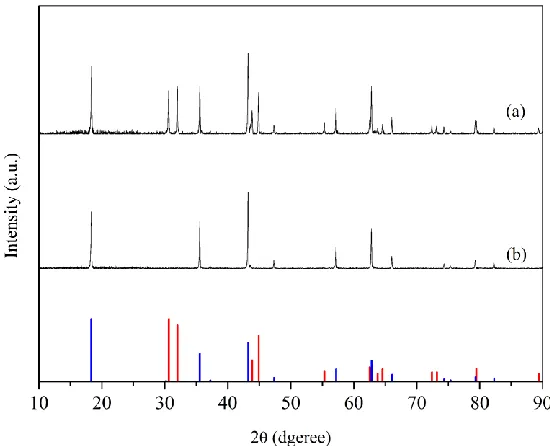
(JCPDS No. 04-0673), suggesting Sn exists in the C-Sn/Li4Ti5O12. There were no carbon diffraction peaks in XRD patterns may attribute to its low graphitization degree.
Figure 1. XRD diffraction of C-Sn/Li4Ti5O12 (a) and C-Li4Ti5O12 (b). The red and blue bars on bottom are standard Sn and Li4Ti5O12 diffraction peaks
For understanding elemental content in the samples, C-Sn/Li4Ti5O12 and C-Li4Ti5O12 were measured by TG and C-Sn/Li4Ti5O12 was tested by elemental analysis. TG results were shown in Fig. 2. C-Sn/Li4Ti5O12 and C-Li4Ti5O12 exhibited low weight loss under 200 ℃ and continued weight loss between 300℃ and 500 ℃, which was related to the removal of adsorbed water and combustion of carbon, respectively. For C-Sn/Li4Ti5O12, the weight increased obviously in the temperature ranges of 505 ℃ to 705 ℃, relating to the oxidation of Sn particles. In addition, a temperature plateau from 705
℃ to 900 ℃ was observed, indicating all the carbon and Sn were oxidized completely. For C-Li4Ti5O12, there was no weight loss beyond 460℃, indicating all the carbon was oxidized. According to TG of C-Sn/Li4Ti5O12, there were 93.74 wt% terminal residues that were incombustible Li4Ti5O12 and new produced SnO2. Furthermore, the carbon content in C-Sn/Li4Ti5O12 was 8.63 wt% measured by elemental analysis. The mass content of Sn and Li4Ti5O12 can be calculated to be 8.78 wt% and 82.59 wt% from TG and elemental analysis data, respectively. Compared with C-Sn/Li4Ti5O12, the carbon content in C-Li4Ti5O12 was 6.26 wt%.
[image:5.596.181.415.127.307.2]
consistent with the results of XRD. More importantly, it is very obvious that Sn particles embed between carbon layer and Li4Ti5O12 core in Fig. 3(e) and (f).
Figure 2. TG curves of C-Sn/Li4Ti5O12 and C-Li4Ti5O12
[image:5.596.171.427.364.719.2][image:6.596.160.437.374.594.2]
Besides Li4Ti5O12 and Sn lattice fringes, some other structure fringes also observed in Fig. 3(f), and the fringes were similar with the carbon layer shown in Fig. 3(c). For understanding carbon ingredients, Fig. 4 shows the Raman spectra of the samples. The intense broad bands at about 1347 and 1586 cm-1 were assigned to the disorder (D) and graphene (G) bands of residual carbon in C-Sn/Li4Ti5O12 composite, respectively. Similarly, the D band and G band of C-Li4Ti5O12 composite were locate in about 1323 and 1596 cm-1. The G band corresponds to one of the E2g modes, which has been assigned as the sp2 graphite-like structure, whereas the D band corresponds to one of the A1g modes, which is attributed to the sp3 type tetrahedral carbon. That is the reason why graphite lattice exists in the coating carbon layer, which is consistent with the Fig. 3(c) and (f). Although there was graphitized carbon in the samples, the graphite diffraction peaks were not reflected in XRD curves [22-24]. Furthermore, the value of ID/IG (the peak intensity ratio) can be used to evaluate the content of sp 3-and sp2- coordinated carbon in the sample, as well as the degree of disorder carbon layer [25,26]. Theoretically, the low values for the ID/IG parameters indicate a high degree of graphitization. The ID/IG values of C-Li4Ti5O12 and C-Sn/Li4Ti5O12 were calculated as 1.0416 and 0.8874, indicating higher graphitization degree of the carbon layer in C-Sn/Li4Ti5O12 than that of Li4Ti5O12, which is caused by high temperature solid state reaction of C-Sn/Li4Ti5O12 (at 700℃).
Figure 4. Raman spectra of C-Sn/Li4Ti5O12 and C-Li4Ti5O12
3.2 Electrochemical performances
[image:7.596.107.494.127.288.2]
(marked as Ⅰ/Ⅰ’; Ⅱ/Ⅱ’; Ⅲ/Ⅲ’ and Ⅳ/Ⅳ’). It is proved that those redox peaks are caused by oxidation-reduction behavior of LixSny (x=1, y=1; x=7, y=2 or 3; x=22, y=5) [28-30].
Figure 5. CVs of C-Sn/Li4Ti5O12 (a) and C-Li4Ti5O12 (b)
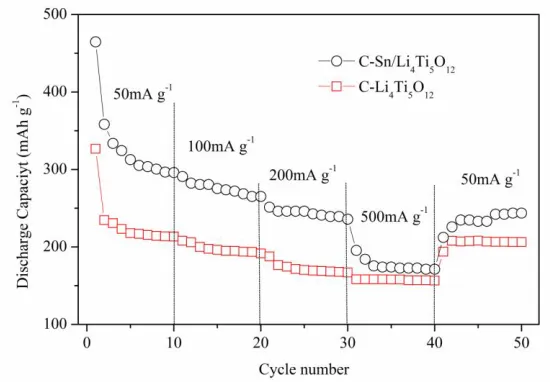
In order to evaluatecycle performance of the samples, the cells were charged and discharged in a series of stages with different current densities from 50 mA g-1 to 500 mA g-1. Fig. 6 shows the variation of discharge capacity in the cycle process. In each stage, both C-Sn/Li4Ti5O12 and C-Li4Ti5O12 kept stable discharge capacity even at 500 mA g-1 though the discharge capacity decreased gradually with the increasing of current density. Significantly, C-Sn/Li4Ti5O12 showed higher discharge capacity than C-Li4Ti5O12 in every cycle stage due to the existence of Sn particles. For C-Sn/Li4Ti5O12 and C-Li4Ti5O12, the discharge capacity recovered when the current switched to initial 50 mA g-1, indicating good reversibility of as-prepared samples.
Figure 6. Stage charge-discharge performance of the samples from 50 mA g-1 to 500 mA g-1
[image:7.596.161.436.499.690.2][image:8.596.160.438.407.610.2]
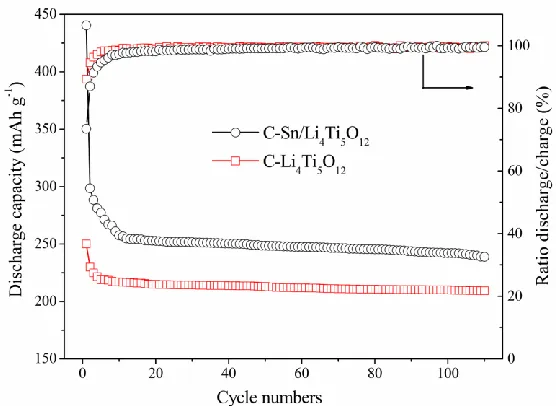
capacity of ~ 250 mAh g -1 for C-Sn/Li4Ti5O12 was obtained after first few cycles activated, while C-Li4Ti5O12 was ~ 215 mAh g -1 at the same conditions. After the electrodes become stable, the coulombic efficiencies of C-Sn/Li4Ti5O12 and C-Li4Ti5O12 were close to 100%, exhibiting high reversibility of as-prepared samples. The stable discharge capacity of C-Sn/Li4Ti5O12 was improved by ~ 16.3% than that of C-Li4Ti5O12, confirming that a certain amount of Sn in C-Sn/Li4Ti5O12 can increase its discharge capacity significantly. Some similar works were studied such as ref. [13] and ref. [14]. In ref. [13], Sivashanmugam et al. prepared novel Li4Ti5O12/Sn nano-composite via high-energy mechanical milling of Li4Ti5O12 andnano-Sn. The composites of 10 wt% Sn/90 wt% Li4Ti5O12 and 30 wt% Sn/70 wt% Li4Ti5O12 delivered stable capacity of 200 mAh g-1 and 300 mAh g-1 after 30 cycles activated, respectively, but the cycled current was only 0.1 mA cm-2 (C/50). In ref. 14, Cai et al. synthesized Li4Ti5O12/Sn composite anode with the weight ratio 9:1 of Li4Ti5O12 to Sn. The Li4Ti5O12/Sn composite maintained 224 mAh g−1 after 50 cycles at 100 mA g−1. It is obvious that its cycle performance is much worse than that of C-Sn/Li4Ti5O12 in this work, which was due to no carbon existence in the Li4Ti5O12/Sn composite. Compared with previous works, the improved electrochemical performances of C-Sn/Li4Ti5O12 may be attributed to two reasons. One is that embedded Sn can provide a high discharge capacity for the electrode. The other is that the highly encapsulated conductive carbon coating layer can provide an excellent conductive web for electrons, more importantly, alleviate the volume change of embedded Sn during cycling.
Figure 7. Cycle performance of the samples at 200 mA g-1
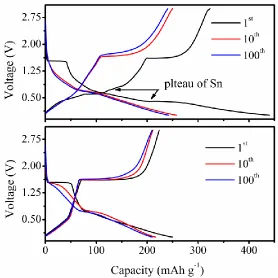
important role in Li+ reaction, which was consistent with the results of CVs. However, the charge-discharge curves were similar between 10th and 100th in the C-Sn/Li4Ti5O12 and C-Li4Ti5O12, suggesting that the charged-discharge plateaus of Sn and Li4Ti5O12 were overlapped into a rather smooth plateau. The overlapped plateau should be own to the neighboring of the broad Li4Ti5O12 redox peaks blow 0.6V and the Sn redox peaks at 0.15 ~ 0.8V, which was detected by CVs. Furthermore, the minute differences between 10th and 100th indicated stable cycle performance of C-Sn/Li4Ti5O12 and C-Li4Ti5O12, which corresponded to the results of Fig. 7.
Figure 8. Charge-discharge behavior of C-Sn/Li4Ti5O12 (a) and C-Li4Ti5O12 (b) for the 1st, 10th and 100th cycles
4. CONCLUSIONS
[image:9.596.159.437.219.497.2]
can be fabricated using Sn as a doping material and carbon as a coating layer, which is proved as an effective way to improve the discharge capacity of anode.
ACKNOWLEDGMENTS
This work was supported by the National Natural Science Foundation of China (No. 21206203), Program for Chongqing Science & Technology Innovation Talents (cstc2013kjrc-qnrc50006) and the Scientific Research Innovation Team of Chongqing University of Technology (No. cqut2015srim).
References
1. J. Liu, W. Liu, Y. L. Wang, S. M. Ji, J. B. Wang and Y. C. Zhou, RSC Adv., 2 (2012) 10470. 2. C. Wang, S. Wang, Y. B. He, L. Tang, C. Han, C. Yang, M. Wagemaker, B. H. Li, Q. H. Yang, J.
K. Kim and F. U. Kang, Chem. Mater., 7 (2015) 5647.
3. X. Lu, L. Gu, Y. S. Hu, H. C. Chiu, H. Li, G. P. Demopoulos and L. Q. Chen, J. Am. Chem. Soc.,137 (2015) 1581.
4. J. Liu, K. P. Song, P. A. van Aken, J. Maier and Y. Yu, Nano Lett., 14 (2014) 2597.
5. . ohjalainen, T. auhala, M. Valkeap , J. Kallioinen and T. Kallio, J. Phys. Chem. C, 119 (2015) 277.
6. R. Raccichini, A. Varzi, S. Passerini and B. Scrosati, Nat. Mater., 14 (2015) 271.
7. A. Nugroho, S. J. Kim, K. Y. Chung, B. W. Cho, Y. W. Lee and J. Kim, Electrochem. Commun., 13 (2011) 650.
8. T. F. Yi, Y. Xie, Y. R. Zhu, R. S. Zhu and H. Shen, J. Power. Sources, 222 (2013) 448. 9. Z. Z. Yu, G. S. Zhu, H. R. Xu and A. Yu, Energy Technol., 2 (2014) 767.
10.K. M. Yang, Y. C. Kang, S. M. Jeong, Y. J. Choi and Y. S. Kim, Int. J. Electrochem., 8 (2013) 11972.
11.S. Y. Han, I. Y. Kim, S. H. Lee and S. J. Hwang, Electrochim. Acta, 74 (2012) 59.
12.L. Z. Xiong, Z. Q. He, Z. L.Yin and Q. Y. Chen, Trans. Nonferrous Met. Soc. China, 20 (2010) s267.
13.A. Sivashanmugam, S. Gopukumar, R. Thirunakaran, C. Nithya and S. Prema, Mater. Res. Bull., 46 (2011) 492.
14.R. Cai, X. Yu, X. Q. Liu and Z. P. Shao, J. Power. Sources, 195 (2010) 8244. 15.M. Uysal, T. Cetinkay, A. Alp and H. Akbulut, J. Alloy. Compd., 645 (2015) 235. 16.J. S. Cho and Y. C. Kang, Small, 11 (2015) 4673.
17.P. C. Lian, J. Y. Wang, D. Y. Cai, G. X. Liu, Y. Y. Wang and H. H. Wang, J. Alloy. Compd., 604 (2014) 188.
18.Y. Zhong, X. F. Li, Y. Zhang, R. Y. Li, M. Cai and X. L. Sun, Appl. Surf. Sci., 332 (2015) 192. 19.S. L. Li, C. Chen, K. Fu, L. G. Xue, C. X. Zhao, S. Zhang, Y. Hu, L. Zhou and X. W. Zhang, Solid
State Ionics, 254 (2014) 17.
20.C. Y. Cui, X. G. Liu, N. D. Wu and Y. P. Sun, Mater. Lett., 143 (2015) 35.
21.L. S. Zhong, J. S. Hu, L. J. Wan and W. G. Song, Chem. Commun., 10 (2008) 1184.
22.L. F. Shen, X. G.Zhang, E. Uchaker, C. Z. Yuan and G. Z. Cao, Adv. Energy Mater., 2 (2012) 691. 23.Z. Q. Zhu, F. Y. Cheng and J. Chen, J. Mater. Chem. A, 1 (2013) 9484.
24.Z. M. Liu, N. Q. Zhang and K. N. Sun, J. Mater. Chem., 22 (2012) 11688.
25.L. Wen, Z. Y. Wu, H. Z. Luo, R. S. Song and F. Li, J. Electrochem. Soc., 162 (2015) A3038. 26.X. B. Hu, Z. Y. Lin, K. R. Yang, Y. J. Huai and Z. H. Deng, Electrochimica Acta, 56 (2011) 5046. 27.W. M. Zhang, J. S. Hu, Y. G. Guo, S. F. Zheng, L. S. Zhong, W. G. Song and L. J. Wan, Adv.
Mater., 20 (2008) 1160.
29.Z. X. Chen, Y. L. Cao, J. F. Qian, X. P. Ai and H. X. Yang, J. Mater. Chem., 20 (2010) 7266. 30.L. M. Sun, X. H. Wang, R. A. Susantyoko and Q. Zhang, Carbon, 82 (2015) 282.