REVIEW
Impact of host immunity on HTLV-1
pathogenesis: potential of Tax-targeted
immunotherapy against ATL
Mari Kannagi
1*, Atsuhiko Hasegawa
1, Yoshiko Nagano
1, Shuichi Kimpara
1,2and Youko Suehiro
3Abstract
Human T-cell leukemia virus type-1 (HTLV-1) causes adult T-cell leukemia/lymphoma (ATL), HTLV-1-associated
myelopathy/tropical spastic paraparesis (HAM/TSP), and other inflammatory diseases. There is no disease-specific
dif-ference in viral strains, and it is unclear how HTLV-1 causes such different diseases manifesting as lymphoproliferation
or inflammation. Although some progress has been made in therapies for these diseases, the prognosis for ATL is still
dismal and HAM/TSP remains an intractable disease. So far, two regulatory proteins of HTLV-1, Tax and HBZ, have been
well studied and shown to have pleiotropic functions implicated in viral pathogenesis. Tax in particular can strongly
activate NFκB, which is constitutively activated in HTLV-1-infected cells and considered to contribute to both
onco-genesis and inflammation. However, the expression level of Tax is very low in vivo, leading to confusion in
understand-ing its role in viral pathogenesis. A series of studies usunderstand-ing IL-2-dependent HTLV-1-infected cells indicated that IL-10, an
anti-inflammatory/immune suppressive cytokine, could induce a proliferative phenotype in HTLV-1-infected cells. In
addition, type I interferon (IFN) suppresses HTLV-1 expression in a reversible manner. These findings suggest
involve-ment of host innate immunity in the switch between lymphoproliferative and inflammatory diseases as well as the
regulation of HTLV-1 expression. Innate immune responses also affect another important host determinant,
Tax-spe-cific cytotoxic T lymphocytes (CTLs), which are impaired in ATL patients, while activated in HAM/TSP patients.
Activa-tion of Tax-specific CTLs in ATL patients after hematopoietic stem cell transplantaActiva-tion indicates Tax expression and its
fluctuation in vivo. A recently developed anti-ATL therapeutic vaccine, consisting of Tax peptide-pulsed dendritic cells,
induced Tax-specific CTL responses in ATL patients and exhibited favorable clinical outcomes, unless Tax-defective ATL
clones emerged. These findings support the significance of Tax in HTLV-1 pathogenesis, at least in part, and
encour-age Tax-targeted immunotherapy in ATL. Host innate and acquired immune responses induce host
microenviron-ments that modify HTLV-1-encoded pathogenesis and establish a complicated network for development of diseases
in HTLV-1 infection. Both host and viral factors should be taken into consideration in development of therapeutic and
prophylactic strategies in HTLV-1 infection.
Keywords:
HTLV-1, ATL, Innate immunity, Acquired immunity, Interferon, IL-10, Tax, CTL, Dendritic cell, Tumor vaccine
© The Author(s) 2019. This article is distributed under the terms of the Creative Commons Attribution 4.0 International License (http://creat iveco mmons .org/licen ses/by/4.0/), which permits unrestricted use, distribution, and reproduction in any medium, provided you give appropriate credit to the original author(s) and the source, provide a link to the Creative Commons license, and indicate if changes were made. The Creative Commons Public Domain Dedication waiver (http://creativecommons.org/ publicdomain/zero/1.0/) applies to the data made available in this article, unless otherwise stated.
Background
Human T-cell leukemia virus type-1 (HTLV-1) causes
two distinct diseases, adult T-cell leukemia/lymphoma
(ATL) in approximately 4% and HTLV-1-associated
mye-lopathy/tropical spastic paraparesis (HAM/TSP) in less
than 2% of infected individuals [
1
–
3
]. ATL is a malignant
lymphoproliferative disease with poor prognosis [
4
,
5
],
while HAM/TSP is a chronic inflammatory disease of the
spinal cord [
6
,
7
]. HTLV-1 also causes other
inflamma-tory diseases such as uveitis and pulmonary diseases [
8
,
9
]. However, as yet, the mechanisms by which HTLV-1
causes such a variety of diseases are not well understood.
NFκB is constitutively activated in HTLV-1-infected
cells and implicated in both tumorigenesis and
inflam-mation [
10
]. Among HTLV-1 gene products, HTLV-1
Open Access
*Correspondence: [email protected]
1 Department of Immunotherapeutics, Graduate School of Medical
and Dental Sciences, Tokyo Medical and Dental University, 1-5-45 Yushima, Bunkyo-ku, Tokyo 113-8519, Japan
Tax and HTLV-1 basic leucine zipper factor (HBZ)
are multifunctional and supposedly contribute to viral
pathogenesis [
11
–
14
]. Transgenic mice expressing Tax
or HBZ proteins exhibit both tumors and inflammation,
supporting this notion [
15
–
17
]. Tax, encoded by sense
mRNA, activates NFκB, CREB, AP-1, and NF-AT, among
others, up-regulating various host genes related to cell
activation and proliferation [
12
]. HBZ is encoded by the
antisense HTLV-1 genome and activates TGF-β/Smad
pathway, promoting FOXP3 expression, but suppresses
CREB, AP-1, NF-AT and classical NFκB pathways,
com-peting with Tax functions [
18
]. Other HTLV-1
acces-sory proteins including p12, p8, p30 and p13 potentially
contribute to viral persistence by degradation of MHC-I,
alteration of T-cell receptor signaling, and suppression of
Tax expression [
19
].
Despite its oncogenic potential, HTLV-1 Tax
pro-tein is undetectable by serological means in freshly
iso-lated peripheral blood mononuclear cells (PBMCs) from
HTLV-1-infected individuals, while it is rapidly induced
in ex vivo culture [
20
]. Because Tax is required for
trans-activating other HTLV-1 genes encoding structural
proteins, these viral proteins are also undetectable in
pri-mary PBMCs. However, HTLV-1 gene expression in vivo
is not silent because most HTLV-1 infected
individu-als maintain antibodies to HTLV-1 structural proteins.
In PBMCs of HTLV-1-infected individuals, the sense
mRNA of the HTLV-1 genome is barely detectable while
HBZ mRNA is continuously detectable by RT-PCR [
14
,
21
]. Furthermore, a recent report indicated the presence
of small amounts of HBZ protein in primary ATL cells
[
22
].
Contrary to the expression levels of Tax and HBZ,
the frequency of Tax-specific cytotoxic T lymphocytes
(CTLs) is greater than that of HBZ-specific CTLs [
23
].
Tax is a major target antigen for HTLV-1-specific CTLs
[
24
,
25
], and the Tax-specific CTL response is
con-served in many HTLV-1-carriers, while impaired in
ATL patients [
26
]. Tax-specific CTLs exhibit anti-tumor
effects in animal models of HTLV-1-infected lymphoma,
suggesting that impaired CTL responses may favor ATL
development [
27
]. We recently developed a therapeutic
vaccine to activate Tax-specific CTLs by using Tax
pep-tide-pulsed dendritic cells [
28
]. A pilot clinical study of
this therapeutic vaccine showed favorable clinical
out-comes in ATL patients, again raising the question of Tax
expression in vivo.
It has been four decades since the discovery of HTLV-1
[
29
,
30
], but there remains confusion in understanding
HTLV-1 expression and pathogenesis. In this review, we
focus on host immunity, which might be a key factor for
both viral expression and pathogenesis, and discuss the
following questions to which answers have been long
sought after in HTLV-1 research:
1. Why does HTLV-1 cause two distinct types of
dis-ease?
2. How is HTLV-1 expression suppressed in vivo and
induced in vitro?
3. Can Tax-targeted vaccines produce anti-ATL effects?
How does HTLV‑1 cause two distinct types
of disease?
HTLV-1 mainly causes two distinct diseases, ATL and
HAM/TSP, manifesting as lymphoproliferation and
chronic inflammation, respectively. Because there is no
apparent disease-specific difference in HTLV-1 strains,
host factors and/or other co-factors are likely to be
essen-tial for the development of these lymphoproliferative or
inflammatory diseases in HTLV-1 infection.
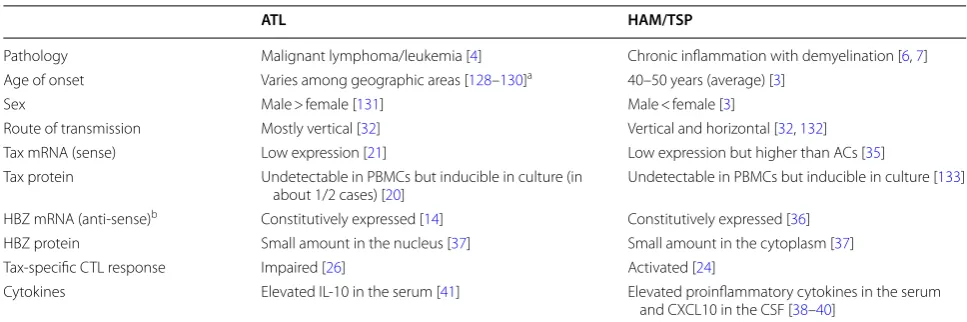
Differences between ATL and HAM/TSP
The differences between these two diseases are
summa-rized in Table
1
. There is a clear difference in sex;
inci-dence of ATL is greater in males, whereas inciinci-dence
of HAM/TSP is greater in females [
3
,
31
]. The route of
transmission also partly differs; ATL develops mainly in
the individuals infected through vertical routes, while
HAM/TSP develops in both populations infected via
ver-tical and horizontal routes [
32
]. Some differences in HLA
alleles have also been reported [
33
,
34
].
HTLV-1 Tax is undetectable at the protein level in
PBMCs from patients with either disease, while Tax
mRNA levels are slightly higher in HAM/TSP patients
than asymptomatic HTLV-1 carriers (ACs) [
35
]. HBZ
mRNA levels in PBMCs are higher in ATL than in HAM/
TSP, but the difference is reported to be insignificant
when standardized by proviral load [
36
]. A recent report
indicated that the localization of HBZ in infected cells
may differ between the diseases, with HBZ being
local-ized to the nucleus in ATL while it is present in the
cyto-plasm in HAM/TSP [
37
].
For HTLV-1-specific T-cell responses, there is a marked
difference between the two diseases. The Tax-specific
CTL response is elevated in HAM/TSP patients while
impaired in those suffering from ATL [
26
]. Because these
CTLs are supposedly critical for anti-tumor surveillance
in HTLV-1 infection, their impairment likely favors
leu-kemogenesis. However, the reason for the differing CTL
responses in the two diseases is not well understood,
and the immunosuppressive state in ATL patients may at
least be involved.
Mechanisms of immune suppression in ATL patients
In general, ATL patients are under
immunosuppres-sive conditions [
43
]. This may be partly attributed to
IL-10-dominant conditions in ATL patients [
41
]. Both Tax
and HBZ promote IL-10 production [
18
,
44
]. TGF-β
pro-duction from ATL cells may also contribute to immune
suppression. Tax promotes TGF-β production but
sup-presses TGF-β/Smad signaling in HTLV-1-infected cells
[
45
,
46
]. HBZ augments TGF-β/Smad signaling,
induc-ing FOXP3, which is frequently expressed in ATL cells,
although HBZ inhibits FOXP3 functions [
47
].
In addition to generalized immune suppression,
ATL patients exhibit impaired HTLV-1-specific T-cell
responses, even at earlier stages of the disease, such as
smoldering and chronic type ATL. This is not merely a
result of generalized immune suppression, as the T-cell
response against cytomegalovirus is mostly conserved at
early stages [
26
]. Such antigen-specific T-cell suppression
is usually established through immune tolerance and/
or T-cell exhaustion. In HTLV-1 infection, both
mecha-nisms are possible.
Because the major route of mother-to-child HTLV-1
infection is breastfeeding from an HTLV-1-infected
mother, newborn tolerance and/or oral tolerance may
potentially be induced. In a rat model, HTLV-1-specific
T-cell tolerance was induced by oral HTLV-1 infection,
resulting in elevated proviral load [
48
]. Epidemiological
studies indicate that vertical HTLV-1 infection is one of
the risk factors of ATL development [
32
], which could
be partly attributed to impaired HTLV-1-specific CTL
responses as a result of immune tolerance. The
mecha-nisms of immune tolerance involve regulatory T cells
(Tregs) producing IL-10 and TGF-β, potentially
contrib-uting to general immune suppression as well [
49
].
T-cell exhaustion due to persistent viral infection also
causes virus-specific immune suppression by
induc-tion of immune checkpoint receptors [
50
]. Expression
of programmed cell death protein-1 (PD-1) on
Tax-spe-cific CTL, and functional improvement of these cells by
blockade of the PD-1/PD-Ligand 1 (PD-L1) interaction
have been reported in ex vivo studies using PBMC from
HTLV-1-infected individuals including ATL patients [
51
,
52
]. Genetic alteration of PD-L1 in ATL cells to elevate
expression may promote T-cell exhaustion [
53
]. However,
a recent report indicated that the use of PD-1 antibody
(Nivolumab) in indolent types of ATL patients resulted
in disease progression [
54
], suggesting an anti-tumor role
of the PD-1/PD-L1 pathway at indolent stages of ATL.
Another clinical trial of PD-1 antibody for advanced stage
ATL patients is underway in Japan [
55
]. PD-1 expression
on HTLV-1-specific CTLs was reported to be lower in
HAM/TSP patients when compared with ACs [
56
],
sug-gesting that the status of T-cell exhaustion in Tax-specific
CTLs may differ between the diseases. Interestingly,
Table 1 Difference between ATL and HAM/TSP
ACs asymptomatic HTLV-1 carriers, ATL adult T-cell leukemia, CSF cerebrospinal fluid, CTL cytotoxic T lymphocyte, HAM/TSP HTLV-1 associated myelopathy/tropical spastic paraparesis, PBMC peripheral blood mononuclear cell, y years
a The mean ages of ATL onset reported are 43 y in Jamaica [128], 67.5 years in Japan [129], and 52 years in the United States [130] b Greater amounts of HBZ mRNA in ATL patients, while not significantly different when standardized by proviral loads [36]
ATL HAM/TSP
Pathology Malignant lymphoma/leukemia [4] Chronic inflammation with demyelination [6, 7]
Age of onset Varies among geographic areas [128–130]a 40–50 years (average) [3]
Sex Male > female [131] Male < female [3]
Route of transmission Mostly vertical [32] Vertical and horizontal [32, 132]
Tax mRNA (sense) Low expression [21] Low expression but higher than ACs [35]
Tax protein Undetectable in PBMCs but inducible in culture (in
about 1/2 cases) [20] Undetectable in PBMCs but inducible in culture [133] HBZ mRNA (anti-sense)b Constitutively expressed [14] Constitutively expressed [36]
HBZ protein Small amount in the nucleus [37] Small amount in the cytoplasm [37]
Tax-specific CTL response Impaired [26] Activated [24]
Cytokines Elevated IL-10 in the serum [41] Elevated proinflammatory cytokines in the serum
[image:3.595.55.539.99.260.2]HBZ induces another immune checkpoint molecule, T
cell immunoglobulin and ITIM domain (TIGIT), and
interacts with thymocyte expressed molecule involved
in selection (THEMIS) that binds to SHP-2, resulting in
inhibition of the checkpoint functions and localization of
HBZ itself in the cytoplasm [
57
,
58
].
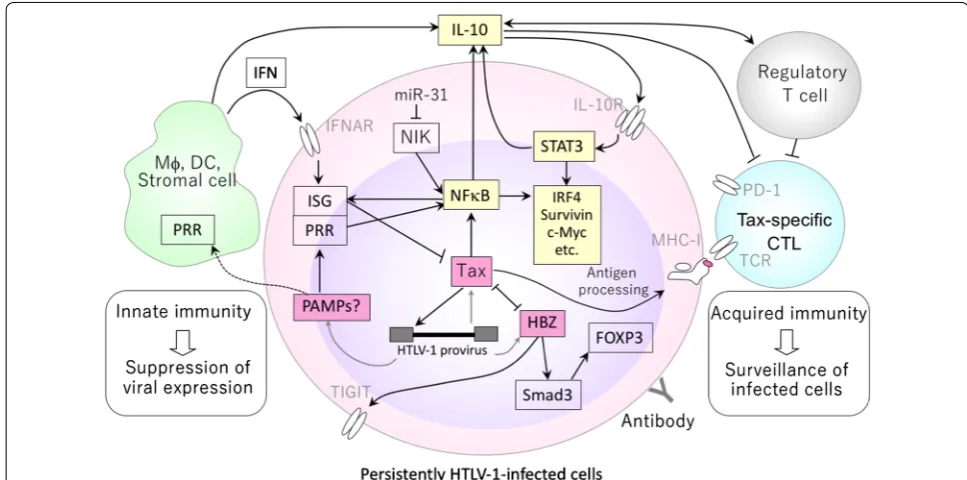
IL‑10‑mediated signals as a switch toward leukemogenesis
While IL-10 is known to suppress inflammation
and T-cell immune responses [
59
], our recent study
indicated that IL-10 may play a more active role in
leukemogenesis by promoting proliferation of
HTLV-1-infected cells [
60
]. Exogenously added IL-10
con-verted the otherwise slow-growing IL-2-dependent
HTLV-1-infected T-cell lines derived from HAM/TSP
patients into fast-growing ones. This was associated
with phosphorylation of STAT3 and induction of
sur-vivin, IRF4, and IL-10, all of which are characteristic of
ATL cells. This finding strongly suggests that auto- or
paracrine IL-10 produced by the HTLV-1-infected cell
and/or the surrounding microenvironment might
trig-ger positive feedback regulation of cell proliferation
and switch the fate of HTLV-1-infected cells towards
leukemogenesis (Fig.
1
).
Recently, Kagdi, et al. reported that IL-10 is produced
by only a small fraction of HTLV-1-infected PBMCs but
not by the majority of ATL cells, resulting in elevated
IL-10 levels in the sera in ATL patients [
42
]. These data
suggest that the source of IL-10 production may not
necessarily be ATL cells themselves but could be
non-malignant HTLV-1-infected cells. A wide variety of
HTLV-1-uninfected cells including helper T cells, Tregs,
monocytes, macrophages, and dendritic cells can also be
the source of IL-10 production.
As an environmental factor,
Strongyloides
stercora-lis
infection is often associated with ATL [
61
,
62
]. It is
intriguing that
S. stercoralis
infection induces IL-10 and
TGF-β [
63
]. This persistent IL-10-predominated cytokine
skewing in vivo produced by
S. stercoralis
infection might
be a risk factor for ATL development. The microbiome
could also be an important determinant for
immunologi-cal status and worthy of investigation in HTLV-1-infected
individuals to find any association with risk of disease
development.
[image:4.595.54.538.387.627.2]Prolonged IFN activation by persistent viral infection
can produce an IL-10-predominant cytokine
imbal-ance in the host, which contributes to T-cell
exhaus-tion through inducexhaus-tion of PD-1 expression, as shown in
the lymphocytic choriomeningitis virus-infected mouse
model [
64
,
65
]. Similarly, persistent HTLV-1
infec-tion itself might potentially cause IL-10 predominant
conditions.
Genetic factors also potentially influence IL-10
pro-duction in persistent viral infections. In HIV-1 infection,
single nucleotide polymorphism (SNP) of the IL-10
pro-moter (-592A) has been implicated in increased
suscep-tibility to HIV-1 infection and AIDS progression [
66
].
In HTLV-1 infection, a previous report indicated that
the -592A allele of the IL-10 promoter was associated
with lower HTLV-1 proviral loads and lower
Tax-medi-ated IL-10 transcription than -592C [
67
]. Association of
the -592A allele with lower susceptibility to HAM/TSP
has also been suggested in individuals from Kagoshima,
Japan [
67
], although it was not significant in Brazilian
population [
68
].
What suppresses HTLV‑1 expression in vivo?
HTLV‑1 expression in vivo and in vitro
The fact that most HTLV-1-infected individuals
main-tain HTLV-1-specific antibodies implies the presence
of HTLV-1 antigens in vivo. However, HTLV-1 Tax and
structural proteins are not detectable in freshly isolated
PBMCs from HTLV-1-infected individuals. One of the
most peculiar phenomena in HTLV-1 expression is the
rapid induction of HTLV-1 expression in PBMCs from
HTLV-1-infected individuals in short-term culture, in
which Tax becomes detectable first, followed by
expres-sion of other structural proteins (Fig.
2
a) [
20
]. HTLV-1
mRNA also rapidly increases within several hours in
cul-ture [
69
].
Such spontaneous induction of HTLV-1 expression in
culture of primary PBMCs is observed in asymptomatic
HTLV-1 carriers, HAM/TSP patients and about half of
ATL patients. In the remaining ATL cases, the ATL cells
do not express Tax even after culture because of genetic
alterations and epigenetic silencing of HTLV-1 gene
expression [
70
].
The mechanism of the on/off switch of HTLV-1 Tax
expression in vitro and in vivo is not well understood.
Requirement of TORC family proteins in long terminal
repeat (LTR)-driven Tax expression [
71
] and decreased
expression of TORC2 in vivo have been reported [
72
].
Positive regulation of Tax expression may involve
stress-induced responses, as hypoxia enhanced HTLV-1
tran-scription [
73
], and p38 MAPK was up-regulated in
primary HTLV-1-infected cells from HAM/TSP patients
during spontaneous viral induction at primary culture
[
74
]. Involvement of p38 MAPK was also shown in
IL-2-dependent HTLV-1-infected cell lines derived from
ATL patients, in which removal of IL-2 resulted in
acti-vation of p38 MAPK and up-regulation of HTLV-1
expression [
75
]. Conversely, inhibition of glycolysis and
the mitochondrial electron transport chain reduced the
induction of HTLV-1 expression [
73
].
Negative regulation of HTLV-1 expression may involve
type-I IFN responses. Although HTLV-1-transformed
cells such as MT-2 cells are known to be resistant to
type I IFN [
76
], IFNα suppresses HTLV-1 expression in
IL-2-dependent HTLV-1-infected cell lines,
presum-ably because of much lower Tax expression in these cells
compared with MT-2 cells. It is well established that
Tax inhibits IFN signals by several mechanisms
includ-ing inhibition of JAK/STAT signalinclud-ing [
77
], competition
of CBP/p300 [
78
], induction of SOCS1 [
79
] and
inhibi-tion of IRF3 phosphorylainhibi-tion [
80
]. Because there are no
detectable levels of Tax in PBMCs of HTLV-1-infected
individuals, PBMCs likely retain susceptibility to IFNs.
Indeed, IFNα suppresses the spontaneous viral induction
in primary ATL cells following ex vivo culture (Fig.
2
b)
[
81
]. IFNα also suppresses de novo HTLV-1 infection
[
82
].
Furthermore, when IL-2-dependent HTLV-1-infected
cells are co-cultured with stromal cells, viral
expres-sion becomes undetectable, yet recovers again when
the infected cells are re-isolated and cultured alone
(Fig.
2
c) [
83
]. This resembles the spontaneous
induc-tion of HTLV-1 expression in primary ATL cells
follow-ing culture ex vivo. Stromal cell-mediated suppression of
HTLV-1 expression involves type I IFN, as the
suppres-sion can be abrogated by blockade of the IFNα/β receptor
[
83
].
IFN signature in HTLV‑1‑infected cells
I IFN production, supporting the notion of a local IFN
response [
86
].
Although systemic type I IFN responses are apparently
absent in HTLV-1-infected individuals, HTLV-1-infected
cell lines and ATL cells express elevated levels of ISGs
such as 2
′
,5
′
-oligoadenylate synthetase, IP-10, and
RNA-dependent protein kinase (PKR) [
87
,
88
]. An IFN
signal-ing signature is also observed in HAM/TSP patients [
89
].
Forced expression of Tax by a retroviral vector can induce
these ISGs in vitro mainly through NFκB activation [
87
].
However, fresh HTLV-1-infected PBMC do not express
detectable levels of Tax. It is unclear whether such
mar-ginal levels of Tax can induce NFκB and ISG.
Further-more, NFκB is activated even in Tax-negative ATL cells
[
10
]. Therefore, there must be alternative mechanisms of
NFκB and ISG activation, besides Tax.
Constitutive NFκB activation in Tax-negative ATL
cells is associated with increased NF-κB-inducing kinase
(NIK) [
90
]. Downregulation of miR-31 by polycomb
pro-teins has been shown to increase NIK, leading to NFκB
activation in ATL cells [
91
]. In advanced stages of ATL,
genetic alterations in T-cell receptor signaling pathway
mediators in ATL cells may also be involved in the
mech-anisms of NF-κB activation [
92
].
Another candidate that may mediate activation of
NFκB and ISG could be pattern recognition
recep-tors (PRRs) that recognize various pathogen-associated
molecular patterns (PAMPs) and potentially mediate
NFκB and IRF3 downstream [
93
]. In de novo infection
with cell-free HTLV-1, pDCs or monocytes can be
acti-vated to produce IFNα through signaling pathways
medi-ated by TLR7 or STING, presumably recognizing
HTLV-1 RNA or reverse transcribed intermediate DNA
[
94
,
95
]. However, in persistently HTLV-1-infected
T-cells in vivo, production of cell-free HTLV-1 is limited.
Primary ATL cells express anti-sense RNAs from the
HTLV-1 provirus, which include not only HBZ RNA but
also anti-sense RNAs containing the HTLV-1 LTR region
that are read through from the cellular flanking region
[
96
]. Although HBZ does not activate NFκB, the latter
RNAs might, as knockdown of these anti-sense RNAs
reduced NIK expression and NFκB activity in the
Tax-negative ATL cell line ED40515(-). A similar effect was
obtained by the use of a PKR-inhibitor. The constitutive
expression of anti-sense RNAs containing the HTLV-1
LTR region might potentially stimulate PRRs such as
PKR to activate NFκB downstream [
96
]. In support of
this notion, a previous report indicated that RNA at the
Rex-responsive element in the LTR potentially activates
ISG [
88
].
Mechanisms of action of AZT/IFNα therapy
Combination therapy with azidothymidine and IFNα
(AZT/IFNα) has been used for ATL patients [
97
,
98
] and
shows good clinical responses, especially in indolent-type
ATL, but is associated with frequent relapses after
ces-sation of treatment [
99
,
100
]. Although AZT alone does
not affect cell growth, IFN-α induces cell growth arrest
with reduction of Tax expression, and AZT/IFNα induces
p53 activation leading to cell apoptosis in
IL-2-depend-ent HTLV-1infected cells [
81
]. This is consistent with
the clinical observation that the AZT/IFNα is effective
in ATL cases without p53 mutations [
101
]. In
HTLV-1-transformed cells, the combination of arsenic trioxide
and IFN-α also induces cell cycle arrest and apoptosis
by degradation of Tax and reversal of NFκB activation
[
102
]. In other malignancies, IFN is known to up-regulate
p53 and enhance susceptibility to chemotherapy [
103
].
ATL cells spontaneously exhibit enhanced levels of p53,
while its function is impaired [
104
,
105
]. As Tax has been
shown to inhibit p53 signaling [
12
,
106
,
107
], IFNα might
suppress Tax expression to such a level that it is unable
to affect p53 activation in response to AZT
incorpora-tion. However, a recent report indicated the involvement
of p53 in AZT/IFNα-mediated apoptosis in Tax-negative
ATL cell lines or primary ATL cells as well, suggesting
the presence of an additional Tax-independent
mecha-nism [
108
].
Significance of Tax‑targeted therapeutic vaccine
in the anti‑ATL response
Anti‑tumor effect of Tax‑specific CTLs
HTLV-1-specific T-cell responses are observed in most
asymptomatic HTLV-1 carriers and HAM/TSP patients,
but impaired in ATL patients. Tax is the major target
antigen for T-cells [
24
,
25
]. Env is another common target
for the T-cell response [
109
], while HTLV-1 pol, p12, and
p13-specific CTLs have also been reported [
110
,
111
].
These proteins are all encoded in the sense strand of the
provirus. HBZ, encoded in the anti-sense strand, is
con-stitutively expressed in infected cells and also recognized
by CTLs [
23
]. However, the frequency of HBZ-specific
CTLs is much lower than that of Tax-specific CTLs [
112
].
HBZ-transfected cells but not HTLV-1-infected cells
were efficiently killed by experimentally induced
HBZ-specific CTLs, suggesting limited HBZ antigen
presenta-tion in the infected cells; however the reason for this is
unknown [
113
].
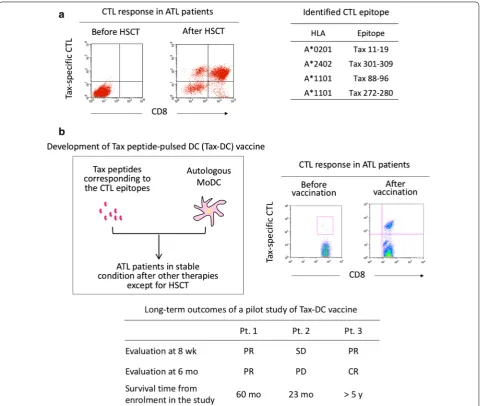
following chemotherapy is recommended in Japan and
has been shown to achieve long-term survival in
one-third of recipients [
114
,
115
]. In ATL patients who
obtained complete remission (CR) after HSCT,
acti-vation of the CD8
+
Tax-specific CTL response is
fre-quently observed [
116
]. This is a consequence of a de
novo immune response of donor-derived T-cells in the
recipient, indicating Tax antigen presentation in vivo
(Fig.
3
a).
Anti-tumor effects of CD8
+
Tax-specific CTLs
have been shown in an animal model, in which
HTLV-1-infected lymphomas in nude rats were eradicated by
adoptive transfer of syngeneic Tax-specific CTLs that
had been induced by vaccines using Tax-coding DNA
[
117
] or Tax peptide with a CpG DNA adjuvant [
118
].
The findings in the ATL patients after HSCT and the
animal experiments encouraged development of an
anti-ATL Tax-targeted vaccine.
Tax peptide‑pulsed dendritic cell (Tax‑DC) vaccine in ATL
patients
The first anti-ATL therapeutic vaccine was designed to
activate CD8
+
Tax-specific CTLs by using Tax peptides
as antigen and autologous DCs as adjuvant (Fig.
3
b)
[image:8.595.59.540.251.657.2][
28
,
119
]. The Tax peptides used corresponded to the
major epitopes of Tax-specific CTLs restricted to
HLA-A*0201, A*2402, and A*1101, which were identified in
ATL patients after HSCT [
116
,
120
]. For DC, autologous
monocyte-derived DCs were maturated in vitro prior to
peptide loading because ATL patients are under
immu-nosuppressive conditions leading to dysfunction of DCs
[
121
].
In the initial pilot study, three ATL patients who
were in stable conditions after other therapies except
for HSCT were subcutaneously injected with Tax
pep-tide-pulsed autologous DCs three times at fortnightly
intervals. All three patients showed clear proliferative
responses of Tax-specific CTLs after vaccination
with-out severe adverse effects [
28
]. Clinical evaluation of the
three patients at 6 months was partial response,
progres-sive disease (PD), and CR. In the patient with PD, the
lymphoma cells at relapse lacked the ability to express
Tax. Survival periods of the three patients after
vaccina-tion were 60, 23, and > 60 months. The Tax-DC vaccine is
currently under phase I trial, in which an additional three
patients have received the Tax-DC vaccine with the same
regimen and have maintained CR at least for 2 years after
vaccination.
These favorable clinical outcomes of the Tax-DC
vac-cine indicate the significance of Tax-specific CTLs in
maintenance of remission, although they may become
ineffective when Tax-negative ATL clones emerge.
Limitations and prospects of Tax‑targeted vaccine
In ATL patients, half of the cases retain the ability to
express Tax in ATL cells, while the other half lose this
ability [
20
]. Therefore, the therapeutic effects of
Tax-targeted immunotherapy are expected in the former
but not in the latter patients. Even in the former cases,
innate immune responses suppress Tax expression to
various extents in tissues. Therefore, Tax-specific CTLs
are presumed to kill only a limited fraction of the
HTLV-1-infected cell population. Nevertheless, the results of a
clinical study of the Tax-DC vaccine suggested the
contri-bution of Tax-specific CTLs to control ATL cells at least
in the cases retaining potential Tax expression. This may
be partly because CTLs can recognize a much lower level
of Tax antigen than the limit of detection by flow
cytom-etry [
122
]. Alternatively, the presence of a small number
of Tax-positive cells might play a critical role in
support-ing other HTLV-1 infected cells without Tax expression.
The importance of Tax-positive cells has been shown in
an ATL-derived MT-1 cell line with only a small
percent-age of Tax-positive cells, in which knockdown of Tax
expression resulted in apoptosis of the whole cell
popula-tion [
123
]. A recent study using single cell mRNA FISH
visualized Tax mRNA bursts only in a small proportion
of cultured clones of the PBMCs isolated from
HTLV-1-infected individuals [
124
].
In ATL patients whose ATL cells lack Tax expression,
Tax-specific CTLs cannot directly attack ATL cells.
How-ever, these CTLs may still control subdominant
HTLV-1-infected cell clones that retain the ability to express
Tax, because there are multiple HTLV-1-infected cell
clones and the dominant ATL clones sometimes differ
among tissues and change during the disease course [
125
,
126
].
Since it takes several weeks to induce immune
responses, the Tax-targeted vaccine cannot be the first
line therapy for aggressive types of ATL. In the
clini-cal studies, Tax-DC vaccines were administered in ATL
patients as a maintenance therapy after chemotherapy.
Indolent types of ATL such as smoldering and chronic
ATL may be more responsive to the vaccine, as ATL cells
likely retain the ability to express Tax more frequently
compared with aggressive ATL. Although HAM/TSP
patients may also retain the ability to express Tax, HAM/
TSP patients usually have active Tax-specific CTLs and
less likely benefit from additional vaccines.
Once its safety and efficacy are confirmed, Tax-targeted
vaccines might potentially be applied for prophylaxis of
ATL development in the future. A small proportion of
ACs exhibit insufficient Tax-specific CTL response and
elevated proviral load [
26
], both of which are considered
as risk factors of ATL. These ACs may be the possible
tar-get population for prophylactic therapy. In a rat model
of oral HTLV-1 infection with immune tolerance,
Tax-DC vaccine successfully induced Tax-specific CTLs and
reduced the HTLV-1 proviral load, suggesting the
prom-ising prophylactic potential of Tax-targeting vaccines
against ATL [
127
].
Conclusion
The complexity of disease mechanisms in HTLV-1
infection results from the host immune responses in
concert with HTLV-1-encoded genes (Fig.
1
). Although
HTLV-1-encoded genes provide multiple mechanisms
to activate cells, HTLV-1 infection alone is not
suffi-cient for cell proliferation. IL-10-dominant cytokine
skewing could be one of the conditions inducing a
pro-liferative phenotype in HTLV-1-infected cells by
stim-ulating the intrinsic STAT3-IRF4 pathway. Together
with its anti-inflammatory/immunosuppressive
prop-erty, IL-10 signaling may act as a switch between
lym-phoproliferation and inflammation, driving disease
towards ATL development at the early stages.
expression at low equilibrium levels in various tissues
in vivo. The presence of an IFN signature in
HTLV-1-infected cells implies continuous innate immune
stimulations going on in these cells, which might also
contribute to pathogenesis in HTLV-1 infection.
While Tax protein is undetectable by serological
means in vivo, Tax-specific CTLs still seem to
recog-nize HTLV-1-infected cells to some extent. The results
of a clinical study of a Tax-targeted therapeutic vaccine
in ATL patients indicated a greater impact of
Tax-spe-cific CTLs on immune surveillance of HTLV-1 infected
cells than expected, again suggesting the presence of
Tax expression in vivo. Although further investigation
is required, this opens up a new door to early therapy
and prophylaxis against ATL.
Abbreviations
AC: asymptomatic HTLV-1 carrier; ATL: adult T-cell leukemia/lymphoma; AZT: azidothymidine; CR: complete remission; CTL: cytotoxic T lymphocyte; DC: dendritic cell; HAM/TSP: HTLV-1-associated myelopathy/tropical spastic para-paresis; HBZ: HTLV-1 basic leucine zipper factor; HSCT: hematopoietic stem cell transplantation; HTLV-1: human T-cell leukemia virus type-1; IFN: interferon; ISG: interferon stimulated gene; LTR: long terminal repeat; NIK: NF-κB-inducing kinase; PAMP: pathogen-associated molecular pattern; PBMC: peripheral blood mononuclear cell; PD: progressive disease; PD-1: programmed cell death protein -1; PD-L1: PD-Ligand 1; PKR: RNA-dependent protein kinase; PRR: pattern recognition receptor; SNP: single nucleotide polymorphism; THEMIS: thymocyte expressed molecule involved in selection.
Acknowledgements
We thank Gillian Campbell, PhD, from Edanz Group (https ://www.edanz editi ng.com/ac) for editing a draft of this manuscript.
Authors’ contributions
MK planed and wrote the manuscript. All authors read and approved the final manuscript.
Funding
The studies described here were partly supported by the research grant of the Princess Takamatsu Cancer Research Fund (01-23302) and the grants (16fk0108315h, 17cm0106315h, 18ck0106371h, and 19ck0106482s0101) from Japan Agency for Medical Research and Development.
Availability of data and materials Not applicable.
Ethics approval and consent to participate
The clinical study of Tax-DC vaccine referred in this review had been approved by the institutional ethics committee and registered as UMIN000011423.
Consent for publication Not applicable.
Competing interests
The authors declare that they have no competing interests.
Author details
1 Department of Immunotherapeutics, Graduate School of Medical and Dental
Sciences, Tokyo Medical and Dental University, 1-5-45 Yushima, Bunkyo-ku, Tokyo 113-8519, Japan. 2 Department of Immunology, Graduate School
of Medical and Dental Sciences, Tokyo Medical and Dental University, Tokyo, Japan. 3 Department of Hematology, National Kyushu Cancer Center, Fukuoka,
Japan.
Received: 21 June 2019 Accepted: 12 August 2019
References
1. Murphy EL, Hanchard B, Figueroa JP, Gibbs WN, Lofters WS, Campbell M, Goedert JJ, Blattner WA. Modelling the risk of adult T-cell leukemia/ lymphoma in persons infected with human T-lymphotropic virus type I. Int J Cancer. 1989;43:250–3.
2. Kaplan JE, Osame M, Kubota H, Igata A, Nishitani H, Maeda Y, Khabbaz RF, Janssen RS. The risk of development of HTLV-I-associated myelopa-thy/tropical spastic paraparesis among persons infected with HTLV-I. J Acquir Immune Defic Syndr. 1990;3:1096–101.
3. Maloney EM, Cleghorn FR, Morgan OS, Rodgers-Johnson P, Cranston B, Jack N, Blattner WA, Bartholomew C, Manns A. Incidence of HTLV-I-associated myelopathy/tropical spastic paraparesis (HAM/TSP) in Jamaica and Trinidad. J Acquir Immune Defic Syndr Hum Retrovirol. 1998;17:167–70.
4. Uchiyama T, Yodoi J, Sagawa K, Takatsuki K, Uchino H. Adult T-cell leukemia: clinical and hematologic features of 16 cases. Blood. 1977;50:481–92.
5. Katsuya H, Ishitsuka K, Utsunomiya A, Hanada S, Eto T, Moriuchi Y, Saburi Y, Miyahara M, Sueoka E, Uike N, et al. Treatment and survival among 1594 patients with ATL. Blood. 2015;126:2570–7.
6. Gessain A, Barin F, Vernant JC, Gout O, Maurs L, Calender A, de The G. Antibodies to human T-lymphotropic virus type-I in patients with tropi-cal spastic paraparesis. Lancet. 1985;2:407–10.
7. Osame M, Usuku K, Izumo S, Ijichi N, Amitani H, Igata A, Matsumoto M, Tara M. HTLV-I associated myelopathy, a new clinical entity. Lancet. 1986;1:1031–2.
8. Kamoi K, Mochizuki M. HTLV-1 uveitis. Front Microbiol. 2012;3:270. 9. Einsiedel L, Fernandes L, Spelman T, Steinfort D, Gotuzzo E.
Bronchiec-tasis is associated with human T-lymphotropic virus 1 infection in an Indigenous Australian population. Clin Infect Dis. 2012;54:43–50. 10. Mori N, Fujii M, Ikeda S, Yamada Y, Tomonaga M, Ballard DW, Yamamoto
N. Constitutive activation of NF-kappaB in primary adult T-cell leukemia cells. Blood. 1999;93:2360–8.
11. Sodroski J, Rosen C, Goh WC, Haseltine W. A transcriptional activator protein encoded by the x-lor region of the human T-cell leukemia virus. Science. 1985;228:1430–4.
12. Yoshida M. Multiple viral strategies of HTLV-1 for dysregulation of cell growth control. Annu Rev Immunol. 2001;19:475–96.
13. Mesnard JM, Barbeau B, Cesaire R, Peloponese JM. Roles of HTLV-1 basic Zip Factor (HBZ) in Viral chronicity and leukemic transformation. Poten-tial new therapeutic approaches to prevent and treat HTLV-1-related diseases. Viruses. 2015;7:6490–505.
14. Satou Y, Yasunaga J, Yoshida M, Matsuoka M. HTLV-I basic leucine zipper factor gene mRNA supports proliferation of adult T cell leukemia cells. Proc Natl Acad Sci USA. 2006;103:720–5.
15. Iwakura Y, Tosu M, Yoshida E, Takiguchi M, Sato K, Kitajima I, Nishioka K, Yamamoto K, Takeda T, Hatanaka M, et al. Induction of inflammatory arthropathy resembling rheumatoid arthritis in mice transgenic for HTLV-I. Science. 1991;253:1026–8.
16. Grossman WJ, Kimata JT, Wong FH, Zutter M, Ley TJ, Ratner L. Develop-ment of leukemia in mice transgenic for the tax gene of human T-cell leukemia virus type I. Proc Natl Acad Sci USA. 1995;92:1057–61. 17. Sugata K, Satou Y, Yasunaga J, Hara H, Ohshima K, Utsunomiya A,
Mitsuyama M, Matsuoka M. HTLV-1 bZIP factor impairs cell-mediated immunity by suppressing production of Th1 cytokines. Blood. 2012;119:434–44.
18. Matsuoka M, Yasunaga J. Human T-cell leukemia virus type 1: replica-tion, proliferation and propagation by Tax and HTLV-1 bZIP factor. Curr Opin Virol. 2013;3:684–91.
19. Edwards D, Fenizia C, Gold H, de Castro-Amarante MF, Buchmann C, Pise-Masison CA, Franchini G. Orf-I and orf-II-encoded proteins in HTLV-1 infection and persistence. Viruses. 2011;3:861–85.
21. Kinoshita T, Shimoyama M, Tobinai K, Ito M, Ito S, Ikeda S, Tajima K, Shimotohno K, Sugimura T. Detection of mRNA for the Tax1/Rex1 gene of human T-cell leukemia virus type I in fresh peripheral blood mono-nuclear cells of adult T-cell leukemia patients and viral carriers by using the polymerase chain reaction. Proc Natl Acad Sci USA. 1989;86:5620–4. 22. Raval GU, Bidoia C, Forlani G, Tosi G, Gessain A, Accolla RS. Localization,
quantification and interaction with host factors of endogenous HTLV-1 HBZ protein in infected cells and ATL. Retrovirology. 2015;12:59. 23. Hilburn S, Rowan A, Demontis MA, MacNamara A, Asquith B, Bangham
CR, Taylor GP. In vivo expression of human T-lymphotropic virus type 1 basic leucine-zipper protein generates specific CD8+ and CD4+
T-lymphocyte responses that correlate with clinical outcome. J Infect Dis. 2011;203:529–36.
24. Jacobson S, Shida H, McFarlin DE, Fauci AS, Koenig S. Circulating CD8+
cytotoxic T lymphocytes specific for HTLV-I pX in patients with HTLV-I associated neurological disease. Nature. 1990;348:245–8.
25. Kannagi M, Harada S, Maruyama I, Inoko H, Igarashi H, Kuwashima G, Sato S, Morita M, Kidokoro M, Sugimoto M, et al. Predominant recogni-tion of human T cell leukemia virus type I (HTLV-I) pX gene products by human CD8+ cytotoxic T cells directed against HTLV-I-infected cells. Int Immunol. 1991;3:761–7.
26. Takamori A, Hasegawa A, Utsunomiya A, Maeda Y, Yamano Y, Masuda M, Shimizu Y, Tamai Y, Sasada A, Zeng N, et al. Functional impairment of Tax-specific but not cytomegalovirus-specific CD8+ T lymphocytes in a minor population of asymptomatic human T-cell leukemia virus type 1-carriers. Retrovirology. 2011;8:100.
27. Kannagi M, Ohashi T, Harashima N, Hanabuchi S, Hasegawa A. Immuno-logical risks of adult T-cell leukemia at primary HTLV-I infection. Trends Microbiol. 2004;12:346–52.
28. Suehiro Y, Hasegawa A, Iino T, Sasada A, Watanabe N, Matsuoka M, Takamori A, Tanosaki R, Utsunomiya A, Choi I, et al. Clinical outcomes of a novel therapeutic vaccine with Tax peptide-pulsed dendritic cells for adult T cell leukaemia/lymphoma in a pilot study. Br J Haematol. 2015;169:356–67.
29. Poiesz BJ, Ruscetti FW, Gazdar AF, Bunn PA, Minna JD, Gallo RC. Detec-tion and isolaDetec-tion of type C retrovirus particles from fresh and cultured lymphocytes of a patient with cutaneous T-cell lymphoma. Proc Natl Acad Sci USA. 1980;77:7415–9.
30. Hinuma Y, Nagata K, Hanaoka M, Nakai M, Matsumoto T, Kinoshita KI, Shirakawa S, Miyoshi I. Adult T-cell leukemia: antigen in an ATL cell line and detection of antibodies to the antigen in human sera. Proc Natl Acad Sci USA. 1981;78:6476–80.
31. Tajima K. Malignant lymphomas in Japan: epidemiological analysis of adult T-cell leukemia/lymphoma (ATL). Cancer Metastasis Rev. 1988;7:223–41.
32. Bartholomew C, Jack N, Edwards J, Charles W, Corbin D, Cleghorn FR, Blattner WA. HTLV-I serostatus of mothers of patients with adult T-cell leukemia and HTLV-I-associated myelopathy/tropical spastic parapare-sis. J Hum Virol. 1998;1:302–5.
33. Jeffery KJ, Usuku K, Hall SE, Matsumoto W, Taylor GP, Procter J, Bunce M, Ogg GS, Welsh KI, Weber JN, et al. HLA alleles determine human T-lymphotropic virus-I (HTLV-I) proviral load and the risk of HTLV-I-associated myelopathy. Proc Natl Acad Sci USA. 1999;96:3848–53. 34. Usuku K, Sonoda S, Osame M, Yashiki S, Takahashi K, Matsumoto M,
Sawada T, Tsuji K, Tara M, Igata A. HLA haplotype-linked high immune responsiveness against HTLV-I in HTLV-I-associated myelopathy: comparison with adult T-cell leukemia/lymphoma. Ann Neurol. 1988;23(Suppl):S143–50.
35. Yamano Y, Nagai M, Brennan M, Mora CA, Soldan SS, Tomaru U, Takenouchi N, Izumo S, Osame M, Jacobson S. Correlation of human T-cell lymphotropic virus type 1 (HTLV-1) mRNA with proviral DNA load, virus-specific CD8(+) T cells, and disease severity in HTLV-1-associated myelopathy (HAM/TSP). Blood. 2002;99:88–94.
36. Saito M, Matsuzaki T, Satou Y, Yasunaga J, Saito K, Arimura K, Matsuoka M, Ohara Y. In vivo expression of the HBZ gene of HTLV-1 correlates with proviral load, inflammatory markers and disease severity in HTLV-1 associated myelopathy/tropical spastic paraparesis (HAM/TSP). Retrovi-rology. 2009;6:19.
37. Baratella M, Forlani G, Accolla RS. HTLV-1 HBZ viral protein: a key player in HTLV-1 mediated diseases. Front Microbiol. 2017;8:2615.
38. Neco H, Teixeira V, da Trindade ACL, Magalhaes PMR, de Lorena VMB, Castellano LRC, de Souza JR, Vasconcelos LR, de Moura P, de Morais CNL. Mediators go together: high Production of CXCL9, CXCL10, IFN-gamma, and TNF-alpha in HTLV-1-associated myelopathy/tropical spastic paraparesis. AIDS Res Hum Retroviruses. 2017;33:1134–9. 39. Futsch N, Prates G, Mahieux R, Casseb J, Dutartre H. Cytokine networks
dysregulation during HTLV-1 infection and associated diseases. Viruses. 2018;10:691.
40. Yamano Y, Coler-Reilly A. HTLV-1 induces a Th1-like state in CD4(+) CCR4(+) T cells that produces an inflammatory positive feedback loop via astrocytes in HAM/TSP. J Neuroimmunol. 2017;304:51–5.
41. Inagaki A, Ishida T, Ishii T, Komatsu H, Iida S, Ding J, Yonekura K, Takeuchi S, Takatsuka Y, Utsunomiya A, Ueda R. Clinical significance of serum Th1-, Th2- and regulatory T cells-associated cytokines in adult T-cell leukemia/lymphoma: high interleukin-5 and -10 levels are significant unfavorable prognostic factors. Int J Cancer. 2006;118:3054–61. 42. Kagdi H, Demontis MA, Ramos JC, Taylor GP. Switching and loss of
cellular cytokine producing capacity characterize in vivo viral infection and malignant transformation in human T-lymphotropic virus type 1 infection. PLoS Pathog. 2018;14:e1006861.
43. Tashiro T, Yamasaki T, Nagai H, Kikuchi H, Nasu M. Immunological studies on opportunistic infection and the development of adult T-cell leukemia. Intern Med. 1992;31:1132–6.
44. Mori N, Gill PS, Mougdil T, Murakami S, Eto S, Prager D. Interleukin-10 gene expression in adult T-cell leukemia. Blood. 1996;88:1035–45. 45. Kim SJ, Kehrl JH, Burton J, Tendler CL, Jeang KT, Danielpour D, Thevenin
C, Kim KY, Sporn MB, Roberts AB. Transactivation of the transforming growth factor beta 1 (TGF-beta 1) gene by human T lymphotropic virus type 1 Tax: a potential mechanism for the increased production of TGF-beta 1 in adult T cell leukemia. J Exp Med. 1990;172:121–9.
46. Mori N, Morishita M, Tsukazaki T, Giam CZ, Kumatori A, Tanaka Y, Yama-moto N. Human T-cell leukemia virus type I oncoprotein Tax represses Smad-dependent transforming growth factor beta signaling through interaction with CREB-binding protein/p300. Blood. 2001;97:2137–44. 47. Zhao T, Satou Y, Sugata K, Miyazato P, Green PL, Imamura T, Matsuoka M.
HTLV-1 bZIP factor enhances TGF-beta signaling through p300 coacti-vator. Blood. 2011;118:1865–76.
48. Hasegawa A, Ohashi T, Hanabuchi S, Kato H, Takemura F, Masuda T, Kannagi M. Expansion of human T-cell leukemia virus type 1 (HTLV-1) reservoir in orally infected rats: inverse correlation with HTLV-1-specific cellular immune response. J Virol. 2003;77:2956–63.
49. Weiner HL, da Cunha AP, Quintana F, Wu H. Oral tolerance. Immunol Rev. 2011;241:241–59.
50. McLane LM, Abdel-Hakeem MS, Wherry EJ. CD8 T cell exhaus-tion during chronic viral infecexhaus-tion and cancer. Annu Rev Immunol. 2019;37:457–95.
51. Kozako T, Yoshimitsu M, Fujiwara H, Masamoto I, Horai S, White Y, Aki-moto M, Suzuki S, Matsushita K, Uozumi K, et al. PD-1/PD-L1 expression in human T-cell leukemia virus type 1 carriers and adult T-cell leukemia/ lymphoma patients. Leukemia. 2009;23:375–82.
52. Masaki A, Ishida T, Suzuki S, Ito A, Narita T, Kinoshita S, Ri M, Kusumoto S, Komatsu H, Inagaki H, et al. Human T-cell lymphotropic/leukemia virus type 1 (HTLV-1) Tax-specific T-cell exhaustion in HTLV-1-infected individuals. Cancer Sci. 2018;109:2383–90.
53. Kataoka K, Shiraishi Y, Takeda Y, Sakata S, Matsumoto M, Nagano S, Maeda T, Nagata Y, Kitanaka A, Mizuno S, et al. Aberrant PD-L1 expression through 3′-UTR disruption in multiple cancers. Nature. 2016;534:402–6.
54. Ratner L, Waldmann TA, Janakiram M, Brammer JE. Rapid progression of adult T-cell leukemia–lymphoma after PD-1 inhibitor therapy. N Engl J Med. 2018;378:1947–8.
55. Ishitsuka K, Utsunomiya A, Ishida T. PD-1 inhibitor therapy in adult T-cell leukemia–lymphoma. N Engl J Med. 2018;379:695.
56. Kozako T, Yoshimitsu M, Akimoto M, White Y, Matsushita K, Soeda S, Shimeno H, Kubota R, Izumo S, Arima N. Programmed death-1 (PD-1)/ PD-1 ligand pathway-mediated immune responses against human T-lymphotropic virus type 1 (HTLV-1) in HTLV-1-associated myelopathy/ tropical spastic paraparesis and carriers with autoimmune disorders. Hum Immunol. 2011;72:1001–6.
impeding the suppressive signaling of co-inhibitory receptors. PLoS Pathog. 2017;13:e1006120.
58. Yasuma K, Yasunaga J, Takemoto K, Sugata K, Mitobe Y, Takenouchi N, Nakagawa M, Suzuki Y, Matsuoka M. HTLV-1 bZIP factor impairs anti-viral immunity by inducing co-inhibitory molecule, T cell immunoglobulin and ITIM domain (TIGIT). PLoS Pathog. 2016;12:e1005372.
59. Ng TH, Britton GJ, Hill EV, Verhagen J, Burton BR, Wraith DC. Regula-tion of adaptive immunity; the role of interleukin-10. Front Immunol. 2013;4:129.
60. Sawada L, Nagano Y, Hasegawa A, Kanai H, Nogami K, Ito S, Sato T, Yamano Y, Tanaka Y, Masuda T, Kannagi M. IL-10-mediated signals act as a switch for lymphoproliferation in Human T-cell leukemia virus type-1 infection by activating the STAT3 and IRF4 pathways. PLoS Pathog. 2017;13:e1006597.
61. Nakada K, Yamaguchi K, Furugen S, Nakasone T, Nakasone K, Oshiro Y, Kohakura M, Hinuma Y, Seiki M, Yoshida M, et al. Monoclonal integration of HTLV-I proviral DNA in patients with strongyloidiasis. Int J Cancer. 1987;40:145–8.
62. Clark JW, Robert-Guroff M, Ikehara O, Henzan E, Blattner WA. Human T-cell lymphoma virus type 1 and adult T-cell leukemia-lymphoma in Okinawa. Cancer Res. 1985;45:2849–52.
63. Anuradha R, Munisankar S, Bhootra Y, Jagannathan J, Dolla C, Kumaran P, Shen K, Nutman TB, Babu S. Systemic cytokine profiles in strongy-loides stercoralis infection and alterations following treatment. Infect Immun. 2016;84:425–31.
64. Teijaro JR, Ng C, Lee AM, Sullivan BM, Sheehan KC, Welch M, Schreiber RD, de la Torre JC, Oldstone MB. Persistent LCMV infection is controlled by blockade of type I interferon signaling. Science. 2013;340:207–11. 65. Wilson EB, Yamada DH, Elsaesser H, Herskovitz J, Deng J, Cheng G,
Aronow BJ, Karp CL, Brooks DG. Blockade of chronic type I interferon signaling to control persistent LCMV infection. Science. 2013;340:202–7. 66. Shin HD, Winkler C, Stephens JC, Bream J, Young H, Goedert JJ, O’Brien
TR, Vlahov D, Buchbinder S, Giorgi J, et al. Genetic restriction of HIV-1 pathogenesis to AIDS by promoter alleles of IL10. Proc Natl Acad Sci USA. 2000;97:14467–72.
67. Sabouri AH, Saito M, Lloyd AL, Vine AM, Witkover AW, Furukawa Y, Izumo S, Arimura K, Marshall SE, Usuku K, et al. Polymorphism in the inter-leukin-10 promoter affects both provirus load and the risk of human T lymphotropic virus type I-associated myelopathy/tropical spastic paraparesis. J Infect Dis. 2004;190:1279–85.
68. Gadelha SR, Junior Alcantara LC, Costa GC, Acosta AX, Rios D, Kashima S, Covas DT, Galvao-Castro B. Correlation between polymorphisms at interleukin-6 but not at interleukin-10 promoter and the risk of human T lymphotropic virus type I-associated myelopathy/tropical spastic paraparesis in Brazilian individuals. J Med Virol. 2008;80:2141–6. 69. Rende F, Cavallari I, Corradin A, Silic-Benussi M, Toulza F, Toffolo GM,
Tanaka Y, Jacobson S, Taylor GP, D’Agostino DM, et al. Kinetics and intracellular compartmentalization of HTLV-1 gene expression: nuclear retention of HBZ mRNAs. Blood. 2011;117:4855–9.
70. Takeda S, Maeda M, Morikawa S, Taniguchi Y, Yasunaga J, Nosaka K, Tanaka Y, Matsuoka M. Genetic and epigenetic inactivation of Tax gene in adult T-cell leukemia cells. Int J Cancer. 2004;109:559–67.
71. Siu YT, Chin KT, Siu KL, Choy EY, Jeang KT, Jin DY. TORC1 and TORC2 coactivators are required for Tax activation of the human T-cell leuke-mia virus type 1 long terminal repeats. J Virol. 2006;80:7052–9. 72. Jiang S, Inada T, Tanaka M, Furuta RA, Shingu K, Fujisawa J. Involvement
of TORC2, a CREB co-activator, in the in vivo-specific transcriptional control of HTLV-1. Retrovirology. 2009;6:73.
73. Kulkarni A, Mateus M, Thinnes CC, McCullagh JS, Schofield CJ, Taylor GP, Bangham CRM. Glucose metabolism and oxygen availability govern reactivation of the latent human retrovirus HTLV-1. Cell Chem Biol. 2017;24(1377–1387):e1373.
74. Kulkarni A, Taylor GP, Klose RJ, Schofield CJ, Bangham CR. Histone H2A monoubiquitylation and p38-MAPKs regulate immediate-early gene-like reactivation of latent retrovirus HTLV-1. JCI Insight. 2018;3(20):e123196.
75. Washiyama M, Nishigaki K, Ahmed N, Kinpara S, Ishii Y, Kanzawa N, Masuda T, Kannagi M. IL-2 withdrawal induces HTLV-1 expression through p38 activation in ATL cell lines. FEBS Lett. 2007;581:5207–12.
76. Oka T, Ohtsuki Y, Sonobe H, Furihata M, Miyoshi I. Suppressive effects of interferons on the production and release of human T-lymphotropic virus type-I (HTLV-I). Arch Virol. 1990;115:63–73.
77. Feng X, Ratner L. Human T-cell leukemia virus type 1 blunts signaling by interferon alpha. Virology. 2008;374:210–6.
78. Zhang J, Yamada O, Kawagishi K, Araki H, Yamaoka S, Hattori T, Shimo-tohno K. Human T-cell leukemia virus type 1 Tax modulates interferon-alpha signal transduction through competitive usage of the coactivator CBP/p300. Virology. 2008;379:306–13.
79. Oliere S, Hernandez E, Lezin A, Arguello M, Douville R, Nguyen TL, Olindo S, Panelatti G, Kazanji M, Wilkinson P. HTLV-1 evades type I interferon antiviral signaling by inducing the suppressor of cytokine signaling 1 (SOCS1). PLOS Pathog. 2010;6:e1001177.
80. Yuen CK, Chan CP, Fung SY, Wang PH, Wong WM, Tang HV, Yuen KS, Chan CP, Jin DY, Kok KH. Suppression of type I interferon production by human T-cell leukemia virus type 1 oncoprotein Tax through inhibition of IRF3 phosphorylation. J Virol. 2016;90:3902–12.
81. Kinpara S, Kijiyama M, Takamori A, Hasegawa A, Sasada A, Masuda T, Tanaka Y, Utsunomiya A, Kannagi M. Interferon-alpha (IFN-alpha) suppresses HTLV-1 gene expression and cell cycling, while IFN-alpha combined with zidovudine induces p53 signaling and apoptosis in HTLV-1-infected cells. Retrovirology. 2013;10:52.
82. Cachat A, Chevalier SA, Alais S, Ko NL, Ratner L, Journo C, Dutartre H, Mahieux R. Alpha interferon restricts human T-lymphotropic virus type 1 and 2 de novo infection through PKR activation. J Virol. 2013;87:13386–96.
83. Kinpara S, Hasegawa A, Utsunomiya A, Nishitsuji H, Furukawa H, Masuda T, Kannagi M. Stromal cell-mediated suppression of human T-cell leukemia virus type 1 expression in vitro and in vivo by type I interferon. J Virol. 2009;83:5101–8.
84. Ivashkiv LB, Donlin LT. Regulation of type I interferon responses. Nat Rev Immunol. 2014;14:36–49.
85. Assil S, Futsch N, Decembre E, Alais S, Gessain A, Cosset FL, Mahieux R, Dreux M, Dutartre H. Sensing of cell-associated HTLV by plasmacytoid dendritic cells is regulated by dense beta-galactoside glycosylation. PLoS Pathog. 2019;15:e1007589.
86. Webster B, Werneke SW, Zafirova B, This S, Coleon S, Decembre E, Paid-assi H, Bouvier I, Joubert PE, Duffy D, et al. Plasmacytoid dendritic cells control dengue and Chikungunya virus infections via IRF7-regulated interferon responses. eLIFE. 2018;7:e34273.
87. Shimizu T, Kawakita S, Li QH, Fukuhara S, Fujisawa J. Human T-cell leukemia virus type 1 Tax protein stimulates the interferon-responsive enhancer element via NF-kappaB activity. FEBS Lett. 2003;539:73–7. 88. Mordechai E, Kon N, Henderson EE, Suhadolnik RJ. Activation of the
interferon-inducible enzymes, 2′,5′-oligoadenylate synthetase and PKR by human T-cell leukemia virus type I Rex-response element. Virology. 1995;206:913–22.
89. Tattermusch S, Skinner JA, Chaussabel D, Banchereau J, Berry MP, McNab FW, O’Garra A, Taylor GP, Bangham CR. Systems biology approaches reveal a specific interferon-inducible signature in HTLV-1 associated myelopathy. PLoS Pathog. 2012;8:e1002480.
90. Saitoh Y, Yamamoto N, Dewan MZ, Sugimoto H, Martinez Bruyn VJ, Iwasaki Y, Matsubara K, Qi X, Saitoh T, Imoto I, et al: Overexpressed NF-kappaB-inducing kinase contributes to the tumorigenesis of adult T-cell leukemia and Hodgkin Reed-Sternberg cells. Blood 2008;111:5118–29. 91. Yamagishi M, Nakano K, Miyake A, Yamochi T, Kagami Y, Tsutsumi A,
Matsuda Y, Sato-Otsubo A, Muto S, Utsunomiya A, et al. Polycomb-mediated loss of miR-31 activates NIK-dependent NF-kappaB pathway in adult T cell leukemia and other cancers. Cancer Cell. 2012;21:121–35. 92. Kataoka K, Nagata Y, Kitanaka A, Shiraishi Y, Shimamura T,
Yasu-naga J, Totoki Y, Chiba K, Sato-Otsubo A, Nagae G, et al. Integrated molecular analysis of adult T cell leukemia/lymphoma. Nat Genet. 2015;47:1304–15.
93. Wu J, Chen ZJ. Innate immune sensing and signaling of cytosolic nucleic acids. Annu Rev Immunol. 2014;32:461–88.
94. Colisson R, Barblu L, Gras C, Raynaud F, Hadj-Slimane R, Pique C, Hermine O, Lepelletier Y, Herbeuval JP. Free HTLV-1 induces TLR7-dependent innate immune response and TRAIL relocalization in killer plasmacytoid dendritic cells. Blood. 2010;115:2177–85.
1 infection of monocytes via STING-mediated apoptosis. Cell Host Microbe. 2013;14:422–34.
96. Kinpara S, Ito S, Takahata T, Saitoh Y, Hasegawa A, Kijiyama M, Utsu-nomiya A, Masuda M, Miyazaki Y, Matsuoka M, et al. Involvement of double-stranded RNA-dependent protein kinase and antisense viral RNA in the constitutive NFkappaB activation in adult T-cell leukemia/ lymphoma cells. Leukemia. 2015;29:1425–9.
97. Hermine O, Bouscary D, Gessain A, Turlure P, Leblond V, Franck N, Buzyn-Veil A, Rio B, Macintyre E, Dreyfus F, et al. Brief report: treatment of adult T-cell leukemia-lymphoma with zidovudine and interferon alfa. N Engl J Med. 1995;332:1749–51.
98. Gill PS, Harrington W Jr, Kaplan MH, Ribeiro RC, Bennett JM, Liebman HA, Bernstein-Singer M, Espina BM, Cabral L, Allen S, et al. Treatment of adult T-cell leukemia-lymphoma with a combination of interferon alfa and zidovudine. N Engl J Med. 1995;332:1744–8.
99. Bazarbachi A, Plumelle Y, Carlos Ramos J, Tortevoye P, Otrock Z, Taylor G, Gessain A, Harrington W, Panelatti G, Hermine O. Meta-analysis on the use of zidovudine and interferon-alfa in adult T-cell leukemia/ lymphoma showing improved survival in the leukemic subtypes. J Clin Oncol. 2010;28:4177–83.
100. Hermine O, Allard I, Levy V, Arnulf B, Gessain A, Bazarbachi A. A prospec-tive phase II clinical trial with the use of zidovudine and interferon-alpha in the acute and lymphoma forms of adult T-cell leukemia/ lymphoma. Hematol J. 2002;3:276–82.
101. Datta A, Bellon M, Sinha-Datta U, Bazarbachi A, Lepelletier Y, Canioni D, Waldmann TA, Hermine O, Nicot C. Persistent inhibition of telomerase reprograms adult T-cell leukemia to p53-dependent senescence. Blood. 2006;108:1021–9.
102. El-Sabban ME, Nasr R, Dbaibo G, Hermine O, Abboushi N, Quignon F, Ameisen JC, Bex F, de The H, Bazarbachi A. Arsenic-interferon-alpha-triggered apoptosis in HTLV-I transformed cells is associated with Tax down-regulation and reversal of NF-kappa B activation. Blood. 2000;96:2849–55.
103. Takaoka A, Hayakawa S, Yanai H, Stoiber D, Negishi H, Kikuchi H, Sasaki S, Imai K, Shibue T, Honda K, Taniguchi T. Integration of interferon-alpha/ beta signalling to p53 responses in tumour suppression and antiviral defence. Nature. 2003;424:516–23.
104. Newcomb EW. P53 gene mutations in lymphoid diseases and their pos-sible relevance to drug resistance. Leuk Lymphoma. 1995;17:211–21. 105. Takemoto S, Trovato R, Cereseto A, Nicot C, Kislyakova T, Casareto L,
Waldmann T, Torelli G, Franchini G. p53 stabilization and functional impairment in the absence of genetic mutation or the alteration of the p14(ARF)-MDM2 loop in ex vivo and cultured adult T-cell leukemia/ lymphoma cells. Blood. 2000;95:3939–44.
106. Pise-Masison CA, Mahieux R, Radonovich M, Jiang H, Brady JN. Human T-lymphotropic virus type I Tax protein utilizes distinct pathways for p53 inhibition that are cell type-dependent. J Biol Chem. 2001;276:200–5. 107. Ariumi Y, Kaida A, Lin JY, Hirota M, Masui O, Yamaoka S, Taya Y, Shimo-tohno K. HTLV-1 Tax oncoprotein represses the p53-mediated trans-activation function through coactivator CBP sequestration. Oncogene. 2000;19:1491–9.
108. Hachiman M, Yoshimitsu M, Ezinne C, Kuroki A, Kozako T, Arima N. In vitro effects of arsenic trioxide, interferon alpha and zidovudine in adult T cell leukemia/lymphoma cells. Oncol Lett. 2018;16:1305–11. 109. Jacobson S, Reuben JS, Streilein RD, Palker TJ. Induction of CD4+,
human T lymphotropic virus type-1-specific cytotoxic T lymphocytes from patients with HAM/TSP. Recognition of an immunogenic region of the gp46 envelope glycoprotein of human T lymphotropic virus type-1. J Immunol. 1991;146:1155–62.
110. Pique C, Ureta-Vidal A, Gessain A, Chancerel B, Gout O, Tamouza R, Agis F, Dokhelar MC. Evidence for the chronic in vivo production of human T cell leukemia virus type I Rof and Tof proteins from cytotoxic T lympho-cytes directed against viral peptides. J Exp Med. 2000;191:567–72. 111. Parker CE, Daenke S, Nightingale S, Bangham CR. Activated, HTLV-1-specific cytotoxic T-lymphocytes are found in healthy seroposi-tives as well as in patients with tropical spastic paraparesis. Virology. 1992;188:628–36.
112. Rowan AG, Suemori K, Fujiwara H, Yasukawa M, Tanaka Y, Taylor GP, Bangham CR. Cytotoxic T lymphocyte lysis of HTLV-1 infected cells is limited by weak HBZ protein expression, but non-specifically enhanced on induction of Tax expression. Retrovirology. 2014;11:116.
113. Suemori K, Fujiwara H, Ochi T, Ogawa T, Matsuoka M, Matsumoto T, Mesnard JM, Yasukawa M. HBZ is an immunogenic protein, but not a target antigen for human T-cell leukemia virus type 1-specific cytotoxic T lymphocytes. J Gen Virol. 2009;90:1806–11.
114. Hishizawa M, Kanda J, Utsunomiya A, Taniguchi S, Eto T, Moriuchi Y, Tanosaki R, Kawano F, Miyazaki Y, Masuda M, et al. Transplantation of allogeneic hematopoietic stem cells for adult T-cell leukemia: a nation-wide retrospective study. Blood. 2010;116:1369–76.
115. Utsunomiya A, Choi I, Chihara D, Seto M. Recent advances in the treat-ment of adult T-cell leukemia-lymphomas. Cancer Sci. 2015;106:344–51. 116. Harashima N, Kurihara K, Utsunomiya A, Tanosaki R, Hanabuchi S,
Masuda M, Ohashi T, Fukui F, Hasegawa A, Masuda T, et al. Graft-versus-Tax response in adult T-cell leukemia patients after hematopoietic stem cell transplantation. Cancer Res. 2004;64:391–9.
117. Ohashi T, Hanabuchi S, Kato H, Tateno H, Takemura F, Tsukahara T, Koya Y, Hasegawa A, Masuda T, Kannagi M. Prevention of adult T-cell leuke-mia-like lymphoproliferative disease in rats by adoptively transferred T cells from a donor immunized with human T-cell leukemia virus type 1 Tax-coding DNA vaccine. J Virol. 2000;74:9610–6.
118. Hanabuchi S, Ohashi T, Koya Y, Kato H, Hasegawa A, Takemura F, Masuda T, Kannagi M. Regression of human T-cell leukemia virus type I (HTLV-I)-associated lymphomas in a rat model: peptide-induced T-cell immunity. J Natl Cancer Inst. 2001;93:1775–83.
119. Kannagi M, Hasegawa A, Nagano Y, Iino T, Okamura J, Suehiro Y. Maintenance of long remission in adult T-cell leukemia by Tax-targeted vaccine: a hope for disease-preventive therapy. Cancer Sci. 2019;110:849–57.
120. Harashima N, Tanosaki R, Shimizu Y, Kurihara K, Masuda T, Okamura J, Kannagi M. Identification of two new HLA-A*1101-restricted Tax epitopes recognized by cytotoxic T lymphocytes in an adult T-cell leukemia patient after hematopoietic stem cell transplantation. J Virol. 2005;79:10088–92.
121. Hishizawa M, Imada K, Kitawaki T, Ueda M, Kadowaki N, Uchiyama T. Depletion and impaired interferon-alpha-producing capacity of blood plasmacytoid dendritic cells in human T-cell leukaemia virus type I-infected individuals. Br J Haematol. 2004;125:568–75.
122. Suzuki S, Masaki A, Ishida T, Ito A, Mori F, Sato F, Narita T, Ri M, Kusumoto S, Komatsu H, et al. Tax is a potential molecular target for immunother-apy of adult T-cell leukemia/lymphoma. Cancer Sci. 2012;103:1764–73. 123. Mahgoub M, Yasunaga JI, Iwami S, Nakaoka S, Koizumi Y, Shimura K,
Matsuoka M. Sporadic on/off switching of HTLV-1 Tax expression is crucial to maintain the whole population of virus-induced leukemic cells. Proc Natl Acad Sci USA. 2018;115:E1269–78.
124. Billman MR, Rueda D, Bangham CRM. Single-cell heterogeneity and cell-cycle-related viral gene bursts in the human leukaemia virus HTLV-1. Wellcome Open Res. 2017;2:87.
125. Iwatsuki K, Inoue F, Takigawa M, Iemoto G, Nagatani T, Nakajima H, Yamada M. Exchange of dominant lymphoid cell clones in a patient with adult T-cell leukemia/lymphoma. Acta Dermato-Venereol. 1990;70:49–52.
126. Tsukasaki K, Tsushima H, Yamamura M, Hata T, Murata K, Maeda T, Ato-gami S, Sohda H, Momita S, Ideda S, et al. Integration patterns of HTLV-I provirus in relation to the clinical course of ATL: frequent clonal change at crisis from indolent disease. Blood. 1997;89:948–56.
127. Ando S, Hasegawa A, Murakami Y, Zeng N, Takatsuka N, Maeda Y, Masuda T, Suehiro Y, Kannagi M. HTLV-1 Tax-Specific CTL epitope-pulsed dendritic cell therapy reduces proviral load in infected rats with immune tolerance against tax. J Immunol. 2017;198:1210–9. 128. Hanchard B. Adult T-cell leukemia/lymphoma in Jamaica: 1986–1995. J
Acquir Immune Defic Syndr Hum Retrovirol. 1996;13(Suppl 1):S20–5. 129. Nosaka K, Iwanaga M, Imaizumi Y, Ishitsuka K, Ishizawa K, Ishida Y,
Amano M, Ishida T, Uike N, Utsunomiya A, et al. Epidemiological and clinical features of adult T-cell leukemia-lymphoma in Japan, 2010–2011: a nationwide survey. Cancer Sci. 2017;108:2478–86. 130. Malpica L, Pimentel A, Reis IM, Gotuzzo E, Lekakis L, Komanduri K,
Harrington T, Barber GN, Ramos JC. Epidemiology, clinical features, and outcome of HTLV-1-related ATLL in an area of prevalence in the United States. Blood advances. 2018;2:607–20.
•fast, convenient online submission
•
thorough peer review by experienced researchers in your field
• rapid publication on acceptance
• support for research data, including large and complex data types
•
gold Open Access which fosters wider collaboration and increased citations maximum visibility for your research: over 100M website views per year
•
At BMC, research is always in progress.
Learn more biomedcentral.com/submissions
Ready to submit your research? Choose BMC and benefit from:
features. The T- and B-cell Malignancy Study Group. Int J Cancer. 1990;45:237–43.
132. Osame M, Janssen R, Kubota H, Nishitani H, Igata A, Nagataki S, Mori M, Goto I, Shimabukuro H, Khabbaz R, et al. Nationwide survey of HTLV-I-associated myelopathy in Japan: association with blood transfusion. Ann Neurol. 1990;28:50–6.
133. Hanon E, Hall S, Taylor GP, Saito M, Davis R, Tanaka Y, Usuku K, Osame M, Weber JN, Bangham CR. Abundant Tax protein expression in CD4+
T cells infected with human T-cell lymphotropic virus type I (HTLV-I) is prevented by cytotoxic T lymphocytes. Blood. 2000;95:1386–92.
![Fig. 2 Switch of HTLV-1 expression in vivo and in vitro. a HTLV-1 antigens in primary ATL cells isolated from the peripheral blood are undetectable before culture (day 0), but are induced after in vitro culture (day 1 and 3) [20]](https://thumb-us.123doks.com/thumbv2/123dok_us/8324668.298965/6.595.63.537.85.642/expression-antigens-primary-isolated-peripheral-undetectable-induced-culture.webp)