R E S E A R C H
Open Access
Comparing accelerometer, pedometer and
a questionnaire for measuring physical
activity in bronchiectasis: a validity and
feasibility study?
B. O
’
Neill
1†, S. M. McDonough
1,2†, J. J. Wilson
2,3, I. Bradbury
1, K. Hayes
1, A. Kirk
4, L. Kent
5, D. Cosgrove
5,
J. M. Bradley
6*†and M. A. Tully
2,3†Abstract
Background:There are challenges for researchers and clinicians to select the most appropriate physical activity tool, and a balance between precision and feasibility is needed. Currently it is unclear which physical activity tool should be used to assess physical activity in Bronchiectasis. The aim of this research is to compare assessment methods (pedometer and IPAQ) to our criterion method (ActiGraph) for the measurement of physical activity dimensions in Bronchiectasis (BE), and to assess their feasibility and acceptability.
Methods:Patients in this analysis were enrolled in a cross-sectional study. The ActiGraph and pedometer were worn for seven consecutive days and the IPAQ was completed for the same period. Statistical analyses were performed using SPSS 20 (IBM). Descriptive statistics were used; the percentage agreement between ActiGraph and the other measures were calculated using limits of agreement. Feedback about the feasibility of the activity monitors and the IPAQ was obtained.
Results:There were 55 (22 male) data sets available. For step count there was no significant difference between the ActiGraph and Pedometer, however, total physical activity time (mins) as recorded by the ActiGraph was significantly higher than the pedometer (mean ± SD, 232 (75) vs. 63 (32)). Levels of agreement between the two devices was very good for step count (97% agreement); and variation in the levels of agreement were within accepted limits of ±2 standard deviations from the mean value.
IPAQ reported more bouted- moderate - vigorous physical activity (MVPA) [mean, SD; 167(170) vs 6(9) mins/day], and significantly less sedentary time than ActiGraph [mean, SD; 362(115) vs 634(76) vmins/day]. There were low levels of agreement between the two tools (57% sedentary behaviour; 0% MVPA10+), with IPAQ under-reporting sedentary
behaviour and over-reporting MVPA10+compared to ActiGraph. The monitors were found to be feasible and acceptable by participants and researchers; while the IPAQ was accepta
ble to use, most patients required assistance to complete it.
Conclusions:Accurate measurement of physical activity is feasible in BE and will be valuable for future trials of therapeutic interventions. ActiGraph or pedometer could be used to measure simple daily step counts, but ActiGraph was superior as it measured intensity of physical activity and was a more precise measure of time spent walking. The IPAQ does not appear to represent an accurate measure of physical activity in this population.
(Continued on next page)
* Correspondence:[email protected] †Equal contributors
6Centre for Experimental Medicine, School of Medicine, Dentistry &
Biomedical Sciences, Queen’s University Belfast, Belfast, UK Full list of author information is available at the end of the article
(Continued from previous page)
Trial registration:Clinical Trials Registration Number NCT01569009: Physical Activity in Bronchiectasis.
Keywords:Physical activity measurement, Bronchiectasis, Step count, Actigraph, Pedometer
Background
Global recommendations on physical activity for health have been developed to support the promotion of physical activity [1]. Similarly, the promotion of physical activity for patients with respiratory conditions is gaining momentum, and the measurement of physical activity is becoming more com-mon in clinical practice [2–6]. Currently, it is unclear which physical activity tool should be used to assess physical activ-ity in Bronchiectasis (BE). Research in other respiratory pop-ulations (COPD and CF) supports the use of triaxial accelerometers such as the ActiGraph; however, currently there is no published research on the best tool for the meas-urement of physical activity in BE [4, 7–9]. Questionnaires e.g. the International Physical Activity Questionnaire are also used for assessment of physical activity in respiratory popu-lations [10]. A recent review on the validity of a range of additional questionnaires to measure physical activity in COPD has reported the lack of conceptual framework underpinning their development [11]. The value of moni-tors, such as ActiGraph, over subjective questionnaires is the provision of precise objective information on physical activity dimensions (frequency, duration, intensity and type), that is not limited by recall and response bias [12]. It is not clear if all these dimensions are useful or necessary, of if the high levels of precision are needed to detect differences in physical activity between groups or changes over time [13]. Other simple objective tools are available e.g. pedometers but the validity, feasibility and acceptability of these have not been compared to the ActiGraph in this population.
There are challenges for researchers and clinicians to select the most appropriate physical activity tool, and a bal-ance between precision and feasibility is needed. Feasibility can be measured by examining the extent to which an in-strument provides extra information not already available to the health care provider, the practicality of use within clinical practice with respect to the degree of training re-quired, method of administration, ease of administration, analysis and interpretation and time taken to administer and score as well as acceptability of the device to patients and clinicians [14]. There is currently limited information about the feasibility and precision of monitors in BE. This information would be particularly useful for clinicians and researchers when deciding which instrument to choose.
Methods Study aims
The aim of this research is to compare assessment methods for the measurement of physical activity dimensions in
people with BE. Specifically we will (i) compare assessment tools (pedometer and IPAQ) to our criterion method (ActiGraph) for the measurement of physical activity dimen-sions, and (ii) assess the feasibility and acceptability of objective assessment tools (ActiGraph, pedometer) and sub-jective assessment tools (IPAQ) to assess physical activity di-mensions in BE from two perspectives: those of the participants’ and those of the researchers’conducting the outcome measurements.
Study design
Patients in this analysis were enrolled in a cross-sectional study using quantitative methodology. Additional methods and results from the primary study which relates to patterns correlates of sedentary behav-iour and physical activity have been published previously [15]. Participants who agreed to take part in the study attended a clinical visit (Visit 1) where they provided baseline demographics; disease severity was estimated using the Bronchiectasis Severity Index [16]. During this visit, an ActiGraph GT3X+ accelerometer and DigiWalker CW700 pedometer were attached and participants were asked to wear the devices for 7 consecutive days following this visit. Eight days later, participants attended for a second clinical visit (Visit 2) where they returned the ac-tivity monitors (ActiGraph and Pedometer) and com-pleted the IPAQ and questionnaires relating to the feasibility and acceptability of the monitors/IPAQ.
Setting and participants
Written informed consent was obtained from all of study participants. The study was supported by the Northern Ireland Clinical Research Network (NICRN) Respiratory Health.
Study activity monitors
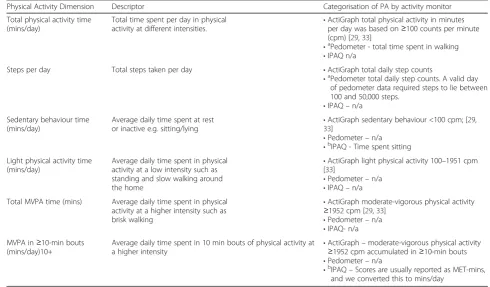
The physical activity dimensions for each of the instru-ments used are summarised in Table 1. At Visit 1, par-ticipants were offered a reminder system to receive daily, alternate-day or once-weekly reminders to wear their monitors. All devices were worn during all waking hours for seven consecutive full days following Visit 1; and any periods of non-wear-time were to be recorded in a daily ‘log’ provided at visit 1. The ActiGraph device and a sealed pedometer were placed beside one another on a belt, worn on the dominant side of the body in line with the anterior axillary line of the hip. As devices were not waterproof they were removed during water sports, washing or showering.
ActiGraph
The ActiGraph GT3X+ (ActiGraph, Pensacola, Florida) is a tri-axial accelerometer that measures body acceler-ation as counts per unit time; using defined cut points for accelerometer counts it is possible to measure activ-ity at different intensities e.g. light, moderate, vigorous
intensity, as well as measure number of steps. The Acti-Graph has been validated for measurement of physical activity dimensions in different populations, and as an accurate measure of sedentary behaviour [17, 18].
Yamax DigiWalker pedometer
The DigiWalker CW-700 is a pedometer which has been used in recent studies to measure step counts in the general population [19, 20], and also in respiratory pop-ulations such as COPD [21–23]. This has been shown to be the most reliable, commercially obtainable pedometer available [24]. This device does not measure intensity of physical activity.
Study questionnaires
International Physical Activity Questionnaire (IPAQ)
[image:3.595.50.541.420.707.2]The long-form IPAQ is a validated 27-item, self-completed physical activity questionnaire which was de-veloped to measure health related physical activity (i.e. activity in bouts of at least 10 min) in most daily situa-tions. It was chosen as it allows participants to include leisure/exercise, walking, occupation, and transportation physical activity in their responses, and the scoring protocol allows greater flexibility in how physical activity is accumulated than other questionnaires [10, 25]. The IPAQ identifies the frequency and duration of moderate
Table 1Descriptors, categorisation and comparable dimensions of physical activity (PA) per instrument
Physical Activity Dimension Descriptor Categorisation of PA by activity monitor
Total physical activity time (mins/day)
Total time spent per day in physical
activity at different intensities. •
ActiGraph total physical activity in minutes per day was based on≥100 counts per minute (cpm) [29,33]
•aPedometer - total time spent in walking
•IPAQ n/a
Steps per day Total steps taken per day •ActiGraph total daily step counts
•aPedometer total daily step counts. A valid day
of pedometer data required steps to lie between 100 and 50,000 steps.
•IPAQ–n/a Sedentary behaviour time
(mins/day)
Average daily time spent at rest
or inactive e.g. sitting/lying •
ActiGraph sedentary behaviour <100 cpm; [29,
33]
•Pedometer–n/a •bIPAQ - Time spent sitting
Light physical activity time (mins/day)
Average daily time spent in physical activity at a low intensity such as standing and slow walking around the home
•ActiGraph light physical activity 100–1951 cpm [33]
•Pedometer–n/a •IPAQ–n/a Total MVPA time (mins) Average daily time spent in physical
activity at a higher intensity such as brisk walking
•ActiGraph moderate-vigorous physical activity ≥1952 cpm [29,33]
•Pedometer–n/a •IPAQ- n/a MVPA in≥10-min bouts
(mins/day)10+
Average daily time spent in 10 min bouts of physical activity at a higher intensity
•ActiGraph–moderate-vigorous physical activity ≥1952 cpm accumulated in≥10-min bouts •Pedometer–n/a
•b
IPAQ–Scores are usually reported as MET-mins, and we converted this to mins/day
n/a parameter not available a
pedometer dimensions comparable to ActiGraph b
and vigorous physical activity, walking physical activity, and time spent sitting during the past week in (i) work related physical activity (ii) transportation physical activ-ity (iii) housework/house maintenance/caring for the family time physical activity and (iv) recreation/sport/ leisure time physical activity. The IPAQ has been utilised in patients with COPD [26].
Feasibility questionnaires
Feasibility questionnaires for the study were developed to facilitate feedback from both participants and re-searchers about the activity monitors and the IPAQ. These were informed by questionnaires that were used in previous research exploring feasibility of accelerome-ters [27]. A 10-point visual analogue scale (VAS) (0‘very difficult/uncomfortable’ through to 10 ‘very easy/com-fortable’) was used to assess participants’perspectives on the ease of fitting, and comfort of wearing the Acti-Graph/pedometer. Participants were also asked to report any difficulties relating to wearing the monitors, or any strategies they adopted to make it easier to wear the monitors.
Researchers’ perspectives on how easy it was to teach participants to apply and wear the monitors was assessed on a 10-point VAS (0 ‘very difficult’through to 10 ‘very easy’), and they also recorded how long it took to down-load data. Both participants and researchers’perspectives on ease of completing/administering and usefulness of the IPAQ was also assessed using a 10-point VAS (0‘very dif-ficult/not useful’through to 10‘very easy/very useful’).
Data handling and analysis
For the ActiGraph and pedometer, participant wear time logs were cross-checked to explore periods of non-wear time of the monitors; for example, if the participant had removed the monitor for bathing or swimming during waking hours. Step count was classified into the following categories: sedentary <5000 steps per day, low active 5000–7499 steps per day, somewhat active/active≥7500 steps per day [28].
Table 1 indicates the physical activity dimension vari-ables that were compared between the ActiGraph and the pedometer or the IPAQ. Due to the limited number of participants performing vigorous physical activity, moderate and vigorous categories were combined. Thus, ActiGraph moderate - vigorous physical activity (MVPA) reflected time spent in moderate/vigorous activity and this included walking time [29]. The IPAQ records walk-ing and moderate/vigorous activity domains separately so to aid comparison these were combined into a‘single’ moderate/vigorous activity domain for analysis.
ActiGraph
ActiGraph data was considered valid if there were more than 600 min of monitoring per day and at least 5 days,
one being a Saturday or Sunday, giving a sample with valid data of n= 55 [30, 31]. Using ActiLife software version 6.8.0, wear-time validation was applied using parameters set by Choi (2011) which allowed for a 2 min interval of non-zero counts with an up/downstream 30 min of con-secutive zero counts window [32]. Step counts were calcu-lated using cut-off points based on manufacturer guidelines [33]. Categorisation of physical activity dimen-sions from the ActiGraph is summarised in Table 1.
Pedometer
After the 7 day monitoring period, data collected from the pedometer on daily step counts and time spent in walking was recorded. A valid day of pedometer data required steps to lie between 100 and 50,000 steps (Table 1). Data-sets which aligned with ActiGraph data (n= 50), with re-spect to wear time, were included in the analyses.
IPAQ
Scores are reported as METs (n= 55), one MET-minute is defined as the MET-intensity multiplied by the mi-nutes per week of activity. MET-intensity levels used to score the IPAQ questions were vigorous (8.0 METs), vig-orous chores (5.5 METs), moderate (4.0 METs), outside/ yard chores (4.0 METs) inside chores (3.0 METs), cycling (6.0 METs) and walking (3.3 METs). Time spent sitting, walking, and in moderate, and vigorous activity was calculated along with walking, moderate and vigorous MET/mins. Physical activity categorical scores (low, moderate or high) were calculated [International Physical Activity Questionnaire 2005].
Statistical analysis
Descriptive statistics were used to summarise study pop-ulations demographic and clinical characteristics. All data was transferred to SPSS for statistical analysis and all statistical analyses were performed using SPSS 20 (IBM), unless otherwise stated. Summary data is re-ported as Mean (SD) and statistical significance was as-sumed atp< 0.05.
To investigate validity of the IPAQ questionnaire and pedometer, the percentage agreement between ActiGraph and these other measures was calculated using limits of agreement [34]. ActiGraph was considered the criterion measure and a value close to or equal to 100%, with nar-row limits of agreement (LOA) indicated higher levels of agreement between the two measures under investigation. Patterns in the plots were also explored to identify any systematic bias between the measurements [35].
Results
Demographics and physical activity data
63[10]years and disease severity was categorised as Stage 1 Mild 27[49]% and Stage 2 Moderate/severe 28[51]% (Bradley et al 2015). There weren= 55/55 datasets avail-able for ActiGraph and IPAQ, n= 50/55 for pedometer (five datasets had less than 5 valid days of pedometer readings).
ActiGraph (n= 50) versus Pedometer (n= 50).
Steps per day and total physical activity time (mins) and were compared between the ActiGraph and the Yamax pedometer (Table 3). In terms of steps per day, there was no significant difference between the two de-vices; however total physical activity time (mins) as re-corded by the ActiGraph was significantly higher than the pedometer (mean ± SD, 232 (75) vs. 63 (32)).
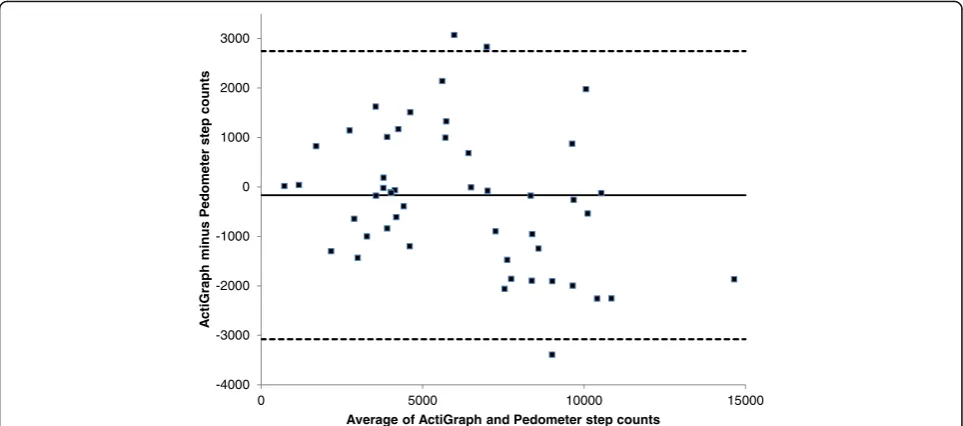
The Bland and Altman plots (Fig. 1) showed that the mean levels of agreement between the two devices was very good for step count (97% agreement); and although the individual differences between the devices were within acceptable limits for all but 3 participants (Fig. 1), the 95% LOA were wide and for some individuals this could vary by as much as 5823 steps. With respect to total physical activity time (mins) there was a lower level of agreement (28%, Fig. 2), with the pedometer under reporting total physical activity (or steps) time by 165 mins (or 2.75 h); and this was proportionally greater in people who were more active, so that the under report-ing could be a great as 234 min (nearly 4 h).
ActiGraph (n= 55) versus IPAQ (n= 55).
[image:5.595.57.539.96.296.2] [image:5.595.305.539.360.662.2]IPAQ reported significantly less sedentary time than ActiGraph [mean, SD; 362(115) vs 634(76) vmins/day], and a much greater number of bouts of at least 10 min of -MVPA10+ [mean, SD; 167(170) vs 6(9) mins/day] (Table 3).
Table 2Demographic and clinical characteristics of patients with bronchiectasis (n= 55)
Age (years) 63 (10)
Gender (male/female) 22 [40]/33 [60]
BMI (kg/m2) 27 (4)
FEV1(% predicted) 76 (21)
FVC (% predicted) 94 (19)
Disease Severity (%)a
Mild 27 [49]
Moderate 18 [33]
Severe 10 [18]
Smoking History:
Never (%) 46 [84]
Ex-smoker (%) 9 [16]
Number of oral antibiotic courses within last year 3 (2)
Number of IV antibiotic courses within last year 0–3 (range)
Results are Mean (SD) or Frequency [%]
Abbreviations:BMIbody mass index,FEV1forced expiratory volume in 1 s (% predicted),FVCforced vital capacity (% predicted) a
Disease severity based on Bronchiectasis Severity Index [16]
Table 3Physical activity (ActiGraph, pedometer and IPAQ) for participants
Physical Activity Instrument Mean(SD)/Median (IQR)
ActiGraph (n= 55)
Steps per day 6,001(2780)a
Total physical activity time(mins/day) 232(75)a
Average times in different PA intensitiesd(mins/day) unbouted (cpm)
Sedentary behaviour time 634(77)b
Light physical activity time 207(63)
Total MVPA time 25(20)
Weekly bout-time 44(64)
MVPA10+(mins/day) 6(9)b
Pedometer (n= 50)
Daily step counts 6193 (3356)a
Total physical activity time (mins/day) 63 (32)a
IPAQ (n= 55)
Total PA level (MET-min/week) 2700 (1037–6209)c
Walking (MET-min/week) 561 (165–1733)c
Moderate (MET-min/week) 1620 (450–4230)c
Vigorous (MET-min/week) 0 (0–480)c
Sedentary behaviour time (mins/day) 360 (270–437)c 362(115)b
MVPA10+(mins/day) 99 (43–251)c 167(170)b
Abbreviations:cpmcounts per minute,IPAQInternational Physical Activity Questionnaire,MVPAmoderate-vigorous physical activity,MVPA10+MVPA accumulated in≥10-min bouts
a
pedometer dimensions comparable to ActiGraph b
IPAQ dimensions comparable to ActiGraph Results are Mean(SD) or Freq [%] orc
results given as median (IQR) d
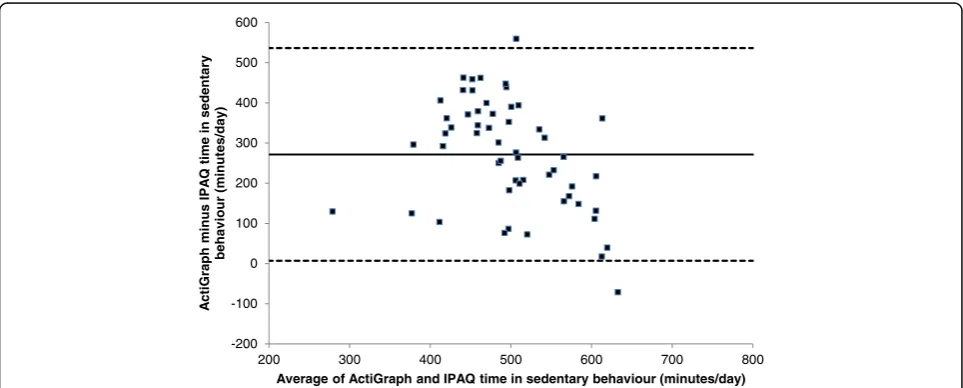
The Bland and Altman plots (Figs. 3 and 4) showed low levels of agreement between the two tools (57% sedentary behaviour; 0% MVPA10+), with IPAQ under-reporting sed-entary behaviour and over-reporting MVPA10+compared to ActiGraph. The latter finding showed bias, in that the over-reporting with IPAQ was greater in people who were more active; people who were very inactive were less likely to over-report MVPA10+.
Categorising activity levels
It was possible to categorise patients into either‘meeting’ or ‘not meeting’ the volume guidelines (≥150mins of at least moderate physical activity per week) or step guide-lines (>10,000 steps per day) [28]. For the volume
guidelines, 11% of patients met these guidelines according to ActiGraph compared to 82% with IPAQ. For the step guidelines, 7% (ActiGraph) compared to 14% (pedometer) respectively met these step-based recommendations.
A more detailed categorisation was possible for all 3 meas-urement tools. Using daily step count categories (see Data Handling and Analysis) and the ActiGraph data: 42% (n= 23/55) were categorised as sedentary, 29% (n= 16/55) low active and 29% (n= 16) somewhat active and above. Using daily step count categories and the pedometer step data (48%)n= 24/50 were categorised as sedentary, 14% (n= 7/ 50) low active and 38% (n= 19/50) somewhat active and above. The IPAQ scoring classification differs and IPAQ classified 18% (n= 10) of patients in low, 38% (n= 21) in
-4000 -3000 -2000 -1000 0 1000 2000 3000
0 5000 10000 15000
A
c
tiGr
aph minus
P
e
dometer
step
counts
Average of ActiGraph and Pedometer step counts
Fig. 1Bland-Altman Plot of ActiGraph vs Pedometer step counts. The mean (SD) difference in steps was -167 (1485), and the upper and lower LOA (2745, -3078)
0 50 100 150 200 250 300
0 50 100 150 200 250 300 350 400
A
cti
Graph mi
nus
P
e
dometer
wal
k-ti
m
e
Average of ActiGraph and Pedometer walk-time
[image:6.595.57.539.88.301.2] [image:6.595.56.540.538.703.2]moderate and 44% (n= 24) in high physical activity categories.
Feasibility and acceptability
Participants
Feasibility and acceptability of monitors revealed that participants found them easy to fit: VAS (out of 10) mean ± SD score ActiGraph 9.8(0.76); pedometer 9.8 (0.76), and comfortable to wear VAS mean score mean score ActiGraph 9.22(1.03); pedometer 9.11 (1.24). Difficulties common to both ActiGraph (25%;
n= 14) and pedometer (34%; n= 17) related to the
elastic belt, on which both devices were located, be-coming loose and slipping from its original location, the belt twisting on strenuous movement or difficul-ties opening and closing the belt clasp. One add-itional difficulty specific to the pedometer included discomfort and irritation from the metal clip against the body (2% n= 1/50). Strategies adopted by partici-pants to make it easier to wear the ActiGraph and pedometer on the belt included wearing it next to their body as opposed to over clothing or vice versa to ensure a secure fit, and wearing the belt through trouser belt-loops to ensure a secure fit. To alleviate
-800 -600 -400 -200 0 200 400
0 100 200 300 400
A
c
tiGraph minus
IP
A
Q
time
in
moder
a
te
-v
igor
ous phy
sical
activ
ity
bouts (minutes/day
)
Average of ActiGraph and IPAQ time in moderate-vigorous physical activity bouts (minutes/day)
Fig. 3Bland-Altman Plot of ActiGraph vs IPAQ time in moderate-vigorous physical activity bouts (MVPA10+). The mean (SD) difference in bouts
was 272 (135), and the upper and lower LOA (536, 7)
-200 -100 0 100 200 300 400 500 600
200 300 400 500 600 700 800
A
c
tiGr
aph
minus IP
A
Q
time in
sedentar
y
behav
iour
(minutes/day
)
Average of ActiGraph and IPAQ time in sedentary behaviour (minutes/day)
[image:7.595.54.540.87.282.2] [image:7.595.57.539.510.704.2]any skin irritation from the pedometer clip strategies included placing cotton between the pedometer clip and skin.
Feasibility and acceptability of IPAQ revealed that participants reported that it was easy to understand the questionnaire: VAS mean ± SD score 7.4 (2.03) and found it useful in its measurement of everyday activity levels: VAS mean score 7.64 (2.30). The aver-age time to complete IPAQ was 12(6) minutes.
Researchers
Researchers reported that it was easy to teach partici-pants how to apply and wear the monitors: VAS (out of 10) mean ± SD score ActiGraph 9.42(1.07); pedometer 9.29 (1.21). 13 participants requested one or more re-minders as a prompt to wear the activity monitor belt. Downloading of the data by researchers took less time for the pedometer compared to the ActiGraph (1.5 min compared to just under 5 mins).
Researchers reported that while it was easy to adminis-ter the questionnaire, VAS mean score 7.87 (1.72), they noted that 48/55 (87.3%) participants required assistance to complete the questionnaire. Reasons for assistance in-cluded additional explanation or clarification of question terminology (24%); some participants required clarifica-tion of physical activity categories (69%) e.g. were unsure which physical activities should be included in different categories; some required clarification of the scoring of their answers (20%) or prompting to complete missing answers (44%); ‘other’ aspects (11%) included patients having difficulty recalling the week’s physical activity and they suggested future inclusion of a diary in the preced-ing week to act as an aide memoire.
Discussion
This study aimed to compare two assessment tools (ped-ometer and IPAQ), with our criterion measure (the Acti-Graph) to measure physical activity dimensions. In general, we showed that when measuring mean step count for a group of people either ActiGraph or pedom-eter could be used. However, when comparing individual step counts or when classifying physical activity accord-ing to step categories the devices were not interchange-able, as different step values were obtained from the ActiGraph and the pedometer within the same individ-ual when worn for the same period of time. In addition, time spent in physical activity did not compare well be-tween these two objective tools. The IPAQ does not ap-pear to represent an accurate measure of physical activity in this population. All three tools appeared to be generally feasible and acceptable to patients and researchers.
The information from this study will help clinicians and researchers to make an informed decision about
which tool to use. ActiGraph provides an advantage compared to the pedometer when a precise profile for patterns and intensity of physical activity dimensions is required e.g. total time spent in light physical activity, number of daily bouts of MVPA or sedentary periods [36]. However, the ActiGraph devices are significantly more expensive than pedometers (approximately $225 versus $20) and have a higher resource burden as quali-fied personnel are needed to manage and analyse this more complex data. If the primary outcome of interest is to change step counts in a group of people, as opposed to change intensity of physical activity, then a pedometer is a valid choice given the very high levels of agreement between group means for ActiGraph and pedometer step counts; this has been shown in other populations also [37]. Pedometers could be a cost effective option in large studies [38], as they are significantly less expensive than accelerometers; and resources such as specialised personnel or data management expertise are not re-quired for the analysis of their simple step count outputs.
The low levels of agreement between the two devices for an individual is notable, and is in agreement with previous studies [38–40]. For example, in the study by Harris et al, 2009 in 121 older adults the LOA for an in-dividual was approximately 8000 step while Kinnunen et al, 2011 reported a LOA of approximately 5000 steps [38, 40]. The reason for the wide variation in step counts between the two devices, demonstrated in our data, is not clear but suggests that the two assessment tools are not interchangeable; this is also suggested by Barriera et al. [37]. The devices measure movement in different ways; e.g. ActiGraph contains a triaxial electronic accel-erometer and the pedometer is a uniaxial mechanical de-vice, and such differences in technical specifications may impact on the validity of monitors [41, 42]. The lack of agreement in total physical activity time between the ob-jective devices in our study remains unclear.
frameworks for physical activity measurement propose a combined approach of direct and self-report (question-naire) to enable a comprehensive exploration of physical activity patterns and behaviour [7, 46, 47].
The additional assessment of the feasibility of using differ-ent physical activity instrumdiffer-ents in this study is important [7]. Both the ActiGraph and pedometer were feasible and acceptable to researchers in terms of their use and down-loading data, with shorter data download time required for the pedometer as it provided less physical activity outputs; both monitors were acceptable to patients. While patients in this study indicated that the IPAQ was acceptable, most pa-tients required assistance to complete it and therefore even though it is reportedly self-completed there needs to be a clinician/researcher present during completion to minimise misinterpreted or missing responses.
Research into the measurement of physical activity is expanding in other populations and suggestions for key factors to consider when selecting physical activity assessment tools include (a) the specific component of physical activity of interest; (b) the population; (c) cost and ease measurement; and (d) precision of measure-ment that is required [7]. A limitation of our study may be the positioning of the pedometer on the ActiGraph belt, which proved slightly problematic on some occa-sions and may have resulted in less step counts/walk-time being recorded in some people. Also we based our feasibility questionnaire around similar themes and re-sponse format to Hale et al. 2008, but such questions have not been validated for this specific use. However, to date research on the measurement on physical activ-ity in bronchiectasis is limited, and this is the first study to assess multiple activity monitors in bronchiectasis. This study will help future research and clinical prac-tice in bronchiectasis by providing data on the use and feasibility of physical activity measurement with Acti-Graph, pedometer and IPAQ.
Conclusion
Accurate measurement of physical activity is feasible in BE and will be valuable for future trials of thera-peutic interventions. ActiGraph or pedometer could be used to measure simple daily step counts in BE, but ActiGraph was superior as it measured intensity of physical activity and was a more precise measure of time spent walking. The IPAQ does not appear to represent an accurate measure of physical activity in this population. The information reported in this study will be valuable for future trials of physical activity and sedentary behaviour patterns, and inter-ventions. Future research could explore the applica-tion of a monitor like the ActiGraph, combined with a new validated and relevant self-report physical activity questionnaire in BE.
Abbreviations
cpm:Counts per minute; IPAQ: International Physical Activity
Questionnaire; IQR: Interquartile range; MVPA: Moderate-vigorous physical
activity; MVPA10+: MVPA accumulated in≥10-minute bouts; n/a: Not
available; PA: Physical activity; SD: Standard deviation
Acknowledgements
The study was supported by the Northern Ireland Clinical Research Network (NICRN) Respiratory.
Funding
This study was funded by The Physiotherapy Research Foundation (PRF); the Charitable Trust of the Chartered Society of Physiotherapy (PRF Award (11) A02). Jason J Wilson was funded by the Department for Employment and Learning as part of a PhD scholarship.
Availability of data and materials
Data relating to this study is from available from the Author on request.
Authors’contributions
All authors contributed to study conception and design. The draft
manuscript was prepared by BO’N, SMcD, JW, IB, AK, JB, MT and these
authors along with KH, DC edited and revised the manuscript. All authors are accountable for all aspects of the work and for the integrity of the data and the accuracy of the data analysis. JB had full access to all of the data in the study. All authors read and approved the final manuscript.
Competing interests
The authors declare that they have no competing interests.
Consent for publication
All authors of the manuscript have read and agreed to its content and are accountable for all aspects of the accuracy and integrity of the manuscript in accordance with ICMJE criteria that the article is original, has not already been published in a journal, and is not currently under consideration by another journal. That you agree to the terms of the BioMed Central Copyright and License Agreement, which we strongly recommend you read and, where applicable, Open Data policy. For authors who are prevented from being the copyright holder (for instance where Crown Copyright applies or researchers are US government employees), BioMed Central can accommodate nonstandard copyright lines. If this applies to you, please contact us and provide details of your situation.
Ethics approval and consent to participate
The study was approved by the NI Research Ethics Committees (Ethics Approval REC Reference: 12/NI/0044) and research departments of all the participating hospitals. Written informed consent was obtained from all of study participants. The study was supported by the Northern Ireland Clinical Research Network (NICRN) Respiratory Health.
Author details
1Centre for Health and Rehabilitation Technologies, Institute for Nursing and
Health Research, Ulster University, Newtownabbey, UK.2UKCRC Centre of Excellence for Public Health (Northern Ireland), Belfast, UK.3Centre for Public
Health, School of Medicine, Dentistry and Biomedical Sciences, Queen’s University Belfast, Belfast, UK.4School of Psychological Sciences and Health,
University of Strathclyde, Glasgow, UK.5Northern Ireland Clinical Research Network, Respiratory Health, Belfast Health and Social Care Trust, Belfast, UK.
6
Centre for Experimental Medicine, School of Medicine, Dentistry & Biomedical Sciences, Queen’s University Belfast, Belfast, UK.
Received: 20 July 2016 Accepted: 21 December 2016
References
1. Global recommendations on physical activity for health. World Health
Organistaion; 2010. [http://apps.who.int/iris/bitstream/10665/44399/1/ 9789241599979_eng.pdf] accessed 17 Feb 2016. ISBN 978 92 4 159 997 9.
2. Spruit MA, Singh SJ, Garvey C, ZuWallack R, Nici L, Rochester C, ATS/ERS
Society/European Respiratory Society statement: key concepts and advances
in pulmonary rehabilitation. Am J Respir Crit Care Med. 2013;188:e13–64.
3. Watz H, Pitta F, Rochester CL, Garcia-Aymerich J, ZuWallack R, Troosters T,
et al. An official European Respiratory Society statement on physical activity
in COPD. Eur Respir J. 2014;44:1521–37.
4. Bradley JM, O’Neill B, Kent L, Hulzebos EHJ, Arets B, Hebestreit H, on behalf
of the Exercise Working Group European CF Society. Physical activity assessment in cystic fibrosis: a position statement endorsed by the
European Cystic Fibrosis Society Board. J Cyst Fibros. 2015;14(6):e25–32.
5. Bolton CE, Bevan-Smith EF, Blakey JD, Crowe P, Elkin SL, Garrod R, et al.
British Thoracic Society guideline on pulmonary rehabilitation in adults:
accredited by NICE. Thorax. 2013;68:ii1–30.
6. Burtin C, Hebestreit H. Rehabilitation in patients with chronic respiratory
disease other than chronic obstructive pulmonary disease: exercise and physical activity interventions in cystic fibrosis and non-cystic fibrosis
bronchiectasis. Respiration. 2015;89:181–9.
7. Ainsworth B, Cahalin L, Buman M, Ross R. The current state of physical
activity assessment tools. Prog Cardiovasc Dis. 2015;57:387–95.
8. Bradley JM, Kent L, Elborn JS, O’Neill B. Motion sensors for monitoring
physical activity in cystic fibrosis: what is the next step? Phys Ther Rev. 2010;
15:197–203.
9. van Remoortel H, Giavedoni S, Raste Y, Burtin C, Louvaris Z, Gimeno-Santos
E, et al. Validity of activity monitors in health and chronic disease: a systematic review. Int J Behav Nutr Phys Act. 2012;9:84.
10. Craig CL, Marshall AL, Sjostrom M, Bauman AE, Booth ML, Ainsworth BE,
et al. International Physical Activity Questionnaire: 12-country reliability and
validity. Med Sci sport Exer. 2003;35:1381–95.
11. Gimeno-Santos E, Frei A, Dobbels F, Rüdell K, Puhan MA, PROactive
consortium. Validity of instruments to measure physical activity may be questionable due to lack of conceptual frameworks: a systematic review. Health Qual Life Outcomes. 2011;9:86. doi:10.1186/1477-7525-9-86.
12. Prince S, Adamo K, Hamel M, Hardt J, Gorber S, Tremblay M. A comparison
of direct versus self-report measures for assessing physical activity in adults: a systematic review. Int J Behav Nutr Phys Act. 2008;5:56.
13. Welk GL, McClain J, Ainsworth B. Protocols for evaluating equivalency of
accelerometry-based activity monitors. Med Sci sport Exer. 2012;44:s39–49.
14. Greenhalgh J, Long AF, Brettle AJ, Grant MJ. Reviewing and selecting outcome
measures for use in routine practice. J Eval Clin Pract. 1998;4:339–50.
15. Bradley JM, Wilson JJ, Hayes K, Kent L, McDonough S, Tully MA, et al.
Sedentary behaviour and physical activity in bronchiectasis: a cross-sectional study. BMC Pulm Med. 2015;15:61.
16. Chalmers JD, Goeminne P, Aliberti S, McDonnell MJ, Lonni S, Davidson J, et
al. The bronchiectasis severity index. An international derivation and
validation study. Am J Respir Crit Care Med. 2014;189:576–85.
17. Yang C, Hsu Y. A review of accelerometry-based wearable motion detectors
for physical activity monitoring. Sensors. 2010;10:7772–88.
18. Carr LJ, Mahar MT. Accuracy of intensity and inclinometer output of three
activity monitors for identification of sedentary behavior and light intensity
activity. J Obesity. 2012;2012;1–9. doi:10.1155/2012/460271.
19. Chan CB, Tudor-Locke C. Real-world evaluation of a community-based
pedometer intervention. J Phys Act Health. 2008;5:648–64.
20. Petersen CB, Severin M, Hansen AW, Curtis T, Grønbæk M, Tolstrup JS. A
population-based randomized controlled trial of the effect of combining a pedometer with an intervention toolkit on physical activity among individuals
with low levels of physical activity or fitness. Prev Med. 2012;54:125–30.
21. Hospes G, Bossenbroek L, Ten Hacken NH, van Hengel P, De Greef MH.
Enhancement of daily physical activity increases physical fitness of out clinic COPD patients: results of an exercise counseling program. Patient Educ
Couns. 2009;75:274–8.
22. Moore R, Berlowitz D, Denehy L, Jackson B, McDonald CF. Comparison
of pedometer and activity diary for measurement of physical activity in chronic obstructive pulmonary disease. J Cardiopulm Rehabil. 2009;29:
57–61.
23. Cavalheri V, Donária L, Ferreira T, Finatti M, Camillo CA, Cipulo Ramos EM,
et al. Energy expenditure during daily activities as measured by two motion
sensors in patients with COPD. Resp Med. 2011;105:922–9.
24. Schneider PL, Crouter SE, Bassett DR. Pedometer measures of free-living physical
activity: comparison of 13 models. Med Sci Sports Exerc. 2004;36:331–5.
25. Hagströmer M, Oja P, Sjöström M. The International Physical Activity
Questionnaire (IPAQ): a study of concurrent and construct validity. Public
Health Nutr. 2006;9:755–62.
26. Inal-Ince D, Savci S, Saglam M, Arikan H, Calik E, Vardar-Yagli N, et al.
Predictors of physical inactivity in elderly patients with chronic obstructive
pulmonary disease. Int J Gerontol. 2013;8:193–6.
27. Hale LA, Pal J, Becker I. Measuring free-living physical activity in adults with
and without neurologic dysfunction with a triaxial accelerometer. Arch Phys
Med Rehabil. 2008;89:1765–71.
28. Tudor-Locke C, Bassett Jr DR. How many steps/day are enough? Sports
Med. 2004;34:1–8.
29. Hart TL, Ainsworth BE, Tudor-Locke C. Objective and subjective
measures of sedentary behavior and physical activity. Med Sci Sports
Exerc. 2011;43:449–56.
30. Gretebeck RJ, Montoye HJ. Variability of some objective measures of
physical activity. Med Sci Sports Exerc. 1992;24(10):1167–72.
31. Trost SG, McIver KL, Pate RR. Conducting accelerometer-based activity assessments
in field-based research. Med Sci Sports Exerc. 2005;37 Suppl 11:S531–43.
32. Choi L, Liu Z, Matthews CE, Buchowski MS. Validation of accelerometer wear and
nonwear time classification algorithm. Med Sci Sport Exerc. 2011;43:357–64.
33. Freedson PS, Melanson E, Sirard J. Calibration of the Computer Science and
Applications, Inc. accelerometer. Med Sci Sports Exerc. 1998;30:777–81.
34. Bland JM, Altman DG. Measuring agreement in method comparison studies.
Stat Methods Med Res. 1999;8:135–60.
35. Portney LG, Watkins MP. Foundations of clinical research: applications to
practice. 2nd ed. New Jersey: Prentice-Hall; 2000.
36. Bauman A, Phongsavan P, Schoeppe S, Owen N. Physical activity
measurement a primer for health promotion. Promot Educ. 2006;13:92–103.
37. Barriera TV, Tudor-Locke C, Champagne CM, Broyles ST, Johnson WD,
Katzmarzyk PT. Comparison of GT3X accelerometer and YAMAX pedometer steps/day in a free-living sample of overweight and obese adults. J Phys Act Health. 2013;10:263.
38. Kinnunen TI, Tennant PWG, McParlin C, Poston L, Robson SC, Bell R.
Agreement between pedometer and accelerometer in measuring physical activity in overweight and obese pregnant women. BMC Public Health. 2011;11:501. doi:10.1186/1471-2458-11-501.
39. Le Masurier GC, Lee SM, Tudor-Locke C. Motion sensor accuracy under
controlled and free-living conditions. Med Sci Sports Exerc. 2004;36(5):
905–10.
40. Harris TJ, Owen CG, Victor CR, Adams R, Ekelund U, Cook DG. A comparison
of questionnaire, accelerometer, and pedometer: measures in older people.
Med Sci Sports Exerc. 2009;41:1392–402.
41. Van Remoortel H, Raste Y, Louvaris Z, Giavedoni S, Burtin C, et al.
Validity of six activity monitors in chronic obstructive pulmonary disease: a comparison with indirect calorimetry. PLoS One. 2012;7(6): e39198. doi:10.1371/journal.pone.
42. Pitta F, Troosters T, Probst VS, Spruit MA, Decramer M, Gosselink R.
Quantifying physical activity in daily life with questionnaires and motion
sensors in COPD. Eur Respir J. 2006;27:1040–55.
43. Thorp AA, Owen N, Neuhaus M, Dunstan DW. Sedentary behaviors and
subsequent health outcomes in adults a systematic review of longitudinal
studies, 1996-2011. Am J Prev Med. 2011;41:207–15.
44. Dyrstad SM, Hansen BH, Holme IM, Anderssen SA. Comparison of
self-reported Versus accelerometer-measured physical activity. Med Sci Sports
Exerc. 2014;46:99–106.
45. Troosters T, van Der Molen T, Polkey M, Rabinovich RA, Vogiatzis I, Weisman
I, et al. Improving physical activity in COPD: towards a new paradigm. Resp Res. 2013;14:115.
46. Pettee-Gabriel KK, Morrow Jr JR, Woolsey A-L T, et al. Framework for
physical activity as a complex and multidimensional behavior. J Phys Act
Health. 2012;Suppl 1:S11–8.
47. Gimeno-Santos E, Raste Y, Demeyer H, Louvaris Z, de Jong C, Rabinovich R,
on behalf of the PROactive Consortium. The PROactive instruments to measure physical activity in patients with chronic obstructive pulmonary