City, University of London Institutional Repository
Citation
:
Fernandez, R. C., Migliavacca, M., Kalyvianaki, E. and Pietzuch, P. (2014).
Making State Explicit for Imperative Big Data Processing. Paper presented at the USENIX
ATC ’14: 2014 USENIX Annual Technical Conference, 19-06-2015 - 20-06-2015,
Philadelphia, USA.
This is the published version of the paper.
This version of the publication may differ from the final published
version.
Permanent repository link:
http://openaccess.city.ac.uk/8186/
Link to published version
:
Copyright and reuse:
City Research Online aims to make research
outputs of City, University of London available to a wider audience.
Copyright and Moral Rights remain with the author(s) and/or copyright
holders. URLs from City Research Online may be freely distributed and
linked to.
This paper is included in the Proceedings of USENIX ATC ’14:
2014 USENIX Annual Technical Conference.
June 19–20, 2014 • Philadelphia, PA
978-1-931971-10-2
Open access to the Proceedings of
USENIX ATC ’14: 2014 USENIX Annual Technical
Conference is sponsored by USENIX.
Making State Explicit for Imperative
Big Data Processing
Raul Castro Fernandez,
Imperial College London;
Matteo Migliavacca,
University of Kent;
Evangelia Kalyvianaki,
City University London;
Peter Pietzuch,
Imperial College London
Making State Explicit for Imperative Big Data Processing
Raul Castro Fernandez
∗, Matteo Migliavacca
†, Evangelia Kalyvianaki
, Peter Pietzuch
∗∗
Imperial College London,
†University of Kent,
City University London
Abstract
Data scientists often implement machine learning algo-rithms in imperative languages such as Java, Matlab and R. Yet such implementations fail to achieve the per-formance and scalability of specialised data-parallel pro-cessing frameworks. Our goal is to execute impera-tive Java programs in a data-parallel fashion with high throughput and low latency. This raises two challenges: how to support the arbitrary mutable state of Java pro-grams without compromising scalability, and how to re-cover that state after failure with low overhead.
Our idea is to infer the dataflow and the types of state accesses from a Java program and use this information to generate astateful dataflow graph (SDG). By explic-itly separatingdatafrom mutablestate, SDGs have spe-cific features to enable this translation: to ensure scala-bility, distributed state can bepartitionedacross nodes if computation can occur entirely in parallel; if this is not possible,partialstate gives nodes local instances for in-dependent computation, which are reconciled according to application semantics. For fault tolerance, large in-memory state is checkpointed asynchronously without global coordination. We show that the performance of SDGs for several imperative online applications matches that of existing data-parallel processing frameworks.
1 Introduction
Data scientists want to use ever more sophisticated im-plementations of machine learning algorithms, such as collaborative filtering [32], k-means clustering and logis-tic regression [21], and execute them over large datasets while providing “fresh”, low latency results. With the dominance of imperative programming, such algorithms are often implemented in languages such as Java, Matlab or R. Such implementations though make it challenging to achieve high performance.
On the other hand, data-parallel processing frame-works, such as MapReduce [8], Spark [38] and Na-iad [26], can scale computation to a large number of
nodes. Such frameworks, however, require developers to adopt particular functional [37], declarative [13] or dataflow [15] programming models. While early frame-works such as MapReduce [8] followed a restricted func-tional model, resulting in wide-spread adoption, recent more expressive frameworks such as Spark [38] and Na-iad [26] require developers to learn more complex pro-gramming models, e.g. based on a richer set of higher-order functions.
Our goal is therefore to translate imperative Java im-plementations of machine learning algorithms to a repre-sentation that can be executed in a data-parallel fashion. The execution should scale to a large number of nodes, achieving high throughput and low processing latency. This is challenging because Java programs support ar-bitrary mutable state. For example, an implementation of collaborative filtering [32] uses a mutable matrix to represent a model that is refined iteratively: as new data arrives, the matrix is updated at a fine granularity and accessed to provide up-to-date predictions.
Having stateful computation raises two issues: first, the state may grow large, e.g. on the order of hundreds of GBs for a collaborative filtering model with tens of thousands of users. Therefore the state and its associated computation must be distributed across nodes; second, large state must be restored efficiently after node failure. The failure recovery mechanism should have a low im-pact on performance.
Current data-parallel frameworks do not handle large state effectively. In stateless frameworks [8, 37, 38], computation is defined through side-effect-free func-tional tasks. Any modification to state, such as updat-ing a supdat-ingle element in a matrix, must be implemented as the creation of new immutable data, which is inefficient. While recent frameworks [26, 10] have recognised the need for per-task mutable state, they lack abstractions for distributed state and exhibit high overhead under fault-tolerant operation with large state (see §6.1).
Imperative programming model. We describe how,
with the help of a few annotations by developers, Java programs can be executed automatically in a distributed data-parallel fashion. Our idea is to infer the dataflow and the types of state accesses from a Java program and use this information to translate the program to an ex-ecutable distributed dataflow representation. Using pro-gram analysis, our approach extracts the processing tasks and state fields from the program and infers the variable-level dataflow.
Stateful dataflow graphs. This translation relies on the features of a new fault-tolerant data-parallel processing model calledstateful dataflow graphs (SDGs). An SDG explicitly distinguishes between dataandstate: it is a cyclic graph of pipelined data-parallel tasks, which exe-cute on different nodes and access local in-memory state. SDGs include abstractions for maintaining large state efficiently in a distributed fashion: if tasks can process state entirely in parallel, the state ispartitioned across nodes; if this is not possible, tasks are given local in-stances of partial state for independent computation. Computation can include synchronisation points to ac-cess all partial state instances, and instances can be rec-onciled according to application semantics.
Data flows between tasks in an SDG, and cycles spec-ify iterative computation. All tasks are pipelined—this leads to low latency, less intermediate data during fail-ure recovery and simplified scheduling by not having to compute data dependencies. Tasks are replicated at run-time to overcome processing bottlenecks and stragglers. Failure recovery.When recovering from failures, nodes must restore potentially gigabytes of in-memory state. We describe an asynchronous checkpointing mechanism with log-based recovery that uses data structures for dirty state to minimise the interruption to tasks while taking local checkpoints. Checkpoints are persisted to multiple disks in parallel, from which they can be restored to mul-tiple nodes, thus reducing recovery time.
With a prototype system of SDGs, we execute Java implementations of collaborative filtering, logistic re-gression and a key/value store on a private cluster and Amazon EC2. We show that SDGs execute with high throughput (comparable to batch processing systems) and low latency (comparable to streaming systems). Even with large state, their failure recovery mechanism has a low performance impact, recovering in seconds.
The paper contributions and its structure are as fol-lows: based on a sample Java program (§2.1) and the features of existing dataflow models (§2.2), we motivate the need for stateful dataflow graphs and describe their properties (§3); §4 explains the translation from Java to SDGs; §5 describes failure recovery; and §6 presents evaluation results, followed by related work (§7).
Algorithm 1:Online collaborative filtering
1 @Partitioned Matrix userItem =new Matrix(); 2 @Partial Matrix coOcc =new Matrix(); 3
4 void addRating(int user,int item, int rating) { 5 userItem.setElement(user, item, rating); 6 Vector userRow = userItem.getRow(user); 7 for (int i = 0; i < userRow.size(); i++) 8 if (userRow.get(i) > 0) {
9 int count = coOcc.getElement(item, i); 10 coOcc.setElement(item, i, count + 1); 11 coOcc.setElement(i, item, count + 1);
12 }
13 }
14 Vector getRec(int user) {
15 Vector userRow = userItem.getRow(user);
16 @Partial Vector userRec =@Global coOcc.multiply( userRow);
17 Vector rec = merge(@Global userRec); 18 return rec;
19 }
20 Vector merge(@CollectionVector[] allUserRec) { 21 Vector rec =new Vector(allUserRec[0].size()); 22 for (Vector cur : allUserRec)
23 for (int i = 0; i < allUserRec.length; i++) 24 rec.set(i, cur.get(i) + rec.get(i)); 25 return rec;
26 }
2 State in Data-Parallel Processing
We describe an imperative implementation of a machine learning algorithm and investigate how it can execute in a data-parallel fashion on a set of nodes, paying attention to its use of mutable state (§2.1). Based on this analysis, we discuss the features of existing data-parallel process-ing models for supportprocess-ing such an execution (§2.2).
2.1 Application example
Alg. 1 shows a Java implementation of an on-line machine learning algorithm, collaborative filter-ing(CF) [32].1It outputs up-to-date recommendations of
items to users (functiongetRec) based on previous item
ratings (functionaddRating).
The algorithm maintains state in two data structures: the matrixuserItemstores the ratings of items made by users (line 1); the co-occurrence matrix coOcc records
correlations between items that were rated together by multiple users (line 2).
For many users and items,useritemandcoOccbecome
large and must be distributed: userItem can be
parti-tioned across nodes based on theuser identifier as an
access key; since the access tocoOccis random, it cannot be partitioned but onlyreplicated on multiple nodes in order to parallelise updates. In this case, results from a single instance ofcoOccarepartial, and must be merged with other partial results to obtain a complete result, as described below.
The function addRating first adds a new rating to
userItem(line 5). It then incrementally updatescoOccby
increasing the co-occurrence counts for the newly-rated
1The annotations (starting with ’@’) will be explained in §4 and
Computational
model Systems
Programming model
State handling Dataflow
Failure recovery Represen- Large Fine-grained Execution Low
Iter-tation state size updates latency ation
MapReduce [8] map/reduce as data n/a scheduled recompute DryadLINQ [37] functional as data n/a scheduled recompute Stateless dataflow Spark [38] functional as data n/a hybrid recompute CIEL [25] imperative as data n/a scheduled recompute HaLoop [5] map/reduce cache scheduled recompute Incremental
dataflow
Incoop [4] map/reduce cache scheduled recompute Nectar [11] functional cache scheduled recompute CBP [19] dataflow loopback scheduled recompute Comet [12] functional as data n/a scheduled recompute Batched dataflow D-Streams [39] functional as data n/a hybrid recompute
Naiad [26] dataflow explicit hybrid sync. global checkpoints Continuous
dataflow
Storm, S4 dataflow as data n/a pipelined recompute
SEEP [10] dataflow explicit pipelined sync. local checkpoints Parallel in-memory Piccolo [30] imperative explicit n/a async. global checkpoints
Stateful dataflow SDG imperative explicit pipelined async. local checkpoints
Table 1: Design space of data-parallel processing frameworks
itemand existing items with non-zero ratings (line 7–12).
This requiresuserItemandcoOccto be mutable, with
ef-ficient fine-grained access. SinceuserItemis partitioned
based on the keyuser, andcoOccis replicated,addRating
only accesses a single instance of each.
The function getRec takes the rating vector of a user, userRow (line 15), and multiplies it by the co-occurrence matrix to obtain a recommendation
vec-toruserRec(line 16). SincecoOccis replicated, this must
be performed onallinstances ofcoOcc, leading to mul-tiple partial recommendation vectors. These partial vec-tors must bemergedto obtain the final recommendation vectorrecfor the user (line 17). The functionmerge
sim-ply computes the sum of all partial recommendation vec-tors (lines 21–24).
Note that addRating and getRec have different
per-formance goals when handling state: addRating must achievehigh throughputwhen updatingcoOccwith new ratings;getRecmust serve requests withlow latency, e.g. when recommendations are included in dynamically gen-erated web pages.
2.2 Design space
The above example highlights a number of required fea-tures of a dataflow model to enable the translation of imperative online machine learning algorithms to exe-cutable dataflows: (i) the model should support large
state sizes(on the order of GBs), which should be
rep-resented explicitly and handled with acceptable perfor-mance; in particular, (ii) the state should permit efficient
fine-grained updates. In addition, due to the need for
up-to-date results, (iii) the model should process data with
low latency, independently of the amount of input data;
(iv) algorithms such as logistic regression and k-means clustering also requireiteration; and (v) even with large state, the model should support fastfailure recovery.
In Table 1, we classify existing data-parallel process-ing models accordprocess-ing to the above features.
State handling. Stateless dataflows, first made popular by MapReduce [8], define a functional dataflow graph in which vertices are stateless data-parallel tasks. They do not distinguish between state and data: e.g. in a word-count job in MapReduce, the partial word word-counts, which are the state, are output by map tasks as part of the dataflow [8]. Dataflows in Spark, represented as RDDs, are immutable, which simplifies failure recovery but re-quires a new RDD for each state update [38]. This is in-efficient for online algorithms such asCFin which only part of a matrix is updated each time.
Stateless models also cannot treat data differently from state. They cannot use custom index data structures for state access, or cache only state in memory: e.g. Shark [36] needs explicit hints which dataflows to cache.
Incremental dataflowavoids rerunning entire jobs
af-ter updates to the input data. Such models are fundamen-tally stateful because they maintain results from earlier computation. Incoop [4] and Nectar [11] treat state as a cache of past results. Since they cannot infer which data will be reused, they cache all. CBP transforms batch jobs automatically for incremental computation [19].
Our goals are complementary: SDGs do not infer in-cremental computation but support stateful computation efficiently, which can realise incremental algorithms.
Existing models that represent state explicitly, such as SEEP [10] and Naiad [26], permit tasks to have access to in-memory data structures but face challenges related to state sizes: they assume that state is small compared to the data. When large state requires distributed processing through partitioning or replication, they do not provide abstractions to support this.
In contrast, Piccolo [30] supports scalable distributed state with a key/value abstraction. However, it does not offer a dataflow model, which means that it cannot ex-ecute an inferred dataflow from a Java program but re-quires computation to be specified as multiple kernels. Latency and iteration. Tasks in a dataflow graph can
bescheduledfor execution or materialised in apipeline, each with different performance implications. Some frameworks follow ahybridapproach in which tasks on the same node are pipelined but not between nodes.
Since tasks instateless dataflowsare scheduled to pro-cess coarse-grained batches of data, such systems can exploit the full parallelism of a cluster but they can-not achieve low processing latency. For lower latency,
batched dataflowsdivide data into small batches for
pro-cessing and use efficient, yet complex, task schedulers to resolve data dependencies. They have a fundamental trade-off between the lower latency of smaller batches and the higher throughput of larger ones—typically they burden developers with making this trade-off [39].
Continuous dataflowadopts a streaming model with
a pipeline of tasks. It does not materialise intermedi-ate data between nodes and thus has lower lintermedi-atency with-out a scheduling overhead: as we show in §6, batched dataflows cannot achieve the same low latencies. Due to our focus on online processing with low latency, SDGs are fully pipelined (see §3.1).
To improve the performance ofiterative computation
in dataflows, early frameworks such as HaLoop [5] cache the results of one iteration as input to the next. Recent frameworks [15, 38, 25, 9] generalise this concept by permitting iteration over arbitrary parts of the dataflow graph, executing tasks repeatedly as part of loops. Simi-larly SDGs support iteration explicitly by permitting cy-cles in the dataflow graph.
Failure recovery. To recover from failure, frameworks either recompute state based on previous data or check-point state to restore it. Forrecomputation, Spark rep-resents dataflows as RDDs [38], which can be recom-puted deterministically based on their lineage.
Contin-uous dataflow frameworks use techniques such as
up-stream backup[14] to reprocess buffered data after
fail-ure. Without checkpointing, recomputation can lead to long recovery times.
Checkpointingperiodically saves state to disk or the
memory of other nodes. With large state, this becomes resource-intensive. SEEP recovers state from memory, thus doubling the memory requirement of a cluster [10]. A challenge is how to take consistent checkpoints while processing data. Synchronous global checkpoin-ting stops processing on all nodes to obtain consistent snapshots, thus reducing performance. For example, Na-iad’s “stop-the-world” approach exhibits low throughput with large state sizes [26]. Asynchronous global check-pointing, as used by Piccolo [30], permits nodes to take consistent checkpoints at different times.
Both techniques include all global state in a check-point and thus require all nodes to restore state after fail-ure. Instead, SDGs use an asynchronous checkpointing mechanism with log-based recovery. As described in §5,
updateUserItem new
rating
rec
request merge
coOcc
rec result
n1 n2
n3
State Element
(SE)
dataflow Task
Element (TE)
getUserVec
updateCoOcc
user Item
[image:6.612.318.526.74.157.2]getRecVec
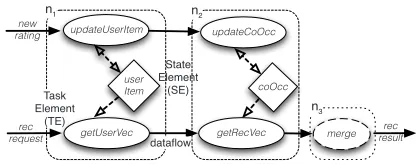
Figure 1: Stateful dataflow graph forCFalgorithm it does not require global coordination between nodes during recovery, and it uses dirty state to minimise the disruption to processing during local checkpointing.
3 Stateful Dataflow Graphs
The goal ofstateful dataflow graphs(SDGs) is to make it easy to translate imperative programs with mutable state to a dataflow representation that performs paral-lel, iterative computation with low latency. Next we de-scribe their model (§3.1), how they support distributed state (§3.2) and how they are executed (§3.3).
3.1 Model
We explain the main features of SDGs using theCF al-gorithm from §2.1 as an example. As shown in Fig. 1, an SDG has two types of vertices: task elements,t∈T, transform input to output dataflows; andstate elements,
s∈S, represent the state in the SDG.
Access edges,a= (t,s)∈A, connect task elements to
the state elements that they read or update. To facilitate the allocation of task and state elements to nodes, each task element can only access a single state element, i.e.A
is a partial function: (ti,sj)∈A,(ti,sk)∈A⇒sj =sk.
Dataflowsare edges between task elements,d= (ti,tj)∈
D, and contain data items.
Task elements (TEs)are not scheduled for execution but the entire SDG is materialised, i.e. each TE is assigned to one or more physical nodes. Since TEs are pipelined, it is unnecessary to generate the complete output dataflow of a TE before it is processed by the next TE. Data items are therefore processed with low latency, even across a se-quence of TEs, without scheduling overhead, and fewer data items are handled during failure recovery (see §5).
The SDG in Fig. 1 has five TEs assigned to three nodes: theupdateUserItem,updateCoOccTEs realise the
addRating function from Alg. 1; and the getUserVec,
getRecVecandmergeTEs implement thegetRecfunction. We explain the translation process in §4.2.
State elements (SEs)encapsulate the state of the compu-tation. They are implemented using efficient data struc-tures, such as hash tables or indexed sparse matrices. In the next section, we describe the abstractions for dis-tributed SEs, which span multiple nodes.
Fig. 1 shows the two SEs of the CF algorithm: the
spec-ify thatuserItemis updated by theupdateUserItem TE and read by the getUserVec TE; coOcc is updated by
updateCoOccand read bygetRecVec.
Parallelism.For data-parallel processing, a TEtican be
instantiated multiple times to handle parts of a dataflow, resulting in multiple TE instances, ˆti,j : j≤ni. As we
explain in §3.3, the number of instancesni for each TE
is chosen at runtime and adjusted based on workload de-mands and the occurrence of stragglers.
An appropriate dispatching strategy sends items in dataflows to TE instances: items can be (i) partitioned using hash- or range-partitioning on a key; or (ii) dis-patched to anarbitraryinstance, e.g. in a round-robin fashion for load-balancing.
Iteration.In iterative algorithms, SEs are accessed mul-tiple times by TEs. There are two cases to be distin-guished: (i) if the repeated access is from a single TE, the iteration is entirely local and can be supported efficiently by a single node; and (ii) if the iteration involves multi-ple pipelined TEs, acyclein the dataflow of the SDG can propagate updates between TEs.
With cycles in the dataflow, SDGs do not provide co-ordination during iteration by default. This is sufficient for many iterative machine learning and data mining al-gorithms because they can converge from different inter-mediate states [31], even without explicit coordination. A strong consistency model for SDGs could be realised with per-loop timestamps, as used by Naiad [26].
3.2 Distributed state
The SDG model provides abstractions for distributed state. An SEsimay be distributed across nodes, leading
to multiple SE instances ˆsi,j, because (i) it is too large
to fit into the memory of a single node; or (ii) it is ac-cessed by a TE that has multiple instances to process the dataflow in parallel. This requires also multiple SE in-stances so that the TE inin-stances access state locally.
Fig. 1 illustrates these two cases: (i) theuserItemSE may grow larger than the main memory of a single node; and (ii) the data-parallel execution of the CPU-intensive
updateCoOccTE leads to multiple instances, each requir-ing local access to thecoOccSE.
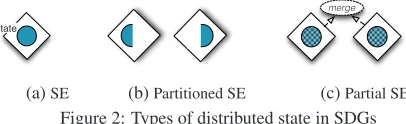
An SE can be distributed in different ways, which are depicted in Fig. 2: apartitionedSE splits its internal data structure into disjoint partitions; if this is not possible, a
partialSE duplicates its data structure, creating multiple
copies that are updated independently. As we describe in §4, developers selected the required type of distributed state using source-level annotations according to the se-mantics of their algorithm.
Partitioned state.For algorithms for which state can be partitioned, SEs can be split and SE instances placed on separate nodes (see Fig. 2b). Access to the SE instances occurs in parallel.
state
(a)SE (b)Partitioned SE
merge
[image:7.612.318.521.76.138.2](c)Partial SE
Figure 2: Types of distributed state in SDGs
Developers can use predefined data structures for SEs (e.g. Vector, HashMap, Matrix and DenseMatrix) or de-fine their own by implementing dynamic partitioning and dirty state support (see §5). Different data structures sup-port different partitioning strategies: e.g. a map can be hash- or range-partitioned; a matrix can be partitioned by row or column. To obtain a unique partitioning, TEs can-not access partitioned SEs using conflicting strategies, such as accessing a matrix by row and by column.
In addition, the dataflow partitioning strategy must be compatible with the data access pattern by the TEs, as specified in the program (see §4.2). For example, mul-tiple TE instances with an access edge to a partitioned SE must use the same partitioning key on the dataflow so that they access SE instances locally: in theCF al-gorithm, the userItem SE and the new rating andrec requestdataflows must all be partitioned by row, i.e. the users for which ratings are maintained.
Partial state. In some cases, the data structure of an SE cannot be partitioned because the access pattern of TEs is arbitrary. For example, in theCFalgorithm, thecoOcc
matrix has an access pattern, in which the updateCoOcc
TE may update any row or column. In this case, an SE is distributed by creating multiplepartialSE instances, each containing the whole data structure (see Fig. 2c). Partial SE instances can be updated independently by dif-ferent TE instances.
When a TE accesses a partial SE, there are two possi-ble types of accesses based on the semantics of the algo-rithm: a TE instance may access (i) thelocalSE instance on the same node; or (ii) theglobalstate by accessing all of the partial SE instances, which introduces a synchro-nisation point. As we describe in §4.2, the type of access to partial SEs is determined by annotations.
When accessing all partial SE instances, it is possible to execute computation thatmergestheir values, thus rec-onciling the differences between them. This is done by a
mergeTE that computes a single global value from partial
SE instances. Merge computation is application-specific and must be defined by the developer. In the CF
algo-rithm, themergefunction takes all partialuserRecvectors
and computes a single recommendation vector.
3.3 Execution
To execute an SDG, the runtime system allocates TE and SE instances to nodes, creating instances on-demand.
Allocation to nodes. Since we want to avoid remote state access, the general strategy is to colocate TEs and
SEs that are connected by access edges on the same node. The runtime system uses four steps for mapping TEs and SEs to nodes: if there is a cycle in the SDG, all SEs ac-cessed in the cycle are colocated if possible to reduce communication in iterative algorithms (step 1); the re-maining SEs are allocated on separate nodes to increase available memory (step 2); TEs are colocated with the SEs that they access (step 3); and finally, any unallocated TEs are assigned to separate nodes (step 4).
Fig. 1 illustrates the above steps for allocating the SDG to nodesn1ton3: since there are no cycles (step 1),
theuserItem SE is assigned to noden1, and thecoOcc
SE is assigned ton2 (step 2); theupdateUserItem and
getUserVecTEs are assigned ton1, and theupdateCoOcc
andgetRecVecTEs are assigned ton2(step 3); finally, the
mergeTE is allocated to a new noden3(step 4).
Runtime parallelism and stragglers. Processing bot-tlenecks in the deployed SDG, e.g. caused by the com-putational cost of TEs, cannot be predicted statically, and TEs instances may become stragglers [40]. Previ-ous work [26] tries to reduce stragglersproactivelyfor low latency processing, which is hard due to the many non-deterministic causes of stragglers.
Instead, similar to speculative execution in MapRe-duce [40], SDGs adopt areactiveapproach. Using a dy-namic dataflow graph approach [10], the runtime system changes the number of TE instances in response to strag-glers. Each TE is monitored to determine if it constitutes a processing bottleneck that limits throughput. If so, a new TE instance is created, which may result in new par-titioned or partial SE instances.
3.4 Discussion
With an explicit representation of state, a single SDG can express multiple workflows over that state. In the case of theCF algorithm from Alg. 1, the SDG processes new
ratings by updating the SEs for the user/item and co-occurrence matrices, and also serves recommendation re-quests using the same SEs with low latency.
Without SDGs, these two workflows would require separate offline and online systems [23, 32]: a batch pro-cessing framework would incorporate new ratings peri-odically, and online recommendation requests would be served by a dedicated system from memory. Since it is inefficient to rerun the batch job after each new rating, the recommendations would be computed on stale data.
A drawback of the materialised representation of SDGs is the start-up cost. For short jobs, the deploy-ment cost may dominate the running time. Our prototype implementation deploys an SDG with 50 TE and SE in-stances on 50 nodes within 7 s, and we assume that jobs are sufficiently long-running to amortise this delay.
4 Programming SDGs
We describe how to translate stateful Java programs stat-ically to SDGs for parallel execution. We do not attempt to be completely transparent for developers or to address the general problem of automatic code parallelisation. Instead, we exploit data and pipeline parallelism by re-lying on source code annotations. We require developers to provide a single Java class with annotations that indi-cate how state is distributed and accessed.
4.1 Annotations
When defining a field in a Java class, a developer can indicate if its content can be partitioned or is partial
by annotating the field declaration with@Partitionedor
@Partial, respectively.
@Partitioned. This annotation specifies that a field can
be split into disjoint partitions (see §3.2). A reference to
a@Partitionedfield always refers to a single partition.
This requires that access to the field uses an access key to infer the partition. In theCFalgorithm in Alg. 1, rows of
theuserItemmatrix are updated with information about
a single user only, and thususerItemcan be declared as a partitioned field.
@Partial. Fields are annotated with @Partial if
dis-tributed instances of the field should be accessed inde-pendently (see §3.2). Partial fields enable developers to define distributed state when it cannot be partitioned. In CF, matrixcoOccis annotated with@Partial, which means that multiple instances of the matrix may be cre-ated, and each of them is updated independently for users in a partition (lines 10–11).
@Global.By default, a reference to a@Partialfield refers
to only one of its instances. While most of the time, com-putation should apply to one instance to make indepen-dent progress, it may also be necessary to support oper-ations onallinstances. A field reference annotated with
@Globalforces a Java expression to apply to all instances,
denoting “global” access to a partial field, which intro-duces a synchronisation barrier in the SDG (see §4.2).
Java expressions deriving from @Global access
be-come logicallymulti-valuedbecause they include results from all instances of a partial field. As a result, any local variable that is assigned the result of a global field access becomes partial and must be annotated as such.
InCF, the access to thecoOccfield carries the@Global
annotation to computeallpartial recommendations: each instance ofcoOccis multiplied with the user rating
vec-toruserRow, and the results are stored in the partial local
variableuserRec(line 16).
@Collection. Global access to a partial field applies to
Input program
SEs
TE extraction
4
Live variable analysis
5
TE code assembly
6
SE access translation
7
partitioning state accesses
SE extraction
2
SE access extraction
3
TEs bytecode
disptaching
semantic live variables state accesses
partitioning
TE invocation
8 control flow
analysis
code generation
SEs
Bytecode Intermediate representation
[image:9.612.75.293.70.170.2]1
Figure 3: Translation of an annotated Java program to an SDG
@Collectionannotation therefore exposes all instances of a partial field or variable as a Java array after@Global ac-cess. This enables the program to iterate over all values and, for example, merge them into a single value.
InCF, the partial recommendations are combined by accessing them using the@Global annotation and then invoking themergemethod (line 17). The parameter of mergeis annotated with@Collection, which specifies that
the method can access all instances of the partialuserRec
variable to compute the final recommendation result.
Limitations.Java programs need to obey certain restric-tions to be translated to SDGs due to their dataflow na-ture and fault tolerance properties:
Explicit state classes. All state in the program must be
implemented using the set of SE classes (see §3.2). This gives the runtime system the ability to partition objects of these classes into multiple instances (for partitioned state) or distribute them (for partial state), and recover them after failure (see §5).
Location independence.Each object accessed in the
pro-gram must support transparent serialisation/deserialisa-tion: as SDGs are distributed, objects are propagated be-tween nodes. The program also cannot make assump-tions about its execution environment, e.g. by relying on local network sockets or files.
Side-effect-free parallelism. To support the parallel
evaluation of multi-valued expressions under @Global
state access, such expressions must not affect single-valued expressions. For example, the statement,@Global coOcc.multiply(userRow), in line 16 in Alg. 1 cannot
up-dateuserRow, which is single-valued.
Deterministic execution.The program must be
determin-istic, i.e. it should not depend on system time or ran-dom input. This enables the runtime system to re-execute computation when recovering after failure (see §5).
4.2 Translating programs to SDGs
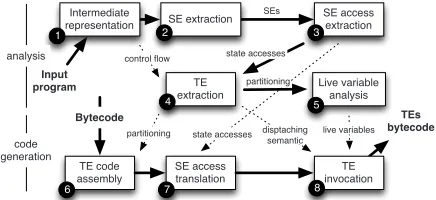
Annotated Java programs are translated to SDGs by the
java2sdg tool. Fig. 3 shows the steps performed by java2sdg: it first statically analyses the Java class to iden-tify SEs, TEs and their access edges (steps 1–5); it then transforms the Java bytecode of the class to generate TE code, ready for deployment (steps 6–8).
1. SE generation.The class is compiled toJimplecode,
a typed intermediate representation for static analysis used by the Sootframework [33] (step 1). The Jimple code is analysed to identify SEs with partitioned or par-tial fields and parpar-tial local variables (step 2). Based on the annotations in the code, access to SEs is classified as local, partitioned or global (step 3).
2. TE and dataflow generation. Next TEs are created so that each TE only accesses a single SE, i.e. a new TE is created from a block of code when access to a different SE or a different instance of the current SE is detected (step 4). The dispatching semantics of the dataflows between created TEs (i.e. partitioned, all-to-one, one-to-all or one-to-any) is chosen based on the type of state access. More specifically, a new TE is created:
1. for each entry point of the class;
2. when a TE usespartitioned accessto a new SE (or to a previously-accessed SE with a new access key). The access key is extracted using reaching expression analysis, and the dataflow edge between the two TEs is annotated with the access key;
3. when a TE usesglobal accessto a new partial SE. In this case, the dataflow edge between the two TEs is annotated withone-to-alldispatching semantics; 4. when a TE useslocal accessto a new partial SE, the
dataflow edge is annotated withone-to-any dispatch-ing semantics. In case of local (or partitioned) ac-cess after global acac-cess, all TE instances must be syn-chronised using a distributed barrier before control is transferred to the new TE, and the dataflow edge has
all-to-onedispatching semantics; and
5. for@Collectionexpressions. A synchronisation
bar-rier collects values from multiple TEs instances, and its dataflow edge hasall-to-onesemantics.
After generating the TEs,java2sdgidentifies the vari-ables that must propagate across TEs boundaries (step 5). For each dataflow, live variable analysis identifies the set of variables that are associated with that dataflow edge.
3. Bytecode generation. Nextjava2sdgsynthesises the bytecode for each TE that will be executed by the run-time system. It compiles the code assigned with each TE in step 4 to bytecode and injects it into a TE tem-plate (step 6) usingJavassist. State accesses to fields and partial variables are translated to invocations of the run-time system, which manages the SE instances (step 7).
Finally data dispatching across TEs is added (step 8):
java2sdginjects code, (i) at the exit point of TEs, to
seri-alise live variables and send them to the correct successor TE instance; and, (ii) at the entry point of a TE, to add barriers for all-to-one dispatching and to gather partial results for merge TEs.
5 Failure Recovery
To recover from failures, it is necessary to replace failed nodes and re-instantiate their TEs and SEs. TEs are
less and thus are restored trivially, but the state of SEs must be recovered. We face the challenge of designing a recovery mechanism that: (i) can scale to save and re-cover the state of a large number of nodes with low over-head, even with frequent failures; (ii) has low impact on the processing latency; and (iii) achieves fast recovery time when recovering large SEs.
We achieve these goals with a mechanism that (a) combineslocal checkpointswithmessage replay, thus avoiding both global checkpoint coordination and global rollbacks; (b) divides state of SEs intoconsistent state, which is checkpointed, and dirty state, which permits continued processing while checkpointing; and (c) par-titions checkpoints and saves them to multiple nodes, which enablesparallel recovery.
Approach. Our failure recovery mechanism combines local checkpointing and message logging and is inspired by failure recovery in distributed stream processing sys-tems [14]. Nodes periodically take checkpoints of their local SEs and output communication buffers. Dataflows include increasing TE-generated scalar timestamps, and a vector timestamp of the last data item from each input dataflow that modified the SEs is included in the check-point. Once the checkpoint is saved to stable storage, up-stream nodes can trim their output buffers of data items that are older than all downstream checkpoints.
After failure, a node recovers its SEs from the last checkpoint, replays its output buffers and reprocesses data items received from the upstream output buffers. Downstream nodes detect duplicate data items based on the timestamps and discard them. This approach allows nodes to recover SEs locally beyond the last checkpoint, without requiring nodes to coordinate global rollback, and it avoids the output commit problem.
State checkpointing. We use an asynchronous parallel checkpointing mechanism that minimises the processing interruption when checkpointing large SEs with GBs of memory. The idea is to record updates in a separate data structure, while taking a checkpoint. For each type of data structure held by an SE, there must be an imple-mentation that supports the separation of dirty state and its subsequent consolidation.
Checkpointing of a node works as follows: (1) to initi-ate a checkpoint, each SE is flagged asdirtyand the out-put buffers are added to the checkpoint; (2) updates from TEs to an SE are now handled using adirty state data structure: e.g. updates to keys in a dictionary are written to the dirty state, and reads are first served by the dirty state and, only on a miss, by the dictionary; (3) asyn-chronously to the processing, the now consistent state is added to the checkpoint; (4) the checkpoint is backed up to multiple nodes (see below); and (5) the SE is locked and its state is consolidated with the dirty state.
State backup and restore. To be memory-efficient,
remote
storage 1
n 1
1
n 2
1
n m
1 1
1
... 1
n n
n
... n
Backup to m nodes Restore to n nodes chunks
serialisation threads
B1 B2 B3
R1 R2
[image:10.612.331.523.72.177.2]R3
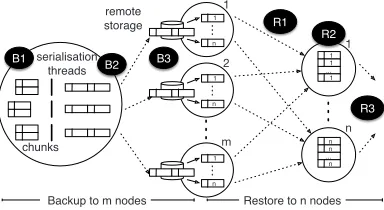
Figure 4: Parallel,m-to-nstate backup and restore checkpoints must be stored on disk. We overcome the problem of low I/O performance by splitting checkpoints acrossmnodes. To reduce recovery time, a failed SE in-stance can be restored tonnew partitioned SE instances in parallel. Thism-to-n pattern prevents a single node from becoming a disk, network or processing bottleneck. Fig. 4 shows the distributed protocol for backing up checkpoints. In step B1, checkpoint chunks, e.g. ob-tained by hash-partitioning checkpoint data, are created, and a thread pool serialises them in parallel (step B2). Checkpoint chunks are streamed tomnodes, selected in a round-robin fashion (step B3). Nodes write received checkpoint chunks directly to disk.
After failure,nnew nodes are instantiated with the lost TEs and SEs. Each node with a checkpoint chunk splits it intonpartitions, each of which is streamed to one of the recovering instances (step R1). The new SE instances reconcile the chunks, reverting the partitioning (step R2). Finally, data items from output buffers are reprocessed to bring the recovered SE state up-to-date (step R3).
6 Evaluation
The goal of our experimental evaluation is to explore if SDGs can (i) execute stateful online processing applica-tions with low latency and high throughput while sup-porting large state sizes with fine-grained updates (§6.1); (ii) scale in terms of nodes comparable to stateless batch processing frameworks (§6.2); handle stragglers at run-time with low impact on throughput (§6.3); and (iii) re-cover from failures with low overhead (§6.4).
We extend the SEEP streaming platform to implement SDGs and deploy our prototype on Amazon EC2 and a private cluster with 7 quad-core 3.4 GHz Intel Xeon servers with 8 GB of RAM. To support fast recovery, the checkpointing frequency for all experiments is 10 s un-less stated otherwise. Candlesticks in plots show the 5th,
25th,50th, 75thand 95thpercentiles, respectively.
6.1 Stateful online processing
0 5 10 15 20
1:5 1:2 1:1 2:1 5:1 100 1000
Throughput
(10
00
requests/s)
Latency
(ms)
Workload (state read/write ratio) Throughput
[image:11.612.83.538.71.155.2]Latency
Figure 5: Throughput and latency with different read/write ratios (online collab-orative filtering)
0 2 4 6 8 10
10 100 1000 2000 0 20 40 60 80 100
Throughput (10,000 requests/s)
Latency (ms)
Aggregated memory (MB)
SDG Naiad-NoDisk Naiad-Disk SDG (latency) Naiad-NoDisk (latency)
Figure 6: Throughput and latency with increasing state size on single node (key/value store)
0 0.5 1 1.5 2
50 100 150 200 1 10 100 1000
Throughput (million requests/s)
Latency (ms)
Aggregated memory (GB) Throughput
Latency
Figure 7: Throughput and latency with increasing state size on multiple nodes (key/value store)
ratings for evaluating recommender systems. We add new ratings continuously (addRating), while requesting
fresh recommendations (getRec). The state size main-tained by the system grows to 12 GB.
Fig. 5 shows the throughput ofgetRecandaddRating
requests and the latencies ofgetRec requests when the
ratio between the two is varied. The achieved through-put is sufficient to serve 10,000–14,000 requests/s, with the 95thpercentile of responses being at most 1.5 s stale.
As the workload ratio includes more state reads (getRec), the throughput decreases slightly due to the cost of the synchronisation barrier that aggregates the partial state in the SDG. The result shows that SDGs can combine the functionality of a batch and an online processing sys-tem, while serving fresh results with low latency and high throughput over large mutable state.
State size. Next we evaluate the performance of SDGs as the state size increases. As a synthetic benchmark, we implement a distributed partitionedkey/value store(KV)
using SDGs because it exemplifies an algorithm with pure mutable state. We compare to an equivalent im-plementation in Naiad (version 0.2) with global check-pointing, which is the only fault-tolerance mechanism available in the open-source version. We deploy it in one VM (“m1.xlarge”) and measure the performance of serv-ing update requests for keys.
Fig. 6 shows that, for a small state size of 100 MB, both SDGs and Naiad exhibit similar throughput of 65,000 requests/s with low latency. As the state size in-creases to 2.5 GB, the SDG throughput is largely un-affected but Naiad’s throughput decreases due to the overhead of its disk-based checkpoints (Naiad-Disk). Even with checkpoints stored on a RAM disk ( Naiad-NoDisk), its throughput with 2.5 GB of state is 63% lower than that of SDGs. Similarly, the 95thpercentile
la-tency in Naiad increases when it stops processing during checkpointing—SDGs do not suffer from this problem.
To investigate how SDGs can support large distributed state across multiple nodes, we scale the KV store by increasing the number of VMs from 10 to 40, keeping the number of dictionary keys per node constant at 5 GB. Fig. 7 shows the throughput and the latency for read requests with a given total state size. The aggregate
throughput scales near linearly from 470,000 requests/s for 50 GB to 1.5 million requests/s for 200 GB. The me-dian latency increases from 8–29 ms, while the 95th
per-centile latency varies between 800 ms and 1000 ms. This result demonstrates that SDGs can support state-ful applications with large state sizes without compro-mising throughput or processing latency, while executing in a fault-tolerant fashion.
Update granularity.We show the performance of SDGs when performing frequent, fine-grained updates to state. For this, we deploy a streamingwordcount(WC) appli-cation on 4 nodes in our private cluster. WCreports the word frequencies over a wall clock time window while processing the Wikipedia dataset. We compare toWC
implementations in Streaming Spark [39] and Naiad. We vary the size of the window, which controls the granularity at which input data updates the state: the smaller the window size, the less batching can be done when updating the state. Since Naiad permits the configuration of the batch size independently of the window size, we use a small batch size (1000 mes-sages) for low-latency (Naiad-LowLatency) and a large one (20,000 messages) for high-throughput process-ing (Naiad-HighThroughput).
Fig. 8 shows that only SDG and Naiad-LowLatency
can sustain processing for all window sizes, but SDG has a higher throughput due to Naiad’s scheduling over-head. The other deployments suffer from the overhead of micro-batching: Streaming Spark has a throughput similar to SDG, but its smallest sustainable window size is 250 ms, after which its throughput collapses; Naiad-HighThroughputachieves the highest throughput of all, but it also cannot support windows smaller than 100 ms. This shows that SDGs can perform fine-grained state up-dates without trading off throughput for latency.
6.2 Scalability
We explore if SDGs can scale to higher throughput with more nodes in a batch processing scenario. We deploy an implementation oflogistic regression(LR) [21] on EC2
(“m1.xlarge”; 4 vCPUs with 15 GB). We compare toLR
from Spark [38], which is designed for iterative process-ing, using the 100 GB dataset provided in its release.
0 50 100 150 200 250
10 100 1000 10000
Throughput (1000 requests/s)
Window size (ms) Naiad-HighThroughput
SDG Streaming Spark Naiad-LowLatency
Figure 8: Latency with different window sizes (streaming wordcount)
0 10 20 30 40 50 60
25 50 75 100
Throughput (GB/s)
Number of nodes SDG
Spark
Figure 9: Scalability in terms of through-put (batch logistic regression)
0 5 10 15 20 25 30
0 10 20 30 40 50 60 0 1 2 3 4 5
Throughput (1000 request/s)
Number of nodes
Time (s) Throughput
[image:12.612.78.552.74.159.2]Nodes
Figure 10: Runtime parallelism for han-dling stragglers (collaborative filtering) Fig. 9 shows the throughput of our SDG
implementa-tion and Spark for 25–100 nodes. Both systems exhibit linear scalability. The throughput of SDGs is higher than Spark, which is likely due to the pipelining in SDGs, which avoids the re-instantiation of tasks after each it-eration. With higher throughput, iterations are shorter, which leads to a faster convergence time. We conclude that the management of partial state in theLRapplication
does not limit scalability compared to existing stateless dataflow systems.
6.3 Stragglers
We explore how SDGs handle straggling nodes by creat-ing new TE and SE instances at runtime (see §3.3). For this, we deploy theCFapplication on our cluster and in-clude a less powerful machine (2.4 GHz with 4 GB).
Fig. 10 shows how the throughput and the number of nodes changes over time as bottleneck TEs are identi-fied by the system. At the start, a single instance of the
getRecVecTE is deployed. It is identified as a
bottle-neck, and a second instance is added att=10 s, which also causes a new instance of the partial state in the
coOccmatrix to be created. This increases the
through-put from 3600–6200 requests/s. The throughthrough-put spikes occur when the input queues of new TE instances fill up. Since the new node is allocated on the less powerful machine, it becomes a straggler, limiting overall through-put. Att=30 s, adding a new TE instance without re-lieving the straggler does not increase the throughput. At
t=50 s, the straggling node is detected by the system, and a new instance is created to share its work. This in-creases the throughput from 6200–11,000 requests/s.
This shows how straggling nodes are mitigated by al-locating new TE instances on-demand, distributing new partial or partitioned SE instances as required. In more extreme cases, a straggling node could even be removed and the job resumed from a checkpoint with new nodes.
6.4 Failure recovery
We evaluate the performance and overhead of our fail-ure recovery mechanism for SDGs. We (i) explore the recovery time under different recovery strategies; (ii) as-sess the advantages of our asynchronous checkpointing mechanism; and (iii) investigate the overhead with differ-ent checkpointing frequencies and state sizes. We deploy
theKV store on one node of our cluster, together with spare nodes to store backups and replace failed nodes. Recovery time. We fail the node under different recov-ery strategies: anm-to-nrecovery strategy usesmbackup nodes to restore tonrecovered nodes (see §5). For each, we measure the time to restore the lost SE, re-process unprocessed data and resume processing.
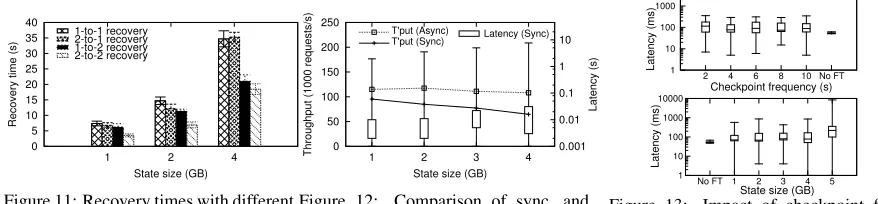
Fig. 11 shows the recovery times for different SE sizes under different strategies: (i) the simplest strategy, 1-to-1, has the longest recovery time, especially with large state sizes, because the state is restored from a sin-gle node; (ii) the 2-to-1 strategy streams checkpoint chunks from two nodes in parallel, which improves disk I/O throughput but also increases the load on the recover-ing node when it reconstitutes the state; (iii) in the 1-to-2 strategy, checkpoint chunks are streamed to two recov-ering nodes, thus halving the load of state reconstruc-tion; and (iv) the 2-to-2 strategy recovers fastest because it combines the above two strategies—it parallelises both the disk reads and the state reconstruction.
As the state becomes large, state reconstruction domi-nates over disk I/O overhead: with 4 GB, streaming from two disks does not improve recovery time. Adopting a strategy that recovers a failed node with multiple nodes, however, has significant benefit, compared to cases with smaller state sizes.
Synchronous vs. asynchronous checkpointing.We in-vestigate the benefit of our asynchronous checkpointing mechanism in comparison with synchronous checkpoin-ting that stops processing, as used by Naiad [26] and SEEP [10].
Fig. 12 compares the throughput and 99th percentile
0 5 10 15 20 25 30 35 40
1 2 4
Recovery time (s)
[image:13.612.81.520.75.177.2]State size (GB) 1-to-1 recovery 2-to-1 recovery 1-to-2 recovery 2-to-2 recovery
Figure 11: Recovery times with different
m-to-nrecovery strategies
0 50 100 150 200 250
1 2 3 4 0.001
0.01 0.1 1 10
Throughput
(10
00
requests/s)
Latency
(s)
State size (GB)
T'put (Sync) Latency (Sync) T'put (Async)
Figure 12: Comparison of sync. and async. checkpointing
1 10 100 1000
2 4 6 8 10 No FT
Laten
cy (
m
s)
Checkpoint frequency (s)
1 10 100 1000 10000
No FT 1 2 3 4 5
Laten
cy (
m
s)
State size (GB)
Figure 13: Impact of checkpoint fre-quency and size on latency
as a function of checkpointing frequency and state size. Fig. 13 (top) shows the processing latency when vary-ing the checkpointvary-ing frequency. The rightmost data point (No FT) represents the case where the checkpoin-ting mechanism is disabled. The bottom figure reports the impact of the size of the checkpoint on latency.
Checkpointing has a limited impact on latency: with-out fault tolerance, the 95thpercentile latency is 68 ms,
and it increases to 500 ms when checkpointing 1 GB ev-ery 10 s. This is due to the overhead of merging dirty state and saving checkpoints to disk. Increasing the checkpointing frequency or size gradually also increases latency: the 95thpercentile latency with 4 GB is 850 ms,
while checkpointing 2 GB every 4 s results in 1 s. Beyond that, the checkpointing overhead starts to im-pact higher percentiles more significantly. Checkpoin-ting frequency and size behave almost proportionally: as the state size increases, the frequency can be reduced to maintain a low processing latency.
Overall this experiment demonstrates the strength of our checkpointing mechanism, which only locks state while merging dirty state. The locking overhead thus re-duces proportionally to the state update rate.
7 Related Work
Programming model. Data-parallel frameworks typi-cally support a functional/declarative model: MapRe-duce [8] only has two higher-order functions; more re-cent frameworks [15, 38, 13] permit user-defined tional operators; and Naiad [26] supports different func-tional and declarative programming models on top of its timely dataflow model. CBP [19], Storm and SEEP [10] expose a low-level dataflow programming model: algo-rithms are defined as a dataflow pipeline, which is harder to program and debug. While functional and dataflow models ease distribution and fault tolerance, SDGs tar-get an imperative programming model, which remains widely used by data scientists [17].
Efforts exist to bring imperative programming to data-parallel processing. CIEL [25] uses imperative con-structs such as task spawning and futures, but this ex-poses the low-level execution of the dynamic dataflow graph to developers. Piccolo [30] and Oolong [24] offer imperative compute kernels with distributed state, which
requires algorithms to be structured accordingly. In contrast, SDGs simplify the translation of impera-tive programs to dataflows using basic program analysis techniques, which infer state accesses and the dataflow. By separating different types of state access, it becomes possible to choose automatically an effective implemen-tation for distributed state.
GraphLab [20] and Pregel [22] are frameworks for graph computations based on a shared-memory abstrac-tion. They expose a vertex-centric programming model whereas SDGs target generic stateful computation. Program parallelisation. Matlab has language con-structs for parallel processing of large datasets on clus-ters. However, it only supports the parallelisation of se-quential blocks or iterations and not of general dataflows. Declarative models such as Pig [28], DyradLINQ [37], SCOPE [6] and Stratosphere [9] are naturally amenable to automatic parallelisation—functions are stateless, which allows data-parallel versions to execute on mul-tiple nodes. Instead, we focus on an imperative model.
Other approaches offer new programming abstrac-tions for parallel computation over distributed state. FlumeJava [7] provides distributed immutable collec-tions. While immutability simplifies parallel execution, it limits the expression of imperative algorithms. In Pic-colo [30], global mutable state is accessed remotely by parallel distributed functions. In contrast, tasks in SDGs only access local state with low latency, and state is al-ways colocated with computation. Presto [35] has dis-tributed partitioned arrays for the R language. Parti-tions can be collected but not updated by multiple tasks, whereas SDGs permit arbitrary dataflows.
Extracting parallel dataflows from imperative pro-grams is a hard problem [16]. We follow an approach similar to that of Beck et al. [3], in which a dataflow graph is generated compositionally from the execution graph. While early work focused on hardware-based dataflow models [27], more recent efforts target thread-based execution [18]. Our problem is simpler because we do not extract task parallelism but only focus on data and pipeline parallelism in relation to distributed state access. Similar to pragma-based techniques [34], we use an-notations to transform access to distributed state into ac-cess to local instances. Blazes [2] uses annotations to
generate automatically coordination code for distributed programs. Our goal is different: SDGs execute imper-ative code in a distributed fashion, and coordination is determined by the extracted dataflow.
Failure recovery. In-memory systems are prone to failures [1], and fast recovery is important for low-latency and high-throughput processing. With large state sizes, checkpoints cannot be stored in memory, but stor-ing them on disk can increase recovery time. RAM-Cloud [29] replicates data across cluster memory and eventually backs it up to persistent storage. Similar to our approach, data is recovered from multiple disks in parallel. However, rather than replicating each write re-quest, we checkpoint large state atomically, while per-mitting new requests to operate on dirty state.
Streaming Spark [39] and Spark [38] use RDDs for recovery. After a failure, RDDs are recomputed in par-allel on multiple nodes. Such a recovery mechanism is effective if recomputation is inexpensive—for state that depends on the entire history of the data, it would be pro-hibitive. In contrast, the parallel recovery in SDGs re-trieves partitioned checkpoints from multiple nodes, and only reprocesses data from output buffers to bring re-stored SE instances up-to-date.
8 Conclusions
Data-parallel processing frameworks must offer a famil-iar programming model with good performance. Sup-porting imperative online machine learning algorithms poses challenges to frameworks due to their use of large distributed state with fine-grained access.
We describe stateful dataflow graphs (SDGs), a data-parallel model that is designed to offer a dataflow ab-straction over large mutable state. With the help of anno-tations, imperative algorithms can be translated to SDGs, which manage partitioned or partial distributed state. As we demonstrated in our evaluation, SDGs can support di-verse stateful applications, thus generalising a number of existing data-parallel computation models.
Acknowledgements. This work was supported by a PhD CASE Award funded by EPSRC/BAE Systems. We thank our PC contact, Jinyang Li, and the anonymous ATC reviewers for their feedback and guidance.
References
[1] AKIDAU, T., BALIKOV, A.,ET AL. MillWheel: Fault-Tolerant Stream Processing at Internet Scale. InVLDB(2013).
[2] ALVARO, P., CONWAY, N.,ET AL. Blazes: Coordination Anal-ysis for Distributed Programs. InICDE(2014).
[3] BECK, M.,ANDPINGALI, K. From Control Flow to Dataflow.
InICPP(1990).
[4] BHATOTIA, P., WIEDER, A.,ET AL. Incoop: MapReduce for Incremental Computations. InSOCC(2011).
[5] BU, Y., HOWE, B.,ET AL. HaLoop: Efficient Iterative Data Processing on Large Clusters. InVLDB(2010).
[6] CHAIKEN, R., JENKINS, B.,ET AL. SCOPE: Easy and Efficient Parallel Processing of Massive Data Sets. InVLDB(2008).
[7] CHAMBERS, C., RANIWALA, A.,ET AL. FlumeJava: Easy, Ef-ficient Data-Parallel Pipelines. InPLDI(2010).
[8] DEAN, J.,ANDGHEMAWAT, S. MapReduce: Simplified Data Processing on Large Clusters. InCACM(2008).
[9] EWEN, S., TZOUMAS, K.,ET AL. Spinning Fast Iterative Data
Flows. InVLDB(2012).
[10] FERNANDEZ, R. C., MIGLIAVACCA, M., ET AL. Integrating Scale Out and Fault Tolerance in Stream Processing using Oper-ator State Management. InSIGMOD(2013).
[11] GUNDA, P. K., RAVINDRANATH, L.,ET AL. Nectar: Automatic Management of Data and Comp. in Datacenters. InOSDI(2010). [12] HE, B., YANG, M.,ET AL. Comet: Batched Stream Processing
for Data Intensive Distributed Computing. InSOCC(2010). [13] HUESKE, F., PETERS, M.,ET AL. Opening the Black Boxes in
Data Flow Optimization. InVLDB(2012).
[14] HWANG, J.-H., BALAZINSKA, M.,ET AL. High-Availability
Algorithms for Distributed Stream Processing. InICDE(2005). [15] ISARD, M., BUDIU, M.,ET AL. Dryad: Dist. Data-Parallel
Pro-grams from Sequential Building Blocks. InEuroSys(2007). [16] JOHNSTON, W. M., HANNA, J.,ET AL. Advances in Dataflow
Programming Languages. InCSUR(2004).
[17] KDNUGGETSANNUALSOFTWAREPOLL. RapidMiner and R vie for the First Place.http://goo.gl/OLikb, 2013.
[18] LI, F., POP, A.,ET AL. Automatic Extraction of Coarse-Grained Data-Flow Threads from Imperative Programs. InMicro(2012). [19] LOGOTHETHIS, D., OLSON, C.,ET AL. Stateful Bulk
Process-ing for Incremental Analytics. InSOCC(2010).
[20] LOW, Y., BICKSON, D.,ET AL. Dist. GraphLab: A Framework for ML and Data Mining in the Cloud. InVLDB(2012). [21] MA, J., SAUL, L. K.,ET AL. Identifying Suspicious URLs: an
Application of Large-Scale Online Learning. InICML(2009). [22] MALEWICZ, G., AUSTERN, M. H.,ET AL. Pregel: A System
for Large-scale Graph Processing. InSIGMOD(2010). [23] MISHNE, G., DALTON, J.,ET AL. Fast Data in the Era of Big
Data: Twitter’s Real-Time Related Query Suggestion Architec-ture. InSIGMOD(2013).
[24] MITCHELL, C., POWER, R.,ET AL. Oolong: Asynchronous
Distributed Applications Made Easy. InAPSYS(2012). [25] MURRAY, D., SCHWARZKOPF, M.,ET AL. CIEL: A Universal
Exec. Engine for Distributed Data-Flow Comp. InNSDI(2011). [26] MURRAY, D. G., MCSHERRY, F., ET AL. Naiad: A Timely
Dataflow System. InSOSP(2013).
[27] NIKHIL, R. S.,ET AL. Executing a Program on the MIT Tagged-Token Dataflow Architecture. InTC(1990).
[28] OLSTON, C., REED, B.,ET AL. Pig Latin: A Not-So-Foreign Language for Data Processing. InSIGMOD(2008).
[29] ONGARO, D., RUMBLE, S. M.,ET AL. Fast Crash Recovery in
RAMcloud. InSOSP(2011).
[30] POWER, R.,ANDLI, J. Piccolo: Building Fast, Distributed Pro-grams with Partitioned Tables. InOSDI(2010).
[31] SCHELTER, S., EWEN, S.,ET AL. All Roads Lead to Rome: Optimistic Recovery for Distributed Iterative Data Processing. In
CIKM(2013).
[32] SUMBALY, R., KREPS, J.,ET AL. The Big Data Ecosystem at LinkedIn. InSIGMOD(2013).
[33] VALLEE´ -RAI, R., HENDREN, L.,ET AL. Soot: A Java Opti-mization Framework. InCASCON(1999).
[34] VANDIERENDONCK, H., RUL, S.,ET AL. The Paralax
Infrastru-cture: Automatic Parallelization with a Helping Hand. InPACT
(2010).
[35] VENKATARAMAN, S., BODZSAR, E.,ET AL. Presto: Dist. ML and Graph Processing with Sparse Matrices. InEuroSys(2013). [36] XIN, R. S., ROSEN, J.,ET AL. Shark: SQL and Rich Analytics
at Scale. InSIGMOD(2013).
[37] YU, Y., ISARD, M.,ET AL. DryadLINQ: a System for General-Purpose Distributed Data-Parallel Computing using a High-Level Language. InOSDI(2008).
[38] ZAHARIA, M., CHOWDHURY, M.,ET AL. Resilient Distributed Datasets: A Fault-Tolerant Abstraction for In-Memory Cluster Computing. InNSDI(2012).
[39] ZAHARIA, M., DAS, T., ET AL. Discretized Streams: Fault-tolerant Streaming Computation at Scale. InSOSP(2013). [40] ZAHARIA, M., KONWINSKI, A.,ET AL. Improving MapReduce