City, University of London Institutional Repository
Citation
: Nigam, A., Huising, R. & Golden, B. R. (2014). Improving Hospital Efficiency: A
Process Model of Organizational Change Commitments. Medical Care Research and Review, 71(1), pp. 21-42. doi: 10.1177/1077558713504464This is the accepted version of the paper.
This version of the publication may differ from the final published
version.
Permanent repository link:
http://openaccess.city.ac.uk/14009/Link to published version
: http://dx.doi.org/10.1177/1077558713504464
Copyright and reuse:
City Research Online aims to make research
outputs of City, University of London available to a wider audience.
Copyright and Moral Rights remain with the author(s) and/or copyright
holders. URLs from City Research Online may be freely distributed and
linked to.
City Research Online: http://openaccess.city.ac.uk/ [email protected]
Improving Hospital Efficiency: A Process Model of Organizational Change Commitments
Amit Nigam, PhD City University London
Cass Business School 106 Bunhill Row London, EC1Y 8TZ
United Kingdom Tel: +44 (0) 20 7040 0289 Fax: +44 (0) 20 7040 8328
Ruthanne Huising, PhD McGill University
Desautels Faculty of Management 1001 Sherbrooke Street West
Montreal, QC H3A 1G5 Canada
Tel: +1 (514) 398-2438 [email protected]
Brian Golden, PhD University of Toronto Rotman School of Management
105 St. George Street Toronto, ON M5S 3E6
Canada
Improving Hospital Efficiency: A Process Model of Organizational Change Commitments
Abstract: Improving hospital efficiency is a critical goal for managers and policy makers. We
draw on participant observation of the perioperative coaching program in seven Ontario hospitals
to develop knowledge of the process by which the content of change initiatives to increase
hospital efficiency is defined. The coaching program was a change initiative involving the use of
external facilitators with the goal of increasing perioperative efficiency. Focusing on the role of
subjective understandings in shaping initiatives to improve efficiency, we show that physicians,
nurses, administrators, and external facilitators all have differing frames of the problems that
limit efficiency, and proposed different changes that could enhance efficiency. Dynamics of
strategic and contested framing ultimately shaped hospital change commitments. We build on
work identifying factors that enhance the success of change efforts to improve hospital
efficiency, highlighting the importance of subjective understandings and the politics of
meaning-making in defining what hospitals change.
Short Title: Improving Hospital Efficiency
Improving hospital efficiency is a critical concern for health care managers and policy
makers. Hospital efficiency reflects the ratio of the value of health services delivered—both the
quantity and quality of care—to the resources used in producing health services. Increased
efficiency is central to performance improvement in hospitals and the larger health system, and a
main goal of hospital organizational change efforts (Bazzoli, Dynan, Burns, & Yap, 2004;
Berwick, 1989; Shortell et al., 1995). Improved hospital efficiency is also an important means of
achieving the policy goal of increasing value in the health care delivery system—slowing the rate
of health care inflation while maintaining quality (Shortell, 2004). Hospitals have substantial
room to improve efficiency, and can use reclaimed resources to invest in improved quality or
better access (Mutter, Rosko, Greene, & Wilson, 2011). Because medical care is in most cases a
product of coordinated work across multiple organizational members and units, there are
multiple, potentially interacting determinants of hospital efficiency (cf. Helfrich, Weiner,
McKinney, & Minasian, 2007). As a result, hospitals can make numerous changes to increase
efficiency, and different hospitals can vary in their approach (Berwick, 1989).
While much research on hospital efficiency has focused on developing methods for
measuring efficiency (Mutter et al., 2011), a growing body of work has begun to explore the
process and outcomes of organizational change efforts to improve efficiency (Fraser, Encinosa,
& Glied, 2008). This work has developed our knowledge of the effects of different programs on
efficiency (Olson, Belohlav, Cook, & Hays, 2008), the role of market and institutional pressures
as drivers of organizational change efforts to improve efficiency (Durkin, Deutsch, &
Heinemann, 2010), and the impact on efficiency of organizational factors such as leadership,
Shortell, 2001; Fraser et al., 2008; Shortell et al., 1995; Tucker, Singer, Hayes, & Falwell, 2008;
Weiner, Shortell, & Alexander, 1997).
Focusing specifically on organizational change efforts that aim to increase hospital
efficiency, this paper shows how the dynamics offraming within and across professional groups
can influence the choices that hospitals make in their effort to increase efficiency. It draws on
participant observation of a provincial government initiative—the perioperative coaching
initiative—to improve perioperative efficiency in hospitals in Ontario, Canada to develop a
conceptual framework explaining how hospitals make decisions about how to target certain
possibilities in their efforts to increase efficiency, and exclude others.
New Contribution
In analyzing how hospitals make choices about what to change, we build on and extend
an emerging body of work identifying general factors—such as a supportive culture, or physician
leadership—that impact the outcomes of efforts to improve efficiency (Bazzoli et al., 2004;
Fraser et al., 2008; Tucker et al., 2008). We complement this work by examining the content of
change efforts that aim to improve efficiency, and the process by which that content is defined.
We develop a conceptual model of how framing across professions influences hospitals’ choices
about what to change. In doing so, we take up the call for research examining what hospitals
“actually do as they implement major organizational change” (Bazzoli et al., 2004: 321) by
examining the organizational decision-making processes that define the content of change.
Our focus on how hospitals define the content of organizational change efforts that aim to
increase efficiency led us to our second contribution: a focus on the importance of framing. With
some exceptions (Hoff et al., 2011), health services research largely focuses attention on
support change, the role of institutional or market pressure in causing change, or the importance
of physician or senior management support (e.g. Bradley et al., 2001; Helfrich et al., 2007;
Shortell, 2004). A fundamental insight of research on framing is the idea that individuals’
subjective understandings, or schema, can shape their actions in support of or against change. As
a result, actors achieve organizational change, in part, by trying to alter others’ subjective
understandings or schema in a way that either gains their support or neutralizes their opposition.
By introducing the literature on framing to a health services research audience, we offer a
conceptual framework for analyzing both the importance of subjective understandings and
schema, and the role of change agents’ efforts to influence the schema of others.
Conceptual Framework
The basic insight that emerged from our research was that hospital decisions about what
to change in their effort to improve efficiency were driven by framing processes across
professional roles. Our conceptual framework emerged from our use of existing literatures on
framing, professions, and occupations to analyze our ethnographic field notes.
A frame is an interpretive schema that enables individuals to organize and make sense of
the complex stimuli of everyday life (Benford & Snow, 2000). The concept of framing originated
in research on social movements. One of the basic insights of the framing literature was to
develop the idea that movement actors, in addition to mobilizing resources, are also engaged
with the work of “mobilizing meanings” (Benford & Snow, 2000). Individuals engage in framing
to gain consensus around a shared understanding of some problematic situation. This consensus
includes a diagnostic frame, shared understandings of the causes of a problematic situation, and a
prognostic frame of the actions or changes that would address the situation (Benford & Snow,
action, social movement actors are embroiled in the politics of meaning construction. More
recent work adapts the concept of framing to emphasize that the politics of meaning making is
important in shaping organizational change in corporations (Kaplan, 2008).
In hospitals, we find that an individual’s professional role, combining their professional
training and tasks and expectations associated with their specific job, shapes how they frame
problems that inhibit efficiency, and frames solutions—changes that would improve efficiency.
Professional roles impact frames by defining the work that individuals do, which shapes their
job-specific goals and exposure to problems and information (Bechky, 2003; Golden, Dukerich,
& Fabian, 2000). An individual’s membership in a professional group can also impact frames by
defining her jurisdictional stake in stability or change. A profession’s jurisdiction is its claim to
authority or control over specific work tasks (Abbott, 1988). Jurisdictional authority is a major
source of power in organizations, giving individuals a vested interest in encouraging changes that
enhance their jurisdictional authority, and opposing changes that challenge it. As a result,
jurisdictional conflict, in which different professional groups vie for control over work tasks or
organizational resources, is a major form of conflict that can influence individuals’ frames of
whether and how an organization should change (Abbott, 1988; Bechky, 2003). Jurisdictional
power plays a critical role in determining what hospitals choose to change by empowering some
groups with jurisdictional authority over certain tasks (e.g. physicians and their clinical tasks)
with the ability to effectively block proposed changes relating to those tasks.
Proponents and opponents of specific changes used a combination of strategic and
contested framing to advance their preferred changes and block changes they considered
undesirable. Strategic framing involves framing processes that are deliberate and goal directed.
(Benford & Snow, 2000; Snow, Burke, Worden, & Benford, 1986). Frame bridging involves
linking ideologically congruent, but structurally unconnected frames of an issue. It connects a
proponent of some change with potential supporters with presumed common interests by
clarifying problems, information, or potential solutions that might solidify their support. Frame
amplificationinvolves highlighting how a particular diagnostic or prognostic frame is consistent
with values or beliefs that are presumed to be important to a potential supporter. Frame extension
involves efforts to draw links between different interests and goals. An individual engages in
frame extension when she frames a link between her main goal and goals that are incidental or
secondary to her, but important to potential supporters. Contested framing processes involve
efforts to challenge the diagnostic or prognostic frames advanced by another actor. Strategic and
contested framing can be combined in practice, as individuals craft frames that aim to both
appeal to potential supporters, and neutralize the effects of competing frames advanced by their
opponents (Benford & Snow, 2000; Kaplan, 2008).
The dynamics of strategic and contested framing across professional roles determined
what hospitals changed. While professional roles shape individuals’ diagnostic and prognostic
frames, and individuals attempted to build support for both their diagnostic and prognostic
frames, we find that hospitals commit to changes if there is sufficient shared support for a
prognostic frame of a change that would increase efficiency. Different actors within a hospital
may identify the same prognostic frame as a solution to different perceived problems.
Methods
Empirical Context
As part of its strategy to reduce surgical wait times (“wait time strategy”), Ontario’s
program to help hospitals improve perioperative efficiency. Perioperative care includes the
continuum of care before, during and after surgery, including pre-surgical assessment, anesthetic
and surgical care within the operating room (“OR”), and post-surgical recovery. Through the
program, hospitals could request a visit by a coaching team that would help them identify
problems that are potential causes of inefficiency. The team, of clinicians and administrators
from other hospitals acting as consultants, would facilitate the development of plans to address
hospital-identified problems. Coaching visits were designed to elicit the perspectives of diverse
professional groups, and to integrate these perspectives into a coordinated effort to increase
efficiency. Each visit involved 1½ to 2 days of interviews and focus groups, followed by 1½ to 2
days of action planning, in which stakeholders in the perioperative program defined the steps that
they will undertake to address problems and improve efficiency. Throughout this process,
consultants acted as facilitators (Sherrard, Trypuc, & Hudson, 2009).
The coaching program is an ideal context to develop knowledge of how hospitals make
choices about what to change in the effort to increase efficiency. It was designed to allow
physicians and staff to identify changes that were best for their hospitals. While there were
common issues across hospitals, there was also substantial variation in the specifics across
hospitals. All hospitals committed to making changes that would increase efficiency, which were
documented in a hospital’s action plan, a document outlining specific change commitments, and
identifying individuals who would be responsible for implementing the commitment.
While the financing and organization of Ontario’s health care system is unique, insights
from the perioperative coaching initiative are more broadly applicable. Ontario has a publicly
funded single payer system, in which the Ministry, with the exception of a small workers’
Ontario can be public or private, and are largely independently incorporated, and governed by
independent boards of directors. Hospitals are responsible for managing costs, providing quality
care, and doing so in a financially sustainable way. As in the United States, hospitals employ
nurses, administrators, and allied health professionals and are responsible for managing the costs
incurred in treating patients. Physicians work primarily in solo- or small-group practices, are not
hospital employees, and are reimbursed on a fee-for-service basis.
Data
Our research draws on observation by the first author (the observer) of seven coaching
team visits over a six month period. Our data include observation in a mix of hospitals that is
representative of hospitals in the province, including one major academic center, four mid-sized
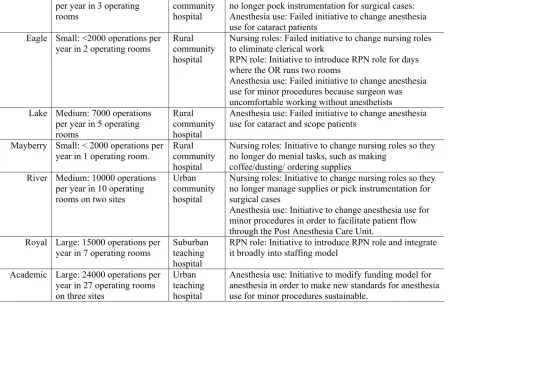
community hospitals (two urban and two rural), and two small rural hospitals. Table 1 provides
an overview of the seven research sites. The observer was able to use a laptop to type his field
notes during most of his observation time, allowing him to gather rich field notes with direct
quotations and close paraphrases of much of what was said. To preserve the confidentiality of
participants in the initiative, we use pseudonyms for all seven hospitals in presenting our results.
Insert Table 1 here
Analysis
We analyzed the field notes using a combination of narrative and comparative case
analysis (Charmaz, 2006; Langley, 1999). Narrative analysis involves constructing a detailed,
chronological story from original or raw data (Langley, 1999). Guided by our interest in how
hospitals define and commit to specific changes, we broke down each visit into segments—
representing each formal meeting or period of informal interaction between meetings—and
initiatives, of importance in these summaries were the issues raised, specific changes proposed,
and framing strategies used to mobilize support or opposition.
We used the technique of following issues forward and back, over the course of a
narrative summary, to develop insight into the process by which individuals framed specific
problems, proposed solutions, and advocated for or contested proposed solutions over the course
of the coaching visit (Langley, 1999). We used comparative case analysis, informed by earlier
rounds of coding and analysis, to further develop a model of how hospitals commit to specific
changes. Our comparative case analysis focuses on three specific changes, chosen using
theoretical sampling (Charmaz, 2006): (1) reorganizing work to free nurses from lower-skilled
tasks, (2) the use of anesthesia for minimally invasive procedures, and (3) the introduction of the
registered practical nurse role (nurses with a two year nursing diploma). We chose these specific
changes for three reasons. First, they were important changes discussed across hospitals, ranging
from two hospitals for the introduction of the registered practical nurse role to five hospitals for
both freeing nurses from low-skilled tasks and changing the use of anesthesia for minor
procedures. Second, the issues were associated with varying levels of framing conflict. Third,
there were differences across the issues in the likelihood that a proposed change would result in a
change commitment. Two authors independently coded each narrative summary to identify
discussion of each of the three specific changes, constructing an issue narrative for each of the
three proposed changes in every hospital in which it was discussed. We coded the narratives for
evidence of distinct frames on the part of different professional roles for each of the three issues,
the use of specific strategic or contested framing processes, and whether the proposed change
Results
We describe in detail how framing processes influenced change commitments by drawing
on three examples. We explain how framing processes led to commitment to change how nursing
jobs were designed in an effort to remove low-skilled tasks using Mayberry Hospital as an
example. We draw on an example from Lake Hospital to show how framing processes blocked
change related to the use of aesthesia in minimally invasive procedures. These two examples are
useful to demonstrate framing processes when physicians do not have much at stake (nursing
roles) and when physicians have quite a bit at stake (use of aesthesia). This is an important
difference as it allows us to draw out the role of a high status actor. We draw on the additional
example of the framing process around nursing roles at Eagle Hospital to show how the
dynamics of framing, even around the same issue, can differ depending on the coalition built.
Together these three sites illustrate our main findings – highlighting the roles of powerful actors
and of coalitions – about framing processes. We include examples from the other sites to provide
insight into the depth of our data and to offer further illustrations.
Impact of Professional Roles on Frames
Individuals’ professional roles impacted their frames of problems that inhibit efficiency,
and proposed changes that would improve efficiency. Table 2 presents the three examples
described below in detail to illustrate how professional roles shape frames. For each example it
presents the initial diagnostic and prognostic frames articulated by different professional groups,
and an account for why these frames are grounded in individual’s professional roles. These
initial frames demonstrate the differences in perspectives across roles that are rooted in the
jurisdictional stakes in professional control (physicians & nurses), financial and operational
Insert Table 2 here
Mayberry Hospital. The new OR manager at Mayberry Hospital, a small rural hospital,
diagnostically framed the problem of efficiency in terms of nurses doing non-nursing tasks. She
described current practices, where nurses clean scopes, order supplies and perform other tasks
that do not require nursing skills as inefficient. She framed her solution as follows:
I would put a [sterile processing staff person] in to clean scopes. Not a nurse. You can turn things
over a lot faster that way… It would also be nice to have someone [other than a nurse] in every
day to do cleanup.
The OR manager offered both a diagnostic frame—nurses doing non-nursing tasks such
as cleaning scopes and ordering supplies—and a prognostic frame—transferring those tasks to
another, non-nursing staff person. These frames were grounded in the work that she did as part of
her professional role. As a manager directly in charge of staffing nursing care for the OR, she
was exposed to the challenges of staffing the OR to accomplish tasks needed to maintain the
functioning of the OR within a defined budget. The physicians seemed largely unaware of any
negative side effects the nurses’ diffuse responsibilities. This lack of understanding is not
surprising given that the negative side-effects did not have direct implications for physicians.
The director of patient care at Mayberry articulated a related diagnostic frame about
efficiency in the OR. In response to the CEO’s statement that he would like to run the OR five
days a week instead of four days a week, she framed a problem, commenting “I’m worried that
we are not using our days in the OR appropriately.” She elaborated to offer a prognostic frame,
asking “Can we do more cases in the time we have? Even if we could fit in one case a day [we
would be able to increase our surgical volumes].” In contrast with the OR manager, her
from a different issue –the CEO’s proposal to add a day of OR time. She recounted “The
proposal looks great. I started to generate the resource requirements, and nowhere did it include
nursing resources.” She went on to elaborate that she did not have the nursing resources to
support the ORs five days, and articulated instead a preference to “fit in that one more case [a
day] without changing our business or hours, or adding overtime.” While she made general
statements that the OR time could be used more efficiently, she did not specifically mention the
range of non-nursing tasks included in nurses’ work. Nevertheless, her prognostic frame, fitting
in an extra case, is consistent with the OR manager’s prognostic frame. Her framing was
similarly grounded in the work she does in her professional role. As a director, she was
responsible for coordinating resources, including nursing resources for all of the clinical areas in
the hospital. Because of her role, she was able to identify the limitations to the CEOs proposal to
add an additional day of OR time. In addition, her role, which exposed her to operations within
perioperative care, helped her form a general understanding that OR resources could be used
more efficiently. As a more senior administrator, however, she had less direct exposure to the
day-to-day work and specific tasks performed by nurses.
The coaches were vocal in framing the issue of nurses doing a range of non-nursing tasks
as a problem. In a private conversation among the coaches, one relayed that she learned that the
first nurse came in an hour before the first surgical case, and that the nurses dust the ORs, make
coffee, and do a range of other menial tasks. An OR manager herself, she was emphatic that this
was a problem. Describing the fact that nurses make coffee, she noted “I go crazy about that! It is
not an uncommon thing for nurses to do.” Through the conversation, the coaches described
framed a solution, using process mapping to reorganize nursing tasks so that nursing hours can
be used to expand the amount of staffed OR time, as a potential solution.
Lake Hospital. At Lake Hospital, the OR Manager’s diagnostic framing of the problem of
anesthetists working on endoscopy (colloquially “endo”) patients was also grounded in her
professional role. Anesthetists in Canada play a similar role as in the United States, and have
comparable levels of jurisdictional authority. Endoscopy is a minimally invasive diagnostic
procedure. While endoscopy can be done with unconscious sedation with an anesthetist, it can
also be done without an anesthetist, using local anesthesia. The OR Manager crafted a diagnostic
frame of the anesthetists’ preferences to work on endo patients as an example of self-interested
behavior that contributed to a larger problem of inappropriate resource use: "Anesthesia is
running the show - some days we are down to a room [due to lack of anesthesia coverage]... but
we have anesthesia in ENDO!" She suggested that anesthetists wanted to work on endo patients
because it was financially attractive, and referred to anesthesia coverage for cataract surgeries,
which is also highly remunerative, noting “they like the eyes [cataracts] of course. They have
their hands in many pots.” Ultimately, she emphasized that the financial motivations of the
anesthetists led to the misallocation (i.e., inefficiency) of anesthesia resources, and proposed
reallocating anesthetists time towards surgeries that truly required anesthesia coverage.
The director of perioperative care had a similar diagnostic frame, and further elaborated
on the consequences of anesthesia coverage for endoscopy, commenting:
On medical staff issues, I believe anesthesia is the worst culprit now [in terms of focusing on
personal financial interests]… Anesthesia as a group worries me. They are the ones who insisted
are staffing endoscopy] they say there are not enough anesthetists to cover other surgeries. I’ve
had to double up on nurses.
Both the OR manager’s and the director of perioperative care’s diagnostic frames were
grounded in their individual professional roles. As clinical administrators, each held some
responsibility for ensuring that the hospital could accomplish the range and volume of surgeries
needed to meet community needs, and had a jurisdictional stake in influencing the allocation of
resources to allow them to accomplish their work. In this hospital, the availability of anesthetists
was one of the main constraints on surgical volumes. As a result, they framed anesthetists’
unnecessary participation in minimally invasive surgeries as a resource issue that exacerbated the
problem of inadequate anesthesia coverage for invasive surgeries. In the effort to gain influence
over how anesthesia resources are allocated, they proposed performing minimally invasive
surgeries without anesthetists, freeing them up to work on invasive surgeries, as a solution.
Use of Strategic and Contested Framing to Build Support for Proposed Change
Proponents of specific changes used a combination of strategic and contested framing to build
support for their prognostic frames of what should be changed in order to improve efficiency.
Strategic framing—bridging, alignment, and extension—allowed proponents to mobilize
supporters, while contested framing allowed them to counter opposition.
Mayberry Hospital. Proponents of specific changes used frame bridging to build support for
solutions that were broadly consistent with potential supporters’ previously articulated frames.
The coaches at Mayberry used frame bridging to gain the director of patient care’s support for
reorganizing work to free nurses of non-nursing task. They did so by connecting their prognostic
frame, shared with the OR manager, with the director’s congruent but more general frame that
…this whole utilizing the day effectively. I think we should look at the hours that we have. [If]
you add one case a day for the ones you are [operating], that can add a lot for the year… We
should make sure the business we are doing daily is functioning as much as it can be. It is not.
In response, the coaches called attention to the range of non-nursing tasks performed by
the hospital’s nurses: “They come in, get the key, go make coffee, dust all the surfaces and
lights.” They used frame bridging, calling attention to menial tasks performed by nurses, in order
to highlight that their prognostic frame — freeing nurses from non-nursing tasks — was
consistent with the director’s stated goal: “You could explore use of [sterile processing staff for]
cleaning scopes instead of nursing. You could add to that floor cleaning, fetching patients, case
picking. You would get rid of some very expensive cleaning and dusting!” Their efforts were
effective. The director was clearly surprised that the nurses dust the ORs every morning, and
began to advocate for hiring staff to take non-nursing tasks away from nurses.
Proponents of specific changes also used frame amplification to highlight the consistency
between their prognostic frame and values that were important to their potential supporters. In a
discussion of the proposed plan to use process mapping to find a way to free nurses from
non-nursing tasks, one of the coaches linked this goal with widely held values, including professional
satisfaction, efficiency, and patient welfare, asking:
Is it worth it to look at system redesign? To look at flow and who is doing what, where, and
when? What are you doing in the unit that doesn’t need to be there? Is there an opportunity to
reexamine the roles of the staff that you already have? Is the right person with the right skills
doing the right task? It is both professionally satisfying and cost-effective. If we have RNs and
Proponents used frame extension to gain support by linking their preferred solution with
new problems that are of importance to potential supporters. In one example the coaches at
Mayberry attempted to solidify support, among a mixed group of nurses, managers,
administrators, and physicians, for their solution of focusing nurses on nursing tasks by framing
it as a solution to one of the top issues identified by a broad range of hospital staff – the desire to
fully staff the day surgery unit. Currently, the day surgery unit was staffed on a limited number
of days each week. These irregular staffing patterns created confusion about where patients
should be admitted or recovered on a day to day basis. When the outgoing OR manager noted
that they could only staff the day surgery unit one day a week because of budget limitations, a
coach interjected that the issues were “all inter-linked,” adding that changing roles so that nurses
no longer checked supplies, and bringing in additional housekeeping support could free up
nursing resources to staff the day surgery unit.
Finally, proponents used a combination of contested and strategic framing to neutralize
opposition. At Mayberry, the chief of surgery initially contested the frame that OR resources
could be used more efficiently, by claiming that they already were efficient. He started off the
meeting by commenting “we are doing reasonably well for a hospital compared with our peers.”
In response to a specific question of what could be done to increase efficiency he added, “I think
the other surgeons agree that, [figuring out] how to save time… that is done on an ongoing
basis.” One of the coaches contested the chief of surgery’s diagnostic frame that they were
already efficient. He first noted that in most hospitals “surgeons all say they are 100 percent
efficient with time,” but then added “I was in one hospital, the OR was open 8 to 1, but the
nurses worked 7 to 3. Well, they use the five hours efficiently, but what about the 3 others?” He
inefficiencies at Mayberry, noting “I know here nurses are in an hour early. Why? In the big ORs
at least they have 30 minutes lead time, not a full hour. That is a long lead time.” He combined
this contested framing with frame bridging, highlighting the range of non-nursing tasks currently
performed by nurses, which could be redirected towards work that could expand the amount of
operating time. This combined use of contested and strategic framing helped convince the chief
of surgery, who responded “We’re doing well overall… Nurses work quick and hard. Perhaps if
we can facilitate their tasks, and have them not do things that aren’t necessary to be done… if
you don’t have to do something, save that and use it for OR time.”
Through their use of strategic and contested framing, the coaches were able to build
support among a coalition of organization members for their prognostic frame of reorganizing
work to free nurses from non-nursing tasks. Through their use of frame bridging, amplification,
and extension, they gained the support of the director of patient care, and CEO. Through their
use of contested and strategic framing processes, they also helped align the chief of surgery with
their prognostic frames. Through their effort, hospital staff, managers, administrators and
physicians all agreed to make changes that would free up nursing time that could then be used to
expand OR time or increase staffing in the day surgery unit. Table 2, discussed below, presents
two additional examples of strategic and contested framing activities.
Use of Contested Framing to Block Proposed Changes
In contrast to the coaches’ effective use of strategic and contested framing to build
support for a proposed change at Mayberry, at Lake, the chief of anesthesia used contested
framing to block proposals to change the use of anesthesia for endoscopy or cataract patients.
Lake Hospital. Though the OR manager and director of perioperative care both privately
neither publicly raised the issue directly to the hospital’s anesthetists during the coaching team
visit. The chief of anesthesia raised the issue in an interview with two of the coaches, by simply
stating “we went into endo full time.” Implicitly, this conflicted with the administrators’ concern
that anesthesia coverage for endoscopy caused major resource problems for the organization. In
response, one coach pushed him for an explanation, asking, “Why do that? Was it remunerative
keep them [practicing in a rural community]? Is it an issue of safety? Most hospitals do lists and
lists of endo without anesthesia gracing the hall.” In response, the chief of anesthesia contested
the coach’s frame that they went into endoscopy for financial reasons, and his implicit frame that
anesthesia coverage for endoscopy was unnecessary. Instead, he insisted that anesthesia coverage
for endoscopy is “beneficial to the patient by improving the flow on the unit, increasing turnover,
and possibly the quality of endo.” His response combined contested framing with frame
amplification, appealing to the widely embraced values of efficiency and clinical quality.
The chief of anesthesia similarly used contested framing in response to a later attempt by
one of the coaches to propose a shift away from anesthesia coverage for cataracts. In the context
of a discussion of best practices for anesthesia care, one of the coaches focused specific attention
on the use of anesthesia for cataracts at Lake, and started to express a prognostic frame of
shifting away from coverage by anesthetists, noting: “For example with cataracts. Many
hospitals have nurses administer [anesthesia for patients] and have the anesthetist oversee [care
delivered by nurses] I’m not sure if any there has been any talk…”
At that point, the chief of anesthesia interrupted her and contested her prognostic frame,
interjecting “Optho[mology] seem happy to have us in the OR.” He went on to challenge the
value of the solution proposed by the coach, noting “I find I change what I do for specific
had with anesthesia care for cataract patients, because of the elderly patient population that they
dealt with. In the end, he reaffirmed “I think our group feels happy to stay involved in cataracts.”
In both exchanges, the chief of anesthesia contested the diagnostic frames that anesthesia
coverage for endoscopy and cataracts were unnecessary, claiming that it increased both quality
and efficiency, and that ophthalmologists preferred anesthesia coverage for cataracts. In
dismissively referring to facilities that did “a standard thing” for patients, and insisting that he
varied what he did, he also contested the coaches’ prognostic frame of moving towards
anesthesia care delivered by nurses as a solution that was inconsistent with the value of
delivering care that is tailored to meet the needs of individual patients. Given his diagnostic
frame, that anesthesia coverage for endoscopy and cataracts was beneficial for the quality and
efficiency of care, his prognostic frame involved continuing with existing anesthesia routines.
In contrast with the change in nursing roles at Mayberry, the coaches and administrators
were not able to gain a commitment to desired changes in anesthesia coverage at Lake. The
hospital was not able to make changes in anesthesia coverage for cataracts and scopes both
because the chief of anesthesia specifically contested the prognostic frame advanced by change
proponents—a shift towards using nurses to deliver anesthesia care with some oversight by
anesthetists—and because he had the power to unilaterally block the change. As physicians,
anesthetists have exclusive authority to make judgments about the anesthesia needs of specific
patients. This authority extends to making decisions about the type of anesthesia that a patient
may need, as well as the types of patients who may need care by an anesthetist. Because of this
authority, his contestation of the administrators’ and coaches’ prognostic frames was effective.
Eagle Hospital. In other cases, the use of contested framing to block proposed changes
Nurse (RPN)—a nurse with a two year associates degree with a more limited scope of practice
than a Registered Nurse—as a solution to staffing challenges in the OR. They gained the support
of the chief of staff, but front line nurses were strongly opposed to the idea of introducing an
RPN role, despite strategic framing efforts by the OR manager, chief of staff, and coaches. Front
line nurses contested the OR managers’ prognostic frame as a threat to patient care. The front
line nurses, however, did not have the power to block the proposed change. Unlike anesthetists,
who have exclusive authority to make judgments about patient’s medical needs, nurses lack the
authority to make judgments about whether an RN or RPN was needed to perform specific
nursing tasks. As a result, the OR manager, with the support of the chief of staff and senior
administrators, was able to gain a commitment to introduce an RPN role despite the contested
framing by front-line nurses. The nurses may have been able to prevent such a change by
developing coalitions with administrators as illustrated in Table 2.
Framing, Coalition Building, and the Content of Change
The dynamics of strategic and contested framing over the course of a coaching visit
helped determine the coalitions of organization members in support of, or opposition to, specific
proposed changes. At Mayberry, the incoming OR manager and coaches initially framed nurses
doing non-nursing tasks as a resource allocation problem, and framed the solution of hiring
additional staff to take on lower skilled tasks from nurses, a frame that was shared with the
coaches. The coaches, through their use of strategic and contested framing, we able to alter the
initial frames of both the director of patient care and the chief of surgery in order to gain their
support for the coaches’ prognostic frame – reorganizing work roles. This coalition was
sufficient to gain an organizational commitment to change. In contrast, at Lake, the OR manager,
coverage for cataracts and scopes as a resource allocation problem that prevented the hospital
from effectively meeting community health needs. The chief of anesthesia did not diverge from
his initial frame that anesthesia coverage for cataracts and scopes was beneficial for both clinical
quality and efficiency, and vocally contested the prognostic frame of moving towards local
anesthesia delivered by surgeons and nurses. A coalition of administrators, without the support
of the chief of anesthesia, was not sufficient to gain a commitment to change. Finally, at Eagle,
the OR manager and coaches were able to use strategic framing to gain the support of the chief
of staff for introducing an RPN role. Their strategic framing efforts to gain the support of front
line nurses, however, were unsuccessful. Nevertheless, a coalition that included the OR manager,
senior administrators, and the chief of staff was sufficient to gain a change commitment.
Table 3 presents two additional examples, drawn from our comparative case analysis, of
how the dynamics of strategic and contested framing shaped the coalition of actors in support of
or opposition to a proposed change. These two examples provide further examples of frame
bridging, amplification, and extension. For each example — one illustrating a commitment to a
change and another illustrating the rejection of a possible change — it depicts the initial frame of
the primary change proponent and the initial frames of the primary targets – the individuals or
groups whose support the primary change proponent tried to enlist. It briefly describes the
strategic and contested frames used both by proponents and opponents, and the coalitions of
actors in support of or opposition to the proposed change. Together, the examples in the text and
tables show that the content of organizational change efforts aimed at increasing hospital
efficiency is an outcome of the dynamics of framing and coalition building across professional
roles. Hospitals commit to changes when a proponent is able to successfully use strategic and
formal authority to adopt their frames. In contrast, they do not commit to changes where those
with formal authority persist in contesting a prognostic frame.
Insert Table 3 here
Discussion
Our analysis shows that hospital physicians’ and staff’s frames—involving subjective
understandings of problems and solutions—were critical to determining what hospitals change in
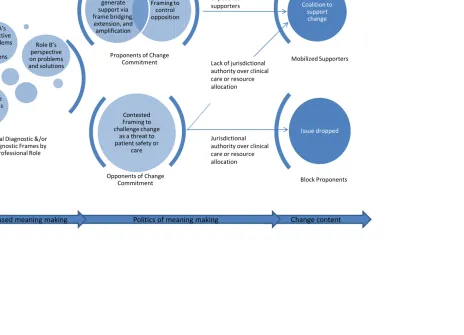
the effort to increase efficiency. Figure 1 presents a process model explaining how framing
processes shape the content of change initiatives that aim to increase efficiency. It depicts
role-based meaning making in hospitals, in which individuals’ professional roles, including the work
that they do and their jurisdictional stake in changes that would enhance or diminish their
authority, influenced the problems that they identified and the solutions that they proposed. This
role-based meaning-making helps define the politics of meaning-making. Depending on their
roles, individuals can come to act as proponents or opponents of specific change commitments.
Proponents draw on strategic and contested framing to influence the frames of potential
supporters. Strategic framing, including frame bridging, extension, and amplification, aims
mobilizing support, while contested framing aims to control opposition. Opponents of change
commitments use contested framing to challenge proposed changes as a threat to patient safety,
quality or efficiency. How the politics of meaning-making plays out ultimately determined the
content of a hospital’s change commitments. If a proponent’s strategic and contested framing
practices were successful in mobilizing a coalition of supporters, their proposed change would be
adopted as a potential change commitment. The effect of contested framing by a change
opponent is contingent on their jurisdictional authority and the specific issue at hand. If an
a change into effect, they can effectively block a proposed change. However, if an opponent
lacks jurisdictional authority over clinical or resource allocation decisions, and change
proponents are able to gain the support of individuals who do have this authority, then their
opposition will be ineffective in preventing a change commitment.
Insert Figure 1 here
Empirically, we observed that it is more difficult to make changes where physicians
framed patient safety and clinical quality as endangered by efficacy. Physicians engaged in
contested framing when changes challenged their jurisdictional authority. In framing their
opposition in terms of safety and quality, physicians defended their jurisdictional authority in
language that was normatively appropriate in the hospital setting. These claims were not
adjudicated using data to assess whether proposed changes actually threatened safety or quality.
Rather, physicians were deferred to as experts in patient safety and clinical quality. Physicians’
contested framing was effective because patient safety and clinical quality override efficiency
claims for medical and other health professionals.
The effectiveness of physician’s contested framing practices is underscored by the failure
to change anesthesia coverage for cataracts and scopes at River, discussed above. Looking across
our cases, in three of the five hospitals where proposals to change anesthesia coverage for minor
procedures were discussed, anesthetists’ opposition blocked proposed changes to anesthesia
coverage. In two hospitals there remained a possibility for future changes in anesthesia coverage.
There were no hospitals where a proposal to modify anesthesia use resulted in a clear change
commitment outlined in the action plan.
One exception in our comparative case analysis of anesthesia care for minimally invasive
River hospital—underscores our finding that subjective frames, rather than objective
jurisdictional interests, were critical in shaping the content of change. At River, the chief of
anesthesia framed proposed changes to anesthesia coverage as potentially beneficial to quality.
As a physician-researcher, he was a believer in providing evidence-based care, and was not fully
aware of the variations in anesthesia practice in the hospital. Perhaps because of his general
belief in evidence-based care, he was open to collecting more information about whether
anesthesia care in his group was appropriate and to enforcing new standards of care if necessary.
His framing of the proposed change as potentially enhancing quality, rather than as a threat to
quality, safety, or anesthetists’ jurisdictional interests, created a possibility for future changes in
anesthesia coverage.
In addition to physicians, senior administrators could draw on their jurisdictional
authority over resource allocation to block proposed changes. Whether senior administrators
support or block a change depends on how they frame its cost effectiveness. For example, when
confronted with evidence that nurses were doing menial tasks, CEO’s in most cases framed this
as a resource allocation problem. At Eagle, the CEO doubted the cost-effectiveness of hiring
additional staff to take on menial tasks performed by nurses. In the end, the OR manager’s and
coaches’ strategic framing efforts were unsuccessful in altering his frame, and he withheld
resources for hiring additional non-nursing staff. This example highlights that frames are
influenced, but not determined, by professional roles. In addition, it suggests that senior
administrators’ subjective frame of the cost effectiveness of a proposed change, rather than
objective data, will determine whether a proposed change is adopted.
One strength of our use of ethnographic analysis of an initiative to improve efficiency is
about what to change in the effort to increase efficiency. This strength, however, inevitably
involves certain limitations. Because we focus on ethnographic analysis of a specific initiative to
increase efficiency, there may be limitations to the generalizability of our findings. As a result,
we intend the framework above to serve as guides for future work that might examine the
generalizability of our findings to other hospital efficiency initiatives. In addition, the richness of
our data inevitably forced us to focus on a narrow slice of what we observed. Other themes,
evident in our data, may yield additional insight into how hospitals increase efficiency.
Conclusions
This paper demonstrates how subjective understandings influence hospital efficiency
efforts. Prior studies, to our knowledge, have not taken into account how frames shape
individuals’ subjective understandings of practices, generating support for or neutralizing
opposition against particular changes. In examining the role of frames in efficiency efforts, we
emphasize how professional roles influence subjective understandings of change proposals, and
how the dynamics of strategic and contested framing defines the content of change initiatives
that aim to increase hospital efficiency. We further show variation in whether individuals
occupying equivalent roles support similar changes, and variation in whether similar strategic
framing processes are effective in mobilizing needed support. One implication of this variation is
that more work is needed to better understand how general characteristics that enhance the
effectiveness of efficiency initiatives in hospitals might come to bear on specific choices about
the content of change. Prior research has shown that physician support, top management team
leadership, organizational culture, and front-line engagement all play a role in enhancing the
al., 1995). Depending on how individuals frame problems and solutions, each of these may have
more complex effects on a hospital’s ability to implement specific changes to increase efficiency.
For example, researchers have shown that physician engagement or support is critical in
shaping the outcomes of hospital organizational change initiatives aimed at increasing efficiency,
value, or quality (Bradley et al., 2001; Ferlie & Shortell, 2001; Shortell et al., 1995; Weiner et
al., 1997). While physician engagement may make it more likely that initiatives to improve
efficiency succeed, it can have mixed effects on the content of change. On one hand, physician
support could mean that physicians devote the time and attention to identify and help implement
changes that could improve efficiency (Weiner et al., 1997). On the other hand, engaged
physicians may still fear the loss of their autonomy, and negatively frame changes that challenge
their jurisdictional interests (Abbott, 1988; Shortell, 2004). As a result, more engaged physicians
may be more aware of potential changes that would threaten their autonomy, or more able to
propose alternative changes that would be less threatening. Future work could potentially
examine physicians’ preferences for or perceptions of a broad range of efficiency-enhancing
changes to develop more robust knowledge of physicians’ preferences regarding change content,
and of the performance impacts of changes preferred or opposed by physicians.
A large body of research shows that senior management support for organizational
change initiatives will enhance their success (Bradley et al., 2001; Ferlie & Shortell, 2001;
Weiner et al., 1997). Nevertheless, senior managers’ frames can have a profound effect on the
content of change — whether or not they have the knowledge or awareness needed to make
judgments about how best to increase efficiency while maintaining quality. Future work can also
develop more robust knowledge of senior managers’ preferences regarding change content, and
References
Abbott, A.D. (1988). The system of professions : An essay on the division of expert labor.
Chicago: University of Chicago Press.
Bazzoli, G. J., Dynan, L., Burns, L. R., & Yap, C. (2004). Two decades of organizational change
in health care: What have we learned? Medical Care Research and Review, 61(3),
247-331.
Bechky, B. A. (2003). Sharing meaning across occupational communities: The transformation of
understanding on a production floor. Organization Science, 14(3), 312.
Benford, R. D., & Snow, D. A. (2000). Framing processes and social movements: An overview
and assessment. Annual Review of Sociology, 26(1), 611-639.
Berwick, D. M. (1989). Continuous improvement as an ideal in health care. New England
Journal of Medicine, 320(1), 53-56.
Bradley, E. H., Holmboe, E. S. , Mattera, J. A , Roumanis, S. A. , Radford, M. J., & Krumholz,
H. M. (2001). A qualitative study of increasing β-blocker use after myocardial infarction:
Why do some hospitals succeed? Journal of the American Medical Association, 285(20),
2604-2611.
Charmaz, K. (2006). Constructing grounded theory : A practical guide through qualitative
analysis. London Sage.
Conrad, D., Wickizer, T., Maynard, C., Klastorin, T., Lessler, D., Ross, A., . . . Travis, K.
(1996). Managing care, inventives, and information: An exploratory look inside the
Durkin, E. M., Deutsch, A., & Heinemann, A. W. (2010). Inpatient rehabilitation facilities:
Variation in organizational practice in response to prospective payment. Medical Care
Research and Review, 67(2), 149-172.
Ferlie, E. B., & Shortell, S. M. (2001). Improving the quality of health care in the United
Kingdom and the United States: A framework for change. Milbank Quarterly, 79(2), 281.
Fraser, I., Encinosa, W., & Glied, S. (2008). Improving efficiency and value in health care:
Introduction. Health Services Research, 43(5p2), 1781-1786.
Golden, B. R., Dukerich, J. M., & Fabian, F. H. (2000). The interpretation and resolution of
resource allocation issues in professional organizations: A critical examination of the
professional-manager dichotomy. Journal of Management Studies, 37(8), 1157-1188.
Helfrich, C. D., Weiner, B. J., McKinney, M. M., & Minasian, L. (2007). Determinants of
implementation effectiveness. Medical Care Research and Review, 64(3), 279-303.
Hoff, T., Hartmann, C. W., Soerensen, C., Wroe, P., Dutta, M., & Lee, G. (2011). Making the
CMS payment policy for healthcare-associated infections work: Organizational factors
that matter. Journal of Healthcare Management, 56(5), 319-335.
Kaplan, S. (2008). Framing contests: Strategy making under uncertainty. Organization Science,
19(5), 729-752.
Langley, A. (1999). Strategies for theorizing from process data. Academy of Management
Review, 24(4), 691-710.
Mutter, R. L., Rosko, M. D., Greene, W. H., & Wilson, P. W. (2011). Translating frontiers into
practice: Taking the next steps toward improving hospital efficiency. Medical Care
Olson, J. R., Belohlav, J. A., Cook, L. S., & Hays, J. M. (2008). Examining quality improvement
programs: The case of Minnesota hospitals. Health Services Research, 43(5p2),
1787-1806.
Sherrard, H., Trypuc, J., & Hudson, A. (2009). The use of coaching to improve peri-operative
efficiencies: The Ontario experience. Healthcare Quarterly, 12(1), 48-54.
Shortell, S. M. (2004). Increasing value: A research agenda for addressing the managerial and
organizational challenges facing health care delivery in the United States. Medical Care
Research and Review, 61(3S), 12S-30S.
Shortell, S. M., O'Brien, James L., Carman, J.M., Foster, R.W., Hughes, E.F., Boerstler, H., &
O'Connor, E.J. (1995). Assessing the impact of continuous quality improvement/total
quality management: Concept versus. Health Services Research, 30(2), 377.
Snow, D. A., Burke, R. E., Jr., Worden, S. K., & Benford, R. D. (1986). Frame alignment
processes, micromobilization, and movement participation. American Sociological
Review, 51(4), 464-481.
Tucker, A. L., Singer, S. J., Hayes, J. E., & Falwell, A. (2008). Front-line staff perspectives on
opportunities for improving the safety and efficiency of hospital work systems. Health
Services Research, 43(5p2), 1807-1829.
Weiner, B. J., Shortell, S. M., & Alexander, J. A. (1997). Promoting clinical involvement in
hospital quality improvement efforts: The effects of top management, board, and
Table 1: Summary of Research Sites
Site Pseudonym Size Location Initiatives
Brew Medium: 7000 operations per year in 3 operating rooms
Rural community hospital
Nursing roles: Initiative to change nursing roles so they no longer pock instrumentation for surgical cases: Anesthesia use: Failed initiative to change anesthesia use for cataract patients
Eagle Small: <2000 operations per
year in 2 operating rooms Rural community hospital
Nursing roles: Failed initiative to change nursing roles to eliminate clerical work
RPN role: Initiative to introduce RPN role for days where the OR runs two rooms
Anesthesia use: Failed initiative to change anesthesia use for minor procedures because surgeon was uncomfortable working without anesthetists Lake Medium: 7000 operations
per year in 5 operating rooms
Rural community hospital
Anesthesia use: Failed initiative to change anesthesia use for cataract and scope patients
Mayberry Small: < 2000 operations per year in 1 operating room.
Rural community hospital
Nursing roles: Initiative to change nursing roles so they no longer do menial tasks, such as making
coffee/dusting/ ordering supplies River Medium: 10000 operations
per year in 10 operating rooms on two sites
Urban community hospital
Nursing roles: Initiative to change nursing roles so they no longer manage supplies or pick instrumentation for surgical cases
Anesthesia use: Initiative to change anesthesia use for minor procedures in order to facilitate patient flow through the Post Anesthesia Care Unit.
Royal Large: 15000 operations per year in 7 operating rooms
Suburban teaching hospital
RPN role: Initiative to introduce RPN role and integrate it broadly into staffing model
Academic Large: 24000 operations per year in 27 operating rooms on three sites
Urban teaching hospital
Table 2: Examples of Initial Frames by Professional Role
Physicians Nurses Administrators Consultants
May berry: Removal of Low-Skilled Tasks from Nurses
None: Surgeons hold expectation that OR Area and Rooms will be prepped.
Nurses explain that they start their shift at least one hour prior to the first surgery so that they can make coffee and dust.
"Nurses DUST!?!" (VP Finance) Top management team horrified to learn about the non-medical tasks that nurses do each day.
"There is a need for process mapping on why the OR Staff are coming in an hour early ..."
Their professional role excludes consideration of such
things. Nurses accept the role.
Diagnosis: Current design of nursing roles is inappropriate.
Prognosis: Need to current a rational case for the tasks that nurses are assigned.
Lake :Use of Anesthesia for Minimally Invasive Procedures Anesthesiologists argue the benefits of their presence in endoscopy, "It is beneficial to the patient, improves the flow in the unit, increases turnover, possibly the quality of endoscopy."
None: Nurses do not raise issue of anesthesia for minimally invasive procedures.
"Anesthesia is running the show - some days we are down to a room [due to lack of anesthesia coverage]... but we have anesthesia in ENDO!"
The consultants raise questions about this practice and contrast it with practices in other hospitals,"Why is that? ... Most hospitals do lists and lists of endo without anesthesia gracing the hall. "
Prognosis: Anesthesia for minimally invasive procedures benefits the patient and the OR unit.
Their professional role excludes consideration of such things.
Diagnosis: The needs and preferences of Anesthesiologists take priority over the patient needs.
Prognosis: The current arrangements do not reflect best practices.
Eagl e: Introduction of RPN
None: Surgeons assume that they will be supported by qualified staff.
When administrators raise the possibility of hiring an RPN, an RN yells, "NOOO!". Another RN says, "I would like to see, before we consider an RPN role, that we attempt to book the days with causals (RNs). I would not want that (RPN) to be our first move."
"Can we use RPNs to do the drops...they can do vitals, drops, and pre-op checklists. That is what they do on the ward. If we cannot get an RN let's get an RPN…it would only be those tasks." (OR Manager)
A consultant advises that "Bringing in an RPN is best practice." The same consultant says to an RN who is against this idea, "You cannot block it. If you consult (with the profesional regulations) it is within the scope of practice."
Their professional role excludes consideration of such things.
Diagnosis: RPNs should not be the first solution. RNs can be hired on a causal basis to help.
Diagnosis: RPNs can be drawn on to do many of the tasks that RNs deem peripheral.
Prognosis: The
Table 3. Illustrations of Framing Dynamics
Issue Reorganizing work to remove low-skilled tasks from nursing
role Introduction of RPN role
Hospital Eagle Royal
Outcome Potential change rejected Potential change accepted
Initial Frame Proponents
Nurses complain about extra, non-nursing work, "There is
some stuff that we have to do that can be taken away…There are cheaper ways of picking up some slack, (such as) a ward clerk and housekeeping."
Coach engages in frame bridging arguing that the continuation of
nursing shortages means that " in 20 years there will be RPNs [doing higher-skilled work] under the supervision of RNs." Here the coach suggests that adopting this prognosis puts the hospital ahead of best
practices.
The OR Manager requests extra non-nursing staff, "If we had
extra housekeeping staff or a porter who could do non-nursing duties that would help."
The RNs are not surprised that the possibility of using RPNs has
been raised, "Everyone is aware it was done in other hospitals and not a huge shock." They do not voice concern about the possibility of this change.
Initial Frame Target
The CEO rejects these arguments, "We always get requests
more, more, more. If nurses are doing some of the things that a clerk can do, then should we then reduce nursing staff."
The Nursing Manager opposes changes that involve hiring RPNs,
"We are an all RN staff and I would like to stay that way….I have seen good RPNs but I have also seen RNs losing their skills because they are doing one hip (procedure) a month."
Strategic Framing
A consultant engages in frame extension, arguing "Nurses are
the most the valuable resource you have. If you have enough now, you will not have enough in a year from now...It could get to be an issue. If you are spending money on overtime for nurses why not throw in a clerk so you do not have to (spend money on overtime)."
Consultant engages in frame amplifcation, trying to show how the
RPN role might be consistent with the goals of the RNs "We don't want to eliminate the RN in scrubs role…. You don't want to lose the knowledge of the RNs so we would be talking about maybe 25% RPNs...Hiring RPNS rather than RNs may give you funding to hire a dedicated materials manager….
Contested Framing
The CEO refuses to entertain these arguments explaining,
"Sometimes we have to look compared to our peers, how we
are doing and generally OR is doing very well." The
Nursing Manager does not contest this prognosis. She admits
that she has seen some RPNs become RNs and then says, "it can work but if we go this route or not now is the time to think about it." The CEO rejects the the consultant's diagnosis that having
Change content Politics of meaning making
Proponents of Change
Commitment Mobilized Supporters Contested
Framing to
control
opposition
Coalition to
support
change
Opponents of Change
Commitment Block Proponents Contested
Framing to
challenge change
as a threat to
patient safety or
care Role A’s
perspective
on problems
and
solutions
Role B’s
perspective
on problems
and solutions
Role C’s
perspective
on problems
and
solutions
Issue dropped
Initial Diagnostic &/or
Prognostic Frames by
Professional Role
Strategic
Framing to
generate
support via
frame bridging,
extension, and
amplification
Change in frames
of potential
supporters
Jurisdictional
authority over clinical
care or resource
allocation
Lack of jurisdictional
authority over clinical
care or resource
allocation