Changing the Game
A Case for Gamifying Knowledge Management
1
Agnessa Shpakova – Viktor Dörfler – Jill MacBryde
Purpose: This exploratory paper investigates gamification as a medium for knowledge work-ers to interact with each other. The paper aims to open the discussion around the sustaining impact that gamification might have on knowledge management.
Design/methodology/approach: The paper employs an exploratory literature review investi-gating the current state of the art in relation to knowledge management and gamification; this literature review serves as the starting point of subsequent theorizing.
Findings: Based on the literature review we theorize that the use of gamification in knowledge management can go far beyond the motivational aspects. To name just a few uses of gamifi-cation, it can help in: supporting flexibility, facilitating transparency and therefore improving trust, visualizing skills and competences as well as generating requirements for new compe-tences, and promoting a collaborative environment among the knowledge workers.
Research limitations/implications: This paper opens the discussion around knowledge man-agement and gamification and suggests a wide range of areas for further research.
Practical implications: In this paper we argue that by looking at gamification as more than just a set of tools for improving motivation and engagement a company can address some pitfalls of a particular type of knowledge workers.
Originality/value: Gamification is a new, but increasingly popular approach, which has been shown to be to be powerful in many areas. This paper is novel in that it initiates a dialogue around the impact that gamification might have on knowledge management.
Keywords: knowledge management, gamification, innovation, knowledge management sys-tems.
1 This is the peer reviewed version of the following article: Agnessa Shpakova, Viktor Dörfler & Jillian MacBryde
2
Introduction
Since its recent entrance into the arena of both practice and scholarship of management, ‘gamification’ has been rapidly gaining ground as a tool of practicing managers, often special-ized consultants, and also as a promising research area of management and organization scholars. By today it has acquired sufficient legitimacy to claim that it is more than just an-other management fad. In this paper we explore the possibility of making use of gamification for supporting knowledge workers in general, with particular focus on innovation-oriented organizations – which is a natural context, as adopting gamification at work today qualifies as innovative.
Gamification is becoming a game changer in some areas, such as marketing (Huotari and Hamari, 2012; Zuckerman and Gal-Oz, 2014), education and learning (DeVries and Edwards, 1973; Gee, 2004; Malone, 1981). We can also find an increasing number of interesting exam-ples of using gamification in the vast area of sustainability. Gamification mechanics is used to increase awareness and facilitate behavioral change in sustainable behavior in smart cities (Kazhamiakin et al., 2016), ride sharing (Reiners and Wood, 2015), energy savings in residen-tial buildings (Muchnik et al., 2016) and sustainable nutritional behavior (Berger and Schrader, 2016), to promote sustainability in tourism by facilitating connection between the stakehold-ers (Negrusa et al., 2015) and to teach sustainability through games (Nordby et al., 2016). With the increasing attention around the term of gamification we find it surprising that the literature is silent about the potential that gamification might bring to the field of knowledge management (KM), and this papers aims to open the discussion.
3 explaining the benefits of KM program is not enough to persuade the workers to charge their everyday routines (Ardichvili et al., 2003; Bordia et al., 2006; Hsu and Lin, 2008; O’Dell and Grayson, 1998). This approach did not revolutionize the work of knowledge workers either, and as a result, the third wave followed with KM shifting towards being a set of principles (Lambe, 2008). Approximately at the same time the practitioners started experimenting with integration of WEB 2.0 tools in the corporate environment, such as blogs (Davison et al., 2013; Hsu and Lin, 2008), wikis (Wagner and Bolloju, 2005), social networks (O’Dell and Huber, 2011) and forums (Voelpel et al., 2005). The latter was the earliest adopted tool and it was the earliest to have game elements embedded in it, before the term ‘gamification’ was widely accepted, for example rating and giving points to the contributors on an urgent requests fo-rum and recognizing the major contributors as experts (Voelpel et al., 2005). This paper also suggests various other ways to gamify WEB 2.0 tools.
The paper is structured as follows. We start by clarifying the term of gamification, which has already generated a lot of confusion. This is then followed by providing an overview of the components that comprise gamification. Subsequently, we continue by discussing the rea-sons why gamification should be taken seriously in KM and how it could benefit KM. Finally, we outline areas for further research.
What is Gamification?
The term gamification was first coined in 2002, but if we think about it, this concept is not so new. Loyalty cards and frequent flyer programs are early examples of gamification the way it is understood today. Frequent flyer programs were first introduced by American Airlines, and soon other airlines, hotel chains and car rentals started using the mechanics of collecting the points and redeeming them for other products and services as a tool to increase the return rate of customers (O’Malley and Lisa, 1998). Collecting points became a very powerful mar-keting tool, at least for a while.
The original definition of Pelling (2011) was narrowly focused on adding game experience to the electronic transactions, but the examples provided above illustrate a much broader range of applications. Later he revisited his own definition and interpreted it as systems that call for social action, such as Kickstarter and Alibaba (Pelling, 2015), but this definition excludes a range of personal applications, such as Nike Plus: a running app, that tracks user’s progress and provides instant feedback in various forms, for example, in a form of an animated avatar that changes the mood and the shape depending on the progress (McGonigal, 2011). There-fore, it would be more appropriate to say that gamified systems can generate a call for social actions, but do not exclusively lead to that.
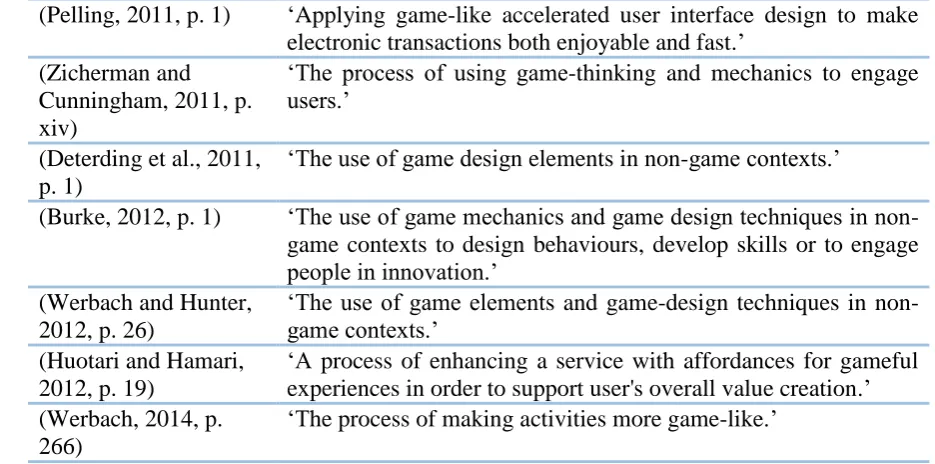
4 (Burke, 2012; Huotari and Hamari, 2012; Zicherman and Cunningham, 2011) in a non-gaming environment (Burke, 2012; Deterding et al., 2011; Werbach and Hunter, 2012). The last as-pect is very important, because it draws a line between games and gamified systems, and therefore shifts the focus from entertaining and creating a full gaming experience to studying the ways in which individual game elements and their combinations influence the behavior. However, most of these definitions are incomplete, too restrained, or misleading.
Table 1: Definitions of Gamification
In particular, Zicherman and Cunningham (2011) did not explain what they understand by game-thinking and did not distinguish between gamified systems and serious games. Burke (2012) defined well the purpose of the application of gamification (e.g. behavioral change), but gamification can serve other purposes, such as triggering organizational change (Rimon, 2015), therefore this definition is too restraining. Huotari and Hamari (2014) developed their definition for marketing applications, therefore it cannot be used for a broader range of ap-plications either.
Werbach (2014) revisited his earlier definition and, as well as Huotari and Hamari, shifted the focus from the use of game elements to the nature of gamification being a process, but at the same time he removed ‘non-game contest’ from the definition and even suggested that games can be gamified too, which blurs the borders between gamification and serious games. Therefore, the final definition, which will also serve as a working definition for this paper, is a combination of the two definitions of Werbach.
‘Gamification – the process of making activities in non-game contexts more game-like.’
(Pelling, 2011, p. 1) ‘Applying game-like accelerated user interface design to make electronic transactions both enjoyable and fast.’
(Zicherman and Cunningham, 2011, p. xiv)
‘The process of using game-thinking and mechanics to engage users.’
(Deterding et al., 2011, p. 1)
‘The use of game design elements in non-game contexts.’
(Burke, 2012, p. 1) ‘The use of game mechanics and game design techniques in non-game contexts to design behaviours, develop skills or to engage people in innovation.’
(Werbach and Hunter, 2012, p. 26)
‘The use of game elements and game-design techniques in non-game contexts.’
(Huotari and Hamari, 2012, p. 19)
‘A process of enhancing a service with affordances for gameful experiences in order to support user's overall value creation.’ (Werbach, 2014, p.
266)
5
Deconstructing Gamification
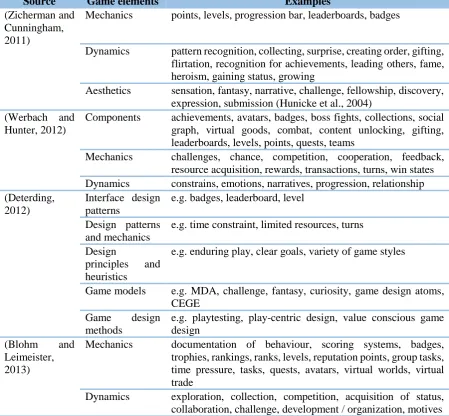
[image:5.595.73.523.236.652.2]In this subsection we try to further our understanding of gamification by identifying and clas-sifying its components. When researchers mention game elements, they usually refer to such components as points, badges, rating, leaderboards, progress bars, etc., but the variety of game elements extends beyond these most widely cited types. The examples of classifications that were found in the literature are presented in the Table 2. And with the variety of these elements comes confusion.
Table 2: Classifications of gamification elements
Most scholars classify the game elements by their level of abstraction, but there is a disagree-ment in the levels (varying from two to five) as well as in the terminology in the literature. The authors of the two most widely cited books, Zicherman & Cunningham (2011) and Wer-bach & Hunter (2012), define three levels, but in different ways. For example, what the for-mer call mechanics (e.g. points and badges), the latter name components, and since they are
Source Game elements Examples
(Zicherman and Cunningham, 2011)
Mechanics points, levels, progression bar, leaderboards, badges
Dynamics pattern recognition, collecting, surprise, creating order, gifting, flirtation, recognition for achievements, leading others, fame, heroism, gaining status, growing
Aesthetics sensation, fantasy, narrative, challenge, fellowship, discovery, expression, submission (Hunicke et al., 2004)
(Werbach and Hunter, 2012)
Components achievements, avatars, badges, boss fights, collections, social graph, virtual goods, combat, content unlocking, gifting, leaderboards, levels, points, quests, teams
Mechanics challenges, chance, competition, cooperation, feedback, resource acquisition, rewards, transactions, turns, win states Dynamics constrains, emotions, narratives, progression, relationship (Deterding,
2012)
Interface design patterns
e.g. badges, leaderboard, level
Design patterns and mechanics
e.g. time constraint, limited resources, turns
Design
principles and heuristics
e.g. enduring play, clear goals, variety of game styles
Game models e.g. MDA, challenge, fantasy, curiosity, game design atoms, CEGE
Game design
methods
e.g. playtesting, play-centric design, value conscious game design
(Blohm and
Leimeister, 2013)
Mechanics documentation of behaviour, scoring systems, badges,
trophies, rankings, ranks, levels, reputation points, group tasks, time pressure, tasks, quests, avatars, virtual worlds, virtual trade
6 the most cited frameworks in the gamification literature and stand in disagreement with each other, it is worth reviewing each of them in more detail.
Zicherman and Cunningham based their classification on the MDA (mechanics, dynamics and aesthetics) framework of game design (Hunicke et al., 2004), which is cited by a number of other scholars, but they do not elaborate on the third aspect of it as well as misinterpret the meaning of the first two levels assigned to them by the original authors. In particular, Hunicke et al. (2004) refer to mechanics as actions and control mechanisms, not simple interface ele-ments, and dynamics as an the underlying behavior. On the other hand, Werbach and Hunter (2012) shared the understanding of Hunicke et al., but instead of adopting and adapting it to the gamification needs, they concentrated on the components that comprise the interface and are visible to us, and left the aesthetics aside.
With regards to other classifications that were identified, Deterding et al. (2011) define five levels, but their understanding is quite different from the previously discussed classifications. Some of the examples provided by the authors are included in different levels by other au-thors, and the explanation of these examples is not sufficient to understand the logic of cat-egorizing the elements in this way. For example, challenges that are presented as a game model are included in game mechanics by Werbach and Hunter (2012), and the whole MDA framework is included in the game models. Apart from that, some levels seem to be applica-ble to all the games. They include game principles and game design, and since they do not refer to specific game types, adding them as extra levels of gamification elements is not jus-tified.
Other researchers distinguish between two levels of the game elements: game mechanics and game dynamics (Blohm and Leimeister, 2013; Pedreira et al., 2015), and their definitions are supported by examples partially overlapping with all three levels listed at the beginning, as well as misinterpret the original meaning of each level of Hunicke et al. (2004).
All the authors mention such elements as points, badges and leaderboards, giving them dif-ferent names, and these elements constitute the basic building blocks, the objects, that users see and interact with. To us it seems logical that the next level should link different building blocks with each other and describe various actions that can be performed with them. And finally the top level binds the elements of the previous levels together. Of all the classifica-tions, the one suggested by Werbach and Hunter (2012) corresponds the most to this logic, namely: components, mechanics and dynamics, though the components that have been in-cluded in this classification might need further revision and can be complemented with ex-amples from other frameworks.
Why Knowledge Management?
7 in innovation, in particular, for research (Ionica and Leba, 2015), for ideation (Hélène Michel, 2016; Hutter et al., 2011; Roth et al., 2015) and selection of ideas (Petersen and Ryu, 2015). Gamification is also used to enhance training programs (Dale, 2014; Uskov and Sekar, 2014) and make tutorials more engaging (Deterding, 2012; Li et al., 2012; Rauch, 2013), and this area of application was borrowed from the advances in gamifying education. However, gam-ification of knowledge management (KM) is so far rarely addressed in a holistic way. Con-versely, most of the current examples of gamification are contextualized in knowledge work, therefore we believe that it is worth exploring in more depth the possibilities of gamification in KM.
Past and present
It is possible to find a number of examples of the use of game elements in KM in the past, though they were not labelled as gamification before. E.g. Siemens used points to reward contributors to the corporate Knowledge Management System (KMS), and these points were either used to demonstrate a status of an expert (the more points you have, the more knowl-edgeable you are), or they could be redeemed for material rewards. This system worked with mixed results: in some countries knowledge workers put significant value on the expert sta-tus, in other countries they preferred to receive material goods (Voelpel et al., 2005). BP used visual intervention called “15 minutes of fame”, a display of someone’s profile that was re-cently updated, on their Connect KMS (Grant, 2013), and this mechanics exploited the dy-namics of expression and promoted people to update their profiles to get noticed. Texas Instrumental gave “Not invented here, but I did it anyway” award in a case contest, where employees could share their experience of knowledge reuse (Davenport and Prusak, 1998). The competition dynamics and the rewarding mechanics legitimized and encouraged search-ing for existsearch-ing knowledge and its reuse. These early examples suggest that gamification could be a powerful technique used for various different purposes.
Currently, gamification has only started entering the area of KM research, and at the moment it either focuses on the aspects of motivation and worker engagement (Jung et al., 2010; Swacha, 2015; Vassileva, 2012), a topic favored by consultants, or employees assessment (Tansley et al., 2016) and HR trainings (Rinc, 2014), being an extension of gamified education, or gamification is mentioned as an add on entertaining layer for a KMS (Pandey and Dutta, 2013). However, we believe that the use of gamification can extend beyond another HR fad.
Future
8 jobs that are boring, but need to be done, for example, calibrating a sensor (Flatla et al., 2011) or digitalizing a library (Roth et al., 2015), and we see examples of successful gamification of these processes, but one could argue that this work can hardly be called knowledge work, and the majority of knowledge worker jobs is more sophisticated and interesting.
In order to imagine the potential impact of gamification on KM we could take some of the most widely used elements of gamification and try to replicate their areas of application in the context of KM. For instance, the points are mostly used to reward the users for certain actions, therefore they can be used as rewards. They can also indicate status, for example, the status of a knowledgeable person, if the points are awarded for sharing the knowledge, and this type of mechanics might reveal ‘disguised heroes’ who have a higher level of exper-tise than it seems. Awarding certain activities with points would also legitimize the time spent on these activities, if they are not seemingly related to the primary job, and varying the amount of rewards would help to prioritize some of these activities over others. Apart from that, allowing knowledge workers to reward others with points for KM activities may lead to reciprocation behavior (Hamari and Koivisto, 2013; Webster and Vassileva, 2006), and create a vicious cycle of mutual help and sustain non-productive collaborative behavior.
Another element, the rates, can enable monitoring the contents of KMS in a decentralized way. If knowledge workers are able to rate the material, the most relevant and up to date contents will have the highest rates, and changing the mechanics of calculating the overall rate allows to change the priorities, e.g. give more weight to the more recent rates or on the overall number of ratings. However, this could also be achieved with points that would keep the score of each material.
The badges can be used as a reward for certain achievements, similar to the points. But they can also visualize these achievements and the skills that knowledge workers have, and there-fore become a knowledge map of the company (which is however standardized to some ex-tent), making it easier for others to identify people with necessary skills and expertise. In some instances, if the badges are linked to certain rewards or compensation and this infor-mation is visible to everyone, this system can help to create transparency and therefore trust, which is an essential prerequisite of knowledge sharing (Davenport and Prusak, 1998) and thinking together (Pyrko et al., 2016). They can also help to generate requirements for new skills and attract people who would be genuinely interested in acquiring these skills in a more efficient and informal manner.
9 aligned with any rewards and recognition, it is no surprise that the study demonstrates very modest results (De-Marcos et al., 2014; Zuckerman and Gal-Oz, 2014).
KM initiative is always accompanied by organizational change, and gamification could serve as a perfect environment for initiating or supporting an organization change. For example, a former VP of customer experience in Yahoo! used gamified corporate portal to implement change by making slight changes in the system, and he claimed that it accelerated the speed of change several times (Rimon, 2015), though the details are not shared. The influence of gamification on corporate culture and organizational change could become two other signif-icant new areas of research, and both topics overlap with KM.
When looking at the technology side of KM, gamification is believed to reinforce the benefits of some of the KMS that became widespread in the recent years (mainly social computing technologies). Gamification elements have already been used in some systems, and the sug-gestions above would work the best if the elements are embedded in KMS, but more research and pilot studies need to be done to discover its full potential and go beyond simple gamified tutorials (Li et al., 2012).
This paper does not elaborate on some important criteria, such as cultural (Rimon, 2015), age (Hartmann and Klimmt, 2006; Williams et al., 2009) and gender (Coppens, 2015) differences that are being explored in the field of gamification and that will have an impact on the ways it could be used in the corporate environment, including the KM area. All of these questions could not be possible covered in one paper, partly due to the limited length of this paper, and partly due to the novelty of this research area. But this is exactly what makes the contribution of this paper significant – it steps on a virgin field and opens a wide range of new areas for further research.
Concluding remarks
This paper aimed at opening the discussion around the area of applying gamification in KM. We have reviewed the literature on gamification and discussed the meaning of this term and made sense of the elements that compose it. We then suggested the definition and a classi-fication that would be appropriate for the purpose of KM and theorized about the ways in which gamification could be used in KM and the possibilities that it opens for KM. Through the early examples that we could find we can see that the impact of gamification on KM can stretch far beyond improved motivation and engagement, and one could find limitless possi-bilities for further research in this area.
10 Gamification was also criticized for becoming an exploitation tool (Bogost, 2011). Gamified systems allow to provide instant feedback on the progress, and instead of creating an enjoy-able experience they can be turned into a “Big Brother is watching you” controlling mecha-nism (Cohen, 2015), but the matter of turning any useful tool into the means of abuse is a question of a weak implementation of that tool and the intentions of those who implement it. The possibility of instant feedback can also be extremely beneficial.
As was mentioned before, gamification has already demonstrated strong presence in educa-tion (Baker et al., 2012; Lee and Hammer, 2011). Educaeduca-tion is probably one of the most knowledge-intense industries and has always been. The generation of millennials grew up playing video games, and it might seem natural that education was also among the early adopters of gamification. The millennials grew up, and gamification moved to other areas together with them, and for them a gamified environment might be an expectation rather than an interesting addition; which is another reason for not neglecting gamification in KM. Education, having gathered a substantial amount of experience and being a natural habitat for knowledge workers, could be a good place to start looking for practical ways that gamifi-cation could be of use to KM. For instance, there is early evidence that gamifigamifi-cation has an impact on such knowing processes as thinking and learning. Apart from that gamification is believed to create social connectivity (McGonigal, 2011), therefore encourages conversations and knowledge sharing, and a sense of belonging to something bigger, such as the purpose of the organization .
However, one should not forget that gamification is only an extra layer and can work only in conjunction with a properly developed KM, so that it can support KM initiatives rather than trying to fix poorly functioning KM by adding gamification to it. In particular, if the KM strat-egy is not aligned with the corporate culture, the KM initiative is likely to fail (McDermott and O’Dell, 2001; Park et al., 2004). For example, in companies that value individual and novel knowledge, employees will be reluctant to contribute to the organizational knowledge, be-cause then they will lose opportunities by giving away what is valued the most (De Long and Fahey, 2000), and gamification is unlikely to reverse the culture. However, gamification could send the signal that the attitude has changed, and accelerate the change.
11
References
Alavi, M. and Leidner, D.E. (2001), “Review: Knowledge Management And Knowledge Management Systems: Conceptual Foundations And Research Issues”, MIS Quarterly, Vol. 25 No. 1, pp. 107–137.
Ardichvili, A., Page, V. and Wentling, T. (2003), “Motivation and barriers to participation in virtual knowledge-sharing communities of practice”, Journal of Knowledge
Management, Vol. 7 No. 1, pp. 64–77.
Argyris, C. and Schön, D. (1978), Organizational Learning, Addison-Wesley, Reading: MA.
Baker, P.M.A., Bujak, K.R. and Demillo, R. (2012), “The evolving university: Disruptive change and institutional innovation”, Procedia Computer Science, Vol. 14, pp. 330–335.
Berger, V. and Schrader, U. (2016), “Fostering sustainable nutrition behavior through gamification”, Sustainability (Switzerland), Vol. 8 No. 1, pp. 1–15.
Blohm, I. and Leimeister, J.M. (2013), “Gamification: Design of IT-based enhancing services for motivational support and behavioral change”, Business and Information Systems
Engineering, Vol. 5 No. 4, pp. 275–278.
Bogost, I. (2011), “Persuasive Games: Exploitationware”, Gamasutra, available at: http://www.gamasutra.com/view/feature/6366/persuasive_games_exploitationware.p hp (accessed 17 August 2015).
Bordia, P., Irmer, B.E. and Abusah, D. (2006), “Differences in sharing knowledge interpersonally and via databases: The role of evaluation apprehension and perceived benefits”, European Journal of Work and Organizational Psychology, Vol. 15 No. 3, pp. 262–280.
Brown, J.S. and Duguid, P. (2000), “Balancing act: how to capture knowledge without killing it.”, Harvard Business Review, Vol. 78 No. 3, pp. 73–80.
Burke, B. (2012), Gamification 2020: What Is the Future of Gamification?, available at: https://www.gartner.com/doc/2226015/gamification--future-gamification (accessed 14 August 2015).
Chinowsky, P., Molenaar, K. and Realph, A. (2007), “Learning Organizations in Construction”,
Journal of Management in Engineering, No. January, pp. 27–35.
Cohen, J.E. (2015), “The Surveillance-Innovation Complex: The Irony of the Participatory Turn”, in Barney, I.D., Coleman, G., Ross, C., Sterne, J. and Tembeck, T. (Eds.), The
Participatory Condition (Forthcoming), University of Minnesota Press, pp. 1–14.
Coppens, A. (2015), “Feminine gamification viewpoint: Social conversations”, Gamification
12 Dale, S. (2014), “Gamification : Making work fun, or making fun of work?”, Business
Information Review, Vol. 31 No. 2, pp. 82–90.
Davenport, T.H. (2005), Thinking for a Living : How to Get Better Performance and Results
from Knowledge Workers, Harvard Business School Press, Boston, Mass.
Davenport, T.H. and Prusak, L. (1998), Working Knowledge : How Organizations Manage
What They Know, edited by Prusak, L., Harvard Business School Press, Boston, Mass.
Davison, R.M., Ou, C.X.J. and Martinsons, M.G. (2013), “Information technology to support informal knowledge sharing”, Information Systems Journal, Vol. 23 No. 1, pp. 89–109.
De-Marcos, L., Domínguez, A., Saenz-De-Navarrete, J. and Pagés, C. (2014), “An empirical study comparing gamification and social networking on e-learning”, Computers and
Education, Elsevier Ltd, Vol. 75, pp. 82–91.
Deterding, S. (2012), “Gamification: designing for motivation”, Interactions, Vol. 19, pp. 14– 17.
Deterding, S., Dixon, D., Khaled, R. and Nacke, L. (2011), “From game design elements to gamefulness”, Proceedings of the 15th International Academic MindTrek Conference on
Envisioning Future Media Environments - MindTrek ’11, pp. 1–7.
DeVries, D.L. and Edwards, K.J. (1973), “Learning Games and Student Teams: Their Effects on Classroom Process”, American Educational Research Journal, Vol. 10 No. 4, pp. 307–318.
Fahay and Prusak, L. (1998), “11 deadliest sins of knowledge management.pdf”.
Flatla, D.R., Gutwin, C., Nacke, L.E., Bateman, S. and Mandryk, R.L. (2011), “Calibration games: making calibration tasks enjoyable by adding motivating game elements”, 24th Annual
ACM Symposium on User Interface Software and Technology - UIST ’11, pp. 403–412.
Gee, J.P. (2004), Situated Language and Learning: A Critique of Traditional Schooling, Routledge, New York; London.
Grant, R.M. (2013), “The Development of Knowledge Management in the Oil and Gas Industry”, Universia Business Review, No. 40, pp. 92–125.
Hamari, J. and Koivisto, J. (2013), “Social motivations to use gamification: an empirical study of gamifying exercise”, 21st European Conference on Information Systems SOCIAL.
Hamari, J., Koivisto, J. and Sarsa, H. (2014), “Does gamification work? - A literature review of empirical studies on gamification”, Proceedings of the Annual Hawaii International
Conference on System Sciences, pp. 3025–3034.
13 Hélène Michel. (2016), “Gamification for innovation: cubification in action with Hélène Michel and Opopoï | Rapid Innovation in digital time”, Rapid Innovation in Digital Times, available at: https://nbry.wordpress.com/2016/09/12/gamification-for-innovation-cubification-in-action-with-helene-michel-and-opopoi/ (accessed 28 September 2016).
Hsu, C.-L. and Lin, J.C.-C. (2008), “Acceptance of blog usage: The roles of technology acceptance, social influence and knowledge sharing motivation”, Information &
Management, Vol. 45, pp. 65–74.
Hunicke, R., LeBlanc, M. and Zubek, R. (2004), “MDA: A formal approach to Game Design and Game Research”, Proc. AAAI Workshop on Challenges in Game, AAAI Press, pp. 1–5.
Huotari, K. and Hamari, J. (2012), “Defining Gamification - A Service Marketing Perspective”,
Proceedings of the 15th International Academic MindTrek Conference: Envisioning Future Media Environments, pp. 17–22.
Hutter, K., Hautz, J., Füller, J., Mueller, J. and Matzler, K. (2011), “Communitition: The Tension between Competition and Collaboration in Community-Based Design Contests.”,
Creativity & Innovation Management, Vol. 20 No. 1, pp. 3–21.
Ionica, A.C. and Leba, M. (2015), “Gamification & Research – Partnership for Innovation”,
Procedia Economics and Finance, Elsevier B.V., Vol. 23, pp. 671–676.
Jung, J.H., Schneider, C. and Valacich, J. (2010), “Enhancing the Motivational Affordance of Information Systems: The Effects of Real-Time Performance Feedback and Goal Setting in Group Collaboration Environments”, Management Science, Vol. 56 No. 4, pp. 724– 742.
Kazhamiakin, R., Marconi, A., Martinelli, A., Pistore, M. and Valetto, G. (2016), “A gamification framework for the long-term engagement of smart citizens”, IEEE 2nd International
Smart Cities Conference: Improving the Citizens Quality of Life, ISC2 2016 - Proceedings,
pp. 1–7.
Lambe, P. (2008), “Is KM Dead? Larry Prusak, Dave Snowden, Patrick Lambe”, available at:
https://archive.org/details/Plambe-IsKMDeadLarryPrusakDaveSnowdenPatrickLambe548.
Lee, J.J. and Hammer, J. (2011), “Gamification in education: What, how, why bother?”,
Academic Exchange Quarterly, Chattanooga State Technical Community College, Vol. 15
No. 2, pp. 146–150.
Li, W., Grossman, T. and Fitzmaurice, G. (2012), “GamiCAD: A gamified tutorial system for first time AutoCAD users”, 25th Annual ACM Symposium on User Interface Software and
Technology, pp. 103–112.
14 Malone, T.W. (1981), “What makes things fun to learn? A study of intrinsically motivating
computer games.”, Pipeline, ERIC, Vol. 6 No. 2, p. 50.
Marquardt, M.J. (1996), Building the Learning Organization, McGraw-Hill Companies, New York.
McDermott, R. (1999), “Why Information Technology Inspired But Cannot Deliver Knowledge Management”, California Management Review, Vol. 41 No. 4, pp. 103–117.
McDermott, R. and O’Dell, C. (2001), “Overcoming cultural barriers to sharing knowledge”,
Journal of Knowledge Management, Vol. 5 No. 1, pp. 76–85.
McGonigal, J. (2011), Reality Is Broken: Why Games Make Us Better and How They Can Change
the World, The Penguin Press, New York.
Muchnik, A., Fonseca i Casas, P., Zamyatina, O. and Casanovas, J. (2016), “Analysis of the Gamification Applications to Improve the Energy Savings in Residential Buildings”, 15th
International Conference on Software Engineering, pp. 45–53.
Negrusa, A.L., Toader, V., Sofica, A., Tutunea, M.F. and Rus, R.V. (2015), “Exploring gamification techniques and applications for sustainable tourism”, Sustainability
(Switzerland), Vol. 7 No. 8, pp. 11160–11189.
Nickols, F. (2000), “The Knowledge in Knowledge Management”, in Woods, J.A. and Cortada, J. (Eds.), The Knowledge Management Yearbook, 2000–2001, Butterworth-Heinemann, Boston, MA, pp. 12–21.
Nonaka, I. and Takeuchi, H. (1995), The Knowledge-Creating Company : How Japanese
Companies Create the Dynamics of Innovation, Oxford University Press, New York.
Nordby, A., Øygardslia, K., Sverdrup, U. and Sverdrup, H. (2016), “The art of gamification; teaching sustainability and system thinking by pervasive game development”, Electronic
Journal of E-Learning, Vol. 14 No. 3, pp. 152–168.
O’Dell, C. and Grayson, C.J. (1998), “If we knew what we know: Identification and transfer of internal best practices”, California Management Review, Vol. 40 No. 3, pp. 154–175.
O’Dell, C.S. and Huber, C. (2011), The New Edge in Knowledge: How Knowledge Management
Is Changing the Way We Do Business, Wiley, Hoboken, N.J.
O’Malley and Lisa. (1998), “Can loyalty schemes really build loyalty?”, Marketing Intelligence
& Planning, Vol. 16 No. 1, pp. 47–55.
Pandey, S.C. and Dutta, A. (2013), “Role of knowledge infrastructure capabilities in knowledge management”, Journal of Knowledge Management, Vol. 17 No. 3, pp. 435–453.
Park, H., Ribière, V. and Schulte, W. (2004), “Critical attributes of organizational culture that promote knowledge management technology implementation success”, Journal of
15 Pedreira, O., García, F., Brisaboa, N. and Piattini, M. (2015), “Gamification in software engineering – A systematic mapping”, Information and Software Technology, Elsevier B.V., Vol. 57, pp. 157–168.
Pelling, N. (2011), “The (short) prehistory of ‘gamification’…”, Funding Startups (& Other
Impossibilities), available at:
https://nanodome.wordpress.com/2011/08/09/the-short-prehistory-of-gamification/ (accessed 16 September 2015).
Pelling, N. (2015), “Gamification Past and Present”, GWC14, Barcelona, available at: https://www.youtube.com/watch?v=XZ4AbQvUGho (accessed 6 October 2015).
Petersen, S.I. and Ryu, H.B. (2015), “Gamification in Concept Design: Applying Market Mechanisms to Enhance Innovation and Predict Concept Performance”, Journal of
Design, Business & Society, Vol. 1 No. 1, pp. 95–110.
Polanyi, M. (1962), Personal Knowledge: Towards a Post-Critical Philosophy, edited by Routledge & Kegan Paul, L., London.
Polanyi, M. (1967), The Tacit Dimension, Doubley, New York.
Pyrko, I., Dörfler, V. and Eden, C. (2016), “Thinking together: What makes Communities of Practice work?”, Human Relations, pp. 1–21.
Rauch, M. (2013), “Best practices for using enterprise gamification to engage employees and customers”, in Kurosu, M. (Ed.), Human-Computer Interaction. Applications and
Services., Springer, Berlin, Heidelberg, pp. 276–283.
Reiners, T. and Wood, L.C. (2015), “How Gamification Can Help Companies to Become More Sustainable: A Case Study on Ride Sharing”, in Reiners, T. and Wood, L.C. (Eds.),
Gamification in Education and Business, Springer, Switzerland, pp. 615–636.
Richard M. Ryan and Deci, E.L. (2000), “Self-determination theory and the facilitatiton of intrinsic motivation, social development, and well-being”, American Psychological
Association, Vol. 55 No. 1, pp. 68–78.
Rimon, G. (2015), “Gamification is More than a Productivity Tool. It Tunes Organizational Change.”, GameEffective, available at: http://www.gameffective.com/customer-service/gamification-more-than-a-productivity-tool/ (accessed 18 September 2015).
Rinc, S. (2014), “Integrating Gamification with Knowledge Management”, Management,
Knowledge and Learning, International Conference, Portoroz, pp. 997–1003.
Roth, S., Schneckenberg, D. and Tsai, C. (2015), “The Ludic Drive as Innovation Driver : Introduction to the Gamification of Innovation”, Creativity and Innovation Management, Vol. 24 No. 2, pp. 300–306.
16 Van der Spek, R. and Spijkervet, A. (1997), “Knowledge management: dealing intelligently with knowledge”, in Liebowitz;, J. and Wilcox, L.C. (Eds.), Knowledge Management and
Its Integrative Elements, CRC Press, Boca Raton, Fla., pp. 31–59.
Swacha, J. (2015), “Gamification in knowledge management motivating for knowledge sharing ”, Polish Journal of Management Studies, Vol. 12 No. 2, pp. 150–160.
Swan, J., Newell, S. and Robertson, M. (2000), “Limits of IT-driven Knowledge Management Initiatives for Interactive Innovation Processes : Towards a Community-Based Approach”, Vol. 0, 33rd Hawaii International Conference on System Sciences, pp. 1–11.
Tansley, C., Hafermalz, E. and Dery, K. (2016), “Talent development gamification in talent selection assessment centres”, European Journal of Training and Development, Vol. 40 No. 7, pp. 490–512.
Tsoukas, H. (2003), “Do we really understand tacit knowledge ?”, in Easterby-Smith, M. and Lyles, M.A. (Eds.), Handbook of Organizational Learning and Knowledge, Blackwell, Oxford, pp. 410–427.
Uskov, A. and Sekar, B. (2014), “Serious games, gamification and game engines to support framework activities in engineering: Case studies, analysis, classifications and outcomes”, IEEE International Conference on Electro/Information Technology, pp. 618– 623.
Vassileva, J. (2012), “Motivating participation in social computing applications: a user modeling perspective”, User Modeling and User-Adapted Interaction, Vol. 22, pp. 177– 201.
Voelpel, S.C., Dous, M. and Davenport, T.H. (2005), “Five steps to creating a global knowledge-sharing system: Siemens’ ShareNet.”, Academy of Management Executive, Vol. 19 No. 2, pp. 9–23.
Wagner, C. and Bolloju, N. (2005), “Supporting Knowledge Management in Organizations with Conversational technologies: Discussion Forums, Weblogs, and Wikis”, Journal of
Database Management, Vol. 16 No. 2, pp. 1–8.
Webster, A. and Vassileva, J. (2006), “Visualizing Personal Relations in Online Communities”, in Wade, V., Ashman, H. and Smyth, B. (Eds.), Proceedings of the Adaptive Hypermedia
and Adaptive Web-Based Systems (AH’2006), June 21–23, Vol. 4018, Dublin, pp. 223–
233.
Werbach, K. (2014), “(Re)defining gamification: A process approach”, Persuasive Technology, Vol. 8462 LNCS, Springer, pp. 266–272.
Werbach, K. and Hunter, D. (2012), For the Win: How Game Thinking Can Revolutionize Your
17 Williams, D., Consalvo, M., Caplan, S. and Yee, N. (2009), “Looking for gender: Gender roles and behaviors among online gamers”, Journal of Communication, Vol. 59 No. 4, pp. 700– 725.
Zicherman, G. and Cunningham, C. (2011), Gamification by Design, O’Reilly Media, Sebastobol, CA.