City, University of London Institutional Repository
Citation:
Fabbri, D. & Menichini, A.M.C. (2016). The commitment problem of secured lending. Journal of Financial Economics, 120(3), pp. 561-584. doi:10.1016/j.jfineco.2016.02.009
This is the accepted version of the paper.
This version of the publication may differ from the final published
version.
Permanent repository link:
http://openaccess.city.ac.uk/17180/Link to published version:
http://dx.doi.org/10.1016/j.jfineco.2016.02.009Copyright and reuse: City Research Online aims to make research
outputs of City, University of London available to a wider audience.
Copyright and Moral Rights remain with the author(s) and/or copyright
holders. URLs from City Research Online may be freely distributed and
linked to.
The Commitment Problem of Secured Lending
Daniela Fabbri∗
Cass Business School
Anna Maria C. Menichini†
University of Salerno and CSEF
September 2015
Abstract
The paper presents a new theory of trade credit where firms buy inputs on credit from suppliers to restore the benefits of secured bank financing impaired by contract incompleteness. In a setting where investment is endogenous and unobservable to financiers, we show that a bank-secured credit contract is time-inconsistent: Upon being granted credit, the entrepreneur has an incentive to alter the original input combination, jeopardizing the bank’s revenues. Anticipating the entrepreneur’s opportunism, the bank offers an unsecured credit contract, reducing the surplus from the venture. One way for the entrepreneur to commit to the contract terms is to purchase inputs on credit from the supplier. The supplier observes the input investment and acts as a guarantor that inputs will be purchased as contracted, thus facilitating access to secured bank financing. The commitment role of trade credit still holds in a multi-period extension that investigates the impact of bank relationship lending on secured debt and trade credit. Our model provides novel testable predictions on optimal financial contracts in both one-period and repeated-lending relationships.
Keywords: collateral, commitment, trade credit, bank financing.
JEL classification: G32, G33, K22, L14.
∗
Contact address: Faculty of Finance, Cass Business School, 106 Bunhill Row, London, EC1Y 8TZ, UK. Tel.: +44 (0)20 7040 0966. Fax.: +44 (0)20 7040 8881. E-mail: [email protected]
†
Introduction
Firms procure funds not only from specialized financial intermediaries but also from suppliers, which
generally delay payments of inputs. Trade credit is an important source of external financing for
firms of all sizes across both developed and developing countries (Petersen and Rajan, 1997; Beck,
Demirg¨u¸c-Kunt, and Maksimovic, 2008; Giannetti , Burkart, and Ellingsen, 2011) and across both
domestic and foreign markets (Auboin and Engeman, 2014; Manova, 2013). Researchers have mostly
rationalized and documented the substitution effect of trade credit, arguing that firms rely on trade
credit when they are constrained on bank financing (e.g., Calomiris, Himmelberg, and Wachtel, 1995;
Petersen and Rajan, 1997; Burkart and Ellingsen, 2004; Love, Preve, and Sarria Allende, 2007; among
others). Recent empirical evidence, however, indicates that the complementarity effects of trade credit
are also relevant. Giannetti, Burkart, and Ellingsen (2011) show that U.S. firms obtaining credit from
suppliers can secure financing from relatively uninformed banks. Garcia-Appendini (2010) documents
that small, non-financial firms in the U.S. are more likely to secure bank credit if they have been
granted trade credit from their suppliers.1
We propose a new theory of trade credit that can be used to explain these stylized facts. Firms buy
capital inputs on account to restore the benefits of secured bank financing impaired by the borrower’s
inability to credibly commit to investment in pledgeable assets. We show that if the investment in
a given asset is not contractible, pledging it as collateral fails to increase external financing. This is
because collateral introduces a problem of moral hazard in the form of asset substitution (i.e., the
entrepreneur has an ex post incentive to alter the input mix), making secured bank credit unfeasible.
We show that the entrepreneur can use trade credit to mitigate this problem. It follows that when
investment is non-contractible, buying inputs on account facilitates access to secured bank lending.2
We construct a one-period model where an entrepreneur produces a good for with uncertain
demand. The entrepreneur uses two inputs, capital and labor, whose purchase is entirely financed
by external financiers. The inputs have different collateral values. For simplicity, only capital can
be pledged to financiers. Being specialized financial intermediaries, banks typically offer the cheapest
source of financing. If banks observe the amount of inputs purchased and thus invested, the optimal
1
Cook (1999) documents that accounts payable raise the likelihood of a Russian firm obtaining a bank loan. Alphonse, Ducret, and Severin (2006) document that the more trade credit U.S. firms use, the more indebted they are to banks, more so for firms with short-term banking relationships. Along the same lines, Gama, Mateus, and Teixera (2010) find that the use of payables allows younger and smaller firms in Spain and Portugal to increase the availability of bank financing.
2
contract is secured debt. The input combination is tilted towards capital, which is fully pledged as
collateral. Collateral gives the bank protection against losses in default, thereby increasing the amount
of external financing and the total surplus of the lending relation. However, the value of the collateral is
not exogenous - it can be affected by the borrower’s input choice. So, if the investment is not observable,
upon receiving the bank loan, the entrepreneur has an incentive to alter the original input combination
towards the input with the lowest collateral value and higher productivity. This jeopardizes the bank’s
expected revenues by reducing the liquidation income in case of default. Anticipating that it will not
break even, the bank abandons the secured contract, thus causing an efficiency loss.
One way to avoid this is for the entrepreneur to purchase the capital input on credit and pledge it to
the supplier in case of default. As the provider of the input, the supplier observes the input investment.
Knowing the investment level and having a stake in the default state, he implicitly guarantees purchase
of the quantity of inputs specified in the financial contracts, and thus available for liquidation to all
creditors, thereby restoring the benefits of secured bank financing.
This commitment effect of trade credit is robust to the possibility of a costly collusive
agreement between the entrepreneur and the supplier and to repeated entrepreneur-bank interactions.
Specifically, we extend our static baseline model to a multi-period setting to investigate how trade
credit and secured debt are affected by relationship lending, i.e., a long-term contract with credit
amounts and repayment obligations contingent on some information about the borrower’s past behavior
(e.g., Boot and Thakor, 1994; 2000). We show that trade credit is still the best way to solve the
commitment problem if projects are not too lengthy. We also find that entrepreneurs are more likely
to use trade credit than relationship lending when inputs have high collateral value and low-quality
information is collected by the relationship lender.
In practice, entrepreneurs largely use secured loans, many of which are sensitive to the commitment
problem. Asset-based lending (ABL) is one important source of short-term financing (typically with
a three-year maturity) that many firms in the U.S. and Canada use to fund their working capital. In
2002, ABL in the U.S. was $326 billion, almost a quarter of total short-term credit, which increased to
$590 billion in 2008.3 In ABL, the bank lends funds to a firm in exchange for collateral, which generally
includes equipment, small machinery, inventory, and accounts receivable. Since the value of the asset
pledged as collateral is clearly affected by input purchases that are not easily observable by the bank,
ABL is particularly vulnerable to the commitment problem analyzed in this paper. Moreover, the
firm likely purchases most of these assets on credit, which is consistent with our theoretical setting.
Our model is less suited for situations where the assets pledged as collateral are registered, such as in
real estate-based lending.4 However, even in these cases, the 2007-2009 financial crisis demonstrated
that there were instances in which creditors were unable to identify ex ante the appropriate value
of the collateral underlying mortgage loans and asset-backed securities. This suggests that the
non-contractibility of the collateral, a key ingredient of our model, may be commonplace.
Our paper is related to two strands of the literature. The first focuses on the role of collateral
in lending, while the second examines the determinants of trade credit use. As for the first strand,
collateral is often a key element of lending arrangements. Berger and Udell (1990) and Harhoff and
Korting (1998) document that nearly 70% of commercial industrial loans in the U.S., the U.K., and
Germany are secured. More recent papers report similar evidence for Spain (Jimenez, Salas, and
Saurina, 2006), Germany, the U.K., and France (Qian and Strahan, 2007; Davydenko and Franks,
2008). There are several theoretical reasons for collateral use. First, collateral reduces the lender’s
losses in case of default (lender risk reduction). Second, it reduces the distortions due to asymmetric
information, in situations of adverse selection (Bester, 1985; Chan and Kanatas, 1985; Besanko
and Thakor, 1987a, 1987b), moral hazard, such as risk shifting via asset substitution (Jackson and
Kronman, 1979; Smith and Warner, 1979), under-investment, or inadequate effort supply (Stulz and
Johnson, 1985; Chan and Thakor, 1987; Boot and Thakor, 1994; Inderst and Mueller, 2007) or both
adverse selection and moral hazard (as in Boot, Thakor and Udell, 1991). All these papers point to the
idea that borrowing not only against returns but also against assets increases the firm’s debt capacity.
This conclusion is obtained in settings where projects mostly use one input and the entrepreneur
pledges outside collateral.
Our paper contributes to the literature by extending the setting to a multi-input technology
with inside collateral. By allowing the investment in pledgeable assets and financing to be jointly
and endogenously chosen, we obtain new economic insights that reveal the limitations of collateral.
Specifically, our conclusion that any secured bank contract is time-inconsistent when investment is
unobservable challenges the accepted view that collateral boosts the firm’s debt capacity through
lender risk reduction. Moreover, in contrast with the risk-shifting literature, our analysis shows that
it is the collateral itself that introduces a problem of entrepreneurial opportunism in the form of ex
post asset substitution, absent in the unsecured contract.
Two ingredients are crucial to the time inconsistency of the secured contract: a multi-input
4
technology and the non-observability of the investment. With one input only, the non-contractibility
of the investment is immaterial, as the size of the loan can be used to infer the input choice. With
investment observability, no commitment problem arises, as the entrepreneur can credibly commit to
the ex ante efficient investment. Thus, investment observability is a crucial determinant of a firm’s debt
capacity. In this respect, we add to the theoretical literature on collateral where asset characteristics
like the degree of tangibility (Almeida and Campello, 2007; Rampini and Viswanathan, 2013), the
redeployability (Williamson, 1988; Shleifer and Vishny, 1992; Marquez and Yavuz, 2013), the ease
in transferring its ownership to creditors in case of distress (Hart and Moore, 1994), or the speed of
depreciation (Rajan and Winton, 1995) are important determinants of firms’ debt capacity.5
Our paper is also related to the literature on trade credit. Some researchers have sought to explain
why agents might prefer to borrow from firms rather than from financial intermediaries. The traditional
explanation is that trade credit plays a non-financial role, thereby reducing transaction costs (Ferris,
1981), allowing price discrimination between customers with different creditworthiness (Brennan et
al., 1988), fostering long-term relationships with customers (Summers and Wilson, 2002), and even
providing a warranty for quality when customers cannot observe product characteristics (Long, Malitz,
and Ravid, 1993). Financial theories hold that suppliers are at least as good as banks as financial
intermediaries. In Biais and Gollier (1997) and Burkart and Ellingsen (2004), this is ascribed to
information advantages. Fabbri and Menichini (2010) show that trade credit can be cheaper than
bank credit because of the supplier’s liquidation advantage.
In this paper, we develop a new theory of trade credit, where firms buy inputs on account to
restore the benefits of secured bank financing jeopardized by contract incompleteness. Our paper
is most closely related to Biais and Gollier (1997) and Burkart and Ellingsen (2004). Like Burkart
and Ellingsen (2004), the supplier has an information advantage that stems from observing input
purchases. Like Biais and Gollier (1997), trade credit works as a signaling device and facilitates bank
lending. However, collateral plays no role in either Biais and Gollier (1997) or in Burkart and Ellingsen
(2004), while it is crucial in our model.
The remainder of the paper is organized as follows. In Section 1, we present the model. In Section
2, we describe the commitment problem that plagues an entrepreneur-bank lending relationship. In
Section 3, we show that trade credit can solve the commitment problem and characterize the properties
of the optimal financial contract. Section 4 allows for collusion between entrepreneur and supplier.
Section 5 considers a multi-period setting and investigates the impact of relationship lending on secured
5
debt and trade credit. In Section 6, we discuss the robustness of our theoretical setting along several
dimensions. We conclude in Section 7. All proofs are in the Appendix.
1
Model setup and assumptions
A risk-neutral entrepreneur has an investment project that uses two inputs: capital (K) and labor
(N). Their investment levels are denoted by IK, IN. The amount of the input invested is converted
into a verifiable state-contingent output,Y ∈ {0, y}.Uncertainty affects production through demand
(i.e., production is demand-driven). During periods of high demand, the invested inputs generate
outputY =ywith probabilitypaccording to a homothetic, strictly quasi-concave production function,
y=f(IK, IN). During periods of low demand, there is no output (Y = 0), but inputs are redeployable
and can be pledged as collateral to creditors. Inputs are substitutes, but a positive amount of each
is essential for production. Cross partial derivatives, fN K, are positive.6 The characteristics of the
technology are common knowledge.
The entrepreneur is a price-taker both in the input market and in the output market. The output
price is normalized to 1, and so is the price of the two inputs.7
The entrepreneur has no wealth, so he needs external funding from competitive banks (LB ≥0)
and/or suppliers (LS ≥0). We assume that lending is exclusive: the entrepreneur cannot borrow from
multiple banks or suppliers.8 The banks and suppliers play different roles. Banks lend cash. The
supplier of labor provides the input, which is fully paid for in cash. The supplier of capital, however,
not only sells the input, but can also act as a financier, by delaying the payment of the inputs supplied.
Each party is protected by limited liability.
Cost of funds. Banks have an intermediation advantage relative to suppliers: lower cost of raising funds on the market than suppliers (rB < rS). This assumption is consistent with the role of banks
as specialized financial intermediaries.
Collateral value. Capital inputs are redeployable and can be pledged as collateral to creditors. They cannot be repossessed by the entrepreneur.9 Financiers are equally good at liquidating the
unused capital, whose scrap value in case of default is given by βIK, with 0 < β < 1.10 Labor has
6
This is tantamount to saying that having more of a given input increases the marginal product of the other input. This condition is satisfied by the most commonly used production functions (e.g., Cobb-Douglas, CES, and their transformations).
7
This normalization is without loss of generality since we use a partial equilibrium setting.
8
In Section 6.2, we discuss the relevance of this assumption in our analysis.
9
In Section 6.1, we discuss the implications of having the entrepreneur seizing the collateral.
10This assumption allows us to highlight the commitment role of trade credit. Giving the supplier a comparative
advantage in liquidating the capital input would not alter our qualitative results, as long as this advantage is not too high, i.e.,βS≤ (1
−p)βBrS
zero collateral value.
Information. In contrast with most theories of financial intermediation that portray banks as informationally superior lenders (e.g., Ramakrishnan and Thakor, 1984), we assume that capital input
suppliers have an information advantage vis-`a-vis the bank when lending to the entrepreneur. This
assumption, frequently interpreted as a natural by-product of the supplier’s business, is commonly
accepted in the theoretical literature on trade credit (i.e., Biais and Gollier, 1997; Burkart and
Ellingsen, 2004), and has empirical support (Giannetti, Burkart, and Ellingsen, 2011). Suppliers are
frequently in the same industry as their customers, and they often visit their premises. In our setting,
this assumption is even more reasonable, given that the supplier’s information advantage concerns the
observation of the input purchase. Since they provide the input, suppliers costlessly observe that an
input transaction has taken place. Banks do not observe the transaction, and the cost of acquiring
this information is assumed to be too high to make observation worthwhile.11 This asymmetry implies
that, while suppliers can condition their lending on the investment, banks cannot.
Contracts. Since there is no output in the bad state, limited liability implies that repayments to banks and suppliers in the bad state are zero. However, financiers can still get the scrap value
of unused inputs. The contract between the entrepreneur and the bank thus specifies the loan, LB,
the repayment obligation in the good state,RB,and the fraction of the collateral obtained in case of
default,γ ∈[0,1]. The contract with the supplier of the capital input specifies the input purchase, IK,
the amount of trade credit, LS, the repayment obligation in the good state, RS, and the fraction of
the collateral obtained in case of default, 1−γ. Last, labor is fully paid for when purchased.12 Thus,
the contract between the entrepreneur and his workers specifies the investment in labor,IN.
The sequence of events is as follows. Att= 1, the entrepreneur makes contract offers to competitive
banks and suppliers specifying the size of the loans,LB, LS,the repayment obligations, RB,RS, the
share of the collateral that goes to the bank and the supplier in case of default, γ,(1−γ), and the
amount of capital input to be purchased,IK. Att= 2, banks and suppliers decide whether to accept
or reject the contract; if they accept, att = 3,the investment decisions, IK, IN,are taken and trade
credit is provided to the entrepreneur; at t= 4, uncertainty resolves; at t= 5, repayments are made.
by the supplier and the bank, respectively. If the above assumption were violated, trade credit would be cheaper than bank credit and therefore strictly preferred. This case has been analyzed in Fabbri and Menichini (2010).
11Full non-observability by the bank and full observability by the supplier are not crucial to our analysis. We could still
get our results by assuming that both the bank and the supplier partially observe the input purchase, but the supplier has an information advantage over banks.
12
2
The entrepreneur-bank contract
In this section, we analyze the entrepreneur-bank contract. In Section 2.1, we analyze the benchmark
case where the investment is contractible, deriving the well-known optimality result of secured lending,
due to the lender’s risk reduction. In Section 2.2, we show that when the investment is non-contractible
any secured debt contract is time-inconsistent, and the only feasible contract is the unsecured one.
2.1 The benchmark case: Contractible investment
Since bank credit is cheaper than trade credit, in period t = 1, the entrepreneur makes a contract
offer only to the bank. The amount of inputs and financing are obtained by solving the following
optimization problem (PC):
max IK,IN,LB,RB
p[f(IK, IN)−RB] (1)
s.t. pRB+ (1−p)βIK ≥LBrB, (2)
LB ≥IN +IK, (3)
where (1) gives the entrepreneur’s expected profit, (2) is the bank’s participation constraint, stating
that banks participate in the venture if their expected returns cover at least the opportunity cost
of funds, and (3) is the resource constraint, requiring that input purchase cannot exceed available
funds.13 Competition among banks implies that (2) is binding. Solving (2) for RB and using the
binding resource constraint (3), the objective function (1) becomes:
pf(IK, IN)−rB(IK+IN) + (1−p)βIK. (4)
The solution to this problem is summarized in Proposition 1.
Proposition 1 When investment is contractible, the entrepreneur and the bank sign a secured
contract (commitment contract, henceforth) with loan LCB = IKC + INC, bank repayment RCB =
1
p
INC +IKCrB−(1−p)βIKC in the good state, and βIKC in the bad state, where IKC, INC are the investment levels solving the first order conditions (26) and (27) in the Appendix. The entrepreneur
gets expected profits ΠC ≡pf IKC, INC
−rB IKC+INC
+ (1−p)βIKC.
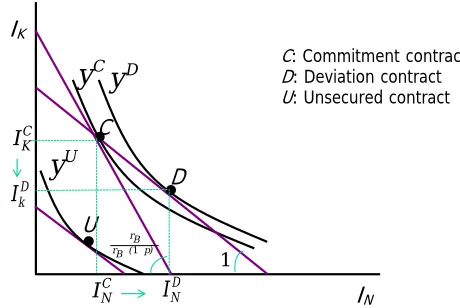
Point C in Figure 1 represents the optimal input combination under the commitment contract.
The input mix is tilted towards capital. The collateral value makes the actual price of capital equal to
13The assumption that only creditors can repossess the assets in distress implies that unused inputs enter the bank’s
rB−(1−p)β, which is lower than the price of labor,rB. In our model, the actual input price depends
on both the selling price and the cost of finance (i.e., the cost of the credit for input purchases). Since
the selling price is set at 1 for both inputs by assumption, differences in the input prices reflect only
differences in the cost of finance. Thus, when a secured contract is signed, the cost of financing the
capital input is lower than that of financing labor, the difference being the collateral value of capital. In
this case, the two inputs have different actual prices, although they are both financed by the bank and
the selling price is the same. In contrast, if both inputs are financed through an unsecured contract,
they have the same financing cost, namely rB, and thus they also have the same actual price.
2.2 Non-contractible investment
The result in Proposition 1 is obtained under the assumption that the entrepreneur can commit to the
investment level specified in the bank contract at t= 1. However, if the investment is unobservable,
then att= 3,once the loanLCB has been granted, the entrepreneur can increase his profit by altering
the input combination. The entrepreneur re-optimizes by solving programmePD:
max IK,IN,RB
p[f(IK, IN)−RB] (5)
s.t. RB =RBC, (6)
LCB =IN +IK, (7)
where constraint (6) requires that the entrepreneur honors his repayment obligation in non-defaulting
states (i.e., RCB in Proposition 1),14 while constraint (7) requires that the ex post total input
expenditure be equal to the loan obtained in the secured contract (i.e.,LCB in Proposition 1).
The solution to the above programme is called deviation contract. The input combination under
the deviation contract isIKD LCB, RBC
≡IKD < IKC andIND LCB, RCB
≡IND > INC, and the corresponding
entrepreneur’s expected profits are:
ΠD ≡p
f IKD, IND
−RCB
>ΠC. (8)
The increase in profits (ΠD > ΠC) is the result of a distortion in the input combination: the
entrepreneur overinvests in labor and underinvests in capital. The incentive to deviate from the
original mix arises because the new input combination is chosen after the loan has been granted.
Thus, the entrepreneur only cares about meeting his repayment obligation in the good state and he is
not concerned with repaying the bank in the bad state. Indeed, no collateral is pledged to the lender
14Because output is verifiable, any return from production will be claimed by creditors and the entrepreneur will get
in the bad state (i.e., no capital inputs are in the lender’s participation constraint (6)). The lack of
collateral increases the actual input price of capital and leaves the price of labor unchanged. As a
result, labor becomes relatively cheaper than in the commitment case. The entrepreneur is thus better
off reducing his investment in capital and increasing it in labor inputs.
The input combination under the deviation contract characterized above is represented by pointD
in Figure 1. PointD lies to the right of pointC on a higher isoquant and on a flatter isocost than that
going through pointC. To see why, consider that the slopes of the two isocost lines tangent to isoquants
yC and yD represent the ex ante and the ex post input price ratios, respectively (i.e., those obtained
before and after the bank loan has been received). The ex ante input price ratio is that implied by the
secured credit contract (pointC). As the contract is secured, the ratio isrB/[rB−(1−p)β]>1, and
hence larger, the higher the collateral value of the capital input. Conversely, since the contract used
by the bank to finance the capital input purchase at point D is unsecured, the financing cost of the
two inputs is the same and equal torB. Therefore, the ex post input price ratio is 1. Since at the new
ex post input prices it must still be possible to afford the original contract, the new isocost line has
to pass through the initial optimum (pointA). By the quasi-concavity of the production function, the
new input combination lies on a higher isoquant, and implies a decrease in IK and an increase in IN.
The difference between the ex ante and the ex post input price ratios is precisely why the entrepreneur
can obtain higher profit by choosing an input combination that is different from the ex ante efficient
one.
.
.
U C
.
C: Commitment contract
D: Deviation contract
U: Unsecured contract IK
IN
D k
I
C K I
D
C N I
p)β ( B r
B r
− − −
1
1
−
C
y
Dy
U
y
D N
[image:11.612.113.343.463.617.2]I
Figure 1: Contractible and non-contractible investment. Points C, D, and U represent the optimal input combination and the production level under the commitment, the deviation and the unsecured contract, respectively. PointD is not an equilibrium contract, since the bank does not break even.
However, pointD in Figure 1 is not an equilibrium. Because of the decreased investment in capital
break even, at the contracting stage the bank will be willing to sign only an unsecured contract with all
the repayment obligations paid for in the good state. Setting the collateral equal to zero in the bank
participation constraint (2), solving it for RB and the resource constraint (3) for LB, the objective
function (1) becomes pf(IK, IN)−(IN+IK)rB, which, compared with the benchmark profits (4),
shows the efficiency loss due to the inability of the entrepreneur to pledge collateral. The solution to
the maximization problem is described in Proposition 2.
Proposition 2 When investment is non-contractible, the entrepreneur and the bank sign an unsecured
credit contract. The bank lends LUB = IKU +INU < LCB to the entrepreneur, where IKU and INU are
the investment levels solving (30) and (31) in the Appendix, with IU
K < IKC, INU < INC. The bank
gets repaid only in non-defaulting states: RUB = 1pLUBrB. The entrepreneur gets expected profits
ΠU ≡ pf IKU, INU− IKU +INUrB < ΠC. There is an efficiency loss due to the inability to pledge
capital input as collateral.
Point U in Figure 1 is the optimal input combination when investment is non-contractible. The
new isoquant yU lies below yC. While the bank is indifferent between pointsC and U – it gets zero
expected profit either way – the entrepreneur’s profit is strictly lower at B, because the lower debt
capacity implied by the inability to pledge capital inputs as collateral reduces the overall investment
and therefore output. The distance between the isoquants,yC−yU,represents the benefits of collateral.
It follows that, to exploit this benefit, the entrepreneur would rather commit to the investment level
of the secured credit contract (point C). Notice also that at U the actual price of the two inputs is
the same and equal torB (as in pointD), which implies the same level of capital and labor.15
In Proposition 2, we posit that only the unsecured contract (point U) can be an equilibrium
outcome. Both the commitment (point C) and any partially secured contract (any point between C
and U) are time inconsistent since the entrepreneur retains the incentive to alter the input mix in
favor of labor. To get the intuition, consider the relation between the ex ante input price ratio and the
ex post one. As long as these two relative prices are different, there will be an incentive to change the
input combination, no matter how much of the loan has been secured. Consider first the fully secured
contract (pointC in Figure 1). The ex ante input price ratio is rB/[rB−(1−p)β]>1, while the ex
post one isrB/rB= 1. It follows that, once the loan has been granted, labor is actually less expensive
(and capital more expensive), thus inducing the entrepreneur to increase the reliance on labor and
lower that on capital. The same reasoning applies to any partially secured bank loan (i.e., to any
contract where 0 < γ < 1). In this case, the ex ante input price ratio will be rB/[rB−(1−p)γβ],
15
whereγ <1, while the ex post one is 1. Since the ex ante price ratio is still greater than the ex post
one, again labor becomes cheaper ex post, with an ex post incentive to alter the input combination.
3
The commitment role of trade credit
So far we have shown that when the project needs two inputs and the investment in the pledgeable
one is non-contractible, any secured entrepreneur-bank contract (fully or partially) has a problem of
input substitution, which causes losses to the bank. The unsecured loan eliminates this problem but
also the benefits of collateral.
In this section, we introduce the supplier of the pledgeable input as a second financier. By observing
the input transaction, he has a natural information advantage, which the entrepreneur can use to
restore his ability to pledge the capital input as a collateral to the bank. In particular, the entrepreneur
can sign a partially secured credit contract with the supplier. Observing the input transaction and
having a stake in the default state, the supplier guarantees that the input investment is carried out
as contracted. This induces the bank to accept a partially secured credit contract as well, mitigating
the efficiency loss due to the lack of commitment.16
While supplier financing restores the benefits of secured lending, this comes at a cost since trade
credit is assumed to be more expensive than bank credit (rS > rB). To avoid the uninteresting case
in which the cost of trade credit is larger than its benefit, we introduce Assumption 1.
Assumption 1 rB
p ≥
1−γprS+
γ p
rB, ∀γ ∈[0,1].
The left-hand side of Assumption 1 represents the financing cost of the pledgeable input when
the entrepreneur does not take trade credit and thus only has access to unsecured bank financing.
The right-hand side is the financing cost when the entrepreneur takes trade credit and also has access
to secured bank credit. When Assumption 1 holds, the cost of finance under the unsecured bank
contract is no less than under any mix of secured trade and bank credit. Thus, taking trade credit
is beneficial to the entrepreneur. The cost on the right-hand side of the expression in Assumption 1
is a weighted average of the fund-raising costs of the bank (rB) and supplier (rS) with weights that
depend on the share of inputs pledged as collateral (γ goes to the bank and 1−γ to the supplier)
and on the probability of default. When default is very likely and the bank liquidates most of the
entrepreneur’s inputs (γ close to 1), having access to a secured bank loan through trade credit is
enormously beneficial, since it reduces the overall cost of financing the inputs. In the extreme case in
16
which γ = 0, the right-hand side of Assumption 1 reaches its upper bound, rS. In this case, it can
still be optimal to take trade credit if rB
p ≥rS. This condition only depends on the model’s parameter
values and turns out to be a sufficient condition for Assumption 1 to be satisfied.
To find the optimal entrepreneur-bank-supplier contract, we proceed in three steps. First, we find
the contract for a genericγ. Next, we show that if the amount of trade credit is too small (γ too high),
the entrepreneur could still “cheat” at the expense of the bank. Finally, we derive the entrepreneur’s
profit under deviation and introduce the incentive compatibility condition that ensures that deviation
is unprofitable. This allows us to determine the incentive-compatible γ and to fully characterize the
optimal contract.
When the bank and supplier can both provide external financing, the optimization problem is
given by programme Pγ:
max LB,LS,RB,RSIK,IN,γ
p[f(IK, IN)−RB−RS], (9)
s.t. pRB+ (1−p)γβIK ≥LBrB, (10)
pRS+ (1−p) (1−γ)βIK ≥LSrS, (11)
LB+LS ≥IN +IK, (12)
RS ≥(1−γ)βIK, (13)
where (9) denotes the entrepreneur’s expected profit, and (10) and (11) are the participation
constraints of the bank and the supplier, respectively. Condition (12) is the resource constraint
when trade credit is also available, while constraint (13) requires repayments to the supplier be
non-decreasing in revenues.17 Competition among banks and among suppliers implies that (10) and (11)
are binding. In order to minimize the reliance on costly trade credit, the entrepreneur would let the
supplier act only as a liquidator, pledging him the minimum collateral that guarantees commitment,
and setting the repayment in the good stateRS equal to zero. However, this implies that returns be
decreasing in revenues, violating constraint (13). Thus,RSmust be set at the minimum level satisfying
constraint (13), which is then binding. In turn this implies that the supplier gets a flat contract.
Proposition 3 describes the solution to programmePγ.
Proposition 3 The entrepreneur-bank-supplier contract has investment IK∗ (γ), IL∗(γ), solving (32) and (33) in the Appendix, and displays the following properties:
17
a. The supplier gets a secured contract with flat repayments across states: an amount L∗S(γ) =
1
rS (1−γ)βI
∗
K(γ) is lent in exchange for the right to a share 1−γ of the collateral value of
the unused inputs βIK∗ (γ) in the default state and a repayment R∗S(γ) = (1−γ)βIK∗ (γ) in the
good state; the share of inputs bought on account L∗S(γ)
I∗
K(γ) is decreasing inγ.
b. The bank gets a secured contract with increasing repayments: an amount L∗B(γ) = IN∗ (γ) +
h
1− 1
rS (1−γ)β
i
IK∗ (γ) is lent in exchange for the right to a share γ of the collateral
value of the unused inputs βIK∗ (γ) in the default state and a repayment RB∗ (γ) =
1
p[L
∗
B(γ)rB−(1−p) (1−γ)βI
∗
K(γ)] > γβI
∗
K(γ) in the good state. L
∗
B(γ) is increasing in
γ.
c. Expected profits are increasing inγ and β and are given by:
Π∗(γ)≡pf(IK∗ (γ), IN∗ (γ))−(IK∗ (γ) +IN∗ (γ))rB+
rB
rS
(1−γ) + (γ−p)
βIK∗ (γ). (14)
d. Asset tangibility IK∗(γ)
I∗
N(γ) is increasing in γ.
In Proposition 3, we derive the properties of the optimal contract for a genericγ. The parameterγ
is the fraction of collateral that goes to the bank and is crucial in our story because it affects both the
entrepreneur’s profit and his incentive to deviate. Since bank credit is cheaper than trade credit, the
higher theγ, the higher the reliance on bank credit, and the higher the entrepreneur’s profit (see point
c of Proposition 3). Thus the entrepreneur would like to setγ as high as possible. However, the higher
theγ,the higher his incentive to deviate from the ex ante contract. The reason is the following. When
the entrepreneur decides to deviate, both the bank and the supplier’s low state return are jeopardized.
However, unlike the bank, prior to the contract execution the supplier observes the change in capital
input provision and refuses to sell the inputs on credit, thus implying a lower total loan and the scaling
down of production by the entrepreneur. The entrepreneur faces therefore a trade-off when deviating:
on one side, the increase in production due to a change in the input mix, and on the other side the
fall in production because of the forgone trade credit. It turns out that, by lowering γ, the bank can
make the fall in production larger, thus affecting the trade-off and the entrepreneur’s incentives to
deviate. The issue is then to determine the maximum γ that prevents deviation (i.e., the value of
γ that makes the entrepreneur indifferent between a mix of secured bank and trade credit and the
deviation contract with forgone trade credit). To this aim, we define the profit from deviation and
Definition 1 Define the entrepreneur’s expected profit after deviating from the contract specified in Proposition 3 as:
ΠF(γ)≡pf IKF, L∗B(γ)−IKF−R∗B(γ), (15)
where IKF (L∗B(γ)) is the level of capital chosen under deviation and satisfying programme PF in the
Appendix.
Given all profitable deviations, the optimal entrepreneur-bank-supplier contract that is incentive
compatible requires that deviation be less profitable than honoring the ex ante efficient contract. This
is ensured by the following incentive compatibility constraint:
ΠF(γ)−Π∗(γ)≤0. (16)
Solving programme Pγ under constraint (16) leads to Proposition 4.
Proposition 4 Under mild conditions, the entrepreneur-bank-supplier contract that prevents
deviation has 0 ≤ γ ≤ γ∗, where γ∗ satisfies condition (16) with equality. Since the entrepreneur’s
expected profitΠ∗(γ)is increasing inγ,the entrepreneur will offer the contract with the highest possible
γ, i.e., γ =γ∗.
In Proposition 4, we identify the optimal share of collateral going to the bank as the upper bound of
the set of collateral shares that are incentive-compatible for the entrepreneur. Usingγ∗ in Proposition
3, we fully characterize the optimal three-party contract. Trade credit is used as a commitment device
and its amount is the lowest possible that makes commitment credible to the bank.
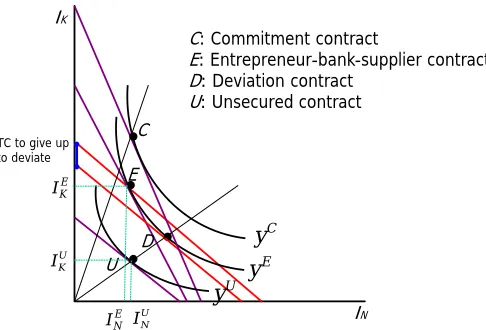
Point E in Figure 2 depicts the input combination and the level of output corresponding to the
entrepreneur-bank-supplier contract implied by Proposition 4. To see why this contract is
incentive-compatible, suppose that initially the entrepreneur signs the three-party contract (pointE) and then
decides to deviate. Upon observing the entrepreneur altering the input mix, the supplier refuses to sell
inputs on credit. This implies a decline in external financing, with a subsequent decline in the scale
of production that makes deviation costly to the entrepreneur. By construction of the
entrepreneur-bank-supplier contract, this decline is such that the entrepreneur is indifferent between sticking to the
original contract and deviating. Graphically, the new optimum under deviation is at pointD, which
lies on the same isoquant as pointE and thus involves the same level of output. The vertical distance
between the isocost lines intersecting pointE and tangent to point D represents the amount of trade
credit the entrepreneur has to renounce to make the contract incentive-compatible. This guarantees
.
.
D E
C: Commitment contract
E: Entrepreneur-bank-supplier contract D: Deviation contract
U: Unsecured contract
IN
IK
TC to give up to deviate
C
.
.
U
C
y
E
y
U
y
E K
I
U K
I
E N
[image:17.612.158.401.81.246.2]I IUN
Figure 2: The commitment role of trade credit. Points C, E, andU represent the optimal input combination and the production level under the commitment, the entrepreneur-bank-supplier and the unsecured contract, respectively. PointD represents the production level if the entrepreneur deviates from the entrepreneur-bank-supplier contract. PointsD andE lie on the same isoquant.
This discussion implies that whether deviating from the original contract is profitable or not
depends on the amount of trade credit the entrepreneur is getting under the original contract, which
corresponds to the amount he has to forgo in case of deviation. It follows that the bank can always
prevent deviation by reducing its supply of financing (i.e., by reducingγ). By doing so, the bank forces
the entrepreneur to give up a larger amount of trade credit when deviating. This reduces production
so much as to offset the benefit of deviation. The commitment effect of trade credit rests upon two
features of the supplier’s contract. First, the supplier provides a share of the capital input on credit.
Second, the supplier has the right to a share of its collateral value in case of default. Both conditions
have to be satisfied for the entrepreneur to have no incentive to alter the input mix ex post.
Point E lies between point C (commitment contract) and point U (unsecured contract) in Figure
2. The three-party contract does not allow the entrepreneur to achieve pointC since the cheaper bank
credit is partially replaced by the more expensive trade credit. However, it generates larger profit than
the unsecured bank contract. By signaling that the bank loan will be used to purchase the inputs as
specified, trade credit facilitates access to secured bank financing.
Notice that the guarantee implicitly offered in our model by the supplier shares some similarities
with a standby letter of credit. This letter is issued by a financial institution on behalf of the buyer
of some goods to guarantee that the seller will be paid on time and for the correct amount. It works
as a credit-enhancement device and facilitates trade. In our story, the supplier also works as a credit
enhancement device by guaranteeing that there is enough collateral to repay the bank in case of
default, and fosters secured bank lending. Thus, while with a letter of credit it is the bank that
a guarantee to the bank (still on behalf of the buyer). However, besides this similarity, there is an
important difference between a letter of credit and the implicit guarantee offered by the supplier in our
story. Indeed, while a letter of credit brings credit risk to the underwriting financial institution, which
becomes liable in case of buyer insolvency, the supplier in our model does not bear any additional
credit risk and eliminates any risk that the bank will not be fully repaid in default.
3.1 Testable predictions
The discussion above allows us to derive testable predictions on the relation between optimal financial
contracts and the characteristics of the assets invested into the project. Since trade credit allows
entrepreneurs to access secured bank financing, there is a positive relation between the joint use of
trade/secured bank credit and the degree of asset pledgeability. Point E in Figure 2 has indeed
an input combination more intensive in pledgeable assets than point U. Related empirical literature
classifies balance-sheet data on assets into tangibles (with high collateral value as plant, property and
equipment) and intangibles (with low collateral value as patents, goodwill and trademarks). If we use
tangibility as an empirical proxy for the degree of asset pledgeability, we obtain Prediction 1.
Prediction 1. Entrepreneurs are more likely to finance investments intensive in tangible assets with both secured bank and trade credit than with unsecured bank credit only.
The collateral value of an input also depends on its liquidation or scrap value β (i.e., its
second-hand market value, also called degree of input redeployability). While the entrepreneur’s profits
under the three-party contract are increasing in input liquidation value, as shown in Proposition 3,
profits under the unsecured contract do not depend on β, because under such a contract there is no
collateral pledging. Thus the benefits of trade credit (i.e., the difference between the profits under
the commitment and under the unsecured contract) are larger when the input liquidation value is
larger. To some extent, the input liquidation value reflects industry characteristics. For example,
standardized goods are likely to have greater scrap value than differentiated products or services. We
can thus state Prediction 2.
Prediction 2. Secured bank and trade credit are more likely to be used by entrepreneurs buying standardized inputs than by entrepreneurs buying differentiated inputs or services.
The reliance on trade credit also depends on the degree of substitutability between inputs. The
commitment problem arises because the entrepreneur can change the input combination after the loan
has been granted. For trade credit to play a role as a commitment device, inputs need to be at least
partial substitutes. With a higher degree of substitutability between inputs, the commitment problem
proportions, there is no extra-profit to be gained by changing the input combination. Since there is
no incentive to deviate, the entrepreneur can access secured bank financing with no need to use trade
credit. Thus, we obtain Prediction 3.
Prediction 3. Secured bank and trade credit are more likely to be used by entrepreneurs with technologies that have input substitutability than by entrepreneurs with technologies that have inputs
used in fixed proportions.
3.2 A numerical example
In this section, we consider a numerical example to illustrate how trade credit can improve on bank
financing when the entrepreneur is unable to commit to the investment level set at the contracting
stage with the bank. We use the following generic parameter values consistent with Assumption 1:
Y ∈ {0, y},withy=AIKaILb,whereA= 20, p=.5;a=b=.4;w=ρ= 1;rB = 1;rS = 1.05;β = 0.7.
Commitment contract. If the entrepreneur can commit to the investment level set at the contracting stage with the bank, it relies only on bank credit. Under our parameter assumptions, the
optimal contract, defined in Proposition 1., implies an investment in capital IKC = 3,728 and labor
ILC = 2,424. Even if the selling price of the two inputs is the same (w = ρ = 1), the actual input
price ratio (rB/[rB−(1−p)β]) is roughly equal to 1.54. With a ratio greater than one, capital is
relatively less expensive than labor (because of the collateral pledged in the bad state), which explains
why capital investment is larger than labor investment. Input purchase is fully financed by secured
bank financing for an amount LC
B = 6,152. The bank gets the repayment RCB = 9,695 in the good
state and the collateral value of capital inputs C = βIKC = 2,610, in the bad state. Production is
yC = 6,059 and profits are ΠC = 1,212.
Deviation contract. Suppose now that the entrepreneur cannot commit to the investment level set at the contracting stage. The bank provides the loan of the commitment contract LC
B = 6,152,
expecting returns RCB = 9,695 andC =βIKC = 2,610,in the good and bad state, respectively. Upon
being granted credit, the entrepreneur has an incentive to re-optimize and choose a different input
mix. While the entrepreneur will make sure to meet the bank good-state repayment obligation, he is
not concerned with repaying the bank in the bad state. This implies that the entrepreneur solves a
maximization problem where no collateral is pledged. Therefore, the actual input price ratio is now
equal to one, implying an equal amount of capital and laborIKD =ILD = 3,076. With the input price
ratio under deviation (called ex post) lower than the ratio under the commitment contract (called ex
why the entrepreneur wants to deviate and reduce the investment in capital below the commitment
level. Under the new input choice, both production and profits increase to yD = 6,172 > yC and
ΠD = 1,324 >ΠC, respectively. While the entrepreneur is clearly better off, the bank is worse off.
Because of the lower investment in capital input, the bank return in the bad state (i.e., the capital
input liquidation value) is strictly lower than the contracted one: βIKD = 2,153<2,610 =βIKC. Thus,
the bank no longer breaks even and the deviation contract is not an equilibrium contract.
Unsecured contract. Anticipating the entrepreneur’s deviation, the bank offers the fully unsecured contract described in Proposition 2. This contract implies a smaller loan amount than
in the commitment contract LUB= 2,048< LCB = 6,152, due to the entrepreneur’s inability to pledge
the collateral as partial repayment of the loan. The bank gets a repayment only in the good state
equal to RUB = 4,096. Since the contract is unsecured, there is no incentive to deviate. Moreover,
an equal amount of capital and labor is invested, IU
K = ILU = 1,024. Due to the lower loan size,
production and profits are strictly lower than in the commitment contract: yU = 2,560< yC = 6,059
and ΠU = 512< ΠC = 1,212. Thus, the unsecured contract eliminates the entrepreneur’s incentive
to deviate but also the benefits of the collateral. The entrepreneur would be better off if he could
credibly commit to the input combination agreed in the commitment contract.
Entrepreneur-bank-supplier contract. To credibly commit to the input mix specified in the commitment contract, the entrepreneur takes trade credit. Since trade credit is more expensive than
bank credit, it is optimal to take the minimum amount of trade credit that stops deviation and rely
for the rest on the cheaper bank credit. Trade credit is L∗S = 374 and it allows the entrepreneur to
access an amount of secured bank financing equal to L∗B = 5,654. Both financiers get a repayment
in the good state: RB∗ = 9,151, R∗S = 392. In the bad state, the collateral value of capital inputs
is shared, with a fraction 1−γ∗ = 0.15 going to the supplier and γ∗ = 0.85 to the bank. With
trade and bank credit together, the entrepreneur gets a total loan strictly larger than the one
received under the unsecured contract and close to the one under the commitment contract, i.e.,
LUB = 2,048<(L∗B+L∗S) = 6,028< LCB = 6,152, with trade credit being only 6% of the total loan.
This allows the entrepreneur to invest IK∗ = 3,641 andIL∗ = 2,386 in capital and labor, respectively,
obtaining slightly lower profits than in the commitment contract, but strictly larger profits than in
4
Entrepreneur-supplier collusion
In Section 3, we argued that trade credit enables the entrepreneur to overcome the problem of
commitment with the bank. This is because the supplier will always refuse to extend credit upon
observing the entrepreneur’s deviation, as he will fail to break even on the new input combination.
This might not be true anymore if the contract between the entrepreneur and the supplier were
renegotiated to allow the supplier to at least break even. In this section, we extend the model to allow
for collusive agreement between the entrepreneur and the supplier.
Suppose that the entrepreneur, the bank, and the supplier have agreed on the contract terms
described in Proposition 3, with γ =γ∗. Once the loan from the bank is obtained, the entrepreneur
may then seek an agreement with the supplier to alter the input mix at the expense of the bank (i.e.,
to reduce the investment in capital and increase that in labor). If the supplier is to accept, they must
renegotiate the contract terms (i.e., loan size and repayments), so as to enable the supplier to at least
break even:18
pRS+ (1−p) (1−γ)βIK ≥LS(γ)rS. (17)
If agreed, the new arrangement allows an increase in overall profits at the expense of the bank. This
allows us to define the gross collusion rent and describe its properties in Proposition 5.19
Definition 2 Define ΠCOL(γ) as the profit from collusion for a generic γ solving programme PCOL
in the Appendix andΠCOL(γ)−Π∗(γ) as the gross collusion rent, where Π∗(γ) is the profit from the
entrepreneur-bank-supplier contract as defined in Proposition 3 for a generic γ.
Proposition 5 The gross collusion rent ΠCOL(γ)−Π∗(γ) is increasing in γ and is zero iff γ = 0.
Thus, any entrepreneur-bank-supplier contract is vulnerable to collusion between the entrepreneur and
the supplier at the expense of the bank.
In Proposition 5, we posit that a collusive agreement to alter the input combination ex post is
always profitable for the entrepreneur and the supplier. Thus, the entrepreneur-bank-supplier contract
is not collusion-proof. The only way for the bank to stop other parties from colluding is to offer an
unsecured contract (γ = 0). However, reaching a collusive agreement may be costly. This cost may be
due to the time and effort spent in writing and enforcing the side contract. It may also be the effect
18An alternative collusive agreement would keep the loan size fixed (L∗
S(γ
∗
)) and renegotiate only the repayments schedule. However, while this would not alter the qualitative properties of the collusion-proof contract, there is no real reason to impose this constraint on the renegotiation. Moreover, renegotiating all the contract terms is profit-maximizing, as it gives the entrepreneur the possibility of reducing its reliance on costly trade credit.
19For simplicity we assume that any collusive rent is seized by the entrepreneur. This is without loss of generality, as
of reputational concerns.20 To capture this cost, define α ∈ [0,1] as the fraction of the profit from
collusion that is lost in reaching such an agreement and [(1−α) ΠCOL(γ)−Π∗(γ)] as the net rent
from collusion. This formulation enables us to find an interior γ that stops parties from colluding.
In particular, for a sufficiently high α, the bank can always prevent collusion by focusing on contract
offers that guarantee a non-positive collusion rent, i.e., those that satisfy the following constraint:
(1−α) ΠCOL(γ)−Π∗(γ)≤0. (18)
Is the entrepreneur-bank-supplier contract collusion-proof when we measure the collusion rent net
of bargaining costs? More specifically, at γ =γ∗ (the value of γ that ensures no unilateral incentive
to deviate), is constraint (18) satisfied? The answer depends on the cost of collusion,α. Let us define
α∗(γ∗) as the value of α at which the collusion-proof constraint (18) is satisfied with equality when
γ =γ∗. Whenα≥α∗(γ∗), the value ofγ that solves (18) is greater thanγ∗,so that the
entrepreneur-bank-supplier contract can also accommodate collusion. Whenα < α∗(γ∗), the value ofγ that solves
(18) is less than γ∗ and the entrepreneur-bank-supplier contract is open to collusion. This amounts
to saying that the value of γ that accommodates both unilateral deviation and collusion has to solve
the following global collusion proofness constraint:
max
(1−α) ΠCOL(γ),ΠF(γ) −Π∗(γ)≤0. (19)
This allows us to state the result in Proposition 6 and then to derive Corollary 1.
Proposition 6 The collusion-proof entrepreneur-bank-supplier contract has γ = ˆγ(α) ≤ γ∗, where ˆ
γ(α) satisfies condition (19) with equality. The properties of this contract are those described in
Proposition 3, with γ = ˆγ(α).
Proposition 6 implies that the properties of the collusion-proof contract, and thus the benefits of
using trade credit, depend on the cost of collusion. Three scenarios can arise. First, collusion can be
so costly that it is never profitable: α(γ∗)≤α≤1. The rent from collusion is lower than the rent from
deviation, so that the global collusion-proof condition (19) coincides with the incentive-compatibility
condition (16). This corresponds to the case already analyzed in Section 3: The entrepreneur buys
commitment from the supplier through trade credit and takes a partially secured loan from the bank.
The share of capital inputs bought on account (through trade credit) isβ(1−γ∗) and the share paid
in cash (through bank credit) isβγ∗. Both shares are independent of α. The equilibrium is at point
E in Figure 2 and the input combination is capital intensive.
20
Second, collusion may be costly, but profitable: 0 < α < α(γ∗). The rent from collusion is
greater than from deviation, so that the global collusion-proofness condition (19) coincides with the
collusion proofness condition (18). The lower the cost of collusion, the larger the amount of trade
credit necessary to make the contract collusion-proof, and the lesser the bank’s participation in the
venture. It follows that the lower the cost of collusion, the larger the share of inputs bought on account
through trade credit, and the lower the one bought through bank credit. The properties of the optimal
contract are those described in Proposition 3, withγ = ˆγ(α). The equilibrium point is located between
pointsE and U in Figure 2, the exact position depending on the cost of collusion. The lower the cost,
the further the equilibrium shifts from point E to pointU, with the input combination becoming less
capital-intensive.
Lastly, collusion may be costless (α = 0). The entrepreneur and the supplier can grab the entire
surplus from their agreement. In this case, the only contract that enables the bank to break even is
the unsecured one (pointU in Figure 2). Since the bank does not have a stake in the bad state return
any longer, the bank is reimbursed only in the good state. This arrangement removes any incentive
to collude.
From Proposition 6 and the above discussion, we can derive Corollary 1.
Corollary 1 Under the collusion-proof contract, the share of inputs bought by the entrepreneur on
credit is decreasing in the cost of collusionα, while the share of inputs paid for in cash, asset tangibility,
and expected profits are increasing in α.
5
Relationship lending and trade credit in a multi-period setting
So far we have shown that when the investment in the capital input is not contractible, any secured
bank contract is time-inconsistent and trade credit can be used to solve the problem and give the
entrepreneur access to secured bank financing. These results depend on the information advantage of
the supplier vis-`a-vis the bank: The supplier, as a provider of the input, knows the investment level
in capital, the bank does not. This argument could suggest that our conclusions strictly depend on
the static nature of the credit relations. In a dynamic setting, the bank could exploit the repeated
interaction to set up a long-term relationship, where information about the past investment level
can be collected and used to determine future contract terms, possibly incorporating a penalty for
misbehavior. Anticipating a future punishment in case of deviation, the entrepreneur would have an
incentive to abide by the contract and there might be no need to use trade credit. The threat of a
We formally study this possibility by extending the static baseline model to a multi-period setting,
similar in spirit to Boot and Thakor (1994), where an intertemporal price-adjustment mechanism
is used to reduce efficiency losses from using collateral. In Section 5.1, we assume the information
collected by the bank to fully reveal the past investment level (perfect signal). In Section 5.2, we
consider instead the case of a noisy signal. We show that trade credit is still the most efficient way to
solve the commitment problem, provided that the duration of the project is not too long.
5.1 A perfect signal
Structure of the repeated game. Consider an economy where the entrepreneur has to finance the project defined in Section 1. This project has a duration of t = T > 1, that is, it can be repeated
for a finite number of periods, T. The entrepreneur enters a long-lasting lending relation with one
bank and signs a long-term contract that specifies the contract terms for anyt= 1, ..., T,contingent
on some information about the past investment level. We denote this financing scheme relationship
lending, because the bank gathers proprietary information through the repeated interaction with the
borrower and uses it to set future contract terms.21
In each period, the entrepreneur faces the commitment problem described in Section 2. He
can invest the amount of inputs specified in the commitment contract (cooperation), gaining the
commitment profits ΠC defined in Proposition 1. Alternatively, he can choose a different input mix
(deviation) and gain the deviation profits ΠD (equation 8). At the end of each period, the bank obtains
a signal revealing with certainty the chosen investment level, which can be used to set the following
period’s contract terms.22
To derive the sequence of profits conditional on each possible decision and on the signal received
by the bank, let us start from the last period. At t=T, the parties cannot agree on a commitment
contract as the entrepreneur surely deviates. Thus, the only contract the parties will agree on is an
unsecured contract, whose price depends on the signal received by the bank. In particular, if the
information reveals cooperation, they agree on the unsecured contract derived in Proposition 2 and
the entrepreneur gets the resulting profits, ΠU. If the information reveals deviation, the bank penalizes
the entrepreneur by charging a higher interest rate (punishment contract) and the entrepreneur gets
profits ΠP <ΠU.23 Profits ΠP are defined later.
21
See Boot (2000) for a review of the literature on relationship lending.
22Assuming that the entrepreneur can collect this information also in the static setting would not alter any of our
results, since the information can only be used with one period lag.
23In the last period of the game, the contracts need to be contingent on the information revealed. If not, we end up
At any timet < T, instead, the parties agree on a commitment contract if the signal collected by
the bank revealed commitment by the entrepreneur in the previous period, or else on a punishment
contract for only one period if the signal revealed deviation, followed by a commitment contract in
any successive period, until a deviation signal triggers a punishment contract again.
Cooperation as an optimal strategy. Given the strategy defined above, we have a sequence of
T entrepreneur’s decisions with associated profits. For simplicity, we assume that the discount factor
is zero.24 In Proposition 7, we posit the condition under which cooperation in all periods weakly
dominates deviation in any one period.
Proposition 7 Under the strategy defined above, cooperation weakly dominates deviation iff:
ΠD−ΠC ≤ΠU−ΠP. (20)
Condition (20) indicates that in any T-period model, the incentive constraint that guarantees
cooperation reduces to a comparison between the one-period deviation benefit (left-hand side) and the
last period deviation cost (right-hand side). Therefore, the entrepreneur will cooperate if the benefit
from deviation is lower than the cost. This crucially depends on the punishment profits ΠP,and thus
on the penalty P the entrepreneur has to pay when deviation is detected by the bank.
The next step is to derive the minimum penalty that prevents deviation (i.e., satisfies condition
(20) with equality). Suppose that in a generic period the signal reveals that the entrepreneur has
deviated. This triggers the punishment contract in the following period. This contract is unsecured
as the one defined in Section 3, but with a higher interest rater0B that incorporates the penaltyP for
deviation. The terms of the punishment contract and the corresponding investment levels are thus set
to solve the following optimization programme (PP):
max IK,IN,LB,RB,P
p[f(IK, IN)−RB]
s.t. pRB =LBrB0 (21)
LB=IK+IN
under the additional no-deviation condition (20). The constraints above have the usual meaning, the
only novelty being thepunishment interest raterB0 ≡rB+LP
B in the individual rationality constraint
(21). This interest rate is made of two components: the market interest rate,rB,plus an extra variable
cost calculated as a fraction of the penaltyP the entrepreneur has to pay upon deviation on the total
loan received, LB.
24
Solving programmePP, we obtain the entrepreneur’s profits under the punishment contract as:25
ΠP ≡pf IKP, INP
−LPB
rB+
P LP
B
<ΠU. (22)
The analysis above posits that under a sufficiently high punishment, relationship lending eliminates
the entrepreneur’s incentive to deviate and provides a viable solution to the commitment problem of
secured lending.
Relationship lending versus trade credit. We now compare two alternative ways to solve the commitment problem of secured financing. On the one hand, we have relationship lending with a
long-term contract that specifies a sequence of credit amounts and repayment obligations contingent
on the borrower’s investment history. On the other hand, there is a sequence of single-period trade and
bank credit contracts, independent of past project investment and with potentially different suppliers
and lenders at each point in time. For brevity, we use the termtrade credit to identify this three-party
contract. If the entrepreneur uses relationship lending, he signs the long-term bank contract that
guarantees cooperation in all periods, getting the commitment profits ΠC derived in Proposition 1 for
T −1 periods and the profits from the unsecured contract ΠU in the last period. The total profits
under relationship lending are thus (T −1)ΠC+ ΠU.If he uses trade credit, he signs the three-party
contract defined in Proposition 3 repeatedly for any of the T periods and gets the expected profits
Π(γ∗), renamed here ΠT C in each period. Thus, the total profits under trade credit areTΠT C.
It follows that relationship lending is preferred to trade credit if the following condition is satisfied:
(T−1)ΠC + ΠU ≥TΠT C. (23)
When T = 1, condition (23) is never satisfied since ΠU <ΠT C. This case coincides with the baseline
model: when the project lasts for one period, the commitment problem can only be solved by using
trade credit. When the game is repeated, cooperation can be achieved and the entrepreneur can gain
the commitment profits ΠC forT−1 periods at the cost of getting lower profits ΠU in the last period
for his inability to credibly commit. With increasing iterations, the weight of ΠU reduces while that
of ΠC increases, so that at some point it becomes more profitable to enter a long-term relationship
with the bank rather than relying on trade credit. This discussion is summarized in Proposition 8.
Proposition 8 Under perfect signal, there is critical duration of the project:
T∗= 1 + Π
T C−ΠU
ΠC−ΠT C >1, (24)