City, University of London Institutional Repository
Citation:
Bowler, D. M., Gaigg, S. B. and Gardiner, J. M. (2014). Binding of multiple
features in memory by high-functioning adults with autism spectrum disorder. Journal of
Autism and Developmental Disorders, 44(9), pp. 2355-2362. doi:
10.1007/s10803-014-2105-y
This is the accepted version of the paper.
This version of the publication may differ from the final published
version.
Permanent repository link:
http://openaccess.city.ac.uk/4225/
Link to published version:
http://dx.doi.org/10.1007/s10803-014-2105-y
Copyright and reuse: City Research Online aims to make research
outputs of City, University of London available to a wider audience.
Copyright and Moral Rights remain with the author(s) and/or copyright
holders. URLs from City Research Online may be freely distributed and
linked to.
Running Title: Memory binding in ASD.
Binding of Multiple Features in Memory by High-Functioning Adults with
Autism Spectrum Disorder
Dermot M Bowler
Sebastian B Gaigg
John M Gardiner
Autism Research Group
City University London
Corresponding Author: Dermot M Bowler,
Autism Research Group,
Department of Psychology, City University London,
Northampton Square,
London EC1V 0HB, UK.
E-mail: [email protected]
Abstract
Diminished episodic memory and diminished use of semantic information to aid recall
by individuals with autism spectrum disorder (ASD) are both thought to result from diminished
relational binding of elements of complex stimuli. To test this hypothesis, we asked
high-functioning adults with ASD and typical comparison participants to study grids in which some
cells contained drawings of objects in non-canonical colours. Participants were told at study
which features (colour, item, location) would be tested in a later memory test. In a second
experiment, participants studied similar grids and were told that they would be tested on
object-location or object-colour combinations. Recognition of combinations was significantly
diminished in ASD, which survived covarying performance on the Color Trails Test (D’Elia,
Satz, Uchiyama et al., 1996), a test of executive difficulties. The findings raise the possibility
Binding of Multiple Features in Memory by High-Functioning Adults with Autism Spectrum Disorder
Autism Spectrum Disorder (ASD) comprises a range of conditions that all show
difficulties with reciprocal social interaction and communication as well as repetitive and
stereotyped behaviours, often accompanied by characteristic language difficulties or global
cognitive impairment (American Psychiatric Association, 2000). Individuals with minimal
language difficulties and normal or higher-than-normal IQ are often referred to as
‘high-functioning’, a category that includes Asperger disorder (Volkmar & Klin, 2000). There is now
a large body of evidence showing that high-functioning individuals with ASD experience
subtle but characteristic memory difficulties (see Bowler & Gaigg, 2008; Boucher, Mayes &
Bigham, 2012, for reviews) the patterning of which can provide both clues to underlying
neuropsychological functioning and potential pointers to intervention. Relatively undiminished
performance on recognition (Bowler, Gardiner & Grice, 2000; Minshew, Goldstein, Muenz &
Payton, 1992) contrasts with greater difficulty on free recall tasks, particularly when materials
are semantically related (Bowler, Matthews & Gardiner, 1997; Smith, Gardiner & Bowler,
2007, but see Leekam & Lopez, 2003) or when learning is assessed over a number of trials
or lists (Bowler et al., 1997; Bowler, Gaigg & Gardiner 2008; Minshew & Goldstein, 1993;
2001, Smith et al., 2007). This patterning of performance led Bowler, Gardiner & and
Berthollier (2004) to propose a Task Support Hypothesis (TSH), which states that memory in
ASD will be better on any task with a test procedure that provides information about the
studied material.
Other aspects of the pattern of memory performance in ASD also point to a difficulty
in the flexible processing of relations among elements of multi-dimensional material as well as
the binding together of subsets of these elements in ways that are task-relevant or unique to
the episode in which they were studied (see Zimmer, Mecklinger & Lindenberger, 2006;
Shimamura, 2010). Diminished recall of categorised word lists in the context of relatively
spared recognition performance suggests enhanced processing of individual items of
material, coupled with difficulties in processing of relations among items. Both enhanced
observed in ASD participants by Gaigg, Gardiner and Bowler (2008). These researchers
found that recall performance of adults with ASD was poorer under conditions that relied
heavily on the ability to relate relatively infrequent members of a category together (e.g. two
items of fruit in a list of 52 words) but not under conditions that relied heavily on focussing on
the characteristics of each item belonging to a particular category (e.g. remembering a 13th, 14th and 15th item of furniture in the same list). People with ASD also show a reduced ability to re-experience the spatio-temporal context that characterises the recollection of a personally
experienced episode (Bowler et al., 2000; Bowler, Gardiner & Gaigg, 2007) as well as
difficulties with episodic future thinking (EFT), i.e. in imagining themselves in future situations
(Lind & Bowler, 2010) and in scene construction, which is the ability to accurately create an
imaginary scene or re-create a previously experienced scene (Lind, Williams, Bowler & Peel,
2014). These last observations reflect abnormalities in relational binding - the capacity to bind
disparate aspects of experience into flexible configurations - and to relate this configural
experience either to stored representations or to a personally constructed view of the world.
Difficulty with recall in the presence of intact recognition is also seen in healthy
ageing, especially when accompanied by frontal lobe decline (Craik & Anderson, 1999), an
observation that led Bowler (2007) to propose an ‘ageing analogy’ as a heuristic for
developing our understanding of memory in ASD. Furthermore, relational processing
difficulties have been demonstrated in healthy older adults by Chalfonte and Johnson (1996)
who found that when they were asked to study grids in which some cells contained drawings
of objects in non-canonical colours (e.g. a pink banana), their rates of recognition of
item-colour and item-location combinations were significantly worse than their recognition of
individual items, colours or places. The existing behavioural findings on memory difficulties in
ASD would lead us to predict similarly diminished recognition of combinations of features in
the presence of intact recognition of individual features in adults with high-functioning ASD if
tested with Chalfonte and Johnson’s paradigm. Such a finding would represent a strong test
of relational memory difficulties in ASD because the paradigm uses a supported test
procedure (recognition) which is known to pose fewer difficulties for people with ASD
importance of executive difficulties both in ASD and in the memory functioning of older
individuals, in Experiment 2 we administered the Color Trails Test (CTT, D’Elia, Satz,
Uchiyama et al., 1996). This consists of two trials. Trial 1 measures sustained attention, and
requires participants to join up in numerical order circles containing the numbers 1-25
randomly distributed on the page. Trial 2 measures attentional shifting and comprises two
sets of 25 circles, one yellow and one pink, each set containing the numbers 1-25. The
participant has to join the circles in numerical order alternating between pink and yellow
circles.
Experiment 1
Method
Participants
Eighteen individuals with ASD (5 female, 13 male) and 18 typical individuals (4
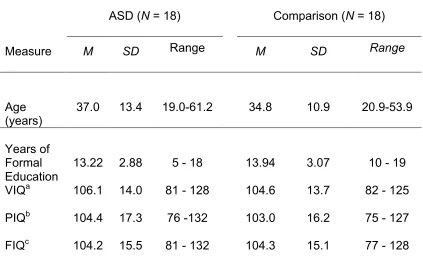
female, 14 male) participated in Experiment 1. Groups were closely matched in terms of
chronological age number of years of formal education and cognitive ability measured by the
Wechsler Adult Intelligence Scale (WAIS-IIIUK; The Psychological Corporation, 2000, see Table 1). Participants with ASD were recruited from a panel maintained by the Autism
Research Group at City University London. A review of available medical records confirmed
that all ASD participants had received a clinical diagnosis according to DSM-IV-TR criteria
(American Psychiatric Association, 2000) by clinical psychologists or psychiatrists in the UK.
The Autism Diagnostic Observation Schedule Generic (ADOS-G; Lord, Risi, Lambrecht, et al.
2000) was furthermore carried out with all individuals in this group by persons trained to
research reliability on this instrument. The observations confirmed difficulties in the areas of
reciprocal social and communicative behaviours consistent with the clinical diagnosis
(Communication score: M = 2.5, SD = 1.5, Range = 0-5, ASD cut-off = 2; Reciprocal Social
Interaction score: M = 7.2, SD = 3.0, Range = 3-12, ASD cut-off = 4; Total score: M = 9.7, SD
= 3.7, Range = 5-17, ASD cut-off = 7). For experiment 2 the ADOS was also available for 14
participants (Communication score: M = 2.6, SD = 1.6, Range = 0-6, ASD cut-off = 2;
score: M = 9.3, SD = 3.6, Range = 5-17, ASD cut-off = 7).1The typical comparison participants were recruited via local newspaper advertisements. All were free of psychotropic medication
and did not report any family history of neuropathology or psychiatric illness. Analysis of the
age, educational and IQ data set out in Table 1 revealed no significant differences (max t =
0.53, min p = .60). The Ishihara Tests for Colour Deficiency (Ishihara, 1999) confirmed that no
one had colour vision deficits. All participants gave their informed consent and were paid
standard University fees for their time.
INSERT TABLE 1
Materials and Design
Following Chalfonte and Johnson (1996) we generated six sets of 22 line drawings
from the Snodgrass and Vanderwart (1980) norms of familiarity, visual complexity, naming
agreement (i.e. agreement amongst participants in naming the objects depicted) and image
agreement (i.e. how closely the drawings resembled participants’ mental images of the
objects). Ratings for drawings in our selected six sets matched closely on all these variables
(all ts < 1.5). We also ensured even distribution of categories (e.g. fruit, furniture…) across
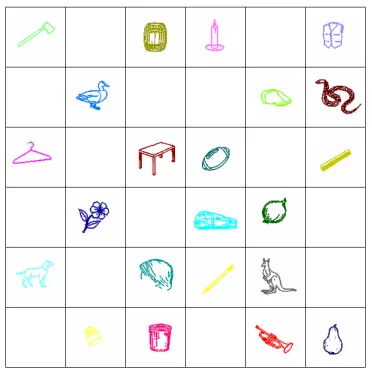
the six sets. The 22 drawings in each set were randomly allocated to locations in a 6x6 grid,
which measured 18 cm x 18 cm on a 30 cm Laptop monitor. Each line drawing was presented
in one of 32 unique colours in the centre of the 3 cm x 3 cm grid locations (see Figure 1).
INSERT FIGURE 1
Different pairs of the six study arrays served as the to-be-remembered materials for
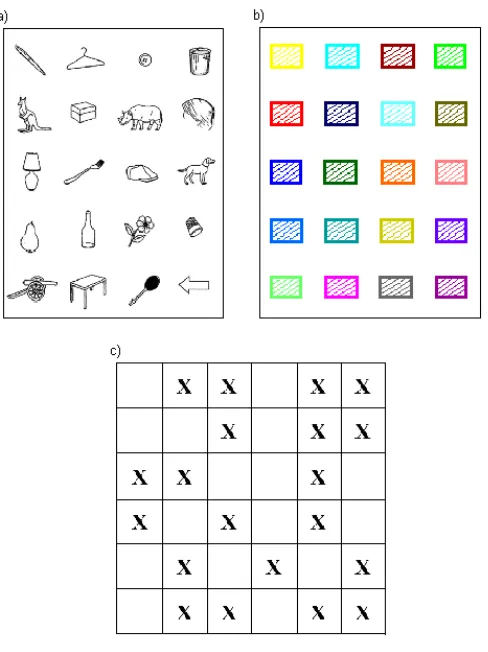
the Item, Colour and Location tests (see Figure 2). For the Item recognition test, 10 black
drawings from the studied item set and 10 from the unstudied item set were displayed in five
rows of four items each (see Figure 2a). For the Colour recognition test twenty colour patches
1 Although for some individuals observations of difficulties in the domains of communication
(10 studied and 10 unstudied) were presented in five rows of four patches each (see Figure
2b). For the Location recognition test, 6x6 grids were displayed, which marked 20 locations
with a black ‘X’. Half of these locations had included a line drawing during study, the other
half did not. Care was taken to ensure counterbalancing of drawing, colour and location
elements across participants.
INSERT FIGURE 2a, b & c
Procedure
Participants were tested individually in a sound attenuated laboratory dimly lit with a
fluorescent desk lamp. The three experimental conditions were separated by several weeks
in order to avoid interference effects. On each occasion participants were told that they would
be shown a set of coloured line drawings that would appear in random locations of a 6x6 grid
and that they should try to remember either what the line drawings were (Item condition),
what colours they saw (Colour condition) or which of the locations in the grid were filled with a
drawing (Location condition). It was made clear to participants that they could ignore aspects
of the study array they were not asked to remember. Participants studied the array for 1
minute and, after a brief description of the recognition test procedure, they were shown the
appropriate test array and asked to indicate which items, colours or locations they
remembered. Participants were allowed unlimited time during the test and they were
instructed to try not to guess.
Results and Discussion
Analysis of between-group false alarm rates revealed no significant differences (max
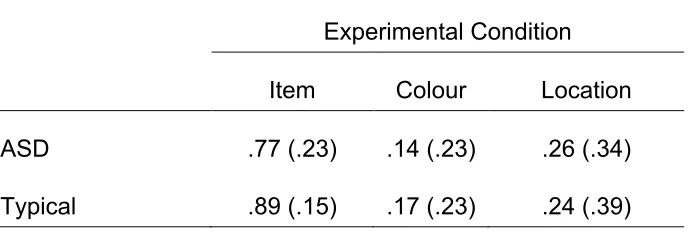
t = .61, df = 34; min p = .55). Analysis of corrected recognition rates (hits-false alarms), set
out in Table 2, was by a 2 (Group) x 3 (Experimental Condition) mixed ANOVA. This revealed
a main effect of Experimental Condition (F(1,56.81) = 76,40, Greenhouse-Geisser correction,
p < .001; effect size r = .76) but no main effect of Group (F(1,34 = 0.05, ns; effect size r = .11)
or interaction between the factors (F(2,56.03) = 0.06, ns, Greenhouse-Geisser correction;
effect size r = .12). These findings extend to line drawings, colours and item locations existing
individuals with ASD (Bowler et al, 2000). The question of whether recognition of
combinations of these features is also undiminished is addressed in Experiment 2.
INSERT TABLE 2
Experiment 2
Method
Participants
Fourteen individuals with ASD (3 female, 11 male) and fifteen typical individuals (2
female, 13 male) participated in Experiment 2. In order to achieve sufficiently large group
sizes, nine ASD and 10 typical participants who had also participated in Experiment 1 also
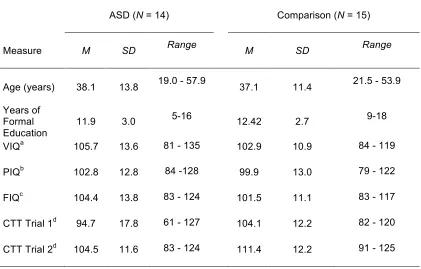
took part in this experiment. As in Experiment 1, participants were closely matched in terms of
chronological age, number of years of formal education and cognitive ability (see Table 3). All
were selected in a similar manner and all met the same inclusion criteria as set out for
Experiment 1. Analysis of the data in Table 3 revealed no significant differences between the
groups (max t = 0.79, min p = .44).
INSERT TABLE 3
Materials and Design
Four new study arrays were generated in the same manner as described for
Experiment 1. Each array thus comprised 22 uniquely coloured line drawings (chosen from
Snodgrass & Vanderwart, 1980) arranged in random locations in a 6x6 grid. Two arrays
served as the to-be-remembered materials for the Item-Colour condition (one serving as
study items and the other as lures, counterbalanced across participants) and two for the
Item-Location condition with half of the participants studying one array whilst the remaining
participants studied the other. The same matching for complexity, familiarity, naming and
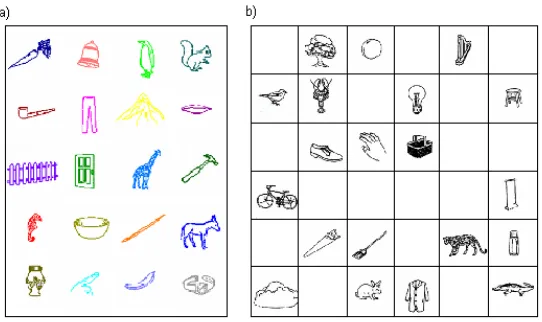
Sample recognition test arrays for the Item-Colour and Item-Location conditions are
depicted in Figure 3a and Figure 3b respectively. For the Item-Colour test, 20 line drawings
from the studied set were presented, ten of which were shown in exactly the same colour as
during study whilst the colours of the remaining ten were randomly reassigned. Thus, the test
included no new item or colour information but rather old and new combinations of studied
items and colours. The Item-Location test was constructed in a similar manner. The CTT
(D’Elia et al, 1996) was also administered to all participants. The score used here was the
time taken to complete the test standardised with a mean of 100 and an S.D. of 15. Mean
scores are set out in Table 3. There was no group difference in either test measure (max t =
1.69, min p = .10).
INSERT FIGURE 3a & b
Procedure
Stimulus presentation was identical to that of Experiment 1. For the Item-Colour
condition, participants were instructed to try to remember both the identity and colour of each
of the line drawings in the grid and told that the test would not include any new drawings or
new colours but that the drawings would either appear in their original colour or swap colours
with the other drawings. Similar instructions were given for the Item-Location test. After
participants indicated that they had understood the instructions, they studied the grid for 1
minute. During the test, they were allowed unlimited time to indicate their responses and they
were asked to try not to guess.
Results and Discussion
Analysis of false alarm rates revealed no significant group differences (max t = 1.2, df
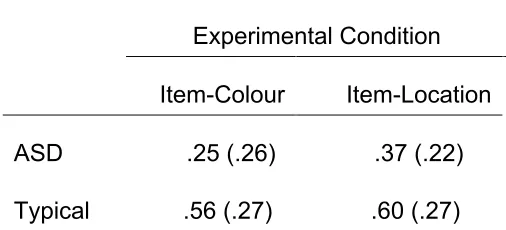
= 27, min p = .24). Corrected recognition rates (hits-false alarms) are set out in Table 4. A 2
(Group) x 2 (Experimental Condition) mixed ANOVA revealed no significant effect for
Experimental Condition (F (1,27) = 1.90, n.s.; effect size r = .26). There was a significant main
factors (F(1,27) = 0.48, ns; effect size r = .13). Thus, the ASD group performed significantly
worse than the comparison group on both of the combination conditions.
INSERT TABLE 4
In addition, because Chalfonte and Johnson (1996) reported an association between
binding and frontal lobe function we repeated the analysis using trials 1 and 2 of the CTT as
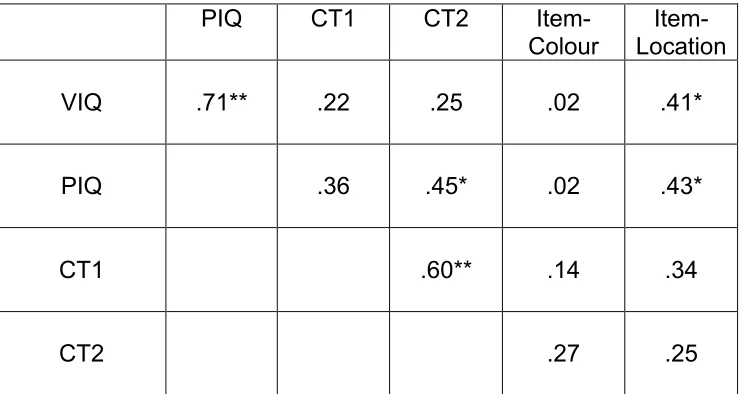
covariates. We also included VIQ and PIQ as covariates because as can be seen in Table 5,
these correlated significantly with performance on the relational memory task. The resulting 2
(Group) x 2 (Experimental Condition) mixed ANCOVA, revealed no significant effect of
Experimental Condition and no significant interactions between Condition and any of the
covariates (maximum F = 2.30, minimum p = .14, maximum effect size r = .30). There was a
main effect of Group (F (1,23) = 12.77, p < .001; effect size r = .60) but no interaction
between the experimental factors (F(1,23) = 0.07, ns; effect size r = .05). Thus, the ASD
group performed significantly worse than the comparison group on both of the combination
conditions.
INSERT TABLE 5
Finally, to compare the performance across the two experiments of the 19
participants who had taken part in both studies, we first of all compared their VIQ and PIQ
scores and chronological ages, which revealed no significant differences (maximum t = 0.76,
minimum p = .51). The single-element data from Experiment 1 was combined into an average
element score which together with the Item-Colour and Item-Location data from Experiment 2
were entered into a 2 (Group) x 3 (Item-type) repeated measures ANOVA, which revealed a
significant main effect for Group (F (1,17) = 5.64. p < .03, effect size r = .50, Item-type (F
(2,16) = 69.59, p < .001, effect size r = .90) and a Group x Item-type interaction (F (2, 16) =
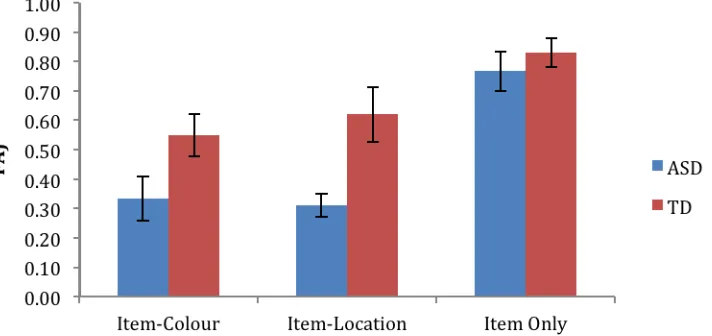
6.44, p < .001, effect size r = .54. Inspection of Figure 4 reveals that the data confirm the
earlier analyses by showing that although both groups show better recognition of single than
multiple-attribute stimuli, the magnitude of the difference is greater in the ASD than in the
The overall findings of Experiment 2 show that the ASD participants experienced
difficulty in recognising previously studied combinations of features even when their
recognition memory for the constituent elements of the combinations was relatively
undiminished and when individual differences in intellectual ability and executive functioning
were statistically controlled.
FIGURE 4 ABOUT HERE
General Discussion
Taken together, the findings of the two experiments support the hypothesis that
individuals with ASD experience difficulty with recognition memory for episodically defined
combinations of features of visual stimuli despite showing little evidence of reduced
recognition of the features separately. As such, the findings replicate with individuals on the
autism spectrum those of Chalfonte and Johnson’s (1996) healthy ageing participants. The
findings have a number of implications for our understanding of memory in ASD. They are
consistent with the view that the ASD-related episodic memory difficulties documented by
Bowler et al. (2000, 2007) and by Lind and Bowler (2010) are likely to result in part from
diminished relational binding, i.e. a difficulty in holding together in memory the separable
features that define a particular episode. It is clear that such a difficulty would adversely affect
the reconstruction of the spatio-temporal context that is characteristic of the episodic
experience (Tulving, 2001) as well as the associated difficulty with scene construction
documented by Lind et al (2014). The present findings also help to refine an account
developed by Minshew, Williams and colleagues (see Williams, Minshew & Goldstein, 2008).
Our demonstration of difficulties with episodic binding of elements of experience provides a
potential operationalization of the problem of dealing with complex memory that Minshew and
colleagues identify as characteristic of individuals with ASD, but which as yet has not been
fully spelled out. Further studies could explore the relation between the measure of relational
binding used here and measures argued by Minshew and colleagues as involving complex
By showing diminished recognition of element combinations alongside intact
recognition of the elements themselves, the findings of Experiment 2, also place an important
constraint on the TSH (Bowler et al., 2004). As pointed out earlier on, the TSH predicts
undiminished performance in the two experiments because they both utilise a procedure
(recognition) that provides a high degree of support at test and should thus be relatively easy
for the ASD participants. Yet the requirement to bind disparate elements together in memory
even under conditions of task support increases memory demands sufficiently to compromise
performance in ASD. The present findings also extend the ageing analogy of memory in ASD
(Bowler 2007). Although this analogy was intended simply as a heuristic for the development
of experimental paradigms for the further study of the neuropsychology of memory in ASD, it
also has implications for how we might address the as-yet under-researched area of cognitive
ageing in this population (see Happé & Charlton, 2012; Mukaetova-Ladinska et al, 2012).
The present findings prompt several further avenues of research. The first is the
extent to which the phenomenon of diminished relational binding is associated with the
broader clinical manifestation of ASD as well as with difficulties experienced by individuals on
the spectrum in their everyday lives. The parallel between patterns of memory difficulties
found in ASD and in healthy ageing prompts further investigation of the effectiveness of
interventions on relational memory performance, and whether such interventions had
knock-on effects knock-on profiles of wider adaptive or cognitive functiknock-oning. A third strand of investigatiknock-on
could explore possible neural and neuropsychological underpinnings of impaired relational
memory. The capacity for relational binding is widely agreed to involve the medial temporal
lobe and in particular the hippocampus (Brown & Aggleton, 2001), which encodes objects,
events and relations among them rapidly and in a way that allows the adaptive use of
encoded information in different settings (Squire, 2004). These two structures have for long
been suspected to play a role in the development of ASD (e.g. Damasio & Maurer, 1978), and
structural hippocampal abnormalities have been identified in post mortem (Bauman &
Kemper, 1985) and imaging studies of morphology (Nicolson, DeVito, Vidal et al, 2006) in
It has been known for some time that although individuals with ASD have little
difficulty in recognition memory, this intact performance can diminish in certain specific
circumstances. The two studies reported here confirm previous observations of intact
recognition memory for single element stimuli and further demonstrate that when studied
materials comprise episodically defined, arbitrary combinations of multiple elements of
experience, these individuals' recognition memory is severely compromised. The potential
implications of this finding both clinically and in terms of understanding the brain mechanisms
Acknowledgements
The authors would like to thank the participants for giving their time in these
experiments, two anonymous reviewers for insightful comments and the Medical Research
Council UK for financial support (grant number: G0401413). The authors declare that they
have no conflict of interest.
References
American Psychiatric Association (2000). Diagnostic and statistical manual of mental
disorders, Fourth Edition – Text Revision. Washington, DC: APA, 2000.
Bauman, M. & Kemper, T. (1985). Histoanatomic observations of the brain in early infantile
autism. Neurology, 35,866-874.
Boucher, J., Mayes, A. & Bigham, S. (2012). Memory in autistic spectrum disorders.
Psychological Bulletin, 138, 458-496.
Bowler, D. (2007). Autism spectrum disorders: psychological theory and research.
Chichester, UK: Wiley
Bowler, D. M. & Gaigg, S. B. (2008). Memory in ASD: Emerging themes and future prospects.
In J. Boucher and D. M. Bowler (Eds.), Memory in Autism: Theory and Evidence.
Cambridge: Cambridge University Press, pp. 330-349.
Bowler, D. M., Gaigg, S. B. & Gardiner, J. M. (2008). Subjective organisation in the free recall
of adults with Asperger’s syndrome. Journal of Autism and Developmental Disorders,
38, 104-113.
Bowler, D. M., Gardiner, J. M. & Berthollier, N. (2004). Source memory in Asperger’s
syndrome. Journal of Autism and Developmental Disorders, 34, 533-542.
Bowler, D. M., Gardiner, J. M. & Gaigg, S. B. (2007). Factors affecting conscious awareness
in the recollective experience of adults with Asperger’s syndrome. Consciousness &
Cognition,16, 124-143.
Bowler, D. M., Gardiner, J. M. & Grice, S. (2000). Episodic memory and remembering in
adults with Asperger’s syndrome. Journal of Autism and Developmental Disorders,
30, 305-316.
Bowler, D. M., Matthews, N. J., & Gardiner, J. M. (1997). Asperger’s syndrome and memory:
Similarity to autism but not amnesia. Neuropsychologia, 35, 65-70.
Brown, M. W. & Aggleton, J. P. (2001). Recognition memory: what are the roles of the
perirhinal cortex and hippocampus? Nature Reviews: Neurosciences, 2, 51-61.
Chalfonte, B. & Johnson, M. (1996). Feature memory and binding in young and older adults.
Craik, F. I, M. & Anderson, N. (1999). Applying cognitive research to the problems of ageing.
Attention & Performance, 17, 583-615.
D’Elia, L. F., Satz, P., Uchiyana, C. L. & White, T. (1996). Color trails test. Professional
manual. Psychological Assessment Resources. Lutz, FL: Psychological Assessment
Resources.
Damasio, A. R., & Maurer, M. G. (1978). A neurological model for childhood autism. Archives
in Neurology, 35, 777–786.
Gaigg, S. B., Gardiner, J. M. & Bowler, D. M. (2008). Free recall in autism spectrum disorder:
the role of relational and item-specific encoding. Neuropsychologia, 46, 993-999.
Happé, F. & Charlton, R. A. (2012). Aging in autism spectrum disorders: a mini-review: .
Gerontology, 58, 70-78.
Ishihara, S. (1999). Ishihara’s Tests for Colour Deficiency: 38 Plates Edition. Kanehara & Co.,
Ltd: Tokyo, Japan.
Leekam, S. & Lopez, B. (2003). Do children with autism fail to process information in
context? Journal of Child Psychology and Psychiatry, 44, 285-300.
Lind, S. & Bowler, D. M. (2010). Episodic future thinking in adults with autism. Journal of
Abnormal Psychology,119, 896-905.
Lind, S. E., Williams, D. M., Bowler, D. M., & Peel, A. (2014). Episodic memory and episodic
future thinking impairments in high-functioning autism spectrum disorder: An
underlying difficulty with scene construction or self-projection? Neuropsychology, 28,
55-67.
Lord, C., Risi, S., Lambrecht, L., Cook, E. H., Leventhal, B. L., DiLavore, P. C., Pickles, A.
&Rutter, M. (2000). The Autism Diagnostic Observation Schedule- Generic: A
standard measure of social and communication deficits associated with the spectrum
of autism. Journal of Autism and Developmental Disorders, 30 (3), 205-223.
Minshew, N. J. & Goldstein, G. (1993). Is autism an amnesic disorder? Evidence from the
California Verbal Learning Test. Neuropsychology, 7, 209-216.
Minshew, N. J. & Goldstein, G. (2001). The pattern of intact and impaired memory functions
Minshew, N., Goldstein, G., Muenz, L. R. & Payton, J. (1992). Neuropsychological functioning
in nonmentally retarded autistic individuals. Journal of Clinical and Experimental
Neuropsychology, 14, 749-761.
Mukaetova-Ladinska, E. B., Perry, E., Baron, M. & Povey, C. (2012). Ageing in autism
spectrum disorder. International Journal of Geriatric Psychology, 27, 109-118.
Nicolson, R., DeVito, T. J., Vidal, C. N. et al (2006). Detection and mapping of hippocampal
abnormalities in autism. Psychiatry Research: Neuroimaging, 148, 11-21.
Shimamura, A. P. (2010). Hirearchical relational binding in the medial temporal lobe: the
strong get stronger. Hippocampus, 20, 1206-1216.
Smith, B. J., Gardiner, J. M. & Bowler, D. M. (in press). Deficits in free recall persist in
Asperger’s syndrome despite training in the use of list-appropriate strategies. Journal
of Autism and Developmental Disorders, 37, 445-454.
Snodgrass, J. G., & Vanderwart, M. (1980). A standardized set of 260
pictures: Norms for name agreement, familiarity and visual complexity.
Journal of Experimental Psychology: Human Learning & Memory, 6, 174-215.
Squire, L. R. (2004). Memory systems and the brain: a brief history and current perspective.
Neurobiology of Learning and Memory, 82, 171-177.
Tulving, E. (2001). Episodic memory and common sense: how far apart? Philosophical
Transactions of the Royal Society, B, 356, 1505-1515.
Volkmar, F. R. & Klin, A. (2000). Diagnostic issues in Asperger synrome. In A. Klin, F. R.
Volkmar & S. Sparrow (Eds.), Asperger syndrome. New York: Guilford Press.
Williams, D. L, Minshew, N. J. & Goldstein, G. (2008). Memory within a complex information
processing model of autism. In J. Boucher and D. M. Bowler (Eds.), Memory in
Autism: Theory and Evidence. Cambridge: Cambridge University Press, pp. 125-142.
Zimmer, H. D., Mecklinger, A. & Lindenberger, U. (2006). Handbook of binding and memory;
Table 1
Average age and IQ scores for the ASD and Typical Comparison Group in
Experiment 1
ASD (
N
= 18)
Comparison (
N
= 18)
Measure
M
SD
Range
M
SD
Range
Age
(years)
37.0
13.4
19.0-61.2
34.8
10.9
20.9-53.9
Years of
Formal
Education
13.22 2.88
5 - 18
13.94
3.07
10 - 19
VIQ
a106.1 14.0
81 - 128
104.6
13.7
82 - 125
PIQ
b104.4 17.3
76 -132
103.0
16.2
75 - 127
FIQ
c104.2 15.5
81 - 132
104.3
15.1
77 - 128
aVerbal IQ (WAIS-RUK or WAIS-IIIUK)
b Performance IQ (WAIS-RUK or WAIS-IIIUK)
Table 2
Mean and Standard Deviations of corrected recognition rates for the Item,
Colour and Location conditions of Experiment 1 as a function of Group.
Experimental Condition
Item
Colour
Location
ASD
.77 (.23)
.14 (.23)
.26 (.34)
Table 3
Average age and IQ scores for the ASD and Typical Comparison Group in
Experiment 2
ASD (N = 14) Comparison (N = 15)
Measure M SD Range M SD Range
Age (years) 38.1 13.8 19.0 - 57.9 37.1 11.4 21.5 - 53.9
Years of Formal Education
11.9 3.0 5-16 12.42 2.7 9-18
VIQa 105.7 13.6 81 - 135 102.9 10.9 84 - 119 PIQb 102.8 12.8 84 -128 99.9 13.0 79 - 122 FIQc 104.4 13.8 83 - 124 101.5 11.1 83 - 117 CTT Trial 1d 94.7 17.8 61 - 127 104.1 12.2 82 - 120 CTT Trial 2d 104.5 11.6 83 - 124 111.4 12.2 91 - 125
aVerbal IQ (WAIS-RUK or WAIS-IIIUK
b Performance IQ (WAIS-RUK or WAIS-IIIUK
Table 4
Mean and Standard Deviations of corrected recognition rates for the
Item-Colour and Item-Location conditions of Experiment 2 as a function of Group.
Experimental Condition
Item-Colour
Item-Location
ASD
.25 (.26)
.37 (.22)
Table 5
Pearson product-moment correlations between corrected recognition scores
and Verbal IQ (VIQ), Performance IQ (PIQ) and Trials 1 and 2 of the Color
Trails Test (CT1 and CT2).
PIQ
CT1
CT2
Item-Colour
Item-Location
VIQ
.71**
.22
.25
.02
.41*
PIQ
.36
.45*
.02
.43*
CT1
.60**
.14
.34
Figure Captions
Figure 1
Example of a study array used in both experiments.
Figure 2
Examples of the Item recognition test (a), Colour recognition test (b) and Location
recognition test (c) of Experiment 1.
Figure 3
Examples of the Item-Colour recognition test (a) and Item-Location recognition test
(b) of Experiment 2.
Figure 4
Corrected hit-rates for Item-Colour and Item Location combinations from Experiment