City, University of London Institutional Repository
Citation
:
d'Avila Garcez, A. S., Gabbay, D. M. and Lamb, L. C. (2014). A neural cognitive
model of argumentation with application to legal inference and decision making. Journal of
Applied Logic, 12(2), pp. 109-127. doi: 10.1016/j.jal.2013.08.004
This is the accepted version of the paper.
This version of the publication may differ from the final published
version.
Permanent repository link:
http://openaccess.city.ac.uk/11835/
Link to published version
:
http://dx.doi.org/10.1016/j.jal.2013.08.004
Copyright and reuse:
City Research Online aims to make research
outputs of City, University of London available to a wider audience.
Copyright and Moral Rights remain with the author(s) and/or copyright
holders. URLs from City Research Online may be freely distributed and
linked to.
City Research Online:
http://openaccess.city.ac.uk/
[email protected]
A neural cognitive model of argumentation with
application to legal inference and decision
making
Artur S. d’Avila Garcez
Department of Computing City University London EC1V 0HB, London, UK.
Dov M. Gabbay
Department of Computer Science King’s College London WC2R 2LS, London, UK
Luis C. Lamb
Institute of Informatics Federal University of Rio Grande do Sul
Porto Alegre, 91501-970, Brazil [email protected]
October 1, 2013
Abstract
use of neural networks for computing prevailing arguments efficiently through the propagation in parallel of neuronal activations, and the use of the same networks to evolve the structure of the argumentation network through learning (e.g. to learn the strength of arguments from data).
Keywords: Argumentation, Neural-Symbolic Reasoning, Legal Decision Mak-ing, Cognitive Modeling.
1
Introduction
Formal models of argumentation have been investigated in several areas, from multi-agent systems and artificial intelligence (AI) to decision making, philosophy and law [4, 8, 13, 17, 30, 33]. In artificial intelligence, models of argumentation have been used for commonsense reasoning, modelling chains ofdefeasible argumentsto reach a conclusion. Such models are mainly founded on logic-based approaches, which have been the standard for the representation of argumentative reasoning in AI [3].
Recent efforts to bridge the gap between logic-based models of argumentation and cognitive models of computation include [10, 11, 34]. In [10, 11], an equivalence is shown between value-based argumentation [2] and standard connectionist networks [22]. This has created a new line of research in argumentation where (i) neural net-works can be used as a cognitive computational model for argumentation and (ii) neural networks can be used to combine argumentation, quantitative reasoning and statistical learning. In [34], behavioural data is used to conclude that in human reasoning, rein-statement does not yield a full recovery of the attacked argument; [1] implements the same idea mathematically through equations that resemble the predator-prey dynam-ics of species populations. Further work integrating logic and neural networks include [20] where clustering in fuzzy ART networks is used to compute prevailing arguments, and [25] which extends the work in [10] to deal with self-defeating arguments and pro-vides a number of interesting examples. At the same time, some non-standard models of argumentation start to emerge, enriching current models with cognitive abilities; e.g. [15] discusses metalevel attacks, coalitions, disjunctive attacks and argument support, [37] provides an adequate semantics for joint attacks, among much else, [29] seeks to unravel the role of emotions in argumentation, [14, 23] propose to handle uncertainty in argumentation through the assignment of probabilities and weights to arguments, and [12, 26] offer a qualitative method for reasoning about uncertainty and preferences between arguments.
perspective for the research on argumentation: the use of connectionist models of com-putation to help investigate and evaluate cognitive models of argumentation. For exam-ple, ideas from connectionism about the modeling of attention and emotion could be investigated in the context of argumentation [29, 36].
Argumentation has also been proposed as a method for helping machine learning systems [27] where an expert’s arguments, or thereasonsfor some of the learning ex-amples, are used to guide the search for hypotheses. This is related to the body of work on abductive reasoning and combinations of abduction and inductive logic program-ming [24, 28]. It is said thatthe arguments constrain the combinatorial search among possible hypotheses, directing the search towards hypotheses that are more comprehen-sible in the light of an expert’s background knowledge[27]. We subscribe to this idea. In fact, experimental results on the integration of learning with background knowledge us-ing neural networks have been shown to outperform symbolic and purely-connectionist systems, especially in the presence of noisy data [9]. In this paper, differently from [27], however, learning from data can be used to inform a process of numerical argumenta-tion, allowing different perspectives of human argumentaargumenta-tion, including joint attacks, argument support, meta-argumentation and disjunctive attacks, to be modelled in the same framework, as detailed in what follows.
The remainder of the paper is organised as follows. First, we define the con-cepts of argumentation and neural cognitive models used throughout the paper. Then, we present an algorithm, generalised from [10], which translates standard and non-standard argumentation frameworks into non-standard connectionist networks. We show that the resulting neural model executes a sound parallel computation of the prevail-ing arguments accordprevail-ing to a number of standard argumentation semantics, and also according to value-based argumentation models [2], abstract dialectical frameworks [5], and other forms of human argumentation. We illustrate the network computation through examples that include joint attacks, support, meta-argumentation and disjunc-tive attacks. Finally, we apply the framework to a real decision making situation in legal reasoning, which indicates that the network model can be a useful tool in the modelling of non-standard and numerical argumentation, and in the analysis ofwhat-if
questions that emerge in real situations. The paper concludes with a brief discussion and directions for future work.
2
Background
In this section, we present the concepts of argumentation and neural networks used throughout the paper.
Definition 1 An argumentation framework has the formA=< α, attack >, whereα
is a set of arguments, andattack⊆α2is a relation indicating which arguments attack
which other arguments.
Definition 2 A value-based argumentation framework is a 5-tuple V AF = < α, attacks, V, val, P >,whereαis a finite set of arguments,attacksis an irreflexive binary relation onα, V is a non-empty set of values,valis a function mapping ele-ments inαto elements inV, andPis a set of possible audiences, where we may have as many audiences as there are orderings onV. For everyA∈α,val(A)∈V.
Bench-Capon also defines the notions ofobjectiveandsubjectiveacceptability of arguments. The first are arguments acceptable no matter the choice of preferred val-ues for every audience, whereas the second are acceptable to some audiences. Argu-ments which are neither objectively nor subjectively acceptable are calledindefensible. A functionv fromattackto{0,1}gives the relative strength of an argument. Given αi, αj ∈ α, if v(αi, αj) = 1thenαi is said to be stronger thanαj. Otherwise, if
v(αi, αj) = 0thenαiis weaker thanαj.
We shall also relate the neural approach with abstract dialectical frameworks [5].
Definition 3 An abstract dialectical framework (ADF) is a tupleD= (S, L, C)where
Sis a set of nodes,L⊆S×Sis a set of links,C={Cs}s∈Sis a set of total functions
Cs: 2s→ {in, out}, one for each node s.
Consider an example. A person is innocent (i), unless she is a murderer (m). A killer (k) is a murderer (m), unless she acted in self-defence (s). There must be evidence for self-defence, e.g. a witness (w) who is not known to be a liar (l). An ADF can model the above example by stating thatsisinifwisinandlisout. Similarly,misinifkisin andsisout. In other words, like neural networks, ADFs include the concept of support. Ifkandwareinandlisoutthenswill bein;sthen defeatsmregardless ofkso that iprevails. Every argumentation framework has an associated ADF. Also, normal logic programs have associated ADFs [5]. Since every logic program also has an associated neural network [9], this fact will be used later to show the required correspondences.
Other established definitions of argumentation semantics will be considered as well [6, 7, 13]. In all the definitions that follow, an argumentation framework is a pairA=
< α, attack >, as above. First, let us define a function F : 2α → 2α, such that F(Args) ={A|Ais defended byα}, whereArgs⊆α. The functionFcomputes the arguments accepted in the sense of [13] or defended by a set of arguments, in the sense of [7]. In this way, we can define conflict-free sets of arguments. A set of arguments isconflict-freeif and only if (iff, for short) it does not contain any argumentsAandB such thatAdefeatsB. LetArgsbe a conflict-free set of arguments.Argsis said to be acomplete extensioniffArgs=F(Args).
In another useful argumentation semantics, thegrounded semantics, only one ex-tension is yielded by making use of the functionFand defining thegrounded extension
as the minimal fixed point ofF [31]. A grounded extension is conflict-free [7]. In the
In semi-stable semantics, a set of argumentsArgsissemi-stableiffArgsis a com-plete extension of whichArgs+=α\Argsis maximal and defines a set of arguments which are defeated by an argument inArgs.
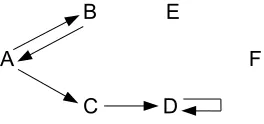
In order to illustrate the different argumentation semantics, we borrow an example from [7]. Consider the abstract argumentation framework depicted as a directed graph in Fig. 1, where each node is an argument and an arrow from argumentX to argument Y denotes an attack fromX onY. This framework has grounded extension{E,F}; complete extensions{E,F},{B,C,E,F} and{A,E,F}; preferred extensions {B,C,E,F}
and{A,E,F}; stable extension {B,C,E,F}; and semi-stable extension {B,C,E,F}. As pointed out in [7], semi-stable and stable extensions will coincide whenever the frame-work has at least one stable extension.
B E
A F
[image:6.612.241.373.272.334.2]C D
Figure 1: An abstract argumentation framework with arguments A, B, C, D, E, and F; D is a self-defeating argument
Finally, we shall also consider meta-argumentation [15]. In a meta-argumentation network, let argumentaattackbin the usual way. It is possible to define an argument cas an attack ona’s attack. This makes the framework more fine-grained in thatc’s attack does not propagate throughout the network, but is targeted at one specific attack in the network. Meta-argumentation can be reduced to argumentation frameworks with the addition of a node denoting(c, a)and a careful re-organization of the network [15]. We shall use a standard definition of neural networks, as follows. A neural network is a directed graph with the following structure: a unit (or neuron) in the graph is char-acterized, at timet,by its input vector Ii(t), its input potentialUi(t), itsactivation
stateAi(t), and itsoutput Oi(t). The units of the network are interconnected via a
set of directed and weighted connections such that if there is a connection from unit ito unitj thenWji ∈ Rdenotes theweightof this connection. The input potential of neuroniat timet (Ui(t)) is obtained by computing a weighted sum for neuroni
such thatUi(t) =PjWijIi(t). The activation stateAi(t)of neuroniat timetis then
given by the neuron’sactivation functionhi such thatAi(t) = hi(Ui(t)).Typically,
hiis either a linear function, a non-linear step function, or a sigmoid function such as
tanh(x). In this paper, we usetanh(x)as activation function and inputs values in the range [−1,1]. In addition,θi(an extra weight with input always fixed at1) is known
as thebiasof neuroni. We say that neuroniisactiveat timetifAi(t)>−θi.Finally,
the neuron’s output valueOi(t)is given by its output functionfi(Ai(t)). Usually,fiis
3
Neural Cognitive Argumentation Frameworks
We start by considering the relationship between argumentation and neural networks informally. If we represent an argument by a neuron then a connection from neuron ito neuronj can indicate that argumenti either attacks or supports argumentj, the weight of the connection corresponding to the strength of the attack or support. Since real numbers are used as weights in a neural network, we associate negative weights with attacks, positive weights with support, and zero weight with the lack of an attack or support.
Definition 4 We say that an argument prevails at timetwhen the activation state of its associated neuron is greater than a predefined valueAminat timet,0< Amin <1.
We say that an argument is defeated at timetwhen the neuron’s activation is smaller than−Amin. Otherwise, i.e. for activations in the interval [−Amin, Amin], we say
that it is unknown whether an argument prevails or not.
There are different ways in which an argument may support other arguments. For example, an argumentimay support argumentjby attacking an argumentkthat attacks j, or argumentimay supportj directly, e.g. by strengthening the value ofj, or even iandj mayget togetherto attackk. Generally, an argumentisupports an argument j if the coordination of i andj reduces the likelihood of j being defeated [39]. A general neural network structure capable of accounting for the above combinations of attack and support and the necessary computations of prevailing arguments would be a recurrent network having an input layer, a single hidden layer, and an output layer with feedback from the output to the input layer [9]. At timet0, input values are provided
to the network. Neuronal activation is then propagated in parallel from the input to the hidden layer at timet1, and to the output of the network at timet2. At timet3,
the output values can be fed back to the input of the network, and this process can be repeated until a stable state is obtained, when input and output values will be the same for each pair of neurons with feedback. Arguments for which the associated neuron is activated at the stable state are said to prevail.
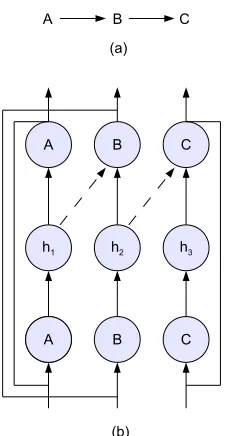
Consider the neural network of Fig. 2(b), which implements the argumentation network of Fig. 2(a). ArgumentsA,B andCare encoded in the network’s input and output layers. In this example, arguments do not get together to attack another argument so that each input neuron is connected directly to a hidden neuron and the weights from the input to the hidden layer simply serve to send the input information forward. Support and attack information is encoded by the weights leading from the hidden to the output layer of the network. Support forAis encoded by the positive weight going from neuronh1to output neuronA. Similarly, support forB (resp.C) is encoded by
the weight going fromh2(resp.h3) toB(resp.C).A’s attack onBis represented by
the dashed arrow going fromh1toB, which should have negative weight, as specified
in the algorithm below. Similarly,B’s attack onCis represented by the dashed arrow going fromh2toC, with a negative weight.
If the absolute value of the weight going fromh1toB(call itW1) is larger than the
value of the weight fromh2toB(call itW2) thenAdefeatsB. This produces{A, C}
of argumentation frameworks [13]. The prevailing arguments are computed by the net-work as follows: suppose thatA,BandCare all present at timet0, denoted by input
vector [1,1,1]. Hidden neuronsh1,h2 andh3all become activated;h1 activatesA,
and blocks the activation ofBfromh2(becauseW1.h1+W2.h2 < 0). At the same
time,Cis blocked byh2(by default, we assume that attacks are stronger than support,
i.e. the weight fromh2toC is greater in absolute value than the weight fromh3 to C, unless stated otherwise). Thus, at timet2, only output neuron Ais activated (i.e.
only the output of neuronAis greater thanAmin). This is then represented as a new
input vector [1,−1,−1] at timet3. Given this new input,Acontinues to prevail,Bis
defeated as before, butCis reinstated becauseBnow fails to defeat it, sinceBis not present in the input anymore. Thus, at timet5, output neuronsAandCbecome
acti-vated. At timet6, a new input [1,−1,1] is produced. Finally, with [1,−1,1] given as
input, output neuronsAandCbecome activated again, producing a stable state in the network. Recall that network outputs are real values in the range (−1,1). To compute a stable state, each output value in the range (Amin,1) is mapped to1, output values
in the range (−1,−Amin) are mapped to−1, and values in the range [−Amin, Amin]
are mapped to0. After this is done, the network’s new input vector can be compared with its previous input. In this example, the input vector at timet9will be identical to
the input vector at timet6, that is [1,−1,1] is a stable state. The network’s stable
ac-tivations indicate the prevailing arguments{A, C}. This result also coincides with the standard ADF interpretation of support (Definition 3). In the case of VAF (Definition 2), ifBis preferred overA, all that needs changing in the network is the value ofW1
orW2so that|W1|< W2, denoting that the attack fromAonB should not be strong
sufficiently to defeatB[10]. In this case, input [1,1,1] produces new input [1,1,−1], which is a stable state, given the neural network’s new set of weights. This new net-work, therefore, computes prevailing arguments{A, B}, as expected in the case of the VAF under consideration.
A B C
A B C
h1 h2
A
h3
(b) A B C
(a)
Figure 2: (a) Illustration of an argumentation network in which argument A attacks ar-gument B, which in turn attacks arar-gument C, and (b) its neural implementation, where solid lines receive positive weights and dashed lines, which represent the attacks, re-ceive negative weights
The algorithm below generalises the algorithm first introduced in [10], which was made for VAF only. It translates argumentation frameworks into single-hidden layer neural networks that behave as exemplified, and can be used to compute prevailing arguments in parallel. It does so by defining the structure and set of weights of a neu-ral network as a function ofAmin, using activation function tanh(x) and inputs in
{−1,1}. Each argument has a strength given by positive weightWl. Certain arguments
may attack other arguments with negative weightW0, and certain arguments may sup-port other arguments with positive weightWs. The weights are such that activations
in the interval [−Amin, Amin] are guaranteed not to occur for now (we shall consider
uncertainty in the next section). The neural network produces outputs in the intervals (−1,−Amin), which is mapped tofalseand denotes that an argument is defeated, and
(Amin,1), which is mapped totrue, denoting that an argument prevails.
By default, Algorithm 1 implements Dung’s argumentation frameworks. If an ar-gumentαiattacks an argumentαj, andαiis itself not attacked, then neuronαishould
block neuronαj. However, ifαi is deemed weaker thanαj, and no other argument
attacksαj, then neuronαi should not block neuronαj. To achieve this, and account
for a number of other, alternative semantics and modes of argumentation in a neural network [16], the constraints onWl andW0 can be modified, as will become clearer
[image:9.612.247.360.127.345.2]A
A C
h2 h3
B h1
A
A B C
A B
C
(b) (a)
Figure 3: (a) An example of a cyclic argumentation network and (b) its neural imple-mentation whose parallel computation produces, in a single pass through the network, a terminal state [-1,-1,-1] with no prevailing argument, following a grounded argumen-tation semantics
θj, will be considered in Section 4. A novelty of the algorithm is that arguments may
have strengthsWl, which may vary from one attack to another. Before we consider
the extensions of Algorithm 1, however, let us make the ideas developed so far more precise.
Definition 5 (N computesA) Let(αi, αj)∈attacks. LetAα(t)denote the activation
of neuronαat timet. We say that a neural networkN computes an argumentation frameworkAif wheneverAαi(t) > Amin andAαj(t) > Amin thenAαj(t+ 1) <
−Amin, and wheneverAαi(t) < −Aminfor everyαi such that(αi, αj) ∈ attacks
thenAαj(t+ 1)> Amin(reinstatement).
Proposition 6 For each argumentation framework Av there exists a single-hidden
layer neural networkN such thatN computesAv.
Proof: First, we show that ifAαi(t) > Aminin the input layer of N thenAαi(t+
1) > Amin in the output layer of N whenever there are no attacks on αi. In the
worst case, the input potential of hidden neuronNiisAminWl, and the output ofNiis
[image:10.612.249.361.125.392.2]Algorithm 1:General Neural Argumentation Algorithm
Given an argumentation frameworkAwith argumentsα1, α2, ..., αn:
1. Create an input and output layer of a neural networkN withnneurons each such that the i-th neuron corresponds to argumentαi;
2. Given0< Amin<1, calculateW= A1 mintanh
−1
(Amin);
3. For each argumentαlinA(1≤l≤n) do:
(a) Add a neuronNl to the hidden layer ofN;
(b) Connect input neuronαl to neuronNl and set the connection weight to: Wl> W;
(c) Connect neuronNl to output neuronαl and set the connection weight toWl;
4. For each(αi, αj)∈attack,do:
(a) Connect neuronNi to output neuronαj;
(b) Set the connection weight toW0<2(tanh−1(−Amin))+(Amin−1)Wl
(n+1)Amin−n+1 ;
(c) Set the biasθjof output neuronαjsuch that
(tanh−1(A
min)−AminWl+nAminW0)< θj<
(tanh−1(−Amin)−Wl+ (n−1−Amin)W0),
wherenis the number of attacks onαj.
5. If an argumentαisupports argumentαj,do:
(a) Connect neuronNi to output neuronαj;
(b) Set the connection weight toWs>2(tanh
−1(−A
min))+(Amin−1)Wl
(n+1)Amin−n+1 ;
(c) Set the biasθjof output neuronαjsuch that
(tanh−1(Amin)−nW0+Wl−AminWs)< θj<
(tanh−1(−A
min)−AminW0+ (n−1)W0+AminWl+AminWs),
wherenis the number of attacks onαj;
6. Set the bias of any other neuron to zero.
potential of output neuronαiwill beAminWl, and we needtanh(AminWl)> Amin.
As a result,Wl>tanh−1(Amin)/Aminneeds to be satisfied. When there is an attack
onαi, the activation of output neuronαj needs to be smaller than−Aminif hidden
neuronNiis active. In the worst case,Nihas activationAmin,Njhas activation1,
and any other attacking neuron has activation−1. Hence,tanh(AminW0+Wl−(n−
1)W0+θ)<−Aminhas to be satisfied, wherenis the number of attacks. Dually, when
there are no attacks onαi, the following inequality has to be satisfied:tanh(AminWl−
nAminW0+θ) > Amin, which givesW0 <
2(tanh−1(−A
min))+(Amin−1)Wl
(n+1)Amin−n+1 and the
constraint onθj, as shown in Algorithm 1, step 4. When at least one argument αi
supports argumentαj, the following inequality has to be satified (again, in the worst
case analysis):tanh(nW0−Wl+AminWs+θ)> Amin. Dually, in the worst case,
tanh(AminW0−(n−1)W0−AminWl−AminWs+θ)<−Aminhas to be satisfied,
which givesWs > 2(tanh
−1(−Amin))+(Amin−1)Wl
(n+1)Amin−n+1 and the constraint onθj, as shown
in Algorithm 1, step 5. This completes the proof.
Proposition 7 For each ADFAathere exists a single-hidden layer neural networkN
such thatN computesAa.
Proof: The standard ADF interpretation is thatv(αi, αj) = 1whenαiattacksαj. This
prevails. Since neural networks with as few as a single hidden layer are universal ap-proximators, it follows that in the neural argumentation approach, any Boolean com-bination of attacks and support can be computed. In the specific case of support, we need to show that ifαisupportsαjthen ifCαi(t) =inthenAαj(t+ 1)> Amin. As
before, we associate inputs in the interval(Amin,1)toinand inputs in the interval
(−1,−Amin)toout. In the worst case, we needtanh(nW0−Wl+AminWs+θ)>
Amin. Thus,Ws >
2(tanh−1(−A
min))+(Amin−1)Wl
(n+1)Amin−n+1 , as guaranteed by the algorithm.
This completes the proof. Notice that, in practice, we convert inputs in the interval
(Amin,1)to1, and inputs in the interval(−1,−Amin)to−1, which relaxes further
the above constraint onWs.
We can also show that the neural-network approach is very general by proving that it computes the many different argumentation semantics, as defined earlier [6, 13]. Before that is done, however, we should note that an argument that is not attacked by any other argument cannot be reinstated in the neural network (an argument that is attacked but not defeated will be reinstated as usual). For example, argumentEin Fig. 1 will beinif its input value is1, and will beoutif its input value is−1. It will continue to beoutover time if it isoutinitially, and will beinotherwise. ArgumentB, on the other hand, will be reinstated whenever argumentAis not present, and vice-versa.
Lemma 8 For each argumentation framework A there exists a single-hidden-layer recurrent neural networkN such that the complete extensions ofAare stable states of
N.
Proof: Recall that a set of argumentsArgsis said to be acomplete extensionofA
iffArgs =F(Args). From Proposition 6, one pass throughN computesF(Args). Recurrently connected,N iteratesF(Args)until a stable state is reached, which is a fixed point ofF, that isArgs=F(Args).
Corollary 9 For each argumentation frameworkAthere exists a recurrent neural net-workN such that the grounded, preferred, stable and semi-stable extensions ofAare stable states ofN.
As an example, consider again the argumentation framework of Fig. 1. Starting from{E, F} ∈in, without a terminal state, the associated neural network can converge to the following stable states:{B,C,E,F}and{A,E,F}, corresponding to its preferred extensions. With a terminal state, the network will converge to either{E,F},{B,C,E,F}
or{A,E,F}, corresponding to its complete extensions.
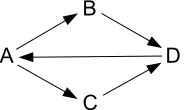
Finally, consider the argumentation network of Fig. 4, for which no stable state exists. With the use of a terminal state, the corresponding neural network will imple-ment a semi-stable semantics, providing the empty set as the only extension. Without a terminal state, the neural network will loop (until it is either halted or its weights are changed), implementing a stable semantics.
B
A D
[image:13.612.260.352.131.186.2]C
Figure 4: Semantic circularity for which no stable state exists
of prevailing arguments, according to a (value-based, preferred, etc.) argumentation semantics.
Definition 10 We say that neural networkN computes an (extension-based semantics of) argumentation frameworkAif every stable state ofN is an extension ofA.
Proposition 11 IfN computesAandAadmits a single extension then starting from input vector [1,1, ...,1],N always finds a stable state corresponding to the prevailing arguments ofA.
Proof: The arguments inN can be viewed as logic programming clauses of the form
αi→αi. Starting from [1,1, ...,1],N will treat eachαias a fact unlessαiis attacked
and defeated by another argumentαj, which corresponds to adding a clause¬αj →αi
to the program (where¬stands for negation by failure). IfAadmits a single extension then the corresponding program will have a single model. The stable models of any logic program can be computed by a single-hidden layer neural network; with a single model, the network is known to always settle down in a stable state corresponding to this model, as proved in [9]. Such a result can be applied directly here to complete the proof.
AandB, defining a preference for either argument by changing the weights of the net-work. If a neural network is such that the weights do not have the same absolute values then it is unlikely that arguments will cancel each other, as seen above, so that the net-work loops. Breaking such a symmetry in the set of weights by changing their values slightly is the norm of network learning, and could be seen as an alternative to the use of terminal states and a solution to the problem of having loops in the computation of such neural networks [10].
4
Neural Cognitive Nonclassical Argumentation
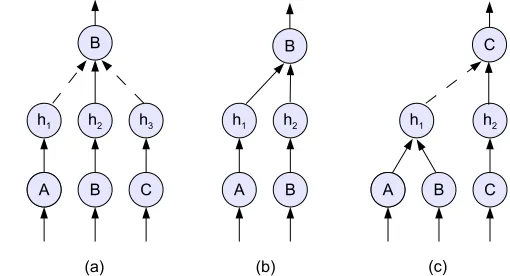
It is natural for a neural network to combine the weights representing multiple support or multiple attacks in order to compute the activation state of a neuron/argument. This is interesting in relation to the question of the accrual of arguments [38]. So far, our standard interpretation has been that any attack suffices to defeat an argument, unless a value-based function says otherwise. Another interpretation, however, is that arguments may get together to attack an argument (that is, only the conjunction of the arguments enables the attack; this is called a joint-attack [1]). Fig. 5(a) shows two argumentsAand Cattacking argumentB. When eitherv(A, B) = 1orv(C, B) = 1for the standard interpretation, the attacks can be implemented by Algorithm 1 above. However, when arguments are allowed to accrue and eitherv(A, B) = 0orv(C, B) = 0, a decision has to be made as to whether or notAandC together can defeatB [10]. The same is true for support. Fig. 5(b) shows an argumentA supporting argumentB as done in ADFs. It may be that withoutA’s support,B would be defeated, say, by an attack from another argumentC, butB is not defeated with A’s support. Finally, Fig. 5(c) shows a situation where, only ifAandBprevail, can they attackC. Hidden neuronh1
implements, in the usual way, a logical-AND. This is the situation where argumentsA andB“get together” to attackC.
A B C B
h1 h2
A
h3
(a)
A B B
h1 h2
A B C C
h1
A
h2
[image:14.612.172.427.468.606.2](b) (c)
Figure 5: Alternative modes of attack and support: (a) multiple attacks, (b) support, and (c) joint-attacks
neuronhi to output neuronB. As said, the natural computation of a neural network
will combine the weights into the input potential ofB. Suppose thatWB2 = 3and
WB1 =WB3 =−2.In this situation, neitherAnorCdefeatB, but, together,Aand
C may defeat B as an unintended consequence of the combination of the weights. To avoid this problem, we use the following convention: when arguments create a joint attack on another argument, the set-up of Fig. 5(c) is used. Ifnarguments are joined through hidden neuronhj, then the biasθhj ofhjshould satisfy the following
inequality, which implements the intended logical-AND.
−nW Amin< θhj < W−(n−1)W Amin
Let us now consider in more detail the situation where an argument receives mul-tiple support (Fig. 5(b)). This situation is similar to that considered earlier, that is, whether some attack is strong enough to defeat all of the support received byB or whether the support forAoverrides the attack, making it unsuccessful. The first case is straightforward and can be implemented by making:
W0 < 1 Amin
(tanh−1(−Amin)−θj− k
X
i=1 Ws),
wherekis the number of supporting arguments, each with weightWs>0.
The second case, in a more general set-up, takes a linearly ordered setαn ...
α2 α1such that argumentα1prevails if it is not attacked, butα1is defeated when
attacked byα2. However,α1prevails again if it is supported by another argumentα3,
but is defeated again if attacked byα4, and so on. We need to assign values to weights Wα1, Wα2, ..., Wαn,as follows:
Wα1 =W,
Wα2 =−W +ε,
Wαj =Wαj−2−Wαj−1+ε, j∈ {3,5,7, ...}, j≤n,
Wαj =Wαj−2−Wαj−1−ε, j∈ {4,6,8, ...}, j≤n.
whereW >0andεis a small positive number such thatW >> ε(typicallyε= 0.1). A further possibility would be to allow certain combinations of support to prevail and certain others to be defeated. This is, in fact, a likely outcome if a learning algo-rithm is to be applied, with the network’s weights changing as a result of learning from data. Any combination of attack and support can be encoded in a neural network, as follows. The linear ordering above can be extended to multisets in the usual way, so that eachαj,2≤j ≤n, denotes a set of arguments. The value ofWαj will then
cor-respond to the sum of the weights either attacking or supportingα1, each weight being
equal toWαj/k, wherekis the cardinality of the set of arguments in question. Since
we would like the combination ofkarguments, and not ofk−1or fewer arguments, to have the above effect, the following inequality should be satisfied:
|Wαj−1 | > |Wαj/(k−1)|
The dual of the conjunctive attacks exemplified above are thedisjunctive attacks
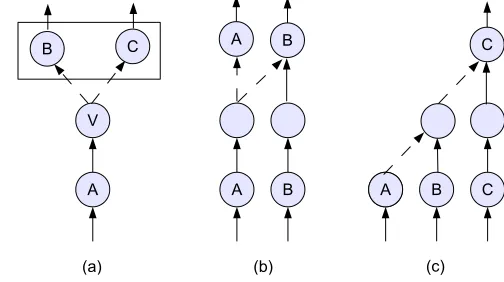
argumentB orC according to some probability distribution. We say that neuron∨
behaves stochastically. Having a standard hidden neuron in Fig. 6(a) would denote that Aattacks bothB andC. With a stochastic hidden neuron, eitherB orC is attacked with a probability. This offers a way of implementing the idea of a disjunctive attack, i.e. one that attacks either argument, but it does not matter which argument. If, for example, the probability of attacking argumentBshould be 50%, a random number is generated in the interval [0,1] and, if this number is greater than 0.5 then argumentB is attacked; otherwise, argumentCis attacked.
LetW
iα1, ..., αn denote the arguments (neurons) attacked stochastically through
hidden neuron∨i. From the point of view of the network computation, for each∨i, we
select a neuronαj,1≤j≤n, at a time (at each round, a singleαjis chosen to receive
activation from∨i. A stable state denoting a setSij of potential prevailing arguments
is then obtained in the usual way (with the sameαjbeing selected if the network recurs
through∨i). We takeTi×jSijas our final set of prevailing arguments (i.e. following a
skeptical semantics).
In addition to disjunctive attacks, the recent literature on argumentation has dis-cussed extensively the modelling of self-defeating arguments as well as the concept of meta-argumentation [15, 25, 26]. Fig. 6(b) exemplifies the implementation of a self-defeating argument in a neural network. In the figure, argumentAattacks argument B, butAis self-defeating, that is, the weight of the connection to output neuron A is negative. Hence,B prevails, as expected. Fig. 6(c) exemplifies a metalevel attack, i.e. an attack not on an argument, but on another attack. In Fig. 6(c), argumentAdoes not attack argumentB, but it attacksB’s attack onC. As a result,Cprevails. In this setting, it is possible forB to succeed in attacking another argument, sayD, through a different hidden neuron. Notice the similarity between Fig. 6(c) and Fig. 5(c). Not surprisingly, the semantics of metalevel attacks can be characterised in terms of joint-attacks, by adding the metalevel attack itself as a node in the argumentation network [15].
A B
V
(a)
A B B
A B C C
A
(b) (c)
[image:16.612.171.423.473.614.2]C A
Figure 6: Disjunctive attacks (a), self-defeating attacks (b), and attacks on attacks (c)
that argumentcattacks this attack; we write it asc7→(a7→b). A meta-argumentation network is an argumentation network extended with such attacks on attacks.
Lemma 13 ([15]) LetAmbe a meta-argumentation network whereαi7→(αj 7→αk).
Amcan be reduced to an argumentation network containing an extra node(αj7→αk)
such thatαjand(αj7→αk)jointly attackαk, andαiattacks(αj7→αk).
Proposition 14 For any meta-argumentation network Amthere exists a neural
net-workN such thatN computesAm.
Proof: We are concerned with the situationαi 7→(αj7→αk)without recursion. In the
reduced network, nodeiattacks nodejk, and nodesjkandjjointly attack nodek. In the neural network (with the same structure as in Fig. 6(c)), we have¬i∧jattacking
k(recall that we have defined joint-attacks as conjunctions). Ifiisinthenjkisout
andkisin; ifiisoutthenkisoutiffjisin. In the neural network, the hidden neuron representingjkwill be activated, attacking and defeatingkiffi < −Amin (orout)
andj > Amin(orin), which clearly produces the same intended outcome.
5
Case Study: Public Prosecution Charging Decision
In this section, we apply the neural cognitive argumentation framework to the mod-elling of a public prosecution charging decision, which was part of a real legal case. The modelling of the charging decision includes many of the argumentation aspects ad-dressed by our proposed framework, notably uncertainty, joint-attacks, argument sup-port and ADF-style reasoning. The results show that the neural model can be a useful tool in the analysis of legal decision making, including the analysis of what-if ques-tions, as detailed below.
The following is an extract from a charging decision statement made 29 May 2012 by Alison Levitt, Queen’s Counsel, Principal Legal Advisor to the Director of Public Prosecutions in relation to allegations that a police officer passed confidential informa-tion to a journalist aboutOperation Weeting, a police investigation into allegations of phone hacking by newspapers in the United Kingdom.
In what follows, we will represent the main aspects of the arguments discussed in the charging decision statement as a neural cognitive model, and analyse the possible model set-ups and computations, and their alternative conclusions in relation to the actual outcomes of this legal case study. We are interested in exemplifying the use of the proposed model in practice, and analysing its usefulness as a tool for modelling the different aspects of argumentation, including the analysis of what-if questions, as detailed below.
The allegation is that the police officer passed confidential information about phone hacking cases to the journalist.
All the evidence has now carefully been considered and I have decided that neither the police officer nor the journalist should face a prosecution. The following paragraphs explain the reasons for my decision.
The suspects have been considered separately, as different considerations arise in relation to each of them.
Between 4 April 2011 and 18 August 2011, Ms. Hill wrote ten articles which were published in The Guardian. I am satisfied thatthere is suf-ficient evidence to establish that these articles contained confidential in-formationderived from Operation Weeting, including the names of those who had been arrested. I am also satisfied that there is sufficient evidence to establish thatthe police officer disclosed that informationto Ms Hill. I have concluded that there is insufficient evidence against either suspect to provide a realistic prospect of conviction for the common law offence of misconduct in a public office or conspiracy to commit misconduct in a public office.
In this case,there is no evidence that the police officer was paid any money
for the information he provided.
Moreover, theinformation disclosed by the police officer, although con-fidential, was not highly sensitive. It did not expose anyone to a risk of injury or death. It did not compromise the investigation. And the informa-tion in quesinforma-tion would probably have made it into the public domain by some other means, albeit at some later stage.
In those circumstances, I have concluded that there is no realistic prospect of a conviction in the police officer’s case because his alleged conduct is not capable of reaching thehigh threshold necessary to make out the crim-inal offence of misconduct in public office. It follows thatthere is equally no realistic prospect of a conviction against Ms. Hillfor aiding and abet-ting the police officer’s conduct.
However,the information disclosed was personal datawithin the meaning of the Data Protection Act 1998 and I am satisfied that there is arguably sufficient evidence to charge both the police officer and Ms. Hill with of-fences under section 55 of that Act, even when the available deof-fences are taken into account.
I have therefore gone on to consider whether a prosecution is required in the public interest. There are finely balanced arguments tending both in favour of and against prosecution.
whether the public interest served by the conduct in question outweighs the overall criminality alleged.
So far as Ms Hill is concerned, the public interest served by her alleged conduct was that she was working with other journalists on a series of articles which, taken together, were capable ofdisclosing the commission of criminal offences, were intended to hold others to account, including the Metropolitan Police Service and the Crown Prosecution Service, and were capable ofraising and contributing to an important matter of public debate, namely the nature and extent of the influence of the media. The alleged overall criminality is the breach of the Data Protection Act, but, as already noted, any damage caused by Ms. Hill’s alleged disclosure was minimal. In the circumstances,I have decided that in her case, the public interest outweighs the overall criminality alleged.
Different considerations apply to the police officer. As a serving police officer,any claim that there is a public interest in his alleged conduct car-ries considerably less weightthan that of Ms Hill. However, there are other important factors tending against prosecution, including as already noted, the fact that no payment was sought or received, and that the disclosure did not compromise the investigation. Moreover,disclosing the identity of those who are arrested is not, of itself, a criminal offence. It is only unlaw-ful in this case because the disclosure also breached the Data Protection Act.
In the circumstances, I have decided that a criminal prosecution is not neededagainst either Ms. Hill or the police officer.
However, in light of my conclusion thatthere is sufficient evidence to pro-vide a realistic prospect of convicting the police officer for an offence un-der the Data Protection Act, I have written to the Metropolitan Police Service and to the IPCCrecommending that they consider bringing dis-ciplinary proceedings against him.” Alison Levitt QC
Let us start by considering the arguments for and against prosecuting the journalist (pj) and the police officer (pp).
Arguments for prosecution:
A:The articles contained confidential information; B:The police officer disclosed the information; C:A prosecution is required in the public interest. Arguments against prosecution:
D:There is no evidence that the police officer was paid any money;
E:Information disclosed by the police officer, although confidential, was not highly sensitive;
F:It did not expose anyone to a risk of injury or death; G:It did not compromise the investigation;
J:Together, the articles would expose the commission of criminal offences; K:Together, the articles would hold others to account;
L: The articles contributed to an important matter of public debate, namely the nature and extent of the influence of the media.
Let us also analyse more closely the arguments relating to whether a prosecution is required in the public interest. The assumption is that both the journalist and the police officer have violated the Data Protection Act.
Arguments for bringing charges under the Data Protection Act: M:The information disclosed was personal data;
Arguments against bringing charges under the Data Protection Act:
N: Disclosing the identity of those who are arrested is not, of itself, a criminal offence;
O:It is only unlawful in this case because the disclosure also breached the Data Protection Act.
Remark 15 Notice how argument O was used rhetorically as part of an argument against bringing charges under the Data Protection Act. Argument O is, in fact, simply stating that the disclosure was unlawful because it breached the Data Protection Act. Consider also how the sentence below is used as part of the argumentation: “The alleged overall criminality is the breach of the Data Protection Act, but, as already noted, any damage caused by Ms. Hill’s alleged disclosure was minimal”. Our model will help quantify suchdamageand will require a definition of minimal, as will become clear. Similarly, the following sentences provide clues as to the weights to be assigned to the neural network, in relation to the police officer: “Any claim that there is a public interest in his alleged conduct carries considerably less weight” and “There is a high threshold to make out the criminal offence of misconduct in public office”. We shall return to these once we have created the network model.
The QC’s conclusion can be summarized as follows:
(a)It was decided that a criminal prosecution is not needed;
(b)It was decided that in the case of the journalist, the public interest outweighs the overall criminality alleged;
(c)There is sufficient evidence to provide a realistic prospect of convicting the po-lice officer for an offence under the Data Protection Act;
(d) A recommendation was made to the police to consider bringing disciplinary proceedings against the police officer.
Our model’s conclusion: Our model is concerned with making explicit the following relations (items 1 to 4 below).
On the issue of the police officer’s misconduct:
1. Do the weights of the arguments exceed the high threshold for the offence of misconduct?
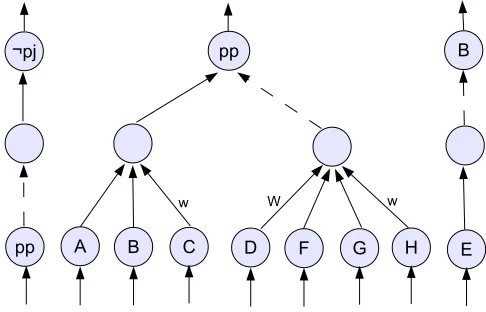
misconduct in public office. Arguments D, F, G and H attack pp collectively (argument D with a high weight (W) for obvious reasons, and argument H with a low weight due to its speculative nature). Argument E attacks argument B. These are all the relevant arguments in relation to pp, as shown in Figure 7, where dashed lines indicate attacks. As a result, neuron B fails to activate, and the weight of the arguments that collectively attack neuron pp should overcome the weight of the arguments that support pp. Hence, neuron pp should fail to activate. We discuss neuron/argument pj next.
2. If the police officer should not be prosecuted for misconduct then the journalist should not be prosecuted for aiding his conduct.
Item 2 above can be modelled in Figure 7 using ADFs simply by stating that if ar-gument pp isout(represented by a negative weight from input neuron pp to the hidden layer) then argument¬pj should bein; hence, the journalist should not be prosecuted (in the neural network, if input neuron pp is not activated then output neuron¬pj will be activated; see dashed line representing a negative weight from input neuron pp in Figure 7). This separation between arguments pj and¬pj allows one to ignore how ar-guments would influence neuron pj during the modelling of neuron¬pj, and is referred toexplicit negationin logic programming [19]. Thus, in case neuron pp fails to activate, which is the case here, neuron¬pj will be activated. This completes the prosecution’s analysis on the basis on misconduct.
pp B
pp ¬pj
A
B
C D F G H
w W w
[image:21.612.178.421.364.520.2]E
Figure 7: Neural implementation of legal case: prosecution decision
On the issue of the violation of the Data Protection Act:
3. Do the weights of the arguments show that the public interest outweighs the violation of the Data Protection Act?
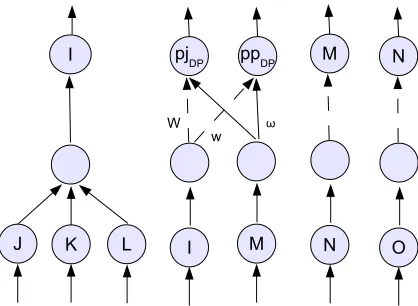
It is clear that arguments J, K and L support argument I, while argument M attacks I. In addition, argument N attacks M, and O attacks N, as shown in Figure 8. The conclusion is that indeed argument I should prevail.
4. Different weights apply to the journalist and the police officer.
for prosecuting the police officer for a violation of the Data Protection Act (call it pjDP). The attacks from argument I onpjDP andppDP should have different weights:
a high (negative) weight W forpjDP and a low (negative) weight (w) forppDP. Our
model’s conclusion, therefore, is thatpjDPshould not prevail (i.e. the journalist should
not be prosecuted), but differently from the QC’s conclusion, if the value of the weight ω connecting argument M to ppDP should be greater than the absolute value of w
then argumentppDP should prevail, i.e. the police officer would be prosecuted for
violating the Data Protection Act. The actual values of weightsωand w may be a matter for debate, but perhaps the QC’s arguments should have focused more on providing a justification for such values.
K I
J
M
L N
N
O pjDP
I M
ppDP
W
[image:22.612.184.393.256.409.2]w ω
Figure 8: Neural implementation of legal case: decision based on data protection act
6
Conclusion and Future Work
We have presented a neural cognitive model of argumentation that is capable of cap-turing a range of argumentation semantics and situations including joint-attacks, argu-ment support, ordered attacks, disjunctive attacks, metalevel attacks and self-defeating attacks. All these different modes of argumentation can be modelled, learned and com-puted by means of a connectionist representation. In its most general form, arguments are weighted according to their strength, can support or attack other arguments di-rectly, but can also combine conjunctively or disjunctively, sequentially or in parallel, at object- or meta-level, as exemplified throughout the paper. We have shown that all these different modes of argumentation can be represented and computed in a natural way by a connectionist network. This also indicates that the connectionist approach can offer an adequate tool for argument computation.
When dealing with uncertainty and metalevel preferences, in [14], the question of where the weights would come from is raised. In [2], voting by an audience is evoked as a solution that depends on metalevel considerations, as in [26]. With the framework proposed in this paper, the question gains a new dimension in that, as with any neural network, the weights can be learned from examples (i.e. instances from previous cases). As future work, we plan to explore the framework’s learning capacity as part of a larger case study.
Uncertainty is intrinsic in human argumentation, yet most logic-based models of argumentation do not deal with uncertainty explicitly. Argumentation can be seen as a method for reducing one’s uncertainty with the prevailing arguments being precisely those that are less-uncertain. In line with [21, 23, 35], the neural cognitive model in-troduced here lends itself well to this idea due to the use of weights and activation intervals as part of a neural network. However, we believe that the neural cognitive approach may also be advantageous from a purely computational perspective due to the networks’ ability to adapt through learning and to compute prevailing arguments in parallel. All of the above is important given the objective of developing models of human argumentation. Future work includes, in addition to the evaluation of the frame-work’s learning capacities, further experimentation on legal reasoning, a comparison of the framework’s knowledge representation and learning capacity, e.g. in contrast with [23, 32], and the evaluation of the framework’s parallel computation gains. A graphical interface is being developed to facilitate the interactive drawing and running of the net-works as shown in the figures above, with all the features introduced here. We believe that such an interface can be useful as a tool for modelling, running and the elaboration of argumentation frameworks in a range of application areas.
References
[2] T.J.M. Bench-Capon. Persuasion in practical argument using value-based argu-mentation frameworks.Journal of Logic and Computation, 13:429–448, 2003. [3] A. Bondarenko, P. Dung, R.A. Kowalski, and F. Toni. An abstract, argumentation
theoretic approach to default reasoning.Artificial Intelligence, 93:63–101, 1997. [4] G. Brewka. Dynamic argument systems: A formal model of argumentation pro-cesses based on situation calculus.Journal of Logic and Computation, 11(2):257– 282, 2001.
[5] G. Brewka and S. Woltran. Abstract dialectical frameworks. InProceedings of the 12th International Conference on the Principles of Knowledge Representation and Reasoning KR 2010. AAAI Press, 2010.
[6] M. Caminada. On the issue of reinstatement in argumentation. In Prof. 10th European Conference on Logics in Artificial Intelligence JELIA’06, pages 111– 123. Springer, LNAI 4160, 2006.
[7] M. Caminada and L. Agmoud. On the evaluation of argumentation for- malisms.
Artificial Intelligence, 171(5-6):286–310, 2007.
[8] C.I. Ches˜nevar, A.G. Maguitman, and R. P. Loui. Logical Models of Argument.
ACM Computing Surveys, 32(4):337–383, December 2000.
[9] A.S. d’Avila Garcez, K. Broda, and D.M. Gabbay. Neural-Symbolic Learn-ing Systems: Foundations and Applications. Perspectives in Neural Computing. Springer, 2002.
[10] A.S. d’Avila Garcez, D.M. Gabbay, and L.C. Lamb. Value-based argumentation frameworks as neural-symbolic learning systems. Journal of Logic and Compu-tation, 15(6):1041–1058, 2005.
[11] A.S. d’Avila Garcez, L.C Lamb, and D.M. Gabbay. Neural-Symbolic Cognitive Reasoning. Cognitive Technologies. Springer, 2009.
[12] P. M. Dung and P. M. Thang. Modular argumentation for modelling legal doc-trines in common law of contract. Artif. Intell. Law, 17(3):167–182, 2009. [13] P.M. Dung. On the acceptability of arguments and its fundamental role in
non-monotonic reasoning, logic programming and n-person games. Artificial Intelli-gence, 77:321–357, 1995.
[14] P. E. Dunne, A. Hunter, P. McBurney, S. Parsons, and M. Wooldridge. Incon-sistency tolerance in weighted argument systems. InProc. 8th Int. Conf. on Au-tononous Agents and Multiagent Systems, AAMAS 2009, pages 851–858, 2009. [15] D. M. Gabbay. Fibring argumentation frames.Studia Logica, 93:231–295, 2009. [16] D. M. Gabbay and A. S. d’Avila Garcez. Logical modes of attack in
[17] A.J. Garc´ıa and G.R. Simari. Defeasible logic programming: An argumentative approach.Theory and Practice of Logic Programming, 4(1):95–138, 2004. [18] M. Gelfond and V. Lifschitz. The stable model semantics for logic programming.
InProceedings of the Fifth Logic Programming Symposium, pages 1070–1080. MIT Press, 1988.
[19] M. Gelfond and V. Lifschitz. Classical negation in logic programs and disjunctive databases.New Generation Computing, 9:365–385, 1991.
[20] S. A. Gomez and C. I. Chesnevar. Integrating Defeasible Argumentation with fuzzy art neural networks for pattern classification.Journal of Computer Science & Technology, 4(1):45–57, 2004.
[21] R. Haenni, J. Kohlas, and N. Lehmann. Probabilistic argumentation systems. In D. Gabbay and Ph Smets, editors,Handbook of Defeasible Reasoning and Uncertainty Management Systems, volume 5, page 221288. Kluwer, 2000. [22] S. Haykin.Neural Networks: A Comprehensive Foundation. Prentice Hall, 1999. [23] A. Hunter. A probabilistic approach to modelling uncertain logical arguments.
International Journal of Approximate Reasoning, 54(1):47–81, 2013.
[24] R.A. Kowalski and F. Toni. Abstract argumentation. Artificial Intelligence and Law, 4(3-4):275–296, 1996.
[25] W. Makiguchi and H. Sawamura. A hybrid argumentation of symbolic and neural net argumentation (part 1). In Argumentation in Multi-Agent Systems ArgMAS 2007, pages 197–215, Honolulu, USA, 2007. Springer, LNCS.
[26] S. Modgil. Reasoning about preferences in argumentation frameworks.Artificial Intelligence, 173(9-10):901–934, 2009.
[27] M. Mozina, J. Zabkar, and I. Bratko. Argument based machine learning.Artificial Intelligence, 171(10-15):922–937, 2007.
[28] S. H. Muggleton and D. Lin. Meta-interpretive learning of higher-order dyadic datalog: Predicate invention revisited. InIJCAI, 2013.
[29] F. S. Nawwab, T. Bench-Capon, and P. E. Dunne. Exploring the role of emotions in rational decision making. InThird International Conference on Computational Models of Argument COMMA, Desenzano del Garda, Italy, 2010.
[30] J.L. Pollock. Self-defeating arguments. Minds and Machines, 1(4):367–392, 1991.
[31] J.L. Pollock. How to reason defeasibly.Artificial Intelligence, 57:1–42, 1992. [32] D. Poole. The independent choice logic and beyond. In Luc De Raedt, Paolo
[33] H. Prakken and G.A.W. Vreeswijk. Logical systems for defeasible argumentation. In D.M. Gabbay and F. Guenthner, editors,Handbook of Philosophical Logic. Kluwer, 2nd edition, 2000.
[34] I. Rahwan, M.I. Madakkatel, J-F Bonnefon, R.N. Awan, and S. Abdallah. Behav-ioral experiments for assessing the abstract argumentation semantics of reinstate-ment.Cognitive Science, 34(8):1483–1502, 2010.
[35] R. Riveret, A. Rotolo, and G. Sartor. Probabilistic rule-based argumentation for norm-governed learning agents.Artif. Intell. Law, 20(4):383–420, 2012.
[36] L Su, P. Barnard, and H. Bowman. On the fringe of awareness: The glance-look model of attention-emotion interactions. In K. Diamantaras, W. Duch, and L.S. Iliadis, editors,International Conference on Artificial Neural Networks, volume 6354 ofLecture Notes in Computer Science, page 504509. Springer-Verlag, July 2010.
[37] Y. Tang, T. J. Norman, and S. Parsons. A model for integrating dialogue and the execution of joint plans. InAAMAS, pages 883–890, 2009.
[38] B. Verheij. Accrual of arguments in defeasible argumentation. InProceedings of Second Dutch/German Workshop on Nonmonotonic Reasoning, pages 217–224. Utrecht, 1995.
![Figure 3: (a) An example of a cyclic argumentation network and (b) its neural imple-mentation whose parallel computation produces, in a single pass through the network,a terminal state [-1,-1,-1] with no prevailing argument, following a grounded argumen-tation semantics](https://thumb-us.123doks.com/thumbv2/123dok_us/1506328.103310/10.612.249.361.125.392/argumentation-mentation-computation-prevailing-argument-following-grounded-semantics.webp)