City, University of London Institutional Repository
Citation
:
Gooch, P. (2012). BADREX: In situ expansion and coreference of biomedical
abbreviations using dynamic regular expressions. London, UK: City University London.
This is the unspecified version of the paper.
This version of the publication may differ from the final published
version.
Permanent repository link:
http://openaccess.city.ac.uk/id/eprint/1163/
Link to published version
:
Copyright and reuse:
City Research Online aims to make research
outputs of City, University of London available to a wider audience.
Copyright and Moral Rights remain with the author(s) and/or copyright
holders. URLs from City Research Online may be freely distributed and
linked to.
City Research Online: http://openaccess.city.ac.uk/ [email protected]
abbreviations using dynamic regular expressions
Phil Gooch
11Centre for Health Informatics, City University London, UK
ABSTRACT
BADREX uses dynamically generated regular expressions to anno-tate term definition–term abbreviation pairs, and corefers unpaired acronyms and abbreviations back to their initial definition in the text. Against the Medstract corpus BADREX achieves precision and re-call of 98% and 97%, and against a much larger corpus, 90% and 85%, respectively. BADREX yields improved performance over pre-vious approaches, requires no training data and allows runtime cus-tomisation of its input parameters.
BADREX is freely available from
https://github.com/philgooch/BADREX-Biomedical-Abbreviation-Expander as a plugin for the General Architecture for Text Engineer-ing (GATE) framework and is licensed under the GPLv3.
1 INTRODUCTION
Identification of abbreviations and acronyms, or short forms (SF), for given term definitions, or long forms (LF), is a well researched topic in the biomedical natural language processing domain (see Torii et al. 2007 for a review). Existing tools such as Schwartz & Hearst (2003) and Ao & Takagi (2005) extract LF-SF pairs for dictionary creation, but do not provide automatic expansion of SFs within the text at the point at which they occur, which is a neces-sary precursor for semantic type assignment and coreference reso-lution. BADREX identifies, expands and annotates LF-SF pairs, and coreferences subsequent SF mentions back to their most recent definition in the text. This may facilitate disambiguation of un-paired abbreviations not possible with dictionary lookup alone (Stevenson et al. 2009).
2 METHODS
2.1 BADREX development
BADREX is implemented in Java as a plugin for the General Archi-tecture for Text Engineering (GATE) framework (Cunningham et al. 2002). It takes a Set of sentences from GATE’s sentence split-ter, over which it iterates once. For each sentence, five processing steps are performed, where Step 1 is similar to the first stage outlined in Schwartz & Hearst (2003) and Step 2 to the third phase of Ao & Takagi (2005):
(1) Identification of candidate <LF, SF> pairs
(2) Applying discard conditions to <LF, SF> candidates to filter unwanted pairs
(3) Identifying the shortest substring in LF that best matches
SF given the constraints of Steps 1 and 2
(4) Matching characters in SF against characters in LF
(5) Optional coreference of unpaired abbreviations/acronyms that match previously found short forms
In Step 1, we create two patterns: the ‘head’ regular expression (regex) identifies a string that contains {1, maxOuterWords}
words followed by a string of {1, maxInnerChars} charac-ters in parentheses or square brackets, and where the first character of the first group is an alphanumeric that matches the first charac-ter of the second group. The ‘tail’ regex consists of a similar pat-tern but where the first character of the last word of the first group is an alphanumeric that matches the last character of the second group. For each sentence in the input, if no match is made by the first pattern, then the second pattern may be executed. The ‘head’ pattern will identify candidate pairs such as:
the behaviour of confluent SV40 transformed rabbit corneal
epithelial cells (tRCEC) (1)
and the ‘tail’ pattern identifies pairs such as
with two-dimensional proton nuclear magnetic resonance (2D 1H
NMR) (2)
(matching characters underlined). In simplified form, the ‘head’ pattern can be expressed as:
\b((\w)\W{0,2}(\w+\W?){1,maxOuterWords})\s* \((\2.{1,maxInnerChars})(\p{Punct}\s*\w+)?\)
and the ‘tail’ pattern as
\b(.{1,maxOuterChars}\b(\w)(\w+\W?))\s* \((.{1,maxInnerChars}\2(\p{Punct}\s*\w+)?)\)
where maxOuterWords is the value of the user-defined parameter for the maximum number of words in the long form (default: 10, as per Ao & Takagi 2005), maxInnerChars is the maximum number of characters in the short form (default: 40, i.e. 10 words), and maxOuterChars = maxOuterWords * 4.
Usually, the short form will appear in parentheses following the long form, but they may appear in reverse order. We allow for this by setting the maximum number of characters as the same by de-fault in both LF and SF. If the matched short form is longer than the candidate long form text preceding it, the values of LF and SF
P. Gooch
In Step 2 we make use of a simplified subset of the discard con-ditions for short forms given in Appendix 1 of Ao & Takagi (2005). For example, short forms starting with a preposition, or starting and ending with a digit, are discarded. These conditions are implemented as regular expressions loaded from external con-figuration files, allowing this behaviour to be easily customised.
In Step 3, we use dynamically generated regular expressions to find the shortest substring of LF following a preposition (if pre-sent) and where either the first character matches the first character of SF, or the first character of the last word matches the last char-acter of SF, depending on whether the ‘head’ or ‘tail’ pattern was executed in Step 1. In example (1) above, ‘the behaviour of conflu-ent SV40 transformed rabbit corneal epithelial cells’ would be shortened to ‘transformed rabbit corneal epithelial cells’.
In Step 4, we strip non-alpha characters from LF and SF, split
LF into a character array, and iterate over SF to match adjacent characters, in the same order, in the LF array. If the proportion of matches in relation to the total alpha characters in SF >= threshold (default: 0.80), then the <LF, SF> pair is accepted and added to a
Map of <SF, LF> key/value pairs.
The accepted pair are converted to inline annotations in the text by making use of the start() and end() methods of the regex
Matcher, adjusted for term truncation in Step 3 and for the start offset of each sentence. The value of LF is stored as a feature on
SF, and vice versa. If the term definition has already been anno-tated with one of a configurable set of known annotations, this annotation is used. For example, if ‘transformed rabbit corneal epithelial cells’ was previously annotated as AnatomicalSite, then ‘tRCEC’ would also be annotated with this semantic type.
In Step 5, we generate regex Matchers over the Map of pairs populated up to that point, and use these to locate and annotate unpaired, candidate SFs in sentences forward of the point at which the corresponding LF-SF pair was first introduced.
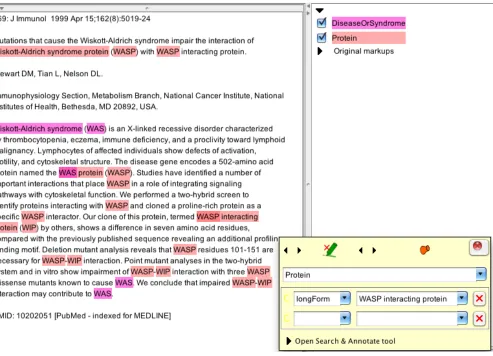
Figures 1 and 2 show sample BADREX output in the GATE Developer application for two abstracts from the evaluation cor-pora. Figure 1 shows semantic type assignment (DiseaseOrSyn-drome and Protein) copied from the long form to subsequent short form mentions, and coreference and expansion of unpaired short forms. In coreference mode, short forms occurring within subse-quent long forms are also expanded: here, the ‘WAS protein’ term contains an inner ‘WAS’ abbreviation that has been expanded to ‘Wiskott-Aldrich syndrome’.
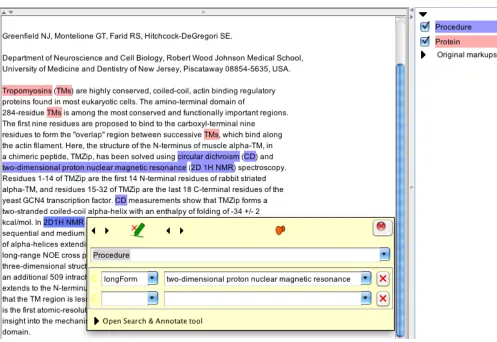
[image:3.612.73.566.343.699.2]Fig. 2S. Example showing how BADREX’s abbreviation coreference allows for white-space variations in subsequent mentions of the initially introduced short form. Here, ‘2D1H NMR’ is coreferenced with ‘2D 1H NMR’ and annotated with the original long form text as a feature.
2.2 Correction of BioText and Medstract data
The labelled, gold standard BioText ‘yeast’ data (http://biotext.berkeley.edu/data.html; Schwartz & Hearst 2003) comprises 1000 MedLine abstracts in a plain text file containing 954 LF-SF pairs annotated with XML-like tags, e.g.
<Long id=1>endoplasmic reticulum</Long> (<Short id=1>ER</Short>)
where the ‘id’ attribute on the <Long> element matches that in the corresponding <Short> element. Using a standard XML parser, we identified and corrected errors in malformed ‘id’ at-tributes and mismatched or malformed <Long> and <Start>
tags. Correction iterations continued until the file parsed.
The Medstract corpus (Pustejovsky et al. 2002; (http://www.medstract.org/index.php?f=gold-standard) comprises
400 MedLine abstracts in a plain text file, where 414 gold standard LF-SF pairs have been extracted into a separate text file (http://www.medstract.org/index.php?f=gold-result; the ‘mark-ables’). We analysed the markables file for offset errors, and following correction of these, we compared the abstracts file against the markables to identify any missing pairs.
P. Gooch
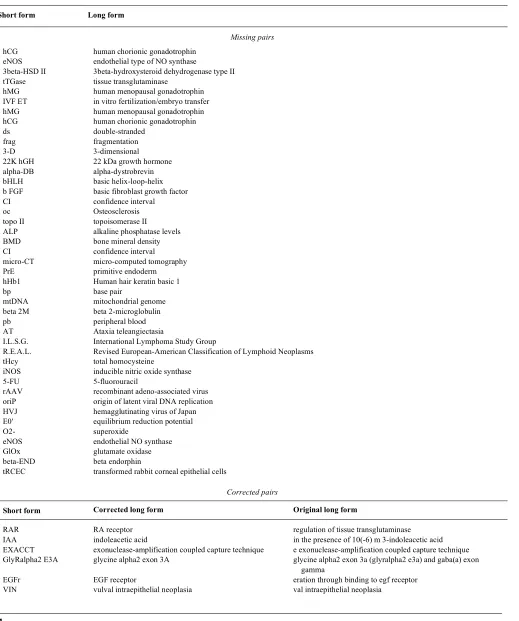
Table 1. Missing and corrected short-form-long-form pairs in the Medstract gold standard markables
Short form Long form
Missing pairs
hCG human chorionic gonadotrophin eNOS endothelial type of NO synthase
3beta-HSD II 3beta-hydroxysteroid dehydrogenase type II tTGase tissue transglutaminase
hMG human menopausal gonadotrophin IVF ET in vitro fertilization/embryo transfer hMG human menopausal gonadotrophin hCG human chorionic gonadotrophin ds double-stranded
frag fragmentation 3-D 3-dimensional 22K hGH 22 kDa growth hormone alpha-DB alpha-dystrobrevin bHLH basic helix-loop-helix b FGF basic fibroblast growth factor CI confidence interval oc Osteosclerosis topo II topoisomerase II ALP alkaline phosphatase levels BMD bone mineral density CI confidence interval micro-CT micro-computed tomography PrE primitive endoderm hHb1 Human hair keratin basic 1
bp base pair
mtDNA mitochondrial genome beta 2M beta 2-microglobulin pb peripheral blood AT Ataxia teleangiectasia
I.L.S.G. International Lymphoma Study Group
R.E.A.L. Revised European-American Classification of Lymphoid Neoplasms tHcy total homocysteine
iNOS inducible nitric oxide synthase 5-FU 5-fluorouracil
rAAV recombinant adeno-associated virus oriP origin of latent viral DNA replication HVJ hemagglutinating virus of Japan E0' equilibrium reduction potential
O2- superoxide
eNOS endothelial NO synthase GlOx glutamate oxidase beta-END beta endorphin
tRCEC transformed rabbit corneal epithelial cells
Corrected pairs
Short form Corrected long form Original long form
RAR RA receptor regulation of tissue transglutaminase IAA indoleacetic acid in the presence of 10(-6) m 3-indoleacetic acid EXACCT exonuclease-amplification coupled capture technique e exonuclease-amplification coupled capture technique GlyRalpha2 E3A glycine alpha2 exon 3A glycine alpha2 exon 3a (glyralpha2 e3a) and gaba(a) exon
gamma
Short form Long form
Corrected pairs – continued
SSSS staphylococcal scalded skin syndrome scalded skin syndrome
EBER EBV-encoded small nuclear RNA ed ebv-encoded small nuclear rna HD Hodgkin's disease 15 with Hodgkin's disease (HD †
GluR glutamate receptor g chemical selectivity of agonists for the nmda subtype of glu-tamate receptor
TUNEL terminal deoxynucleotidyl transferase mediated deoxyu-ridine triphosphate biotin nick end labelling
ted deoxyuridine triphosphate biotin nick end labelling
LC/ESI/MS/MS HPLC/electrospray ionization tandem mass spectrometric lective hplc/electrospray ionization tandem mass spectrometric CYSP cysteine peptide conformations of the polypeptides beta endorphin
ESI/MS electrospray ionization mass spectrometry ectrospray ionization mass spectrometry Lid Lidocaine lidated for the quantitation of lidocaine
DEX-MPS dextran-methylprednisolone succinate DEX-MPS) and its degradation products methylpr † UV Ultraviolet 60:40 v/v) and ultraviolet (UV) detection at †
† Incorrect short form
3 RESULTS
In the BioText corpus, we found 13 incorrectly matching or mal-formed ‘id’ attributes and 21 mismatched or malformed <Long>
and <Start> tags. The corrected labelled corpus is available from http://soi.city.ac.uk/~abdy181/software/#badrex (reproduced with permission).
Table 1 shows the results of analysis of the Medstract corpus; against the Medstract gold standard markables: we added an addi-tional 43 markables that we judged to be correct short-form–long-form pairs and amended 17 pairs that we judged to have incorrect spans. The corrected markables file is also available from the above URL.
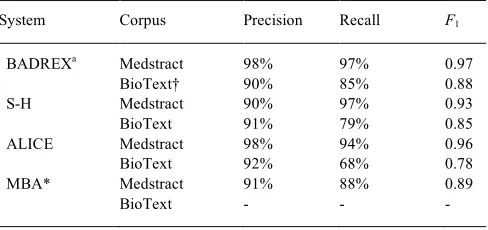
[image:6.612.52.573.64.252.2]Evaluation of BADREX performance against both corpora in comparison to that of S-H, ALICE and MBA are shown in Table 2.
Table 2. Evaluation results against corrected gold standard data sets
System Corpus Precision Recall F1
BADREXa Medstract 98% 97% 0.97
BioText† 90% 85% 0.88
S-H Medstract 90% 97% 0.93
BioText 91% 79% 0.85
ALICE Medstract 98% 94% 0.96
BioText 92% 68% 0.78
MBA* Medstract 91% 88% 0.89
BioText - - -
a Coreference mode disabled in BADREX for this evaluation † Corrected BioText corpus available in XML format from the author.
* Results reported by authors; software unavailable to evaluate on BioText corpus.
4 DISCUSSION
Our goal was to develop a customisable tool for identifying, ex-panding and annotating in situ biomedical abbreviations in free text, while matching or exceeding the performance of existing approaches. Running both ‘head’ and ‘tail’ candidate matches, allowing a variable threshold and only considering alpha characters when matching allows us to identify pairs such as ‘topoisomerase I
(Top1p)’ and ‘two-dimensional polyacrylamide gel electrophoresis (2D-PAGE)’ missed by the other approaches, yet without unduly compromising precision.
By using regular expressions in steps 1 and 3, we simplify the creation of the finite state machine hard-coded in Schwartz & Hearst (2003) and allow it to be easily parameterised, so that opti-mal parameter values for a given corpus can be identified. While we used default values for these (detailed above) in this evaluation, iterative regression techniques could be used to find minimum values for the maxOuterWords, maxInnerChars, and
threshold parameters that maximise precision and/or recall for other corpora.
We have not evaluated the coreferencing features of BADREX here. In addition, BADREX can be configured to annotate com-mon medical abbreviations extracted from Wikipedia (Wikipedia 2012). Future work will evaluate the contribution of these features as components in the disambiguation of unpaired abbreviations. BADREX is currently coupled to GATE but a standalone version is planned.
5 CONCLUSION
The use of regular expressions dynamically generated from docu-ment content yields modestly improved performance over previous approaches to identifying term definition–term abbreviation pairs, with the benefit of providing in-place annotation, expansion and coreference in a single pass. BADREX requires no training data and allows runtime customisation of its input parameters. The
GATE plugin is freely available from
https://github.com/philgooch/BADREX-Biomedical-Abbreviation-Expander and is licensed under the GPLv3.
ACKNOWLEDGEMENTS
[image:6.612.54.298.470.585.2]P. Gooch
REFERENCES
Ao H, Takagi T (2005) ALICE: an algorithm to extract abbreviations from MEDLINE. J. Am. Med. Inform. Assoc., 12(5), 576–86.
Cunningham H et al. (2002) GATE: A framework and graphical development envi-ronment for robust NLP tools and applications. Proceedings of the 40th Anniver-sary Meeting of the Association for Computational Linguistics (ACL’02), Phila-delphia.
Pustejovsky J et al. (2002) Medstract: natural language tools for mining the biobib-liome. Available from: http://www.medstract.org/ [Accessed 10 May 2012] Schwartz AS, Hearst MA (2003) A simple algorithm for identifying abbreviation
definitions in biomedical text. Proceedings of the Pacific Symposium on Biocom-puting, 8, 451–462.
Stevenson M et al (2009) Disambiguation of biomedical abbreviations. Proceeding BioNLP '09 Proceedings of the Workshop on Current Trends in Biomedical Natu-ral Language Processing. Association for Computational Linguistics Stroudsburg, PA.
Torii M et al. (2007) A comparison study on algorithms of detecting long forms for short forms in biomedical text. BMC Bioinformatics, 8(Suppl 9), S5, doi:10.1186/1471-2105-8-S9-S5.
Wikipedia (2012) List of medical abbreviations . Available from: http://en.wikipedia.org/wiki/List_of_medical_abbreviations