City, University of London Institutional Repository
Citation
:
Besold, T. R., Hernández-Orallo, J. & Schmid, U. (2015). Can Machine
Intelligence be Measured in the Same Way as Human intelligence?. Kunstliche Intelligenz,
29(3), pp. 291-297. doi: 10.1007/s13218-015-0361-4
This is the accepted version of the paper.
This version of the publication may differ from the final published
version.
Permanent repository link:
http://openaccess.city.ac.uk/18667/
Link to published version
:
http://dx.doi.org/10.1007/s13218-015-0361-4
Copyright and reuse:
City Research Online aims to make research
outputs of City, University of London available to a wider audience.
Copyright and Moral Rights remain with the author(s) and/or copyright
holders. URLs from City Research Online may be freely distributed and
linked to.
City Research Online:
http://openaccess.city.ac.uk/
[email protected]
(will be inserted by the editor)
Can machine intelligence be measured in the same way as
human intelligence?
Tarek Besold · Jos´e Hern´andez-Orallo · Ute Schmid
Received: date / Accepted: date
Abstract In recent years the number of research projects on computer programs solving human intelligence prob-lems in Artificial Intelligence (AI), Artificial General In-telligence (AGI), as well as in Cognitive Modelling, has significantly grown. One reason could be the interest of such problems as benchmarks for AI algorithms. An-other, more fundamental, motivation behind this area of research might be the (implicit) assumption that a computer program that successfully can solve human intelligence problems has human-level intelligence and vice versa. This paper analyses this assumption.
Keywords Intelligence Tests· Strong AI· Psychome-tric AI·Cognitive Modelling
1 Introduction
As early as the possibility of machine intelligence was considered, the role of human intelligence tests in the development and evaluation of AI was linked to the un-derstanding of what intelligence is and how it should be measured. However, the question ofwhether human in-telligence tests are valid for the evaluation of machines
has had very different (and opposed) answers, including absolute indifference of or neglecting the question. Why do we find this diversity of answers? Is it because of
Tarek R. Besold
Institute of Cognitive Science, University of Osnabr¨uck,
Ger-many, E-mail: [email protected]
Jos´e Hern´andez-Orallo
Dept. de Sistemes Inform`atics i Computaci´o, Universitat
Polit`ecnica de Val`encia, Spain, E-mail: [email protected]
Ute Schmid
Faculty Information Systems and Applied Computer Science, University of Bamberg, Germany, E-mail: [email protected]
disparate conceptions of what a machine is and the na-ture of computation? Is it because of divergent views of what intelligence is and what human intelligence tests measure? Or is it because various breadths and types of psychometric tests are being considered?
In order to find answers, in section 2 we first analyse the conceptual notions of machine intelligence that have been adopted in (strong) AI and Cognitive Science, also introducing the notion of a computational theory of mind, the Church-Turing thesis, and the Physical Sym-bol System Hypothesis (PSSH) as necessary theoreti-cal foundations. In section 3, we rely on the conception of (human) intelligence and its measurement, mostly but not only from psychometrics. We highlight the rel-evance of the set of subjects to be measured and the set ofproblemsthat are considered. Section 4 presents previous experience about the use of psychometric tests in AI and some explicit claims about their convenience for measuring machine intelligence and for stimulating the progress of AI. In section 5 we are ready to un-ravel the question by the use of severalarguments, and clarify whether and, if so, under which circumstances human intelligence tests are necessary and sufficient for the evaluation of machine intelligence. Finally, we close with some remarks about how human intelligence tests can still be useful for AI (and AI for psychometrics) and future directions for intelligence evaluation.
2 Conceptual foundations of strong AI
2 Besold, Hern´andez, Schmid
“strong” artificial intelligence and cognitive systems re-search, namely the concept of a computational theory of mind, the Church-Turing thesis, and the Physical Symbol System Hypothesis (PSSH).
The computational theory (Pylyshyn, 1980) founda-tionally bridges the gap between humans and comput-ers by advocating that the human mind and brain can be seen as an information processing system and that reasoning and thinking correspond to processes that meet the technical definition of computation as formal symbol manipulation. The Church-Turing thesis (Tur-ing, 1969) adds an account of the nature and limitations of the computational power of such a system by estab-lishing Turing computability as valid characterisation of computability in general. The PSSH (Newell, 1980) op-erates on a different level, characterising the nature of the computations: taking the computational character-istic of cognition and intelligence as given, it proposes a general criterion for a system to display intelligence by stating that “[t]he necessary and sufficient condition for a physical system to exhibit general intelligent action is that it be a physical symbol system”, with “general in-telligent action” referring to rational behaviour which, in turn, can be understood as an agent’s ability and determination to select a certain action if, given her goals, it is known that this precise action will lead to achieving the goal(s) (cf. Newell, 1982).
The implications of the PSSH are twofold. In its ne-cessity, it states that also human thinking and higher-level cognition is a kind of symbol processing. In its sufficiency, it opens up the way to machine intelligence also on a paradigmatic level with regard to the type of computation. Whilst in the meantime also alterna-tive readings have been proposed, in the classical ac-count of the hypothesis, the symbols are physical ob-jects representing things in the world, having a recog-nisable semiotic meaning or denotation but exhibiting arbitrary shapes unrelated to their meanings, and al-lowing for recursive composition with other symbols by rule, thus forming a combinatorial representation (Har-nad, 1990). Arbitrariness of shape and combinatorial nature of the representation are thereby two key prop-erties: the former allows symbols to designate anything at all by not prescribing to the symbol what expressions it can designate, but instead by leaving the determina-tion of the designated object of a complex expression to the interaction between respective symbol tokens, whilst the latter characteristic accommodates for the generality of the intended intelligent action by estab-lishing a representation language.
While proponents of strong AI and Artificial Gen-eral Intelligence (AGI) (K¨uhnberger and Hitzler, 2009; Besold, 2013a) explicitly claim that the recreation of
human-level intelligence on computer systems is pos-sible, researchers in “standard” (weak) AI and Cog-nitive Modelling work on the weaker assumption that computability provides an appropriate conceptual ap-paratus for theories of the mind. That is, computa-tional models can be used to simulate human infor-mation processes thereby providing detailed and con-sistent generative descriptions of different areas of cog-nition (Johnson-Laird, 1988). However, in both cases, the methodological challenge is to provide empirical ev-idence that the behaviour generated by a computer sim-ulation is based on principles similar to human cogni-tion. In other words, whenever we create an AI system or a computational cognitive model, we implicitly or explicitly propose that the computer program realises or models (aspects of) human-like intelligence.
3 Defining and measuring (human) intelligence
But what is meant by the term “intelligence”? In every-day life we use this term intuitively to evaluate our fel-low human beings. Ascribing intelligence in this context typically means that this person is better than average in intellectually demanding areas such as mathematics, physics or chess. On the other hand, the term intel-ligence is used to contrast and compare human abil-ities with that of other species, typically animals. In the context of strong AI and AGI, intelligence usually is ascribed by observation or interviewing of a system, i.e. a kind of implicit or unsystematic conduction of the Turing test (Turing, 1950). In the context of Cog-nitive Modelling, performance parameters of computer models (such as number of iterations to solve a task) are compared to empirical data (such as solution times) gained from empirical studies with human subjects.
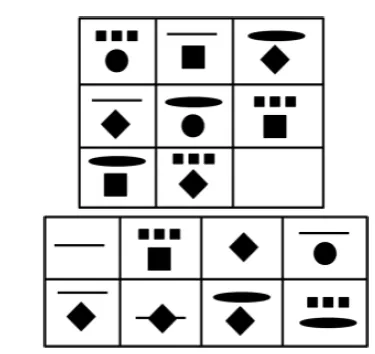
Fig. 1 A visual pattern problem similar to Raven Progressive
Matrix problems (Lovettet al., 2010).
general factor (the g factor) which determines perfor-mance in all more specific domains. However, there is high controversy about the so-called “theories of intel-ligence”, each elaborating a different “taxonomic struc-ture of abilities” (Sternberg, 2000), and its correspon-dence with theories of mind in psychology and cognitive science.
The most prominent example of a test measuring general intelligence is the Raven Progressive Matrix test —a non-verbal test where matrices of visual patterns are given and the pattern of the given regularities has to be identified (see Fig. 1). Inductive reasoning with numbers is another example for a test that is included in several IQ tests (Amthaueret al., 1999). For example, given the series3, 7, 15, 31, 63, the pattern 2×f(n−
1) + 1 can be identified and used to calculate the next number 127(Hofmannet al., 2014).
As mentioned above, theories of intelligence and tests have always dealt with two intertwined dimensions: the landscape of abilities (the problems that make up the tasks) and the kind of individuals (the subject popu-lations). For instance, different sets of tasks (and not only different ranges of difficulty) are used for children and disabled people than for the rest of the normative adult population. How does this duality between tasks and subjects behave for machine intelligence? The dis-cussion in section 2 is relevant to the consideration of the taxonomy of the sets of tasks (symbolic, computa-tional, etc.) and a hierarchical taxonomy between sets of subjects in the order humans, animals and machines. Given that psychometrics provides a well-established methodological approach to capture human intelligence, why not adopt a similar procedure to decide whether AI programs are intelligent? This idea could offer a fur-ther method to assess intelligence of artificial systems
besides the Turing test approach and the performance comparison of humans and computer models.
4 Psychometrics and Psychometric AI
“Psychometric AI” (PAI) (Bringsjord and Schimanski, 2003) as a research program aims to apply the full bat-tery of techniques from psychometrics to a strong AI context, setting its internal standard by declaring an agent as intelligent if and only if it does well in all established, validated tests of intelligence and mental ability, and subsequently setting out to use the results of the respective tests in a dedicated effort to build agents meeting the aforementioned criterion. PAI has by now become a line of research in its own right as, e.g., documented by the articles collected in Bringsjord (2011).
Still, the use of psychometrics in an evaluation-related AI context is wider. For example, Detterman (2011) has challenged the field of AI to assess an artificial system’s performance by using classical IQ tests (but, unlike PAI, without the commitment to and focus on the engineering of agents adhering to the introduced standard). Detterman’s call is issued to AI researchers working on approaching the level of intelligence exhib-ited by humans, challenging them to prove the validity of their claims by administering an IQ test (precompiled by experts in human psychometrics) to their computer systems and comparing the actual IQ scores — with the restriction that in the full version of the challenge only “a priori algorithms” are admissible, i.e., algorithms not previously specialised for a battery of tasks.
Over the last years, we can observe a growing num-ber of publications presenting computer programs solv-ing IQ test problems, mostly addresssolv-ing tests with high loading of the g-factor such as Raven Progressive Ma-trices and number series problems. In standard AI re-search, IQ test problems have been identified as chal-lenging application domains for algorithmic approaches to inference (Siebers and Schmid, 2012). In AGI, algo-rithms for solving IQ test problems are designed with the aim to surpass average human performance on these tests (Stranneg˚ardet al., 2013a,b).
[image:4.595.59.247.91.268.2]4 Besold, Hern´andez, Schmid
series problems to demonstrate that the proposed al-gorithms are general enough to be applied to problems outside the original domain.
In Cognitive Science, researchers are interested in providing cognitive models simulating cognitive prin-ciples of pattern identification that are assumed to be underlying human general intelligence (Lovett et al., 2010). Cognitive models for IQ test problems can relate the concept of item difficulty of psychometrics with the complexity of information processing. While item diffi-culty is defined by the percentage of subjects in a val-idation sample who solve this item, a cognitive model can give an explanation of item difficulty with respect to the necessary effort for an algorithmic solution.
These different perspectives on developing algorith-mic approaches to solve IQ test problems have differ-ent underlying assumptions about how to determine whether a computer program is intelligent: even if AI uses IQ tests as a challenging area of application, there is no need to ascribe intelligence to such programs — evaluation can be done by comparing the performance of different algorithms. Nevertheless, many researchers may still have the implicit assumption that a program which performs better is more intelligent.
When AI algorithms based on general principles of inference are tested for applicability over different do-mains, it is harder to define a rank order over approaches. It is open to discussion which system is more power-ful —one that outperforms others in some domains but has weak performance or is not even applicable in other domains or one with average performance over a broad variety of domains. One is tempted to use the anal-ogy to humans which have one isolated exceptional skill but are intellectually impaired otherwise —so called id-iot savants (Miller, 1999)— versus humans with aver-age abilities over many areas. When a cognitive model is proposed, the crucial question is not whether this model is intelligent in itself but to what extent it mim-ics the cognitive processes performed by humans when solving such problems, that is, whether the model can provide an explanation of human behavior. How to de-termine similarity between processing features of a com-puter model and empirically observable behavior in hu-mans is a challenging methodological problem in its own (Cooperet al., 1996). If processing parameters of model and human performance are judged as sufficiently simi-lar, the model is assumed to capture the core character-istics of human information processing. In consequence, it might be claimed that the model captures relevant aspects of human intelligence.
From all these approaches, only AGI models explic-itly make the claim to aim at creating human-level (or even super-human) intelligence. In this context, PAI
can be seen as an alternative approach to the previously more dominant observational assessments (like the Tur-ing test).
5 Can human intelligence tests work for machines?
The validity of any discriminative test is mostly based on its necessity and sufficiency. In the case of intelli-gence, this is not different, and a similar argument has been applied to the Turing test and other proposals for measuring (artificial) intelligence. Namely, necessity means that if a system is intelligent then it must pass the test and sufficiency means that if a system passes the test then it must be intelligent.
In order to analyse whether human intelligence tests are valid for machines we will introduce six arguments (or characteristics of human intelligence tests) that can be used to explore whether they are necessary and suf-ficient, as summarised in Table 1. Many of these argu-ments rely on machines and humans (and non-human animals) being differentsubjectpopulations and on the breadth and variety ofproblemsin the test.
1.Human intelligence tests are anthropocentric. As hu-mans are the quintessential example of intelligence, it makes sense to derive the concept and the measurement tools from them. Human tests have just been tuned to become necessary and sufficient for humans (or as much as possible). For instance, they evolved into culture-fair tests to solve problems about necessity. They also evolved to have a range of tasks to solve problems about sufficiency. So, this argument can be used to question whether human intelligence, as measured by IQ tests, is a particular (anthropocentric) type of intelligence, instead of a universal one. Also, even if it is human-level intelligence what we want to measure, it is not clear that the tests can work for other kinds of sub-jects. Hence, there can be important concerns about the necessity and sufficiency of these tests for non-human subjects, such as machines (and animals).
# Argument Necessity Sufficiency
1 Human intelligence tests are anthropocentric. Effect Effect
2 Human intelligence tests are administered in a particular way. Effect
-3 Human intelligence tests are specialised to kinds of subjects. Effect Effect
4 Human intelligence tests are usually normalised to a population. Effect Effect
5 Human intelligence tests are robust to training. - Effect
[image:6.595.48.528.78.160.2]6 Human intelligence tests are composed of many different abilities and factors. Effect Effect
Table 1 Six arguments that can be used to determine the (in)adequacy of human intelligence tests for machines and whether they can have effect on the necessity and sufficiency of these tests.
of human intelligence tests for other kinds of subjects, such as machines (and animals, small children and dis-abled people). As a sign of this, tests for animals are administered with rewards, not instructions.
3. Human intelligence tests are specialised to kinds of subjects. The two previous arguments can be responded by the fact that there are specialised human intelligence tests for disabled people, for children of different ages, etc. It could also be argued that the same could be done for machines. Actually, Detterman suggests that a “unique battery of intelligence tests” (Detterman, 2011) could be designed on purpose for machines developed by “the editorial board of Intelligence and members of the International Society for Intelligence Research”. However, which are the criteria for the inclusion in this ‘unique’ battery? And if some tests are developed anew, what would be the guidelines to specialise these tests for machines? Would they be still useful for humans? And what if the battery is finally passed by a machine? Would the commission be tempted to look for a differ-ent or more machine-unfriendly battery that humans can pass but the program cannot, `a la CAPTCHA1
(Von Ahn et al., 2003)? In the end, any adaptation or specialised selection of tasks would raise questions about the necessity and sufficiency for machines, even more than a standard human intelligence test.
4.Human intelligence tests are usually normalised to a population. The result from a human intelligence test is just a number that can be compared to other num-bers, in an ordinal, but not a quantitative way. In other words, human intelligence is measured at “the ordinal level”, or is “weakly measurable” (Bartholomew, 2004, pp. 145). For instance, to make the number meaningful, IQ is normalised to have a mean of 100 and a standard deviation of 15. Clearly, this normalisation is not going to work for other populations, as it does not work for children or even some subgroups of the human popula-tion. However, we cannot re-normalise for machines, as the mere notion of an ‘average’ machine is ridiculous, because there is no normative population of machines. This means that even if the human normalisation is
1 CAPTCHAs (Completely Automated Public Turing test
to tell Computers and Humans Apart) are tests (e.g., dis-torted letters) to detect bots in Internet applications.
used, we have problems about sufficiency, i.e., it is un-clear what it means if a machine scores an IQ of 20 or an IQ of 524, as these values are clearly anomalous for humans. Conversely, from the necessity point of view, what are machines far below or far above human intel-ligence expected to score?
5.Human intelligence tests are robust to training. Hav-ing a public and transparent measurement benchmark is always a good thing for science. Some human intel-ligence tests are well-known and public, but not all. Actually, some academic and professional psychological tests are never made public, because otherwise people could practice on them and game the evaluation. Even if care is taken not to disclose or repeat exercises to avoid rote learning, humans can prepare for thekindsof tests. Fortunately, the improvement of training, even if signif-icant, is limited (Bors and Vigneau, 2001), although the reasons and the permanent effect beyond the particular test are not very well understood. Aware of this, Detter-man talks about two levels in his challenge, the second where tests are not disclosed previously to the evalua-tion (so programmers cannot implement specialised ap-proaches). However, it is not clear that this robustness to humans trying to game the evaluation by systematic practising should also hold for machines. As already discussed in the previous section, specialised systems can be built whose only purpose is to score well in in-telligence tests (e.g., Sanghi and Dowe, 2003), without being able to do well in other tasks. This raises strong doubts on sufficiency.
6 Besold, Hern´andez, Schmid
the relations between abilities and factors could be in-terpreted for machines, or how different tasks could be weighted for an aggregated value. For instance, if the
gfactor has been found in human evaluation, should it appear for machines as well? More blatantly, should we expect well-established tests of choice reaction time to be correlated with intelligence in machines as they are correlated in humans (Dearyet al., 2001)? Most of the research in human intelligence is then, in principle, not extrapolatable to machines (not even to animals), rais-ing delicate issues about the breadth, composition and interpretation of separate results of any test battery for machines. Actually, it is unclear whether we can come up with a right set of problems by making the battery larger or smaller such that they are sufficient and nec-essary for machines.
From the above analysis of arguments, there seem to be serious doubts about the necessity and sufficiency ofcurrenthuman intelligence tests for the evaluation of machines. This is consistent with other previous papers (Dowe and Hern´andez-Orallo, 2012; Besold, 2014).
6 Conclusions
In the previous sections we have discussed whether hu-man intelligence tests are valid for the evaluation of ma-chines. As a result, we have found several issues about their sufficiency and necessity. Even if we argue that in-telligence tests are not valid, in principle, for the evalu-ation of machines, it is important to highlight that this does not mean that human intelligence tests are useless for artificial intelligence and cognitive science. More on the contrary, it is precisely the analysis of what is lack-ing in our AI systems to score well in a range of human intelligence tests and what is lacking in human intelli-gence tests to properly discard those systems that are not intelligent what can give us insight about the nature of human intelligence tests and also about the progress of AI if the tests are generalised. In other words, the use of human intelligence tests in AI research is use-ful, provided we are cautious about the semantic and quantitative interpretation of results.
The PAI methodology for AI, however, does not ad-vocate for any generalisation or improvement of psycho-metric tests. This can actually be one of the most useful outcomes of this process, by the development of brand-new tests based on (algorithmic) information theory (Hern´andez-Orallo, 2000; Legg and Hutter, 2007) or on models about cognition (Mueller et al., 2007), and their hybridisation with (cognitive) generalisations of the Turing Test (Besold, 2013b) or generalisations of psychometrics (Hern´andez-Orallo et al., 2014), where
tests are devised for any kind of cognitive system inde-pendent of its type or nature (individual or collective, artificial, biological, or hybrid). This suggests that an interesting way of looking at the question is by revers-ing it: can human intelligence be measured as a very special case of machine intelligence?
References
Amthauer, R., Brocke, B., Liepmann, D., and Beaudu-cel, A. (1999). Intelligenz-Struktur-Test 2000 (I-S-T 2000). Hogrefe, G¨ottingen.
Bartholomew, D. J. (2004). Measuring Intelligence: Facts and Fallacies. Cambridge University Press. Besold, T. R. (2013a). Human-level artificial
intel-ligence must be a science. In K.-U. K¨uhnberger, S. Rudolph, and P. Wang, editors,Artificial General Intelligence, volume 7999 of LNCS, pages 174–177. Springer Berlin Heidelberg.
Besold, T. R. (2013b). Turing revisited: A cognitively-inspired decomposition. In V. C. M¨uller, edi-tor,Philosophy and Theory of Artificial Intelligence, SAPERE 5, pages 121–132. Springer.
Besold, T. R. (2014). A note on chances and limita-tions of Psychometric AI. In KI 2014: Advances in Artificial Intelligence, pages 49–54. Springer. Bors, D. A. and Vigneau, F. (2001). The effect of
prac-tice on raven’s advanced progressive matrices. Learn-ing and Individual Differences,13(4), 291–312. Bringsjord, S. (2011). Psychometric artificial
intelli-gence. Journal of Experimental & Theoretical Artifi-cial Intelligence,23(3), 271–277.
Bringsjord, S. and Schimanski, B. (2003). What is Ar-tificial Intelligence? Psychometric AI as an Answer. InProceedings of the 18th International Joint Con-ference on Artificial Intelligence (IJCAI’03), pages 887–893. Morgan Kaufmann.
Burghardt, J. (2005). E-generalization using grammars.
Artificial Intelligence,165, 1–35.
Cooper, R., Fox, J., Farringdon, J., and Shallice, T. (1996). A systematic methodology for cognitive mod-elling. Artificial Intelligence,83, 3–44.
Deary, I. J., Der, G., and Ford, G. (2001). Reac-tion times and intelligence differences: A populaReac-tion- population-based cohort study. Intelligence,29(5), 389–399. Detterman, D. (2011). A challenge to Watson.
Intelli-gence,39(2-3), 77–78.
Dowe, D. L. and Hern´andez-Orallo, J. (2012). IQ tests are not for machines, yet.Intelligence,40(2), 77–81. Harnad, S. (1990). The symbol grounding problem.
Physica D,42, 335–346.
Hern´andez-Orallo, J. (2000). Beyond the Turing Test.
Hern´andez-Orallo, J., Dowe, D. L., and Hern´ andez-Lloreda, M. V. (2014). Universal psychometrics: Measuring cognitive abilities in the machine king-dom. Cognitive Systems Research,27(0), 50–74. Hofmann, J., Kitzelmann, E., and Schmid, U. (2014).
Applying inductive program synthesis to induction of number series a case study with IGOR2. In KI 2014: Advances in Artificial Intelligence, pages 25– 36. Springer.
Johnson-Laird, P. N. (1988). The Computer and the Mind: An Introduction to Cognitive Science. Fontana Press, London.
K¨uhnberger, K. U. and Hitzler, P. (2009). Facets of artificial general intelligence. KI,23(2), 58–59. Legg, S. and Hutter, M. (2007). Universal intelligence:
A definition of machine intelligence. Minds and Ma-chines,17(4), 391–444.
Lovett, A., Forbus, K., and Usher, J. (2010). A structure-mapping model of Raven’s Progressive Ma-trices. InProceedings of CogSci-10, pages 2761–2766. Miller, M. (1999). The savant syndrome: intellectual impairment and exceptional skill. Psychological Bul-letin,125(1), 31–46.
Mueller, S. T., Jones, M., Minnery, B. S., and Hiland, J. M. H. (2007). The BICA cognitive decathlon: A test suite for biologically-inspired cognitive agents. In
Proceedings of Behavior Representation in Modeling and Simulation Conference, Norfolk.
Newell, A. (1980). Physical symbol systems. Cognitive Science,4, 135–183.
Newell, A. (1982). The knowledge level. Artificial In-telligence,18, 87–127.
Pylyshyn, Z. (1980). Computation and cognition: Issues in the foundation of cognitive science.The Behavioral and Brain Sciences,3, 111–132.
Sanghi, P. and Dowe, D. L. (2003). A computer pro-gram capable of passing I.Q. tests. In P. P. Slezak, editor,Proceedings of ICCS/ASCS-2003, pages 570– 575, Sydney, AU.
Siebers, M. and Schmid, U. (2012). Semi-analytic nat-ural number series induction. In KI 2012: Advances in Artificial Intelligence, pages 249–252. Springer. Spearman, C. (1904). General intelligence objectively
determined and measured.American Journal of Psy-chology, 15, 201293.
Sternberg, R. J., editor (2000). Handbook of Intelli-gence. Cambridge University Press.
Stranneg˚ard, C., Amirghasemi, M., and Ulfsb¨acker, S. (2013a). An anthropomorphic method for number sequence problems.Cognitive Systems Research, 22-23, 27–34.
Stranneg˚ard, C., Cirillo, S., and Str¨om, V. (2013b). An anthropomorphic method for progressive matrix
problems. Cognitive Systems Research, 22-23, 35– 46.
Turing, A. M. (1950). Computing machinery and intel-ligence. Mind,59, 433–460.
Turing, A. M. (1969). Intelligent machinery. In B. Meltzer and D. Michie, editors, Machine Intel-ligence, volume 5, pages 3–23. Edinburgh University Press.
Von Ahn, L., Blum, M., Hopper, N. J., and Langford, J. (2003). CAPTCHA: Using hard AI problems for security. InAdvances in Cryptology - EUROCRYPT 2003, pages 294–311. Springer.
Wechsler, D. (1944). The measurement of adult intelli-gence. Williams & Wilkins, Baltimore.
Tarek R. Besoldis a member of the AI Research Group at the Institute of Cog-nitive Science of the University of Os-nabr¨uck (Germany). He studied math-ematics and computer science at the University of Erlangen-Nuremberg (Ger-many) and at the University of Zaragoza (Spain), and logic at the University of Amsterdam (The Nether-lands). In 2014 he was an academic visitor at the Centre for Intelligent Systems and their Applications (CISA) of the University of Edinburgh (Scotland, UK). Main fields of research and scientific interest are: Analo-gies and analogical reasoning, rationality and creativity, human-level AI, and neural-symbolic integration.
Jos´e Hern´andez-Orallo is a reader in the Departament de Sistemes Inform´ a-tics i Computaci´o, Universitat Polit` ecni-ca de Val`encia (UPV, Spain). He holds a M.Sc. in Computer Science from UPV, partly completed at the ´Ecole Nationale Sup´erieure de l’ ´Electronique et de ses Applications (France), and a Ph.D. in Logic from Universitat de Val`encia. His main research areas are in machine learn-ing, artificial intelligence, data minlearn-ing, machine evalu-ation and inductive programming.
8 Besold, Hern´andez, Schmid