Europe Direct is a service to help you find answers
to your questions about the European Union
Freephone number (*):
00 800 6 7 8 9 10 11
(*) Certain mobile telephone operators do not allow access to 00 800 numbers or these calls may be billed.
More information on the European Union is available on the Internet. (http://europa.eu and http://ec.europa.eu/citizensrights)
Cataloguing data can be found at the end of this publication.
Luxembourg: Publications Office of the European Union, 2010
ISBN 978-92-79-14164-5 doi: 10.2780/11453
© European Union, 2010
Reproduction is authorised provided the source is acknowledged.
Printed in Belgium
3
p 5 Chapter 1 WHAT IS CSS AND HOW DOES IT WORK?
p 6 Chapter 2 CONTEXT OF CITIZENS SIGNPOST SERVICE AND NEW DEVELOPMENTS IN 2009
p 6 1. Background
p 6 2. New developments
p 6 2.1 Enhanced cooperation with SOLVIT p 6 2.2 Common enquiry form
p 6 2.3 Advice to SOLVIT Centres p 8 2.4 Direct Advice Service
p 9 Chapter 3 STATISTICS
p 9 1. Overall number of enquiries p 10 2. Profile of enquirers
p 11 3. Enquiries per nationality
p 12 4. Enquiries per million inhabitants p 12 5. Enquiries per source
p 13 6. Topics covered
p 14 Chapter 4 ANALYSIS OF CASES HANDLED BY CSS IN THREE SELECTED SUBJECT AREAS
p 14 1. Cars and driving p 14 1.1 Introduction p 14 1.2 Moving with a car p 14 1.2.1 Registration
p 15 1.2.2 Type approval and technical control p 15 1.2.3 Taxes
p 15 1.2.4 Buying a car in another Member State p 15 1.3 Moving as a driver
p 15 1.3.1 Insurance p 16 1.3.2 Driving licences p 16 1.3.3 Penalties on drivers p 16 1.4 Main findings
p 17 2. Social security and welfare benefits p 17 2.1 Introduction
p 17 2.2 Competence
p 18 2.3 Eligibility and transfer of benefits p 18 2.4 Calculation and payment of benefits p 19 2.5 Procedures and administration p 20 2.6 Main findings
p 20 3. Residence rights for non-EU family members of EU citizens p 20 3.1 Introduction
p 20 3.2 Recognition as family members in the host country p 20 3.2.1 Spouses
p 20 3.2.2 Partners
p 20 3.2.3 Other dependent family members
p 21 3.3 Recognition as family member covered by EU law p 21 3.4 Entry and residence
p 21 3.4.1 Entry visas p 21 3.4.2 Residence cards
p 22 3.5 Travelling as a family member to another EU Member State p 22 3.6 Main findings
5
1 http://ec.europa.eu/solvit. 2 http://ec.europa.eu/eures.
3 http://www.enterprise-europe-network.ec.europa.eu.
Chapter 1
What is Citizens Signpost Service and
how does it work ?
Citizens Signpost Service (CSS) is an EU advice service for the public, currently provided by legal experts from the European Citizen Action Service (ECAS), an independent non-profit organisation located in Brussels, operating under contract with the European Commission. The legal experts are lawyers from all EU Member States with excellent knowledge of their national and European law. CSS gives personalised advice to EU nationals on their rights under EU law. Replies are given normally within 3 working days, at the latest within one week. Citizens can choose for the replies to be provided by e-mail or telephone.
Questions can be asked by
● individuals who are nationals of the European Union, Norway, Iceland or Liechtenstein, ● non-Europeans – if they have derived rights
under EU law, e.g. are family members of an EU national or resident in an EU country,
● European/national information and advice services on behalf of individuals,
● commercial bodies - if the enquiry concerns the rights of one or more employees.
Questions need to relate to a real (not hypothetical) situation and to citizens’ rights in one or more EU countries and under EU law.
6
4 SEC(2008) 1882.
5 http://ec.europa.eu/youreurope/nav/en/citizens/index.html.
Chapter 2
Context of Citizens Signpost Service
and new developments in 2009
1.
Background
CSS is one of several Single Market Assistance Services designed to help citizens make the most of their rights in the internal market. Some of these services, such as CSS, are subcontracted to external service providers whereas others are managed directly by the Commission.
Whilst these services provide an important role in the functioning of the internal market, in the past there was criticism about lack of cooperation between them. In addition, the range of services on offer, all operating under different brand names, may be confusing to the public. To address these concerns, the Commission adopted an Action Plan on Single Market Assistance Services4 in 2008. This action plan aims at getting the services to work closer together to present a seamless overall service package to the public and at creating a single entry point that gives access to all available services.
In total there are 7 services covered by the Action Plan: Enterprise Europe Network, European Consumer Centres, EURES, Europe Direct call centre, SOLVIT, Citizens Signpost Service and Your Europe webportal.
2.
New developments
In 2009 CSS has expanded its services in two areas, in line with the principles of the above-mentioned action plan.
2.1 Enhanced cooperation with SOLVIT
CSS has entered into a special cooperation with SOLVIT, which is a problem-solving network that deals with problems between individuals or companies and the authorities in another country in cases where there is a possible misapplication of EU law. If, after examining a citizen’s request for advice, CSS considers that the citizen may need further help in solving a problem with the national administration in question, his/her enquiry will be transferred from CSS to SOLVIT and the citizen is informed accordingly.
2.2 Common enquiry form
Enquiries can arrive at CSS via a variety of channels. At the moment, the principal entry point tends to be the Your Europe web portal5. As part of the Single Market Assitance Services action plan, this website is currently undergoing substantial restructuration and up-dating. From 2010 this website will serve as a main information source on citizens’ rights in the internal market. If citizens cannot find the information needed or request advice on concrete cases or assistance in order to help solve concrete problems with national administrations, the Your Europe website guides them to a common enquiry form6. This is a common web-based entry form by means of which the enquiry is submitted either to CSS or SOLVIT according to the nature of the case. This common intake form channels the enquiries to the correct service and helps avoid frustrating rejections of enquiries and difficult forwarding of enquiries from one service to the other. First experiences of this form have been very positive as the vast majority of enquirers accept that their case may be transferred between the two services.
2.3 Advice to SOLVIT Centres
In some cases, national SOLVIT centres do not have an in-house legal expert who can advise on complex cases. For this reason, a system has been set up to allow SOLVIT Centres to ask CSS questions on specific issues of EU law which should help them better prepare their cases. The aim is to provide legal advice on request to the SOLVIT Centres in order to prepare them for submission to their counterpart SOLVIT Centre within the SOLVIT system. This advice consists principally of establishing whether EU law is correctly implemented or interpreted and giving legal references on EU law.
7
Belgium 3%
Cyprus 11%
France 27%
Italy 40% Luxembourg
3%
Malta 8%
[image:7.595.111.469.161.439.2]Slovenia 8%
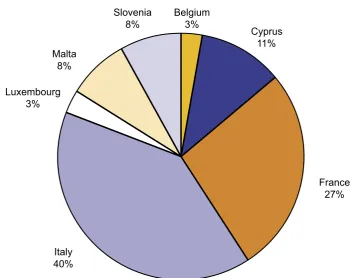
Figure 1: CSS support to SOLVIT per SOLVIT Centre:
The subjects of cases which are submitted to CSS by SOLVIT Centres are very diverse. The majority concern work-related questions and residence rights.
This service was restricted in the first phase to a selected number of SOLVIT Centres, and was opened to all SOLVIT Centres in October 2009. Thus the statistics regarding the number of enquiries per SOLVIT Centre are not yet representative. The Italian and French SOLVIT
Centres were those which most often asked for CSS advice (15 and 10 times respectively), followed by the SOLVIT Centres from Cyprus (4), Malta (3), Slovenia (3) as well as Belgium and Luxemburg (1 each).
Figure 2: CSS support to SOLVIT Centres by main subject:
Work 31%
Residence 21% Judicial rights
10% Fundamental rights
(incl. Charter) 10% Social security
8% Goods
(other than motor vehicles) 5%
[image:7.595.108.468.508.800.2]2.4 Direct Advice Service
The other new feature is a Direct Advice Service offered by CSS legal advisers on the premises of the Commission Representations in Dublin and Berlin. This service started in Dublin on 13 July 2009 and in Berlin on 1 September 2009. A third Commission Representation, namely that in Madrid, will start to offer this service on 1 January 2010.
These CSS legal advisers provide citizens with general information on their EU rights and obligations and assist them with problems relating to Community law and its application in domestic law.
The legal advisers are responsible for organising consultations, which are open to the public at the Commission Representation, and also answer written enquiries. Citizens can meet the legal advisers personally upon appointment or discuss their problem with them on the telephone.
9
[image:9.595.76.509.273.555.2]Chapter 3
Statistics
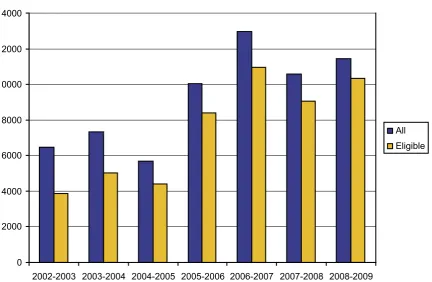
Figure 3: Evolution of enquiries:
0 2000 4000 6000 8000 10000 12000 14000
2002-2003 2003-2004 2004-2005 2005-2006 2006-2007 2007-2008 2008-2009 All Eligible
The higher volume of enquiries recorded in 2006/2007 can be explained by the introduction of a more effective website and certain promotional activities which have not been repeated since.
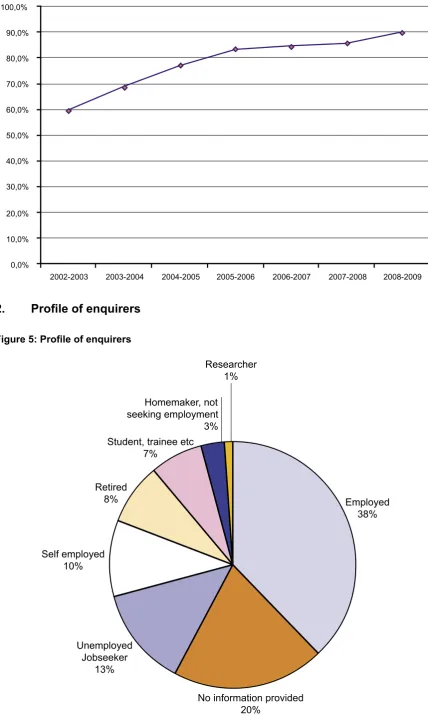
The number of eligible questions increased between 2007/2008 and 2008/2009 by nearly
14%. The number of eligible questions increased continuously in order to reach 90,1%. For a better understanding it should be pointed out that the category of 9,9% of ineligible questions concern questions falling outside the scope of CSS or which are incomplete or duplicates.
1.
Overall number of enquiries
Since the Citizens Signpost Service was started in its current form in July 2002 it has handled more than 69.000 cases. During the period of this report7 (2008/2009) CSS dealt with 11.449 cases.
This is an increase of 8,5% compared to 2007/2008. The number of enquiries fluctuates slightly over the months.
10
Figure 4: Evolution of eligible enquiries:
0,0% 10,0% 20,0% 30,0% 40,0% 50,0% 60,0% 70,0% 80,0% 90,0% 100,0%
2002-2003 2003-2004 2004-2005 2005-2006 2006-2007 2007-2008 2008-2009
[image:10.595.90.519.70.789.2]2.
Profile of enquirers
Figure 5: Profile of enquirers
Homemaker, not seeking employment 3%
Researcher 1%
No information provided
Employed 38%
Unemployed Jobseeker
13% Self employed
10%
Retired 8%
11
[image:11.595.56.520.168.482.2]3.
Enquiries per nationality
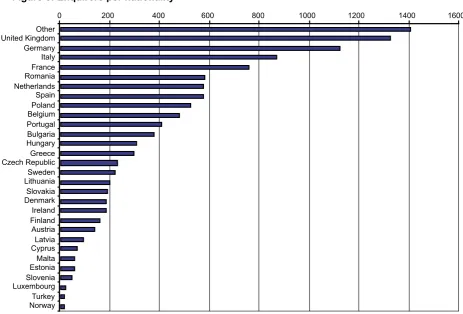
Figure 6: Enquirers per nationality
0 200 400 600 800 1000 1200 1400 1600
Other United Kingdom Germany Italy France Romania Netherlands Spain Poland Belgium Portugal Bulgaria Hungary Greece Czech Republic Sweden Lithuania Slovakia Denmark Ireland Finland Austria Latvia Cyprus Malta Estonia Slovenia Luxembourg Turkey Norway
There is no significant change compared to the previous year8. The higher number of enquiries coming from the larger EU Member States is not surprising.
8 «Other» refers to enquiries from non EEA-nationals.
The number of enquirers describing themselves as employed fell from 44% last year to 38%, whereas the number of unemployed enquirers and jobseekers increased slightly from 11% to 13%.
4.
Enquiries per million inhabitants
Figure 7: Enquirers per million inhabitants
0 20 40 60 80 100 120 140 160
Malta Cyprus Lithuania Bulgaria Belgium Luxembourg Estonia Ireland Latvia Portugal Netherlands Slovakia Denmark Hungary Finland Romania Greece Sweden Slovenia Czech Republic United Kingdom Austria Italy Poland Germany Spain France Norway Turkey
Whilst, in terms of sheer volume, the more populous countries generate the largest share of enquiries – which is to be expected – the breakdown of enquiries per million inhabitants shows that nationals from smaller countries tend to submit more enquiries than those of larger countries. This can be explained by the fact that
nationals of larger EU Member States have more employment and residential possibilities within their own country whereas nationals of smaller EU Member States are more likely to cross borders. This picture is similar to that given by the statistics of the previous year.
5.
Enquiries per source
About 55% of all enquiries are submitted using the online enquiry form available at http://ec.europa. eu/citizensrights and around 45% of the enquiries are received via EUROPE DIRECT by telephone (free phone number 00800 6 7 8 9 10 11), e-mail or the EUROPE DIRECT online form.
13
Figure 9: Main subjects of enquiriesSocial Security 24%
Residence 21%
Work 15% Entry procedures
11% Motor-vehicles
10%
Taxes 4%
[image:13.595.112.468.420.712.2]Others 15% Figure 8: Enquiries per source
3674
5154 6899
6295
0 1000 2000 3000 4000 5000 6000 7000 8000
2007-2008 2008-2009
Europe Direct Contact Center Online enquiry form
6.
Topics covered
The enquiries concern a wide range of subjects. The three most frequently asked topics (social security, residence rights and work) amount to 60% of all questions, and the six most frequently asked topics (including entry procedures, motor vehicles and taxation) amount to more than 85% of all questions.
14
Chapter 4
Analysis of cases handled by
CSS in three selected subject areas
Amongst the large number of cases dealt with by CSS, the service’s legal experts have flagged three areas which stand out as meriting further analysis, as follows:
● Cars and car-related issues ● Social security and social welfare
● Residence rights for non-EU family members of EU citizens
In each subject area the cases show a wide variety of problems, some of which occur frequently while others are expressed less often or occasionally. The less frequent problems appear to reflect less commonly encountered personal circumstances, but they may also suggest that certain problems involve difficulties which are sufficiently well known as to discourage those concerned from asking about them. The findings set out below describe the wide spectrum of issues raised rather than concentrate simply on the most numerous.
The scope of this section is to point out the problem areas, not to make recommendations for potential actions to avoid these problems in the future.
1. Cars and driving
1.1 Introduction
While many cases amount to requests for detailed information, a significant proportion suggest the existence of persistent problem areas. An explanation of the topics most frequently asked about in the field of cars and driving is given below.
1.2 Moving with a car
1.2.1 Registration
Lack of knowledge of the basic rules
The basic problem encountered by enquirers is a lack of information on registration of cars or other vehicles. Many citizens do not know that the registration of a car must follow the effective residence of the owner, and that there are specific criteria to identify that residence. Cars should be
to another country. When citizens are not aware of this obligation, problematic situations can easily arise.
Application of the «6-month rule»
Some EU Member States require the vehicle to be registered before the statutory six months after arrival. In some cases delays in registering the car or paying vehicle registration tax makes the owner liable to substantial penalties, including possible forfeiture of the vehicle. Citizens ask what they should do if they plan to spend less than six months in a particular country.
In some cases, particularly in more complex cases (see «specific situations» below), it appears that local authorities or police are not fully aware of the EU legislation on registration of vehicles in cross-border situations.
Formalities and documents
A secondary issue is that there is confusion about the complex registration formalities and the documents needed when moving a car from one country to another as well as about the delays and the possible costs. The avoidance of extra costs can lead very mobile citizens to try to avoid having to change registration, with the temptation to go back to the country of residence regularly to interrupt the six month residence period which triggers re-registration.
Specific situations
There are citizens who are faced with a double claim for registration, for example:
● those who have a second home in another EU Member State and a car attached to that residence but who are registered as residents in their country of origin;
● those who split their year with lengthy periods in two EU Member States with the same car; ● when a car is owned by a resident in one EU
15
Registration certificatesIn some cases, the refusal of the country of origin to issue a registration certificate or a duplicate is a barrier to registering the car in the new country. Citizens would like the relevant authorities of the two countries involved to communicate directly for the information they need. The high cost of getting such certificates is also mentioned.
1.2.2 Type approval and technical control
Lack of knowledge
The basic problem in this area is a lack of knowledge about type approval. Citizens generally do not know the difference between national and EU type approval. If they do know about it, they ask where they can find which type their car has. This information should normally be provided by competent national authorities. With old cars or cars built by a manufacturer that has no local legal representative, the real problem is who to turn to for technical specifications required by the registration authorities.
Formalities and documents
Enquirers often give descriptions of the many documents and formalities required when they register a car with national type approval, which they perceive as a barrier to freedom of movement. The non-recognition of components or spare parts produced abroad but approved in another EU Member State is also mentioned.
A number of problems were reported by citizens who wanted to register right-hand drive vehicles in a particular EU Member State.
Technical controls
There are also complaints about ad hoc technical control visits taking place after new registration of the car, where the rules applied are those which apply to a change of owner in the host country, whereas ownership has not changed (just the country of residence).
1.2.3 Taxes
Lack of knowledge
Citizens are concerned about the level of car-related taxes and there seems to be a general lack of knowledge of the rules, European as well as national. For instance, the rule of country of competence for VAT in relation to cars, depending whether they are new or used, and how “new” is to be defined, is largely not known.
Double taxation
Many citizens find themselves having to pay VAT in the country of destination of the car whilst having already – erroneously – paid VAT in the country of purchase. Vehicle registration tax can be an obstacle which limits the freedom of movement of citizens. Car owners moving around the EU have to repeatedly pay this tax which owners remaining in their own country do not have to pay more than once. The amount of the tax in some countries can be high when compared to the actual age and value of the car. The reason for this is that countries define first registration as that which takes place in their country, without looking at the history of the car at EU/EEA level.
The differences in tax systems can also create difficulties where the registration documents of a car do not contain the information required to secure a tax deduction in certain EU Member States, e.g. for less polluting cars.
1.2.4 Buying a car in another Member State
There are indications, especially from the new EU Member States, that car manufacturers seek to differentiate national markets. Some citizens complain about refusal to supply non-residents or only at a discriminatory price. In one such case, the citizen said that the car dealer explicitly referred to an agreement between European car importers.
1.3 Moving as a driver
1.3.1 Insurance
Temporary insurance
One frequently-encountered problem seems to be that insurers are not willing to insure a car for the short period required to move the car to another country where it will be registered. Another problem is that there is not enough information about transit plates and where to get them; it is not clear whether such plates are available in all EU Member States.
Access to insurance and costs
16
However, it clearly transpires that insurers are generally not willing to insure a car registered in another country, and extend their services to non-residents only for the time necessary to change registration plates in the country of destination. The fact that the country of destination sometimes imposes a very short deadline to register (see section 1.2.1 above) can add to the difficulties.
Payouts
Getting the insurer of the other party to pay, after an accident involving a driver insured in another Member State, is an issue which is raised. The green card system is rarely mentioned, and there is no sign that the concerned citizens are informed about how it works.
1.3.2 Driving licences
Lack of detailed information
The main problem as concerns driving licences is that many citizens are not aware of the mutual recognition of driving licenses, and ask what they need to do to exchange their licences. It may be that their licence needs to be renewed and they prefer to avoid having to go back to the home country just for that. It may also be linked to the fact that some countries have a system where the licence has open-ended validity.
Most enquirers are however aware of the existence of mutual recognition and ask how it works in practice and applies to their case, or ask for advice when they experience difficulties with national authorities that they cannot reconcile with what they understand of the EU rules.
Traffic police sometimes tell the driver to exchange his/her licence for the national model. It is not apparent from these cases whether this occurs in circumstances where a penalty is applied (see «Penalties on drivers» section 1.3.3 below). There are also cases where, when a change of licence is imposed, the authorities request certification from the home country that the driving licence is still valid which is not an easy process.
Renewal
The renewal of the driving licence poses the same sort of problem. Many citizens do not know that in some countries driving licenses have to be renewed after some years (when living in these countries) even if they hold a licence of a country where licences have unlimited validity. The variety of national legislation is very confusing taken in the context of mobility with an “EU model” driving licence. It is not clear which national rules govern
Driving tests
Questions are asked on the possibility to take examinations for a driving licence in a country other than that of residence, e.g. on the occasion of vacations where the person has a second home. Clearly this reflects ignorance of the principle of territorial (i.e. residence-based) competence, but cross-broder workers have a point when they invoke possible language barriers (they would be more comfortable taking the test in the country where they work or that of their nationality) and ask why there is exclusive competence in this aspect when there is mutual recognition of licenses. It is not clear either why some EU Member States impose a waiting period as resident in order to be eligible to take the driving test.
1.3.3 Penalties on drivers
Citizens lack information on the consequences of penalties and fines incurred whilst driving in another EU Member State. They are concerned about the legality of sanctions imposed in another EU Member State and the possibility to appeal against penalties, especially when they have returned to their country of residence.
This problem becomes more crucial, understandably, when authorities rely on private companies to claim and follow-up on payment of fines. Citizens then ask about the procedural guarantees, which may differ from those in their country of residence.
There is a general sense that problems arise because of ignorance of the rules by drivers themselves (who do not necessarily tell the full story in their enquiries). For example, it appears that they forget to mention that what triggered the request to exchange the licence is an infringement of the highway code, and do not acknowledge that there are valid reasons for which the host country may impose switching to its model for the needs of administration, for instance penalty “points” need to be marked on the licence.
1.4 Main findings
17
2. Social security and welfare
benefits
2.1. Introduction
The CSS receives more requests for practical and legal information than complaints in the field of social security and welfare benefits than in any other, which seems to be a reflection of a widespread lack of information. It should be borne in mind that this is an area in which EU Member States co-operate with each other within a framework of EU co-ordination. Questions are often complex and can range from issues of competence and procedure to access to benefits and calculation of rights. All aspects of social security are concerned, particularly health care, pensions, unemployment benefits, and maternity and family benefits.
In the current economic situation, short-term income-related concerns have become more prevalent (e.g. unemployment benefits, family benefits) in a context where migration – whether leaving one’s country or returning to it – may be directly related to the recession.
A good many cases are from those who have not yet moved to another EU Member State but are considering or planning to do so, or from those who have just migrated and have not worked and contributed to the social security system of the host country. These enquiries are largely requests for information about the national legislation of the new country (where the CSS concentrates on signposting to proven sources) or to clarify the rules of social security affiliation.
Enquiries are often prompted by a lack of awareness on the part of citizens, inadequate guidance from national administrations, or a combination of both.
2.2 Competence
Looking at problems encountered in contacts with national administrations, cross-border workers complain about the difficulty of obtaining accurate information about their rights and obligations adapted to their specific situation. Citizens in unclear cross-border situations say that it is never really a problem to become registered in a particular national system if this means having to pay contributions, but difficulties arise when it comes to securing benefits.
Many services dealing with the public are not familiar with the basic rules laid down in the EU regulations for resolving which national authorities are competent. This is shown clearly in cases of simple cross-border situations where the rules
of competence are easy to apply – e.g. where a person works in a country where he/she resides, but also in another EU Member State – and yet the national authorities have not agreed on where this person should register.
Home country principle
The basic principle that one is socially insured in the country where one works and pays social contributions is not widely understood. Some enquirers seem to prefer a model which would allow them to stay in the system of their home country (or country of previous employment) regardless of where they work in the EU. There is sometimes a misunderstanding that the principle of free movement should grant this right and that co-ordination of social security systems and preservation of acquired rights should allow this.
Spouses
A number of citizens working and insured in a country which is different from the one in which they reside with their spouse ask if they can be covered for health care in their country of residence but through the spouse’s insurance.
Workers with an unclear status
A serious issue concerns the increasing number of workers with an unclear status (e.g. recruited in their own country in order to work in another EU Member State for a company that does not have any establishment there and is not showing sign of wanting to declare them there as employees) who are left to find out for themselves about their social insurance. There is a sense that unscrupulous employers are finding it easier to ignore their obligations and disguise employees in other EU Member States as free-lance workers without informing them clearly about their status.
Students
18
Sailors
A further sub-group who experience problems are sailors working for a company established in an EU Member State which artificially changes to a flag (of convenience) of a non-EU country. They complain that they become dependent of a new, totally foreign system without having had a chance to accept this important change in their employment conditions.
2.3 Eligibility and transfer of benefits
Workers in precarious situations in a Member State other their own often enquire about their rights there. Frequent questions relate to the length of time they need to work in the host country before being eligible to make claims and transfer of their rights to their home country when they return.
Unemployment
Problems are faced by workers who have lost their job in the host country and return to their home country where they feel they have more chance of finding a job rapidly. In some cases citizens neglect to take the necessary steps – registering as unemployed, possibly respecting a waiting period and possibly asking for an E303 form – and then find not only that they cannot claim unemployment benefits in the country of origin, but that it is too late (or difficult) to obtain the transfer of unemployment benefits from the country of last employment.
Maternity rights
A considerable number of questions come from new mothers or pregnant women who plan to give birth in another Member State and enquire about exporting the maternity benefits of their country of origin, or getting those of the host country/country of destination.
European Health Insurance Cards
A frequent misunderstanding is that the European Health Insurance Card (EHIC) is believed to be a guarantee of reimbursement when seeking health care needed on the spot whilst travelling abroad. In some cases private doctors or hospitals appear to be unaware of the scope of these cards.
On-line purchase of medicines
Some citizens wish to get around the legal
country of insurance by buying medicine on the web, and still obtain reimbursement. There remains much legal uncertainty in this area.
Discrimination
As regards complaints about the authorities, many concern discrimination in access to non-contributory welfare benefits, e.g. through habitual residence tests which are not applied to home nationals. Another complaint concerns the failure to consider equivalent periods of work or contribution in another EU Member State to enable qualification for benefits e.g. for unemployment, disability or maternity. In some cases, citizens complain about the fact that benefits are artificially categorised as non-contributory allowances to avoid granting their exportability.
Pensions
An important trend our questions from retiring workers who ask about preserving their rights (pensions, healthcare, but also non-contributory residence-based welfare benefits) when moving to other countries.
2.4 Calculation and payment of benefits
Family benefits
Enquiries about family benefits are increasing. There appears to be a lack of knowledge amongst cross-border workers of the special rules which apply to family benefits. For example, the country of work does not pay the full amount due under their national legislation because benefits are paid by the country of residence of the family. In such cases, this is sometimes perceived as discrimination based on residence and an infringement of the presumed right to obtain benefits regardless of residence. Where enquirers mention such issues, CSS explains that EU co-ordination of social security aims to eliminate abnormal disadvantages for migrants, but also abnormal advantages (as getting full family benefits in two countries at the same time would be).
Coordination between national authorities
19
how the other country applies its own legislation rather than communicating directly with the other competent authorities.
Unemployment
A very mobile category of workers who have lost jobs during the recession complain about difficulties in the eligibility for and calculation of unemployment benefits. The problem concerns the failure to aggregate all their periods of work or contribution when they are discontinuous and spread over two or more countries.
Pensions
There are many enquiries about old-age pensions, with many citizens not knowing about the rule, under EU law, by which pensions are calculated according to the contributions made in each country where the person has worked. Some more informed users ask directly about the calculation method, but most simply ask whether their pension rights will be preserved if they take a job in another EU Member State.
2.5 Procedures and administration
Health-care
The basic problem related to programmed health care in another EU Member State is insufficient or misleading information. For instance, there is great confusion between the scope respectively of the European Health Insurance Card (EHIC) for care needed on the spot and the E112 prior authorisation for programmed care. Citizens are generally unaware that prior authorisation is the safest option, but also – where the E112 is denied – that it is not a condition sine qua non. There is particular confusion in the case of non-hospital care.
Invalidity
The fact that medical certificates of invalidity from other EU Member States are not recognised continues to provoke indignation from citizens who complain about the need to repeat difficult and costly examinations, and comment that this seems to run counter the recognition of medical qualifications in the Internal Market. There appears to be a paradox in EU law in the case of cross-border workers, as they are covered for health care in their country of residence but need a medical certificate of the country of employment if they want to justify incapacity or invalidity.
Family benefits
Another administrative bottleneck is found when the host country demands an official family benefit document («livret») to support the claim for family benefits, when such a document is not delivered by the country of origin or birth of the child.
Atypical situations
According to enquirers, national authorities are sometimes reluctant to deal with atypical situations such as posted work, multiple countries of work, separated families or cross-border work. The information given to the person leaving for another country is sometimes superficial or misleading, and this can create problems. As mentioned above, citizens report a lack of direct communication between official counterparts in national administrations.
Communication
E-forms should be the solution for cross-border communication between social security institutions. However, there are complaints about long delays in the delivery of E-forms, lack of information on the procedures to use them, and inaccurate information about the E-form needed in a given situation. Moreover, it is sometimes the case that an E-form is not recognised, e.g. for linguistic reasons.
Delays
Most complaints concern procedural delays. Typical cases are long delays to process pension claims or obstruction by way of progressively asking for more documentation in what appears to be a never-ending process. This occurs particularly in respect of family benefits. A frequent complaint is that most or all of the three-month period of transfer of unemployment benefits is taken up with trying to register in the host country and trying to effectively obtain benefits on the spot, with the result that looking for work is made more difficult without benefits.
European Health Insurance cards
20
Citizens are often unaware that the EHIC can be used to get urgent health care in another Member State but thereafter an E112 is required. In some cases citizens rely on the EHIC for long stays, i.e. actual residence in a Member State.
Pensions
Retired workers claiming pensions from different countries complain that much time is spent in trying to identify the competent authorities. Apparently, the principle that the administration of the country of residence should co-ordinate and centralise is not known by enquirers, and not sufficiently put into practice proactively by the relevant institutions.
2.6 Main findings
From the variety of cases handled, it clearly results that the information needs of the increasingly mobile population in Europe are not properly met. It does not suffice to have good and detailed information at EU level on the «Europa» website if citizens are not looking for it there or cannot find it there. Information thus appears to be lacking both at the level of citizens and of national authorities. Moreover, providing a set of standard E-forms is proving to be insufficient to ensure adequate communication between national authorities.
3.
Residence rights for non-EU
family members of EU citizens
3.1 Introduction
Most citizens who contact the CSS appear to be well informed of their rights, often quoting Directive 2004/38/EC and sometimes including the relevant provisions. The questions are, for the most part, complaints or requests to confirm that there is an infringement of EU law and to seek advice on redress. The complaints are in general justified concerning difficulties with the procedural aspects, but less so when it comes to the substantive conditions to be met in order to claim rights as family members of an EU citizen.
3.2 Recognition as family members in the host country
3.2.1 Spouses
Several issues arise concerning the non-EU spouses of EU citizens.
Marriage
There are difficulties in securing recognition of marriage where the EU citizen gets married to a non-EU national in a country outside of the EU/ EEA. The host country requires the country of the nationality of the EU citizen to confirm that they recognise the marriage, whereas the latter country does not see itself as competent. It is not clear from the cases whether this situation arises in relation to atypical circumstances that raise suspicion about the marriage.
Engagement
Being engaged to be married does not open up the right to obtain a visa for the non-EU fiancé of an EU citizen. While engagements do not normally have a legal status, there are signs that immigration authorities are not giving it due consideration as indication of a “durable relationship” under the terms of the directive.
Separation
After legal separation, a non-EU spouse may seek recognition of the right to remain in the host country. It is sometimes difficult for the spouse to provide documents held by the EU citizen (e.g. passport, ID card or payslips), since the latter may not be willing to help. It is also observed that a number of non-EU nationals are unaware that exercising family rights in the country of residence of their EU family member does not give them the right to stay (or to work) in another EU Member State, unless they can enjoy this right under Directive 2003/109/EC concerning the status of third-country nationals who are long-term residents.
3.2.2 Partners
Registered partnerships should be considered as equivalent to marriage when the legislation of the host country recognises them as such, but this is not applied consistently. There are quite a number of enquiries about “partners” and the difficulty in practice of establishing a “durable relationship” in the meaning of EC law. Apparently, without some form of official registration, it can be difficult to obtain recognition, or at least there is not sufficient guidance available on the evidence to be produced.
3.2.3 Other dependent family members
21
this is particularly problematic where the family member concerned is either a parentless child or an isolated elderly relative unable to take care of himself/herself. Once again, the enquiries concern the evidence required.
There are cases where the EU citizen complains that there are different conditions to enjoy the right of residence as family members under EU law, for the direct ascendant of the EU citizen or for the direct descendant of his/her non-EU spouse.
An interesting question is whether residence rights can be claimed in respect of an EU citizen who is a minor in another EU Member State by supporting parents who are non-EU nationals. The national authorities are quoted as saying that this is not contemplated by EU law, but the Commission has clarified that EU Member States must always act in accordance with the relevant case-law9 of the European Court of Justice on the rights of minor EU citizens and “in the best interest of the child”.
3.3 Recognition as family member covered by EU law
The CSS received a number of complaints that EU Member States did not correctly apply parts of Directive 2004/38 on entry and residence rights for non EU nationals who are family members of an EU citizen. The precise problem was that this Directive was not applied if the family members had not previously lawfully resided with the EU citizen in another EU/EEA Member State before coming to the host country.
There is much concern expressed when EU citizens claim family rights in their home country only to find that they are not protected by EU law. The complaints are stronger when this may lead to situations of reverse discrimination, i.e. where the home nationals are less protected in their own country than foreign EU citizens10. Significant numbers of enquiries are received about length of residence required in another EU Member State as an EU citizen in order to be considered “migrant” in the meaning of EC law (i.e. with the right to move). In some cases it appears that national authorities may be unaware of case law of the European Court of Justice, e.g. by imposing a visa and charging for it to non-EU family members of an EU citizen returning to his home country from another EU Member State, where the family members hold a residence card (see 3.2.3).
3.4 Entry and residence
3.4.1 Entry visas
Delays
The basic problem with entry visas is that although non-EU family members of an EU citizen have the right to obtain an entry visa to move with or join an EU citizen, there are clear signs that many countries have still not put in place a separate administrative processing of visas for these family members. Many complainants state that authorities are not aware of the rule that the visa must be delivered as soon as possible and on the basis of an accelerated procedure, or that it must be free of charge, or a combination of both. Delays of more than four weeks, although considered unreasonable by the Commission, are frequently raised.
Types of visas
Non-EU nationals are sometimes instructed to apply for a long-term or family-reunification visa, if their declared intention is to remain in the country of destination as family members, whereas they should apply for a short-term visa only and eventually apply for a residence card on the spot, in the host country. There are some «catch 22» situations, when the consulate in the country of departure says it can deliver only short-term visas.
Administration
The excessive documentation required with the application for a visa is often raised. The requirements include bank account statements and other financial information, proof of accommodation, an invitation letter or return ticket, a medical certificate, etc. In general, applicants complain about a lack of transparent information as regards the documents needed and the procedure to follow.
3.4.2 Residence cards
In some reported cases, non-EU family members applying for a residence card in the host country are asked to go back to their country of origin and apply for a visa from there, although there is no indication that they entered the host country illegally.
Residence cards and visas
There is confusion between residence cards and visas, in the United Kingdom in particular,
22
with many users referring to the “EEA 2 form” (residence card for non EEA or Swiss nationals) as a “visa form”. There is a particular problem with procedures for family members of nationals of central European member states in the UK. It was also observed in some other countries that a period of employment in the host country is required before being able to apply for residence card for family members.
Administration
As with for visa applications, the list of documents to be presented is often excessive, including bank account statements and other financial information about the family member himself or herself, and this even when the EU citizen is a “migrant worker” (in the EU law sense of the term) and not subject to the sufficient resources condition.
Many complaints in this field concerned the UK and, to a lesser degree, Ireland, where the procedure between submitting the application and getting a reply is reported to be long. Apparently the competent services there had been confronted with a back-log of applications and were unable to meet the six months limit set by EU law. In most cases, the problem described above appeared when applying for a residence card for the first time, but in some cases the same difficulties were raised in relation to applying for the renewal of the card or even for a permanent residence card.
In parallel, enquirers complain that they cannot find information on the status of their application. Some citizens are surprised that the procedure to renew their residence card is a repetition of the one to apply for a first residence card. There are also complaints that the application for a permanent residence card is seen as a full-length repetition of the application for a first residence card. Some citizens ask whether it is necessary to go through the procedure again when moving to another Member State.
Length of validity
There are complaints that non-EU family members receive a residence card that is of shorter duration than the contemplated stay of the EU citizen, and in any case of less than five years (e.g. three months, renewed several times) because the EU citizen’s worker’s status is unclear or atypical (seasonal worker,
self-3.5 Travelling as a family member to another EU Member State
Much interest is expressed in residence cards, especially for family members of EEA citizens, as a means to travel within the EU without having to go through the visa formality. However, in practice, residence cards are sometimes not recognised as equivalent to a visa to travel between the UK and Ireland on the one side and Schengen countries on the other side, even when the holders are family members of an EU citizen travelling together with her/him. Linguistic reasons are sometimes cited for not recognising the residence card delivered in another EU Member State.
3.6 Main findings
The breaches of EU rules on residence rights for non-EU family members of EU citizens often – but not always – coincide with personal/family situations likely to raise suspicion on the part of the authorities that the purpose behind the claim of family rights is not to live together as a family but to be able to enjoy the right to move and reside freely. It is not clear from the enquiries received whether EU Member States are following the Commission’s guidelines on the indicative criteria for abuse and fraud and how to implement them. There appears to be evidence that some EU Member States are not sufficiently relying on the possibility to terminate or withdraw rights “at any point of time” if abuse or fraud is detected, and prefer to act in advance.
European Commission
2009 Report on the functioning and development of the Citizens Signpost Service CSS
Luxembourg: Publications Office of the European Union
2009 — 22 pp. — 21 x 29.7 cm
27
How to obtain EU publications
Publications for sale:
● via EU Bookshop (http://bookshop.europa.eu)
● from your bookseller by quoting the title, the publisher and/or ISBN number
● You can obtain their contact details by linking http://bookshop.europa.eu, or by sending
a fax to +352 2929-42758.
Free publications:
● via EU Bookshop (http://bookshop.europa.eu)
● at the European Commission’s representations or delegations. You can obtain their
28
KM
-A
C-09-001-EN-C
9 789279 141645