This is a repository copy of
Developing student expertise in scientific inquiry
.
White Rose Research Online URL for this paper:
http://eprints.whiterose.ac.uk/152314/
Version: Published Version
Book Section:
Burnham, J. orcid.org/0000-0001-7448-7470 (2019) Developing student expertise in
scientific inquiry. In: Seery, M.K. and McDonnell, C., (eds.) Teaching Chemistry in Higher
Education : A Festschrift in Honour of Professor Tina Overton. Creathach Press , pp.
391-404. ISBN 9780992823313
[email protected] https://eprints.whiterose.ac.uk/
Reuse
Items deposited in White Rose Research Online are protected by copyright, with all rights reserved unless indicated otherwise. They may be downloaded and/or printed for private study, or other acts as permitted by national copyright laws. The publisher or other rights holders may allow further reproduction and re-use of the full text version. This is indicated by the licence information on the White Rose Research Online record for the item.
Takedown
If you consider content in White Rose Research Online to be in breach of UK law, please notify us by
Teaching Chemistry in Higher Education
A
Festschrift
in Honour of Professor Tina Overton
Edited by
Published by Creathach Press
Copyright 2019 © Contributing Authors
Cover image by Christopher Armstrong
Back cover image (Courtesy of Tina Overton/University of Leeds)
All rights reserved.
No part of this publication may be copied, reproduced, or transmitted in any form or by any means, without the prior permission of the publishers.
ISBN: 978-0-9928233-1-3
overtonfestschrift.wordpress.com
To access Supplementary Information, use the code: overtonfs3
Jennifer A. J. Burnham
Department of Chemistry, University of Sheield
The role of developing student expertise in scientiic inquiry often falls on laboratory work. Domin’s taxonomy of laboratory instruction styles has been expanded with more detailed scrutiny of inquiry instruction. The most common form of laboratory teaching is the conirmation style where students follow recipes to reproduce known results in a straight-forward and resource-eicient manner. This style achieves few pedagogic goals of laboratory education and inquiry-based instruction is better suited to the acquisition of the skills, methodology, and procedures of scientiic inquiry.
A guided inquiry instruction style improves on the conirmation style by reinforcing the point of the experimental work, even though students will still to follow-the-recipe where they can. Tutor support is needed when students apply what they know about the scientiic method to an experiment design task. In the absence of support, students are unable to engage in scientiic inquiry. With extensive support even novices can design and carry out good experiment work. Advice for and examples of the implementation of inquiry are provided to help the reader do this in their own teaching.
Developing student expertise
in scientiic inquiry
27
To cite: Burnham, J. A. J. (2019), “Developing student expertise in scientiic inquiry”, in Seery, M. K. and Mc Donnell, C. (Eds.), Teaching Chemistry in Higher Education: A Festschrift in Honour of Professor Tina Overton, Creathach Press, Dublin, pp. 391-404.
Inluence of Professor Tina Overton
Introduction
The role of developing chemistry students’ inquiry skills usually inds a place as part of the laboratory curriculum. Laboratory work is considered to be a central component of studying chemistry. It can serve many purposes including illustrating concepts and phenomena, teaching experimental skills, and developing expertise in inquiry (Kirschner, 1992; Hofstein and Lunetta, 2004; Reid and Shah, 2007). Historically, laboratory teaching involved an investigative approach giving experience of systematic research (Hofstein and Lunetta, 1982; Reid and Shah, 2007) mirroring the apprenticeship served by a PhD student training to be an experimental scientist (Stewart and Lagowski, 2003). In more recent years, the emphasis in laboratory teaching has been put on the chemistry being performed (Meester and Maskill, 1995, quoted in Reid and Shah, 2007).
Classiication of laboratory activities
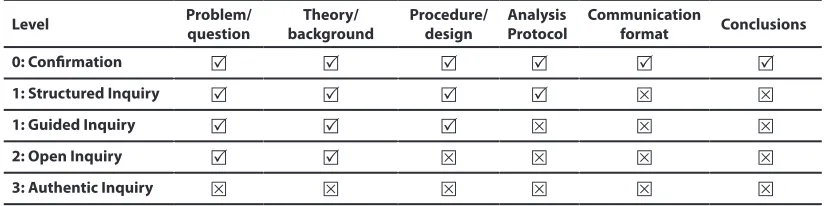
[image:5.536.61.469.369.449.2]Diferent authors have used the same terms to describe very diferent laboratory activities. Domin’s (1999) taxonomy of laboratory teaching styles (Table 1) provides some clarity through a classiication of activities based on approach, procedure, and outcome. Fay et al. (2007) and Buck et al. (2008) have added to this by breaking down the inquiry domain into diferent levels of inquiry (Table 2). There is some overlap between the two classifcations: Domin’s expository style matches the conirmation style (inquiry level 0), and his inquiry style encompasses structured to authentic inquiry (inquiry levels 1–3). The discovery style can also be thought of as guided inquiry (inquiry level 1) because the classiication in Table 2 does not consider whether the outcome has been predetermined or not. Authentic inquiry, inquiry level 3 is seen in scientiic research where theory is used to develop experiments that allow development of new theory. This chapter uses the descriptive terms from Tables 1 and 2 to describe diferent laboratory activities.
Table 1: Taxonomy of laboratory instruction styles (Domin, 1999)
Outcome Approach Procedure
Expository Predetermined Deductive† Given
Inquiry Unknown Inductive‡ Student generated
Discovery Predetermined Inductive Given
Problem-based Predetermined Deductive Student generated
†Deductive approach: students use specific examples of a phenomenon to illustrate an underlying principle. ‡Inductive approach: students develop an understanding of an underlying principle by studying a specific example
of a phenomenon.
Table 2: A classiication of experiment by level and type of inquiry (Fay et al., 2007; Buck et al., 2008) based on what is () and is not () provided to students
Level Problem/
question
Theory/ background
Procedure/ design
Analysis Protocol
Communication
format Conclusions
0: Conirmation
1: Structured Inquiry
1: Guided Inquiry
2: Open Inquiry
[image:5.536.62.474.526.629.2]Developing student expertise in scientiic inquiry
The conirmation instruction style
The conirmation or expository instruction style, inquiry level 0, is also called veriication, recipe-following, or cook-book work. These terms describe activities where students follow detailed instructions to practice laboratory techniques and reproduce theoretical phenomena taught in lectures. The conirmation style presents the laboratory as being subservient to theory and science as “a body of information which is (and can be) veriied and certain” (Kirschner, 1992). In conirmation laboratories, students are typically not given the opportunity to develop expertise in scientiic inquiry. Criticisms of the conirmation style are not new (e.g. Wham, 1977) and almost all papers written about this style highlight its laws. The published criticisms include the following:
• Scientiic inquiry is a complex procedure and the principles of the scientiic method cannot be learned “by osmosis”, students need to be taught how it is done (Garratt and Tomlinson, 2001);
• Applying set algorithms to solve problems is not really problem solving (Bodner, 2003);
• “Critical, independent, creative thinking is rarely expected or encouraged” or possible (Stewart and Lagowski, 2003);
• Students learn to ask “what is the answer supposed to be?” rather than “what is the answer?” (Allen et al., 1986);
• This type of practical often leads to “boredom and apathy towards scientiic work” (Kirschner, 1992);
• Exercises can be performed with little preparation and engagement by students (Domin, 1999; 2007);
• The goals the students have for their laboratory work (inishing early, avoiding mistakes) are diferent to the pedagogic aims and intended learning outcomes of the work (DeKorver and Towns, 2015) hence these are not achieved (Hofstein and Lunetta, 2004; Abraham, 2011);
• Students do the majority of their learning after the practical session when they set about completing post-laboratory assignments (Domin, 2007).
To sum up, conirmation exercises require low levels of cognitive engagement. Students are not involved in experiment planning or design so the laboratory is an unrealistic portrayal of scientiic inquiry. There are low levels of student engagement, and little creative, critical or independent thinking is required. Relatively little learning occurs, because students spend their time determining whether they have the correct answer instead of thinking more deeply about what they are doing. The work lacks relevance to real life. Nonetheless, the conirmation style of laboratory teaching persists.
Some educators have pragmatic reasons for adopting the conirmation instruction style which are rooted in predictability. Where a procedure and outcome is known in advance, the practical exercise is easy to plan for and can make the most of available resources. Inquiry-style work is inherently less predictable and activities can be limited by the availability of equipment or chemicals (Seery et al., 2019; Tsaparlis and Gorezi, 2007). Inquiry-style work also needs greater teaching support compared to conirmation instruction (between 2–10 students per instructor (Tsarparlis and Gorezi, 2007; Keller and Kendal, 2017) compared to 40 students per class (Cheung, 2011)). These factors can make large enough barriers to implementation to dissuade teachers from inquiry laboratories (Cheung, 2011).
concepts and they can struggle to apply knowledge outside of the context of the inquiry or problem (Kirschner et al., 2006).
Educators acknowledging the laws in the conirmation style have tried diferent strategies to improve on it. One approach is to use social interaction to enhance learning in laboratories, by embedding questions in the laboratory instructions (Cox and Junkin, 2002) or using an argument-driven inquiry (ADI) instructional model involving critique and peer-feedback of data-interpretation (Walker et al., 2011). Another approach is to reduce the high cognitive load associated with laboratory work (Johnstone et al., 1994; Kirschner
et al., 2006; Reid and Shah, 2007; Reid, 2008) for example through carefully planned prelaboratory tasks (see Agustian and Seery, 2017, for a review), dedicated skills enhancement sessions (Sedwick et al., 2018), or experimental seminars for discussion, comparison, reasoning and modelling of results (Kirschner, 1992). Recontextualising knowledge where a subject is deeply fragmented is diicult (Luckett, 2009) and reducing the cognitive load associated with recontextualisation can be achieved when each exercise is presented in the same way (cf. Hall and Vardar-Ulu, 2013). However, reducing the cognitive load does not prevent a typical student reverting to recipe-following where it is the quickest way of completing set tasks (DeKorver and Towns, 2015).
Alternatives to the conirmation instruction style
The nature of the activities, the expectations of those involved, and the nature of the assessment all impact on the learning environment in the laboratory (Hofstein and Lunetta, 2004) and learning a process like the scientiic method is best done through practice (Abraham, 2011). “To change the experience, you don’t need to change the experiment, just what you do with it” (quoted in Reid and Shah, 2007). For example, conirmation exercises can be reworked as problem-based or guided inquiry tasks (see for example McGarvey, 2004; Allen et al., 1986; Mohrig et al., 2007). Problem-based learning (PBL) is a subset of context-based learning in which learning occurs through the solving of a problem (Smith, 2012; Overton, 2007). Students plan an experiment in order to solve the problem and learn about an aspect of the experiment (McGarvey, 2004) and they engage better in PBL mini-projects than in conirmation laboratory classes (Mc Donnell et al., 2007). As noted above, downside to this style is that the learning can be so entwined with the context or problem that students struggle to apply the ideas in a diferent context (Kirschner et al., 2006).
Inquiry-based learning provides opportunities for students to engage meaningfully in scientiic investigation (Hofstein and Lunetta, 2004). Students can “discover” and explore a phenomenon for themselves through laboratory work (Albright and Beussman, 2017; Bodner et al., 1998; Kulevich et al., 2014) with lectures on principles occurring afterwards (Abraham, 2011; Allen et al., 1986). Resources are easier to plan for where procedures are given or predictable (Seery et al., 2019) such as in lower levels of inquiry work. These exercises have better student outcomes and better student feedback than conirmation exercises (see for example Chatterjee et al., 2009; Sedwick et al., 2018). Spreading the inquiry over several weeks allows time for risk assessment and chemical and equipment purchase enabling students to engage in authentic inquiry (Quattrucci, 2018).
Scafolding the stages of inquiry guides students through unfamiliar processes, reducing cognitive load, helping students perform better (Morgan and Brooks, 2012), and enabling them to engage in inquiry work (Quattrucci, 2018). Scafolding is important because switching from conirmation exercises to inquiry work can be diicult for students (Hall and Vardar-Ulu, 2013; Bruck and Towns, 2009).Examples of scafolding include thoughtfully-designed simulations that guide student inquiry of a concept (Moore
Developing student expertise in scientiic inquiry
Methods
The university where I work has a strong research identity which shapes its teaching. The expectation is that students will end their third year laboratory modules “research-ready” and equipped to undertake a masters-level research project. In the irst and second year, students on all chemistry degree programmes follow a programme of conirmation exercises with little in the way of open-ended experiments. They complete a set of exercises in inorganic, organic, or physical chemistry laboratories, before rotating onto the next. There are typically 50 students in the laboratory with one academic and two or three postgraduate laboratory teachers as well as a technician. This work is set in the second year inorganic chemistry laboratory where students spend ive weeks before moving on.
My aim is to develop students’ inquiry skills so that they are ready for open-ended experimentation and research work in their inal year. A curriculum is made up of three distinct components: knowledge, skills, and subject-related attributes (Barnett, 2009; Barnett et al., 2001). I used this as a lens to analyse my laboratory curriculum and found that the emphasis fell strongly on chemistry knowledge. The majority of exercises allowed students to follow recipes without much thought. The skills and attributes students were developing focussed on survival and inishing the work in the allotted time rather than those desirable in a chemist. My laboratory course was, therefore, not helping students become “research-ready”.
My work has looked at building inquiry into the teaching laboratory within and alongside the existing conirmation style of instruction, without large cost implications. My irst attempts tried experiments with unknown outcomes. Students were given written instructions but no extra support. The work they produced showed they were unable to experiment instead they were anticipating a correct answer and had not engaged with the inquiry. Hall and Vardar-Ulu (2013) noted this too and Bruck and Towns (2009) highlight the diiculty students have in changing from conirmation to inquiry work. This chapter descibes observations from two subsequent attempts. A third attempt introducing open inquiry is described in detail in Burnham (2013). These studies were granted ethical approval in accordance with institution guidelines.
Presentation and Discussion of Findings
Reworking conirmation exercises as guided inquiry
required tasks. The pre-laboratory assignment focus was conirmed as being on the laboratory work rather than the underlying chemistry. In the laboratory, students talked to each other about what they were doing and they also asked the postgraduate laboratory teachers for help with the tasks. Students thought about the chemistry when prompted by the questions in the text or discussion with postgraduates, and postgraduates helped the students understand the chemistry they were doing. The post-laboratory assignment helped students understand what they had done. When posed with the question “To what extent do you understand the investigation having done the prelaboratory, the laboratory, and the postlab?”, 21% of respondents replied completely, 53% quite a lot and 26% somewhat or not really.
[image:9.536.53.487.79.368.2]The aim or research question highlighted to students the point of what they were doing and the majority understood the investigation by the end of the postlaboratory. Similarly to the conirmation exercises investigated by Domin (2007), the post-laboratory assignment helped the students understand what they had done. Including in-text questions and in-laboratory discussion helped the students understand what they were doing just as in the indings of Cox and Junkin (2002) and the question driven pedagogy of Teixeira et al., (2010). Students generally understood the point of what they were doing with respect to the aim of the work, but their understanding was less outside of set tasks. Some students were interested in the chemistry they were doing whereas others were satisied with cutting corners providing they completed the required activities. Learning was therefore prompted by the required activities, and despite the intent for students to engage in inquiry in the laboratory, the evidence suggested students were doing the laboratory rather than engaging with it.
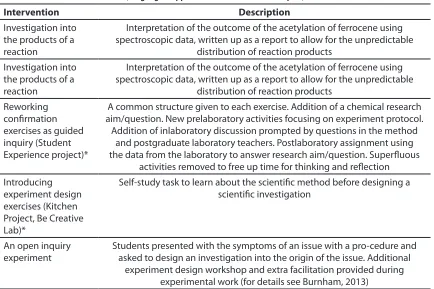
Table 3: Interventions introduced to develop student expertise in inquiry (* highlights approaches discussed in this chapter)
Intervention Description
Investigation into the products of a reaction
Interpretation of the outcome of the acetylation of ferrocene using spectroscopic data, written up as a report to allow for the unpredictable
distribution of reaction products Investigation into
the products of a reaction
Interpretation of the outcome of the acetylation of ferrocene using spectroscopic data, written up as a report to allow for the unpredictable
distribution of reaction products Reworking
conirmation exercises as guided inquiry (Student Experience project)*
A common structure given to each exercise. Addition of a chemical research aim/question. New prelaboratory activities focusing on experiment protocol.
Addition of inlaboratory discussion prompted by questions in the method and postgraduate laboratory teachers. Postlaboratory assignment using the data from the laboratory to answer research aim/question. Superluous
activities removed to free up time for thinking and relection Introducing
experiment design exercises (Kitchen Project, Be Creative Lab)*
Self-study task to learn about the scientiic method before designing a scientiic investigation
An open inquiry experiment
Students presented with the symptoms of an issue with a pro-cedure and asked to design an investigation into the origin of the issue. Additional
Developing student expertise in scientiic inquiry
A strong theme was that they found these laboratory classes stressful. The stress was linked to the need to complete set tasks within a given time frame. Students highlighted irritating behaviours in others that impeded their progress in the laboratory and they felt under pressure when doing write-ups.This stress was present even though, on average, 90% of students inished and left the laboratory before the end of the allotted time. The student researcher suggested that inishing early was viewed as luck, not as a reward for being eicient. Postgraduates who had done the previous course noted a more relaxed atmosphere in the reworked sessions, however, the extra time to complete the activities appeared to have gone unnoticed by the students.
[image:10.536.53.485.259.446.2]The focus on an aim or research question was successful in imparting to students an awareness of the chemical purpose of each exercise, but students in the reworked guided inquiry laboratory were still recipe-following. This is unsurprising since DeKorver and Towns (2015) highlight that students will adopt the most straightforward approach in the laboratory. Students wanted feedback that explains where marks were lost, suggesting they were more concerned with individual assessments than the inquiry theme of the course.
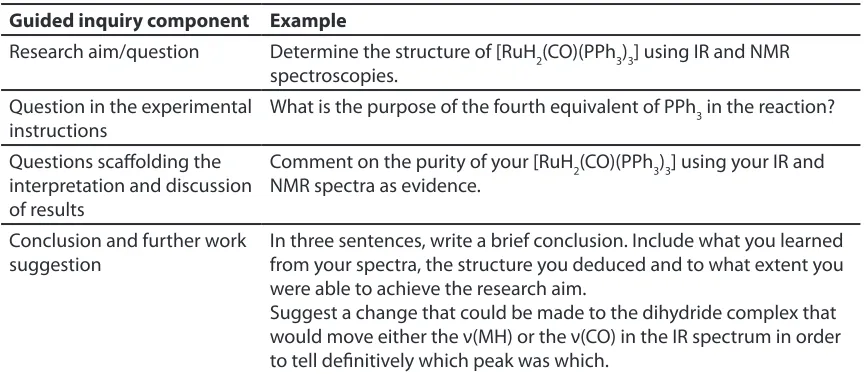
Table 4: The guided inquiry scafolding used in an experiment by Armstrong et al. (2017)
Guided inquiry component Example
Research aim/question Determine the structure of [RuH2(CO)(PPh3)3] using IR and NMR spectroscopies.
Question in the experimental instructions
What is the purpose of the fourth equivalent of PPh3 in the reaction?
Questions scafolding the interpretation and discussion of results
Comment on the purity of your [RuH2(CO)(PPh3)3] using your IR and NMR spectra as evidence.
Conclusion and further work suggestion
In three sentences, write a brief conclusion. Include what you learned from your spectra, the structure you deduced and to what extent you were able to achieve the research aim.
Suggest a change that could be made to the dihydride complex that would move either the ν(MH) or the ν(CO) in the IR spectrum in order to tell deinitively which peak was which.
Introducing experiment design exercises
The purpose of the preparatory scientiic method tasks was to lead students into designing experiments without extra teaching. The research question “what is the efectiveness of the scientiic method task in planning and reporting an experiment?” was used to design a simple evaluation of the interventions. Data from the Kitchen Project showed that all students had engaged with the scientiic method task and subsequent small group discussion with a tutor. Data from the BCL indicated that students interpreted the scientiic method task in diferent ways. There was no correlation between the amount of the scientiic method task done and the quality of the Kitchen Project investigations. This suggests that the group discussion was useful in smoothing-out the diferences between those who were very well prepared and those who had achieved less. The varied interpretations of the scientiic method task in the BCL indicates that a tutor-facilitated discussion of the task is essential in ensuring all students have had the opportunity to meet the required learning outcomes before proceeding to an experiment design task.
Tutor assistance was found to be necessary to help students identify experiment variables in both the Kitchen Project and the BCL. Experiment designs were not uniform in quality. Although some showed awareness of the importance of repetition of measurements to get accurate and precise results, others were much less structured. Students in the Kitchen Project had completed the guided inquiry laboratory programme the year before, but their need for help showed that the guided inquiry programme and the scientiic method task had not prepared them to be able to design an experiment unassisted. This agrees with the inding from Garratt and Tomlinson (2001) that experiment design needs to be taught.
In general, students who spent more time researching, preparing and planning their experiment did better quality investigations. These students had the same background as the students in my unsuccessful attempts to introduce inquiry, which shows that any student has the potential to do good quality experimental work if given the right support. The beneits of inquiry work can extend several years after the intervention (Szteinberg and Weaver, 2013). A Kitchen Project participant with prior experience of intensively-supported experiment design found that the scientiic method task merely reinforced what they already knew.
The BCL students appreciated the opportunity of doing some experiment design. It is noteworthy that they wanted more experiment design, earlier in their degree course. This discrepancy may be the root of the wish of graduates that more experiment design had been included in their degree courses (Hanson and Overton, 2010).
Practical implications and adaptability
Scientiic inquiry can be presented with diferent amounts of structure. Where resources are stretched, structured or guided inquiry scafolding can be added to conirmation exercises to give them a sense of purpose.Tasking students to learn about the scientiic method can feed into a class discussion of this before they set about designing and executing an experiment. Conirmation exercises can be transformed into open inquiry, problem-based inquiry, or authentic inquiry, where students set their own aims, design and realise an experiment, and analyse the resulting data.
Developing student expertise in scientiic inquiry
and suitable scafolding of learning tasks to embed knowledge so that it can be applied outside of the inquiry context. There is a wealth of advice in the literature to be considered when implementing inquiry into the curriculum. Examples are given in Table 5 and you should consider the following when planning inquiry style instruction:
• Ensure the students have a good theoretical knowledge base before starting laboratory work (but not the answers their experiments will give, Bruck and Towns, 2009) and consider introducing new techniques separately in skills-based laboratory classes (Sedwick et al., 2018) or training sessions (Ford et al., 2008);
• Good facilitation is necessary because students who are familiar with one type of experiment will assume that all experiment work is the same unless they are made to see otherwise (Mohrig et al., 2007);
• Help students develop reasonable expectations of the success (or lack of ) of inquiry work (Bruck and Towns, 2009). Using errors arising from real-life experimental work provides excellent learning opportunities about dealing with poor data (Davis et al., 2017);
• Tailor the scafolding to the experience-level of the student because, although novice students beneit from strongly-guided learning activities, these can disadvantage more experienced students who have developed their own ways of doing things (Kirschner et al., 2006);
• Ease students into inquiry by incrementally increasing the amount of freedom they are given (Bruck and Towns, 2009). Introduce a learning stage before the experience stage (Wham, 1977) so that students can perform a trial run on a model system before doing the actual experiment (Newton et al., 2006);
• The experiment design process should be scafolded and facilitated (Etkina et al., 2010) and can be introduced outside of laboratory work (as with Iimoto and Frederick, 2011; Jones, 2011).
It is important to get buy-in to an inquiry-style of instruction from all participants; students, teaching assistants and staf. Students need to understand the purpose of the inquiry work they are being asked to do. They show a preference for a more structured level of inquiry if a topic is perceived to be diicult (Basey and Francis, 2011). They believe they learn more and get higher grades in guided inquiry than in open inquiry experiments (Chatterjee et al., 2009) but they may beneit from activities that they have not liked (Sandi-Urena and co-workers, 2011). Basey and Francis (2011) noted that some teaching assistants facilitated an open inquiry laboratory in the manner of a guided inquiry laboratory.Professional development activities can assist teaching assistants to develop as facilitators rather than disseminators of knowledge (Wheeler et al., 2017a; 2017b). Colleagues need convincing that barriers to implementation are not insurmountable (Cheung, 2011). Student-directed project work is accompanied by signiicant demands on chemical, equipment, and teaching resources (Keller and Kendall, 2017) which can be optimised where activities are predictable (Domin, 1999). However, changing even one activity can beneit students (Cacciatore and Sevian, 2009). In addition, changes increase engagement with laboratory work (Mc Donnell et al., 2007) and the positive beneits extend for several years afterwards (Szteinberg and Weaver, 2013).
Conclusions
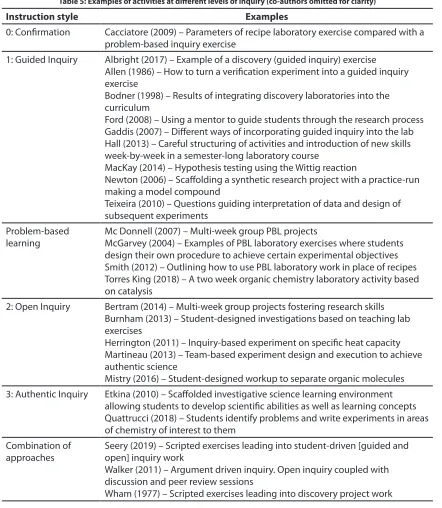
Table 5: Examples of activities at diferent levels of inquiry (co-authors omitted for clarity)
Instruction style Examples
0: Conirmation Cacciatore (2009) – Parameters of recipe laboratory exercise compared with a problem-based inquiry exercise
1: Guided Inquiry Albright (2017) – Example of a discovery (guided inquiry) exercise Allen (1986) – How to turn a veriication experiment into a guided inquiry exercise
Bodner (1998) – Results of integrating discovery laboratories into the curriculum
Ford (2008) – Using a mentor to guide students through the research process Gaddis (2007) – Diferent ways of incorporating guided inquiry into the lab Hall (2013) – Careful structuring of activities and introduction of new skills week-by-week in a semester-long laboratory course
MacKay (2014) – Hypothesis testing using the Wittig reaction
Newton (2006) – Scafolding a synthetic research project with a practice-run making a model compound
Teixeira (2010) – Questions guiding interpretation of data and design of subsequent experiments
Problem-based learning
Mc Donnell (2007) – Multi-week group PBL projects
McGarvey (2004) – Examples of PBL laboratory exercises where students design their own procedure to achieve certain experimental objectives Smith (2012) – Outlining how to use PBL laboratory work in place of recipes Torres King (2018) – A two week organic chemistry laboratory activity based on catalysis
2: Open Inquiry Bertram (2014) – Multi-week group projects fostering research skills Burnham (2013) – Student-designed investigations based on teaching lab exercises
Herrington (2011) – Inquiry-based experiment on speciic heat capacity Martineau (2013) – Team-based experiment design and execution to achieve authentic science
Mistry (2016) – Student-designed workup to separate organic molecules 3: Authentic Inquiry Etkina (2010) – Scafolded investigative science learning environment
allowing students to develop scientiic abilities as well as learning concepts Quattrucci (2018) – Students identify problems and write experiments in areas of chemistry of interest to them
Combination of approaches
Seery (2019) – Scripted exercises leading into student-driven [guided and open] inquiry work
Walker (2011) – Argument driven inquiry. Open inquiry coupled with discussion and peer review sessions
Developing student expertise in scientiic inquiry
the student will be familiar with scientiic inquiry and experiment design and will therefore be a more active contributor to their project. My results show the importance of good facilitation when students design an experiment of their own, therefore, investment in teaching resource must be made in order to realise learning outcomes associated with developing expertise as a researcher. The role of developing students’ scientiic inquiry skills does not need to be conined to the laboratory, but it is in the laboratory where the beneits will ultimately be felt.
Acknowledgements
Data and insight in the Student Experience project was gathered by Dorothy Robertson, an MChem research project student.
References
Abraham, M. R. (2011), “What can be learned from laboratory activities? Revisiting 32 years of research”, Journal of Chemical Education, Vol. 88 No. 8, pp. 1020-1025.
Albright, J. C. and Beussman, D. J. (2017), “Capillary zone electrophoresis for the analysis of peptides: Fostering students’ problem-solving and discovery learning in an undergraduate laboratory experiment”, Journal of Chemical Education, Vol. 94 No. 3, pp. 361-366.
Allen, J. B., Barker, L. N. and Ramsden, J. H. (1986), “Guided inquiry laboratory”, Journal of Chemical Education, Vol. 63 No. 6, pp. 533-534.
Agustian, H. Y. and Seery, M. K. (2017), “Reasserting the role of pre-laboratory activities in chemistry education: a proposed framework for their design”, Chemistry Education Research and Practice, Vol. 18 No. 4, pp. 518-532.
Armstrong, C., Burnham, J. A. J. and Warminski, E. E. (2017), “Combining sustainable synthesis of a versatile ruthenium dihydride complex with structure determination using group theory and spectroscopy”,
Journal of Chemical Education, Vol. 94 No. 7, pp. 928-931.
Barnett, R., Parry, G. and Coate, K. (2001), “Conceptualizing curriculum change”, Teaching in Higher Education, Vol. 6 No. 4, pp. 435-449.
Barnett, R. (2009), “Knowing and becoming in the higher education curriculum”, Studies in Higher Education, Vol. 34 No. 4, pp. 429-440.
Basey, J. M. and Francis, C. D. (2011), Design of inquiry-orientated science labs: impacts on students’ attitudes,
Research in Science & Technological Education, 29(3), 241-255.
Bertram, A., Davies, E. S., Denton, R., Fray, M. J., Galloway, K. W., George, M. W., Reid, K. L., Thomas, N. R. and Wright, R. R. (2014), “From cook to chef: Facilitating the transition from recipe-driven to open-ended research-based undergraduate chemistry laboratory activities”, New Directions in the Teaching of Physical Sciences, Vol. 10 No. 1, pp. 26-31.
Bodner, G. M. (2003), “Problem solving: the difference between what we do and what we tell students to do”,
University Chemistry Education, Vol. 7, pp. 37-45.
Bodner, G. M. (2004), “Twenty Years of Learning: How To Do Research in Chemical Education. 2003 George C. Pimentel Award”, Journal of Chemical Education, Vol. 81 No. 5, pp. 618-625.
Bodner, G. M., Hunter, W. J. F. and Lamba, R. S. (1998), “What happens when discovery laboratories are integrated into the curriculum at a large research university?”, The Chemical Educator, Vol. 3 No. 3, pp. 1-21.
Bruck, L. B. and Towns, M. H. (2009), “Preparing students to benefit from inquiry-based activities in the chemistry laboratory: Guidelines and suggestions”, Journal of Chemical Education, Vol. 86 No. 7, pp. 820-822. Buck, L. B., Bretz, S. L. and Towns, M. H. (2008), “Characterising the level of inquiry in the undergraduate laboratory”,
Burnham, J. A. J. (2013), “Opportunistic use of students for solving laboratory problems: Twelve heads are better than one”, New Directions in the Teaching of Physical Sciences, Vol. 9, pp. 42-48.
Cacciatore, K. L. and Sevian, H. (2009), “Incrementally approaching an inquiry laboratory curriculum: Can changing a single laboratory experiment improve student performance in general chemistry?”, Journal of Chemical Education, Vol. 86 No. 4, pp. 498-505.
Chatterjee, S., Williamson, V. M., McCann, K. and Peck, M. L. (2009), “Surveying students’ attitudes and perceptions towards guided-inquiry and open-inquiry laboratories”, Journal of Chemical Education, Vol. 86 No. 12, pp. 1427-1432.
Cheung, D. (2011), “Teacher beliefs about implementing guided-inquiry laboratory experiments for secondary school chemistry”, Journal of Chemical Education, Vol. 88 No. 11, pp. 1462-1468.
Cox, A. J. and Junkin III, W. F. (2002), “Enhanced student learning in the introductory physics laboratory”, Physics Education, Vol. 37 No. 1, pp. 37-44.
Davis, E. J., Pauls, S. and Dick, J. (2017), “Project-based learning in undergraduate environmental chemistry laboratory: Using EPA methods to guide student method development for pesticide quantitation”,
Journal of Chemical Education, Vol. 94 No. 4, pp. 451-457.
DeKorver, B. K. and Towns, M. H. (2015), “General chemistry students’ goals for chemistry laboratory coursework”,
Journal of Chemical Education, Vol. 92 No. 12, pp., 2031-2037.
Domin, D. S. (1999), “A review of laboratory instruction styles”, Journal of Chemical Education, Vol. 76 No. 4, pp., 543-547.
Domin, D. S. (2007), “Students’ perceptions of when conceptual development occurs during laboratory instruction”, Chemistry Education Research and Practice, Vol. 8 No. 2, pp. 140-152.
Etkina, E., Karelina, A., Ruibal-Villasenor, M., Rosengrant, D., Jordan, R. and Hmelo-Silver, C. E. (2010), “Design and reflection help students develop scientific abilities: Learning in introductory physics laboratories”, The Journal of the Learning Sciences, Vol. 19 No. 1, pp. 54-98.
Fay, M. E., Grove, N. P., Towns, M. H. and Bretz, S. L. (2007), “A rubric to characterize inquiry in the undergraduate chemistry laboratory”, Chemistry Education Research and Practice, Vol. 8 No. 2, pp. 212-219.
Ford, J. R., Prudenté, C. and Newton, T. A. (2008), “A model for incorporating research into the first-year chemistry curriculum”, Journal of Chemical Education, Vol. 85 No. 7, pp. 929-933.
Gaddis, B. A. and Schoffstall, A. M. (2007), “Incorporating guided-inquiry learning into the organic chemistry laboratory”, Journal of Chemical Education, Vol. 84 No. 5, pp., 848-851.
Garratt, J. and Tomlinson, J. (2001), “Experiment design - can it be taught or learned?”, University Chemistry Education, Vol. 5 No. 2, pp. 74-79.
Hall, M. L. and Vardar-Ulu, D. (2013), “An inquiry-based biochemistry laboratory structure emphasizing competency in the scientific process: A guided approach with an electronic notebook format”, Biochemistry and Molecular Biology Education, Vol. 42 No. 1, pp. 58-67.
Hanson, S. and Overton, T. (2010), Skills required by new chemistry graduates and their development in degree programmes, Higher Education Academy UK Physical Sciences Centre, Hull, UK.
Herrington, D. G. (2011), “The heat is on: An inquiry-based investigation for specific heat”, Journal of Chemical Education, Vol. 88 No. 11, pp., 1558-1561.
Hofstein, A. and Lunetta, V. N. (1982), “The role of the laboratory in science teaching: neglected aspects of research”, Review of Educational Research, Vol. 52 No. 2, pp. 201-217.
Hofstein, A. and Lunetta, V. N. (2004), “The laboratory in science education: Foundations for the twenty-first century”, Science Education, Vol. 88 No. 1, pp. 28-54.
Iimoto, D. S. and Frederick, K. A. (2011), “Incorporating student-designed research projects in the chemistry curriculum”, Journal of Chemical Education, Vol. 88 No. 8, pp. 1069-1073.
Developing student expertise in scientiic inquiry
Jones, C. D. (2011), “The kitchen is your laboratory: A research-based term-paper assignment in a science writing course”, Journal of Chemical Education, Vol. 88 No. 8, pp. 1062-1068.
Keller, V. A. and Kendall, B. L. (2017), “Independent synthesis projects in the organic chemistry teaching laboratories: Bridging the gap between student and researcher”, Journal of Chemical Education, Vol. 94 No. 10, pp. 1450-1457.
Kirschner, P. A. (1992), “Epistemology, practical work and academic skills in science education”, Science & Education, Vol. 1 No. 3, pp. 273-299.
Kirschner, P. A., Sweller, J. and Clark, R. E. (2006), “Why minimal guidance during instruction does not work: An analysis of the failure of constructivist, discovery, problem-based, experiential, and inquiry-based teaching”, Educational Psychologist, Vol. 41 No. 2, pp. 75-86.
Kulevich, S. E., Herrick, R. S. and Mills, K. V. (2014), “A discovery chemistry experiment on buffers”, Journal of Chemical Education, Vol. 91 No. 8, pp. 1207-1211.
Luckett, K. (2009), “The relationship between knowledge structure and curriculum: A case study in sociology”,
Studies in Higher Education, Vol. 34 No. 4, pp. 441-453.
MacKay J. A. and Wetzel, N. R. (2014), “Exploring the Wittig Reaction: A collaborative guided-inquiry experiment for the organic chemistry laboratory”, Journal of Chemical Education, Vol. 91 No. 5, pp. 722-725.
Martineau, C., Traphagen, S. and Sparkes, T. C. (2013), “A guided inquiry methodology to achieve authentic science in a large undergraduate biology course”, Journal of Biological Education, Vol. 47 No. 4, pp. 240-245.
Mc Donnell, C., O’Connor, C. and Seery, M. K. (2007), “Developing practical chemistry skills by means of student-driven problem-based learning mini-projects”, Chemistry Education Research and Practice, Vol. 8 No. 2, pp. 130-139.
McGarvey, D. J. (2004), “Experimenting with undergraduate practicals”, University Chemistry Education, Vol. 8, pp. 58-65.
Mistry, N., Fitzpatrick, C. and Gorman, S. (2016), “Design your own workup: A guided-inquiry experiment for introductory organic laboratory courses”, Journal of Chemical Education, Vol. 93 No. 6, pp. 1091-1095. Mohrig, J. R., Hammond, C. N. and Colby, D. A. (2007), “On the successful use of inquiry-driven experiments in the
organic chemistry laboratory”, Journal of Chemical Education, Vol. 84 No. 6, pp. 992-998.
Moore, E. B., Herzog, T. A. and Perkins, K. K. (2013), “Interactive simulations as implicit support for guided-inquiry”,
Chemistry Education Research and Practice, Vol. 14 No. 3, pp. 257-268.
Morgan, K. and Brooks, D. W. (2012), “Investigating a method of scaffolding student-designed experiments”,
Journal of Science Education and Technology, Vol. 21 No. 4, pp. 513-522.
Newton, T. A., Tracy, H. J. and Prudenté, C. (2006), “A research-based laboratory course in organic chemistry”,
Journal of Chemical Education, Vol. 83 No. 12, pp. 1844-1849.
Overton, T. L. (2001), “Teaching chemists to think: From parrots to professionals”, University Chemistry Education, Vol. 5 No. 2, pp. 62-68.
Overton, T. L. (2007), “Context and problem-based learning”, New Directions in the Teaching of Physical Sciences, Vol. 3, pp. 7-12.
Quattrucci, J. G. (2018), “Problem-based approach to teaching advanced chemistry laboratories and developing students’ critical thinking skills”, Journal of Chemical Education, Vol. 95 No. 2, pp.259-266.
Reid, N. (2008), “A scientific approach to the teaching of chemistry”, Chemistry Education Research and Practice, Vol. 9 No. 1, pp. 51-59.
Reid, N. and Shah, I. (2007), “The role of laboratory work in university chemistry”, Chemistry Education Research and Practice, Vol. 8 No. 2, pp. 172-185.
Sedwick, V., Leal, A., Turner, D. and Kanu, A. B. (2018), “Quantitative determination of aluminium in deodorant brands: A guided inquiry learning experience in quantitative analysis laboratory”, Journal of Chemical Education, Vol. 95 No. 3, pp. 451-455.
Seery, M. K., Jones, A. B., Kew, W. and Mein, T. (2019) “Unfinished recipes: Structuring upper-division laboratory work to scaffold experimental design skills”, Journal of Chemical Education, Vol. 96 No. 1, pp. 53-59. Shane, J. W. (2007), “Hermeneutics and the meaning of understanding”, in Theoretical Frameworks for Research
in Chemistry/Science Education, Bodner, G. M., Orgill, M. Eds., Pearson Education Inc. Upper Saddle River, N.J. USA.
Smith, C. J. (2012), “Improving the school-to-university transition: using a problem-based approach to teach practical skills whilst simultaneously developing students’ independent study skills”, Chemistry Education Research and Practice, Vol. 13 No. 4, pp. 490-499.
Stewart, K. K. and Lagowski J. J. (2003), “Cognitive apprenticeship theory and graduate chemistry education”,
Journal of Chemical Education, Vol. 80 No. 12, pp. 1362-1366.
Szteinberg, G. A. and Weaver, G. C. (2013), “Participants’ reflections two and three years after an introductory chemistry course-embedded research experience”, Chemistry Education Research and Practice, Vol. 14 No. 1, pp. 23-35.
Teixeira, J. M., Nedrow Byers, J., Perez, M. G. and Holman, R. W. (2010), “The question-driven laboratory exercise: A new pedagogy applied to a green modification of Grignard reagent formation and reaction”, Journal of Chemical Education, Vol. 87 No. 7, pp. 714-716.
Torres King, J. H., Wang, H. and Yezierski, E. J. (2018), “Asymmetric aldol additions: A guided-inquiry laboratory activity on catalysis”, Journal of Chemical Education, Vol. 95 No. 1, pp. 158-163.
Tsaparlis, G. and Gorezi, M. (2007), “Addition of a project-based component to a conventional expository physical chemistry laboratory”, Journal of Chemical Education, Vol. 84 No. 4, pp. 668-670.
Walker, J. P., Sampson, V. and Zimmerman, C. O. (2011), “Argument-driven inquiry: An introduction to a new instructional model for use in undergraduate chemistry laboratories”, Journal of Chemical Education, Vol. 88 No. 8, pp. 1048-1056.
Wham, A. J. B. (1977), “The Nature of Practical Work at the Tertiary Level, in Research for the Classroom and Beyond”, A Report of the Chemical Society Education Division Symposium, University of Loughborough, July 1977, The Chemical Society, London.
Wheeler, L. B., Clark, C. P. and Grisham, C. M. (2017a), “Transforming a traditional laboratory to an inquiry-based course: Importance of training TAs when redesigning a curriculum”, Journal of Chemical Education, Vol. 94 No. 8, pp. 1019-1026.
Wheeler, L. B., Maeng, J. L. and Whitworth, B. A. (2017b), “Characterizing teaching assistants’ knowledge and beliefs following professional development activities within an inquiry-based general chemistry context”,
Journal of Chemical Education, Vol. 94 No. 1, pp. 19-28.