Verification and Reliability, 6 (2). pp. 61-82. ISSN 0960-0833 , This version is available at https://strathprints.strath.ac.uk/2673/
Strathprints is designed to allow users to access the research output of the University of Strathclyde. Unless otherwise explicitly stated on the manuscript, Copyright © and Moral Rights for the papers on this site are retained by the individual authors and/or other copyright owners. Please check the manuscript for details of any other licences that may have been applied. You may not engage in further distribution of the material for any profitmaking activities or any commercial gain. You may freely distribute both the url (https://strathprints.strath.ac.uk/) and the content of this paper for research or private study, educational, or not-for-profit purposes without prior permission or charge.
Macdonald, F. and Miller, J. and Brooks, A. and Roper, M. and Wood, M.
(1996) Applying inspection to object-oriented software. Software Testing,
Verification and Reliability, 6 (2). pp. 61-82. ISSN 0960-0833
http://eprints.cdlr.strath.ac.uk/2
673
/
This is an author-produced version of a paper published in Software Testing,
Verification and Reliability ISSN 0960-0833.
This version has been peer-reviewed, but does not include the
final publisher proof corrections, published layout, or pagination.
Strathprints is designed to allow users to access the research
output of the University of Strathclyde. Copyright © and Moral
Rights for the papers on this site are retained by the individual
authors and/or other copyright owners. Users may download
and/or print one copy of any article(s) in Strathprints to facilitate
their private study or for non-commercial research. You may not
engage in further distribution of the material or use it for any
profitmaking activities or any commercial gain. You may freely
distribute the url (
http://eprints.cdlr.strath.ac.uk
) of the Strathprints
website.
Any correspondence concerning this service should be sent to The
Applying Inspection to
Object-Oriented Software
by
F Macdonald, J Miller, A Brooks, M Roper and M Wood
Empirical Foundations of Computer Science (EFoCS)
Software
F Macdonald, J Miller, A Brooks, M Roper and M Wood
Empirical Foundations of Computer Science (EFoCS)
June 1995
Abstract
The benefits of the object-oriented paradigm are widely cited. At the same time, inspection
is deemed to be the most cost-effective means of detecting defects in software products.
Why then, is there no published experience, let alone quantitative data, on the application
of inspection to object-oriented systems? We describe the facilities of the object-oriented
paradigm and the issues that these raise when inspecting object-oriented code. Several
problems are caused by the disparity between the static code structure and its dynamic
runtime behaviour. The large number of small methods in object-oriented systems can
also cause problems. We then go on to describe three areas which may help mitigate
problems found. Firstly, the use of various programming methods may assist in making
object-oriented code easier to inspect. Secondly, improved program documentation can
help the inspector understand the code which is under inspection. Finally, tool support
can help the inspector to analyse the dynamic behaviour of the code. We conclude that
while both the object-oriented paradigm and inspection provide excellent benefits on their
own, combining the two may be a difficult exercise, requiring extensive support if it is to
be successful.
1
Introduction
The inspection process was first described by Michael Fagan in 1976 [8]. It is a
structured method for statically validating documents. A team consisting of the author
of the document, a moderator, a recorder, and a number of inspectors proceed to inspect
the document using a multi-stage process. The inspection starts with a period of
planning, where the participants are selected and materials prepared. The next stage
is the overview, where the group receive a briefing on the document under inspection.
During preparation, each member of the team individually becomes familiar with the
material and starts to gather defects. The preparation stage is then followed by the actual
inspection meeting, which involves the entire team. At this point the team categorise
each defect for type, class and severity and record it for the author to fix. This meeting
is followed by a period of rework, where the author addresses each defect. Finally, a
follow-up is carried out to ensure each defect has been addressed.
The benefits of inspection are widely known. In addition to Fagan’s papers
de-scribing his experiences [8, 9], there are many other favourable reports. For example,
Doolan [6] reports a 30 times return on investment for every hour devoted to inspections.
Russell [22] reports a similar return of 33 hours of maintenance saved for every hour of
inspection invested. Davis [5] indicates that inspection can cut development costs by
25 to 30 percent.
The last decade or so has seen an explosion in the use of object-oriented techniques,
with several new programming languages being developed to provide the facilities
required to implement object-oriented systems. One of the most popular is C++, a
hybrid object-oriented language developed from C by Bjarne Stroustrup [24]. Another
is Eiffel, developed by Bertrand Meyer [19]. The object-oriented paradigm provides
several new concepts. The most fundamental is the class, which encapsulates data and the methods used to access that data in one package. Similar to the use of ADTs
in traditional programming, classes provide a means to enforce data privacy. Classes
cannot be used directly, instead an instance of the class (an object) has to first be created. This is similar to declaration of a variable in a procedural programming
derived class. It allows an existing class to be reused, instead of coding the new class
from scratch, but also provides the means to add new facilities. Polymorphism is the ability of a declaration to refer to objects of more than one class, provided they are
related by a common base class. For example, if class B inherits from class A, wherever
a reference is made to an instance of class A, an instance of class B can be substituted.
This is allowed because an instance of class B will include all the properties of class A,
although it may also define further properties. Finally, the concept ofgenericityis the ability to design classes which can be parameterised with respect to type and operations,
so that, for example, we may have a generic stack class which can be instantiated to
perform stack operations with any type of object.
The object-oriented paradigm is generally perceived to provide several benefits.
Firstly, it provides the means for producing a good design. Classes provide a natural
way to encapsulate data, while also making the system very modular. Since a class
tends to be designed around a set of data and the functions associated with that data,
classes are usually highly cohesive, yet the coupling between them is weak. These are
usually deemed to be required properties of any good design. Another potentially major
benefit is code reuse [15], which occurs in two ways. Reuse within a system is achieved
through inheritance. Also, a good object-oriented system should produce classes which
can be reused in other systems. In fact, there is a major interest in producing reusable
libraries of classes. Generic classes are always good candidates for reuse. Yet another
quoted benefit is reduced maintenance effort. As the details of the implementation
of the class are kept hidden from the client, the maintainer is free to make changes
to the class internals, provided the interface is not changed. Similarly, inheritance,
along with polymorphism, reduces the maintenance need when extending the system.
Class functionality can easily be extended by subclassing, and these subclasses can then
be used wherever their parent class is already used. A final claim of object-oriented
programming is that it is more natural [2]. This is due to its data-centred nature. The
system is built by modelling an abstraction of the real world, with everything based on
real objects.
Given that inspection is supposedly the most cost-effective means of finding defects,
is little, if any, work on inspecting object-oriented code, as indicated by Jones [12] and
supported by our own search of the literature. In this paper we will describe some of the
issues in applying inspection to object-oriented software, and some of the techniques
that may be applicable in improving the effectiveness of such inspection.
The rest of this paper is organised as follows. Section 2 describes existing work
which has relevance to inspection of object-oriented software: this includes testing and
maintenance of object-oriented software. Section 3 is devoted to providing examples
of the difficulties that can be found in inspecting object-oriented code. We provide
examples in both a pure object-oriented language (Eiffel) and a hybrid language (C++).
Between them, these two languages demonstrate almost all the features available in
any object-oriented programming language. Section 4 describes some of the
tech-niques which can be applied to help reduce these difficulties. Section 5 contains our
2
Related Work
As indicated in the introduction, there is no published experience on applying inspection
to object-oriented software. However, there has been other work on object-oriented
systems which has relevance to inspection. Here we describe testing and maintenance
of object-oriented software, as well as program understanding. We also describe some
qualities of object-oriented code that may be subject to inspection.
2.1
Testing Object-Oriented Software
One area that has relevance to the inspection of object-oriented software is that of
testing. For example, J¨uttner et al. [13] describe some of the problems that object-oriented systems can present for integration testing. Since object-object-oriented software is
characterised by objects and classes which interact using message passing, inheritance
and using relationships, integration testing requires a different approach to that used for
procedural software, where the system consists of modules linked by function calls and
common data. In fact, according to J¨uttneret al. [13], the relationships within object-oriented code are much more intense than those in procedural software, which blurs
the distinction between class and integration testing, as compared with the equivalent
module and integration testing of procedural systems. Furthermore, there is no simple
hierarchical system structure to which a systematic testing strategy can be applied.
Some of the difficulties found when testing object-oriented software are as follows
[13]. Inheritance poses a difficulty for class testing. Although it is reasonable to expect
that a class may be tested in isolation, the use of inheritance may mean there are hidden
interactions between inherited code and the new class. Therefore, both the old and
new methods, along with their interactions, must be tested. There is also a problem in
trying to trace control flow. The code for each class in no way describes the order in
which the methods may be called. This is compounded by polymorphism and dynamic
binding, which precludes the static prediction of which methods will actually be called
at runtime. Stubbing is also made more difficult, due to a combination of the different
Finally, the use of short methods moves the complexity from method bodies to the
interactions between them. Again, when combined with polymorphism and dynamic
binding, this results in complex interactions which hinder testing.
Although inspection is affected by the same features that make testing of
object-oriented code more difficult, inspection is fundamentally different from testing in that
the code is never actually run while under scrutiny. Instead, inspection is a form of
static analysis where the key task is understanding the code to discover defects in the
program logic. This static nature of inspection has implications for object-oriented
code, especially where such features as polymorphism and genericity, which depend on
the dynamic behaviour of the code, are concerned. When these features are used, the
dynamic structure of the system is very different to the static structure defined by the
source code. In fact, the problems that this creates for inspection are not dissimilar to
those found when trying to understand object-oriented code to perform maintenance.
2.2
Maintaining Object-Oriented Software
Wilde et al. [27] describe two prerequisites for successful maintenance. First of all the system has to be easy to change. This is a prime goal of the object-oriented
paradigm, and is achieved, to some degree, by the encapsulation mechanism of the
class. The second requirement is an in-depth understanding of the software which is
being maintained. In both this paper and an earlier paper by Wilde and Huitt [26], the
authors describe the problems that object-oriented software pose for maintenance.
The first problem described by Wilde et al. [27] is the tracing of dependencies in a system which makes use of inheritance. The method being examined may not only
be used with the class it is declared in, but also with any subclasses which may inherit
from this class. Similarly, any declarations referred to may exist in this class or in
some superclass. The severity of this problem depends on the depth of the inheritance
hierarchy. There is also a problem where the system contains a large number of small
methods. For example, in one Smalltalk system described, of the 450 methods present,
over 80% consisted of two lines or less [27]. The large number of methods increases
by the maintainer to ensure the correctness of any changes made. It may also be the
case that what is considered to be a single unit of functionality in a procedural program
is spread over several classes in an object-oriented system. To understand one piece of
functionality then requires the study of several classes and their interactions.
Wilde and Huitt’s earlier paper describes some additional issues [26]. The use of
polymorphism and dynamic binding prevent the exact method invocation from being
predicted statically. Instead, the maintainer has a set of methods, any one of which
may be invoked. It is therefore more difficult to identify dependencies within the
system. There is also a problem when the maintainer becomes familiar with one or
two versions of a method. This may lead to the assumption that all versions of that
method have the same behaviour, when in fact each method has a slightly different
behaviour. Furthermore, there may be far more possible dependencies within an
object-oriented system than within a procedural system. All of these problems hinder the
program understanding task which the maintainer must perform to undertake a correct
modification to the system.
2.3
Delocalised Plans and Program Understanding
In addition to work on object-oriented systems, some work on understanding procedural
systems has relevance. For example, Soloway et al. [23] describe a problem that is found in trying to understand procedural programs which is equally applicable to
object-oriented systems, referred to as the presence of “delocalised plans”. A delocalised plan
is defined as being when “pieces of code that are conceptually related are physically
located in non-contiguous parts of the program”. The large number of small methods
found in object-oriented systems may mean they contain many of these delocalised
plans. Soloway and his colleagues describe two studies they performed. The first used
professional programmers from the Jet Propulsion Laboratory to study the design of
software documentation for maintenance (this is also described in an earlier work by two
of the authors [17]). The second study involved protocol analysis of a code inspection
performed at IBM.
understanding: micro-strategies, which were used when trying to understand lines of
code, and macro-strategies, which were used at a higher level. A typical micro-strategy
used was an “Inquiry Episode”. Here, the subjects followed a pattern consisting of
several steps: read some code, ask a question about it, form a conjecture, perform a
search for confirmation, then come to some answer. These inquiry episodes are triggered
when a subject comes across a delocalised plan. However, in object-oriented code the
vital step of searching for confirmation may be hard, because methods tend to be more
distributed. This is complicated by the use of inheritance and polymorphism, as will be
described later.
Solowayet al. also identified two types of macro-strategies. A systematic strategy involved the programmer trying to understand the entire program, while an as-needed
strategy was used by programmers wishing only to understand the portion necessary to
implement a change. For inspection, the systematic strategy may be the most
appropri-ate, since the inspector must understand all the code to evaluate it for defects. However,
as the authors point out, a systematic strategy can only be applied to small programs.
The complexity and size of larger systems prevent anyone from understanding the entire
system (in reasonable time), and so there must be some means of splitting the system
into logically cohesive, but independent units.
Finally, the authors also demonstrate that program understanding is crucial to
in-spection. In their study of code inspection meetings, they found that 34% of the time
was spent on achieving clarity of the code. The more complex the code is, the longer
it takes to understand. Since object-oriented systems tend to consist of large numbers
of interactions such as message passing and inheritance, this may make them harder
to understand and therefore more time-consuming to inspect. Object-oriented systems
shift the complexity from method bodies to the interactions between them [13].
2.4
Inspecting for Quality
In addition to inspecting for defects in the code, where ‘defect’ roughly equates to
‘bug’, there are other qualities which code can be inspected for. Fagan [9] indicates
obvious that we require code of good quality, and while many people feel that they can
differentiate between low quality and high quality code, it is difficult to define such an
attribute. One attempt to define quality for object-oriented code is the “Law of Demeter”
[16], a style rule for the construction of methods which minimises the number of objects
which a method can send messages to. The authors start by defining an acquaintance
class as a class which is not an argument or instance variable of a method, but which
supplies a method used in this method. A preferred acquaintance class is a class of
global variables used in the method or a class of objects created within the method.
A method’s preferred supplier classes are either preferred acquaintance classes or an
instance variable or argument class of this method. The Law of Demeter then has
two forms. The first is the class form, which has two versions. The minimisation
version states “Minimise the number of acquaintance classes over all methods.” The
strict version states “All methods may have only preferred supplier classes.” The
object form of the law states “All methods may have only preferred-supplier objects,”
where preferred-supplier objects are argument variables, the current object and any
subparts of the current object, any directly created objects or any global objects. These
laws restrict object communication and are intended to reduce dependencies between
classes, promoting maintainability and understandability. While it is the programmer’s
responsibility to apply the Law of Demeter, a compiler can be used to enforce the class
form’s strict version. The object version is more difficult, however, and cannot be
enforced at compile time. Currently, the only technique which may be used to check
for its use is inspection, but it may be difficult to inspect large amounts of code for
compliance with the law. Every method must be checked for its use by classifying
all objects used within that method. With large systems, this is time-consuming and
error-prone. Other indicators of code quality have similar problems.
Another quality which object-oriented code can be inspected for is reusability. Over
the last ten years, there has been increasing interest in the area of object-oriented domain
analysis [1]. Domain analysis is the study of a specific application area to identify
potential reuse of analysis, design and code. Where identification of reusable code is
concerned, inspection would seem to be the ideal time to conduct such activities. This
would then be able to give input on the suitability of code for reuse. If necessary, the
analyst can give guidance on making appropriate changes to “almost reusable” code to
allow full reuse. Since reusability is deemed to be a major benefit of the object-oriented
paradigm, inspecting for reusability should be an important part of object-oriented code
inspection.
Code quality and reusability are two qualities of object-oriented code that are judged
using inspection. It is therefore important that object-oriented code is amenable to such
inspection, not just to remove defects but to ensure that the code itself is of a high
standard and is capable of being maintained and reused in the manner which the
Method Invocation
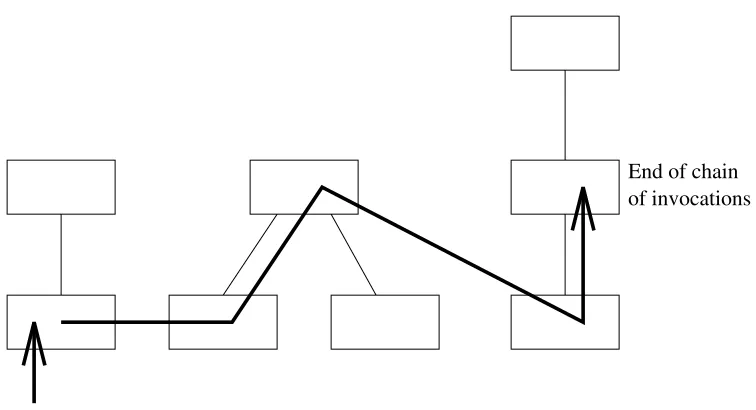
[image:15.612.112.490.56.261.2]End of chain of invocations
Figure 1: A sequence of method invocations in an object hierarchy.
3
Issues in Applying Inspection to Object-Oriented
Soft-ware
3.1
Method Size and Distribution
A typical object-oriented system consists of many small methods, each of which
pro-vides only a little functionality (for examples of this, see [27]). Therefore to understand
more than just trivial parts of the system, large numbers of these methods must be
cog-nitively grouped together. It may be difficult to reconstruct the meaning of this code,
however, and we have described Soloway et al.’s [23] work on “delocalised plans,” which occur when conceptually related code is spread over spatially distributed parts of
the program.
The method distribution problem can be easily illustrated. Consider Figure 1 which
depicts an object hierarchy. The arrow on the lower left object indicates an invocation of
one method. However, it may be found that this method in turn invokes other methods,
which in turn invoke yet other methods, and so on. It quickly becomes apparent that
is illustrated by the arrow moving through several objects. It must also be considered
that each method may invoke multiple methods, which themselves invoke multiple
methods. This greatly increases the paths that must be followed. It follows that the
complexity of the system is transferred from method bodies to the interactions between
them. Inspection is then made harder by having to understand all these interactions to
predict the effect of a single method call.
3.2
Inheritance
Inheritance is perhaps the most powerful feature of object-oriented programming, and is
one of the major differences between object-based and object-oriented code. Inheritance
allows the behaviour of one class to be reused and extended by another class. The derived
class (subclass or child class) has all the features of the base class (superclass or parent
class), but adds further behaviour which generally indicates some type of specialisation.
For example, in categorising a population of students, we may have some
class student which has properties common to all students, such as name,
matriculation number and so forth. However, we may require a class called
post graduate student, which has all the attributes of student, but also
re-quires additional details such as supervisor and topic. We could create a completely
separate class, and paste in the code from student but this is wasteful and could
make maintenance difficult, as any changes in the common code must be made to both
classes. Instead, we define post graduate student to inherit fromstudent,
then add only the new information. Any change made tostudentis then automatically
reflected inpost graduate student.
Despite the advantages of inheritance, including code reuse and reduced
mainte-nance effort, there is difficulty in understanding such code due to the distribution of
behaviour over several classes. These problems are detailed below.
3.2.1 Single Inheritance
Given the code in Figure 2, and an instancenew managerof classMANAGER, when
feature
calculate_tax is
end ...
end -- EMPLOYEE class EMPLOYEE
class SALESPERSON inherit
EMPLOYEE feature
...
end -- SALESPERSON
class MANAGER inherit
EMPLOYEE feature
award_bonus is do
bonus := sales_increase * bonus_rate end
end -- MANAGER
Figure 2: Example Eiffel code for single inheritance
new_manager.calculate_tax
we immediately wish to find the definition of calculate tax to ensure that this
is also correct. The logical starting point is to inspect the MANAGER class. But as
the feature calculate tax is common to both SALESPERSONand MANAGERit
is actually defined inEMPLOYEE and inherited. Finding the definition then involves
traversing the hierarchy examining each inherited class. In deeper hierarchies with
many inherited classes the definition may take some time to locate.
A similar problem is encountered with the definition of award bonus in class
MANAGER. Within this definition there are three references which may need to be
followed. These can be defined anywhere within theMANAGERclass or its inherited
class parent1 { public:
parent1() {...}; void function1() {...}; };
parent2() {...}; public:
class parent2 {
int function2(int z) {...}; };
child() {x = 0}; public:
class child : parent1, parent2 {
...
x = function2(y); ...
void call_me(int y) {
} private:
int x; };
Figure 3: Example C++ code for multiple inheritance
original code. As we get further away from the original code, it becomes more difficult
to remember the context in which we were searching in this direction. The effectiveness
of the inspection may then start to decrease.
3.2.2 Multiple Inheritance
Given the C++ code in Figure 3, which implements a simple example of multiple
inheritance, and assuming a declared instance MyChild of class child, then on
finding the call
MyChild.function1;
we must find the definition offunction1. We start by examining thechildclass,
class. But which one? And how far up the hierarchy must we look? Four or five levels
of inheritance is not uncommon. This can mean the exploration of up to ten classes,
assuming two parent classes. If there are more than two parent classes, then the number
is proportionately bigger. If theparentclasses use multiple inheritance, then the number of possibilities is further increased. A similar situation occurs with
MyChild.call_me(2);
Although we initially know that call me is declared somewhere in child or its
parents, there is now another level of indirection: where is function2 declared?
The possibilities include child, parent1and parent2, along with any of their
ancestors. Note that we assume C++ is being used in the strict object-oriented sense.
Instead, it may be that there are functions declared which are not part of any class, with
function2being one of them. In this case, the declaration could exist practically
anywhere.
3.2.3 Further Issues Concerning Inheritance
In addition to single and multiple inheritance, as described above, there are concepts
which can complicate the situation. Also, there are concepts which can ease the task
of inspection. We start by describing some Eiffel characteristics allowing the features
inherited from the base class to be adapted in several ways. We also describe several
idiosyncrasies from C++.
Repeated inheritance is an Eiffel concept which can cause confusion. It is generally
used when we wish to reimplement an inherited feature by adding some behaviour in
addition to that which it already has. We could simply inherit it, then define another
feature which calls the first and then implements the required behaviour, but this means
the new feature must have a different name. If we inherit it, then redefine it to keep the
same name, we no longer have access to the original feature, and hence must repeat the
code in the new feature. Repeated inheritance allows us to inherit the feature once to
redefine it (allowing us to use the name) and then inherit it a second time to rename it
(which gives us access to the feature, albeit under a different name). We then simply
code. As can be seen from this description, repeated inheritance is by no means a trivial
concept. When inspecting code which uses repeated inheritance, it can be very easy to
lose track of which code is actually being used. An inspector may miss the repeated
inheritance and assume the code being called is simply that in the base class, missing
out the additional code in the derived class. If the inspector does spot the repeated
inheritance, he has to find the original feature in the inherited class, inspect it, then
inspect the new code in the derived class.
Also in Eiffel, the use ofrenameallows a feature in the base class to be renamed
when it is inherited in the derived class. Finding the feature involves searching the
derived class for the feature definition, or for arenameclause. If the feature has been
renamed then the clause gives an idea of which route through the parent classes should
be followed, but gives no indication of how far up the class hierarchy one must travel.
The Eiffelredefineclause can remove some problems. If a feature is redefined
for this class, then the definition must occur in this class, and can be found easily. By its
nature, however, redefinition is almost always bound to use features declared towards
the top of the class hierarchy. To inspect properly, these definitions must also be found.
In a similar vein, theundefinekeyword removes the definition of the corresponding
feature for this class, leaving it in a deferred state. The definition of the feature must
now occur either in this class, or any class which may inherit from it, reducing the
amount of which must be inspected for the definition. Finally, the join mechanism that
exists in Eiffel consolidates several inherited methods, possibly via multiple inheritance,
from two different classes. This consolidation provides an anchor point from which
the definition of the method can be searched for. Again, this can reduce the number of
classes which may have to be inspected.
The friend keyword is a controversial C++ feature. A function declared to be
a friend of a class will have unrestricted access to all private data of that class,
thus completely circumventing the usual encapsulation mechanism. While there is
an argument in using friend for efficiency reasons, or to allow the usual implicit
parameter of the function to be made explicit, thus allowing coercion, friend can
hinder inspection by removing much of the logical structure of the system.
class A { private:
int a; };
class B : public A {
void b(){a = 1;}; // Illegal - B has no access to a public:
};
Figure 4: An example of visibility restriction in C++.
keywordspublic,protectedandprivate. These keywords limit the access of
both non-member functions and derived classes to class features. For example, given
the code in Figure 4, the method bdeclared in class B makes an illegal reference to
the variableadeclared in classA. This reference is illegal becauseahas been declared
asprivatein A and is not available to any other classes. Similar access rules can
apply when inheriting base classes. By restricting access to features, we improve the
encapsulation of the class and reduce the possible interactions between that class and
any other classes. Intelligent interpretation of such access restrictions can therefore
be used to limit the amount of code which has to be inspected. However, as class
features may be declared aspublic,protectedorprivateand classes may then
be inherited as public,protected orprivate, the visibility rules involved are
fairly complex. It may be difficult for inspectors to decipher exactly what interface is
presented by each class when they inspect code to ensure that the interfaces presented
are the minimum required and nothing more. Feature visibility can also be restricted in
Eiffel, where a feature can be made visible only to a certain class clientele, defined by
the parameters given after thefeaturekeyword. Similar issues arise here.
3.3
Polymorphism and Dynamic Binding
Polymorphism is the ability to take more than one form. In object-oriented
class X feature
process is do
put_string("In class X.") end
end -- X
class Y inherit
end
X redefine process
process is feature
do
put_string("In class Y.") end
end -- Y
feature make is
local local_x : X local_y : Y do
local_x:=local_y -- local_x now refers to an object of class Y
end end -- Test
local_x.process -- Y.process is called local_x.process -- X.process is called
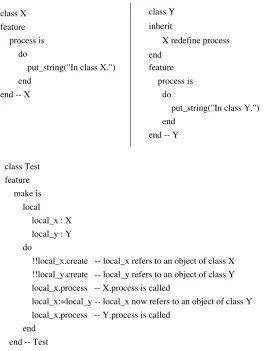
[image:22.612.109.379.61.412.2]!!local_y.create -- local_y refers to an object of class Y !!local_x.create -- local_x refers to an object of class X class Test
Figure 5: An example of polymorphism and dynamic binding.
of object. Polymorphism goes hand in hand with dynamic binding, which allows the
function associated with such a reference to be inferred at run time. This contrasts with
static binding, where the exact function call is known at compile time and can never be
changed while the program is executing.
The concepts of polymorphism and dynamic binding can best be described by
example. Consider the code in Figure 5 (based on Figure 5 from [15]). local x
is initially created to be of classX, whilst local y is of classY. On the first call of
local x.process, IN CLASS X. is printed. Although, on the surface, local x
and local y appear to be instances of completely different classes, the assignment
therefore an instance of classYalready contains all the details of an instance of class
X, and may also contain much more. Yis said toconformtoX. This type of behaviour is the essence of polymorphism. Note thatlocal y:=local xis not legal, since an
object of classXmay not have enough information to completely fill an instance ofY.
Sincelocal xnow refers to an object of classY, the next timelocal x.process
is called, IN CLASSY. is printed. This is dynamic binding at work: the actualprocess
feature called depends on the dynamic type oflocal x, not its static type.
Further polymorphism can occur with parameter passing. If we define a feature to
take a parameter of classX, then in addition to an instance of classX, we can also pass an
instance of classY, or indeed any derived class ofX. This can cause difficulties in C++
,where multiple methods can be declared which differ only in their parameter lists, both
in number of parameters and parameter types. It then becomes more difficult to predict
which method is called at run-time, taking into account any coercion of parameters
which may take place.
The concept of polymorphism is very powerful, but this power comes with a price.
Like recursion, polymorphism is simple in theory, but hard in practice. Ponder and Bush
have written about the problems that polymorphism causes for program understanding
due to dependence on the dynamic data state of the program [21]. The problem is
especially acute when combined with inheritance. Ponder and Bush show data from a
Smalltalk-80 system, where, for example one method is defined 90 times, and where
there are 89 procedures which are received by 486 different types. This leads to
“considerable ambiguity,” an understatement of immense proportions. Consider the
second call oflocal x.processin Figure 5. When inspectors reach this call they
must know the current type oflocal x. It is simple to find in this example, but in
larger systems, the type assignment may be much further away. It is also possible for
confusion to occur when multiple type changes occur.
A specific case occurs with a popular demonstration of polymorphism: iterating
over an array of heterogeneous types. Consider the following Eiffel declaration:
my_array : ARRAY[X]
derived fromX. To call the same featureprocessfor every element of the array, we
simply write:
my_array.item(i).process
for each value ofi. However, when we inspect this code, we must check every possible
definition ofprocessthat may be used. It can be difficult to find all implementations of
the feature, due mainly to the distribution definitions over several classes. More
impor-tantly, we must ensure that every implementation has consistent behaviour, producing
the same ‘result’, however ‘result’ is defined. Things may be further complicated if
different implementations deliberately have slightly different behaviours. If inspectors
believe they understand one implementation, they may incorrectly assume all
imple-mentations produce the same behaviour. This may occur when naming conventions are
not adhered to.
Polymorphism used in feature parameters causes similar problems. Any features
of the parameter that are used must be checked for consistent behaviour, since the
implementation which is called at run time may not be known. If one implementation
has slightly different behaviour from the others, it may introduce subtle bugs. We must
find exactly which implementation is being used.
3.4
Genericity
Genericity is the ability to define classes that are parameterised with respect to type.
They are usually used to define container classes which can then be used to hold any
type of data. Some common examples include lists, hash tables and trees. Without
genericity, a new class would have to be written every time we wished to store a new
type of data. We would then have multiple classes defining exactly the same behaviour,
which would cause maintenance and administrative difficulties. Genericity also allows
the use of static type-checking.
Genericity in C++ is implemented using templates. Class templates are used to
define a related family of classes. The class is defined with one or more type parameters
is instantiated with the appropriate type, all instances of the argument are replaced by
the new type to produce a new class. Similarly, function templates can be used to
define a related family of functions, defining similar operations on multiple types. An
instantiated version of the function is created for each type which uses it. Both class
and function templates can have multiple type arguments.
In Eiffel, genericity is achieved with generic classes which take a list of type
parameters. Eiffel defines two types of genericity. Unconstrained genericity is simply
when the type which can be supplied is not limited in any way. In this case, there is little
common behaviour which we can rely on having access to. Therefore, it is used only
for the simplest generic classes. Much more useful is constrained genericity, where
the parameters are constrained to be derived from a certain class. This constraining
class specifies the minimum behaviour which we can expect from any class which may
instantiate the generic class. In fact, unconstrained genericity is simply constrained
genericity where the constraining class is classANY (every non-basic class which has
no explicit inheritance clause inherits from classANY, hence every class conforms to
classANY). In this situation, it is usual to leave out the constraining class altogether.
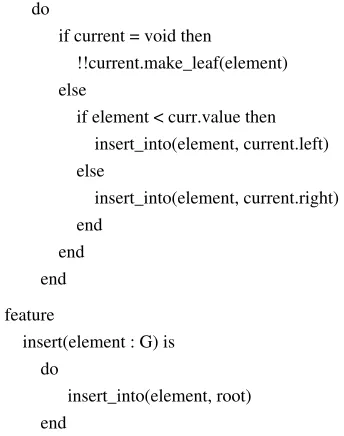
An example of constrained genericity is given in Figure 6. Here, we define class
SEARCHTREE, which can be instantiated by any class, as long as it conforms to class
COMPARABLE. This constraint is necessary because we require use of a comparison
operator to insert new elements into the tree. However, there is a problem for inspection
in relying on the implementation of such behaviour. In this case, COMPARABLEis a
well-defined class and the meaning of the less-than operator is well-known. However, it
may be the case that the constraining class is less well-defined, with far more complex
operations. Derived classes may have redefined key behaviour in an inconsistent way.
Therefore, what works for one instantiation may produce slightly different behaviour for
another instantiation. This implies that a generic class must be inspected with respect to
each instantiating class. This can be problematic with respect to the number of possible
feature {SEARCHTREE}
class SEARCHTREE[G -> COMPARABLE]
root : NODE[G]
do
end end
end
insert_into(element, current.right) else
insert_into(element, current.left) if element < curr.value then !!current.make_leaf(element) else
if current = void then
feature
insert(element : G) is do
insert_into(element, root) end
end -- class SEARCHTREE
insert_into(element : G; current : NODE[G]) is left:=leftchild
class NODE[G]
creation make_leaf
feature{SEARCHTREE} value : G
left, right : NODE[G]
do
value:=avalue
right:=rightchild end
end -- class NODE
[image:26.612.116.288.358.576.2]make_leaf(avalue : G; leftchild : NODE[G]; rightchild : NODE[G]) is
3.5
Partitioning Object-Oriented Code for Inspection
The previous sections have assumed the entire system is capable of being inspected at
once. The inspector browses the code until he becomes familiar with it and understands
its structure, and can then start to examine the code for defects, perhaps aided by a
checklist. In reality, most systems will be far too complex to be inspected in a single
step, and will be split into chunks. The amount of code inspected is also limited by
the two-hour rule: an inspector should not spend more than two hours at a time on
individual preparation, and an inspection meeting should not last more than two hours.
There is a general belief that the effectiveness of any inspection is greatly reduced when
such limits are exceeded. Finally, there may be guidelines in place on the rate at which
code should be inspected, which may be as low as one or two pages an hour. Again,
exceeding these limits may decrease the effectiveness of the inspection. These three
factors produce the problem of deciding how to split the code. For a simple object-based
system, this problem is no worse than for modular procedural code.
For a system with a large inheritance hierarchy, the problem is much more difficult.
As demonstrated in the previous sections, there are many dependencies which must be
resolved when inspecting object-oriented code. If the system is arbitrarily split, then
inspectors may be left with references to code which they have no access to, preventing
them from properly completing the inspection. When inheritance is involved there is
a problem similar to that found in testing, where although it is tempting to test a class
in isolation, it must actually be tested in context of its parent classes because of the
possibility of hidden interactions. The same is true of inspection. Each class must be
inspected in the context of any parent classes. There may be many such parent classes,
which combine to produce a very large body of code to be inspected. On the other
hand, a single method may be too small a unit to inspect, even before considering the
number of references that may be left unresolved by inspecting the method on its own.
A one- or two-line method has very little semantic information to allow an accurate
4
Assisting Inspection of Object-Oriented Software
4.1
Programming Techniques
From the previously described problems caused by inheritance, it is apparent that there
is a need to control the use of inheritance. Korson and McGregor point this out, and
suggest a “very disciplined” use of inheritance [15]. Gamma et al., in their book on patterns for object-oriented design [10], suggest one principle of object-oriented design
is:
Favour object composition over class inheritance.
They argue that the use of object composition allows you to keep each class
encap-sulated and dedicated to one task. It also inhibits the growth of class hierarchies into
“unmanageable monsters.” Such hierarchies will be very difficult to inspect, as
demon-strated in Section 3.2. A guideline for programming is the Law of Demeter, described
above, which limits message passing to a reduced set of related objects. By rationalising
communication patterns between objects, the system may be easier to understand and
inspect [16].
Van Emden [25] describes a method of inspection called structured inspection, which
make use of what he refers to as theinspection protocol. The inspection protocol defines what is to be carried out at the inspection. In a traditional inspection, as described by
Fagan [8], the protocol may only consist of a checklist to assist in defect finding. For a
structured inspection, the code to be inspected is written with the goal of inspectability
in mind. Comments are placed in the code to guide the inspection. The comments are
assertions about the state of the program at that point, with each being a well-defined
inspection item. The inspection then consists of examining each of these items in turn,
checking that the code between two assertions ensures the truth of the latter assertion.
This idea may greatly increase the focus of the inspection, as well as breaking the code
into more manageable chunks for inspection, thus alleviating one problem identified.
The assertion checking system provided in Eiffel would seem to be an ideal vehicle to
int *p, pivot;
p = partition(left, right, pivot);
} }
if(find_pivot(left, right, &pivot)) {
quicksort(p, right); {
quicksort(left, p-1);
void quicksort(int *left, int *right) FUNCTION NAME: quicksort(int *left, int *right)
PURPOSE: To implement the Quicksort algorithm to sort an array of integers. ‘left’ is a pointer to the
CALLS: find_pivot, partition
CALLED-BY:
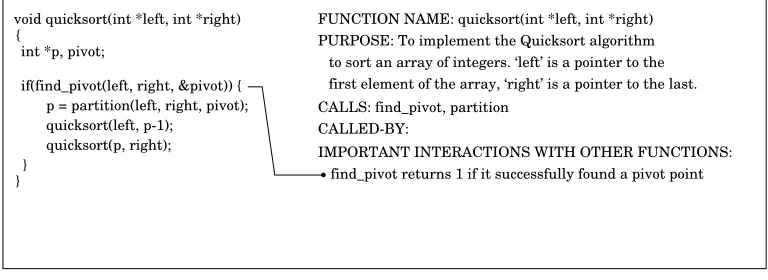
[image:29.612.103.487.65.205.2]IMPORTANT INTERACTIONS WITH OTHER FUNCTIONS: find_pivot returns 1 if it successfully found a pivot point first element of the array, ‘right’ is a pointer to the last.
Figure 7: An example of Solowayet al.’s program documentation method.
Eiffel assertions also provide an opportunity to ensure that all implementations of a
polymorphic method have the same behaviour. This can reduce confusion where more
than one implementation exists, but where each implementation has a slightly different
behaviour.
4.2
Supporting Documentation
With specific reference to delocalised plans, Solowayet al. [23] present a type of pro-gram documentation which explicitly identifies relationships which form delocalised
plans. The documentation consists of the program text on the left side of a page. The
right hand side contains explicit descriptions of interactions which form delocalised
plans. For example, any subroutine called in the program fragment would be
docu-mented in the accompanying text, indicating its purpose, and any routines which it may
call. There may also be comments which describe the interactions occurring in the
code. These are linked by arrows to the appropriate line. An example of the
docu-mentation is shown in Figure 7, using code based on that given for an impledocu-mentation
of Quicksort in [14]. While this idea may be useful to make explicit the dependencies
within object-oriented code (for example “This method relies on method X in the parent
class”), there is no obvious support for describing dynamic behaviour. The technique
fails due to its static nature.
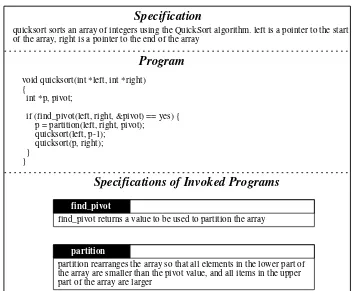
void quicksort(int *left, int *right) {
int *p, pivot;
if (find_pivot(left, right, &pivot) == yes) { p = partition(left, right, pivot);
quicksort(left, p-1); quicksort(p, right); }
}
Program
Specifications of Invoked Programs
partition rearranges the array so that all elements in the lower part of the array are smaller than the pivot value, and all items in the upper part of the array are larger
find_pivot returns a value to be used to partition the array
find_pivot
partition
of the array, right is a pointer to the end of the array
quicksort sorts an array of integers using the QuickSort algorithm. left is a pointer to the start
[image:30.612.108.462.60.351.2]Specification
Figure 8: An example of Parnaset al.’s Display Method.
assert that successful software systems will have more people reading the code than
writing it. Furthermore, while it is easy to understand isolated details of the program,
it is far harder to make sense of the overall structure. It is therefore important that
a system is well documented, with the structure being made apparent. Parnas et al. propose a solution with their “Display Method”. In this method, each fragment of the
program is represented by a display. The set of displays associated with a program
is supplemented by a lexicon, containing definitions of all the terms in the program,
and an index of all the variables and program fragments along with where they occur.
An example of a display is given in Figure 8. A display consists of three parts. The
first parts presents a specification of the program fragment this display represents. The
second part contains the source code of the fragment under consideration. The final
possible to study the correctness of this program fragment without requiring access to
any other code which it may use.
While the display method is intended for use with procedural code, where Parnaset al.[20] have reported great success in inspecting safety critical software, the principles can be applied to object-oriented code. The proliferation of small methods provides
the ideal subject for this technique, although it may be that the average one- or
two-line method may be too small a unit to use. Such a method usually only consists of
a single method invocation, and has little semantic information, whichever way it is
described. Being designed for use with procedural code, there is also no policy to deal
with inheritance. Furthermore, like Soloway’s method, the technique is static, and is
therefore of limited use in describing the dynamic behaviour of object-oriented code
which is necessary to understand the system.
Although enhanced documentation can help an inspector, it is clear that the static
nature precludes the description of the dynamic behaviour of the system, which, as we
have seen, is far more important in an object-oriented system. Therefore it may be that
some form of tool support, possibly working in conjunction with the running system,
may be more appropriate.
4.3
Tool Support
Although there are already a number of tools to support the inspection process (see [18]
for a recent review of those available), none explicitly support the dynamic nature of
object-oriented code. Instead, the code is treated as a static document. From Section 3
it is clear that this is not sufficient.
An automated tool for viewing code statically, based on the work of Parnaset al. [20] described in the previous section, is one possibility. Each display could be presented
on-screen, with hypertext-style links between the displays, allowing the inspector to
browse round the system. However, this still only represents the static structure of the
code. We still require some form of dynamic inspection tool to help inspect code which
makes use of dynamic object-oriented features.
int RCode= TheScale->Activate(DText, AttribList[CurrKey]);
DText->ShowAttribs(AttribList);
}
int GroupLine::Activate(Scale* TheScale, DisplayedText* DTex){
return(RCode)
DText->ShowLine(Value);
int GroupLine::Deactivate(Scale* TheScale, DisplayedText* DText){
return(TheScale->Deactivate(DText, AttribList[Currkey])); }
void GroupLine::ChangeKey(int NewKey, Scale* TheScale){
HighlightColour = TheScale->HCol(AttribList[CurKey]); }
CurKey = NewKey;
[image:32.612.76.506.62.352.2]Line Bar Activator Scale Group ScaleLine Inheritance Hierarchy: Browser: GroupLine.cc GetX() GetY() NumLines() Activate() Deactivate() ChangeKey() Name() State() HCol() Active() HCol() On() ChangeKey() GroupLine
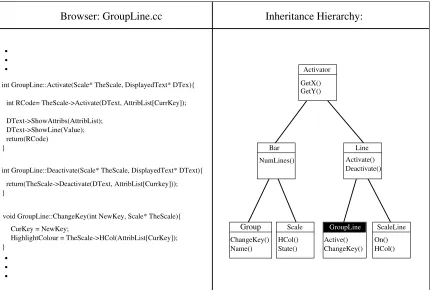
Figure 9: An example maintenance tool set.
the idea that the requirements of inspection are similar to those of maintenance. It
is therefore obvious that tools which help understanding for maintenance could also
be used to support inspection. One example is Valhalla, a prototype object-oriented
development environment described by Wildeet al. [27]. This system provides object animation capabilities for both the development and maintenance phases. The animation
allows viewing of messages passed between objects. This can aid understanding of the
dynamic properties of the system. Instead of analysing static pages of text, the inspection
would then consist of analysing these animations.
Another example of such support for maintenance is described by Crocker and
Mayrhauser [3]. They describe a suite containing four types of tool. Framework tools
are used to provide an infrastructure, and include a database which allows the sharing
of information among tools. Mundane tools are those used for information gathering,
generator. Change tools are used to predict the effects of program modification. They
include a consistency checker and ripple effect analyser. From our point of view, the
most useful tools are those described as knowledge tools, which can assist in program
understanding. Theinheritance hierarchy generatorgenerates a graph of the inheritance relationship in the system, which can then be studied to enhance understanding of the
system. Theabstraction generatoris used to help build new abstractions, and add and delete methods. The abstraction generator takes a set of input functions and generates
a subset of functions which are related by common data. A subset of these can then be
used as the interface for a new class. A similar analysis can be used to decide which
data items are candidates for membership of the class. Finally, the remaining code is
analysed to indicate changes required to use the new class in place of the existing code,
for example removing references to encapsulated data. The analysis for the addition
and removal of methods is similar. The final tool described is acode browser which displays the output produced by the other tools. This is used in conjunction with acode slicer, which allows the view of the program to be limited by certain criteria, such as occurrences of a certain variable or method call. An example of how such a toolset may
appear is given in Figure 9. The class hierarchy is displayed on the right-hand side,
with the text of the current class displayed on the left-hand side. The displayed code
may be a program slice on a variable usage or function call. It is then easy for the code
inspector to traverse the class hierarchy and inspect the required code.
These maintenance systems would suffer from one drawback if they were to be
applied to software inspection: they require the software system to be complete and
running. They are not designed to work with fragments of code, such as individual
classes. Browsing using the class hierarchy may also be limiting because it does not
reflect the dynamic nature of the code.
Given that a major problem in inspecting object-oriented code is tracing method
calls and references over several classes, it may be useful to have some form of reduced
representation which provides an overall view of the code being inspected. Such a
representation would be similar to that used be Seesoft, as described by Eicket al. [7]. Seesoft is a tool designed for visualising line-oriented software statistics. The main
Viewer:node_holder.e
end
ItemStack.push(CurrItem)
from i := 1 until
loop
CurrItem := ItemArray.item(i)
push(Item : data)
Definition:stack.push()
i > NumItems
analyse.e
node_holder.enode.e sort.e list.e stack.e queue.e scale.e
100
200
300
400
500 0
[image:34.612.112.470.71.300.2]600
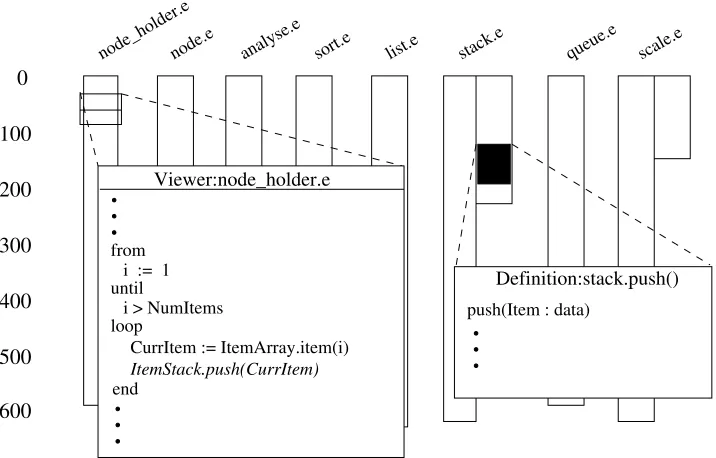
Figure 10: How a reduced representation could be used to assist inspection of object-oriented code
Within these columns, a horizontal line is used to represent a line of code within the
file. These lines are coloured according to the value of some attribute, e.g. age. A
separate scale is used to display the entire value range for this attribute. The user can
click on values in this scale, or the columns and lines themselves to toggle each value
on and off. This allows the display of code with just a certain value or a range of
values. Such manipulations allow the user to find useful patterns in the code, in effect
allowing interactive querying of a database of statistics. Seesoft also provides code
reading windows which allow the user to access the source code under consideration.
This type of tool could be extended to assist inspection of object-oriented code as
follows. While inspecting code in a reading window the reduced representation would
highlight the current line of code. If this line was a method invocation, the definition of
that method would also be highlighted. The inspector could then immediately move to
that definition, and so on. The history of such a progression may be stored and when
the inspector comes to a suitable understanding of some method, it would be possible to
This process would continue until the original starting point was reached. By speeding
the traversal between methods, it is easier for an inspector to gain an understanding of
the code. At the same time, the inspector is forming a mental picture of the system
with the reduced representation. A further use of such a system would be used to help
decide which code should be included in an inspection. By tracing method invocations,
the classes required to perform the inspection could quickly be found. An example of
how this may look is given in Figure 10. The window contains reduced representations
of all files under inspection. The file currently being accessed (node holder.e)
has a cursor over it, indicating the current line being inspected, as determined by the
browser window. The current line is shown in italics, and in this case is a call of method
pushin classstack. The definition of this method has been found by the tool in file
stack.e, as indicated by the inverse patch on this file, and the definition is displayed
in the method window.
Other visualisation systems designed for object-oriented code may provide help
with inspection. For example, De Pauw et al. [4] describe a language independent visualisation system. The system uses a preprocessor to instrument the subject programs
with code which generates events. These events can be received by a visualisation
application which can use the data to update one or more views of the program. The
authors describe several visualisations they have constructed. They include an allocation
matrix, showing the number of classes instantiated by each class, and an inter-class
call matrix, showing patterns of communication between each class. Although these
visualisations are intended for use in debugging and code tuning, and rely on having the
entire system available and running, the principles could be applied to smaller chunks of
code. Visualisation could allow the inspection team to provide summary information on
which methods and classes are used by each class. They can then use this information
5
Conclusions
Inspection is widely believed to be the most effective means of finding defects in
software. At the same time, the object-oriented paradigm is cited as providing many
benefits in developing software. However, there is little published material on applying
inspection to object-oriented software.
We have described how some of the facilities of an object-oriented language can
inhibit inspection of code written in that language. Inheritance can impede the search
for the definition of class features. Polymorphism and dynamic binding combine to
hinder the static prediction of which methods will be invoked at runtime. Genericity
can prove problematic with respect to the number of classes that may have to be
inspected in conjunction with a single class, due to the dependence on the behaviour of
these instantiating classes. The last two problems stem from the disparity between the
static code structure and the dynamic, runtime system structure. Furthermore,
object-oriented systems tend to consist of a large number of small methods, which distributes
functionally related code over a wider area than procedural systems, making inspection
more difficult. This also increases the number of relationships which exist within the
system which have to be understood. Finally, while inspection is an ideal time to enforce
code quality, the notions of quality of object-oriented code are less well-defined than
those of procedural code, and may be difficult to enforce during inspection.
We have also described some techniques which may be applied to inspection of
object-oriented software to help obviate these problems. There are several programming
techniques which make code easier to inspect. Restricting the use of inheritance reduces
the complexity of the class hierarchy [10], whilst the Law of Demeter can reduce the
amount of unstructured communication between objects [16]. Code can also be written
with inspectibility in mind, by placing assertions about the state of the program as
comments in the code [25]. Eiffel assertions may be used for this purpose. In addition
they may be used to ensure all implementations of a polymorphic method have the same
behaviour. There are also several methods of documenting code to assist in inspection.
the Display Method which allows portions of source code to be inspected in isolation
using the specifications of any other program fragments that may be called. Finally, we
described how tool support could assist with object-oriented code, especially with the
more dynamic properties. An automated version of Parnaset al.’s Display Method may be one possibility, whilst another may be in the use of tools used to support maintenance,
such as the Valhalla system [27] or the maintenance suite described by Crocker and
Mayrhauser [3]. Finally, visualisation tools may be of some help, such as the static
Seesoft system [7] or the dynamic visualisation system described by De Pauwet al. [4]. We believe that this type of support is essential if inspection is to be successfully used
with the object-oriented paradigm. Lack of such support will reduce the benefits of our
References
[1] E. V. Berard.Essays on Object-Oriented Software Engineering Volume 1. Prentice-Hall, 1993.
[2] G. Booch.Object-Oriented Analysis and Design with Applications (2ed.). Ben-jamin/Cummings, 1994.
[3] R. T. Crocker and A. Mayrhauser. “Maintenance Support Needs for
Object-Oriented Software,”Proceedings of COMPSAC ’93, pp. 63–69.
[4] W. De Pauw, R. Helm, D. Kimelman and J. Vlissides. “Visualizing the Behaviour
of Object-Oriented Systems,”Proceedings of OOPSLA ’93, pp. 326-337.
[5] A. M. Davis. “Fifteen Principles of Software Engineering,”IEEE Software, Vol. 11, No. 6, November 1994, pp. 94–101.
[6] E. P. Doolan. “Experience with Fagan’s Inspection Method,”Software - Practice and Experience, Vol. 22, No. 2, February 1992, pp. 173–182.
[7] S. G. Eick, J. L. Steffen, E. E. Sumner Jr. “Seesoft - A Tool For Visualizing Line
Oriented Software Statistics,” IEEE Transactions on Software Engineering, Vol. SE-18, No. 11, November 1992, pp. 957–968.
[8] M. E. Fagan. “Design and Code Inspections to Reduce Errors in Program
Devel-opment,”IBM System Journal, Vol. 15, No. 3, 1976, pp. 182–211.
[9] M. E. Fagan. “Advances in Software Inspection,”IEEE Transactions on Software Engineering, Vol. SE-12, No. 7, July 1986, pp. 744–751.
[10] E. Gamma, R. Helm, R. Johnson and J. Vlissides.Design Patterns: Elements of Reusable Object-Oriented Software, Addison-Wesley, 1995.
[11] T. Gilb and D. Graham.Software Inspection. Addison-Wesley, 1993.
[13] P. J¨uttner, S. Kolb and P. Zimmerer. “Integration and Testing of Object-Oriented
Software,” Proceedings of EuroSTAR ’94.
[14] A. Kelley and Ira Pohl.A Book on C. Benjamin/Cummings, 1990.
[15] T. Korson and J. D. McGregor. “Understanding Object-Oriented: A Unifying
Paradigm,” Communications of the ACM, Vol. 33, No. 9, September 1990, pp. 40–60.
[16] K. J. Lieberherr and I. M. Holland. “Assuring Good Style for Object-Oriented
Programs,”IEEE Software, Vol. 6, No. 5, September 1989, pp. 38–48.
[17] S. Letovsky and E. Soloway. “Delocalized Plans and Program Comprehension,”
IEEE Software, Vol. 3, No. 3, May 1986, pp. 41–49.
[18] F. Macdonald, J. Miller, A. Brooks, M. Roper, M. Wood. “A Review of Tool
Sup-port for Software Inspection,” InProceedings of CASE ’95 International Workshop on Tools and Technologies(to be published).
[19] B. Meyer.Eiffel: The Language. Prentice Hall International, 1992.
[20] D. L. Parnas, J. Madey and M. Iglewski. “Precise Documentation of
Well-Structured Programs,”IEEE Transactions on Software Engineering, Vol. SE-20, No. 12, December 1994, pp. 948–976.
[21] C. Ponder and W. Bush. “Polymorphism Considered Harmful,”ACM SIGSOFT Software Engineering Notes, Vol. 19, No. 2, April 1994, pp. 35–37.
[22] G. W. Russell. “Experience with Inspections in Ultralarge-Scale Development,”
IEEE Software, Vol. 8, No. 1, January 1991, pp. 25–31.
[23] E. Soloway, J. Pinto, S. Letovsky, D. Littman and R. Lampert. “Designing
Doc-umentation to Compensate for Delocalized Plans,”Communications of the ACM, Vol. 31, No. 11, November 1988, pp. 1259–1267.
[25] M. H. Van Emden. “Structured Inspections of Code,”Software Testing, Verification and Reliability, Vol. 2, 1992, pp. 133–153.
[26] N. Wilde and R. Huitt. “Maintenance Support for Object-Oriented Programs,”
IEEE Transactions on Software Engineering, Vol. SE-18, No. 12, December 1992, pp. 1038–1044.
[27] N. Wilde, P. Matthews and R. Huitt. “Maintaining Object-Oriented Software,”