This is a repository copy of
On the post-common-envelope central star of the planetary
nebula NGC 2346
.
White Rose Research Online URL for this paper:
http://eprints.whiterose.ac.uk/151543/
Version: Published Version
Article:
Brown, A.J. orcid.org/0000-0002-3316-7240, Jones, D., Boffin, H.M.J. et al. (1 more
author) (2019) On the post-common-envelope central star of the planetary nebula NGC
2346. Monthly Notices of the Royal Astronomical Society, 482 (4). pp. 4951-4955. ISSN
0035-8711
https://doi.org/10.1093/mnras/sty2986
This article has been accepted for publication in Monthly Notices of the Royal Astronomical
Society ©: 2018 The Author(s). Published by Oxford University Press on behalf of the
Royal Astronomical Society. All rights reserved.
[email protected]
https://eprints.whiterose.ac.uk/
Reuse
Items deposited in White Rose Research Online are protected by copyright, with all rights reserved unless
indicated otherwise. They may be downloaded and/or printed for private study, or other acts as permitted by
national copyright laws. The publisher or other rights holders may allow further reproduction and re-use of
the full text version. This is indicated by the licence information on the White Rose Research Online record
for the item.
Takedown
If you consider content in White Rose Research Online to be in breach of UK law, please notify us by
Advance Access publication 2018 November 3
On the post-common-envelope central star of the planetary
nebula NGC 2346
Alex J. Brown ,
1,2‹David Jones ,
3,4‹Henri M. J. Boffin
5and Hans Van Winckel
61Department of Physics and Astronomy, University of Sheffield, Sheffield S3 7RH, UK
2Isaac Newton Group of Telescopes, Apartado de Correos 368, E-38700 Santa Cruz de La Palma, Spain 3Instituto de Astrof´ısica de Canarias, E-38205 La Laguna, Tenerife, Spain
4Departamento de Astrof´ısica, Universidad de La Laguna, E-38206 La Laguna, Tenerife, Spain 5European Southern Observatory, Karl-Schwarzschild-Str 2, D-85748 Garching, Germany 6Instituut voor Sterrenkunde, KU Leuven, Celestijnenlaan 200D bus 2401, B-3001 Leuven, Belgium
Accepted 2018 October 26. Received 2018 September 27; in original form 2018 August 30
A B S T R A C T
The common-envelope phase is one of the most poorly understood phases of (binary) stellar evolution, in spite of its importance in the formation of a wide range of astrophysical phe-nomena ranging from cataclysmic variables to cosmologically important supernova Type Ia, and even recently discovered gravitational wave producing black hole mergers. The central star of the planetary nebula NGC 2346 has long been held as one of the longest period post-common-envelope systems known with a published period of approximately 16 d, however the data presented were also consistent with much shorter periods of around 1 d (a more typical period among the known sample of post-common-envelope binary central stars). Here, us-ing the modern high-stability, high-resolution spectrograph HERMES, we conclusively show the period to, indeed, be 16 d while also revising the surface gravity to a value typical of a subgiant (rather than main sequence) resulting in an intrinsic luminosity consistent with the
recently publishedGAIAparallax distance. Intriguingly, the implied mass for the secondary
(3.5 M⊙) makes it, to our knowledge, the most massive post-common-envelope secondary
known, whilst also indicating that the primary may be a post-RGB star.
Key words: techniques: radial velocities – binaries: spectroscopic – planetary nebulae: indi-vidual: NGC 2346.
1 I N T R O D U C T I O N
Central star binarity is now thought to be a key ingredient in under-standing the formation and evolution of a large fraction of planetary nebulae (PNe; Jones & Boffin2017) – playing an important role in the observed morphologies (Hillwig et al.2016), chemistry (Wesson et al.2018), and perhaps even in the planetary nebula luminosity function (PNLF; Ciardullo et al.2005; Davis et al.2018). However, very little is known about the processes by which binary stars can produce a PN – particularly the common envelope (CE) phase (see e.g. the review of Ivanova et al.2013). One particularly interest-ing puzzle is the observed period distribution of post-CE central stars that shows a strong propensity of periods of a few days or less (Jones & Boffin2017), while models of the CE phase gener-ally predict many more systems at longer periods (see section 4 of De Marco, Hillwig & Smith2008). As such, the properties of the few longer period systems known, including recent discoveries
⋆E-mail:[email protected](AJB);[email protected](DJ)
by Manick, Miszalski & McBride (2015), Sowicka et al. (2017), and Miszalski et al. (2018), are of particular interest – likely hold-ing the key to resolvhold-ing this disagreement and, perhaps, even to understanding the CE phase itself.
The binary central star of NGC 2346 was one of the first to be discovered (M´endez 1978), with a subsequent radial velocity study by M´endez & Niemela (1981) deriving an orbital period of roughly 16 d making it one of the longest period post-CE binaries known to-date. However, there was considerable confusion over the true orbital period, with periods of around 1 d also presenting a reasonable fit to the data. Later photometric studies also found a dominant 16 d period but in this case not directly attributable to the orbital motion of the binary but rather due to (variable) occultations of the binary by a dust cloud (Mendez, Gathier & Niemela1982; Acker & Jasniewicz1985). Further support for such a long period comes from the observed nebular chemistry with Wesson et al. (2018) finding that PNe with shorter period binary central stars typically show extreme abundance discrepancies, while they place an upper limit on the abundance discrepancy factor of NGC 2346 of less than 10 (more consistent with a longer period central star).
2018 The Author(s)
D
o
w
n
lo
a
d
e
d
fro
m
h
ttp
s:
//a
ca
d
e
mi
c.
o
u
p
.co
m/
mn
ra
s/
a
rt
icl
e
-a
b
st
ra
ct
/4
8
2
/4
/4
9
5
1
/5
1
5
9
4
8
3
b
y
U
n
ive
rsi
ty
o
f S
h
e
ffi
e
ld
u
se
r
o
n
0
1
O
ct
o
b
e
r
2
0
1
4952
A. J. Brown et. al.
Figure 1. Radial velocity curve of NGC 2346.
As well as constraining the observed radial velocity variabil-ity, M´endez & Niemela (1981) also derived the spectral type of the secondary star in the system (the hot primary is not visible in their optical spectra) concluding it to be an A-type star of mass M=1.8 M⊙, temperatureTeff=8000 K, and surface gravity log
g=4.00. These values imply a distance of 0.7±0.1 kpc to the system, however the parallax as measured byGAIAresult in a much larger distance of 1.45+−00..0908 kpc (Gaia Collaboration2018). This
larger distance is also consistent with the distance to the nebula (D=1.57±0.54 kpc) as derived using the Hαsurface brightness – radius relation of Frew, Parker & Bojiˇci´c (2016).
In this paper, we present a study, based on VLT-FORS2 and Mercator-HERMES spectroscopy, of the central star of NGC 2346 to revisit the orbital period and stellar parameters in order to crit-ically re-evaluate its status as one of the longest period post-CE binaries known as well as try to reconcile the apparent discrepancy between parallax distance and the distance implied by previous modelling attempts.
2 R A D I A L V E L O C I T Y M O N I T O R I N G
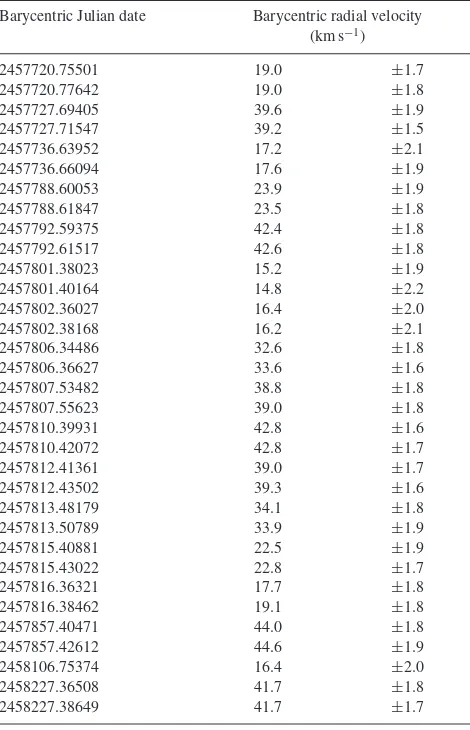
The central star of NGC 2346 was observed 33 times (1800 s expo-sure time), between 2016 November 27 and 2018 April 18, using the Hermes Spectrograph mounted on the 1.2 m Mercator Tele-scope at the Observatorio del Roque de Los Muchachos on the Spanish island of La Palma (Raskin et al.2011). The pipeline re-duced data were then continuum subtracted using theISPECsoftware (Blanco-Cuaresma et al.2014) and cross-correlated against an A-type spectral template produced usingSPECTRUM(Gray & Corbally
1994). The resulting heliocentric radial velocity measurements are shown in TableA1.
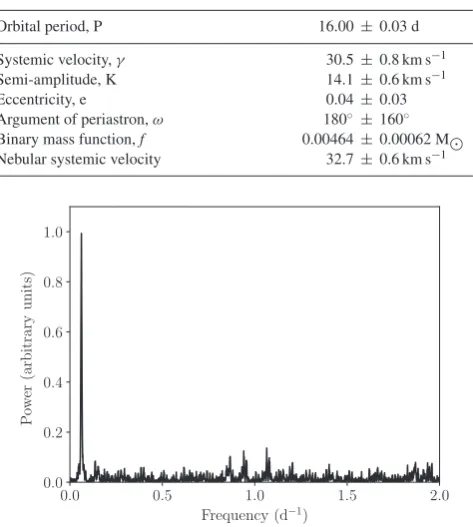
[image:3.595.58.271.57.218.2]The radial velocities were then fit using the RADVELpackage (Fulton et al.2018), sampling the posterior probability densities of the orbital parameters (period, semi-amplitude, eccentricity, argu-ment of periastron) via Markov Chain Monte Carlo. The data are shown folded on the resulting best-fitting solution in Fig.1while the parameters of the fit and their uncertainties are listed in Table1. Fits were attempted forcing shorter orbital periods (with P∼1 d consistent with the possible periodicities identified by M´endez & Niemela1981), but in all cases the quality of the fit was significantly poorer than for a period of 16 d. In Fig.2, we present aCLEANed power spectrum, computed via 10 iterations with a loop gain of 0.1 (Roberts, Lehar & Dreher1987), of the radial velocity observa-tions clearly showing that the 16 d period derived by the fit is the
Table 1. Parameters of the central star of NGC 2346 derived from the Mercator radial velocities.
Orbital period, P 16.00± 0.03 d
Systemic velocity,γ 30.5± 0.8 km s−1
Semi-amplitude, K 14.1± 0.6 km s−1
Eccentricity, e 0.04± 0.03
Argument of periastron,ω 180◦ ± 160◦
[image:3.595.309.546.78.342.2]Binary mass function,f 0.00464± 0.00062 M⊙ Nebular systemic velocity 32.7± 0.6 km s−1
Figure 2. Power spectrum of the radial velocity observations of NGC 2346 showing the clear peak at a frequency of 0.0625 d−1(P=16 d).
only convincing peak. As such, the new Mercator–HERMES data confirm the period favoured by M´endez & Niemela (1981), fully ruling out the shorter period aliases which contaminated their data. We have also verified that adding the data from M´endez & Niemela (1981) did not improve the orbit, given the very high-quality data from Hermes.
The systemic velocity as measured by the fit (γ = 30.5 ± 0.8 km s−1) is appreciably different from the
values quoted in the literature for the nebula (with most lying in the range 20–25 km s−1; M´endez & Niemela1981; Durand, Acker &
Zijlstra1998). However, the systemic nebula velocity, as measured by fitting two Gaussians (consistent with the two features arising from the front and back ‘walls’ of the bipolar structure) to the [OIII]5007 Å emission line profile and taking the centroid (see Fig. 3), of our observations is found to be marginally consistent with the stellar systemic velocity (vneb=32.7±1.6 km s−1). Arias
et al. (2001) provide support for a similar nebular velocity, as they find that the maximum intensity of their Fabry–Perot scans lies on the channel map at 27 km s−1, while of the channel maps either side
of this the redder map (at 37 km s−1) is more symmetrical than its
blue counterpart (at 17 km s−1) – indicative that the true systemic
velocity lies between 27 and 37 km s−1just as our measured values
for both nebula and binary do.
3 S T E L L A R PA R A M E T E R S A N D A B U N D A N C E S
The central star of NGC 2346 was observed using the FORS2 in-strument of the ESO VLT’s UT1 Antu telescope (Appenzeller et al.
1998) with single spectra taken back-to-back using the 1200B (600 s exposure time) and 1200R (along with the GG435 order blocking filter, 60 s exposure time) grisms. A 0.7 arcsec slit was employed with the MIT/LL CCD mosaic binned 2×2 (≡0.25 arcsec per
MNRAS482,4951–4955 (2019)
D
o
w
n
lo
a
d
e
d
fro
m
h
ttp
s:
//a
ca
d
e
mi
c.
o
u
p
.co
m/
mn
ra
s/
a
rt
icl
e
-a
b
st
ra
ct
/4
8
2
/4
/4
9
5
1
/5
1
5
9
4
8
3
b
y
U
n
ive
rsi
ty
o
f S
h
e
ffi
e
ld
u
se
r
o
n
0
1
O
ct
o
b
e
r
2
0
1
Figure 3. Gaussian fits of the [OIII]5007 Å emission from the PN NGC 2346.
Figure 4. FORS2 spectrum of the central star of NGC 2346 (red) along with the best-fitting synthetic spectrum (black) implying an effective temperature, Teff=7750 K, and a surface gravity, logg=3.0.
binned pixel) to provide a spectral resolution of 1–2 Å across the observed wavelength rangeλ∼3600–5000 Å (1200B grism) and
λ∼5800–7200 Å (1200R grism). The spectra were bias-subtracted, wavelength-calibrated, and flux-calibrated using bias, arc lamp, and standard star observations acquired as part of ESO’s standard cal-ibration plan. The spectra were then sky-subtracted (using only regions dominated by nebular emission, in order to subtract both sky and nebular contributions) before optimal extraction.
The temperature and surface gravity of the star were probed by comparing the resulting extracted spectra to synthetic spectra produced bySPECTRUMusing model atmospheres from Castelli & Kurucz (2004) which had been reddened assuming E(B−V)=0.25 and Rv = 3.1 (Frew et al.2016). The best-fitting model (shown
overlaid on the observed spectrum in Fig.4) was found to have an effective temperatureTeff=7750±200 K and surface gravity log
[image:4.595.52.280.264.368.2]g=3.0±0.25. Consistent values were derived using the equivalent widths of iron lines present in the Mercator–Hermes spectrum pre-sented in Section 2. Furthermore, this analysis allowed the deriva-tion of the metallicity of the companion resulting in a best-fitting value for [Fe/H]∼ −0.35 (see Fig. 5). The quality of the fit is demonstrated for a selection of singly and doubly ionized iron lines in Fig.6. Lines of many other elements were present in the spectra including the s-process elements barium and strontium, and several elements from groups 2 (calcium, magnesium), 3 (scandium, yt-trium), and 4 (titanium, zirconium). These were all probed for signs of inconsistency with respect to the derived metallicity (perhaps as a result of chemical contamination from the primary around the time of the CE phase; Miszalski, Boffin & Corradi2013), however no
Figure 5. Iron abundances in the secondary component of the central star of NGC 2346 as a function of excitation potential (upper panel) and reduced equivalent width (lower panel).
Figure 6. Observed (black) and synthetic (red) spectrum shown around two regions containing multiple lines of singly and doubly ionized iron, highlighting the quality of the fit. The synthetic spectrum was produced using parametersTeff=7750 K, logg=3.0, and [Fe/H]= −0.35.
Table 2. Atmospheric parameters for theSPECTRUMmodel.
Effective temperature,Teff 7750 ±200 K
Surface gravity, log(g) 3.0 ±0.25 dex Metallicity, [Fe/H] −0.35 ±0.2 dex
Microturbulence,ξ 4.0 ±0.1 km s−1
Rotational velocity, vsini 52 ±5 km s−1
evidence for deviation in their abundances from those expected for the measured metallicity were found.
Collectively, the derived stellar parameters (listed in Table 2) are consistent with evolutionary tracks of a subgiant star of mass
∼3.5 M⊙(Bertelli et al.2009). These tracks are extremely depen-dent on a multitude of factors, however a further sanity check of this mass is provided by theGAIAparallax distance (D=1.45 kpc). The luminosity of such a star (log(L/L)⊙ ∼2.4) implies an un-extincted apparent magnitude of approximately 10.8 at a distance of 1.45 kpc (assuming a typical bolometric correction of−0.2; Pickles1998) – which is roughly consistent with the measured extinction corrected
D
o
w
n
lo
a
d
e
d
fro
m
h
ttp
s:
//a
ca
d
e
mi
c.
o
u
p
.co
m/
mn
ra
s/
a
rt
icl
e
-a
b
st
ra
ct
/4
8
2
/4
/4
9
5
1
/5
1
5
9
4
8
3
b
y
U
n
ive
rsi
ty
o
f S
h
e
ffi
e
ld
u
se
r
o
n
0
1
O
ct
o
b
e
r
2
0
1
[image:4.595.314.541.287.462.2] [image:4.595.309.546.543.600.2]4954
A. J. Brown et. al.
magnitude of Kohoutek (1995) at 10.9 mag, particularly when al-lowing for the effects of the observed large amplitude variability (Kohoutek1983) and accounting for the uncertainties on the mea-sured parameters (gravity, effective temperature, metallicity, and extinction) and evolutionary tracks.
4 D I S C U S S I O N
We have conclusively shown that the orbital period of the binary central star of NGC 2346 is, as previously derived by M´endez & Niemela (1981), approximately 16 d. Furthermore, detailed study of the stellar parameters via spectral synthesis revises the secondary in the system from a main-sequence star to a subgiant, the absolute magnitude of which is consistent with the recently derivedGAIA parallax distance.
At an inclination of 65◦(consistent with the binary plane being
aligned with the waist of the bipolar nebula; Arias et al.2001), and assuming a canonical mass of 0.6 M⊙for the primary, the binary mass function (derived from the Hermes radial velocity curve) im-plies a secondary mass of∼5.3 M⊙. For the derived surface gravity and temperature, such a massive companion would present with a luminosity inconsistent with the distance derived byGAIA. As such, either the binary plane is not aligned with the nebular waist (a lower inclination would imply a lower secondary mass), or the primary has a lower mass. The former option seems unlikely given that, in all cases where both are known, the binary orbital inclination is found to be coincident with the nebular waist – with a probability of chance an alignment being less than one in one million (Hillwig et al.2016). The orbital period of NGC 2346 is significantly longer than the other systems, however all are post-CE meaning that one would not expect a misalignment.1It is, perhaps possible that the
quoted inclination of the nebula is not accurate, with a value of∼45◦
bringing the secondary mass down to 3.5 M⊙(consistent with the derived atmospheric parameters and evolutionary tracks).
The second possibility, that the nebular progenitor has a lower mass, is perhaps equally unlikely. In order to be the more evolved component of the binary, the initial mass of the primary must have been greater than that of the secondary which, given that we do not see any evidence for chemical contamination in its atmosphere, is likely to be very similar to its current mass.2The white dwarf
initial-final mass relation would imply that the primary’s mass should be
∼0.8 M⊙(e.g. El-Badry, Rix & Weisz2018), unless its evolution was cut at a particularly early stage by the CE. For example, assum-ing a mass of 3.5 M⊙for the secondary and an orbital inclination of 65◦, the implied primary mass is 0.46 M
⊙– consistent with the
system experiencing the CE while the primary was on the red giant
1Some evidence for misalignment between binary and nebula has been
found in LoTr 5 (Jones et al.2017; Aller et al.2018). However, the orbital orbital period of the central star of LoTr 5 is much longer (∼2700 d), clearly differentiating its evolution from the others considered in that it has not experienced a CE phase.
2It is possible that the mass transfer could have occurred before the primary
could become significantly chemically enriched (i.e. while it was still on the RGB), which would not result in chemical enrichment of the secondary. However, other post-CE systems, where significant accretion from primary to secondary has occurred, indicate that the majority of the mass transfer occurs very shortly before entering the CE phase (Miszalski et al.2013; Jones et al.2015) – meaning that if there was significant transfer of non-chemically enriched material while the primary was on the RGB it is also likely that the system experienced the CE while the primary was still on the RGB.
branch (RGB). Models of post-RGB evolution have demonstrated that such systems are capable of ionizing PNe (Hall et al.2013), and a handful of other candidate (much shorter orbital period) post-RGB PNe have been discovered (Hillwig et al.2017). If the nebula is the product of a CE on the RGB, then it would be expected to be more massive (as the envelope mass on the RGB is greater than on the AGB). This is seemingly borne out by estimates of the molecular mass of the nebula performed by Arias et al. (2001), who concluded that for a distance of 0.69 kpc the total molecular mass of the nebula was∼0.8 M⊙which when scaled for to the new distance of 1.45 kpc implies an estimated molecular mass of approximately 3.5 M⊙. It is important to highlight that this value is extremely dependent on the adopted pre-shock density, with more extreme values resulting in almost an order of magnitude difference in the estimated molecular mass (see section 3.5.2 of Arias et al.2001, for a full discussion) – none the less this estimate (derived using an intermediate value of the pre-shock density) serves to show that the PN may, indeed, be the product of a CE while the primary was on the RGB.
In summary, we confirm the central star of NGC 2346 to be one of the longest period post-CE systems known (see e.g. Rebassa-Mansergas et al.2012; Sowicka et al.2017; Miszalski et al.2018). Furthermore, the secondary of the system is found to be subgiant which, in spite of the larger uncertainties involved, must be one of, if not the most, massive post-CE secondaries known (Davis, Kolb & Willems2010; Zorotovic et al.2010). These properties make the central star of NGC 2346 an important system with which to study the CE and particularly the dependence of the CE efficiency on the parameters of the stellar components, extending the parameter space to longer periods and higher secondary masses (where, intriguingly, an anticorrelation between secondary mass and CE efficiency has been found; Davis, Kolb & Knigge2012). Unfortunately, the mass of the primary (another key ingredient in extending the parameter space of these studies) is unknown, however, assuming that the binary orbital plane is at least close to aligned with the waist of the bipolar nebula would imply a low primary mass perhaps consistent with a post-RGB object rather than post-AGB. Alternatively, NGC 2346 may be the first post-CE system in which the binary plane is not coincident with the nebular waist.
AC K N OW L E D G E M E N T S
We thank the anonymous referee for their useful comments. This re-search was based on observations obtained with the HERMES spec-trograph, which is supported by the Fund for Scientific Research of Flanders (FWO), Belgium, the Research Council of KU Leuven, Belgium, the Fonds National de la Recherche Scientifique (FNRS), Belgium, the Royal Observatory of Belgium, the Observatoire de Gen`eve, Switzerland, and the Th¨uringer Landessternwarte Tauten-burg, Germany. The Mercator telescope is operated thanks to grant number G.0C31.13 of the FWO under the ‘Big Science’ initiative of the Flemish government. HVW acknowledges support from the Re-search Council of the KU Leuven under grant number C14/17/082. This paper is based on observations made with ESO Telescopes at the La Silla Paranal Observatory under programme IDs 093.D-0038 and 096.D-0080. This research has been supported by the Spanish Ministry of Economy and Competitiveness (MINECO) under the grant AYA2017-83383-P. The authors wish to thank all observers of the HERMES consortium institutes (KU Leuven, ULB, Royal Observatory, Belgium, and Sternwarte Tautenburg, Germany) who contributed to this monitoring programme.
MNRAS482,4951–4955 (2019)
D
o
w
n
lo
a
d
e
d
fro
m
h
ttp
s:
//a
ca
d
e
mi
c.
o
u
p
.co
m/
mn
ra
s/
a
rt
icl
e
-a
b
st
ra
ct
/4
8
2
/4
/4
9
5
1
/5
1
5
9
4
8
3
b
y
U
n
ive
rsi
ty
o
f S
h
e
ffi
e
ld
u
se
r
o
n
0
1
O
ct
o
b
e
r
2
0
1
R E F E R E N C E S
Acker A., Jasniewicz G., 1985, A&A, 143, L1
Aller A., Lillo-Box J., Vuˇckovi´c M., Van Winckel H., Jones D., Montesinos B., Zorotovic M., Miranda L. F., 2018,MNRAS, 476, 1140
Appenzeller I. et al., 1998, The Messenger, 94, 1
Arias L., Rosado M., Salas L., Cruz-Gonz´alez I., 2001,AJ, 122, 3293 Bertelli G., Nasi E., Girardi L., Marigo P., 2009,A&A, 508, 355
Blanco-Cuaresma S., Soubiran C., Heiter U., Jofr´e P., 2014,A&A, 569, A111
Castelli F., Kurucz R. L., 2004, preprint (arXiv:astro-ph/0405087) Ciardullo R., Sigurdsson S., Feldmeier J. J., Jacoby G. H., 2005,ApJ, 629,
499
Davis B. D., Ciardullo R., Jacoby G. H., Feldmeier J. J., Indahl B. L., 2018,
ApJ, 863, 189
Davis P. J., Kolb U., Willems B., 2010,MNRAS, 403, 179 Davis P. J., Kolb U., Knigge C., 2012,MNRAS, 419, 287 De Marco O., Hillwig T. C., Smith A. J., 2008,AJ, 136, 323 Durand S., Acker A., Zijlstra A., 1998,A&AS, 132, 13 El-Badry K., Rix H.-W., Weisz D. R., 2018,ApJ, 860, L17 Frew D. J., Parker Q. A., Bojiˇci´c I. S., 2016,MNRAS, 455, 1459 Fulton B. J., Petigura E. A., Blunt S., Sinukoff E., 2018,PASP, 130, 44504 Gaia Collaboration, 2018,A&A, 616, A1
Gray R. O., Corbally C. J., 1994,AJ, 107, 742
Hall P. D., Tout C. A., Izzard R. G., Keller D., 2013,MNRAS, 435, 2048 Hillwig T. C., Jones D., De Marco O., Bond H. E., Margheim S., Frew D.,
2016,ApJ, 832, 125
Hillwig T. C., Frew D. J., Reindl N., Rotter H., Webb A., Margheim S., 2017,AJ, 153, 24
Ivanova N. et al., 2013,A&AR, 21, 59
Jones D., Boffin H. M. J., 2017,Nature Astron., 1, 0117
Jones D., Boffin H. M. J., Rodr´ıguez-Gil P., Wesson R., Corradi R. L. M., Miszalski B., Mohamed S., 2015,A&A, 580, A19
Jones D., Van Winckel H., Aller A., Exter K., De Marco O., 2017,A&A, 600, L9
Kohoutek L., 1983,MNRAS, 204, 93P Kohoutek L., 1995, A&AS, 113, 107
Manick R., Miszalski B., McBride V., 2015,MNRAS, 448, 1789 M´endez R. H., 1978,MNRAS, 185, 647
M´endez R. H., Niemela V. S., 1981,ApJ, 250, 240
Mendez R. H., Gathier R., Niemela V. S., 1982, A&A, 116, L5
Miszalski B., Boffin H. M. J., Corradi R. L. M., 2013,MNRAS, 428, L39 Miszalski B., Manick R., Mikołajewska J., Van Winckel H., Iłkiewicz K.,
2018,PASA, 35, e027 Pickles A. J., 1998,PASP, 110, 863 Raskin G. et al., 2011,A&A, 526, A69
Rebassa-Mansergas A. et al., 2012,MNRAS, 423, 320 Roberts D. H., Lehar J., Dreher J. W., 1987,AJ, 93, 968
Sowicka P., Jones D., Corradi R. L. M., Wesson R., Garc´ıa-Rojas J., Santander-Garc´ıa M., Boffin H. M. J., Rodr´ıguez-Gil P., 2017,MNRAS, 471, 3529
Wesson R., Jones D., Garc´ıa-Rojas J., Boffin H. M. J., Corradi R. L. M., 2018,MNRAS, 480, 4589
Zorotovic M., Schreiber M. R., G¨ansicke B. T., Nebot G´omez-Mor´an A., 2010,A&A, 520, A86
[image:6.595.310.545.166.531.2]A P P E N D I X A : R A D I A L V E L O C I T Y M E A S U R E M E N T S
Table A1. Radial velocity measurements of the central star of NGC 2346.
Barycentric Julian date Barycentric radial velocity (km s−1)
2457720.75501 19.0 ±1.7
2457720.77642 19.0 ±1.8
2457727.69405 39.6 ±1.9
2457727.71547 39.2 ±1.5
2457736.63952 17.2 ±2.1
2457736.66094 17.6 ±1.9
2457788.60053 23.9 ±1.9
2457788.61847 23.5 ±1.8
2457792.59375 42.4 ±1.8
2457792.61517 42.6 ±1.8
2457801.38023 15.2 ±1.9
2457801.40164 14.8 ±2.2
2457802.36027 16.4 ±2.0
2457802.38168 16.2 ±2.1
2457806.34486 32.6 ±1.8
2457806.36627 33.6 ±1.6
2457807.53482 38.8 ±1.8
2457807.55623 39.0 ±1.8
2457810.39931 42.8 ±1.6
2457810.42072 42.8 ±1.7
2457812.41361 39.0 ±1.7
2457812.43502 39.3 ±1.6
2457813.48179 34.1 ±1.8
2457813.50789 33.9 ±1.9
2457815.40881 22.5 ±1.9
2457815.43022 22.8 ±1.7
2457816.36321 17.7 ±1.8
2457816.38462 19.1 ±1.8
2457857.40471 44.0 ±1.8
2457857.42612 44.6 ±1.9
2458106.75374 16.4 ±2.0
2458227.36508 41.7 ±1.8
2458227.38649 41.7 ±1.7
This paper has been typeset from a TEX/LATEX file prepared by the author.
D
o
w
n
lo
a
d
e
d
fro
m
h
ttp
s:
//a
ca
d
e
mi
c.
o
u
p
.co
m/
mn
ra
s/
a
rt
icl
e
-a
b
st
ra
ct
/4
8
2
/4
/4
9
5
1
/5
1
5
9
4
8
3
b
y
U
n
ive
rsi
ty
o
f S
h
e
ffi
e
ld
u
se
r
o
n
0
1
O
ct
o
b
e
r
2
0
1
![Figure 3. Gaussian fits of the [OIII]5007 Å emission from the PN NGC2346.](https://thumb-us.123doks.com/thumbv2/123dok_us/1796171.134265/4.595.309.546.543.600/figure-gaussian-ts-the-oiii-emission-from-ngc.webp)