Angular distribution for the elastic scattering of electrons from Ar
¿„
3s
23p
5 2P
…
above the first inelastic threshold
S. J. Brotton, P. McKenna,*G. Gribakin, and I. D. Williams
School of Mathematics and Physics, The Queen’s University of Belfast, Belfast BT7 1NN, United Kingdom
共Received 7 December 2001; published 20 December 2002兲
The measured angular differential cross section 共DCS兲 for the elastic scattering of electrons from Ar⫹(3s23 p5 2P) at the collision energy of 16 eV is presented. By solving the Hartree-Fock equations, we
calculate the corresponding theoretical DCS including the coupling between the orbital angular momenta and spin of the incident electron and those of the target ion and also relaxation effects. Since the collision energy is above one inelastic threshold for the transition 3s23 p5 2P – 3s3 p6 2S, we consider the effects on the DCS
of inelastic absorption processes and elastic resonances. The measurements deviate significantly from the Rutherford cross section over the full angular range observed, especially in the region of a deep minimum centered at approximately 75°. Our theory and an uncoupled, unrelaxed method using a local, spherically symmetric potential by Manson关Phys. Rev. 182, 97共1969兲兴both reproduce the overall shape of the measured DCS, although the coupled Hartree-Fock approach describes the depth of the minimum more accurately. The minimum is shallower in the present theory owing to our lower average value for the d-wave non-Coulomb phase shift2, which is due to the high sensitivity of2to the different scattering potentials used in the two
models. The present measurements and calculations therefore show the importance of including coupling and relaxation effects when accurately modeling electron-ion collisions. The phase shifts obtained by fitting to the measurements are compared with the values of Manson and the present method.
DOI: 10.1103/PhysRevA.66.062706 PACS number共s兲: 34.80.Kw
I. INTRODUCTION
The angular differential cross section共DCS兲for electrons scattered elastically by a bare nucleus is described by the Rutherford formula. If the ion contains electrons, however, the potential departs from the Coulomb form close to the ion, which causes additional non-Coulomb phase shifts relative to the Coulomb phase shifts. The structure produced by the non-Coulomb phase shifts causes deviations from the Ruth-erford cross section and is highly sensitive to the scattering potential used in the calculations. Electron-ion interactions are consequently more difficult to model theoretically than electron scattering from the corresponding neutral isoelec-tronic state and, hence, especially careful treatment of the exchange and polarization terms is required关1兴. Experiments are therefore required to assess the accuracy of the approxi-mations used in the calculations, and the experimental DCS presented here provides a more stringent test than measure-ments of the total cross section. The understanding of how electrons and ions interact is required to model high-temperature plasmas, for example, which finds applications in a diverse range of fields including astrophysics, controlled thermonuclear fusion, the physics of the upper atmosphere, and x-ray lasers.
In comparison to the scattering of electrons from neutral atoms, there are few experiments or theoretical calculations for electron-ion collisions. The measurements of the elastic DCS are especially scarce due to their difficulty, which is partly a consequence of the low density of target ions in the
beam. There are measurements of the elastic DCS for Xe6⫹, Xe8⫹, and Ba2⫹ below 50 eV at scattering angles between 30° and 90°关2兴, Ar⫹and Kr⫹at 3.3 eV in the angular range of 120° to 170° 关3,4兴, Na⫹ 关5兴, Cs⫹ 关6兴, Ar8⫹ and Xeq⫹ where 3⭐q⭐6 in the increased angular range between 32° and 148° and at lower collision energies 关7兴 compared to their earlier measurements 关2兴, Nq⫹ with q of 1, 2, and 3 关4,8兴, and Ar7⫹and Ar8⫹关9兴. Similar processes occur in fast ion-atom and ion-molecule ionization studies, where the so-called ‘‘binary encounter peak’’ is due to the elastic scatter-ing of a quasi-free-electron in a neutral target from the pro-jectile ion 共see, for example, Ref. 关10兴 and references therein兲. The interpretation of the DCS is complicated, how-ever, by the effect of the host atom on the quasi-free-electron.
The measurements关2–9兴and calculations for various ions 关1,11–15兴apply, strictly, only to systems where the electron scatters elastically at energies well below the first inelastic threshold. In the above-mentioned applications, however, the energies of the incident electrons are frequently sufficient to produce an excited state of the target ion, and so, as dis-cussed in Sec. III, the electron-ion interaction may be com-plicated by inelastic absorption processes and the formation of elastic resonances. For further simplicity, there is a ten-dency in both experiment and theory to consider only closed-shell ions, since it is then unnecessary to account for the coupling between the orbital angular momenta and spin of the incident electron and those of the target ion 共see Sec. III B兲. We therefore investigate a more challenging problem, where an electron scatters elastically from an open-shell ion at an energy above the first inelastic threshold.
As the charge of the ion for a given nucleus increases, measurements 关8兴 and partial wave calculations 关16兴 show *Present address: Department of Physics and Astronomy,
that the DCS approaches the Rutherford form. To obtain the most accurate information about the short-range electron-ion interaction, we therefore study a singly charged ion. The Ar⫹ system is one of the most interesting of the singly charged ions, since, due to a low-energy shape resonance, there is the largest rise in the d-wave phase shift as the collision energy increases 关11兴. The d-wave phase shift for Ar⫹ is conse-quently especially sensitive to the scattering potential used in the calculations and, hence, the inclusion of coupling and relaxation effects 共see Sec. III兲and the accurate representa-tion of polarizarepresenta-tion become more important.
In view of the above discussion, we present below the measured DCS for the elastic scattering of electrons from Ar⫹(3s23 p5 2P) at an energy above one inelastic threshold
and, by solving the Hartree-Fock equations, calculate the corresponding theoretical DCS including the coupling and relaxation effects. To determine the importance of accurately representing the scattering potential when modeling electron-ion colliselectron-ions, we compare the measurements with our cal-culation and an uncoupled, unrelaxed theory. Finally, by fit-ting to the measurements, we obtain the non-Coulomb phase shifts for comparison with the calculations of Manson and Turner 关14兴.
II. EXPERIMENTAL DETAILS
The electron spectrometer is described in other publica-tions关5,6,17,18兴, and so only a brief discussion is given here. The Ar⫹beam produced by a 5 GHz electron cyclotron reso-nance共ECR兲ion source关19,20兴is transported to the interac-tion region, where it is decelerated to 1 keV with a typical current of 1A and focused to a spot diameter of 3 mm. The electrostatically confined gun lens system is based on a de-sign described by Bernius, Man, and Chutjian关21兴that pro-duces a near parallel 共see below兲 1 mm beam of electrons with a current and energy resolution关full width at half maxi-mum 共FWHM兲兴 of 150 nA and 0.6 eV, respectively, which intersects the target ion beam at 90°. The energies of the electrons scattered from the interaction region are measured by an electrostatic hemispherical deflection analyzer, which uses two triple aperture electrostatic lenses and is similar to a design discussed by Brunt, Read, and King关22兴. To observe at different scattering angles, the analyzer can be rotated be-tween ⫺20° and 85° with respect to the direction of the incident electron beam. The energy analyzed image at the exit plane of the analyzer is recorded by a position sensitive detector. The corrections for the transformation from the laboratory to the center of mass reference frame at less than 0.013 eV and 0.1° for the collision energy and scattering angle, respectively, in the angular range studied are negli-gible. The base pressure in the interaction chamber is 5
⫻10⫺10mbar.
The density of ions in the beam at 105 cm⫺3 is very low compared to the typical values of 1012 to 1014cm⫺3 for a neutral gas target. Therefore, most of the counts recorded are due to electrons scattering elastically from nontarget, re-sidual gas in the chamber or metallic surfaces, and this yield will be referred to as the background. The ion beam is con-sequently switched on 共giving the Ar⫹ plus background
counts兲and off共yielding the background counts only兲to al-low the target ion signal to be separated from the background noise. The space-charge potential across the ion beam can deflect the incident and scattered electrons. It is therefore important to ensure that the electron beam is parallel rather than sharply focussed, for otherwise the degree of deflection can be significant. The background counts would then be measured at a different scattering angle than the target ion plus background counts, which could lead to an inaccurate estimate of the Ar⫹signal.
Ion beams produced by different electron impact sources usually contain some fraction of metastable states共see Hofer
et al.关23兴for Ar⫹, Kr⫹, and Xe⫹). Using the energy levels of Ar⫹共Griffin et al.关24兴and references therein兲, we expect that the ground-state beam contains metastable states such as 3 p4(3P)3d4D7/2 共see Varga, Hofer, and Winter 关25兴 for a
fuller list of the metastable states and discussion兲. The ECR source was tuned to maximize the production of singly ion-ized Ar, and so the fraction of ions in more highly charged states is relatively small. The metastable states are therefore mainly produced in single collisions, that is, by a direct tran-sition or after cascading from more highly excited states of Ar⫹, rather than from electron capture into states of higher charge. The measurements of Ref. 关25兴 for single collision conditions can consequently be used, which show that the metastable fraction in a singly charged Ar beam is less than 4% for all energies of the incident ionizing electrons. We therefore expect that metastable states do not produce sig-nificant effects in the measurements presented below.
III. THEORY FOR SCATTERING BY A MODIFIED COULOMB POTENTIAL
In Sec. III A, we begin by discussing the simplest sys-tems, namely, where an electron scatters elastically from a closed-shell ion at energies well below the first inelastic threshold. The physical complications arising when the inci-dent electron has sufficient energy to excite a state of the target or the ion is open shelled are discussed in Secs. III B to III D.
L-S coupling is used below, where the approximation is
made that the total orbital angular momentum L and the total spin S are conserved separately in the scattering process. The calculations of Johnson and Guet 关1兴for Cs⫹ show that the spflip cross section is small. Since sporbit effects in-crease as approximately the second power of the nuclear charge Z for low-charged many-electron ions, we expect that
L-S coupling is accurate for the lighter ion Ar⫹.
A. Elastic scattering from a closed-shell ion below the first inelastic threshold
For electron-ion collisions, the scattering potential is of the Coulomb form at large distances r between the scattered electron and the ion, but departs from a 1/r dependence at smaller distances where the charge density of the target is significant. The potential is therefore written as
V共r兲⫽Vs共r兲⫺ Zi
where Vs(r) is the spherically symmetric, short-range
poten-tial; Zi is the charge of the target ion; and atomic units are
used in this section. Due to the short-range potential, there is an additional phase shift l relative to the Coulomb phase
shift␦l, and so the scattering amplitude becomes
fel共兲⫽ 1
2ikl
兺
⫽0⬁
共2l⫹1兲关e2i共␦l⫹l兲⫺1兴P
l共cos兲, 共2兲
where k is the wave number, l is the orbital angular momen-tum quanmomen-tum number, andis the scattering angle. The Cou-lomb phase shifts ␦l are calculated using
␦l⫽arg⌫共l⫹1⫺iZi/k兲. 共3兲
In contrast to most scattering problems where only the first few partial waves l are significant, Eq. 共3兲 shows that the partial wave decomposition of the Coulomb scattering am-plitude
fc共兲⫽ Zi
2k2sin2共/2兲exp兵i共Zi/k兲ln关sin
2共/2兲兴⫹2i␦ 0其
共4兲
requires an infinite number of angular momenta l. To avoid the summation from l⫽0 to infinity in Eq.共2兲, it is therefore mathematically convenient to separate fel() into a Coulomb
term fc() and a term due to the short-range potential fs()
by writing共see pp. 65 and 66 in Ref.关26兴for further details兲
fel共兲⫽fc共兲⫹fs共兲, 共5兲
where
fs共兲⫽ 1
2ikl
兺
⫽0⬁
共2l⫹1兲e2i␦l关e2il⫺1兴P
l共cos兲. 共6兲
The non-Coulomb phase shifts approach zero with increasing
l in such a way that the partial wave expansion of fs()
converges rapidly. The differential cross section is then given by
d
d⍀⫽兩fc共兲⫹fs共兲兩 2⫽兩f
c共兲兩2⫹兩fs共兲兩2
⫹2 Re兵fc*共兲fs共兲其. 共7兲
The non-Coulomb phase shifts for all net charges of a positive ion in its ground state with the nuclear charge Z have been calculated by Manson and Turner 关14兴for 2⭐Z
⭐30. The spherically symmetric, Herman-Skillman 共Hartree-Slater兲potential关11兴was used:
V共r兲⫽⫺Z r⫹
1
r
冕
0 r␣共t兲dt⫹
冕
r⬁␣共t兲
t dt⫺3
冉
3
8 共r兲
冊
1/3
,
共8兲
where (r)⫽␣(r)/4r2 is the spherically averaged total electronic charge density of the ion calculated using the wave function of neutral Ar with one 3 p electron removed. The approximation is made that the removal of the 3 p elec-tron does not produce a redistribution of charge in the re-sidual ion, and so the charge density (r) and the corre-sponding scattering potential V(r) are referred to as unrelaxed or ‘‘frozen.’’ The last term on the right-hand side of Eq. 共8兲, proportional to the one-third power of the elec-tronic density, is a local potential that gives an approximate representation of the effects of exchange averaged over the total spin states S 关12兴. The calculation using Eqs. 共4兲–共7兲 and the non-Coulomb phase shifts by Manson and Turner 关14兴 is referred to below as the Herman-Skillman 共HS兲 method, and the resulting DCS will be compared with ex-periment in Sec. IV. The phase shifts for l⫽0, 1, and 2 have also been computed by Szydlik, Kutcher, and Green 关12兴 using the independent particle model potentials of Green, Sellin, and Zachor关27兴.
B. Elastic scattering from an open-shell ion
For the present open-shell target, the orbital angular mo-mentum l of the incident electron and that of the ion, 2P,
couple to form the total orbital angular momentum L, which for l⭓1 gives L⫽l⫺1, l, and l⫹1, and the spins couple to form a singlet or triplet state. To account for the orbital an-gular momentum of the ion requires a spherically asymmet-ric potential, and to formally include the coupling between the spins necessitates the use of a nonlocal exchange poten-tial共see, for example, Ref.关28兴兲. In Sec. III A, however, the target ion is represented by a Coulomb field plus a local,
spherically symmetric potential. To account for the coupling
effects, we therefore calculated the phase shifts by solving the Hartree-Fock equations for each partial wave l of the incident electron in the self-consistent field of Ar⫹ (3s23 p5 2P). In the present approach, the Hartree-Fock
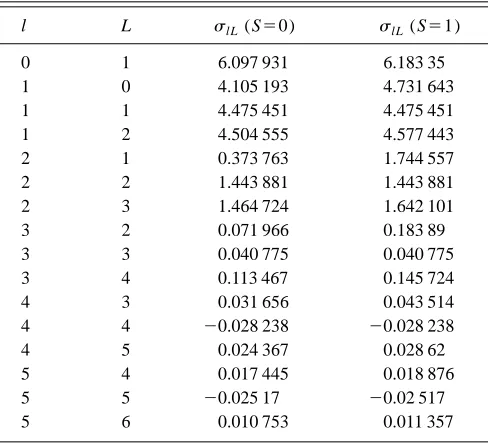
po-tential depends on the total orbital angular momentum L and the total spin S using a nonlocal exchange potential. Further-more, the self-consistent field of the ground state of Ar⫹ includes the effects of relaxation. Our phase shifts for the first six partial waves l and the allowed L and S are shown in Table I. In the expression for the scattering amplitude fs(),
the terms within the summation must be weighted by the appropriate factors, that is,
fel⫾共兲⫽fc共兲⫹ 1
2ik
冋
e2i␦0共e2i0⫾⫺1兲⫹
兺
l⫽1⬁
兺
L⫽l⫺1l⫹1
共2L⫹1兲
3 e
2i␦l共e2ilL⫾⫺1兲P
where the superscripts⫹or ⫺denote singlet or triplet scat-tering, respectively. In our experiment the average over the four possible spin states is observed, and so the differential cross section is given by
dav
d⍀ ⫽
1
4兩fel⫹兩 2⫹3
4兩fel⫺兩
2. 共10兲
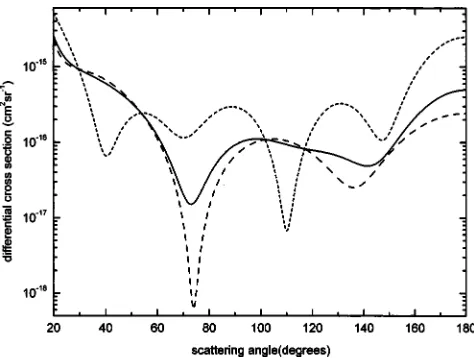
The singlet, triplet, and spin-averaged differential cross sec-tions calculated using the phase shifts in Table I and Eqs.共9兲 and共10兲are shown in Fig. 1.
To determine the importance of including relaxation, we calculated the unrelaxed phase shifts using the ‘‘frozen’’ field of the neutral Ar atom with one 3 p electron removed. The
relaxation was found to cause the non-Coulomb phase shifts to reduce, especially for the d wave where the decrease after averaging over L and S is 0.20 rad. The l reduce because
the electron cloud for the relaxed ground state of Ar⫹ is slightly less diffuse and, hence, the attraction by the potential is smaller.
C. Inelastic processes
The method of partial waves with real phase shifts dis-cussed in Secs. III A and III B applies only to elastic colli-sions. However, the impact energy in the experiment at 16 eV lies above one inelastic threshold due to the transition 3s23 p5 2P – 3s3 p6 2S, which requires the excitation energy
of 13.48 eV 关29兴. To account for the resulting absorption from the incident beam, it is a standard practice to introduce complex phase shifts,
l共k兲⫽Rel共k兲⫹i Iml共k兲. 共11兲
For the present purposes, it is sufficient to use the uncoupled formula共5兲rather than the coupled expression共9兲. The scat-tering amplitude for a modified Coulomb potential at ener-gies above the first inelastic threshold then becomes
fel共兲⫽fc共兲⫹
1
2ikl
兺
⫽0⬁
共2l⫹1兲e2i␦l
⫻关l共k兲e2i Rel⫺1兴Pl共cos兲, 共12兲
wherel(k) is the absorption factor defined by
l共k兲⫽exp关⫺2 Iml共k兲兴. 共13兲
To determine the effect of the inelastic process on the elastic DCS, we therefore require the absorption factors l(k) for
each significant partial wave l. The l(k) are related to the
partial inelastic cross sections labsby
l abs⫽
k2共2l⫹1兲共1⫺l
2兲. 共14兲
However, although the total inelastic cross section abs has
been calculated by Tayal and Henry 关30兴, it appears that the partial cross sections labs are unavailable in the literature. We might consequently, instead, consider estimating the rela-tive importance of the inelastic process by comparing abs
with the total elastic cross sectionelbutelis infinite. We
therefore first make the approximation that the DCS for the inelastic process is isotropic. Using the following value for the total inelastic cross section at the collision energy of 16 eV 关30兴:
abs⫽3.28⫻10⫺17 cm2, 共15兲
the ratio of the inelastic DCS to that for elastic scattering from a Coulomb potential, 兩fc()兩2, is then given
approxi-mately by
dabs
d⍀
冒
del
d⍀ ⬇
abs
4
冒
兩fc共兲兩 [image:4.612.53.297.93.315.2]2⫽0.5 sin4共/2兲, 共16兲
FIG. 1. The singlet 共short-dashed curve兲, triplet 共long-dashed curve兲, and spin-averaged共solid curve兲 differential cross sections for the elastic scattering of electrons from Ar⫹(3s23 p5 2P) at the
[image:4.612.55.294.508.685.2]collision energy of 16 eV calculated using the coupled HF method. TABLE I. The non-Coulomb phase shiftslL(S) for the elastic
scattering of electrons from Ar⫹(3s23 p5 2P) at the collision energy
of 16 eV calculated using the coupled HF method.
l L lL(S⫽0) lL(S⫽1)
0 1 6.097 931 6.183 35
1 0 4.105 193 4.731 643
1 1 4.475 451 4.475 451
1 2 4.504 555 4.577 443
2 1 0.373 763 1.744 557
2 2 1.443 881 1.443 881
2 3 1.464 724 1.642 101
3 2 0.071 966 0.183 89
3 3 0.040 775 0.040 775
3 4 0.113 467 0.145 724
4 3 0.031 656 0.043 514
4 4 ⫺0.028 238 ⫺0.028 238
4 5 0.024 367 0.028 62
5 4 0.017 445 0.018 876
5 5 ⫺0.025 17 ⫺0.02 517
which is negligibly small over most of the angular range observed and reaches a maximum of 0.1 at 85°. We therefore do not include the effects of the inelastic process in the analysis of Sec. IV. The neglect of the complex phase shifts is supported by the elastic scattering of electrons from the neutral gases Ar, Kr, and Xe, where it is found that the com-plex potential has little effect on the DCS even at energies well above the first inelastic thresholds 关31兴.
D. Elastic resonances
The elastic resonances are produced by the doubly excited states of neutral argon, which occur when the incident elec-tron is temporarily trapped in the attractive field provided by an excited state of the ion. The doubly excited states so populated can decay to the initial ground state Ar⫹ (3s23 p5 2P) or the excited state Ar⫹(3s3 p6 2S), which are
referred to as the elastic and inelastic channels, respectively. Tayal and Henry 关30兴 calculated the collision strengths for the transition 3s23 p5 2P – 3s3 p6 2S as a function of the
im-pact energy, which shows that the resonances cover the en-ergy range of the present experiment. We therefore consider below the effects of such resonances on the elastic DCS.
In this section, for simplicity, we use the uncoupled关Eq. 共5兲兴rather than the coupled expression关Eq.共9兲兴for the scat-tering amplitude. The elastic scatscat-tering amplitude when one or more partial waves l
⬘
are resonant then becomes共similar expressions without the Coulomb phase shifts are derived in pp. 604 – 607 of Ref. 关32兴and Appendix C in Ref.关33兴兲fel共兲⫽fc共兲⫹fs共兲
⫺
兺
l⬘
共2l
⬘⫹
1兲 2k⌫ele2i共␦l⬘⫹l⬘兲l⬘ E⫺Er⫹i⌫/2
Pl⬘共cos兲,
共17兲
where fc() and fs() are defined in Sec. III A, Er is the
resonance energy, and the total width⌫is given by
⌫⫽⌫el⫹⌫in, 共18兲
with⌫eland⌫indenoting the partial widths for the decay to
the elastic and inelastic channels, respectively. The doubly excited states decay predominantly to the elastic channel, and therefore, to a good approximation, ⌫elcan be replaced
by⌫in Eq.共17兲. To the best of our knowledge the resonance parameters required to calculate the elastic DCS using Eq. 共17兲are unavailable, namely, the energies Er, widths⌫, and
[image:5.612.319.556.55.234.2]classifications L of the doubly excited states of neutral ar-gon in the energy range of our experiment. The classifica-tions of the doubly excited states are needed to determine which partial waves l
⬘
can couple to the ground state of the ion, Po, to form the given Land, hence, are resonant.Figure 1 in Ref.关30兴shows that there is a broad resonance centered at the collision energy of approximately 16 eV. To investigate the effect of such a doubly excited state without knowledge of the resonance parameters, we calculated the elastic DCS for many different resonance energies, widths, and classifications. As an example, we show in Fig. 2 the theoretical DCS including a Fo doubly excited state that
couples to the d and g partial waves. In Fig. 2, the non-Coulomb phase shifts are set equal to the values of Manson and Turner 关14兴as shown in Table II; the resonance energy
Er is put at the impact energy E to display the maximum
possible effect of the doubly excited state; and we use 50 meV as an estimate for ⌫, since this value is typical of the widths for the lower lying doubly excited states 3s3 p6ns, np, and nd of argon in the energy range of 9.2 to 12.5 eV
共relative to the ground state of Ar⫹) measured by Mitchell
et al.关34兴. To account for the imperfect energy resolution of the spectrometer, we show in Fig. 2 the theoretical curve including the Foresonance convolved with a Gaussian appa-ratus function of 0.6 eV FWHM and, for comparison, the angular distribution without the resonance or convolution is included. Clearly, the effect of a doubly excited state, al-though potentially large for perfect energy resolution (FWHM⫽0), is significantly reduced when observed in the present experiment. Furthermore, the reduction in the
influ-FIG. 2. The theoretical differential cross section including an Fo
elastic resonance observed with perfect energy resolution 共 short-dashed curve兲 and a Gaussian apparatus function of 0.6 eV full width at half maximum共solid curve兲. For comparison, the angular distribution without a resonance or convolution is included 共 long-dashed curve兲.
TABLE II. The calculated non-Coulomb phase shiftslof Ref.
关14兴compared to the values obtained by least-squares fitting to the measurements and the corresponding2. The coupled phase shifts
lL(S) 共see Table I兲 averaged over the total spin S and the total
orbital angular momentum L weighted by the factors (2S⫹1)(2L ⫹1) are included.
Ref.关14兴 Least squares Average
0 6.172 6.34⫾0.17 6.161
1 4.575 4.26⫾0.14 4.533
2 1.714 1.686⫾0.085 1.507
3 0.0699 0.0699 0.110
4 0.004 25 0.004 25 0.0123
5 0.000 34 0.000 34 0.001 07
2
[image:5.612.315.562.622.734.2]ence of the resonance is greater or smaller depending on whether the width ⌫ is narrower or broader than 50 meV, respectively. For perfect energy resolution, the effect of a doubly excited state is only to add a constant phase shift to l⬘ for each resonant partial wave l
⬘
, and so the DCS canstill be parametrized by equations of the type 共4兲–共6兲.
IV. THE COMPARISON BETWEEN EXPERIMENT AND THEORY
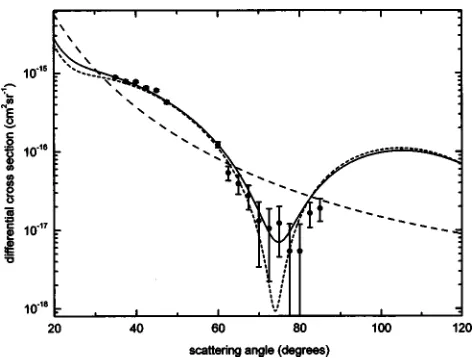
In Fig. 3, the measured DCS for the elastic scattering of electrons from Ar⫹ (3s23 p5 2P) at the collision energy of
[image:6.612.56.294.54.233.2]16 eV is compared to the HS method 共see Sec. III A兲, the coupled HF approach 共see Sec. III B兲, and the Rutherford cross section. The experimental data are normalized to the coupled HF theory at the scattering angle of 35°. The error bars represent the statistical reproducibility of the data at the 90% confidence level and include the effect of subtracting the background共see Sec. II兲. To account for the angular ac-ceptance of the electron analyzer, each theoretical DCS in Fig. 3 is shown convolved with a Gaussian function G of 2° FWHM, that is,
I共兲⫽
冕
0180d共0兲
d⍀ G共⫺0兲d0. 共19兲
The angular broadening causes a small reduction in the depth of the minima centered at approximately 75°, and the sharper the minimum the greater the reduction. The measurements deviate significantly from the Rutherford cross section over the full angular range observed, especially in the region of a deep minimum centered at approximately 75°. Both calcula-tions reproduce the overall shape of the measured DCS, al-though the coupled HF approach describes the depth of the minimum more accurately.
To understand why the minimum is shallower in the coupled HF method, we averaged the coupled phase shifts over the total spin S and the total orbital angular momentum
L weighted by the factors (2S⫹1)(2L⫹1). The average values are compared to the phase shifts of Manson and Turner 关14兴in Table II, which shows that thel are similar
with the important exception of2. The coupled HF method
therefore describes the depth of the measured minimum more accurately due, mainly, to the lower average value for the d-wave phase shift. If a resonant state is present, how-ever, then a shallower minimum could be produced using the phase shifts of Manson and Turner关14兴, as discussed in Sec. III D and illustrated in Fig. 2 for a particular L.
In the HS and coupled HF methods, we consider next why only the 2 differ significantly. For d-wave scattering from Ar⫹, the potential consists of a double well separated by a barrier 关35,36兴. The behavior of2 is therefore atypical for the following two reasons 关11–13,37兴. First, the d wave starts to penetrate into the inner potential well as the colli-sion energy increases from 0 to approximately 2 Ry, which causes 2 to rise rapidly. Due to the resulting low-energy
d-wave shape resonance, 2 is more sensitive to the details
of the potential used in the calculations. A similar atypical behavior occurs for f-wave scattering from Cs⫹ 关1,13兴. To understand the second reason, consider the ‘‘effective poten-tial’’ or the sum of the attractive electrostatic and repulsive centrifugal potentials. Owing to the partial cancellation be-tween the electrostatic and centrifugal terms in the region of the double well, the effective potential is very much smaller than the electrostatic or centrifugal potentials individually. Consequently, small changes in the electrostatic potential cause large relative changes in the effective potential. Thus, the double well and barrier leads to an increased sensitivity even when the resonant trapping of the wave function in the inner potential well becomes small, which explains the dif-ference of approximately 0.2 rad between the2 at energies well above the d-wave resonance. A related discussion com-paring the HS and HF phase shifts for the photoionization of neutral Ar is given by Kennedy and Manson 关38兴. In sum-mary, we suggest that the significant separation between the 2is due to the high sensitivity of the d-wave phase shift to
the different scattering potentials used in the HS and coupled HF methods. In particular, as discussed in Secs. III A and III B, the use of a relaxed potential here rather than the un-relaxed potential in Ref.关14兴is the main cause of our lower average value for 2.
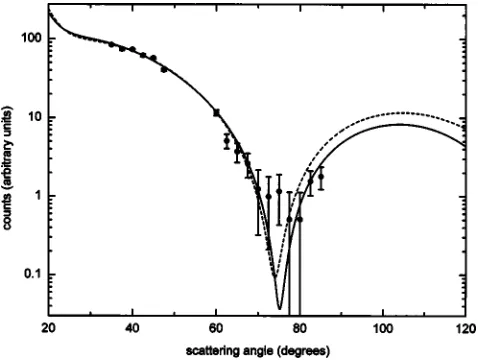
To obtain the non-Coulomb phase shifts accounting for the angular acceptance of the electron analyzer, we least-squares fitted the convolved expression 共19兲for the DCS to the measurements using the Levenberg-Marquardt method 关39兴. The three terms on the right-hand side of Eq. 共9兲 for each partial wave l with different total angular momenta L
⫽l⫺1, l, and l⫹1 have the same angular dependence, and the resulting degeneracy makes it impossible to fit to our measurements using the coupled formula. We therefore opti-mized the uncoupled expression共see Sec. III A兲in which all the terms, by contrast to Eq. 共9兲, are orthogonal when inte-grated over the scattering angle. In view of the limited angu-lar range observed and the statistical uncertainties involved, only the s, p, and d non-Coulomb phase shifts were opti-mized whilst 3, 4, and 5 were fixed at the theoretical
values of Ref. 关14兴. Due to the large angular momentum
barrier for l⭓3, all the calculations共Refs.关11兴,关14兴, and the present coupled HF兲 show that the phase shifts l⭓3 are small共ⱗ0.1 rad兲and, hence, have only a slight effect on the DCS. Therefore, fixing3, 4, and5 to theory has only a
very small effect on the fitted values of0,1, and2. The optimized non-Coulomb phase shifts are presented in Table II and the corresponding fitted DCS is shown in Fig. 4. The DCS according to the HS method is included in Fig. 4, which has been convolved with a Gaussian function to account for the angular acceptance of the electron analyzer 关see Eq. 共19兲兴. For the nonlinear parametersl, the errorslin Table
II are defined by 关40兴
2共
lm⫹l兲⫽2共lm兲⫹1 共20兲
and account for the statistical uncertainties, wherelm is the
value oflthat gives the minimum2. When using Eq.共20兲
to determine l¯m for a particular partial wave l¯, the
non-Coulomb phase shifts lm for all the other partial waves (l ⬍3) are reoptimized, and therefore the resulting error esti-mate also accounts for the correlation between the phase shifts or the nonuniqueness of the fitting procedure. In addi-tion, there are probably also small nonstatistical errors, such as those caused by removing the background as discussed in Sec. II, which are difficult to estimate and so are not included in the l. The 2 obtained when all thel are fixed at the
values of Manson and Turner 关14兴 is included in Table II, which confirms the expectation that the agreement with ex-periment improves by optimizing the first three non-Coulomb phase shifts. The number of degrees of freedom for the present analysis is 13, and so for good fits 2 is approximately normally distributed with a mean value of 13 and a standard deviation
冑
2 of 5.1关40兴. The value of 2obtained here at 36.1 therefore suggests that the model and the data are not quite consistent within the quoted experi-mental uncertainties, which is probably due to small non-statistical errors共see above兲. Similarly, values of2 signifi-cantly larger than the number of degrees of freedom are also obtained when fitting the phase shifts to other electron-ion
elastic scattering measurements关41兴. Table II shows that the
s and d non-Coulomb phase shifts according to Manson and
Turner 关14兴 and the fit are consistent within the quoted ex-perimental uncertainties, although there is possibly a small discrepancy for the p wave. The fitted 2 is closer to the value of Manson and Turner关14兴than the coupled HF result, which seems to contradict the observation that the lower
d-wave phase shift describes the depth of the measured
mini-mum more accurately. However, we suspect that the fitting procedure is compensating for a small systematic error due to a data point or points away from the minimum at approxi-mately 75°, which otherwise would give a value of2closer
to 1.507.
The distortion of the ion by the incident electron during the collision alters the scattering potential, but the resulting polarization effects are not included in the present static-exchange method. The agreement between our measure-ments and calculation suggests, however, that the effect of polarization on the phase shifts is small共ⱗ0.1 rad兲.
V. CONCLUSION
Measurements of the DCS for the elastic scattering of electrons from Ar⫹(3s23 p5 2P) at the collision energy of 16
eV have been presented. We calculated the corresponding non-Coulomb phase shifts l by solving the Hartree-Fock
equations for the incident electron in the self-consistent field of Ar⫹(3s23 p5 2P). The coupling between the orbital
angu-lar momenta and spin of the incident electron and those of the target ion are formally included in our model, since the Hartree-Fock potential here depends on the total orbital an-gular momentum L and the total spin S using a nonlocal exchange potential. Furthermore, the self-consistent field of the ground state of Ar⫹includes the effects of relaxation. We compared the measurements with our coupled HF calculation and an uncoupled, unrelaxed theory using a local, spherically symmetric HS potential. Both calculations reproduce the overall deviations of the experimental data from the Ruther-ford cross section, but the coupled HF approach describes the depth of the measured minimum at around 75° more accurately owing to our lower average value for2.
For d-wave scattering from Ar⫹, the potential consists of a double well separated by a barrier. Consequently, there is a
d-wave shape resonance and small changes in the
electro-static potential cause large relative changes in the effective potential共electrostatic plus centrifugal terms兲. Therefore, the
d-wave phase shift is highly sensitive to the details of the
scattering potential used in the calculations, which explains why only the 2 differ significantly in the HS and coupled
HF methods. In particular, the use of a relaxed rather than an unrelaxed potential here is the main cause of our lower 2. Thus, we have shown that the experimental DCS for electron-ion collisions in the energy range of a shape reso-nance provides a stringent test of the accuracy of the ap-proximations of the theory.
The DCS is dominated by the Rutherford cross section at low scattering angles. To obtain the most accurate informa-tion about the short-range electron-ion interacinforma-tion, the angu-lar distribution at angu-larger scattering angles is consequently
[image:7.612.55.294.57.237.2]quired, particularly in the backward hemisphere (90°⬍ ⭐180°). We therefore intend to modify the present appara-tus to allow observations over the full angular range (0° ⭐⭐180°). The detailed structure expected at larger scat-tering angles would permit phase shifts to be fitted with greater accuracy and the optimization of higher partial waves. The resulting l would test more stringently the
ap-proximations of the calculations and thereby advance our understanding of electron-ion interactions.
ACKNOWLEDGMENT
We thank Professor S. T. Manson for comments on the manuscript.
关1兴W. R. Johnson and C. Guet, Phys. Rev. A 49, 1041共1994兲. 关2兴B. A. Huber, C. Ristori, C. Guet, D. Ku¨chler, and W. R.
Johnson, Phys. Rev. Lett. 73, 2301共1994兲.
关3兴J. B. Greenwood, I. D. Williams, and P. McGuinness, Phys. Rev. Lett. 75, 1062共1995兲.
关4兴I. D. Williams, in Proceedings of the 20th International
Con-ference on Physics of Electronic and Atomic Collisions,
Vi-enna, edited by F. Aumayr and H. Winter 共World Scientific, Singapore, 1998兲, p. 313.
关5兴B. Srigengan, I. D. Williams, and W. R. Newell, Phys. Rev. A 54, R2540共1996兲.
关6兴B. Srigengan, I. D. Williams, and W. R. Newell, J. Phys. B 29, L897共1996兲.
关7兴C. Belenger, P. Defrance, R. Friedlein, C. Guet, D. Jalabert, M. Maurel, C. Ristori, J. C. Rocco, and B. A. Huber, J. Phys. B 29, 4443共1996兲.
关8兴I. D. Williams, B. Srigengan, J. B. Greenwood, W. R. Newell, A. Platzer, and L. O’Hagan, Phys. Scr. T 73, 119共1997兲. 关9兴Z. Wang, J. Matsumoto, H. Tanuma, A. Danjo, M. Yoshino,
and N. Kobayashi, J. Phys. B 33, 2629共2000兲.
关10兴C. Liao, S. Hagmann, C. P. Bhalla, S. R. Grabbe, C. L. Cocke, and P. Richard, Phys. Rev. A 59, 2773共1999兲.
关11兴S. T. Manson, Phys. Rev. 182, 97共1969兲.
关12兴P. P. Szydlik, G. J. Kutcher, and A. E. S. Green, Phys. Rev. A 10, 1623共1974兲.
关13兴D. C. Griffin and M. S. Pindzola, Phys. Rev. A 53, 1915 共1996兲.
关14兴S. T. Manson and C. S. Turner共private communication兲. 关15兴J. T. Shepherd and A. S. Dickinson, J. Phys. B 32, 513共1999兲. 关16兴I. D. Williams, Rep. Prog. Phys. 62, 1共1999兲.
关17兴B. Srigengan, I. D. Williams, and W. R. Newell, J. Phys. B 29, L605共1996兲.
关18兴P. McKenna, B. Srigengan, and I. D. Williams共unpublished兲. 关19兴M. Liehr, G. Mank, and E. Salzborn, NSCL Report No.
MSUCP-47, 1987共unpublished兲.
关20兴T. K. McLaughlin, Ph.D. thesis, Queen’s University of Belfast, 1992共unpublished兲.
关21兴M. T. Bernius, K. F. Man, and A. Chutjian, Rev. Sci. Instrum. 59, 2418共1988兲.
关22兴J. N. Brunt, F. H. Read, and G. C. King, J. Phys. E 10, 134 共1977兲.
关23兴W. Hofer, W. Vanek, P. Varga, and H. Winter, Rev. Sci. In-strum. 54, 150共1983兲.
关24兴D. C. Griffin, M. S. Pindzola, J. A. Shaw, N. R. Badnell, M. O’Mullane, and H. P. Summers, J. Phys. B 30, 3543共1997兲. 关25兴P. Varga, W. Hofer, and H. Winter, J. Phys. B 14, 1341共1981兲. 关26兴N. F. Mott and H. S. W. Massey, The Theory of Atomic
Colli-sions, 3rd ed.共Oxford University Press, London, 1965兲. 关27兴A. E. S. Green, D. L. Sellin, and A. S. Zachor, Phys. Rev. 184,
1共1969兲.
关28兴B. H. Bransden and C. J. Joachain, Physics of Atoms and
Mol-ecules共Longman, Harlow, 1983兲, Sec. 12.2.
关29兴C. E. Moore, Atomic Energy Levels, Natl. Stand. Ref. Data Ser., Natl. Bur. Stand.共U.S.兲Circ. No. 35共U.S. GPO, Wash-ington, D.C., 1971兲, Vol. 1.
关30兴S. S. Tayal and R. J. W. Henry, J. Phys. B 29, 3443共1996兲. 关31兴R. A. Berg, J. E. Purcell, and A. E. S. Green, Phys. Rev. A 3,
508共1971兲.
关32兴H. S. W. Massey and E. H. S. Burhop, Electronic and Ionic
Impact Phenomena, 2nd ed. 共Oxford University Press, Lon-don, 1969兲, Vol. 1.
关33兴U. Fano, Phys. Rev. 124, 1866共1961兲.
关34兴P. Mitchell, J. A. Baxter, J. Comer, and P. J. Hicks, J. Phys. B 13, 4481共1980兲.
关35兴A. R. P. Rau and U. Fano, Phys. Rev. 167, 7共1968兲. 关36兴S. T. Manson and J. W. Cooper, Phys. Rev. 165, 126共1968兲. 关37兴S. M. Younger, Phys. Rev. A 26, 3177共1982兲.
关38兴D. J. Kennedy and S. T. Manson, Phys. Rev. A 5, 227共1972兲. 关39兴D. W. Marquardt, J. Soc. Ind. Appl. Math. 11, 431共1963兲. 关40兴P. R. Bevington, Data Reduction and Error Analysis for the