TypEx: A Type Based Approach to XML Stream Querying
George Russell
Department of Computer andInformation Science University of Strathclyde
Glasgow, U.K.
[email protected]
Mathias Neum ¨uller
Department of Computer andInformation Science University of Strathclyde
Glasgow, U.K.
[email protected]
Richard Connor
Department of Computer andInformation Science University of Strathclyde
Glasgow, U.K.
[email protected]
ABSTRACT
We consider the topic of query evaluation over semistruc-tured information streams, and XML data streams in par-ticular. Streaming evaluation methods are necessarily event-driven, which is in tension with high-level query models; in general, the more expressive the query language, the harder it is to translate queries into an event-based implementation with finite resource bounds.
We consider an alternative model by introducing a two-phase evaluation strategy. A queryQ is decomposed into an event driven primary filter queryQ′, which incrementally
gathers relevant data from the input stream, and another query Q′′ which consumes this data as it becomes
avail-able. Evaluation ofQ(s) is then equivalent to Q′′(Q′(s)).
The importance of the separation is that it allows the first phaseQ′ to be expressed in a non-Turing complete algebra
which may therefore be generally amenable to event-based interpretation. The second phaseQ′′may be expressed in
an arbitrary higher-order language, so long as its execution takes no longer than the extraction of the next input in-stance from the input stream.
In this paper a type algebra is used to express the first-phase query. This builds on previous work, which shows how traditional programming language types may be given a semantics within XML, therefore allowing their projection onto XML resources. A side-effect of this definition of pro-jection is that instances of a type may be extracted in a form available for computation within a traditional domain. The use of type projection in this context also allows Q′′
to be statically typed according to the type filter used for
Q′, which itself may be deduced by inference overQ′′. A
mechanism for translating a type into a network of event driven automata, which has the effect of gathering all data captured by that type from a semistructured input stream, is described. Although at an early stage of investigation, ini-tial results suggest this approach provides a credible
alter-Copyright is held by the author/owner.
International Workshop on the Web and Databases (WebDB). June 12-13, 2003, San Diego, California.
native to stream-based querying in at least some application domains.
Categories and Subject Descriptors
H.2.4 [Database Management]: Languages—Query Lan-guages; D.3.3 [Programming Languages]: Language Con-structs and Features—Data Types and Structures
Keywords
Type projection, stream processing, query typing, language integration, semistructured data
1.
INTRODUCTION
The requirement for efficient, stream-based XML querying is by now established. There are several applications of such systems, notably in selective dissemination of information (SDI) and publish / subscribe systems [1] and for very large data environments and data integration [8]. Another mo-tivation is the efficient transformation of streaming XML data, in applications such as XSLT processing and contin-uous data streams [9]. Such applications require processing to occur in real time as data becomes available, rather than after the end of the input stream is reached as in most XML query models.
SAX1
provides a fully general XML stream-processing ab-straction, giving the programmer an event-based interface based on callbacks. This interface provides full real-time streaming functionality; however the nature of the interface makes programming challenging for many applications, as conversion from the event stream to the logical structure of the underlying data is entirely the burden of the program-mer.
Given this difficulty, a number of authors have investigated translation from a higher-level expressive form into an event-based model, expressed most commonly as a deterministic finite state automata (DFA) network [2, 7, 9, 11, 12]. Par-tial translations from both XPath and XQuery have been discussed, and while there are still open issues, significant progress has been made. One of the major outstanding is-sues however is the identification of the level of expression which can be sensibly handled in this model. Both XPath and XQuery contain expressions which can not usefully be translated into a DFA model without compromising com-putational thresholds underlying the purpose of the transla-1
tions; the same of course is true for any single query language with sufficient expressive power to handle any reasonable range of queries.
We propose a significant departure from this methodology which we show works well for certain classes of application. The query is coded as a function in a Turing-complete pro-gramming language, with the assumption that the execution of this function will occur within acceptable bounds if its in-put can be isolated and passed to it as a process separated from the parsing of the input stream. This function could represent the query in its entirety, but in this domain the whole query is more likely to be represented by the repeated application of the function to instances of its input as they are extracted from the XML stream.
The function is typed according to its input, and this type is used to generate a deterministic state automata based input filter which extracts corresponding values from the XML input stream. These values are then passed, as they occur, to the query. In this way fully general queries can proceed in parallel with the parsing of the input. This builds on our previous work [5, 14, 15, 6, 10], in which we show how traditional programming language types may be given a semantics within XML, therefore allowing their extraction from XML resources.
The method will only work well if the query function is short-lived, and its type represents a significantly small subset of the XML stream; however we believe there exist many instances of this pattern. The main properties of the method are as follows:
• only the type-based extraction requires to be trans-lated into the event-based paradigm
• only the second part of the query requires to be ex-pressed, as the filter can be automatically generated from it
• the two phases of the execution can proceed in parallel
Compared with single-phase deterministic automata trans-lations from XPath or XQuery, the method seems likely to work relatively well for complex queries over core regular data within a loosely structured stream, while it is likely to work relatively badly for simple queries over data that is inherently unstructured. The tradeoffs with respect to simplicity of expression and efficiency are complex and re-quire further investigation, but in this paper we have at least shown credibility in these domains with respect to some classes of application.
In more generality, not considered further in this paper, the same basic two-part query framework may be used entirely within the XML standards domain, by expressing the fil-ter by a projection defined over XML Schema. Instances of XML would then be generated by the first phase, allowing the secondary part to be expressed in any XML query lan-guage. One particularly interesting aspect of this is that, if the entire data stream is known to be valid with respect to a given schema, then the soundness of the filter may be
statically assessed, and furthermore user-level tools for gen-erating it from the XML Schema stream description could be envisaged.
2.
A MOTIVATING EXAMPLE
For motivation, an example streamed application is coded in Java using various alternative implementation techniques, namely SAX, XPath, and TypEx, the system based on the approach described. SAX only creates temporary data struc-tures to report parsing events which need to be transferred manually into the application specific data model for pro-cessing. The XPath code uses an XPath expression to define a superset of the required data, in conjunction with DOM code to perform the required query; the TypEx code uses a Java class definition to define a superset of the required data, in conjunction with a method of that class to query it. In the cases of XPath and TypEx the initial extraction may be performed incrementally and processed in parallel with the code that uses the extracted values, whereas in the SAX application the entire processing must be performed within the parsing callbacks.
The example is a news ticker application, which extracts news items from an arbitrary XML stream. Schema infor-mation of the expected stream is incomplete and restricted to the relevant data. The application programmer knows that there areitem elements which contain at least two di-rect child elements namedtitle anddescription. Both these items contain only textual content and can occur only once within anyitem. This data may be embedded at any point in the source and additional content may appear beneath item elements. The application is to display the content of these two fields as they are detected within an unbounded stream of XML.
2.1
Parsing Event Based Model
An example of an approach in which the query is directly contained in the application code is the event-based abstrac-tion model used bySAX. Mappings between parsing events and the data model used are spread over various callback methods, making it hard to understand and thus maintain. The mixture of selection and computation also increases the coupling between user-specified computation and parsing process and is thus undesirable.
Listing 1: The SAX handler for the news ticker
public classNewsHandlerextendsDefaultHandler{
privateStringBuffer title , description ;
privateStack elements =newStack();
public voidcharacters(char[] ch,
5 int start , int length){
if (elements.search(”item”) == 2){
if (elements.search(” title ”) == 1) title .append(ch, start , length );
if (elements.search(”description”) == 1)
10 description .append(ch, start , length ); }
}
public voidstartElement(String namespaceURI, String localName, String qName, Attributes atts){ 15 elements.push(qName);
description =newStringBuffer(); title =newStringBuffer();
}
20 }
public voidendElement(String namespaceURI, String localName, String qName){
elements.pop();
if (qName.equals(”item”)
25 System.out.println( title +”\n”+ description); }
public static voidmain(String[] args){
SAXParser parser =
SAXParserFactory.newInstance().newSAXParser();
30 parser .parse(newURL(args[0]).openStream(), newNewsHandler());
} }
Listing 1 shows that the required state information is main-tained by using a stack containing all opened tags (line 15). String buffers are created once an openingitem tag is found. Upon occurrence of character data the top two elements of the stack are checked. If they fit the structural constraints, the content is appended to the relevant buffers. The con-tent of these buffers is printed when the end of a news item is detected. Note that this implementation does not verify order, multiplicity or even existence of required fields, but just checks that identified fields suffice the structural con-straints. Other constraints would need to be checked using either a more complicated handler or a partial schema val-idation process, which is currently not part of any of the relevant standards.
2.2
XPath/DOM Based Model
The combination ofXPath [16] andDOM allows a different approach. Programs specify the desired set of nodes using a path expression, and operate over the results using tree traversal code. XPath expressions are navigation expres-sions over tree structured data which are sent to an exe-cution engine in a similar fashion as embedded SQL state-ments. Selection is mechanically performed by the system and returns a collection of trees, requiring tree traversal code in the user specified computation. Typically a superset of the data required is returned because XPath returns the en-tire subtrees rooted at the selected nodes, regardless of the data requirements of the subsequent computation. However, as there is no strong coupling between the two phases, it can-not be guaranteed that the returned data actually satisfies the computational needs.
Listing 2: The same application using XPath
public classBBCNewsXPath{
public static voidmain(String[] args){
DocumentBuilderFactory factory = DocumentBuilderFactory.newInstance();
5 DocumentBuilder builder =
factory .newDocumentBuilder(); Node doc = builder.parse(
newInputSource(newURL ( args [0]). openStream()));
10 NodeList results =
XPathAPI.selectNodeList(doc,
”//item[description and child :: text ()] ” +”[ title and child :: text ()] ”
+”[count(title)=1]”
15 +”[count(description)=1]”);
for (int i=0; i<results.getLength(); i++){
Node result = results .item(i ); Element aItem = (Element) result; NodeList titles = aItem
20 .getElementsByTagName(”title”);
String title =
((Element) titles .item(0)) . getFirstChild (). getNodeValue(); NodeList descriptions = aItem
25 .getElementsByTagName(”description”);
String desc =
((Element) descriptions.item(0)) . getFirstChild (). getNodeValue(); System.out.println( title + ”\n” + desc);
30 }
} }
The program shown in Listing 2 uses the single XPath state-ment stretching from lines 12–15 to declare the navigational steps required to select the relevant data. The XPath ex-ecution engine returns aNodeListcontaining the selected nodes (line 10). The loop starting in line 16 iterates through this list and extracts the data from the relevant text nodes using the DOM API, and in particular the method getEle-mentsByTagName which selects nodes based on their name. Structural checks upon the input format have been added to the XPath query in Listing 2, which allows them to be omit-ted from the result processing code which otherwise would contain explicit structural checking. The XPath implemen-tation used is not streaming, but this does not affect the purpose of the example.
2.3
Type Projection Based Model
The approach suggested by this paper has been implemented in theTypEx system. The extraction phase identifies data that may be relevant for the query by means of a filter type and binds this data to an instance of this type for use in the second phase. Since the computation is specified in terms of the filter type, the returned instances of this type will always contain a superset of the information required.
Listing 3: The filter classitem
public classitem{
String title , description ;
publicString toString(){
return title+”\n”+description;
5 }
}
com-Listing 4: The TypEx Newsticker
public classBBCNewsimplementsObserver{
Extractor stories ;
publicBBCNews(){
stories =newExtractor(item.class);
5 stories .addObserver(this); }
public voidparse(InputStream in){
stories .parse(in );
}
10 public voidupdate(Observable o, Object i){
System.out.println((item) i );
}
public static voidmain(String[] args){
BBCNews p =newBBCNews();
15 p.parse(newURL(args[0]).openStream()); }
}
putation, i.e. the printing of the content is also defined by this type. Listing 4 shows the usage of this filter. It creates anExtractorparameterised by the type (line 4), which ex-tractsitem objects during parsing and passes them to the observer for display.
3.
TYPE BASED EXTRACTION
In this section we outline the translation of a core type language into a network of co-operating, deterministic au-tomata. The resulting network is capable of extracting val-ues of those types.
The type language includes both record and list construc-tors, but does not allow anonymous lists to occur as they have no semantic projection in XML. In addition, lists can-not occur at the top level, as this would be incongruous with the purpose of the mechanism, which is to release typed data as soon as possible. A grammar for the type language is given below.
typedef ::= label : type type ::= record | scalar
record ::={label1: field1,. . ., lab eln:fieldn}
field ::= scalar | record | list[ type ] scalar ::= int | string
A type expression is translated into a set of named compo-nent types as shown by the following example:
p:{a: int, b: list[{d: int}], c:{d: int}}
is transformed into
p : T1
T1:{a:T2,b:list[T3],c:T3} T2:int
T3:{d:T2}
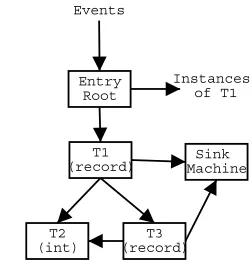
Each typeTiin this representation is mapped to an
automa-ton, whose jobis to extract an instance of that type from the input stream and return it as a value. The topology
produced by this example is shown in Figure 1. The size of the automata network equals the size of the corresponding type graph plus one for the additionalsinkmachine.
The root and sink machines always occur as single in-stances; the others are generated according to the individual type components. Each internal connection is a two-way link, passing input events in one direction and results in the other. Only one machine at a time actively processes events; a machine become active when it receives an init() event, and remains so until either areturn()orfail() event is passed back to its initiator. Non-active machines pass events on to the currently active machine. Events are prop-agated synchronously in that they are not passed to the active machine until the previous event has been processed; this avoids synchronicity problems with the return events being passed back up the chain.
Entry Root
T1 (record)
Sink Machine
T3 (record) T2
(int)
[image:4.612.367.493.193.326.2]Instances of T1 Events
Figure 1: The example automata network
The following messages are defined: open(l),close(l),text(v), init(l),return(v), andfail(). A parameterlstands for a la-bel corresponding to an XML tag lala-bel, and a parameter v
stands for a value. open(l), close(l) and text(v) are events corresponding to a simplified input stream, and correspond to the textual form of the XML being processed. init(l), as described, causes a machine to become active; its parame-ter is a label which, when subsequently received within a close(l) message, will cause it to pass control back to its initiator. This is either by means of areturn(v)message, in the case it has been able to extract a value corresponding to its type from the input stream, and by means of a fail() message otherwise. There are four different classes of ma-chines: entry,sink,scalarandrecord, as defined by the following behaviours:
• Entry: discard every event until an open(l) occurs, wherel is the label corresponding to the name of the top-level typedef. At this point, init(l) is passed on to the machine corresponding to the type of the top-leveltypedef, which then becomes the active machine. Further events are passed to this machine until either a return(v)orfail() is received from it. On areturn(v), the parametervis passed on to the network’s receiver; onfail(), no further action occurs.
until the correspondingclose(l) event is received, en-suring that any contained subtrees using the same la-bellare also discarded. No value is returned.
• Scalar: on receipt ofinit(l), a scalar machine requires the first event it receives to be atext(v)message, and its second to be a close(l) message. Depending on the particular scalar type, the string parameter v is examined to ensure it is structurally compatible, and if so is coerced and returned. Any other combination of events causes the machine to pass afail()event back to its initiator.
• Record: a record machine starts with internal state variables corresponding to each of the field names oc-curring in its progenitor type description. For each one, the value is initialised toundefined if the field is a scalar or record type, and to an empty list if it is a list type. These variables are used to build up the state corresponding to the record value it attempts to extract. It may receive text(v), open(l) and close(l) events from its initiator:
– text(v): the event is discarded
– open(l): the behaviour depends on whether there is an internal state variable corresponding to l, and if so what its value is. If there is no internal variable, an init(l) message is sent to the sink
machine. If there is a variable which is a list, aninit(l)message is passed to the machine cor-responding to the field type; if this returns with a value, it is appended to the list, otherwise no action is taken. If there is a variable whose value is defined, this results in termination withfail(). Finally, if there is a variable whose value is not yet defined, an init(l) message is passed to the machine corresponding to the field type; if this returns with a result, it is assigned to the inter-nal variable, otherwise no action is taken. This behaviour corresponds to a structural sub-typing approach to extracting the corresponding data values in the XML whilst ignoring order fields and any extra fields that are not pertinent to the query.
– close(l): if all internal state fields are defined, a record value based on them is constructed and re-turned to the calling machine in areturn(v) mes-sage; otherwise, afail()message is passed back.
4.
IMPLEMENTATION
The automata networks withinTypEx form the middle layer of the system architecture. Below this layer an event handler translates parsing events generated by an underlying XML parser into automata events. Above the automata layer is the transformation layer, which generates networks from fil-ter specifications and transforms extracted data graphs into instances of the specified type. The top layer is the program-mer visible API, which allows the specification of an input source and associated filter types. It allows multiple listen-ers per filter and multiple filtlisten-ers per data stream, affording a degree of parallelism in the query process.
Each automaton is implemented as a Java class. Automata networks are generated using reflection to examine the field
types and names of filter types. Reflection is also used dur-ing data instantiation process.
5.
EXPERIMENTAL RESULTS
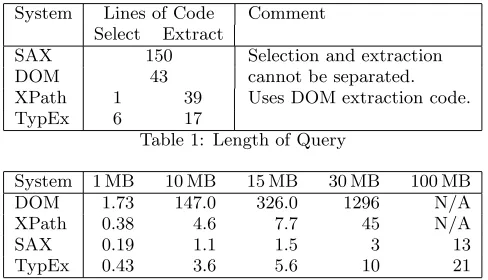
To determine the viability of our approach, we have pro-cessed a more complex example query than the one discussed in Section 2. The data set under consideration has been generated using the XMark benchmark [13] scalable data generation tool and describes auction site details containing items for sale, persons (bidders and sellers) and some more information not relevant for our purposes. In particular, we have queried large XML files (up to 11GB in size) for people (with attributes such as name, address, etc.). We compare programs based on SAX, DOM XPath and TypEx both in terms of the complexity of the code and their runtime per-formance. The number of lines have been taken as a simple measure of the complexity of the code (Table 1).
System Lines of Code Comment Select Extract
SAX 150 Selection and extraction
DOM 43 cannot be separated.
XPath 1 39 Uses DOM extraction code.
TypEx 6 17
Table 1: Length of Query
System 1 MB 10 MB 15 MB 30 MB 100 MB
DOM 1.73 147.0 326.0 1296 N/A
XPath 0.38 4.6 7.7 45 N/A
SAX 0.19 1.1 1.5 3 13
[image:5.612.315.559.196.336.2]TypEx 0.43 3.6 5.6 10 21
Table 2: Length of Query Execution (s)
Table 1 supports the observation gained from the news ticker example and illustrates the conciseness possible using the TypEx approach. The SAX program, contains a mix of high-level application code and low-level parsing callbacks and results in an order of magnitude increase of code. DOM and XPath approaches lie between these two extremes and are almost identical because of their common tree traversal code.
6.
RELATED WORK
To the best of our knowledge, this is the first attempt of using types as filters in a two stage stream query process. The requirements for stream processing have been identified in [3] and elsewhere.
Much of the effort concentrates on implementing the XPath [16] language over streams. A number of independent ef-forts are proceeding, such as XMLTK [2], SPEX [11], and XSQ [12]. Green et al. [7] describe the implementation of an XPath subset using a lazily generated network of DFA and provide a comparison with other XPath implementa-tions over streams. The work concentrates on the construc-tion of a single automata network representing a large num-ber of XPath queries which are executed simultaneously. Olteanu et al. [11] describe the translation of a subset of XPath expression into equivalent expression using only for-ward axis, which can then be efficiently processed by their SPEX XPath system using a network of event driven au-tomata. Finally the XSQ system [12] is based upon push-down transducers with associated buffers and aims at com-plete XPath support.
A more recent approach by Lud¨ascher et al. [9] describes the implementation of the computationally complete query language XQuery over streaming data, using transducer net-works derived from a query expression. Their XSM system optimises the derived network based on static analysis and available schema information. Optimisation strategies used may prove useful for our approach.
Type projection is introduced in [5] and formalised in [15]. Language integration with Java is described in [14] in more depth, while its use within query languages for XML is also outlined [10, 6].
7.
CONCLUSIONS
We have outlined a novel mechanism which allows XML stream queries to be decomposed into an extraction and a computation phase over the extracted data based on a single type description. While the concept requires further investigation, it has a number of advantages for some classes of application. In particular, it may allow the programmer to use a higher-level, and therefore more succinct, query without gravely affecting properties of efficiency. Queries are formulated within the domain of the host language and can thus be statically typed.
The mechanisms have been implemented and first results show some promise. However the investigation is at an early stage and a great deal of work remains to be done.
8.
ACKNOWLEDGEMENTS
We would like to thank Fabio Simeoni, David Lievens, Steve Neely and the anonymous referees for making useful sug-gestions on the presentation of this work. It has been fi-nancially supported by EPSRC (GR/M72265) and BBSRC (17/BIO12052.) George Russell and Mathias Neum¨uller are supported by PhD studentships funded by the University of Strathclyde.
9.
REFERENCES
[1] M. Altinel and M. J. Franklin. Efficient filtering of XML documents for selective dissemination of information. In A. E. Abbadi, et al., editors,VLDB 2000, pages 53–64, 2000. Morgan Kaufmann.
[2] I. Avila-Campillo, T. J. Green, et al. XMLTK: An XML toolkit for scalable XML stream processing. In PLAN-X: Programming Language Technologies for XML, 2002.
[3] B. Babcock, S. Babu, and other. Models and issues in data stream systems. In L. Popa, editor, PODS 2002, pages 1–16, Madison, Wisconsin, USA, 2002. ACM.
[4] P. A. Bernstein, Y. E. Ioannidis, et al., editors. Proceedings of the 28th International Conference on Very Large Databases, Hong Kong, China, 2002. Morgan Kaufmann.
[5] R. Connor, D. Lievens, et al. Extracting typed values from XML data. InOOPSLA Workshop on Objects, XML and Databases, 2001.
[6] R. Connor, D. Lievens, et al. Projector – a partially typed language for querying XML. InPLAN-X: Programming Language Technologies for XML, 2002.
[7] T. J. Green, G. Mikklau, et al. Processing XML streams with deterministic automata. In D. Calvanese et al., editors,ICDT 2003, volume 2572 of LNCS, pages 173–189. Springer, 2002.
[8] T. Kiesling. Towards a streamed XPath evaluation. Diplomarbeit, Universit¨at M¨unchen, 2002.
[9] B. Lud¨ascher, P. Mukhopadhyay, and
Y. Papakonstantinou. A transducer-based XML query processor. In Bernstein et al. [4].
[10] P. Manghi, F. Simeoni, et al. Hybrid applications over XML: Integrating the procedural and declarative approaches. InFourth International Workshop on Web Information and Data Management (WIDM’02), Virginia, USA, Nov 2002.
[11] D. Olteanu, T. Kiesling, and F. Bry. An evaluation of regular path expressions with qualifiers against XML streams. InICDE 2003, Mar 2003.
[12] F. Peng and S. S. Chawathe. XPath queries on streaming data. InSIGMOD 2003, 2003.
[13] A. R. Schmidt, F. Waas, et al. XMark: A benchmark for XML data management. In Bernstein et al. [4], pages 974 – 985.
[14] F. Simeoni, D. Lievens, et al. Language bindings to XML.IEEE Internet Computing, 7(1), Jan/Feb2003.
[15] F. Simeoni, P. Manghi, et al. An approach to high-level language bindings to XML.Information & Software Technology, 44(4):217–228, 2002.
[16] World Wide WebConsortium.XML Path Language (XPath) Version 1.0, W3C recommendation 16 November 1999 edition, 1999.