Int. J. Electrochem. Sci., 12 (2017) 3231 – 3240, doi: 10.20964/2017.04.07
International Journal of
ELECTROCHEMICAL
SCIENCE
www.electrochemsci.org
Highly Sensitive Voltammetric Sensor for Determination of
Ascorbic Acid Using Graphite Screen Printed Electrode
Modified with ZnO/Al
2O
3Nanocomposite
Mohammad Reza Ganjali1,2,* , Fariba Garkani Nejad3, Hadi Beitollahi4, Shohreh Jahani4, Morteza Rezapour5, Bagher Larijani6
1
Center of Excellence in Electrochemistry, University of Tehran, Tehran, Iran
2
Biosensor Research Center, Endocrinology & Metabolism Molecular-Cellular Sciences Institute, Tehran University of Medical Sciences, Tehran, Iran
3
Department of Chemistry, Graduate University of Advanced Technology, Kerman, Iran
4
Environment Department, Institute of Science and High Technology and Environmental Sciences, Graduate University of Advanced Technology, Kerman, Iran
5
IP Department, Research Institute of the Petroleum Industry (RIPI), P.O. Box 14665-137, Tehran, Iran
6
Diabetes Research Center, Endocrinology & Metabolism Clinical Sciences Institute, Tehran University of Medical Sciences, Tehran, Iran
*
E-mail: [email protected]
Received: 31 December 2016 / Accepted: 5 February 2017 / Published: 12 March 2017
A sensitive and selective voltammetric sensor based on graphite screen printed electrode modified by ZnO/Al2O3 nanocomposite for the detection of ascorbic acid has been successfully developed. The
electrochemical behavior of prepared electrode for the determination of ascorbic acid was systematically investigated by cyclic voltammetry (CV) and differential pulse voltammetry (DPV). Under optimum conditions, the modified electrode exhibits linear responses to ascorbic acid in the ranges 1.0–100 μM, with detection limits (S/N = 3) calculated to be 0.6 μM. Finally, the developed sensor was successfully applied to the detection of ascorbic in real samples.
Keywords: Ascorbic acid; ZnO/Al2O3 nanocomposite; Graphite screen printed electrode; voltammetry
1. INTRODUCTION
vitamins C and all the B vitamins are water-soluble. Water-soluble vitamins do not get stored in the body for the long time; they easily get expelled through urine. Water-soluble vitamins need to be provided more than fat-soluble ones [1].
Ascorbic acid or vitamin C plays an important role in the formation and maintenance of the collagen and also as a powerful antioxidant protecting the body against oxidative stress, and present in the human diet as a vital vitamin. Further, it is also used for the prevention and treatment of prevalent cold, mental illness, infertility, cancer and AIDS [2-4]. Also ascorbic acid is important biochemical active molecule and is widely used as food additives or antioxidants for pharmaceutical purpose. Studies show that ascorbic acid is essential for the natural synthesis of dopamine in the human body. On the other hand, large doses of ascorbic acid may reduce the risk of kidney stone formation in women. Thus, determination of this compound is very essential for pharmaceutical and biological studies [5, 6].
Numerous analytical methods for determining this vitamin has been reported, including spectrophotometry, HPLC, fluorescence, chemiluminescence and electrochemical methods, such as, potentiometry, polarography and voltammetry [7-14]. Among these methods, electrochemical methods have attracted more attention in last two decades for food and biological compounds analysis because of fast response, low detection limit, low cost, simple operation and the absence of pretreatment [15].
A screen-printed electrode (SPE) is simple, versatile, low cost, portable, easily operated, reliable, small sized, and capable of mass production. Therefore, it is applied widely in the electroanalytical measurments. In order to improve their electrochemical performance, SPEs have been modified with these nanostructures include, for example, carbon nanomaterials, Au nanoparticles, graphene, and nanostructures metal oxides. When an electrode is modified its sensitivity and selectivity is improved. Also, its detection limit compared to unmodified electrodes becomes lower and can be used as a promising device to facilitate the direct electron transfer [16-36].
Nanomaterials are used for various applications in electrochemistry [37-47]. Among metal oxides, ZnO nanostructures due to wide band gap (3.37 eV), large excitation binding energy (60 eV), non-toxicity, biocompatibility, chemical and photochemical stability, and high electron communication features is preferred for the fabrication of effective sensors. In addition, ZnO can act both as an electronic and structural promoter which exhibiting a major influence on the catalytic activity. Besides, alumina or other refractory oxides mainly increase the long-term stability as structural promoter of the catalyst system. Absence of any of these constituting components severely reduces the performance of the catalyst system. Therefore, the importance of using ZnO/Al2O3 nanocomposite as catalytic
materials is very high [48-52].
According to the previous points, it is important to create suitable conditions for analysis of ascorbic acid in biological fluids. In this study, we describe application of novel ZnO/Al2O3
nanocomposite as a nanostructure sensor for voltammetric determination of ascorbic acid. The proposed sensor showed good electrocatalytic and accumulative effect on ascorbic acid. ZnO/Al2O3/SPE shows advantages in terms of selectivity, reproducibility, and sensitivity. Eventually,
2. EXPERIMENTAL
2.1 Apparatus and reagents
The electrochemical measurements were done by an Autolab potentiostat/galvanostat (PGSTAT 302N, Eco Chemie, the Netherlands). The experimental conditions were controlled with General Purpose Electrochemical System (GPES) software. The screen-printed electrode (DropSens, DRP-110, Spain) consists of three main parts which are a graphite counter electrode, a silver pseudo-reference electrode and a graphite working electrode.
All solutions were freshly prepared using double distilled water. Ascorbic acid and other reagents were of analytical grade and were provided from Merck chemical company (Darmstadt, Germany). Buffer solutions were made from orthophosphoric acid and its salts in the pH range of 2.0-9.0.
2.2 Synthesis of ZnO/Al2O3 nanocomposite
Aluminum hydroxide was prepared by dissolving of 3 g of Al(NO3)3.9H2O in 100 ml of
distilled water. The pH of solution was set to 8 by ammonia solution and it was kept at 60 oC for 18 h. The precipitate was washed by ethanol and aceton three times, respectively. The Al(OH)3 was
prepared by aging of precipitate at 75 oC for 24 h.
A solution of zinc nitrate (0.3 M) was prepared in 80 ml of distilled water. The pH of solution was set to 9.5 by ammonium solution (25%) and the 0.13 g of aluminum hydroxide was added to the solution and the solution was mixed for 2h at room temperature. The solution was aged at 90 oC for 4 h at 250 rpm stirring rate. The precipitate of ZnO-Al2O3 was washed by ethanol and distilled water,
respectively.
2.3 Preparation of modified electrode
A bare screen-printed electrode was coated with ZnO/Al2O3 nanocomposite as follows. A stock
solution of ZnO/Al2O3 in 1 mL aqueous solution was prepared by dispersing 1 mg ZnO/Al2O3 with
ultrasonication for 1 h, and a 5 µl aliquot of the ZnO/Al2O3/H2O suspension solution was casted on the
carbon working electrodes, and waiting until the solvent was evaporated in room temperature.
3. RESULTS AND DISCUSSION
3.1 Electro-oxidation of ascorbic acid at a ZnO/Al2O3/SPE
Fig. 1 depict the cyclic voltammetric responses for the electrochemical oxidation of 100.0 μM ascorbic acid at ZnO/Al2O3/SPE (curve a) and bare SPE (curve b). The anodic peak potential for the
that on the bare SPE (curve b). Similarly, when the oxidation of ascorbic acid at the ZnO/Al2O3/SPE
(curve a) and bare SPE (curve b) are compared, an extensive enhancement of the anodic peak current at ZnO/Al2O3/SPE relative to the value obtained at the bare SPE (curve b) is observed. In other words,
[image:4.596.194.405.151.369.2]the results indicate that the ZnO/Al2O3 nanocomposites improve the ascorbic acid oxidation signal.
Figure 1. Cyclic voltammograms of (a) ZnO/Al2O3/SPE and (b) bare SPE in 0.1 M PBS (pH 7.0) in
the presence of 100.0 μM ascorbic acid at the scan rate 50 mVs-1.
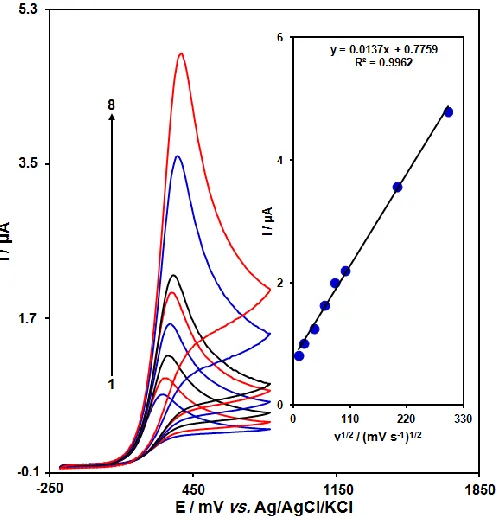
Figure 2. Cyclic voltammograms of ZnO/Al2O3/SPE in 0.1 M PBS (pH 7.0) containing 70.0 μM
ascorbic acid at various scan rates; numbers 1-13 correspond to 10, 20, 40, 60, 80, 100, 200.0, 300.0, 400.0, 500.0, 600.0, 700.0 and 800 mV s-1, respectively. Insets: (A) variation of anodic and cathodic peak current vs. ν1/2
[image:4.596.176.424.424.682.2]
Potential scan rates on the oxidation current of ascorbic acid has been optimized (Fig. 2). According to the obtained results, increase of the scan rate caused an increase in the peak current. Also, from the linear dependence of the anodic peak current (Ip) on the square root of the potential scan
rate (ν1/2
) over a wide range from 10 to 300 mV s−1, it can be concluded that the oxidation process is a type of diffusion controlled ones
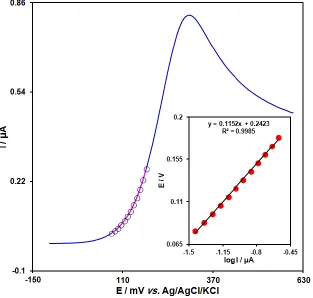
[image:5.596.143.456.247.545.2]Fig. 3 shows a Tafel plot that was drawn from points of the Tafel region of the LSV. Tafel slope of 0.1152 V obtained in this case which corresponds well with the involvement of one electron in the rate determining step of the electrode process, assuming a charge transfer coefficient of α=0.49 [53].
Figure 3. LSV (at 10 mV s−1) of electrode in 0.1 M PBS (pH 7.0) containing 70.0 µM ascorbic acid. The points are the data used in the Tafel plot. The inset shows the Tafel plot derived from the LSV.
3.2 Chronoamperometric studies
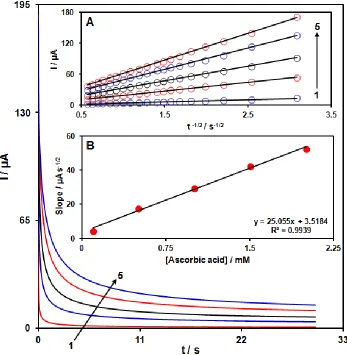
Chronoamperometric measurements of ascorbic acid at ZnO/Al2O3/SPE were done by set the
I =nFAD1/2Cbπ-1/2t-1/2
Where D and Cb are the diffusion coefficient (cm2 s-1) and the bulk concentration (mol cm−3),
respectively. Experimental plots of I vs. t−1/2 were used, with the best fits for different concentrations of ascorbic acid (Fig. 4A). The slopes of the resulting straight lines were then plotted vs. ascorbic acid concentration (Fig. 4B). Based on the obtained slope and Cottrell equation the mean value of the D was found to be 5.35×10⁻⁵ cm2/s.
Figure 4. Chronoamperograms obtained at ZnO/Al2O3/SPE in 0.1 M PBS (pH 7.0) for different
concentration of ascorbic acid. The numbers 1–5 correspond to 0.1, 0.5, 1.0, 1.5 and 2.0 mM of ascorbic acid. Insets: (A) Plots of I vs. t-1/2 obtained from chronoamperograms 1–5. (B) Plot of the slope of the straight lines against ascorbic acid concentration.
3.3 Calibration plot and limit of detection
[image:6.596.125.472.208.563.2][image:7.596.163.435.138.383.2]
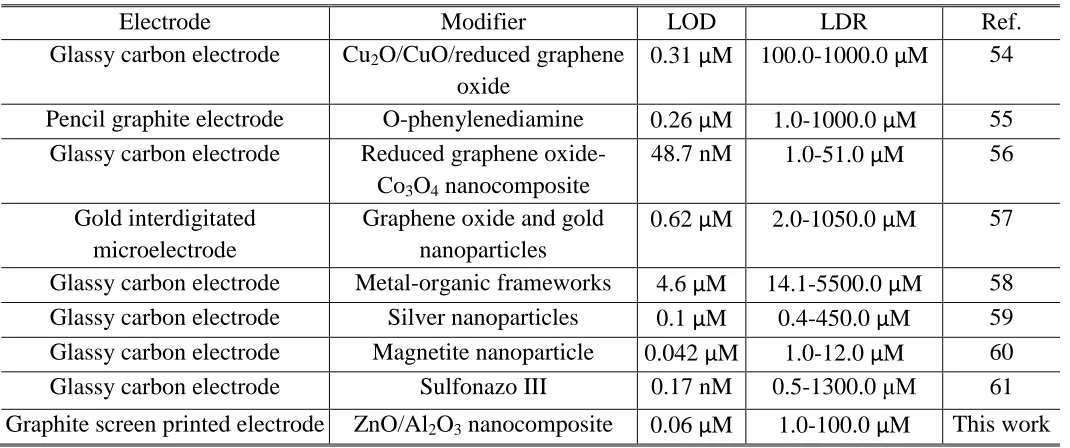
acid in the range of 1.0 to 100.0 μM. The detection limit (3σ) of ascorbic acid was found to be 0.6×10⁻⁷ M. These values are comparable with values reported by other research groups for electrocatalytic oxidation of ascorbic acid at the surface of chemically modified electrodes (see Table 1).
Figure 5. DPVs of ZnO/Al2O3/SPE in 0.1 M (pH 7.0) containing different concentrations of ascorbic
acid. Numbers 1–12 correspond to 1.0, 5.0, 10.0, 20.0, 30.0, 40.0, 50.0, 60.0, 70.0, 80.0, 90.0 and 100.0 µM of ascorbic acid. Insets: (A) a plots of the electrocatalytic peak current as a function of ascorbic acid concentration in the range of 1.0-100.0 µM.
Table 1. Comparison of the efficiency of some electrodes used in detection of ascorbic acid.
Electrode Modifier LOD LDR Ref.
Glassy carbon electrode Cu2O/CuO/reduced graphene
oxide
0.31 μM 100.0-1000.0 μM 54 Pencil graphite electrode O-phenylenediamine 0.26 μM 1.0-1000.0 μM 55
Glassy carbon electrode Reduced graphene oxide- Co3O4 nanocomposite
48.7 nM 1.0-51.0 μM 56 Gold interdigitated
microelectrode
Graphene oxide and gold nanoparticles
[image:7.596.33.568.506.730.2]
3.4 Real sample analysis
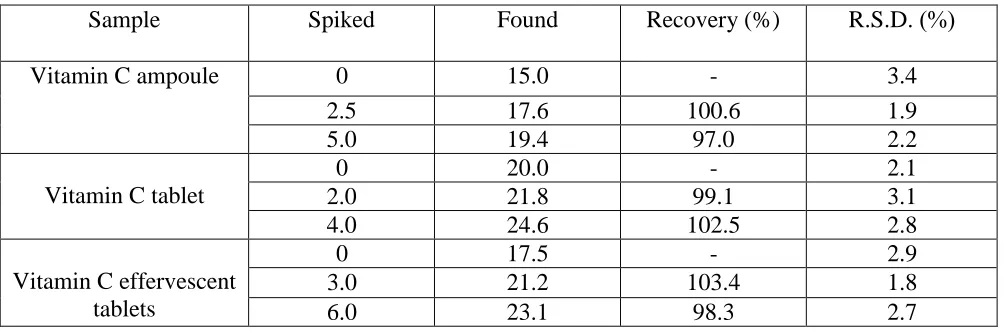
[image:8.596.49.553.250.416.2]To study the analytical applicability of the proposed electrode, it was applied to the determination of ascorbic acid in Vitamin C ampoule, Vitamin C tablet and vitamin C effervescent tablets. The results for determination of ascorbic acid in real samples are given in Table 2. Acceptable recovery of the results was obtained. The reproducibility of the method was calculated by the mean relative standard deviation (R.S.D.).
Table 2. The application of ZnO/Al2O3/SPE for determination of ascorbic acid in vitamin C ampoule,
vitamin C tablet and vitamin C effervescent tablets (n=5). All concentrations are in µM.
Sample Spiked Found Recovery (%) R.S.D. )%(
Vitamin C ampoule 0 15.0 - 3.4
2.5 17.6 100.6 1.9
5.0 19.4 97.0 2.2
Vitamin C tablet
0 20.0 - 2.1
2.0 21.8 99.1 3.1
4.0 24.6 102.5 2.8
Vitamin C effervescent tablets
0 17.5 - 2.9
3.0 21.2 103.4 1.8
6.0 23.1 98.3 2.7
4. CONCLUSIONS
In summary, an ultrasensitive and selective ZnO/Al2O3/SPE nanosensor was developed for
individual determination of ascorbic acid. Under the optimal operating conditions, the ZnO/Al2O3/SPE
nanosensor showed high sensitivity and selectivity for determination of ascorbic acid with wide linear ranges (1.0-100.0 μM) and limit of detection as low as 0.6 μM. Moreover, its further application for the detections of ascorbic acid in real samples was also demonstrated with good accuracy.
ACKNOWLEDGEMENT
The authors thank the research council of University of Tehran for financial support of this work.
References
1. P. Ravisankar, A. Abhishekar-Reddy, B. Nagalakshmi, O. Sai-Koushik, B. Vijaya-Kumar and P. Sai-Anvith, IOSR. J. Pharm. 5 (2015) 12.
2. V. Kumar-Gupta, A. Kumar-Jain and S. Kumar-Shoora, Electrochim. Acta 93 (2013) 248. 3. S. Mukdasaia, U. Crowley, M. Pravda, X. Hec, E. P. Nesterenko, P. N. Nesterenko, B. Paull, S.
Srijaranai, J. D. Glennon and E. Moore, Sens. Actuator B 218 (2015) 280.
5. H. Y. Gu, A. M. Yu and H. Y. Chen, Anal. Lett. 34 (2001) 2361.
6. G. C. Curhan, W. C. Willett, F. E. Speizer and M. J. Stampfer, J. Am. Soc. Nephrol. 10 (1999) 840.
7. J. B. Raoof, R. Ojani, H. Beitollahi and R. Hossienzadeh, Electroanalysis 18 (2006) 1193. 8. P. Moreno and V. Salvado, J. Chromatogr. A 870 (2000) 207.
9. H. Beitollahi, A.Mohadesi, M. Mostafavi, H. Karimi-Maleh, M. Baghayeri and A. Akbari, Ionics
20 (2014) 729.
10. T. Perez-Ruiz, C. Martınez-Lozano, A. Sanz and V. Tomas, Analyst 119 (1994) 1825.
11. H. Beitollahi, M. Mazloum Ardakani, H. Naeimi and B. Ganjipour, J. Solid State Electrochem. 13 (2009) 353.
12. M. J. Esteve, R. Farre and A. Frıgola, Fresenius J. Anal. Chem. 351 (1995) 804. 13. S. Cakir, I. Atayman and O. Cakir, Microchim. Acta 124 (1997) 237.
14. M. J. F. Villamil, A. J. Miranda-Ordieres, A. Costa Gareıa and P. Tunon- Blanco, Anal. Chim. Acta 273 (1993) 377.
15. X. Li and G. Xu, J. Food. Drug. Anal 22 (2014) 345.
16. C. C. o ak, A. Altın, B. Aslıssen and S. occak, Int. J. Electrochem. Sci. 11 (2016) 233. 17. H. Beitollahi, J. B. Raoof and R. Hosseinzadeh, Electroanalysis 23 (2011) 1934.
18. G. Zhao, Y. Si, H. Wang and G. Liu, Int. J. Electrochem. Sci. 11 (2016) 54.
19. 19. H. Beitollahi, F. Ebadinejad, F. Shojaie and M. Torkzadeh-Mahani, Anal. Methods 8 (2016) 6185.
20. O. Domínguez-Renedo, M. A. Alonso-Lomillo, and M. J. Arcos-Martinez, Talanta 73 (2007) 202.
21. Sh. Jahani and H. Beitollahi, Electroanalysis (2016).
22. K. F. Chan, H. N. Lim, N. Shams, S. Jayabal, A. Pandikumar and N. M. Huang, Mater. Sci. Eng C 58 (2016) 666.
23. H. Mahmoudi Moghaddam, H. Beitollahi, S. Tajik and H. Soltani, Electroanalysis 27 (2015) 2620.
24. F. Arduini, C. Zanardi, S. Cinti, F. Terza, D. Moscone, G. Palleschi and R. Seeber, Sens. Actuator B 212 (2015) 536.
25. H. Beitollahi and F. Garkani Nejad, Electroanalysis 9 (2016) 2237.
26. T. Alizadeh, M. R. Ganjali, M. Akhoundian and P. Norouzi, Microchim. Acta 183 (2016) 1123. 27. H. Beitollahi, S. Tajik and Sh. Jahani, Electroanalysis 28 (2016) 1093.
28. S. Wang, Y. Wang, Q. Min, T. Shu, X. Zhu, A. Peng and H. Ding, Int. J. Electrochem. Sci. 11 (2016) 2360.
29. E. Molaakbari, A. Mostafavi, H. Beitollahi and R. Alizadeh, Analyst 139 (2014) 4356.
30. P. Kanyong, S. Rawlinson and J. Davis, Anal. Bioanal. Chem. (2016) DOI: 10.1007/s00216-016-9351-0.
31. H. Beitollahi, H. Karimi-Maleh and H. Khabazzadeh, Anal. Chem. 80 (2008) 9848.
32. C. Hu, J. Deng, X. Xiao, X. Zhan, K. Huang, N. Xiao and S. Ju, Electrochim. Acta 15 (2015) 298.
33. H. Beitollahi and S. Nekooei, Electroanalysis 28 (2016) 645.
34. C. Hu, J. Deng, X. Xiao, X. Zhan, K. Huang, N. Xiao and S. Ju, Electrochim. Acta 15 (2015) 298.
35. H. Beitollahi, S. Ghofrani Ivari and M. Torkzadeh-Mahani, Mater. Sci. Eng. C 69 (2016) 128. 36. A. Hayat, A. Rhouati, R. K. Mishra, G. A. Alonso, M. Nasir, G. Istamboulie and J. L. Marty, Int.
J. Environ. Anal. Chem. 96 (2016) 237.
37. M. Rahimi-Nasrabadi, S.M. Pourmortazavi, M.R. Ganjali, P. Novrouzi, F. Faridbod, and M. S. Karimi, J. Mater. Sci.: Mater. Electron. (2016) DOI 10.1007/s10854-016-5926-y.
39. H. Djahaniani, M. Rahimi-Nasrabadi, M. Saiedpour, S. Nazarian, M. Ganjali, and H. Batooli, Int. J. Food Properties, (2016) Doi.org/10.1080/10942912.2016.1188826.
40. M. Rahimi-Nasrabadi, S.M. Pourmortazavi, M.R. Ganjali, P. Norouzi, F. Faridbod, and M. S. Karimi, J. Mater. Sci.: Mater. Electron. (2016) Doi:10.1007/s10854-016-5421-5.
41. M. Aghazadeh, I. Karimzadeh, T. Droudi, M. R. Ganjali and P. H. Kolivand, Current Nanoscience, 13 (2016) DOI: 10.2174/1573413713666161129160640.
42. I. Karimzadeh, M. Aghazadeh, T. Doroudi, M. R. Ganjali, P. H. Kolivand, and D. Gharailou, J. Cluster Sci. DOI: 10.1007/s10876-016-1139-z.
43. I. Karimzadeh, M. Aghazadeh, M. R. Ganjali, P. Norouzi, T. Doroudi, and P. H. Kolivand, Mater. Lett. http://dx.doi.org/10.1016/j.matlet.2016.12.010.
44. P. Norouzi, H. Haji-Hashemi, B. Larijani, M. Aghazadeh, E. Pourbasheer and M. R. Ganjali. Current Anal. Chem. 13 (2017) 70.
45. K. Movlaee, M. R. Ganjali, M. Aghazadeh, H. Beitollahi, M. Hosseini, S. Shahabi, and .P. Norouzi Int. J. Electrochem. Sci. 12 (2017) 305.
46. M. R. Ganjali, T. Alizadeh, B. Larijani, M. Aghazadeh, E. Pourbasheer and P Norouzi. Current Anal. Chem. 13 (2017) 62.
47. H. Karimi-Maleh, M. R. Ganjali, P. Norouzi, and A. Bananezhad, Mater. Sci. Eng. C 73 (2017) 472.
48. B. Dong, H. Zhou, J. Liang, L. Zhang, G. Gao and S. Ding, Nanotechnology 25 (2014) 435403. 49. Y. Wang, Y. Yuan, X. Cheng, X. Li, J. Zang, J. Lu, Y. Yu and X. Xu, Mater. Sci. Eng. C 53
(2015) 23.
50. H. Beitollahi, A. Gholami, and M. R. Ganjali, Mater. Sci. Eng. C 57 (2015) 107.
51. Y. Wang, Sh. Wang, L. Tao, Q. Min, J. Xiang, Q. Wang, J. Xie, Y. Yue, Sh. Wu, X. Li and H. Ding, Biosens. Bioelectron. 65 (2015) 31.
52. M. Kurtz, H. Wilmer, T. Genger, O. Hinrichsen and M. Muhler, Catal. Lett. 86 (2003) 77. 53. A. J. Bard, L. R. Faulkner, Electrochemical Methods Fundamentals and Applications, (2001)
second ed, Wiley, New York.
54. B. Wang, J. He, F. Liu and L. Ding, J. Alloys Comp. 693 (2017) 902.
55. C. Yan, X. Liu, R. Zhang, Y. Chen and G. Wang, J. Electroanal. Chem. 780 (2016) 276.
56. B. Dinesh, V. Veeramani, S.M. Chen and R. Saraswathi, J. Electroanal. Chem. 786 (2017) 169. 57. A. Abellan-Llobregat, L. Vidal, R. Rodriguez-Amaro, A. Berenguer-Murcia, A. Canals, E.
Morallon, Electrochim. Acta 227 (2017) 275.
58. L. Wang, C. Gong, Y. Shen, W. Ye, M. Xu and Y. Song, Sens. Actuators B 242 (2017) 625. 59. M.A. Khalilzadeh and M. Borzoo, J. Food Drug Anal. 24 (2016) 796.
60. N.K. Bhajanthri, V.K. Arumugam, R. Chokkareddy and G.G. Redhi, J. Mol. Liq. 222 (2016) 370. 61. A.A. Ensafi, M. Taei, T. Khayamian and A. Arabzadeh, Sens. Actuators B 147 (2010) 213.