This is a repository copy of Selection and performance in post-compulsory education. White Rose Research Online URL for this paper:
http://eprints.whiterose.ac.uk/148182/ Version: Published Version
Monograph:
Ahmad, U., McIntosh, S. orcid.org/0000-0002-9492-5455 and Popli, G.
orcid.org/0000-0003-2919-2627 (2019) Selection and performance in post-compulsory education. Working Paper. Sheffield Economic Research Paper Series, 2019014 (2019014). Department of Economics, University of Sheffield ISSN 1749-8368
© 2019 The Author(s). For reuse permissions, please contact the Author(s).
[email protected] https://eprints.whiterose.ac.uk/
Reuse
Items deposited in White Rose Research Online are protected by copyright, with all rights reserved unless indicated otherwise. They may be downloaded and/or printed for private study, or other acts as permitted by national copyright laws. The publisher or other rights holders may allow further reproduction and re-use of the full text version. This is indicated by the licence information on the White Rose Research Online record for the item.
Takedown
If you consider content in White Rose Research Online to be in breach of UK law, please notify us by
Selection and Performance in Post-Complusory
Education
Authors
: Uzma Ahm
a
d
,
Steven
McIntosh, Gurleen Popli
ISSN 1749-8368
SERPS no. 20190
14
Selection and Performance in Post-Compulsory Education
Uzma Ahmada*, Steven McIntoshb & Gurleen Poplib
a* Corresponding Author: Sheffield International College, University of Sheffield, Sheffield,
b Department of Economics, University of Sheffield, 9 Mappin Street, Sheffield, S1 4DT, UK.
June 2019
Abstract
This paper investigates the determinants of participation and performance in post-compulsory
education, controlling for the selection into post-compulsory education and prior attainment,
using a unique primary dataset on pupils studying in the post-compulsory grade in 2011-2012
from one district of the Punjab province of Pakistan. The main findings of the paper show that
participation and performance in post-compulsory education are two different processes, with
participation being driven by availability of post-compulsory institutions within travel distance,
while performance, once in post-compulsory education, is determined by ability. The results
further highlight that distance reduces participation most for those living in rural areas.
JEL Codes: J24, I20
Keywords: post-compulsory education, participation, performance, distance, selection,
Pakistan
Acknowledgements: We gratefully thank Nicolas Van de Sijpe and Pamela Lenton for helpful
comments on an earlier draft. We would also like to thank the participants at the Fifth Lisbon
Research Workshop on Economics, Statistics and Econometrics of Education, Lisbon, January
1. Introduction
In this paper, we investigate the determinants of (1) the decision to participate into
post-compulsory education (i.e. when continuing into education is a choice, usually made at the age
of 16 years), and (2) performance in post-compulsory education, controlling for selection into
post-compulsory education. In our analysis, along with other key drivers such as prior
attainment and family socioeconomic status (SES), we specifically investigate the accessibility
of post-compulsory education, measured as the distance to the nearest institution that provides
post-compulsory education, as a determinant of participation. For our analysis, we use a unique
primary dataset collected from Pakistan, with detailed information on individual and family
characteristics, which is then linked with an administrative data to obtain educational
outcomes.
There exists literature investigating the determinants of participation in
compulsory education, and a limited separate literature investigating performance in
post-compulsory education. However, there exist no studies to our knowledge, which investigate
jointly the determinants of participation and performance in post-compulsory education.1
The often-discussed determinants of the decision to participate in post-compulsory
education include prior attainment of the individuals, their family SES, and perceived benefits
of schooling (Eckstein and Wolpin, 1999; Chevalier et al., 2013). Some studies also link the
local labour market conditions with enrolment in post-compulsory education, with evidence
suggesting that individuals are more likely to participate in education if the local labour market
1 There are studies that investigate both participation and performance in education together. A large
is weak as education becomes more attractive due to a high local unemployment rate; for
example, see McIntosh (2001) for Germany, Netherlands, Sweden and England, Bradley and
Lenton (2007) for Britain, and Clark (2011) for England.
Similarly, factors determining performance in education, in general, include: ability,
family SES, teacher quality and school characteristics; for example, see Chevalier et al. (2013)
for the UK,Black et al. (2005a) for Norway,Engin-Demir (2009) for Turkey, Kasirye (2009)
for Uganda, and Garcia (2014) for Russia. For post-compulsory education, specifically, the
impact of working while in school has also been studied; a review by Neyt et al. (2017) finds
that while working whilst in school has an impact on educational choices (engagement and
continuation), it does not have an impact on education performance.
In developing countries there are additional determinants associated with educational
participation and attainment. On the demand-side, poor and resource-constrained families see
little immediate benefits of education, and on the supply-side the availability of, or access to,
schools is limited. Accessibility of schools is an important consideration as costs associated
with education increase with distance; these costs can be financial (travel and reallocation
costs), temporal (commuting time) and psychological (inconvenience and unpleasantness of
commuting every day). While CCTs have been a common policy response to the demand-side
constraints; for the supply-side factors, the common policy response has been to build more
schools or to reduce the distance costs to schools.
The existing literature looking at the impact of accessibility of schools on both
participation and attainment largely focuses on the new schools built at the primary level
(Duflo, 2001; Burde and Linden, 2013; Kazianga et al., 2013) and the reduction in the distance
cost for access to middle schools (Muralidharan and Prakash, 2017).2 There exists very little
2 Of the two supply-side policies one could argue that building new schools, relative to reducing the
evidence on the impact of accessibility to institutions providing post-compulsory education.
One exception is Dickerson and McIntosh (2013), who are the first to study the impact of
distance to an institution on the decision to participate in post-compulsory education at age 16.
Using data from the UK, they find an overall small negative effect, with higher distance
reducing participation in post-compulsory education.
Why Pakistan? Pakistan is a developing country facing difficult challenges in its
education system, of which school dropout is one.3 Despite the vast and growing literature
examining educational outcomes in developing countries, the literature on educational
outcomes in Pakistan is still in its infancy. Pakistan is an interesting case to study the impact
of accessibility and availability of educational institutions on participation in post-compulsory
education as in Pakistan parents have the flexibility to choose between private or government
(state-funded) schools, according to their affordability. This choice is not innocuous, as it
exacerbates the existing inequalities in the society, with individuals from relatively poor
backgrounds accessing the free education provided by government schools, and the relatively
rich accessing the private independent schools which charge fees.4
The present study uses primary survey data on 611 pupils from the Bahawalpur district
of Punjab, Pakistan, studying in grade 12 (last year of schooling) at age 17-18 years,5 to explore
the determinants of performance and participation in post-compulsory education, controlling
for previous attainment in grades 9 and 10, the last two years of compulsory education. A
relative to other long-term determinants of participation such as prior attainment and family background.
3 Pakistan has the highest proportion of out-of-school children in South Asia, with roughly one in 10 of
the world’s primary-school-age children who are not in school living in Pakistan. A quarter of year 8 (lower secondary school, age 12 years) children drop out of education, with children in rural areas more likely to drop-out relative those in urban areas. Source: UNICEF (2013).
4 In Pakistan in urban areas 61% of the school enrolment for compulsory education, age 6 to 16 years,
is in private school; the corresponding figure for the rural areas is 21%. (Source: ASER, 2015)
5 The ages written next to each grade, for Pakistan, are indicative, which assumes that every child is
Heckman-selection model (Heckman, 1979) is used when analysing performance in grade 12
to control for potential sample selection bias due to unobserved characteristics being associated
with the decision to leave (or continue in) education after achieving compulsory education.
Proximity to nearest post-compulsory institution, measured as the distance to the nearest
institution and living in an urban location, are used as instruments for selection into
post-compulsory schooling, since both measure the accessibility and availability of post-post-compulsory
educational institutions. The results show a lack of significant selection effects, which suggests
that participation and performance are not jointly determined. Participation is determined by
the accessibility of post-compulsory institutions, while performance in grade 12 is driven by
ability, which is measured by previous attainment.
The present study contributes to the literature in the following ways. (1) It is the first
study (to the best of our knowledge) to jointly investigate the determinants of participation and
performance in post-compulsory education for both developed and developing countries. (2) It
is the first study for a developing country, investigating the effects of proximity to nearest
institution providing post-compulsory education. (3) It is the first study for Pakistan looking at
the determinants of performance in higher grades, grade 12 taken at age 17-18, conditional on
participation. (4) The present study takes into account the differences across regions
(urban/rural) in the analysis of participation in Pakistan.
The remainder of the paper is structured as follows. Section 2 reviews the studies
looking at accessibility of post-compulsory education from both developed and developing
countries, and the relevant literature on performance and participation in post-compulsory
education in Pakistan. Section 3 describes the data and discusses the key variables used in the
analysis; section 4 presents the methodology employed, and summary statistics of variables
used; section 5 discusses the empirical results; and section 6 concludes with some policy
2. Literature review
2.1. Participation in post-compulsory education
There are studies which look at the effect of distance on participation in university education;
Frenette (2006) for Canada; Spiess and Wrohlich (2010) for Germany; Gibbons and Vignoles
(2012) for England. For both Canada and Germany evidence suggests that pupils living within
commuting distance are more likely to attend university, relative to those who live out of
commuting distance. Further, distance to the educational institution is found to matter more for
those from low-income families. For England, results suggest little effect of geographical
distance on the participation decision, but a strong effect on the choice of institutions.
In terms of the post-compulsory education participation decision, Dickerson and
McIntosh (2013) are the first to investigate the effect of distance to the nearest educational
institution on a pupil’s immediate post compulsory participation decision in England. Their
study highlights the small overall effect of the distance variable; with an additional kilometre
in distance leading to a 1.5 percentage points decrease in the probability of participation in post
compulsory academic study. In line with the literature the study finds a strong correlation
between post compulsory participation, prior attainment and family background. They also find
that distance affects women more than men. Further, distance has more significant impact on
young people who are on the margin of participation in post compulsory education (according
to their prior attainment and family background).
The Dickerson and McIntosh (2013) study is closest to our paper. Our paper, however,
is different in two significant ways. First, we are different in the way we measure distance.
Dickerson and McIntosh measure distance ‘as a crow files’ which could be substantially
different from real distance, while we measure the ‘actual’ distance. The actual distance is
measured by driving from pupils’ homes to nearest educational institution using data on the
participation; none of the previous studies have measured distance using this method. Second,
while Dickerson and McInstosh look only at participation, we look at both participation and
performance in post-compulsory education.
2.2. Determinants of performance
There are a few papers which look at the effect of school accessibility and educational
performance. Falch et al. (2013) look at the impact of travel time on the probability of
graduation from upper secondary school in Norway. They find that reduced travel time has a
positive effect on graduation, with the effect strongest for students with mediocre prior
academic achievement i.e. those at the margin of graduation. Tiger et al. (2017) use data from
Brazil and find a negative causal impact of commuting durations on the academic performance
of sixth-grade students, after controlling for a range of family and school characteristics. Asahi
(2014) looks at the effect of improved school accessibility on educational performance of
students, using data from Santiago, Chile. Increased school accessibility is measured by a new
subway line which reduced the distance between schools and their nearest subway station. The
key finding of the paper suggests that increased accessibility is associated with substantially
lower test scores, which the author explains by an increase in school enrolment (thus increasing
the class size) for the more accessible schools.
2.3. Studies from Pakistan
Lloyd et al. (2009) look at factors responsible for primary and middle school dropout in the
Punjab region of Pakistan. They use a longitudinal dataset, covering seven years from
1997-2004, which tracks changes in both the school and the family environment of individuals.
Attending a government-funded primary school and the family experiencing an unwanted birth
(used as an instrument to capture an exogenous household shock) increases the likelihood of
availability of post primary schooling reduce the chances of dropout. Results also suggest
higher dropout rates for girls relative to boys.6
For Pakistan, much of the focus on performance in education has been on the learning
differences observed across the different school types: private and government. Almost all
studies (Alderman et al., 2001, Arif and Saqib, 2003, and Das et al., 2006, focussing on primary
schools, and Aslam, 2009, looking at middle schools) find that the attainment of children in
private schools is much higher relative to government schools, even after controlling for a range
of household characteristics.7
Ours is one of the first papers for Pakistan to look at participation and performance in
post-compulsory education. We also contribute to the limited literature on the impact of
accessibility to educational institutions on participation at post-compulsory levels of education.
3. Data and empirical specification
This paper uses primary survey data collected by one of the authors. The data are for 611 pupils
studying in grade 9, in 2008-09, in the Bahawalpur district of the Punjab province of Pakistan.8
The data were collected using a random sampling technique over all private and government
6
Low levels of literacy and gender gap in school enrolment resulted in the Government of Punjab, Pakistan, implementing a gender-targeted CCT (Female Secondary School Stipend (FSSS)) in 2004. The program was implemented in the 15 districts of Punjab, all of which had literacy levels below 40% in the population aged 10 years and older; Bahawalpur was one such district with a literacy rate of 35%. The program gave a stipend to families conditional on girls being enrolled in middle school (grades 6-8) in government-funded schools. The program had a positive impact on enrolment of girls in government schools (Chaudhury and Parajuli, 2010). While this CCT covered the area from which we obtain our data, the fact that it targeted only girls, in government-funded schools, for middle school grades means it should not have any bearing on our analysis.
7 There is a significant gap in the learning levels of children in the private and government-funded
schools. For urban areas 62% of the children in the last year of primary school (age 10 years) enrolled in private school could read a story in their native language (Urdu/Sindhi/Pashto), compared to 51% in government schools; corresponding figures for the rural areas are 67% and 52% respectively. (Source: ASER, 2015)
8 Grade 9 in Pakistan is equivalent to grade 10 in the UK education system (a year before taking the
schools, registered with the Education Department, in the district. Out of the 40 such schools,
15 school names were drawn, producing a sample of 6 government schools and 9 private
schools. Each school was then approached to acquire their consent to participate in the study,
all schools with the exception of one private school giving their consent, resulting in a sample
of 14 schools: 6 government and 8 private. Among the 14 selected schools, all grade 9 pupils
were given an opportunity to participate in the survey, a total of 700 pupils. For those pupils
who were willing to participate, further consent was acquired from their parents. At every stage,
schools, pupils and parents were assured of the confidentiality and anonymity of the survey.
The choice of Punjab and particularly Bahawalpur district for the field survey was based
on the following grounds: (1) Literature on private schooling in Pakistan has noticed that much
of the expansion in private schooling has been particularly prominent in the province of the
Punjab (Aslam, 2009). (2) Bahawalpur is the largest district of Punjab in terms of area; it has a
high number of reputable educational institutions, as well as a large number of government
schools available in the city.
Data were collected from the pupils using pupil questionnaires filled in by the pupils
themselves. Pupil questionnaires provided information on personal characteristics such as
gender and age, as well as physical activity, hours of study at home, health status and mode of
transport to school. A family questionnaire was sent to the home of each child and returned to
the school authorities the next day completed by either parent (or the child completed the
questionnaire by asking the parent questions if the parent was illiterate), containing information
on parents’ education, family size, family income, number of rooms, house tenure, etc.
Data on exam scores were subsequently obtained for sampled pupils studying in grade
9 in 2008-09, grade 10 in 2009-10, grade 11 in 2010-11, and grade 12 in 2011-12. Grades 9
and 10 are the last two years of compulsory schooling while grades 11 and 12 are
performance in these exams is considered by the universities and colleges in Pakistan at the
time of giving admissions to higher education.
All schools in the sample are affiliated to the Board of Intermediate and Secondary
Education (BISE) which is responsible for conducting exams in grades 9, 10, 11 and 12 in all
government and private schools. The data on pupils are matched with administrative
examination data held by the BISE, using unique pupil identifiers to obtain their test scores.
Test scores from these exams are a reliable measure of students’ academic performance as the
examination system is uniform all over the Punjab province. The exam papers are the same
across all schools and exams are held at the same time, scheduled by the BISE. The only
difference is the medium of instruction and the language in which exams are set, where the
Urdu language is used in all government schools and English language in the private schools.
The exams are nationally set, so marking standards are the same and exams are marked outside
the schools by the same set of external examiners, leaving little chance of systematic
manipulations, tempering of results, or leakages of exam papers, while minimizing the
incidence of cheating (Kingdon, 1996). Further, Clotfelter et al. (2010) argue that tests/exams
being external to school as compared to within school means students are also more likely to
take them seriously.
The variable ‘distance to nearest post-compulsory education institution’, in kilometres,
was calculated using information on the actual home address of the pupils, recorded for all
sampled students at the time of the first survey. The distance was measured by driving from
the pupils’ homes to the nearest feasible post-compulsory educational institution, not the school
that they actually attended, the idea being to capture the accessibility of the nearest
post-compulsory education institution for each pupil.
Participation is identified by whether pupils are observed in the administrative data with
in fact be due to missing data on individuals who are actually continuing to study, rather than
to a decision not to participate in post-compulsory education.9 One reason for missing data
could be relocation of families out of the district. Using the unique pupil identifier, pupils can
be searched for in two adjacent districts of Bahawalnagar and Rahimyarkhan, as the BISE
Bahawalpur, is responsible for registration of students and conducting exams in all these three
districts of Punjab. A search was undertaken for all missing pupils in the administrative data
for the two adjacent districts. However, we found none of the pupils in the adjacent districts,
so moves to at least these two districts can be ruled out. It could be possible that the families
have moved to another district further away, where they can no longer be tracked; if this is the
case then we have no way of tracing these families, however this seems unlikely as migration
out of the Bahawalpur district is very limited.
After making every attempt to trace the students via the administrative data, we can
make a reasonable claim that if we do not observe a student in the list of grade 12 exam results,
it is almost certainly because they are no longer in education and not simply due to missing
data. It is therefore people making a choice over whether or not to participate in post
compulsory education.
3.1. Empirical specification
The main aims of this paper are to investigate the determinants of (1) participation in
post-compulsory education, and (2) performance in post-post-compulsory education, controlling for
selection into post-compulsory education. Correcting for selection here is important, as the
pupils who dropout from education are more likely to be those with low ability, who are less
9 Missing observations due to sample attrition is not possible in our sample, as all information used
motivated, from low quality schools and from disadvantaged home backgrounds (Alivernini
and Lucidi, 2011; Chowdry et al., 2013).
Let be the unobserved utility, derived by individual , from participation in
post-compulsory education. Assuming a linear in parameter specification, this utility depends on a
set of covariates, given by vector , such that we have: , where is the vector
of parameters to be estimated and is the random error, which we assume to be normally
distributed. We do not observe , rather what we observe is a dummy variable indicating
participation:
(1)
Equation (1) is the participation equation, where if the pupil graduated from grade 12
i.e. finished post-compulsory education; this is estimated as a probit model.
Vector includes a range of covariates such as: prior attainment of the pupil, measured
as the total score in grade 9; measures of pupil attributes in grade 9, such as age, health
problems, gender and birth order; a set of variables capturing the family characteristics of the
pupil measured in grade 9, such as fathers’ education, mothers’ education, fathers’ income,
whether or not parents own their house; as well as a dummy variable capturing the type of
school attended (private or government school) by pupils in grade 9. The participation model
has two additional variables: distance to the nearest post-compulsory education institution, and
a dummy variable capturing whether the pupil lives in an urban or a rural area.
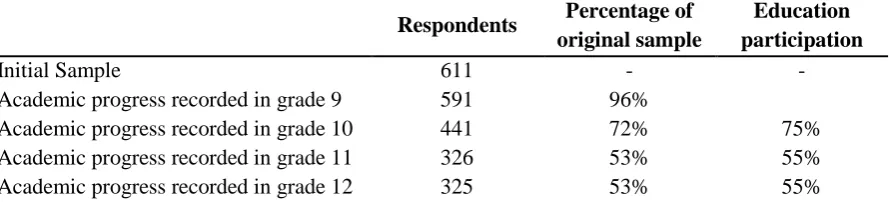
Table 1 gives the education participation rate of the pupils in our survey. Starting with
the 611 pupils from the randomly drawn schools in grade 9, we were able to match 591 (96%)
of them with the administrative data and obtain their grade 9 test scores. Of these 591 students,
by the end of grade 12, 325 (55%) graduate. There appear to be two dropout points from
education; some are not completing grade 10 (or not doing the exams at least) while others are
variable as all those who were observed in administrative data in grade 9 and then are also
observed in the same administrative data in grade 12 i.e. they participate in post-compulsory
education and take the school leaving exam at the end of grade 12. There is just one pupil who
did participate after the end of compulsory education, in grade 11, but did not take the school
leaving exam at end of grade 12, we drop this pupil from our analysis. The group of
non-participators in post-compulsory education include a group who dropout after grade 9 and a
group who dropout after grade 10. In our main analysis we do not distinguish between the two
dropout points. However, it is possible that there are two separate decisions that need to be
modelled, i.e. decision 1 – whether or not to take the grade 10 exams, and decision 2 – whether
or not to participate in post-compulsory schooling and take the grade 12 exams. To check the
validity of treating the two decisions as a single decision, as a robustness check we separately
consider the second decision in isolation, modelling the selection into post-compulsory
education conditional on having completed the grade 10 exams.
To investigate the pupils’ performance at the post compulsory level we use a value
added education production function (Hanushek and Rivkin, 2012). In this specification, we
use both current and past educational inputs, and take into account the effect of prior
attainment, which captures the effect of previous teachers and schools, and individual ability
The empirical specification we estimate is given as:
(2)
where is the academic performance measured by grade 12 total score of the pupil, and
is the past performance of the same pupil, with parameter capturing the effect of past
performance.10 In our analysis we use grade 9 score as the prior achievement. It could be argued
10 An Education Production Function (EPF) is used to examine the relationship between the test scores
that it would be more natural to control for grade 10 scores, since grade 10 is the last year of
compulsory education. However, as Table 1 shows, relying on grade 10 scores to provide the
measure of prior attainment would involve a significant reduction in the number of available
observations, due to some pupils not taking their end of compulsory schooling exams. The
main analysis is therefore undertaken using grade 9 scores, though we do undertake analysis to
ensure that the results are robust to using grade 10 scores.
The vector is the vector of the pupil’s individual and family characteristics,
containing all variables mentioned in the participation model, except for the distance variable
and the urban dummy, and with the addition of variables indicating type of institution attended
in grade 12. Information for the type of school attended at post-compulsory level is identified
from the administrative data. is the parameter vector to be estimated, while is the normally
distributed error term.
Not every pupil is observed in grade 12, as we cannot assume participation is random,
we correct for selection using the Heckman selection approach, with equation (1) serving as
the first stage of the analysis. is the inverse Mills ratio from the first stage regression, this is
used as an additional regressor in equation (2). is the associated parameter taken as a measure
of sample selection bias; if is statistically different from zero, the null hypothesis of no sample
selection bias is rejected.
3.2. Excluded variables
For identification of the selection process, we need at least one variable to satisfy the exclusion
restriction, that is, a variable that directly affects participation, but has no impact on
performance once in post-compulsory education. In our specification, we consider two such
variables: distance to the nearest post-compulsory educational institution and an urban/rural
dummy. The basic intuition for using distance as an instrument for participation, is that it
captures the costs of attending a relevant academic institution (Dickerson and McIntosh, 2013),
which can be particularly constraining for those from disadvantaged background.
Actual distance, in kilometres, is not used often due to the complex data requirement.
In lieu of distance, some studies use a rural/urban dummy in analysing participation in
university or post-secondary education, such as Kane and Spizman (1994) for the US, and
Christofides et al. (2001) for Canada. These studies, however, do not draw direct inferences on
distance, they implicitly assume that youths living in urban areas are closer to education
institutions than rural youths and hence are more likely to participate in education. There is a
criticism that distance and urban/rural location should not be used interchangeably; for
example, Frenette (2006) argues that there could be rural areas which are better served by
educational institutions, while for some small urban area accessibility might be limited (though
Frenette was talking about universities and not post-compulsory educational institutions). In
the current analysis we use both distance and rural/urban location as separate controls in the
selection equation while studying the impact of geographical constraints on the participation
decision. Use of the urban/rural dummy also helps us address another criticism, that it might
be the case that the distance is higher but the government transport is better in urban areas.11.
We therefore also consider an interaction term between the two variables.
3.3. Descriptive statistics
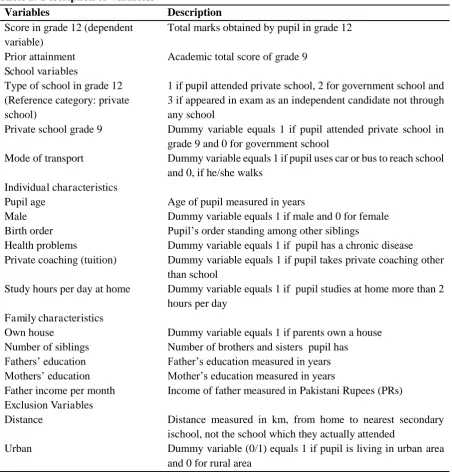
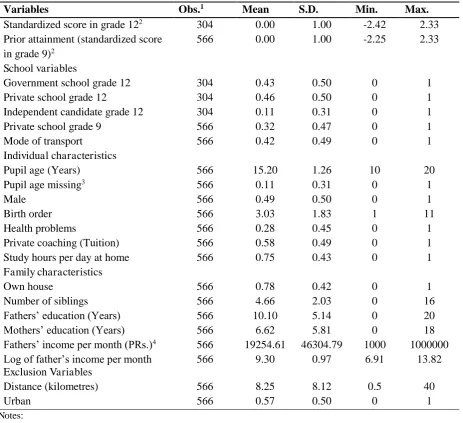
A description of the variables used in this study is given in Table 2, and the descriptive statistics
for these variables are provided in Table 3. The grade 12 score is the sum of scores over seven
11 One could argue that there are differential resources between the two (urban and rural) locations that
subjects; four subjects are compulsory (Language, English, Religion and Pakistan Studies) and
three are optional depending on the field of study chosen. In total five fields of study exist in
grade 12: premedical group, pre-engineering group, general science group, humanities group,
and commerce group. The total score for each subject is 200 except Religion and Pakistan
Studies, these two subjects having a total score of 75 each. The maximum total marks in grade
12 are therefore 1150. Prior attainment (grade 9 score) is the overall/aggregate score in seven
subjects being offered in grade 9 in schools; of these four subjects are compulsory (Language,
English, Religion and Mathematics) while three subjects are elective, differing across the two
possible fields of study: Science and Arts. The maximum total score in grade 9 is 625. In our
analysis we standardize all test scores to have a mean of 0 and standard deviation of 1.
There are three categories for type of institution in grade 12: appearing in the exam after
attending private school, after attending government school, or as an independent candidate.
Independent candidates are those who do not attend any formal institution; usually these are
rural youths, females, or disabled individuals. They undertake self-study and preparation for
exams, and send their exam admissions independently to their respective registered board.
There are certain subjects/disciplines that cannot be taken as an independent candidate,
particularly science subjects such as physics, chemistry, and biology. As these subjects have
practical exams along with theoretical exams, attending regular classes is a requirement for
them. In the current dataset, 43% of pupils in grade 12 attended a private institute, 46% a
government institute and 11% of pupils appeared as independent candidates. In grade 9 there
are only two possible categories of institution: private and government school. The option of
being an independent candidate does not exist in grade 9. In grade 9, 32% of pupils are from
private schools with the remainder from government schools.
The mode of transport variable captures the transport used daily to get to the school
located in pupils’ postcode areas. Therefore, pupils from relatively well-off families can use a
car, bus or motorcycle to reach schools while pupils from relatively poorer families either use
cycles or walk to schools. In our sample 42% of the pupils use a car or bus.
The average age of students in grade 9 is 15 years. The minimum age to start primary
education in Pakistan is 5 years; however, there is no enforcement of this, and parents can send
their children late to school, particularly in rural areas. About 11% of the pupils did not report
their age. Rather than dropping these individuals from the sample, we use a dummy variable
indicating ‘age missing’. Among those who do report their age there is a huge variation, with
the maximum reported age being 20 years and the minimum reported age being 10 years.12
We also control for birth order of the pupil under consideration, as there is evidence to
suggest that higher birth order has a negative impact on the educational performance of children
(Black et al., 2005b). For health problems, the question asked of the pupils is ‘do you have any
chronic health problems affecting your studies?’; 28% of the sample report such problems.
Studying time at home is also important as many students have to help with household chores,
especially girls, which can negatively affect their performance at school. Half of the
respondents are female. The other family variables in our analysis include ownership of house
(78% of the households own their own home), number of siblings, and mother and father’s
education, and father’s income.
12 The age distribution in the data is as follows:
Age (years) missing 10 11 12 13 14 15 16 17 18 19 20
Number of observations 60 1 2 5 23 107 161 156 32 10 8 1
The variable distance to nearest post-compulsory institution, measured in kilometres, is
the actual measured distance from pupils’ homes to the nearest post-compulsory education
institution; this is not the actual school attended in grade 12. The mean distance to the nearest
post-compulsory education institution is 8 kilometres. To account for non-linearity, log of
distance is used in this study (Newbold and Brown, 2015). Urban is a dummy variable taking
value 1 if the pupil is living in an urban area and 0 if she is living in a rural area.13
4. Results and discussions
4.1. Determinants of participation in post-compulsory education
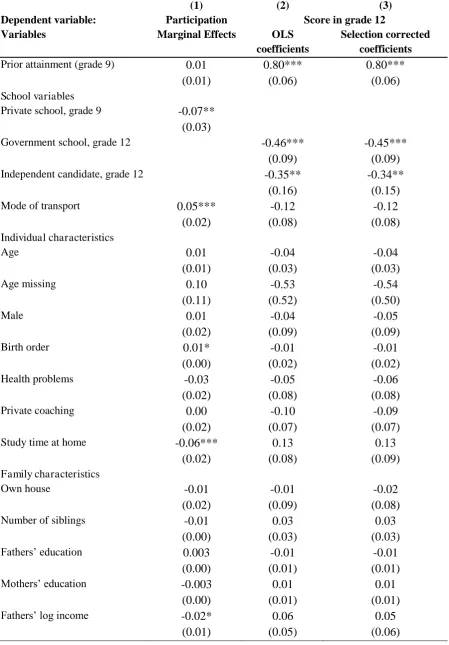
Table 4, column (1) presents the probit analysis of equation (1) showing determinants of
participation in post-compulsory education. The dependent variable is measured as a binary
variable, taking value of 1 if a pupil participated in a post-compulsory education (grade 12),
and a value of 0 otherwise. The column reports the average marginal effects with robust
standard errors.
Prior attainment has no significant effect on participation in post-compulsory education.
This result is different from previous findings for developed countries (McIntosh, 2001).
Attending a private school in grade 9 significantly decreases the likelihood of participation in
post-compulsory education by 7 percentage points holding other things constant. Analysis of
the raw data show that pupils in private schools in grade 9 are actually far more likely to
participate in post-compulsory education (as we might expect). The negative coefficient
observed here in the multivariate regression is due to the controls used, with distance being the
key variable affecting the private school coefficient. The data show that pupils who go to
private schools live much closer to their nearest institution, which benefits their participation,
and because distance is a key determinant of participation, then when we control for distance
13 The definition of rural and urban areas for Bahawalpur are taken from the following Asian
and hold it constant (and so take away the private schools' advantage), the private school
coefficient becomes negative.
The mode of transport variable is positively and significantly associated with the
probability of participation in post-compulsory education, using a bus/car as a mode of
transport being associated with a 5 percentage point higher likelihood of participation in
post-compulsory education. Mode of transport is used as an indicator of disadvantage. The estimated
coefficient therefore indicates that a lower level of disadvantage has a positive association with
participation in post-compulsory education.
Among individual characteristics, the only statistically significant coefficient is time
spent studying at home and birth order. Studying at home more than two hours is associated
with a 6 percentage point lower probability of participating in post-compulsory education; this
could be due to those struggling in their studies, needing to spend more time studying at home
to catch-up. Higher birth order increases the probability of participation in post-compulsory
education.
Among family characteristics the only significant coefficient is father’s income which
is negatively and significantly associated with the likelihood of participation in
post-compulsory education. The negative coefficient on fathers’ income is surprising. In the raw
data, father’s income is higher for those who continue into education relative to those who do
not. The negative coefficient observed here in the multivariate regression is therefore due to
fact that other characteristics of the household are being controlled for, with income having no
positive effect over and above that of these other characteristics.
The significant and negative coefficient on log of distance suggests that the further a
pupil lives from a compulsory institution, the less likely he/she is to participate in
post-compulsory education. A unit increase in log of distance reduces the likelihood of participation
indicating that pupils living in urban areas are more likely to participate in post-compulsory
education, living in an urban area increasing the probability of participation in post-compulsory
education by 25 percentage points relative to living in a rural area. This is in line with the
general hypothesis that urban areas potentially have more accessible institutions.
Our results suggest that past performance is not associated with participation in
post-compulsory education, which is contrary to the findings often found in the literature, as
discussed earlier. For our sample, participation in post-compulsory education is mainly
determined by the distance to the nearest post-compulsory school and living in an urban area.
This is an interesting finding as both variables measure the accessibility to post-compulsory
education for young people and suggests that if institutions are made more accessible,
participation in post-compulsory education can be increased. These results are consistent with
the findings from previous studies (Dickerson and McIntosh, 2013; Frenette, 2006; Spiess and
Wrohlich, 2010).
4.2. Determinants of performance in post-compulsory education
Determinants of performance without selection correction
For performance in post-compulsory education (grade 12) we start by estimating equation (2)
using OLS, i.e. without correcting for selection effects. Results are reported in column (2) of
Table 4. The dependent variable in this model is the standardized pupils score in grade 12.
The variable most strongly associated with performance in post-compulsory education
is prior attainment, as measured by performance in grade 9; a one standard deviation (SD)
increase in attainment in grade 9 is associated with a 0.8 SD increase in post-compulsory marks.
This finding is consistent with previous literature such as Todd and Wolpin (2007) who find
positive effects of past educational performance on current educational outcomes.
Attending a government school relative to a private school in the post-compulsory years
an independent candidate, not through a private institution, is associated with a decrease of
0.35 SD of marks in the post-compulsory grade. These findings are consistent with previous
literature. Both Aslam (2009) and Kingdon (1996) compared the relative efficiency of private
and government schools and found that the achievement of students in private schools is higher,
relative to students in government schools. This could be due to poor resources, including
higher pupil to teacher ratios, in the government schools.
All other variables in this model have statistically insignificant coefficients.
Determinants of performance correcting for selection bias
Column (3) of Table 4 reports the results for performance from Heckman’s specification, i.e.
after correcting for selection (first stage for which is reported in column (1)). There is no
significant difference in the estimated coefficients between the OLS and selection corrected
specifications. The Wald test that all coefficients in the model (except the constant) are 0 is
rejected.
The selection correction term (lambda) is insignificant; further, we cannot reject the
null hypothesis that , where (rho) is the correlation between the error terms of the first
stage and the second stage regressions. This suggests that there is no selection problem,
performance once in post-compulsory education is mainly determined by past performance and
characteristics of the educational institution.14
4.3. Validity of exclusion restrictions
The excluded variables determining participation should not affect the outcome variable,
performance in post-compulsory education. It is, however, possible to make a theoretical
14 For both the OLS model and the Heckman specification (for both the first and the second stage
argument for the potential effect of the excluded variables on performance. For example, it
might be the case that time spent on commuting directly reduces the time available for school
work, thus reducing achievement. Also, the different neighborhood conditions in urban areas
might influence achievement directly. For example, rural areas are less connected and have
lower population density. Pupils in rural areas are therefore likely to have fewer peers as
examples continuing in education, be more likely to have to work in the household or on the
land, have poorer, less well resourced schools etc. Rural/urban status in particular might
therefore be expected to pick up factors associated with school performance, and therefore be
wrongly excluded from the attainment equation. To confirm that this is in fact not the case, the
instruments were entered, one at a time, into the performance equation, to see if they have
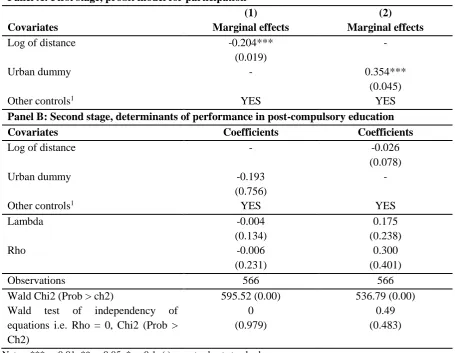
significant coefficients. First, we include only log of distance as an instrument in the
participation equation and include the urban dummy in the performance equation; results are
reported in column (1) of Table 5. Second, we include the urban dummy as an instrument in
the participation equation and include log of distance in the performance equation; results are
reported in column (2) of Table 5.15 In both cases, the coefficient on the variable included in
the first stage remains statistically significant, while the coefficient on the variable included in
the second stage is found to be statistically insignificant. Neither distance nor rural/urban status
appears to be associated with Year 12 attainment, conditional on the other control variables
included. Further, rho and lambda in the second stage remain statistically insignificant
indicating no selection.
One other potential concern would be that where people live is endogenous, i.e. they
have specifically chosen their house location for the access it gives to schools. This could
15 In each case, it is assumed that the single identifying instrument remaining is sufficient to identify
potentially affect the instruments for reasons that might also affect participation, for example
if those who value education more choose to live near schools. Distance, in this case, would
not be a random exogenous variable but would have been endogenously determined. Evidence
suggests that this does happen in the UK (Allen et al., 2010). For example, most school places
are allocated on the basis of the catchment area, so that places are usually offered first to
children who live nearest to a school (Gibbons, 2012). This is less relevant here as such
decision-making is not usual in Pakistan. First, there is no official policy to assign school places
on the basis of catchment area as there are no defined catchment areas or postcodes. Parents
can choose any school depending mainly upon their affordability and then preferences.
Secondly, families in Pakistan do not choose their house and move location for schooling
reasons as it is hard for them to afford relocation. This potential criticism is therefore not
particularly relevant in the existing case.
5. Robustness checks
In this section several robustness checks are applied to check the sensitivity of the results.
5.1. Changing sample to those observed in grade 10
One potential criticism of the main analysis is that there could be a further selection issue as
there is still one more year of compulsory schooling involved after grade 9, from which some
individuals drop out. The analysis is therefore redone, focussing on the post-compulsory
participation choices of only those who made it to the end of grade 10 and sat the final exams
in compulsory schooling. The results for this are reported in columns (1) and (2) of Table A1
in the Appendix.
The usable sample when using grade 10 as the potential dropout point is 419
observations. The results are similar to those already reported – both for the first stage i.e.
participation, and the second stage i.e. performance. Similar results for the grade 9 and grade
to post-compulsory education) do not need to be modelled separately, but rather we can treat
the ‘complete grade 10’ decision and ‘enter grade 11’ decision as a single decision as to whether
to participate in post-compulsory education or not, with those choosing not to do the grade 10
exams simply dropping out a little earlier as they know that they will not be continuing to the
post-compulsory level.16
5.2. Distance to the nearest school of the same kind
It could be argued that it is not the distance to the nearest school that matters, but the distance
to the nearest school of the type the family would consider. For example, it could be argued
that if a family would only consider going to a private school, then the fact that a government
school is only 1 km away would be irrelevant, since it would be how close the nearest private
school is that would be relevant. To address this criticism, we restrict our sample to the
individuals where the measured distance to the nearest post-compulsory educational institution
is of the same type as the one attended in the compulsory phase. For example, if a student in
grade 9 was going to a private school, and the nearest post-compulsory institution (for which
we have the distance) is a private school then we retain this individual in the sample; on the
other hand if the nearest post-compulsory institution is a government school then we drop this
individual from the sample. To do this we assume that pupils going to private (government)
schools in grade 9 would prefer to continue in a private (government) post-compulsory
institution. Once we restrict the sample in this way, we are left with 379 observations. The
results for this are reported in columns (3) and (4) of Table A1 in the Appendix. The results
using this restricted sample again remain qualitatively the same.
16 All robustness checks reported below were repeated for the grade 10 sample. The results, not reported,
5.3. Interaction of the excluded variables
It could be argued that distance has more impact on participation for those from rural areas
where transport links are likely to be not as good. Individuals who live in rural areas typically
have less access to public transport, a larger distance to travel, and a greater level of
disadvantage. In the current dataset, the average distance to the nearest school for pupils from
urban areas is 2 kilometres, while it is 16 kilometres for pupils living in rural areas. As a
consequence, the participation of individuals living in rural areas may be more affected by the
distance to the nearest school. To test this hypothesis, we estimate the participation equation
with interaction effects between distance to nearest post-compulsory educational institution
and the urban dummy. The results are reported in Table 6. The estimated coefficients for other
control variables remain qualitatively the same as in Table 4, therefore they are not reported
but are available on request. Distance to the institution remains a significant deterrent to
participation. The coefficient on the urban dummy is now insignificant which suggests that if
pupils live at zero distance from a school (literally next door to a school) then it does not make
any difference to their participation whether they live in an urban area or rural area - the school
is right there for them. The interaction term has a positive and a significant coefficient,
suggesting that the negative effect of distance is much larger in rural areas. The second stage
results, not reported but available on request, remain unchanged.
6. Conclusions
This paper fills the gap in the existing literature by exploring the joint determinants of
participation and performance in post-compulsory education, controlling for any selection
effects. The paper focuses on the impact of accessibility of institutions on participation in
education. Accessibility is captured by two different variables: distance from pupils’ homes to
the nearest post-compulsory educational institution, and the location where pupils live – urban
age 14-15 years from the Bahawalpur district of Punjab, Pakistan in 2008-9. The survey collects
detailed information on the individual and family characteristics, and is then linked with
administrative data to obtain exams scores. The distance variable is created using actual travel
distance by driving from pupils’ homes to the nearest post-compulsory educational institution.
The findings of the paper suggest that participation in post-compulsory education in
Bahawalpur is strongly associated with distance to the nearest post-compulsory educational
institution and urban location, while past performance, as an indicator to some extent of ability,
is not found to be associated with participation. To investigate determinants of post-compulsory
performance, a Heckman selection model is used, where distance and urban location are used
as excluded variables that explain participation but not performance. The key variables
associated with performance are past attainment and type of institution attended. We find no
evidence of selection bias, suggesting that participation decisions and final performance
outcomes are two completely different processes. Thus, those participating in post-compulsory
education are not necessarily the most able, but those with the best access to post-compulsory
education.
These results have a number of implications, with the efficiency of the post-compulsory
education system in Pakistan being key amongst them. The results suggest that the young
people most capable of doing well in post-compulsory education are not necessarily those who
are participating. Given that prior attainment in the compulsory phase is shown to be a strong
predictor of achievement in grade 12, participation by those with easy access, but not
necessarily high ability, will affect the aggregate human capital being produced by the system.
Particularly in a country such as Pakistan where the opportunity cost of funding for education
is likely to be high, the consequences of such misallocation are clear.
The implications for policy are numerous. First, access to post-compulsory education
likelihood of success. At present, although post-compulsory colleges typically offer places on
the basis of prior attainment, there is no fixed pass mark for acceptance, no guidelines from
education policy and colleges set their own minimum level of acceptance in order to ensure
places are filled, depending on the numbers applying and what their marks are. Private colleges
in particular have more freedom to set their admissions criteria, with ability to pay fees being
one consideration.
Second, more help needs to be given to those who do not continue into post-compulsory
education but have the ability and prior attainment to do well, had they done so. Lack of access
to educational institutions has been highlighted in this paper as one possible deterrent factor,
but there could be others in terms of family background and the need for financial support, or
simply more information and guidance in communities where an absence of peers going into
post-compulsory education means a lack of role models to inspire young people to do likewise.
Finally, focussing particularly on the access issue, though results from the analysis
suggest that lower distance increases participation, the reason for this distance effect is not
clear. It could be either financial cost or time cost due to frequent long travelling. If distance
reduces participation due to longer travel time that involves longer commuting, then reducing
the travel time by increasing the frequency of government transport is an effective policy. If
distance reduces participation due to financial issues, then giving a subsidy, grant or loan to
young pupils would be an appropriate option. For example, the Canada Student Loan Program
(CSLP) provides loans to poor pupils (Frenette, 2006). Further, the results find that
participation affected by distance is more a rural phenomenon than urban, with distance
reducing participation more for those living in rural areas. Provision of more further-education
institutions in rural areas and targeting rural pupils for further-education subsidies would be an
optimal policy.
performance in detail, one drawback is that the sample size is small. Further, we would be
cautious before generalising the findings to other parts of Pakistan, or indeed to other countries.
For-example, the Bahawalpur district is an agricultural state in south Punjab, Pakistan, while
other metropolitan areas may exhibit different patterns of participation or performance.
Nevertheless, for this region, the results have provided useful information to policy-makers and
educators on the separate processes driving participation and performance in post-compulsory
References
ASER Pakistan. Annual Status of Education Report Pakistan (2015).
Alderman, H., Orazem, P. F., & Paterno, E. M. (2001). School quality, school cost, and the
government/private school choices of low-income households in Pakistan. Journal of Human
Resources, 304-326.
Alivernini, F., & Lucidi, F. (2011). Relationship Between Social Context, Self-Efficacy, Motivation,
Academic Achievement, and Intention to Drop Out of High School: A Longitudinal Study. The
Journal of Educational Research, 104(4), 241-252.
Allen, R., Burgess, S., & Key, T. (2010). Choosing secondary school by moving house: school quality
and the formation of neighbourhoods: The Centre for Market and Government Organisation working
paper no. 10/238.
Arif, G.M., & Saqib, N. (2003). Production of cognitive life skills in government, private, and NGO
schools in Pakistan. Pakistan Development Review, 42(1), 1–28.
Asahi, K. (2014). The Impact of Better School Accessibility on Student outcomes: Discussion Paper No.
0156, Spatial Economics Research Centre, London School of Economics.
Aslam, M. (2009). The relative effectiveness of government and private schools in Pakistan: are girls
worse off? Education Economics, 17(3), 329-354.
Black, S. E., Devereux, P. J., & Salvanes, K. G. (2005a). Why the Apple Doesn't Fall Far:
Understanding Intergenerational Transmission of Human Capital. The American Economic Review,
95(1), 437-449.
Black, S. E., Devereux, P. J., & Salvanes, K. G. (2005b). The more the merrier? The effect of family
size and birth order on children's education. The Quarterly Journal of Economics, 120(2), 669-700.
Bradley, S., & Lenton, P. (2007). Dropping out of post-compulsory education in the UK: an analysis of
determinants and outcomes. Journal of Population Economics, 20(2), 299-328.
Burde, D., & Linden, L. L. (2013). Bringing Education to Afghan Girls: A Randomized Controlled
Trial of Village-Based Schools. American Economic Journal: Applied Economics, 5 (3): 27-40.
Chaudhury, N., & Parajuli, D. (2010). Conditional cash transfers and female schooling: The impact of
the female school stipend programme on government school enrolments in Punjab, Pakistan. Applied
Economics, 42 (28), 3565–83.
Chevalier, A., Harmon, C., O' Sullivan, V., & Walker, I. (2013). The impact of parental income and
education on the schooling of their children. IZA Journal of Labor Economics, 2(1), 1-22.
Chowdry, H., Crawford, C., Dearden, L., Goodman, A., & Vignoles, A. (2013). Widening participation
in higher education: analysis using linked administrative data. Journal of the Royal Statistical
Society: Series A (Statistics in Society), 176(2), 431-457.
Christofides, L. N., & Hoy, M. (2001). Family income and postsecondary education in Canada.
Clark, D. (2011). Do Recessions Keep Students in School? The Impact of Youth Unemployment on
Enrolment in Post compulsory Education in England. Economica, 78(311), 523-545.
Clotfelter, C. T., Ladd, H. F., & Vigdor, J. L. (2010). Teacher credentials and student achievement in
high school a cross-subject analysis with student fixed effects. Journal of human Resources, 45(3),
655-681.
Das, J., Pandey, P. & Zajonc, T. (2006). Learning levels and gaps in Pakistan. World Bank Policy
Research Working Paper no 4067, The World Bank, Washington DC.
Dickerson, A., & McIntosh, S. (2013). The impact of distance to nearest education institution on the
post-compulsory education participation decision. Urban Studies, 50(4), 742-758.
Duflo, E. (2001). Schooling and Labor Market Consequences of School Construction in Indonesia:
Evidence from an Unusual Policy Experiment. American Economic Review, 91 (4), 795-813.
Eckstein, Z., & Wolpin, K. I. (1999). Why youths drop out of high school: The impact of preferences,
opportunities, and abilities. Econometrica, 67(6), 1295-1339.
Engin-Demir, C. (2009). Factors influencing the academic achievement of the Turkish urban poor.
International Journal of Educational Development, 29(1), 17-29.
Falch, T., Lujala, P., & Strom, B. (2013). Geographical Constraints and Educational Attainment.
Regional Science and Urban Economics, 43(1), 164–176.
Frenette, M. (2006). Too far to go on? Distance to school and university participation. Education
Economics, 14(1), 31-58.
Fiszbein, A., & Schady, N. (2009). Conditional Cash Transfers: Reducing Present and Future Poverty.
Washington, DC: World Bank.
García, E. D. T. (2014). Determinants of educational outcomes: Analysis of the Republic of Tatarstan.
Communist and Post-Communist Studies, 47(1), 39-47.
Gibbons, S. (2012). Big ideas: valuing schooling through house prices. Centrepiece, 17(2), 2-5.
Gibbons, S., & Vignoles, A. (2012). Geography, choice and participation in higher education in
England. Regional science and urban economics, 42(1), 98-113.
Hanushek, E. A., & Rivkin, S. G. (2006). Teacher quality. Handbook of the Economics of Education,
2, 1051-1078.
Heckman, J. (1979). Sample Selection Bias as a Specification Error. Econometrica, 47(1), 153-161.
Kane, J., & Spizman, L. M. (1994). Race, Financial Aid Awards and college Attendance. American
Journal of Economics and Sociology, 53(1), 85-96.
Kasirye, I. (2009). Determinants of learning achievement in Uganda. Economic Policy Research
Centre, Uganda.
Kazianga, H., Levy, D., Linden, L. L., & Sloan, M. (2013). The Effects of ‘Girl-Friendly’ Schools:
Evidence from the BRIGHT School Construction Program in Burkina Faso. American Economic
Kingdon, G. (1996). The Quality and Efficiency of Private and Government Education: A Case-Study
of Urban India. Oxford Bulletin of Economics and Statistics, 58(1), 57-82.
Lloyd, C. B., Mete, C., & Grant, M. J. (2009). The implications of changing educational and family
circumstances for children's grade progression in rural Pakistan: 1997–2004. Economics of
Education Review, 28(1), 152-160.
McIntosh, S. (2001). The demand for post-compulsory education in four European countries. Education
Economics, 9(1), 69-90.
Muralidharan, K., & Prakash, N. (2017). Cycling to school: increasing secondary school enrollment for
girls in India. American Economic Journal: Applied Economics, 9(3), 321-50.
Neyt, B., Omey, E., Baert, S., & Verhaest, D. (2017). Does Student Work Really Affect Educational
Outcomes? A Review of the Literature. IZA Discussion Paper No. 11023.
Newbold, K. B., & Brown, W. M. (2015). The Urban–Rural Gap in University Attendance:
Determinants of University Participation Among Canadian Youth. Journal of Regional Science,
55(4), 585-608.
Spiess, C. K., & Wrohlich, K. (2010). Does distance determine who attends a university in Germany?
Economics of Education Review, 29(3), 470-479.
Tigre, R., Sampaio, B., & Menezes, T. (2017). The Impact of Commuting Time on Youth's School
Performance. Journal of Regional Science, 57(1), 28-47.
Todd, P. E., & Wolpin, K. I. (2003). On the specification and estimation of the production function for
cognitive achievement. The Economic Journal, 113(485), F3-F33.
Todd, P. E., & Wolpin, K. I. (2007). The production of cognitive achievement in children: Home,
school, and racial test score gaps. Journal of Human capital, 1(1), 91-136.
UNICEF (2013). Out-of-School Children in the Balochistan, Khyber Pakhtunkhwa, Punjab and Sindh
Table 1: Post-compulsory participation rate in the sample
Respondents Percentage of
original sample
Education participation
Initial Sample 611 - -
Academic progress recorded in grade 9 591 96%
Academic progress recorded in grade 10 441 72% 75%
Academic progress recorded in grade 11 326 53% 55%
Academic progress recorded in grade 12 325 53% 55%
Table 2: Description of Variables
Variables Description
Score in grade 12 (dependent variable)
Total marks obtained by pupil in grade 12
Prior attainment Academic total score of grade 9
School variables
Type of school in grade 12 (Reference category: private school)
1 if pupil attended private school, 2 for government school and 3 if appeared in exam as an independent candidate not through any school
Private school grade 9 Dummy variable equals 1 if pupil attended private school in
grade 9 and 0 for government school
Mode of transport Dummy variable equals 1 if pupil uses car or bus to reach school
and 0, if he/she walks Individual characteristics
Pupil age Age of pupil measured in years
Male Dummy variable equals 1 if male and 0 for female
Birth order Pupil’s order standing among other siblings
Health problems Dummy variable equals 1 if pupil has a chronic disease
Private coaching (tuition) Dummy variable equals 1 if pupil takes private coaching other
than school
Study hours per day at home Dummy variable equals 1 if pupil studies at home more than 2
hours per day Family characteristics
Own house Dummy variable equals 1 if parents own a house
Number of siblings Number of brothers and sisters pupil has
Fathers’ education Father’s education measured in years
Mothers’ education Mother’s education measured in years
Father income per month Income of father measured in Pakistani Rupees (PRs)
Exclusion Variables
Distance Distance measured in km, from home to nearest secondary
ischool, not the school which they actually attended
Urban Dummy variable (0/1) equals 1 if pupil is living in urban area
and 0 for rural area