Int. J. Electrochem. Sci., 12 (2017) 6990 – 7003, doi: 10.20964/2017.08.30
International Journal of
ELECTROCHEMICAL
SCIENCE
www.electrochemsci.orgMini Review
Highly Sensitive and Selective Innumerable Electrode Catalysts
for Bio-Sensing Molecules: An Overview
Rasu Ramachandran1,*, Tse-Wei Chen2,6, Shen-Ming Chen2,*, Pandi Gajendran1,
Perumal Elumalai3, Natrajan Biruntha Devi4, Marudhamuthu Murugan5, Tien-Wen Tseng6
1
Department of Chemistry, The Madura College, Vidya Nagar, Madurai – 625 011, Tamil Nadu, India.
2
Electroanalysis and Bioelectrochemistry Lab, Department of Chemical Engineering and Biotechnology, National Taipei University of Technology, No.1, Section 3, Chung-Hsiao East Road, Taipei 106.Taiwan (ROC).
3
Centre for Green Energy Technology, Madanjeet School of Green Energy Technologies, Pondicherry University, Puducherry – 605 014.
4
Department of Chemsitry, S.Vellaichamy Nadar College, Nagamalai pudukkottai, Madurai – 625021, Tamil Nadu, India.
5
Department of Microbial Technology, School of Biological Sciences, Madurai Kamaraj University, Madurai – 625 021, Tamil Nadu, India.
6
Department of Chemical Engineering and Biotechnology, National Taipei University of Technology, No.1, Section 3, Chung-Hsiao East Road, Taipei 106.Taiwan (ROC).
*
E-mail: [email protected] (S.-M. Chen), [email protected] (R. Ramachandran)
Received: 26 April 2017 / Accepted: 30 May 2017 / Published: 12 July 2017
In the past two decades, many of the researches have been made in the development of an innovative electrochemical and biosensor analysis. The direct glucose oxidase (GOx) is the most promising bio-sensing technology for the detection of novel biomolecules. The simple method, compact design, low-cost, high current density and low-level detection limit advantages over the promising bio-sensing technology. The discussed fabricated electrode materials were studied through morphological (SEM, TEM and AFM), electrochemical (Cyclic voltammetry and amperometry), the effect of pH and electrode stabilities. In addition those, the suggested biosensors overview have been reported satisfying long-term stability of the bio-molecules.
1. INTRODUCTION
Carbon nanotubes have attracted in many scientific research fields such as chemistry, physics, materials science and biotechnology due to their outstanding chemical, structural, electrical properties and large electrode surface area for the enhancement of both electrochemical and biosensors like analysis [1, 2]. Also great efforts have been used for the development of the simultaneous determinations of biomolecules (Dopamine and catechol) and the bio-composite electrode fabricated with functionalized carbon nanotube and poly(3,4-ethylenedioxythiophene) (PEDOT) [3]. Recently, nano-size based electrode materials, which could need for the development of high, simple and ultrasensitive bio-sensing molecules for the detection up to low sensitivity levels. The use of biosensor modified (Fullerene-60, SWCNT and MWCNT) electrode materials registered lower ascorbic acid current and high selectivity towards the specific bioactive compounds [4].
2. ELECTRODE CATALYSTS
2.1. Graphene based catalyst
Graphene (GR) supported multi-walled carbon nanotube (MWCNT) can be modified with carbon ionic liquid (CILE), the modified (GR-MWCNT/CILE) electrode was applied for the electrocatalytic activity of haemoglobin (Hb). The immobilized modified (Hb) electrode detected lowest level (0.0153 mM-1 L-1 and 34.9 nM L-1 ) of H2O2 and NaNO2 [5]. A new class of Horseradish
peroxidase (HRP) induced deposition of polyaniline (PANI) based graphene-carbon nanotube-nafion/gold-platinum alloy modified (PANI/HRP-GE-CNT/Nafion/AuPt) composite was mainly focused for the measurement of H2O2 reduction peak currents up to lowest level (1.7 x 10⁻⁷ M) [6]. Zai
et al [7] have used a novel new hybrid water-dispersible sulfonated graphene sheets and oxygen functionalized multi-walled carbon nanotube (SGSs/MWCNTs-COOH) electrode displayed good synergetic effect. The successfully used detected lowest limit value of 4.6 nM. The improvements in the electrochemical biosensors of the poly(diallyldimethylammonium chloride)-capped gold nanoparticles functionalized graphene/multi-walled CNT (PDDA-AuNPs/G/MWCNTs) composite were attributed to the distribution of graphene in the MWCNT nanotubes. The glucose oxidase (GOD) fabricated biosensors demonstrated satisfactory sensitive (29.72 mA M-1 cm-2) performance and their LOD (4.8 nM) [8]. The electrochemical ELISA-like immunosensors (Horseradish peroxidase/hydrogen peroxide) has much attention of their application for the detection of miRNA. The electro sensitive method has been widely used for the oxidation of hydroquinone in to benzoquinone [9]. Considerable attention has been focused for the fabrication of a new kind of amperometric biosensor on cytochrome C (Cyt C) immobilized graphene oxide-multi-walled carbon nanotube (GO-MWCNT) composite on the new gold electrode. The modifications of composite electrode surface area revealed that successful formation of highly conducting MWCNT on the GO electrode surface. The fabricated composite electrode surface was exhibited excellent current sensitivity (0.533 A pM-1
2.2. Metal oxides
Vilian et al [11] developed novel amperometric bio-composite sensors of functionalized MWCNT/polymer-L-Histine/Zinc oxide nanocomposite with immobilized haemoglobin (Hb). The immobilized, functionalized MWCNT based ZnO nanocomposite, can serve as a faster amperometric biosensor of hydrogen peroxide (0.01 M) and bromate (0.30 M). Recently, molecular imprinted polymers (MIPs) electrode is an important electrode for the modifications of MWCNT decorated with iron oxide (Fe3O4@MWCNT). The proposed modified chitosan based nanocomposite, which was
characterized through X-ray diffraction analysis and scanning electron microscope (SEM), further the electrochemical studies were characterized by the cyclic voltmmetry (Cv) and differential pulse voltammetry (DPV) methods. The fabricated iron oxide based chitosan nanocomposite for the detection of benzylpenicillin (1.5 x 10⁻⁹ mol L-1) [12]. As in the field of glucose biosensors, the electrochemical deposition of platinum nanoparticles was deposited onto MWCNTs and immobilized enzyme with chitosan-SiO2 by the sol-gel method. The designed and developed electrode matrix was
employed for good performance to glucose (LOD = 1 M) [13]. An interesting nanocomposite platform containing chitosan (Chit), MWCNTs and electrodeposited manganese oxide (MnOx) has received much attention for the detection of a novel electrochemical sensor of chromium (III). The modified nanocomposite resulted an excellent electrocatalytic (0.3 M) property and improved their sensitivity (18.7 nA M-1
) [14].
2.3. Conducting polymers
The development of high sensitive and a stable MWCNTs based polyaniline (MWCNTs-PANI) composite have been prepared by in situ polymerization method. The fabricated composite revealed that the special binding force between lactin and carbohydrates, despite of this composite provide low level detection limit (1.0 pM) of ultrasensitive concanavalin A (Con A) [15]. Similarly, poly(Basic red 9) dye, which was electrochemically polymerized on functionalized-MWCNTs. The composites (f-MWCNTs/BR9) were extensively employed on their modification of the electrode surface for improving electrochemical performance of neurotransmitters biosensors (Serotonin in borine calf serum (BCS) and epinephrine) [16]. Zhang et al [17] have used a facile and green approach for the polymerization of core-shell structured poly(3,4-ethylenedioxythiophene) on MWCNTs (PEDOT/MWCNTs). The uniformly growth of polymer composite due to the presence of π-π interaction between PEDOT and MWCNTs. An efficient core-shell nanofiber composite could apply to the development of high performance of electrocatalytic biosensor applications. Polyaniline based Prussian blue (PANI/PB) hybrid composite have emerged as a new class of materials that were received considerable interest, because the biosensors (H2O2) showed a rapid response (0.01 mM),
which was immobilized with cytochrome C at neutral conditions. The mediator less biosensor catalysts (P3-MT/MWCNT/GCE) exhibited excellent electrocatalytic activities towards H2O2 and bio catalytic
determinations of nitrate ion (NO2- to NO3-) [20]. Goff et al [21] have reviewed on the basis of recent
advancements in the combinations of conducting polymer based single-walled carbon nanotubes (SWCNTs) composites electrochemical biosensors properties. The conducting polymer based composites have able to strong interaction with biomolecules and flexibility of functional materials.
2.4. Nanoparticles
Nanoparticles are interesting nanomaterials could effectively increase the surface area and active sites of the composite electrode. The ultrasensitive electrochemical methods have received an extension for the determinations of dimethylstilbestrol (DES) by gold nanoparticle supported MWCNTs-Chitosan (AuNPs/MWCNTs-CS) composite [22]. A simple, eco-friendly and low cost methodology is an important method for the designing of MWCNTs with silver nano particles based on human serum albumin (AgNPs/HAS-MWCNTs). The designed hybrid (AgNPs/HAS-MWCNTs) composites have been characterized through XRD, SEM and TEM and also recently applied in biotechnological applications [23]. A rapid hydrothermal method, which can be developed for the preparation of monodispersed colloidal carbon nano sphere and gold nanoparticles (AuNP/C) were successfully assembled by self -assembled approach. The self-assembled (AuNPs/C) hybrid offer promising template for bio-immobilization and this hybrid can be conjugated with horseradish peroxidase-labelled antibody (HRP-Ab2-AuNPs/C) for the sensitivity analysis of protein molecules
[24]. Recently, Claussen and co-workers [25] developed a scalable nanostructure of biosensor based multi-layered graphene petal modified with platinum nanoparticle electrode enabled a robust sensor designed that exhibited enhanced glucose sensitivity (LOD range = 0.01 – 50 mM) and long term stability (˃1 Month). A special spontaneous redox methods promising route for the fabrications of uniform based palladium nanoparticles (PdNPs) on surfactant functionalized MWCNTs at room temperatures. The remarkable electrochemical properties of palladium based composite materials suggest the possibilities of catalytic towards the oxidation of ethanol and glucose in alkaline medium [26]. Walcarius and his co-workers have reviewed over 450 scientific articles for the stimulating developments of nano sized materials (Carbon nanotubes and graphene oxide), nano engineered polymers and composites. This kind of discussed functionalized and bio-functionalized nanostructured materials contributed to the improvement of enzymatic biosensors, DNA sensors and immune sensors etc.,[27].
2.5. Nanocomposite
nafion based carbon nanotube composite, which was immobilized with Tris(2,2’-bipyridyl)ruthenium(II) (Rubpy)32+. In addition, the ethanol biosensors were exhibited excellent
performance in electrocatalytic activities and long term stability (2 weeks). The stepwise and self-assembled gold nanoparticles were electrochemically deposited on poly(L-Arginine)/MWCNTs composite film for the determinations of casein. The P-L-Arg/MWCNTs composites have been much attracted due to their high electrode surface area, unique electronic properties and long term stability of the immune sensors [30]. A simple and smooth three-dimensional cauliflower like morphology of polymer based single-walled carbon nanotube with horseradish peroxidase (Polypyrrole/SWCNT-HRP) nanocomposite can be employed for the detection of hydrogen peroxide (H2O2) [31]. The
bio-nano hybrid film of polypyrrole (Ppy)-nafion(Nf)-functionalized f-MWCNT bio-nanocomposite provided a high surface area for glucose oxidation immobilization and led to outstanding electrocatalytic properties (5 M) [32]. The hexagonal shaped arranged titanium nitride (TiN) nanoparticle decorated MWCNT nanocomposites were successfully synthesized by Haldorai and his co-workers [33]. The MWCNTs/TiN nanocomposites were characterized through Raman spectrum and transmission electron microscopy (TEM). Raman spectrum of MWCNTs-TiN was exhibited two broad bands such as D (1350 cm-1) and G (1584 cm-1) respectively and the optimized average nanoparticles (20 nm) studied from TEM analysis. The fabricated nanocomposites have been used for nitrate detection. A uniformly distributed and apaghetti-like morphology of MWCNT based polysulfone (MWCNT/PSf) composites were suitable electrode materials for electrochemical sensors, which were important processes for improving electrochemical performance [34].
3. MORPHOLOGICAL STUDIES
microscope (FE-SEM) images of low and high magnifications of high density of the hierarchically grown nanostructured conducting polymer (3-(5-hydroxy-1,4-dioxo-1,4-dihydronapthalene-2(3)yl)) proponic acid (JUGA) were modified on oxidized multi-walled carbon carbon nanotube (o-MWCNT) for cancer biomarker miR-141. The modified nanostructured poly(JUG-Co-JUGA/o-MWCNT) composite displayed the lowest detection limit and high sensitivity of targeted micro-RNA (miR-141) [39]. Ishikawa et al [40] have prepared a single-walled carbon nanotube by chemical vapour deposition (CVD) method. Fig.1.shows the scanning electron microscope (SEM) and atomic force microscope (AFM) of low and high density of the streptavidin molecule on carbon nanotube showed that, there is no significance difference in the number of streptavidin molecules.
Figure 1. (a) and (b) shows SEM and AFM images of carbon nanotubes after exposure to streptavidin. ("Reprinted with permission from (ACS.Nano 4 (2010) 6914-6922). Copyright (2010) American Chemical Society”).
This is clearly indicated that, the enhanced Vt shift lower density nanotube exhibited very
stronger interaction between the CNT and streptavidin molecule and the resultant detection limit value of 1 pM.
4. SCHEME
[image:6.596.117.481.252.415.2]
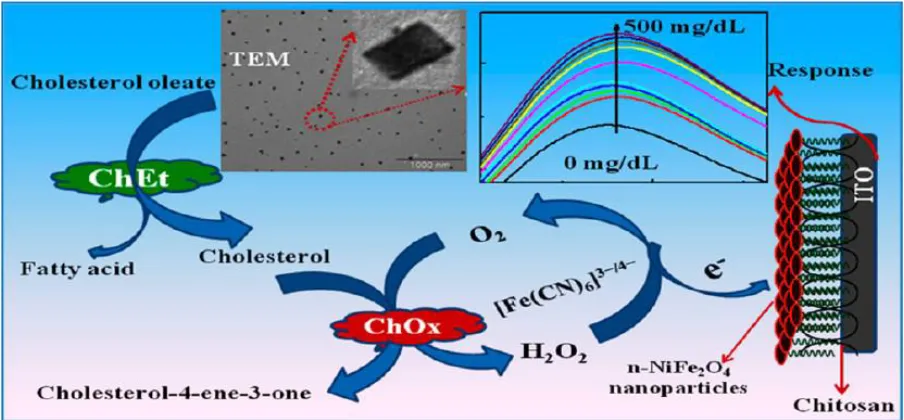
detection of diagnostic acute dengue (NS1) virus. Similarly, Othman and his co-workers [43] have reviewed for the fabrication of functional nanostructured materials with bioactive, low cost and large quantity in practical applications. The summarized mechanism assembly of enzyme based nanoparticle composites for biosensors, ie the designed biosensors can conjugate with other conducting materials like conducting polymers and biosensors, which was the interchange between the enzyme and the deposited nanomaterials. Ma et al [44] reported the molecular imprinted polymer (MIP) electrode was constructed on the MWCNTs electrode for the sensitive determination of retrovirus the human immunodeficiency virus p24 (HIV-p24). The successfully prepared MIPs/MWCNTs/GCE electrode exhibited a sensitive and reproducible superior electrochemical performance of HIV-p24 in human serum sample. Carbon nanotube was functionalized with electrochemical treatment, further it immobilized with acetylcholinesterase, the covalent linkage on the functionalised electrode. Conducting polymer (Poly(4-(2,5-dithiophene-2-yl-1H-pyrrole-1-yl)benzenamine) has been electro polymerized on the functionalized carbon nanotube electrode. The schematic diagram, which was displayed the procedure for the fabrication of the proposed amperometric detection of organophosphorus pesticides [45]. Recently, an interesting tungsten disulphide/MWCNTs composite received increasing attention attributed to their electrochemical synergetic and lowest level detection of DNA biosensors [46]. Fig.2.showed that a new hybrid nanocomposite (Nickel ferrite NiFe2O4)
modified with cholesterol esterase (ChEt) and cholesterol oxidase (ChOx) have been prepared by hydrothermal method.
Figure 2. Shows the schematic representations of hybrid nanocomposite based on hydrothermally synthesized nanostructured NiFe2O4 (n-NiFe2O4) and chitosan (CH) has been explored for
[image:7.596.72.524.414.624.2]
The nanocrystalline novel biocompatible ChEt-ChOx/nNiFe2O4-CH/ITO bio electrode explored
large surface area, high conductivity and good biocompatibility for biomedical (Cholesterol biosensor) applications [47].
5. ELECTROCHEMICAL STUDIES
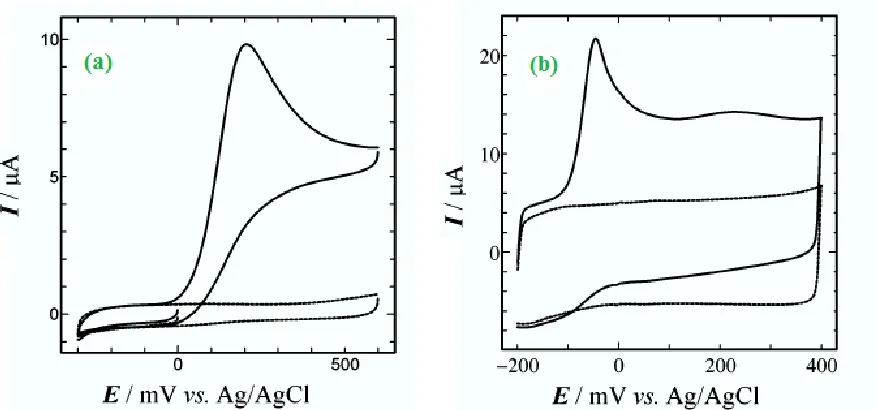
Electrochemical analysis is one of the most versatile electroanalytical techniques, which will give useful information in the mechanism of all electrochemical reactions. Li et al [48] developed a novel cost effective, simple and reproducible nafion coated xylose dehydrogenase (XDH) supported multi-walled carbon nanotube (Nafion/Bacteria-displaying XDH/MWCNTs) nanocomposite for highly sensitive and selective electrochemical biosensor applications. In the case of electrochemical studies, Nafion/Bacteria-displaying XDH/MWCNTs nanocomposite, the peak current was significantly higher than the unmodified electrode. Randviir and his co-works [49] pioneered the use of screen printed electrode for the detection of both synthetic capsaicin and chili extracted capsaicin. Here, electroanalytical techniques (Cyclic voltammetry and electrochemical impedance spectroscopy), which were applied most appropriate method of the characteristics of peak currents and their charge transfer resistance (RCT) values up to low level concentrations of capsaicin. Zhang et al [50] developed novel
graphite and heat-treated-SWNT modified electrode towards the electrochemical oxidation and determinations of ascorbate in the rat brain. From the voltammetry analysis, the demonstrated ascorbate oxidations at heat-treated SWNT modified electrode (Fig.3b) were obviously more negative those than graphite-modified (Fig.3a) electrode. This was clearly indicated that, faster electron-transfer kinetics of the ascorbate oxidation.
[image:8.596.84.522.470.675.2]
Recently, there has been a considerable interest for the development of cobalt(II)phthalocyanine-multi-walled carbon nanotube (CoPc-MWCNTs/GC) modified electrode by the drop coating method. The demonstrated electrocatalytic properties of CoPc-MWCNTs/GC modified electrode showed pairs of redox peaks and the successive addition of amperometric response of ascorbic acid (LOD = 1.0 x 10⁻⁶ M) [51]. Munge et al [52] have used Horseradish based randomly aligned non-oriented MWCNTs electrode, the optimized remarkable detection limit value of 1.5 nM and their electrical conductivity provided large surface area facilitated faster electron transfer and excellent electrocatalytic activity towards hydrogen peroxide sensor. Bizid et al [53] established dispersed MWCNTs have been modified with ferrocene-poly(Para-phenylene) composite. The modified nanocomposites (MWCNTs/Fc-PPP), which were immobilized with ssDNA probes for the sensing of DNA hybridization up to 1.6 pM and their linear range of detection limit up to 100 pM. A novel topological structure of polymer-ferrocene terminated hyper branched polyurethane (HPU-Fc) based electrodes were good candidates for the key role in the design and engineering of non-enzymatic glucose sensor. The designed accurate and highly sensitive HPU-Fc film electrode significantly employed for the determination of glucose in blood serum sample [54].
5.1. Effect of pH
The globular shape fiber-like and stack-like structure of polymeric form of xanthurenic acid (PolyXa) and Flavin adenine dinucleotide (FAD) have been successfully fabricated on MWCNTs by different prepared (Electrochemical) methods for the electrochemical determinations of reduced β-nicotinamide adenine dinucleotide (NADH) and hydrogen peroxide (H2O2), which was immobilized
with polyXa/FAD before and after the adsorption of CNTs. The surface confined process more stable in various scans rates and their optimized different pH values. From the voltammetric analysis of PolyXa/FAD/MWCNTs composite displayed in different pH (From 1 - 13) and their formal redox potential value of both polyXa and FAD exhibited at -69 mV pH-1 and -48.2 mV pH-1 respectively [55].
5.2. Amperometry (i-t)
glucose immobilized PANCAA/MWCNT composite was characterized by chronoamperometry method, the fabricated composite enhanced the maximum current value of GOx. Xu et al [58] cast the multi-walled carbon nanotubes on a surface of glassy carbon electrode. The demonstrated electrochemical and electrocatalytic activity amperometric response of H2O2 in the linear range from 4
M to 2 mM and their LOD value was 1 M. Batra et al [59] have synthesized smooth (Net-like) and globular structural morphology of graphene oxide nanoparticles (GrONPs) decorated with pencil graphite electrode (PGE) by electrodeposition method and investigated their electrode properties for amperometric detection of lactate biosensors (LOD = 0.1 M). The lactate hydrogenase immobilized GrONPs/PGE composite’s stabilities were tested for 60 days, only 25 % of lost from the initial electrocatalytic activities.
Figure 4. (a) SEM images of electrospun nanofibrous membranes of MWCNT filled PANCAA and (b) Chronoampeometric curves with glucose concentrations on the MWCNT-filled PANCAA (PANCAA/MWCNT) nanofibrous membrane deposited electrode. ("Reprinted with permission from (J. Phys. Chem. C 113 (2009) 2955-2960). Copyright (2009) American Chemical Society”).
On the other hand, Li and his co-workers [60] demonstrated that a unique electronic and electrocatalytic properties of remarkable synergetic augments on the current (LOD = 0.5 M) response by the development of MWCNTs based phosphomolybdic acid (PMo12) composite film cast on
pyrolytic graphite electrode (PG). The cyclic stability of the PG/MWCNTs/PMo12 composite was
[image:10.596.77.522.264.428.2]
5.3. Electrode stability
Sun and his co-workers [62] have overviewed significant effort for the development of hierarchically structured porous materials exhibited outstanding properties like high surface area, good accessibility and enhanced mass transport (Diffusion, migration and convection) properties. Recently, they highlighted more literatures for the strategy of synthesis hierarchically porous dimensions like materials by various template methods. Herein, these kinds of porous based materials were applied in various applications such as energy conversion, catalysis and sensing of biomedicine. Carbon nanotube epoxy composite (CNTEC) hybrid materials as a new electrode with improved microbial bio-sensing properties. As a result, the Pseudomonas fluorescence immobilized CNTEC composite was exhibited high current values (2 to 3 folds) and good operating stability [63].
Figure 5. (a) TEM photographs of PVDF−MWCNT−PtNP hybrid nanofibers (b) Electrochemical H2O2 selectivity of biosensor and (c) Electrochemical long-term storage stability in response to
5 mM H2O2. ("Reprinted with permission from (ACS Appl. Mater. Interface 6 (2014)
7563-7571). Copyright (2014) American Chemical Society”).
[image:11.596.322.522.276.425.2]
over long period test and rapid current enhancement for the reduction of hydrogen peroxide (H2O2)
(Fig.5), the displayed lowest detection limit value of 0.61 M [64]. The perspectives of functionalized MWCNTs based polypyrrole (PP) composites were greatly electrodeposited on pencil graphite electrode (PEG) dependent on its DNA biosensors for the determinations of anticancer drug of 6-mercaptopurine [65].
6. CONCLUSIONS
The current developments of multi-walled carbon nanotubes based modified composite electrodes were focused on their unique morphology, physiochemical and electrochemical bio-sensing properties. The best strategies of this overview, the combined methodology of theoretical and fundamentals electrochemical (Biosensors) analysis and simple method for the fabrications of novel type of composite materials. To date, abundant methods and several of the electrode materials have been developed and used in both academic and research laboratory for biosensor based electrochemical sensor technology. Among these, only we have discussed the recent advances in the fabrications/modifications of biosensor using MWCNTs (Carbon) based composites.
ACKNOWLEDGEMENT
We gratefully acknowledge financial support from the Science & Engineering Research Board (SERB), Government of India, New Delhi (File No: EEQ/2016/000427: Diary No: SERB/F/8355/2016-17) and The Management and Chemistry Department Staff members, The Madura College, Madurai, Tamil Nadu, India.
References
1. J. Li, E.K. Jessica, M.C. Alan, C. Hua, N.H. Tee, Y. Qi, F. Wendy, H. Jie, M. Meyyappan, Electroanalysis 17 (2005) 15.
2. J. Wang Electroanalysis 17 (2005) 7.
3. C. Lete, S. Lupu, B. Lakard, Y.V. Hihn, F.J.D. Campo, J. Electroanal. Chem. 744 (2015) 53-63. 4. A. Barberis, Y. Spissu, A. Fadda, E. Azara, G. Bazzu, S. Marceddu, A. Angioni, D. Sanna, M.
Schirra, P.A. Serra, Biosens. Bioelectron. DOI:10.1016/J.bios.2014.08.019.
5. W. Sun, L. Cao, Y. Deng, S. Gong, F. Shi, G. Li, Z. Sun, Anal. Chim. Acta 781 (2013) 41-47. 6. Q. Sheng, M. Wang, J. Zheng, Sens. Actuators, B 160 (2011) 1070-1077.
7. H. Zai, Z. Liu, Z. Chen, Z. Liang, Z. Su, S. Wang, Sens. Actuators, B 210 (2015) 483-490. 8. Y. Yu, Z. Chen, S. He, B. Zhang, X. Li, M. Yao, Biosens. Bioelectron.52 (2014) 147-152. 9. H.V. Tran, B. Piro, S. Reisberg, L.H. Nguyen, T.D. Nguyen, H.T. Duc, M.C. Pham, Biosens.
Bioelectron. 62 (2014) 25-30.
10. B. Dinesh, V. Mani, R. Saraswathi, S.M. Chen RSC Advances 4 (2014) 28229.
11. A.T.E. Vilian, S.M. Chen, C.H. Kwak, S.K. Hwang, Y.S. Huh, Y.K. Han, Sens. Actuators, B 224 (2016) 607-617.
12. Y. Hu, J. Li, Z. Zhang, H. Zhang, L. Luo, S. Yao, Anal. Chim. Acta 698 (2011) 61-68. 13. Y. Zou, C. Xiang, L.X. Sun, F. Xu, Biosens. Bioelectron. 23 (2008) 1010-1016.
14. A. Salimi, B. Pourbahram, S.M. Majd, R. Hallaj, Electrochim. Acta 156 (2015) 207-215.
16. Y. Li, A.J. Ali, S.M. Chen, S.Y. Yang, B.S. Lou, F.M.A.A. Hemaid Colloids Surf., B 118 (2014) 133-139.
17. K. Zhang, J. Xu, X. Duan, L. Lu, D. Hu, L. Zhang, J. Nie, K.B. Brown Electrochim. Acta 137 (2014) 518-525.
18. Y. Zou, L.X. Sun, F. Xu, Biosens. Bioelectron.22 (2007) 2669-2674. 19. J. Li, E.C. Lee Biosens. Bioelectron. 71 (2015) 414-419.
20. M. Eguilaz, L. Agui, P.Y. Sedeno, J.M. Pingarron, J. Electronal. Chem. 644 (2010) 30-35. 21. A.F. Goff, M. Holzinger, S. Cosnier, Analyst 136 (2011) 1279.
22. J. Bai, X. Zhang, Y. Peng, X. Heng, Y. Liu, S. Jiang, B. Ning, Z. Gao, Sens. Actuators, B 238 (2017) 420-426.
23. A.R. Galvan, F.F.C. Torres, E.V. Basiuk, A. Heredia, V.A. Basiu, The Cnadian J. Chem. Eng. 91 (2013) 264-270.
24. R. Cui, C. Liu, J. Shen, D. Gao, J.J. Zhu, H.Y. Chen, Adv. Funct. Mater 18 (2008) 2197-2204. 25. J.C. Claussen, A. Kumar, D.B. Jaroch, M.H. Khawaja, A.B. Hibbard, D.M. Porterfield, T.S. Fisher
Adv. Funct. Mater 22 (2012) 3399-3405.
26. Z.X. Cai, C.C. Liu,G.H. Wu, X.M. Chen, X. Chen, Electrochim. Acta 112 (2013) 756-762. 27. A. Walcarius, S.D. Minteer, J. Wang, Y. Lin, A. Merkoci, J. Mater. Chem B 1 (2013) 4878-4908. 28. R. Singh, C. Dhand, G. Sumana, R. Verma, S. Sood, R.K. Gupta, B.D. Malhotra, J. Mol. Recognit
23 (2010) 472-479.
29. H.N. Choi, S.H. Yoon, Y.K. Lyu, W.Y. Lee, Electroanalysis 19 (2007) 459-465.
30. Q. Cao, H. Zhao, Y. Yang, Y. He, N. Ding, J. Wang, Z. Wu, K. Xiang, G. Wang, Biosens. Bioelectron.26 (2011) 3469-3474.
31. M.C. Kum, K.A. Joshi, W. Chen, N.V. Myung, A. Mulchandani, Talanta 74 (2007) 370-375. 32. B.K. Shrestha, R. Ahmad, H.M. Mousa, I.G. Kim, J.I. Kim, M.P. Neupane, C.H. Park, C.S. Kim,
J. Colloid Interface Sci. 482 (2016) 39-47.
33. Y. Haldorai, S.K. Hwang, A.I. Gobalan, Y.S. Huh, Y.K. Han, W. Voit, G.S. Anand, K.P. Lee Biosens. Bioelectron.79 (2016) 543-552.
34. S. Sanchez, M. Pumera, E. Fabregas, J. Bartroli, M.J. Esplandiu, Phys. Chem. Chem. Phys. 11 (2009) 7721-7728.
35. P. Du, S. Liu, P. Wu, C. Cai, Electrochim. Acta 53 (2007) 1811-1823. 36. Y.W. Lin, T.M. Wu, Polym Int 60 (2011) 382-388.
37. J. Li, J.D. Qiu, J.J. Xu, H.Y. Chen, X.H. Xia, Adv. Funct. Mater 17 (2007) 1574-1580. 38. Y. Liu, J. Liu, H. Tang, J. Liu, B. Xu, F. Yu, Y. Li Sens. Actuators, B 206 (2015) 647-652.
39. H.V. Tran, B. Piro, S. Reisberg, L.D. Tran, H.T. Duc, M.C. Pham Biosens. Bioelectron. 49 (2013) 164-169.
40. F.N. Ishikawa, M. Curreli, C.A. Olson, H.I. Liao, R. Sun, R.W. Roberts, R.J. Cote, M.K. Thompson, C. Zhou, ACS Nano 4 (2010) 6914-6922.
41. M. Chen, J.Q. Xu, S.N. Ding, D. Shan, H.G. Xue, S. Cosnier, M. Holzinger, Sens. Actuators, B 152 (2011) 14-20.
42. M.M.S. Silva, A.C.M.S. Dias, B.V.M. Silva, S.L.R.G. Filho, L.T. Kubota, M.O.F. Goulart, R.F. Dutra, J. Chem. Technol. Biotechnol 90 (2015) 194-200.
43. A. Othman, A. Karimi, S. Andreescu, J. Mater. Chem. B 4 (2016) 7178-7203. 44. Y. Ma, X.L. Shen, Q. Zeng, H.S. Wang, L.S. Wang, Talanta 164 (2017) 121-127.
45. M. Kesik, F.E. Kanik, J. Juran, M. Kolb, S. Timur, M. Bahadir, L. Toppere Sens. Actuators, B 205 (2014) 39-49.
46. X. Liu, H.L. Shuai, Y.J. Liu, K.J. Huang Sens. Actuators, B 235 (2016) 603-613.
47. J. Sigh, A. Roychoudhury, M. Sirvastava, V. Choudhary, R. Prasanna, D.W. Lee, S.H. Lee, B.D. Malhotra, J. Phys. Chem. C 117 (2013) 8491-8502.
50. M. Zhang, K. Liu, K. Gong, L. Su, Y. Chen, L. Mao, Anal. Chem 77 (2005) 6234-6242. 51. X. Zuo, H. Zheng, N. Li Sens. Actuators, B 161 (2012) 1074-1079.
52. B.S. Munge, R.S. Dowd, C.E. Krause, L.N. Millord, Electroanalysis 21 (2009) 2241-2248. 53. S. Bizid, R. Mlika, A.H. Said, M. Chemli, H.K. Youssoufi Electroanalysis 28 (2016) 2533-2542. 54. H. Li, F. Zhao, L. Yue, S. Li, F. Xiao Electroanalysis 28 (2016) 1003-1011.
55. K.C. Lin, Y.S. Li, S.M. Chen Sens. Actuators, B 184 (2013) 212-219.
56. X. Pang, P. Imin, I. Zhitomirsku, A. Adronov, J. Mater. Chem 22 (2012) 9147-9154. 57. Z.G. Wang, Y. Wang, H. Xu, G. Li, Z.H. Xu J. Phys. Chem. C 113 (2009) 2955-2960. 58. J.Z. Xu, J.J. Zhu, Q. Wu, Z. Hu, H.Y. Chen Electroanalysis 15 (2003) 219-224. 59. B. Batra, V. Narwal, C.S. Pundir, Eng. Life. Sci 16 (2016) 786-794.
60. Z. Li, J. Chen, D. Pan, W. Tao, L. Nie, S. Yao, Electrochim. Acta 51 (2006) 4255-4261. 61. K. Singh, B.P. Singh, R. Chauhan, T. Basu, J. Appl. Polym. Sci. 125 (2012) E235-E246. 62. M.H. Sun, S.Z. Huang, L.H. Chen, Y. Li, X.Y. Yang, Z.Y. Yuan, B.L. Su, Chem. Soc. Rev 45
(2016) 3479-3563.
63. U.A. Kirgoz, S. Timur, D. Odaci, B. Perez, S. Alegret, A. Merkoci, Electroanalysis 19 (2007) 893-898.
64. P. Zhang, X. Zhao, Y. Lai, X. Wang, J. Li, G. Wei, Z. Su, ACS Appl. Mater. Innterfaces 6 (2014) 7563-7571.
65. H.K. Maleh, F.T. Javazmi, N. Atar, M.L. Yola, V.K. Gupta, A.A. Ensafi, Ind. Eng. Chem. Res 54 (2015) 3634-3639.