Inference and Update
∗
Fernando R. Vel´azquez-Quesada
Institute for Logic, Language and Computation. Universiteit van Amsterdam. Plantage Muidergracht 24, 1018 TV. Amsterdam, The Netherlands.
Abstract
We look at two fundamental logical processes, often intertwined in plan-ning and problem solving: inference and update. Inference is an internal process with which we uncover what is implicit in the information we already have. Update, on the other hand, is produced by external commu-nication, usually in the form of announcements and in general in the form of observations, giving us information that might have been not available (even implicitly) before. Both processes have received attention from the logic community, usually separately. In this work, we develop a logical language that allows us to describe them together. We present syntax and semantics, as well as a complete axiom system. We also discuss similari-ties and differences with other approaches, and we mention some possible ways the work can be extended.
1
Introduction
Consider the following situation, fromvan Benthem[2008a]:
You are in a restaurant with your parents, and you have ordered three dishes: fish, meat, and vegetarian, for you, your father and
your mother, respectively. Now a new waiter comes from the
kitchen with the three dishes. What can he do to get to know which dish corresponds to which person?
The waiter can ask“Who has the fish?”; then he can ask “Who has the meat?”. Now he does not have to ask anymore: “two questions plus one inference are all that is needed” (van Benthem[2008a]).
The present work looks at these two fundamental logical processes, often intertwined in planning, problem solving and real-life activities. Inference is
aninternal process: the agent revises her own information in search of what
can be derived from it. Update, on the other hand, is produced by external communication: the agent gets new information via observations. Both are logical processes, both describe dynamics of information, both are used in every day situations, and still, they have been studied separately.
∗
Inference has been traditionally taken as the main subject of study of logic, allowing us to extract new information from what we already have. Among the most important branches, we can mention Hilbert-style proof systems, natural deduction and tableaux. Recent works, likeDuc[1995,1997] andJago[2006b,a] have incorporated modal logics to the field, representing inference as a non-deterministic step-by-step process.
Update, on the other hand, has been the main subject of what have been calledDynamic Epistemic Logic. Works likePlaza[1989],Gerbrandy[1999a] and
Gerbrandy[1999b] turned attention to the effect of public announcements over the knowledge of an agent. Many works have followed them, including the study of more complex actions (Baltag et al.[1999],van Ditmarsch[2000],Baltag and Moss[2004]) and the effect of announcements over a more wide proposi-tional attitudes (the soft/hard facts ofvan Benthem[2007], the knowledge/belief ofBaltag and Smets[2008]).
Invan Benthem[2008c], the author shows how these two phenomena fall directly within the scope of modern logic. As he emphasize, “asking a question and giving an answer is just as ’logical’ as drawing a conclusion!”. Here, we propose a merging of the two traditions. We consider that both processes are equally important in their own right, but so it is their interaction. In this work, we develop a logical language that allows us to express both inference and update together.
We start in section by2providing a modal framework for representing the agent’simplicitandexplicitinformation, and isolate the case of true information. Then, in section3, we provide a representation ofinferenceand we focus on the truth-preserving case. Moreover, we show how dynamics of the inference process itself can be described too. Section4introduces the other logical process:
update. We compare our work with other approaches in section 5, and we
conclude in section 6 with a summary and some further work we consider
interesting. The present work focuses in the single-agent case, leaving the analysis of group-information concepts like common or distributed knowledge for the future.
2
Implicit and explicit information
Our goal is to represent the agent’s information, and how it evolves through the use of inference and update. TheEpistemic Logic(EL) framework with Kripke models (Hintikka[1962]) is one of the most widely used for representing and reasoning about agents’ information. Nevertheless, it is not fine enough to represent the Restaurant example. Agents whose information is represented within such framework suffer from what Hintikka called thelogical omniscience problem1: they are informed of all validities and their information is closed
under truth-preserving inference.
Though this feature is useful in some applications, it is too much in some others. More important for us, ithidesthe inference process. If we represent the Restaurant example with Kripke models, the answer to the second question informs the waiter not only that your father will get the meat but also that your mother will get the vegetarian dish. In this case, the inference is very
simple, and some could even say that there is no inference at all. Nevertheless, inferences are in general more complex: proving a theorem basically consists on successive application of deductive inference steps in order to show that the conclusion indeed follows from the premises. Some theorems may be straightforward but, as we know, some are not.
As van Benthem argues invan Benthem[2006], we can give to the modal operator a moreimplicitreading, describing not the agent’s current information, but what she may get to know after enough time and inference steps. This work uses that interpretation, reading formulas of the formϕas“the agent is
implicitly informed aboutϕ”. With this idea in mind, we extend the EL framework
to representexplicitinformation too. Moreover, we also provide a mechanism with which the agent can increase it. The work of this section resembles those presented inFagin and Halpern[1988],Duc[1995,1997],Jago[2006b] andJago
[2006a]; the precise relation will be clarified in section5.
2.1
Formulas, rules and the explicit
/
implicit information
lan-guage
The agent’s explicit information will be given by a set of formulas; the mech-anism that allows her to improve it will be given by syntactic rules. Our first step is to define the language from which these formulas come from, and what a rule in that language is.
Definition 2.1(Formulas and rules). LetPbe a set of atomic propositions
• A formulaγof theinternal languageIis given by
γ::=p| ¬γ|γ∨δ
withp∈P.
• Arulebased onIis a pair (Γ, γ) (sometimes represented asΓ⇒γ) where Γis a finite set of formulas andγis a formula, all of them inI. Given a rule ρ=(Γ, γ), we callΓtheset of premises ofρ(prem(ρ)) andγtheconclusion ofρ(conc(ρ)). We denote byRIthe set of rules based on formulas ofI,
omitting the subindex when no confusion arises.
While formulas describe situations about the world, rules describe relations between such situations. Intuitively, the rule (Γ, γ) indicates that if everyδ∈Γ
is true, so it isγ.
The internal language is used for representing the agent’s explicit informa-tion. By using just the propositional one, we allow the agent to have explicit information about situations, but not about her own information or the infor-mation of other agents. This is indeed a limitation, but it makes possible the update definition of section4. In section6we briefly discuss the reasons for this limitation, leaving a deep analysis for a further work.
Now we can give the definition of our framework. Syntactically, we extend
Epistemic Logicby adding two new kinds of formulas: one to express the agent’s
Definition 2.2 (Explicit/implicit information language EI). LetP be a set of atomic propositions. The formulas of theexplicit/implicit information language
EIare given by
ϕ::=> |p|Iγ|Lρ| ¬ϕ|ϕ∨ψ|^ϕ
withp∈ P,γ∈ Iandρ ∈ R. Formulas of the formIγare read as“the agent is
explicitly informed aboutγ”), and formulas of the formLρare read as“the agent
can apply ruleρ”.
The boolean connectives∧,→and↔as well as the modal operatorare
defined as usual.
Semantically, each world of our model has three components: a valuation for the truth value of atomic propositions (just as in possible worlds models) and two sets: one indicating theformulasthe agent is explicitly informed, and other indicating therulesshe can apply at that world. We have just one relation between worlds, the accessibility one, indicating which ones the agent considers possible from a given one.
Definition 2.3(Explicit/implicit information model). LetPbe a set of atomic propositions. Anexplicit/implicit information modelis a tupleM=hW,R,V,Y,Zi
where:
• Wis a non-empty set of worlds.
• R ⊆ W ×W is the accessibility relation, describing the agent’s implicit
information.
• V:W→℘(P) is anatomic valuation function, indicating the atomic propo-sitions that are true at each possible world.
• Y:W →℘(I) is theinformation set function, indicating the explicit
infor-mation of the agent at each possible world. We ask for the inforinfor-mation sets to be preserved by the accessibility relation: ifγ ∈ Y(w) and Rwu,
thenγ∈Y(u) (thecoherenceproperty for formulas).
• Z: W → ℘(R) is therule set function, indicating the rules the agent can
apply at each possible world. We ask for the rule sets to be preserved by the accessibility relation: ifρ∈Z(w) andRwu, thenρ∈Z(u) (thecoherence
property for rules).
We will denote withEIthe class of all explicit/implicit information models.
In the definition of the model we have two restrictions, reflecting our idea of what it represents. Intuitively, the setsY(w) andZ(w) represent the formulas and rules the agent is explicitly informed about. If while staying inwthe agent considersupossible, then it is natural to ask foruto preserve everything the agent is explicitly informed atw.
Formulas ofEIare interpreted in models ofEIas follows.
Definition 2.4 (Semantics for EI). Given a model M = hW,R,V,Y,Zi in EI
and a worldw∈ W, thesatisfactionrelationbetween the pair (M,w) and>,
negations and disjunctions is given as usual. The case for atomic propositionsp and implicit information formulas^ϕis just like in epistemic logic. For explicit
(M,w)Iγ iff γ∈Y(w)
(M,w)Lρ iff ρ∈Z(w)
As usual, we have the following definitions.
• A formulaϕistrue at w in Mwhenever (M,w)ϕ.
• A a formulaϕisvalid in M(notation: Mϕ) wheneverϕistrue at w in
Mforall worlds winM.
• A formulaϕisvalid in the class of modelsM(notation:Mϕ) ifϕis valid
inMforall models MinM.
We provide a syntactic characterization of formulas ofEIthat are valid in
the class of modelsEI. Non-defined concepts, like a (modal) logic,Λ-consistent (inconsistent) set and maximalΛ-consistent set (for a normal modal logicΛ) are completely standard, and can be found in chapter 4 ofBlackburn et al.[2001].
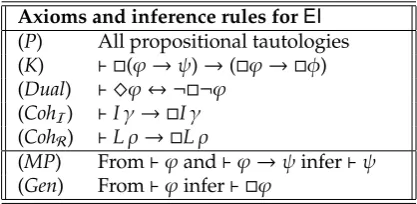
Definition 2.5(LogicEI). The logicEIis built from the axioms and rules shown in table1. AxiomsP,KandDualas well as the two rulesMPandGenare stan-dard for modal logic. AxiomsCohIandCohR describe the particular
require-ments of the models, thecoherenceproperty for formulas and rules, respectively.
Axioms and inference rules forEI
(P) All propositional tautologies
(K) `(ϕ→ψ)→(ϕ→φ)
(Dual) `^ϕ↔ ¬¬ϕ
(CohI) `Iγ→Iγ
(CohR) `Lρ→Lρ
(MP) From`ϕand`ϕ→ψinfer`ψ
[image:5.595.192.401.381.483.2](Gen) From`ϕinfer`ϕ
Table 1: Axioms and inference rules forEI.
Theorem 1(Soundness and completeness ofEIw.r.t. EI). The logicEIis sound
and strongly complete with respect to the classEI.
Proof. For soundness, we just need to prove that axioms ofEIare valid inEI,
and that its rules preserve validity. We omit the details here.
For completeness, we recall that strong completeness is equivalent to satis-fiability of consistent set of formulas (see Proposition 4.12 ofBlackburn et al.
[2001]). We define the canonical modelMEIfor the logicEI; with the Linden-baum’s Lemma, the Existence Lemma and the Truth Lemma, we show that everyEI-consistent set of formulas is satisfiable inMEI. Finally, we show that
MEIis indeed a model inEI. See sectionA.1for details.
2.2
When information is knowledge
As it is currently defined, an explicit/implicit information model do not impose any restriction on the information of the agent. We do not ask for any property for the accessibility relation, so there are no constrains for implicit information, others than those given by the representation itself, like closure under modus ponens (the K axiom) and the inclusion of validities (the Gen rule). In the case of explicit information, we can have information sets with formulas that are not true, or even inconsistent ones. Moreover, the models do not impose any restriction about the rules the agent can apply: they do not have to be truth-preserving.
Among the models inEI, we can distinguish those in which both implicit and explicit information are true, and the rules are truth-preserving. We start by considering models with equivalence accessibility relations, as it is usually done
inEpistemic Logic; this makes implicit information true. For explicit information,
we ask for every formula in the information set to be true at the corresponding world. Finally, in the case of rules, we define a translation TR that takes rules in
Rinto an implication inEIwhose antecedent is the conjunction of the premises
and whose consequent is the conclusion.
TR(ρ) :=V
prem(ρ)→conc(ρ)
The formal definition of this particular class of models is as follows.
Definition 2.6(The classEIK). We denote byEIK the class of explicit/implicit
information models satisfying
• Equivalence:Ris an equivalence relation.
• Truth for formulas:for every worldw∈W, ifγ∈Y(w), then (M,w)γ.
• Truth for rules:for every worldw∈W, ifρ∈Z(w), then (M,w)TR(ρ).
Models in this class will be also calledknowledge models, and instead of ex-plicit/implicit information we will talk about explicit/implicit knowledge.
For a syntactic characterization of formulas valid inEIKmodels, we have
the logicEIK.
Definition 2.7 (Logic EIK). The logic EIK extends EI (see definition 2.5) by
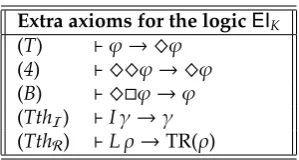
adding the axioms of table2. AxiomsT,4andBmake the accessibility relation an equivalence relation. AxiomTthI guarantees that formulas in the agent’s
information set are true, and axiomTthRguarantees that the rules she can apply
are truth-preserving.
Theorem 2 (Soundness and completeness of EIK w.r.t. EIK). The logic EIK is
sound and strongly complete with respect to the models in the classEIK.
Proof. The fact that axioms of table2are valid inEIK proves soundness. The
fact that the canonical model for the logic EIK satisfies the equivalence, truth
for formulasandtruth for rulesproperties proves completeness. Details can be
Extra axioms for the logicEIK
(T) `ϕ→^ϕ
(4) `^^ϕ→^ϕ
(B) `^ϕ→ϕ
(TthI) `Iγ→γ
[image:7.595.222.372.123.203.2](TthR) `Lρ→TR(ρ)
Table 2: Extra axioms for the logicEIK.
We recall thecoherenceproperty for formulas and rules: ifγ∈Y(w) (ρ∈Z(w))
andRwu, then we haveγ∈Y(u) (ρ ∈Z(u)). When the accessibility relation is
an equivalence relation, we get the same information and rule set for all the worlds that belong to the same equivalence class.
Note how in knowledge models, from axiomCohI(Iγ→Iγ) and axiom
TthI(Iγ→γ) we getIγ→γ. The same apply for rules: fromCohR (Lρ →
Lρ) andTthR (Lρ →TR(ρ)) we getLρ →TR(ρ). These formulas indicate
that whatever is part of the agent’s explicit information also belongs to her implicit information.
It is now time to turn our attention into thedynamicsof information. In the following sections, we extend the language to describe two different ways in which the agent can improve her knowledge. Through inferences, she will extract information that is implicit in what she explicitly have; moreover, we will provide her a mechanism to improve her inferential abilities. Through updates, she will get information that may not be available (even implicitly) to her before.
3
Inference
The agent can extend her explicit knowledge by using rules. As mentioned before, a rule (Γ, γ) intuitively indicates that if everyδ ∈ Γis true, so it isγ.
However, in principle, there is no restriction in the way the agent can use a rule. She can use it to get the conclusion without having all the premises, or even deriving the premises whenever she has the conclusion.
In the previous section we distinguished, among all the explicit/implicit information models, those in which the agent’s information is true. In the same spirit, in this section we will define an inference operation that preserves truth.
3.1
A particular case: truth-preserving inference
The inference process adds formulas to the information set. Since we want to represent atruth-preservinginference, we restrict the way in which the rule can be applied. Thedeductionoperation over a modelMis defined as follows.
Definition 3.1(Deduction operation). LetM=hW,R,V,Y,Zibe a model in the
classEI, and letσbe a rule inR. The modelMσ=hW0,
R0,
V0,
Y0,
Z0i
is given by
• W0
:=W, R0
and, for everyw∈W0
,
• V0
(w) :=V(w), Z0
(w) :=Z(w) and
• Y0
(w) := (
Y(w)∪ {conc(σ)} if prem(σ)⊆Y(w) andσ∈Z(w)
Y(w) otherwise
The operation (·)σis called thededuction operationwith ruleσ.
Note how the conclusion of the rule is added to a world just when all the premises and the rule are already there. This allows us to prove that, in particular, the deduction operation preserves models inEIK.
Proposition 1. Letσbe a rule inR. If M is a model inEIK, so it is Mσ.
Proof. See sectionA.3.
The languageEIDextendsEIby closing it under deduction operations.
Take a ruleσ: ifϕis a formula inEID, so it ishDσiϕ. These new formulas are
read as“there is a way of deductively applyingσafter whichϕis the case”. Define the abbreviation
Preσ≡I prem(σ)∧Lσ
where, forΓa finite set of formulas of the internal language, we writeIΓfor V
γ∈ΓIγ. Then, the semantics for deduction formulas is given as follows.
Definition 3.2. LetMbe a model inEI, and take a worldwin it.
(M,w)hDσiϕ iff (M,w)Preσ and (Mσ,w)ϕ
The formula [Dσ]ϕ is defined as the dual of hDσiϕ, that is, [Dσ]ϕ ↔ ¬hDσi ¬ϕ. Therefore,
(M,w)[Dσ]ϕ iff (M,w)Preσ implies (Mσ,w)ϕ
We now provide a syntactic characterization of the formulas inEIDthat
are valid in models inEIK. By proposition1, the deduction operation is closed
for models inEIK, so we can rely on the logicEIK: all we have to do is give a
set of reduction axioms for formulas of the formhDσiϕ
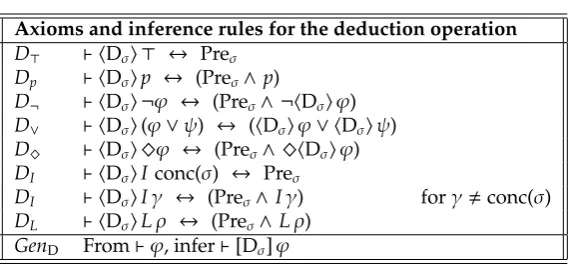
Definition 3.3(LogicEIKD). The logicEIKD is built from axioms and rules of
EIK(see definition2.7) plus axioms and rules in table3. Each one of the axioms
express how formulasafterthe deduction operation are related with formulas
beforethe operation.
Theorem 3(Soundness and completeness ofEIKDw.r.t. EIK). The logicEIKD is
sound and strongly complete for the class of modelsEIK.
Proof. Soundness follows from the validity of the new axioms and the
validity-preserving property of the new rule. Strong completeness follows from the fact that, by a repetitive application of such axioms, any deduction operation formula can be reduced to a formula inEI, for whichEIKis strongly complete
Axioms and inference rules for the deduction operation D> ` hDσi > ↔ Preσ
Dp ` hDσip ↔ (Preσ∧p)
D¬ ` hDσi ¬ϕ ↔ (Preσ∧ ¬hDσiϕ)
D∨ ` hDσi(ϕ∨ψ) ↔ (hDσiϕ∨ hDσiψ)
D^ ` hDσi^ϕ ↔ (Preσ∧^hDσiϕ)
DI ` hDσiI conc(σ) ↔ Preσ
DI ` hDσiIγ ↔ (Preσ∧Iγ) forγ,conc(σ)
DL ` hDσiLρ ↔ (Preσ∧Lρ)
[image:9.595.155.441.119.252.2]GenD From`ϕ, infer`[Dσ]ϕ
Table 3: Axioms and rules for deduction operation formulas.
In previous versions of the present work (Velazquez-Quesada[2008]) infer-ence was represented as a modal relation between worlds. Formulas of the form hσiϕ, read as“there is a way to apply the ruleσ after whichϕ is the case”,
were interpreted with a relationDσfor every ruleσ. In order to preserve the
intuitive meaning, some properties for the relation were required. Inference re-lations should relate worlds with the same valuation and, for the particular case of deduction, the following four properties were stated, indicating properties that the sets of formulas should have to properly represent a truth-preserving inference:
1. to apply a rule we need the premises and the rule,
2. after applying it, we preserve the explicit information we had before,
3. the explicit information is increased by the conclusion of the rule, and
4. there is no other difference between the explicit information before and after the rule application.
In the present work, inference is represented not as a modal relation but as a model operation. From its definition we can see that deduction preserves world-valuation. But not only that: the four previous properties still hold, as the validity of the following formulas shows.
1. hDσi > →Preσ 2. Iγ→[Dσ]Iγ
3. [Dσ]Iconc(σ) 4. hDσiIγ→Iγ (forγ,conc(σ))
Moreover, in this representation, inference is functional: we can apply a rule deductivelyevery timewe have it together with its premises, and the result of the application is unique. The first property was a problem for update operations in the previous setting, and the second one was only expressible with the use of nominals.
The deduction operation adds a formula to the information sets only if it is the conclusion of an applicable rule (i.e., we already have the rule and its premises). Note how in such cases, the conclusion of the rule is actually part of the agent’s implicit information: if a rule is applicable in the current world, then we have it as well as its premises. AxiomsCohI andCohR put both premises
premises and the implication that results of translating the rule true at them. Then, theKaxiom makes the conclusion true in all these worlds. The validity of (Iprem(ρ)∧Lρ)→conc(ρ) proves our point, but the converse is not true.
In general there are formulas belonging to the agent’s implicit information that are not reachable via deduction, since her rule set may not have a rule to derive each one of them. And even if there are such rules, the agent may not have all the needed premises.
3.2
Dynamics of deduction
Just as the agent’s explicit information changes, her inferential abilities can also change. This may be because he is informed about another rule (as we will describe when we work withupdatesin section4), but it may be also because
shebuildsnew rules from the ones she already has. For example, from the rules
({p},q) and ({q},r), it makes sense to derive the rule ({p},r). It may take one step
to the agent to add it to her rule set, but it will save intermediate steps later by allowing the agent to go directly from havingpto havingr.
In fact the example, a kind oftransitivity, represents the application ofCut over the rules the agent has available. In general, inference relations can be characterized by thestructural rulesthey satisfy. These structural rules indicate how to derive new rules from the ones we already have. In the case of deduction the rules are the following:
Reflexivity: ϕ⇒ϕ Contraction: ψ, χ, ξ, χ, φψ, χ, ξ, φ⇒⇒ϕϕ
Permutation: ψ, χ, ξ, φψ, ξ, χ, φ⇒⇒ϕϕ Monotonicity: ψ, χ, φψ, φ⇒⇒ϕϕ
Cut: χ⇒ψ, χ, φξ ψ, ξ, φ⇒ϕ⇒ϕ
Each time a structural rule is applied, we get a new rule. In our framework, the application of an structural rule modifies the model by adding the new rule to the rule set. Note thatContractionandPermutationare not so interesting for us, since we are already considering the premises of a rule as a set, and hence their application does not yield a new rule. On the other hand, Reflexivity,
MonotonicityandCutcan increase the agent’s inferential abilities.
Definition 3.4(Structural operations). LetM=hW,R,V,Y,Zibe a model inEI.
Reflexivity. Let δ be a formula of the internal language. Consider the rule
ςδ=({δ}, δ). The modelMRef(δ) =hW0,R0,V0,Y0,Z0iis the result of adding ςδto every rule set. Formally,
• W0
:=W, R0
:=R,
• V0
(w) :=V(w), Y0
(w) :=Y(w), for everyw∈W0
,
• Z0
(w) :=Z(w)∪ {ςδ}, for everyw∈W0
.
The operation (·)
Monotonicity. Letδbe a formula inI, and letςbe a rule overI. Consider the
ruleς0=
(prem(ς)∪ {δ},conc(ς)), extendingςby addingδto its premises.
The modelMMon(δ,σ)=hW0,R0,V0,Y0,Z0iis the result of addingς0to every
rule set that already containsς. Formally,
• W0:=W, R0:=R
and, for everyw∈W0
,
• V0
(w) :=V(w), Y0
(w) :=Y(w) and
• Z0
(w) := (
Z(w)∪ {ς0} ifς∈Z(w)
Z(w) otherwise
The operation (·)
Mon(δ,ς)is called themonotonicity operationwithδandς.
Cut. Letς1, ς2be rules over the internal language, such that the conclusion ofς1
is contained in the premises ofς2(that is, conc(ς1)∈prem(ς2)). Consider
the ruleς0=
((prem(ς2)− {conc(ς1)})∪prem(ς1),conc(ς2)), combiningς1
andς2. The modelMCut(ς1,ς2) =hW0,R0,V0,Y0,Z0iis the result of adding ς0
to every rule set that already hasς1andς2. Formally,
• W0
:=W, R0
:=R
and, for everyw∈W0
,
• V0(w) :=V(w), Y0(w) :=Y(w) and
• Z0
(w) := (
Z(w)∪ {ς0}
if{ς1, ς2} ⊆Z(w)
Z(w) otherwise
The operation (·)
Cut(ς1,ς2)is called thecut operationwithς1andς2.
Just as the deduction operation, the three structural operations preserve models inEIK.
Proposition 2(Closure of structural operations). Let M be a model inEIK, and let
MSTRstand for either MRef(δ), MMon(δ,ς)or MCut(ς1,ς2). If M is inEIK, so it is MSTR.
Proof. See sectionA.4.
We enrich the language to express how the structural operations change the agent’s inferential abilities. The languageEID∗
extendsEIDby making
it closed under formulas representing structural operations: ifϕis inEID∗
, so they arehRef
δiϕ,hMonδ,ςiϕandhCutς1,ς2iϕ. Each one of the formulas are read
as“there is a way of applying the structural operation after whichϕis the case”. With
the following abbreviations
PreMon(δ,ς) ≡Lς
PreCut(ς1,ς2) ≡Lς1∧Lς2∧(Iprem(ς2)→Iconc(ς1))
the semantics of the new formulas is given as follows.
(M,w)hRef
δiϕ iff (MRef(δ),w)ϕ
(M,w)hMonδ,ςiϕ iff (M,w)PreMon(δ,ς)and (MMon(δ,ς),w)ϕ
(M,w)hCutς1,ς2iϕ iff (M,w)PreCut(ς1,ς2)and (MCut(ς1,ς2),w)ϕ
Just as before, the boxed versions of the structural operation formulas is defined as the dual of their correspondentdiamondversions:
(M,w)[Refδ]ϕ iff (MRef(δ),w)ϕ
(M,w)[Monδ,ς]ϕ iff (M,w)PreMon(δ,ς)implies (MMon(δ,ς),w)ϕ
(M,w)[Cutς1,ς2]ϕ iff (M,w)PreCut(ς1,ς2)implies (MCut(ς1,ς2),w)ϕ
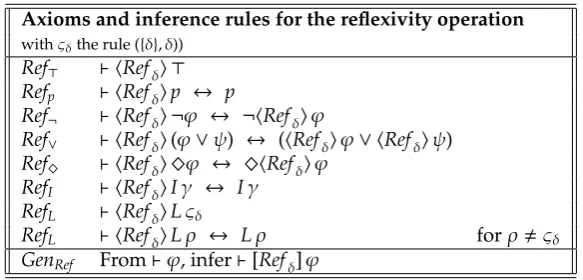
It is now time to provide reduction axioms for the new formulas. The fact that structural operations are closed for models inEIK(Proposition2) allows us
to rely on the logicEIKonce again. Tables4,5and6provide axioms indicating
how the truth value of formulasafterthe structural operations depends on the truth value of formulasbeforethem.
Definition 3.6(LogicEIKDS). The logicEIKDSextendsEIKD(definition3.3) with
axioms and rules of tables 4,5 and 6. Just as the axioms for deduction for-mulas, those of the mentioned tables express how formulasafterthe structural operations are related with formulasbeforethem.
Axioms and inference rules for the reflexivity operation
withςδthe rule ({δ}, δ))
Ref> ` hRefδi >
Refp ` hRefδip ↔ p
Ref¬ ` hRefδi ¬ϕ ↔ ¬hRefδiϕ
Ref∨ ` hRefδi(ϕ∨ψ) ↔ (hRefδiϕ∨ hRefδiψ)
Ref^ ` hRefδi^ϕ ↔ ^hRefδiϕ
RefI ` hRefδiIγ ↔ Iγ
RefL ` hRefδiLςδ
RefL ` hRefδiLρ ↔ Lρ forρ,ςδ
[image:12.595.151.443.378.518.2]GenRef From`ϕ, infer`[Refδ]ϕ
Table 4: Axioms and rules forreflexivityformulas.
Theorem 4(Soundness and completeness ofEIKDSw.r.t.EIK). The logicEIKDSis
sound and strongly complete with respect to the models in the classEIK.
Proof. Just as for the logic EIKD, soundness follows from the validity of the
new axioms and the validity-preserving property of the new rules. Strong completeness follows from the fact that, by a repetitive application of such axioms, any structural operation formula can be reduced to a formula inEID,
for whichEIKDis strongly complete with respect toEIK.
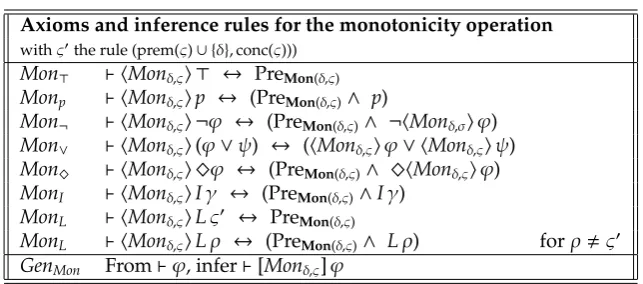
Axioms and inference rules for the monotonicity operation
withς0
the rule (prem(ς)∪ {δ},conc(ς)))
Mon> ` hMonδ,ςi > ↔ PreMon(δ,ς)
Monp ` hMonδ,ςip ↔ (PreMon(δ,ς)∧ p)
Mon¬ ` hMonδ,ςi ¬ϕ ↔ (PreMon(δ,ς)∧ ¬hMonδ,σiϕ)
Mon∨ ` hMonδ,ςi(ϕ∨ψ) ↔ (hMonδ,ςiϕ∨ hMonδ,ςiψ)
Mon^ ` hMonδ,ςi^ϕ ↔ (PreMon(δ,ς)∧ ^hMonδ,ςiϕ) MonI ` hMonδ,ςiIγ ↔ (PreMon(δ,ς)∧Iγ)
MonL ` hMonδ,ςiLς0 ↔ PreMon(δ,ς)
MonL ` hMonδ,ςiLρ ↔ (PreMon(δ,ς)∧ Lρ) forρ,ς0
[image:13.595.136.458.121.263.2]GenMon From`ϕ, infer`[Monδ,ς]ϕ
Table 5: Axioms and rules formonotonicityformulas.
Axioms and inference rules for the cut operation
withς0
the rule ( (prem(ς2)− {conc(ς1)})∪prem(ς1), conc(ς2) ) Cut> ` hCutς1,ς2i > ↔ PreCut(ς1,ς2)
Cutp ` hCutς1,ς2ip ↔ (PreCut(ς1,ς2)∧ p)
Cut¬ ` hCutς1,ς2i ¬ϕ ↔ (PreCut(ς1,ς2)∧ ¬hCutς1,ς2iϕ)
Cut∨ ` hCutς1,ς2i(ϕ∨ψ) ↔ (hCutς1,ς2iϕ∨ hCutς1,ς2iψ)
Cut^ ` hCutς1,ς2i^ϕ ↔ (PreCut(ς1,ς2)∧ ^hCutς1,ς2iϕ) CutI ` hCutς1,ς2iIγ ↔ (PreCut(ς1,ς2)∧Iγ)
CutL ` hCutς1,ς2iLς0 ↔ PreCut(ς1,ς2)
CutL ` hCutς1,ς2iLρ ↔ (PreCut(ς1,ς2)∧ Lρ) forρ,ς0
[image:13.595.137.460.303.442.2]GenCut From`ϕ, infer`[Cutς1,ς2]ϕ
Table 6: Axioms and rules forcutformulas.
see the relation between the different operations and, in particular, it is inter-esting to see how deduction is affected by structural operations. We finish this section presenting some validities, expressing how deduction after structural operations is related with deduction before them.
Theorem 5. The formulas in table7are valid in models of the classEIK.
Reflexivity withςδthe rule({δ}, δ)
• hRef
δi hDσiϕ ↔ hDσi hRefδiϕ forσ,ςδ
• hRef
δi hDςδiϕ ↔ (hDςδiϕ∨(Iδ∧ hRefδiϕ)) Monotonicity withς0
the rule(prem(ς)∪ {δ},conc(ς))
• hMonδ,ςi hDσiϕ ↔ hDσi hMonδ,ςiϕ forσ,ς0
• hMonδ,ςi hDς0iϕ ↔ (hDς0iϕ∨(Iδ∧Lς∧ hDςi hMonδ,ςiϕ))
Cut withς0
the rule( (prem(ς2)− {conc(ς1)})∪prem(ς1), conc(ς2) )
• hCutς1,ς2i hDσiϕ ↔ hDσi hCutς1,ς2iϕ forσ,ς0
• hCutς1,ς2i hDς0iϕ ↔
(hDς0iϕ∨(Iprem(ς
[image:13.595.136.461.563.682.2]1)∧Lς1∧(Iconc(ς1)→ hDς2i hCutς1,ς2iϕ)))
Proof. See sectionA.5.
4
Update
So far, our language can express the agent’s internaldynamics, but it cannot express external ones. We can express how deductive steps modify explicit knowledge, and even how structural operations extends the rules the agent can apply, but we cannot express how both explicit and implicit knowledge are affected by external observations. Here we add the other fundamental source of information; in this section, we extend the language to express updates.
Updates are the result of the agent’s social nature. We get new information because of our interaction with our environment, information that may be completely new in the sense that it does not follows from what we explicitly know. Updates are usually represented as operations, modifying the semantic model. InPublic Announcement Logic(PAL), for example, an announcement is defined by an operation that removes the worlds where the announced formula does not hold, restricting the epistemic relation to those that are not deleted. In our semantic model, we have a finer representation of the agent’s knowledge: we have explicit knowledge (her information sets) but we also have implicit one (given by the accessibility relation). We can extend PAL by defining different kinds of model operations, affecting explicit and implicit knowledge in different forms, and therefore expressing different ways the agent processes the incoming information. Here, we present one of the possible definitions, what we have calledexplicit observations.
4.1
Explicit observations
The previously defined operations do not modify the accessibility relation, and therefore do not affect implicit knowledge. With respect to explicit information, they add formulas or rules to the correspondent sets whenever they follow from what is already there. The deduction operation adds the conclusion of the rule whenever the premises and the rule are already present, and the structural operations add a rule whenever it logically follows from the ones that are currently available.
Observations, on the other hand, do modify the accessibility relation because it removes worlds where the observation does not holds. With respect to explicit information, they add arbitrarytrueinformation (formulas or rules), no matter if it was implicitly available (i.e., it follows from the explicit information) or not.
Definition 4.1 (Explicit observation operation). Let M = hW,R,V,Y,Zi be a
model inEI, and letχbe a formula ofI(a rule based onI). The modelMχ!= hW0,
R0,
V0,
Y0,
Z0i
is the result of removing the worlds that are not compatible with χ, restricting the accessibility relation accordingly, and addingχ to the agent’sinformation(rule) set. Formally,
• W0
:={w∈W|(M,w)χ}, (W0
:={w∈W|(M,w)TR(χ)})
• R0
:=R∩(W0×
W0
),
• Y0
(w) :=Y(w)∪ {χ} (Y0
(w) :=Y(w)) for everyw∈W0
,
• Z0
(w) :=Z(w) (Z0
(w) :=Z(w)∪ {χ}) for everyw∈W0
.
The operation (·)χ!is called theexplicit observation operationwithχ.
The operation preserves models inEIKtoo.
Proposition 3(Closure of structural operations). Let M be a model inEIKandχ
a formula inI(a rule based onI); if M is inEIK, so it is Mχ!.
Proof. See sectionA.6.
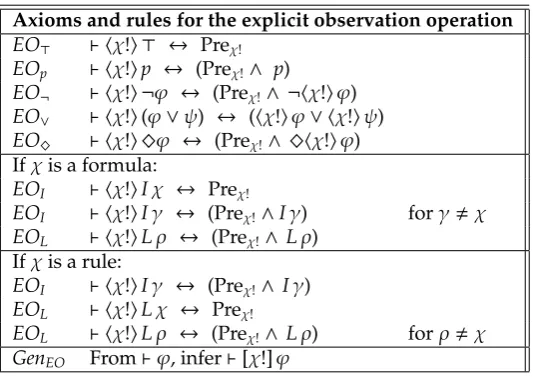
The languageEID∗!extendsEID∗
by closing it under explicit observations: if ϕis in EID∗!, so it ishχ!iϕ. These formulas are read as“there is a way of
explicitly observing χafter which ϕis the case”. In case χ is a formula, define
Preχ! ≡ χ; in caseχis a rule, define Preχ! ≡ TR(χ). The semantics of explicit
observation formulas is given as follows.
Definition 4.2. LetMbe a model inEIand letw∈Wbe a world in it. Then,
(M,w)hχ!iϕ iff (M,w)Preχ! and (Mχ!,w)ϕ
The formula [χ!]ϕis defined as the dual ofhχ!iϕ, as usual.
Definition 4.3(LogicEIKDSO). The logicEIKDSOis built from axioms and rules
ofEIKDS(definition3.6) plus axioms and rules in table8.
Axioms and rules for the explicit observation operation EO> ` hχ!i > ↔ Preχ!
EOp ` hχ!ip ↔ (Preχ!∧ p)
EO¬ ` hχ!i ¬ϕ ↔ (Preχ!∧ ¬hχ!iϕ)
EO∨ ` hχ!i(ϕ∨ψ) ↔ (hχ!iϕ∨ hχ!iψ)
EO^ ` hχ!i^ϕ ↔ (Preχ!∧ ^hχ!iϕ)
Ifχis a formula:
EOI ` hχ!iIχ ↔ Preχ!
EOI ` hχ!iIγ ↔ (Preχ!∧Iγ) forγ,χ
EOL ` hχ!iLρ ↔ (Preχ!∧ Lρ)
Ifχis a rule:
EOI ` hχ!iIγ ↔ (Preχ!∧ Iγ)
EOL ` hχ!iLχ ↔ Preχ!
EOL ` hχ!iLρ ↔ (Preχ!∧ Lρ) forρ,χ
[image:15.595.165.432.449.638.2]GenEO From`ϕ, infer`[χ!]ϕ
Table 8: Axioms and rules forexplicit observationformulas.
Theorem 6(Soundness and completeness ofEIKDSOw.r.t.EIK). The logicEIKDSO
5
Comparison with other works
The present work explores a representation of explicit/implicit information that allows us to describe the way different process affects both kinds of information. Several other works have proposed similar frameworks; in this section we present a brief comparison between some of those approaches and our proposal.
5.1
Fagin-Halpern’s logics of awareness
Fagin and Halpern presented in Fagin and Halpern[1988] what they called
logic of general awareness(LA). Given a set of agents, formulas of the language
are given by a set of atomic propositionsPclosed under negation, conjunction and the modal operatorsAiandLi(for an agenti). Formulas of the formAiϕ
are read as“the agent i is aware ofϕ”, and formulas of the formLiϕare read as
“the agent i implicitly believes thatϕ”. The operatorBi, which expresses explicit
beliefs, is defined asBiϕ:=Aiϕ∧Liϕ.
AKripke structure for general awarenessis defined as a tupleM=(W,Ai,Li,V),
whereW ,∅is the set of possible worlds,Ai :W →℘(LA) is a function that
assigns a set of formulas ofLAto the agentiin each world (her awareness set),
the relationLi⊆(W×W) is a serial, transitive and Euclidean relation overWfor
each agenti(LAdeals with beliefs rather than knowledge) andV :P→℘(W)
is a valuation function.
Given a Kripke structure for general awarenessM=(W,Ai,Li,V), semantics
for atomic propositions, negations and conjunctions are given in the standard way. For formulas of the formAiϕandLiϕ, we have
M,wAiϕ iff ϕ∈Ai(w)
M,wLiϕ iff for allu∈W,LiwuimpliesM,uϕ
It follows thatM,wBiϕiffϕ∈Ai(w) and, for allu∈W,LiwuimpliesM,uϕ.
Note how theexplicit beliefs implies implicit beliefs property holds because of the definition of explicit beliefs: an agent explicit believes that ϕ (Biϕ) if
and only if she is aware of it (Aiϕ) and she implicitly believes it (Liϕ). In
our approach, explicit and implicit information are defined separately, and it is because of the coherenceand the truthproperties that explicit information implies explicit information.
Given the similarities between the functions Ai and Y and between the
relationsLiandR, formulasAiϕandLiϕinLAbehaves exactly likeIϕandϕ
inEI(plus the subindexes). The difference between the approaches is in the
rules we use to perform inference and, therefore, in the dynamic part.
The rule set functionZrepresents explicitly the processes that the agent can use atwto improve her explicit information about formulas. The information of the agent consists not only of formulas about the world, but also of rules that allow her to infer new formulas. It is not that the agent knows that after a rule application her information set will change; it is that she knows theprocessthat leads the change. We interpret a rule as an object that can be part of the agent’s information, and whose presence is needed for the agent to be able to apply it. For the internal dynamics, the languageLAdoes not express changes in the
relationToverWrepresenting steps in time. Still, they do not indicate what the process(es) that change the awareness sets is (are).
Our approach does indicate the process that transform the explicit infor-mation: inference. Different from their relational approach, in our work this process is represented not as relation between worlds, but as a model operation that modifies the content of the information set at each world. They represent steps in the agent’s reasoning process, increasing her explicit information.
Finally, the language of formulas belonging to the awareness sets is more powerful that our internal languageI. As we mentioned before, that limitation
allows us to define the update operation for representing external dynamics (observations), a process that is not considered inLA.
5.2
Duc’s dynamic epistemic logic
InDuc[1995,1997] andDuc[2001], Ho Ngoc Duc proposed a dynamic epistemic logic to reason about agents that are neither logically omniscient nor logically ignorant.
The syntax of the language is very similar to the inference part of our language. There is an internal language, the classic propositional one (PL), to express agent’s information. There is also another language to talk about how this information evolves. Formally,Atdenotes the set of formulas of the form Kγ, forγin PL. The languageLBDEcontainsAtand is closed under negation,
conjunction and the modal operatorhFi. Formulas of the formKγare read as
“γis known”; formulas of the formhFiϕare read as“ϕis true after some course of
thought”. Note how the language just focus on the way the agent’s information evolves and does not provide formulas to talk about the real world.
A modelM is a tuple (W,R,Y), whereW , ∅is the set ofpossible worlds,
R⊆(W×W) is a transitive binary relation andY:W→℘(At) associates a set
of formulas ofAtto each possible world. ABDE-model is a modelMsuch that: (1) for all w ∈ W, ifKγ ∈ Y(w) andRwu, thenKγ ∈ Y(u); (2) for all w ∈ W,
ifKγandK(γ→ δ) are inY(w), thenKδis inY(u) for someusuch thatRwu;
(3) ifγis a propositional tautology, then for allw∈ Wthere is a worldusuch
thatRwuandKγ∈ Y(u). Such restrictions guarantees that the set of formulas
will grow as the agent reasons, and that her information will be closed under modus ponens and will contain all tautologies at some point in the future.
Given aBDE-model, the semantics for negation and conjunctions are stan-dard. The semantics of atomic and reasoning-steps formulas are given by:
M,wKγ iff Kγ∈Y(w)
M,whFiϕ iff there is someu∈Wsuch thatRwuandM,uϕ
5.3
Jago’s logic for resource-bounded agents
In Jago [2006b,a], Jago presented a logic for resource-bounded agents. He considers a semantic model similar to ours, based in Kripke models and with a set of formulas of some internal language assigned to every agent in each possible world to describe explicit information. Moreover, he also considers rule-based inference as the mechanism through which the agent can improve her information. Similar to Duc and different from us, inference is represented as a relation between worlds: there is an arrow labelled with a rule ρ from worldwto worlduif and only if atwthe agent has the rule and all its premises, and atuthe agent extends what she has atwby adding the conclusion ofρ.
There are two main differences in the approaches. The first one is again the treatment of the mechanism to improve explicit information, but here we go further in the comparison since Jago’s work is the origin of our proposal. As mentioned before, our model-operation representation facilitates the work by giving us a functional treatment of inference for free, while the modal repre-sentation forces us to ask for properties of the relation in order for inference to behave in a functional way. Those properties may need a more powerful lan-guage to be expressed (the uniqueness of the result of a rule application can only be expressed with nominals, in order to really differentiate worlds) and some of them may be not preserved after updates (the existence of a world resulting from an available rule application is not preserved since new information may turn applicable rules that were not before). And that is precisely the second difference: our approach considers not only internal dynamics (inference) but also external ones (updates).
5.4
van Benthem’s acts of realization
Invan Benthem[2008b], the author considers a language extending the propo-sitional one with the operators KandI for implicit and explicit information, respectively. Semantically, we have tuples (W,Wacc,∼,V) where (W,∼,V) is a
Kripke model andWaccis the set ofaccess worlds: pairs (w,X) withwa standard
world andXa set of formulas of the propositional language (the access set). There are three restrictions: accessibility relations are equivalence relations, for each access world (w,X), all formulas inX should be true at (w,X), and epistemically indistinguishable worlds should have the same access set. These models are similar to ourknowledge modelsof definition2.6, the only difference being our rule set function and their properties. Given a model and an access world (w,X), atomic propositions are interpreted according to the valuation at
w, boolean connectives andKare interpreted as usual, andIϕis true at (w,X)
if and only ifϕ∈X.
Then, implicit and explicit observations are defined. The first restricts the worlds to those that satisfy the observation, just as public announcements do; the second performs the same operation but also modifies the access sets by adding the observation to it. This explicit observation is exactly like our explicit observation of section4, and the implicit observation can be defined in our framework.
The main difference in the approaches is that, after the previous definitions, van Benthem notices that“the preceding is not yet a right division of labour, as events
goes further and proposes two more “orthogonal” acts: one simply delimiting the implicit information in the style of standard public announcements (what he calls“bare observation”, syntactically represented with [!ϕ]) and another one simply adding true formulas to the access sets (what he calls “act of
realiza-tion”, syntactically represented with [#ϕ]). The previous implicit observation
becomes abare observation, while the explicit one becomes a composition of a
bare observationand anact of realization.
Anact of realizationis more general than our deduction. As we mentioned
before, formulas that can be added by a deduction operation are part of the agent’s implicit information (as the validity of (Iprem(ρ)∧Lρ) → conc(ρ)
shows) but the converse is not true. On the other hand, any formula that is part of the implicit information can be added to the access sets by an act of realization (as the validity ofh#ϕiIϕ↔Kϕshows). Validities, for example, can
be added without any further consideration.
6
Final remarks and further work
Let us describe the restaurant example with our framework. The initial setting can be given by a modelMwith six possible worlds, each one of them indicating a possible distribution of the dishes from the new waiter’s point of view. For him, all of them are indistinguishable from each other, that is, the accessibility relation is an equivalence relation.
For explicit information, consider a set of atomic propositions of the form
pdwherepstands for a person (father,mother oryou) anddstands for some dish (meat,fish orvegetarian). The waiter explicitly knows each person will get only one dish, so we can put the rules
ρ1 :{yf} ⇒ ¬yv ρ2:{fm} ⇒ ¬fv
and similar ones in each world. Moreover, he explicitly knows that each dish corresponds to one person, so the rule
σ:{¬yv,¬fv} ⇒mv
can be also added, among many others. Letwbe the real world, whereyf,fm andmvare true. The formula¬Imv∧ ¬mv, indicating that the waiter does not know yet (neither explicitly nor implicitly) that your mother has the vegetarian, is true at (M,w).
While approaching to the table, the waiter can improve the rules he knows: he can, for example, apply theCutrule overρ1andσ, since he has both rules
and the conclusion of the first is in the premises of the second. This does not give him new explicit information, but will allow him to infer faster later. From the application, he gets the rule
ς1:{yf,¬fv} ⇒mv
Then, the formulas
are also true at (M,w). Moreover, he can applyCutagain, this time withρ2and ς1, obtaining the rule
ς2:{yf,fm} ⇒mv and making the formulas
• hCutρ1,σi hCutρ2,ς1i ¬Imv • hCutρ1,σi hCutρ2,ς1iLς2
true at (M,w).
After the answer to the question“Who has the fish?”, the waiter explicitly knows that you have the fish. Four possible worlds are removed from the model and the ruleς2is preserved, but he still does not know (neither explicitly
nor implicitly) that your mother has the vegetarian. Then,
• hCutρ1,σi hCutρ2,ς1i hyf!i(Iyf∧Lς2) • hCutρ1,σi hCutρ2,ς1i hyf!i(¬Imv∧ ¬mv)
are true at (M,w).
Then he asks “Who has the meat?”, and the answer removes one of the
remaining worlds. Not only he knows implicitly that your mother has the vegetarian dish: he is also able to infer it, adding it to his explicit information:
hCutρ1,σi hCutρ2,ς1i hyf!i hfm!i(mv∧ hDς2iImv)
Two structural operations, two explicit observations and one inference is all the waiter needs.
The work can be extended in several ways. The first one is by extending the internal language beyond the propositional one. As we mentioned, we choose the propositional language because it allows us the definition of updates given in section4. If we extend the language to the full explicit/implicit information one, we may face Moore-type-observations, likep∧ ¬^pindicating thatp is
the case and the agent did not know it explicitly. Formulas like these cannot be simply added to the information sets since, although they are true at the moment they are observed, they become false immediately after. A simple solution is to keep in the information sets those formulas that are true in the new model, but we still have difficulties because of circularity: we define the new information set as those formulas that were there before and are still true in the new model, but in order to check whether an explicit information formula is true or not we already need the information set. A further analysis providing a solution to this limitation will greatly increase the expressivity of the framework.
We have analyzed the particular case where the agent has true information, that is, when the accessibility relation is an equivalence relation and formulas as well as the translation of the rules are true at the correspondent worlds. This is not the general case: by removing such restrictions we can talk not only about knowledge but also about other kinds of information, likebeliefs. Some recent works combine these two notions, giving us a nice way of studying these two propositional attitudes together.
Moreover, we have analyzed the case where inference preserves truth, but there are other interesting inference processes, likedefault reasoning,abduction
orbelief revision. They are not deductive, but they are important and widely
the proposed framework, we can represent different inference processes, and we can study how all of them work together.
For the external dynamics, this finer representation of knowledge allows us to define different kinds of observations. Given the already discussed restriction of the internal language, we can represent observations that do not affect explicit information (like van Benthem’sbare observationspreviously discussed) and our already defined explicit observations. If we lift the restriction, we will be able to represent more kinds of observations, all differing between them in how introspective is the agent about the observed fact.
In the context of agent diversity (Liu[2006,2008]), this finer representation of the processes that affect information allows us to make a distinction between agents with different reasoning abilities. The rules an agent has may be very different from those of another, and they will not be able to perform the same inference steps. Moreover, some of them may be able to perform several in-ference steps at once instead of a single one. The idea works also for external dynamics: agents may have different observational power. It will be interesting to explore how agents that differs in their reasoning and observational abilities interact with each other.
Acknowledgments
The author thanks Johan van Benthem for his invaluable ideas and suggestions that led to the present work. He also thanks the group of the ILLC’sSeminar on Logics for Dynamics of Information and Preferences, as well as the organizers and participants of theSecond Workshop in Decisions, Games & Logic (DGL’08)and
theWorkshop on Logic and Intelligent Interactionin ESSLLI 2008; their comments
have helped to improve earlier versions.
A
Technical appendix
A.1
Completeness for basic models
The key observation is that a logicΛis strongly complete with respect to a class of structures if and only if everyΛ-consistent set of formulas is satisfiable on some structure of the given class (Proposition 4.12 ofBlackburn et al.[2001]). Using the the canonical model technique, we show that everyEI-consistent set of formulas is satisfiable in a model in EI. Proofs of Lindenbaum’s Lemma, Existence Lemma and Truth Lemma are standard.
Lemma 1(Lindenbaum’s Lemma). For anyEI-consistent set of formulasΣ, there
is a maximalEI-consistent setΣ+such thatΣ⊆Σ+.
Definition A.1(Canonical model forEI). The canonical model of the logicEIis the epistemic inference modelMEI=hWEI,REI,VEI,YEI,ZEIi, where:
• WEIis the set of all maximalEI-consistent set of formulas.
• REI := {(w,u) | for allϕinEI,ϕ∈uimplies^ϕ∈w} (or, equivalently,
REI:={(w,u)|for allϕinEI,
ϕ∈wimpliesϕ∈u}).
• YEI(w) :={γ∈ I|Iγ∈w}.
• ZEI(w) :={ρ∈ R|Lρ∈w}.
Lemma 2(Existence Lemma). For every world w∈WEI, if
^ϕ∈w, then there is a
world u∈WEIsuch that REIwu andϕ∈u.
Lemma 3(Truth Lemma). For all w∈WEI, we have(MEI,w)
ϕ iff ϕ∈w.
By the mentioned Proposition ofBlackburn et al.[2001], all we have to show is that everyEI-consistent set of formulas is satisfiable, so take any such setΣ. By Lindenbaum’s Lemma, we can extend it to a maximalEI-consistent set of formulas Σ+; by the Truth Lemma, we have (MEI,Σ+) Σ, soΣis satisfiable
in the canonical model ofEIatΣ+. It is only left to show thatMEIis indeed a model inEI, that is, we have to show that it satisfiescoherencefor formulas and rules.
Remember that any maximal EI-consistent set Φ is closed under modus ponens, that is, ifϕandϕ→ψare inΦ, so it isψ.
• Coherence for formulas.Supposeγ∈YEI(w); we want to show that for all usuch thatREIwuwe haveγ∈YEI(u). Note thatIγ→Iγ(axiomCoh
I)
is inw.
By definition,γ∈ YEI(w) impliesIγ∈ w; by the modus ponens closure, we haveIγ∈w. Take anyusuch thatREIwu; thenIγ∈uand therefore γ∈YEI(u).
• Coherence for rules.Similar to the case of formulas, with theCohRaxiom.
A.2
Completeness for knowledge models
We know already thatEIis complete with respect to models inEI(sectionA.1). In order to show thatEIKis complete with respect toEIK, we just have to show
that the canonical model forEIKsatisfyequivalence,truth for formulasandtruth
for rules.
Definition A.2(Canonical model forEIK). The canonical model forEIK,MEIK =
(WEIK,REIK,VEIK,YEIK,ZEIK), is defined just as the canonical model for EI, but
the worlds are maximal EIK-consistent sets of formulas instead of maximal
EI-consistent ones.
Here is the proof for the three properties.
• Equivalence. AxiomsT,4andBare canonical for reflexivity, transitivity
and symmetry, respectively, soREIKis an equivalence relation.
• Truth for formulas.We want to show thatγ∈YEIK(w) implies (MEIK,w)
γ. Suppose γ ∈ YEIK(w); then we getIγ ∈ w. By axiomTthI we have
γ∈w; by the Truth Lemma, (MEIK,w)γ.
A.3
Closure of deduction operation
LetMbe a model inEIK. To show thatMρ(definition3.1) is also inEIK, we will
show that it satisfes coherence and truth for formulas, coherence and truth for rules and equivalence. Equivalence and both properties of rules are immediate since neither the accessibility relation nor the rule set function are modified. For the properties of formulas, we have the following.
• Coherence for formulas. Suppose γ∈ Y0
(w) and pick any u ∈ W0
such thatR0
wu; we will show thatγ∈Y0
(u). FromR0
wuwe getRwu. From the definition ofY0
, we know that eitherγwas added by the oper-ation or else was already inY(w). In the first case,γshould be conc(σ) and therefore prem(σ)⊆Y(w) andσ ∈ Z(w). But then, by coherence for
formulas and rules ofMandRwu, we have prem(σ)⊆Y(u) andσ∈Z(u);
therefore conc(σ) ∈ Y0(u), that is, γ ∈ Y0(u). In the second case, by
co-herence for formulas ofM and Rwu, we have γ ∈ Y(u) and therefore
γ∈Y0
(u).
• Truth for formulas.Supposeγ∈Y0
(w); we will show that (Mσ,w)γ.
Again, from the definition ofY0
, we know that eitherγwas added by the operation or else was already inY(w). In the first case, γ should be conc(σ) and therefore prem(σ) ⊆ Y(w) and σ ∈ Z(w). By truth for
formulas ofMwe have (M,w) V
prem(σ); by truth for rules ofMwe have (M,w)V
prem(σ)→conc(σ). Therefore, we have (M,w)conc(σ),
i.e., (M,w)γ. In the second case, by truth for formulas ofMwe get also (M,w)γ.
Now,γis a propositional formula, whose truth value depends only on the valuation atw. SinceV0(w)=V(w), we get (Mσ,w)γ, as required.
A.4
Closure of structural operations
LetM = hW,R,V,Y,Zibe a model in EIK. To show thatMRef(δ),MMon(δ,ς) and
MCut(ς1,ς2)are also inEIK, we will show that they satisfy coherence and truth for
formulas, coherence and truth for rules and equivalence. Equivalence and both properties of formulas are immediate since neither the accessibility relation nor the information set function are modified. For the properties of rules, we have the following.
LetMRef(δ) be given byhW0,R0,V0,Y0,Z0i, as in definition3.4. Recall that ςδ=({δ}, δ).
• Coherence for rules. Supposeρ ∈ Z0
(w) and pick anyu ∈ W0
such that R0
wu; we will show thatρ∈Z0
(u). FromR0
wuwe getRwu. From the definition ofZ0
, we know that eitherρwas added by the oper-ation or it was already inY(w). In the first case,ρshould beςδ, and we
haveςδ ∈Z0(u) for everyu∈ W0; in the second case, coherence for rules
ofMandRwugive usρ∈Z(u), and thereforeρ∈Z0
(u).
• Truth for rules.Supposeρ∈Y0
(w); we will show that (MRef(δ),w)TR(ρ).
ςδand we clearly have (MRef(δ),w)δ→δ; the second case follows from
the truth for rules ofM((M,w) TR(ρ)), the fact that the truth value of TR(ρ) depends just on the valuation of the world, and the definition ofV0
(V0(w)=V(w)).
LetMMon(δ,ς)be given byhW0,R0,V0,Y0,Z0i, as in definition3.4. Recall that ς0=
(prem(ς)∪ {δ},conc(ς)).
• Coherence for rules. Supposeρ ∈ Z0
(w) and pick anyu ∈ W0
such that R0
wu; we will show thatρ∈Z0
(u). FromR0
wuwe getRwu.
From the definition ofZ0, we know that eitherρwas added by the oper-ation or it was already inY(w). In the first case, ρshould beς0and we should haveς∈ Z(w). From coherence for rules ofMand Rwuwe get
ς∈ Z(u) and thereforeς0 ∈
Z0
(u). The second case follows immediately from coherence for rules ofMand the definition ofZ0
.
• Truth for rules. Suppose ρ ∈ Y0
(w); we will show that (MMon(δ,ρ),w) TR(ρ).
From the definition ofZ0
, we know that eitherρisς0
or it was already
inZ(w). From the definition of Z0
, we know that either ρ was added
by the operation or it was already in Y(w). In the first case, ρ should beς0
and we should haveς ∈ Z(w); then, truth for rules ofMgives us
(M,w)V
prem(ς)→conc(ς). SinceV0(w)=V(w), we get
(MMon(δ,ς),w) ^
prem(ς)→conc(ς)
and therefore
(MMon(δ,ς),w)(
^
prem(ς)∧δ)→conc(ς)
i.e., (MMon(δ,ς),w) TR(ς0). The second case follows from the truth for
rules ofM((M,w)TR(ς)), the fact that the truth value of TR(ρ) depends just on the valuation of the world, and the definition ofV0
(V0
(w)=V(w)).
LetMCut(ς1,ς2)be given byhW0,R0,V0,Y0,Z0i, as in definition3.4. Recall that ς0=
((prem(ς2)− {conc(ς1)})∪prem(ς1),conc(ς2)).
• Coherence for rules. Supposeρ ∈ Z0(w) and pick anyu ∈ W0such that
R0wu; we will show thatρ∈Z0(u). FromR0wuwe getRwu.
From the definition ofZ0
, we know that eitherρwas added by the op-eration or it was already inY(w). In the first case, ρ should be ς0
and we have{ς1, ς2} ⊆ Z(w); from coherence for rules ofMandRwuwe get {ς1, ς2} ⊆∈Z(u) and thereforeς0 ∈
Z0
(u). The second case follows imme-diately from coherence for rules ofMand the definition ofZ0
.
• Truth for rules. Supposeρ ∈ Y0
(w); we will show that (MCut(ς1,ς2),w)
TR(ρ).
From the definition ofZ0
, we know that eitherρwas added by the opera-tion or it was already inY(w). In the first case,ρshould beς0and we have
{ς1, ς2} ⊆Z(w). Now, suppose (M,w)1TR(ς0); then,