Pointer Semantics with Forward Propagation
Sujata Ghosh
∗Center for Soft Computing Research Indian Statistical Institute Kolkata, West Bengal, India
Benedikt L¨owe
† Institute for Logic, Language and Computation Universiteit van Amsterdam 1018 TV Amsterdam, The NetherlandsSanchit Saraf
‡Department of Mathematics and Statistics Indian Institute of Technology
Kanpur 208016, India
Abstract
Pointer semantics describing a formal language with the pos-sibility of self-reference have been invented by Haim Gaif-man; they form a fundamental way of understanding the se-mantics of logic programming, but have also been used exten-sively in philosophical logic and other applications of logic. In pointer semantics, truth values flow backwards along from the defining statement to the propositional variable. As a con-sequence, pointer semantics cannot deal properly with de-pendence networks that have terminal nodes. Ghosh, L¨owe and Scorelle have proposed an abstract system of combining pointer semantics with forward flow of truth values. Their system was difficult to handle, and apart from the fact that the system could handle some enlightening examples, very few theoretical insights were made. In this paper, we now produce a more concrete variant of this system, built on three-valued logic which allows us to gain more theoretical control over its properties.
Introduction
Pointer semantics were invented by Haim Gaifman (Gai88; Gai92) as a formal propositional language for finitely many propositions{p0, ...,pn}defined in terms of each other. The language of pointer semantics is closely related to logic pro-gramming and is the logical reflection of the “Revision The-ory of Truth” (Her82; GB93). Phenomena such as self-reference can be studied in pointer semantics as has been done in detail in Bolander’s PhD thesis (Bol03) in a graph-theoretic setting where the dependence of a propositionpi on a propositionpj is represented by an edge fromitojin thedependency graph. The revision rules of pointer seman-tics let the truth value ofpj affect the truth value ofpi; we can say that truth values “flow backwards in the dependency graph”.
∗
Additional affiliation: Department of Mathematics, Visva-Bharati, Santiniketan, India.
†
Additional affiliations: Department Mathematik, Universit¨at Hamburg, Hamburg, Germany; Mathematisches Institut, Rheinis-che Friedrich-Wilhelms-Universit¨at Bonn, Bonn, Germany.
‡
The third author would like to thank the Institute for Logic, Language and Computation (ILLC) of theUniversiteit van Amster-damand theDepartment Mathematikof theUniversit¨at Hamburg for their hospitality during his visit from May to July 2008. All three authors would like to thank Bjarni Hilmarsson (Amsterdam) for programming support.
In (L¨ow06), the second author proposed to apply the ideas of pointer semantics to a belief framework, interpreting the propositions not just as being defined in terms of each other, but at the same time being sources of information. As soon as you see propositions as sources of information, the pointer semantics model with its backward flow of truth val-ues is not adequate anymore. The paradigmatic example for this is the following situation:
“Suppose a reasoning agent is sitting in an office without win-dows. Next to him is his colleague, also located in the office without windows; the agent is simultaneously talking to his friend on the phone who is sitting in a street caf´e.
Friend: Everything your colleague says is false; the sun is shining!
Colleague: Everything your friend says is false; it is raining! This situation can be described by the following graph:
F
− **
+
> > >
> > >
C
−
j
j
−
S
.
As in theNested Liars, there are two consistent truth value assignments, but the context makes sure that one of them is intuitively preferred, as the agent’s friend has first hand expe-rience of the weather in the street caf´e.” (GLS07, p. 402–403)
Even if you assume that the agent trustsF, but initially be-lieves inS(i.e., we would expect a belief revision), Gaifman pointer semantics will never change the value ofS, as truth values only propagate backwards, and thus the values of ter-minal nodes in the dependency graph will never be revised.
In the context of belief, this is not a realistic feature: our trust inF, who tells us thatSis true, should influence us to change our initial belief aboutS. Formally, we would need
forward propagationof truth values along the dependency graph.
This idea has been implemented in a formal system in (GLS07), but the system proposed by the authors (using the interval[−1,1]as the truth values and a relatively compli-cated numerical function to combine the backward and for-ward influences) did not shed much light into divulging the intricate properties of belief change.
we give the basic definitions, building on the formal system from (L¨ow06; GLS07), introducing an abstract algebra of pointer systems, and proving that this abstract algebra has logical properties if you restrict your system to backward propagation (“B-operators”). We then extend the concept of pointer semantics to includeforward propagationin our section “Belief Semantics with Forward Propagation”. In the section “Properties of our Belief Semantics” we test our system in an example originally used in (GLS07) and finally see that our system is ostensibly non-logical. However, this should not come as a shock, as the system is intended to model systems of belief:
“The fact that the logic of belief, even rational belief, does not meet principles of truth-functional deductive logic, should no longer surprise us (Gol75, p. 6).”
Leaving the empirical study of comparing this system with our intuitions for future endeavors, we focus on the test case mentioned above to show non-trivial properties of the sys-tem, with some concluding remarks.
Definitions
Abstract Pointer Semantics
Fix a finite set of propositional variables{p0, ...,pn}. An
expressionis just a propositional formula using∧,∨, and ¬and some of the propositional variables or the empty se-quence, denoted by .
We fix a finite algebra of truth valuesTwith operations ∧,∨and¬corresponding to the syntactic symbols. We as-sume a notion of order corresponding to information content that gives rise to a notion ofinfimumin the algebra of truth values, allowing to forminf(X)for some subset ofX ⊆T. A truth value will represent the lowest information content (i.e., a least element in the given order); this truth value will be denoted by ½. We allowinfto be applied to the empty set and letinf∅:=½.
Our salient example is the algebra T := {0,½,1} with the following operations (“strong Kleene”):
∧ 0 ½ 1
0 0 0 0
½ 0 ½ ½
1 0 ½ 1
∨ 0 ½ 1
0 0 ½ 1
½ ½ ½ 1
1 1 1 1
¬
0 1
½ ½
1 0
.
The value ½ stands for ignorance, and thus the infimum is defined asinf({t}) :=t,inf({½}∪X) :=½,inf({0,1}) := ½. This algebra of truth values will be used in this paper, even though the set-up in this section is more general.
IfE is an expression andpi is one of the propositional variables, thenpi←E is aclause. We intuitively interpret
pi←Eas “pistatesE”. IfE0, ..., En are expressions, a set of clausesΣ :={p0←E0, ...,pn←En}is called apointer
system. Aninterpretationis a functionI:{p0, ...,pn} →
Tassigning truth values to propositional letters. Note that if Tis finite, the set of interpretations is a finite set (we shall use this later). A given interpretationIcan be naturally ex-tended to a function assigning truth values to all expressions (using the operations∧,∨and¬onT). We denote this ex-tended function with the same symbolI.
A clause can be transformed into an equation in T: if pi←E is a clause, we can read it as an equationpi = E inT. IfQis such an equation, we say that an interpretationI is asolutionofQif plugging the values{I(p0), ..., I(pn)} into the corresponding variables of the equation results in the same value left and right of the equals sign. An interpre-tation is a solution of a set of equations if it is a solution of each equation in the set.
A function mapping interpretations to interpretations is called a revision function; a family of these functions in-dexed by pointer systems is called arevision operator. If δis a revision operator, we writeδΣfor the revision
func-tion assigned to the pointer system Σ(and sometimes just write δif Σis clear from the context). We use the usual notation for iteration of revision functions, i.e.,δ0(I) :=I,
δn+1(I) :=δ(δn(I)).
Given a pointer system{p0←E0, ...,pn←En}, we define itsdependency graphby letting {0, ..., n}be the vertices and allowing an edge fromitojifpjoccurs inEi. Given a propositionpi, arrows point toifrom the propositions oc-curring inEi, and thus we call a revision operatorδan
B-operator(for “backward”) if the value ofδ(I)(pi)only de-pends on the values ofI(pj)forpjoccurring inEi.
FixΣandδ. We call an interpretationI (Σ, δ)-stableif there is someksuch that for alln≥k,δn(I) =I. We call I(Σ, δ)-recurringif for everykthere is an≥ksuch that δn(I) =I.1 IfΣis fixed by the context, we drop it from the notation and call interpretationsδ-stableandδ-recurring. IfH is an interpretation, we consider the sequenceH∞:= {δi(H) ; i ∈
N}of interpretations occurring in the infinite iteration ofδonH. Clearly, if there is a stable interpretation inH∞, then this is the only recurring interpretation inH∞. We writeRecΣ,δ(H)for the set of recurring interpretations inH∞. Note that since the set of interpretations in finite, this set must be non-empty. IfI ∈ RecΣ,δ(H), then there arei, j >0such thatI=δi(H) =δi+j(H). Then for ev-eryk < jand everyn, we haveδi+k=δi+n·j+k(H), so the sequenceH∞exhibits a periodicity of lengthj(or a divisor of j). After the first occurrance of anI ∈ RecΣ,δ(H), all further elements ofH∞are recurring as well, and in partic-ular, there is a recurringJ such thatδ(J) =I. We shall call this anI-predecessorand will use this fact in our proofs.
Finally, we define our semantics and let
JΣ,piKδ,H:= inf{I(pi) ;I∈RecΣ,δ(H)}, and
JΣ,piKδ:= inf{I(pi) ;∃H(I∈RecΣ,δ(H))}.
An algebra of pointer systems
In the language of abstract pointer systems, the possibility of complicated referential structures means that the individual proposition cannot be evaluated without its context.
As a consequence, the natural notion of logical opera-tions is not that between proposiopera-tions, but that between sys-tems. In this section, we define conjunction, disjunction and
1
negation of statements in pointer systems. The definitions are straightforward, but very little systematic work has been done.
If Σ = {p0←E0, ...,pn←En} is a pointer system and
0 ≤i ≤n, we define a pointer system that corresponds to the negation ofpiwith one additional propositional variable
p¬,
¬(Σ,pi) := Σ∪ {p¬←¬pi}.
If we have two pointer systems
Σ0={p0←E0,0, ...,pn0←E0,n0}, and
Σ1={p0←E1,0, ...,pn1←E1,n1},
we make their sets of propositions disjoint by considering a set{p0, ...,pn0,p
∗
0, ...,p∗n1,p∗}ofn0+n1+ 2propositional variables. We then set
Σ∗1:={p∗0←E1,0, ...,p∗n1←E1,n1}.
With this, we can now define two new pointer systems (with an additional propositional variablep∗):
(Σ0,pi)∧(Σ1,pj) := Σ0∪Σ∗1∪ {p∗←pi∧p∗j},
(Σ0,pi)∨(Σ1,pj) := Σ0∪Σ∗1∪ {p∗←pi∨p∗j}.
Logical properties of Gaifman pointer semantics
Fix a systemΣ = {p0←E0, ...,pn←En}. A proposition
pi is called a terminal node if Ei = ; it is called a
source nodeifpi does not occur in any of the expressions E0, ..., En. This corresponds directly to the properties ofi in the dependency graph: piis a terminal node if and only ifihas no outgoing edges in the dependency graph, and it is a source node if and only ifihas no incoming edges in the dependency graph.
TheGaifman-Tarski operatorδBis defined as follows:
δB(I)(pi) :=
I(Ei) ifpiis not terminal, I(pi) ifpiis terminal.
Note that this operator can be described as follows:
“From the clausepi←Eiform the equationQiby
replac-ing the occurrences ofpi on the right-hand side of the
equality sign with the valuesI(pi). Ifpi is a terminal
node, letδ(I)(pi) := I(pi). Otherwise, let I∗be the
unique solution to the system of equations{Q0, ...,Qn}
and letδ(I)(pi) :=I∗(pi).”
(*)
This more complicated description will provide the motiva-tion for the forward propagamotiva-tion operatorδFin the section
“Belief semantics with forward propagation”.
The operatorδB gives rise to alogicalsystem, as the
se-mantics defined byδBare compatible with the operations in
the algebra of pointer systems.
Proposition 1 LetΣ ={p0←E0, ...,pn←En}be a pointer
system. For anyi≤n, we have
J¬(Σ,pi)KδB =¬JΣ,piKδB.
Proof. In this proof, we shall denote interpretations for the set {p0, ...,pn} by capital letters I andJ and interpreta-tions for the bigger set{p0, ...,pn,p¬} by lettersIˆandJ.ˆ It is enough to show that ifIˆisδB-recurring, then there is
some δB-recurring J such that Iˆ(p¬) = ¬J(pi). If I is δB-recurring, we callJ an I-predecessor ifJ is alsoδB
-recurring andδB(J) = I, and similarly forI. It is easy toˆ
see that everyδB-recurringI(orI) has anˆ I-predecessor (or
ˆ
I-predecessor) which is not necessarily unique.
AsδB is a B-operator, we have that ifJˆisδB-recurring,
then so isJ := ˆJ{p0, ...,pn}.
Now let Iˆ be δB-recurring and let Jˆ be one of its I-ˆ
predecessors. Then by the above, J := ˆJ{p0, ...,pn} is δB-recurring and
ˆ
I(p¬) =δB( ˆJ)(p¬) =¬Jˆ(pi) =¬J(pi).
q.e.d.
Proposition 2 LetΣ0={p0←E0, ...,pn←En}andΣ1=
{p0←F0, ...,pm←Fm}be pointer systems. For anyi, j ≤ n, we have
J(Σ0,pi)∨(Σ1,pj)KδB =JΣ0,piKδB∨JΣ1,pjKδB.
Similarly for∨replaced by∧.
Proof.The basic idea is very similar to the proof of Proposi-tion 1, except that we have to be a bit more careful to see how the two systemsΣ0andΣ1can interact in the bigger system.
We reserve lettersI0andJ0for the interpretations onΣ0,I1
andJ1 for those onΣ1andI andJ for interpretations on
the whole system, includingp∗. IfJΣ0,p1K = 1, then any δB-recurringI must haveI(p∗) = 1by the∨-analogue of the argument given in the proof of Proposition 1. Similarly, forJΣ1,pjK= 1and the case thatJΣ0,piK=JΣ1,pjK= 0. This takes care of six of the nine possible cases.
If I0 and I1 are δB-recurring, then so is the function
I := δ(I0)∪δ(I1)∪ {hp∗, I0(pi)∨I1(pj)i}(if I0 is
k-periodic andI1is`-periodic, thenIis at mostk·`-periodic).
In particular, if we have such anI0withI0(pi) =½ and an I1withI1(pj)6= 1, thenI(p∗) =½ (and symmetrically for interchanged rˆoles). Similarly, if we have recurring interpre-tations for relevant values0and1for both small systems, we can put them together toδB-recurring interpretations with
values0and1for the big system. This gives the truth value ½ for the disjunction in the remaining three cases.
q.e.d.
Note that the proof does not really depend on the partic-ular operatorδB. Other B-operators, as long as the logical
connectives are properly represented by our semantical rules for the revised values ofp¬ andp∗, will be fine here. This shows thatδB interacts with our algebra of pointer systems
to give rise to a logical system.
Belief semantics with forward propagation
H0 δB(H0) δF(H0) H1 δB(H1) δF(H1) H2 δB(H2) δF(H2) H3 δB(H3) δF(H3) H4
0 ½ 0 0 1 0 ½ 1 ½ 1 1 1 1
1 1 ½ 1 1 ½ 1 1 ½ 1 1 ½ 1
0 0 ½ 0 0 ½ 0 0 ½ 0 0 ½ 0
½ 0 ½ 0 0 ½ 0 0 ½ 0 0 0 0
[image:4.595.99.516.54.119.2]½ ½ ½ ½ 1 ½ 1 1 1 1 1 1 1
Figure 1: The first three iterations of values ofH0= (0,1,0,½,½)up to the point of stability (H3= (1,1,0,0,1)).
connected toiin the dependency graph.2 Here, we split the operator in two parts: the backward part which is identical to the Gaifman-Tarski operator, and the forward part which we shall define now.
In analogy to the definition ofδB, we defineδFas follows.
Given an interpretationI, we transform each clausepi←Ei of the system into an equationQi ≡I(pi) =Ei where the occurrences of thepi on the left-hand side of the equation are replaced by theirI-values and the ones on the right-hand side are variables. We obtain a system{Q0, ...,Qn}ofn+ 1 equations inT. Note that we cannot mimic the definition of δB directly: as opposed to the equations in that definition,
the system {Q0, ...,Qn} need not have a solution, and if it has one, it need not be unique. We therefore define: ifpiis a source node, thenδF(I)(pi) :=I(pi). Otherwise, letSbe the set of solutions to the system of equations{Q0, ...,Qn} and let δF(I)(pi) := inf{I(pi) ;I ∈ S} (remember that
inf∅ = ½). Note that this definition is literally the dual to definition (*) ofδB (i.e., it is obtained from (*) by
inter-changing “right-hand side” by “left-hand side” and “termi-nal node” by “source node”).
We now combineδB andδFto one operatorδTby
defin-ing pointwise
δT(I)(pi) :=δF(I)(pi)⊗δB(I)(pi)
where⊗has the following truth table:
⊗ 0 ½ 1
0 0 0 ½
½ 0 ½ 1
1 ½ 1 1
.
[image:4.595.60.285.622.668.2]Let us briefly motivate this table. The values for agreement (0⊗0, ½⊗½, and1⊗1) are obvious choices. The two values for complete disagreement (0⊗1and1⊗0) are also relatively clear: as long as you do not want to give one of the two directions primacy over the other, you have little choice but give the value ½ of ignorance. For reasons of symmetry, this leaves two values ½⊗0 = 0⊗½ and ½⊗1 = 1⊗½ to be decided. We opted here for the most informative truth table that gives classical values the benefit of the doubt. The other options would be the tables
⊗0 0 ½ 1
0 0 ½ ½
½ ½ ½ 1
1 ½ 1 1
⊗1 0 ½ 1
0 0 0 ½
½ 0 ½ ½
1 ½ ½ 1
⊗2 0 ½ 1
0 0 ½ ½
f½ ½ ½ ½
1 ½ ½ 1
.
2
Actually, the system was even more complicated, as interpre-tations did not only provide values for the vertices, but also for the edges in the dependency graph.
Each of these connectives will give rise to a slightly differ-ent semantics. We opted for the first connective⊗, as the semantics based on the other three seem to have a tendency to stabilize on the value ½ very often (the safe option: in case of confusion, opt for ignorance).
Properties of our belief semantics
As mentioned in the introduction, we should not be shocked to hear that a system modelling belief and belief change does not follow basic logical rules such as Propositions 1 and 2. From its beginnings (Hin62) to modern doxastic systems, logics of belief have always dealt with the peculiarities of the logical structure of belief. Let us take the particular ex-ample of conjunction: the fact that belief is not closed un-der the standard logical rules for conjunction is known as the preface paradoxand has been described by Kyburg as “conjunctivitis” (Kyb70; HB99). While the phenomenon of “conjunctivitis” focusses on the fact that something strange happens with the belief of large conjunctions of individually believes propositions, in other contexts (that of the modality of “ensuring that”), we have a problem with simple binary conjunctions (Sch08).
Of course, the failure of certain logical rules in reason-ing about belief is closely connected to the so-called “errors in reasoning” observed in experimental psychology, e.g., the famous Wason selection task (Was68). What consti-tutes rational belief in this context is an interesting ques-tion for modellers and philosophers alike (Ste97; Chr07; Cou08).
The fact that reasoning about beliefs is such a complicated topic makes it unlikely that there is one objectively accurate semantics that describes reasoning about beliefs in pointer structures. Instead, different semantics will be relevant in different situations. Which semantics to choose is a deci-sion that the modeller has to make with as much informa-tion as possible. This is one of the reasons why we decided for a very lean and easy to survey system (as opposed to the more complicated system of (GLS07)). Let us focus on some concrete examples to validate our claim that the se-mantics we propose do agree with intuitive understanding, and thus serve as a quasi-empirical test for our system as a formalization of reasoning in self-referential situations with evidence.
Concrete examples
H0∗ δB(H
∗
0)δF(H
∗
0) H
∗
1 δB(H
∗
1)δF(H
∗
1) H
∗
2 δB(H
∗
2)δF(H
∗
2) H
∗
3 δB(H
∗
3)δF(H
∗
3) H
∗
4 δB(H
∗
4)δF(H
∗
4) H
∗
5
0 ½ 0 0 1 0 ½ 1 ½ 1 1 1 1 1 1 1
1 1 ½ 1 1 ½ 1 1 ½ 1 1 ½ 1 1 ½ 1
0 0 ½ 0 0 ½ 0 0 ½ 0 0 ½ 0 0 ½ 0
½ 0 ½ 0 0 ½ 0 0 ½ 0 0 0 0 0 0 0
0 ½ ½ ½ ½ ½ ½ 1 ½ 1 1 ½ 1 1 1 1
1 1 ½ 1 1 ½ 1 1 ½ 1 1 ½ 1 1 ½ 1
0 0 ½ 0 0 ½ 0 0 ½ 0 0 ½ 0 0 ½ 0
½ 0 1 ½ 0 ½ 0 0 ½ 0 0 0 0 0 0 0
½ ½ ½ ½ ½ ½ ½ ½ ½ ½ 1 ½ 1 1 1 1
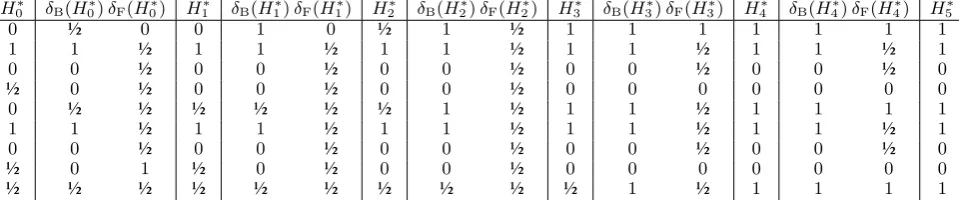
Figure 2: The first three iterations of values of H0∗ = (0,1,0,½,0,1,0,½,½) up to the point of stability (H4∗ = (1,1,0,0,1,1,0,0,1)).
a few examples. Keep in mind that our goal should be to model human reasoning behaviour in the presence of par-tially paradoxical situations. In this paper, we can only give a first attempt at testing the adequacy of our system: an em-pirical test against natural language intuitions on a much larger scale is needed. For this, also cf. our section “Dis-cussion and Future Work”.
The Liar As usual, the liar sentence is interpreted by the systemΣ := {p0←¬p0}. Since we have only one
propo-sitional variable, interpretations are just elements of T = {0,½,1}. It is easy to see thatδB(0) =δF(0) =δT(0) = 1,
δB(½) = δF(½) = δT(½) = ½, andδB(1) = δF(1) =
δT(1) = 0. This means that theδT-behaviour of the liar
sentence is equal to the Gaifman-semantics behaviour.
The Miller-Jones Example Consider the following test example from (GLS07):
Professors Jones, Miller and Smith are colleagues in a com-puter science department. Jones and Miller dislike each other without reservation and are very liberal in telling everyone else that “everything that the other one says is false”. Smith just returned from a trip abroad and needs to find out about two committee meetings on Monday morning. He sends out e-mails to his colleagues and to the department secretary. He asks all three of them about the meeting of the faculty, and Jones and the secretary about the meeting of the library com-mittee (of which Miller is not a member).
Jones replies:“We have the faculty meeting at 10am and the library committee meeting at 11am; by the way, don’t believe anything that Miller says, as he is always wrong.”
Miller replies: “The faculty meeting was cancelled; by the way don’t believe anything that Jones says, as he is always wrong.”
The secretary replies: “The faculty meeting is at 10 am and the library committee meeting is at 11 am. But I am sure that Professor Miller told you already as he is always such an accurate person and quick in answering e-mails: everything Miller says is correct.”(GLS07, p. 408)
Trying to analyse Smith’s reasoning process after he re-turns from his trip, we can assume that he generally believes the secretary’s opinions, and that he has no prior idea about the truth value of the statements “the faculty meeting is at 10am” and “the library meeting is at 11am” and the utter-ances of Miller and Jones. We have a vague intuition that
tells us that in this hypothetical situation, Smith should at least come to the conclusion that the library meeting will be held at 11am (as there is positive, but no negative evidence). His beliefs about the faculty meeting are less straightfor-ward, as there is some positive evidence, but also some neg-ative evidence, and there is the confusing fact that the secre-tary supports Miller’s statement despite the disagreement in truth value.
In (GLS07, p. 409), the authors analysed this example with their real-valued model and ended up with a stable so-lution in which Smith accepted both appointments and took Jones’s side (disbelieving Miller). In our system, we now get the following analysis: A pointer system formulation is given as follows.
p0 ← ¬p1∧ ¬p4,
p1 ← ¬p0∧p2∧p4,
p2 ← ,
p3 ← p0∧p2∧p4,
p4 ← ,
wherep0 is Miller’s utterance, p1 is Jones’s utterance, p2
is “the library meeting will take place at 11am”, p3 is the
secretary’s utterance, andp4is the “the faculty meeting will
take place at 10am”.
We identify our starting hypothesis with H := (½,½,½,1,½)(here, as usual, we identify an interpretation with its sequence of values in the order of the indices of the propositional letters). Then δB(H) = (½,½,½,½,½)and
δF(H) = (½,½,1,1,½), so that we getH0 := δT(H) =
(½,½,1,1,½). Then, in the second iteration step,δB(H0) =
(½,½,1,½,½)andδF(H0) = (½,½,1,1,½), so we obtain
stability atδT(H0) =H0.
Examples of nonlogical behaviour
In what follows, we investigate some logical properties of the belief semantics, viz. negation and disjunction, fo-cussing on stable hypotheses. To some extent, our results show that the operatorδTis rather far from the logical
prop-erties ofδBdiscussed in Propositions 1 and 2.
Negation Consider the pointer systemΣgiven by
p0 ← ¬p3, p1 ← ,
[image:5.595.67.547.62.164.2]The interpretation H := (0,1,0,½) is δT-stable, as
δB(H) = (½,1,0,0), δF(H) = (0,½,½,1), and thus
δT(H) =H.
Now let us consider the system ¬(Σ,p3). Remember
from the proof of Proposition 1 that stable interpretations for the small system could be extended to stable interpretations for the big system by plugging in the expected value forp¬. So, in this particular case, the stable value forp3 is ½, so
we would expect that by extendingHbyH0(p¬) :=½, we would get another stable interpretation.
But this is not the case, as the table of iterated values given in Figure 1 shows. Note thatH0is not even recurring.
Disjunction Consider the pointer systemsΣandΣ∗ and their disjunction(Σ,p4)∨(Σ∗,p∗1)given as follows:
p0 ← ¬p3, p∗0 ← ¬p∗3,
p1 ← p∗1, ← ,
p2 ← p∗2, ← ,
p3 ← p1∧p2, p∗3 ← p∗1∧p∗2,
p∗ ← p4∨p∗1.
Note thatΣandΣ∗are the same system up to isomorphism and thatΣ is the system from the previous example. We already know that the interpretationH = (0,1,0,½)isδT
-stable (therefore, it is δT-stable for bothΣ andΣ∗ in the
appropriate reading.
The natural extension of H to the full system with nine propositional variables would be H∗
0 :=
(0,1,0,½,0,1,0,½,½), as p∗ should take the value H(p4)∨H(p∗1) = ½∨0 = ½. However, we see in
Fig-ure 2 that this interpretation is not stable (or even recurring).
Discussion and future work
Testing the behaviour of our system on the liar sentence and one additional example cannot be enough as an empirical test of the adequacy of our system. After testing more exam-ples and having developed some theoretical insight into the system and its properties, we would consider testing the sys-tem experimentally by designing situations in which people reason about beliefs in self-referential situations with evi-dence, and then compare the predictions of our system to the actual behaviour of human agents.
Such an experimental test should not be done with just one system, but with a class of systems. We have already discussed that our choice of the connective⊗combiningδB
andδFtoδTwas not unique. Similarly, the rules for how to
handle multiple solutions (“take the pointwise infimum”) in the case of forward propagation are not the only way to deal with this formally. One natural alternative option would be to split the sequenceH∞into multiple sequences if there are multiple solutions. For instance, if we are trying to calculate δF(H)and we have multiple solutions to the set of
equa-tions, thenδF(H)becomes a set of interpretations (possibly
giving rise to different recurrences and stabilities, depend-ing on which possibility you follow). There are many vari-ants that could be defined, but the final arbiter for whether these systems are adequate descriptions of reasoning pro-cesses will have to be the experimental test.
References
Thomas Bolander. Logical Theories for Agent Introspec-tion. PhD thesis, Technical University of Denmark, 2003. David Christensen.Putting Logic in its place. Formal Con-straints on Rational Belief. Oxford University Press, 2007. Marian E. Counihan. Looking for logic in all the wrong places: an investigation of language, literacy and logic in reasoning. PhD thesis, Universiteit van Amsterdam, 2008. ILLC Publications DS-2008-10.
Haim Gaifman. Operational pointer semantics: Solution to self-referential puzzles I. In Moshe Y. Vardi, editor,
Proceedings of the 2nd Conference on Theoretical Aspects of Reasoning about Knowledge, Pacific Grove, CA, March 1988, pages 43–59. Morgan Kaufmann, 1988.
Haim Gaifman. Pointers to truth. Journal of Philosophy, 89(5):223–261, 1992.
Anil Gupta and Nuel Belnap. The revision theory of truth. A Bradford Book. MIT Press, Cambridge, MA, 1993. Sujata Ghosh, Benedikt L¨owe, and Erik Scorelle. Belief flow in assertion networks. In Uta Priss, Simon Polovina, and Richard Hill, editors,Conceptual Structures: Knowl-edge Architectures for Smart Applications, 15th Interna-tional Conference on Conceptual Structures, ICCS 2007, Sheffield, UK, July 22-27, 2007, Proceedings, volume 4604 of Lecture Notes in Computer Science, pages 401–414. Springer, 2007.
Alan H. Goldman. A note on the conjunctivity of knowl-edge.Analysis, 36:5–9, 1975.
James Hawthorne and Luc Bovens. The preface, the lottery, and the logic of belief.Mind, 108:241–264, 1999.
Hans G. Herzberger. Notes on naive semantics. Journal of Philosophical Logic, 11(1):61–102, 1982.
Jaakko Hintikka.Knowledge and Belief. Cornell, 1962. Henry Kyburg. Conjunctivitis. In Marshall Swain, edi-tor,Induction, Acceptance, and Rational Belief, page 5582. Reidel, 1970.
Benedikt L¨owe. Revision forever! In Henrik Sch¨arfe, Pascal Hitzler, and Peter Øhrstrøm, editors, Conceptual Structures: Inspiration and Application, 14th International Conference on Conceptual Structures, ICCS 2006, Aal-borg, Denmark, July 16-21, 2006, Proceedings, volume 4068 ofLecture Notes in Computer Science, pages 22–36. Springer, 2006.
Benjamin Schnieder. On what we can ensure. Synthese, 162:101–115, 2008.
Edward Stein.Without good reason. The rationality debate in philosophy and cognitive science. Clarendon Library of Logic and Philosophy. Clarendon Press, 1997.