PROGRAMME TO THE PHILIPPINES
A thesis presented in partial fulfillment of the requirements for the
degree of Master of Philosophy in Development Studies at
Massey University
The role of education in the development of any given society is, beyond doubt, central, and crucial. When developing countries began their drive for social and economic development more than three decades ago, education was perceived as a means not only of raising political and social consciousness, but also of increasing the number of skilled workers and raising the level of trained humanpower. There is nothing new in a developing country seeking help from the developed countries who fund scholarships, trainings and programmes. The effects of these scholarships, trainings and programmes on the developing countries is much an open issue for study.
This thesis examines the outcomes and effectiveness of an educational aid programme in the Philippines. Its central purpose is to determine and evaluate the New Zealand Official Development Assistance (NZODA) Education and
'
Training Programme for the Philippines. This entails an examination of the social and private benefits, as well as the costs accrued to the recipients and donor country were also looked at. The NZODA educational aid for the Philippines was further analysed in relation to the general aid objectives of gender bias, rural and urban development, and equal development of private and government institutions.
DEDICATION
To my Filipino brothers and sisters struggling through the margins of life and suffering from the bondage of poverty, illiteracy and domination
PREFACE
It was in Summer of 1994 when my attention was called by the Director of the Institute for Development Education (IDE), Dr. Tan, to submit an application for an international scholarship. I was surprised to be nominated by the University of Santo Tomas, the university where I was then teaching at, considering the fact that I was one of the youngest amongst the faculty members, and the youngest amongst the (IDE) researchers. However, what concerned me more was the scholarship which I had not heard of before. I personally submitted the nomination to the Special Committee on Scholarships (SCS), and luckily, I was interviewed. A few minutes after the interview, I was given a letter addressed to the Department of Health for a physical examination. Quite happy, I told some of my colleagues, only to find out that two of my colleagues had the same application, filed two years earlier but have yet to be acted upon. I was told that I would not be able to go, just like them. After passing the IEL TS in November of the same year, I was informed that by Febrnary I would be going to New Zealand. Then, on the 11 th of February of
1995, a day after the defense of my Mastera! Thesis in Development Education at UST, I flew to New Zealan'd for further study. Although I was quite hesitant in going, but considering that the study would be under a scholarship and someone was encouraging me to really go, I finally did.
done for the development of the Philippines? New Zealand is just one country, how about the grantees in other Developed Countries? What has the education in New Zealand contributed to them?
It was these questions that motivated me to study this topic. Personally, at the time of the completion of this thesis, I had some thoughts about the uncertainty of the future of my career. Despite the completion of my study, I am not sure of what lies ahead. Will it just be a mere stock of knowledge or will it have immediate relevance to my work? Although it is quite relevant to my research work in the University, the degree of significance remains to be seen. How many graduate grantees have been in the same predicament?
ACKNOWLEDGMENTS
I gratefully acknowledge and sincerely thank a number of institutions, organisations, and individuals for their support and assistance in making the conduct of this study easy and possible:
• The New Zealand Government, in general, and the Ministry of Foreign Affairs and Trade, in particular, through Massey University International Students' Office for my scholarship;
• The Philippine Government, m general; the Special Committee on Scholarships, the University of Santo Tomas and the Institute for Development Education, rn particular, for their confidence in nominating me for an ODA scholarship; and the Faculty of Pharmacy, Medical Technology, Bio-Chemistry and Botany for my Sabbatical Leave;
• In particular, my main supervisor, Peter van Diermen from Development Studies, and my second supervisor, John Overton, Head of the Institute of Development Studies, for their supervision, guidance and critical comments on the conduct of the study and the writing of this thesis;
• The Head of the Department of Special Education, Rus Thomson, for his proof-reading, comments and encouragement; Maxine, the wife of Rus. Res and Alice for their encouragement and help in finding me a proof-reader; • The Chairman of the Special Committee on Scholarships (SCS), Ms.
Carmencita Juan-Guiyab; NZ Embassy in the Philippines- Programme Officer, Patricia Tan; and SCS NZ Desk Officer Lirio Laguilles, for the interview and their ready help, comments and provision of materials;
• Dr. Emily B. Tan; Dean Norma V. Lerma; personnel and colleagues at the University of Santo Tomas Institute for Development Education and Faculty of Pharmacy, Medical Technology, Bio-Chemistry and Botany, for their support and encouragement;
• To Sr. Marie Rosanne B. Mallillin, SPC., Chairman of the Asia Partnership for Human Development, for her encouragement, support and unexpected pre-paid phone calls;
• To all my friends that I have made whilst being in New Zealand, specially Manong Angel, Manang Myrna, Gigi, Manang Linda, Jimmy and family, John and Manang Angie, Tony Banks, Rommie, Len, Beatrice, Cammille, Louella and Kuya Boy, Gemma and Manny, Salli, Jess, Miles, Nieva and Acmad for their inspiring friendship and support throughout my stay in New Zealand;
.
• To Amy, Vicki and Jomar for their help in the typing and editing of this thesis;
• To Tony Banks and Allan for their comments and suggestions;
• To the members of my family, specially Nanay, nieces and nephews for their prayers that I may succeed in my study at Massey;
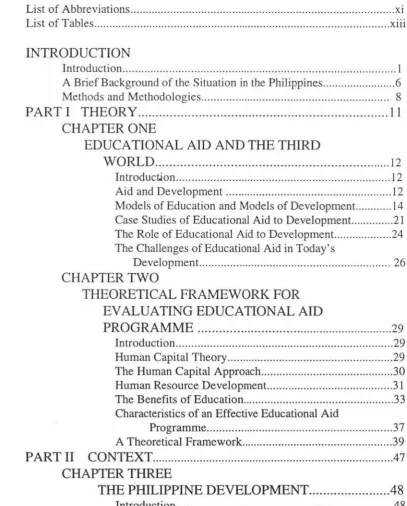
TABLE OF CONTENTS
Abstract. ... ii
Dedication ... iii
Preface ... iv
Acknowledg1nents ... vi
Table of Contents... viii
List of Abbreviations ... xi
List of Tables ... xiii
INTRODUCTION
Introduction ... I A Brief Background of the Situation in the Philippines ... 6Methods and Methodologies... 8
PART I THEORY ...
...
..
.
...
..
...
!
1
CHAPTER
ONE
EDUCATIONAL
AID AND THE
THIRD
WORLD
....
...
...
...
..
...
12Introduction ... 12
Aid and Development ... 12
Models of Education and Models of Development... ... 14
Case Studies of Educational Aid to Development.. ... 21
The Role of Educational Aid to Development.. ... 24
The Challenges of Educational Aid in Today's Development. ... 26
CHAPTER
TWO
THEORETICAL
FRAMEWORK
FOR
EVALUATING
EDUCATIONAL
AID
PROGRAMME ...
..
....
...
..
....
...
...
.
...
.
29Introduction ... 29
Human Capital Theory ... 29
The Human Capital Approach ... 30
Human Resource Development.. ... 31
The Benefits of Education ... 33
Characteristics of an Effective Educational Aid Programme ... 37
A Theoretical Framework ... 39
PART II
CONTEXT ...
.
...
...
...
.
...
.
....
.
47CHAPTER
THREE
THE PHILIPPINE DEVELOPMENT
...
...
. .48
[image:9.577.109.517.193.700.2]The Philippines ... .48 Philippine Development Through Education:
Experiences, Thrusts and Perspectives ... 51 Aid and the Philippines ... 59
Official Development Assistance as a Type
of Aid in the Philippines ... 62
CHAPTER FOUR
NEW ZEALAND AND THE PHILIPPINES :
PARTNERS
I
N DEVELOPMENT
...
66 Introduction ... 66 The New Zealand Development CooperationProgramme ... 64 The New Zealand-Republic of the Philippines
Relationship ... 72
The New Zealand Official Development Assistance
to the Philippines ... 75 The NZODA to the Philippine Education and
Training ... 79
Summary ... 85
PART III CASE STUDY ANALYSIS
... 86
CHAPTER
FIVE
RESULTS OF THE NZODA EDUCATION
AND TRAINING PROGRAMME TO THE
PHILIPPINES
...
.
...
.
...
.
...
87Introduction ... 87 Characteristics of the Graduate Grantees ... 87
Results of the NZODA Education and Training
Programme to the Philippines ... 93
CHAPTER
SIX
EFFECTIVENESS
OF THE NZODA
EDUCATION
AND
TRAINING
PROGRAMME TO THE PHILIPPINES
...
114 lntroduction ... 114 Costs and Benefits of the Programme ... 114 On the Effectiveness of the NZODA Education andTraining Programme ... 127 Social and Private Benefits to Education
Appendix A
Distribution of Graduate Grantees ... 166 Appendix B
Guiding Principles ... 167 Appendix C
Table 5.6.1 : Frequency distribution on education and
change in income ... 168 Appendix D
Table 5.7.1 : Frequency distribution on change in work
position or designation after the education ... 169 Appendix E
Table 5.11.1 : Grantees' benefits gained from the
programme ... 170 Appendix F
ASEAN CID
csc
DAC DAC-ODA DECS DFA EU FTIGDP
GNP
GTZ HCA HCM HDI HRD IAC IAEA IBRD ICA IDA IDA/IBRD IELTS ILO IMF ISO MA MERT MFAT Mphil MsCMTPDP
NCSONEDA
NGO
NSONZ
NZ$
NZODA
LIST AND ABBREVIATIONS
Association of South East Asian Nations Committee on International Development Civil Service Commission
Development Assistance Committee
Development Assistance Committee-Overseas
Development Administration
Department of Education, Culture and Sports Department of Foreign Affairs
European Union
Food Terminal Incorporated Gross Domestic Product Gross National Product
German Agency for Technical Cooperation Human Capital Approach
Human Capital Model Human Development Index Human Resource Development International Agriculture Center International Atomic Energy Agency
International Bank for Reconstruction and Development International Cooperation Administration
International Development Agency
International Development Agency/International Bank for Reconstruction and Development
International English Language Testing System International Labor Organisation
International Monetary Fund International Students' Office Master of Arts
Ministry of External Relations and Trade Ministry of Foreign Affairs and Trade Master of Philosophy
Master of Science
Medium-Term Philippine Development Plan National Census and Statistics Office
National Economic Development Authority Non-Government Organisation
National Statistics Office New Zealand
New Zealand Dollars
ODA ODA/GNP OECD OECD/DAF OECF PhD PNOC PRODED RICs
scs
SEAMEO TIPP UN UNDP UNESCO UNESCO/ UNDP UNICEF USAID US$ VISCA WBOfficial Development Assistance
Official Development Assistance/Gross National Product Organisation for Economic Cooperation and Development
Organisation for Economic Cooperation and Development/ Development Assistance Committee Overseas Economic Cooperation Fund
Doctor of Philosophy
Philippine National Oil Corporation
Programme for Decentralized Educational Development Regional Industrial Centres
Special Committee on Scholarships
Southeast Asian Ministers of Education Organization Trade and Investment Promotion Programme
United Nations
United Nations Development Programme
United Nations Educational, Scientific and Cultural Organization
United • Nations Educational, Scientific and Cultural Organization/ United Nations Development Programme United Nations International Children's Emergency Fund United States Agency for International Development United States Dollars
LIST OF TABLES AND FIGURES
TABLES
Table 2.1Measurement of private and social benefits ... .45 Table 3.1
Gross enrollment ratios in the Philippines, 1960-1990 ... 52 Table 3.2
Enrollment ratios by level of education ... 52 Table 3.3
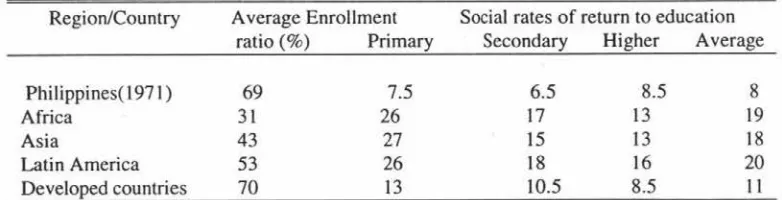
Social rates of return to education in the Philippines
and other world regions ... 53 Table 3.4
Private rates of return to education in the Philippines
and other world regions ... 54 Table 4.1
New Zealand's bilateral assistance programme
expenditure 1995-1996 ... 71 Table 4.2
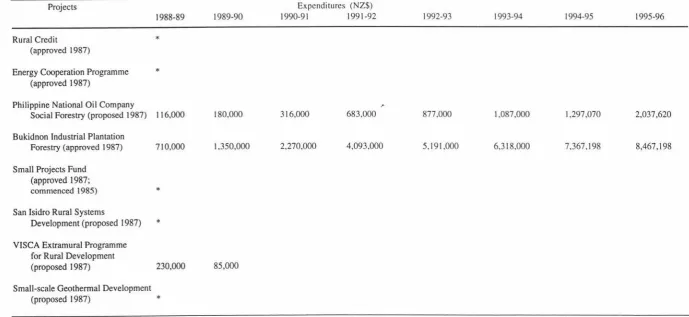
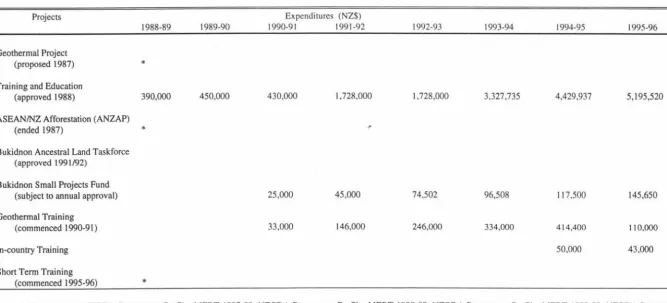
Summary of New Zealand projects and expenditures
in the Philippines ... 77 Table 4.3
NZODA's bilateral aid programme expenditure for fully funded Filipino students and trainees in NZ,
1990-1997 ... 81 Table 5.1
Age distribution of graduate grantee respondents ... 88 Table 5.2
Graduate grantees in place of work and programme finished under NZODA education and training
programme ... 89 Table 5.3
Programme and courses of study finished under the
NZODA education and training programme ... 92 Table 5.4
Perceived frequency values on the significance of
obtained education to present work ... 94 Table 5.5
Frequency values on the extent of relationship between work and education obtained
Table 5.6
T-test values on education and change in income ... 102 Table 5.7
T-test values on change in work position or designation
after the education ... 104 Table 5.8
Carried out productive development work in their
respective office of work ... 106 Table 5.9
Graduate grantees level of confidence as acquired from NZODA education in relation to the delivery of their
work role ... 108 Table 5.10
Significance of difficulties encountered or most likely to be encountered in carrying out development
work ... 110 Table 5.11
Regression results of NZODA Education and Training Programme to the development aspects
of the grad!!ate grantees ... 113 Table 6.1
Summary of benefits and costs of the NZODA
Education and Training Programme ... 115 Table 6.2
T-test values on graduate grantees' benefits gained from the NZODA Education and Training
Programme ... 117 Table 6.3
Identified benefits to the Philippine society ... 119 Table 6.4
Identified benefits to the Philippine government.. ... 120 Table 6.5
Identified benefits to New Zealand society ... 121 Table 6.6
Costs of the programme to the grantees ... 125 Table 6.7
Costs of the programme to the Philippine society ... 126 Table 6.8
Main purpose of the NZODA Education and
Training Programme ... 128 Table 6.9
Identified development sectors in the Philippines where education and trammg programme
Table 6.10
Perceived levels of changes brought about by the programme in relation to Philippine
development. ... 132 Table 6.11
Perceived extent of effectiveness of the NZODA
education and training programme ... 133 Table 6.12
Association between social and private benefits with key characteristics, educational and social/professional factors ... 136 Table 6.13
Update estimates of returns to education in
the Philippines ... 139
FIGURES
Figure A
Schematic Representation of the Thesis Structure ... .4 Figure 2.1
The Human Capital Approach ... 30 Figure 2.2
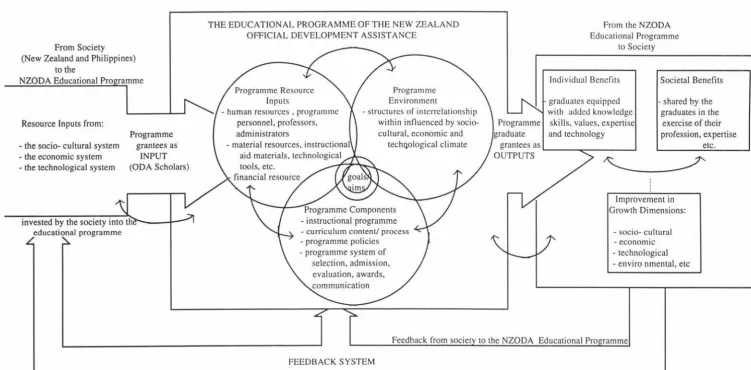
Flow Model of Education in the New Zealand
Official Development Assistance Programme ... .41 Figure 4.1
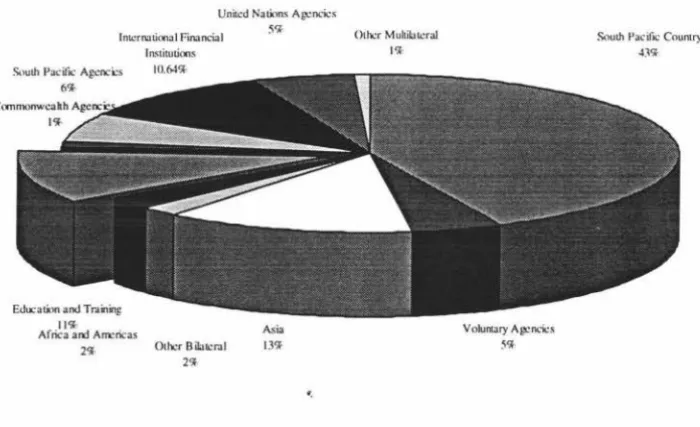
NZODA Programme Expenditure 1995/96 ... 69 Figure 4.2
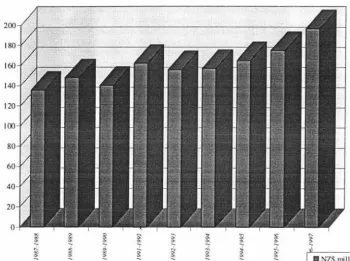
Growth of NZODA Assistance 198711997 ... 70 Figure 4.3
Education is a necessary component of development, for an educated population will more readily promote national developmental objectives (Gould 1993: I). It will not only satisfy a basic and universal human need, as defined by the United Nations, but will be an investment in world development. Since the advent of the "human capital" theory of the '60s, it has been widely accepted that investment in education and training is a crucial factor in economic development. However one conceptualises development, that is, as economic growth, as modernisation, as redistributive justice, or as socio-economic transformation, education has a significant role (Mabogunjie 1989: 36-46).
Progress is basically the result of human effort. It takes human agents
to mobilize capital, to exploit natural resources, to create markets and
to carry on trade. Their effectiveness as prime movers depends not
only on their own development but on the knowledge, skills and
capacities of those whom they lead as well. Thus in a very real sense the wealth of a nation and its potential for social, economic and political growth stemfrom the power to develop and effectively utilise
the innate capacities of the people (Harbison and Myers 1964:13)
People have always been the focus of all development efforts and activities (Todaro 1996; Gould 1993; Berlage and Stokke 1992; World Bank 1991 ). But often, ambitious development efforts and activities are dependent on the supply of educated and skilled workers. This is at the time when the transfer of skills and technology continues and proves to be a crucial ingredient in the development process (King 1991; Gould 1993; Todaro 1996; Schultz 1972; Becker 1962, 1964; Cohn and Geske 1990).
But, just how effective is this aid? And what has been the outcomes of education programmes? Comments have been made that it is only in education that "aid becomes a true aid". Yet, studies focusing on the effectiveness and outcomes of educational aid with reference to the recipient country's social,
cultural, economic and political environments are few. Where studies have been undertaken they tend to rely on project evaluation reports. Few independent studies have been done to evaluate the effectiveness of educational aid in a country's development.
In view of this, this thesis therefore examines the issue of the effectiveness of educational aid in the Philippines. Specifically, the study determines the outcomes and evaluates the effectiveness of the New Zealand Official Development Assistance Education and Training Programme to the Philippines. It is the concern of this study to take recipients I as the central concern, and to examine how recipients of the Third World, individually and collectively have been affected by that educational experience in the international development efforts to achieve improved economic and social well- being.
To examine the main issue, this thesis is divided into three parts (see Figure A). Part I provides an overview which establishes a theoretical framework developed from reviewing the literature on the relationships of aid, education and development. Chapter One reviews the significance of aid in the Third World through the relationship of models of education and models of development. The role of aid and education in the process of economic development is investigated (Part I). Given the variations in the concept of development2 context amongst countries of the Third World (Gould
1
Recipient refers to the graduate educational aid grantee.
INTRODUCTION
1
PARTI: THEORYChapter 1: Educational Aid and the Third World
Chapter 2: A Theoretical Framework for Evaluating
Educational Aid Programmes in a Developing Country
PART II: CONTEXT
Chapter 3: The Philippine Development
Chapter 4: New Zealand and the Philippines: Partners in Development
PART III: CASE STUDY ANALYSIS
Chapter 5: The Effectiveness and Outcomes of New Zealand Official Development Assistance Educational
Programme to the Philippines
Chapter 6: Problems and Issues of the New Zealand Official Development Assistance Educational Programme to the Philippines
CONCLUSION
Figure A
Schematic Representation of the Thesis Structure
1993: 146), the importance of development thrust, experiences and the role of
international relationship of the Philippines specifically with New Zealand are
required to be included (Part II). Having considered how aid in education fits
within a development thrust, experiences (historical), and international
relationship with New Zealand, the effectiveness and outcomes of New
Zealand Official Development Education and Training Programme to the
Philippines was analysed by examining the responsiveness, relevance and
efficiency of the benefits gained from the programme and how these benefits
complement each other (Part III). Finally, the issue of the contribution of educational aid to Philippine economic development was examined.
Drawing on the issue of how educational revolutions (Chapter One) have
essentially altered the traditional relationship between manual and mental
labour, and between skilled i\nd unskilled labour, Chapter Two presents a theoretical framework for evaluating educational aid programme in a Third
World country. The chapter starts with the "Human Capital Model" (HCM)
and a discussion on the private and social benefits of education. Given the
models, benefits, challenges and other issues of educational aid, characteristics
of an effective educational aid programme is determined within a Third World
system.
Part II establishes the relationship between the theoretical framework and a
selection of case studies. Chapter Three introduces the Philippines as a
country in which educational aid plays an important role. The chapter
discusses experiences, thrusts and perspectives in education in the Philippines.
Chapter Four establishes New Zealand and the Philippines as partners in
development. Specifically, it examines the objectives, content and delivery of
Part III (Chapter Five) analyses the outcomes or results of the educational aid
programme. Chapter Six is a discussion of the the effectiveness NZODA
educational programme to the Philippines. The thesis ends with a conclusion
and a set of recommendations on how to improve the quality of aid in
education.
A Brief Background of the Situation in the Philippines
The Philippine population of 48.1 million in 1980 grew to 67.5 million in 1995 indicating an average growth rate of 2.3%. The population in the Philippines is expected to double by the year 2019 to 128 million. Two- thirds of this increase will occur in the 15:65 year old age bracket, with an average growth rate of 4.5% (IBON 1994; NSO 1995).
In
the I 995 employment cohort, 27 .5 million are in the work-force; of this 25.135 million are employed. In 1988, 55.2% of the population was below the poverty line (NEDA 1992: 1 ).High levels of poverty, widespread unemployment and underemployment, a large government deficit, low levels of savings and investment (Todaro 1997:594-595), and a massive external debt of $28.9 billion in 1991 (IBON 1994; NSO I 994) remain as the Philippines' major economic problems. Further, the industrial sector is concentrated in the urban areas, especially in Manila (the largest and capital city). Weak linkages to the rural economy, an inadequate infrastructure, and limitations in transportation, communication and the supply of electricity are major obstacles to economic growth.
during 1990-91, but has showed a significant improvement since, attaining a
5.2% growth in 1995 (!BON 1994; Business Review 1995). The increase in GNP (Gross National Product) was fueled by higher level of investments,
improved export earnings, sustained consumer confidence and recovery in the industrial sector.
To sustain the country's economic growth, the Philippine government has
defined its development framework.3 The ultimate goal of the program is to improve the quality of life for every Filipino through people empowerment.
The strategy is anchored on principles of human development and
international competitiveness. Human development pertains to investment in human capital through enhancement of education, skills training, the provision
of health services, and greater access to productive resources. International competitiveness, on the other ~and, is the ability to produce high quality products and services acceptable to the world market. The program has adopted two themes: "Global Excellence" and "People Empowerment".
The Philippines, like other Third World countries, is in need of new skills and technology4. There is commitment to the belief that education is a necessary component of development (Paqueo 1989), and that education readily
promotes national development objectives (Gould 1993: l ).
Methods and Methodologies
The study uses a combination of two or more methods in the evaluation5• The research lies primarily in setting up a systematic framework by which outcomes of educational aid can be evaluated. Secondly, it attempts to establish a relationship between the programme components (including delivery) and outcomes, and draws conclusions from these relationships. The question of whether aid attains the needs of the recipient as defined in the objectives (Berlage and Stokke 1992, Stokke 1991 a, Gould 1993) was central to this study. Objectives were assessed by examining whether a programme is meeting its objectives as defined in relevant documentation, or by the evaluation of programme implementors and recipients.
The outcomes of the programme were assessed by the use of the 'human capital model' developed by Schultz in 1962, and supplemented by Becker in 1964 ( 1974, 2nd edition). Results or outcomes are measured through the rates of returns of education (Psacharopolous 1987) or the benefits, (which may either be direct or indirect (Shultz 1962, 1967, I 972; Blaug 1965; Coombs Philips 1968)), accrued both to the individual and to society as a whole. Both quantitative and qualitative data were gathered to address this issue. The situation before and after the completion of the programme were analysed. Further, situations with and without the programme were compared using the 'direct returns to education' approach developed by Psacharopolous in 1981. The essence of this approach is that education results in direct, measurable returns to the individual and society (Psacharapolous 1981, 1987, 1988; Becker, 1964; Coombs 1985; Schultz 1962, 1967, 1972; Taubman and
5 The approach and methods used in the evaluation work have to relate to various aspects of
Wales 1974; Solmon 1981 ). The value of educational investment was then measured through the ratio of mean annual earnings of the cohort receiving a
higher level of education (with training situation) and the cohort receiving a lower level of education (without situation). The quantitative data was analysed using the formula (see discussion on Chapter VII) developed by
Mincer in 1974; which says that the higher the ratio of rate of return, the larger the return to investment in the training.
Combinations of qualitative and quantitative methods were used in the analysis of the effectiveness and outcomes of the New Zealand Official Development
Assistance Educational Programme in the Philippines. The Chairman,
programme officer and other staff of the Scholarship Committee chaired by the
National Economic Development Authority (NEDA) were interviewed, being
the representative of the Philippine government. The programme officer of
the New Zealand Embassy in Manila was also interviewed. Important and/or confidential documents were either shown or given to the researcher. A survey questionnaire was administered to all the graduates or and persons who
have received the educational aid. A total of 79 completed questionnaires (in
English/' were gathered, which is 64.3% of the total number of graduates. A summary of results is shown in Appendix A. A total of 34 graduates were also
interviewed using the semistructured interview techniques. Interviews were conducted in person except for five graduates whose places were inaccessible to the researcher.
telephone.
Interview with these five graduates were done by the
The questionnaire for the graduates was modified as a result of advice given by
colleagues who had studied in other countries under ODA funding. Questions
were developed to include the changes brought about by the educational aid.
This includes earnings and productivity, and other activities related to their
work. In addition, questions on the costs and the effects of the education programme were asked. Questionnaires were administered through the mail.
Questionnaires were mailed twice for each graduate using two addresses; their work address and home address. This was done anticipating that in some cases the graduate may have transferred to another work place or another
home.
Responses to the questionnaires and semi- structured interviews served as the
primary sources of data for the study. All data collected was tabulated and analysed using the Excel package. The effectiveness and outcomes of the
educational aid in the Third World system was analysed in relation to the
Part I provides an overview on the importance of education to development in
general, specifically the importance of aid education and role in development; and a theoretical framework for evaluating educational aid programme. Part II
is divided into two Chapters. Chapter One presents the Human Capital Model
and its importance in education. Moreover, it presents the private and social
benefits derived from education by the individual and the society. The review
on the challenges and characteristics of an effective educational aid programme provides the theoretical framework in evaluating educational aid programme.
Chapter Two presents the theoretical framework that is used in the evaluation
of the New Zealand Official Development Assistance (NZODA) Education and
EDUCATIONAL AID AND THE THIRD WORLD
Introduction
This chapter provides an overview of the significance of educational aid to the
Third World. The chapter reviews the major theoretical positions on
development and education, and identifies approaches to development through
education and aid, and outlines a perspective on educational aid.
Aid and Development
In the early post- World War II period, foreign aid was justified primarily as a
national security measure, that was needed to strengthen allies and to build up
low-income countries so that they would be less vulnerable to communist
invasion or take over. Initially, economic aid commitments to less developed
countries were believed to be necessary to make some military pacts more
acceptable. Regardless of the rationale, subsequent investment was invariably
required to protect the initial investments.
In the 1960s, security was more broadly defined. Less emphasis was placed on
the quest for military allies and development was given a higher place,
although by no means an overriding priority was given to it in foreign
assistance efforts. The 1970s saw vast changes in the global political and
military landscape, in the economic scene, and most especially in the worldwide
understanding of the nature of the development process. Since then,
development has undergone various changes, not only in its definition but also
in its perspectives and processes.
Aid, specifically those bilateral programmes, began with quite different and
mutually inconsistent rationales such as: maintaining historic ties with colonies
respectability, extending political influences, winning new markets, paving the
way for private investment, or simply by desire to help those in need. Today,
aid is recognised as an arm of foreign policy, an economic instrument that can
be used to ultimately serve political ends besides being an expression of
goodwill and mutual cooperation among nations concerned with international
development.
It is in this regard that the issue of foreign aid takes a greater significance in the
development efforts of underdeveloped countries. However, it has been
realised (DAC 1989; King 199 I; Reyes 1986) that aid, on the average, has accounted for only about 20% of the investment resources of the undeveloped
countries. Thus, the vital question is not just how efficiently the 20%, in and of
itself is used, but how effective it has been in building institutions and in the
promotion of policies that help improve the overall use of a country's
resources, including those both human and natural.
On the issue of the effects of aid, economic traditionalists argue that aid has
indeed promoted growth and structural transformations for many
underdeveloped countries, while others argue that aid does not promote faster
growth but rather exacerbates undeveloped conditions through balance of
payments deficits as a result of rising debt repayment obligations and the tying
of aid into the exports of donor country7. In the '70s- '80s, aid had been
associated with problems of population, unemployment, inflation, government
deficit and balance of payments. The expression of aid weariness was often
used to describe the attitude of developed countries toward foreign assistance
(Todaro 1997). Aid often only benefited small elite groups in the
underdeveloped countries, thus widening the gap between the rich and the
poor. In some instances, like the Philippines, the rich became richer while the poor became poorer as a result of corrupt bureaucracies.
7
the world economy dominated by the developed countries. It is in this issue that it has always been a part of the set of objectives of aid to reduce this inequality down to the most rural people of the underdeveloped country. As the decades went on, and as evidenced by mixed issues on the impact and outcomes of aid, donor agencies became more and more concerned with the development of their own aid projects and programmes. This also led the way to the birth of empowerment or development from below.
There is a great deal of literature on the positive and negative impacts and outcomes of specific aid projects and programmes, which this thesis will use to examine in detail the educational assistance package by way of a case study. The study examines educational assistance because of its perceived significance to the construct of development.
Models of Education and Models of Development
Education can be measured by such different measures as the amount of learning or by attendance at school; it can encompass a wide range of features in its content and organisation, in terms of the range of the students' experience in school and the impact of that experience after he or she leaves school. Education has impacted significantly on all aspects of the development process. These educational experiences have affected people individually and collectively in different ways. Interactions and experiences as effects of development processes have had major influences over wide areas of public life during the past decades. Conversely, the strategy and purpose of development has impacted dramatically on the education system (Gould 1993:202).
development. More education requires more fonnal education, but the form
and content of education differs enormously from one developmental context
to the next. In different countries at any one time, and at different periods in
the same country, the contribution of education to development has varied
(Schultz 1972; Psacharapolous 1987; Coombs 1985).
Education is an issue of great concern to the governments and people of the
underdeveloped countries. Investment in education has brought benefits to
individuals, their communities and society in general. Benefits have ranged
from improved level of knowledge and skill in the population, better quality of
human resources, more choice for people over their lives, more secure
economic future, and access to well paid jobs in the modern sector. Investment
in education has proven to be beneficial to many, but not for all. There is no
assurance that new skills and knowledge are always put to sufficiently
productive use, or that the individual is suddenly liberated from a range of
social and cultural constraints (Gould 1993:204). Education has brought the
universalist ideas and knowledge of science and technology to many people,
but it has failed to ensure the availability of new techniques and machines for
the use of that knowledge. Nevertheless, the uncritical acceptance of western
models of education have had negative impacts on Less Developing Countries
(LDCs). For example, it has influenced migration patterns, the national and
trans-national brain drain of skilled workers, and has led to the growing
number of unemployed graduates, and widened the difference between rural
and urban sectors.
In theory, education can be a liberating force, but in practice it has also been a
force for stability and preservation of the status quo. White collar jobs are
preferred by the educated. In effect, education often fails to produce the skills
and technology needed for development. There has been mis-matches between
reforms, and what has been provided by western education systems.
For several New Industrialised Countries (NICs), economic transformations was not seen as being led by education reforms but rather, the reverse transformation required the restructuring of education. This has been the experience of South Korea (Hong 1983:225; King 1984: I 0), Taiwan (Todaro 1997) and Singapore (Chew 1986: 133), where a very rapid increase in scientifically oriented and technically skilled workers was required. For example, Chew (1986: 133) reports that "management in the electronics industry generally places a lot of emphasis on up- grading of human capital." The role of formal technical education as a factor in the economic dynamism of East Asia is contributory rather than dominant, and certainly much less dominant than the role of foreign capital and internal political stability (Gould I 993:205). Although there have been many changes in curriculum, structure
.
and finance in education in the mass countries of Africa, Latin America, South Asia and Middle East, ther have been very few attempts to alter attitudes towards education, either from within or from outside the education system (Fransman and King 1984). The education system ensures social reproduction rather than being a vehicle for social change or economic dynamism (Coombs 1985; Zwanaepoel 1985). Education may continue to function and exist even when a national state collapsed. In the Philippines for example, (a Third World country with low score9 on the UNDP Human Development Index (UNDP 1991 )), the school system remains in place 1°, but its quality has seriously collapsed at all levels. Teachers are paid extremely meager and much devalued salaries. In effect, the majority of teachers spend most of their time outside school earning additional income. Many of them have left the country and became overseas workers. Schools are being commercialised. There are9 Philippine HDI score is 0.613, where HDI score is from O to
I (New Internationalist I 993/1994: 70).
10 Literacy rate is 90% male, 90% female ( I 990), while school enrollment ( 1989) are as
buildings decay, and there is not enough expenditure on learning materials.
Education is an important tool for development planning, especially for politicians. In general, education has been consistently aligned with national ideologies for development (Gould 1993; King 1991 ). In any development agenda, whether at the international or national level; public or private activity, much aid and technical assistance is given to education. But international agendas seem to be affected by global powers and trading relationships, and that makes singularly educational initiatives and perspectives difficult. They can act only within the boundaries of the relationships, no matter how good the initiatives are, or how well they are politically and financially supported from within and outside each country. Although each country has its own priorities and objectives, it can act only within the boundaries of its own national, political, cultural and social development strategies, as well as being controlled by the constraints of structural adjustment and growing indebtedness (Gould 1993:206; Mallillin 1981 :5).
positively affected in their development by the operations of the development/ education relationship that seemed to apply in the developed countries. But as education systems in developed countries were different in strategies, priorities and emphasis, so were they in the Third World.
For this issue, therefore, it can be generalised that 'development' models are similar to education models. Approaches to education are deeply rooted in the modernisation perspective that assumes easy and necessary cross-cultural transferability of the institutions and content of education. The idea of efficiency, that is, the maximisation of benefit and minimisation of cost is an essentially positivist approach. Hettne ( 1990) argued that 'development' strategies and approaches in the undeveloped countries have been characterised by three basic features: they have tended to be exogenously based; they have been rooted in a positivist ideology derived from the rationality of classical economic theory; and they'have been essentially evolutionary, following the presumptions of the Western development model based on stages of growth. The assumption of an approach to global development using universally applicable theories and practice has been a characteristic feature of the second half of the twentieth century, and these theories have been largely based on the three characteristic features.
The models of education that have been followed have certainly been mostly
exogenous, borrowing heavily from a modernisation perspective which
assumes easy and necessary cross-cultural transferability of the institutions and content of education (Gould 1993:208). The structural experiences of the West, as well as its institutional forms that are inherited from the colonial period and its assumed relevance to the development of Third World countries
have remained at the fore end of the twentieth century. The historical experience of education in the industrial world of manufacturing, supported by cheap labour forces is unlikely to be repeated in any part of the Third World, as their modern economic needs have a different skill mix and skill levels. Just as there has been a general rejection of the diffusionist paradigm in development theory and a growing recognition of the possibilities for, or even desirability of indigenously derived development strategies, so too this has occurred in education. There are possibilities for a range of locally defined strategies and modes of delivery of primary/ secondary/ higher, rural/ urban, academic/ technical certainly. Many cases of national experiments for innovation seem particularly constrained by two aspects: externally by the conditionality of 'aid'
programmes and multilateral and commercial loans, and internally by the demand from parents for familiar, traditional forms of education for their
children.
Inherited models, however, are hierarchical, bureaucratic and centralised. During the 1950s-1980s, when development planning came to the forefront among the Third World countries, various sub-sectors including education were integrated into a national strategy with defined targets and objectives. Although the education system expanded 11, the management of the larger system involved deconcentration of administration down the hierarchy to regions, provinces, districts or towns rather than decentralisation of policy and implementation decisions. Management structure has been top-down,
11
its own clientele, the 'people' in its planning and management.
In view of this, Hettne ( 1990) argue that theories, to be more effective, should be locally ordered, more related to local cultural realities and aspirations, and more flexible in their delivery. He further argues that in doing so, then the education system would be more at ease with a new ideology of development that was sensitive to spatially variable needs and the aspirations of a population. This would probably mean, among other things, much greater decentralisation with stronger local powers. It would also mean much less dependence on formal and adult education, more on-the-job training and a much more radical curriculum in schools. In essence, emphasis should be given to education 12 without denying the continuing importance of a formal school system.
In conclusion, such types of development are rather idealistic, given the pressures for continuity and conformity from above and from below. They would possibly result in an ever greater diversity of national experiences in education and in the impacts of education on the socio-economic life of the nation. Human resources would be developed in a way that allows the system as a whole to be more responsive to local or indigenous circumstances rather than to macro-economic requirements. They would consider people's basic needs. The effect may not be as direct, but the perceived change in the population components is possible as affected by the restructuring of values in the new ideology, emphasising the locally relevant skills that are needed to raise the quality of life of the population. Such changes could further develop dynamism and vitality among the rural areas of the Third World that could address the issue between education and migration. For the Third World, being more self-sufficient creates less incentive for internal and external brain drain. Better provision of basic needs would relate education more directly, both geographically and in terms of control and responsibility, to the people
decentralisation in education, as associated with structural adjustments, could possibly move thinking about education and development away from these approaches, specifically in economic and major international development agencies that are rather universalist in view of education-development relationships. They could move towards views that are more consistent with approaches of geographers and that of the grassroots levels throughout the Third World, that recognise the importance and practice of education. In such case, it would be important to be more concerned to examine the contextual
variables that differentiate one country from another or one region from another than to impose an efficient general solution that would have equal applicability and maximum impact everywhere. This perspective is able to be
related to the issue of educational assistance 1
3,
that is, the individualities of both the recipient and the donor countries should be considered. Such thinking on the issue of models of education and development is deemed important and related to the study of specific countries' development or underdevelopment.Case Studies of Educational Aid and Development
In this study, countries such as Japan, Singapore and Indonesia are considered models of education and development. Although these countries are certainly not the ideal types in the strict sense of the 'concept of development', they furnish glimpses of varied development patterns that some underdeveloped and developing countries may or may not have experienced. As such they have been included as case studies illustrative of some principles that link education with development.
Singapore
Pang (1980:495-504) describes Singapore's economic development and growth over the last 20 years which has led to a virtual full employment
economy with rising per capita income and standards of living. The author
and social stability allowed for the development of a market economy guided by macro-economic planning; (2) of particular importance was the government's emphasis on manpower training to continually upgrade and to improve worker's productivity; (3) the country adopted an outward looking export oriented economic policy. Interdependence did not lead to one sided dependence but provided Singapore with the necessary technology and resources for development; and (4) macro-economic policies capitalised on the country's comparative advantage through subsidiaries. Labour intensive technologies gradually shifted to more capital intensive technologies as labour became more scarce. The combination of pursuing rapid economic growth and investing heavily in human resources is considered the key to Singapore's success.
Japan
Indonesia, is one developing country that is heavily investing in education,
specifically on youth education. This is based on the concept that youth is a
potential wealth (Muhi et al 1986:60).
Following the abortive Communist coup on 30 September, 1964, Indonesia has
launched some realistic economic policies (Indonesian Information Service,
Indonesian Embassy, Manila, n.d.). This was followed by Indonesia's
Five-Year Development Plan of 1969-1974. With the conclusion of the first Five
-Year Development Plan in I 974, Indonesia has embarked on another second
Five-Year Development Plan which emphasises development in the areas of (I)
Tourism; (2) Infrastructure; (3) Regional Organisation; (4) Personnel
Development; and (5) Mass media support. As part of the development of the
country, the government has likewise built a sound basis for proper economic
growth. The rate of inflation which has been discouraging in the past years is
now improving. On the whole', production has improved from the start of
1968. Another important development is focused on agriculture. To cope
with employment, the planners envision renovations and changes in agricultural
technology through improved education, both local and foreign. Although
many of the economic objectives set in the first Five-Year Development Plan
were successfully achieved, Indonesia recognises the shortcomings of past
developments, in which education has a significant role. Like other developing
nations, Indonesia is fast adjusting to changing times in the fields of health,
employment, capital participation, business, and more specially in education.
In Indonesia, the envisioned support and cooperation of the educated
population, specially its youth, are significant in the exploitation, manipulation
and development of Indonesia's potential wealth.
Given the Singapore, Japan and Indonesia's experiences in development, it is
evident that education and training of people, whether overseas or local is one
of the key factors in the development of the "human" as a "resource". It is in
the form of a case study of the NZODA to the Philippines; this is discussed in the next section.
The Role of Educational Aid for Development
Education has long been recognised as a central element in development. When the more developed countries began their drive for social and economic development more than 30 years ago, education was perceived as a means not only of raising political and social consciousness, but also of increasing the number of skilled workers and raising the level of trained humanpower. Although substantial progress was made during the l 950's, educational growth failed to achieve a more equitable distribution of income and social services, and resulted in disequilibrium between the productive capacity of the education
system and the absorptive capacity of the labour market (Woodhall 1987).
The I 960's witnessed profound changes in the perfection of the development process as the developing countries began to experience the unprecedented effects of industrialisation especially upon the rural areas. They began to perceive that development was not just national economic growth and efforts were directed towards improving the welfare of human beings, primarily in terms of providing goods and services needed to eliminate manifestations of poverty, such as: malnutrition, disease, illiteracy and squalor. These efforts were spurred on by the I 970 resolution of the United Nations General Assembly stating that
" ... as the ultimate purpose of development is to provide increasing opportunities for all people for a better life, it is essential to expand and improve facilities for education, health, nutrition, housing and social welfare and to safeguard the environment" (World Bank 1980:12-15).
underlines the significance of educational aid in three inter-related ways,
namely:
I. As a basic human need. People need education to acquire a broad base of
knowledge, attitudes, values and skills on which they can build in later life.
Such education provides people with the potential to learn, to respond to new
opportunities, to adjust to social and cultural changes, and to participate in the political, cultural and social activities.
2. As a means of meeting other basic needs. Education influences and in turn is
influenced by access to other basic needs such as nutrition, safe drinking water,
health services, and shelter. For instance, while clean water can make an
important contribution to better health, for instance, whether it will do so,
depends on the education and understanding of its users.
3. As an activity that sustains and accelerates overall development. First, education prepares and trains skilled workers at all levels to manage capital,
technology, services and administration in every sector of the economy.
Second, through trained personnel, developed methodologies and institutional
settings, education facilitates the advancement of knowledge in pure and applied fields. Third, as the concern for the management of the environment,
for conservation and the use of energy, and for achieving a balance between
human population and natural resources mounts, education will raise the
consciousness of people and provide knowledge, skills and trained manpower
to deal with environmental issues. Fourth, the ability of the individuals to
identify with their changing culture and find constructive roles in society,
depends, to a large extent, on what education can provide by way of
self-understanding, better knowledge of the choices available to society, and a
development, parallel, for example, to agriculture or industry, but as a pervasive element that is integrated, horizontally and vertically, into all
development efforts.
Education, for example, in the broadest sense, is a major objective of technical co-operation (TC) programme. Official Development Assistance (ODA), which refers to grants and soft (concessional) loans extended by governments of developed countries and by multi-lateral official agencies to developing countries; in general, aid is provided either for capital or technical assistance purposes. Foreign capital assistance is an important development input into a country, specially to the developing and underdeveloped ones. While labour is generally abundant, highly skilled labour ( or technical expertise and experience in certain fields) is also equally important.
The Challenges of Educational Aid in Today's Development
billion a year of Development Assistance Committee bilateral commitments. In recent years, the World Bank and International Development Association (IDA) approved some US $700 million of loans for education (OECD DAC I 984; World Bank 1984 ). Although a huge amount has been allocated to education, it probably accounts for only I 0% of all aid budget of the developing countries (OECD-DAC 1984 ). Official bilateral aid to education comes principally from Organisation for Economic Cooperation and Development/ Development Assistance Committee (OECD/DAC) countries. Almost 80% of the aid to education from bilateral aid assistance sources and from most specialised agencies of the United Nations goes for technical assistance-teachers, experts, advisers and fellowships for students and trainees. Among the multilateral agencies, the World Bank Group (including IBRD and IDA) is the largest single multilateral supplier of educational aid. Such priorities in this type of assistance reflects the perceived role of education as providing the economy with'· skilled manpower and the many other social benefits that go with it.
However, it is not a matter of how much aid is given to education, nor the role and influence of aid moneys in national development. Rather, as King ( 1991 :ix) argued, educational aids' contribution to development is commonly based on the donors' perspectives on education and this is what really matters. Educational aid, despite its obvious benefits have contributed to the educational crisis in two substantial ways. First, they have heightened and accelerated the already strong popular demand for education, and secondly, following King's argument, often, undeveloped countries are encouraged and enticed to emulate the donor countries' own educational models and practices-even when they are conspicuously ill-suited to the needs and circumstances of the imitating countries.
but also on what has been learned from the past experiences that can now be
put to good use in the task of shaping a better future. Past experiences
resulted in the inclusion of issues such as gender biases, rural-urban
development, and private-government development. These issues, then, were
CHAPTER TWO
THEORETICAL FRAMEWORK FOR EVALUATING
EDUCATIONAL AID PROGRAMME
Introduction
This chapter presents a theoretical framework for evaluating an educational aid
programme in a Third World country. It includes discussions, publications and
studies that were conducted in relation to human capital theory and the
benefits derived from the educational aid programme. The chapter begins with
the discussion of the human capital theory and the human capital approach,
followed by the discussion on the educational benefits, benefits imbedded in the
goals and objectives of an aid programme with respect to education and
training as espoused by the Human Resource Development concept, the
characteristics of an effective educational programme and the expected benefits
from it. It also provides views critical to the prevailing assertion that income
and success is related to education. Given the constructs, the chapter ends by
presenting a theoretical framework.
Human Capital Theory
Many economists have pointed out that education and training create assets in
the form of knowledge and skills which increase the productive capacity of
humanpower in just the same way as investment in new machinery raises the
productive capacity of the stock of physical capital. In 1776, Adam Smith in
The Wealth of Nations said that "a man educated at the expense of much
labour and time ... may be compared to one of those expensive machines", and
regarded as a form of investment that promised future benefits. In the early
years of the twentieth century the Russian economist Strumilin ( I 924) and
economists in the United Kingdom and Europe drew analogies between
investment in education and investment in physical capital. However, it was
not until I 955 and continuing to the present day that there was large scale
support for the idea that expenditure on education represented investment in
human capital. One writer reviewing the theoretical and empirical work on the
subject has described it as "the human investment revolution in economic
thought" (Bowman I 966). Economists such as Schultz ( I 961, 197 I) and
Becker ( I 975) have developed and analysed the concept of human capital,
treating education and training as a form of investment, producing future
benefits in the form of higher income for both educated individuals and for the
society as a whole.
The Human Capital Approach (HCA)
The concept of Education as investment is most clearly set out in the HCA.
The basic premise of the human capital approach is that variations in labour
income are due, in part, to differences in Jabour quality in terms of the amount
of human capital acquired by the workers. Investment in human capital leads
to higher productivity, which in tum causes higher earnings as shown in
Figure 2. I.
Investment in
Education
Higher
Productivity
The Human Capital Approach Figure 2.1
Source: Cohn and Geske 1990:35.
Higher
An important facet of the human capital approach is investment in 'on the job training' and the criteria determining who will pay for such training and who will benefit therefrom (Harris and Jarrett 1990). Based on the pioneering work of Becker (1962, 1964), a distinction is made between 'general' and specific training. 'General' training refers to training that provides valuable knowledge and skills to workers usable both within the present employment (where training takes place) and in other employments. However, 'specific' training has value only within the current employment and is totally irrelevant for the workers productivity in other firms. In the first instance, the theory predicts that the worker will be willing to pay for the general training (in the form of reduced income during the training) and that the employer would be willing to pay the worker a higher wage following the training. For specific training, the worker is not likely to agree to pay, and likewise, the employer is not likely to pay a higher wage to a worker tr~ined in such a manner. This last statement is altered to some extent when it is recognised that employers investing in specific training of workers are reluctant to Jet them go and thus are likely to pay them a higher wage to retain them. Similarly, the worker may not object to paying for some of this specific training when it is realised that such training would bring a return in the form of greater job security and higher wages. Empirical corroboration of this view can be evidenced (see for example the work of Mincer 1970, 1974).
Human Resource Development
economic thinking, this has introduced new ways of thinking about the role of individuals and their skills in the development process. This thinking has been led by such organisations as the International Monetary Fund and the World Bank. One of their main ideologies is the thought that human resources encompasses all of the many attributes of a people, that is, their physical, biological, psychological and cultural components. These account for both the
social values that determine preferences and the economic value of the
producer and consumer services that a people render, whether they come to them as earnings or directly as personal satisfactions (Schultz 1972:9).
Much of the analysis concerning HRD is related to the idea of the value of education to the individual and to the society, which is far from new (Cohn and Geske 1990: 18). However, a emphasis has been placed upon the economics of health, education, and other human resources. Adam Smith in 1776, as well as several other economists like Ginzberg (1966), Von Thunen (1968), Alfred Marshall (I 890), Blandy ( 1967), James Dodge ( 1904 ), E. A. Caswell (1917), Gorseline ( 1932), J. R. Walsh ( 1935), Dublin and Lotka (1946), Psacharapolous (1987), Harris and Jarrett (1993), World Bank (1994), United Nations ( 1995), agree that education confers both direct and indirect benefits upon the individual receiving the education and the society to which this individual belongs. Smith ( 1952) believes that without ample education, the masses of working people would be so alienated from the society and that the principle of the 'division of labour' would be threatened.