Rochester Institute of Technology
RIT Scholar Works
Theses
Thesis/Dissertation Collections
4-25-2000
Circular Resolutions
Cynthia Cascione
Follow this and additional works at:
http://scholarworks.rit.edu/theses
This Thesis is brought to you for free and open access by the Thesis/Dissertation Collections at RIT Scholar Works. It has been accepted for inclusion
in Theses by an authorized administrator of RIT Scholar Works. For more information, please contact
Recommended Citation
ROCHESTER INSTITUTE OF
TECHNOLOGY
A Thesis Submitted
to the
Faculty
ofThe College
ofImaging
Arts
andSciences
In
Candidacy
for
the
Degree
ofMASTERS OF FINE ARTS
Circular Resolutions
by
Cynthia
C Cascione
Approvals
Chief Advisor: Luvon Shepp.aJid
Date:
0/
12-
L
/tJ
t)
Associate Advisor: Susan Ferrari-Rowley
Date:
~id'i
/
qlclJ.)-t
Associate Advisor: Bob Dorsey
Date:
9
!
22-1
c/u
Department Chairperson: Torn Light:imlt
Date,
i
k
t-/
O
f)
I, Cynthia Cascione hereby grant permission to the Wallace Memorial Library of RIT to
reproduce my thesis in whole or
in
part. Any reproductions will not be for commercial
use or profit.
Special
thanks to
Zerbe Sodervick
andSusan
Farrari-Rowely.
They
both
wentbeyond
their
role as professors andhad
a profoundimpact
onthe
resolution ofmy ideas.
They
have
supportedmy
endeavors and encouragedmy
growthfar beyond
classroomTable
of
Contents
I.
An
Introduction
p.1
II.
The
Circle
p.2
in.
The
Arrow
p.4
IV.
Breast Self
Exam
Patterns
p.4
Figure
1: BSE Pattern No. I
Figure 2: BSE Pattern No. 2
Figure
3: BSE Pattern No. 3
V.
Arrow
Series
p.6
Figure
4:
Untitled:
detection
Figure 5:
Untitled:
incision
Figure 6:
Untiiled:
penetrationFigure
7:
Untitled:
retractionVI.
Sewing
p.8
VII.
Armor
Series
p.9
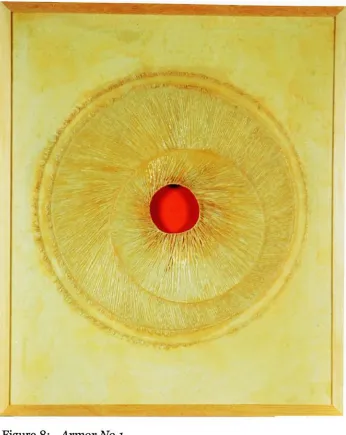
Figure 8: Armor No. 1
Figure
9: Armor No. 2
Figure 10: Armor No. 3
VIE.
Rebuilding
Connections
p.1 1
Figure 1 1
:Isolation
Figure 12: Connection
Figure
13: Attraction
Figure 14: Interaction
IX.
Personal Inspiration
p.12
X.
Subject
vs.Producer: Women's
traditionalrolein
the
Arts
p.13
XI.
Artistic Influences
p.14
XII.
Conclusion
p.1 6
[image:5.519.52.443.95.557.2]An
Introduction
To
experience a work ofart,
asin
making
love,
is
to
experiencehuman
contact;
and one cansay equally
well,
the
"content"is
just
the
"form"involved,
orthe
"form"is
just
the
"content" involved...""Painting
is
a "language," andit's
only
legitimacy
is
that
it
can "say"certain
things that
words can't.What I
cando
in
wordsis
give you afew
associations,
afew
metaphors,
but
mainly
point outthat,
asWittgenstein
says,
"the
instant
youreach what
is
interesting
in
terms
ofmeaningfulness,
wordsstop. 1
My
thesis
titled
Circular
Resolutions
exploresthe
feminine
experiencein
relation
to
illness
and renewal.Illness.
ofthe
body,
or ofthe
mind createsanxiety,
which restricts our
ability
for
change anddistorts
thought
evenfurther
to
createbarriers between
us and reality.The
barriers
webuild
to
protect ourfragile
state of mind become" our main obstacles
towards
recovery.In
moments ofclarity
we realizethat
wehave
to
make changesin
ourlives
to
survive our ownfears.
Change
promotesrecovery,
which occursfrom
finding
the
strengthto
confront
fear
and shedthe
layers
of repression.The identification
ofillness,
breaking
down
these
layers
ofisolation
andthe
dilution
offear
are all part ofmy
personal exploration within
these
paintings.The
content examinedin
eachpainting
is
recycled and used within eachseries although
the
nature ofmy
painting
style andthe
application ofthe
1
Stephanie
Terenzio,
Robert Motherwell & Black. (London & New York:Petersburg
Press,
1980),
pigment varies
in
form
throughout
my
thesis.
I
feel
the
needto
expressthe
different
aspects ofmy personality
anddiversify
my
approachfor
the
resolutionof
my ideas.
This
ultimately,
resultsin
an eclecticgrouping
ofimages.
The
process
for
creating
is
very
important
to the
development
ofthese works,
as eachseries results
from
adifferent level
offunctioning
and control ofthe
process.Some
paintings are producedfrom
a premeditatedinternal
exploration,
whichis
executed
from
memory,
creating
anintended
image.
Others rely
on asubconscious exploration of same
theme,
where chancetakes
on a greaterrole
in
production.Painting,
my
daytime
activity,
releases pentup
energy
and emotion.The
constant application and quick removal of pigment
builds
up
texture
which thencan
be
scratchedthrough
or eradicated with anotherlayer
of paint.The
processexplores a subconscious reaction
to
my
present emotions and produces a complexsurface.
This
surface^
is
a result of a constant analysis andjudgment
of eachlayer
constructed.This
method ofcreating
and analysisderived from
emotioncreates
turmoil.
At
the
sametime
my
sewnpaintings,
my evening
activity,
areconstructed
using
a predeterminedimage,
whichfrees
my
mindfrom
suchturmoil.
The
image
createdis discovered
before
the
actualprocess is
started,
leaving
my
minddetached from
the
image
during
the
process of creating.The
repetitiveness of
sewing
releases mefrom internal
conflict as processtakes
over,
forging
a comfortable unionbetween
my
daytime
andmy evening
methods ofcreating.
The
Circle
In
it lies
too the
motif of perpetual, uninterruptedactivity,
ofitself:
by
opening
itself
andgaining
newterritory,
it
nevertheless still
ceaselessly
circles rounditself
watchesit's
ownpast,
can neverbreak
free from
the
soliloquy
andindeed
may
not,
for
by
sodoing
it
wouldlose
what constitutesits
individuality.
2I
amvery
interested in
the
images
of sciencepertaining
to
how
things
areconstructed,
ofhow
they
develop
andchange,
andthe
diagrams
documented for
visualization.
I
am attractedto
objects andideas
that
are precise.The
circle,
amathematical and natural
phenomenon,
always maintains 360degrees.
The
circumference always equals
the
diameter
times
3.1416,
andthe
radiusis
always equal
to
onehalf
the
diameter.
The
circleis
true
and constantbut
never-ending.
In
most culturesthe
circlehas
avery
significant relevanceto
life.
It has
always
been
one ofthe primary
feminine
signs,
as opposedto the
line
representing
the
masculine spirit.In
many worship
based
societiesthe
circlewas associated with
the
idea
of a protected or consecratedspace,
in
additionto
being
the
shape of equality..
The
circlerepresenting the
female
form
has
been
the
main componentwithin
my
compositions.Its
cyclical nature symbolized a universalrelationship
to
life
andthought,
whilethe
softness -ofits form
is
feminine in
quality.In
earlierworks
I've
usedthe
circle as an element within afigurative framework.
The
result was
less
than
ideal because
the
illustrative
nature ofmy
style wastoo
literal.
Frustrated
withmy
inability
to
fully
expressmy
ideas,
I
simplifiedmy
symbols and eliminated
the
extraneous elements ofthe
figure. Focus
wasthen
placed upon
the
breast
andthe
pregnantform.
2
Resulting
from
this
breakdown
ofimagery
into
its
basic
elements,
the
formal
components ofmy
thesis
developed.
Circles
layered
uponcircles,
broken
and penetrated
by
arrows and other sphericalconfigurations,
encapsulatethe
visual repertoire within
my
pieces.The
circle'sability
to
enclose and protectthe
interior form
became
animportant
aspect ofconveying
my
thoughts
for it
allowed me
to
expressanxiety
visually.The
Arrow
-
The
arrow,
a signifier ofdirection,
controlsthe
visual movement withinthe
painting.Its
presence played adominant
rolein
the
early
paintings ofmy
thesis,
whilein
the
later
images,
the
arrowhas
asofter,
more subconscious role.Its universality
ofmeaning
andthe
relationship
it has
to the
medicalcommunity
fits
my
purpose well.This
symbol alsoheld importance
in
many
cultures,
and was often viewed as a phallic symbol as well as a weapon.The
strong,
ridged,
obtrusive nature ofthe
arrow conveys an aggressive presencewithin
the
paintings,
whichis
imperative
to
the
overall message conveyed.These
arrowspenetrate,
pinpoint,
direct,
and connectthe
source of eachimage.
In
later
paintingsthe
arrowdissolves its
aggressive nature and resolvessuggest a
relationship
between
forms.
This relationship
becomes
a signifier ofconnection rather
than
ofisolation.
Breast Self Exam Patterns
The Breast Self Exam
seriesis
the
beginning
ofmy
visualtestimony
ofexperiences with persons who
have had
cancerin
allits
variousforms.
I
have
witnessed
survivors,
have
encouragedthose
struggling
to
survive,
andhave
courageous strengthen as
their
bodies
weakened.When
they
passedthey
left
metheir
strength.I
possestheir
willto
survive and attemptto
expresstheir
experiences
in
my
paintings.I
speak ofthe
detection
oftheir
illness,
the
penetration of
love
in
moments ofneed,
andthe
boundaries they
createto
protectthemselves
andtheir
loved
ones.I
tell
stories ofhealing,
whethertrue
orimagined,
and expressmy
anxiety
over reality.These
paintingsbased
onthe
BSE
patterns circulatedby
the
American
Breast
Cancer
Society
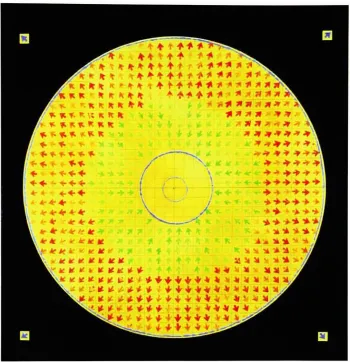
areintentionally
sterile.The
triptych
expresses anobsessive
display
of examination.Each
canvasis broken into
a linch
x 1inch
grid structure
overlaying
abright
yellow-orange under painting.Within
the
grid,
each linch
x 1inch
box holds
anarrow,
signifying
the
direction
ofmovement one must
follow
to
examinethe
breast.
The
arrows are vibrantin
color and each color
illustrates
a changein
the
direction
of movement.A
richblack
overpainting
surroundsthe
breast
and containsthe
bright
coloration ofthe
background
pigment and arrows.BSE Pattern
No.i
(fig.i)
examinesthe
breast
ft
starting from
the
mid-sectioninward,
than
from
the
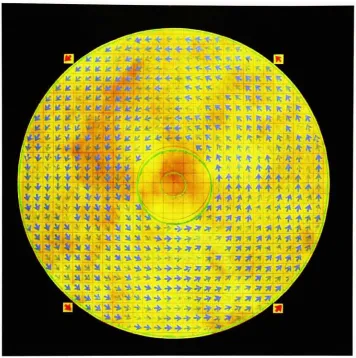
mid-section outward.BSE
Pattern N0.2 (fig.
2)
searchesthe
breast in
a counterclockwise motion aroundthe
exterior,
moving in
towards the
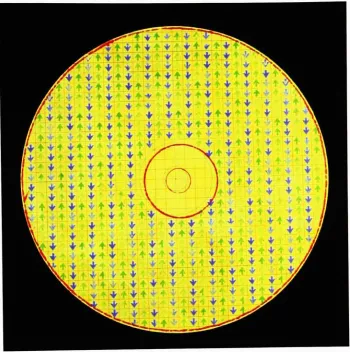
nipple.The
third pattern, BSE Pattern
No. 3 (fig.
3)
examinesthe
breast
in
an upward thendownward
movement acrossthe
breast:
My
indention
wasto
attract attention throughthe
juxtaposition
of vibrantcolors and
the
obsessivepatterning
of movement.The
premeditated,
sterilequality
ofthe
painting
invites
the
viewerto
questionmy
intent.
This
questioning
opensthe
doors for
learning,
educating
those
ofthe
importance
of*k
KK K* * * K IS * K K
It X
****** * - * * <-*<*
/
* *-4r4r *r4-4e *r4e *r **>4r*- 4r
**/.-*
t
, 4r* eie
teiemKIt It * It ItX
X It * k KICK** *
^*
^
* * > *n -ax* #1
*a a n t i %
M3f 3f * Jf* Jf\
\
te4c4 ***-Ml
- ???>>?
?
+ ->+-/
**?+**a x * s ii
>*J|
*, ^ a hx i
********
-* 4 * Xi*.
Jtir * * **** -
**
-V-V* * * ' ^^* ** **** *******
^fcfc
*********** V * *,,**
****
* [image:11.519.90.440.92.454.2]^
* *^^^^
^
.^^B
*r* * **
*
^
^^^^^^^^^^
^r
* ^ it**<
j
^T
- '< * *ttfi <'?**** iqK-K'KK^^T
* X v It ,.^T.-
** f-^f'S^R^VV^^
V
tf * t : i k KR;K K * K K'<"
K K R: it
**^w
V
* k vt-* tf *'^.VvKR>K^ltj)t
W**
*K\IK *i*:K*
* * * *--- <*. * **>
<t \*>
*
*
/-*
*,*
*"* ~ a a -%\r-V
\V* V *
**
*!*
*1* .- ** -t ***;*!*i*"'
It* (t *
*
t* T '* **?
*
*
-* * *
*>^1*j*,
*
*****
*>4n***>**>
**
***
*
*
X Of*
* *
*V
^ Si*-** 71*
*
t* ***
^ 71 X-* **-f
**
J
m.
nx^K^Jom^. ^L^V- ******* * i* ;?***
*J<*
*^
^X
- ^ *M SI - -A.++^++#* **** **-*M
^_
-J5iX5(^Vll.*-*.*..*.****
7^k
AV X * *:&*-A*<**>?.>*Jf Jr* XXX
J
^M>tiA
.'-YH V.**-> .^.** ..*** l*^i S4
*>"*
*^i^>^jyjy|
^
_^^^^^^H^^*
"*"^^^J*
*"*>>
^^^
[image:12.519.88.444.92.450.2]encourage all viewers
to
appreciatethe
importance
ofthese
images,
the
messageis
perhaps more poignantto
those
viewers whothemselves
have
experiencedbreast
cancer(personally
orby
association).For
both
men andwomen,
notbeing
aware ofthe
method of self exam canbe
detrimental
to
their
health.
Statistics
showthat
every
year about 180,000women
in
the
United
States
arediagnosed
withbreast
cancer.In
otherwords,
one
in
every
eightAmerican
womendevelops
the
illness
annually.Most
ofthese
women are above
the
age offorty,
althoughthe
American
Breast Cancer
Association
encourages women at 20 years of ageto
begin
monthly
examinationsof their
breasts.
Arrow
Series
This grouping
of paintings usesthe
formal
elements ofthe
Breast
self examseries, the
circle and thearrow,
in
aless
sterile morepainterly
manner.The
painterly quality
of theseimages
andthe
intricate
effects oflayering
appealfo
the
viewer on an aestheticlevel.
There
is
also atendency
towards
describing
simplicity
and order.The
concentric ringsthat
make-up the composition ofthe
paintings are a micro section of an actual event.
This
series represents theinternal
emotional and physical conflictsbetween
the
arrow,
the
outsideelement,
andthe
form.
Symbolically,
the
arrow sometimesforceful,
sometimesdelicate,
but
alwaysintrusive,
bridges
a criticalrelationship
withinthe
paintings,
asin
life.
The
presence ofthe
arrow signifiesthe memory
ofexperience,
which canblend into
the
surrounding
pigment,but
never ceasesto
exist.
The
protective ringssurrounding
the nucleusvary
in
permeability.This
allows visual entrance
to
somelevels
ofthe
circularform
and conflict withthe
physical
level
althoughthey
speak ofthe
emotional conflicts anindividual has
with
the
prospect of surgery.The
structures ofthe
canvases arebuilt
using
a circularform
underneaththe
stretchedfabric,
creating
a squarepainting
surface with araised,
internal
circular structure.
This
form
adds athird
dimension
to the
canvas and enhancesthe
sense ofdepth.
The
surfaces ofthe
paintings arethen
sealed withpolyurethane and silica sand
creating
a rough surfacefor
supporting
pigment.This
four-part
series resultsin
a stylistic approachto painting,
which signifies anaction
addressing
the
medical and emotional aspects ofdiscovery
and removal ofillness.
Using
the
term
illness
abstractly,
these
paintings are relevantto
many
interpretations
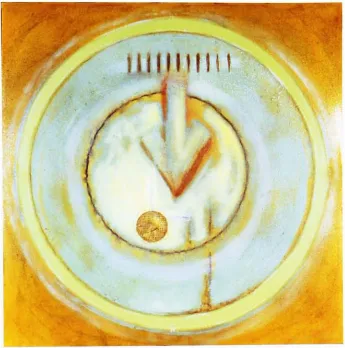
of sickness.Untitled:
detection
(fig. 4),
part one ofthe
four
part series usesthe
arrow asa signifier
pointing
outthe
positioning
ofillness.
This
area,
constructedby
cutting
ahole
through
the
canvas andthen
attaching
aburlap
section,
breaks
*the
symmetricalbalance
ofthe
painting.The
coloration consists of yellows andbluish
greenssuggesting
the
discoloration
of aninfected
area.The
arrowdirects
the
viewerfrom
the
top
down
toward the
foreign
object, the
burlap,
whichis
affixed
to
the
image
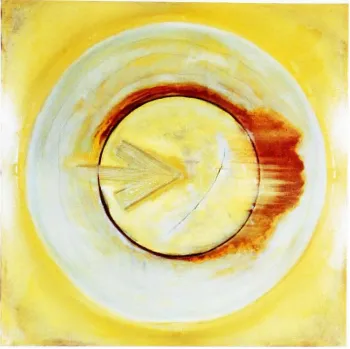
with staples.Untitled:
incision (fig.
5) the
secondpainting
in
this
series wasphysically
slashed
by
aknife
to
obtainthe
affectedtissue,
andblood flows from
withinthe
wound.
The
arrow entersthe
compositionfrom
the
left
as a reddishbrown
stainflows
toward the
right.The
whitebackground
allowsthe
underlayers
of yellowsand
blues
to
surfacethroughout
the
painting.Thin
lines
of graphiteenergy
Figure
4
:Untitled:
detection
[image:16.519.88.433.94.442.2]image is
painted with a softnessthat
aesthetically
engagesthe
viewer anddilutes
the
harsh
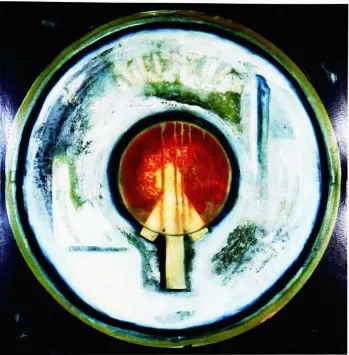
content.Untitled:
penetration(fig.
6)
shovesthe
arrow upwardfrom
the
bottom
ofthe
painting,
penetrating
the
interior
membrane.The
internal
fluid
drips
down
the
penetrating
arrow,
extracting
the
alientissue.
The
circle of white washis
fluidic
andits
fragmentation
allows exposure ofthe
underpainting.The
dark
blues
ofthe
exterior are set againstthe
bright
whites ofthe
large
circlesurrounding
the
redinterior.
The
high
contrast withinthe
painting
resultsin
abold
interaction
between
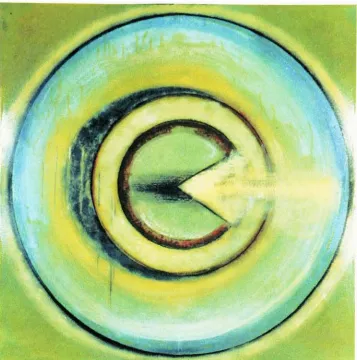
elements.Untitled:
retraction(fig.
7), the
final
movementin
the action,
pullsthe
arrow
away
from
the
interior
ofthe
image.
The
path ofthe
arrowis
partially
obliterated
during
its
retraction.A ring
of rust surroundsthe
internal
void,
suggestive of
the
dried fluid
remaining.The interior
is left
empty,
revealing
afoundation
ofgreen,
unlikethe
rest ofthe
series,
whichhave
highly
textural
interiors.
Sewing
I
became 'inspired
by
the
concept ofhand
sewing images
on canvas whenI
accidentally
stabbedmy
hand
with aknife.
In
the
emergency
roomI
watchedthe
physician sew togetherthe
splayedflesh.
The
act ofclosing my
skin offfrom
the
outside elementsto
promotehealing
was abeautiful
example ofprotection,
suggesting
a solutionto
my
ideas
abouthealing.
This
act andthe
resulting
healing
process reiteratedthe
themesin my
thesis
andinfluenced
its
direction.
Another
very important
aspectto
the
sewn canvaseshas been
their
association
to
the
female
gender.Throughout
history
sewing
was notonly
usedfor
utilitarian purposesbut
also as an acceptableform
of artistic expressionfor
women.
With
the
rise ofindustrialization
andinexpensive
fabricated
clothing,
the
practicaldemand
for
hand
sewing
dwindled,
whilethe
status of womenin
society
rose.Women
began
to
create artbeyond
the
confines ofthe
home
andsewing
lost
the
roleit
once maintained withinthe
female
experience.I've
borrowed
this
traditional
method offemale
expressionto
enhancemy
ownpersonal style and
to
empower'"woman's
work"to
rise above acurrently
diminished
status.Armor
Series
Definition-
Armor:
Covering
wornto
protectthe
body
against weapons...A quality
orcondition
serving
as adefense difficult
to
penetrate. 3These
images disclose
the
nature of armorbuilt
aroundillness
for
the
benefit
ofhealing.
The sewing
procedureis
reminiscent ofthe
scabbing
over of awound on a microscopic
level.
The
body
regenerates new cellsto
makeitself
whole again and
those
fibers-bind
together to
build
a powerful structure ofprotection,
mending
the
open wound andshielding
it from further distress.
Each
painting
is
sewnusing
a predetermined pattern withthe
intended focus
onthe
center of
the
canvas.These
sewn paintings areinitiated
by lightly drawing
the
desired
image
on
the
stretched canvas.Once
the
image is
discovered,
it is
then
methodically
sewn.
Once
the
sewing
is
completed,the
canvasis
thenlayered
withpolyurethane and pigment.
The
pigmentis
applied as awash,
andthen
wipedpainting
appropriates a skinlike
appearance.These
paintings aremonochromatic,
therefore
less
devoted
to
colorrelationships,
with moreemphasis placed on
the
intricate
stitchery.The
textural
aspects ofthese
paintings articulate
my
thoughts
onthe
fascinating
process ofhealing.
The
circle cut out ofthe
center ofthis
painting,
titled
Armor No.
l(fig.
8)
allows
the
viewerto
enterinto
the
wound.The
wound,
physically
opento
the
elements,
is
inviting
the
viewerinside.
Here
we are ableto
examine a panel ofbright
orange,
representative of softflesh.
The
sewn circleenveloping
the
cutoutexpresses
the
buildup
ofenergy
aroundthe
wound.This
buildup
ofenergy
is
poised
in
atightly
organizedfashion,
ready
to
bridge
the
gap
and closethe
interior
space.Armor
No.
2(fig.
9) the
nextstep
in
the
recovery
process closesthe
woundwith a mesh of new growth.
The
fibers
offlesh
built-up
aroundthe
edges ofthe
wound
lash
out acrossthe
open void.These
fibers
then
intertwine
with one'another
to
build
animpermeable
sheathcovering
the
delicate
skin ofthe
wound.This
causesthe.
skinto
become
red andswollen,
irritated
by
the
scabbing
over ofnew material.
All
ofthe
energy
in
this
stage ofhealing
is focused
ontop
ofthe
wound unlike
the
first
stagein
whichthe
energy
is focused
aroundthe
area ofinfection.
Armor
No.
3 (fig.
10)
finalizes
the
process ofhealing.
The
interior
oncein
astate of
disruption
andturmoil, is
now calm and pristine.The energy
has
receded
from
the
center ofthe
canvas andthe
renewed skinis
revealed.A
shadow of
the
injury
remains withinthe
structure ofthe
newflesh,
as well as a3
New World Dictionary. 2nd
ed., s.v.
"Armor",Guralink,
David.ring
ofirritation,
not yetdissolved.
The
outside circlehas begun
to
break down
and once again allows entrance
into
the
shelteredinterior
ofthe
form.
Rebuilding
Connections
An
important
aspectto
recovery
is
the
rebuilding
ofbroken
connections,
both
connections within oneself andlinkages
withthe
external world.These four
paintings expose
the
needfor
andthe
wantto
be
part ofthe
whole again.They
also
begin
to
break from
the
strict symmetrical composition ofthe
otherpaintings.
The
circleis
explored as animperfect,
amorphic,
shapeforging
relationships
to
human
experience,
rather than a shape constructed withmechanical precision.
This
approachto the
series was experimental andemotional,
rejuvenating
my
ideas
andextending
my
conceptsfurther
than
before.
Isolation
(fig.
11)
is
the
link between
the
protection andhealing
paintingsin my
thesis.This painting
speaks ofthe
necessity for isolation
toward the
renewal of strength
for
rebuilding
broken
connections.The
circular shellfloats
within a white
aura,
stillencasing
it
in
a shroud of protection.The dark
atmosphere of
the
background
envelopsthe
circularshell,
glowing
with renewedenergy.
A
suggestive arrowdirects
the
viewer's attentionto the
focus
ofthe
painting,
exposing the
newenergy
from
withinthe
interior
ofthe
piece.Connection
(fig.
12)
brakes
patternfrom
the
previous elevenpaintings,
those
that
have
only
one subject.Two
separate compositional elements arebrought
together withinthe
painting.These
separate elements sharethe
samepictorial space and are connected
by
aline
attachedto
their centers.They
complement one another
in
their spatialrelationship
and coloration.Both
aremaukr%r+
variants of white and are painted with
broad loose brushstrokes.
The
smallersphere sits within
the
yellow protectivebarrier
ofthe
larger
sphere andvisually
grounds
the
form.
The
observedrelationship is
infused
withenergy in
the
form
of
the
yellowring,
which encapsulatesboth forms.
Attraction
(fig. 13)
once again suggeststhe
interaction
oftwo
circularelements.
The
larger intricate
circle pushesdown into
the
picture planeto
address
the
smaller circle.The
interaction
between
the two
shapesis
dominated
by
the
weight ofthe
larger
circle.Scratched lines
of communication connectthe
separate
elements,
although athin
redline
ofhesitation
remains as abarrier
from
completeintegration.
Both Attraction
andInteraction
(fig.14)
share ahighly
textural
surface created by*attaching-layers
of paperto
the
surface ofthe
canvasbefore
painting.Interaction's
surfaceis
enhancedfurther
by
the
peeling away
ofthe
layers
of
paper,
exposing
the
raw canvasthat
lies
underneath.This painting
brings
together
a communion of elementsin
such away
asto
exploreunity
between
separate
forms.
Personal
Inspiration
I've
alwaysbeen
interested in
artthat
either evokes or provokes emotion.Particularly,
I
amfascinated
by
transformativeimages
that
almostforce
usto
contemplate our
relationship
withthe
external world.Many
works of art madeby
famous
artists,
contemporary
artists and even non-artistshave
baffled
my
senses.
I
continually
searchfor
provocativeimages
that
have
tantalizing
andirritating
affects,
toying
with our sensibilities and evocativeimages
that
conjureup
suppressed energies and emotions.I
have
alsobeen
highly
influenced
by
the
roles women
have
played withinthe
history
of art.Mainly,
I
have been
interested in
the
reasonswhy
history
is seemingly
void of "great"female
artists.Subject
vs.Producer:
Women's
traditional
rolein
the
Arts
Historically
women's major contributionto the
artshas
been
assubject,
not as producer.
Countless
images
producedby
countless male artistslabel
the
female,
the
feminine
in
their
portrayal asmother,
lover,
seductress,
deceiver,
andgoddess,
most oftenin
the
form
ofthe
nude.Labeling
the
female
spirit withstrict social roles and
portraying her
so often as an object reinforcesher
inability
to
perform outside a given context.Art
has been defined
by
menfor
men andfrom
menusing
phalliocentriclanguage,
and patriarchal constructs.There
is
noandrogynous construct set
up
to
define
art,
since arthas
alwaysbeen
defined
in
male gender
terms.
When
women's workis
taken
into
considerationthe
artis
most often regarded
only
asfemale
work,
using
gender rolesto
define
the
experience
itself.
Historically
there
was no reason or roomto
define
anything,
in
the
constructions ofideals,
based
uponthe
female
experience sinceit
wasin
a world otherthan that
ofthe
male.In
this
society
where women sharethe
sameexperiences as
men,
they
are stilldefined in
terms
ofhistoric
gender constructs.That
is
where problems arisein
deciphering
female
art.The
oldforms
of analysisare not constructed with a
hermaphroditic
voice,
so a woman'sinvolvement
in
society
has been
attributedto
themappropriating
male traits.Instead,
society
needs
to
recognizehuman
traits,
notthose
of anindividual
gender or race.Gender is better
realized as an accomplishment ofsociety
than
as alaw
of nature.A
quoteby
Renoir
in
aletter
to
a poetfriend
venting
his frustration
with womenmoving beyond
there
"natural
place",
is
aninsightful
look into
the
negativemanifestations of patriarchal constructs.
I
considerthat
women are monsters who areauthors,
lawyers,
andpoliticians,
like George
Sand,
Madam
Adam,
andother
bores
who arenothing
morethan
five legged
beasts.
The
woman who
is
an artistis
merely
ridiculous.Gracefulness is
awoman's
domain,
evenher duty.
I
know
very
wellthat
today
things
have become
worse,
but
what can wedo?
<Although
Renoir's ranting
is
extreme,
this
passagedoes
showthe
barriers
womanin
the
arts and other professionalfields
encounter.Historically
there
were no great women artistsbecause
institutionally
this
wasimpossible;
womenhad
no voicein
the
public arena.After
institutions
cracked open
their
doors
for
women, their
riseto
greatness washindered
by
the
social role allocated
to them.
The
development
of great artistshas been in direct
relationship
to the
acceptance ordismissal
ofthe artist,
by
the
audience.The
audience
has been
manipulatedby
the
institution
of power.The
realm of powerlay
withinthe
language
of man.Those
acceptedby
the
audience orin many
cases
later
audiences,
fit
the
ideal
ofthe
public realm.The
ambivalencetowards
women artists rested
in
the
fact
that
there
is
no comprehensionin
the
language
of man
for
the
experience ofthe
woman.Artistic
Influences
Contemporary
artists such asRothko,
Frankenthaller
as well asthe
philosophies of
the
Dada
andSurrealists
paintershave had
a profoundinfluence
on
my
development
as an artist.These
'artists and philosophieshave influenced
my
transition
into fine
artpainting,
from
aformal
educationin illustration.
As
an
illustrator
I
learned
the
importance
ofclarity
ofintent
and gainedthe
4
Snyder-ott,
Joelynn."The
Female Experience andArtistic
Creativity." WomenCreativity
and theArts. (New York:
Continuum,
1995)
pg. 73.necessary
knowledge
ofthe
physicalto
translate
form into
two-dimensional
visual representation.
I've
internalized
the
basic
technical
components ofpainting
andcomposing,
whichhas
given methe
freedom
to
focus
morein depth
on content.This
knowledge
I
found extremely
important,
evenin
the
development
of non-representationalimages.
Mark Rothko
andHelen
Frankenthaler
both
possess a masterfulunderstanding
of color and color relationships.I
hope
to
strengthenmy
ownknowledge
of colordynamics
andinteraction* by
studying
their
explorations."Constantly
exploring,
reshaping,
andre-evaluating
form
and color.Rothko
gives expression
to
an unparalleled range ofemotions,
moods and sensations."sRothko
achieves a sense ofluminosity
from his
use ofcolor,
-which emanatesfrom
withinthe
body
ofthe
work.This
luminosity
he
achievesfrom
colorinteractions
is
enhancedby
athin
line
of pigment applied withinhis
rectangles or aroundtheir
edges.He
has
the
remarkableability
to
reducepainting
to
it
essence whileconveying
complex relationshipsbetween
color and emotion.Rothko
believed
that
The
progression of a painter'swork,
asit
travels
in
time
from
point
to point,
willbe
toward
clarity:toward the
elimination ofall obstacles
between
the
painter andthe
idea
andbetween
the
idea
andthe
observer...To
achievethis
clarity
is, inevitably,
to
be
understood. 6His
simplistic arrangement ofform
and colorhas
achievedthis
clarity
ofintent,
whileattaining
astonishingly
varied results withinhis
severely
restrictedformat.
National
Gallery
ofArt,
Mark Rothlfo. (Washington DC: YaleUniversity
Press,
1986)
p. 62.Helen
Frankenthaler's
use of colorhas
had
a similar affect onmy
development
as a painter.She
encapsulated an enormous range oftones
withineach color she
discovers,
to
the
pointthat
her
decoratively
flat
paintingsimply
the
possibility
oflimitless
space.Each
colorfinds
its
own shape anddefines
its
personal space within
the
image.
Her
non-representational
paintings evoke emotion and maintain abalance between
spontaneity
and willfulness andbetween intuition
and calculation.This
combination ofdiverse
interrelationships
is
infinitely
difficult
for
any
artistto
accomplish.Conclusion
This
body
of workis
a visual exploration ofmy
experiences withillness,
both
physical andmental,
personally
andby
association.,The
circlehas
remained an essential component within
my
paintings,
andis
reflective ofthe
overall nature of
the
series.The
paintings evolvesin
acontinuum,
beginning
with
detection
andisolation,
traveling
through
the
recovery
process andreturning
to the
reconnection of severedties,
broken from isolation.
The
perfectcircle,
the
amorphiccircle,
the
protectivecircle,
the
sacredcircle,
the
clyclicalcircle and
finally
the
feminine
circle are allexposed,
revealing
my relationship
to
life
andto
living.
Sewing
andpainting, two
diverse
systemsfor
creating,
speak
to the
needs ofthe
imagery
andbalance my
creative energies."Making
artdepends
uponnoticing
things
-things
about
yourself,
yourmethods,
your subject matter.Sooner
orlater,
for
instance,
every
visual artist noticesthe
relationship
ofthe
line
to the
picture's edge.Before
that
momentthe
relationship
6
Ibid.,
p.299.
does
notexist;
afterwardsit's
impossible
to
imagine
it
notexisting.
From
that
moment onevery
newline
talks
back
and
forth
withthe
picture'sedge." ?
This
thesis
is just
onethought-moment
that
willinfluence
the
next,
and
beyond
towards the
resolution ofmy
past andfuture
experiences.This
body
of work reflectsjust
one ofmany
thought-moments,
eachcarrying
me closerto
my
ideal.
The
most crucial aspect ofcompleting
these
paintingshas
been
the
identification
and comprehension ofmy
weaknesses.
The
realizationthat
my understanding
of colorin
insufficient
to
exploitits
powerfulnature,
guidesmy
future
effortstowards
overcoming
suchflaws.
In
conclusionI
believe
these
paintings provokethought
whilesatisfying
my
aesthetic needs
for
expressing
visual messages.They
encourage meto
develop
agreater
understanding
of color relationships andto
continueexploring
andadjusting my
methods of visual expression.I
see no purposein
painting
thatwhich
is
notbeautiful,
ordescribe ideas
that
are not evocative.7
David
Bayles and Ted Orland Art and Fear. (Santa Barbara: CapraPress,
1997)
p. 109.Bibliography
Bayles,
David
andTed Orland. Art
andFear.
Santa
Barbara:
Capra
Press,
1994.Hofmann,
Werner. Hundertwasser. Austria:
Verlag
Galerie
Welz
Salzburg,
1973.Huges,
Robert.
The Shock
ofthe New. New York:
McGraw-Hill,
1991.National
Gallery
ofArt,
Mark Rothko. Washington DC:
Yale
University
Press,
1986.New
World Dictionary.
2nded.
S.v.
"Armor", Guralink,
David.
Snyder-ott,
Joelynn.
The
Female Experience
andArtistic Creativity. Woman's.
Creativity
andthe Arts. Ed.
Apostolos-Cappadona,
Diane.
New York:
Continum,
1995-Terenzio,
Stephanie. Robert Motherwell
andBlack. London
andNew York:
Petersburg
Press,
1980.Walker,
Barbara.
The Woman's
Dictionary
ofSymbols
andSacred Objects.
San