Rochester Institute of Technology
RIT Scholar Works
Theses
Thesis/Dissertation Collections
2006
The Consideration of Camera Testing for Accurate
Color Reproduction Within Museums and
Institutions
Natalie Russo
Follow this and additional works at:
http://scholarworks.rit.edu/theses
This Thesis is brought to you for free and open access by the Thesis/Dissertation Collections at RIT Scholar Works. It has been accepted for inclusion in Theses by an authorized administrator of RIT Scholar Works. For more information, please [email protected].
Recommended Citation
School of Print Media
Rochester Institute of Technology
Rochester, New York
Certificate of Approval
Master's Thesis
This is to certify that the Master's Thesis of
Natalie Russo
has been approved by the Thesis Committee as satisfactory
for the thesis requirement for the Master of Science degree
at the convocation of
May 2006
Thesis Committee:
Franziska Frey
Primary Thesis Advisor
Patti Russotti
Secondary ThesIs Advisor
Illegible Signature
Graduate Thesis Coordinator
Illegible Signature
Graduate Program Coordinator
Illegible Signature
The ConsiderationofCamera
Testing
for Accurate ColorReproductionWithin MuseumsandInstitutions
by
Natalie RussoAthesis submittedinpartialfulfillmentoftherequirements
forthedegreeofMasterofScience
intheSchoolofPrint Media
intheCollegeof
Imaging
ArtsandSciencesoftheRochester Instituteof
Technology
2006
Primary
ThesisAdvisor: ProfessorDr. FranziskaFrey
Title of Thesis:
Thesis Release Permission Form
Rochester Institute of Technology
School of Print Media
The Consideration of Camera Testing for Accurate Color Reproduction
Within Museums and Institutions
I, Natalie Russo, hereby grant permission to the Wallace Memorial Library of RIT
to reproduce my thesis in whole or in part. Any reproduction will not be for commercial
,
use or profit.
Natalie Russo
Signature of Author
Acknowledgments
My
sincere appreciation goes toTheSchool ofPrint MediaatRochesterInstituteof
Technology,
toProfessor Dr.FranziskaFrey
forallherassistance andguidance, andtoProfessor Patti Russotti for her never-endingsupport and encouragement. Iwould also
like tothankNitin
Sampat,
AllenPhillips,
andMichael Hansen for theirongoingsupport.Iwouldliketo thank theYamatoya/Numakura Graduate Research
Fellowship
FundandthePrint
Industry
Center fortheirfinancial support giventome whileworkingonthisresearch.
I wouldalsoliketoacknowledge andthankmyparentsfor
believing
in meandfor providingme with the toolsnecessaryto succeed;to them, Iamforevergrateful.
Lastly,
I am also gratefulfor myanimal companions who makemy lifecomplete.TableofContents
Abstract x
Chapter 1: IntroductionandStatement oftheProblem 1
StatementoftheProblem 1
BackgroundandSignificance 2
Reason for Interest 4
Chapter 2: Literature Review 6
Digital
Imaging
WithintheMuseum Environment 6RIT
Benchmarking
ConferenceKey
Findings 9RIT
Benchmarking
ConferenceDefining
Current Needs 13Color Reproduction 17
Color Management 29
Photographic Considerations 33
The Digital Scanback Camera 39
Software
Technology
45StandardsandCamera
Testing
46Testing
aCamera'sQuality
52Monitor Calibration Standards 53
Metadata 54
Workflow Guidelines 55
Chapter 4:
Methodology
60Chapter5:
Finding
63Camera
Testing
63The Tests in Greater Detail 69
Metadata 86
Usability
87Museum
Photography
89Museum Photographers 92
Chapter 6:
Summary
and Conclusions 96The Four Selected Tests 96
Should Camera Dealers Do Testing? 99
Testing
Services 99Museum Conclusions 100
Camera
Testing
Conclusions 101Chapter 7: Recommendationfor Further Research 102
Bibliography
103Appendix A: A Case
Study
- The DigitalImaging
Workflow ofPhotographer Allen PhillipsattheWadsworth Atheneum MuseumofArt,
Hartford,
CT 106ListofTables
Table 1:The
Benchmarking
AmericanMuseum Project-Key
Findings 10Table 2: The
Benchmarking
AmericanMuseumProject Suggested Future Research 14Table 3a: Wueller's
Mandatory
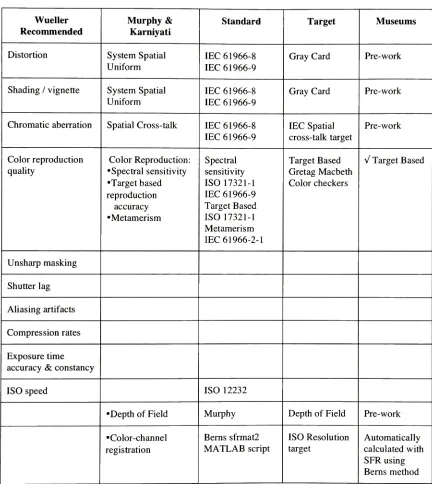
Testing: AComparisonofCamera Tests 67Table 3b: Wueller's Recommended Testing: A ComparisonofCamera Tests 68
Table4: Museum
Photography
Variables 91Table5: Knowledge andSkill Sets Needed for Museum Photographers 94
Table6: Recommended Camera Tests 98
Table BI: List ofstandardsthatare summarizedinthis standardsreview 131
Table BII: Areferencetableforthedigital image qualityparameters ofthediscussed
ListofFigures
Figure 1: Management wheelfor digital
imaging
projects 8Figure 2: The Visual Spectrum 18
Figure 3:
(a)
Theprobable sensitivitycurvesforthethreetypesofcones, withthethreebest R. G. and
B,
lightsforadditive color reproduction,(b)
Typical spectralsensitivitycurves foundfrom
bleaching
experimentswiththehumanretina 23Figure 4: Color matchingfunctionsoftheCIE2standard observer 25
Figure 5: Exampleofnegative colormatching
functions,
aidingtocolor reproductioninaccuracies 27
Figure6: Spectral sensitivities ofatypicalscanback camera 28
Figure 7: Spectral sensitivities ofatypical CCDcamera 28
Figure 8: The LAB color space represents
lightness, hue,
and saturation 30Figure 9: Profile Connection Space as partof an open
loop
workflow 33Figure 10: Trilinearcolor
imaging
sensor 40Figure 11: Functional block diagramoftheKodaktrilineararraysensor 44
Figure 12: Single-channel block diagramoftheKodaktrilineararray sensor 44
Figure Al:
Blume,
Peter,
The ItalianStrawHat, 1952,
Oilonboard,
The WadsworthAtheneum Museumof
Art,
600 MainStreet, Hartford,
CT06103,
TheHenry
Schnakenberg
Fund,
1955.32 1 10Figure A2: RearmountedDaylight Infrared filter Ill
Figure A3: RearmountedDaylight Infrared filter 1 1 1
Figure A4: Johnson Magnetic AngleLocator 1 12
Figure A5: BetterLight
Focusing
Aid 112FigureA7: LaCie Calibrationmenu 1 13
Figure A8: Angle locatorand camera 1 15
Figure A9:
Focusing
aids at either corner ofpainting 115Figure A10: BetterLightcamerahard drive 1 16
Figure Al 1:
Inserting
theBetterLight digital back intothe4x5camera 1 16Figure A12: Theprescannedimage 117
Figure A13:
Focusing
rectangle 117Figure A14:
Focusing
window 117Figure A15: Thefinefocus knobonthecamera 1 17
Figure A16: ColortabintheViewFindermaincontrolwindow 118
Figure A17: Spotmeterspot on eachofthefourmiddlegraypatches 118
Figure A18: Neutralized graypatchinformation 1 18
Figure A19: Tonetabin ViewFinderwindow 119
Figure A20:
Saving
thecustom curve 119FigureA21: Kodak Color Flow Profile Editor 2.1 software 121
Figure A22:
Opening
therespectivefile 121Figure A23: Selective Color 122
Figure A24: Color
Editing
window 122Figure A25: Eye droppertool 122
Figure A26:Selectedcolor 122
Figure A27: Color beforeadjustment 123
Figure A29: Colorcorrectedimage witheditlist 124
Figure A30:
Saving
ICCprofile 124Figure A31: ICCprofile asitappears onthe
desktop
124Figure A32:
Moving
the profileto theColorSync folder 124Figure A33:
Moving
theprofiletotheColorSync folder 124Figure A34: Selectpreferencestofindprofile 125
Figure A35: Selectprofile 125
Figure A36:
Verify
theproper profileisselected 125Figure A37: Set high-resolution image scan 125
Figure A38:
Scanning
thehigh-resolution digital image 126Abstract
Theneed forcolor accuratedigitalimagesfor fineart reproductionisareality
faced
by
art museums andinstitutionsaroundtheworld. Itisthe goalofmostinstitutionstoreplace old,sometimes used andabused,
transparency
archiveswithdigital imagearchives;many institutions have already begunthiswork. Anumber ofdifferent
imaging
systems withvariedworkflows,some
idiosyncratic,
arebeing
usedforthiswork. Thereis,
therefore, an urgent needforthedevelopmentandsharingofworkingmethodsthatwill ensureefficient, consistent,and color accurate results. Theseworkflows must use
camera systemstotheirfullestcapability.Itseemsclear,then,thata complete
understandingofthequalitymetrics usedto assesscurrentlyavailable camera systemsis
thenecessary first step inthedevelopmentofnewly suggestedworkflows.
Thegoal ofthisresearchprojectwastoconsider all ofthestepsnecessary for
photographerstocreatecolor accurateimages offineartfor both archivingand
reproductionpurposes, andtointroducecamera
testing
asthe newstartingpointfordigital
imaging
workflows.Introducing
cameratesting
as part ofimaging
workflows willassist photographers withtheir
imaging
endeavorsby
enablingthem tounderstandwhatqualitymetrics shouldbeconsidered when workingwithdigital
imaging
systems.Thisresearch wasrestricted to thecurrentlyavailable colorimetric
imaging
devices. Oneofthemain concerns withmostdigital camerasisthat their"spectral
sensitivities are not lineartransformationsof an averagehumanvisual system's spectral
sensitivities. Thisis theunderlyingreasonwhycolorinaccuraciesexistin digitalimages"
(Smoyer, Taplin, Berns, 2005,
p. 4). Thisresearchhas been focusedon themostaffective and efficient waysformuseum photographersto accommodateforthis
inaccuracy.
Thisresearch began
by
consideringagroupofcameratestspreviously introducedtomuseums andinstitutions
during
a research project entitledDirect Digital ImageCapture of Cultural Heritage:
Benchmarking
American Museum PracticesandDefining
Future Needs. Thegoalofthisresearch wastoconsider all oftheteststhatwere
introduced,
andtonarrowthetesting
criteriadowntofourorfivetests. This wascompleted andthe
key
finding
suggestthat traditional photographicqualitymetricsremainthemostimportantparameters totest
for,
inordertoensure high qualityphotographic reproductions.
Thus,
thekey
findingsofthisresearchrecommendthat tonereproduction,spatial
frequency
response, imagenoise, and colorreproductionaccuracybetestedforasthefirst step inafineartreproduction
imaging
workflow.Alsoconsideredwithinthisresearch weretheinfluential variablesthatplay a part
in digital
imaging
workflows within museums andinstitutions. These have beenoutlinedandtakeninto consideration
during
the selectionoftherecommended cameratests. Itisthe
feeling
oftheresearcherthatintroducing
cameratesting
tophotographers willhelp
themto understandtheequipment,technology,andworkflowparameterswith which
they
Chapter1
Introductionand
Statement
oftheProblemStatementofthe Problem
Digital
imaging
technologieshavetakena strongholdwithin museumsandinstitutions,
replacing someoralltraditionalphotographicprocedures. Thisshiftintechnologieshascreated a needforphotographerstoadjusttoandtore-educate
themselves inordertoimplementthesenewtechnologies. Althoughdigital
imaging
technologiesoffera wide range of
benefits,
oftenthenecessaryworkflowsare notfully
understood; therefore,thebenefitsare not
fully
realized. Arecentsurvey conductedby
Rochester Instituteof
Technology
(RIT)
scholars points outthat"more thanhalfoftherespondents reportaperceivedlackofknowledgeabout
digital,
howeveramajority feelscomfortablewiththeirinstitutions embracing digital
photography"
(Berns, Frey, Rosen,
Smoyer,
andTaplin, 2005,
p. 1).Theresultsfromthissurvey also pointoutthatthe
top
threereasonsfor digitalimaging
withinmuseumsandinstitutionsare"tomakecollections accessible overtheInternet,
toinclude digital images in a collection managementsystem,andtoproducereproductions"
(Berns,
Frey, Rosen, Smoyer,
&Taplin,
2005,
p. 1). This is a majorconcern
because,
ifimaging
departmentswithinmuseumsandinstitutions arecreatingthentime,money, and man-hours are
being
lost.Whenan artifactisimaged,
itshouldbedone inordertoachievethebestpossible representation ofthepiece.Thiscan allowfor
imagerepurposing for futureneeds,such asthe
Internet, databases,
and reproduction. Butifthegoal when
imaging
is theInternet, databases,
orreproduction,then it islikely
thatthequality ofthearchivalimagewillbecompromisedin orderto fulfillanimmediate
goal
(Berns, Frey, Rosen, Smoyer,
&Taplin,
2005).BackgroundandSignificance
RIT scholarsrecentlyconducted a research projectfunded
by
theMellonFoundation,
entitledDirect Digital Image Capture of Cultural Heritage:Benchmarking
American Museum Practicesand
Defining
Future Needs. Thisresearchprojectwascarried outinaneffortto
document,
toevaluate, andtounderstand thecurrent practicesof
imaging
departmentswithin museums all overtheUnitedStates.Oneofthemain componentsofthisproject was asurveywhichwas available
onlinefora year. Participants frommorethan50museumsfilledoutthe78-question
survey;theresultsestablished aclearunderstandingofthecurrentissues faced
by
museum photographers.
Theresearchers conductingthisproject alsocompletedan in-depth investigation
into fourmuseumsthathadadopted adigitalworkflowearlyon, allowingthem
significanttimetoestablishtheirworkflow. The sametwopaintings wereimagedat each
Theresultsofthe four varyingworkflows andtheinformationgainedfromthe
surveyproject were presented at a conference atRIT in Septemberof2004. Allwho
participated wereinvitedto attendtheconference todiscuss digital
imaging
workflowsandtheavailableequipment, as well astodefinefuture needs
(Berns, Frey, Rosen,
Smoyer,
&Taplin,
2005).The informationgainedfrom boththesurveyandthevaryingresultsofthe
in-depthlookatfour different
imaging
workflows provides a clear picture oftheidiosyncrasieswhichhave alargeeffect onthe
imaging
practices atvarious museumsandinstitutions. One ofthe
key
findingsoftheresearch suggeststhat"it ispossibletodevelop
a single experiential proceduretoevaluate color and spatialquality"
(Berns,
Frey,
Rosen, Smoyer,
&Taplin,
2005,
p. 2). This impliesthatifthecamerasbeing
usedwithin museums couldbeassessedfor qualitypurposes, itwouldthenbepossibleto
construct aworkflowbasedon a conciseknowledgeofthecameras'
performance.
Specifically,
ifa cameraistestedforcolorreproductioncapabilityby
analyzingthespectral sensitivityofthecamera's
imaging
device,
thiswillcreate a startingpointforanticipated deviationfromthe standard observer.Thisisthefirst
discrepancy
inthecolorreproductionprocess; whenthedeviationis
known,
a workflowcanbeconstructed,oradjustedtoaccountforthedeviation.
Another
key finding
oftheresearchis "there isnot a common workflowamongthetested institutions"
(Berns, Frey, Rosen, Smoyer,
&Taplin,
2005,
p. 2). Itwouldbebeneficial ifa suggestedworkflowwasinplacetoassistphotographerswith"howto"
asrequiringnumerousand often complex equipmenttesting.Ifsimple
testing
couldaccessthecondition ofthe
imaging
equipment,a workflow couldbeconstructed andimplementedtoprovide andtoenable greaterqualityandconsistency intheimages
created. Thiswould allowforconsistentimagesforarchivalpurposes, for easy sharingof
digital
files,
andfor repurposingofimages as needed.Reasons for Interest
Personal interest inthe topicoffineart reproduction stemsfromtheresearcher7 s
first-handexperience as a photographerworking ina museum. Employedatthe
Wadsworth Atheneum Museumof
Art,
Hartford,
CT,
theresearcherexperiencedthetrials andtribulationsofassisting inthecreation andinitiationof adigital
imaging
department. The departmentwasoriginally fundedwiththeintentionofproducing fine
art reproductions and catalogues.
However,
onceresearchhad beenconducted andtheequipmenthad beenpurchased, itwasapparenttothephotographersthatreproduction
was notthesolepurposeofthe
imaging
department.Theresearcherworked withphotographerAllen
Phillips;
togetherthey
begandigitally imaging
paintings witharchivalgoals. (A descriptionoftheentire workflow canbefound in Appendix
A.)
Eachimage created couldberepurposedfor differentapplications,such ascatalogues,
brochures,
advertisements, theInternet,
and soon.TheexperiencesattheWadsworthAtheneumMuseumofArtleadtheresearcher
toinvestigatethe topicofdigital
imaging
within museums.Having
received aBFAinplace at
RIT,
theresearcher came across theDirectDigital Image Capture of CulturalHeritage:
Benchmarking
American Museum PracticesandDefining
Future Needsresearch project ontheRIT website. Thisprojectbroughttogetheracommunityof
photographersfrommuseums aroundthecountryto addressissues concerning digital
imaging
practices within museums. Thereportsfromthisproject provide a significantamount ofinformationaboutthecurrent state ofdigital
imaging
withinmuseums,enablingtheresearchertocontinuetheinvestigation withsupportfromthedigital
imaging
community atRIT.Theresearcher would alsoliketohighlightthe
driving
factorsofimaging
projectswithinmuseums andinstitutions.
Imaging
departmentsoften sufferfromsmallbudgets,
andhavetomakedowiththe
imaging
equipmentthey
have."Many
systems usecomponents re-purposedforthis specific application. Asaconsequence,thereisawide
range ofqualityofthese variousimage
archives"
(Berns, Frey, Rosen,
Smoyer,
&Taplin,
2005,
p. 1). Not only mayimaging
departments berestrictedby
asmallbudget,
butthey
may alsoberequiredtoworkquickly,
imaging
certainitemsat specifictimes inspecificlocations. Inaddition,
they
must often caterto thespecificneeds of curatorsormarketingpersonnel. Allofthese factorsandmanymore caninfluencethequalityoftheproduced
digital images.
Thus,
theresearcherhasadesiretoassistimaging
departmentswithinmuseumstomakethemost out oftheequipment
they have,
tohelp
themassesswhatequipment
they
may actuallyneed, andtoillustratetheprocedure ofcreatingarchivalChapter2
LiteratureReview
Digital
Imaging
withinthe MuseumEnvironmentPhotography
isused within museumsforthepurpose ofreproducingartwork.Until recently thistypeofphotography wasprimarilytraditionalinprocess, usingaview
camera,4x5 colorpositive
film,
andtraditionalprocessing.Themostcommonimagescreatedwere4x5 colortransparencies, whichcouldbeusedforreproduction, as wellas
toprovide a referenceforreproductionmatching. Over time,museum photographers and
printersbecame veryaccustomedto this traditionalworkflow.
However,
withtheadventofdigital photography andtheimplementationofthis
technology
withinthephotographyindustry
as awhole,it isnow imperativethatmuseumphotography follows suit.Themigrationfromtraditionalphotographyto digital photographywithin
museumsshouldbeginwith a wellthought-out, long-termplan whichfocusesonthe
creation andmaintenance of adigital imagearchive. Atransition todigital
imaging
requires new equipment,
technically
skilledphotographers,collections managementpersonnel, and adatabase for storing digital
images,
metadata,and objectinformation.Funding
allocatedfortheupkeepandmaintenanceof an archiveofdigital images isalsoessential. Althoughtheserequirements seemclear,
they
are oftennotthemost prevalent(Kenney,
Rieger,
2000).Abby
Smith,
DirectorofProgramsoftheCouncilonLibrary
andInformation
Resources,
states"most digitalprojects aredriven atleast inpartby
strategicinstitutionalconsiderationsthatoften conflict withthewell-ordered andnarrowly
confined parameters of anideal digitalconversion
project"
(Kenney, Rieger,
2000,
p. 2).The digital age andtheInternethavechangedthewaypeopleacquirealltypesof
information.This changeisseen as a
driving
force behinddigitizing
collections inordertoprovide a secureInternetpresenceformuseumsorinstitutions. "Cultural institutions
are
investing
in digitization fortworeasons:First,
they
remain convinced ofthecontinuingvalue of such resourcesfor
learning,
teaching,research, scholarship,documentation,
and public accountability.Second,
they
recognizethatchanginguserbehavior may jeopardizetheseresources andtheirstewardship"
(Kenney,
Rieger,
2000,
p. 1). The trendin digital
imaging
isbeing
drivenby
the demand fordigitally
accessibleinformation viatheInternet. This is beneficialtoamuseum or
institution,
as wellastotheuser,because
by
makingcollectionsavailable overtheInternet,
imagesofart andartifacts canbeviewedfromanywhereintheworld. This increasedaccessisone ofthe
most valuable aspectsofdigital
imaging
projects.Digital accessdecreasesphysicalaccess, which canbe favorabletoanartifact, aswellasfavorable fortheresearcher who
willsavetimeandmoney
by
nothaving
to traveltothelocationofthe artifact(Kenney,
Rieger,
2000).Digitalimagearchives are now
being
viewed asinstitutional assets,andthis trendhas asignificantimpactonthevalue ofthe
digitizing
initiative. It isapparentthatimagestimeof conception.The developmentand maintenance of an efficientdigital
imaging
system relies on thedecisionsmade at each stage ofthe
imaging
process. These decisionsaffecttheusage oftheimagesnow andinthefuture. Intheir
book, Moving Theory
intoPractice,
Kenny
andRieger(2000)
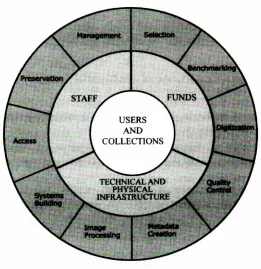
present a managementwheelfor digitalimaging
[image:21.564.152.413.210.479.2]programs. (See Figure 1.)
Figure 1. Managementwheel for digital
imaging
projects. [Source:Kenney, Rieger, 2000,
p.6]
Thiswheelillustratesall oftheelements ofadigital
imaging
project. Atthecenterofthewheel are users andcollections. Themiddleringrepresents theinstitutional
resources madeupofthe staff,
funding
andtheinfrastructure,
bothtechnicalanddigital
imaging
program,including
preservation,access, systemsbuilding,
imageprocessing,metadatacreation, qualitycontrol,
digitization,
benchmarking,
selection,andmanagement. Itis suggestedthattheinstitutionalresource elementswithinthemiddle
ringofthemanagement wheel"willenhance or constrain digitizationprograms"
(Kenney, Rieger, 2000,
p.6).However,
it is imperativethatall aspectsofthemanagementwheel are considered atthe timeofinitiationand aremaintainedforthe
future inordertoprovide an efficientdigital archival system capable ofservingusersfor
yearstocome
(Kenney,
Rieger,
2000).RIT
Benchmarking
ConferenceKey
FindingsThe RIT-basedresearchproject,Direct Digital ImageCapture of Cultural
Heritage:
Benchmarking
American Museum PracticesandDefining
FutureNeeds,
establishesthecurrent statusofdigital
imaging
projectswithinAmericanmuseums.Principle investigators
Roy
Berns andFranziskaFrey,
alongwithresearchersMitchellRosen,
ErinSmoyer,
andLawrenceTaplin,
completed(July
2005)
twoyears ofworkinvestigating
thetopic. Thekey
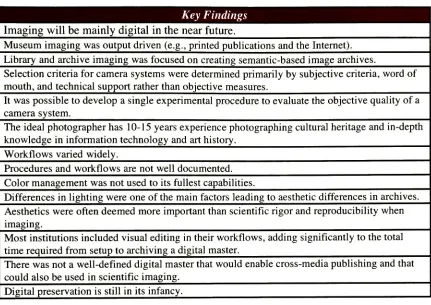
findingsoftheprojectarelisted in Table 1Table 1. The
Benchmarking
American Museum Projectkey
findings.Imaging
willbe mainly digital inthenearfuture.Museum
imaging
was outputdriven(e.g.,printed publications andtheInternet).Library
and archiveimaging
wasfocusedoncreatingsemantic-basedimagearchives.Selectioncriteriaforcamera systems weredetermined primarily
by
subjectivecriteria,wordof mouth,andtechnicalsupport ratherthanobjective measures.Itwaspossibleto
develop
asingleexperimental proceduretoevaluatetheobjectivequalityof a camera system.The idealphotographerhas 10-15yearsexperiencephotographingculturalheritageandin-depth knowledge in informationtechnologyand arthistory.
Workflowsvaried widely.
Proceduresand workflows are notwelldocumented. Colormanagement was notusedtoits fullestcapabilities.
Differences in
lighting
wereone ofthemainfactorsleading
toaestheticdifferencesinarchives. Aestheticswere oftendeemedmoreimportantthan scientific rigor andreproducibilitywhen imaging.Most institutions includedvisualediting intheirworkflows,adding significantlytothe total timerequiredfrom setuptoarchivingadigitalmaster.
Therewas notawell-defineddigitalmasterthatwould enable cross-mediapublishingandthat couldalsobeusedinscientificimaging.
Digitalpreservationisstillin its infancy.
Eachofthe
key
findings listed illustratestheneedforguidance and supportstheconcerns associated withdigital
imaging
projects withinthemuseum environment. Forexample, the
key finding
that output,either ontheInternetorinpublicationformat,
isthedriving
force behind digitalimaging
initiativesisagreatconcern,because ifresources areallocated andutilizedforthecreation ofadigital
image,
thenitis mostbeneficialiftheimage beofarchival quality. Theother
finding
relatedto thisis "therewas not awell-defined digital masterthat would enablecross-mediapublishing andthatcould alsobe
usedinscientific
imaging"
(Berns &
Frey, 2005,
p.l). Althoughtheresearchindicateshas beena considerationforsome timenow.
Kenney
& Rieger(2000)
givethisexample:"thereisagrowingsupportforcreating digitalmastersthatare rich enoughtobeuseful
overtime and cost effective.This position presumesthatconversion standards are set
higherthantheimmediaterequirements"
(p. 25). The discussion ofthecreation ofdigital masterfiles leadsto considerations about equipment
evaluation, characterization,and workflow guidelines.
Thefindingsfrom Direct Digital Image Capture of Cultural Heritage:
Benchmarking
AmericanMuseum PracticesandDefining
Future Needs indicatethat thetransition from analogtodigitalphotographyiswellunderway."Over halfofthesurvey
respondentstookat least 90%oftheirphotographs
digitally
in 2003...[which]
was allhappening
despite aperceivedlackofknowledgeaboutdigitalimaging by
the practitioners"(Berns &
Frey, 2005,
p. 55).There is also awiderangeof
imaging
workflowsamongmuseumphotographers,notmanyofwhichhave been documented. The findingsalso suggestthat thereis little
structureto theevaluation ofdigital
imaging
equipmentpriortopurchase (Berns &Frey,
2005). Thissuggests thattheevaluationof a camerasimaging
quality isoverlookedwhenpurchasing decisions are
taking
place. Although"procedures fortesting
thequalityofdigital camerashave beenestablishedintherecent
past"
(Smoyer, Taplin,
&Berns, 2005,
p.
1),
they
haveyettobe implemented intothemainstream museum environment.Thisis becausethe tests"arenot yet suitable andcomprehensive enoughtobeusedinamuseumsetting andhavenotbeen developed specificallyforthedirect digitalcapture of
artwork"
aware ofthepossibilityof cameratesting, perhaps individualcameraimage quality will
now beconsideredwhen purchasingdecisions are
being
made.The
key
findingsfromtheDirect Digital Image Capture of Cultural Heritage:Benchmarking
American Museum PracticesandDefining
FutureNeedsproject alsoindicatethatmost of museums surveyedhavenotfulfilled
benchmarking
procedurestothefullestcapacity.
What exactly does
benchmarking
mean?Kenney
& Rieger(2000)
statethat"benchmarking
is primarilya managementtool,designedtoleadtoinformed decisionmaking about a rangeofchoices andanunderstandingoftheconsequences ofsuch
decisions"
(p.24).
Considering
thefindings ofDirect Digital Image CaptureofCulturalHeritage:
Benchmarking
American Museum PracticesandDefining
FutureNeeds,
it isclearthattheimplementationof
benchmarking
proceduresdoesnot alwayshappen atthebeginning
ofthe transitionfrom analogtodigitalphotography;however,
itwouldbebeneficialif it did.
Benchmarking
procedurescanassist a managementteamindefining
the terms ofitsproject.
According
toAnne R.Kenney
inMoving Theory
intoPractice,
thecategoriestoconsiderwhen
benchmarking
are: requirementsdefinition,
measurement, tolerancevalues andverification. Requirements definitionconsistsofassessing "source documents
and
identifying
thevariables associated withquality,cost, and/orperformance"
(Kenney
&
Rieger, 2000,
p. 24). Themeasurementscategoryconsistsofgatheringanddocumenting
data,
objectivelycharacterizingmaterial,anddetermining
thevariabletonal range, scanningrequirements
(resolution, bit-depth),
andthecorrespondingimaging
metrics (MTFand signal-to-noise
ratio)"
(Kenney&
Rieger,
2000,
p. 24). Thetolerancevaluescategoryrecommendsto"determine howmuch
variance"
willbetolerated
throughout the workflow,as well asfordifferentqualityrequirementsfor differentimage
usages
(Kenney
&Rieger,
2000,
p.24). The verificationcategoryofbenchmarking
requires approval and modificationtothebenchmarkedproceduresthrough
testing
andprocedure evaluation
(Kenney
&Rieger,
2000).Benchmarking
procedures can"reduce bothexperimentation andthe temptationtooverstate orunderstate
requirements"
(Kenney
&Rieger,
2000,
p. 24). Thedevelopmentofbenchmarkedprocedures, such as camera
testing
andworkflowdocumentationforadigital
imaging
project,allowsfora consistent and controlledworkflow thatmay beadjustedtoensurehigh imagequality.
RIT
Benchmarking
ConferenceDefining
Current NeedsTheoutcome oftheDirect Digital Image CaptureofCultural
Heritage-Benchmarking
AmericanMuseum PracticesandDefining
Future Needsprojectisanassessment ofthe currentpracticesofdigital
imaging
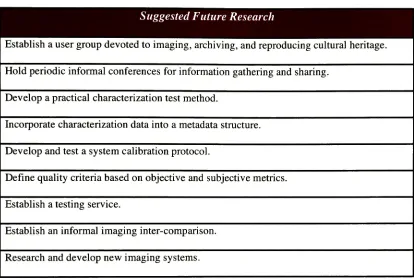
withinmuseums and suggestionsforthefuture. Thesuggestionsfor futureresearchanddevelopmentarelisted in Table 2
Table 2. The
Benchmarking
AmericanMuseumProjectsuggested futureresearch.Suggested Future Research
Establishausergroup devotedto
imaging,
archiving,andreproducingculturalheritage.Holdperiodicinformalconferencesfor information gatheringandsharing.
Develop
apracticalcharacterizationtestmethod.Incorporatecharacterizationdata intoa metadata structure.
Develop
andtestasystemcalibration protocol.Define qualitycriteriabasedonobjective and subjectivemetrics.
Establishatestingservice.
Establishaninformal
imaging
inter-comparison.Researchand
develop
newimaging
systems.Theneedforcamera
testing
proceduresis a recurrentthemeamongthefindings.To
"develop
apractical characterization testmethod...andtoestablishatesting
service"
arelistedas areasforsuggestedfuture research(Berns&
Frey, 2005,
p.2).Partofthisproject was anin-depth lookatfour different
imaging
workflows,alongwith objectivecharacterizationofthefourcamera systems. Thetestsusedtocharacterizethecameras
foreach workflow were complex. Thegoalistobeableto"consolidatethe
characterization procedure
by
reducing thenumber oftargets thatmustbeimaged"(Berns &
Frey, 2005,
p.59). Targetconsolidationisneededbecause some ofthe targetsThetargetsare not specifictodigital
imaging
withinmuseums, andthey
are notoptimized forthistypeof characterization.
Therefore,
it isproposedthattesting
procedures and targetsbecreatedspecifically fordigital
imaging
workflows withinmuseums.
Aconcern alsoregardingthecurrent camera
testing
proceduresis thecomplexityofthedataprocessing. Itis desirabletocreate "anapplicationtoguidea noviceuser
through the
testing
procedure...[including]
instructionsforcaptureofthe testimagesandautomaticprocessingoftheimages data...[aswell asa] metric
report"
(Berns &
Frey,
2005,
p. 59). Theestablishment of atesting
servicethatcould providea metrics reportisalsodesirable because itcould serve as"an importanttool for
industry
togaugetheirmeasurementqualitycompared with each otherandwithstandard
instrumentation"
(Berns &
Frey, 2005,
p.61). Atesting
servicecouldalso serve as acatalystforimproving
imaging
technology
by
allowingphotographerstocommunicatetheirneeds.Alsolisted for futureresearchis thedevelopmentand
testing
of"asystemcalibration
protocol,"
aswell astheincorporationof"characterizationdata intoa
metadata
structure,"
bothofwhichareexamples of
benchmarking
procedures(Berns &Frey,
2005,
p.2).The developmentof asystem calibrationprotocol will require a set ofstandard conditionsforeach componentofan
imaging
system.These componentsinclude"lighting,
camerasetup (exposure time,dynamicrange,depth offield,
magnification,etc.),colormanagement,file formatandencoding, metadata, and
workflow"
(Berns&
Oncea system calibration protocolhas beenestablished, therespective
imaging
system canbeadjustedtothe protocol,resultinginanimagearchivethatconforms to the
standard conditions. Asystem calibration protocol would allow standardization of
imaging
procedures, allowingformultipleimagearchives created underthesameimaging
conditions,regardless of where theimaging
tookplace. Thiswould reduceimageappearancediscrepanciesand allowfor easy sharingof archives.
However,
whether or not animaging
systemhas beencalibratedtoa setstandard,the
imaging
procedures withinagiven system areimportanttodocument. Theimaging
procedureisreferredtoasthesystem's characterization. Thecharacterization ofany
imaging
systemis likethe system'sfingerprint. "Characterization datacanbealsobeusedtodetermine asystem'srepeatabilityand
reproducibility"
(Berns &
Frey, 2005,
p.60). Ifcharacterizationdata isstoredwith animage'smetadata,it isthenpossibleto
know under whatconditionstheimagewascreated.
"Including
thecharacterizationdatainanimage'smetadata structureensuresthatanimagewillnotbeseparatedfromthe
imaging
systemcharacteristics"
(Berns&
Frey,
2005,
p.60),
thusallowing fortherepeatability andreproducibility of aspecificimage withthespecific
imaging
systemcharacteristics.
The Direct Digital Image Capture of Cultural Heritage:
Benchmarking
AmericanMuseum Practicesand
Defining
FutureNeedsresearchprojecthasestablished aclearassessmentofthecurrentstatus andthecurrentneeds ofthe digital
imaging
environmentwithinin museumsintheUnited States. It hasprovidedan excellentfoundationforthe
eagertocommunicatetheneedsof photographerswithinthisindustry. Thisresearch
serves as a catalystforchange, encouragingtheprogressionof
imaging
technologies,imaging
procedures,andcommunitycommitment.Color Reproduction
Introduction
Thediscussionofdigital
imaging
requires areview of color managementtheory.In ordertoutilize color management
theory
tothefullest,
it is helpfultounderstand colorreproduction,how it
developed,
and whatit is basedon. Itis first helpfultorealizethat"coloris apropertyoflight"
(Fraser, Murphy,
&Bunting, 2005,
p. 5). Withoutlight,
thereis novisiblecolor.Thenext considerationis that, inordertoexperiencetheevent of
seeingcolor, theremustbeanobserver,alightsource, and anobjector scene. 'Thecolor
eventisasensation evokedintheobserver
by
thewavelengths oflightproducedby
thelightsource andmodified
by
the object;if anyofthese three things changes, thecoloreventis different...we see adifferent
color"
(Fraser, Murphy,
&Bunting, 2005,
p.5).The Visual Spectrum
Lightisone onthemain componentsto thevisualcolor experience. Without
light,
thereis nocolortobeseen. "Butalllight isn'tcreated equal: thecharacteristics ofthe
light haveaprofound effect on ourexperienceof
color"
(Fraser, Murphy,
&Bunting,
2005,
p. 6). Light energy isclassified asphotons.Aphotonis "a fundamentalpacketofparticles, andinother ways photonsbehave likewaves"
(Fraser, Murphy,
&Bunting,
2005,
p. 548). Eachphoton exists with a specificenergylevel,
which doesnot affectthespeed at whichittravels (sincethespeed oflight isconstant); rather, theenergy level
determines how fastthephoton pulsates. Thehighertheenergy levelthe photon
has,
theshorterthewavelength at whichthe photon pulsates. "Thespectrum refersto thefull
range ofenergy levels
(wavelengths)
thatphotonshaveasthey
travel throughspace andtime"
(Fraser, Murphy,
&Bunting, 2005,
p.7). The visual spectrum referstothepart ofthespectrumtowhichthehumaneyeissensitive. Thevisual spectrumrangesfrom
approximately 380 to700nanometers
(nm)
(Fraser, Murphy,
&Bunting,
2005). Figure 2illustratesthevisual spectrum.
Thespectrum
short wavelengths(high energy) longwavelengthsflowenergy)
1n m 1000nm 1mm 1m 1km Ml'"motors 10
'*
Id' 10'
10"
10
|__________|____HBB
viilblstightFigure 2. Thevisual spectrum.
[Source:
Fraser, Murphy,
&Bunting,
2005,
p.7]
The humaneyehas varyingresponsesto thedifferentwavelengths withinthe
as red andorange), andtheshort wavelengths (400nm)evoke coolcolors(such asblue
andviolet.) Thevisual spectrum rangesfromredtoorangetoyellow togreento
blue,
andfinally,
toviolet.There are also wavelengthsjustoutsidethevisual spectrum which canindirectly
affecthumanvision.Forexample, whenfluorescentagentsare presentinobjects such as paperor
laundry
detergent(in clothingonce washed), theseagents willabsorbnon-visible photonsinthe
ultra violet
(UV)
region oftheelectrometricspectrumand emitvisiblephotons,causingthephenomenon referredto as
fluorescence,
creating abrighterappearance. Infrared
(IR)
photons are also concernsfor digitalimaging
devices.Mostdigital
imaging
devicesarehighly
sensitive toinfraredand,therefore, must containaninfrared filtertoabsorb non-visibleIRphotons priorto thementeringthe
imaging
device
(Fraser, Murphy,
&Bunting,
2005).Understanding
thevisualspectrum oflightisanimportant aspect ofunderstandingcolormanagement,aswellasunderstandingthe
humanvisualsystem.
The Human Visual System
Colormanagementin thedigitalage stemsfromcolorscience andfromcolor
appearance models. Anunderstanding ofthehumaneye andhowcolorisreceived and
interpreted
by
thebrain isessentialtounderstandingall aspectsofcolorreproduction."Thesensation of coloris caused
by
electromagnetic radiationof variousfrequenciesbeing
receivedby
theconesintheretina"
(Rajala, 1995,
p. 1). Theretina, located inthebackofthehumaneye,is madeupofathinlayerof photoreceptorcells referredtoas
presentintheopticalimage intochemical and electrical signalsthatcan betransmittedto
the laterstages ofthevisual
system"
(Fairchild, 2005,
p. 4).Next,
thesignals are"processed
by
anetwork of cells andtransmittedto thebrainthroughtheopticalnerve"
(Fairchild, 2005,
p. 4). This is howthehumaneye andbrainworktogethertocreate theexperience of seeing.
Thephotoreceptor cellsinthe retina, therodsandcones,serve differentvisual
functions. Therods allowforvision atlowluminance
levels,
andthe conesallowforvisionathigh luminance levels. Rods and conescanfunction separatelyortogether,
depending
ontheluminanceconditions. Thevisual color experienceis dependentonthecones withintheretina.
Therearethreetypes ofcones andonlyonetypeofrod,makingtherodsunableto
aidthecolor vision experience. Thethree typesof coneswithintheretinaallowing for
color visionareknownas
L, M,
andScones.Thesenames are usedtodescribethesensitivity functionofthecones,respectively,
long-wavelength,
middle-wavelength, andshort-wavelength (sometimesreferredtoas
RGB,
red, greenandblue). It is importanttonotetherelativedistributionofthe
L,
M,
andSconesthroughout theretina. "TherelativepopulationoftheL:M:S cones areapproximately 12:6:1 (withreasonable estimates as
highas
40:20:1)"
(Fairchild, 2005,
p. 10). Thisconedistributionrequires extraconsideration whenaddressing issues of visual response. That
being
stated,it istheseL,
M,
andScones withinthehumanretinathatallowfor humancolorvision,andthey
alsoTrichromaticColor Reproduction
"Theretina contains three typesof cones whichfilterthe
incoming
electromagnetic radiation
forming
thebasisforthethreecolorprimary systems usedintelevision,printingand photography.That
is,
any color canbereproducedby
combiningdifferentamounts ofred,green andblue
primaries"
(Rajala, 1995,
p.1)
Although anycolor canbe visuallycreated
by
combiningvaryingamounts oftheprimarycolors,
reproducing anycoloris
technically
not so simple.The investigationoftrichromaticcolorbegan inthe 1700s.In
1722,
JakobChristoffel LeBlon iscreditedwithprinting usingathree-color technique. In
1807,
"Thomas
Young
wasinstrumental in gaining general acceptancefortheviewthatitistheretina ofthehumaneye thatisresponsibleforthis triplefeatureof
color"
(Hunt,
2004,
p. 9).In
1861,
JamesClark Maxwellcreatedthefirstcolor photographusingatrichromatic technique. It is Maxwell'swork whichhas hada
lasting
effectonthetrichromaticcolor process. Maxwellcreatedacolor photograph
by
capturingthesamescenethroughared,green, andblue
filter,
andfromthenegativeshecreatedthreepositive slides. Heplaced each ofthe three positive slidesintoseparate projectors, with
respectivered, green,andblue filterswith whichtheimagewas projectedthrough,and at
last,
afullcolorreproduction ofthephotographwas created. "Theprinciple ofhis(Maxwell's)
method,reproductionof allcolorsby
mixtures, in varyingamounts,ofresourcesthemethod itself (triple projection)can produce resultsofvery high
quality"
Hunt
2004,
p. 9).Trichromatic Limitations
Althoughtrichromatic color reproductionissuccessful atreproducingmost
colors, it hassomelimitationswhichpreventit from
being
abletocolorimetricallyreproduce all colors.Thespectral response curves ofthe
L,
M,
andScones withinthehumanretina mustbe determinedfirst inordertoaddresscolor reproduction
(Hunt,
2004). Bothmethodsofdirectmeasurement andindirectmeasurement of"thelight
reflectedbackthrough the pupil oftheeye,havegiven similar
results"
(Hunt
2004,
p.l1),
400 500 600 7O0
[image:36.564.155.405.79.350.2]Wavelength(nm)
Figure 3.
(a)
Theprobablesensitivity curvesforthe threetypesofcones, withthethreebest
R, G,
andB,
lights foradditive color reproduction,
(b)
Typicalspectralsensitivitycurvesfound from
bleaching
experiments withthehumanretina. [Source: Hunt
2004,
p.12]
Itis clearfrom figure 3that the sensitivitycurves ofthethreeconetypeswithin
theretinaoverlapconsiderably;thereisalso adebateaboutthelocationofthecurve
peaks. Some suggestthecurves
L, M,
andSpeakat440nm, 530nm,and565 nm,respectively,while othersindicatethepeaks areat
440,
545,
and580nm. Theoverlappingofthesensitivitycurvesofthe threeconetypeswithintheretina causesthe
mostconcern. Theusefulness ofthesensitivitycurves ofthe threeconetypesis the
abilityto transmitluminance informationatthesamewavelength
(using
suitablefilterstothe spectrum with whichtheMcones are solely sensitiveto, "no filtercanbe foundto
transmitlightthatstimulatesthe" Mconesonly Hunt
2004,
p. 13). Toaccountfor this,one must select"a filterthat transmitsanarrowbandoflight inthe green part ofthe
spectrum at a wavelength of about5 1 0nm as shown astheG in...[Figure
3]
...whilethebandsoflightpassed
by
thered andbluefilters arethosemarkedR andB"
(Hunt, 2004,
p. 13).
Hunt
(2004)
furtherstates,.. .
[it]
isthusclearthattheinability
ofany beamsofred,green, and blue lighttostimulate theretinal conesseparately introducesabasic
complicationintothewhole oftrichromatic color reproduction.Ifthe
p andb (L and
S)
curvesdidnotoverlap intheblue-green part ofthe spectrum,thengreenlightcouldbefoundthatstimulatedthe y-cones (Mcones)on theirown;but,
sincethepandb (LandS)
curvesdo overlapappreciably, they-cones (Mcones) cannotbesimulatedontheirown. Forcolorvision,thisoverlappingprovidesthebasis forgooddetection
of changesin huethroughout thespectrum.
But,
forcolorreproduction, itmeansthatsimpletrichromaticmethods cannot achieve correctcolorreproductionforall colors. The
difficulty
cannotbeavoided, because itstemsfromthebasicnatureofhumancolorvision;theresultisunwanted
stimulations inreproductionsystems (p. 13).
The CIE Standard Observer
The International CommissiononIllumination
(CBE)
is awell-established,internationally
recognizedorganization dedicatedtothestudyand progression of colormanagement systems. Tocontinuethediscussionoftrichromaticcolor reproduction
limitations,
considertheCIE2 standard observer.Duetothevaryingcolor visionbetween
individuals,
"the CIEhas comeupwiththeconcept ofthestandardobserver"
(Sharma,
2004a,
p. 83). "The CIE has specifiedthreeprimary colors and conductedthespectrum"
(Sharma,
2004a,
p.83). The results ofthesestudies were publishedin1931,
andthey
are referredtoastheColorMatching
Functions(Sharma,
2004a). Figure 4isa representation ofthestandard observer colormatching functioncurves.
350 400 450 500 550 600 650 700
Wavelength(nm)
Figure 4. Color matching functionsoftheCIE2standard observer. [Source:
Sharma,
2004a,
p.84]
TheCIE's 1931 2
standard observer colormatching functionprovidesthe
spectral reflectancecurves, aswell as amathematicalrepresentation oftheaverage
human'scolor vision at a2viewingangle. The 2
angledescribestheviewing angle at
theeyewhenthevieweris
looking
at anobject 18inches,
orata normal viewing distance(Sharma,
2004a). "ThisobserverreceivestristimulusvaluesCIE XYZ froma spectralstimulus(pk accordingtowherex(k), y(k),andz(k)denote thestandard spectralmatching
functionsandk is determinedfromthenormalization ofY= 1 forthespectral stimulus of
theilluminant"
(Hill, 2002,
p. 1).However,
duetothephenomenaknown asmetamerism,"differentspectral stimulicpx mayresultinthe sameXYZvalues,"
appearthesameunderoneilluminantanddifferentunder another
(Hill,
2002,
p.l).Thiscanbe both beneficialand problematic beneficialbecause itallows forcolormatching
across awiderange ofmedia, butproblematicbecause "each image capturing device
exhibitsitsowndevicemetamerism. Colorstimuli
being
metamerictothestandardobserver are nolongermetamericfortheimage capturing
device,
andtherearedevicemetameric colors
looking
differenttoanobserver"
(Hill,
2002,
p. 2). Metamerismconsidered, it isthegoal of
imaging
devices tomimic thestandardobserver'strichromaticcolorvisionusingthree channelstomimic the spectral response ofthe
humaneye.
However,
becausetheLand Sconeresponsesoverlapconsiderably, Hill(2002)
statesthatcameras...wouldruninto severe problemsof electronicnoisewhen separating technicalcolorsignalslike sRGB tocontroloutputdevices...Thisis
becausenoise componentsalwaysaddupeveniftristimulusvaluesare
subtracted. Butcorrect coloranalysiscanalsoberealized
by
three technicalsensors with spectral responsivitiesderived from any linear transformofthecolormatching functions. Thisallowsoptimizedseparationofspectral responsivities of camerachannels and scanners
with respecttobestelectronic signal-to-noiseratio.
However,
again adraw backcomes in duetothefactthatresponsivitiesoptimized inthis
wayexhibit negativepartslike allcolormatching functionscorresponding
torealizableprimarycolorsdo. Since ahighsignal-to-noise ratioisthe
moreimportant feature in imagecapturing,all presentcameras and
scannersusean approximationto thepositivepartsofthesecurvesonly.
Asaresult,thereoccurinevitableerrorsofcoloranalysisinallourpresent
&(W
WW
A
//
'I!
if
g
V
t
1
rs(W
V Wnm
[image:40.564.189.380.79.211.2]400 500 600 700
Figure 5. Exampleof negative colormatching
functions,
aidingtocolorreproductioninaccuracies. [Source:
Hill, 2002,
p.5]The Color Reproduction
Inaccuracy
Reality
Foraccurate colorreproductionusingadigitalcamera,it is ideal ifthedigital
camera's spectral sensitivities matchthespectral sensitivities ofthehuman visual system.
"Strictly,
a camera's spectral sensitivities shouldbealineartransformationofthehumanvisualsystem'sspectral sensitivities. That
is,
throughalineartransformation,theL, M,
andS sensitivities arewell-estimated.
Thus,
CIE color-matchingfunctions,
whichdonotresemble
L, M,
andSsensitivities, meetthiscriterion"
(Berns,
2001,
p. 2).However,
mostdigitalcamerasdonotmeetthis criterion, andthis isthemaincause of colorinaccuracieswithindigital images. Forexample,Figure 6 showsthe
difference between humanspectral sensitivities andatypical scanbackcamera, thetype
mostoften used whenphotographingartwork. Thesolidlinesarethecamera's spectral
beseenin Figure
7;
herethespectral sensitivitiesof aCCDimaging
deviceareillustratedin solid
lines,
andthedashedlines illustratehumanspectral sensitivities.380 430 480 530 580 630 680 730 780
Wavelength,nm
Figure6: Spectralsensitivities
of atypical scanback camera.
[Source:
Berns, 2001,
p.4]
380 430 480 530 580 630 680 730 780
Wavelength,nm
Figure 7: Spectralsensitivities
of atypicalCCDcamera.
[Source:
Berns, 2001,
p.7]
Itisclearfromthesecurvesthatthereisalarge difference inthesensitivities
ofhumansand
imaging
devices,
thuscausingalargeproblem when coloraccuracy isthegoal. Itis importanttorealize thatcoloraccuracy is only one ofthecriteria
consideredwhen
designing
adigitalcamera. "Low-lightsensitivity,imagenoise,resolution,read-outspeed,manufacturing costs,and soon allmustbeconsidered.
Many
ofthesedesigncriteria aremutuallyexclusive; thefinal design isalways a
compromise"
Color Management
Device-Dependent Color
Digitalcameras, scanners,and monitors operate intheRGB
(red,
green,andblue)
color space.
Printing
devicesuseCMYK(cyan,
magenta,yellow, andblack)
inktoproduce prints. Therange of colors capable of
being
producedby
eachdeviceis referredto asthedevice gamut.Alldevices behave
differently,
whetherin thewaythey
acquirecolor
information,
represent colorinformation,
orreproducecolorinformation(Sharma,
Color,
2004). Forexample, ifthesamedigital image file isprinted outwithidenticalRGB values usingtwodifferentprinters,theprintsmay look
different,
orwhenthesameimage is scannedusingtwodifferent scanners,theRGBpixel valuesmay be different.
"Theconclusiontodraw fromthis isthatCMYK (and
RGB)
arebasically
instructions foradevice anddonotinthemselves tellus whatcolorapixelwillbe"
(Sharma, 2004a,
p. 14).
Therefore,
eachdevice is dependentonitsowngamut and calibration.Thesedifferences createtheneedforcolormanagement.
Device-IndependentColor
Colormanagementsystems arenecessary toreproduce accurate colorinan
all-digitalworkflow. Thequestionsare howto color manageand
by
what standards?The CIEhas establishedan
internationally
recognizedstandard usedfordevice-independentcoloridentification. "CIE systemsformthebasis forcolor management. The
LAB systemisusedinprofilegeneration and isalso usedin Photoshop. The
Yxy
system2004a,
p.15).CIELAB,
officially knownasCIE 1976L*,
a*,b*,
isthesystem ofnumeric coloridentificationthatcorrespondstoa colorbasedonits positionin a3Dcolor
space. Figure 8 illustratestheLAB color space. "ThecoordinateL* standsfor
lightness,
a*
representstheposition ofthecolor on a red-greenaxis, andb* representsthe position
ofthecolor on a yellow-blue
axis"
(Sharma, 2004a,
p. 15).TheYxy
colorsystemusesa2-dimensionalgraph calledthechromaticity diagramtoplotthex andycoordinatesof a
color. CIEcolor specification systems are reliablemeasurement systemsthatincorporate
theuse ofmeasuring instrumentstocolorimetrically evaluate color.The CIELAB
colorspaceis usedtocreateICCprofiles andisalsousedtocalculate Delta
E,
whichis aquantitativewayofmeasuringthedifference betweencolors of a printedreproduction
(Sharma,
2003).Figure8. The LAB colorspacerepresents
lightness,
hue,
and saturation.Color Profiles
Digitaldevicessuch ascameras, scanners, monitors, and printers produce color
thatis device-dependent.Thismeansthat thesame colormay look
different,
depending
on whichdevicereproduces it. The factthatdifferentdevicesreproducethe same color
differently
creates abig
problem whenperformingcolormanagement. Thisis theprimaryreason whycolor profiles are necessary. Profiles areusedto transformdevice-dependent
hardware into device independentcolor spaces. "Colorspacedefinitions"
(King,
n.d.,p.2)
are profiles usedto transformdevice-dependenthardware into device-independentcolor spaces.
The International Color Consortium
(ICC)
"wasestablishedin 1993 forthepurpose ofcreatingandpromotingthestandardization of anopen, vendor-neutral,
cross-platform systemfor managing
color"
(Romano &
Riordan, 2003,
p.221). The ICC isanindependentorganization whichwasfounded
by
thesecompanies:"Adobe, Agfa,
Kodak,
Taligent, Microsoft,
Sun,
andSilicon Graphics...[today]
theICC isopentoallcompanieswho workin fieldsrelatedtocolor
management"
(Sharma,
2004a,
p. 22). The ICCstandardized"colorspacedefinitions"namingthem"profiles"
(King,
n.d., p 2). ICCcolorprofiles are createdusingthedevice-independentCIELAB color space
(Sharma,
2003).Profilesarecommunicationtoolsallowing forthecorrectinterpretationof color
image
data,
regardless ofthetypeofhardwareor softwarebeing
used. Profilesarecreatedusing acombination of softwareand
hardware,
such asspectrophotometersandcolorimeters, which are usedtomeasurethecolorsofmonitors,or printedtargets. The
accountedfor. An ICCprofile iscreatedtoadjustforthedifference betweentheknown
targetandthedevicecapabilities. Productssuch asGretagMacbeth'sEye-Oneprofile
solution system andX-Rite's ColorMasterSoftwarecanbeusedtocreateICC profiles
(Bury,
2004).Profile Connection Space
ICCcolor management provides a standard referencespace, knownastheprofile
connectionspace, whichis usedtotransmitprofileinformation
(King,
n.d.). Anall-digitalworkflow canspreadover awide varietyofmonitors andprinting technologiesin
different locations. These devicesrequireareference point sothat
they
can all representaccuratecolorwithout
having
tobeconnectedtoone another,asina closedloop
system.The difference betweenaclosed
loop
andanopenloop
color management systemistheability foran open
loop
systemtocommunicate accurate colorinformationtoany deviceoperatingthrough theprofileconnection space.Inan open
loop
workflow,each device isindependent,
andconsistentcolorusing ICCprofilesrequires communicationwiththeprofileconnection space. Sharma
(2004a)
furtherstatesthat...
[every]
devicemusthave a profile.Thus,
weneed a scanner profile forascanner,amonitor profileforamonitor, and aprinterprofileforaprinter. Agoldenrule ofcolor managementis 'image +
profile' ...Ina typicalworkflow, images fromascannermay be 'broughtinto' theprofile
connectionspaceusingthescanner profile. Toprinttheimageitwould
be 'sentout'
fromtheconnectionspaceto aprinterusing a printer profile.
Thus,
color management operations requirea source and adestinationprofile-we needtoknow wheretheimageis coming fromand whereit is
going. Anothergolden ruleincolor managementis 'profile-PCS-profile'
Proofing
systems have benefitedfromcolor-managementsystemsbasedon ICCprofilingcapabilities. Forexample,"thesetechnologieshave allowedinkjetsimulations
offinalpress
results"
(Felici,
2004,
p. 7). Figure 9 illustrates howan openloop
workflowusestheprofile connection space.
/
Profile
connection
V
Figure 9. Profile Connection Spaceas partof an open
loop
workflow. [Source:Sharma, 2004a,
p.157]
Photographic Considerations
Filmvs. Digital
Imaging
technologieshave undergoneatransformationinrecentdecades.equipment,
leading
tocolor managementissues,
aswellastotheneedtounderstandthe new challenges presentedby
thisnew technology.Digital imagecapture variesgreatlyfromfilmcapture. Fraserand Raw
(2004)
state offerthisexplanation:
Filmmimicstheeye's responseto
light,
whichishighly
non-linear.. .Perhapsthebiggest difference between shooting filmandshooting digital
isthe waythe twodifferentmedia respondtolight. Filmrespondstolight thesamewayour eyes
do,
butsilicondoesnot(p.l).Forexample, filmcansufferreciprocity
failure,
which "meansthat theresponse(density)
of a photographic material cannotbepredicted solely fromthe totalexposurea film hasreceived(exceptover a smallrangeofexposuretimes)"
(Stroebel, 1990,
p. 121).In otherwords,
during
long
shuttertimes,thebuild-up
of exposurebeginstoblockthe lightilluminating
onthefilmastimepasses; this slowsdowntheresponsetimeofthe film.Thus,
alongerthananticipatedexposureisrequiredtocompletelyexposethe image.Filmnotonly hasanonlinear responseto
light,
italsocomes with anembedded,predeterminedtonalcurveresponse. Each different filmtypehasauniquecurve, applicable foradesiredresult. Different films have differentqualitiesfor varying
reproductionobjectives.These differencescausethefilmtorespond
differently
to the illuminant intermsofbothtonaland color response. Filmismadetogive apleasingresultinresponsetoanaveragescene. Differenttypesoffilm may beused when
during
imagecapture and alsothroughexposure anddeveloping
variations(Kodak,
2005).
Digital
imaging
technology
differsfrom filmtechnology
mostly inthedigitalimaging
sensors responsetoanilluminate.Theterm"raw"inreferencetofiletypeisused inconjunction withdigital
imaging
technologies.Arawdigitalfile isadirectrecordoftheluminancedatacollected
by
thedigitalimaging
sensors. Rawfilesaremadeofunprocessedlinear datathat are captured
by
theimaging
sensors, whichcountthephotonsreachingthesensor.
Wherefilm hasa predetermined embeddedtonalcurve,rawcameradata does not.
Typicaldigital
imaging
sensors thatacquiredata inthis formare referredtoas"mosaicsensors"
or"colorfilter
array"
cameras. Color filter arraycamerashave a
two-dimensional arraythatismadeupof rowsand columns of photosensitivedetectors. These
detectorsareusuallymadeupofCCD (charge-coupled
device)
orCMOS(complementary
metaloxide semiconductor)technology.Thesearethesensorsthatcountthephotons andthus"produce achargethat's
directly
proportionalto theamount oflightthatstrikesthem"
(Fraser, 2004b,
p.l).The initialdatacaptured
by
thesensorsis ingrayscale.Hence,
thecolorfilterarray isalsoresponsiblefor creatingcolorimages usingthegrayscale data. This is
possiblebecauseeach elementin thecolorfilter array is filteredsothatit is only
responsivetored, green,orblue light. Thecolor receptiveelements arepatterned,
commonly inaBayerpattern,sothateachsensorycapturestherespectivelight fora
ring,"
whichisstoredinthemetadata ofthe
file,
thegrayscaleinformationforeach pixelisconvertedtocolorinformationwhenthefileenterstherawconverter. Becausethe
photo sensors are spacedin apattern, theraw converter also relies onthemetadatato
interpolatethe"missing" colorinformationfortherespectivecolor
by looking
toapixel's nearest neighbor.Thisprocess isreferredtoas
demosaicing
(Fraser,
2004b).The Raw Digital Image
Whena rawdigital fileentersintoa raw converter andgoesthrough the
demosaicing
process,it isthenreadytobe"developed."Developing
a raw image fileallows forthe
following
imageaspectstobeselected: whitebalance,
colorimetricinterpretation,
gammacorrection,and noise reduction.Whitebalancecanbesetoncamera;
however,
this is simplyacquired asinformationwhichis addedto thefile'smetadata. Whenaraw fileentersintotheraw
converter, theconverter will eitherusethe white
balancing
information fromthemetadata ortheconverterwilldeterminethewhitebalance itself
by
analyzingtheimage.However,
whitebalancecan alsobeselected or adjustedby
the operator.Colorimetric interpretationof arawfilerequirestherawconvertertoassign
"specificcolor meaningsto thered,green, andbluepixels, usually inacolorimetrically
definedcolor spacesuch asCIE
XYZ"
(Fraser,
2004b,
p.3).Gammacorrectionisthemostimportantaspect oftherawconverter,because we
rely onthis steptobeableto "see"anormal
looking
image.Becausedigitalimaging
mustbe appliedtoit inordertoaccountforthe differenceintonalresponsebetweenraw
dataandboth filmandthehumaneye. "Theraw converter applies gammacorrectionto
redistributethe tonalinformation sothatitcorresponds morecloselyto thewayour eyes
seelightand
shade"
(Fraser, 2004b,
p.3). Thegamma/tonecurvedeterminesthelight-to-darkrelationshipwithinthevisible
image,
anditcan alsobeadjustedby
theoperatorinan efforttoenhancethedesiredresults createdthroughtherawconversionresponse.
Thenoisereduction, antialiasing, andsharpeningsteps
help
toensuretheimagedetailthatmay becompromisedthroughthe
demosaicing
process. Digitalrawconvertersarerelatively newto the
imaging
industry;
priorto theirintroduction,
raw conversionmost oftentookplace withinthecamera,beforethedigital file wasdownloadedtoa
computer.Theimportantaspectofoff-cameradigitalraw convertersisthat
they
allowfor