Professional Access Control
by
Leigh Howard de la Motte, B.Comp.
A dissertation submitted to the
School of Computing
in partial fulfilment of the requirements for the degree of
Bachelor of Computing with Honours
University of Tasmania
Declaration
I, Leigh de la Motte, declare that this thesis contains no material which has been accepted for the award of any other degree or diploma in any tertiary institution. To my knowledge and belief, this thesis contains no material previously published or written by another person except where due reference is made in the text of the thesis.
Abstract
Acknowledgements
Special thanks go to my Supervisor, Jacky Hartnett, for her patience and her ability to keep me on track. The encouragement she gave made the whole process much more pleasant. Her advice on security concepts and insightful comments regarding my work, were extremely important.
Peter Vamplew and Jacky Hartnett provided good support and advice in their roles as Honours Coordinators.
I would also like to thank all the health practitioners and administrators that have contributed ideas. Especially, thanks to Chris Showell and Justin Thurley, from the Department of Health and Human Services, for their time and input into this project. Their advice and comments greatly assisted the development of a practical solution.
Christian McGee and Greg Frith were very helpful with assisting me to set up Oracle. Andrew Spilling and Rick Smith provided great tech support during the year. My thanks also go to Claire Tomlim and Heather de la Motte for proof reading this document.
Table of Contents
Chapter 1
Introduction...1
Chapter 2
Background...52.1 Patient Medical Records ...5
2.1.1 EHRs, Data ownership, Consent and Duty of Care...5
2.1.2 Increasing Threats against Medical Records...6
2.2 Hospital Environment ...7
2.2.1 Patient Movement...8
2.2.2 Staff Movement ...8
2.2.3 Openness to the Public...8
2.3 The Professional Environment and Ethics ...8
2.3.1 System Admin vs Professional Decisions...9
2.4 Implementation Requirements ...10
2.5 Hospital Environment Pros and Cons...12
2.6 Discussion ...13
2.6.1 Who Makes Authorisation Decisions?...13
2.6.2 Business Rules and Policies ...14
2.6.3 Summary ...15
Chapter 3
Related Work...163.1 Basic Access Control Terminology ...16
3.2 Mandatory and Discretionary Access Control: ...17
3.3 Role Based Access Control:...20
3.4 Team-based Access Control:...22
3.4.1 TMAC Versions ...22
3.4.2 TMAC Deficiencies...23
3.6 Organisation-Based Access Control:...25
3.7 Provisional Authorisation Models:...26
3.8 Auditing: ...27
3.9 Clark-Wilson: ...28
3.10 Middleware: ...28
3.11 Review of Existing Models...29
Chapter 4
Method ...314.1 Workflow Analysis...32
4.2 Model Analysis...32
4.3 Team Definition...32
4.4 Model Development ...33
4.5 Model Implementation...34
4.6 Functional Testing ...36
4.6.1 Testing Procedure ...38
4.6.2 Testing Sequence...38
4.7 Scenario Verification ...39
Chapter 5
Results and Discussion...405.1 Hospital Scenarios ...40
5.2 Models...42
5.2.1 The Trusted Access Control (TAC) Model...42
5.2.2 The Professional Access Control (PAC) Model...46
5.3 Oracle PAC Toolkit ...57
5.4 Simulation Test Results ...59
5.5 Validation Results...61
Chapter 7
Further Work ...69
Chapter 8
References...71
Appendices
List of Figures
Figure 1: Player Categories...16
Figure 2: General Access Control Principles...17
Figure 3: Mandatory Access Control...18
Figure 4: Discretionary Access Control...19
Figure 5: Role-Based Access Control...20
Figure 6: Team-Based Access Control...22
Figure 7: Team Concept Differences...24
Figure 8: Provisional Access Control...26
Figure 9: Method Flow Diagram...31
Figure 10: Foundational Access Control Models...43
Figure 11: Trusted Access Control...44
Figure 12: Staff Roles and Units ...48
Figure 13: Team Staff Categories ...49
Figure 14: Professional Access Control...50
Figure 15: PAC Access Method #1...53
Figure 16: PAC Access Method #2...54
Figure 17: PAC Access Method #3...55
Figure 18: PAC Access Method #4...55
Figure 19: Applications using the Oracle PAC Toolkit...58
List of Tables
Table 1: Hospital Scenarios ...42Table 2: Example of the Current Hospital State Table...59
Table 3: Example of the Changes Table...60
Table 4: Simulation Test Results...62
Chapter 1
Introduction
Much research has been done into developing access control systems for health related environments. Even after all this work, no clear system has emerged that meets the requirements in an efficient way. The two main reasons for this are the obvious complexity of the health domain and the inherent difficulties in successfully implementing new systems in such a volatile and changeable environment. Access control systems are at the foundation of such networks. Thus, any investment that is made for incorporating new access control mechanisms is substantial, both in terms of finance and personnel training.
Many sophisticated and clever access control solutions have been developed. While many of them have shown promise, there has been a tendency to reject them on the basis that they are either too inflexible or hard to implement.
Occam’s razor, which is attributed to the 14th century English Franciscan friar, William of Ockham, states that, ‘When two viable explanations are offered for a phenomenon, the simplest full explanation is preferable.’ (Wikipedia date unknown) Applying his principle to the complex domain of hospital access control would suggest that if a simple solution to the problem can be found which meets the requirements, then that solution will be good. With this in mind, the aim of this project was to try to find a simple, low-impact solution to the access control problem.
put appropriate access control systems in place. To enable organisations to take this step, access control solutions need to be tailored so that they can efficiently meet the demands placed on them. They need to take the organisational environment and requirements into account in order to provide access control mechanisms that are efficient and usable.
This thesis focuses on the problem of finding a suitable access control solution which can be incorporated into public hospitals. It deals with the aspect of user authorisation and does not cover the aspect of user authentication. In the State of Tasmania all public hospitals are run by the State Government Department of Health and Human Services (DHHS). The solution proposed in this thesis is therefore focussed somewhat on meeting the access control requirements within DHHS controlled hospitals. The DHHS made it clear that a workable solution must guarantee availability of records to clinicians, to ensure they are never denied access to information necessary for clinical decision making. In addition, for the solution to be acceptable it could not introduce any additional work for users. While DHHS patient records are still largely paper-based, the current state of access control in the hospitals in question is that all clinicians have access to all the electronic hospital records of all patients. The solution seeks to provide a system which can easily be implemented and that gives access to users on a need-to-know basis.
One of the positive factors in the hospital domain is the professional ethical environment that already exists. Clinicians are well aware of their duty to maintain patient confidentiality. Peer review processes and evidence-based practice are also now commonly used within the health system. The solution proposed here seeks to make use of these positive factors to provide a system which is highly usable and easily managed by the clinicians who will have to use it. This thesis promotes the view that in such environments, there is fundamentally no reason why informed users should be more incompetent or unethical in their management of access issues than system administrators. The solution should therefore allow system administrators to take a back seat as far as hands-on control is concerned. Their role in such a system would be one which entails role management, monitoring and auditing rather than direct control.
The first thought was to use an existing access control model to facilitate the solution. It was found that while a number of existing models showed potential, no one model was able to meet the access control requirements of the system. Most of the existing models, including the popular Role Based Access Control (RBAC) model, rely on specifying access privileges in advance. This can be a very complex task. The volatile nature of the team situation and the need to satisfy all possible access scenarios meant that such models were not suitable. The solution therefore needed to knit together the positive features of the existing models with new features tailored for handling volatile teams in the professional environment.
While the solution was aimed at meeting the requirements in the local domain, it is of such a general nature that it can be used in other hospital domains. There is also potential for it to be extended to other domain types where volatile teams are used. This thesis also raises some fundamental access control issues and proposes two new access control models. The fundamentals of the models are covered, but the technical details, such as the mathematics, are not.
Chapter 2
Background
2.1 Patient Medical Records
Traditionally medical records have been stored on paper, with images such as X-Rays stored in hardcopy form in formats such as PACS. Records are increasingly being stored in digital formats, providing various storage, distribution and access advantages (Coiera 2003, pp. 118,119). Increased security requirements come with these advantages. The important consideration for hospital records is that users need to be restricted to seeing only relevant records, but they need to be able to access those records easily.
2.1.1 EHRs, Data ownership, Consent and Duty of Care
It is worth noting that much work is being done to try to come up with a national system for using and storing individual patient records, termed Electronic Health Records (EHRs) (Englebardt & Nelson 2002)
There is no general agreement globally on who actually owns medical records. For example, in the UK, it is considered that the patient owns their own record, whereas in the US, the practitioners are considered to own the record. Information privacy is increasingly becoming a legal consideration which institutions and practitioners must take into account. In the United States the Health Insurance Portability and Accountability Act (HIPAA) of 1996 requires that access to health information be tightly controlled. (Nanda 2004) (Reuters 2004)
National Electronic Health Records Taskforce submitted a comprehensive report to health ministers which proposed a uniform data protection regime across Australia with individual participation based on informed consent (NEHRT 2000). National privacy legislation which is applicable to health records has also been put into place (The Office of the Federal Privacy Commissioner 2004). The Commonwealth HealthConnect initiative (Czapski & Creevey 2003) (HealthConnect 2002) includes detailed guidelines with relation to patient consent. Patient consent is seen as important in order to gain consumer trust. (Win et al. 2003, p. 6)
While these aspects may seem irrelevant to the issue of access control in a hospital, it is worth noting that any legislation which specifies data ownership or consent requirements will affect access control requirements. Regardless of specific legal regulations, the bottom line is that a hospital collectively and practitioners individually, have a duty of care with respect to maintaining the confidentiality and integrity of patient records. Protection of a patient’ s records means only allowing individuals who have been granted permission by the patient to access their data.
2.1.2 Increasing Threats against Medical Records
When evaluating medical record security requirements and the cost-effectiveness of solutions, it is necessary to take a long term view of the potential threats that may come against a system. It is not sufficient just to assume that no-one is really interested in medical records. Schneier (2000, p. 66) emphasises that “medical information is about as personal as it gets”. He notes genetic predisposition to disease, abortions and reproductive health, emotional health and psychiatric care, drug abuse, sexual behaviours, sexually transmitted diseases, HIV status, physical abuse as sensitive personal information. Patients have a right to expect that their medical records are adequately protected. This is increasingly important as the amount of digital data stored increases.
the United States documented the recent hacking of 5,000 administrative patient files from one of the country’s top hospitals (CSD 2000).
Identity theft is a high-growth area of crime (Schneier 2000). The collection of personal information is becoming a major industry in itself. In the United States, the Federal Trade Commission (FTC) identified 200 firms - 175 of them on the Web - that offer to collect personal financial information and then sell it to third parties, in violation of federal law (CSD 2001b).
It is worth noting that not all attacks necessarily come from the outside. Kropp & Gallaher (2001) reported that a significant number of organizations have experienced an insider security lapse, costing an average of about a quarter-million dollars per incident. There is also the possibility that evidence of medical errors can be erased by insiders if integrity controls are not present.
2.2 Hospital Environment
A hospital ward is a dynamic environment in which patients, visitors and staff constantly come and go. Staff members have many different roles – administrative, clinical and service related. Practitioners may work directly for the hospital, be in private practice, or be contracted to the hospital from another organisation. To add to the confusion, all these different categories of people are mingled together.
Conditions on different wards can vary significantly due to the nature of the ward. While hospital wide management practices exist, practices may also vary from ward to ward.
2.2.1 Patient Movement
In the course of their treatment, patients are often moved between wards. It can be that they are transferred to a more appropriate ward according to their current condition, or that they temporarily go to a service unit, such as the X-Ray unit, for a short term procedure. While these movements occur, at any one time a particular patient is considered to be under the care of a particular ward.
2.2.2 Staff Movement
Each staff member is basically associated either with a particular ward (or wards) or a particular care unit. As such, some staff members are generally static in that they work a whole shift in one location, while others are not – they can care for patients in a number of different locations. There is also a degree of flexibility within the work structure in that staff can be moved from quieter to busy wards as needs are determined. As well as this there is the shift-based nature of the work to consider.
2.2.3 Openness to the Public
Many places in a hospital are open directly to the public. In other places certain visitors are allowed, maybe at specified times. There is little to stop an individual with intent from going virtually anywhere within the hospital.
2.3 The Professional Environment and Ethics
The American Heritage® Dictionary of the English Language (AHD 2000) describes the adjective professional as “ characterized by or conforming to the technical or ethical standards of a profession” . The question is, “ Should the existence of a professional environment be considered when designing an access control system?”
occur. This study shows that it is important to consider the professional environment.
Computer security is much more than just a technical IT access problem. The largest security weaknesses in IT systems are the people in the system. Schneier (2000, p. 255) goes as far as saying, “ People often represent the weakest link in the security chain and are chronically responsible for the failure of security systems” . Mandatory Access Control is often thought of as being foolproof – but what if the system administrator is corrupt or a system user has obtained access by using fraudulent identification? In fact, all system users, with the exception of hackers, initially gain system access by completing some human-to-human identification/ authorisation process. In many cases this stage can be the greatest security risk.
The vast majority of Health professionals pride themselves on their ethical practice. Being a professional entails conformity to regulations, professional codes of behaviour, and relevant organisational policies. Breaches of these standards can result in severe personal repercussions. The very reason why it is uncommon for system administrators to be corrupt is because they are professionals and there are consequences if they are found wanting. There is no reason why health professionals should behave more irresponsibly given that they are informed of their responsibilities and that the system supports appropriate security policies.
In fact, the hospital environment is one of high ethical standards where it is easy to facilitate peer review systems. It is, however, important that hospital policies and staff professional development includes appropriate IT security requirements (Webb et al. 2003).
2.3.1 System Admin vs Professional Decisions
Who should manage access to digital health records – the system administrator, the health professionals, or both?
There are two key issues here; what is meant by maintaining the security of patient records; and the importance that is associated with providing protection. Pfleeger (2000, p. 9) identifies the three primary qualities of data security as confidentiality (preventing unauthorized disclosure), integrity (preventing unauthorized modification), and availability (preventing denial of authorized access). IT security theorists and system administrators tend to place an emphasis on the aspects of confidentiality and integrity. For example, many access control models have been constructed which deal with confidentiality and integrity, but few if any, have dealt with availability. Health professionals, in contrast, place a high emphasis on having all the relevant information about a patient available, so that they can make informed clinical decisions.
The professional control issue can be compounded if conflict over the importance of availability versus confidentiality and integrity are not resolved. Health professionals naturally tend to see limiting availability to records as a threat, while system administrators naturally see a need to restrict confidentiality or integrity breaches as they reflect badly on their professionalism. There is obviously a need for policies which clearly spell out priorities in these areas. On balance, it seems that that the vast majority of patients are clearly more concerned about their health than the security of their records. Therefore, an access control model which makes availability a priority is preferable.
The ideal access control model would, it is suggested, give health professionals 100% guaranteed access to all relevant records while maximising confidentiality and integrity safeguards. This all needs to be done in a fashion that minimises implementation and running costs, and maximises system usability.
2.4 Implementation Requirements
(Englebardt & Nelson 2002, pp. 322-324) (Lam 2003, p. 4). This aspect is magnified when users are already busy. Security is also dependent on usability. Schneier (Schneier 2000, pp. 260-262) states the most insecure system is the one that is not used and that such a system is often not used because it is just too irritating. He goes on to say that smart security designers know that users find security measures intrusive and that they will work around them whenever possible. It follows that a system which uses day to day workflow to enforce security, hiding it behind-the-scene, will be more successful that one that increases user workload.
Englebardt & Nelson point out that usability is multidimensional and includes:
x Ease of using an application;
x Ease of learning;
x Ease of remembering interaction methods;
x User satisfaction with system use;
x Efficiency of use;
x Error-free/error-forgiving interactions; and
x Seamless fit of an information system to the task(s) at hand.
Implementing a system can be a complex task that is more than just technical. Webb et al. (2003), Doolan (2003), and Parry & Tucker (2003) list key considerations as:
x Taking the perspective of the clinician into account;
x Developing competencies relevant to the application;
x Organising and implementing a training program to fit in with workforce constraints and the need to maintain client services;
x Policy Development;
x Consideration of the underlying processes and workflows in their entirety and within the relevant context;
x Developing and continuously updating a migration management plan that focuses on maintaining clinical productivity and quality;
x Building, monitoring and maintaining momentum, principally by engagement key members to “ driver” changes.
x Encouraging innovation; and
These useability and implementation issues show the considerable advantage that a simple system can provide. Past experience of implementing a complex middleware solution (Hartnett 2002) has also highlighted the need for simplicity. To this end, the implementation developed uses an off-the-shelf product that is already in use in the target domain (Oracle is used by the DHHS). In consideration of the importance of taking the perspective of the clinicians into account and on providing user satisfaction, the solution provides 100% availability of patient records. In any case, a simple, usable, and efficient system is better than no system at all – which is effectively the case at present in the state’ s public hospitals.
2.5 Hospital Environment Pros and Cons
To conclude discussion of domain conditions, it is worth noting the major pros and cons that preliminary research and personal communications with health practitioners unearthed. On the positive side:
x A strong ethical environment exists;
x Computers are already used for everyday work;
x A team environment is established;
x Peer review principles are in place; and
x Computers are increasingly being used for medical communications.
On the negative side:
x Different procedures exist in different wards/units;
x The environment is rapidly changing (volatile);
x The domain is open to outsiders;
x There is generally a poor understanding of computer security issues;
x There is often a poor view of computer usefulness;
x Implementation cost tends to be a big problem; and
2.6 Discussion
2.6.1 Who Makes Authorisation Decisions?
Consider the three basic types of people in the hospital environment in terms of the IT system. They are the System Administrator (sys admin), the User (health practitioner), and the Owner (the patient generally). Authorisation decisions are made by all three of these classes of people. For example, the patient can consent for a health care worker to access their record. A health care worker can, usually with the patient’ s consent, refer the patient to a specialist. The sys admin can authorise a user to perform certain accesses.
For the sake of efficiency it is better if the person making the authorisation decision enables the access in question. As the patient does not have any input into the system, someone has to implement the accesses which they authorise. The worker closest to the scene is the health practitioner currently dealing with the patient. Wherever it is reasonable for them to do so, they should implement the patient’ s decision. Similarly, when a fellow practitioner needs to be authorised to perform an access, the closest person to the scene is generally another user. For maximum efficiency they should be enabled to make the authorisation. Consequently, efficiency is maximised if the users can authorise each other to perform accesses. This, in most aspects, reflects how the paper-based record system operates. It is therefore reasonable to postulate that changing to a digital system that reflects the paper-based system will maximise usability and implementation efficiency. System administrators should be left to do the high level tasks rather than being dragged onto the wards to do the patient-user and user-user authorisation tasks.
usability and security. It is a matter of maximising the benefits to find the correct balance. Ideally, normal workflow mechanisms can be used to make the authorisations happen. For example, access for a clinician to a patient’ s record can be triggered by the patient’ s admission to a ward where the clinician is working.
2.6.2 Business Rules and Policies
In order to have an authorisation system that works efficiently it is important, for the reasons outlined previously in Section 2.3.1, that everyone works together towards a set goal. Thus, it is vital that hospital management take the responsibility for making appropriate policy decisions and ensuring that all staff members honour the policies developed. Policies must clearly define user responsibilities, detail steps to deal with security breaches, and provide mechanisms for policy reviews and upgrades.
As mentioned previously, system administrators should ideally be left to deal with the high level authorisation tasks. These would include overall user management, system auditing, breach detection and response. Administration should concentrate on efficient monitoring rather than hands-on authorisation tasks.
The requirement for guaranteed availability comes at the cost of having to allow emergency accesses where prior access privileges cannot be given in advance. The potential for abuse of the emergency access mechanism necessitates that breach detection and response mechanisms be built into the system. The volatility and unpredictability of the environment dictate that the response mechanisms must be flexible enough to deal with unforseen occurrences. It is therefore necessary that the solution not be prescriptive in nature or require complex privilege reassignments in reaction to every unforseen situation.
2.6.3 Summary
Research into the hospital domain indicates that the solution should:
x Guarantee user access;
x Not increase user workload;
x Minimise the burden on system administrators;
x Be incorporated with normal workflow processes;
x Be flexible enough to cope with volatility and unforseen circumstances;
x Take advantage of the professional environment;
x Take the perspective of the clinician into account;
x Be easily implemented;
x Not be prescriptive in nature; and
Chapter 3
Related Work
This section deals with relevant practical and theoretical work in the area of access control. Before going on to look at individual models and principles, the basic access control terminology used throughout the thesis is introduced.
3.1 Basic Access Control Terminology
In order to contrast existing access control models and to introduce the new models in an understandable fashion, each model will be represented in a similar, related diagrammatic form. This section introduces the diagram format and briefly summarises basic access control principles.
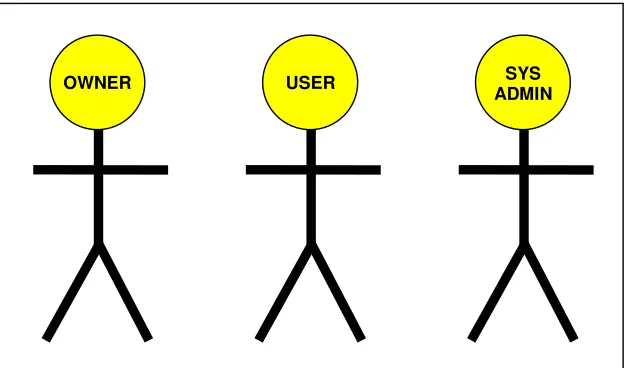
[image:24.612.184.496.504.688.2]There are three basic categories of people involved with a computer system – System Administrators, Users and Owners. These are represented by the three stickmen in Figure 1. In the remaining model figures circles represent individual players.
Figure 1: Player Categories
USER ADMIN SYS
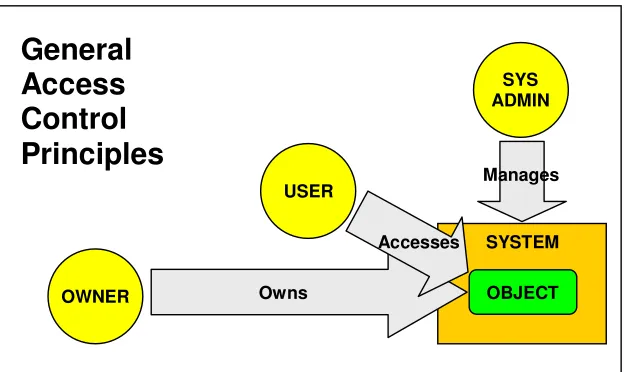
Figure 2 lays out the basic relationships between the players and the computer system. A system administrator manages the system. The system contains objects (for example, data), each of which has an owner. Users are players who seek to access the objects. System administrator, owner and user are the generic access control terms for the players. In a real domain the players are usually known by other terms. For example, in the hospital domain, system administrators may be known as IT services personnel, the owners as patients or clients, and the users as health practitioners or staff members.
Figure 2: General Access Control Principles
3.2 Mandatory and Discretionary Access Control:
MAC and DAC are both fundamental access control models. They have been around for several decades and form the basis for most access control implementations.
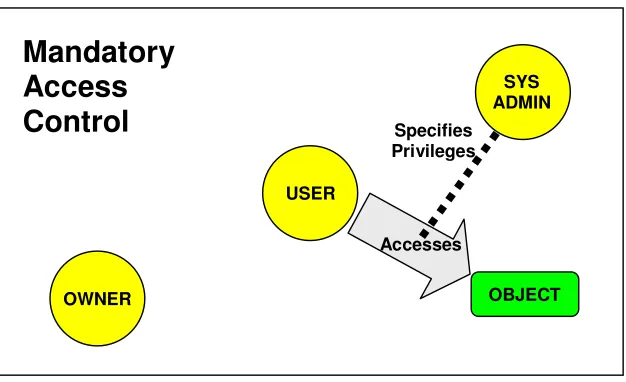
MAC invests all the power in a central authority, usually known as the system administrator. As depicted in Figure 3, the sys admin determines who can access which objects. In most systems different access privileges are specified, such as READ, WRITE, APPEND… The sys admin assigns privileges to each user-object (often termed subject-object) relationship.
USER
SYS ADMIN
OWNER
SYSTEM
OBJECT Owns
Manages
Accesses
Figure 3: Mandatory Access Control
At the time of MAC’ s inception computer systems were much smaller, so it was a practical solution for system administrators to manage all the user object accesses directly. Even today many systems can be managed adequately with MAC. However, with the emergence of larger systems with more users and with systems becoming more volatile in terms of user movement and access change requirements, management is much more demanding. Many of the models described in the rest of this section are extensions to the MAC model, which are designed to cope with the increased administrative burden of large systems.
While the ability to cope with more complexity has increased, the authorisation responsibility still rests with system administrators. This essentially means that a system administrator has to be involved with all accesses, specifying necessary privileges to users in advance of them making an access. In volatile situations such as those present in the hospital environment, it is often impossible to predict in advance which privileges are necessary. For example, in an emergency a doctor may need to access a record to check for the presence of adverse drug reactions or specific conditions. If the doctor has not already been granted access rights to the patient’ s record then there is a major problem. If allowances for such occurrences are made beforehand then many unnecessary access privileges have to be assigned, opening the system up to a greater degree of risk.
USER
SYS ADMIN
OWNER OBJECT
Accesses
Mandatory
Access
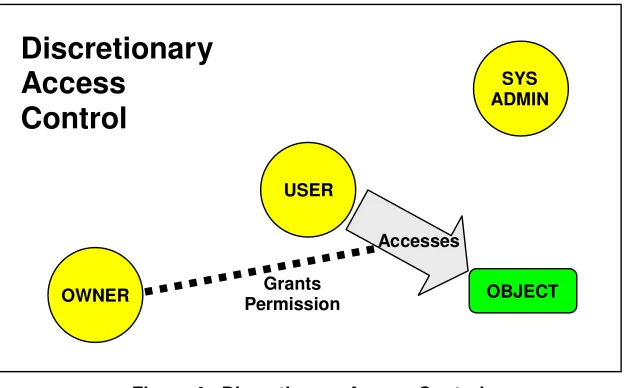
DAC, in contrast, gives the owner the ability to grant access permissions to users (see Figure 4). DAC and MAC can both be applied in a system (Pfleeger 2000, p. 290). If this is done MAC takes precedence. In many domains a DAC system can provide a useful degree of flexibility, lessening the demands on system administrators. There is however, a basic need for the owner to also be a user – so that they can physically grant the access permission. While it could be technically feasible to grant patients some form of ability to interact with the system in order to make a grant, it would seem impractical. The need for patients to be present, conscious, cooperative and capable can introduce obstacles that are difficult to overcome. Consequently, in the Australian health domain and similar domains, DAC seems of little use for managing user accesses.
Figure 4: Discretionary Access Control
On the other hand, in cases where the object is owned by a user, DAC can be useful. If the American approach to the ownership of medical records were in place (where the practitioners own the records), DAC may prove useful. As this does not seem to be the way the Australian system is going, it is of little point considering DAC as a useful tool.
While it seems largely irrelevant to the domain considered here, there is a need to describe DAC. A third fundamental access control model, TAC, is proposed. It is important therefore, to be able to compare and contrast TAC with both MAC and DAC.
USER
SYS ADMIN
OWNER OBJECT
Accesses
Discretionary
Access
Control
3.3 Role Based Access Control:
Role Based Access Control (RBAC) was formally described by Ferraiolo & Kuhn (1992) and has since evolved to a stage where it has been incorporated in many commercial systems, including Informix, Oracle and Sybase (Ramaswamy & Sandhu 1998). In February 2004, the National Institute of Standards and Technology (NIST) RBAC Model was adopted by the American National Standards Institute, International Committee for Information Technology Standards (ANSI/INCITS) as ANSI INCITS 359-2004 (NIST 2004).
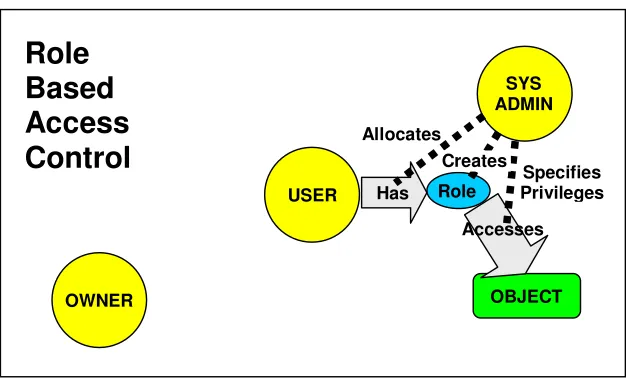
[image:28.612.183.496.436.629.2]RBAC is based on MAC and as such all authorisation powers reside in the system administrator. As shown in Figure 5, RBAC requires that access privileges are assigned to abstractions called ‘roles’ , which are created by the system administrator. The system administrator specifies the privileges for the role and can allocate one or more roles to each user, as required. The administrative burden in RBAC, compared to MAC, is greatly reduced because privileges are not required for each subject-object relationship. The success of RBAC is mainly due to the fact that the concept of roles fits closely with business practice and that it has administrative advantages over older methods.
Figure 5: Role-Based Access Control
There is much research being conducted into extending RBAC to get it to provide additional functionality. Of particular relevance, Neumann and Strembeck (2003) have described how context constraints can be used to check predefined conditions to
USER
SYS ADMIN
OWNER OBJECT
Accesses
Role
Based
Access
Control
SpecifiesPrivileges Role
Has
determine whether an access request is to be allowed. Such things as time and location can be used. This idea has considerable merit when it comes to implementing a real time authorisation process. An interesting approach could actually be to use roles themselves as context constraints.
One of the security concerns relating to RBAC is the possibility that a user with multiple roles may be allowed to commit fraud or make errors due to the privileges of each role. Botha and Eloff (2001) show how the principle of separation of duties can be satisfied in an active access control environment, to overcome this concern. The term “ active access control” relates to the ability of the system to make “ just-in-time” authorisations which take the context into account.
In order to try to reduce the demands on system administrators when it comes to dealing with volatile situations, variations of RBAC can delegate authorisation tasks to certain users. While this is seen by many as a panacea to solve problems, it suffers from two major flaws. Firstly, delegation of administrative authorisation tasks to users sets a dangerous precedent, as their primary jobs mean that they may tend to make unnecessary authorisations for reasons of expediency. If the delegation of administrative responsibilities is done without the knowledge of the user there is added danger. The inherent positives of RBAC are due to the fact that the roles given to users reflect their workplace responsibilities and qualifications. Any RBAC implementation which assigns administrative responsibilities to non-administrative personal takes the concept of roles beyond its proper place! Secondly, and most vitally, the RBAC process still requires that authorisations are made prior to when they are needed. While this delegation process puts the authoriser closer to the point of decision making, the fact is that it is still not necessarily at the point of the decision making.
3.4 Team-based Access Control:
TeaM-based Access Control (TMAC) is a system that is built on top of RBAC and is fundamentally a MAC type model. It attempts to mould RBAC to be more flexible by using an abstraction for user groups called teams.
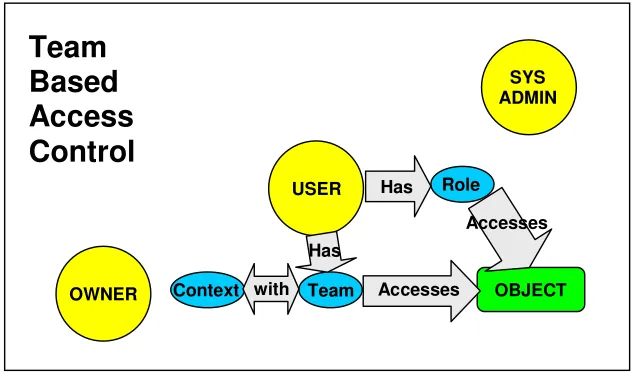
[image:30.612.181.498.303.492.2]Figure 6 shows only the basic TMAC concept with the foundational RBAC role abstraction supplemented with team and context abstractions. Users can make RBAC accesses in the normal way. In addition, if they are part of a team and the context they are in is appropriate, then they can access the other objects. There is still a basic reliance on the system administrator to perform the relevant administrative activities, although these can be delegated in normal RBAC fashion.
Figure 6: Team-Based Access Control
3.4.1 TMAC Versions
The various versions of TMAC, while suffering in a number of ways by their fundamental ties to RBAC and MAC, offer a number of useful insights. Three significant versions of TMAC are outlined in this section.
Thomas (1997) introduced the notion of TMAC and described how the advantages of RBAC could be coupled with the concept of restricting access only to relevant clients. This reflects the major benefit of using a team-based approach. He also indicated how the framework could be made to be self-administering by “ trapping basic calls by the host information system to assign and de-assign team members” -
USER
SYS ADMIN
OWNER OBJECT
Accesses
Team
Based
Access
Control
Role Has
Team Context
Has
the purpose of this being to reduce the administrative overheads. Again, this is a worthy ambition. Unfortunately, the cost in using this approach is to turn users into quasi-system administrators.
Georgiadis et al (2001) extended the TMAC model proposed by Thomas to use contextual information, such as time and location. The idea of using context constraints is a useful concept that may enable a wide range of access control solutions. Georgiadis and his team developed a model called Context-based Team Based Access Control (C-TMAC) which uses authorisations that are activated at the time that they are needed. The group programmed a “ view-based active access-control system” , using the C-TMAC model, for use in healthcare environments (Georgiadis et al. 2002).
The most recent incantation of TMAC was TMAC 2004, by Alotaiby & Chen (2004). It is fairly similar to previous versions in nature, but does not specify team specific roles as the other versions do. Rather, it uses the already specified organisational roles. This seems like a good step as team roles appear to introduce a high level of complexity for no significant gain.
3.4.2 TMAC Deficiencies
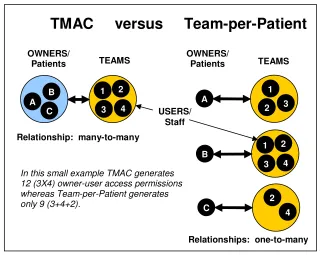
While the TMAC variants has some good points, such as introducing the very idea of team based solutions and the use of constraints to aid active access, they still suffers from a number of drawbacks. There is a fundamental problem in their notion of what constitutes a team. TMAC teams are relatively inflexible entities, requiring someone with system admin privileges to change team composition in advance of any necessary action. A hospital clinical team would generally be made up of the staff on a ward - the whole team having access to all the patient records for the ward. This represents a many-to-many owner-user relationship (see Figure 7).
(from 180 to 60). The team-per-patient approach is also more beneficial for workflow management purposes because it captures the particular individuals who are working with each patient.
Figure 7: Team Concept Differences
The question of who adds and takes away users from teams is another concern. In order to have a flexible system, team changes need to be made quickly and efficiently. This cannot happen if the system administrators are the only ones controlling team composition. The only way that TMAC can get around this is to delegate these administrative tasks to team members, which then begs the question of whether the delegates are actually qualified to do such tasks. Would it be alright to give system administrators the right to perform clinical procedures? The concept of giving clinicians privileges designed for system administrators is just as bizarre! It may appear to solve the problems imposed by RBAC’ s prescriptive nature, but it is fundamentally flawed. Users must be treated as users and system administrators as system administrators! While the solution proposed in this thesis in fact gives users more control, it requires that system administrators monitor how they perform. It thus recognises the inherent qualifications and responsibilities of the players, a thing which, ironically, these TMAC role-based solutions have deviated from.
OWNERS/ Patients
TMAC versus Team-per-Patient
USERS/ Staff TEAMS
1
B 2
A
3
C 4
TEAMS
3
1 B
2
2 3 4
A 1
OWNERS/ Patients
4
C 2
Relationship: many-to-many
Relationships: one-to-many In this small example TMAC generates
Another problem with TMAC is that it is still tied to the RBAC/MAC idea that authorisations must happen before they are required. The whole problem with this approach goes back to the fundamental security myth that confidentiality and integrity are always paramount. Availability seems not to be of concern when it is, in many cases, the primary thing required! As with the requirement that staff with system admin privileges are required to change team composition, the need for authorisations to be made in advance, introduces added inflexibility to team management procedures.
In conclusion, when looking from a distance, TMAC appears to offer a viable solution, but when the details are inspected, the fundamental floors in the approach are revealed. Role-based solutions are no panacea!
3.5 Task-Based Access Control:
Task-Based Access Control (TBAC) is another active access control model which has been proposed (Thomas & Sandhu 1997). It tackles access control from a workflow perspective and provides mechanisms for the management of permissions. While this concept has merit when considering the problem from the perspective of task management, this thesis is concerned with just access authorisation.
It was useful to look at TBAC because it shows that it is possible to build access control into workflow applications. If workflow applications can be used to trigger access control mechanisms, the administrative burden will be greatly reduced.
3.6 Organisation-Based Access Control:
extend RBAC. It deals with the need for users other than system administrators to specify permissions. It is however a great deal more complex than the solution that is required.
3.7 Provisional Authorisation Models:
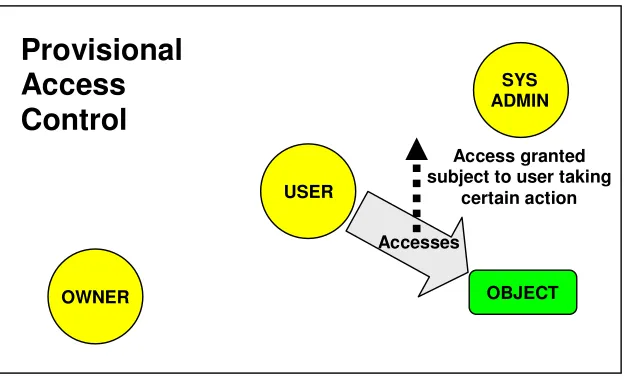
[image:34.612.185.498.338.530.2]Provisional authorisation models (Bretan 2004) do not seem to be in the mainstream. Critically though, they introduce a mechanism which is ideal for dealing with emergency accesses where there is no time to grant permission for an access in the usual way. While other models simply accept or deny a request, provisional authorisations deal with the grey area between acceptance and denial. They allow a user to make an access subject to them taking some security action such as signing a statement (see Figure 8).
Figure 8: Provisional Access Control
Kudo (2002) proposed the Provision-Based Access Control model (PBAC). PBAC is a specific example of a provisional access control model (the general term). This model uses the “ access control framework” , an international architecture standard, as its basis. It also uses normal hierarchical authorisation structures. The relevance of this work is that it shows that a retrospective authorisation process can be built into a hierarchical authorisation system. That is, retrospective authorisation can coexist with context and role-based mechanisms.
Provisional
Access
Control
USER
SYS ADMIN
OWNER OBJECT
Accesses
Access granted subject to user taking
3.8 Auditing:
The concept of auditing is an old one (Schneier 2000) (Stallings 2003). While it is a retrospective activity, its implications as an access management tool need to be considered. If users know that their accesses are audited and that breaches of organisational policy will indeed be observed and dealt with, then there is an element of “ mind control” influenced over users. In some cases management may consider that this is all the access control that is necessary.
It is proposed in the solution provided to use auditing as a primary tool for handling accesses which are not made by team members. This is viable in ethical environments which are capable of delivering a high degree of user compliance. Provisional authorisations will be granted to such users subject to them providing (or agreeing to provide at a later time) an access reason or report. Systematic auditing of these reasons and reports provides the required retrospective system control. For most accesses that require it, the auditing will initially be done by colleagues, taking the load off system administrators. This type of auditing will be done as part of the daily workflow as a communication feature. As such, it will not generate any extra work
In general terms, RBAC type active access control solutions seek to delegate access permissions down through the role based hierarchy, from top to bottom. In contrast, the proposed system percolates auditing responsibilities from the bottom up, leaving only the most critical auditing tasks to the system administrators.
3.9 Clark-Wilson:
The Clark-Wilson model (Gollmann 1999, pp. 56-58) introduced the idea of “ well-formed transactions” . Under the model, users do not have direct access to stored data. Rather, they are given access to procedures which interact with the data. The Oracle implementation outlined in this thesis makes use of this concept. The ability to store procedures in a database and control access to the procedures provides a good security-based option. Oracle provides the ability to produce a total database package, with all the functional requirements and security built-in. The package can then be used as a foundation to produce new workflow applications or provide the necessary access control features to existing systems.
3.10 Middleware:
Middleware has been seen as a solution for adding access control and consent features to existing and new systems (Woodcock & Gillies 2003) (Hartnett 2002). While such systems have great potential for providing the appropriate security, they fall down in the area of complexity. They tend to be seen by organisational decision makers as being too complex. It could be that they are ahead of their time in that there is merely not enough demand for such sophisticated security solutions at this time.
The failure of such systems to be implemented successfully in real-world situations has been a major motivation for seeking a simpler solution such as the one proposed here. It is envisaged that organisations are more likely to accept solutions that employ well-known and tested off-the-shelf products such as Oracle.
3.11 Review of Existing Models
The main requirement for the system is to guarantee availability. In emergency situations in hospitals it is possible that clinicians will need immediate access to patient records without any other person being available to grant permission for the access. It is not suitable to cater for this rare occurrence by granting all clinicians such access by default. This means that any model which does not facilitate accesses without prior grant being made, is not suitable. Both MAC and DAC based models require such grants and are therefore not suitable as the basis for the volatile team-based model that is required.
The only models which do meet such requirements are the PBAC model and auditing. PBAC allows access subject to a further security action being taken by the user. While PBAC functionality can be included in the required model, PBAC alone does not solve the issues of restricting access by individuals to objects based on their qualifications and function within the organisation. It also does not provide an efficient way of easing the burden on system administrators.
Auditing is similar in nature to PBAC, but essentially requires personnel to continually be monitoring the system. The benefits and effects of auditing are well known. Of particular relevance is the deterrent factor that it provides to users who may be tempted to flout security requirements. PBAC provides the potential to deploy an active auditing mechanism which can do most of the day to day auditing tasks. If a way can be found to incorporate a peer-review process into such a mechanism, then the burden on system administrators can be substantially reduced.
TMAC based models are deficient due to their inflexibility in dealing with the management of team composition, and on the granularity of access control that they can provide. A one-to-many owner-user relationship was shown here to be more beneficial. The TMAC 2004 model did however show, as did ORBAC, that using organisation wide roles was the best way to proceed and that context constraints can be a useful tool.
TBAC and aspects of the TMAC models showed that it is possible to use normal workflow operations to trigger access control functions. Such functionality allows access control to take place behind-the-scene. This is beneficial in minimising the burden on system administrators.
It is interesting to note that one of the aims of many of the models based on RBAC, such as TMAC, is to come up with a “ self-administering” model. What they are really attempting to do is to define a user-controlled access system based on MAC. Surely it is more appropriate to base a user-controlled system on a foundational access control model which specifies the scope of user control!
The middleware solution points the way to using stored procedures within a database to provide access control functionality. The Clark-Wilson model inturn provides a powerful way to control the confidentiality and integrity of stored data, by introducing the concept of well-formed transactions. Both these concepts are worthy of consideration.
Chapter 4
Method
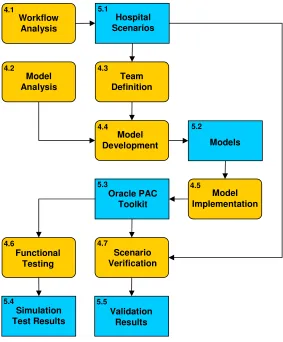
[image:39.612.197.480.281.623.2]This chapter outlines the steps taken in the development and testing of the TAC and PAC models and the resulting Oracle implementation. Figure 9 shows the steps in a flow diagram. Each step is covered by its own section in this or the next chapter.
Figure 9: Method Flow Diagram
In Figure 9, the blue rounded boxes represent the tasks that were undertaken in the process. The orange rectangular boxes show the resulting items produced. The numbers in the top corners of the boxes show the section which covers the item.
Model Analysis
4.2
Team Definition
4.3
Model Development
4.4
Model Implementation
4.5
4.6
Models
5.2
5.3
Hospital Scenarios
5.1
Scenario Verification
4.7 4.1
5.4
Simulation Test Results
Functional Testing Workflow
Analysis
5.5
Validation Results Oracle PAC
4.1 Workflow Analysis
After preliminary research gave a broad understanding of the domain, it was then possible to establish the detailed requirements of a hospital access control system. This was done by interviewing health practitioners, administrators and IT managers. As well as getting a feel for practical implementation issues, the purpose of this was to establish as many relevant and distinct hospital requirements, in the form of scenarios, as possible.
From time to time during the remainder of the process other scenarios emerged. These were included with the initial set. The complete set of scenarios is shown in Section 5.1.
4.2 Model Analysis
This stage of the process involved researching related work in access control techniques and models. The initial purpose of the research was to find a suitable model to meet the domain requirements. As the research proceeded, it became evident that no single existing model fulfilled all the requirements. The purpose thus changed into one of extracting useful concepts from existing models that could be incorporated into a new model.
Chapter 3, on Related Work, described each of the models which provided useful information for this part of the process.
4.3 Team Definition
A team-based access control model requires the team concept to be defined. The scenarios produced by the workflow analysis and the team-based examples researched in the model analysis were analysed qualitatively to produce a suitable team concept for the hospital domain.
4.4 Model Development
Having extracted the requirements, the next step was to establish an appropriate access control model or mechanism. This was done by looking at established models and researching newer developments. It was found that no one model in itself was adequate to meet the requirements that were demanded. It seemed a new model needed to be developed that fitted the established constraints. The existing models were reviewed in order to establish whether any of their features would be useful. An outline of the relevant models considered was provided in the Related Works chapter.
It was clear from the scenarios that the main priority was to find a way to transfer the bulk of the authorisation decision making to the users. This had to be done in a way that made access control as fine grained as possible while providing both good security and guaranteed availability.
The initial concept was to use a team based approach with a team for each patient. Members of the team would have access to the patient’ s record. It was clear that a model was needed where the users within a team could bring other users into the team. This simply reflected the referral process used in the health system.
The scenarios established that patient admissions basically just allocated a patient to a particular unit or ward. It was therefore necessary to find an efficient way to initialise the patient’ s team on their admission. The concept of a default team for each ward was established.
The research into team based approaches confirmed that such an approach was feasible. After comparing the differences in the team concepts, it was felt that the approach of one team per patient was the most practical, due to its flexibility and its potential usefulness as an abstraction relevant to workflow processes.
practitioners were far more likely to need to access the records of their colleague’ s patients than those with no such association. This reflects the team work that occurs between fellow workers of the same profession. Rather than put all such workers on the team by default, it was felt that it was more appropriate to get their fellow workers to put them onto the team and to also provide them with a simple non-member access method. In addition to this, a method was established for users with no such relationship to gain access.
RBAC provided a method of limiting what a particular user could see within a patient’ s record. It was felt that this was a worthwhile additional property to include. Once the inclusion of role-based restrictions were included, it was necessary to include a way for users to view things that they would not normally be allowed to see. This was necessary in order to keep in line with the established requirement of providing 100% availability.
In addition to RBAC and the team based concept, the research into existing models confirmed a number of other initial ideas. Particularly, the use of context variables was confirmed, as was the concept of providing some form of provisional access. Oracle’ s ability to allow “ well-formed” transactions was also appealing.
Details of the resulting models developed are given in Section 5.2.
4.5 Model Implementation
The initial proposal for this project envisaged using Oracle. One reason for this was that, for the sake of simplicity and acceptance, it was thought best to use a well regarded off-the-shelf product. The State Government Health Department, the Department of Health and Human Services (DHHS), were already using Oracle within their system. The implementation would therefore have a better chance of being trialled in a clinical environment if Oracle were used.
sign on, role based access control, virtual private networks (VPD), the Enterprise Manager interface and PL/SQL Procedures and Functions.
The Oracle research revealed PL/SQL or Java as the logical language choices. Further research into PL/SQL functionality led to its adoption as the language choice (Moore 2004) (Naude 2003) (Robinson 2003). There were a number of reasons for choosing it. Firstly, it could be stored within the Oracle database, making it portable as well as easy to install and use. Secondly, the research indicated that it could be made to run faster than Java. Thirdly, role-based access privileges could be applied to each PL/SQL procedure, thus enabling well-formed transactions.
A difficult choice had to be made regarding what form the implementation should take. It was decided to concentrate on verifying that the proposed model was workable by providing the required functionality in an Oracle package, rather than producing an implementation with its own tailor-made interface. The reason for this was that the workability of the model was the primary goal. Producing an application from the functionality provided in the Oracle package would be fairly trivial and would divert attention to the interface chosen. The interface would inevitably not match that which would be used by a particular organisation. The whole point was to highlight that any desired interface can be produced or an existing one used, not to highlight a particular interface design or a particular functionality that could be developed.
When Oracle is used in practice, database administrators can use a number of built-in Oracle tools to manage the database. One of these tools is the Oracle Enterprise Manager. This tool is particularly useful in dealing with the specification of access permissions and roles. It basically provides an interface with which to manage RBAC. As such it was basically not worth rebuilding RBAC type procedures into the implementation when an interface is already there to manage those aspects of the implementation. For example, the issue of how to deal with agency staff (casual short term contract staff) can be taken care of by simply specifying appropriate RBAC roles and privileges. This can be done entirely within Enterprise Manager.
design. The command line based SQL*Plus interface was used to program the database and the PL/SQL functions and procedures. In order to test the procedures and functions as they were loaded, a small amount of test data was placed in the database.
Once each procedure or function was completed it was tested briefly to check that the desired functionality was achieved. Print statements were placed within the procedures and functions to show the flow of control. In this way, it was possible to determine that each possible path taken within a procedure or function was checked.
4.6 Functional Testing
The implementation consists of a set of top-level PL/SQL procedures which perform the team management and auditing functionality required by the PAC model. Behind the set of procedures lie a collection of PL/SQL functions which perform operations for each other and the top-level procedures.
As mentioned above, each procedure and function went through a brief functionality test on completion. The next testing phase was undertaken once the implementation was complete. The purpose of this phase (the “ simulation testing” phase) was to test the procedures and functions rigorously on a complete set of data.
The simulation testing stage involved creating a simulated hospital with wards, administrators, health practitioners and patients, and testing the model-based procedures. As all the functions are called by the procedures, it is sufficient to assume that they are performing correctly if the procedures work correctly, as long as all the possible variations of input and hospital states are tested. The goal then was to test each procedure in a way that took into account all the variations of input and hospital states.
It was felt that testing using a simulated hospital would achieve more than just purely testing the functionality of the implementation. It would also give some insight into how the procedures could be used in hospital based applications and on how the database performs with a reasonably sized set of data. The other positive feature of the process was that the changing relationships between patients and users could be observed. Simulation testing also verified that the database was operating correctly because the overall view of the hospital could be checked rather than just localised changes.
The simulated hospital was set up with 24 patients and 24 users on 3 wards. Scripts for creating and loading the database were used for this purpose. The users consisted of administrators, nurses, RMOs, specialists, and allied health professionals, as well as supervisors for each category. In order to check the state of the hospital at any time, two test procedures were programmed. The output of the first gave the current state of the hospital, while that of the second showed the changes that have occurred since the last hospital state change output. Both procedures produce tables (see Section 5.4 and Appendix A for examples).
It is important to note that these tables were produced just for test purposes and that they were not generated from a stored access control matrix. The implementation calculates the category of the user-owner relationship at the time of each access, by checking the user’ s role and unit set with the roles on the owner’ s team and the owner’ s unit.
4.6.1 Testing Procedure
Testing was then performed by the following process:
1. The initial state of the hospital was output using the first test procedure; 2. A set of procedures (stored in a test script) was loaded which produced text
showing the flow of control; and
3. The changes from the initial state were output using the second test procedure.
4. The changes were checked for correctness.
4.6.2 Testing Sequence
The following set of tests was performed:
TEST #1: LOGON PROCEDURE – SET UP TEST #2: ADMITTING PATIENTS – SET UP TEST #3: LOGON PROCEDURE
TEST #4: ADMITTING PATIENTS TEST #5: RE-ADMITTING PATIENTS TEST #6: REFERRING PATIENTS TEST #7: TRANSFERRING PATIENTS TEST #8: RELEASING PATIENTS TEST #9: REMOVING PATIENTS
TEST #10: VIEWING PATIENT RECORDS
TEST #11: VIEWING HIDDEN PATIENT RECORDS TEST #12: REQUESTS AND REPORTS
TEST #13: VIEWING REPORTS AND LATE REPORTS TEST #14: PATIENT LISTINGS
TEST #15: LOGOFF PROCEDURE
Verification that the tests produced correct results were done by checking that the changes to the hospital state matched with the changes that the set of procedures was expected to produce. The flow of control was also checked to ensure that it was correct.
4.7 Scenario Verification
Chapter 5
Results and Discussion
This chapter contains the results that were obtained in the various stages of the project. The chief results of the project were the access control models that were developed and the verification that Oracle could be used to implement a suitable access control solution. It is worth thinking of the other results as being supplementary, in that they either led to these developments or verified their completeness. Please refer back to the flow diagram in Figure 9 to see where each of the sections discussed in this chapter fit in with the overall picture.
[image:48.612.145.535.500.696.2]5.1 Hospital Scenarios
Table 1 shows the scenarios that were collected in the workflow analysis stage of the project. The Scenario Category column is the name of the scenario group. The Model Requirements column shows the task that is required in terms of model functionality. The other columns are self-explanatory.
Scenario
Category Scenario Name Description Scenario Requirements Model
Patient
Issues Admission Patient is assigned to a ward on admission. Patient assigned ward and an initial team.
Anonymity Patient wants to remain anonymous. None. Use admin procedure of assigning a dummy name.
Change
Carer Patient requests someone else looks after them. Replace one team member with a colleague.
Transfer
Patient Patient is moved to another ward in an emergency. Remove patient from ward and admit to another ward.
Staff Change
Issues Staff Break Staff member goes on a break and colleagues cover for him.