Strategies in Readers with a Specific Reading Disability Compared
to Normally Achieving Readers.
Miriam Louise Kirby, BA (Hons)
Submitted in fulfilment of the requirements for the Degree of
Doctor of Philosophy (Clinical Psychology)
This thesis contains no material which has been accepted for a degree or diploma by the University or any other institution, except by way of background information and duly acknowledged in the thesis. This thesis contains no material previously
published or written by another person except where due acknowledgment is made.
Signed:. Date: .. .
J/c:/C?.!: ... .
This thesis may be made available for loan and limited copying in accordance with the Copyright Act 1968. ·
The self-teaching model of reading acquisition proposed by Share (1995, 1999)
suggests that phonological decoding may be the principal means for becoming skilled at word recognition. Given that individuals with a specific reading disability (SRD) have been shown to have a phonological processing deficit (Rack et al., 1992), the lack of proficiency in these skills could have detrimental effects on orthographic processing skills. In contrast, Lennox and Siegel (1994) argue that the cognitive profile of children who have a specific reading disability (SRDs) might include deficient phonological skills and superior orthographic skills. In a two-year
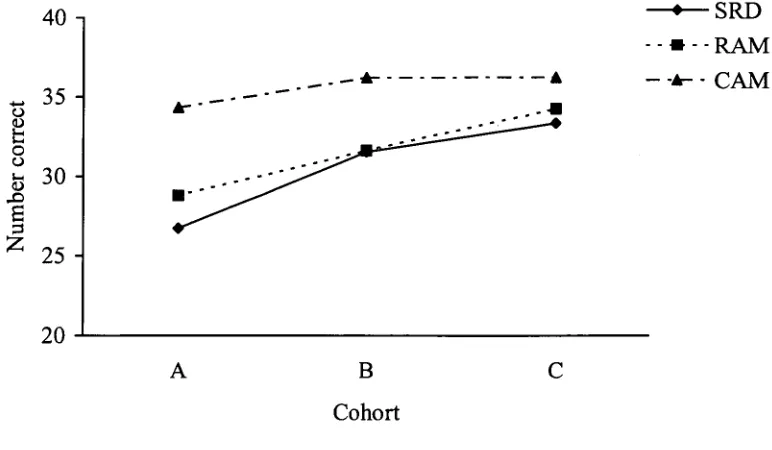
longitudinal study, SRDs in Grades 3, 5, and 7 and their chronological age (CAMs) and reading age (RAMs) matched controls (N=98) performed a range of standardised and experimental tasks to investigate the development of phonological and
representations. In discriminating between nonwords containing legal letter strings and those containing letter strings in positions that never occur in the English
language, all groups performed similarly indicating that the participants had attained a sufficient level of orthographic knowledge required to perform this task.
Orthographic strategy use and coding skills appeared to be relatively intact in comparison to phonological processing skills for SRDs. However, there was
Tab
le
O
f
Con
ten
ts
Abstract iii
Acknowledgements
Chapter 1 Introduction 1 Chapter 2 Models of wordrecognition 3 Chapter 3 Models ofreading acquisition 13 Chapter 4 Specific reading disability: Phonological
and orthographic processing skills 24 Chapter 5 Phonological and orthographic strategy use
in SRDs and normally achievingreaders 43
Chapter 6 Method 54
Chapter 7 Results: Reading data 67 Chapter 8 Results: Grapheme-phoneme addition and deletion 74 Chapter 9 Results: Phonological and orthographic choice 92 Chapter 10 General discussion and conclusions 100
References 120
Introduction
Children with a specific reading disability (SRD) present with a deficit in reading
ability that cannot be attributed to sensory or neurological damage, lack of
educational opportunity, or low intelligence. Given that between 4% and 7% of
children are considered to have a specific reading disability or SRD (Snowling,
1998), research in this area is important to assist in the processes of diagnosis,
remediation, and prevention. This thesis is aims to obtain information from
experimental measures about the theoretical underpinnings of SRD. In general terms,
it is primarily concerned with developing a greater understanding of how the
processes involved in reading development in SRDs may deviate from the normal
course of reading acquisition.
This thesis is not concerned with reading acquisition from the perspective of reading
for meaning but rather the development of component processes of word recognition
independent of sentential context. Although it is recognised that many theories of
word recognition incorporate procedures for deriving meaning from isolated words
by way of a semantic processing mechanism, a discussion or overview of this aspect
is not pertinent to the aims of this thesis. Therefore, the first chapter will outline
theoretical and computational models that attempt to elucidate or simulate visual
word recognition, with a primary focus on phonological and orthographic processes
given that they are heavily implicated in the models of reading acquisition to be
outlined in Chapter Two.
processes. Although it is a well known finding that SRDs differ from normally
achieving readers with respect to aspects of reading that place heavy demands on
phonological processing (e.g., Rack, Snowling, & Olson, 1992), there is less
consistent evidence regarding the role of orthographic processing skills in SRDs.
Therefore, this thesis will measure the development of both phonological and
orthographic component processes over a two-year longitudinal study. The main aim
of this thesis is to determine whether a phonological deficit has a detrimental impact
upon the development of orthographic processing skills or whether SRDs possess
intact orthographic processing skills that compensate for their phonological deficit.
Models of Word Recognition
Models of word recognition help to answer the question of how we are able to
recognise a visually presented word or what processes are engaged when we read a
word. One model that has received a great deal of attention is the dual-route model
first proposed by Coltheart (1978). The basic concept underlying dual route theory is
the idea that there are two processing routes or mechanisms for recognising printed
words. Each of these routes is thought to have a distinct function. These routes are
the direct lexical access or orthographic route and the indirect sublexical access or
phonological route. The proposal that there are two routes by which we access a
word is based on the observation that skilled readers are able to read aloud correctly
two different types of letter string, the pronounceable nonword and the irregular or
exception word.
Coltheart (1985) reports that the role of the phonological route is to transform an
orthographic representation into a phonological code using grapheme-phoneme
correspondence (GPC) rules. In order to generate the pronunciation of a word using
this route, three tasks are conducted in sequence, graphemic parsing, phoneme
assignment, and blending. Firstly, for any given word, the letter string has to be
parsed or broken down into a series of graphemes. Using GPCs, phonemes or sounds
are assigned to each grapheme. Finally, the phonemes are blended together to
However, if this were the only process available to recognise words, this would lead
to incorrect pronunciations of irregular or exception words in the English language
because these do not follow GPC rules. In order to pronounce these types of words,
word specific information needs to be accessed from the mental lexicon using the
orthographic route. When a familiar irregular word is encountered, it is proposed that
it is recognised by being directly accessed from the lexicon based on its orthography
or visual features. This process is engaged when familiar words are encountered,
irrespective of whether they are irregular or regular, because the orthographic route
allows faster and more efficient access whereas the processing in the phonological
route requires more resources (Paap & Noel, 1991).
Although the evidence is not consistent (e.g., Hanley & McDonnell, 1997), there are
many proponents of the view that word recognition is phonologically mediated for
both good and poor readers (Johnston, Rugg, & Scott, 1987) and that the
phonological route is automatically mobilised when a word is encountered,
regardless of whether the word is successfully identified using the orthographic route
(Doctor & Coltheart, 1980; Folk & Morris, 1995; Frost, 1998; Lesch & Pollatsek,
1993; Van Orden, 1987). This suggests that these processes are not activated in
isolation of one another.
that takes letters as input and generates a phonemic representation as output. In
earlier conceptualisations of the model (Coltheart et al., 1993), the GPC route was
exposed to the printed forms of words and their pronunciations and effectively learnt
the grapheme-phoneme rules embodied in the training set of words. The GPC rules
were automatically learned from exposure to the spellings and pronunciations of real
words. The system was then able to apply these rules to new letter strings it had not
seen before and was able to demonstrate accurate nonword reading. This
demonstration was largely used to highlight the inability of an alterative model
(Seidenberg & McClelland, 1989) to simulate human behavioural data for nonword
reading accuracy.
Compared to other computational models (Plaut, McClelland, Seidenberg, &
These routes do not operate independently of one another as they share the same
initial processing stage, the letter identification stage, which delivers its output to two
different destinations, the orthographic input lexicon and the GPC rule system. The
two routes also share a final processing stage, as both deliver a pronunciation
(Coltheart et al., 2001; Coltheart & Rastle, 1994). The DRC model adopts a cascaded
approach as Coltheart et al. (2001) propose that it is more consistent with
behavioural data that suggests that activation occurs in both routes when a letter
string is encountered. Therefore, a pronunciation is thought to be derived from the
input of both the GPC and lexical routes by using the levels of activation they
contribute to the phoneme system. For example, nonword reading is typically
associated with a nonlexical procedure for pronunciation but the DRC model
suggests that nonwords also activate orthographically similar words in the
orthographic lexicon. The phonemic activation that this generated is paired with the
results from the GPC route to facilitate nonword naming. This has been further
exemplified by results showing that if the lexical route is disabled, nonword naming
times increase (Coltheart & Coltheart, 2000, cited in Coltheart et al., 2001).
generated by the lexical and nonlexical routes and increases naming latencies.
Coltheart and Rastle (1994) found that the effect of low frequency exception words
on naming latencies decreased as the position of the exceptional phoneme moves
from left to right, a finding which they then replicated with human participants.
In summary, dual route theorists have identified certain facts about reading that they
believe can only be explained by positing the existence of separate lexical and
nonlexical routes. Coltheart et al. (1993) postulate that the DRC model can
successfully account for skilled reading of nonwords, regular, and exception words,
lexical decisions, and acquired and developmental dyslexia. Further work reported
by Coltheart et al. (2001) reviews other reading phenomena that the model has been
able to simulate, such as frequency and lexicality effects, and suggests that the DRC
model is the only current computational model that can successfully multi-task. The
model is now being adapted to account for polysyllabic reading (Rastle & Coltheart,
2000) and to model word recognition in the German language (Ziegler, Perry, &
Coltheart, 2000). A connectionist model of word recognition in the French language
has also been conceptualised that shares some features of the DRC model in that it
accounts for two distinct global (real word) and analytic (nonword) reading
procedures (Ans, Carbonnel, & Valdois, 1998).
The dual route model has undergone much criticism and should by no means be
considered the only theory available for explaining the processes of word
(PDP) model. The key feature of the model is the proposal that there is a single,
uniform procedure for computing a phonological representation (i.e., a
'pronunciation') from an orthographic representation that is applicable to all types of
letter string including regular words, exception words, and nonwords. In contrast to
dual-route conceptualisations, the model does not include a lexical lookup procedure
because it does not contain a lexicon in which individual entries correspond to
individual words. Furthermore, it does not contain a set of pronunciation rules. The
model operates using a single mechanism that learns to process all types of letter
strings through experience with spelling-to sound correspondences implicit in the set
of words from which it learns.
The general framework for lexical processing adhered to by the PDP model assumes
that reading involves the computation of three types of codes, orthographic,
phonological, and semantic. Each of these codes is assumed to be a distributed
representation or a pattern of activation distributed over a number of representational
units. Processing is interactive across the three levels such that activation at one level
influences activation at another level and is mediated by connections among units
through a system of hidden units.
Seidenberg and McClelland (1989) implemented only part of this general framework
and used a simplified model that removes the semantic and contextual levels.
network has no initial knowledge of particular correspondences between spelling and
sound. The model must learn these relationships from exposure to letter strings and
corresponding strings of phonemes and by adjusting the strengths of connections to
more closely approximate the target activation.
After training the model by exposing it to monosyllabic words, Seidenberg and
McClelland (1989) examined how the model performed on different types of words
that were used in behavioural studies. Since the model was trained on a large set of
words, it could be tested using the same items that were used in specific experiments
with human participants. Coltheart et al. (1993) considered how well the PDP model
could account for this data. The model incorrectly pronounced only 2.7% of words
and most of these errors were in response to low-frequency exception words, which
is consistent with data collected in naming latency experiments with human
participants. Therefore, there is both quantitative and qualitative evidence supporting
the accurate simulation of exception word reading by the model.
Seidenberg and McClelland (1989) reported some simulation data using nonwords as
input but did not report what proportion of nonwords the model read correctly.
(1989) database and was exposed to the same nonwords, the DRC model read them
with 98% accuracy (Coltheart et al., 1993). This suggests that the inability to read
nonwords accurately was not due to the training words, but more to do with how
word identification processes were represented by the model. When the Seidenberg
and McClelland (1989) model was modified with improved orthographic and
phonological representations, Seidenberg, Plaut, Petersen, McClelland, and McRae
(1994) found that there was no longer a deficit in nonword performance for the
connectionist model compared to the DRC model (Coltheart et al., 1993).
A third perspective for considering word recognition processes is the analogy model
first proposed by Glushko (1979) that suggests that both the lexical and nonlexical
processes can operate in conjunction to pronounce any kind of letter string.
Therefore, it is postulated that these processes do not exist as separate mechanisms
but share a common knowledge base. Glushko (1979) focused on the functional
properties of the lexical and nonlexical knowledge bases rather than viewing them as
separate mechanisms. He proposed that words and nonwords are pronounced through
the integration of orthographic and phonological information from a number of
sources that are activated in parallel.
that pronunciation occurs by activation and synthesis. The information that is
activated by the letter string is modified in order to synthesise a pronunciation.
Glushko (1979) argued that a letter string is not read aloud by retrieving a single
pronunciation from memory or by employing abstract spelling-to-sound rules. Words
and nonwords are pronounced using similar kinds of knowledge, the pronunciations
of words that resemble them and specific spelling-to-sound rules for multi-letter
spelling patterns. Effectively, this position asserts that the lexical and nonlexical
mechanisms work in unitary fashion for every letter string.
A connectionist model that is most consistent with analogy models of word
recognition has been postulated by Zorzi, Houghton, and Butterworth (1998). The
model utilises larger units at the onset-rime level, although phonological and
orthographic representations are still at the phoneme and letter level. Unlike other
connectionist models there are no hidden units and this was designed to represent a
lack of lexical representations and led to regularisation errors. Therefore, this
two-layer model was not adequate for exception words and a hidden two-layer was
incorporated to mediate connections between spelling and sound to deal with
Models of Reading Acquisition
Many earlier theories of reading development proposed that reading development
unfolds in a sequence of stages. For example, Marsh, Freidman, Welch, and Desberg
(1981) propose a four-stage theory of reading development where the first two stages
are based on rote learning and guessing, initially based on contextual information but
becoming more sophisticated and based on visual similarity and other visual cues.
The later stages are characterised by decoding, which again becomes more
sophisticated as they develop a more consolidated rule base for decoding words.
Although Marsh et al. (1981) assume that it is an increase in sight word vocabulary
that causes the child to move into a sequential decoding stage, Stuart and Coltheart
(1988) cite evidence to the contrary that suggests that it is the development of phonic
skills that leads to an increase in vocabulary. Marsh et al.'s (1981) model is also
incompatible with models of skilled adult reading such as the dual-route model
because it describes a well-developed non-lexical translation route but does not
describe a means for direct lexical access.
child is able to parse the letter string into graphemes rather than single letters. In the final phase, an orthographic strategy is adopted where words are instantly analysed into orthographic units without phonological conversion. However, in this model, it is unclear how the intermediate phase of phonological decoding relates to the
development of the orthographic strategy.
The stage theories that have been outlined assume that all children pass through the same stages in the same order. However, Stuart and Coltheart (1988) argue that the process of reading acquisition may vary depending on the phonological skills of the beginning reader. A review of the earlier literature on the development of
phonological awareness concluded that there is significant evidence that
phonological awareness has a causal role in learning to read (Wagner & Torgeson, 1987). Stuart and Coltheart (1988) postulate that children who are phonologically skilled before learning to read might use these skills in early reading development. In contrast, beginning readers who are not phonologically skilled may initially approach reading as a visual memory task. Stuart and Coltheart (1988) investigated this
hypothesis by assessing the phonological skills of pre-literate children and followed their progress in reading acquisition over a four-year period to determine whether there were any qualitative differences that could be attributed to different levels of phonological skill.
knowledge became a significant predictor of reading age in the first year of school. Therefore, phonological skills and knowledge are useful to beginning readers and can be utilised as they learn to read. Children without such knowledge and skills will view the task of learning to read as one of committing visual strings to memory. Children who fit this profile could be regarded as logogapItic readers relying mainly on a rote learning strategy to develop a sight word vocabulary.
Stuart and Coltheart (1988) do not limit the role of phonological processing in reading development to sequential decoding of a letter string from left to right. Instead, they propose that children are able to use their phonological knowledge and skills to generate a route for direct lexical access. Similarly, Aaron, Joshi, Ayotollah, Ellsberry, Henderson, and Lindsey (1999) argue that the transition from beginning to skilled reading is essentially represented by a transition from being predominantly a decoder to being predominantly a sight word reader. They utilised naming speed as an index of sight word reading and found that somewhere between Grades 3 and 4, children have mastered basic reading skills and start utilising sight word reading. Furthermore, poor decoding skills were strongly related to poor sight word reading skills indicating that these skills are not independent of each other and that sight-word reading appears to be based on decoding skills.
independently into their spoken equivalents that is central to reading acquisition. The
self-teaching hypothesis proposes that each successful decoding encounter with an
unfamiliar word provides an opportunity to acquire word-specific orthographic
information. Both adult skilled readers and young children only have to be exposed
to a word a relatively small number of times to generate an accurate orthographic
representation of the word. Both word-specific and general orthographic knowledge
is obtained. It is essential to obtain word-specific orthographic information in order
to become a skilled reader because the majority of words are then efficiently and
directly accessed from the lexicon. However, phonological decoding may be the
principal means by which people become skilled at word recognition.
Thus, in contrast to stage-based theories, Share (1995, 1999) adopts an item-based
perspective in which word recognition depends on how often the reader is exposed to
a word, how the word is identified, and whether word identification is successful.
Therefore, high frequency items are likely to be recognised automatically with
minimal phonological processing from the earliest stages of reading acquisition.
Novel or less familiar items that do not have an orthographic representation will need
to be phonologically decoded in order to generate a correct pronunciation.
a great deal of cognitive effort and therefore, does not disrupt the process of comprehension.
Share (1995, 1999) explains that the process of phonological decoding becomes increasingly `lexicalised' during reading acquisition. Beginning readers master an initial set of simple one-to-one correspondences between print and sound, which is refined as they gain more orthographic knowledge. Some limited but functional self-teaching skills may exist at the very earliest stages of learning to read prior to the development of conventional decoding skills. As demonstrated by Stuart and Coltheart (1988), letter-sound knowledge and phonemic awareness are both implicated as critical co-requisites for reading acquisition and represent early self-teaching attempts. These partial decoding skills may not lead to correct
pronunciation of words presented in isolation but beginning readers use contextual information to supplement low level decoding. The initially incomplete and over-simplified representation of English spelling-to-sound correspondences becomes modified and refined with increasing exposure to print. A more complex, accurate, and highly sophisticated understanding of the relationships between orthography and phonology evolves. Basic knowledge structures utilised by beginning readers provide a catalyst for developing the complex set of spelling-to-sound rules that is used by skilled readers.
The self-teaching mechanism involves two component processes, phonological and orthographic, that make independent contributions to the acquisition of word
orthographic component reflects the ability to store and retrieve word-specific
orthographic information. Proficiency in visual/orthographic processing influences
the speed and accuracy with which orthographic representations are acquired and is
heavily dependent on the successful operation of the phonological component. Share
(1995, 1999) argues that there is no convincing evidence to suggest that reading
competence can be acquired in the absence of decoding skill. However, decoding is a
necessary but not sufficient condition for becoming skilled at word recognition.
Proficient reading depends on both phonological and orthographic mechanisms.
Therefore, it could be argued that lack of proficiency in one of the component
processes encapsulated by the self-teaching model would have detrimental effects on
the ability to become skilled in the other, and would in turn have implications for the
development of skilled reading.
Whereas some theorists argue that phonological recoding provides opportunities to
learn about the orthographic structure of words (e.g., Share's self teaching
mechanism 1995, 1999), Ehri (1984; Ehri & Wilce, 1980) provides evidence that
there is a reciprocal relationship such that visual information acquired from reading
experiences helps develop conceptualisations of the phonemic structure of words and
indicates that the acquisition of orthographic images as symbols for sounds underlies
both spelling (Ehri, 1980a) and reading (Ehri, 1980b) development. In later
formulations of her model, Ehri stresses the importance of developing complete
visual-orthographic connections in lexical memory and the importance of
reading. In English, written words consist of fixed sequences of letters that symbolise
the pronunciation of specific words. Individual letters or letter combinations equate
to symbols for phonemes or phoneme blends. Letters combine in consistent patterns
across words to symbolise larger syllabic and subsyllabic units.
There are four phases in Ehri's (1992, 1997) model that reflect the predominant type
of connection linking written representations to pronunciation and meaning. In the
pre-alphabetic phase, word recognition is based on salient non-alphabetic visual cues
rather than letter sound connections. The partial alphabetic phase involves phonetic
cue reading where connections are formed between some of the letters in written
words and the sounds that are detected when they are pronounced, usually first and
final letters (e.g., Ehri & Wilce, 1985). Connections are derived from letter-sound or
letter-name knowledge. For example, on hearing the pronunciation of a word,
children associate the sounds they hear with the written representations. If they know
the letter names, the process can be further enhanced because letter names tend to
contain or cue the relevant sound. Only partial connections are made because they
cannot segment the words, lack full knowledge of the spelling system, and do not
know how to group graphemes. Although this provides a system for remembering
words, they can often confuse words with similar letters.
readers, full alphabetic readers can decode unfamiliar words. When words become familiar, they become known by sight, which increases the efficiency of word recognition.
The final phase is the consolidated alphabetic phase, which reflects knowledge of the phonological counterparts of multi-letter graphemes or units. Letter patterns become part of generalised knowledge of the spelling system. Being able to represent larger letter units decreases the number of connections needed to secure words in memory and helps in learning multi-syllable words. This phase is also described as cipher reading and this ability usually emerges around Grade 2.
Ehri and Soffer (1999) demonstrated that gaphophonemic knowledge is critical to the full alphabetic phase and is consistent with the idea that decoding skills are important for the development of alphabetic knowledge. It involves understanding that letters function as graphemes to symbolise phonemes and learning how to segment the pronunciation of words to detect phonemes. Similarly, Joubert and Lecours (2000) found that their participants required more time to read nonwords containing complex graphemes than nonwords with graphemes corresponding to single letters. They suggested that within the sublexical route there is an independent cognitive process that assembles letters into graphemes, indicating a role for
orthographic processes in what is usually considered to be a phonologically driven task.
both orthographic and phonological knowledge, Goswami (1993) describes an
interactive analogy model that proposes that the development of reading skills
represents an increasingly refined process of lexical analogy. It predicts that
beginning readers establish orthographic recognition units with phonological
underpinning at the onset-rime level. As phonological knowledge improves,
awareness of phonemes develops and phonological coding of smaller grapheme units
is established to supplement processing at the onset-rime level. This model also
accommodates the development of pronunciation rules as a result of this refinement.
A prevalent argument in the literature is whether use of a GPC strategy (small units
first hypothesis) precedes use of use analogy in reading acquisition or vice versa
(large units first hypothesis). Goswami and Bryant (1990) concluded from their
review of the earlier literature on phonological awareness that awareness of
A further empirical study by Goswami and East (2000) confirmed the position that
for beginning readers, large units are implicitly specified but they need to be taught
about small units. Large units are utilised using analogy but this depends on the size
of the child's reading vocabulary. They concluded that both rhymes and phonemes
are important to beginning readers and predict a relationship between onset-rime and
phoneme level representations. Although Goswami's view has recently been
critiqued (e.g., Savage, 2001) she maintains that rhymes are important for learning to
read English and cites empirical evidence to support her contentions (Goswami,
2001).
Brown and Deavers (1999) discuss the use of analogy compared to GPC rules in
reading 'regular' and 'irregular' nonwords and argue that strategy use depends on the
context within which targets are presented. They utilised Coltheart and Leahy's
(1992) methodology where nonword pronunciations vary depending on whether
participants adopt rime-level or phoneme-level spelling-sound correspondences.
Their results supported a small-units first hypothesis as older children were more
affected by the consistency of the rime than younger children. Similarly, Coltheart
and Leahy (1996a) found that across all skill levels from beginning readers to adult
skilled readers, GPC rules were predominantly utilised over body-based analogies for
nonword reading.
nonwords for better and adult readers compared to younger less skilled readers. More
extensive use of an analogy strategy is not made until children are more experienced
with print. Similarly, Thompson, Cottrell, and Fletcher-Finn (1996) provide evidence
that beginning readers have access to multiple sources of information in the process
of reading acquisition including sublexical relationships between phonological and
orthographic representations implicitly acquired through exposure to print,
acquisition of GPC rules, analogy, and contextual information.
As with models of word recognition, models of reading acquisition highlight the
importance of phonological and orthographic processing skills in the development of
reading ability. Although it is important to provide an overview of the role of
Specific Reading Disability: Phonological and Orthographic
Processing Skills
As with any cognitive ability, there is a group of children whose reading development falls below what would be expected on the basis of their age. Children may be poor readers for a number of reasons. They may be of low intelligence overall and have difficulty with a number of cognitive tasks. They may have had limited educational opportunities through illness or other factors such as poor family background. They may have a medical problem such as vision or hearing impairment or a neurological deficit that may delay or impair their reading development. For these children, we can identify and account for learning difficulties. However, some children face difficulty in learning to read, even though they have success in the development of other cognitive skills. This kind of impairment cannot be attributed to sensory or neurological damage, lack of educational opportunity, or low intelligence and is described in this context as a specific reading disability (SRD) but is often referred to as dyslexia in the literature. Based on the available evidence, Snowling (1998) concluded that "it seems reasonable to infer that between 4% and 7% of children will have a specific reading disability...equivalent in practical terms to a retardation of some 24 months in reading relative to expectation" (p. 5).
research aims to identify the core problems that children with an SRD face so that intervention can address the child's specific needs. Furthermore, if we can uncover some factors that are linked to the development of SRD, this will improve the success of early intervention programs designed to prevent later difficulties in reading development. Research in this area also compares children with SRD with children who are normally achieving readers to gain further insight into the normal processes of reading development and word recognition.
Phonological Processing and SRD
Rack et al. (1992) propose that SRDs differ from normally achieving readers with respect to aspects of reading that place heavy demands on phonological processing skills. Nonword reading is a useful way of engaging these processes because they are visually unfamiliar and cannot be accessed directly as they have no orthographic representations in the lexicon. Therefore, it is argued that phonological skills must be utilised to decode nonwords using GPC rules to generate a response. Although it is not a consistent finding (Bruck, 1988; Johnston, Rugg, & Scott, 1988), meta-analytic studies have shown that when SRDs are compared to normal readers, they perform poorly on measures of nonword reading (Rack et al., 1992; van Ijzendoorn & Bus,
1994).
Given that their nonword reading deficit suggests limited spelling-to-sound processing skills, SRDs are also expected to show reduced or absent regularity effects based on dual route conceptualisations of word recognition. Regularity effects are demonstrated by greater speed and accuracy in identifying regular words
only be accessed using the orthographic route whereas regular words can also, be
accessed through the phonological route if the word is unfamiliar and does not have
an entry in the mental lexicon. If the phonological route is impaired, an advantage for
regular words would not be expected given that recognition of both word types has to
rely on the orthographic route. Although Schlapp and Underwood (1988) did not find
a regularity effect for poor readers aged between nine and 11 years old on a lexical
decision task, there is inconsistent evidence regarding significant differences
between SRDs and normally achieving readers for regularity effects. Metsala,
Stanovich, and Brown (1998) conducted a meta-analysis to test the prediction of the
dual-route version of the phonological-deficit model that regularity effects should be
attenuated for individuals with reading disabilities relative to reading level controls.
Based on the data from 17 studies, there was no evidence that individuals with
reading disabilities demonstrate a smaller regularity effect compared to controls. This
suggests that psuedoword reading places greater demands on phonological abilities
than reading regular and irregular words.
Computational simulations have revealed that deficient phonological representations
can cause a selective deficit in nonword reading yet regularity effects can be
Besides nonword reading, SRDs also show difficulty in other components of phonological processing such as parsing letter strings, segmenting speech into phonemes, and using conversion rules or spelling-to-sound correspondences
(Backman, Bruck, Herbert, & Seidenberg, 1984; Fox, 1994; Manis, Szeszulski, Holt, & Graves, 1990; Snowling, 1980). Not only do SRDs demonstrate difficulties in decoding nonwords, this decoding process can be broken down into smaller components to reveal deficits in a number of phonological processing skills.
There is a wide range of tasks that aim to operationalise phonological awareness. Yopp (1988) investigated the reliability and validity of the gamut of tests that had been reported in the literature. Most tests of phonemic awareness were positively correlated. Overall, phoneme deletion tasks were the most difficult whereas rhyming tasks were the easiest. Phoneme blending was easier than phoneme deletion. Two factors were identified; simple phonemic awareness which was represented by segmentation, blending, sound isolation, and phoneme counting, and compound phonemic awareness represented tasks that required multiple steps to complete such as phoneme deletion. A causal link between phonemic awareness and reading acquisition was identified. A similar relationship between reading acquisition and phonemic awareness skills was also reported by Fox and Routh (1984) in their study of segmentation and blending operations.
reciprocal relationship. This highlights a difference between phonological sensitivity, involving rudimentary recognition of phonological aspects of oral language such as rhyme and alliteration which is sufficient for synthesis tasks, and phonological awareness, involving a more complete awareness of individual phonemes which is sufficient for analysis tasks. However, Wagner, Torgeson, and Rashotte (1994) did not find a distinction between phonological analysis and synthesis to support this distinction between sensitivity and awareness.
Hoien, Lundberg, Stanovich, and Bjaalid (1995) contributed to the debate in the literature as to whether phonological tasks reflect one or several underlying
constructs. Based on data from preschool children and replicated with a larger sample of Grade 1 children, they provided evidence that phonological awareness can be separated into discrete rhyme, syllable, and phoneme factors and the phoneme factor accounts for the most variance in reading skill.
Duncan and Johnston (1999) compared phonological awareness at the phonemic and onset-rime level and nonword naming skills of Grade 6 disabled readers and controls to determine which type of awareness is most closely related to nonword naming skill. Only the phoneme deletion task was a correlate of nonword reading. The correlation between these variables for poor readers is consistent with the idea that they have an underlying difficulty manipulating phonology at the phonemic or small-unit level. This is consistent with other findings that have demonstrated that
Taylor, 1998). The study provided support for the phonological deficit hypothesis because the poor readers were significantly worse than reading age matched controls for phoneme deletion and nonword naming and phoneme deletion skill was
significantly related to nonword naming ability among poor readers. However, the finding that SRDs have a phonological deficit on phoneme deletion tasks is not consistent as Thompson and Johnson (2000) found that they were less accurate than chronological age match controls but performed similarly to reading age match controls on a phoneme deletion task presented in the auditory modality.
Gottardo, Chiappe, Siegel, and Stanovich (1999) considered whether the processing mechanisms that differentiate skilled from less-skilled readers may be related to the size of the orthographic unit used in decoding. They proposed that less-skilled readers are less efficient as decoding small-unit spelling-sound correspondences compared to decoding larger-unit correspondences. They found that less-skilled Grade 3 readers showed a pseudoword reading deficit on the Woodcock Reading Mastery Test — Revised (WRMT-R; Woodcock, 1987) and on the syllable and phoneme deletion tasks. Overall, less-skilled readers were less sensitive to all measures of spelling-sound correspondence, regardless of unit size. However, the evidence indicated a particular difficulty with small units based on their phoneme deletion performance. Assink, Lam, and Knuijt (1998) also provide evidence that poor readers appear to have inadequate command of grapheme-phoneme associations at the level of individual letter-sound connections.
development of sensitivity to phonemes (Goswami & Bryant, 1990), phonological sensitivity, or the ability to analyse, segment, and blend phonemes, has more recently been reported to be more strongly related to word identification and phonological decoding compared to other phonological processing abilities (Bowey, 1996) and syntactic processing and verbal working memory (Gottardo, Stanovich, & Siegel, 1996). In particular, phoneme deletion appears to be the most valid measure of phonological awareness (Lechner, Gerber, & Routh, 1990).
Coltheart (1996) highlighted the need for further research on components of the phonological processing system such as phoneme segmentation, deletion, and synthesis to determine how these phonological processing skills may contribute to the nonword reading deficit typically found in SRDs. Phonological manipulation skills indicate the extent to which a child possesses well specified segmentally structured phonological representations, which are crucial for establishing connections between orthographic and phonological representations (Hatcher & Hulme, 1999). Therefore, this study will utilise measures that index these skills given that they may be more sensitive to group differences in orthographic and
phonological processing.
Orthographic Processing and SRD
When SRDs are presented with nonwords or unfamiliar English words, it appears that they cannot rely on their phonological processing mechanism to derive an accurate representation. So, what happens to their orthographic processing skills or ability to access lexical information? Even in the absence of an efficient
depending on the level of exposure to print (Stanovich & West, 1989) and the direct
instruction they receive. Most of the research in the area of word recognition has
focussed on phonological processing given that there is extensive evidence that this
component of word recognition is deficient in SRDs. In contrast, there has been
limited research regarding the development of orthographic processes or the nature
of orthographic processes in SRD. However, research has indicated that
phonological skills are not the only important factor in the development of word
recognition skills as orthographic coding has been found to make an independent
contribution (Braten, Lie, & Andreassen, 1998; Olson, Wise, Johnson, & Ring,
1997; Stanovich & West, 1989).
Beminger (1994) postulates that one of the reasons that orthography receives little
attention in the reading literature is that there is a lack of a well established theory of
orthography and its role in reading and writing acquisition. She argues that such a
theory must take into account developmental changes in orthographic knowledge and
should be integrated with our current understanding of phonological processing.
Progress in research on orthographic processing has also been limited due to the lack
of consensus regarding how to define, operationalise, and measure it (Olson,
Forsberg, Wise, & Rack, 1994; Vellutino, Scanlon, & Tanzman, 1994), largely
because orthographic processing involves multiplekinds of orthographic knowledge
(Beminger, 1994).
A small body of research has begun to evolve which investigates the use of
Szeszulski, Holt, & Graves (1988) designed a test battery to measure the degree of
phonological and orthographic strategies in reading, spelling, and associated visual
and linguistic skills of SRDs compared to reading age match controls at three grade
levels (Grades 1, 2 and 3). For SRDs and controls there was a developmental
improvement in phonological and orthographic processing skills with each increment
of reading Dude level. The performance of SRDs was qualitatively different than
reading age match controls as they were poorer at reading and oral language tasks
involving phonological information (e.g., nonword pronunciation, phoneme deletion,
rhyme generation) and were better at tasks requiring strictly visual processing (e.g.,
visual matching of letters and shapes) whereas the groups did not differ for
orthographic tasks (e.g., lexical verification, lexical decision, homonym matching).
This is in contrast to a similar study reported by Manis et al. (1990) in which it was
found that, in addition to a difficulty with measures of phonological decoding, SRDs
tended to perform at a lower level than both reading age and chronological match
controls on the same battery of orthographic tasks.
Olson, Kliegel, Davidson, and Foltz (1985) and Olson, Wise, Conners, Rack, and
Fulker (1989) utilised a pseudohomophone choice task, which required SRDs and
reading age matched controls to discriminate a real word from a pseudohomophone
foil (e.g., rain-rane). In both studies, the groups could not be discriminated in terms
of accuracy on this task. However, SRDs had faster reaction times than controls. The
superiority of SRDs on this task is not a robust finding. For example, Manis,
task compared to reading age match controls. One difficulty with the
pseudohomophone choice task is that it may be confounded by spelling ability as it requires knowledge about the spelling of words. However, it was not documented in any of the above research whether the participant's ability to spell the stimulus words was measured. This would be an important consideration for future research using this task.
An alternative orthographic task designed by Siegel, Geva, and Share (1995) measures the ability to discriminate between nonwords containing legal
combinations of English letters and those containing letter strings in positions that never occur in the English language. Given that the stimuli in this task are
pronounceable non-words, it is not confounded by the ability to read or spell the words. Therefore, this orthographic awareness task may access a more general level of orthographic knowledge than other tasks because it requires an understanding of probable sequences and positions of letters within words. Both Siegel et al. (1995) and Stanovich and Siegel (1994) report that SRDs were superior to reading age match controls on this task, despite the observation that SRDs were deficient on the pseudohomophone choice task in the latter study. Similarly, Pennington, McCabe, Smith, Lefly, Bookman, Kimberling, and Lubs (1986) investigated spelling errors of adult dyslexics and found that they were significantly more accurate on some
the sample were severely disabled as only two participants in the phonological deficit
group performed below the 25
th
percentile.
These studies have provided relatively inconsistent results regarding the nature of
orthographic processing in SRD, which may be attributed to the nature of the task.
Simultaneous presentation of targets and foils tends to enhance the performance of
readers with an SRD. Berninger (1994) suggests that readers with an SRD may have
a lower criterion for orthographic precision but are more accurate when target words
can be compared to foils. Therefore, these tasks are less likely to discriminate
between SRDs and controls.
For beginning and skilled readers, it has been demonstrated that orthographic
information is activated during, and interferes with, performance on phoneme
awareness tasks such as phoneme counting and phoneme deletion (Barron, 1994;
Donnenwerth-Nolan, Tanenhaus, & Seidenberg, 1981; Ehri & Wilce, 1980;
making phonological judgements and that they potentially rely on orthographic information to a greater extent than normal readers.
Lander!, Frith, and Wimmer (1996) conducted a further investigation of the extent to which orthographic information interferes with the performance of 12-year-old children with dyslexia on phoneme awareness tasks compared to spelling level and age matched controls. For the phoneme counting and phoneme deletion tasks, normal readers were heavily distracted by the knowledge of word spellings but for dyslexics the distraction was less strong as was indicated by dyslexics showing a significantly lower number of orthographic intrusions. However, dyslexic children committed more other errors, demonstrating their difficulty with phoneme segmentation.
Therefore, a weak link between phonological and orthographic representations might be a central problem in dyslexia such that seeing a written word does not
automatically evoke the word's phonology and vice versa. Leinonen, Muller, Leppanen, Aro, Anonen, and Lyytinen (2001) also provide evidence that
phonological and orthographic processes are less highly integrated in adult dyslexic readers.
In their review of the literature on orthographic and phonological processes, Lennox and Siegel (1994) concluded that successful reading depends upon the integration between phonological and orthographic skills. Children with reading disabilities are generally deficient in terms of phonological abilities. In contrast, they are
superior to reading age match controls on orthographic tasks measuring general knowledge of English orthography (Siegel et al., 1995).
Although these findings suggest that children with reading disabilities are more sensitive to orthographic features than normal readers, it is unclear from the research whether or not this serves as a compensatory mechanism. However, Lennox and Siegel (1994) argue that the cognitive profile of children who have a reading
disability may include deficient phonological skills and superior orthographic skills. The conclusion that SRDs are more sensitive to orthographic features than controls is inconsistent with the evidence reported by Landerl et al. (1996) that this
population is less sensitive to orthographic information as they experience fewer orthographic intrusions on phoneme awareness tasks. Therefore, this thesis aims to clarify this discrepancy in the literature by investigating the developmental
differences between SRDs and normally achieving readers on measures of phonological and orthographic processing skills.
Development of Phonological and Orthographic Processing Skills in SRDs and Normally Achieving Readers
task was designed to examine the ability to analyse spoken nonwords into their individual phonemic elements. The experimenter orally presented nonwords and the participants had to pronounce the nonword without one of the phonemes, for
example "spur without the /p/ is "sarf'. Pseudoword pronunciation measured the ability to translate an orthographic code into a phonological code. Some
pseudowords shared common spelling patterns with real words whereas others were chosen so that they did not resemble a common spelling pattern so that pronunciation depended entirely on decoding ability rather than use of analogy. The orthographic processing measures were orthographic verification and homonym verification tasks. The other tasks in the study included pseudoword and irregular word spelling to measure the phonological and orthographic aspects of spelling ability.
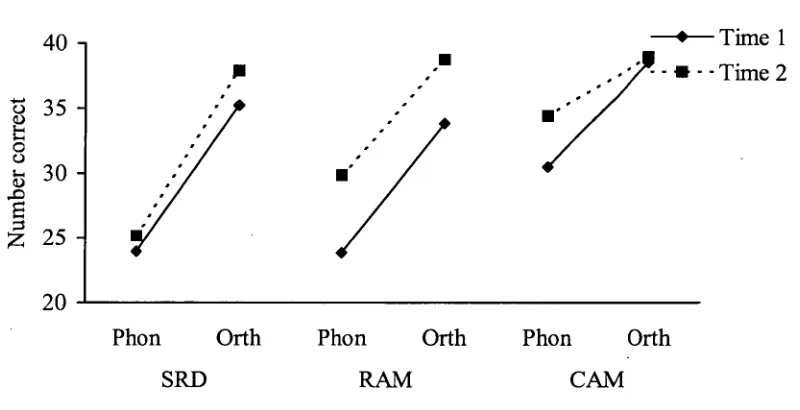
The improvement in word identification skills observed for dyslexic readers over the course of the two-year study was largely attributed to improvements in orthographic skill, although their deficit on this measure in relation to normally achieving readers remained reasonably stable over time. Although the dyslexics made gains in
attempt to use a phonological strategy to spell irregular words that are not within
their lexicon or they may find it difficult to access the entry in the lexicon if they do
not have well established connections between phonological and orthographic
representations (Landerl et al., 1996).
Snowling, Goulandris, and Defty (1998) conducted a two-year longitudinal study to
investigate whether dyslexia is a disorder of development and whether subtypes of
dyslexia exist. The baseline data indicated that, although dyslexic children were
generally poorer than chronological age match controls for reading, spelling, and
phonological processing skills, their performance was consistent with that of younger
reading age matched controls suggesting that the dyslexic readers were delayed on
these tasks. However, the longitudinal data indicated that dyslexic readers had an
atypical pattern of development as they performed significantly poorer than reading
age match controls over time.
Pennington, Lefly, Van Orden, Bookman, and Smith (1987) found that, in a sample
of child, adolescent, and adult dyslexic and normally achieving readers from the same
family, orthographic learning occurred early whereas phonological processing skills
had a more protracted developmental course. Dyslexic readers demonstrated little
improvement in phonological skill across age, but made steady improvement on
orthographic coding tasks. Differences between dyslexics and reading age match
controls on a nonword reading task were found only for adults and not for
Phonological and Orthographic Processes in Subtype of SRDs
Although it is not within the scope of this thesis to identify subtypes of SRDs, there
is some evidence from the subtyping research in the literature that contributes to an
understanding of the development of and relationship between phonological and
orthographic processes in SRDs. Before outlining that literature, an overview of
dyslexic subtypes will be provided.
A number of attempts have been made to classify subtypes of SRD. Coltheart (1985)
demonstrated support for his dual route model of word recognition from the pattern
of deficits shown by patients who had acquired reading disorders after brain injury.
He hypothesised that if two separate procedures existed for reading aloud then he
expected to find different subtypes of patients in whom one of the procedures was
impaired while the other was intact. There has been some evidence from single case
studies of a double dissociation of deficits in brain-injured patients that supports the
existence of two separate word recognition processes (Bub, Cancelliere, & Kertesz,
1985; Funnel, 1983). These patients either have a selective impairment in the ability
to read pronounceable nonwords and relatively intact ability to read words
(phonological dyslexia) or, the nonlexical procedure remains fully intact but the
number of words with accessible lexical representations is usually limited to
high-frequency words (surface dyslexia).
There are reported cases of developmental dyslexia that mirror the subtypes
Coltheart, 1993; Manis et al. 1988, 1990; Stanovich, Siegel, Gottardo, Chiappe, & Sidhu, 1997). For example, Castles and Coltheart (1993) attempted to determine whether patterns of reading can be found in developmental dyslexia that are
analogous to those found in acquired dyslexia and are consistent with the dual route model of reading. Using a sample of dyslexics ranging in age from eight to 14 years old and their reading age matched controls, regression analyses were conducted on regular, irregular, and nonword reading accuracy. Evidence was found for a double dissociation between surface and phonological dyslexic reading patterns, although a higher proportion was classified as having phonological dyslexia. However, a large proportion of the dyslexic sample demonstrated difficulties with both irregular and nonword reading, although tended to be markedly worse on one compared to the other. Therefore, although the majority of dyslexics in this sample appeared to have a phonological deficit, a proportion of dyslexic readers who have a primary difficulty with nonword reading, which indexes the operation of the phonological route, also have a secondary difficulty in utilising the orthographic route to read irregular words. This finding suggests that impairment in one route of the dual model can have
s secondary effects on the functioning of the other route, suggesting some interplay between the development of phonological and orthographic processing skills.
(1990) reported that SRDs were also less accurate than both reading age and
chronological age match controls on orthographic tasks. These dyslexics appeared to have impaired knowledge of orthographic patterns for specific words and this was usually seen in conjunction with a phonological problem.
Snowling et al. (1998) also investigated whether cognitive differences underlie phonological and surface dyslexia subtypes found in their sample. The findings indicated that individual differences in dyslexia resulted from variation in the severity of phonological processing deficits. SRDs with a specific nonword deficit (phonological dyslexia) had more significant phonological processing difficulties compared to SRDs who had a primary difficulty with decoding irregular words (surface dyslexia) suggesting an atypical pattern of reading development in phonological dyslexia. In contrast, the performance of surface dyslexics on phonological tasks was appropriate for their reading age but lower than expected given their chronological age. This suggests that they although they are delayed, they follow a normal developmental course. Manis, Seidenberg, Stallings, Joanisse,
Bailey, Freedman, and Curtin (1999) provide further evidence for a distinction between phonological dyslexia characterised by deficits in nonword reading and phoneme awareness, and delayed dyslexia characterised by difficulties with the development of orthographic skills.
suggests that they are unable to compensate adequately for their phonological processing difficulties, which may be a result of less precise or incomplete
orthographic representations in the lexicon (Manis et al., 1990). Similarly, Lundberg and Hoien (1990) provide evidence that without intact phonological skills, readers cannot develop accurate orthographic representations.
Although SRDs have typically been represented as having a core phonological deficit, the evidence suggesting a subgroup of SRDs who demonstrate an
orthographic processing deficit indicates that we cannot always assume that, because a child has been identified as having an SRD, they will need extra instruction in phonological processing skills. However, we must also ask the question of whether it is useful to compartmentalise SRDs into two distinct groups. Coltheart, and Jackson (1998) argue against defining dyslexia with respect to a demonstrated phonological difficulty, and in relation to exclusion criteria such as IQ. They suggest that an alternative method is to evaluate reading subskills against age-related norms to obtain a profile of the child's reading system. This will allow the identification of proximal causes of reading difficulties and will assist in identifying targets for remediation. It may be of more benefit to view SRDs as falling somewhere on a spectrum that ranges from phonological difficulties to orthographic difficulties to account for individual variation in orthographic and phonological skills in SRDs. It is also important to highlight the distinction between the tendency to use a
Phonological and Orthographic Strategy Use in SRDs and Normally
Achieving Readers
Although there is continued debate surrounding the nature of word recognition and
reading acquisition models, both phonological and orthographic component
processes play a significant role, regardless of the model currently receiving favour.
However, results based on previous research are problematic for a number of
reasons. For example, an important issue raised by Maths et al. (1993) is that
phonological and orthographic skills may be difficult to measure independently
because most measures of orthographic skill are contaminated by phonological
processing. There are two explanations for this. One is that strong phonological
decoding skills are related to rapid acquisition of orthographic codes in memory as
proposed by Share's (1995, 1999) self-teaching model. Furthermore, younger and
poorer readers tend to find it difficult to avoid using a phonological strategy on
orthographic tasks. For example, Bruck (1990) reported that normal readers become
less reliant on phonological decoding whereas adult dyslexic readers continue to use
this strategy, even though they have poor spelling-sound knowledge. A second issue
is that these tasks measure orthographic and phonological processing ability but do
not demonstrate whether normal readers and SRDs differ in terms of preferred or
dominant strategy use. Thirdly, there is little evidence suggesting that normal readers
and SRDs demonstrate differences in the flexible use of phonological and
orthographic strategies in response to task demands. Nor is there evidence regarding
the development of dominant strategy Use and flexible strategy use in SRDs
Hendriks and Kolk (1997) attempted to provide direct evidence for strategic
influences in developmental dyslexia and made the assumption that even if one route
is more efficient than the other, dyslexic children may still utilise the less efficient
route. They examined variations in performance of dyslexic readers when they were
required to use a speed versus accuracy strategy in performing a word recognition
task. When speed was emphasised, they made more word substitutions and exhibited
less sounding-out behaviour, which was regarded as similar to the behaviour of
phonological dyslexics who tend to rely on the lexical route. When accuracy was
emphasised, the opposite occurred, suggesting that they performed like surface
dyslexics and relied on the nonlexical route to identify words. This provides evidence
that the reading behaviour of dyslexic children can be affected by strategic decisions.
Foorman and Liberman (1989) investigated the extent to which beginning readers use
phonological and orthographic strategies and whether strategy use differs between
good and poor readers. Participants were asked to read and spell irregular and regular
words and complete a visual recognition task. Good readers were expected to
demonstrate a regularity effect to indicate their reliance on phonological codes in
word recognition whereas poor readers were expected to use analogies in word
recognition using visual-orthographic codes. The results did not indicate a dichotomy
between strategy use in good and poor readers. Not all good readers processed words
phonologically and not all poor readers were deficient in phonological coding.
strategies and also benefited from visual-orthographic knowledge provided by clue words. Correlations indicated that participants who had developed segmentation skills tended to use a phonological strategy in word recognition.
In an attempt to differentiate between phonological and orthographic strategy use, Stuart (1990) examined the relationship between strategy use, current reading and spelling ability, and earlier phonological awareness skills in nine-year-old children using a consonant deletion task. Words and nonwords were presented aurally and the participants were asked to delete one of three target consonants (/1/, In!, Is!) that were part of a consonant cluster. The stimuli were designed so that the target response would differ depending on whether an orthographic or phonological strategy was used and all correct responses were real words. For example, participants were given the word 'cast' and were asked to say the word without the /s/. If they responded 'cart', it was inferred that they had used a phonological strategy which emphasised the sounds of the letters when the /s/ sound was removed whereas if they responded 'cat', this indicated the use of an orthographic strategy which emphasised the
Although Stuart (1990) provides evidence for differences in strategy use in good and
poor readers, from a developmental perspective the results are limited in that
performance was only measured at one age level. A second difficulty is that the
instructions are presented in the auditory modality and require the deletion of a
phoneme (e.g., Is/), which may explain the more frequent use of a phonological
strategy given that the modality of presentation and the instructions emphasised the
phonological properties of the stimuli. Furthermore, this task investigated dominant
strategy use but did not assess flexibility in strategy use. Therefore, recent studies in
the psychology department at the University of Tasmania have utilised a forced
choice grapheme-phoneme deletion task that constrains the use of orthographic and
phonological processes independently in a single task (Binns, 1997; Claydon, 1996;
Martin, Pratt, & Fraser, 2000). The instructions given to participants indicate which
strategy is to be used to complete the task. The instructions specify whether a
grapheme (or letter) or a phoneme (or sound) is to be deleted from the word. If an
orthographic strategy is required, participants are instructed to delete a grapheme and
pronounce the new word based on its spelling or orthography. If a phonological
strategy is required, participants are instructed to delete a phoneme and pronounce
the new word based on what it sounds like or its phonology.
the type of instruction (orthographic or phonological) and modality on performance. In this design there are two inconsistent combinations, auditory/orthographic and visual/phonological, where the modality of presentation is not congruent with the instructions for strategy use and therefore places greater demands on working
memory. For example, a word presented in the auditory modality will be held in the phonological loop in working memory while it is being manipulated. In order to complete the task using the orthographic strategy, the sound of the word has to be ignored and the visual features of the individual letters have to be generated in order to access the new spelling directly from the lexicon. Similarly, to use the
phonological strategy for a visually presented word, the spelling of the word has to be ignored and the sound of the word must be generated but cannot be pronounced out loud. Inconsistent conditions add a degree of difficulty to the task and give an indication of flexibility in strategy use, as it is often the case that the mode of presentation will influence choice of strategy, irrespective of instructions.
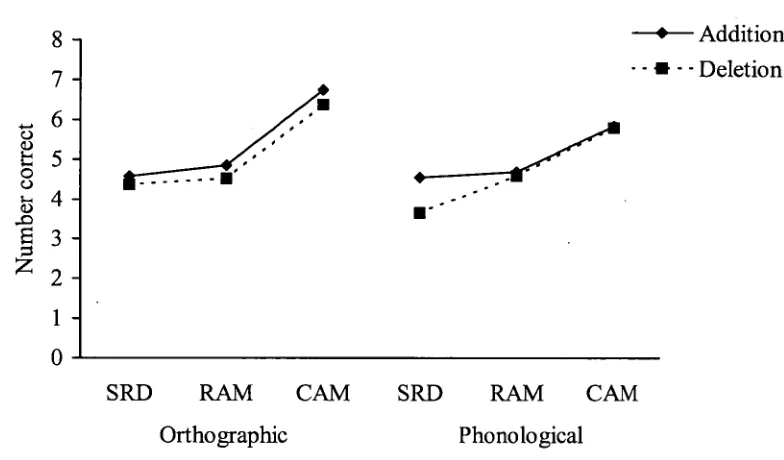
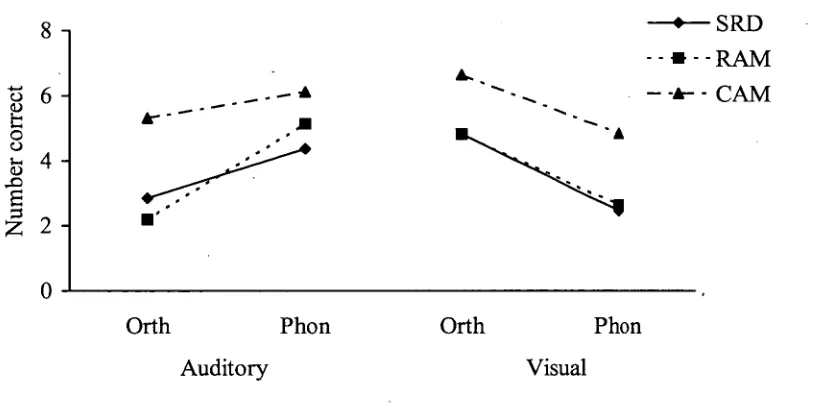
Martin et al. (2000) used the grapheme-phoneme deletion task with SRDs and normal readers and found that this adaptation of earlier versions of the deletion task (Bruce, 1964; Rosner & Simon, 1972; Stuart, 1990) provided a useful measure of group differences in phonological and orthographic strategy use and flexibility. Whereas SRDs demonstrated a particular difficulty using the phonological strategy in the auditory modality, their performance using the orthographic strategy was superior to reading age match controls and equivalent to chronological age match controls in the visual modality, a finding that was consistent with previous studies suggesting intact orthographic processing skills (Siegel et al., 1995; Stanovich & Siegel, 1994). Developmentally, the early reliance on phonological processing by the reading age match controls was superseded by the skill and flexibility of the
chronological age match controls in both phonological and orthographic strategy use.