First published in 2007 Australian Academic Press 32 [eavs Street
Bowen Hills Qld 4006 Australia
www.australianacademicpress.com.au
© 2007. Copyright for each contribution in the book rests with the listed authors, and where an author is not indicated copyright rests jointly with Parikshit Basu, Grant O'Neill and Antonio Travaglione as the editors.
Copying for educational purposes
The Australian Copyright Act 1968 (Cwlth) allows a maximum of one chapter or 10% of this book, whichever is the greater, to be reproduced and/or communicated by any educational institution for its educational purposes provided that the educational institution
(or the body that administers it) has given a remuneration notice to Copyright Agency Limited (CAL) under the Act.
For details of the CAL licence for educational institutions contact: Copyright Agency Limited, 19/157 Liverpool Street, Sydney, NSW 2000. E,mail [email protected]
Production and communication for other purposes
Except as permitted under the Act, for example a fair dealing for the purposes of study, research, criticism or review, no part of this book may be reproduced, stored in a retrieval system, or transmitted in any form or by any means electronic, mechanical, photocopying, recording or otherwise without prior written permission of the copyright holder.
National Library of Australia Catalogumg-m-Publicanon data:
Engagement and change : exploring management, economic and finance implications of a globalising environment /
editors, Pankshlr K. Basu ; Antonio Travaglione j Grant
O'Neill. lst ed.
Bowen Hills, Qld. : Australian Academic Press, 2007. ISBN: 9781875378883 (pbk.)
International business enterprises-,Management. Globalization--Economic aspects.
International economic relations. Basu, Parikshit K.
Contents
Introduction
Exploring the Impact of Globalisation on Contemporary Business Grant O'Neill, Parikshit Basu and Antonio Travaglione
1
Part 1
China in the Global Market Environment
Chapter 1
Economic and Business Relations Between China and Australia: Insights Into China's Global Economic Footprint
Clem Tisdell
11
Chapter 2
How Can Australia Benefit from China's Economic Reforms Parikshit Basu, Richard Sappey and John Hicks
25
Chapter 3
There is Serious Money to be Made in China and Lost Opportunities for Western Managers Kate Hutchings
Challenges
37
Chapter 4
Guest Workers in Taiwan: Experiences of Racialisation and Racism Robert Tierney
47
Part 2
Human Management Issues in the Integrated World
Chapter 5
The Evolution of Human Resource Development in Australian Firms: Towards a More Strategic Function
Andrew Smith
59
Chapter 6
Working Under AWAs: Perceptions From the Top Val Siemionow
69
Chapter 7
Capturing the 'Value-Addedness' of the Business Management Graduate
Zelma Bone
81
Chapter 8
The Development and Effects of Psychological Contracts: An Exploration of the Contracts Established by Academics Within an Australian University Business School
Branka Krivokapic-Skoko, Grant O'Neill and Marcelle Droulers
91
Chapter 9
How to Manage Staff with Individual Contracts?
Some Experiences With Psychological Contracts in New Zealand Rupert Tipples and John Verry
105
Chapter 10
Happy High-Performing Managers
Peter Hosie, Peter Sevastos and Antonio Travaglione
117
Chapter 11
Intellectual property protection and the WTO TRIPS Agreement: Finding a Global Balance for Development as Part of the Doha Round Anne Ardagh
139
Part 3
Financial and Accounting Issues in a Globalised World
Chapter 12
Contextualising and Profiling Contemporary Financial Management Estian Calitz
155
Chapter 13
Capital Flows to Emerging Markets from Australia: Facts Rakesh Gupta
167
Chapter 14
Corporate Debt Default and Developmental Role of Development Banks: A Theoretical Approach Mohammad Ziaul Hoque
175
Chapter 15
On Foxes Becoming Gamekeepers: The Capture of Professional Regulation by the Australian Accounting Profession
Graham Bowrey, Brian Murphy, Ciorstan Smark and Ted Watts
183
Chapter 16
Part 4
Cultural Change and Its Effects on Management and Workplace Performance
Chapter 17
Leading the iGeneration With a More Social Approach to Intelligence linda Herkenhoff
205
Chapter 18
Innovation Development Early Assessment System John English
215
Chapter 19
Moral Judgment in Management: The Role of Phronesis and Aporia Robert Macklin
227
Chapter 20
The Importance of Perceived Organisational Support in
Encouraging Positive Employee Discretionary Extra-Role Behaviour Robert Sharkie
237
Chapter 21
Communities of Practice, Clusters or Networks? Prospects for Collaborative Business Arrangements in the Mining and Engineering Sector, Central Western New South Wales
Mark Frost and Judith Crockett
249
Chapter 22
Time to Take Another Look? The Mentoring Option
for Work-Life Balance 261
Pamela Mathews and Stacey Jenkins
Chapter 23
Marketing Intelligence: How Linguistic Ability and International Experience Impact on an Export Marketing Manager
Jasmine Williams and Troy Heffernan
273
-Chapter
18
Innovation Development
Early Assessment System
John (Jack) English
Australia's Industrial Performance
How does Australia's
industrial performance compare with other nations and what are the implications for the role of innovation? Table 1 reflects Australia's rankings in four of the United Nations Industrial Development Organization's indicators for industrial performance in 1990 and again in 2002.UNIDO's industrial performance indicators focus upon countries' competitive ability to produce and export manufactured goods. Australia ranked 25th in 2002 for manufacturing value added per capita, falling one place from 24th position in 1990.While Australia improved the dollar value of manufacturing value added per capita, so did many other countries resulting in a fall in the relative ranking.
Australia ranked 43rd in 2002 for manufactured exports per capita, falling eight places from 35th position in 1990. This indicator reflects the component of manufacturing value added that is exposed to international competition. Australia more than doubled the dollar value of manufactured exports per capita, but it did not match the increases in many other countries resulting in a signifi-cant drop in the relative ranking.
Table 1
Australia's Industrial Performance (World Ranking)
1990 2002
Manufacturing Value Added $2488 (24th) $2797 (25th) Manufactured Exports $688 (35th) $1390 (43rd) Technological Structure of MVA 50.6% (27th) 49.5% (35th) Technological Structure of ME 31.3% (43rd) 41.3% (5200)
Source: United Nations Industrial Development Organization (UNIDOl, Industrial Development Report 2005 (adapted).
Iii
i'"
'I
I,'l
'i,i
Engagement and Change: Exploring Management, Economic and Finance Implications of aGlobal Environment
Australia ranked 35th in 2002 for the share of medium- or high-technology production in manufacturing value added, falling eight places from 27th position in 1990. The higher a country ranks on this indicator, the more technologically complex is its industrial structure. This indicator reflects a disappointing setback in the agonisingly slow structural shift in Australia from lower technology to higher technology activities.
Australia ranked 52nd in 2002 for the share of medium- or high-technology production in manufactured exports, falling nine places from 43rd position in
1990, despite a significant improvement in the indicator. It reflects the slow evo-lution of Australia's industrial and export structure compared with a large number of other nations and further highlights the need to shift both manufac-turing value added and exports up the technology scale.
It is dear that Australia's recent industrial performance does not compare favourably with the industrial performance in many other nations. Despite improvements in three out of the four performance indicators, Australia has slipped in all four relative rankings. If we want to entertain any notions about playing in the major league of exporting nations, then we need to refine our ability to identify new ideas with genuine commercial potential and bring them to market.
Purpose of Early Assessment
An innovation is a complex series of activities in which an idea is conceived, proceeds through a succession of developmental steps and culminates in a product, a process, or a service that is accepted in the marketplace. It starts with an idea, or initial discovery, that needs to be assessed, developed and tested. Everything, from the smallest incremental improvement to the most radical innovation, starts with an idea.
Prospective innovators generally believe that the leap from an idea to market entry is only a short distance and they often do not recognise how complex, costly, and time consuming the process can be. Consequently, it is important to be able to assess the commercial feasibility of new ideas very early in the innova-tion process, because it is the least costly stage in which to identify and eliminate likely failures (English & Udell, 2004). Inasmuch as many new ideas turn out not to be commercially feasible, indiscriminately investing time, money and effort in them only dilutes the resources available for projects with genuine potential. Innovation is not a democracy in which all ideas are created equal. It is a meri-tocracy in which those ideas with demonstrated commercial merit should be developed further.
Innovation Development Early Assessment System
An IDEAS assessment takes place long before there is enough tangible informa-tion to do a business plan, and its purpose is to decide if further development of the idea is warranted. Idea assessment does not need to be expensive or time-con-suming, particularly in the early stages of the innovation process, but it does need to be systematic and comprehensive. There are three basic approaches to deter-mining if an idea warrants further development.
The first approach is an informal and unstructured yes or no assessment that
amounts to little more than a beauty contest. It is the least expensive approach, but it is also the least beneficial because it is not likely to provide much insight into, or information about, the idea. Moreover, there is no way to control for quality or to insure the use of uniform criteria.
The second approach is an in-depth analysis by a panel of specialists who have the requisite technical and marketing expertise. This approach usually provides the best possible assessment and the greatest amount of information about strate-gies for commercialisation. However, it is also the most expensive approach and beyond the capacity of most individuals to underwrite.
The third approach is the IDEAS approach. It consists of a standardised
analysis designed by a cross-section of specialists representing a broad range of technical and commercial expertise. It is a low-cost, comprehensive and system-atic analysis that can be undertaken by anyone trained in the IDEAS protocol. It provides a uniform, easily communicated and easily understood basis for assess-ment coupled with comprehensive and valuable feedback. It is intended to be an efficient and cost-effective way to provide an assessment of the commercial strengths and weaknesses of an idea.
Most assessment models require information that does not exist or is too costly to obtain in the very early stages of the innovation process. The result is that many prospective innovators skip assessment altogether and move directly into research and development. In other words. the day of reckoning for low potential ideas is postponed until the cost of abandonment is much higher. The rationale for making an informed decision early in the innovation process is two-fold. First, few prospective innovators have the resources to withstand failure and early assessment can be extremely valuable in order to avoid costly mistakes. Second, both individuals and organisations need to focus their resources on the most promising innovations, and early assessment is an important tool in identi-fying ideas with genuine commercial potential.
Origins of the IDEAS Program
IDEAS is based on the Preliminary Innovation Evaluation System (PIES) devel-oped by Professor Gerald G. Udell and his colleagues at the Experimental Center for Invention and Innovation in the United States with financial support from the US National Science Foundation, the US National Bureau of Standards and the US Small Business Administration (Udell, 2004). Professor Udell formed the
Engagement and Change: Exploring Management, Economic and Finance Implications of a Global Environment
Table 2
PIES Evaluation Results
Evaluation Categories Successful firms (n = 93) Failed firms (n = 1130) Significance {pvalue} mean score mean score
Social impact 82.4% 81.4% NS
Business risk 91.0% 84.0% 0.010
Demandanalysis 64.6% 58.0% 0.001
Market acceptance 72.3% 66.4% 0.001
Competitive capability 60.4% 57.9% 0.010
Experience and strategy 66.7% 59.7% 0.001
Venture assessment 66.2% 59.1% 0.001
Overall mean 71.5% 66.8% 0.001
Innovation Institute in which his system has been used to evaluate an estimated 30,000 ideas and inventions - primarily in the United States and Canada. A European version of the system has also been launched at the University of Nottingham with a planned rollout throughout the European Union.
In the initial version of PIES, the criteria were selected after a considerable amount of research in the new-product literature and discussions with a number of experts involved in invention and innovation - including independent inven-tors, technologists, patent attorneys, consultants, licensing agents, corporate researchers, and new-product planning specialists. Since that time, new criteria have been added as experience, changes in market conditions and continued val-idating research have suggested they are warranted.
A study of the PIES protocol found that it was effective in discriminating between success and failure in 1223 cases in the United States (Knotts, Jones, & Udell, 2003). Table 2 contains the results.
For each evaluation category, the difference between the mean scores for failed firms and successful firms is significant, except for social impact. This exception might have been the result of a de-selection process in which firms with products that were illegal, unsafe or inappropriate for the mass market might have chosen to withdraw earlier from the program. Overall, failed firms had' a lower mean rating than successful firms (66.8% to 71.5%, P< .00l).
Innovation Development Early Assessment System
IDEAS Assessment Framework
IDEAS is concerned with commercial feasibility. There are many ideas that are technically feasible, but not all of them are commercially feasible. If an idea is both technically and commercially feasible, then it is generally worthwhile to develop the idea further with a view to identifying a commercialisation strategy and compiling a business plan. IDEAS consists of a series of questions that do not require a great deal of information in order to make a preliminary judgment. In most cases, there is sufficient information inherent in the basic concept to arrive at an informed assessment about the commercial feasibility of an idea.
The first objective of IDEAS is to determine if a new idea ought to be devel-oped further. There are two ways to approach this: identify ideas that have the potential to become successful innovations, or identify ideas that do not have the potential to become successful innovations. The second approach is much easier to operationalise because there are too many unknowns to be able to predict success accurately this early in the innovation process. Occasionally, an idea or invention will occur with such clarity of technical and commercial feasibility that its potential for success is obvious, but this is a rare event.
The second objective of IDEAS is to provide feedback. Without genuine feedback, aspiring innovators can be left confused and/or frustrated because they do not know what to do next. For example, if an assessment shows a short product life cycle, it does not necessarily mean the idea should be abandoned. However, it does mean that certain financial, production, and marketing strate-gies will be more appropriate than others. Feedback is important because it: • reduces misunderstandings
• creates an environment that is conducive to creativity • provides insight into the innovation process
presents an opportunity to correct errors
• stimulates consideration of strategies for further development.
IDEAS consists of 35 questions. Each question contains five possible responses ranging from very favourable to very unfavourable. The question for stability of demand is an example.
Stability of Demand
Fluctuations in demand are likely to be:
• highly stable - not susceptible to fluctuations
• stable - modest variations can be accurately foreseen
Engagement and Change: Exploring Management, Economic and finance Implications of a Global Environment
Opportunity Risk Complexity
Potential
-Demand
External Critical Risks Competencies
Market I I Commercial Acceptance I I Feasibility
Establishment Critical Risks Resources Competitive
Position r
-Figure 1
Assessing commercial feasibility.
During an IDEAS workshop, the information that each question is attempting to elicit and the meaning of each of the responses is carefully explained. The main activity of the workshop is for each participant to rate their idea across the 35
questions by selecting the most accurate responses. The responses are then combined into a series of diagnostic diagrams and a Commercial Feasibility Rating.
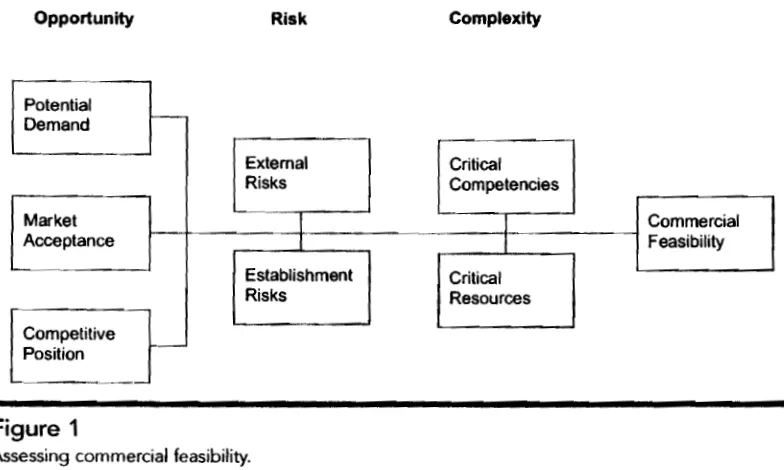
IDEAS is organised into three themes: the market opportunity, the associated
risk, and the degree of complexity involved in putting the idea into operation. The
[image:11.516.61.453.60.295.2]assessment of commercial feasibility is divided into seven sections depicted in Figure 1.
Opportunity
The first theme is designed to assess the market opportunity. It is divided into three sections composed of potential demand, market acceptance and competi-tive position.
Potential Demand
One of the important determinants in evaluating commercial feasibility is poten-tial demand. Demand is also difficult to assess because it requires some insight into the behaviour of the marketplace and a certain amount of guesswork about the firm that will eventually take the idea to market. Potential demand questions, although general at the early assessment stage, are designed to explore several key aspects about demand.
Innovation Development Early Assessment System
Is demand likely to be stable or unstable? How long is the life cycle likely to be?
• What potential is there for related products, processes or services?
Market Acceptance
Market acceptance is an important determinant in converting potential demand into sales. It affects both the rate of adoption and the extent to which the market can be penetrated. There are a variety of reasons why the market may accept or reject a new idea. These questions focus on five of the most important reasons.
Is it compatible with existing attitudes and patterns of use? What degree of learning is required to consume or use it? • What level of need is fulfilled or utility provided?
• How visible are the benefits and what degree of promotion is needed to create customer awareness?
How difficult will it be to establish distribution channels?
Competitive Position
Competitive position questions assess how an idea for a new product, process, or service is likely to fare compared with the dominant competitive pressures already in the marketplace or likely to emerge after market entry.
• How is it different from similar products, processes or services?
• How will its perceived value compare with equivalent products, processes or services?
Is it vulnerable to the bargaining power of customers? Is it vulnerable to the bargaining power of suppliers? • Is it vulnerable to the bargaining power of competitors?
Risk
The second theme is designed to assess the risk associated with an idea by search-ing for its fatal flaws. Risk is divided into two sections composed of external risks and establishment risks.
External Risks
External risks are dangers that are generally beyond an innovator's control but nevertheless affect the commercial feasibility of their idea. They originate from a variety of sources such as government, advocates of various popular causes, existing and potential vested interests and the public. The questions in this section deal with the following types of external risks.
Does it meet legal, safety and other regulatory requirements? Is it vulnerable to changes in technology?
Engagement and Change: Exploring Management, Economic and Finance Implications ofa Global Environment
Does it have an effect on the environment?
Is it vulnerable to any of the dominant forces in our society?
To what extent could sales be limited by dependence on other external factors?
Establishment Risks
Establishment risks also represent obstacles that have the potential to affect the commercial development of an idea. The difference between these and external risks is the degree of control that an innovator may have over them. The innova-tor needs to recognise what they are, the extent to which they can be resolved or avoided and whether or not they want to take these risks. Establishment risk questions focus on the following five business-related uncertainties associated with commercialising an idea.
Will this product, process or service actually perform the way you want it to? Are the start-up components available and reliable?
What market research remains to be done?
What research and development remains to be done? What sort of money will it take to get started?
Complexity
The third theme is designed to assess the degree of complexity associated with trying to put an idea into operation. Complexity is divided into two sections composed of critical competencies and critical resources.
Critical Competencies
For the most part, an innovation is the result of a successful marriage between commercial potential and the essential expertise and resources to make it happen. The relative importance of the critical competencies depends upon the cation of the idea and the nature of the market it faces. At times, very sophisti-cated ideas can be relatively easy to implement. It is also true that some very simple ideas can require a high degree of management, marketing or financial expertise. We are concerned with identifying the critical competencies needed to develop and successfully launch an idea and whether the innovator can realisti-cally provide or acquire them. The critical competencies examined include:
Innovation Development Early Assessment System
Critical Resources
Successfully commercialising an idea not only depends on expertise, but also on key resources that, together, form the basis for creating and sustaining value. These questions are concerned with identifying critical resource intensity as well as what the innovator can realistically provide or acquire. Critical resource requirements form the basic dimensions for a business plan. The critical resources examined include:
operating resources
human resources
financing resources
• knowledge resources reputational resources.
Commercial Feasibility Rating
The objective in an IDEAS workshop is to arrive at a judgment about the overall attractiveness of the opportunity, the risks associated with commercialisation and the degree of complexity involved in putting the idea into operation. The result is a Commercial Feasibility Rating, together with diagnostic diagrams for the underlying drivers. A Commercial Feasibility Rating is not merely a mechanical procedure. It is a method designed to assist an innovator to exercise their judgment. It depends upon an understanding of the IDEAS protocol and' the extent to which the assessment has been objectively undertaken.
An integral part of the assessment process is to plot diagnostic diagrams of the responses. This can be done for each of the sections and each of the themes. The example in Figure 2 is a template for the diagnostic diagram for market opportu-nity. The diagrams help to visualise the way in which the responses have con-tributed to the overall assessment. Each diagram contains an Area of Concern. Responses that fall into the Area of Concern highlight potentially important issues that may affect an idea's commercial feasibility. Engaging in a visual evaluation for each component of the system reveals a great deal more insight into the strengths and weaknesses of an idea than the overall
Engagement and Change: Exploring Management. Economic and Finance Implications of a Global Environment
Market Potential
Competitor Trend
Suppliers Stability
Customers Life C~le
Value Related Potential
Differentiation Compatibility
Figure 2
Market opportunity diagram.
remain unanswered at this very early stage. The Commercial Feasibility Rating falls into one of three bands that are described in terms of a traffic light.
Red Light
If an idea's Commercial Feasibility Rating is under 60, then its commercial poten-tial is considered unacceptably low and further development is not recom-mended. A Commercial Feasibility Rating below 60 generally represents a poor opportunity, unacceptable risks, and/or impractical operational complexity. In this situation, abandonment may be the best course of action. Sometimes it
IS
the idea itself that is flawed and sometimes the flaw is in the marketplace.Yellow Light
[image:15.483.73.450.76.281.2]Innovation Development Early Assessment System
Green
Light
If an idea's Commercial Feasibility Rating is between 80 and 100, then its commer-cial potential is good and further investment of time, energy and money is usually recommended. A Commercial Feasibility Rating in the lower half of this range gen-erally represents a good opportunity, an acceptable level of risk and is operationally realistic - but it may still have one or two important unknowns that need to be
resolved. A Commercial Feasibility Ratingin the upper half of this range generally represents an excellent opportunity, a low level of risk and is operationally practical.
This does not mean that an idea with a Commercial Feasibility Rating over 80 is automatically accepted. On the contrary, all new products, processes and services have some degree of risk and managing that risk is part of the key to long-term success. Ignoring even relatively minor risk factors can be serious, if not fatal, to the commercialisation process. Therefore, careful attention is paid to responses that fall into the area of concern even though the Commercial Feasibility Rating is high.
Reaching
aDecision
It should be apparent that IDEAS does not make decisions. Its purpose is to provide a useful framework for assisting a prospective innovator to exercise their judgment about whether or not to move to the next stage in the innovation process. There are three more factors that are also likely to influence a decision to abandon, revise or go ahead with their idea.
The first factor is their willingness to accept the risk and how far they will go before saying 'No.' Some people can tolerate very high levels of risk and others have a very low tolerance for risk. Most successful innovators, however, do not fall into either group. Rather, they are willing to take some risks, but they also work hard to avoid or overcome them. There are always concerns with every new idea, so it is expected that some responses will fall into the Area of Concern. The ques-tions in which a response falls into the Area of Concern need to be carefully reviewed. Many of these concerns can be resolved. What seems to get so many individuals into trouble is their failure to deal with these concerns early in the innovation process.
The second factor is the financial returns that that an idea is expected to generate. If an innovator can see the potential for a very high return, then they may be more likely to invest their time and money in a high-risk venture. If they expect a moderate return, then they will probably be more conservative.
The third factor is the relative size of the initial investment. The more money they need to invest, the lower will be the degree of risk they consider acceptable. However, this may be mitigated by the financial returns they expect to earn. In other words, ideas that offer big margins and appeal to large markets generally warrant a greater investment than specialty items with limited market appeal and modest prospects for profits.
Engagement and Change: Exploring Management, Economic and Finance Implications of a Global Environment
Conclusion
Launching a new product, process or service is far more difficult than most people anticipate. This is, in part, due to the complicated nature of the innovation process and the unexpected obstacles that inevitably occur along the way. IDEAS is one method for evaluating the attractiveness of the market opportunity, the risks involved and the degree of complexity in attempting to commercialise a new idea. The objective is to help prospective innovators to come to a conclusion about the commercial feasibility of their idea and whether or not they want to develop it further. To the extent that Australian innovators become skilled at identifying and acting upon genuine commercial opportunities, the more likelyAustralia will see its rankings improve in UNIDO's indicators of industrial performance.
References
English, J. (2006). IDEAS: Innovation Development Early Assessment System, workshop manual.
Canberra, Australia: Innovation Evaluation Systems.
English, J., & Udell, G.G. (2004). Preliminary evaluation system for economic development agencies. Journal of New Business Ideas and Trends, 2( 1), 11-20.
Jones, C, & English, J. (2004). A contemporary approach to entrepreneurship education.
Education + training, 46(8/9),416-423.
Knotts, T.L, Jones, S.c., & Udell, G.G. (2003). Small business failure: The role of management practices and product characteristics. Journal of Business and Entrepreneurship, October,
8-16.
Udell, G.G. (2004). Assessing the commercial potential of ideas, inventions and innovations: A balanced approach. Southwest Missouri State University: Innovation Institute.
United Nations Industrial Development Organization. (2005). Industrial development report 2005: Capability building for catching-up. Retrieved July 15, 2006, from http://www.