A CROSS RATIO IN CONTINUOUS GEOMETRY
by
B.D.JONES B.Sc.
submitted in fulfilment of the requirements for the degree of
MASTER OF SCIENCE UNIVERSITY OF TASMANIA
HOBART
INTRODUCTION
A. Fuhrmann [8] generalizes Sperner's definition of the cross ratio of four collinear points with coord-inates in a division ring to apply to four linear vari-eties over a division ring. The form of, his cross ratio is still very classical. In Part 2 of this a cross ratic is defined for a configuration of subspaces of a contin. uous or discrete geometry. Although this cross ratio could'nt be further removed in appearance from the classical form we give a simple proof (Section 4) to show that, for the case of four points on a line , it does in fact agree with the usual cross ratio. Moreover, it will follow from the results of Sections 5,6 that for the case of finite dimensional (i.e discrete) geom-etries, Fuhrmann's cross ratio is essentially the same as the one introduced here. The cross ratio has the desired property of invariance under collineations ( Theorem 3 ).
Results, similar to classical ones are obtained for the properties of the cross ratio under permutations of order in the configuration.( Theorems 4-9 ).
-iguration (satisfying a minimum of position conditions) Section 6 is devoted to studying the invariance
properties' of this representation. Several complete setE of invariants for the representation , under collineatic -ns , are obtained. These involve a cross ratio and
some position conditions (Lemmas 4,5). Theorem 12 goes half way towards providing a complete set of invariants
in terms of cross ratios alone. However, the converse of this theorem is out of reach at present. Lemma 3 reduces the question of invariance to one of a special kind of similarity involving the cross ratio.
Part 1 contains a general discussion of continuous geometries. The exposition follows the original papers N-[5.1 of von Neumann, who invented the subject. Also, in Section 6 of Part 1 we collect some other results needed for Part 2. The references given for these are mainly to [7], since the original work [6] is unavail-able.
( 1 )
PART 1
CONTINUOUS GEOMETRIES AND REGULAR RINGS
The axioms and basic properties of the systems call-ed continuous geometries were developcall-ed by J. von
Neumann in the sequence of papers [1] - [51 . The follow-ing brief summary of these results forms a background to Part 2.
I. AXIOMS: Consider a class L of at least two differ-ent elemdiffer-ents .ov, -t 9 -C , and in it a relation "4", with the following properties:
A. /01,4-e is a partial ordering of L, relative to which L is a complemented, modular lattice with unit and.
zero elements, i.e
(i) For each pair "iv, -- there are(necessarily) unique elements.uvve(join),AwnI(meet) satisfying
tl and 1:4
(ii) The zero(unit) element 0(1) is also unique and satisfies 0 4/01v(Alt. , 4 1 ) for all4r/vin L.
(iii) The modular law holds in
(2)
(iv) For every/at, in L there exists at least one
-e
(called a complement of -cA- ) in L such that‘e = I
and -e= 0 .B. L is complete,relative the partial order < 1, i.e for any subset N of L there exists an element UN(r) N) of L such that : UN 4 <=>
-e
4
-a
l
_
for all4
in N (4 N <=>
-e
for all in N).C. The lattice L is irreducible i.e 0 =
n
L, 1 =UT., are the only elements of L with unique complements.D. A limit notion can. be introduced in L as foll-ows: Let 2 denote an infinite aleph and consider a sequ- ence S of /cr. from La I where a runs over all ordinals < 2 • Define
(1) If a <3 <2 implies ,trt,a < then
a-> 2 a
( ii) If a < <2 implies ,c.A-0 4 /ov a then lim* (tit. a
)=n
S Otherwise 1im * (4,va) is undefined.E. The lattice operations up n are continuous in L i.e,a<0<2 =>4„,c6. 4,6,, then a
0
1 im* (/r.n. rt -*) =1 i in* ( /CA- )n.iea ---...2 a
and if a< r3< 2=> ' 01
-
<,r.n,- then lim* (vt- v-e) = lila* * )v-le(3)
The axioms (A)-(E) are invariant under the dualizat-ion obtained by reversing the partial order, along with the resulting interchanges of u n and 0,1 . Hence the dual of any theorem derived from these axioms is also derivable from them.
The axioms can clearly be satisfied when L is the lattice of subspaces of a finite-dimensional projective geometry; in particular, the notion of lintis void. 2. THE DIMENSION FUNCTION: It is possible to define,Ln exactly one way, a function D = D(,,c/1-) on the elements of L such that the following conditions are satisfied:
(i) D takes real values O, 41.
(ii) = 0 <=>-crt-= 0, D(1) = 1 .
(iii) -Zs ) + D(-rAdn-t) = D(-it) + D(- e) • (iv) The range of D is one of the sets
D = 0,1/n,2/n,....,1 1, some integer -n
n or, D eo = all real numbers ;.(:), <1 1
If D has range D n then L = Ln is the lattice of sub-spaces of an irreducible projective geometry with ordina: -ry dimension n+1. In this case L is called a discrete
geometry. On the other hand, if D has range D, o , then L = L eo is the lattice of "subspaces" of an irreducible
3. IDEALS IN RINGS: We consider only rings 9?. with unit 1. The results stated below for right ideals have obvious counterparts for left ideals.
A subset ALA-of A, is a right ideal if (i) xpy in
AcA.
=> x+y in-at, and (ii) x => xy in -u- -,all y in . The principal right ideal generated by an a in A, is the set (a) r = ax; xeA.
IIn any ring with unit the right ideals form a lattic ■
L under the relation of set indlusion; lattice meet is set intersection , whilst lattice join is defined by
= x+y; x y in-e 1. L has as zero elemem the empty ideal 01 and as unit element the ideal A,
An element e in
A,
is called idempotent if e2 = e. If e is idempotent so also is 1-e. For idempotent e we have : x belongs to (e) r <=> ex = x.Two principal right ideals ,ot., ,e are inverse if and only if they are complements in the lattice of right ide -1s. This being,there exist a unique idempotent e such
that /‹.^.= (e)r, = (1—e)r.
4. REGULAR RINGS:
A
is said to be regular if it satis-fies one of the following equivalent conditions: for every a in A. there exists(i) x in A such that axa = a
(5)
(iii) an idempotent f such that (f) 1 = (a)1. ideal
(iv) a right'inverse to (a) r.
= (e)1 =
) a left ideal inverse to (a)I.
Every division ring is regular( x = a-1 in (i) ). Let A, be a regular ring. IfAcrt,is a right ideal in
A,
then the left annihilator of 'Cr" is defined as/
= x in A/ ; xy = 0 for all y 1
The set 4n'ris a left ideal, principal if -VI, is princip-al. In particular, = (e)r for idempotent e, then
a
/
1-e)le
Denote by R ) the set of all principal right (left) ideals in a regular, ring A, . Then
(i) R are complemented modular lattices.
(ii) Rk. is anti-isomorphic to L under the one-one inverse mappings
in R, /cry , 4 in L, -> r (cf. Lemma 1)
The centre g of a regular ring is a commutative regular ring. An ideal in a regular ring which is both left and right is called a two-sided ideal. A principal ideal ,<Jt, is a two-sided ideal if and only if it is
(6)
A reduction of a ring Ar is a decomposition of X into two two-sided ideal direct summands. If A, is regular its only reductions are of the form (e)ilt u(1-e) t where e is a central idempotent and ()denotes
two-sided ideal. Since the only idempotents in a division ring are 0,1 it follows that A, is an irreducible regular ring if and only if its centre is a field.
(7)
principal right ideals of A . Moreover, for 143 this ring is uniquely determined by L, to within ring isomorphism.
Thus, the lattice of subspaces of every discrete or continuous geometry is isomorphic to the Rp, of an irreducible regular ring A, 2 unique to within
isomorphism(except for the exceptions mentioned).
If L is a discrete geometry L n then is the complet matrix ring PI, over, a division ring ID, whilst if L is a
continuous geometry L 00 2 then the corresponding irreduc-ible regular ring is called a continuous ring.
An algebraic characterization of the continuous ring; may be obtained as follows: For any geometry L the num-bers
D((a) r ) D'((a) I ) 9 1-D((a) 11,5 1-D'((a)) are equal, for any a in the ring of the geometry, where D( D' ) is the dimension function defined on
Their common value is called the rank, R(a) , of a. The function R(a) has the following properties
(i) 0 R(a) < 1 for all a in 17, (ii) R(a) = 0 <=> a = 0.
(8)
(iv) R(a) = R(b) <=> a = ubv 1 where u -1 1 v -1 exist. (v) R(ab) mini R(a),R(b) 1
(vi) R(a+b) ‘ R(a) + R(b) .
(vii) For e 2 = e l f 2 = f, ef = fe = 0 we have R(e+f) = R(e) + R(f) .
The function R(a-b) serves as a metric in ( the rank distance ). If *fi is the ring of a discrete or continuous geometry , it is complete in the topology of the rank distance i.e, if a 1 ,a 2 ,a3 ,....- are in > then the existence of a in A with
lim R(a -a) is equivalent to
lim R(a
R -a w)= 0
co
(9)
is called a complete rank ring. In this way a one-one correspondence between continuous geometries and contin-uous rings is obtained.
•
( 1 )
6. It is convenient to list below some other defin- itions , theorems and lemmas which will be drawn upon in Part 2. We give these results in the setting of a system L satisfying axious (A)-(E), and the associated complete rank ring A, (i.e L is RA ), although many of them remain valid in a more general setting.
ar
The operations 9 introduced in 4 have the addition -al properties given by
LEMMA 1: For each re.",, ,
e
in La
,=> "ON.
&I" (ii) --4J2.- ,
rra 47", =
( iv) (,)tite
=
A proof is given in [ 7; Hilfssatz 1.3, ch. VI
LEMMA 2: If epf are idempotent elements of A ,then (i) (e) rL/(f)r = (e+g)r , where g is any idempotent such that (g)r = ((l-e)f)r
(ii) (e)rn (f) r = (f-fg)r „ where g is any idempotent such that (g)1 = (f-ef)x.
LEMMA 3: If e l f are idempotents elements of A, ,then (i) (e) r = (f) r <=> e = f+fy(1-0, some y in A (ii) (e) = (f) <=> e = f+(1-f)zf, some z in A 17; Hilfssatz 1.5, ch VI -1
Call an element a of A non-singular if a ' in
• Then
LEMMA
4:
If epf are idempotents of the same rank in A then e = sfs-1 , for some non-singular s inA .
E9;
Lemma9,
p 4.00 1LEMMA
5: (a) r
= (b) r
<=>
a = by for some non-singul-ar v inr7; Hilfssatz 1.6, ch VII -1
LEMMA 6: (i) If e is a non-zero idempotent in A then Ote ( = iexe;x in )k 1) is the complete regular rank ring corresponding to L((e) r ) (= the sublattice of L of all ,01- such that-o'4 (e) r ) .
(ii) If is the centre of )1 then e,e is the centre of
eike .
(12)
RELATIVE COMPLEMENTS: If,r..te4
_e
in L then a relative complement of .cdt, Lin-e
is an element (not necessarily unique) of L such that 'en- ri = 0 and. 'al, =-
6:(
Since L is complemented and modular it is also relativel2 complemented, i e whenever -c'-- exists at least one relative complement of /en-- in.t ( for, if
1".1
is a complement of then - e n 1? is a relative complementof 'en- in ).
LEMMA
7:
If ape in A are such that e2=e and (e) r (a)r then (a-ea) r is a relative complement of (e)r in (a)r.[11; 3.2(111)
INDEPENDENCE: A finite set krti;I = 1, of elementE of L is called independent if
• (1 )
Equation (1) holds if and only if for every two disjoint subsets I1 I2 of the index set we have
(2) (run. ) r r 1.1 ) =0 lei1 icI2
E7 ;
Definition 1.15, Satz 1.8, ch IFor independent -riti.(1=1,...,k) write e E9 in place of ■at-i v vtic .
Li4
n =
0, all I = 1, ...,k-1.(13)
A setie.-1' i = 1,....,k1 of idempotents is called indep-endent if
e.e = e. if i=j
j 0 if i/j i,j=1,... 1k
THEOREM 1: If e1' ek are independent idempotents
from 94, then the (e. )r are independent subspaces of L and
(e. ) r
e
9 (eiR)r = (tail + + e ) r for every set of distinct integers on the range [1, . ( the ei +...+e; are idempotent)J*1
THEOREM 2: -ovi 1 wk are independent if and only
. if there exist independent idempotents ei ek such that = (ei)r p I = ipoopk.
[7; Satz 1.3,Satz1.4, ch VI]
HOMOGENEOUS BASIS: If two elements rat-, -g of L possess a
con non complement (i.e
= e
)
then we sa3 "at- is perspective to-e
(writtenm..~-e ) with axisNotice that the conditions (1)v1- 9 =
-e
-
E some,C and ( ii) =
4
EDI-. =(i)r some 'es_ are equival-
ent.
(I4)
n independent subspaces'O'- 1,..., ir are said to form a basis for L if
1 = 1. If also
ipj = lpoolon
then the basis is called homogeneous. n is called the order of the basis.
We also require
LEMMA 8: -1-/-■
<=> D
('r.A-)=
D(4 )(in fact this is how v Neumann defines D; see E13) EXISTENCE OF MATRIX UNITS:If = 0 for some-.
in L then we denote by L. the set of all relative complements of 4A-in IA. ,i.e
Eitetrt. <=> "Cm 9 =
THEOREM 3: Let e 1 ,e 2 be independent idempotents such that ,01-= (e i ) r , = (e 2 ) r . Then ,C is in L4 and only if there exists a unique e 12 ink such that
e l e 12 e 2 = e 12 and
= ( e 2 -e 12 ) r
THEOREM 4:With the same notation as in Theorem 3, /c. is in both L L 4 if and only if there exist unique elements e 21 ,e 12 in
A
such thate l e l _e_= e12, e2e21e1 = e 21 , e 21 e 12 = e 2 , e 12 e 21 = e 1, and /ID= ( e l —e 21 ) r = (e2—e12)r
•
(15)
The left multiplications in A carry right ideals into right ideals and so induce mappings in L. Denote by y t the mapping (x) r -> (tx) r , all x and some fixed t in
2. .
ThenLEMMA 9: (i) y t is an order-preserving enclomorphi-sm of L, i.e
==>
Yt'lln- 4 Y t -e(ii) If t is non-singular then (y -t
) -1
exists and equals y t-1 and Y't is a lattice automorphism, i.e "-cm. < <=> Y t'IrL Y t-t.
[9; Lemma
3,
p 3993It follows easily that the y t with non-singular t have the additional properties
Yt (4A- u = Y t
Yt (-(fl-n = Y t -zr" Y t-t
(16)
A system of n2 elements e
ij(i,j = 1 1 ...,n) of X is called a system of matrix units if
{O. if j # k (i) e. .e ij kh e -
ih if j = k (ii) fe ii = 1
If the e 1 are a system of matrix units then the e 1 j
independent idempotents.
LEMMA 10:<n- 1 i =1,..,n1 is a homogeneous basis for L if and only if there exist n matrix units e. . in
A such that-4A- = (e. ) r° [7; Satz 1.1,1.2„ch IX-1
LEMMA 11:
r
n
,the nxn matrix ring overr ,
is aregular ring if and only if
r
is regular. D; Satz 2.1, chTHEOREM
5:
L has order n if and only if there exists a regular ring r n such that is isomorphic to r nLemma 10 provides a system of matrix units e 1 ; taking j
= el' el = ell, we have an isomorphism as follow:
XS R and (xii)e
r
n
correspond if and only ifx = Ze. A xije lj till 1
•
(17)
= e lixe ji 1,j = 1,....,n
[7; Hilfssatz 2.2,ch IX]
THE CORRESPONDENCE BETWEEN MODULES AND IDEALS: Let
r
be a regular ring and denote by V nr the n-dimensional vector space over
r •
A subset M of Vrir is called ar
right submodule if (i) v 1 ,v2 eM => v i +v2 eM and (ii)veM => vye M all y e
F.
For every right submodule M setecx(M) = ( ii ); M, j = 1 .
Then r."-(M) is a right ideal in rn • Conversely, given
a right ideal An- in r n let
M (•(71-) = (. . • ) n '• (' 1 ) = A 1 ), some A e
'
Then M(4A-) is a right submodule of V rn and
= "r-rt- M(4"-(M)) = M.
THEOREM 6:0The correspondence M <->(M) is a lattice
isomorphism between the lattice of all
r-
right submodulesof Vrn and the lattice of 'right
OP •
(ii) Under this isomorphism the right
submodules which correspond to principal ideals are
exactly those which are finitely generated.
(18)
PART 2
A CROSS RATIO IN CONTINUOUS GEOMETRY
In all of what follows, A will always denote, without explicit mention to the contrary, a complete rank ring and L its lattice of principal right ideals. 1. Firstly, we prove two theorems which will be useful later on.
THEOREM 1: For any apb in it , with (h) 1 = (a)1 (i) D((a)r..)(b)r) = D((hb)r) + D((a)r) (ii) D((a)rn (b)r) = D((b)r) - D((hb) r) . PROOF: Let = (a)r = (b)r p 'C =
and let 11 be a relative complement of I."' in 7774 p i.e < ED = 77), . Then
"MI
771, == 7? p as t Also, ?)n = (0) r , as
D( n h ) = D( ) + D( ) - D( rni )
= - D(70i .71),) +D( 7ni ) - D(Min Mt) +D(m1)
= 0
( 1 9 )
= (0)1 = (
717i n h )r=
(Th
lr
n
xr)z
=
77)1
1' ha)rr
= 771
1
E
Part 1 ; LemnEt 1 and its dual In other words,(h) v = (1 )1,
and for some y in A p in 71 1 we have yh + p = 1
From Pk = 77 it follows, by Part 1 ; Theorem 2] that there exist independent idempotents el ,e2 such that
= (yr , 71 = (e2)r , 7r (el + e2)T, and hence that
b = (el + e2)b = elb + e2b . Then, since elb c 771
hb = he2b = hn
where n = e2b and clearly R(n) = D(7) ) . Thus
R(hb) = R(hn) R(yhn)
(20)
And, as obviously R(n) R(hn), equality must hold p i.e R(hb) = R(n) =
D(7) ) .
En addition we have
D( ) = D ( ) - D( rt Mx ) =- D( 702.y - D( ) and therefore
R(hb) = D((hb) r ) = D(Mi ‘ant ) -D(7771 ) . This proves (1); (ii) follows immediately.
Now let a = cf, b = c(1-f) for some cpf in A. . Then 777,,772, = (co ru (c(1-f)) r contains cf + c(1-f)= c. But cf, c(1-f) belong to (c) r , which therefore contains
, and so equality holds i.e in this case we have D(Nunk) = D((c) )
and we have proved
COROLLARY 1: R(c) = R(hc(1-f)) + R(cf) , for any c o f in
/Z.
with (h) 1 = (cf)f, .(21)
COROLLARY 2: For any d r e,f in A- with (h) 1 = (af) 7, R(df +e(1-0) = R(df) + R(he(1-f)) .
THEOREM 2: Let apf in A be such that f 2 = f ) = (a(1-f)f, . Then
R(haf) = R(h) = R(f) if and only if
(a(1-4))r (af) r (1) r .
PROOF: Necessity: R(haf) = R(h) = R(f) => a is non-singular by [ 10] . Then (a(1-t)) r%d (af) r contains
a(1-f) + af = a, i.e
(a(1-0) r N./(af) r > (a) r = (i) r and equality must hold. Also
(a(1-0) r 1 (af) r = (0) r
for, if x belongs to the left-hand side, then for some y 2 z in A, x = a(1-f)y = afz ; thus .a -l x = (1-0y =
-
(2
2)a[(1-f)y +fzi = 1 . Also,
h = ha(1-0y + hafz = hafz so that
R(h) 4 R(haf) 4 R(h) i.e
R(h) = R(haf) 4 R(f) . But,
R(h) = 1- R(a(1-f)) 1- R(1-f) = R(f) . This completes the proof.
COROLLARY 31 For any b,c,f in A. with f 2 = f, (h)I = (b(1-f))1,
R(hcf) = R(h) = R(f) if and only if
(b(1
-f)li_e a (
cf) r
= (1) r
(23)
2. THE CROSS RATIO
By a configuration we mean p as always, an ordered. quadruple. Let Pn (K) be an n-dimensional projective space over a field K. Suppose that two hyperplanes u •
th
w2 are defined by the (n+1) -order row vectors r 1 ,r2 %
and the two points w it it2 by means of the (n+1)th -ord.er column vectors r3, r4. Then the cross ratio of the confi-guration iw1 ,w In1'n2I can be defined uniquely as
116)1 ,w2 0'1 ,7'2 ) =
.
1' 1 r3 r2 . r3 rer r
2.r
For K a division ring, Sperner defines the cross ratio as
R = (r i .r4) - ( 1 .r3 )(r 2 .r4 ) -1 (r2 .r3 )
and shows that it is uniquely determined up to inner automorphisms of K.
If iV 1 ,V2 ,V3 ,V4 1 is any configuration of subspaces of P(K) (K a division ring), where V. is spanned by the columns of a matrix M and the null-space of V. by the rows of a matrix 'M. 1 Fuhrmann [8] defines a formal matrix
214-)
and shows that an N.S.0 for A to exist is V-I
V14. = v
V3 = V (n)the space spanned by the columns of the (n+l) th -order unit matrix. This being so , the class of all matrices similar to A is invariant under non-singular collineat-ions, and is by definition the cross ratio 13 c(V i ,V 2 ;V 3 0/ 4 , of the configuration.
For a configuration TP1 from L the conditions
(1)
hold if and only if there are unique idempotents e t f with
(2) = (e) r = (1-e) r 'C = (f) r =
For any a in A. , <a> will denote the set of all sas-1 , for non-singular s in A • We make the
DEFINITION 1:
The cross ratio of a configuration42,4,1 satisfying (1) is
(25)
THEOREM
3:
The cross ratio is invariant under allnon-singular collineations y t . [Part 1 ; p 15]
PROOF : Sincey t is a lattice automorphism , it
follows from (1) that
yt
ey
t
= ( ) r = y t,ceyt,z0-1\ and since y
t = (te) = (tet ) r it follows that tet-1 ,tft-1 are the unique idempotents in the sense of (2) . Hence Cyiv1, 2 y t4E;y t -c l yi.1,9) is defined and equals
- - -1
<tet 1 tft 1 tet > = <tefet-1> =
3.
PERMUTATION PROPERTIES OF THE CROSS RATIOAll told there are 24 possible cross ratios, corres-ponding to permutations of order in the configuration . Of course, different conditions (1) are required to define them ,and therefore it is reasonable to expect some cross ratios to be equal.
THEOREM
4:
nks1.
2
-e;s9,t ) = <e-efe>(26)
THEOREM
5:
4.51. Q: - = 40.0 =-v-9 = ( 1 ) r imply= cu9
PROOF: There exists a unique idempotent g such that
?/1/1.= ( e ) r = (g) r andl, = (1-f) r = (1-g) r (i.e, (f) I = (g)1;
Hence, [ Part 1 ; Lemma
3 J,
for some xiy in g = e + ex(1-e) f = g + (1-g)yg and as fg = f eg = g we havefef = fefg = fefeg = (g +(1-g)yg)efeg Let e
l = (1-g)yg = ex(1-e) Then - 0.1. s X1 = 1-s i (i = 1,2), gs 1 =s 2 e=0, s i g=s i , es 2 =s 2 and
( 1 +s)( 1 -s l )fef ( 1 ) ( 1 -s 2 )
= (1+s 2 )(1.46: 1 )(g (1-g)T6efeg(l+s t )(1-8 2 ) = (l+s 2 )efeg(1-93. 2 ) as ge = e
= ( 1 +8 2 ) efe( 1 +s 2 ) ( 1 -s 2 ) = efe
i.e, we have shown <fef> =<efe> , which is the de6ired result.
(27)
PROOF: Interchange 411, -le with'e I I, respectively,
in Theorem 5 .
THEOREM
7:
'.0,1a)...e = <=631.0 =-e 'c =—m, E91.9 = (1)rimply 13,(17v1/1); ( wher4 f.€ 01-emotes th-e
ibxretse Jzfe e 9z,e th e sy htini until unit 4)
PROOF: There exist unique idempotents gvh such that
(e)r = (g) r , 4 =(I—e ) , =(I—h) r , ,c =(44 =
(h)r P
= 1 •"•f) r = (1 r .
Since 13c(vt, vc, ) = <ghg> we are required to
show that <ghg> = <efe>. As ge = e, he = h, hf = f, gi=g we have
eghgefe = ghefe = ghfe = gfe ge = e , so that —efe exists and equals eghge. Then, as eg = g
and g = e + ex(1-e) for some x in
A •
ghg = eghgeg = eghge(e +
6x(1--e)) .
Let s = ex(1-e). Then se = 0, es = s so that(1+s)ghg(1-s) = (1+s)eghge(e + ex(1-e))(1 - ex(1-e)) = eghge .
Hence <ghg> = <eghge> = <efe>
THEOREM 8: ii = 6)IP = (1)r imply
( i) Ii4(1A. ; , tP ) = )3,(tP g ; 421-zA-) and
(28)
PROOF: There exists a unique idempotent g such that
/1 ".= (e) r = (g) r = (f) r = (1g) r (Orp = (g)') ad (i): For some xpy in A we have
g = e + ex(1-e) , 1-f = g + (1-g)yg . Then, since (1-f)g = 1-f 0 eg = g
(1-f)e(1-f) = (1-f)e(1-0g = (1-f)e(1-f)eg . Let s i =
(1
-g)yg, s 2
=
ex(1-e) .Then, since ge = e,(1+s 2 )(1-s 1 )(1-0e(1-f)eg(1+s i )(1-s 2 )
= (1+s 2 )(1-8 1 )(g+(1-g)yg)e(1-f)eg(1+s 1 )(1-s 2 ) = (1+s 2 )ge(1-f)eg(1-s 2 )
= (1+ex(1-e))e(1-0e(e+ex(1-e))(1-ex(1-e)) = e(1-f)e
so that <(1-1)e(1-0> = <e(1-f)e> . Also, (1+s 2 )(1-s i )(1-f)(1+8 1 )(1-ts 2 )
= (1+s 2 )(1-(1-g)yg)(g+(1-g)yg)(1+(1-g)yg)(1-s 2 ) = (1+s 2 )g(1-s 2 )
=(14.82 )e(14-s 2 )(1-s 2 ) = e
so that <1-f> = <e> . Finally, since
(1-f)(1-e)(1-f) = 1-f-(1-f)e(1-f),efe = e-e(1-f)e
(29)
1-g = f + fy(1-11 ) and 1-e = 1-g + gz(1-g). Let
= gz(1-g), 2 = fy(1-f). Then, as (1-e)(1-g) = 1-e s, “1-g) = 1-g,
(1+B 2 )(1-s 1 )(1-e)f(1-e)(1+s,i )(1-s 2 )
= (1+8 2 )(1-s 1 )(1-e)f(1-e)f(1-g)(1+s i )(1-s 2 ) = (1+s 2 )(1-g)f(1-e)f(1-g)(1-s 2 )
= f(1-e)f,
so that <(1,e)f(1-e)> = <f(1-e)f>; similarly, using the same non-singular t = (1+8 2 )(1-s i ) we find “1-e)t -1 = f, i.e, <1-e> = <f>. Finally we have
= <fef>, which is (ii).
THEOREM 9: ,01,
_e
= C IP=
4
(6) -to = (1) r imply( 461- , ; ,-tp = 13kep and.
(ii) 0,0 ;02-40 = 8c(--et-m-;-tp,t )
PROOF: Interchange',- with c , -tP respectively
(30)
From Theorems
4-9
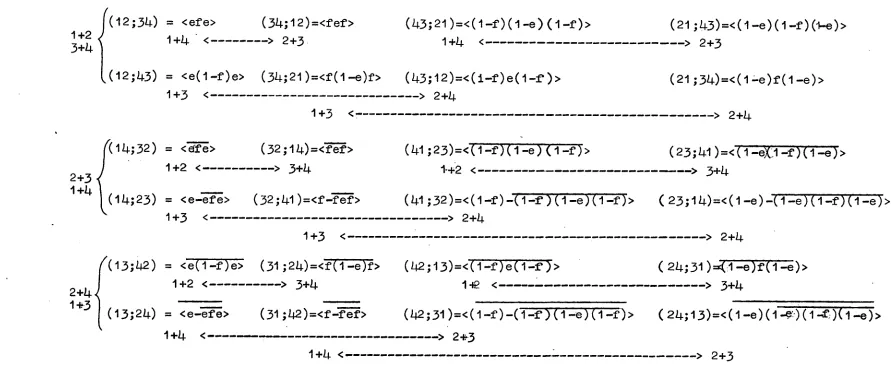
we can deduce the situation illus-trated in Table 1, where we have made the identification:= 1,
=
2, = 3, 4P =4.
Relations in the margin are necessary and sufficient for the existence of the cross ratios in the corresponding rows. Either condition at the end of a double arrow is sufficient for the equa-lity of the cross ratios connected. Irr.general the cross-ratios in any one column are distinct, whilst equality in one row indicates the corresponding equality in the other rows. When -tn.= ED 14. = = iv = (1)
it is clear that, in general , there are exactly six distinct cross ratios(viz., those in the same column).•
TABLE 1
( 31 )
(12;34) = <efe> (34;12)=<fef> (21 ;43)=<(1-e)(1-f)(1-e)>
1+2
3+4 1+4 < > 2+3. 1+4 < > 2+3
(12;43) = <e(1-f)e> (34;21)=<f(1-e)f> (43;12)=<(i-f)e(1-f)> ( 21 ;34)=<(1 .-e)f(1-e)>
1+3 < > 2+4
1+3 < > 2+4
2+3 1+4 2+4 1+3 (14;23) (13;42)
(13; 2 4)
= <eife> 1+2 <
= <e-
i
> 1+3 <( 32 ;14)=<fef> > 3+4
(41 ;23)=<(1-f)( 1-e) (1-f)> 1-+2 < (23;41)=<(1-41 -f)(1-e)> (41;32)=<(1-f)-(1-..r)(1-e)(1-f)> >2+14 --> 3+4 (23;14)=<(1-e)-(1-e)(1-f)(1-e)> 2+4 > (32;41 )=<f-fer>
1+3 < = <e(1-f)e>
1+2 <
(31 ;24)=<f(1-e)f> > 3+4
(42 ;13)=<(1-f)e(1-f )> 142 <
( 24; 31)=(l -e)f(1-e)> >3+4
(31;42)=<f-fef>
= <e-efe> 42; 31)=<(1-f)-(1-e) (1-e)(1-f)> ( 24.;13)=<(1-e)(1--P:.)(1-‘)(1-e)>
1+4 < > 2+3
1+4 < > 2+3
[image:34.980.54.945.98.464.2](32)
L1. FOUR POINTS ON A LINE
Let A be the 2x2 matrix ring r2 over a division ring r • We will establish the connection of our cross ratio with the one usually ascribed in this case.
Considertwor-submodules(points).of Pi X.
P. =
1 ( 1 1 p ; fixed?11' arbitrary p in r I, (i = 1,2), andx, /x 2 . From 74 ,94 x2 it follows that P 1 and P2 are complementary. Now, under the one-one correspondence between submodules of V2 and principal right ideals in
r describedin[Part1;Theorei orresponds
2 1
to the principal right ideal
= ( 11_1 0
I x. 0
t
J
r
where1-1 (1=e.,say, is idempotent. Moreover, the X- 0
1
lattice isomorphic nature of the correspondence shows ru Ge(fj,. = r
2
and hence there exists a unique idempotent e in r 2 such that (e
1 )r = (e)r and (e2)r = (1-e) r. Therefore, for some x11x2 in r
2 we must have
e = el + e 1 x 1 (1-e
and
(2) 4-e 2 -e 2x2 (1-e 2 ) = 2 C
X2
-1
c X2-1 - X-1 2 1 -X2-1 c
x2=
cX -1
-1 1 411DX (1) e 1 +e 1 x 1 (1-e 1 ) =
-1 -1 -1
X-1b
=
(33)
Equating (1) and (2) we find
- -1 -1
b =-c, cX 21 = 1-bX 1 ,-X 2 +X2 2 1 - X-1cX-1=X-1 i bXi $
-1 -1
and 1- 2 c=X b $ ie
(3)
-bx 2 = 1-bx -1
(4) -•x. -1
2 2 2-1
(5)
(3) and (5) give the same solution, viz
(6)
b = (XT 1 -X -2-1 ) -/ = X 2 ( x2 X1 ) -1 1.1 = x/ (x2 - ) .-1 X2whilst (4) holds whenever (3) does, for (4) is t using (3) - X -1 2 (1+13X -21 ) = - X-2 1 1b X-1 = (1 X.71 b)x71
so that, finally, we have
1-X2( -X 1) -1 X 2 ( X 2 -X 1) -1 X i ,
-1 -1 -1 -1
Xi -X i X 2 ( X 2 - X 1 ) X i X 2 ( X 2 - X ) e =
-A 2 1 0
0
Then efe =
A3 0
A 3
(x2 - x1 ) 1 o
0 0
X i -A4
1 1 X, 0
-A 2 0 1
( x2....x1 )1 ( x4...x3)1 0
0 0
( x2 - ) ( x3 - x2 ) ( x4 - k3 )
X, 1
0 0
- ) ( x2
-x, )
( x2 - )
Similarly, if P 3 ,P4 are r-submodules with different parameters 1.3 21.4 , we find for the unique idempotent f such that /r/2 ED ,o2.= I.
r
2f =
-x3(x4 -x3) 1
-( x4 - x3) -1
x3( x4 - x3 ) -1 x4
( x4 - x3 ) -1 x4
Using (6) we find
1 0 1 X 2 (A2 •- 0
0 1 0 0
and
1 0 1 A4
-x3
(x4 - x)_1
•
(35)
x1 0 0 (X 2 —X 1 ) -1 0 —1 X 2
1 A1 0 0 0 0 0
-1
where
* = (X
2
- ) -1 (X
3
- X
2
)(X
4
- X
3
) -1
(Xi - x
4
)
and just as well
efe
where
=
=
1, 1b
I *
11
(X 2 -
,-2
011
°
00
0 1s.1X i
1 (x2- b-2
1-1
,
X i (X 2 -X i )
) -1 0 x2 b = 0 xi Al
X1 )
0 0 —1 0 0 7.11
X2 X1 1 X 2 -I 11 1 0 0 Al 1 1 1 0 0 0 Al 0 Al 1 —1 0 1 —1
and finally, we conclude that, due to the isomorphism
between
r oland
rthere is a one-one correspondenct
0 0
<efe> <-> <4r>.
when Theô'em II a4Na 12-
a*e the same as 1:9 ;Theolems 214 ; he'nce a? afrfrficatior) of Lenrbla 2 wi/i Show tAat-
(36)
5.
THE NORMAL FORM OF A CONFIGURATIONThe following theorem will ensure the existence of matrix units.
THEOREM 10: Let
e1'e2 be idempotents in with the following properties: (i) e 1 e 2 = e 2 e 1 = 0 and (ii)
R(e l ) = R(e 2 ) . Then there exist unique elements e 12 , e
21 in A such that e l e i -e-
e e = e12, e2e21e1 = e21 , e 21 e 12 =
PROOF: It suffices to show the existence of a 17 in L such that : (e l ) r
G (e
2
)
r
= (e
l
)
r
e = (e
2
)
r
. Then the existence and uniqueness of e 12 ,e21 is guarant-eed by Part 1; Theorem 4]. Let fit. = (e l ) r ,4 = (e 2 ) r . Then El(m) = D(4!) is equivalent Hence there is a in L such that 'T/1.. G)10 = 4 6319 . Then) (ta = ((viQ ) n -t )
as . -ED = (( ( PI 1W ))
as itO=J.1(./ LO
= /tit ul
But this is equivalent to '0.-vtP-rit,u_1( . Let
4": = -19 n (--tft. i)
(37)
and we have
re. = tea n 19 ( ,w_
= (0)
r / as 'CRM 4.0 = (0) r and
=
ern_ ci (r/L c) ))= erf u tf) n (-eri as ire- 'fa ci-e
= /Ca 4.1 y i.e
Similarly, -v-t- G 4 = . This completes the proof.
The configuration irca- 0 -it t -0 0 101 will be denoted by C . If C 0 6 are two configurations such that for some non-singular a in A.
A
^
= . = t
'
. 4.9 =
'a
then we say that there exists a non-singular collineatiol
A
of C onto C and write y a : C -> C
We will now give a generalization of the well-known theorem which states that any four distinct collinear points can be projected onto the points 0 1 1,00 0 r, where
( 3 8 )
Suppose(from now on) that the members of C satisfy
( 1 )
rex),0 = = -
MOO=( 1 )
r
and. let M
I 1
n-2. be relative complements of
rvCin
Arit„ respectively
l
i.e
• crta = /-a/ n /C. )
177z = .
Then
)(./ /21)
ci
= (1)
r
.
Also
( put ) )79
1
)
7
0
2.
= n
=
,
u2 7)7
2
n , as /P
L
=
eta n T.Tht
= (o) r
.and since
(/canT )07b
1
= (0)
r
we conclude that
rvin'•
Thi 9 MLare independent and
[Part 1 ;Theorem 2 there exist unique 5 independent
idempotents e
l
,e
2
9e
3
such that ( e
l
) =
/ran(e
2
)
r
= P7
1
,
(39)
= (e 1 ) r (e2 ) r = (e l 4. e 2 ) r ' = (e l + e3 ) r ' Taking, as in Section 2, e and f to be the unique idempotents defined by the conditions
rut q).t= (1) r =
etc)
(i.e, 'at = (e) r ,J = (1-e) r ,42 = (f) 1, 1 1E0 = (1-f) r ) we have : (e 1 i-e 2 )e = e, e(e 1 +e 2 ) = (e 1 i-e 3 )if = f, f(e 1 +e 3 ) = e 1 i-e 3 , and since (e l ) r4 (e) r , also ee i = e i ,
(i = 1,2); similarly fe i = e i (i = 1,3).
Moreover, from (e l +e 2 ) r = (e) r and 1-(e 1 +e 2 ) = e3 , .1
follows: (e 3 ) k / = e) r = (1-e) 1 ; similarly, (e 2 ) 1=(1-f)
From the relations (1) we deduce
(2) D(4A-) = D(-c ) , D(.1`) = D(W ), D(-r, ) + D(2) = 1.
Hence, also D(77/1 ) = D(711L ) ,i.e e 2 ,e3 are independent idempotents
af
the same rank, and by Theorem 10 there exist unique matrix unitse22 = e 2 , e 23' e 32' e 33 = e 3 such that
e .e =ejq,jfj = P ( i,j,p,q = 2,3 ) . ij Pq 0, if
/ P
Since e 32 = e 32 e 2 , e 2 = e 23 e32 , it follows that (e 32 ) = (e 2 ) 14 similarly, (e 23 ), = (e 3 ) 1 1 so that
'UI et.9 = ( 1 )r f
we have (ei +e2)r (1-1)r = (1)r • Hence there is an idempotent h such that (el+e2)r = (h)r, (1-f)r = (1-h)r. The latter means, for some z in A , 1-h = 1-f+(1-f)zf.
r
Also, (h) r = (e3) and by Theorem 2,
(h)r
e
(1-h)r = (1)r implies R(e3(1-h)) = fl(e3) = R(1-h) But, R(e3(1-h)) = R(e3(1-f)(1+(1-f)zf)) = R(e3(1-f)),since 1+(1-f)zf is non-singular; so that, using (1-f)e 2 = (1-1) , we have
R(e3(1-f)e2) = R(e3) = R(e2)
But clearly (e3(1-0e2)1 4 (e2)1 = (e32)1 ; hence equality must holdpise
(e3 (1-f)e 2 ) 2c = (e 32 ) a and , for some x in A , we have
e32 = xe3(1-0e2 = e3xe3(1-f)e2 . Clearly, this means
R(e32) 4 R(e3xe3) R(e3) = R(e32) so that equality holds,i.e
R(e3xe3) = R(e3)
(41)
Consider a = e
l - e1(1-f)e2 + e2 + e3xe3. a is non-singular; for,
a( 1 + e1 (1-0e
2)(e1 + e2 + e3xe3
) =
e1 + e2 +e3= I.
Let us examine the effect of the non-singular collineatio: .11 y a on C.
( 1) Ya-E/1.- = Ya(el+e2)r
=
1 - e 1 (I-f)e 2 + e 2 ) r = (e1+e
2)r = AVL since: e -e
1 (1-f)e2+e2)(1+e1 (1-f)e2) = e1+e2 implies
Ya1/1- (e l +e 2 ) r . The reverse inclusion is clear since contains ee2 and so must contain e 1 -e1 (1-f)e2 +e2'
(ii) Ya/C = Ya(e1+e3 ) r
=
1+e3xe3)r = (e
1+e3
) r
= 1.0 since.• (e1 +e3 xe3 )(e1 +e3 xe3 ) = e1 +e3 implies Yo/C
(e l +e 3 ) r ;on the other hand, since (e 1 +e 3 )(e 1 +e-oce 3 ) = e
1+e3xe3
,
it follows that ya/17. •ru9 = Y
a (1-f)r Y a
=
= (e 1 (1-0e 2 -e / (1-f)e 2 +e2 +e32 ) r = (e2 +e32 ) r .
(iv) Since (1-e)e3 = 1-e, e 3 (1-e) = 1-e we have 1-e = (e 1 +e 2 +e 3 )(1-e)e 3
= e 1 (1-e)e 3+e 2 (1-e)e 3+e3 and Y al= Y a (1-e) r
= y (e 1 (1-e)e3+e 2 (1-e)e 3+e3 ) r
= (e 1 (1-e)e 3 -e 1 (1-f)e 2 (1-e)e 3+e 2 (1-e)e 3+e 3xe 3 ) r
((e 1 (1 -e)e 3 -e 1 (1-f)e 2 (1-e)e 3 +e 2 (1-e)e 3 +e3xe 3 )(e3 (1-f)e 2
) )1.
= (b+e 2 (1-e)e 3 (1-0e 2 +e3xe 3 (1-0e 2 ) r = (b+e 2 (1-e)e 3 (1-0e 2 +e 32 ) r p
where b= Cel(1-e)e3-e1(1-f)e2(1-e)ei)e3(1-f)e2 Equality must hold as
D(Y a-it) = D(..e) = 1-D('m) = 1-R(e 1 +e 2 ) = R(e 3 ) whilst
R(b+e 2 (1-e)e 3 0-0e 2 +e32 ) R( 3 (b+e 2 (1-e)e 3 (1-f)e 2 +e32 )) = R(e3 e 32 )
= R(e
32) = R(e3) .
i.e,
But, since (1-f) 1 = (e 2 ) 1 , (1-e) 1 = (e3 ) 1 , ee 2 = e 2 e2 (1-e)e 3 (1-f)e 2 = e 2 (1-e)(1-0e 2
= e
2-e2ee2-e2fe2+e2efe2 = e 2 efe 2 = e2 efee 2 , and
b = le 1 (1-e)e 3 -e 1 (1-f)e 2 (1-e)e 3 le3 (1-f)e 2 = e 1 11-e-(1-0(1-e)i(1-f)e 2
= e 1 f(1-e)(1-0e 2 = e
1 be 2 so that,finally
y a4 = (e 1 be 2 +e 2 efee 2 +e32 ) r Writing efe = 13( we have the
LEMMA 1: (i) <e 2yke2 > = 4K/0 ,41;.e,20..)
(ii) <e 1 +e 1 be 2 +e 2ce 2 > =
PROOF: Since (e 2 ) 1 = (1-1), we have, for some y in e 2 = 1-f+fy(1-f). Then
e 21e 2 = e 2 (1-e)(1-f)e 2
= t1-f+fy(1-f)1(1-e)(1-f) Let s = fy(1-0; then (1-0(1+s) = 1-f and
i.e, <e24:0
2>- = <(1-f)(1-e)(1-f)>
which proves (i).
Again,since (e)r = (1-e
3)r and (f)r = (1-e2)r' we have for some x,z in A
e = 1-e 3+(1-e 3 )xe3 f = 1-e 2 +(1-e 2 )ze 2 and so
efe = 11-e 3 +(1-e3 )xe 3 10- 2 +(1-e 2 )ze 2 111-e 3+(1-e = (1-e 3 )(1+ze 2 +xe 3+xe 3 ze 2 +xe 3 ze 2xe 3 )
. Let s i = e i xe y s 2 = e 1 ze 2xe 3 , 5 3 = e 1 ze 2 ,s 4 = e 1 x.e3ze 2 2
ands 5 =e 2xe 3 .Thens.=0 (i = 1,....,5) and after a simple calculation,
(1+8 5 ) (1+8 1 )efe(1-s 1 ) (1-8 5 ) = e
1+e1xe3ze2+e1ze2xe3ze2+e2xe3ze2 On the other hand,
e 1 +e 1 be 2 +e 210 2 = e 1 +e 1 f(1-e)(1-0+e 2 (1-f)(1-e)(1-0
and easy calculations show,successively
(1-e)(1-f) = -e 3ze 2 +(1-e 3 )xe 3 ze 2 e 1 (1-e)(1-f) = e 1 xe 3ze 2 ; (1-f)(1-e)(1-f) = e 2xe 3 ze 2 -(1-e 2 )ze 2xe 3ze 2 , (e 2 -e 1 )(1-f)(1-e)(1-f) = e 2xe 3ze 2 +e 1 ze 2 xe 3 ze 2 .
so that
(4
5)
Denoting by N (normalform) the configuration i(effe2) rp(elbe2+e24.e24"e32) r p(effe3) 10 (e2+e32) r i we have proved the
THEOREM 11: For any configuration C satisfying (1) there is a non-singular collineation
ya: C -> N such that
and
=
<el +e1be2+e21/e
2>
11( -10 , ,c ; 42,14 ) = <e2Re2> °
When, in addition to (1)the members of C satisfy ,cotri
4: =
(0)r, N reduces toi(e2)r, (e0p2 e32)10(e3)r,(e324-e2)ri
•
Conversely, given a non-singular collineation Ya: ->
then the members of C must satisfy the relations (1). For, by [Part 1; Lemma 2],
(i) (e 1 +e2) (e
1+e3)r = (e1+e2+g)r
where (g) r = ((1-e i -e 2 )(e i +e 3 )) r = (e 3 ) r i.e g = e 3 and. so y a'ut = (1)1., •
(ii) (e l +e 2 ) r (e 2 + 3 ) = (el+e3)r (e2+e32)r = (1)r
The "u" part follows as in (i) whilst xe(e l +e 2 ) r n (e 2 + e
32) r => x = (e1+e2)x = (e2+e32)x => e3x = 0 = e32x' i.e e
2x = 0; but then x = 0. Similarly for the other came (iii) (e i +e 2 ) r e(e i be 2 +e 213;e 2 +e 32 ) r = (1) r .For, (e 1 +e 2 )x = (e 1 be 2 +e211e 2 +e 32 )z => e 3x = 0 = e 32 z => e2z = 0, i.e x = 0; whilst
R(e1be24,24e2+e32) R(e 3 (e 1 be 2 +e 24e2 +e 32 )) = R(e 32 ) = R(e 3 ) => D((e l +e 2 ) r ) eD((elbe2+e2lie2+e32)r) 1, so that equality must hold.
Finally, as
Y a
(t
) = (1) r Ya (4n-11-t ) = if and only if(147)
6.
SIMILARITY INVARIANTS FOR THE NORMALFORM• The object of this section is to determine the
extent to which the cross ratios provide similarity invariants for the normalform N. We will see that being given a non-singular collineation between two configurat-
A
ions 0,0 implies a special kind of similarity of their cross ratiost:Theorem 12:1; on the other hand, if e v e have a cross ratio in common it is , in general, necess-ary to assume that their members satisfy some further conditions(i.e in addition to 5.1) before there will be a non-singular collineation between them ELemmas 4,51.
Notice that the existence of a non-singular collinea-
A
tion y n : C -> C implies the existence of one between thE normalforms,viz ria. 1 YA(Y (Y -1 • •)) I N a n a
A A
where a,a are the non-singular elements for 0,0 respect- ively in the sense of Theorem 11. Conversely, Yn :N -> N
A
=> yA4 :C -> C.
a na
A A
Let the normalform N, provided by Theorem 11, of C be
i(f1+f2)/0(f1 f2+f2142+f32)e (f1+f3)r2(f2+f32)r/
where the matrix units f have similar properties to their counterparts e in N.
(L48)
THE GENERAL COLLINEATION: Assume that there exists a non-singular collineation
Clearly, corresponding members have the same dimension, and therefore corresponding matrix units have the. same ra -nk. This information allows us to replace the f's by the
e's, for
LEMMA 2: If ie ij i,if ij i are two systems of n 2 matrix units(cf.[Part 1; p 16]) such that
R(e 11 ) = R(f 1 ) 1 i =
then there exists a non-singular m in such that -1
mf ij m = e ij , i,j = 1,...,n.
PROOF: By [Part 1; Lemma 14] we have non-singular = 1,...,n) in such that
s i
s.f.s. -1
""= " e—=e—If.=f ii ). Hence
Let
e.s.f.s. -1 e.
1 1 1 1 1
m = e.
11s.f. 1 p 1 i i
i=1 i=1
and then, since the f i are independent idempotents, mp.= 2 e.1s.1fij 2f.s-le
i
-1 = 2 e.s f.s. e.
i 1 1 1 = 2 e 4 =1,
i
(
4
9)more Let
-
mfJn-1 = e.s f.s. e. = e (i = 1 21. i
= (i,j =
Thengil .. = e. and I is a system of n 2
matrix units, gij
-1 for Z g ii = 1 and gi j
gkh = mf i f j - khm {b.
fih if j/k
-1
m m = if j=k gih
for all i t j,k,h = 1,..,n . Now, r- Part 1; Theorem 4=1„ (fi ) r ()(f i -f ji ) r = (f i ) r (). (f j ) r
and since m is non-singular (i.e since ym is a lattice automorphism) it follows that
ym (f i
i-f ii ) r = Ym (fd r Ym (f i ) r i.e(ed r E) (e.1
-g
j
d
r
=
(e i ) r (e i ) rand,by the uniqueness part of the last theorem referred to) we can only havegij = , all ipj . e ij
Now, even though the matrix units of
N 9 N
do not form a complete 32 system(the e lj a lj pe jil f il with j = 2,3 are absent),it is still clear that the assertion of Lemma 2 holds for them, with exactly the same proof. Therefore, there exists a non-singular m in A such that-1
(50)
A A* A *
Then y N -> N , where N is
i(e l +e2 ) r ,(e l b * e 2 +e2i* e 2 +e 32 ) r ,(e l +e3 ) r ,(e2 +e 32 ) r i
and b * = mtm-1 ,
A7 =
mi m -1 .Consequently, we may as wellA
assume, from the outset, that N is the configuration
A
obtained by replacing b* and ic * in N * with b and R resp-ectively. This assumption will apply for the remainder of the section.
The relations (n(e l +e 2 )) r = (e 1 +e2 ) r (n(e
1+e3))r = (e1+e3)r and (n(e2 +e32 ))r = (e2 +e ) 32 r are equivalent to
(i) (e 1 +e2 )n(e 1 +e 2 ) = n(e 1 +e2 ) (ii) (e 1 +e 3 )n(e 1 +e 3 ) = n(e 1 +e 3 ) (iii) (e 2 +e 32 )n(e 2 +e32 ) = n(e 2 +e32 ).
Right multiplying (i) by e 1 ,e 2 ( (ii) by e 1 ,e3 ) and then left multiplying the two resulting equations by e 3 (e 2 ) gives
(1 ) epe l = e 3ne2 = e2ne1 = e 2ne3 = 0-
Since e1+e2+e
3 = 1, we can write (iii) as (iv) (e 1 +e3-e32)n(e2+e
32) = 0
and left multiplying (iv) by e l we find e 1 ne 2 = -e 1 ne 32 , i.e
(2) e ne = -e ne
( 51 )
Finally, taking (1),(2) into account, (iv) becomes e 3ne 32 = e 32ne 2 + e 32 e 2ne 3 e 32 = e 32 ne 2 y
that is
(3) e 3ne 3 = e 32 ne 23 .
Then, as e 1 +e 2 +e 3 = 1, n = (e 1 +e 2 +e 3 )n(e 1 +e 2 +e3 ) and
•
(1),(2),(3) combine to give14) n= e 1 ne 0 0
e1ne2 e
2ne2 0
-e
1ne23 0 e32ne 23
where the matrix denotes the sum of its entries. Since
A
also y
n- 1 : N -> N e1 n
-1
e1 e e2 n
-1
e -e i n-1 e23 1
n -e2 1 2
0 0
e32n-1
0 0 e23
(5)
n
-1 =and it is clear that npn-1 have the most general form possible under the conditions. We note also, for future reference, that
e.ne. = e n e.neA . = e 1n-1 (i = 2,3)
(6) i 9 1
e l = ne l , e l 11 -1 e l = n-1 e l .
y
n: N -> 11 also implies
(52)
that is , for some y in A_ , n(e
1be2+e 2+e32) = (e1be2+e2lie2+e32)y . Then
e23n(e1be2+e2
1e
2
+e32) = e23e32y = e2y and as e 3n = e3ne 3 = e 32ne 23 we havee 2y = e 23ne 32 = e 23e32 ne 23e 32 = e 2 ne 2 • Hence
(7) n(e 1 be 2 .4-e 211e 2 +e 32 ) = (e 1 te 2 +e2 ke 2 +e32 ) ne 2 . But, by (3), e i ne l = ne l e 2ne2 = e 2n and therefore
A A
e 1 ne 1 be 2 +e 1 ne24e 2 +e 1 ne 32 = e 1 be 2ne 2 = e 1 be 2n ; and as e 1 ne 2 = -e 1 ne3 2 this yields
A
- (8) e 1 be 2 = e 1 ne 1 be 2 n - e 1 ne 2 (e 2 -e 210 2 )n 1 .
Also from (7),
A A
e 2ne 24e 2 = e 24,e 2ne 2 = e 213,e 2n , i.e A
(9) e 24,e2 = e 2 ne 2g 2 n . But, from (1),(2),(3),
-1 -1 -1
n e 2n = e 2n e 2ne 2 = e 2n ne 2 = e 2 so that
e 2 e
2 = ne2Re2n -1 , i.e
A
(10) <e
-1 -1 e
ln el e 1n e2 0 e2n-1 e
2 Writing
e l ne1
0
e
lne2 e
2ne2 n
12 =
(53)
and. g= e
l el be2 0 e 211e 2
1 we have the
LEMMA 3: The following condition is necessary and sufficient for the existence of a non-singular coll ineat-i on of N onto for some non-singular n in Pt we have
A
n
12 12 = g where n12n12 = n12n12 = e
l +e2 .
PROOF: Assume y n is a non-singular coll ineat i on of ^
N onto N. Then n12
12
-1 • - -1 -1
e
l neln e1 e1n.eln 1
e
2 +e1 ne1 be2 n e. 2 2 +e1 ne2 13,e2 n e -1
0 e 2 ne 24e 2 n e 2 and as e 1 n-1 e
l = ne1 we have e1ne1n -1
e
1 = el. Also, by
•
A
( 9) , • e 2 ne 24e 2 = e 213,e 2 n, that is
A
e 2ne 24e 2 n-1 e 2 = e 213,e 2 . Finally, by ( 8) ,
= p=
00
n •
12. -e1 ne 23 0 e32 ne 23 we have
Mp =
n • -ei n-1 e23 12.
0 - 0 0 e 32 n 1 e 23
A
= e
1be2+e1ne2n -1
e
2+e1ne1n -1
e 2 = e
1be9 2
for, since e 1 +e 2 +e 3 = 1 and e 3n-1 e 2 = 0, \ -1 0 = e 1 e 2 = -1e 2 = e i n(e i +e 2 +e 3 )n e
2 = e
1ne1n -1
e
2+e1ne2n -1
e2 We have shown that
A
n12
12 = g •
Also, as e 2ne 2 = e 2n, it follows that e 2 ne 2n-1e 2 = e 2
and hence that n12.
E.
12 =
e1ne1n-1 e
1 e1ne1n -1
e
2+e1ne2n -1
e 2 -1
0 e
2ne2n e2 = e l +e 2 .
Conversely, assume that there is a non-singular n such that (11) holds. Then letting
(55)
' 1 2"l2 • -e 1 ne 1 n-1 e 23-e 1 ne 23e32n-1 e 23
. 0
0 0 e 32ne 23e 32n-1 e23 = e 1 +e2 +e3 = 1
as 9 by (11) , e i ne i n -1 e 2 +e i ne 2n-1 e 2 = 0, that is - -
e i ne i n 1 e23+e i ne 2n 1 e23 = 0; also by (i1 )
- -
e 32ne 23e 32n 1 e 23 = e 32 e 2ne 2n 1 e 2 e23 = e 32 e 23 =
A
Thus m is non-singular. In order that Y m: N -> N it
A
suffices that Yra( e i be 2 +e 213,e 2 +e 32 ) r = ( e i be 2 +e 213,e 2 +e32 ) r . But this is so, since (11) implies (8) and (9) and. hence
n12 ° -e 1 ne 2
0 00 0 0
0 e32ne23 O e 1 l':;e2
O e2ie2
0 e32
O e l be2 0 O e 2 -e2 0
O e 32 0
-1
1112 ° e23
• 0
-1
e32ne23
0 0
(56)
Combining Lemmas 1 and
3
with (10) we haveTHEOREM 12: The existence of a non-singular collin- ^
eation of N onto N implies
13C( = IP /C ) •
COROLLARY
4:
If e l = 0 and C has the form i(e 2 ) r ,(e 2 re 2 +e 32 ) r ,(e 3 ) r ,(e 2 +e 32 ) r i for some r in k , then,to:) = <e 2 re 2 > PROOF: x=e
2x = (e2re2+e32)z => e32z = 0 , i.e e2z = 0; hence x = O. Since e 2 +e 3 = 1 and R(e 2 re 2 +e 32 )
R( e 32 ) = R(e 3 ) we must have
(e2 ) r e
(e 2 re 2 +e 32 ) r =(1) r so that the cross ratio is defined. Then Theorems 11,12,(57)
RANK RELATIONS: Recall that y a(-tn_n ) =Zn = (e i ) rst a = (e 2 +e 32 ) r and y a-e = (e 1 be 2 +e 2Re 2 +e32 ) r .
Since (e 2 +e 32 ) r = (e 3+e 23 ) r and both e 2 +e 32 and e3+e
23 are idempotent, we have
(1--e3 -e 23 ) y = (e 2 +e32 ) r . An easy calculation shows that
e 2 -e 24e 2 -e 1 be 2 = -(1-e 3 -e 23 )(e 1 be 2 +e 24,e 2 +e 32 ) . Hence, by Theorem 1(ii),
R(e2-e24.'„e2 e1be2) = R(1 ".'e3 e23)(e1be24. e24:e2+e32))
= D(y a -61 ) - D(y a-en y a -1.0 )
= D(y a -e ) - D(y a (-en )) (12) = D( -41") - D( ri 'to ) .
By [Part 1; Lemma 1] we have
((-'Li' 'E )Li ya7.9 = ('01 )1.1 (ya
w ) 1
= (1-e i )In (1 -e3-e23) and, as e 1 +e 2 +e 3 = 1, we see that
1-e 3 -e 23 = e 1 +(e 2 -e 23 ) ; since e e -e
23 are independent idempotents , this means (1-e3 -e 23 ) z = (e 1 )(:) (e2 -e 23 ) 1 ;
hence,
(58)
= e2-"e23)1'
by modularity, since (e 2 -e 23 )(1-e 1 ) = e 2 -e 23 implies
(e2-e23)a (1-e1 )/' Then, as
e 2 -e 21?(e 2 = (e 23 -e 2 )(e 1 +e24e2+e32) P we have, by Theorem 1(i),
R(e 2 -e 2Re 2 ) = R((e 23 -e 2 )(e 1 be 2 +e 2IO 2 +e 32 ))
= n(((-ra
(11:)u
-r
a
:(P
)ur
a
t)
-D“,ran
)knc
x
-
19)
D(lct ( (,tn./1 )
z9
-D(
1
6
1
((Tar) )u LO ))(13) = D((tta(lt ) via) - D((Puirve)uto)
= D( (-) ) +D ( u ) -D (('tftr) ) (u) ) )
= D(Ifin ) + D(-/P) + D($) - D(-toti-g/- )
- D ( ( 4it ) (-0 I.)) - D((-ta )
since (-can )n ,to = (zfla '0 )/7 (/est-t-t0 ) = (0) r • Thus,
(59)
(15) R(e 2 -e 2/3ce 2 ) = R(e 2 -e 210 2 -e 1 be 2 ) - D((elna'r- )/1(10(},*
LEMMA 3: If e 1 ,e 2 are independent idempotants and u,v arbitrary elements in A , then for some w in
(e l u + e 2 v) 1 = (e 2 v) / 6) ( e l u - e 1 we 2v) a, .
PROOF: (e 2 v) I (e 1 u+e 2 v) v since e 2 v = e 2 (e 1 ui-e 2v). If h is any idempotent such that (h) k = (e 2v) 1, , then
, [Part 1; Lemma
7],
a relative complement of (0 1 in (e 1 u+e 2v) 1 is given by( ( e i u+e 2 v)(1-h)) 1, =(e 1 u-e 1 uh) 1
since e 2vh = e 2 v. Now, h = ze 2 v for some z in and hence e1 uh = e1uze2v. Let w = e1 uz and we have
(e 1 u+e 2 v) 1 = (e 2 v) z. (e i u-e l we 2v) I . Clearly, we also have
R(e1 u+e2v) = R(e
2v) + R(e1 u-e1we2v) .
Lemma
3
shows that for some w in -k(60)
(17) e 1 bte 2 = e 1 be 2 - e 1 we 2 (e 2 -e 24e 2 ) . Moreover, (17) shows that
e
1 e1we2
0 e
2
e
l eIbe2 0 e R
2-e2 e
l -e1we2
0 e
2
•
e
l e1bte2
0 e 2lice 2
i.e Lemma
3
applies and gives a non-singular collineation carrying N intoi(e l +e 2 ) r ,(e i b le 2 +e 2 4e 2 +e 32 ) r ,(e l +e_) .(e +e ) 1 . 5 r7 2 32 r For this reason we may assume (16) to hold with b'
(61)
COMPLEMENTS TO LEMMA 3: Notice that the similarity of (10),(11) is actually in the following stronger sense: if a l beeAe(some idempotent e) then write <a> = <b> if xay = b where x,yeeAe and xy = yx = e. From now on < > will have this meaning. Similarity in the new sense inip.1- ies similarity in the old sense . ; for, x+1-e is non-singul -ar with inverse y+1-e and (x+1-e)a(y+1-e) = b. Let n =
x+1-e; then ene = x and en-1 e = y.
In general, in order to obtain a non-singular collin-
A
eation of N onto N, it is not enough to be given one cross ratio. However, by assuming in addition that the members of N,R satisfy one other condition 1 we can arrive at this position.
A ,
LEMMA
4:
If (i) <g> = <g> and (ii) bothc,e
satisfy-ton.42 = (0)
r ' then there exists a non-singular collineat
A
-ion of N onto N .
PROOF: By (i) , we have for some non-singular r, (e 1 +e 2 )r-1 (e 1 +e 2 )g(e 1 +e 2 )r(e 1 +e 2 ) =
\ - \ _,
where (e l +e 2 )r(e l +e2)r 1 (e l +e 2 ) =(e l +e 2 )r 1
(e i +e 2 )r(e i +e 2 = e
(62)
g(e 1 +e 2 )r(e 1 +e 2 ) = (e 1 +e 2 )r(e 1 i-e 2 )g
i.e, subtracting each side from (e 1 i-e 2 )r(e 1 i-e 2 ), ( e 2 -e 21:0 2 -e 1 be 2 )( (e 1 +e 2 )r(e 1 +e2 ))
= ((e
1 +e2)r(e1+e2))(e2-e2ie2-e1be2) and hence
(18) (e 2 -e 24:e 2 -e 1 be 2 )e 2 re 1 = 0 . But, from (ii), we have using (12)
R(e 2 -e 210 2 -e 1 be 2 ) = R(1-e) =
and since, obviously , (e 2 -e 24e 2 -e 1 be 2 ) 1 (e 2 ), we must have equality. Hence also
(e 2 -e 210 2 -e 1 be 2 )1; = (e 2 )
i.e, (18) holds if and only if e 2 re 1 = e 2 e 2 re 1 = 0. Similarly e 2 r-1e 1 = 0. We have shown that (11) holds, and therefore there is a non-singular collineation of
A
N onto N.
LEMMA 5: If (i) <e 24e2 > = <e 2 e 2 > and (ii) both
c,6
satisfy ka n
n u = (0)
r
,
then there is a( 6 3 )
PROOF: (ii) implies, by (15),
R(e 2 -e 2102 ) =R(e 2 -e 210 2 -e i be 2 ) i.e, by (16),
R(e 1 be 2 ) = 0
A
so that e 1 be 2 = 0, and similarly e 1 be 2 = O. (i) implies, for some non-singular r,
A e
2
4
2
= e2re2Ile2r e2 ' -1where e2r e
2 is the inverse of e2re2 in e292 e 2. Then an easy calculation shows that
A
(e l i-e 2 r -l e 2 )g(e l +e 2 re 2 ) = g i.e (11) holds.
When 471-n/E = (0)
r (i.e e1 = 0 ) Lemma
5
is theconverse of Theorem 12. For then <g> = <e 24e 2 > and Lemma
5
shows that <g> = <a> => the existence of a non-singularA
(64)
7.
When., ( '01 n ) u--t) = (0) r we have seen(Lemma
5
that e1 be2 = 0. In this case N can be decomposed into
i(y r ,(0) r ,(y r ,(0) r i i(e2 ) r ,(e211,e 2+e32 ) r,(e3 ) 10,
(e2 +e32 ) r i where the direct sum means component-wise direct sum. The left hand summand is obviously uninteresting and from now on we neglect it. We may as well assume that
e l = 0, i.e AA-0PC. = (0) r . Then
(1 ) /DI ED = q/1-69 t = = = (1) r
From (1 ' ) we deduce that rvi.-1-e,'C, tio all have dimension 1/2. Moreover, since e 2 +e3 = 1 and R(e 2 ) = R(e 3 ) it
follows that /C. form a homogeneous basis of order two for L
E
Part 1; Lemma 10 J.' We can extend the range of (1') as follows: Let
g
denote the centre ofA (
is a field) . Then e 2 "-e 2 is the centre of e 2A e 2E
Part 1; Lemma6
], and is isomorphic to7
under the correspondence :; 9 X <->e 2xe 2 . Let
= (e 2ae2+e32be2 ) r where a„b e 3, and define
(65)
Clearly, b 0 <=>"(4. (a,b) /•rA, . For, since e 2 ae 2 exists in e 2 'e2 , ,riz. (a,0) = (e 2 ae 2 ) r = (e 2 ) r . Conversely if = 1A-(a,b) then e 2 ae2 +e32be2 = e2 z, some z in
=> e 32be2 = 0 => e2 be2 - 0 => b = 0. Since </1-(a l lo) = (e 2ab-1 e2+e 32 ) r if b 0, if we agree to write 'zit= 'Vico then we can( symbolically) parametrize M as
=(eLae 2 +e32 ) r ; a s. u 'envoi . M includes vtit. = 42.0 1 = 0 , = ''1• Moreover, when
ever, a / 0, we have
(2) efit. a 9 'C/L 0 = /22 a e ,cse, = 44. 6 GI /tie, = (1) r .
To see this , notice that 7■1 is a subspace satisfying
(3)
if and only if there exist Part 1; Theorem 41] unique matrix units u,v such that
uv = e
3' = e 2 , e 3ue2 = u., e2ve3 = v and = ( e 2-u) r = ( e3-v) r .
Then, since by [7; Satz 3.3] we have a one-one corres-pondence between the 1v satisfying (3) and the invert-ible elements of e 2 . e 2, given by
/v1 <-> e 2 ae2 = -e 23u, where e 2 ae2 = -ve 32 1
it follows that (2) holds.
Also, if a e , then e 2 -e 2ae 2 e e 2 . e2 and therefore
(66)
x = (e
232)x = (e2ae2-4-e32)z => e32x = e32z => e2x = e 2 z. Hence (e 2 -e 2 ae 2 )x = O,i.e e 2x = 0 and we can only have x = 0. This shows that /a
1
n
rrzta = (0)r' for a/1. Since R(e2ae2+e32) R(e32) = R(e3
)
we haveD(4%1- a El) 4.,/to = D(vta) D('et i ) >„R(e 3 )+R(e 2 ) = 1 9 so that equality must hold, i.e
(3) a 6)/ 1 &t, = (1)
r whenever a / 1. '
(2) and (3) show that cross ratios are defined for all permutations of kele./el. a ,t 09,,ey; moreover, cross ratf-os in the rows of Table 1(with replaced by -
•e
,
e.
a
) are equal.Define
ki=
AV
(m,0 9 1) = ix6 9
t
;x€ ,e.z a
some /eA ae M.744
is closed for cmultiplication, but not for addition. For any a e let-*
(a) = (e 2 (k7a)e 2 )119, i.exE -e(a) <=> e
2lite2x = e2ae2x. Now, if y
e
4,enM
9 theny = (e 24e 2 +e 32 )z 1 = (e 2 ae 2 +e 32 )z 29 for some a and z i9 z 2 e so that e 3y = e 32 z 1 = e32 z 2 , i.e e 2 z 1 = e 2 z2 = z, say. Hence y = (e 2 lie 2 +e 32 )z = (e 2 ae2 +e 32 )z and the- refore z i(a). Conversely, assume that y E
(67)
cs,
xe 49,- (a). Hence also y = (e2ae2-1-e32), i.e ye lonh7. Finally, if R(e211e2-e2ae2) = R(e2) then clearly
..e(a) = (e3)r and hence yl't(a) = (0) r. Defining e2ae to be an eigenvalue of e2/e2 in e2'je2 if R(e2(4r-a)e2) < R(e2) , we have shown
(4) i
a 114 =ix; xe Ytwhere e2Ae2 denotes the set of eigenvalues of e24,e2 in e2 e2.
By Corollary .4, R(41,0,Cka;tkotty = <e2ae2>. Hence a permutation of 21-, f, W amongst themselve6
(obviously leaves in unchanged) induces the correspon-ding permutation of the parameters. Moreover, assume that the inverses referred to in Table 1 exist, and we have
(e2-e2102)-(e2-e2ae2) = -(e24e2-e2ae2) and e2 e2 -e2ae2 = -e2ae2Re2(e24e2-e2ae2) .
(68)
8. SOME COLLINEATIONS INDUCING PERMUTATIONS
Case (i): e
2
Re
2
exists in e
2
Ae
2
. Than n = e
32
+e
2
4e
23
is non-singular with n
-1
= e
23
+e
32
e
2
10
2
and
Y
n
i'
01
-•2 •
1
:
=
i(e32)
r
y(e32102+e211e2)
r
,(e2Rte23)
r
,(e
32+e24e2)
r
i
i(e3 ) r ,(e2+e32 ) r
,(e 2) r ,(e24e2+e32 ) r i
=
Case (ii): e
2
-e
2
Re
2
exists. Then n= e
2
+e
32
-e
2
Re
23
-e
3
-
is non-singular with n
= (e
1
2
+e
3
)(e
2
-e
2
10
2
)-(e
2
Re
2
+
e
32
)(e
2
-e
2
11e
2
)e
23'
and y
n
kft.
v
.t,/ic
t
ipl =
(e
2
4.e
32
)
/
0(e
32
11e -e
32
)
ro
(e
2
1
°
.
23
+e
3
) P(e
2
-e
A
e
2
)
r
i
=
i(e
2
+e
32
)
r'
(e
3
)
rP
(e
2
11e
2
4.e
32
)
r'
(e
2
)
r
1
4