DNA Research12, 215–220 (2005) Short Communication doi:10.1093/dnares/dsi006
Complete Nucleotide Sequence of the Chloroplast Genome from
the Tasmanian Blue Gum,
Eucalyptus globulus
(Myrtaceae)
Dorothy A.Steane*
Cooperative Research Centre for Sustainable Production Forestry, School of Plant Science, University of Tasmania, Private Bag 55, Hobart, Tasmania 7001, Australia
(Received 22 November 2004; revised 4 April 2005)
Abstract
The complete nucleotide sequence of the chloroplast genome of the hardwood speciesEucalyptus globulusis presented and compared with chloroplast genomes of tree and non-tree angiosperms and two softwood tree species. The 160 286 bp genome is similar in gene order to that ofNicotiana, with an inverted repeat (IR) (26 393 bp) separated by a large single copy (LSC) region of 89 012 bp and a small single copy region of 18 488 bp. There are 128 genes(112 individual gene speciesand 16 genesduplicated in the inverted repeat) coding for 30 transfer RNAs, 4 ribosomal RNAs and 78 proteins. One pseudogene (c-infA) and one pseudo-ycf (c-ycf15) were identified. The chloroplast genome ofE. globulusis essentially co-linear with that of another hardwood tree species, Populus trichocarpa, except that the latter lacks rps16 and rpl32, and the IR has expanded in Populus to include rps19 (part of the LSC in E. globulus). Since the chloroplast genome of E. globulus is not significantly different from other tree and non-tree angiosperm taxa, a comparison of hardwood and softwood chloroplasts becomes, in essence, a comparison of angiosperm and gymnosperm chloroplasts. When compared withE. globulus,Pinuschloroplasts have a very small IR, two extra tRNAs and four additional photosynthetic genes, lack any functionalndhgenesand have a significantly different genome arrangement. There doesnot appear to be any correlation between plant habit and chloroplast genome composition and arrangement.
Key words:eucalypt; Myrtaceae; chloroplast DNA; pseudogene; gymnosperm
Eucalyptus globulus isone of the most economically important species for hardwood forestry plantations in temperate regionsof the world.1 It hasbeen studied intensively by quantitative, population and evolutionary geneticists and is becoming a model species for genetic research inEucalyptus. Chloroplast DNA has been essen-tial to many studiesof population geneticsand phylogeo-graphy in Eucalyptus. Thispaper presentsthe complete chloroplast genome fromE. globulusand comparesit with chloroplast genomes from other angiosperm taxa [includ-ing the hardwood tree species, Populus trichocarpa (B. Heinz, S. DiFazio, K. Ritland et al., manuscript in pre-paration)] and softwood tree species (Pinus thunbergii2 andPinus koraiensis).
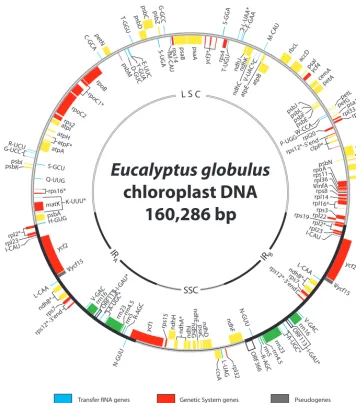
The complete chloroplast genome of E. globulus (GenBank accession no. AY780259) may be represented
asa circular chromosome (Fig. 1), although thisislikely to be a rare form of the molecule, asmost chloroplast DNA is, in fact, linear.3,4 Comprising 160 286 bp, it ranks among the larger land plant chloroplast genomes. Most land plant plastids sequenced to date have genomes of 116–163 kb, and the longest belongs toOenothera elata (163 935 bp5). The structure of theE. globuluschloroplast genome is typical of most plastids: a large single copy (LSC) region (89 012 bp) and a small single copy (SSC) region (18 488 bp) are separated by an inverted repeat (IR) (26 393 bp). The relative sizes of the LSC, SSC and IR regions remain reasonably constant across gen-omesof angiosperms(approximately 55, 12 and 16.5% of the total genome size, respectively), regardless of the overall size of the genome. The relative size of the IR in gymnosperms varies much more. For example, in Ginkgo bilobathe IR is17 kb, but inP. thunbergii it is just 495 bp2containingtrnI-CAU and 83 bp from the 30
end ofpsbA, but lacking the ribosomal RNA genes that characterize other land plant IRs.
Communicated by Katsumi Isono
* Tel. þ61-3-62261828, Fax. þ61-3-62262698, E-mail: dorothy.
The Author 2005. Kazusa DNA Research Institute.
TheEucalyptuschloroplast genome has a GC-content of 36.9%, which iscomparable with that of other vascular plant plastids (e.g. 36.7% inPopulus, 37.8% in Nicotiana, 38.4% inZea, 39.2% inOenotheraand 38.5% in P. thunbergii). The genome isAT-rich in both the non-coding intergenic regions(67% AT) and the coding regions(62% AT), where there isan AT bias(73%–
4.5%) in the third base positions of all amino acid codons. This phenomenon is also observed in other plastid gen-omes. In contrast, the tRNA genes show less of an AT bias (58%), and the rRNA geneshave a slight GC bias(55%). The latter ischaracteristic of rRNA genesin other plants.6
Table 1 lists all genes detected in the chloroplast gen-ome ofE. globulus. The start codons for the protein-coding genes were based on alignments with plastomes of other taxa. The start positions are, therefore, hypothetical and
can be confirmed only through analysis of gene tran-scripts. The genome is essentially co-linear with that of the annual angiospermNicotiana tabacum(Fig. 2a), with all the same genes except sprA, which isabsent from E. globulus. The chloroplast genome of E. globulus is also virtually co-linear with that from another hardwood tree species, P. trichocarpa (Fig. 2b), except for three notable differences: (i) rps16 and flanking intergenic sequences (1800 bp of LSC) are missing fromPopulus; (ii) the gene rpl32 and flanking sequences (1100 bp of SSC) are absent fromPopulus; and (iii) the IR inPopulus hasexpanded to include rps19, with the ‘extra’ copy of thisgene located close to JLA. As in other angiosperms,
theE. globulusplastome has four ribosomal RNA (rRNA) genesand 30 transfer RNA (tRNA) genes(of which seven are located in the IRs) that provide tRNAs for all 20 amino acids(Table 1). There are 78 protein-coding
rrn5 R-UCU G-UCC psbI psbK rpl2* rpl23 I-CAU L-CA A ndhB* rps7 rps1 2*-3 ’end N-GU U G-GC C psb Z psb C psb D T-GGU petN C-GC A S-G GA L-U AA * F-GAA M-C AU rbcL acc D psaI ycf4 cemA petA petL petGpsaJ
rpl33rps18
psbBpsbT psbH petB* petD* ycf2 yc f15 V-G AC rrn 16 O RF113 I-GA U* A -U G C* rrn 23 rrn4.5 rrn5 R-A GC O R F366 rpl32 L-U A G ccsA p sa B p saA y cf3* rps1 4 fM-CA U S-U GA E-UUC Y-GU A D-G U C psbM rpo B rps 4
T-UGU ndh J nd hK ndh C V -UA C* atp E atpB rpoC1* rpoC2 rps2 atpI atpH atp F* atpA S-GCU Q-UUG rps16* K-UUU* matK psbA H-GUG ycf2 ycf15 V-GA C I-GA U* OR F113 rrn16 A-UGC * rrn 23rrn4. 5 R-A GC
ycf1 rps15 ndhH ndhA
*
n
dh
Indh
G N -GUU ndhF nd h D psaC ndhE L-CAA nd hB * rps7 rp s12*-3 ’end infA rpl14 rpl16* rps8 rpoA rps11 rpl36 psbN clpP* rps3 rpl22 rps19 rpl2* rpl23 I-CA U psbJ psbL psbF W-CCA P-UGG rpl 20 rps12*-5’ end psbE
Eucalyptus globulus
chloroplast DNA
160,286 bp
Transfer RNA genes
Ribosomal RNAs
Genetic System genes
Photosynthesis genes
Pseudogenes
[image:2.637.122.479.75.478.2]Other ORFs
Figure 1.Gene map of the plastid chromosome ofEucalyptus globulus. Genesbelonging to different functional groupsare color coded (see key).
Genes drawn inside the circle are transcribed clockwise; those outside the circle are transcribed anti-clockwise. In cases where two genes overlap,
one of them is shifted off the map to show its position. Asterisks indicate genes that contain introns. Pseudogenes are marked byc. ORF366 in IRB
Table 1.List of genes found inEucalyptus globuluschloroplast genome (GenBank accession no. AY780259; herbarium accession no. HO528199)a.
RNA genes
Transfer RNAs trnA-UGCb,c trnC-GCA trnD-GUC trnE-UUC trnF-GAA
trnfM-CAU trnG-GCC trnG-UCCb trnH-GUG trnI-CAU
trnI-GAUb,c trnK-UUUb trnL-CAAc trnL-UAAb trnL-UAG
trnM-CAU trnN-GUUc trnP-UGG trnQ-UUG trnR-ACGc
trnR-UCU trnS-GCU trnS-GGA trnS-UGA trnT-GGU
trnT-UGU trnV-GACc trnV-UACb trnW-CCA trnY-GUA
Ribosomal RNAs rrn16S rrn23Sc rrn4.5Sc rrn5Sc
Genetic system genes
Conserved ORFsd ycf1 ycf2c ycf3e ycf4
Intron maturase matK
RNA polymerase rpoA rpoB rpoC1b rpoC2
Ribosomal proteins
Large subunit rpl14 rpl16b rpl2b,c rpl20 rpl22
rpl23c rpl32 rpl33 rpl36
Small subunit rps11 rps12e,f rps14 rps15 rps16b rps18
rps19 rps2 rps3 rps4 rps7c rps8
Photosynthesis genes
Acetyl-CoA carboxylase accD
ATP-dependent protease clpPe
ATP synthase atpA atpB atpE atpFb atpH atpI
Cytochromeb/f petA petBb petDb petG petL petN
Cytochromecbiogenesis ccsA
Membrane protein cemA
NADH dehydrogenase ndhAb ndhBb,c ndhC ndhD ndhE ndhF
ndhG ndhH ndhI ndhJ ndhK
Photosystem I psaA psaB psaC psaI psaJ
Photosystem II psbA psbB psbC psbD psbE psbF
psbH psbI psbJ psbK psbL psbM
psbN psbT psbZ
Rubisco rbcL
Open reading framesORF113c ORF366g
Pseudogenes Pseudo-infA Pseudo-ycf15c
a
Chloroplasts were isolated using sucrose gradients20,21and cpDNA wasextracted using a modified CTAB method.22The DNA was randomly sheared, producing fragments of 2–4 kb. Fragments were ligated into pSMART-LC vector (Lucigen) and were inserted into One Shot GeneHogsElectrocompetent Escherichia coli (Invitrogen). Recombinant clones were sequenced using Big Dye Terminator v.3.1 chemistry and an ABI 3730 xl capillary sequencer. Sequences were quality scored using Phred software23and contigs were assembled using Phrap software (see http://www.phrap.org/). The 22 resulting contigs were aligned with conserved regionsof the tobacco chloroplast genome24to gain an estimate of gene order. PCR primers were designed to fill the gaps, and the PCR amplified fragments were sequenced in both directions on a CEQ 8000 Genetic Analysis System (Beckman Coulter). Sequence assembly was carried out using Sequencher 3.1 (Gene Codes Corporation, USA) and Sequence Navigator 1.0.1 (Applied Biosystems, Inc., USA). From two to six times coverage was obtained for all regions of the chloroplast genome. The software package DOGMA15 was used to locate putative genes. The coordinates and composition of genes were checked against GenBank by using BLASTX and BLASTN. Genomic analyses were conducted using the Biomanager suite of programs available from ANGIS (Australian National Genome Information Service).
b
Gene containing one intron. c
Two gene copiesdue to IR. d
ycf1 and ycf2 are known to be essential chloroplast genes, although their exact functions remain unclear;ycf3 and ycf4 are hypothesized to be involved in biogenesis of photosystem I (see text).
e
Gene containing two introns. f
Divided gene. g
ORF366 occursin IRBand isa truncated form ofycf1 that spans IRAand SSC.
genes, including four conserved open reading frames (ORFs) (‘ycfs’). Approximately 74 protein-coding genes are common to most angiosperm chloroplast genomes, and an additional 5 are present in only some species.7 Of these five, four (accD, ycf1, ycf2 andrpl23) appear to be functional in the plastome of E. globulus, but the fifth,infA, isa pseudogene (c), asinPopulus,Nicotiana, ArabidopsisandOenothera.7One other pseudogene was detected, that of a hypothetical chloroplast protein,
cycf15. One open reading frame, ORF113, hashigh homology to regionsof ycf68 in rice, maize and Pinus, aswell asto hypothetical proteinsORF119 and ORF58 in the trnI intron of Oenothera. A second open reading frame, ORF366, isfound in IRB at the junction with
the SSC. It isa truncated inverted repeat ofycf1 and is probably non-functional.
There are three classes of ORFs in plastid DNA: (i) genesof known function; (ii) hypothetical chloroplast reading frames (ycfs) that are highly conserved between species; and (iii) species-specific or rapidly diverging ORFs. Four major ycfs have been partially characterized, but their precise functions are not yet understood. Two highly conserved ycfs, ycf1 and ycf2, have been
demonstrated to be essential to cellular function in dicots;8 they are not involved in photosynthesis, but are speculated to be involved in cellular metabolism or to have a structural role in the plastid.8Two more ycfs, ycf3 andycf4, are believed to be involved in the forma-tion of photosystem I.9,10The functionality of some other ycfs, however, has been brought into question by the relatively frequent occurrence of pseudo-ycf loci. For example, althoughycf15 in tobacco appearsto be a poten-tially functional protein-coding gene, in many other species—including E. globulus—a variable insertion of
[image:4.637.117.474.72.402.2]250 bp (295 bp in E. globulus) introducespremature stop codons. Schmitz-Linneweber et al.11 showed that although the ycf15 cistron may be transcribed, splicing of the two conserved ends does not occur; hence,ycf15 is probably not a protein-coding gene. Theycf15 sequences of E. globulus and Oenothera are very similar after the removal of their insertions. However, both with and with-out the intervening sequence, ycf15 of both taxa have premature stop codons, providing further evidence that ycf15 isprobably not a functional protein-coding gene. Another example of a ycf that hashighly conserved domains, but often is not completely conserved, is
Figure 2.Harr plot analysis comparing chloroplast genomes from an annual angiosperm, hardwood (angiosperm) trees and softwood (gymnosperm)
trees: a)Nicotiana tabacumandEucalyptus globulus; b)E. globulusandPopulus trichocarpa; c)Pinus koraiensisandPinus thunbergii; and d)
E. globulusandP. thunbergii. Plots were constructed using COMPARE (GCG) and DOTPLOT (GCG). Each dot represents a position where
45 out of 50 nucleotides match in both sequences. All genomes are available from GenBank, except for that ofPopulus, which can be viewed
ycf68. InE. globulus, ORF113 ishighly homologousto a small region of ycf68 in rice and maize, ORF75 in P. koraiensis, ORF75a inP. thunbergiiand a hypothetical protein inO. elata(ORF58). All these ORFs have some homology toycf68. Such ORFsand ycfsthat have some highly conserved regions may have roles in gene regula-tion (e.g. as promotor or terminator sequences) or may be genes specifying a structural RNA11(aswasat first pro-posed for sprA in tobacco chloroplasts,12 but waslater discounted13).
ThepsbL gene that codesfor a 38 amino acid peptide of photosystem II is highly conserved among many higher plants. This gene is unusual because inEucalyptus, aswell asin some other taxa (e.g. Nicotianaand Spinacia, but not Populus), transcription of the gene does not require any of the standard chloroplast initiation codons [i.e. leucine (TTG, CTG), isoleucine (ATT, ATC, ATA), valine (GTG) or, the most common, methionine (ATG)]. Instead, ACG appears at the beginning of the gene. It has been shown inNicotianathat a translatablepsbL mRNA containing an AUG initiator codon isformed by C to U editing of the ACG codon,14 and it is possible that a similar mechanism exists inEucalyptus.
In general, the chloroplast genome ofE. globulusisnot significantly different from most other angiosperms, so a comparison of hardwood and softwood chloroplasts becomes, in essence, a comparison of angiosperm and gymnosperm chloroplasts. Chloroplast DNA sequences are available for two gymnosperms, P. thunbergii (119 707 bp) and P. koraiensis (116 866 bp). Both genomes are significantly smaller than those of most angiosperms sequenced so far. Pairwise comparisons using Harr plots (Fig. 2c) and DOGMA software15 (data not shown) show that the chloroplast DNA sequences of the two pine species are very similar. In contrast, those same analytical techniques indicate that the chloroplast genomes ofP. thunbergii andE. globulus are arranged very differently (Fig. 2d). Relative to Eucalyptus, rbcL and itsneighboring regionsin the LSC region are inverted in the pines, and a large region from the LSC, including psaA and psaB, occursin the SSC.2The rRNA genesfromrrn16 totrnR-AGC that are in the inverted repeat in angiosperms form a cluster in the middle of the SSC in P. thunbergii.2 In addition to the 30 tRNA genesfound in angiosperms, the two pine species have two unusual tRNAs,trnP-GGG andtrn R-CCG. The first of these is also found in hornworts16and ferns17, andtrnR-CCG has been found in moss, although it is not essential for plastid function in moss and may not be a functional gene.18 Angiosperms and pines have the same suite of ribosomal protein genes, except that the pineslackrps16. Pineshave an intactinfA gene, in con-trast to the pseudogene found in Eucalyptus and many other angiosperms (see above). In addition to the 29 genes encoding componentsof the photosynthetic apparatusin angiosperms, pines have 4 more genes that exist in some
lower plants:psaM,chlB,chlL andchlN. ThepsaM gene (which isduplicated in the LSC ofP. thunbergii,2but not inP. koraiensis) has been found in non-vascular plants, but is absent from ferns and angiosperms, suggesting parallel losses in the latter two groups during their evolu-tion.17The geneschlB,chlL andchlN may be associated with the ability of pines to synthesize chlorophyll in the dark (asin Chlamydomonas19). A major difference in the gene content between pinesand angiospermsisthe complete absence of functional ndh genesfrom pine chloroplasts.2 It isunclear whether chloroplast ndh geneshave been transferred to the nuclear genome of pines, or whether pine chloroplasts lack an NADH dehyd-rogenase altogether. Eucalyptus and Nicotiana have 21 introns, 5 more than P. thunbergii and P. koraiensis. Of these five, three occur in genes that are absent from pines(rps16, ndhA and ndhB), and two occur in clpP that, in pines, has no introns. The 16 remaining split genes are conserved between pines and angio-sperms.2
In conclusion, there does not appear to be any correla-tion between plant habit and plastome composicorrela-tion and arrangement. Differencesbetween chloroplast genomesof tree and non-tree angiosperm species are slight. In con-trast, although angiosperm and gymnosperm chloroplasts share many genes, there are significant differences in genome size, arrangement and gene content.
Acknowledgements: The author thanksPeter
Wilson and other staff at the Australian Genome Research Facility (AGRF); Natalie Papworth and Alan McFadden (Royal Tasmanian Botanical Garden); Peter Boyer (SouthWind Writing and Publishing Services, Tasmania); Bob Elliott, Adam Smolenski, Natalie Conod, Rebecca Jones, Catherine Phillips, Briony Patterson, Gay McKinnon, Brad Potts and Rene´ Vaillancourt (University of Tasmania). This research wasfunded by the Cooperative Research Centre for Sustainable Production Forestry (CRC-SPF).
References
1. Eldridge, K. G., Davidson, J., Harwood, C., and van Wyk, G. 1993, Eucalypt Domestication and Breeding, Clarendon Press, Oxford.
2. Wakasugi, T., Tsudzuki, J., Ito, S., Nakashima, K., Tsudzuki, T., and Sugiura, M. 1994, Loss of allndhgenes as determined by sequencing the entire chloroplast genome of the black pinePinus thunbergii, Proc. Natl Acad. Sci. USA,91, 9794–9798.
3. Oldenburg, D. J. and Bendich, A. J. 2004, Most chloroplast DNA of maize seedlings in linear molecules with defined ends and branched forms,J. Mol. Biol.,335, 953–970.
4. Bendich, A. J. 2004, Circular chloroplast chromosomes: the grand illusion,Plant Cell,16, 1661–1666.
5. Hupfer, H., Swiatek, M., Hornung, S., et al. 2000,
Complete nucleotide sequence of the Oenothera elata
plastid chromosome, representing plastome I of the five
distinguishable Euoenothera plastomes,Mol. Gen. Genet., 263, 581–585.
6. Goremykin, V. V., Hirsch-Ernst, K. I., Wolfl, S., and Hellwig, F. H. 2003, Analysis of theAmborella trichopoda chloroplast genome sequence suggests thatAmborellaisnot a basal angiosperm,Mol. Biol. Evol.,20, 1499–1505. 7. Millen, R. S., Olmstead, R. G., Adams, K. L., et al. 2001,
Many parallel losses ofinfA from chloroplast DNA during angiosperm evolution with multiple independent transfers to the nucleus,Plant Cell,13, 645–658.
8. Drescher, A., Ruf, S., Calsa, T., Carrer, H., and Bock, R. 2000, The two largest chloroplast genome-encoded open reading frames of higher plants are essential genes, Plant J.,22, 97–104.
9. Boudreau, E., Takahashi, Y., Lemieux, C., Turmel, M., and Rochaix, J. D. 1997, The chloroplast ycf3 andycf4 open reading framesofChlamydomonas reinhardtiiare required for the accumulation of the photosystem I complex,EMBO J.,16, 6095–6104.
10. Ruf, S., Kossel, H., and Bock, R. 1997, Targeted inactiva-tion of a tobacco intron-containing open reading frame reveals a novel chloroplast-encoded photosystem I-related gene,J. Cell Biol.,139, 95–102.
11. Schmitz-Linneweber, C., Maier, R. M., Alcaraz, J. P., Cottet, A., Herrmann, R. G., and Mache, R. 2001, The plastid chromosome of spinach (Spinacia oleracea): com-plete nucleotide sequence and gene organization, Plant Mol. Biol.,45, 307–315.
12. Vera, A. and Sugiura, M. 1994, A novel RNA gene in the tobacco plastid genome: its possible role in the maturation of 16S ribosomal RNA,EMBO J,13, 2211–2217.
13. Sugita, M., Svab, Z., Maliga, P., and Sugiura, M. 1997, Targeted deletion ofsprA from the tobacco plastid genome indicates that the encoded small RNA is not essential for pre-16S rRNA maturation in plastids, Mol. Gen. Genet., 257, 23–27.
14. Kudla, J., Igloi, G., Metzlaff, M., Hagemann, R., and Kossel, H. 1992, RNA editing in tobacco chloroplasts
leadsto the formation of a translatable psbL mRNA by a C to U substitution within the initiation codon,EMBO J., 11, 1099–1103.
15. Wyman, S. K., Jansen, R. K., and Boore, J. L. 2004,
Automatic annotation of organellar genomeswith
DOGMA.,Bioinformatics,20, 3252–3255.
16. Kugita, M., Kaneko, A., Yamamoto, Y., Takeya, Y., Matsumoto, T., and Yoshinaga, K. 2003, The complete nucleotide sequence of the hornwort (Anthoceros formosae) chloroplast genome: insight into the earliest land plants, Nucleic Acids Res.,31, 716–721.
17. Wolf, P. G., Rowe, C. A., Sinclair, R. B., and Hasebe, M. 2003, Complete nucleotide sequence of the chloroplast gen-ome from a leptosporangiate fern,Adiantum capillus-veneris L.,DNA Res.,10, 59–65.
18. Sugiura, C. and Sugita, M. 2004, Plastid transforma-tion reveals that moss tRNA(Arg)-CCG is not essential for plastid function,Plant J.,40, 314–321.
19. Liu, X. Q., Xu, H., and Huang, C. Z. 1993, ChloroplastchlB gene isrequired for light-independent chlorophyll accumu-lation inChlamydomonas reinhardtii,Plant Mol. Biol.,23, 297–308.
20. Palmer, J. D. 1986, In Weissbach, A. and Weissbach, H. (eds) Methods in Enzymology. Academic Press, New York, pp. 167–186.
21. Steane, D. A., West, A. K., Potts, B. M., Ovenden, J. R., and Reid, J. B. 1991, Restriction fragment length polymorphisms in chloroplast DNA from six species of Eucalyptus,Aust. J. Bot.,39, 399–414.
22. Doyle, J. J. and Doyle, J. L. 1990, Isolation of plant DNA from fresh tissue,Focus,12, 13–15.
23. Ewing, B. and Green, P. 1998, Base-calling of automated sequencer traces using Phred. II. Error probabilities, Genome Res.,8, 186–194.