TEACHING PROGRAMME ON KNOWLEDGE REGARDING
LEARNING DISABILITIES AMONG SCHOOL
TEACHERS AT SELECTED SCHOOLS,
KERALA
By
Reg. No: 301331001
A DISSERTATION SUBMITTED TO THE TAMIL NADU
Dr. M. G. R. MEDICAL UNIVERSITY, CHENNAI IN
PARTIAL FULFILLMENT OF REQUIREMENT
FOR THE DEGREE OF MASTER OF
SCIENCE IN NURSING
A STUDY TO ASSESS THE EFFECTIVENESS OF STRUCTURED
TEACHING PROGRAMME ON KNOWLEDGE REGARDING
LEARNING DISABILITIES AMONG SCHOOL
TEACHERS AT SELECTED SCHOOLS,
KERALA
By
Reg. No: 301331001
Approved by
_______________
_______________
EXTERNAL
INTERNAL
A DISSERTATION SUBMITTED TO THE TAMIL NADU
Dr. M. G. R. MEDICAL UNIVERSITY, CHENNAI IN
PARTIAL FULFILLMENT OF REQUIREMENT
FOR THE DEGREE OF MASTER OF
SCIENCE IN NURSING
TEACHING PROGRAMME ON KNOWLEDGE REGARDING
LEARNING DISABILITIES AMONG SCHOOL
TEACHERS AT SELECTED SCHOOLS,
KERALA
CERTIFIED THAT THIS IS THE BONAFIDE WORK OF
Reg. No: 301331001
PPG College of Nursing
Coimbatore
SIGNATURE :
________________________ COLLEGE SEAL
Dr. P. MUTHULAKSHMI, M.Sc(N)., M.Phil., Ph.D.,
Principal,
PPG College of Nursing,
Coimbatore - 35.
A DISSERTATION SUBMITTED TO THE TAMIL NADU
Dr. M. G. R. MEDICAL UNIVERSITY, CHENNAI IN
PARTIAL FULFILLMENT OF REQUIREMENT
FOR THE DEGREE OF MASTER OF
SCIENCE IN NURSING
A STUDY TO ASSESS THE EFFECTIVENESS OF STRUCTURED
TEACHING PROGRAMME ON KNOWLEDGE REGARDING
LEARNING DISABILITIES AMONG SCHOOL
TEACHERS AT SELECTED SCHOOLS,
KERALA
APPROVED BY THE DISSERTATION COMMITTEE ON NOVEMBER 2013
RESEARCH GUIDE :
Dr. P. MUTHULAKSHMI, M.Sc(N)., M.Phil, Ph.D., Principal,
PPG College of Nursing, Coimbatore.
SUBJECT GUIDE :
Prof. S. J. RAJESH, M.Sc(N)., M.Phil., Ph.D., HOD, Department of Mental Health Nursing,
PPG College of Nursing, Coimbatore-35.
MEDICAL GUIDE :
Dr. RAJENDRAN, MD., DPM.,
Consultant Psychiatrist,
Ashwin Hospital,
Coimbatore - 12.
A DISSERTATION SUBMITTED TO THE TAMIL NADU
Dr. M. G. R. MEDICAL UNIVERSITY, CHENNAI IN
PARTIAL FULFILLMENT OF REQUIREMENT
FOR THE DEGREE OF MASTER OF
Dedicated
to Almighty
God, Loving
Parents,
Husband, Sister,
Friends & Well
ACKNOWLEDGEMENT
My heartfelt thanks to the Lord Almighty, for the foundation of the knowledge, wisdom and grace whose salutary benison enabled me to achieve this target.
My deep gratitude and love towards my dearest husband Mr. Sunish George and our little loved one Ashlin Sunish, my ever-loving father Mr. M. Georgekutty, my mother Mrs. Laila George, my beloved sister Ms. Ansu George, my
father-in-law Mr. M. George and my mother-in-law Mrs. Annamma George who were
helped me throughout this project period by their cooperation, concern and adjustment to complete this study.
I am grateful to Dr. L.P. Thangavelu, M.S., F.R.C.S., Chairman and Mrs. Shanthi Thangavelu, M.A., Correspondent P.P.G. Group of Institutions,
Coimbatore, who helped us in making the project a great success.
It is my long felt desire to express my profound gratitude and exclusive thanks
to Dr. P. Muthulakshmi, M.Sc(N)., M.Phil., Ph.D., Principal, P.P.G. College of
support of Prof. S. J. Rajesh, M.Sc(N)., M.Phil., Ph.D., Head of the Department, Mental Health Nursing. His keen support, guidance, encouragement, sustained patience, valuable suggestions and constructive evaluation have enabled me to shape up this research as a worthy contribution to the field.
I express my sincere and heartfelt gratitude to Mrs. Abirami, M.Sc (N), Lecturer and head of the department of Mental Health Nursing without her interest and valuable guidance, thought provoking stimulation, timely help, constant encouragement to support the study, the study would have never take up shape.
I express my gratitude and special credits to Mrs. Kaladevi, M.Sc.(N)., Lecturer, Department of mental health Nursing, Without her esteemed suggestions, interest, valuable guidance, thought provoking stimulation, timely help, constant encouragement and support to the study, the study would have never taken up the shape.
My sincere thanks Prof. Venugopal for guiding me patiently and helping me to interpret and record available data correctly. In each session helped me to grow here confident regarding statistical analysis.
It is my long felt desire to express exclusive thanks to Prof. B. Rajalakshmi,
M.Sc.(N)., Department of Medical Surgical Nursing without their esteemed
I express my heartfelt gratitude and thanks to Prof. K. Jayabarathi, M.Sc(N)., Prof. L. Kalaivani, M.Sc (N)., and all other faculty members of P.P.G
College of Nursing for their esteemed suggestions, constant support, timely help and guidance till the completion of my study.
I express my sincere thanks to the Principal RI6W7KHUHVD¶V+LJK6FKRRODQG
Mar Ivanios High school for granting me permission to conduct study in the mentioned schools.
I take this opportunity to thank the Experts who have done the content validity and valuable suggestions in modification of tool.
I extend my thanks to the Dissertation Committee Members for their healthy criticism, supportive suggestions which molded the research.
I like to thank the Library Staffs for extending their help in the research for the reference materials for the study.
I would also express my sincere thanks to Mr. N. Siva Kumar of Nawal Comtech Solutions, Saravanampatti for their patience and timely cooperation in typing the manuscript and helping in CD preparation.
My fondest thanks are expressed from my heart to my Dear Most Colleagues for all their support, guidance and help given to me during my study.
I extend my thanks to all the Participants in the study
CHAPTER CONTENTS PAGE No.
I INTRODUCTION
Need for the Study
Statement of the Problem
Objectives
Hypothesis
Operational Definitions
Assumptions
1
4
7
7
8
8
9
II REVIEW OF LITERATURE
Conceptual Framework
10
19
III METHODOLOGY
Research Approach
Research Design
Setting of the Study
Variables
Population
Sample Size
Sampling Technique
Criteria for Selection of Samples
Description of the Tool
Testing of the Tool
Pilot Study
Data Collection Procedure
Plan for Data Analysis
22
22
22
23
23
24
24
24
24
25
26
26
27
CHAPTER CONTENTS PAGE No.
IV DATA ANALYSIS AND INTERPRETATION 30
V RESULTS AND DISCUSSION 46
VI SUMMARY, CONCLUSION,
NURSING IMPLICATIONS, LIMITATIONS AND
RECOMMENDATIONS
49
REFERENCES
ABSTRACT
S.No. CONTENT PAGE No.
1. Grading of Knowledge Level 25
2. Distribution of Demographic Variables of School Teachers 31
3. Description of Pretest and Post Test Knowledge of the School
Teachers Regarding Learning Disabilities
40
4. Distribution of Statistical Value of Pretest and Post Test
Knowledge Regarding Learning Disabilities
42
5. Association of Demographic Variables with Post Test Score
Knowledge Regarding Learning Disabilities Among the
School Teachers
LIST OF FIGURES
S.No. CONTENTS PAGE No.
1. Modified Conceptual Framework Based on Wiedenbach's
Helping Art of Clinical Nursing Theory (1968)
21
2. The Schematic Representation of the Variables 22
3. The Schematic Representation of the Variables 23
4. The Overall View of Research Methodology 29
5. Distribution of Demographic Variables According to the
Age of School Teachers
34
6. Distribution of Demographic Variables According to the Sex
of School Teachers
35
7. Distribution of Demographic Variables According to the
Qualification of the School Teachers
36
8. Distribution of Demographic Variables According to the
Year of Experience of the School Teachers
37
9. Distribution of Demographic Variables According to the
Nature of the Employment of School Teachers
38
10. Distribution of Demographic Variables According to the
School Teachers with Previously Identified Children with
Learning Disabilities
39
11. Distribution of Pre-test and Post-test Knowledge of the
School Teachers Regarding Learning Disabilities
41
12. Distribution of Statistical Value of Pre-test and Post-test
Knowledge Regarding Learning Disabilities
APPENDIX TITLE
1. Letter seeking permission for conducting the study
2. Letter seeking permission from Experts for content validity of the
tool
3. Format for the content validity
4. List of experts for content validity
5. Questionnaire
English
6. Teaching Module
English
7. A. V. Aids
1
CHAPTER - I
Introduction
³&KLOGUHQGRQRWFDUHKRZPXFK\RXNQRZuntil they know how much you care´
- Teddy Roosevelt.
³&KLOGUHQUHTXLUHJXLGDQFHDQGV\PSDWK\IDUPRUHWKDQLQVWUXFWLRQ´
- Annie Sullivian (2008)
Children with disabilities are like butterflies with a broken wing. They are just as beautiful as all others but they need help to spread their wings.
Learning disabilities cannot be cured, but they can be treated successfully and children with learning disability can go on to live happy, successful lives.
- Anne Ford
The term Learning Disability FDPHWRXVHLQ¶V.Learning disability is also termed as specific academic skill disorder or specific learning disability. National Joint Committee on Learning Disability defines Learning Disability as A heterogeneous group of disorders manifested by significant difficulties in the acquisition and use of listening, speaking, reading, writing, reasoning or mathematical abilities.
National Institute of Health (2008) stated that Learning Disability is a disorder WKDW DIIHFWV SHRSOH¶V DELOLW\ WR HLWKHU LQWHUSUHW ZKDW WKH\ VHH DQG KHDU RU WR OLQN
Abdal Haqq (2007) stated that teachers need to be trained to identify students who need intervention, to handle problems in class room, to locate sources of help for students, to take part in the collaborative process and to view themselves as part of a team effort to address the academic, social and healthy development of students.
Central Council of Health and Central Family Welfare Council declared that the teachers should be trained for observing and screening the students for defects and deviations from normal health to maintain effective surveillance and for providing supportive health education for the prevention of health problems by developing desirable health habits.
Wagner (2005) purports that the teachers rapport with a learning disabled child is proved to be vital in helping the child succeed. According to learning disability services, students can greatly benefit when the teacher takes a little time and thought to accommodate these needs. These students may need accommodation in some classroom activities, and exams. Making the child aware of a disability is great service to the child.
Children are mirror of a nation. They are our future and our most precious UHVRXUFHV 7KH TXDOLW\ RI WRPRUURZ¶V ZRUOG DQG SHUKDSV HYHQ LWV VXUYLYDO ZLOO EH
determined by the well-being, safety and the physical and intellectual development of children today. To predict the future of a nation, it has been remarked, one need not consult the stars; it can more easily and plainly be read in the faces of its children.
3
DUHDWLPHRIQHZDFKLHYHPHQWDQGQHZH[SHULHQFHV,QGLYLGXDOFKLOGUHQ¶VQHHGVDQG
preferences should be respected.
Behavioral and emotional problems in school aged children can cause significant difficulties in children's healthy development. For many children, they are also predictive of longer-term antisocial behaviors and mental health problems. Some children show symptoms that are consistent with diagnoses of Anxiety, Depression, Oppositional Defiant Disorder (ODD), Attention-Deficit Disorder (ADHD), and Conduct Disorder (CD) (American Psychiatric Association, 1994). As well as causing significant distress for children and families during their childhood, children with emotional and behavioral problems face an increased risk of low self-esteem, relationship problems with peers and family members, academic difficulties, early school leaving, adolescent homelessness, the development of substance abuse issues and criminality. A child personality is considerably influenced by the character and conduct of their parents. Surveys reveals that the parents are often more concerned about their behavior.
Aparent is really WKH FKLOG¶VILUVWWHDFKHU$WHDFKHULV DSHUVRQZKRSURYLGH student direct classroom teaching, or class room setting ,or educational services directly related to class room teaching. Teachers play an influencing role in development of personality listeniQJ WR FKLOG¶V SUREOHPV LV DQ LPSRUWDQW VNLOO RI D
teacher (Saraswathi. K. N, 2012) than about their physical well-being (Robbinowits, 2000).
among children in their schools. School children will spend their more time with their respective school teachers.
Planned teaching programme will be positively influence on school teachers to know more about the behaviors indicating learning disorders among children who manifest complex psychopathology, characterized by poor learning capacity, attachment difficulties, relationship insecurity, sexual behavior, trauma-related anxiety, conduct problems, defiance, inattention/hyperactivity, and less common problems such as self-injury and food maintenance behaviors.
0RGHUQ PHWKRGV RI WHDFKLQJ GHPDQG RQ WKH WHDFKHU¶V DELOLW\ WR ILQG RXW WKH
weakening or the disability to learn on the part of the pupil. A wall should not be set up between the teacher and the pupil. The teacher should understand that in his earlier and younger days, he too was a student with a number of deficiencies. Dedication, devotion and discipline along with enormous patience and love for the children alone will help a teacher to encourage students with such disabilities to overcome them and learn slowly but gradually.
Need for the Study
$OHDUQLQJGLVDELOLW\LVDQHXURORJLFDOFRQGLWLRQWKDWLQWHUIHUHVZLWKDSHUVRQ¶V
ability to store, process, or produce information.
/HDUQLQJ GLVDELOLWLHV FDQ DIIHFW RQH¶V DELOLW\ WR UHDG ZULWH VSHDN VSHOO
FRPSXWH PDWK UHDVRQ DQG DOVR DIIHFW D SHUVRQ¶V DWWHQWLRQ PHPRU\ FR-ordination,
5
Health Promotion of India (2000) stated that one third of the population in India is school age children; out of this 14% belong to the age group of school age.
Lalitha. K estimated that nearly 4 million school age children have learning disabilities, 7.7% of children have ever been told that they had learning disability. Prevalence of reading disability is conservatively estimated to the range between 4% and 6% in the general school aged population. In India, prevalence estimates of learning disability ranges from 9% to 30%. The incidence of dysgraphia in India is 2% to 18%, and of dyscalculia 5.5%.
Karande. S (2008) reported that up to 5-10% of seemingly normal school children have hidden disabilities in India. Among that 80% of those have dyslexia.
Philip. J (2007) stated that the teachers should have knowledge about learning disabilities in children. The teacher must assess the VWXGHQWV¶ ability, interest,
creativity and commitment to the specific field areas of the human endeavor. This SURFHVV QHHGV WKH WHDFKHU¶Vknowledge of the child through observations of student
behaviors within the learning environment.
According to World Health Report, 15% of children have serious learning disabilities. Epidemiological study of child and adolescent psychiatric disorders conducted by ICMR indicated the overall prevalence of mental and learning disorders in Indian children to be 12.5%. Mental disorders account for 5 of the top 10 leading causes of disability in the world for children above 5 years of age. Besides the increase in number of children seeking help for emotional problems, over the years, the type of problems has also undergone a tremendous change.
Through education, individuals¶ behavior is shaped. In formal or conventional
mode of education, teacher plays a pivotal role in this regard. Moreover, it is again overwhelming at primary and secondary school levels. It is, therefore, necessary that a teacher should know his or her pupils thoroughly as to their abilities, limitations, motives, aspirations, needs and physical development patterns, so that teaching can be made interesting and effective. Teacher should be able to know all such things through the study of educational psychology. Such knowledge can contribute to the promotion of learning process and developing studentV¶ personalities positively by
understanding about individual disabilities.
7
Panda. K. C (1997) explained that mental health problems of school going children should, observed by parents and teachers, Teachers should have more knowledge of problems of childhood because the children will spend their more time in schools. So teachers should be able to understand the abnormal behavior of child and they can provide some related mental health services to the child with the guidance of school of psychology or from psychologists. Early diagnosis and early screening helps the prevention of progress of disease for the treatment of the child and for effective mental health service. Thus the researcher has decided to design to assess the knowledge of the school teachers regarding learning disabilities of school children and decided to develop a Health Education Pamphlet According to Federal law I.D.E.A. Sec 612.5(A), All children with learning disabilities are to be educated to the ³PD[LPXPH[WHQW´ZLWKFKLOGUHQZKRGRQRWKDYHGLVDELOLWies.
Statement of the Problem
A study to Assess the Effectiveness of Structured Teaching Programme on Knowledge Regarding Learning Disabilities Among School Teachers at Selected Schools, Kerala.
Objectives
¾ To assess the level of knowledge regarding learning disabilities among school teachers.
¾ To deliver structured teaching programme regarding special learning disabilities among school teachers.
¾ To find out the association between selected demographic variables with the post-test knowledge score on learning disabilities.
Hypothesis
There is a significant difference between pre-test knowledge and post-test knowledge score on learning disabilities among school teachers after structured teaching programme.
Operational Definitions
Assess
The act which is planned by researchers to evaluate the knowledge of school teachers regarding learning disabilities by using structured questionnaire.
Effectiveness
It refers to find out a desired or intended result of structured teaching programme regarding learning disabilities among school teachers.
Structured Teaching Programme
It refers to systematically planned group of instructional design to provide information regarding learning disabilities among school teachers.
Learning Disabilities
9
School Teachers
This refers to the professionals who have completed diploma or related degree in education, certified by the Kerala Government who imparts knowledge for Pre-KG to 5th standard students.
Assumptions
¾ School teachers have inadequate knowledge regarding the management of children with learning disabilities.
CHAPTER - II
Review of Literature
³%HOLHYHWKDWSUREOHPVGRKDYHDQVZHUVWKDWWKH\FDQEHRYHUFRPH DQGWKDW\RXFDQEHVROYHWKHP´
- Nightingale Nursing Times
Review of literature is a broad, comprehensive, systematic and critical view of scholarly publication, unpublished print materials, audio and visual materials and personnel communication.
The researcher presents the review of related literature which helps the studying of problems in depth. It also serves as a valuable guide to understand what has been done, what is still unknown and untested.
Polit and Hungler (1999) literature review refers to an extensive, exhaustive and systematic examination of publications relevant to the research project .An extensive review of the research and the non- research literature was done to gain the maximum information.
Literature Review is Discussed as Under the Following Headings
¾ Review related to learning disabilities
¾ Review related to school teachers knowledge regarding learning disabilities. ¾ Review related to structured teaching programme regarding learning
11
Review Related to Learning Disabilities
Akpan. M. U (2010) conducted comparative study about the academic performance of school children with learning disabilities with that of their controls. A total of 132 primary school pupils aged 6-12 years with learning disabilities and their matched-controls were selected. Their academic performance was assessed and compared using the overall scores achieved in the first and second term examinations in the 2005-2006 academic sessions, as well as the scores in individual subjects. Number of days absent from school was documented. While 26.5% and 12.9% pupils with learning disabilities had high and poor academic performance respectively, 38.6% and 9.1% pupils without such disabilities had high and poor performances respectively. Learning disabilities are associated with poor academic performance in school children in Uyo.
Ojinnaka. N. C (2010) a cross-sectional study was carried out among 572 pupils from six primary schools selected randomly from private and government schools in Uyo. Pupils with a normal IQ were selected using a systematic sampling method. The discrepancy method was adopted by their teachers, to determine the prevalence and pattern of learning disabilities among children living in Uyo, a town in south-south Nigeria. $FFRUGLQJ WR WKH WHDFKHUV¶ DVVHVVPHQW132 pupils (23.1%) had
indicating learning disabilities. She find out that there is a high prevalence of learning disabilities among primary school children in Uyo.
determine the prevalence of ADHD. A sample size of 1287 students aged 6-13 years in 67 government and 10 private primary schools was selected by multistage systematic random sampling. At Saudi Arabia. Data was collected using two types of questionnaires: the modified Arabic version of the Attention Deficit Disorders Evaluation Scale (ADDES) school version, and Parents' questionnaire to diagnose the three main subtypes of ADHD namely: inattention, hyperactivity-impulsivity, and combined ADHD. The majority of the boys were from government schools (83.0%), were of age 6-<9 years (40.5%) and of Saudi nationality (80.7%). The overall prevalence of combined ADHD was 16.4%, with a prevalence of 12.4% for hyperactivity-impulsivity and 16.3% for inattention disorders respectively. The study also revealed a variety of family factors to be significantly associated with the development of ADHD. The prevalence of each subtype of ADHD was higher if the child was the 6th one in the family.
13
Atten Disord. J (2006) a cross-sectional descriptive study was conducted from March 2004 to February 2005. A total of 2,000 primary school students, ages 6 to 12, are selected and 1,541 students (77.1%) give consent to participate in this study. The aim of this study is to identify Attention Deficit Hyperactivity Disorders among primary school children in the State of Qatar An Arabic questionnaire is used to collect the socio demographic variables and a standardized Arabic version of the &RQQHU¶V' Classroom Rating Scale for ADHD symptoms of the students surveyed,
51.7% are males and 48.3% females. The data reveal that 112 boys (14.1%) and 33 girls (4.4%) scored above the cutoff for ADHD symptoms, thus giving an overall prevalence of 9.4%. The study reveals that ADHD is found to be a common problem among school children in Qatar.
Panda. P. P (2006) a cross sectional observation study was carried out in primary school children of slum dwelling area of Kathmandu Valley which included 454 students. The aim of study was to find out morbidity in habit and learning disorders in age group of 6-10 years so that early detection will be helpful to correct them to prevent it from further personality maladjustment. There was statistical difference in gender wise learning disorders. The morbidity is due to multiple factors of physic- social environment. However severity of co-morbidity is also more here in this area.
learning difficulties in children. Based on the screening method results and parents' interviews, 45.6% of the children were estimated to have learning disabilities, of which 36.5% had significant problems. Conduct disorders (5.4%), Hyperkinetic syndrome (12.9%), scholastic under-achievement (17%), and enuresis (20.3%) were detected to be the main pre-disposing factors in children. Close co-operation between school teachers, parents, and health care providers is suggested to ensure healthy development of children.
Bose. V. S (1999) study was to examine the nature of learning disabilities manifested by children at each class level. 837 children (410 girls and 427 boys) between the ageof 6-11 years from Classes I - V studying in an English medium school were the subjects of the study. An academic performance checklist including Attention, Disciplinary, Academic and Emotional problems, etc. was developed for use by teachers in a class room setting. The average occurrence of each problem was calculated by dividing the frequency of occurrence by the sample size. Results revealed that the most prevalent types of problems that were faced by teachers at the primary school level were those related to attention, study, discipline and emotional problems.
Shanta. K (1999) the study examined behavioral problems and disciplining among children with µscholastic skills difficulties¶ (SSD) as compared to a group of
15
externalizing and internalizing types of dysfunctions, namely attention seekingbehavior, hyperactivity, impulsivity, oppositional behavior and conduct problems in the first domain of dysfunction, and depression and anxiety in the second domain of dysfunction. The study group also had higher prevalence of learning and miscellaneous behavioral problems.
Review Related to School Teachers Knowledge Regarding Learning Disabilities
Lindsay. G, et.al., (2007) conducted a study in UK on Longitudinal patterns of learning disorders in children with specific speech and language difficulties A sample of children with SSLD were assessed for BESD at ages 8, 10 and 12 years by both teachers and parents. Language abilities were assessed at 8 and 10 years. Results showed: High levels of BESD (Behavioral, emotional and social difficulties) were found at all three ages but with different patterns of trajectories for parents' and teachers' ratings. Language ability predicted teacher- but not parent-rated BESD, so study result that there is need of education for care of child with learning disabilities.
school personnel who most frequently recommended an assessment for ADHD. The results are discussed in terms of their educational significance and implications for teacher preparation and continuing education.
Parthasarathy. R (1994) conducted a study on school teachers¶ knowledge, attitudes and practices on childhood developmental and learning disabilities in Singapore. 503 preschool teachers are evaluated, most aged 30-44 years with experience of 6years. As a result a pass rate in know1edge achieved in 50%with overall median total score of 50. Autistic spectrum disorder 6% attention deficit 68% and hyperactive disorder 32%; at last they concluded that this study demonstrated educational deficit in the childhood developmental and learning disabilities among our school teachers.
Review Related To Structured Teaching Programme Regarding Learning
Disabilities
Priyesh Bhanwara (2012) described that the planned teaching is effective in increasing the knowledge regarding learning disabilities. The study was conducted in selected schools of Pune city. The samples were teachers both male and female. Sample size was 60. Non convenient purposive sampling technique was used. The result was teachers are got the adequate knowledge regarding learning disabilities.
17
technique. The outcome of this study was the teachers are got the adequate knowledge regarding learning disabilities.
Washburn. E. K (2011) FRQGXFWHG D VWXG\ RQ WHDFKHUV¶ NQRZOHGJH RI EDVLF
language concepts and dyslexia at New York. Results revealed that teachers lack essential knowledge needed to teach struggling readers, particularly children with dyslexia and study indicated that teachers on average, were able to display implicit skills related to certain basic language concepts(ie, syllable counting), but failed to demonstrate explicit knowledge of others (ie, phonics), also teachers seemed to hold the common misconception that dyslexia is a visual processing deficit rather than phonological processing deficit.
Lalitha. K and Padmavathi. K (2009) conducted a study to assess the effectiveness of structured teaching programme on the level of knowledge and opinion of teacher trainees regarding learning disabilities in selected teaching institutions at Bangalore. In this study they found that structured teaching programme was effective for imparting knowledge to the teacher trainees.
Walter. S. G (2007) conducted a study on reducing behavioral problems in early care and education programmeamong 144 school teachers in Tolland Pre School. It showed that 76% of the teachers improved their ability to identify children in need of mental health referral, and 88% reported that education programme reduces the likelihood suspensions and expulsion.
psychological emotional and learning problems. A total of 675 parents were participated in this study in this he find that training programme was effective for reducing emotional and learning problems.
19
Conceptual Framework
Interrelated concepts or abstractions assembled together in a rational scheme by virtue of their relevance to a common theme; sometimes called conceptual framework. The conceptual framework used for this study was modified based on WiedHQEHFK¶s helping art of clinical nursing theory (1964).
$FFRUGLQJ WR :LHGHQEHFK¶V QXUVLQJ SUDFWLFH FRQVLVW RI LGHQWLILFDWLRQ
identifying a need for help, (ministration) ministration the needed help, and (validation) validating that the need for help was met.
Identification
¾ ,GHQWLILFDWLRQGHWHUPLQHVDSDWLHQW¶VQHHGIRUKHOSEDVHGRQWKHH[LVWHQFH of a need. Whether the patient realizes the need and whether the patient is meeting the need, and whether the patient cannot meet the need alone.
¾ In this study, the teachers of school going children need have been identified, through the pre-test assessment of knowledge and assessment of demographic variables.
Ministration
¾ It refers to provision of needed help.
Validation
¾ ,WUHIHUVWRFROOHFWLRQRIHYLGHQFHWKDWVKRZVSDWLHQW¶VQHHGVKDYHEHHQPHW and that his functional activity has been restored as direct result of the QXUVH¶VDFWLRQ
21 F igure. 1 Modif ied Con ceptual Fra m ew
ork Based on
Wiedenb
ach's He
lping Ar
t of Cli
nical Nu rsin g Theory (1968) Not inc luded in th e s tudy IDENTIF ICATION MINISTRATION VALIDATION Dem ographic Variables Age
, Sex, Qualif
ication, Ye ar of Experience , Nature of Em ploy m e nt, P r eviously identified children w ith lear ning disab il ities P r e t e st Assess m e
nt of knowled
g
e
regarding special children am
ong school tea
c hers Str u ctured te a c hing progra m m e on lear ning di fficulties of special children P ost Tes t Assess m e nt of kno w ledge
regarding special ch
il
d
ren
am
ong school teachers
Adequate Kno
w ledge Inadequat e Kno w ledge Modera te ly
Adequate Kno
w
ledge
Reasse
ss
CHAPTER - III
Methodology
This chapter explains the methodology adopted by the researcher to assess the effectiveness of structured teaching programme on learning difficulties of among school teachers of selected schools at Kerala. It deals with research approach, research design, setting of the study, population, sample size, sampling technique, criteria for selection of sample, description of tools, testing of the tool, pilot study, data collection procedure and plan for data analysis.
Research Approach
Quantitative approach was used for the study.
Research Design
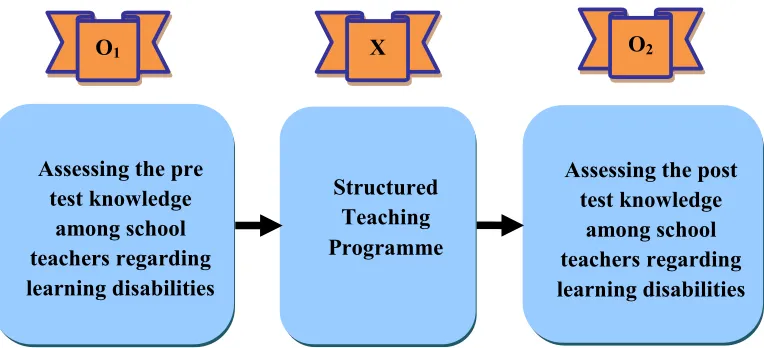
[image:35.612.134.516.517.691.2]One group pre-test post-test research design was adapted for this study a subtype of pre experimental design. It involves the manipulation of independent variables.
Figure. 2 The Schematic Representation of the Research Design
O1 X O2
Assessing the pre test knowledge
among school teachers regarding learning disabilities
Structured Teaching Programme
Assessing the post test knowledge
23
Q1 Pre-test assessment, X Intervention
Q2 Post-test assessment
Setting of the Study
The study was conducted at St.Theresas High School and Mar Ivanios High School located at Kalayapuram, 8Km away from Kottarakara town, Quilon (DT), Kerala. Both the schools contain more than 750 students and 80 teachers approximately.
Variables
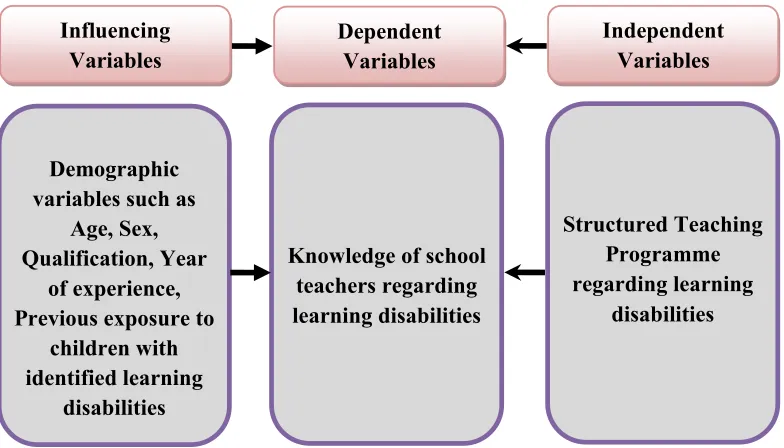
[image:36.612.128.520.455.679.2]Independent variable is structured teaching programme on learning disabilities among school teachers. The dependent variable is knowledge among the school teachers regarding learning disabilities and the influencing variables are demographic variables.
Figure. 3 The Schematic Representation of the Variables Influencing
Variables
Dependent Variables
Independent Variables
Demographic variables such as
Age, Sex, Qualification, Year
of experience, Previous exposure to
children with identified learning
disabilities
Knowledge of school teachers regarding learning disabilities
Structured Teaching Programme regarding learning
Population
The accessible population includes the school teachers at selected schools at Kerala.
Sample Size
The sample size included for the study consists of 40 school teachers.
Sampling Technique
The samples were selected by using Convenient Sampling Technique. It is a type of non-probability sampling method.
Criteria for Selection of Samples
Inclusive Criteria
¾ Both male and female teachers.
¾ Teachers who are willing to participate in this study. ¾ Teachers from Pre-KG to 5th standard.
¾ Samples who can understand the information.
Exclusive Criteria
¾ Teachers who have attended previous classes regarding learning disabilities.
25
Description of the Tool
The researcher has developed a structured questionnaire after reviewing the literature and considering the opinion of psychiatric nursing experts to assess the knowledge regarding learning disabilities. The tool consists of three sections.
Section ± A Demographic Variable
It includes age, sex, nature of employment, years of experience, qualification, previously identified children with learning disabilities.
Section ± B Structured Questionnaire
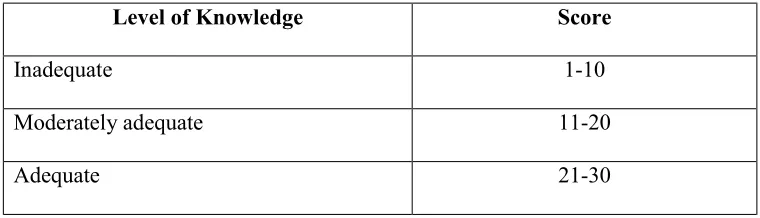
[image:38.612.145.525.535.644.2]To assess the knowledge regarding learning disabilities. It contains 30 multiple choice questions to assess knowledge regarding learning disabilities among the school teachers. Each question has 4 options in which one option is correct and other three options are wrong. Each correct answer carries one mark, wrong answer carries zero mark, the possible maximum mark is 30 and minimum score is zero.
Table. 1 Grading of Knowledge Level
Level of Knowledge Score
Inadequate 1-10
Moderately adequate 11-20
Testing of the Tool
Content Validity
The tool was given to five experts in the field of psychiatric nursing, psychiatrist and psychologist for content validity. All the comments and suggestions given by the experts were duly considered and correction was made after discussion with research guide.
Reliability
The reliability of the tool was determined by Brown Spearman split half method, showing knowledge questionnaire reliability with +0.98. So the reliability of the tool was satisfactory.
Pilot Study
27
Data Collection Procedure
The study was conducted for a period of four weeks from 01/07/2014 to 31/07/2014. Prior permission was obtained from the Principal of 6W7KHUHVD¶V School
and Mar Ivanios School, submitting an application giving assurance to abide by the rules and regulation.
The researcher explained the purpose of the study in compassionate manner and informed consent was taken from the teachers. 40 samples were selected from the school by using convenient sampling technique. The first phase of data collection was conducted in 6W7KHUHVD¶V school with 20 samples. The knowledge was assessed by
using structured questionnaire. After that, the structured teaching programme was given to the school teachers regarding learning disabilities. After a period of 14 days the post test was conducted by using the same questionnaire to determine the extent of effects of structured teaching programme.
By using the similar technique the study conducted at Mar Ivanios school with 20 samples. Pretest session was conducted on 10/07/14 with the structured questionnaire following these 4 days continuous structured teaching programme was given for a period of 1hour and the school teachers were encouraged to clarify their doubts. The post test was conducted from 14th day on 23/06/14 using same questionnaire.
Plan for Data Analysis
Descriptive Statistics
¾ The demographic variables were analyzed by using frequency and percentage.
Inferential Statistics
29
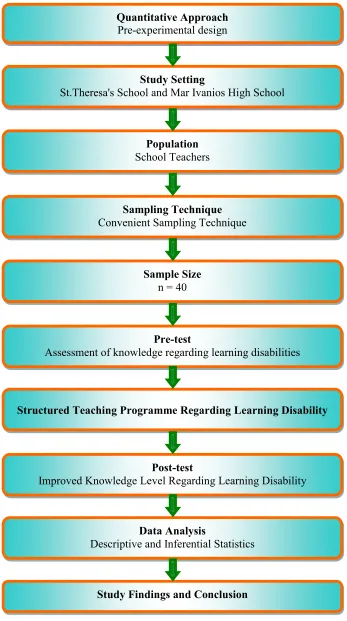
Figure. 5 Overall View of Research Methodology Population
School Teachers Quantitative Approach Pre-experimental design
Study Setting
St.Theresa's School and Mar Ivanios High School
Sampling Technique Convenient Sampling Technique
Sample Size n = 40
Pre-test
Assessment of knowledge regarding learning disabilities
Structured Teaching Programme Regarding Learning Disability
Post-test
Improved Knowledge Level Regarding Learning Disability
Data Analysis
Descriptive and Inferential Statistics
CHAPTER - IV
Data Analysis and Interpretation
This chapter deals with the analysis and interpretation of data from the school teachers at selected schools, Kerala to assess the knowledge regarding learning disabilities.
The findings based on the description an inferential analysis tabulated as follows:
Section - I : Distribution of demographic variables of school teachers
Section - II : Description of school WHDFKHUV¶ NQRZOHGJH UHJDUGLQJ OHDUQLQJ
disabilities.
Section - III : Distribution of Statistical value of pre-test and post-test knowledge
regarding learning disabilities.
Section - IV : Association of demographic variables with post-test score of
31
[image:44.612.121.526.162.687.2]SECTION
±
I
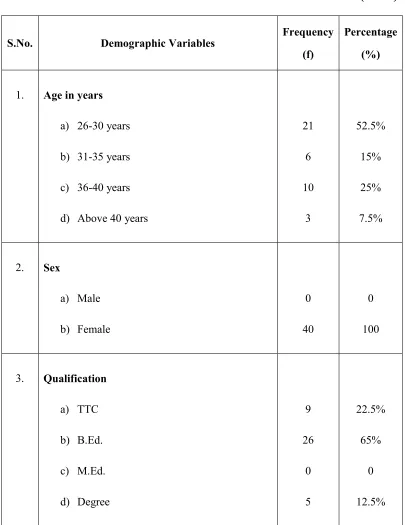
Table. 2 Distribution of Demographic Variables of School Teachers
(n = 40)
S.No. Demographic Variables
Frequency
(f)
Percentage
(%)
1. Age in years
a) 26-30 years
b) 31-35 years
c) 36-40 years
d) Above 40 years
21
6
10
3
52.5%
15%
25%
7.5%
2. Sex
a) Male
b) Female
0
40
0
100
3. Qualification
a) TTC
b) B.Ed.
c) M.Ed.
d) Degree
9
26
0
5
22.5%
65%
0
12.5%
(Table 2 continued)
S.No. Demographic Variables
Frequency
(f)
Percentage
(%)
4. Years of experience
a) Less than 3 years
b) 4-6 years
c) 7-10 years
d) 11-13 years
19
8
8
5
47.5%
20%
20%
12.5%
5. Nature of the employment
a) Temporary
b) Permanent
28
12
70%
30%
6. Previously identified children with learning
disabilities
a) Yes
b) No
14
26
35%
33
Table 1 shows that distribution of demographic variables of the school teachers
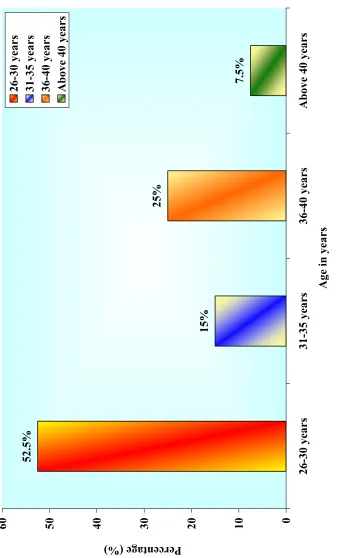
With regard to the distribution of age of the school teachers, 21 (52.5%) belongs to 26-30 years, 6 (15%) were belongs to 31-35 years 10(25%) were belongs to 36-40 years, 3 (7.5%) were belongs to <40 years.
While considering the sex of the school teachers, 40(100%) were female teachers
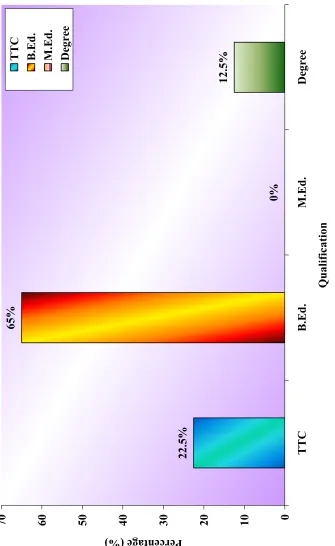
About qualification of teachers, 9(22.5%) teachers were completed TTC, 26(65%) were completed B.Ed 5(12.5%) were completed degree.
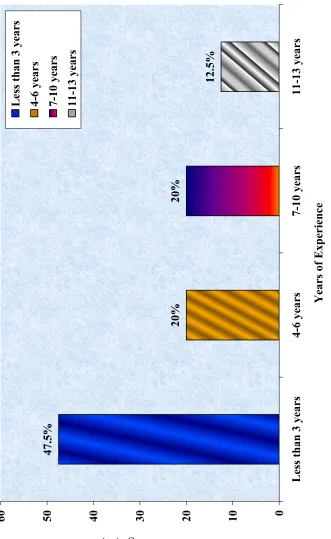
Looking to the years of experience, 19(47.5%) were having below 3 years of experience, 8(20%) were having 4 bytes of experience, 8(20%) were having 7-10 years and 5(12.5%) were having 11-13 years of experience.
In nature of employment 28(70%) of the teachers are temporary and 12(30%) of the teachers are permanent.
F
igure. 5
Distr
ibution of
De
m
o
g
r
aphic Variables Acco
rding to t
h
e Age
of
School
Teachers
7.5%
25%
15%
52.5%
0
10
20
30
40
50
60
26-3
0
years
31-3
5
years
36-4
0
years
Above 40 years
Age in years
Percentage (%)
26-3
0
years
31-3
5
years
36-4
0
years
35
[image:48.612.144.475.121.676.2]F
igure. 6
Distr
ibution of
De
m
o
g
r
aphic Variab
les Acco
rding to t
h
e Sex of
School
Teachers
100%
0%
0
20
40
60
80
100
120
Male
Fem
a
le
Se
x
Percentage (%)
Male Fem
a
F
igure. 7
Distr
ibution of
De
m
o
g
r
a
phic Variables Acco
rding to t
h
e Qu
alif
ication o
f the School
Teachers
12.5%
0%
65%
22.5%
0
10
20
30
40
50
60
70
TTC
B.Ed
.
M.Ed
.
Deg
ree
Qualification
Percentage (%)
TTC B.Ed
.
M.Ed. Deg
37
[image:50.612.147.478.125.664.2]F
igure. 8
Distr
ibution of
De
m
o
g
r
aph
ic Variables Acco
rding to t
h
e Ye
a
r
of
Experience
of
the School Teachers
12.5%
20%
20%
47.5%
0
10
20
30
40
50
60
Less than 3 years
4
-6
years
7-1
0
years
11-1
3
years
Ye
ars of Experience
Percentage (%)
Less than 3 years 4-6
years
7-1
0
years
11-1
3
F igure. 9 Distr ibution of De m o g r aphic Variables Acco
rding to t
h e Nature of the Em ploy m e nt of School Teachers 30% 70% 0 10 20 30 40 50 60 70 80 T e m por ar y P e r m ane nt
Nature of the Em
39
[image:52.612.122.454.121.667.2]F
igure. 10
Distribution of
De
m
o
g
r
aphic Variables According to t
h
e Sc
hool Teachers w
ith P
r
eviously
Identified Ch
ildren
w
it
h
Learning Disabilities
65%
35%
0
10
20
30
40
50
60
70
Ye
s
N
o
Previously Identifi
ed Special Children
Percentage (%)
Ye
s
SECTION - II
Table. 3 Description of Pretest and Post Test Knowledge of the School Teachers
Regarding Learning Disabilities
(n = 40)
Level of
Knowledg
e
Pre-test Post-test
Inadequat
e
Moderatel
y
Adequate
Adequat
e
Inadequat
e
Moderatel
y
Adequate
Adequat
e
f % f % f % f % f % f %
[image:53.612.125.522.194.363.2]3 7.5 35 87.5 2 5 0 0 4 10 36 90
41
[image:54.612.149.474.120.682.2]F
igure. 11
Distr
ibution of
P
r
e-te
st and
P
ost-te
st
K
n
ow
ledge of the Scho
ol Teachers Rega
rding Learning Disabil
ities
5%
87.5%
7.5%
90%
10%
0%
0
20
40
60
80
100
120
Inade
quate
M
ode
r
a
tely A
d
e
quate
Adequate
Level of k
now
ledge
Percentage (%)
SECTION - III
Table. 4 Distribution of Statistical Value of Pretest and Post Test Knowledge
Regarding Learning Disabilities
(n = 40)
S. No. Knowledge Mean S.D µW¶YDOXH
1. Pre test 14 3.72
14.02*
2 Post test 25.29 3.12
*significant at 0.05 level
Table 4 shows that the mean pretest score of knowledge was 14, SD 3.6 and post-test mean score of knowledge was 24.35 SD (2.89). For 29 degree of freedom at 5% level of significance the calculated µt¶ value was +HQFHWKHFDOFXODWHG¶W
43
[image:56.612.143.466.122.679.2]F
igure. 12
Distr
ibution of
Stat
istical Valu
e of
P
r
e
-t
e
st and P
o
st
-t
est
K
n
ow
ledge Regarding Learning Disabil
ities
14
25.29
0
5
10
15
20
25
30
Pretest
Post test
Know
ledge
Mean
SECTION - III
Table. 5 Association of Demographic Variables with Post Test Score Knowledge
Regarding Learning Disabilities Among the School Teachers
(n = 40)
S. No. Demographic Variables
Above
Mean
Below
Mean
F2
1. Age in years
a) 26-30 years
b) 31-35 years
c) 36-40 years
d) Above 40 years
5
7
12
1
9
1
3
2
8.55*
2. Sex
a) Male
b) Female
0
25
0
15
1.25
3. Qualification
a) TTC
b) B.Ed.
c) M.Ed.
d) Degree
8
15
0
2
2
9
0
4
45
S. No. Demographic Variables
Above
Mean
Below
Mean F
2
4. Years of Experience
a) Less than 3years b) 4-6 years c) 7-10 years d) 11-13 years
12 4 4 5
7 3 3 2
0.74
5. Nature of the employment
a) Temporary b) Permanent
18 7
11 4
1.88
6. Previously identified children with
problems of special children
a) Yes b) No
15 9
11 5
4.02*
*significant
CHAPTER - V
Results and Discussion
This is a pre-experimental study indented to evaluate the effectiveness of structured teaching programme regarding learning disabilities among the school teachers in selected schools at Kerala. The results of the study are discussed according to the objectives.
The First Objective of the Study to Assess the Level of Knowledge Regarding
Learning Disabilities among School Teachers
Structured questionnaire method was used to assess the pretest score of knowledge regarding learning disabilities among the school teachers. During the pre-test 3(7.5%) teachers showed inadequate knowledge, most of the teachers 35(87.5%) demonstrated moderately adequate knowledge and 2 (5%) adequate knowledge regarding learning disabilities. During the post-test, 0(0) were demonstrated inadequate knowledge, 4(10%) of teachers showed moderately adequate knowledge and most of the teachers 36(90%) showed adequate knowledge about learning disabilities of children.
47
The Second Objective of the Study was to Deliver the Structured Teaching
Programme Regarding Learning Disabilities Among the School Teachers
The structured teaching programme was given to the teachers at St. 7KHUHVD¶V
and Mar Ivanios School, Kerala. Teaching was given for two days through power point presentation. It included the definition, types, etiology, symptoms, diagnostic evaluation, identification, treatment, tips for working students with learning disabilities and the rights and responsibilities of both the teacher and the students regarding learning disabilities of children. The teaching duration was for one week in four sessions which was for about 1 hour in two schools. It was found to be effective as they were communicating and clarifying their doubts related to learning disabilities of children.
Dileep Natekar (2012) conducted study, to assess the knowledge of primary school teachers regarding learning disabilities of children and their difficulties in academic performance, among children in Bangalore. Self- administered structured questionnaire was prepared and administered to 50 school teachers between 1-7th standard based on purposive sampling technique.
The Third Objective of the Study was to Evaluate the Effectiveness of Structured
Teaching Programme regarding Learning Disabilities
FDOFXODWHG µW¶ value was more than the expected table value(2.064). It revealed that
there was a significant difference in the pre-test and post-test level of knowledge and the hypothesis is accepted.
Priyesh Bhanwara (2012) described that the planned teaching is effective in increasing the knowledge regarding learning disabilities. The study was conducted in selected schools of Pune city. The samples were teachers both male and female. Sample size was 60.non-convenient purposive sampling technique was used.
The Fourth Objective of the Study was to Find out the Association Between
Selected Demographic Variables with Post Test Knowledge Score of Learning
Disability
The fourth objective of the study was to find out the association between selected demographic variables with the post-test knowledge score of learning disabilities. There is a significant association between the age of the school teachers and previously identified learning disability with the knowledge of the post test score is significant at 0.05 level.
49
CHAPTER - VI
Summary, Conclusion, Nursing Implication,
Limitation and Recommendation
Summary
The purpose of the study was to help the teachers to improve the knowledge regarding learning disabilities.
The Following Objectives were Set for the Study
¾ To assess the level of knowledge on behavioral learning disabilities among school teachers.
¾ To deliver structured teaching programme on learning disabilities among school teachers
¾ To evaluate the effectiveness of structured teaching programme on learning disabilities among the school teachers
¾ To find out the association between selected demographic variables with the post-test knowledge score of learning disabilities.
The Alternative Hypothesis Set for the Study
There is significant efficient of structured teaching programme regarding knowledge among school teachers at selected schools, Kerala.
Major Findings of the Study Were as Follows
¾ The pretests mean score of knowledge was 14.
¾ 7KH FDOFXODWHG µW¶ value for knowledge score was 14.02 at 29 degree of freedom at 0.05 level of significant
¾ There was significant association between post-test knowledge with age, previously identified children with learning disabilities.
¾ There was no significant association between post-test knowledge with sex, qualification year of experience, nature of employment.
Conclusion
7KH FDOFXODWHG ³W´ YDOXH RI NQRZOHGJH VFRUH ZDV DW GHJUHH RI
freedom at 0.05 level of significance which indicates the structured teaching programme was effective in improving the knowledge regarding learning disabilities.
There was significant association between post-test knowledge with age, previously identified children with learning disabilities. There was no significant association between post-test knowledge with age, sex, qualification and year of experience.
Nursing Implications
Learning disabilities in the children is not cured but must be managed through early identification by timely health education. The findings of the study have implications on nursing practice, nursing education, nursing administration and nursing research.
Nursing Practice
51
¾ Teaching programme can be conducted for the school teachers.
¾ More knowledge regarding learning disabilities will help for early identification of the learning disabilities of children.
¾ Health education can also provide with media, pamphlets which will help the client to increase the knowledge regarding learning disabilities among the school teachers.
¾ 1XUVHV¶ active participation in school health programmes by providing direct and indirect care helps to achieve the goals of health services. Teachers deficit in knowledge regarding learning disabilities indicate the needs for arranging health education session in related topics.
¾ Nurses should focus on psychiatric rehabilitation in the community setting by using health teaching regarding learning disabilities.
Nursing Education
¾ Nurse Educator should emphasize more on preparing students to impact health information to the public regarding children with learning disabilities.
¾ The study has clearly proved that structured teaching programme was effective in improving the knowledge regarding learning disabilities. To practice this, the nursing personal needs to be equipped with adequate knowledge and practice regarding structured teaching programme.
¾ The curriculum of nursing education should enable student nurse to equip themselves within the knowledge of learning disabilities of the children. ¾ The nursing education should give more importance to the application of
Nursing Administration
¾ Nurse as an administrator should take limitation in formulating policies and protocols for short and long term health teaching.
¾ The nursing administration should motivate the subordinate for participating in various educational programmes and improve their knowledge and skills.
¾ The administrator serves as a reserves person for young nursing students, parents and school teachers for proving guidance and counseling forchildren with learning disabilities.
¾ The nurse administrator has the power to formulate pamphlet and flashcards for the awareness of learning disabilities of the children among the school teachers.
¾ Cassettes about learning disabilities of children can made available to nurse educator in nursing education institution.
Nursing Research
¾ There is a good scope for nurse to conduct research in this area, to find out the effectiveness of various teaching strategy to educate the teachers and the parents
¾ The effectiveness of the research study can be made by further implication of the study.
53
Limitations
¾ The study findings can be generalized only to the selected school teachers. ¾ The size of the sample only 40 hence the finding should be generalized with
caution.
¾ Study was limited to one month, improvement in knowledge take place slowly.
¾ The study did not use any control group. There was a possibility of threat to internal validity such as events occurring between pre-test and post-test session like mass media or other people can influence the school teachers
knowledge.
Recommendation
¾ Similar study can be conducted in a large group to generalize the study findings.
¾ The study can be conducted to assess the attitudes and coping strategy of school teachers towards children with learning disabilities.
¾ Comparative study can be done between urban and rural areas.
¾ A quasi experimental study can be conducted with control group for the effective comparison.
¾ This study can be conducted as descriptive study to assess the extent nature of learning disabilities of children.
¾ A study can be conducted in term of knowledge, attitude and practice of alternative learning methods among school teachers of children with learning disabilities.
REFERENCES
Books
¾ Abraham, (2001). Pediatrics. (1st edition). Singapore: Mc. Graw Hill international company.
¾ Alphonsa, Jacob. (1994). Handbook of psychiatric Nursing. (2nd edition). Pune: Vera population
¾ Ann, W (1995). Psychiatric nursing to the hospital and the community.(1st edition). California: Application and large company.
¾ Bahtia, M S. Essentials of psychiatry. (5th editon). New Delhi: CBS Publishers. ¾ Barbara, Johnson. (1995). Child, Adolescent and Family Psychiatric nursing.(2nd
edition). Philadelphia: J.B Lippincott publication.
¾ Basavanthappa, B.T (2003). Nursing research. (1st edition). New delhi: jaypee publishers.
¾ Beharmann, (2000). Text Book of pediatrics. (1st edition) Singapore: Harcouret Are Pvt Ltd.
¾ Behman, khighan(1998). Essential pediatrics. (2nd edition). Singapore : Harcourt Brace Publishers.
¾ BhaskarRao. (2000). Methods of Biostatistics. (2nd edition). Hydrabad: paras publishers.
¾ Bhatia M.S, (1996) A Comprehensive Text book of child and adolescent Psychiatry, New Delhi CBS publishers and Distributors.
¾ Catherine, E. (1990). Pediatrics (1st edition). Philadelphia: W.B. Saunders company.
¾ Daniel, W.W (2004). Biostatistics- A Founder for Analysis in Health Science. (7th Edition). New Delhi: Pushpa Prince Service
¾ Donald, E. (1941). Behavioral psychiatry. (3rd edition). USA: Springer verla company.
¾ Dorthy. R. Marlow.(2005) Text book pediatrics Nursing; ,6th edition Elsevier Company New Delhi:
¾ Dutta, (2009). Pediatric nursing. (2nd edition). New Delhi: Jaypee Brothers publications.
¾ Elmen, R. Grossman.(1994). Everyday pediatrics. (2nd edition). New York: Mc Grew Hill company publication.
¾ Ghai, O.P.(2007). Essential Pediatrics. (6th edition). New Delhi: CSB publishers. ¾ Gupta SP.(1997).Statistical Methods, Sultanchand and Sons Publishers, New
Delhi.
¾ Gurumani, N (2004). An introduction to biostatics. (1st edition). India MJP publishers.
¾ Hugh. (1998). Nursing Theories and Models. (2n edition). New York: JJ International ltd.
¾ Louise,(1994). Basic concepts of and mental health nursing. (1st edition). Philadelphia: JB Lippincott company
¾ Louise. (1994). Basic concepts of mental health nursing. (1st Edition). Philadephia: JB Lippincott publication.
¾ Mary. C. Townsend (2010). Psychiatric and Mental Health Nursing ± Concepts of Evidence Based Practice. Jaypee Brother Publication.
¾ Nambi.s(1998) Psychiatry for Nurses ; 1st edition. Jaypee Brothers publication , ¾ Panda K C(1997) Education of Exceptional Children, New Delhi, Vikas
Publishing House Pvt Ltd. 174 ± 175PP.
¾ Pillai, R.S.N and Bagavathi. (2003). Practical Statistics. (2nd edition). New Delhi: Chand and Sons Company Publication
¾ Polit, D.F (1995). Nursing research and methods.(1st edition). Philadelphia: Lippincott publication.
¾ Polit, D.F and Beck C.T (2006). Nursing Research. (7th edition). New Delhi: Wolters Kluwer Health publication.
¾ Rutter M. Maughan B. Psychosocial adversities in childhood and adult psychopathology: J. Personality Disorders. 1997. P.117-118.
¾ Sadock, B.J AndSadock, V.A (2003). Synopsis of psychiatry-Behavioral Sciences and Clinical Psychiatry. (9th edition). Lippincott Williams Wilkins. New York. ¾ Sreevani, R (2010). A guide to mental health and psychiatric nursing. (3rd
edition). New Delhi: Jaypee Brothers Medical Publishers.
¾ Sunder Rao and Richard, J. (1996). An Introduction to Biostatistics. (3rd edition). New Delhi: Vora Medical publications.
¾ Varghese. (2002) A manual on family intervention for the mental health professional. Ver 2. WHO/NIMHANS
Journals
¾ Ambrose, E.R. (2000). Diagnosis and evaluation of the child with ADHD.
¾ Arnold, M. (2001). Practice parameter for the assessment and treatment of children and adolescents with behavioral problems. American Journal of child and adolescent psychiatry. 40(3), 24-30.
¾ %URJ 0* 6HFRQGDU\ VFKRRO WHDFKHU¶V SHrception of pupils undesirable behaviors. Journal of educational psychology, 8(1).17-30
¾ Dr. Parathasarathy R. (1994). Promotion of Mental Health through Schools.
Health for the Millions. 4: 12±13.
¾ Ehsan Ullah Syed. (2009). Screening for Emotional Behavioural Problems Amongst 5 -11 year old School Children In Karachi. Ind