111:1' II)
-....
--><
..
w
w
0COMMISSION OF THE EUROPEAN COMMUNITIES
SCIENCE
RESEARCH AND DEVELOPMENT
SPEAR
Evaluation of the Impact
of European Community Research Programmes
upon the Competitiveness
of European Industry - Concepts
and Approaches
Commission of the European Communities
~valuation
of the Impact
of European Community Research Programmes
upon the Competitiveness
of European Industry - Concepts
and Approaches
-/
Authors :
J
.S. MetcalfeL. Georghiou with
P. Cunningham H.M. Cameron
~ .' , MONITOR/SPEA~: C.E. de Ia Torre
Coordinator
Published by the
COMMISSION OF THE EUROPEAN COMMUNITIES Directorate-General
Telecommunications, Information Industries and Innovation L-2920
LUXEMBOURG
LEGAL NOTICE
Neither the Commission of the European Communities nor any person acting on behalf of the Commission is responsible for the use which might be made of the following
information
Cataloguing data can be found at the end of this publication
Luxembourg: Office for Official Publications of the European Communities, 1992
ISBN 92-826-3818-9 Catalogue number: CD-NA-14198-EN-C
©ECSC-EEC-EAEC Brussels • Luxembourg, 1992
Contents
Page
1.
Introduction1
1.1
The Competitiveness Rationale1
1.2
Evaluation and Competitiveness2
1.3
Objectives of this Report4
2.
Definitions of Competitiveness 73.
An Analytical Perspective 153.1
The Importance of Competition 153.2
Contrasting Views: Equilibrium and Process 16.3.3
The Competitive Process 193.4
Dimensions of Competitive Advantage 233.5
Competitive Consequences 273.6
The National Picture 304.
Guidelines for Evaluation 334.1
Introduction 334.2
Implications of the Analytical Perspective 334.3
Advance Preparation - Clarification of Objectives 354.4
Scope of the Evaluation 364.5
Contextual Information 374.6
Motivations of Finns 384.7
The Contribution to Competitiveness ofLonger-Term Research 39
4.8
Technology Transfer Within and Beyond Projects 404.9
Assessing the Impact of Programmes onIndustrial Competitiveness - Generic Questions 41
Section
I
Introduction
l.l The Competitiveness Rationale.
During the 1980's there was a general trend towards justifying public support for research and development in terms of the impact it would have upon industrial com-petitiveness. In some cases this rationale was applied to the whole spectrum of
Community programmes were part of the trend referred to above. Programmes such as ESPRIT and BRITE sought to enhance the competitive performance of dif-ferent sectors of European industry. Article 130F of the Single European Act gives as the underpinning mtionale for the Fmmework Programme that,
"The Community's aim shall be to strengthen the scientific and
technological basis of European industry and to encoumge it to become
more competitive at international level."
Individual progmmmes have also adopted enhancement of competitive perform-ance as part of their objectives but the objectives are not broken down further into a
verifiable format. Whether it is possible to be more specific is one of the qustions to
be addressed by this study but, for the moment, it is sufficient to note the widespread
and underpinning presence of the competitiveness rationale. It should also be noted, however, that there are a number of other objectives for Community R&D embodied in the S.E.A. and hence that not all programmes need embody a contribution to com-petitiveness in their objectives.
1.2 Evaluation and Competitiveness.
Panels appointed to evaluate Community progmmmes have already had to pass judgement on the contribution made to competitiveness. It is instructive to examine
how the issue was treated in the cases of two large programmes which e~licitly
ad-dressed the competitiveness of European industry, ESPRIT-1 and BRITE -.
Evaluation of the first BRITE programme (1985-1988)
The evaluation of BRITE contained a section discussing industrial competition and the role of technology. While stating that it was essential that a scientific and
technical culture should be introduced into the European industria~ system, the report
stated:
1 Y. Farge et al. Evaluation of the first BRITE programme (1985-1988), Commission of the European Communities, July 1988 ·
"Boosting competitiveness means reducing production costs and de-livery times, and improving quality, just as much as developing new products and processes. For BRITE-II, the panel recommends that the concept of competitiveness be defined more clearly in the call for proposals, and taken into account more extensively in the selection criteria."
The panel queried the incorpomtion of the concept of pcompetitivity in a re-search progmmme whose primary goal was to enhance the competitiveness of
Euro-pean industry. This was in the context of a more geneml criticism of some projects
being too distant from the market.
The economic impact of the progmmme was assessed through a questionnaire to
which 177 out of 445 participants replied, and direct interviews by the panel. It was
concluded that most projects should exert a genuine impact on the competitiveness of the industries concerned, even if such an impact cannot be estimated correctly.
The review of ESPRIT 1984-1988
The review of ESPRIT I began by stressing that the overall strategic goal of the progmmme was to provide the European IT industry with the technology base which it needs to become and stay competitive with the USA and Japan in the 1990's. Com-ments in the report in this area were genemlly restricted to detailing ways in which the technology base was enhanced, and associated matters such as dissemination of results. The benefits of collaborative working were also stressed, as were contribu-tions to standards. In concluding and looking ahead, the report saw the problems of risk aversion in new product investment as the main feature obstructing European in-dustry compared with the USA and Japan.
While presenting a general picture of the standing of European industry in the IT
sector (through trade balance and market share data) the
report
did not attempt tolink changes in these to the progmmme.
General Problems in evaluating the impact of R&D on competitiveness
As the above examples illustrate, evaluation panels have faced difficulties in deal-ing with, or even comprehenddeal-ing the competitiveness issue. One reason for this is
that the programmes they are evaluating may represent a necessary step to
improve-ment of competitiveness but they certainly do not represent a sufficient one. An
en-hanced technological base still requires investment and successful entrepreneurial
activity to support it Products may draw upon multiple sources of knowledge, and
an R&D project may contribute to the development of a number of products (or
pro-cesses). Collectively these problems of attribution make it difficult to assess the
economic return on R&D, even in industry.
A further well-known difficulty in evaluating the benefits of f{&D is that deriving from the time-interval needed for many results to be applied. Since evaluations take place during or immediately after a programme, these may not yet have been felt.
A third important point is that Community spending accounts for only about 4% of non-military R&D expenditure in Member States, meaning that its impact is diffi-cult to s)Parate from that of R&D spending by recipients from their own or other re-sources. Nevertheless, the Community input may be relatively large in a given area for a given recipient.
1.3 Objectives of this Report.
In view of the difficulties encountered in the evaluation of competitiveness, this
report has the following objectives:
• to clarify the meaning of the concept of competitiveness; and
• to suggest guidelines for evaluation of programmes in terms of their impact upon competitiveness.
The work presented in this report is largely the result of a desk study, though it draws upon previous empirical work. Informal discussions were held with a small number of participants in the ESPRIT and BRITE programmes regarding their per-ceptions of the likely input of their projects on the competitive performance of their
firms. The study also benefitted from co~ments received from members of the
SPEAR Network on Methods for Socio-Economic Evaluation of R&D.
Section 2 of the report reviews some of the recent literature on the nature,
meas-urement and sources of competitiveness in order to investigate what
isgenerally
understood by the
term.Section 3 then goes on
topresent a more
analyticalper-spective which seeks to explore the consistency of the various concepts of
competi-tiveness through presentation of a dynamic perspective and ultimately
toarrive at a
view of which measures provide the
bestindication of competitive advantage in
par-ticular circumstances. Section 4 draws upon the earlier material
toset out
gui-delines for
the
evaluationof the impact of Community programmes on competitive
performance; and Section 5 draws some conclusions and suggests some future lines
of research.
SECTION2
Definitions of Competitiveness
In recent years a plethora of reports, books and articles have appeared on the nature, measurement and creation of competitiveness. Few issues can have enjoyed more official attention in the last decade than competitiveness, and it remains the constant concern of commentators on the industrial and management scene. Discussion of "technology gaps", of "catching up" and "falling behind" has been commonplace, yet little clear agreement has been reached other than that technology is important to the competition advantage of firms and nations and, ultimately, to the long run standard of living of a nation's citizens. Three reasons can be put forward to explain why our understanding is fragile. First and foremost the relation between technology and competition reaches to the core of the operation of a capitalist market economy, and
this core is inevitably complex. Even the concepts of technology and competition admit
divers and often incompatible interpretations. Secondly, and however important as a contributory factor, technology is only one of the elements which determine patterns of competitive behaviour and there are no simple ways to isolate the technological from other important elements of firm performance. Finally, technology itself is complex. It has many dimensions, it is located in different institutions, and its mechanisms of accumulation differ considerably across its different constituent parts. For these reasons one of the central tasks in this area is to understand more clearly the nature of technology and the processes by which it accumulates. Our purpose in this section is to review some of the leading contributions to this debate, taking this as an introduction to the more analytical treatment of the problem which follows in Section 3. This brief survey of the literature establishes without doubt that there is general agreement on what competitiveness is but substantial disagreement over important details. Since the details are important for policy purposes this lack of agreement is a matter for concern. As we shall see, much of the confusion is related to the different levels at which competitive-ness may be considered, supra-national, national, regional, industrial and firm. At each level different factors come into play, different indicators are appropriate and different policy conclusions follow.
A useful starting point is the recent work by Porter3 who draws attention to competing explanations of competitiveness. Some explanations run in tenns of macroeconomic policies (exchange rates, interest rates, etc), others in tenns of availability of labour (quantity and quality) and natural resources, others in tenns of industrial policies and yet others in tenns of management practices and capabi~ities. As he rightly comments
"none of these explanations for national competitiveness, any more than a variety of others that have been put forward, is fully satisfactory. None is sufficient by itself in rationalizing the competitive position of a nation's industries".
His own preferred definition is in terms of national productivity, where productivity is broadly defined,
"a nation's finns must relentlessly improve productivity in existing industries by raising product quality, adding desirable features, improv-ing product technology, or boostimprov-ing production efficiency".
The clarity of this view is not always matched in the other literature.
At the level of the individual finn matters seem more straightforward; competitive-ness is concerned with generating superior product and process attributes relative to rivals and articulating these advantages to gain market position. A recent case study by Lehnard4 makes this abundantly clear. It concerns a household products company located in the USA which recognised that over the longer term, 20 years or so, its competitive position would be eroded by foreign competition and that it must transform its product range and manufacturing processes if it was to survive. Thus it undertook a six year research and development programme to redesign its product range while simultaneously automating the production process. The programme was overwhelm-ingly successful, cutting labour requirements from 600 to 171 operatives and permitting substantial real reductions (between 42% and 62%) in the real cost of its products. The success of the programme was reflected in an expanding market share in US and European markets, a 30% pre-tax rate of return on the investment and a greatly enhanced future design capability. In short, this company became more competitive by investing
3 M. Porter, 1990, The Competitive Advantage of Nations, Macmillan
4 A.P.Lehnard,l987, 'Revatalizing the Manufacture and Design of Mature Global Products' in B.R.Guile and
in product and process superiority relative to its rivals and reaped the reward one would expect it to reap in an international market economy.
This differential advantage view of competitiveness is endorsed by the President's Commission Study (1985) in the USA.
"A firm is competitive if it can produce products or services of superior quality or lower cost than its domestic or international competitors".
This carries over to the national level as well but with qualifications.
"While there are parallels between competitiveness at the firm level and at the national level, the definition of the latter is much more complex. It is unlikely that all sectors of a nation's economy will be equally competitive in world market. Success in one industry can reduce com-petitiveness in another, as wages and factor costs are bid up. Neverthe-less, while the definition of competitiveness does not require that all industries be equally strong, we reap benefits from maintaining a level of diversity in our industrial base."
Similarly Cox and Kreigbaum 5 identify
greater
competitiveness with lower prices or higher quality compared to rival firms. The general theme here is one of relating competitiveness to market performance, a view endorsed by a separate study (Cabinet Office on Commerce and Trade). 6 There it is argued that"no single indicator can adequately measure our competitive standing in world markets. However, competitiveness is best measured by four key indicators: (1) labour productivity, (2) real wage growth, (3) real returns as capital employed in industry, and (4) position in world trade. These measures come closest to reflecting a nation's ability to meet the challenges of international markets while increasing the real incomes of its citizens. Any one of these indicators can be influenced by factors other than competitiveness. Taken together, however, they present a corrobor ... ating picture of a nation's competitive position. Each shows a different
5 J.Cox and H.Kreigbaum, 1989. ITUUJvation and Industrial Strength. A Study in the United Kingdom. West Germany, the United States and Japan
6 Cabinet Office on Commerce and Trade, 1982, An Assessment of US Competitiveness in High Technology Industries
facet of our competitiveness."
Moreover, the report continues,
*'Just as it is inappropriate to focus on only one indicator, US perform-ance along these indicators of competitiveness must be evaluated over time. The trends in these key indicators are at least as important as current
performance. Trends are essential in assessing our future
competitive-ness and represent vital indications of whether the United States is
making the
progress
necessary to meet its national goals. Understandingthese trends is also crucial to understanding the long-tenn implications
of the recent economic upturn for US competitiveness".
We endorse entirely the dynamic view of competition which is entailed by the emphasis on trends.
However it is intrinsic to this market based view that not all sectors can be
competitive just as not all firms within sectors can be competitive. As the
report
observes
"finally, US competitiveness is not defined as the ability of any single
US industry to remain viable.
H
any one US industry cannot becompe-titive, then resources should flow to other industries in which they can be used more effectively. This benefits our productivity and hence our
economic growth. All industries cannot be competitive, because
increas-ing competitiveness in one industry will allow it to build up wages and attract resources away from others and reduce their competitiveness. Competitiveness also does not distinguish among industries simply due to classification as "basic" or "high tech". Both basic and high tech industries can be competitive if they utilise resources productively: any industries that cannot will remain stagnant or decline. It is in the US national interest to maintain a broad and diverse industrial base in which many industries achieve high levels of productivity.
The link between technology and market performance is emphasized in a recent
study from the Office of Technology Assessment. 7. It is argued that technology is the
key to competitive success.
"Nations that rely on low wages to sell their goods in the world market are, by definition, poor, whereas superior technology raises productivity and thus supports rising standards of living. Moreover, technology is a
steady, predictable source of advantage, while others may shift with
political currents. For example, a nation's fiscal and monetary policies
affect the value of its currency, which in turn affects the saleability of its
manufactured goods in the world market But macroeconomic policies are changeable and are far beyond the control of private firms."
Consequently there are no simple remedies for loss of competitiveness but
nonethe-less the basis of competitive success in the USA is to be found in enhanced technology.
Increasing investments in physical, human and knowledge capital, developing closer links between firms, their suppliers and customers, encouraging the diffusion of technology to smaller firms and public support for the development of risky long term
technolo§ies: these are the remedies which are proposed. In similar vein, Rothwell and
Zegveld in their review of technology policies, identify three elements of a balanced
and integrated technology policy to restore industrial competitiveness. These are:
technical opportunity - this defines the capacity to change the ways in which things are
currently done and includes, for example, the technical and scientific infrastructure; the structure and dynamics of the industrial sector in tenns of propensities to innovation and propensities to grow- crudely, this links "demand pull" to "technology push"; and
the size and structure of market demand - i.e. the incentives to innovate. Together these
factors constitute the most significant structural dimensions of competitiveness. Gov-ernments can intervene to influence each of these elements as well as their interdepend-ence.
Within this generally agreed theme of relating competitiveness to market
perform-ance some interesting disagreements emerge. One concerns the question of whether competition is other than a zero-sum game. Thus in a US Department of Commerce
publication 9 it is argued that
"the principle of comparative advantage should remind us that a nation
cannot be competitive in all products or services even if productivity in
these industries is high relative to other countries. Moreover, efforts to make certain industries more competitive will make other industries less competitive ... the situation [is] a zero-sum game."
8 R. Rothwell and W.Zegve1d. 1981, Industrial Innovation and Public PoliCJ'• Pinter, London
9 US Department of Commerce, Inten18tiona1 Trade Administration, 1987. Improving US Competitil'eness
By contrast, the President's Commission report argues that
"competitiveness is not a zero-sum game. All nations benefit from and
depend on the economic growth of other nations. As other nations grow, they provide large export markets for US gOods as well as low-cost sources of supply for products in which the United States lacks a comparative advantage. The United States can buy products where it has no advantage from other nations and reallocate its own resources to high productivity uses. Every nation can improve its competitiveness, and all
nations will benefit. The goal of competitiveness is not to create
disad-vantages for our trading partners but to strengthen and better deploy the advantages of America has at its command"
By way of comment it is clear that this quotation runs together concepts of absolute and comparative advantage, resource productivity and competitiveness which could,
with some justification, be clarified. It is true that absolute advantage must be
distin-guished from competitiveness because competitiveness is necessarily a relative
con-cept, indeed it is a tautology to state that an improvement in the comparative advantage
of country A in industry X entails a corresponding increase in the comparative advantage
of country B in industry Y. To that extent comparative advantage is both relative and
symmetric. However, we would contend that to equate comparative advantage with
competitiveness is too simple-minded. Comparative advantage is a static concept By
contrast policy makers and industrial managers need to have dynamic concepts of
competitiveness. These are bound to be more general in scope than the question of
resource productivity.
As far as indicators of competitiveness are concerned there is no clear cut opinion to be found, it rather depends on the level at which competitiveness is defined. As we have seen, Porter equates competitiveness to a broadly defined notion of productivity, while the Cabinet Office study takes a more eclectic view. There is general agreement that the level of the trade balance of a country is not an ideal indicator. Thus the same Cabinet Office study argues that
"there is no empirical evidence that nations with current account
sur-pluses have been able to outperform nations with deficits in terms of
As we shall see in Section 3 there is more to be said on this matter.
To draw this brief survey together we present in Table 1 the results of a comprehensive
review of measures of competitiveness produced ·by a team at the University of
Bradford. 10 The authors classify these measures in two dimensions, the level at which
competition is analysed and uses the time horizon to distinguish between competitive perfonnance, its sustainability through the generation of competitive potential and management of the competitive process. The measures indicated place most emphasis on competitiveness in foreign markets (which may not be the case for a firm or product) but this stress is consistent with Community ideas of competitiveness relative to other global trading blocks. The review stresses that single measures of competitiveness do not capture all of the elements of the concept and that the measures are inter-related. While an excellent review of the existing conventional wisdom, it reflects that consensus by emphasising the static aspects over the dynamic. Since our prime concern is with
technical change, it is only natural that the latter assumes greater importance. In the
next Section, we attempt to build upon the foundations set out previously but to
emphasise the dynamic
process
which characterises technical change. From thistheoretical viewpoint we may then prioritise among the range of measures of
competi-tiveness presented to us.
10 P.J.Buckley, C.L.Pass and K.Prescott, 'Measures of International Competitiveness: A Critical Swvey' ,Journal
SECI10N3
An Analytical Perspective
In the previous section we reviewed some of the recent investigations of competitive
performance in modem economies, and it will be clear from this review that there is no
simple way in which the nature of competitiveness can be summarized. Whatever it is, it is multi-dimensional and it relates to the dynamics of structural change and the diffusion of technologies and organisational behaviours. It is certainly not a time independent concept, and the systematic forces which are at work, must be matched carefully with those random forces which make the results Lf competition so unpre-dictable.
For the policy maker, anxious to improve competitive performance, this is no doubt frustrating to hear. However, a better understanding of the complexities of competition
.can only help the better design and implementation of competition enhancing policies.
We shall turn to this topic in our final section. One task now is to present as clear a
statement as is possible of the nature of competition and of the meaning of, and sources
of competitive advantage.
3.1 The Importance of
Competition
Underlying all of the recent concern with the competitive strength of firms and nations is, we believe, a perception that it is of primary importance in determining standards of living both absolutely, and relatively across nations. The share of the world's wealth generating capability a nation can command, in conjunction with its share of the world's population, determines its standard of living. Competitiveness it seems is the key to gaining a greater share of world wealth generation and with it a
higher standard of living. Moreover, there are good reasons to expect competitive success to be cumulative for considerable periods of time so that, to use the well worn phrase, 'the rich get richer and the poor get poorer'. While this element of cumulative causation is important in the history of nations and firms, it is also true that competitive success can be reversed, that nations and finns which seem uncompetitive at one stage of history, shake off their constraints and rise rapidly -in relative importance. Any understanding of competition must be able to incorporate these important elements of historical change and turbulence. Mokyr's recent book 11is an outstanding account of how the technological position of industries and nations can be transformed over time.
Of course, it goes without saying, that the competitiveness of nations is nothing more than an appropriate aggregate of the competitiveness of the firms which they contain: 1neasured either in terms of production or in tenns of ownershipj for in a world of direct investment and capital mobility, the two can differ substantially. To understand com-petitiveness we have to be sensitive to the different levels at which it is generated and of the important feedbacks which link the various levels.
3.2 Contrasting Views : Equilibrium and Process
One of the great contrasts of modem economic thought, is the disparity between what the economist means by greater competition and what the businessman means by greater competition. At its most fundamental, this is a conflict between competition as a state of equilibrium and competitive as a process of change.
The economist's concern is with the efficiency of market mechanisms in allocating given resources in an efficient way, and this has led to the view of a competitive situation as one in which two independent conditions hold. First, a situation is more competitive the less able is the businesstnan to influence the price at which his product is sold. In the limit of perfect competition, a firm can sell as much as it wants at a market determined price, over which it has no influence. Secondly, a situation is more competitive if a firm's profits are closer to the limit at which it would just consider keeping its capital in that line of business. The first condition is a question of market structure, perfect competition is more closely approximated, the greater the number of competing firms in line of production. The second condition is a question of freedom of entry and exit, that is of the mobility of capital and managerial capability within and
between industries.
It is this line of argument which leads to the contrast between monopoly, a single producer, and perfect competition, very many producers, with a whole spectrum of
monopolistic competition and oligopoly/duopoly situations in between. What unifies
this approach is not so much the emphasis on numbers of finns and entry/exit conditions,
but rather the concern with positions of market equilibrium, that is, situations in which
no firm has any incentive to change its production or pricing behaviour.
To the businessman, this is rather difficult to
grasp,
for it omits what is the mostobvious element, namely the changes which occur as a result of rivalrous behaviour. From this viewpoint, a market in equilibrium is one in which the forces of competition have ceased to act. The economist's view, quite valid in terms of its concern with efficient resource allocation, offends common sense when it comes to discussing the competitive behaviour of everyday business activity. Rivalry means behaving differ-ently from other firms, differdiffer-ently in a way which conveys competitive advantage and alters the prevailing balance between the rival producers. The economist's traditional
concern with equilibrium simply rules such considerations out of bounds. As Hayek
perceptively noted,
"if the state of affairs assumed by the theory of perfect competition ever existed, it would not only deprive of their scope all the activities which the verb 'to compete' describes, but would make them virtually
im-possible" 12
In short, verbs define actions but in the traditional concept of competition, the use
of equilibrium denies the possibility for action. Correspondingly, actions which finns take to enhance their competitiveness, price reductions, improvements in product
quality, advertising campaigns, are deemed to be imperfections which diminish
com-petition and introduce elements of monopoly that reduce efficiency. This paradox that competitive behaviours are judged to have anti-competitive consequences, is at the root
of the difficulty in making sense of competition.
The simple point is that competitive behaviours cannot be understood by reference to equilibrium but only by reference to a process of change driven by differential
12 F. Hayek, 1948, 'Economic Theory and the Meaning of Competition' in Individualism and Economic Order,
Chicago
behaviour. It is because firms strive to be different that a situation is competitive, and clearly the development of technology is of prime importance in this regard. Some additional paradoxes which follow from the equilibrium view are worth noting. In
conditions of perfect competition, the firms are not rivals, for by definition they can sell whatever amounts they please at current prices. Indeed, the most competitive situation in the traditional view is one in which all rivalry has been eliminated. This may help in understanding outcomes in the world market for wheat or some other standardized commodity, but it could not be further removed from the conditions of competition among the industrial nations. Secondly, in equilibrium there can be no scope for entrepreneurial behaviour, for entrepreneurship and equilibrium are incompatible con-cepts. However, entrepreneurship is a highly valued business trait precisely because of its connotations as a competitive force. Clearly, the equilibrium view is not helping us to come to terms with vital elements of cotnpetitive behaviour.
Our solution -to this difficulty, is to view competition as a process of change driven by variety in behaviour across firms. It is an open ended process in which new economic states are to be discovered, and while it may not be predictable in terms of its outcomes, it is possible to be confident about the mechanisms at work. The approach we shall take may be summed up in terms of the following three questions:
-a) What dimensions of differential behaviour yield competitive advantage? b) What mechanisms generate those differential behaviours?;and
c) What mechanisms resolve these behaviours into competitive outcomes.
Clearly this triad forms a basis for classifying policies to enhance competitive performance, as is briefly explored below. It is hardly surprising that technical change is a key element in the process view of competition. No economist has perceived this more clearly than Schumpeter, for his 'gale of creative destruction' depends on the differential behaviour of competing firms, and their drive to be different is premised on their search for a decisive-cost or quality advantage. But, innovation is an exploratory process and experimental behaviour is a necessary feature of real world competition with all the uncertainties and lack of predictability that this entails. That it appears from some points of view to entail duplication and waste of resources is inevitable, for our view of competition is that it is a learning process premised on imperfect knowledge. There is no more destructive feature of an economic theory than the one which claims perfect knowledge for decision makers and policy makers.
define legitimate competitive behaviour; and the criteria which identify success and
failure. Any such race in which all the competitors performed identically, would not
only be unusual, it would also be entirely predictable and devoid of interest. For what is important about any race is its inherent unpredictability, the scope for surprise, the fall of the favourite, the triumph of the dark horse are the essence of the serious
competition. Moreover, while an economic race may have some
~ttributes
of a sprint,it is perhaps better thought of as a race without an end, in which c mpetitors join, gain benefits along the way and ultimately drop out. Staying the'd stance becomes the
principal distinguishing characteristic of the competitive firm. As. in any race, there is
an ordering of participants at any point, but being first is not the only satisfactory
position. So, it is in competition. The possibility of competition depends on a
divergence of views across firms as to the appropriate policies with respect to range of products, prices and methods of manufacture. Thus, the mechanisms by which oppor-tunities to behave differently arise, and the way in which firms conduct and act on these opportunities, are not onl(j central to the competitive race, but central to the policies to influence its outcomes.
3.3
The Competitive
Process
. The first task in elaborating a process view of competition is to distinguish carefully
between the competing units and the environment which selects between their beha-viours. Markets provide the environment, markets for outputs as well as markets for
inputs, and firms compete in both domain~ in terms of prices (e.g. product price and
\Vages offered to particular groups of employees) and q~lity (e.g. product quality and
working conditions). But, markets are much more than price structures. They are
networks of formal and informal relationships , 14they have a rate of growth, positive
or negative expanding or contracting opportunities for competition. Some markets operate continuously, others only at infrequent intervals and questions of the frequency of market selection are important to the competitive process. Compare, for example, competition in the defence or nuclear power industries with that in the food industry to
see the force of this point. More importantly, markets apply selective pressure to firms
with different ferocity. How quickly a firm loses customers if it raises its relative price or reduces its relative product quality is of paramount importance in this respect.In a tnarket of well informed customers, one might expect this reaction to be rapid, in a
\Vorld of greater ignorance it is less so. An important feature of any market environment
13 For an extended discussion of this point see L. Georghiou, J.S.Metcalfe et at PostInnovation Performance -Technological Development and Competition, MacMillan, 1986.
14 G.B.Richardson,l972, 'TI1e Organisation of Industry', Economic Jounuz/, vo1.82
is always the degree of intelligence with which users can make their selections between rival product/price offering. Moreover, there is no reason to expect this selective pressure to be the same for all firms. Market segmentation is a well known phenomenon and firms which have accumulated goodwill from their customers clearly enjoy some reduction in selective pressure.
When we tum to the question of the units of competition, we face one of the issues which makes the discussion of competition so complex, namely the different levels at which competition operates. We shall distinguish and discuss competition at three different levels, recognising that intermediate levels of analysis, for example, an industrial sector, may be appropriate in some circumstances. These levels are the transformation process, the business unit or firm, and the nation. Before we elaborate on the competitive process we must also dwell briefly on the different dimensions of technology which are relevant; namely, knowledge, skills and artefacts. Artefacts are the most obvious dimension of technology in terms of the competition process, they are the products and associated methods of production which firms deploy to gain compe-tition advantage. For the analysis of technology, the artefacts provide the most direct measure of technological progress, either ex post, in terms of past improvement or ex ante, in terms of forecast improvement. Underpinning the capability to produce and itnprove the artefacts are the knowledge of skill bases centred in firms and other institutions. (It was recently argued that skills and research manpower are the main driving forces of competitiveness15) Over the longer term it is the ability to create these less tangible dimensions of technology which is the ultimate determinant of competition advantage. With these distinctions in mind we tum to our three levels of competition.
The Transformation Process
At this level we find the basic units of market competition, namely the products and their associated methods of manufacture. We call such a product/process pairing a transformation process and emphasize its unity as far as competition is concerned. Products cannot be treated separately from their methods of manufacture, differences in both dimensions are relevant to the way in which competition operates. Clearly, technology is virtually synonymous with the concept of a transformation process both in terms of the respective artefacts and in terms of the skills and underpinning knowledge which make production possible. Moreover, this is true both at a point in time and over time in terms of the opportunities to use enhanced skills and knowledge to improve the products and their methods of manufacture. As we shall emphasise
(4) . i
below, the ability of firms to maintain a momentum of improvement in their
transfor-mation processes, is a necessary condition for long tenn competitive survival.
In introducing technology at this point, we can go further. Any product and its method of manufacture can be presented in tenns of a set of associated petfonnance characteristics, the product characteristics determining its application and what users will pay for it, and the manufacturing characteristics determining the inputs which are
required and the corresponding costs of production. Indeed, a useful tool for any analysis of competition is a mapping of how the performance characteristics of different transformation processes stand relative to each other, and how they move over time. A map identifies the key performance characteristics which defme competition advantage, it identifies the inherent limits on those petfonnance characteristics and plots the trajectories of advance for the performance characteristics. Mapping of this kind we
see as a fundamental tool for strategy and policy formation.16 Such a device provides
an immediate picture of the differential behaviour of rival firms in the technological dimension.
Not only is this the fundamental level of market competition, it is the level where the process of competitive change is most rapid and the level at which competitive advantage is most clearly defined. In modem conditions the process is played on an international stage.
The Business Unit/Firm
Every transformation process is operated for a purpose by an organisation and this organisation is what we term a business unit, or business for short. It is the level at which all the relevant decisions are made concerning the operation of a transformation
process. In the case of small firms, the business unit (the unit of operational
manage-ment) and the finn (the unit of ownership) are one and the same. For larger firms this is rarely so, they typically are organised into several business units each one responsible for a given transformation process. The relation between the umbrella firm and the constituent business, is often a key element in the competitive behaviour of the latter. Central strategy often determines the funds available for investment, and the perfor-mance of Rand D activity, both of which greatly influence the petfonnance of business units. A crucial point here is that competition at the level of the business unit, is different from competition at the level of the firm. If a transformation process is not economic,
16 M. Boden, 1991, The Identification of Technology Priorities for European Research and Technology Development: A Feasibility Study. Report for the SAST Unit, DG XII, the Commission of the European Communities
then it will not survive, nor will its business unit But, the large firm can readily incorporate such changes, diversifying into new business units and diversifying itself of existing ones to ensure the survival of the finn as is appropriate. Indeed, this is a major element in the explanation of why some firms live so long, they do so by becoming
different collections of business units in response to competitive pressures.
Competition at the level of the finn is also different because firms face competition in the capital market for ownership. A top management team which allows its capital market quotation to fall relative to the value of the underlying assets is courting a takeover from a management team which considers it can perform better. Moreover, the capital market also provides a source of funds over and above that generated by
internal cash flows and firms compete for access to these funds. As capital markets
become more closely integrated, so the competitive pressures at that level increase. What one wants of the capital market in this respect is that it works with the grain of competition at the level of transformation processes: distributing funds in such away as to encourage the relative expansion of the more profitable business units.
Nations
Our final and most problematic unit of competition is the nation: problematic because
it is not nations which compete, but rather the firms located in them. A nation is an
environment not an active competitive un·it However, it is always possible to take an aggregate of business units in one nation and compare its performance with a similar aggregate drawn from another nation and make deductions about competitive perfor-mance. Such comparisons are of considerable statistical interest and employed with care they can give insights into the underlying process. This kind of literature was reviewed in Section 2 above.
However, we can give this level of analysis some genuine competitive content if we see different nations as competing for the location of wealth generating activity. Firms can choose to locate their productive activities abroad rather than domestically. Deci-sions to do so, depend on many factors, some macroeconomic such as tax regimes, general wage levels and exchange rates, other microeconomic, such as the supply of trained labour, and access to an Rand D infrastructure. Nations which provide good environments prosper, no doubt attracting further wealth creating activity in the process. Clearly, this is a level of competition where different national policies can have
considerable impact on the relative ~rfonnance of their constituent firms. This has
been demonstrated clearly by Porter 1 who shows the importance of proximity, location
Having distinguished three levels of competition, we can now turn more precisely to the determination of competitive advantage, concentrating attention for the most part on competition at the primary level, namely the transformation process cum business unit.
The fundamental point is to be able to distinguish measure of competitive advantage from measures of the consequences of competitive advantage.
3.4 Dimensions of Competitive Advantage
At its most elementary level, competition is the joint outcome of two mechanisms: choices by customers across rival products; and, choices by finns as to which products to produce at what levels of output. Thus, the basic indicators of competitive advantage relate to the quality of a product and the costs at which that product can be produced. A business unit has competitive advantage relative to a rival measured in terms of how superior is its product and process combination. Competitive advantage depends on being different in these two crucial dimensions. Thus, one can take as partial measures of competitive advantage, any number of indices of product quality or input productivity remembering that their significance is only to be found in comparison with the corresponding indices for rivals. Since there exists a multiplicity of such partial measures, an obvious question relates to how they are to be combined together to form some overall measure of competitive advantage.
Clearly, technology in terms of its artefact petfonnance dimensions is central to such measures of competitive advantage, but technology does not operate in isolation and its influence is modified by two sets of factors. First, as far as manufacturing efficiency is concerned, there is an inevitable element of organisation behaviour which is com-pounded with technology to determine factor productivity. Firms with similar transfor-mation processes may operate them in quite different ways, and many productivity enhancing innovations are organisational and not technological in a strict sense ('just in time' inventory control is an excellent example). Similarly, competitive advantage with respect to product performance can depend on a multiplicity of non technological characteristics such as after sales support or intangible design elements which determine the morphology of a product. Secondly, competitive advantages depend on costs and product valuations which are determined in part by the relative prices of different
17 M. Porter, 1990. The Competitive Advantage of Nations, Macmillan
productive inputs and the relative valuations which users place on different product
characteristics. If two finns experience the same structure of such prices, then their
competitive advantage reduces to matters of technology alloyed with organisation. If they face different prices (for example, because of local scarcity of some inputs or public
policies which, say, influence energy prices) then these differences in environment
influence the appropriate measures of competitive adv~ntage.
In short, the prime determinants of competitive advantage are to be found in
differences in Unit costs and quality of the competing products. Effectively, a
compe-titive advantage is
any
dimension of performance which increases user's preferencesfor a firm's product or reduces the cost of producing that product. But this is only a
starting point, for the differences between firms are not given data but are revised over time by the very behaviour of rival firms as they seek greater competitive advantage. Finns compete over the medium and long tenn in tenns of sequences of innovations which enhance the performance characteristics of their products and manufacturing methods. Thus, the ability to sustain an appropriate momentum of technological change
is the sine qua non of maintaining competitive advantage. This ability depends on an
immense range of factors which may be grouped according to, the opportunity to make
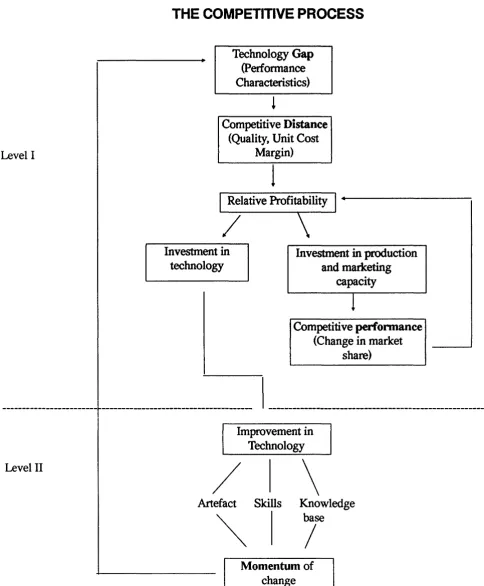
innovations; the resources available to do so; and, the incentives to advance technol-ogy. Ultimately maintaining competitive advantage depends on being more creative than ones rivals. Figure 1 provides an outline sketch of the principle elements involved.
It distinguishes two levels of competition, in terms of artefacts in the market place (level
Levell
[image:29.583.48.532.124.710.2]Level II
Figure 1
THE COMPETITIVE PROCESS
Technology
Gap(Performance Characteristics)
1
Competitive Distance (Quality, Unit Cost
Margin)
/
Investment in
technology
1
Investment in production
and marketing capacity
Competitive perfonnance (Change in market
share)
Improvement in
Technology
/
Artefact Skills
~
\
Knowledge
base
I
I
. Momentum of changeAs far as technological opportunity is concerned a great deal depends on the de-sign configuration that underpins a particular transformation process. Technology is not infinitely malleable, rather the set of concepts, theories and facts which underpin a transformation process shapes and limits the kinds of improvements in technology which can be imagined and brought into effect Design configurations limit ultimate performance of a technology and a firm which uses a design configuration of an
infe-rior kind is ultimately doomed to loose competitive advantage. It is only rarely the
case that firms operating one design configuration make a successful transition to a competing and superior one. Quite small differences in configuration may constitute
insuperable barriers to technology transfer. 19 Thus, over the long term the
oppor-tunities to innovate are not spread equally across technologies; the firm with luck or foresight is the one which happens to work with the configuration which has the greater performance potential.
Opportunity is only one element in the picture, for innovation is a resource intens-ive process and the resources which firms can devote to formal and informal R&D are crucial in turning potential into actual performance. Notice that R&D statistics
are often an imperfect indicator of the true volume of resources devoted to
enhanc-ing a finn's technology. Not only the resources devoted to R&D but the ability to
manage the R&D process are crucial here. Innovation is a question of resources and resourcefulness the key insight may save a considerable degree of R&D effort. One cannot predict how creative ability will vary across individual research and de-velopment employers although it may be the case that the bigger the overall research spend the greater the expectation of competition enhancing innovations. Here we see one of the elements of cumulative causation. Firms with a high market share
(cet.par) enjoy higher aggregate profits and have more resources to devote to R&D thus increasing their chances of gaining further competitive advantage. Moreover they can cross subsidize R&D in one business unit from profits earned in other busi-ness units. That large firms do not dominate the innovation process, particularly with regard to radical innovations, is a reflection that resources alone are not always enough.
To sum up competitive advantage has two dimensions: at a moment in time and over time. At a moment in time it is measured by those dimensions which indicate
enhanced product quality or lower cost of production. Over time it is measured by
the firms creativity in enhancing the corresponding dimensions of performance.
It is immediately apparent that a variety of technology policies may be directed to-wards the enhancement of competitive advantage in single firms or groups of firms. . Br<;>adly speaking they can be divided into policies aimed at improving artefacts (or more precisely the performance chamcteristics of a transformation process), at im-proving skills, and at imim-proving the underpinning knowledge base. These policies may involve directing R&D resources to firms or ensuring that finns link more effec-tively into the higher education and other R&D institutions in a nation. Policies may also treat firms in isolation or be collaborative ·in nature. Whatever the pattern the proxititate test of their success is how they improve the transformation process to en-hance competitive advantage.
3.5 Competitive Consequences
Thus far we have focused attention on the measurement of competitive advantage in terms of product quality and unit cost recognising that each of these can be ex-pressed in terms of many partial indicators of competitive advantage. We now have to explain what difference competitive advantage makes to competitive performance, for unless there is a clear mechanism linking the two then any definition or measure of competitive advantage amounts to very little.
We begin with one of the key points made in the introduction, that competition is a dynamic process and that it is concerned with the changing relative importance of different transformation processes. After all, this is what market mechanisms do when they work effectively. Products which users prefer and products which are pro-duced relatively cheaply are selected for, over time, they account for an increasing proportion of total sales in a market Thus competition as a process entails changes in the relative economic weight of competing transformation processes. It is from this perspective a multi-technology diffusion process. What we have to establish is that this process is linked directly to differences in competitive advantage as treated above.
The first point to note is that competitiveness is a relative concept. To talk of the competitiveness of a business unit in isolation is meaningless, any indicator which fo-cuses on a single business or product is without content. To say, for example, that a business is competitive because it earned X% on its capital is an empty statement All statements of competitiveness are comparative and involve the pair wise com pari-sons of competing businesses, or the comparison of a single business with some ag-gregate of its competitors. Thus competitiveness is a chain relationship, a given business may be competitive against one firm and uncompetitive relative to another.
In broader comparisons one ca11 compare a busu1~.ss wun tne aver; ge of 1ts nvals in
a particular market context to assess its competttive advantage. What then follows from a knowledge of the finn's post bon 111 this cham?
One might expect first that competitive advantage would be reflected in the mar-ket share of a business, the marmar-ket betng 1dentu,_ed (~tb.,lallv With dtffietJ.lty one should add) in terms of all those bt&.stnesses selltng produ~1:s wrucl1 are used for the same purpose by an identified group of customers. But in leading us to the position that a more competitive business is one with a relatively high market share this is clearly misleading. Market share is a static measure. At best, share of market is a re-flection of past competitive performance, what we need is an appropriate dynamic measure. However, when we turn to the change in market share over a given time period matters are immediately more clear cut, and the following definitions suggest themselves:
• a business is more competitive than its rival if its market share over a given period is increasing more quickly than that of its rival;
• two businesses are equally competitive if their market shares are changing at the same rate.
More generally we can say that a finn is competitive if its market share is increas-ing and uncompetitive if its market share is declinincreas-ing.
H
its market share is constant then it has neither competitive advantage nor disadvantage. Notice carefully that while the change in market share is the measure of competitiveness this does not rule out the possibility that competition advantage depends on the level of market share, through factors such as scale effects. We simply emphasise that because competitive-ness is a process, the measures of competitive outcomes must be based on the meas-urement of change.These definitions require a little more explanation. Naturally they depend on the length of time period chosen for the comparison, a period which eliminates short term market noise and the general effects of the trade cycle is desirable. What this
period is will vary from one market context to another and depends in part on the frequency with which consumers make competition choices between rival products.
In some markets choices are made continuously and the time period for defining changes in market share will be short. In others, e.g. defence capital equipment choices are made at infrequent intervals and the corresponding time period must be
drasti-e;aHy but unle&s it has the <..apa(.;Jty a.o ~upply tr.e erealbr market this will not be a
sus-tainable strategy. In ar1y p114c-tical ~hu~tion ttte 1df-nttftcation of the relevant market
may present considerable cttaHtnges, espeually m periods of rapid technological change. These quahfil:attons apart, the tn1pon.ant point about the change in market share cntenon is that u ca.ptures the oynarntcs ot change, in a simple yet powerful way. How ts the change 1n rnarket share crH~cton related to the measurement of
com-pel1ltve advantage?
Again \Ve are faced w1th the tnherent complex tty of the concept of competition
and we have to step back to the underlying elementary, fundamental market pro-cesses.
Cunstder a bustness whose rnarket share tS increa~tng steacWy over time. We can
(teat dus from two ctrtgit:s, growth m rr.arke( dernand and expansion of the capacity
to supply the product in question. On the demand side the price of the product and its quality relative to rivals must be such that consumers are switching towards this product, more and rnore users accept it and reject other products when making their
purch&Mng df-A;.tSiOflS Ufl th.e ~uppiy Stele the t1rrn rrtUSt be ab1e to vahdate the
in-Cft,asmg dt:-mand wtth an eApandtrtg rate of production, That is the pnce must be
such relatl ve to the urut cost of production to induce the required rate of expansion and provide the flow of investment funds which is required so to do. A higher price relative to rivals would mean a higher rate of capacity expansion and a lower rate of demand growth, and conversely for a lower price. When the market overall is not de-clining over time the forces of competition lead to a rather obvious result, namely that businesses maintain a rough balance between the size of their market and the ca-pacity to supply it. Competition in declining markets, where there is systematic ex-cess capacity, raises some interesting problems but this is rarely the situation found in technologically intensive industries. The upshot of all this is that the quality of the products a firm supplies and its cost of production taken relative to the average of those of its rivals, determines its profitability and whether its market share is in-creasing or declining over the relevant time period.
The relation with competitive advantage becomes clear if we take a case in which all the businesses would grow at the same rate if they enjoyed the same profitability cum rate of return on invested capital. Differences in growth are traceable directly to differences in profitability. This is a special case but it leads to an important result. Namely a business which is increasing its overall market share must have a positive competitive advantage relative to the average for its rivals, where competitive advant-age is measured in terms of a combined index of product quality and unit cost of pro-duction. Competitive advantage translates directly into increases in the economic
importance of that business in the market place. Correspondingly for the finn with declining market share. It follows that a firm whose market share is constant has neither competitive advantages nor disadvantages on average relative to its rivals. It is at an advantage relative to some and at a disadvantage relative to others in the chain but overall these positive and negative effects wash out
This base case is instructive for it provides us with the conditions under which
changes in market share are related to competive advantage in the way we would
ex-pect, that is, firms with advantages improve their market position over time. A better quality product attracts demand and increases profitability, so that output can grow faster and market share increase. Similarly, a lower cost of production enables price
to be lower to attract demand and profitability to be greater so that capacity can
in-crease. Either way the causation is the same: from competitive advantage to profita-bility to changes in market share, that is, changes in the relative position of a
business in the market place. The crucial point to emphasise is that it is the
dif-ferences betw~inns in product quality and unit cost which drive this dynamic
pro-cess. So far the argument has hinged on all the competitors having a common
propensity to expand. If this is not so and the propensity to expand is positively
correlated with profitab~ty, an outcome which might be imposed by an efficient
capital market, this would reinforce the link between competitive advantage and changes in market share. Indeed the operation of the capital market is central to the dynamics of the competitive process. To sum up, the competitive consequences of a firm's competitive advantages depend crucially upon the working of several aspects of the market mechanism. There is no simple link between competitive advantage as conventionally understood and the dynamics of the competitive process. Thus a tech-nology policy aimed at enhancing competitive advantages may be successful on its own terms and yet not have the desired effect in tenns of wealth creation because the
competitive process is distorted in some other directions. This leads us to a general
proposition of some importance. The returns to technology policy are enhanced the more other policies ensure undistorted product markets which choose fairly and effi-ciently between the products of rival producers, undistorted factor markets which are free of localised imperfections, and undistorted capital markets which distribute pro-portionately more resources to finns with greater competitive advantages, that is, firms which are intrinsically more profitable.
3.6 The National Picture
One advantage of the dynamic approach is that it aggregates readily to the
changes in the balance of trade of competing nations.
The analogue to market share for a nation as a whole is the share of the world's wealth generating capacity (industry by industry or for national productive activity as a whole) located within its borders. The difference between this and the share of world consumption of the same products taken by its population translates directly into its balance of payments (trade account) when the latter is expressed as fraction of its domestic production. A payments deficit occurs when a nation's share in world consumption exceeds its share in world production, and conversely for a surplus. But like the ~ket share level of the previous section the balance of payments indi-cates nothing about current competitiveness, it is at most a cumulated reflection of past competitiveness. However, the current change in the balance of payments yields a different story. Notice first that the overall share of a nation in world con-sumption is likely to change relatively slowly under the influence of relative popula-tion and per capita income
growth.
Even at the industry level it is likely to be relatively sluggish. However, the same is not true for shares in world production which empirically can be seen to change substantially in a short space of time. Any reduction in the share of world production is matched by a decline in the trade bal-:-. ance ratio and it is this decline which is indicative of lack of competitive advantage in international markets. Conversely a rising production share produces an increase in the trade balance ratio. Thus it is not the sign and magnitude of the trade balance ratio which reflects national competitive advantage but rather the sign and magni-tude of thechange
inthe trade balance ratio.
Given the consequence of enhanced national competitiveness is an enhanced share of world productive activity, the linkbetween national competitiveness and national competitive advantage follows exactly the line suggested above. Competitive advantage, measured in this case relative to world average performance, produces a rising share of world production given that the competing nations have equivalent propensities to invest in the capac-ity to produce.
Of course this leaves unsaid a great deal about the multiplicity of factors which determine natural differences in competitive advantage and the policies which may influence these differences. Without in any way attempting to be exhaustive, the fol-lowing classification may nonetheless be useful. At a general level are policies which determine the national environment faced by all firms without any intended bias between industries and firms. The exchange rate, taxation, industrial relations, public support of education and scientific research would be typical 'climate setting' policies. Clearly they influence the profitability of domestic production and to this extent repel or attract flows of overseas investment. Such policies also impinge
di-rectly on the efficiency of market selection mechanisms, particularly with respect to resource mobility and the efficiency of the capital market. At a second level,
\.
policies may be targeted at particular groups of firms (not always coterminous with a single industry) with the aim of enhancing the competitiveness of the group. Sup-port of collaborative research is a good example of a group supSup-port policy which ex-tends to users and producers of a particular set of technologies. Such policies may
be further subdivided into those which influence the rate of experimentation in new
technology and those which influence the diffusion of new technology by encoura-ging growth in production and application. At a third level are policies which target the performance of individual firms and business units, as with specific R&D sub-sidies.
It has not been our intention to provide a full taxonomy of policy but we consider the following distinction between levels and purposes shown in Thble 2 is worthy of further elaboration. It will be clear that the precise policy instruments employed need to be sensitive to the distinction between levels and forces drawn here. Indeed this provides the convenient stage to make a transition to the third section of this paper, when we treat the more practical aspects of competitiveness and evaluation.
Table2
Focus Level
Business Unit/Firm Industrial Group Nation
Rate of innovative R&D subsidy Collalxntive Support foc
experimentation programme training and
research
Rate of selection in Information Exchange rate/
market dissemination policy in control of inflation