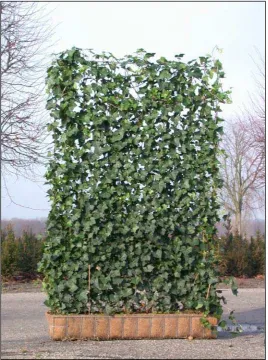
White Rose Research Online URL for this paper:
http://eprints.whiterose.ac.uk/102682/
Version: Accepted Version
Article:
Cameron, R.W. orcid.org/0000-0002-7786-0581 and Blanusa, T. (2016) Green
Infrastructure and Ecosystem Services – Is the Devil in the Detail? Annals of Botany. ISSN
0305-7364
https://doi.org/10.1093/aob/mcw129
This is a pre-copyedited, author-produced PDF of an article accepted for publication in
Annals of Botany following peer review. The version of record [Ross W. F. Cameron and
Tijana Blanuša Green infrastructure and ecosystem services – is the devil in the detail?
Ann Bot] is available online at:
http://aob.oxfordjournals.org/content/early/2016/07/19/aob.mcw129
[email protected] https://eprints.whiterose.ac.uk/ Reuse
Unless indicated otherwise, fulltext items are protected by copyright with all rights reserved. The copyright exception in section 29 of the Copyright, Designs and Patents Act 1988 allows the making of a single copy solely for the purpose of non-commercial research or private study within the limits of fair dealing. The publisher or other rights-holder may allow further reproduction and re-use of this version - refer to the White Rose Research Online record for this item. Where records identify the publisher as the copyright holder, users can verify any specific terms of use on the publisher’s website.
Takedown
If you consider content in White Rose Research Online to be in breach of UK law, please notify us by
1 VIEWPOINT PAPER
1 2
Green Infrastructure and Ecosystem Services – Is the Devil in the Detail?
34
Ross W.F. Cameron1*† and Tijana Blanuša2,3†
5 6
1
Department of Landscape, University of Sheffield, S10 2TN, UK
7
2
School of Agriculture, Policy and Development, University of Reading, RG6 6AR, UK
8
3
Royal Horticultural Society, Plant Sciences Department, Garden Wisley, Woking GU23
9
6QB, UK
10
*For correspondence: [email protected]
11
†
Joint first authors
2 Abstract
1
Background - Green infrastructure is a strategic network of green spaces designed to deliver
2
ecosystem services to human communities. Green infrastructure is a convenient concept for 3
urban policy makers, but the term is used too-generically and with limited understanding of 4
the relative values or benefits of different types of green space and how these complement 5
one another. At a finer scale/more practical level– little consideration is given to the 6
composition of the plant-communities, yet this is what ultimately defines extent of service 7
provision. This paper calls for greater attention to be paid to urban plantings with respect to 8
ecosystem service delivery and for plant science to engage more-fully in identifying those 9
plants that promote various services. 10
11
Scope - Many urban plantings are designed based on aesthetics alone, with limited thought on
12
how plant choice/composition provides other ecosystem services. Research is beginning to 13
demonstrate, however, that landscape plants provide a range of important services, such as 14
helping mitigate floods and alleviating heat islands, but that not all species are equally 15
effective. The paper reviews a number of important services and demonstrates how genotype 16
choice radically affects service delivery. 17
18
Conclusions – Although research is in its infancy, data is being generated that relates plant
19
traits to specific services; thereby helping identify genotypes that optimise service delivery. 20
The urban environment, however, will become exceedingly bland if future planting is simply 21
restricted to monocultures of a few ‘functional’ genotypes. Therefore, further information is 22
required on how to design plant communities where the plants identified:- a/ provide more 23
than a single benefit (multi-functionality) b/ complement each other in maximising the range 24
3 through diversity. The identification/development of functional landscape plants is an
1
exciting and potentially high impact arena for plant science. 2
3
Key words: alien plants, biodiversity, building energy-efficiency, carbon sequestration, 4
ecosystem services, green infrastructure, human health and well-being, policy, pollution, 5
storm-water management, temperature regulation, urban. 6
4 INTRODUCTION
1 2
What is green infrastructure?
3
Green infrastructure (GI) is a term that was coined to provide an antonym to grey 4
infrastructure (Benedict and McMahon, 2012). Grey infrastructure is the built components of 5
cities including buildings, roads, pavements, sewers and other structural utilities. Green 6
infrastructure is meant to spatially complement grey infrastructure and at the same time 7
counterbalance some of the negative effects associated with grey infrastructure. Natural 8
England in the UK (Anon, 2009) define green infrastructure as: 9
‘A strategically planned and delivered network comprising the broadest range of high quality 10
green spaces and other environmental features. It should be designed and managed as a 11
multifunctional resource capable of delivering those ecological services and quality of life 12
benefits required by the communities it serves and needed to underpin sustainability. Its 13
design and management should also respect and enhance the character and distinctiveness of 14
an area with regard to habitats and landscape types’. 15
Green infrastructure is composed of a range of green landscape typologies, including 16
parks, nature reserves, street trees, gardens, river corridors, ponds, green roofs and walls, 17
farmed land and allotments etc. as well as linking elements such as the ‘green corridors’ 18
found alongside roadways and railway lines [NB water features themselves are sometimes 19
referred to as components of ‘blue infrastructure’]. Although ‘green infrastructure’ is a very 20
convenient concept to describe an urban green network, the term is used by policy makers all 21
too generically with little understanding of the balance and interlinking of the different 22
typologies (or indeed their different ‘values’ in terms of ecosystem service (ES) delivery). 23
Mel (2008) raised concerns that any underestimation of the complexity of green spaces 24
5 function. In practical terms, GI is now seen by most city planners as a necessary requirement, 1
but what actually populates these greenspaces that are ‘blocked out’ between the buildings is 2
often given inadequate attention (Matthews et al., 2015). Furthermore, implementing new, or
3
improving existing green space is hampered by financial constraints, limited expertise, a lack 4
of tools to value the different green space types as well as a lack of comprehension of how 5
landscape typology affects service provision (Sandström et al., 2006; De Groot et al., 2010;
6
Hunter and Luck, 2015). At a finer scale – i.e. at a plant or plant-community level, frequently 7
little consideration is given to the composition of these spaces and rarely in terms of the 8
benefits that might be conferred other than purely aesthetics. Even in relatively detailed 9
policy documents such as the European Commission’s ‘Building a Green Infrastructure for 10
Europe’ (EU, 2013) only one plant species is mentioned in relation to its ES delivery; namely 11
the value of the seagrass Cymodocea nodosa to support fishing stocks. Likewise, in a
12
comprehensive review on ‘The Multifunctionality of Green Infrastructure’ (EU, 2012), there 13
is no mention of any specific plant species within the 37 page report; although both these 14
reports begin to acknowledge that different typologies (habitats) provide distinctive ES. 15
As stated in the definition above, GI should be designed and managed to accentuate 16
the ESs and quality of life benefits to human society. These ecosystem ‘services’ are 17
normally defined as 1/ supporting (e.g. soil formation, photosynthesis, primary production, 18
nutrient and water cycling); 2/ provisioning (e.g. food, fibre, fuel, fresh water, genetic 19
resources, natural pharmaceuticals and chemicals); 3/ regulating (ecosystem processes 20
including regulation of air and water quality, climate, pests and disease) and 4/ cultural 21
(including cognitive development, spiritual enrichment, recreation and aesthetic experiences) 22
(Anon, 2005). There are a number of instances where these services are well understood, and 23
in a botanical context where the ‘suppliers’ are readily identified, e.g. in the provision of food 24
6 additional cases, however, where optimum service provision is difficult to articulate in terms 1
of plant genotypes. This is where the plant scientist can play an important role, both in 2
defining more precisely the benefits of GI and in determining how these are dictated by 3
genotype choice; the level of service delivery being determined by the selection of 4
appropriate plant species, but also within a horticultural context, by cultivar choice within a 5
species. 6
7
The Urban Context
8
In an urban GI context, plant genotype choice is very much determined historically by 9
aesthetics (private gardens), cultural symbolism (civic squares), ecological suitability and 10
niche opportunities (wasteland or ‘brownfield’ sites) and functionality in relation to food 11
(allotments, vegetable plots and orchards). We have some notion of what plant genotypes 12
inhabit or could be used to populate these ‘spaces’ in terms of their suitability for certain 13
environmental conditions and soils types. The issue of plant selection becomes much more 14
difficult however, when GI is designed around wider human needs, for example to: 15
• regulate urban air temperature, noise and atmospheric pollution; 16
• intercept rainfall, reduce storm water run-off and mitigate flash flooding; 17
• maximise the thermal insulation of buildings and thus reduce energy consumption. 18
Even when a role for plants per se has been recognised in such situations, the choice of
19
genotype has been seen as largely irrelevant up to now. But should this be the case? Do all 20
plants respond in a similar way, have comparable functional traits or provide broadly the 21
same level of ecosystem service? 22
23
7 Research has been carried out over the last few years, largely driven by these questions. 1
These research programmes have not only attempted to better quantify the extent to which 2
plants contribute to certain ‘urban’ ESs (e.g. Tzoulas et al., 2007; Cameron et al., 2012;
3
Gómez-Baggethun and Barton, 2013) but also to begin to identify genotypes that optimise the 4
desired service provision (e.g. Freer-Smith et al., 2005; Blanusa et al., 2013). However, only
5
a small fraction of the potentially useful genotypes have been studied so far, and further 6
evaluations are required to furnish policy makers with more comprehensive and accurate lists 7
of beneficial plants. The urban environment, however, will become a bland place indeed, if 8
planting is limited to simply a few ‘functional’ genotypes placed strategically at relevant 9
locations. Information is thus required on how to design entire plant communities where the 10
plants identified:- a/ provide more than a single benefit (multi-functionality) and b/ 11
complement each other in terms of maximising the range of benefits that can be delivered in 12
the one locale. Such concepts are not new in urban horticulture. Plants have been chosen to 13
provide a range of complementary flower colours to appeal to human aesthetics, for example 14
pastel blues harmonising with pale pink in an Edwardian flower border (Bisgrove, 2013). The 15
difference now is that these plant communities should not only be visually appealing, but also 16
enhance the functionality of the site. A case in point, a city-centre roadside planting may need 17
to be designed in future to: provide nectar and pollen for native invertebrates, act as a filter to 18
remove particulate matter emitted by passing vehicles, provide localised cooling through 19
shading and evapotranspiration, and help relieve psychophysiological stress experienced by 20
pedestrians as they walk along the road, as well as be deemed aesthetically pleasing in its 21
own right. Not only this, but this plant community may need to be resilient enough to tolerate 22
periods of sub-optimal irrigation, high aerial temperatures in summer and the effects of de-23
icing salts applied in winter. To date, little information exists to provide the appropriate plant 24
8 Research in this context is not solely focussed on identifying plants for future use. It is 1
also important in understanding the extent to which existing popular cultivars and their ES 2
delivery are vulnerable to abiotic, biotic and even societal change. For example, for a cultivar 3
that is currently dominant in the landscape and which provides a specific positive service, 4
then a change in popularity either to a different species or even just a different clonal form, 5
may alter the delivery of that service. As an illustration, the replacement of golden/light green 6
foliage conifers commonly placed in garden hedges (e.g. × Cuprocyparis leylandii
7
'Castlewellan Gold' or Cupressus macrocarpa 'Goldcrest') with cultivars possessing darker
8
foliage is likely to reduce the albedo of the hedges, and increase the amount of solar energy 9
absorbed in that location/neighbourhood. Even subtle changes in cultivar abundance due to 10
e.g. fashion, might change the service delivery level that a given species confers. 11
12
Urban Services – Old and New
13
For certain services, differences in genotype have been evident over many decades largely 14
through anecdotal observations. The identification of plants specifically to aid wildlife 15
conservation falls into this category. Only since the concept of ESs has become mainstream, 16
however, has the full service potential of urban plants been more widely investigated 17
(Cameron and Hitchmough, 2016). For a number of these more recently-defined services, 18
evidence is now also beginning to build as to the extent to which plant choice matters. A 19
range of service areas are highlighted below, with evidence of how genotype choice can 20
affect the level of service delivery. 21
22
HOW MUCH DOES GENOTYPE CHOICE MATTER? 23
1. Urban biodiversity
9 Plant choice is often determined by a genotype’s ability to support certain fauna taxa or 1
guilds. Paradoxically, this does not result in simply recommending native plant species, but 2
potentially also utilising non-native (alien) species to support native fauna; a point that has 3
caused much debate around the relative merits/risks associated with planting non-native 4
species in an urban environment (Shackelford et al., 2013; Standish et al., 2013). As an
5
example, the Asiatic shrub Buddleia davidii has long been valued by UK gardeners for its
6
ability to provide nectar to native Lepidoptera species (Hardy and Dennis, 2008); being
7
considered more effective in this respect than any native shrub during mid-late summer (a 8
consequence of which the species’ common name is ‘butterfly bush’). Recent systematic 9
studies support the notion that native is not always best. Helden et al. (2012) ranked both UK
10
native and non-native tree species for their value in supporting phytofagus invertebrates and 11
their associated avian predators. The results demonstrated that not all native trees are 12
necessarily superior in providing habitat/food resource compared to non-natives, e.g. natives 13
such as Corylus avellana and Sorbus aucuparia host fewer Hemiptera (true bugs) than
non-14
native Sorbus intermedia or Quercus rubra. Although there are genuine concerns that some
15
non-native plants are invasive and cause radical reductions in native flora and fauna (Alpert 16
et al., 2000), there are situations where introduced alien species have restored services that
17
were previously lost after the elimination of the dominant native species. In California, for 18
example, stands of non-native Eucalyptus globulus provide habitat that is equally rich in
19
understorey plants, leaf litter invertebrates, amphibians and birds as the native Quercus
20
agrifolia/Umbellularia californica dominated forests (Sax, 2002). Species composition varies
21
between the two woodland types, but overall richness does not. Other conservation-based 22
services that non-native plants provide include: nesting/feeding habitat for birds (Chen 2001; 23
Berens et al., 2008; Sogge et al., 2008; Bajema et al., 2009; ) refuge habitat for rare
10 invertebrates (Chiba, 2010) and acting as ‘nurse crops’ to allow more effective establishment 1
of native vegetation (Lugo, 2004, Sullivan et al., 2007).
2
As with Buddleia, many non-native plant species are encouraged because they supply
3
nectar and pollen to pollinating insects, such a bees and hoverflies, although concerns have 4
been raised about how this impacts on pollination rates within native plant species due to 5
increased competition and cross pollination (Bjerkness et al., 2007). Certain key factors
6
determine the value of non-native plants to native invertebrates, including the ability to 7
access nectar or pollen and the volume of nectar available (Potts et al., 2003; Carvalheiro et
8
al., 2014). Inter-relationships are often prevalent if the plant is from the same biogeographical
9
region, albeit not the same country (so called ‘near natives’), as there may have been some 10
co-evolution in the past with the native insects, or closely-related species. For example in UK 11
gardens, plants native to nearby European countries, North America and northern Asia (i.e. 12
the Holarctic ecozone) may be particularly beneficial to the native insects, as their 13
evolutionary histories have overlap (Goulson et al., 2008; Salisbury et al., 2015). So Salvia
14
nemorosa with a natural distribution within central Europe, when planted in the UK offers a
15
similar service to pollinators as the native Salvia pratensis (Carreck et al., 1997; Anon,
16
2013a). Another factor affecting the value of non-native plants as a food source relates to the 17
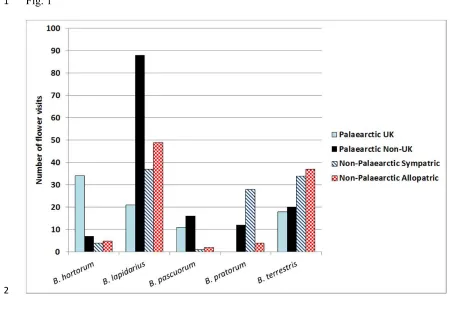
feeding behaviour of the insects themselves. In bumble bees, species with catholic 18
(polylectic) diets, such as Bombus pratorum and B. terrestris actually favour plants out-with
19
their biogeographical range, whereas those that are more specialist feeders e.g. B. hortorum
20
and B. pascuorum are more reliant on native or near-native plants (i.e. from the Palaearctic
21
ecozone) (Fig. 1)(Hanley et al., 2014).
22
Irrespective of these factors around evolutionary overlap or feeding strategies there 23
can be remarkable differences in flower attractiveness based on cultivated forms even within 24
the same plant species. Garbuzov and Ratnieks (2015) recorded that within aster, Aster
11
belgii the cultivars ‘Alice Haslam’ and‘Dandy’ had 15.2 and 10.1 insects visits m-2 of plant
1
cover respectively, compared to no visits in the morphologically similar cultivars ‘Sheena’ or 2
‘White Wings’. Similar large variations were recorded across cultivars of Lavandula
3
(Garbuzov and Ratnieks, 2014). In essence, either relatively small morphological differences, 4
or more fundamental (but less obvious) physiological differences (e.g. carbohydrate form and 5
concentration in the nectar) are determining whether a genotype is a useful service provider 6
or not. 7
8
2. Local temperature regulation
9
Vegetation provides a localised cooling service through i. shading land and built surfaces 10
from solar irradiance, ii. evapotranspiration, with solar energy being converted to latent heat 11
(thus avoiding a rise in leaf and surrounding air temperatures), iii. transforming a small 12
proportion of thermal energy to chemical energy via photosynthesis and iv. an albedo effect,
13
reflecting incoming solar energy back to the atmosphere thereby reducing the potential for 14
short wave irradiance to be converted to long wave infra-red wavelengths (i.e. heat) at ground 15
level. Species vary in their ability to interact with solar irradiance, and hence the capacity to 16
cool their immediate locality. Street and park trees are highly-valued, especially in the 17
tropics, for their ability to cool ground surfaces and the surrounding air, although the extent 18
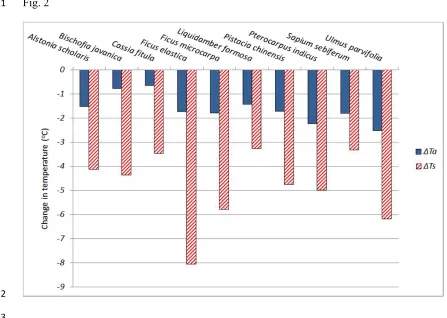
of cooling is radically altered by the characteristics of the chosen tree (Fig. 2). Lin and Lin 19
(2010) demonstrated that those species typified by dense canopies (high leaf area indices – 20
LAI) and thick leaves (e.g. Ficus elastica) were effective at cooling the soil surface, whereas
21
lightly-coloured foliar species such as Ulmus parvifolia and Pterocarpus indicus were better
22
placed to directly cool the air below the canopy. Within parks, correlations between tree 23
canopy cover and reductions in air temperature have been noted in Ethiopia (0.2oC cooler for
24
every 10% increment in cover). Groves of trees dominated by Eucalyptus (E. grandis, E.
12
camaldulensis and E. globulus) showed greatest temperature reductions followed by stands of
1
Olea (O. europaea and O. capensis) while populations of Grevillearobusta and Cupressus
2
lusitanica were less effective at cooling (Feyisa et al., 2014). In warm, arid climates where
3
stomatal conductance (gs) is frequently suppressed during the hottest periods of the day as an
4
adaptation to conserve water, shade cooling may be a more critical factor in aiding human 5
thermal comfort (Shashua-Bar et al., 2010; Feyisa et al., 2014).
6
Even in temperate climates such as the UK, greater attention is being paid to 7
understanding and adopting those tree species that provide greater street cooling. 8
Investigations into the influence of evapotranspirational cooling (Rahman et al., 2015)
9
showed that the more rapid growing species tended to have greatest gs and thus enhanced
10
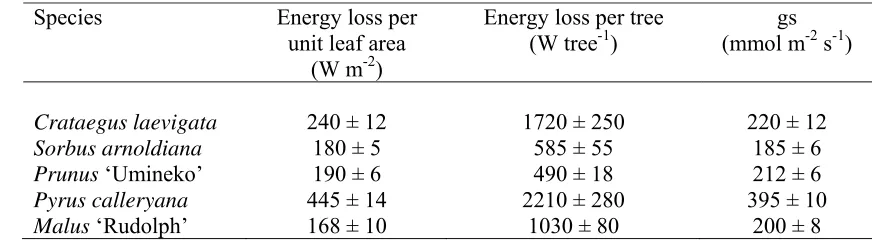
cooling capacity (Table 1). Indeed genotypes that combined high gs with wide canopies and
11
high LAI such as Pyrus calleryana and Crataegus laevigata provided 3 to 4 times more
12
cooling than alternatives such as Sorbus arnoldiana and Prunus ‘Umineko’. These latter
13
genotypes showing some susceptibility to urban stress, a possible cause of relatively low gs
14
values. The red-leaved Malus ‘Rudolph’was tolerant of urban conditions, but also provided
15
low cooling potential. This may relate to colour affecting the energy balance of the leaf, or 16
that leaves with an atypical colour often correspond to lower gs; Vaz Monteiro et al., (2016)
17
found this to be so in Heuchera cultivars where the red/purple leaved Heuchera ‘Obsidian’
18
has lower gs and higher leaf temperatures than cultivars with green or gold/yellow foliage.
19
Smaller scales of ‘green intervention’ are also used to promote local cooling, 20
particularly on or around buildings. Most green roof systems utilise Sedum spp.due to their
21
tolerance of shallow substrates and drought stress. Recent research, however, showed that 22
these are not the best species to employ if cooling is the over-arching priority (Blanusa et al.,
23
2013; Vaz Monteiro et al., 2016). Rather, species with light-coloured, non-succulent, leaf
24
canopies were superior in their cooling capacities to that of Sedum, due to a combination of
13 higher values for transpiration, LAI and latent heat loss, and lower values for both sensible 1
and soil heat transfer. Indeed, species choice alone could result in 2, 3 and 5 fold differences 2
in latent, sensible and soil heat fluxes, respectively. As with trees, short stature shrubs (e.g. 3
Salvia officinalis and Stachys byzantina) which possess traits including high LAI, high
4
evapotranspiration rate and light-coloured, silvery or hirsute leaves appear most effective at 5
cooling. 6
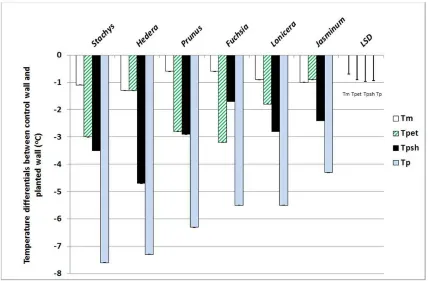
Stachys was also shown to provide >7.0oC cooling effect on a green wall system
7
(comparable to the common evergreen climber Hedera helix). By blocking stomatal and
8
cuticular water loss with poly (1-acetyloxiethylene) sealant in a proportion of the plants, the 9
relative cooling effects of shading and evapotranspiration could be calculated. Data indicating 10
that Hedera reduced temperature largely through shading, whereas both shading and
11
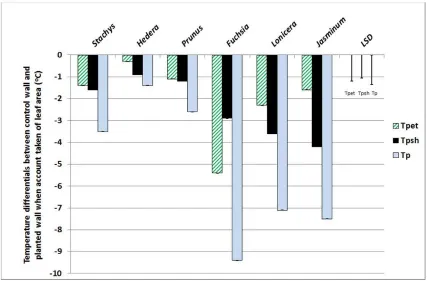
evapotranspiration were key factors in the cooling conferred by Stachys (Fig 3). When
12
evaluated on a per leaf area basis, these species were out-performed, however, by Fuchsia,
13
Jasminum and Lonicera (Fig 4). Again, the mechanisms by which the cooling was conferred
14
varied markedly between species (Cameron et al., 2014). Fuchsia promoted
15
evapotranspirational cooling, whereas shade cooling was more important in Jasminum and
16
Lonicera. This variation in mechanisms is important to recognise, because specific
17
manipulation of a given species can further enhance the desired traits, for example, the 18
effectiveness of individual leaves can be influenced through careful training of the stems. In 19
species that confer cooling via shade, attaining multiple layers of leaves which maximise light
20
interception is the objective. Conversely, with species that cool via evapotranspiration then
21
providing a single layer of evenly-spaced leaves may be the priority in an attempt to optimise
22
moisture transfer from the leaves to the surrounding atmosphere. 23
24
3. Energy conservation
14 The cooling ability of plants in summer and their ability to insulate buildings in winter not 1
only impact on human thermal comfort, but also energy conservation and economics. Akbari 2
et al. (2001) estimated that increasing the urban forest within the USA would reduce national
3
energy use by 20% and save over $10B p.a. through reduced reliance on artificial air 4
conditioning and improvements in air quality. Using tree belts to protect buildings from cold 5
wind helps entrap warm air around the building fabric and reduces energy loss by conduction 6
and convection of heat from the interior of the building. Models indicated shelter from trees 7
reduced winter energy consumption in Scottish buildings by 17% (Lui and Harris, 2008). An 8
empirical study using replicated heated brick cuboids, showed that placing a green façade 9
around the structures reduced mean winter energy use by 38% (and under some severe 10
weather conditions improved savings up to 45%)(Cameron et al., 2015). Subsequent studies
11
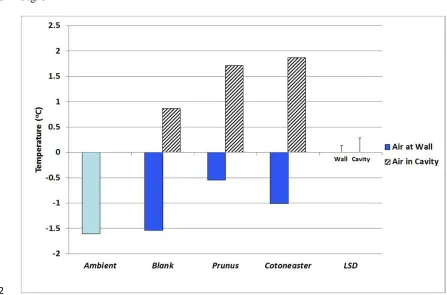
indicated that thicker-leaved Prunus laurocerasus improved air temperature at a wall surface
12
during cold nights, compared to smaller-leaved, less-densely foliated Cotoneaster franchetti.
13
Yet the latter species was overall the more beneficial as it enhanced the temperature within 14
the wall cavity, due to it allowing more solar heat gain onto the wall during the daylight hours 15
than the Prunus, whilst also conferring some insulation effect at night (Fig. 5).
16 17
4. Storm-water retention
18
Vegetation plays a key role in capturing, retaining and detaining precipitation, and if 19
placed/designed in harmony with hydrological flow pathways mitigates storm-water flooding. 20
Selection and age of park/street trees affect the ability to capture rainfall and store it on 21
leaves, stems and bark (Xiao and McPherson, 2002). Due to its greater canopy and leaf size 22
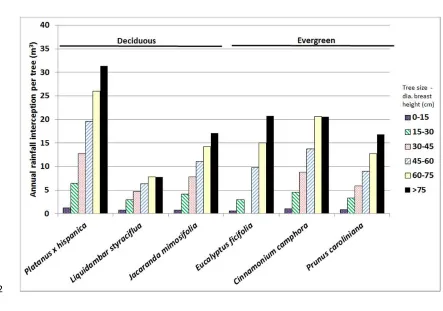
and more extensive branch structure Platanus x hispanica retains a greater volume of
23
rainwater than e.g. Liquidamber styraciflua (Fig. 6). ‘Fine–textured’ canopies, as promoted
24
by the numerous needles in evergreen conifer species e.g. Pinus strobus are very effective at
15 holding moisture within the tree canopy too. Similarly, species possessing rough bark with 1
many grooves and fissures (e.g. Quercus rubra) hold more water than equivalent
smooth-2
barked species (e.g. Betula lenta). For a 300 mm diameter tree, normative bark water storage
3
capacities ranged from approximately 100 l for B. lenta to 250 l for Q. rubra (Levia and
4
Herwitz, 2005). 5
For green roofs, storm water management too is influenced by plant selection 6
(Lundholm et al., 2010; Schroll et al., 2011). Nagase and Dunnett, (2012) indicated water
7
retention was improved by using grasses and forbs rather than succulents, largely due to 8
structural differences As much of the water retained on a green roof is held within the pore 9
structure of the substrate (VanWoert et al., 2005), however, the ability to remove this existing
10
water via evapotranspiration (i.e. re-charge the storage capacity) before the next storm event 11
is also critical. Plant choice is also important here, as by deploying genotypes with high 12
transpiration rates the substrate can be dried quickly and the storage capacity restored over a 13
relatively short timeframe (Kemp pers. comm.). 14
15
5. Carbon sequestration
16
Using biomass as a predictor of carbon levels within urban trees, McPherson and Simpson 17
(1999) indicated that species could be ranked based on their ability to absorb carbon dioxide, 18
e.g. after 40 years growth Quercus ilex > Ceratonia siliqua > Eucalyptus globulus >
19
Cinnamomum camphora > Pinus radiata > Pinus strobus > Cupressus macrocarpa. These
20
data, however, do not indicate how much carbon might be transported to the soil via leaf 21
litter, root dieback or root exudates. Other studies suggest that this could be significant, with 22
75% of terrestrial carbon held within soils (Edmonson et al., 2014). Again such studies
23
indicate that genotype influences the soil carbon pool. Soil organic carbon stocks within 24
urban parks were enhanced under Fraxinus excelsior (26 kg m-2 of land area) and mixed
16 stands of Acer pseudoplantanus/A. platanoides (19 kg m-2) compared to stands of Quercus
1
robor or even other mixed woodland types (both 14 kg m-2) (Edmonson et al., 2014).
2 3
6. Mitigating the effects of soil, aerial and water pollutants
4
The beneficial services provided by certain plants are acknowledged within parts of the land 5
remediation sector. Tolerance to heavy metal elements and thus the ability to phytoremediate 6
contaminated soils varies markedly within tree genera such as Salix (Punshon and Dickinson,
7
1999); tolerance in this genus being clone- or hybrid-specific, rather than species-specific. 8
This is due to either different selection pressures based on population provenance or active 9
breeding between tolerant genotypes. 10
Leaf structure affects the extent by which plants are able to capture particulate matter 11
(PM) from the air (Beckett et al. 2000; Freer-Smith et al. 2005; Kardel et al., 2011; Blanusa
12
et al., 2015). As such, the choice of street tree impacts on the potential to remove
particle-13
based pollution along roadways. Particulate matter emitted from diesel engines is a specific 14
health concern; with PM <10 m dia. (PM10) able to enter human airways, PM <2.5 m 15
(PM2.5) accessing pulmonary air sacs and PM <0.1 m entering the blood system. In a study 16
evaluating the pollution capture potential of Italian street trees, it was evident that Tilia
17
cordata and Platanus × hispanica were the favoured choice for capturing particles <10 m,
18
whereas Quercus cerris and Quercus ilex were more effective at capturing PM >10 m
19
(Blanusa et al. 2015). UK studies also differentiated species effects with Pinus nigra var.
20
maritima and Sorbus aria being superior to other trees for trapping PM >10 m, with Pinus
21
also effective at accumulating PM <10 m (Beckett et al., 2000). Speak et al. (2012) found
22
that grasses (Agrostis stolonifera and Festuca rubra) were more effective at PM <10 m
23
capture than either broad-leaved Plantago lanceolata or succulent Sedum album when
24
17 complex canopy structures which reduce near-surface air flow and increase deposition rates, 1
as well as possessing parallel grooves on their leaves which trap particles and prevent their 2
re-suspension. Although large areas of green space are required to reduce air pollutants across 3
the entire urban matrix, discrete interventions using vegetation along roadways or to target 4
point sources of pollution such as industrial complexes may have a place in mitigating 5
problems at a local scale. 6
Plants also act as biofilters to remove pollutants from storm-water run-off. Read et al.
7
(2008) showed that volume of total suspended solids, concentrations of organic and inorganic 8
N and P, and concentrations of Cu varied 2-4 fold among the species tested. Moreover, for 9
pollutants such as NOx, NH4+, Mn, Pb and Fe differences between species could be as much
10
as 20 fold. When root mass was taken into account, remediation potential was even more 11
marked; Carex appressa, Melaleuca ericifolia, Juncus flavidus and J. amabilis being
12
significantly more effective at retaining/absorbing N and P than Leucophyta brownie,
13
Microlaena stipoides and Acacia suaveolens.
14 15
7. Human health and well-being
16
The value of plants in providing therapeutic landscapes has been under intensive study for the 17
last two decades (e.g. Tzoulas et al., 2007; Sandifer et al., 2015). The key attributes of green
18
space in this context is an ability to alleviate stress in humans (attention restoration) (Kaplan, 19
1995) and to encourage physical activity in a consistent and sustained manner (e.g. gardening 20
or hill walking) (Cameron, 2014). Others consider that plant-derived volatile chemicals such 21
as -pinene and -pinene have a direct role by enhancing the body’s immunological function 22
and/or providing anti-cancer properties (Li et al., 2007) although the evidence for this is more
23
circumspect. Again the assumption has been that all green spaces have equal merit in stress 24
18 restoration potential. Plant choice may be one of the sub-factors affecting quality of 1
landscape. Although working with a relatively small population, Li et al. (2012) indicated
2
that plants noted for their green foliage or predominately purple-blue flower hues (Lavandula
3
angustifolia) resulted in more positive psychological responses in participants than species
4
that exhibited red (Papaver rhoeas), yellow (Brassica napus), or white (Leucanthemum
5
vulgare) flower colours. This was supported by lower ratings of irritability, fatigue and
6
anxiety and higher scores of vigour. In contrast, exposure to all flower communities 7
irrespective of predominant colour induced physiological improvements in the participants 8
compared to exposure to non-natural scenes. This included decreases in systolic and diastolic 9
blood pressure, heart rate, electrocardiogram readings and fingertip pulse rates and increased 10
galvanic skin response. There is also a limited amount of evidence that humans have a 11
preference for particular plant forms (Heerwagen and Orians, 1993; Lohr and Pearson-Mims, 12
2006; Lee et al., 2014), for example flat-topped specimen trees (e.g. Acer palmatum, Cornus
13
controversa, Pinus sylvestris var. scotica) reminiscent of Vachellia tortilis (umbrella thorn
14
acacia) – a key landscape ‘icon’ present during human evolution on the African savannahs. 15
Whether this sort of visual preference actually translates into a health benefit remains to be 16
determined. 17
8. Noise mitigation
18
Noise is considered a stress-inducing factor, and plants are used to absorb, diffuse and 19
deflect noise (noise attenuation). Shelter belts of vegetation are now utilised to protect 20
residents from road, rail and industrial sources of noise. Dense plantings of shrubs, where 21
plants are a few metres higher than the receiver of the noise are considered optimal for noise 22
attenuation. Species such as Bambusa dolichoclada and Garcinia subelliptica, characterised
23
by dense foliage and low forking branches correlate with greater noise reduction compared to 24
Nageia nagi with broader-spaced branches and leaves (Fang and Ling, 2003). As with other
19 phenomena discussed previously, plant traits also interact with sound waves. Greater density, 1
height, length and width of shelter belts help diffuse noise more effectively, whereas 2
increasing leaf size and branching characteristics aid absorption of sound waves. Even in 3
situations where vegetation does not alter decibel level per se, the presence of plants seem to
4
provide a psychological benefit and recipients perceive the noise to be lower than it actually 5
is (Irvine et al., 2009).
6 7
9. Crime and security
8
Parks and other green spaces are often associated with crime and anti-social behaviour 9
(James et al., 2009) and although crimes do undoubtedly occur in parks, often the perceptions
10
of crime are greater than the reality. Indeed there is evidence that green space can mitigate 11
against criminal activity, or at least certain types of activity. Kuo and Sullivan (2001) for 12
example, correlated a loss of green views from apartment blocks with increased incidences of 13
domestic violence; the mechanisms being that the green vistas were providing a beneficial 14
restoration effect from physio-psychological stress, but on the removal of this therapeutic 15
influence (trees within sight of the apartment blocks had been cut down) this stress could 16
manifest itself as aggression. Other research has suggested that re-greening vacant urban 17
spaces, also inhibits criminal activity. In Philadelphia (USA) between 1999 and 2008 18
approximately 4,400 open derelict spaces were cleaned-up, planted with trees, grass and other 19
landscape plants, and surrounded by wooden fences, thus providing an impression of greater 20
care and maintenance being conferred to each of the sites (Branas et al., 2011). Regression
21
analyses associated re-greening with consistent reductions in gun assaults across the four 22
different sections of the city studied (P < 0.001) and consistent reductions in vandalism in 23
one of these sections (P < 0.001). The extent to which these positive responses are linked to 24
more/better quality vegetation per se or simply to a perception that the sites were more
20 effectively managed is difficult to prove. The fact that residents also reported less stress 1
around the re-vegetated plots, however, may indicate there was at least some restorative 2
effect being activated. Increasing tree cover has also been linked with reductions in robbery, 3
burglary, theft as well as shooting, with modelling by Troy et al. (2012) suggesting a 10%
4
increase in tree canopy cover across the urban matrix correlates with a 12% reduction in 5
crime rates, even when confounded factors such as socio-economic considerations are 6
accounted for. These aspects need further exploration and we are not at the point where 7
specific genotypes can be advocated to stop homicides! Nevertheless, trees especially those 8
with abroad crown or a high crown/trunk ratio that people seem to prefer (Lohr and Pearson-9
Mims, 2006; Gerstenberg and Hoffman, 2016), may be the ones to consider when promoting 10
a relaxed ambience (see examples above, but also at a larger ‘landscape scale’ selections such 11
as Acercappadocicum, Quercus robur, Morus alba,Catalpa bignonioides and Prunus
12
yedoensis).
13
In contrast to trees, shrubs or at least dense belts of shrubs, are positively associated 14
with crime or perceptions of crime (Troy et al., 2012). Such plantings can conceal criminals
15
before an attack or afford criminals a place to hide their activities or their stolen goods. To 16
counteract this shrubs/small trees that either have bare stems at the base, or can be readily 17
pruned to remove basal foliage (e.g. Prunus laurocerasus, Corylus avellana, Cotoneaster
18
cornubia, Cercis siliquastrum) are advocated for those park sites where retaining sight lines
19
through the vegetation reduces the risk of crime. Here, however is an example of a trade-off 20
between two different ecosystem services – the precise opposite of this vegetation 21
design/shrub form being required to attenuate noise problems. Around the home, however, 22
other shrub species provide a distinct ‘security’ service though, notably those with thorns or 23
sharp serrations to the leaves. Species/cultivars within genera such as Pyracantha, Berberis,
21
Rosa,Ilex, Rubus and Ulex being commonly utilised to protect the domestic property from
1
intruders. 2
3
10.Educational and cultural opportunities around engagement with nature
4
In a society that is rapidly becoming urbanised, urban green space is a vital component for 5
citizens, and children in particular, to engage with nature. Engagement in the natural world 6
has been linked to health benefits (see above), but also personal and social development, 7
positive attitudes and values, greater resilience to stressful life events, opportunities for self-8
discovery and un-structured play, improved cognitive functioning as well as acting as a 9
catalyst for social interactions that themselves promote an aptitude for learning (Wells and 10
Evans, 2003; Charles and Louv, 2009; Gundersen et al., 2016). Indeed, such engagement
11
enhances ecological literacy with corresponding ‘life chances’, including opportunities for 12
careers in the natural environment, not least in the environmental and biological sciences. A 13
report from the Royal Society for the Protection of Birds -RSPB (Anon, 2013b), however, 14
suggested that up to 80% of children in the UK have ‘insufficient connection to nature’. This 15
has implications for educational opportunities and well-being for the children, but also for the 16
future conservation of species, as a lack of knowledge often relates to a lack of care (Charles 17
and Louv, 2009). This is one reason why conservation bodies such as the RSPB and the UK 18
Wildlife Trusts are now investing in research and promotional campaigns around this issue. 19
Interestingly, the RSPB report indicates that engagement with nature can be highest in urban 20
situations, suggesting that urban green spaces are playing a significant role in allowing 21
wildlife to be present, appreciated and relatively easy for people to access. Highly-visual 22
animal taxa encourage interactions with the natural world, but so to do ‘iconic’ or cultural-23
linked plant species, e.g. for children in western cultures Helianthus annuus (sunflower),
24
Antirrhinum majus (snapdragon), Papaver rhoeas, (corn poppy) Aesculus hippocastanum
22 (horse chestnut), Taraxacum officinale (dandelion) and Narcissus cultivars (daffodils)
1
amongst many others. In addition, being involved with food growing in home gardens, 2
allotments and community gardens educates children about natural processes and enhances 3
awareness about food. Moreover, such activities improve social capital, within and out-with 4
the family (Thompson et al., 2007), and introduce children to healthier eating habits (Carney,
5
2012). 6
7
Disservices
8
Despite the range of services provided by landscape plants, some species also present 9
drawbacks (disservices). Landscape architects are under pressure to avoid plants that drop 10
fruit onto pavements, so male plants are the preferred choice rather than the female 11
equivalent where this is a problem e.g. either only the male form of Ginkgo biloba or the
12
seedless form ‘Fastigiata’ are recommended as roadside plantings. As well as being 13
unsightly, over-ripe fruit, as with domestic plum (Prunus domestica) for example, attract
14
nuisance insect species, notably wasps and flies. Trees that are associated with large amounts 15
of leaf litter (e.g. Aesculus, Juglans, Populus, Salix spp.) are best avoided in pedestrian
16
precincts and those linked with high honeydew secretions (sugary exudates from aphids and 17
scale insects) e.g.Tilia x europaea are not appropriate for planting within car parks, due to
18
marking the paintwork of cars. Poor choice of species also correlates with problems 19
associated with trapping litter (Cotoneaster spp.), excessive pollen production (Betula) or the
20
release of biovolatile organic compounds (which elicit ozone formation and reduce air quality 21
e.g. Pinus, Eucalyptus spp.), irritant hairs (Fremondodendron californica) or even direct toxic
22
effects if ingested (Laburnum × watereri 'Vossii'). Other species are notorious for the level of
23
23
Cupressus × leylandii). Again choice of species becomes paramount in minimising the
1
potential for disservices, and promoting positive traits. 2
3
Multiple benefits
4
Research within the authors’ teams has started to investigate the multiple services offered by 5
green roof plants. Certain leaf/canopy traits identified as contributing to localized cooling 6
(Vaz Monteiro et al., 2016) are also closely correlating with a species’ capacity to mitigate
7
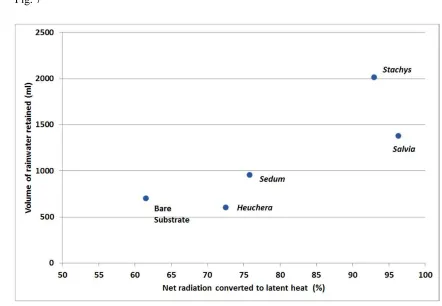
flooding by reducing surface run-off (Kemp pers. comm.). In these latest experiments, Salvia
8
officinalis and Stachys byzantina (previously identified as the species with greatest cooling
9
capacity from our small selection of model species) demonstrated the greatest ability to retain 10
water in the canopy (about 5% of that applied) and to increase the ‘re-charge potential’ of the 11
substrate (they increased water holding capacity by 50%, compared to only 30% with Sedum)
12
before a subsequent rainfall event. In this case, the common trait of high evapotranspiration 13
rate has a positive influence on both the cooling service and the ability to recharge the water 14
holding capacity of the substrate (Fig. 7). 15
Identifying single functional traits that have potential to provide multiple services has 16
been an objective in other ecosystem management approaches (e.g. de Bello et al., 2010). In
17
addition to our studies highlighting the benefits of Salvia and Stachys on urban temperature
18
and water management, these two species are identified with wider service provision [the 19
hairs of Stachys leaves provide nesting material for wool-carder bees Anthidium manicatum
20
(Garbuzov and Ratnieks, 2014) and are effective at trapping aerial pollutants (Shackleton et
21
al., 2013); Salvia provides nectar (Mačukanović-Jocić et al., 2011) and pollen (Bozek, 2002)
22
for honey bees, Apis mellifera, and its foliage is a fundamental ingredient in Mediterranean
23
cuisine and a source of essential oils (Carrubba et al., 2014)].
24 Other studies show too that certain species are better than others in promoting
1
multiple services. In woodland systems for example, both Picea and Betula forests increase
2
timber resources, dead wood occurrence (important habitat provision) and soil carbon 3
accumulation compared to woodland stands of alternative species (Gamfeldt et al., 2013).
4
Pinus on the other hand has less influence on soil carbon, but provides timber, deadwood and
5
a more open canopy that facilitates Vaccinium groundcover; the berries of which are used as
6
a local food source by both humans and wildlife. So different woodland types may offer 7
multiple services, but also a different suite of services based on the community composition 8
(Isbell et al., 2011); an important point to consider when designing plant communities in the
9
urban landscape. 10
11
What next?
12
The concept that plants provide a range of ESs to the urban environment has become 13
gradually recognised over the last two decades, but the notion that plant choice and their 14
community structure and dynamics may be important components in this service delivery 15
remains to be universally acknowledged. From the point of view of most practitioners, plant 16
choice within urban GI still tends to be determined by what survives and what is aesthetic 17
(and in some circumstances, e.g. urban nature reserve, the geographic origin of the plants). 18
This paper highlights though, that genotype selection can make a radical difference to level of 19
ES delivery, and further research is required to help populate a more comprehensive data 20
base relating plant selection to key benefit/s. This will allow practitioners to select 21
appropriate genotypes to meet specific situations and scenarios. This will inevitably involve 22
developing inventories, and allied publications to disseminate information and advice to end 23
users. In very practical terms, it would be useful to see this new information added to the 24
25 qualities e.g. ‘good autumn colour’, but also add information around their service provision 1
e.g. ‘helps cool the patio’ or ‘improves wall insulation’. To date, this service provision has 2
only been documented with respect to wildlife conservation value (‘fruit attracts birds’, 3
‘perfect for pollinators’ etc.), but this should go further. At a more strategic level, information 4
on ‘model’ functional plant communities and case studies of where these have been put into 5
practice should be made available to policy makers and other stakeholders. As outlined 6
above, many policy makers now understand the ‘whys’ for GI, but focus now needs to shift to 7
the ‘hows’ and ‘wheres’ to help ensure effective implementation. 8
Plants that optimise ES provision need to be embedded into the urban fabric more 9
effectively. This means providing them with the appropriate space and necessary resources. 10
Indeed, the body of data collected to date challenges a number of current paradigms about 11
urban GI. Rather than trying to get robust, stress-adapted species to just survive on green 12
roofs and walls, placement of appropriate infrastructure (e.g. deeper substrates and artificial 13
irrigation) could allow for much more functional species to be employed. The advantages 14
gained potentially significantly outweigh any additional costs associated with the enhanced 15
infrastructure. 16
Site and management limitations currently threatened plant survival and hence 17
functionality in many urban situations. Even larger and more expensive plants such as 18
standard trees may fail due to site limitations. These may relate to issues such as compaction 19
leading to poor soil structure with inadequate aeration or drainage properties, pollutants, 20
excessively high or low pH (influenced by residual building materials), phytotoxicity through 21
de-icing salts and other ‘urban’ contaminants, as well as direct physical damage to roots and 22
trunks, e.g. from trenching associated with utility provision and maintenance within 23
streetscapes (Jim, 1998; Cameron and Hitchmough, 2016). Insufficient irrigation remains a 24
26 factors will need to be addressed, especially if the philosophy moves away from simply ‘what 1
will survive’ to ‘what provides function’ i.e. potentially a greater use of less-resilient but 2
perhaps more functional plants in future. Despite the financial implications, however, of 3
dealing with these issues effectively, increasing attention is already being paid to ensuring 4
greater plant longevity, at least from the more technically-advanced landscape companies. 5
For example, many street trees are now planted into ‘structured’ soils – where the aggregate 6
is designed to withstand compaction and remain well-aerated over time (Buhler et al., 2007).
7
Likewise, better integrated approaches to urban design exploit rainfall run-off and recycled 8
waste water more effectively, thereby meeting plants irrigation requirements; the more 9
sophisticated systems being automated to save on human labour too. The encouraging aspect 10
here is, as the cost-benefit analyses moves in favour of the benefits (i.e. society fully 11
understands the value of the plantings) then higher costs can be, and often are, justified. 12
Relatively expensive –‘micro’ green walls (so called ‘air pollution units’) are being 13
introduced to bus stops and other locations along roadsides, with air actively passed through 14
the rhizosphere in an attempt to remove aerial contaminates such as nitrous oxides (Henry, 15
2015). If these prove to be effective, they are likely to be adopted as local authorities become 16
more concerned about urban air pollution. Economic models and traditional views on who are 17
the custodians of urban landscapes may also change in line with ES provision. If trees 18
provide greater thermal comfort in and around shopping precincts (Taleghani et al., 2016;
19
Sanusi et al., 2016), then tree plantings may be implemented and maintained by the retailers
20
rather than the local authority, as more comfortable employees and customers correlates with 21
potentially greater sales returns (Kolb et al., 2012); see point below too about the role of
22
residents/volunteers. 23
Urban design also needs to be more imaginative, and aim to exploit the plant traits to 24
27 of the building during different seasons e.g. in a northern hemisphere scenario, façades would 1
be placed on a building’s southern aspect and used to provide direct shade to the building 2
during hot, sunny summer days, but their orientation altered on the cooler, duller days of 3
winter, to maximise natural daylight from the south to illuminate the building (Figs. 8 and 9). 4
Further research is warranted to investigate the feasibility and cost-effectiveness of such 5
approaches. 6
Advances should not be limited to a technical nature alone, however. Existing 7
paradigms around the social/societal context may need to be challenged too, particularly with 8
respect to the management of urban green landscapes. There may be movement away from 9
central civic control to those situations where residents, volunteers and more locally-10
organised groups take on greater responsibility for the management of the new plant 11
communities. This may not just be solely due to financial constraints on local authorities, but 12
also the fact that some of the service delivery (e.g. health and well-being) depends on citizens 13
taking a more active role within, and indeed actively advocating for, their greenspaces. 14
Detailed information is required before an individual genotype can be fully assessed 15
for its functional merits. This limits the number of species/cultivars that can be evaluated 16
within a given time and could lead to a situation where only a small proportion of the useful 17
plant genotypes are identified and actively endorsed for their ES provision, at least initially. 18
The urban environment is going to be poorly served, however, if only ‘monocultures’ of a 19
few ‘functional keystone’ genotypes are slavishly promoted and used. At the same time it is 20
not feasible to evaluate in depth, the ES potential of every one of the 400,000 genotypes 21
available to the landscape sector. Thus, we argue that an initial step forward is to deepen our 22
understanding about how particular structural/physiological traits (e.g. colour, hairiness, size 23
of canopy and/or root system, inherent evapotranspiration rate) correlate with the provision of 24
28 various categories (‘cooling’, ‘rainfall mitigation’, ‘pollutant trapping’ etc.), the diversity of 1
urban planting will be increased whilst also improving overall ES delivery. The extent to 2
which the possession of ‘generic’ structural traits, however, actually relates to the magnitude 3
of service delivery remains to be tested in full. For example, do all grey-leaved plants provide 4
a similar albedo? Obviously too, where space is limited, it is desirable to identify genotypes 5
that deliver more than a single service. 6
Additionally, although some species have a greater number of functional traits than 7
others, designing more diverse plant communities is likely to provide greater resilience in the 8
long term (Isbell et al., 2011; Lundholm, 2015), as well as being intrinsically more interesting
9
per se. So the urban plant communities of the future should incorporate a range of genotypes
10
which are targeted at a particular service (e.g. atmospheric cooling) but also include others 11
that cover different ES provision requirements (e.g. noise abatement), as well as adding yet 12
further genotypes, simply to help ensure variety and diversity. Similarly, a more complete 13
understanding of the desired goals of these communities will in itself help drive their design 14
and management. For example, plant communities that are designed to attract Lepidoptera for
15
example, may need to provide a source of nectar for longer than any one (transient flowering) 16
plant species alone can give. Similarly the community should include plant species that act as 17
hosts to the larval stages, as well as simply feeding the adults; thus allowing the insect to 18
complete its entire lifecycle within a fairly small geographical range. Unlike the rural 19
environment, where emphasis should remain on native species and natural/semi-natural 20
ecosystems, the urban environment has more opportunity to experiment with how vegetation 21
can be used more effectively and with greater innovation (with appropriate safeguards) to 22
optimise ES delivery. The concept of GI is now ‘in place’ in many of our towns and cities, 23
but its true potential will only be realised when we elaborate and enrichen ‘the details’, and 24
29 1
CONCLUSIONS 2
This paper calls for greater attention to be paid to individual plants when considering 3
ecosystem service provision in an urban context. The arguments presented here indicate, 4
quite simply, that plant choice matters! It is no longer appropriate for urban green space to be 5
populated with plant species based on an ad hoc manner relating to a vague notion of
6
aesthetics, or even simply on a ‘what can survive’ basis. As urbanisation increases and there 7
is greater pressure on land for development, green spaces need to be able to justify their 8
inclusion within the urban matrix, based on effective and wide-ranging service delivery. 9
More research is required to understand better how plant traits impact on that service 10
delivery, and how functional communities of plants can be designed to address specific 11
problems or provide a range of important services with a limited space. Our knowledge base 12
in selecting appropriate plants/communities is in its infancy, but as the value of, and 13
requirement for, urban green infrastructure become more apparent, there will be increasing 14
pressure to ensure that plant choice is optimised and that this choice is based on strong 15
scientific rationale. As such, this is an exciting and important new area for plant research. 16
More-over the opportunity for scientists and practitioners to transform the urban matrix 17
through more effective and wider used of plants (in some case quite literally turning our grey 18
cities green) has significant and notable impact for plant science, globally. This arena of 19
research has opportunities to link plants directly to the key issues of the day including human 20
health and well-being, climate change adaptation, crime reduction, social cohesion and 21
through better habitat provision for wildlife, allowing us to still engage with nature 22
irrespective of where we live. In a human society now largely urbanised (Hall and Pfeiffer, 23
30 perhaps in due time becoming the second most important aspect of plant cultivation globally 1
after that aligned to commercial food production. 2
3 4
LITERATURE CITED 5
Akbari H, Pomerantz M, Taha H. 2001. Cool surfaces and shade trees to reduce energy use 6
and improve air quality in urban areas. Solar Energy70: 295-310.
7
Alpert P, Bone E, Holzapfel C. 2000. Invasiveness, invasibility and the role of 8
environmental stress in the spread of non-native plants. Perspectives in Plant Ecology,
9
Evolution and Systematics3: 52-66.
10
Anon. 2005.Ecosystems and human well-being Vol 5. Millennium Ecosystem Assessment,
11
Washington, DC: Island Press. 12
Anon. 2009. Green Infrastructure Guidance. Natural England. www. 13
naturalengland.org.uk/publications. Accessed 13 October 2015. 14
Anon. 2013a. Urban Pollinators http://urbanpollinatorsblogspotcouk/2013/09/pollinator-15
friendly-garden-plants-forhtml. Accessed 14 September 2015. 16
Anon. 2013b. Connecting to Nature – Finding out how connected to nature the UK’s children 17
are. Royal Society for the Protection of Birds. 18
https://www.rspb.org.uk/Images/connecting-with-nature_tcm9-354603.pdf. Accessed 28 19
April 2016. 20
Bajema RA, DeVault TL, Scott PE, Lima SL. 2009. Reclaimed coal mine grasslands and 21
their significance for Henslow’s Sparrows in the American Midwest. The Auk 118: 422–
22
431. 23
Benedict MA, McMahon ET. 2012.Green infrastructure: Linking landscapes and
24
communities. Island Press.
31 Beckett KP, Freer-Smith PH, Taylor G. 2000. Particulate pollution capture by urban trees: 1
Effect of species and windspeed. Global Change Biology 6: 995-1003.
2
Berens DG, Farwig N, Schaab G, Böhning-Gaese K. 2008. Exotic guavas are foci of 3
forest regeneration in Kenyan farmland. Biotropica40: 104–112.
4
Bisgrove R. 2013. The colour of creation: Gertrude Jekyll and the art of flowers. Journal of
5
Experimental Botany64: 5783-5789.
6
Bjerknes AL, Totland Ø, Hegland SJ, Nielsen A. 2007. Do alien plant invasions really 7
affect pollination success in native plant species? Biological Conservation138: 1-12.
8
Blanusa T, Fantozzi F, Monaci F, Bargagli R. 2015. Leaf trapping and retention of 9
particles by holm oak and other common tree species in Mediterranean urban 10
environments. Urban Forestry & Urban Greening14: 1095-1101.
11
Blanusa T, Vaz Monteiro MM, Fantozzi F, Vysini E, Li Y, Cameron RWF. 2013. 12
Alternatives to Sedum on green roofs: Can broad leaf perennial plants offer better ‘cooling
13
service’? Building and Environment59: 99-106.
14
Bozek M. 2002. Flowering biology and pollen flow of three species from genus Salvia L.
15
Annales Universitatis Mariae Curie-Sklodowska Sectio EEE Horticultura (Poland).
16
Branas CC, Cheney RA, MacDonald JM, Tam VW, Jackson TD, Ten Have TR. 2011. A 17
difference-in-differences analysis of health, safety, and greening vacant urban space. 18
American Journal of Epidemiology, 174: 1296-1306.
19
Buhler O, Kristoffersen P, Larsen SU. 2007. Growth of street trees in Copenhagen with 20
emphasis on the effect of different establishment concepts. Arboriculture and Urban
21
Forestry33: 330.
22
Cameron RW. 2014. Health and Well-Being In: Horticulture: Plants for people and places,
23
32 Cameron RW, Blanuša T, Taylor JE, Salisbury A, Halstead AJ, Henricot B, Thompson 1
K. 2012. The domestic garden–Its contribution to urban green infrastructure. Urban
2
Forestry & Urban Greening11: 129-137.
3
Cameron RWF, Hitchmough J.2016. Environmental horticulture: Science and
4
management of green landscapes. Boston, CAB International.
5
Cameron RWF, Taylor JE, Emmett MR. 2014. What's ‘cool’ in the world of green 6
façades? How plant choice influences the cooling properties of green walls. Building and
7
Environment 73: 198-207.
8
Cameron RWF, Taylor JE, Emmett MR. 2015. A Hedera green façade - Energy
9
performance and saving under different maritime-temperate, winter weather conditions. 10
Building and Environment 92: 111-121.
11
Carney M. 2012. Compounding crises of economic recession and food insecurity: A 12
comparative study of three low-income communities in Santa Barbara County. Agriculture
13
and Human Values, 29: 185-201.
14
Carreck NL, Williams IH, Little DJ. 1997. The movement of honey bee colonies for crop 15
pollination and honey production by beekeepers in Great Britain. Bee World78: 67-77.
16
Carrubba A, Catalano C. 2009. Essential oil crops for sustainable agriculture – A review 17
In: Climate Change, Intercropping, Pest Control and Beneficial Microorganisms.
18
Springer, pp 137-187. 19
Carvalheiro LG, Biesmeijer JC, Benadi G, Fründ J, Stang M, Bartomeus I, Kunin WE. 20
2014. The potential for indirect effects between co flowering plants via shared pollinators 21
depends on resource abundance, accessibility and relatedness. Ecology Letters17:
1389-22
1399.
23
Charles C. and Louv R. 2009. Children’s nature deficit: What we know and don’t know. 24
Children and Nature Network, pp.1-32.