COMMISSION
OF
THE
EUROPEAN
COMMUNITIES
cOM
(88)
192 finaL
BrusseLs, 15 Apri L
1988
ERASMUS PROGRAMI'IE
AnnuaL
rePort
1987
-2-CONTENTS
I.
INTRODUCTION
:
GENERAL CONTEXTAND
REVIEW
OF
THE1987/8
ACADEMTC YEARrr.
REpoRT
oN
ERASMUSACTrVrrrES,
15.6.87-31
.12.87
III.
CONCLUSIONSAND FUTURE PERSPECTIVES
FOR
1988/9
Annexes
1.
Composition
of the
ERASMUSAdvisory
Committee
2.
Statisti-cs
3. List of the Inter-University
Cooperation
Programmes
supported
tn
198'7/8
4. List of the
Study
Visits
supported
in
1987/8
5. List of the
ERASMUSNational
Grant-Al^rarding
Authorities
6. List of the
National
Academic
Recognition Information
Centres
7.
Documentation
sent to universities containing a description
of
the
types
of financial
support
available in
198'l
/8
Page
3
-3-I.
INTRODUCTION
:
GENERALCON1EXT
AND
REVIEW
OF THE
1987/B
ACADEMIC
YEARGeneral
context
1. In recent years, the conviction
has grown
that in order tc
maintain
and enhance
the competitivity of the
European
Community
on world.
markets and
to
make
the
Community
an
entity that is closer to its
in-habitants in the
framework
of a
Peopl-e's
Europe,
urgJent
efforts
must
be undertaken
to put the entire inteLlectual
resources
of the
Commu-nity to better
use and
to
produce,
in particular,
a
much
higher
num-ber of
graduates
with first-hand
experience
of living
and
working
in
other countries of the
Communitv.
2. It is within this context that the
Council
decided
to
]aunch
the
ERA:i-MUSProgrdrrrn€r
or the
European
Community
Action
Scheme
for the
Mobi-lity of University
Students.
The
goals of the
Programrne
as
stated in
the
Council Decision
(1
) are the following
:- to
increase
substantially the
number
of university students (2)
carry-ing out
an
integrated period of study in
ancther
Ment'er
State, in
order that the
Ccmnunity
may
draw on
manpower
with direct
experience
of the
economic
and
social life of other
Member
States, while
ensur-ing
equal
opportunities for the
boys
anci
girls benefitting
from
such
mobility;
- to
promote
wide-ranging
and
intensive
cooperation
efforts
between
the universities of all the
Member
States;
87/327/EEC
Decision
of
15 June 1987
(oJ
No L166
of
25 June 1987,
pages
20
to
24).fn the
context
of the
ERASMUSProgranner
the
term
"university" shall
be used
to
cover
all
types
of
post-secor.dary education and
training
establishments which
offer,
where
appropriate
within the
framel^tork
of
advanced
training, qualifications or
diplomas
of that level,
whatever
such establishments
may
be
called in the
Member
States.
(1)
-4-- to harness the fuII
intellectual
potential
of the
univer-sities in the
Community
by
means
of
increased
mobility of
teachi
ng
staff,
thereby
improving
the quality of the
education and
training
provided
by the universities with a view to
securing
the
competitive-ness
of the
Community
in the
world
market;
- to
strenlthen
\
the interaction
between
citizens in different
Member
States
with a
view
to consolidating the
concept
of a
People's
Europe;
- to
ensure
the
development
of a pool of
graduates
with direct
experi-ence of
inter-Community
cooperation,
thereby
creating the basis
upon
which
intensifi.ed
cooperation
in the
economic and
social
sectors
can
develop
at
Community
level.
3.
The
ERASMUSProgramme
cannot be regarded
as a
separate
entity, but
needs
to
be considered
within the context
and
in the line of a series of
com-munity
initiat.ives
which
should be
recalled, including notably
:- the
community
programme
on
cooperation
between
universities
and
enter-prises
regarding
training in the field of
technc,loEy
(COV.ETT)
adapted
by
a
Council Decision
(1)
on
24
July
1986;
the plan
designed
to
stimul"ate
cooperation
and exchanges
in the
scien-tific field, especially
as
concerns
the
awarding
of financial
support
and research grants;
the various
cornmunity
pnoqrdnres
currently
being
implemented and
deve-Ioped
in
respect
of the mobility of
young
people,
the
improvement
of
language courses as
well as the
strengthening
of the
Community
dimension
in curricula of different levels
and
European
cooperation
in the
teacher
training
sector;
86/365/EEC
Decision
of
24
JuIy
1985
(oJ
N'
L222
of I
August
1986,
- the other various
actions
currently
berngdeveloped
with a
view
to
setting
up
a
Pec,ple's
EuroPe.
Broadly speaking, owing
to the transnatior.al
dimension
underlying
the
Programme,
and
the specific projects linked to it,
ERASMUSconstitutes
together
with
COI'4ETTa significant.
component
in the
development
of
Lhe
internal
market.
fn fact,
ERASMUSshould
contribute'
on
the
one
hand,
to
strengthening
the
competitive
position of enterprjses
(by
placing
em-phasis
on
the
promotion
of a larger
number
of
students having
had
first-hand
experience
of other
Member
States
in the
course
of their
studies
and
who
are better qualified
thanks
to their
kncrnledge
of
languages
and
other cultures)
and, on
the other
hand,
to consolidating provisions in
favour
of staff mobility
through
measures
designed
to facilitate
the
academic
recognition of
diplomas"
For
the
purpose
of carrying out the four actions indicated
above,
the
Council Decision
considered necessary
a
budget
of
85
MECUfor the first
three-year
period of the
Programme,
from 1
July
1987
to
30 June
1990.
A
joint declaration by the
Council
and
the
Commission
provides
for
the
distribution of this total
Lhree-year budget
as
follows :1987/8:
10MECU;
1988/89
:
30
MECU;1989/90:45
MECU.
This declaration further
pro-vides that
as
of
1989,/90, expenditure
for Action 2
(student
grants) will
be dcuble
that for Action 1
(European
University
Network),
but that in
the initial
launching
period of the
Prograrune,
funding on
the
European
University
Network
would predominate. The
Anr,ex
to the
Council
Decision
stipulates that after the first year, the cost of the
measures
adopted
for
Actions
3
and
4 will not
exceed
10%
of the
annual appropriations
tc
be
alloted to the
ERASMUSProqramme.
In addition to the
10
MECUfor
1987/8
provided
for in the
Counci.l
De-cision, a further 1.2
MECUwere
available for this first
academic
year.
This
sum
has
been
adopted
in the
framework
of the
Community
budget
for
'I
987
for the
purpose
of stimulating higher
educ:ation cooF)eration
(joint
study
pro€Jrarnmes,
study
visits)
and
r4/as
accordingly
assimilated to
the
ERASMUS
budget.
q
1.
-6-Review
of
the
1987/8
academic year
Despite
the
-
unavoidable
- transitional
nature
of this first
year
of
operation, the
ERASMUSProgramme
is
weII
and
truly
under
way
and
the reactions
of
the
universities
have
been
very
positive
indeed,
sur-passing,
in fact,
the
hopes
of
the
Commission.
As
sh6wn
in
table
5in
Annex
2,
demand
for
ERASMUShas
outstripped the
amount
of
the
funds
available by
a
factor of
more
than
3:1
. In
the
case
of
student
grants,
this
factor
$ras
approximately
5:1, In
the
light of this first
year
of
experience;
the
Conmission's
original
proposal
of
a
budget
of
175
MECUfor
the
first
three
years
of
the
Programme's
operation,
which
the
Council
reduced
to
85
MECU,
seems
most
realistic.
During
the
Programme's
first
year
of
operation,
398
inter-university
cooperation progranmes
(ICP) received
community
support covering
aIl
the
Community
countries
and
involving
altogether
about
850
higher
education
institutions.
These progranmes
constitute the starting
point
for
the construction
of
the
European
University
Network
(Action
1
of
ERASMUS).
Around 3,000
students received
grants
which enabled
them
to
spend
a period
of
study
in
another
Member
State (action
2).
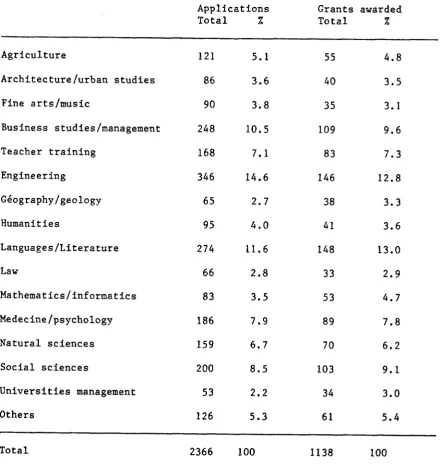
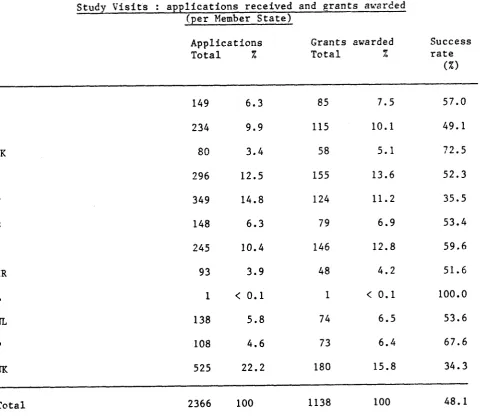
1,138
study
visit
agreement.s
afforded
sorne
3r000
university
teachers
and
administrators
the
opportunity
of travelling to
other
Member
States
to lay
the
foundations
of
cooperation
programmes
and
to
become
ac-quainted
with
the higher
education
system
of
the countries
visited.
1
2
university
associations are
curently
implementing
European
pro-jects with
the
financial
support
of
ERASMUS.
The
components
of
the
prograrune
which
relate to
academic
recognition are
well in
hand
and
a
large-scale
and
intensive
information
campaign
has
been launched
in
Member
States
whose
universities
have been
found,
so far,
topar-ticipate
Iess
actively in
the
ERASMUSProgramme.
The Programme's
in-frastructure
(ERASMUSAdvisory
Committee,
National
Agencies
for
the
awarding
of
grants,
ERASMUSBureau)
is
now
properly
established.
Together,
all
these
factors contributed to the
success
of this first
year
of activity. Naturally,
some
difficulties
have
arisen
and'are
not
to
be underestime.ted. The
universities in
sone
of the
Member
States
8.
II.
10.
(uK,
F, D,
rRE)
have been
quick to
come
forward
with
proposals
for
in-ter-university
cooperation
programmes (European
University
Network),
but
those
in other
Member
States (f,
GR,
p,
DK)
have
been
much
less in
evidence.
Several
academic
disciplines are clearly
underrepresented
in
the
rcPs supported
this year, notably the
Naturar sciences,
Medical
Sciences
and Teacher
Training.
The
limited
resources
available for
Action
2
and
the inflexibirity
of the
system
imposed
by the
council
Decision
for arlocating the Action
2
budget
to
Member
states,
have
red
to
severe imbalances
between
the
Member
States in
respect
of
student
grants : with the
budget
made
avail-abre
to
each
of
them,
some
Member
States
(DK,
E,
GR,
I, P)
were
able to
award
grants to practically aII
students
participating in
an
ERASMUSprogramme,
while
other's
(D, F,
IRL,
uK)
couLd
only offer grants to
one
out of four or five students. rf
these
measures
were
to continue, they
could
have extremery
damaging
ef-fects.
Many
organisational
probrems
remain
to
be
soLved
in order
co
arrange
for the inclusion within
ERASMUSof individual
students
wishing
to
move
to other
EC Member
States
outside the
framework
of
fCPs.
None
of
these problems
is substantial
enough, however,
to carl into
question
the
fundamentally
positive
outcome
of this first
year
of the
programme's
operation.
REPORT
ON
ERASMUSACTIVITIES
1 5.6.87-31
.12.8'7
The
strategy to
implement
ERASMUStn
1981/8 has centered around three
sectors
of activity
:-
launch
of the initial
progranme
operations
-
measures
to
inform
the
academic
community,
national authorities
and
the
media
about
the
Programme
-
establishment
of
an
organisational-
and
consultative
i.nfrastrucEure
for the
Programme.
Due
to the
extremely
tight
schedul"e
Lmposed
by the council
Decision,
these
three activities
have
been
conducted
concurrently.
The
following
paragraphs
of this section
summarize
each
of
these sectors
of activity
in turn, starting with the
measures
that
were adopted
to carry out
the
-8--
The European
University
Network
(support
to universities)
(Action
1 )-
student
-
measures
grants
(Action
2)
11.
to
improve
academic
recognition (Action
3)
-
complementary
measures
(Action
4)
Action 1 :
European
University
Network
:
Support
for Inter-university
Cooperation
Programmes
(Icp) an{study Visits
Inter-university
Cooperation
Programmes
The
main
objective of the
ERASMUSProgranme
is to
boost
student
mobi-lity well
above
its
present
unsatisfactory level. In order to
achieve
this objective, it will not
be
sufficient
merely
to
prcvide
direct
grants to individual students.
The
universities
themselves
must be
en-couraged
to
make
arrangements
with universities in other
Member
States
whereby students
may
undertake
a period of
study
elsewhere
in the
Com-munityr!,ltrich
forms
a
coherent
and
recognised
part of their overall
course
of
study
and
therefore
does
not entail a
prolongation
of this
course. It is also felt that inter-university
arrangements
of this
kind
(which
in practice are often
implemented
at
departmental and
fa-culty levels)
can minimize
the organisational
problems
of
study
abroad
and
provide
a solid
framework
for
exchanging students on
a regular
ba-sis.
Similar
consi.derations
apply
with
regard
to staff mobility : while
in-dividual,
short-term guest
lectures
may,
in certain
circumstances'
ful-fill
a useful function, a truly significant
pooling
of the intellectual
resources
of the
Community's
universities for the
purpose
of
providing
a better quality
education
can
only
be
achieved thro-$r longer Su+ationl
13.
-9-ERASMUS
therefore
provides
financial
support
to
encourage
long-Iasting
cooperation
between
different
Member
State unjversities which,
atnongst
themselves,
have
established inter-university
cocperation
programmes
(ICP)
regarding
student
and/or
staff mobility.
Such
programmes
re-ceiving
support
in the
framework
of
ERASMUSconstitute the
European
University
Network.
Student
tlobility
Programmes
:
ERASMUSsupport
is
intended
for
pro-granmes
which
provide
for the
student.s
of
one
university the
chance
to
undertake,
within a university of
another
Memt,er
State, a
period
of
study which
will
be
fully
recognised
by the
home
university
when
awarding these
students
the,ir final
diploma
or qualificatior:. AII
stu-dent
mobility
progralnmes
which
satisfy this criterion of
recc,gnition
are
eligible,
regardless
of the field of studyr the level of
study
(up
to
and
includinc;
the'
doctorate), or the type of participating
in-stitution.
However,
the
Commission
grants definite priority to
reci-procal
exchange
progranmes
(regardless
of
whether
this reciprccal
ele-ment
is
organised
in a single
academic
field or different fields).
The
recognised
period of
study
in
another
Member
State
must
be
of
substantial duration
(normally
at least a
thre'e-month
or
six-month
academic "term"
)
;
periods given over
to
no more
than
practical
field-work, international
conferences and seminars
or very short visits
are
not eligible.
The Commission
accords
preference
to
progranmes which
a.llow
students
to satisfy criteria
enabling
them
to benefit
frcm
ERAS-MUS/mobilitv
qrants.
'\
15.
Financj.al support
from
the
Commission may
cover
the following
expenses
entailed
by
a
student
mobility
programme
i
the
costs
of travelling
and
staying
abroad
for university staff
members
who
take part in
meetings
to plan,
develop,
implement,
monitor
and
evaluat.e
the
progranme
(organisation
and
content
of
teaching
and
courses,
accommodation
and
effective cost of living
in
another
Member
State,
supervision
of students, examination
boards
and
panels, questions
relating
Lo
academic
recognition
and
qualifications,
etc.
)
;14.
-1
0-preparation
and
translation
of written
and
other
teaching materjal;
preparation
of
students
(information,
linguistic
preparation,
aca-&nic
and
other
facilities
provided
by
the
horne
and/or
host
institu-tion);
expenditure
for
making
information
about
the
prograrnme
more
widely
available;
-
other
expenditure
directly
related
to
carrying
out
the
progranune.
the
normal salary
16. fn
no case
may
financial
support
be used
to
cover
costs of staff taking part in the
progreunme.
17.
For
each student
mobility
prograrrur.e,
the
maximum
support which
may be
awarded
is
ECU
25,000
per year per participating university (the
ave-rage
anount
in
1987/8 lcs
well
be1ew
this figure).
Each
group
of
stu-dents
who
are working
for the
sarne
diploma
or the
same
qualification
and
who
go from one
university to
another
one
in
another
Member
State,
ccnstitutes a distinctly
separate
mobility
progranme
in
applying
th'i-s ,)
I
this
maximum.
18. Staff mobility
prograrwes
: this
support
is
intended
for
inter-univer-sity
progranmes
which
provide
an
opportunity for the
teachinq
staff
of
one
university to
teach
in a partner university in
another
MemberState.
Priority is
accorded
to
programmes
for reciprocal
exchanges
(within
a single
academic
field or in different fields) in
which
the visiting
staff
member
makes
a substantial
and
integrated contribution to
the
teaching
progranule
of the host university
over
a period of at least
one
month.
The
financial
support from
the
Commission may
be used
to
cover
the
following
expenses
:- the cost of the
development and
operation of the
programme
:the costs of travelling
and
staying
abrcad
for
meetings
concerning
the organisation
and
content of
teaching
activity
and examinations;
cost of translating
teaching
material; the specific Iinguistic
pre-paration of the
teaching
staff, etc.
The
maximum
financial
support
available for
these
expelqe-9--f,q-EqU
51000
per
year
per
unl-v-e-!91!y-for
each
programme;
19.
-1',I-the travelling costs of -1',I-the
teaching
staff : by this is
meant the
mobility costs (journey
and
stay
abroad)
of
teaching
staff
who
go
to the partner university in order to
teach
and
administer
examina-tions;
the
maximum
amount
of financial
support
available
varies
according
to the length of the period
spent
abroad;
for a
three-month
period, for
example,
the
maximum
support
that
may
be granted
is
ECU
3,500
per staff
member;
the costs of replacing
teaching
staff :
when
a staff
member
on
mis-sion
abroad
has
to
be
replaced
during his or her
absence,
the
Com-sion
may
grant,
under
certain
circumstances,
maximum
financial
sup-port of
ECU
2,500
per
month
of
replacement.
Programmes
supported
in the
1987/8
acaienj.c
year.
21. Arr universities
which had
applied for
1987/8
support
of joint
study
proltrannres,
a
scheme
which preceded
EFISMUS,
h/ere
immediately
inforned
of the
adoption
of
ERISMUS
and
given the cpportunity of
adapting
their
reguests
to the
new
terms
of
reference regarding
inter-university
co-opgg.Ilon_prganmes
(ICP).
The
608
reguests
conc:erned
were
referred
to the
Academic
Advisory
Group
(1) in late
June,
and
on
the basis of
the
Group's
recc,mnre'ndat,ions,
the
Commission
decided
in
October
to
pro-vide
support
tc a first
batch
of
240
inter-university
cooperation
pro-grarunes
(ICP), in the
framework
of Action
1
of
ERASMUS(European
uni-versity
Network)
.
230
of
these
prcjects also
obtained
financial
sup-port for participating students. Early in Jury, the
commission
for-warded
to all universities a
dccument
prepared
in
conformity
with
the
provisions of the
ERASMUSDecision, setting out the grants
avaiLable
in
198-t/8 and
giving universities until
30
September
to
submit
their
new
applications.
*
(1
)
The
rolelthis
group,
which
consists
of
representatives from
the
A
academic
world
appcinted
by the
Commission
(Heads
of universities,
professors
with
extensive
experience
in the
matter
of
organisj.ng
teacher
and
student
exchange programnr€s)
is to give the
Commission
22.
23.
-1
2-250 fur#-her
applications
were
received on
the basis of this
second
round,
which
was
an
exceptional
measure adop'ted
only for
1987/8.
These
erte:"ed
into conpetition with the 36t pro;ects not
supported
in
the
first
round
in order to
ensure
equality of opportur.ity
across
the
two
selection
rounds.
After
revior"-
hl, the
Academic
Adviscry
Group
in late
November,
the
Commj.ssion
selected
a further
158
fCPs
for
sup'pcrt
(127
of.
which were
also
awarded
sup'port
unc''er
Action 2 for the
pur'-pc,se
cf providing
student
grants).
In aII, the
Commission
received
868
applications for financial
sup-port within the
framework
of Inter-university
Cooperati-on
Prograrnmes
(ICP)
in the
1981/88 academic
year.
398
applications
(45.9%)
were
accepted
by the
Commission
and
received
financial
support
totalling
MECU
3.8,
representing
329"
of the total
amount
(MECU
12)
requested.
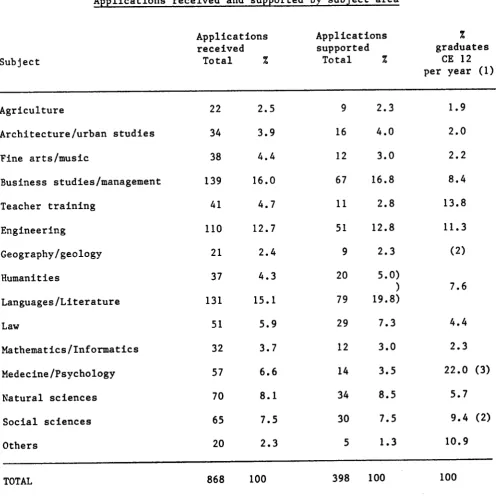
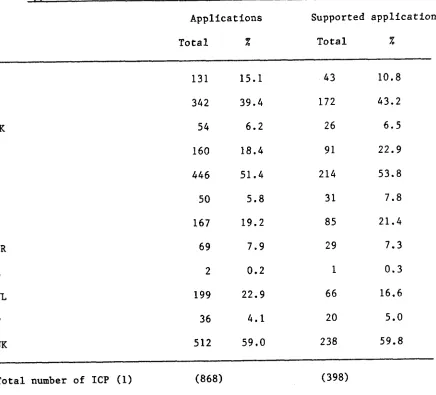
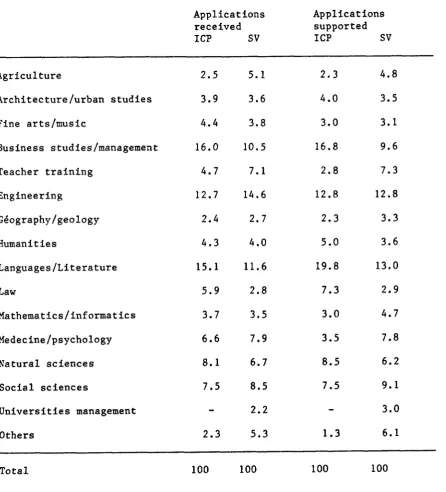
Tables
'l
and
2
show
the distribution of applications
and
grants
awarded
per
academic
discipline per
Member
State.
Table
1
reveals
high
concentrations
of applications
received
and
grants
awarded
in
language and
literature,
business
studies
and
engineering,
which
to-gether
accounted
for exactly half of the total
amount
of financial
support granted.
On
the other
hand,
the natural
sciences,
social
scienceg, general humanities, teacher
training, agriculture
and
medi-cine
appear
to
be
less weII
represented
(1
).
Medicine and teacher
training
were
also the only fields of study to receive significantly
fewer
grants
than
might
have
been
expected
on
the basis of their
per-centage
of applications,
suggesting
that the
gualiEy
of the
applica-tions
received
in
these
fields
was
somewhat
disappointing.
Plausible
reasons
may
be
adduced
to
account
for this : in the
case
of
medicine,
restrictions
on,
the
admission
of
students
and
highly structured
,(1)
Houever,
this
impression
is a relative
one
when
one
compares
the
number
of
programmes
supported
with that of the
students
or
with
24.
-1
3-externally validated curricula
tend
to
make
integrated
student
ex-changes
difficult;
in the
case
of
teacher
training, mobitity is
often
impeded
by
the
requirement
that
students must
take a certain
number
of disciplines concurrently
and
carry out training periods in
schools.
Viewed
in
terms
of
Member
State participation, the high
involvement
rates of
French and
British universities in both applications
and
grants
awarded
immediately catches
the eye.
A
number
of factors
may
be
responsible
here, notably the
language
factor
(English
and
French
being
by far the
most
widely
taught
foreign
languages
in the
Comrnunity),
existing structures for
disseminating
information
on
available
eom-munity
grants within the institutions of
these
countries
and
the
back-ground
of
experience developed
in the
framework
of the Joint
Study
Programme
Scheme.
The
highly
encouraging performance
of
Spanish
uni-versities in attracting
ERASMUSsupport
is also
worthy
of note.
Onthe other
hand,
Italian universities are not participating
as
fu11y
in
ERASMUSas would be
merited
by the country's
popul-ation
figures
or overall
student
numbers.
The
apparent
overall participation rate
of
Belgian
universities
camouflages
the dearth of
programmes
involving
universities
located
in the
Flemish-speaking
part of that
country.
In
general terms,
however,
it
may
be
said that this first
selection
of
ICPs
represents
a
broad spectrum
of
cooperation
prograflunes
between
universities in all
Member
States
in a very
wide
range
of
academic
disciplines.
Furthermore,
some
extremely
exciting
examples
of
coc,pera-tion
prograrnmes
are
being
developed
and
operated already
now
with
the
support
of
ERASMUS,
in particular
as
regards student
exchange
pro-granmes
26. In
some
cases,
it is
even
possibJ.e
fication, i.e. a
degree
award from
students
to obtain a dual
quali-different
Member
States
:25.
for
-1
4-.
Business
studies /
Management
sclence
E
Universidaad
Pontificia Comillas,
ICADE,
Madrid
F
Groupe
ESC
Reims,
CESEMD
Pachhochschule
ftir
Technik und
Wirtschaft,
Reutlingen
[K
Middlesex
Polytechnic,
London
Four-year
bilateral integrated
exchange
programmes
whereby
mixed
groups
of
students
spend
two
years (theoretical
and
practical
study)
in
each
of
two
countries
and
receive fully validated
degree
awards.
Currently
around
1r000
students
are
involved.
. Electrical
engineering
/
Mechanical engineering
UK Coventry (Lanchester) eolytechnic
D
Fachhochschule
Osnabrtick
Fully integrated
course
leading to a
double
qualification of
Bachelor
of
Engineering and
Diplom-Ingenieur.
Language
tuition (intensive
courses)
is part of the curriculum
from
the first
year
on.
.
Energy
studies, Materials
science,
Machine
systems,
Industrial
ro-botics
UK
Cranfield Institute of
Technology
F
Universj.t6
de Technologie de
Compidgne
Fully integrated
course
leading to the
double
qualification of
Master
of
Science and Dipl6me
d'Ing6nieur.
The
course
also
aims
to
acquaint
engineering
students
with the
economic,
political
and
administrative
-1
5-French and
Italian studies /
Language
and
literature
Universit6
Universitd
Savoie,
Chamb6ry
Torino
Fully integrated
two-year
exchange prograrune
at
deuxidne
cycle level,
the first
year
of
which
leads to a Franco-Italian
Lice.nce
and the
second
year
of
which
leads to a joint
degree
Maitrj
se,/Laurea
awarded
by
a
bi-national jury
under
the
auspices
of
both
universities
and
recognised
in
both countries.
2'l. In other
instances,
proeJrarnnes
follow the
more
"classical" pattern,
whereby
students
spend
the first part of their studies at their
homeuniversity ad
then
go
to
another
EC Member
State for
an
intercalated
study
year,
before
returning to
cornplete
their
degree
:.
Physics/Chemi
stry,/Mathematics
UK University of
Sussex
B Universit6 Libre
de
Bruxelles
D Universitdt
Bochum
D
Universi.t5t
Freiburg
D Universitiit
Ttibingen
F Universit6
de
Paris VII
F Universit6
de
Paris
Xf
F Universit6
de
Nantes
F Universit6
de Grenoble
f
F
Ecofe
Sup6rieure
de
T6l6communications de Bretagne, Brest
F Institut National
Polytechnique,
Grenoble
F Universit6 d'Aix-Marseille II
F Universit6
de
Caen
F
ENSACToulouse
I
Universiti di
Firenze
Joint
prograrune
linking the University of
Sussex
with'15 other
uni-versities in 4
Member
States.
Students
in
science
subjects
,/mathe-matics are
exchanged
for
one
academic
year as
an
integrated part of
their
home
university
courses,
with
Sussex,
the ccre institution,
exchanging
with
each
of the other universities
depending
on
the
sub-ject
area.
de
di
F
-1
6-Comparative
national
lar' /
Law
D
Universitdt
Passau
UK University
College
Cardiff
I
UniversitA
degli
Studi di
E
Universidad
de
Santiago
de.F
Universit6
d'Angers
F
Universit6
de
Tours
with
languages
Pavia
Cor.postela
Passau
has
introduced
a first
degree
level
course
in
law
combined
with the
law
of
another country
and
exchanges
students
with the
part-ner universities in Spain,
France,
Italy
and
the
United
Kingdon:
for
one
academic
year. Credits
taken abroad
are fully
recognised
as
counting
towarrds
the
home
degree.
Students
receive
a
supplementary
certificate for their studies
abroad.
Language
ccurses
are
provided
to
prepare
the
students
for the
course.
28.
Mention should
also
be
made
cf the
prograrrur€s
in
which neighbcuring
universities in differer:,t
Ment'er
States link
together
to
form
what
may
be
termed
as
"transfr'or.t.ier'
regional
ccc,peration
prc.jects,'.
Onegood
exarnp'le
cf this is located in the
,,Saar-Lor-Lux',
region
:.
Environm€lr.t
al
sciences
B
Fondation
Universitaire
Luxembour'geoise,
Arlon
lrx
Centre
Universitaire
de
Luxenbour