This is a repository copy of Complex-valued wavelet lifting and applications. White Rose Research Online URL for this paper:
http://eprints.whiterose.ac.uk/110760/ Version: Accepted Version
Article:
Hamilton, J., Nunes, M.A., Knight, Marina Iuliana orcid.org/0000-0001-9926-6092 et al. (1 more author) (2017) Complex-valued wavelet lifting and applications. Technometrics. pp. 48-60.
https://doi.org/10.1080/00401706.2017.1281846
Reuse
Items deposited in White Rose Research Online are protected by copyright, with all rights reserved unless indicated otherwise. They may be downloaded and/or printed for private study, or other acts as permitted by national copyright laws. The publisher or other rights holders may allow further reproduction and re-use of the full text version. This is indicated by the licence information on the White Rose Research Online record for the item.
Takedown
If you consider content in White Rose Research Online to be in breach of UK law, please notify us by
Complex-valued wavelet lifting and
applications
Jean Hamilton
HEDS, ScHARR, University of Sheffield
Matthew A. Nunes
∗Department of Mathematics and Statistics, Lancaster University
Marina I. Knight
Department of Mathematics, University of York
and
Piotr Fryzlewicz
Department of Statistics, London School of Economics
December 20, 2016
Abstract
Signals with irregular sampling structures arise naturally in many fields. In applica-tions such as spectral decomposition and nonparametric regression, classical methods often assume a regular sampling pattern, thus cannot be applied without prior data processing. This work proposes new complex-valued analysis techniques based on the wavelet lifting scheme that removes ‘one coefficient at a time’. Our proposed lifting transform can be applied directly to irregularly sampled data and is able to adapt to the signal(s)’ characteristics. As our new lifting scheme produces complex-valued wavelet coefficients, it provides an alternative to the Fourier transform for irregular designs, allowing phase or directional information to be represented. We discuss applications in bivariate time series analysis, where the complex-valued lifting construction allows for coherence and phase quantification. We also demonstrate the potential of this flexible methodology over real-valued analysis in the nonparametric regression context.
Keywords: lifting scheme; wavelets; nondecimated transform; (bivariate) time series; coher-ence and phase; nonparametric regression.
1
Introduction
Since the early nineties, wavelets have become a popular tool for nonparametric regression,
statistical image processing and time series analysis. In particular, due to their natural
localisation, wavelets can provide sparse representations for certain functions that cannot be
represented efficiently using Fourier sinusoids. Reviews of the use of wavelets in statistics
include Nason (2008) and Abramovich et al. (2000).
Until recently, the majority of work in the statistical literature has been based on the
discrete wavelet transform (DWT). However, classical wavelet methods suffer from some
limitations; in particular, usage is restricted to data sampled at regular time or spatial
loca-tions, and a dyadic data dimension is often imposed. Wavelet lifting (Sweldens, 1996) can be
used to overcome many of the shortcomings of the standard DWT. Specifically, wavelet
func-tions obtained through the wavelet lifting scheme provide an extension of classical wavelet
methods to more general settings, such as irregularly sampled data.
On the other hand, it is now well-established that complex-valued data analysis tools can extract useful information that is potentially missed when using traditional real-valued
wavelet techniques, even for real-valued data, see for example Lina and Mayrand (1995);
Fer-nandes et al. (2003); Selesnick et al. (2005). In particular, using complex-valued multiscale
methods has been advantageous in a range of statistical applications such as
nonparamet-ric regression (Barber and Nason, 2004), image processing (Kingsbury, 1999; Portilla and
Simoncelli, 2000) and time series analysis (Magarey and Kingsbury, 1998; Kingsbury, 2001).
Complex-valued multiscale techniques building upon the lifting scheme as introduced by
Sweldens (1996) have been introduced in the literature by Abbas and Tran (2006), who
briefly investigated their proposed technique in the image denoising context, and by Shui
et al. (2003), who focused on the design of complex filters with desired band-pass properties.
This article introduces a new adaptive complex-valued wavelet lifting scheme built upon the lifting ‘one coefficient at a time’ (LOCAAT) framework of Jansen et al. (2001, 2009).
A nondecimated variant of the proposed transform, which allows for an overcomplete repre-sentation of such data is also introduced. The added benefits of our methodology are: (i)
flexibility – it can be applied to irregularly sampled grids of (possibly) non-dyadic length;
exploits additional signal information not used by real-valued transforms; and (iii)
applica-bility – it allows for the analysis of bivariate nonstationary signals with possibly different
(irregular) sampling structures, previously not directly possible using methods currently in
the literature.
We demonstrate the benefits of our new technique for spectral estimation of irregularly
sampled time series, with a particular focus on coherence and phase quantification for
irreg-ularly sampled bivariate time series. In this context, the methodology can be viewed as a
wavelet lifting analogue to the Fourier transform and can be used for the same purposes. The
good performance of our method is also displayed in the nonparametric regression setting.
The paper is organised as follows. Section 2 introduces the new complex-valued
lift-ing algorithm, includlift-ing its overcomplete variant. Section 3 details the application of the
complex-valued lifting algorithm to discover local frequency content of irregularly sampled
uni- and bivariate time series. Section 4 tackles nonparametric regression for (real-valued)
signals.
2
The complex-valued lifting scheme
The lifting scheme (Sweldens, 1996) was introduced as a flexible way of providing
wavelet-like transforms for irregular data. Lifting bases are naturally compactly supported, and via the recursive nature of the transform, one can build wavelets with desired properties, such as
vanishing moments. In addition, lifting algorithms are known to be computationally faster
than traditional wavelet transforms since they require fewer computations compared with
classical transforms. For an overview of the lifting scheme, see Schr¨oder and Sweldens (1996)
or Jansen and Oonincx (2005).
In this section we introduce a complex-valued lifting scheme for analysing irregularly sampled signals. The proposed lifting scheme can be thought of as a wavelet lifting analogue
to the Fourier transform. An irregularly sampled signal is decomposed into a set of
complex-valued wavelet (or detail) coefficients, representing the variation in the data as a function of
location and wavelet scale (comparable to Fourier frequency).
In a nutshell, the scheme can be conceptualised in two branches: one branch of the
the imaginary component. Hence by using two different (real-valued) lifting schemes, one
obtains a complex-valued decomposition, akin to the dual-tree complex wavelet transform
of Kingsbury (2001). However, our approach differs from that of Kingsbury (2001) in that
it employs two lifting schemes linked through orthogonal prediction filters, rather than two
separate DWTs. The new scheme is therefore able to extract information from signals via
the two filters whilst also naturally coping with the irregularity of the observations. Our
approach also differs fundamentally from the complex-valued lifting techniques currently in
the literature (Abbas and Tran, 2006; Shui et al., 2003) through the particular filter
con-struction we propose (Section 2.2) in conjunction with the lifting concon-struction that removes
‘one coefficient at a time’ (Section 2.1). This allows us to embed adaptivity in our
complex-valued multiscale setup, i.e. construct wavelet functions whose smoothness adjusts to the
local properties of the signal.
In what follows we introduce the proposed scheme using an abstract choice of real and
imaginary filters, and the subject of filter choice is deferred until Section 2.2, while an
overcomplete version of the complex-valued lifting transform is introduced in Section 2.3.
2.1
The algorithm
Suppose a functionf(·) is observed at a set ofnirregularlyspaced locations,x= (x1, . . . , xn).
The proposed lifting scheme aims to decompose the data collected over the irregularly
sam-pled grid,{(xi, fi =f(xi))}ni=1, into a set ofRsmooth coefficients and (n−R) complex-valued
detail coefficients, withR the desired resolution level. The quantityR is akin to the primary resolution level in classical wavelet transforms, see Hall and Patil (1996) for more details.
We propose to construct a new complex-valued transform that builds upon the LOCAAT
paradigm of Jansen et al. (2001, 2009), shown to efficiently represent local signal features
in the fields of nonparametric regression (Nunes et al., 2006; Knight and Nason, 2009) and
spectral estimation (Knight et al., 2012). We shall therefore refer to our proposed algorithm
under the acronym C-LOCAAT.
Similar to the real-valued LOCAAT algorithm, C-LOCAAT can be described by
recur-sively applying three steps: split, predict and update, which we detail below. At the first stage (n) of the algorithm, the smooth coefficients are set as cn,k =fk, the set of indices of
The (irregular) sampling is described using the distance between neighbouring observations,
and at stage n we define the span of xk as sn,k =
xk+1−xk−1
2 . The sampling irregularity is
intrinsically linked to the notion of wavelet scale, which in this context becomes continuous,
as opposed to dyadic in the classical wavelet settings; this results in each coefficient having
an associated scale across a continuum. This aspect will be discussed in detail following the
introduction of the C-LOCAAT algorithm.
In the split step, a point jn to be lifted is chosen. Typically, points from the densest
sampled regions are removed first, but other predefined removal choices are also possible
(see Section 2.3). We shall often refer to the removal order as a trajectory.
In the predict step the set of neighbours (Jn) of the point jn are identified and used
to estimate the value of the function at the selected point jn. In contrast to real-valued
LOCAAT algorithms, this is achieved using two prediction schemes, each defined by its respective filters, L and M. The filter L corresponds to estimation via regression over the
neighbourhood, as is usual in LOCAAT. In order to extract further information from the
signal, our proposal is to construct the second filter (M) orthogonal on L, to ensure that it
exploits further local signal information to the filter L. Section 2.2 discusses this in detail.
The prediction residuals from using the two filters are given by
λjn = l
n
jncn,jn−
X
i∈Jn
lnicn,i, (1)
µjn = m
n
jncn,jn−
X
i∈Jn
mnicn,i, (2)
where {ln
i}i∈Jn∪{jn} and {m
n
i}i∈Jn∪{jn} are the prediction weights associated withL and M.
The complex-valued detail (wavelet) coefficient we propose is obtained by combining the
two prediction residuals
djn =λjn+ iµjn. (3)
In the update step, the smooth coefficients {cn,i}i∈Jn and spans of the neighbours {sn,i}i∈Jn
are updated according to filter L:
cn−1,i = cn,i+bniλjn,
sn−1,i = sn,i+linsn,jn ∀i∈Jn, (4)
where bn
i are update weights. In practice, the update weights are chosen such that the mean
original series (Jansen et al., 2009). One such choice is to setbn
i = (sn,jnsn−1,i)/(
P
i∈Jns
2
n−1,i).
The neighbours’ spans update accounts for the modification to the sampling grid induced by
removing one of the observations. Updating according to the Lfilter only ensures that there
is a unique coarsening of the signal for both the real and imaginary parts of the transform.
The observation jn is then removed from the set of smooth coefficients, hence after the
first algorithm iteration, the index set of smooth and detail coefficients are Sn−1 =Sn\{jn}
and Dn−1 = {jn} respectively. The algorithm is then iterated until the desired primary
resolution level R has been achieved. In practice, the choice of the primary level R in LOCAAT lifting schemes is not crucial provided it is sufficiently low (Jansen et al., 2009),
with R = 2 recommended by Nunes et al. (2006).
After observationsjn, jn−1, . . . , jR+1 have been removed, the function can be represented
as a set ofRsmooth coefficients, {cr−1,i}i∈SR, and (n−R) detail coefficients, {dk}k∈DR (DR =
{jn, ..., jR+1}). As in classical wavelet decompositions, the detail coefficients represent the
high frequency components of f(·), whilst the smooth coefficients capture the low frequency content in the data.
The lifting scheme can be easily inverted by recursively ‘undoing’ the update, predict and
split steps described above for the first filter. Specifically, the update step is first inverted:
cn,i=cn−1,i−binλjn, ∀i∈Jn, then the predict step is inverted by
cn,jn =
λjn −
P
i∈Jnl
n icn,i ln
jn
or (5)
cn,jn =
µjn−
P
i∈Jnm
n icn,i mn
jn
. (6)
Undoing either predict (5) or (6) step is sufficient for inversion. As for real-valued
lift-ing, inversion can also be performed via matrix calculations due to the transform linearity.
However, using (5) for inversion is generally computationally faster, especially for large n.
Wavelet lifting scales. The notion of wavelet scale in this context becomes continuous
and is intrinsically linked to the data sampling structure and trajectory (removal order)
choice. Denote the lifting analogue of the classical wavelet scale for a detail coefficient djk
by αjk = log2(sk,jk), with low α-values corresponding to fine scales. In order to give lifting
scales a similar interpretation to the classical notion of dyadic wavelet scale, we group wavelet
functions of similar α-scales into discrete artificial levels{ℓi}J ∗
(2009), for a chosen J∗. The further use of artificial scales is discussed in Sections 2.3 and
3 (under the spectral estimation context) and in Appendix B (under the nonparametric
regression context). Note that the usage of the same lifting trajectory for the two lifting
branches (coupled with the one filter update) ensures that our proposed lifting transform
generates a common scale for both real and imaginary parts. In other words, at each stage of
the algorithm there is just one set of smooth coefficients associated to a unique set of scales.
>
...
>
>
>
>
[image:8.595.198.386.204.386.2]>
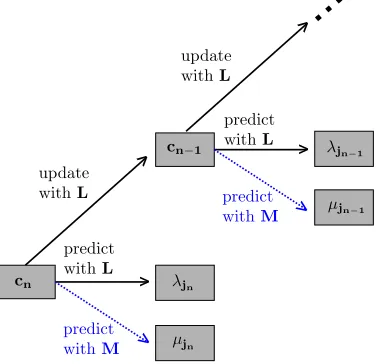
Figure 1: The complex-valued lifting scheme (C-LOCAAT). Solid lines correspond to the
steps of the standard LOCAAT lifting scheme whereas dotted lines indicate the extra
predic-tion step required for the complex-valued scheme. After (n−R) applications, the function can be represented as a set of R smooth coefficients {cr−1,i}i∈Sn−R and (n−R) detail coefficients
{λjk+iµjk}k∈Dn−R, each associated with a particular scale {αjk}k∈Dn−R.
2.2
Filter construction
The proposed complex-valued lifting transform is illustrated schematically in Figure 1 in
terms of two general prediction filters L and M. As already explained, we construct the
second filter (M) orthogonal on L, thus ensure different signal content extraction.
For clarity of exposition, let us consider a LOCAAT scheme with a prediction step based
upon two neighbours in a symmetrical configuration. The regression over the neighbourhood
generates prediction weights for the two neighbours, let us denote them by l1 and l3 (see
(L) of the form (l1,1, l3), which depends on the sampling of the observationsx= (x1, . . . , xn)
(Nunes et al., 2006). We determine the unique (up to proportionality) three-tap filter M
that is orthogonal on L and ensures at least one vanishing moment. Hence we can express
the set of filter pairs as having the form
L = (l1,1, l3), l1, l3 >0
M = (m1, m2, m3),
and l1m1 +m2 +l3m3 = 0 (i.e. L·M = 0) and l1+l3 = 1, m1+m3 = m2 (i.e. ensure
one vanishing moment). The solution to these constraints can be parameterised as M =
(−1+l3
1+l1m,
l1−l3
1+l1m, m). The proportionality constant can be determined by bringing both
filters L and M to the same scale through kLk = kMk, which yields m = l1√+1
3 . Hence the
solution can be succinctly written as M = (Am,(1 +A)m, m) with A= l1−2
l1+1 and m=
l1√+1
3 .
This particular example of the lead filter L represents a prediction scheme using linear
regression with two neighbours in a symmetrical configuration. This is a choice that has
proved to be successful both for (real-valued) nonparametric regression (Nunes et al., 2006;
Knight and Nason, 2009) and for (real-valued) spectral estimation (Knight et al., 2012).
Since L can be viewed as a prediction filter for a real-valued LOCAAT scheme, we
can also employ the adaptive prediction filter choice of Nunes et al. (2006) in our proposed construction. The ‘best’ local regression (order and neighbourhood) is chosen at each predict
step, subject to yielding minimising the detail coefficients. Consequently, we obtain an
adaptive complex-valued lifting transform, with the highly desirable flexibility of being able to adapt to the local characteristics of the data – see Appendix B in the supplementary
material for an illustration of this adaptiveness in the nonparametric regression setting.
The orthogonality of the two filters M and L also mirrors the attractive properties of
Fourier sinusoids, hence this choice results in an interpretable quantification of phase, which
shall further be exploited according to the context—by phase alteration when denoising
real-valued signals, or by ensuring phase preservation in the context of spectral estimation.
A further insight and justification of the proposed filter choice is provided in Appendix
2.3
The nondecimated complex-valued lifting transform
In the classical wavelet literature, the nondecimated wavelet transform (NDWT) (Nason
and Silverman, 1995) has properties that make it a better choice than the discrete wavelet
transform (DWT) for certain classes of problems, see e.g. Percival and Walden (2006). The
concept is akin to basis averaging, and has delivered successful results in both
nonpara-metric regression and spectral estimation problems, not only in the classical wavelet setting
(NDWT) but also for irregularly spaced data through the nondecimated lifting transform
(NLT) (Knight and Nason, 2009; Knight et al., 2012).
In this section, we also exploit the benefits of this nondecimation paradigm for irregularly
sampled data and to this end, we shall introduce the complex-valued nondecimated lifting transform (CNLT). However, note that our use of the term ’nondecimation’ differs from the
classical NDWT. Specifically, due to the irregular sampling structure, nondecimation cannot
be performed via decomposing shifts of input data without data interpolation.
Although similar in spirit to the NLT, our transform hinges on the proposed
complex-valued lifting scheme (Section 2.1) and therefore yields an overcomplete complex-complex-valued data
representation, extracting additional signal information. In particular, the CNLT algorithm
results in a wavelet transform that yields (complex-valued) wavelet coefficients at each grid
point (x) and at multiple scales (α).
Next we shall describe our proposed univariate and bivariateCNLT techniques. We shall
show that in the nonparametric regression setting, our univariate proposal significantly
out-performs current wavelet and non-wavelet denoising techniques (see Section 4 and Appendix
B), while its bivariate extension allows for estimation of the dependence between pairs of
series (see Section 3).
2.3.1 Univariate CNLT
So far, the proposed complex-valued lifting scheme decomposes the original signal {(xi, fi = f(xi))}ni=1into a set ofRsmooth coefficients and (n−R) complex detail (wavelet) coefficients,
with each detail coefficient djk corresponding to exactly one scale αjk.
We now aim to construct a new scheme that transforms the original signal into a collection
wavelet coefficients spread over all scales, rather than just one. The key to our proposal is
to note that if an observation is removed early in the LOCAAT algorithm, its associated
detail coefficient has a fine scale; conversely, if a point is removed later in the algorithm, it
is associated with a larger scale.
We therefore propose to repeatedly applyC-LOCAAT using randomly drawn trajectories,
Tp for p= 1, ..., P, where each removal order Tp is generated by sampling (n−R) locations
without replacement from (x1, . . . , xn); we refer to this algorithm as CNLT.
Following this procedure, a set ofP detail coefficients{dp xk}
P
p=1 is generated at each
loca-tion xk, wheredpxk denotes the wavelet coefficient at locationxk obtained using C-LOCAAT
with trajectory Tp. At any given locationxk, the set of P detail coefficients will be
associ-ated with different scales, {αp xk}
P
p=1; note that this differs from the classical NDWT which
produces exactly one detail coefficient at each location and dyadic scale.
Similar to the NLT, the number of trajectoriesP should be ‘large enough’ to ensure that an ample number of coefficients is produced at as many scales and locations as possible,
subject to computational constraints (Knight and Nason, 2009; Knight et al., 2012).
2.3.2 Bivariate CNLT
We now consider the extension of CNLT to the analysis of bivariate series.
Same irregular grid. Let us first assume we have observations {(xi, fi1, fi2)}ni=1 on two
functions f1 and f2, measured on the same x-grid. Apply the univariate CNLT (Section
2.3.1) to each signal, using the same set of trajectories {Tp}Pp=1 for both series.
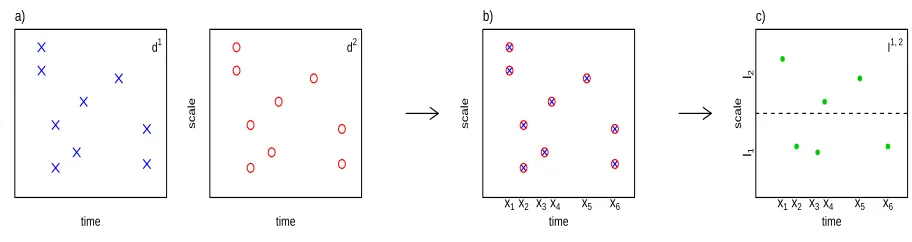
The identical sampling grids results in an exact correspondence between the coefficients
of each series, i.e. for each coefficient of the first series there is a coefficient of the second
series at exactly the same location and scale (see Figure 2a). In other words, after application
of the CNLT to both series, for each time point, xk, we obtain two sets of complex-valued
detail coefficients {d1,p xk}
P
p=1 and {d2x,pk}
P p=1.
Different irregular grids. Let us now assume we have the data {(x1
i, x2i, fi1, fi2)}ni=1 on
two functions f1 and f2, measured on the differentx-grids.
time scale d1 a) time scale d2 time scale
x1x2 x3x4 x5 x6
b)
time
scale
I1, 2
l1
l2
x1x2 x3x4 x5 x6
[image:12.595.68.524.70.191.2]c)
Figure 2: Construction of bivariate CNLT transform for time series observed on the same
sampling grid (x refers to time here): a) univariate CNLT is applied using the same set of
trajectories for both series and yields two sets of detail coefficients {d1,p
xk}p,k and {d
2,p
xk}p,k; b)
the CNLT transform consists of combinations of coefficients from each series; c) the detail
coefficients are averaged within each scale.
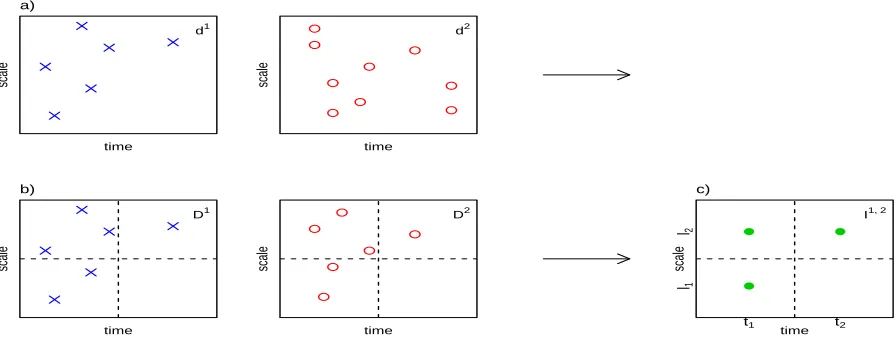
we partition the x-grid into a set of artificial x-intervals {x(j)}T∗
j=1, where T∗ is chosen to
provide the desired resolution level on the x-axis. As illustrated in Figure 3, the result can be visualised in terms of forming a grid over the area of the resulting detail coefficients.
Formally, for each artificialx-interval{x(j)}T∗
j=1 and artificial scale{ℓi}J
∗
i=1, the set of detail
coefficients for each grid square (using trajectories {Tp}Pp=1) is given by
D1
x(j)(ℓi) = Gm d1x,p1
k|α
1,p x1
k ∈ℓ
i, x1
k ∈x( j)
(7)
Dx2(j)(ℓi) = Gm d2x,p2
k|α
2,p x2
k ∈ℓ
i, x2
k ∈x
(j)
, (8)
where d1x,p1
k = λ
1,p x1
k + iµ
1,p x1
k and d
2,p x2
k =λ
2,p x2
k + iµ
2,p x2
k are the complex-valued wavelet coefficients
fromf1 andf2, and G
m is a random sampling procedure selectingmi,j = min(#(d1),#(d2))
coefficients. Recall that α1x,p1
k and α
2,p x2
k represent the scales (log2 of span) associated to the
coefficients d1x,p1
k and d
2,p
x2k. Thus for each artificial x-interval and scale, we obtain the same
number of detail coefficients (although the exact coordinates of the coefficients may differ).
We term these constructions as the bivariate complex nondecimated lifting transform
(bivariateCNLT) on the same/different grid(s), as appropriate. Section 3 will discuss
appli-cations where the proposed bivariateCNLT construction provides a framework for estimation
time
scale
a)
d1
time
scale
d2
time
scale
b)
D1
time
scale
D2
time
scale
c)
I1, 2
l1 l2
[image:13.595.74.522.74.251.2]t1 t2
Figure 3: Construction of bivariate CNLT transform for time series observed on different
sampling grids (x refers to time here): a) each series is lifted individually as described in Section 2.3; b) the sets of coefficients in each grid square. The coefficients are sampled so
that there is the same number in the grid square of each series; c) the coefficients of each
series are combined to form the appropriate bivariate quantities, producing one coefficient
to represent each grid square.
3
Complex lifting analysis of irregularly sampled time
series
Spectral analysis is an important tool in describing content in time series data,
complemen-tary to time domain analysis. In particular, the Fourier spectrum allows a decomposition in
terms of sinusoidal components at different frequencies, giving a description of the strength of
periodic behaviour within the series. Such traditional methods are based on the assumption
of second-order stationarity, although extensions to deal with non-stationarity exist, such as
the short-time Fourier transform (STFT, Allen (1977); Jacobsen and Lyons (2003)) or more
sophisticated time-frequency analysis methods (e.g. locally stationary time series, Nason
et al. (2000); SLEX, Ombao et al. (2002)). Similarly, cross-spectral analysis of multivariate time series can be used to describe and study the interrelationships between many variables
of interest observed simultaneously over time, see Reinsel (2003) or L¨utkepohl (2005) for
stationary wavelet approach.
This work aims to deal with a further additional challenge, that of irregular sampling.
Irregularly sampled time series arise in many scientific applications, e.g. finance (Engle,
2000; Gen¸cay et al., 2001), astronomy (Bos et al., 2002; Broerson, 2008) and environmental
science (Witt and Schumann, 2005; Wolff, 2005) to name just a few. Many applications deal
with the sampling irregularity either by means of a time-frequency Lomb-Scargle approach
under the assumption of time series stationarity (Van´ıˇcek, 1971; Lomb, 1976; Scargle, 1982),
or process the data prior to analysis, restoring it to a regular grid then suitable for analysis
by standard methods, see for example Erdogan et al. (2004) or Broerson (2008). Although
it is convenient to work within a regularly spaced time series setting, a typical result will
amount to signal smoothing, leading to information loss at high frequencies and estimation
bias (Frick et al., 1998; Rehfeld et al., 2011).
Many time series observed in practice will exhibit (second-order) nonstationary behaviour
as well as being irregularly sampled. Although the literature does currently offer (albeit
few) options for the analysis of irregularly sampled nonstationary series (see e.g. Foster
(1996); Frick et al. (1998); Knight et al. (2012)), there is no well established method for
estimating the dependence between pairs of such signals. In the next section, we propose to
describe the local frequency content of irregularly sampled time series by making use of the
proposed complex-valued lifting scheme and introducing a complex-valued cross-periodogram
and associated measures.
3.1
The complex lifting periodogram
Recall that the CNLT provides a set of detail coefficients and associated scales{dp xk, α
p xk}
P p=1,
where the scale associated with each detail coefficientαp
xk is a continuous quantity. In a spirit
similar to that of Knight et al. (2012), this information will allow a time-scale decomposition
(typically termed the (wavelet) periodogram) of the variability in the data, with the crucial
difference that the wavelets coefficients are now complex-valued and therefore contain more
information. In constructing the periodogram, we use a set of discrete artificial scales,
{ℓi}J∗
i=1, which partitions the range of the continuous lifting scales{αxpk}for allpandk, with J∗ chosen to provide a desired periodogram ‘granularity’. Each scale αp
xk will fall into one
unique level ℓi for each p and observation x
trajectories such that xk is associated with a scale in the set ℓi, and ni,k =|Pi,k| denote the
size of the set. For each time point xk, k = 1, . . . , n and artificial scale ℓi, i = 1, . . . , J∗, we
introduce the complex lifting periodogram(also referred to in text as CNLT periodogram)
Ixk(ℓ
i) = 1 ni,k
X
p∈Pi,k
|dp xk|
2 = 1
ni,k
X
p∈Pi,k
(λp xk)
2+ 1
ni,k
X
p∈Pi,k
(µp xk)
2,
where | · | denotes the complex modulus.
3.2
The complex lifting cross-periodogram
Similar to other complex wavelet transforms (Portilla and Simoncelli, 2000; Selesnick et al.,
2005), the complex-valued nature of the bivariate CNLT coefficients (see Section 2.3.2)
pro-vides both local phase and spectral information. In order to estimate the dependence between
pairs of time series, we first define the complex lifting cross-periodogram, the cross-spectral analogue of the periodogram. As in Section 2.3.2, our discussion will be split based on
whether the data has been sampled over the same or different grids.
Bivariate time series observed on the same grid. For each time pointxk,k = 1, . . . , n
and artificial scale ℓi, i = 1, . . . , J∗, define the complex lifting cross-periodogram (also
re-ferred to as CNLT cross-periodogram) for series observed on the same grid as
I(1,2)
xk (ℓ
i) = 1
ni,k
X
p∈Pi,k d1,p
xkd
2,p
xk, (9)
where d1,p xk = λ
1,p xk + iµ
1,p
xk and d
2,p xk = λ
2,p xk + iµ
2,p
xk are the detail coefficients from f
1 and f2.
The CNLT cross-periodogram consists of combinations of coefficients from each series and
provides information about the relationship between the signals. Note that unlike theCNLT
periodogram, the cross-periodogram is complex-valued.
Similar to classical Fourier cross-spectrum methodology (see e.g. Priestley (1983)), the
CNLT cross-periodogram can be separated into its real and imaginary parts to define the
CNLT co-periodogram and theCNLT quadrature periodogram, respectively resulting in
cxk(ℓ
i
) = 1
ni,k
X
p∈Pi,k λ1x,pkλ
2,p xk +
1
ni,k
X
p∈Pi,k µ1x,pkµ
2,p xk,
qxk(ℓ
i) = 1
ni,k
X
p∈Pi,k µ1,p
xkλ
2,p xk −
1
ni,k
X
p∈Pi,k λ1,p
xkµ
These quantities, together with the individual lifting spectra of each process, can be used to
calculate the measures of phase and coherence between the two series f1 and f2:
φxk(ℓ
i
) = tan−1−qxk(ℓ
i) cxk(ℓ
i)
, (10)
ρxk(ℓ
i) =
p
cxk(ℓ
i)2+q
xk(ℓ
i)2 q
Ix(1)k(ℓ
i)I(2) xk(ℓ
i)
. (11)
The CNLT cross-periodogram provides a measure of the dependence between series, but its
magnitude is affected by the individual CNLT periodograms of the signals. Hence as in the
regularly sampled setting, it is preferable to normalise this quantity, providing a coherence
measure that satisfies 0≤ρxk(ℓ
i)≤1 (as in (11)). This is similar to the coherence measure
for regularly sampled signals introduced in Sanderson et al. (2010). The CNLT phase as
defined in (10) provides an indication of any time lag between the signals. Several examples
examining the coherence and phase between signal pairs are given in Section 3.3.
Bivariate time series observed on different grids. Closer to real data scenarios, we
now consider time series that were sampled over different irregular grids, with one such
real data example being discussed in Section 3.3.3. In order to obtain the cross-spectral
quantities, we combine the appropriate sets of detail coefficients for each grid, corresponding
to f1 and f2, i.e. D1
x(j)(ℓi) and Dx2(j)(ℓi) introduced in equations (7) and (8). For each
artificial time period, x(j), j = 1, . . . , T∗ and artificial scale ℓi, i = 1, . . . , J∗, we define the
complex lifting cross-periodogram for series observed on different irregular grids as
Ix(1(j,2)) (ℓ
i
) = 1
ni,j ni,j
X
s=1
order{D1x(j)(ℓ
i
)}sorder{D2x(j)(ℓi)}s, (12)
where ni,j is the number of pairs in the grid square defined at time x(j) and scale ℓi, and
order{D}s indicates thesth time-ordered detail.
If the sampling schemes coincide for the two series ({x1
k}k ≡ {x2k}k) and the same
tra-jectories are used to generate the details {d1,p
xk}p,k, respectively {d
2,p
xk}p,k, then equations (9)
and (12) coincide, except for the quantities being also averaged over the defined artificial
time period. The co- and quadrature periodograms may be obtained in the same fashion as
Figures 2 and 3 provide a visual representation for the complex lifting cross-periodogram
construction under the assumption of the same, respectively different sampling grids.
We now make some remarks about the proposed periodogram constructions.
Scale interpretation. The relationship between artificial scale (ℓi) and classical Fourier
frequency can be described in terms of the scale which maximises the coherence for a Fourier
wave of periodT. Definingρ(ℓi) = 1
n
Pn
k=1ρxk(ℓ
i), the design of the filters outlined in Section
2.2 is such that ℓi = argmax
j∈{1,...,J∗}ρ(ℓ
j) =T /3.
We emphasise that this relationship is dictated by the choice of filter pairs: the CNLT
periodogram and co-periodogram (as defined above) are composed of the sum of the wavelet
coefficients from the two schemes, while the quadrature periodogram contains products of the
coefficients. Hence to ensure that the resulting estimates are interpretable, the two filters are
specified so that combinations of coefficients (either through multiplication or summation)
provide the same scale-frequency relationship (see Sanderson (2010), Sections 5.3 and 6.2.1).
The provided mapping between wavelet lifting scale and Fourier frequency can be used to
compare our results to those of classical Fourier-based methods (see Section 3.3 next).
Periodogram smoothing over time. As is customary, the CNLT periodogram will be
smoothed over time using simple moving average smoothing, i.e. we compute ˜Ixk(ℓ
i) =
1 #(Mi
k)
P
j∈Mi kIxj(ℓ
i), where Mi
k={j:xk−Mi < xj ≤xk+Mi} and Mi denotes the width
of the averaging window, permitted to take different values for each scale, li.
3.3
Examples
We now illustrate the proposed methodology by application to both simulated and real
irregular time series. The results were produced in theR statistical computing environment (R Core Team, 2013), using modifications to the code from the adlift package (Nunes and Knight, 2012) and the nlt package (Knight and Nunes, 2012).
3.3.1 Simulated data
Signals sampled on the same irregular sampling grid. In this example, the
{(xk, fk1, fk2)}200k=1, where
fk1 = sin
2πxk
10
+ sin
2πxk
30
+ sin
2πxk
70
+ζk1,
fk2 = sin
2π(xk−τ)
30
+ζk2,
where τ = 0 for xk < 200 and τ = 6 for xk ≥ 200, and the quantities ζk1 and ζk2 are
independent, identically distributed Gaussian variables with mean zero and variance 0.22.
The observations are irregularly sampled such that (xk+1−xk)∈ {n/10 :n = 10,11, . . . ,30}
and (n−11)Pn−1
k=1(xk+1−xk) = 2.
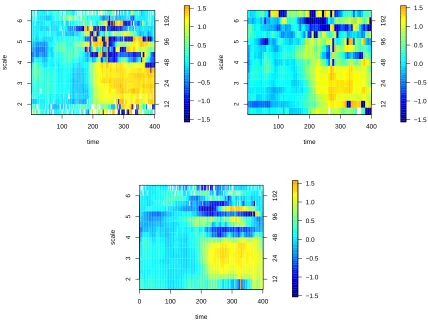
Estimates for coherence and phase are computed using the complex-valued lifting scheme
using a sample of P = 1500 randomly sampled trajectories, discretising using J∗ = 20
artificial scales and smoothing over time using a window of width Mi = 60, ∀ i. The
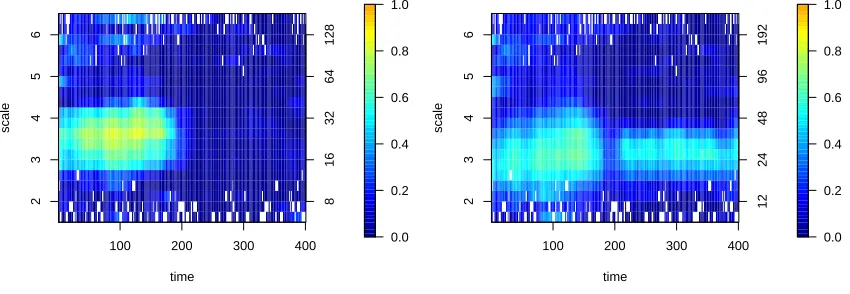
coherence estimate (Figure 4, right) provides a clear visualisation of the dependence between
the two series, with a peak occurring at scale log2(30/3) = 3.3 (equivalent to a Fourier period
of 30). The time lag that is introduced halfway through the second signal is also clearly
captured by the phase estimate (Figure 5, left), which is approximately zero for the first half
of the series, then shows a marked increase for the second half.
time
scale
100 200 300 400
2 3 4 5 6 8 16 32 64 128 0.0 0.2 0.4 0.6 0.8 1.0 time scale
100 200 300 400
[image:18.595.78.503.440.587.2]2 3 4 5 6 12 24 48 96 192 0.0 0.2 0.4 0.6 0.8 1.0
Figure 4: Coherence estimation for data observed on the same irregular sampling grid: using
the real-valued bivariate lifting scheme (left); using the complex-valued lifting scheme (right).
Scale gets coarser from bottom upwards.
For comparison, the estimated coherence using a real-valued bivariate scheme (Sanderson,
time
scale
100 200 300 400
2 3 4 5 6 12 24 48 96 192 −1.5 −1.0 −0.5 0.0 0.5 1.0 1.5 time scale
100 200 300 400
2 3 4 5 6 12 24 48 96 192 −1.5 −1.0 −0.5 0.0 0.5 1.0 1.5 time scale
0 100 200 300 400
[image:19.595.76.504.89.418.2]2 3 4 5 6 12 24 48 96 192 −1.5 −1.0 −0.5 0.0 0.5 1.0 1.5
Figure 5: Phase estimation using the complex-valued lifting scheme: data observed on the
same irregular sampling grid (left); data observed on different irregular sampling grids (right);
data observed on the same regular grid (bottom). Scale gets coarser from bottom upwards.
also clearly estimates a dependence for the first half of the series, it does not continue to
detect it following the time delay. This again emphasises the advantage of using a second
filter, present in the complex-valued lifting transform.
Signals sampled on different irregular sampling grids. The methods described in
Section 3.2 are now demonstrated by revisiting the same simulated data example, but with
the two series observed on different irregularly spaced sampling grids: {(x1
k, x2k, fk1, fk2)}200k=1.
Aside from the sampling, the series satisfy the same properties as previously described.
The estimates were obtained using a discretisation ofJ∗ = 15 artificial scales andT∗ = 60
as in the previous example. The resulting estimated coherence and phase are shown in
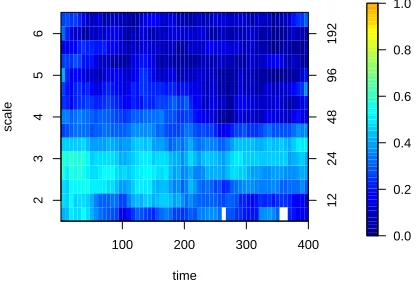
Figure 6, respectively Figure 5, right. It is interesting to note that while estimates broadly
agree with those corresponding to sampling using the same (irregular) grid (Figure 4 and
Figure 5, left), the price to pay for the different sampling schemes is the reduced clarity of
the estimator. This is point is further reinforced by the phase estimate corresponding to a
regular sampling situation, see Figure 5, bottom.
time
scale
100 200 300 400
2
3
4
5
6
12
24
48
96
192
[image:20.595.185.394.226.367.2]0.0 0.2 0.4 0.6 0.8 1.0
Figure 6: Coherence estimation for data observed on different irregular sampling grids. Scale
gets coarser from bottom upwards.
Coherence and phase analysis comparison with Fourier-based methods. For
com-parison with established Fourier-based techniques, we also performed coherence analysis of
stationary, regularly sampled vector autoregressive (VAR) processes, as well as phase
analy-sis of the signals described above. For regularly sampled stationary processes, we compared
our estimates to the well-behaved Fourier estimates, while in the presence of sampling
ir-regularity/nonstationarity, we compared our method to the short-time Fourier transform
(STFT) and the Lomb-Scargle method. For brevity, we do not include the coherence and
phase comparison plots here, but they can be found in Appendix A of the supplementary
material.
Specifically, in the supplementary material we illustrate the coherence estimates obtained
through both a classical Fourier-based approach and our lifting-based method on two
displaying a slight depreciation when compared to the well-behaved Fourier estimates, suited
for regular sampling and stationary process behaviour. However, in general if the data is
believed to be amenable to be analysed with standard methodology, Fourier-based
estima-tion should be preferred to the proposed method which was specifically designed to offer a
solution for the challenging situations that include irregular sampling.
As already highlighted, traditional methods do not readily handle data that feature both
potential nonstationarities and irregular sampling, thus STFT required further intervention
while the Lomb-Scargle method failed to account for nonstationarity. Thus in order to obtain
the desired phase analysis, we mapped the irregular data to a regular grid (by e.g.
interpo-lation) and then used STFT in order to capture the nonstationary time-frequency content of
the data. The Lomb-Scargle analysis naturally dealt with the sampling irregularity, but
as-sumed stationarity and therefore it did not provide time-localisation information. The phase
estimation plots of the STFT method exhibit little resolution in time or frequency, possibly
due to the spectral blurring induced by the overlapping windows in the STFT as noted in
Shumway and Stoffer (2013). Furthermore, for signals sampled over different irregular grids,
the method creates additional blurring in the phase plot. By contrast, the Lomb-Scargle
method is able to deal naturally with the irregular sampling structure of the signals, but it
does not contain any time-phase information. In addition, there is no marked distinction in
frequency where the phase is large, unlike for that of our complex lifting method (see Figure
5). These features yet again highlight the appeal of our technique.
3.3.2 Simulated data with varying time delay
The next example explores the effect of increasing the time delay between two signals. For
each value of τ = 1, . . . ,15, the series {(xk, fk1, fk2)}200k=1 are simulated following
fk1 = sin
2πxk
30
+ζk1,
fk2 = sin
2π(xk−τ)
30
+ζk2,
where (xk+1 −xk)∈ {n/10 : n = 10,11, . . . ,30} and (n−11)
Pn−1
k=1(xk+1−xk) = 2, ζk1 and ζk2
are independent, identically distributed Gaussian variables with mean zero, variance 0.22.
Just as in the classical (Fourier) analysis, it is interesting to inspect the coherence and
series and possible time delays, respectively. The estimated coherence and phase
correspond-ing to the increascorrespond-ing τ = 1, . . . ,15 are shown in Figure 7. To give an overall sense of the coherence and phase magnitude over time, the estimates are averaged over the full time
range to give ρ(ℓi) = 1 200
P200
k=1ρxk(ℓ
i). We used P = 750 randomly sampled trajectories and
discretised using J∗ = 20 artificial scales.
When τ = 0, the coherence is 1 and the phase is 0. For τ 6= 0 the coherence is greatest at a scale of log2(30/3), corresponding to the period of variation (T = 30) in the data. The coherence intensity and response over scale are affected by the magnitude of the time delay.
The coherence is lowest at time delays around 7.5 (T /4), and at these shifts the peak at scale log2(30/3) is also more pronounced. At τ = 15 (T /2) the signals are sign reversed versions
of each other and, again, the observed coherence is 1 at all scales. The phase is also greatest
at scale log2(30/3). The phase response varies as a function of time delay and alternates
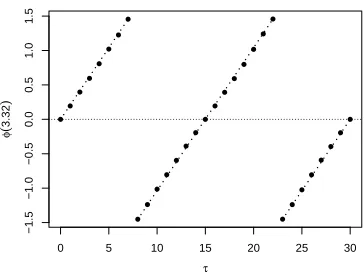
between positive and negative values, with |φ(ℓi)| maximised at ℓi =T /4. This is displayed
in Figure 8 which shows the estimated phase at scale log2(30/3) as a function of time delay. For completeness, we also provide a direct comparison with classical Fourier coherence
and phase estimation when the signals are regularly sampled (see Figure 9). Whilst the
overall behaviour is similar for both the classical and CNLT methods, the Fourier method
displays less variability across coherence estimates with the changing time delay (Figure
9, left), as well as more localised phase-frequency information (Figure 9, right). However,
in general, note that if the data is believed to be amenable to be analysed with standard
methodology, this should be preferred to the proposed CNLT method which was specifically
designed to offer a solution for the challenging situations that include irregular sampling.
3.3.3 Financial time series
In this section we demonstrate the use of the proposed complex-valued lifting transform
through an application to financial data consisting of prices of all trades on 1 March 2011
(in normal trading hours) for two IT companies, Baidu and Google, both traded on the
NASDAQ stock exchange. Comparison of the two companies is of interest as the main
product of both is a search engine, but they are based in different geographical regions.
Often several trades per second occur and in this case the last quoted value for each
scale coherence (a v er age) 0.0 0.2 0.4 0.6 0.8 1.0
1 2 3.32 4
a) scale phase (a v er age) −1.5 −1.0 −0.5 0.0 0.5 1.0 1.5
1 2 3.32 4
b) τ 0 1 2 3 4 5 6 7 8 9 10 11 12 13 14 15
Figure 7: a) Coherence and b) Phase between f1 andf2 (Section 3.3.2) as a function of scale
and τ ∈0,15. Forτ 6= 0 the coherence and (absolute) phase are greatest at scale log2(30/3).
0 5 10 15 20 25 30
[image:23.595.111.473.66.208.2]−1.5 −1.0 −0.5 0.0 0.5 1.0 1.5 τ φ ( 3.32 )
Figure 8: Estimated phase between f1 andf2 (Section 3.3.2) at scale log
2(30/3) (equivalent
to a Fourier period of 30), as a function of τ.
with no trades, the time series are not equally spaced. For the analysis we consider the
returns of each series– for Google, the series contains 7984 observations with an average
sampling distance of 2.93 seconds and range 1 to 48; for Baidu, the series contains 6535
observations with an average sampling gap of 3.58 seconds and range 1 to 52.
The data was analysed using the methodology described in Section 3.2 using J∗ = 15
artificial scales and T∗ = 390 artificial time intervals (each time interval has a width of 60
seconds). The estimates were smoothed over time using a window width ofM1 = 60 minutes
at the finest scale and increasing by a factor of 1.05, to provide a larger smoothing window
[image:23.595.200.382.302.438.2]frequency coherence 0.0 0.2 0.4 0.6 0.8 1.0
0 0.05 0.1 0.15
a) frequency phase −1.5 −0.5 0.5 1.0 1.5
0 0.05 0.1 0.15
b) τ 0 1 2 3 4 5 6 7 8 9 10 11 12 13 14 15
Figure 9: a) Coherence and b) Phase between f1 and f2 (Section 3.3.2) as a function of
frequency and τ ∈0,15 using classical Fourier methods.
The main feature of the resulting coherence estimate is an increased coherence around scale
6, corresponding to a Fourier frequency of T ≈3 minutes. The magnitude of the coherence at this scale is seen to be more pronounced towards the end of the day. There is also a period
of higher coherence observed in the middle of the day, at low wavelet scales (corresponding
to high frequency information).
time (mins)
scale
100 200 300
0 2 4 6 8 10 a) 0.00 0.02 0.04 0.06 0.08 0.10 0.12 0.14 time (mins) scale
100 200 300
[image:24.595.86.473.89.245.2]6 7 8 9 10 b) 0.0 0.1 0.2 0.3 0.4 0.5 0.6
Figure 10: Coherence between Google and Baidu using methods from Section 3.2: a)
com-puted on different irregular sampling grids; b) comcom-puted using one minute averages. Scale
gets coarser from bottom upwards.
[image:24.595.82.504.455.603.2]minute average returns. The estimated coherence using the aggregated data is shown in
Figure 10b), where J∗ = 10 artificial scales and T∗ = 78 artificial time intervals (each
representing a range of 5 minutes) were used. Notice that finer behaviour details are erased,
reflecting the coarser sampling rate of the averaged data, and that spurious coherence is
unsurprisingly induced by aggregation.
4
Real nonparametric regression using complex lifting
As with the traditional wavelet and lifting transforms, our proposed complex nondecimated
lifting transform can be used for nonparametric regression problems, including those with
nonequispaced sampling design. In a nutshell, the proposed smoothing procedure can be
described as (i) perform the complex lifting transform of the original data, (ii) combine
the real and imaginary coefficients into a statistic to undergo thresholding/shrinkage and
(iii) take the inverse lifting transform to obtain the estimated unknown signal. A detailed
description and estimator properties are provided in Appendix B (supplementary material).
We briefly illustrate the application of this technique to the ethanol data example from
Brinkman (1981) that has been analyzed extensively, see for instance Kovac and Silverman
(2000) and Cleveland et al. (1992). The data consist of 88 measurements of NOx exhaust emissions from an automobile test engine, together with corresponding engine equivalence
ratios, a measure of the richness of the air/ethanol mix (Kovac and Silverman, 2000; Loader,
1999). Because of the nature of the experiment, the observations are not available at
equally-spaced design points, and the variability is larger for low equivalence ratios.
We estimate the ratio-dependent (heteroscedastic) variance using a wavelet domain local
estimation procedure similar to that of Kovac and Silverman (2000) and Nunes et al. (2006).
Note that our complex adaptive lifting estimate is very similar to the smoothing spline,
and both identify changes in slope around 0.7 and 0.9. However, the magnitude and duration
of these effects appear to be different between the two estimates. The real-valued adaptive
lifting estimate has an overall similar appearance albeit being less smooth and featuring
more abrupt changes that are unlikely to be true features of the process. In this example,
the true shape of the ethanol curve is of course unknown, however we believe that it is more
0.6 0.7 0.8 0.9 1.0 1.1 1.2
1
2
3
4
Engine equivalence ratio
NOx
0.6 0.7 0.8 0.9 1.0 1.1 1.2
1
2
3
4
Engine equivalence ratio
NOx
0.6 0.7 0.8 0.9 1.0 1.1 1.2
1
2
3
4
Engine equivalence ratio
[image:26.595.107.467.83.441.2]NOx
Figure 11: Ethanol data and estimates. Small circles=data; solid line=estimate. Top-left:
smoothing spline with cross-validated smoothing parameter; top-right: multiple observation
adaptive lifting using R-lift with heteroscedastic variance computation and EbayesThresh
posterior median thresholding; bottom: C-AP1S with heteroscedastic variance computation
and level-dependent soft thresholding.
job in this case.
Supplementary Materials
The supplementary materials contain additional results and comparisons with other methods.
The R packagesCNLTregandCNLTtsaimplementing the regression and time series techniques
Acknowledgements
The authors would like to thank the two anonymous referees for helpful suggestions which
led to a much improved manuscript.
References
Abbas, A. and T. D. Tran (2006). Multiplierless design of biorthogonal dual-tree complex
wavelet transform using lifting scheme. In IEEE International Conference on Image Pro-cessing. 2006, pp. 1605–1608. IEEE.
Abramovich, F., T. Bailey, and T. Sapatinas (2000). Wavelet analysis and its statistical
applications. Journal of the Royal Statistical Society D 49(1), 1–29.
Allen, J. (1977). Short-term spectral analysis, and modification by discrete fourier transform.
IEEE Transactions on Acoustics Speech and Signal Processing 25(3), 235–238.
Barber, S. and G. P. Nason (2004). Real nonparametric regression using complex wavelets.
Journal of the Royal Statistical Society B 66(4), 927–939.
Bos, R., S. de Waele, and P. M. T. Broersen (2002). Autoregressive spectral estimation
by application of the Burg algorithm to irregularly sampled data. IEEE Transactions on Instrumental Measurement 51(6), 1289–1294.
Brinkman, N. D. (1981). Ethanol fuel-a single-cylinder engine study of efficiency and exhaust
emissions. Technical report, SAE Technical Paper.
Broerson, P. M. T. (2008). Time series models for spectral analysis of irregular data far
beyond the mean data rate. Measurement Science and Technology 19, 1–13.
Cleveland, W., E. Grosse, and W. Shyu (1992). Local regression models. InStatistical Models in S. Chambers, J.M. and Hastie, T.J. (eds).
Erdogan, E., S. Ma, A. Beygelzimer, and I. Rish (2004). Statistical models for unequally
spaced time series. In Proceedings of the 5th SIAM International Conference on Data Mining. SIAM.
Fernandes, F. C. A., I. W. Selesnick, R. L. C. van Spaendonck, and C. S. Burrus (2003).
Complex wavelet transforms with allpass filters. Signal Processing 83(8), 1689–1706. Foster, G. (1996). Wavelets for period analysis of unevenly sampled time series. The
Astro-nomical Journal 112(4), 1709–1729.
Frick, P., A. Grossman, and P. Tchamitchian (1998). Wavelet analysis for signals with gaps.
Journal of Mathematical Physics 39, 4091–4107.
Gen¸cay, R., M. Dacorogna, U. A. Muller, O. Pictet, and R. Olsen (2001). An Introduction to High-Frequency Finance. Academic press.
Hall, P. and P. Patil (1996). On the choice of smoothing parameter, threshold and truncation
in nonparametric regression by non-linear wavelet methods.Journal of the Royal Statistical Society B, 361–377.
Jacobsen, E. and R. Lyons (2003). The sliding DFT.IEEE Signal Processing Magazine 20(2), 74–80.
Jansen, M., G. Nason, and B. Silverman (2001). Scattered data smoothing by empirical
bayesian shrinkage of second generation wavelet coefficients. In M. Unser and A. Aldroubi
(Eds.),Wavelet Applications in Signal and Image Processing IX, Volume 4478, pp. 87–97. SPIE.
Jansen, M., G. P. Nason, and B. W. Silverman (2009). Multiscale methods for data on graphs
and irregular multidimensional situations. Journal Of The Royal Statistical Society Series B 71(1), 97–125.
Kingsbury, N. (1999). Image processing with complex wavelets. Philosophical Transac-tions of the Royal Society of London A: Mathematical, Physical and Engineering Sci-ences 357(1760), 2543–2560.
Kingsbury, N. (2001). Complex wavelets for shift invariant analysis and filtering of signals.
Applied and Computational Harmonic Analysis 10(3), 234–253.
Knight, M. I. and G. P. Nason (2009). A ‘nondecimated’ lifting transform. Statistics and Computing 19, 1–16.
Knight, M. I. and M. A. Nunes (2012). nlt: a nondecimated lifting scheme algorithm. R package version 2.1-3.
Knight, M. I., M. A. Nunes, and G. P. Nason (2012). Spectral estimation for locally stationary
time series with missing observations. Statistics and Computing 22(4), 877–895.
Kovac, A. and B. W. Silverman (2000). Extending the scope of wavelet regression
meth-ods by coefficient-dependent thresholding. Journal of the American Statistical Associa-tion 95(449), 172–183.
Lina, J.-M. and M. Mayrand (1995). Complex Daubechies wavelets. Applied and Computa-tional Harmonic Analysis 2(3), 219–229.
Loader, C. (1999). Local Regression and Likelihood. Springer: New York.
Lomb, N. (1976). Least-squares frequency analysis of unequally spaced data. Astrophysics and Space Science 39(2), 447–462.
L¨utkepohl, H. (2005). New introduction to multiple time series analysis. Springer Science & Business Media.
Magarey, J. and N. Kingsbury (1998). Motion estimation using a complex-valued wavelet
transform. IEEE Transactions on Signal Processing 46(4), 1069–1084.
Nason, G. and B. Silverman (1995). The stationary wavelet transform and some applications.
Nason, G. P. (2008). Wavelet Methods in Statistics with R. Springer.
Nason, G. P., R. von Sachs, and G. Kroisandt (2000). Wavelet processes and adaptive
estimation of the evolutionary wavelet spectrum. Journal of the Royal Statistical Society B 62(2), 271–292.
Nunes, M. A. and M. I. Knight (2012). adlift: an adaptive lifting scheme algorithm.
Nunes, M. A., M. I. Knight, and G. P. Nason (2006). Adaptive lifting for nonparametric
regression. Statistics and Computing 16(2), 143–159.
Ombao, H., J. Raz, R. von Sachs, and W. Guo (2002). The SLEX model of a non-stationary
random process. Annals of the Institute of Statistical Mathematics 54(1), 171–200. Park, T., I. A. Eckley, and H. C. Ombao (2014). Estimating time-evolving partial coherence
between signals via multivariate locally stationary wavelet processes. IEEE Transactions on Signal Processing 62, 5240–5250.
Percival, D. B. and A. T. Walden (2006). Wavelet Methods for Time Series Analysis, Vol-ume 4. Cambridge University Press.
Portilla, J. and E. P. Simoncelli (2000). A parametric texture model based on joint statistics
of complex wavelet coefficients. International Journal of Computer Vision 40(1), 49–70. Priestley, M. B. (1983). Spectral Analysis and Time Series. Volumes I and II in 1 book.
Academic Press.
R Core Team (2013). R: A Language and Environment for Statistical Computing. Vienna, Austria: R Foundation for Statistical Computing.
Rehfeld, K., N. Marwan, J. Heitzig, and J. Kurths (2011). Comparison of correlation analysis
techniques for irregularly sampled time series. Nonlinear Processes in Geophysics 18(3), 389–404.
Sanderson, J. (2010). Wavelet methods for time series with bivariate observations and irreg-ular sampling grids. Ph. D. thesis, University of Bristol, UK. https://www.shef.ac.uk/ scharr/sections/heds/staff/hamilton_j.
Sanderson, J., P. Fryzlewicz, and M. W. Jones (2010). Estimating linear dependence between
nonstationary time series using the locally stationary wavelet model. Biometrika 97(2), 435–446.
Scargle, J. (1982). Studies in astronomical time series analysis. II- Statistical aspects of
spectral analysis of unevenly spaced data. The Astrophysical Journal 263, 835–853. Schr¨oder, P. and W. Sweldens (1996). Building your own wavelets at home. ACM
SIG-GRAPH course notes.
Selesnick, I., R. Baraniuk, and N. Kingsbury (2005). The dual-tree complex wavelet
trans-form. IEEE Signal Processing Magazine 22(6), 123–151.
Shui, P.-L., Z. Bao, and Y. Y. Tang (2003). Three-band biorthogonal interpolating complex
wavelets with stopband suppression via lifting scheme. IEEE Transactions on Signal Processing 51(5), 1293–1305.
Shumway, R. H. and D. S. Stoffer (2013). Time Series Analysis and its Applications. Springer Science & Business Media.
Sweldens, W. (1996). The lifting scheme: A custom-design construction of biorthogonal
wavelets. Applied and Computational Harmonic Analysis 3(2), 186–200.
Van´ıˇcek, P. (1971). Further development and properties of the spectral analysis by
least-squares. Astrophysics and Space Science 12(1), 10–33.
Witt, A. and A. Y. Schumann (2005). Holocene climate variability on millennial scales
recorded in greenland ice cores. Nonlinear Processes in Geophysics 12(3), 345–352. Wolff, E. W. (2005). Understanding the past-climate history from Antarctica. Antarctic