Copyright © 1997, American Society for Microbiology
Replication and Neutralization of Human Immunodeficiency
Virus Type 1 Lacking the V1 and V2 Variable Loops of the
gp120 Envelope Glycoprotein
JIE CAO,
1NANCY SULLIVAN,
1,2ELIZABETH DESJARDIN,
1CRISTINA PAROLIN,
1,3JAMES ROBINSON,
4RICHARD WYATT,
1ANDJOSEPH SODROSKI
1,2*
Division of Human Retrovirology, Dana-Farber Cancer Institute, and Department of Pathology, Harvard Medical
School,
1and Department of Cancer Biology, Harvard School of Public Health,
2Boston, Massachusetts 02115;
Institute of Microbiology, University of Padua, Padua 35121, Italy
3; and Department of Pediatrics, Tulane University
Medical Center, New Orleans, Louisiana 70112
4Received 11 April 1997/Accepted 28 August 1997
A human immunodeficiency virus type 1 (HIV-1) mutant lacking the V1 and V2 variable loops in the gp120
exterior envelope glycoprotein replicated in Jurkat lymphocytes with only modest delays compared with the
wild-type virus. Revertants that replicated with wild-type efficiency rapidly emerged and contained only a few
amino acid changes in the envelope glycoproteins compared with the parent virus. Both the parent and
revertant viruses exhibited increased sensitivity to neutralization by antibodies directed against the V3 loop or
a CD4-induced epitope on gp120 but not by soluble CD4 or an antibody against the CD4 binding site. This
result demonstrates the role of the gp120 V1 and V2 loops in protecting HIV-1 from some subsets of
neutralizing antibodies.
Human immunodeficiency virus type 1 (HIV-1) is the
etio-logic agent of AIDS (3, 18). Like that of other retroviruses, the
entry of HIV-1 into target cells is mediated by the viral
enve-lope glycoproteins. The gp120 exterior enveenve-lope glycoprotein
binds to the viral receptors on the target cell, while the gp41
transmembrane envelope glycoprotein serves to anchor the
oligomeric envelope glycoprotein complex in the viral
mem-brane (2, 43). HIV-1 binds to the primary viral receptor, CD4
(10, 26, 32, 33), and then the gp120-CD4 complex binds to one
of the family of chemokine receptors (1, 8, 12–15, 29, 59, 62).
Following receptor binding, the envelope glycoproteins
medi-ate the fusion of viral and target cell membranes, which is
critical for successful entry of the viral core into the cell (19,
53).
Most of the surface-exposed elements of the mature
enve-lope glycoprotein complex are contained on the gp120 exterior
envelope glycoprotein (36, 45, 46). When the gp120
glycopro-teins derived from different HIV-1 isolates are compared, five
conserved regions (C1 to C5) and five variable regions (V1 to
V5) can be identified (38, 51). Efficient CD4 binding is
depen-dent on discontinuous elements derived from the third
(aspar-tic acid 368 and glutamic acid 370) and fourth (tryptophan 427
and aspartic acid 457) conserved regions (9, 27, 30, 39).
Con-served, discontinuous epitopes overlapping the CD4 binding
site serve as targets for neutralizing antibodies (21, 24, 41, 52,
55, 56, 58).
Intramolecular disulfide bonds in the gp120 glycoprotein
result in the inclusion of the first four variable regions (V1 to
V4) in large, looplike structures (31). Antibody mapping
stud-ies indicate that of the linear epitopes on the gp120
glycopro-tein, those located in the V2 and V3 regions constitute the
most exposed elements on the HIV-1 multimeric envelope
glycoprotein complex (36, 45). Both V2 and V3 loops can serve
as targets for neutralizing antibodies (17, 20, 23, 34, 35, 42, 44,
48, 54). Changes in V2 and V3 loop amino acids can influence
the tropism of HIV-1 isolates for primary macrophages and
T-lymphocyte lines (4–7, 22, 47, 60, 61), probably by
influenc-ing chemokine receptor preference (8, 8a).
Consistent with the proposed exposed conformation of the
V1-V2 and V3 variable loops, these regions can be removed
from the HIV-1 gp120 glycoprotein without globally disrupting
the conformation of the protein (40, 55, 56, 63, 64). Several of
the discontinuous conserved gp120 epitopes overlapping the
CD4 binding site or exposed upon CD4 binding (the CD4BS
and CD4-induced [CD4i] epitopes, respectively) are more
ac-cessible to antibodies following variable-loop removal (57, 63,
64). This observation has led to the proposal that one of the
functions of the major gp120 variable loops is to protect
con-served gp120 epitopes from neutralizing antibodies. Here we
examine the replicative ability and sensitivity to neutralization
of HIV-1 variants containing deletions in the major variable
loops.
Deletions affecting the major gp120 variable loops (64) were
introduced into the pSVHXBc2 plasmid, which contains an
infectious HIV-1 provirus (16). The
D
V1/2 envelope
glycopro-tein contains a deletion of gp120 residues 128 to 194. The
D
V3
envelope glycoprotein contains a deletion of gp120 residues
303 to 323. The
D
V1/2/3 envelope glycoprotein contains both
of the above deletions. The pSVHXBc2
D
KS plasmid, which
contains an HIV-1 provirus with a large deletion in env, was
used as a negative control. Jurkat lymphocytes were
trans-fected with these provirus-containing plasmids. Viral
replica-tion was monitored by measuring reverse transcriptase activity
in pelleted culture supernatants, and viral cytopathic effects
were measured by counting the number of syncytia and trypan
blue-positive single cells in the culture (28). Figure 1 shows
that the
D
V1/2 virus replicated with a delay in kinetics
com-pared with the wild-type virus. By contrast, the
D
V3,
D
V1/2/3,
and
D
KS proviruses did not give rise to detectably replicating
viruses, even after long-term culture of the transfected cells
(Fig. 1 and data not shown).
Supernatants of the transfected Jurkat cells were used to
infect fresh Jurkat cells. The replication phenotypes of the
* Corresponding author. Phone: (617) 3371. Fax: (617)
632-4338. E-mail: [email protected].
9808
on November 9, 2019 by guest
http://jvi.asm.org/
viruses following infection were similar to those observed after
transfection. Compared with the wild-type virus, the
D
V1/2
virus exhibited a mild delay in replication and in the induction
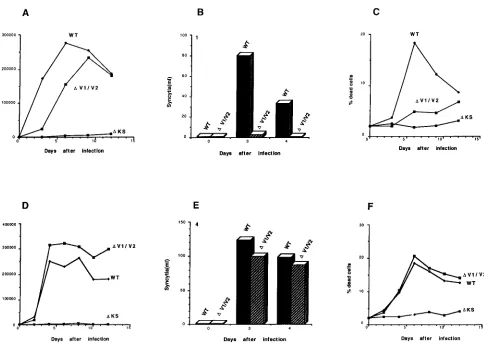
of cytopathic effects (Fig. 2A to C). The
D
V1/2/3 and
D
KS
variants apparently did not replicate (Fig. 2A to C and data not
shown).
The
D
V1/2 virus obtained at 2 weeks after infection of Jurkat
cells was used to infect fresh Jurkat cells, and this process was
repeated until, after 2 months of passage, an increase in virus
replication and cytopathic effect was noted. Infection of Jurkat
cells with an equivalent number of reverse transcriptase units
of the wild-type and putative revertant viruses resulted in
com-parable levels of virus replication and cytopathic effects (Fig.
2D to F).
To characterize the revertant virus, the KpnI-BamHI env
fragments (nucleotides 5928 to 8054) were amplified by PCR
from genomic DNA of infected Jurkat cells. Six env clones
were sequenced in their entirety, and three clones containing
representative sequence changes compared with the parental
D
V1/2 env gene were selected for detailed analysis. All of the
clones retained the V1-V2 loop deletion. Clone 4.4 encoded a
single additional amino acid change at aspartate 107 (107 D/
R), clone 3.2 encoded two changes (128 G/D and 281 A/S), and
clone 4.2 encoded the two changes observed in clone 3.2 plus
two additional changes (440 S/N and 734 E/K). To determine
if these amino acid changes were sufficient to account for the
observed reversion in the replicative and syncytium-forming
abilities of the
D
V1/2 mutant, the clone 4.4, 3.2, and 4.2 env
sequences were cloned into an infectious HXBc2 HIV-1
pro-virus (16) and into plasmid pSVIIIenv (19). Direct transfection
of Jurkat cells with the proviral clones indicated that the
vi-ruses with the clone 4.4, 3.2, and 4.2 env genes replicated faster
and achieved higher levels of virus production than did the
parental
D
V1/2 virus (data not shown). The replicative ability
of the parental and revertant envelope glycoproteins was
di-rectly examined by using an env complementation assay
previ-ously described (19). Briefly, HIV-1 recombinants encoding
chloramphenicol acetyltransferase (CAT) and containing the
different envelope glycoproteins were produced in HeLa cells.
Recombinant viruses were incubated with Jurkat cells, and
CAT activity was measured. The results indicate that the clone
4.4, 3.2, and 4.2 envelope glycoproteins complemented HIV-1
entry into Jurkat cells at least as well as the wild-type envelope
glycoproteins and more efficiently than the parental
D
V1/2
envelope glycoproteins (Table 1). The syncytia observed in
Jurkat cultures infected with the clone 4.4, 3.2, and 4.2 viruses
were greater in size and number than those seen in the culture
infected with the
D
V1/2 parental virus (Table 1), and the
effi-ciencies of single-cell lysis were similar for the parental and
revertant viruses (data not shown). Immunoprecipitation of
35S-labeled envelope glycoproteins from cell lysates and
super-natants of these infected cultures confirmed that the revertant
virus envelope glycoproteins migrated comparably to those of
the
D
V1/2 parental virus (data not shown), consistent with the
retention of the V1-V2 deletion in the revertant viruses. These
results indicate that only a few amino acid changes in the
envelope glycoproteins are sufficient to allow functional
rever-sion in the absence of the V1-V2 gp120 loop.
To study the neutralization sensitivity of the parental and
revertant viruses with V1 and V2 deleted, recombinant
CAT-encoding viruses containing the wild-type, parental
D
V1/2, and
clone 4.4, 3.2, and 4.2 envelope glycoproteins were produced in
HeLa cells. These viruses were incubated with soluble CD4
(sCD4) (11) or monoclonal antibodies prior to the infection of
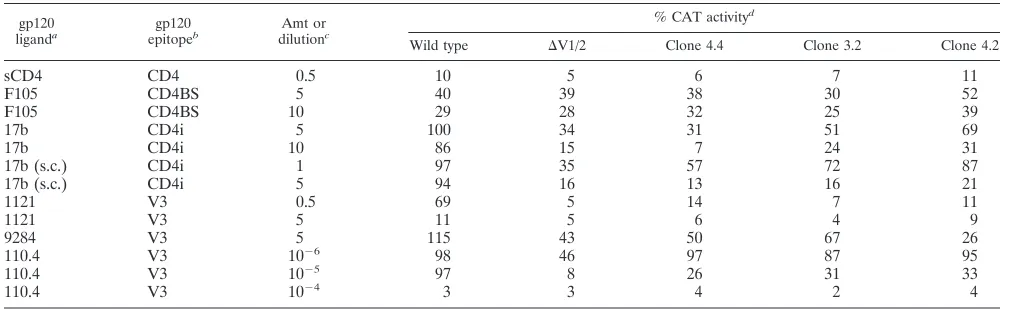
Jurkat lymphocytes. Table 2 shows that compared with the
wild-type virus, the parental
D
V1/2 and revertant viruses were
more sensitive to neutralization by antibody 17b, which
recog-nizes a CD4i gp120 epitope (57), and by V3-directed
mono-clonal antibodies 1121, 9284, and 110.4 (25, 49). Increased
neutralization sensitivity was also seen with regard to a
single-chain sFv fragment of antibody 17b (65). Some of the revertant
viruses were neutralized slightly more efficiently by these
an-tibodies than was the parental
D
V1/2 virus. Compared with the
wild-type virus, the viruses with V1 and V2 deleted did not
exhibit increased sensitivity to neutralization by sCD4 or by
F105, a monoclonal antibody directed against the CD4 binding
site.
The ability of HIV-1 to replicate efficiently with an envelope
glycoprotein containing a 66-residue deletion is remarkable.
The HXBc2 envelope glycoproteins lacking the V1 and V2
variable loops exhibit 17 and 30% of the ability of the wild-type
envelope glycoproteins to support a single round of virus entry
into human peripheral blood mononuclear cells and Jurkat
lymphocytes, respectively (64; data not shown). These
obser-vations support the concept that the V1 and V2 variable loops
are exposed domains extrinsic to the folded core of the gp120
glycoprotein. This concept is also supported by previous
ob-servations that the gp120 glycoproteins with V1 and V2 deleted
were recognized by sCD4 and a number of monoclonal
anti-bodies directed against conformation-dependent structures
(40, 55, 56, 63, 64). As has been seen for other HIV-1 envelope
glycoproteins with partial fusion defects (28), the
syncytium-forming ability of the
D
V1/2 virus was more attenuated than
was its replicative ability.
[image:2.612.62.280.68.241.2]A small number of amino acid changes are able to allow
functional reversion of the
D
V1/2 mutant, consistent with the
rather mild nature of the replication defect observed. The
mechanistic basis for the reversion is uncertain. Deletion of the
V1 and V2 loops has been shown to increase the exposure of
the CD4i epitopes on the monomeric HIV-1 gp120
glycopro-tein (64). The increased sensitivity of the viruses with V1 and
V2 deleted to neutralization by an antibody, 17b, directed
against these epitopes (57) is consistent with such an increased
exposure on the oligomeric envelope glycoprotein complex.
Increased sensitivity of the viruses with V1 and V2 deleted to
V3-specific neutralizing antibodies was also seen. Since the V3
loop and the 17b epitope have been suggested to be proximal
to each other (37, 64) and to the chemokine receptor binding
FIG. 1. Replication of HIV-1 with envelope glycoproteins with variable loops deleted. Jurkat lymphocytes were transfected with proviral DNA specifying HIV-1 with the wild-type (WT),DV1/2,DV1/2/3, orDKS envelope glycoprotein. TheDKS provirus has a large deletion in env and served as a negative control. RT, reverse transcriptase.
V
OL. 71, 1997
NOTES
9809
on November 9, 2019 by guest
http://jvi.asm.org/
region of gp120 (59, 62), this increased exposure may require
some adjustments of gp120 sequences related to chemokine
receptor interaction. The sensitivity patterns of the wild-type,
D
V1/2 parent, and revertant viruses provide some insight into
the nature of these adjustments. The revertants (clones 3.2 and
4.2) with the phenotypes closest to that of the wild-type virus
were less sensitive to neutralization by the 17b antibody and
the 17b sFv fragment than was the parental
D
V1/2 virus. In
addition, the revertants exhibited slight decreases in sensitivity
to neutralization by the 110.4 V3 antibody compared with the
D
V1/2 parental virus. The reversions may involve a movement
of the V3 loop resulting in decreased exposure of the CD4i and
some V3 epitopes. In light of this model, it is interesting that
two of the gp120 regions involved with reversion-associated
changes have previously been suggested to interact with the V3
loop (5, 50). Alanine 281 is proximal to aspartate 279, changes
in which affect the phenotype of V3 loops altered at valine 318
(50). Serine 440 has been suggested to interact with the V3
loop residue, lysine 322, which specifies HIV-1 tropism and
chemokine receptor choice (5). Further studies should clarify
the structural basis for the revertant phenotypes.
[image:3.612.60.544.64.407.2]Our data are consistent with the notion that elements of the
V3 loop and the CD4i epitopes are apparently masked by the
V1 and V2 loops, suggesting an in vivo function of these loops.
The requirement that a persistent virus must evade
neutraliz-ing antibodies may have selected for a large, flexible, and
variable structure superimposed on an extant, functional
en-velope glycoprotein core. Even if these exposed structures
elicit neutralizing antibodies, as has been seen for the V1 and
V2 loops (17, 34, 35), there may be a net survival advantage if
variation in the exposed elements can be tolerated and if more
conserved structures are masked. Previous studies suggested
that the V3 loop contributes to masking of the CD4 binding
FIG. 2. Infection of Jurkat lymphocytes with HIV-1 with envelope glycoproteins with variable loops deleted. Supernatants of Jurkat lymphocytes transfected with proviral DNAs specifying HIV-1 with different envelope glycoproteins were used to infect fresh Jurkat lymphocytes (A to C). Virus replication in the Jurkat cultures was monitored by reverse transcriptase (RT) production, syncytium formation, and the amount of single-cell lysis. In D to F, equivalent numbers of reverse transcriptase units of the wild-type (WT) andDV1/2 revertant viruses were used to infect fresh Jurkat lymphocytes and virus replication was monitored.
TABLE 1. Functional properties of HIV-1 envelope glycoproteins
Envelope glycoprotein Virus entrya Syncytium-forming abilitybDKS
0
0
Wild type
100
100
DV1/2
71
4
Clone 4.4
111
52
Clone 3.2
128
74
Clone 4.2
109
93
aThe ability of the envelope glycoproteins to complement the single-round
infection of a CAT-expressing HIV-1 recombinant with env deleted was deter-mined as previously described (19).DKS represents a negative control envelope glycoprotein containing a large deletion in gp120. Values were normalized to a wild-type value of 100.
bSyncytium-forming ability was determined 3 to 4 days after transfection of
Jurkat cells with HXBc2 proviruses containing the different env genes. Values were normalized to a wild-type value of 100.
on November 9, 2019 by guest
http://jvi.asm.org/
[image:3.612.49.290.585.661.2]site (63), consistent with the observations here that removal of
the V1 and V2 loops alone does not increase the sensitivity of
the virus to neutralization by sCD4 or a CD4BS antibody.
Future studies should help to clarify the molecular strategies
employed by HIV-1 to evade host immune responses.
We thank Marshall Posner and Raymond Sweet for gifts of
mono-clonal antibodies and sCD4. We thank Lorraine Rabb and Yvette
McLaughlin for manuscript preparation and Amy Emmert for artwork.
R.W. was supported by a fellowship from the American Foundation
for AIDS Research. This work was supported by grants from the
National Institutes of Health (AI 24755 and AI 31783) and by a Center
for AIDS Research grant to the Dana-Farber Cancer Institute (AI
28691). The Dana-Farber Cancer Institute is also the recipient of a
Cancer Center grant from the National Institutes of Health (CA
06516). This work was made possible by gifts from the late William
McCarty-Cooper, from the G. Harold and Leila Y. Mathers Charitable
Foundation, and from the Friends 10.
REFERENCES
1. Alkhatib, G., C. Combadiere, C. C. Broder, Y. Feng, P. M. Murphy, and E. Berger.1996. CC-CKR5: a RANTES, MIP-1a, MIP-1breceptor as a fusion cofactor for macrophage-tropic HIV-1. Science 272:1955–1958.
2. Allan, J., T. H. Lee, M. F. McLane, J. Sodroski, W. Haseltine, and M. Essex. 1983. Identification of the major envelope glycoprotein product of HTLV-III. Science 228:1091–1094.
3. Barre-Sinoussi, F., J. C. Chermann, F. Rey, M. T. Nugeyre, S. Chamaret, J. Gruest, C. Dauget, C. Axler-Bin, F. Vezinet-Brun, C. Rouzioux, W. Rozen-baum, and L. Montagnier.1983. Isolation of a T-lymphocyte retrovirus from a patient at risk for acquired immunodeficiency syndrome (AIDS). Science 220:868–871.
4. Cann, A. J., M. J. Churcher, M. Boyd, W. O’Brien, J.-Q. Zhao, J. Zack, and I. S. Y. Chen.1992. The region of the envelope gene of human immunode-ficiency virus type 1 responsible for determination of cell tropism. J. Virol. 66:305–309.
5. Carrillo, A., and L. Ratner. 1996. Human immunodeficiency virus type 1 tropism for T-lymphoid cell lines: role of the V3 loop and C4 envelope determinants. J. Virol. 70:1301–1309.
6. Cheng-Mayer, C., M. Quiroga, J. W. Tung, D. Dina, and J. A. Levy. 1990. Viral determinants of human immunodeficiency virus type 1 T-cell or mac-rophage tropism, cytopathogenicity, and CD4 antigen modulation. J. Virol. 64:4390–4398.
7. Cheseboro, B., J. Nishio, S. Perryman, A. Cann, W. O’Brien, I. S. Y. Chen, and K. Wehrly.1991. Identification of human immunodeficiency virus enve-lope gene sequences influencing viral entry into CD4-positive HeLa cells, T-leukemia cells, and macrophages. J. Virol. 65:5782–5789.
8. Choe, H., M. Farzan, Y. Sun, N. Sullivan, B. Rollins, P. D. Ponath, L. Wu, C. R. Mackay, G. LaRosa, W. Newman, N. Gerard, C. Gerard, and J. Sodroski. 1996. Theb-chemokine receptors CCR3 and CCR5 facilitate
infection by primary HIV-1 isolates. Cell 85:1135–1148.
8a.Cocchi, F., A. DeVico, A. Garzino-Demo, A. Cara, R. C. Gallo, and P. Lusso. 1996. The V3 domain of the HIV-1 gp120 glycoprotein is critical for che-mokine-mediated blockade of infection. Nat. Med. 2:1244–1247. 9. Cordonnier, A., L. Montagnier, and M. Emerman. 1989. Single amino acid
changes in HIV envelope affect viral tropism and receptor binding. Nature 340:571–574.
10. Dalgleish, A. G., P. C. L. Beverley, P. R. Clapham, D. H. Crawford, M. F. Greaves, and R. A. Weiss. 1984. The CD4 (T4) antigen is an essential component of the receptor for the AIDS retrovirus. Nature 312:763–767. 11. Deen, K., J. S. McDougal, R. Inacker, G. Folena-Wassterman, J. Arthos, J.
Rosenberg, P. Maddon, R. Axel, and R. Sweet.1988. A soluble form of CD4 (T4) protein inhibits AIDS virus infection. Nature 331:82–84.
12. Deng, H. K., S. Choe, W. Ellmeier, R. Liu, D. Unutmaz, M. Burkhart, P. di Marzio, S. Marmon, R. E. Sutton, C. M. Hill, C. Davis, S. C. Peiper, T. J. Schall, D. R. Littman, and N. R. Landau.1996. Identification of a major co-receptor for primary isolates of HIV-1. Nature 381:661–666.
13. Doranz, B., J. Rucker, Y. Yi, R. Smyth, M. Samson, S. Peiper, M. Parmen-tier, R. Collman, and R. Doms.1996. A dual-tropic primary HIV-1 isolate that uses fusin and theb-chemokine receptors CKR-5, CKR-3, and CKR-2b as fusion cofactors. Cell 85:1149–1158.
14. Dragic, T., V. Litwin, G. P. Allaway, S. Martin, Y. Huang, K. A. Nagashima, C. Cayanan, P. J. Maddon, R. A. Koup, J. P. Moore, and W. A. Paxton.1996. HIV-1 entry into CD41cells is mediated by the chemokine receptor CC-CKR-5. Nature 381:667–673.
15. Feng, Y., C. C. Broder, P. E. Kennedy, and E. A. Berger. 1996. HIV-1 entry cofactor: Functional cDNA cloning of a seven-transmembrane, G protein-coupled receptor. Science 272:872–877.
16. Fisher, R., E. Collati, L. Ratner, R. Gallo, and F. Wong-Staal. 1985. A molecular clone of HTLV-III with biological activity. Nature 316:262–265. 17. Fung, M. S. C., C. R. Y. Sun, W. L. Gordon, R.-S. Liou, T. W. Chang, W. N. C.
Sun, E. S. Daar, and D. D. Ho.1992. Identification and characterization of a neutralization site within the second variable region of human immuno-deficiency virus type 1 gp120. J. Virol. 66:848–856.
18. Gallo, R. C., S. Z. Salahuddin, M. Popovic, G. M. Shearer, M. Kaplan, B. F. Haynes, T. J. Palker, R. Redfield, J. Oleske, B. Safai, G. White, P. Foster, and P. D. Markham.1984. Frequent detection and isolation of cytopathic retroviruses (HTLV-III) from patients with AIDS and at risk for AIDS. Science 224:500–503.
19. Helseth, E., M. Kowalski, D. Gabuzda, U. Olshevsky, W. A. Haseltine, and J. G. Sodroski.1990. Rapid complementation assays measuring replicative potential of human immunodeficiency virus type 1 envelope glycoprotein mutants. J. Virol. 64:2416–2420.
20. Ho, D. D., M. S. C. Fung, Y. Cao, X. L. Li, C. Sun, T. W. Chang, and N.-C. Sung.1991. Another discontinuous epitope on glycoprotein gp120 that is important in human immunodeficiency virus type 1 neutralization is identi-fied by a monoclonal antibody. Proc. Natl. Acad. Sci. USA 88:8949–8952. 21. Ho, D. D., J. A. McKeating, X. L. Li, T. Moudgil, E. S. Daar, N.-C. Sun, and
[image:4.612.48.553.80.235.2]J. E. Robinson.1991. Conformational epitope on gp120 important in CD4 binding and human immunodeficiency virus type 1 neutralization identified by a human monoclonal antibody. J. Virol. 65:489–493.
TABLE 2. Neutralization of recombinant HIV-1 with different envelope glycoproteins
gp120
liganda epitopegp120b dilutionAmt orc
% CAT activityd
Wild type DV1/2 Clone 4.4 Clone 3.2 Clone 4.2
sCD4
CD4
0.5
10
5
6
7
11
F105
CD4BS
5
40
39
38
30
52
F105
CD4BS
10
29
28
32
25
39
17b
CD4i
5
100
34
31
51
69
17b
CD4i
10
86
15
7
24
31
17b (s.c.)
CD4i
1
97
35
57
72
87
17b (s.c.)
CD4i
5
94
16
13
16
21
1121
V3
0.5
69
5
14
7
11
1121
V3
5
11
5
6
4
9
9284
V3
5
115
43
50
67
26
110.4
V3
10
2698
46
97
87
95
110.4
V3
10
2597
8
26
31
33
110.4
V3
10
243
3
4
2
4
a17b (s.c.) represents a single-chain sFv fragment of monoclonal antibody 17b produced in Drosophila cells (65). bCD4BS, CD4 binding site epitope; CD4i, CD4-induced epitope.
cAll sCD4 and antibody concentrations are in micrograms per milliliter, except for antibody 110.4, which was used at the indicated dilutions. sCD4 and antibodies
were incubated with recombinant HIV-1 and Jurkat cells in 1 ml at the indicated concentrations for 1 h at 37°C prior to the addition of 0.5 ml of fresh medium without additional antibody or sCD4. After 24 h, 1 ml of fresh medium was added and the virus-cell mixture was incubated at 37°C for an additional day prior to determination of CAT activity.
dThe values shown are percentages of the target cell CAT activity measured in the presence of sCD4 or antibody relative to that measured in the absence of sCD4
or antibody. Thus, 100% indicates no neutralization and 0% indicates complete neutralization.
V
OL. 71, 1997
NOTES
9811
on November 9, 2019 by guest
http://jvi.asm.org/
22. Hwang, S. S., T. J. Boyle, H. K. Lyerly, and B. R. Cullen. 1991. Identification of the envelope V3 loop as the primary determinant of cell tropism in HIV-1. Science 253:71–74.
23. Javaherian, K., A. J. Langlois, C. McDanal, K. L. Ross, L. I. Eckler, C. L. Jellis, A. T. Profy, J. R. Rusche, D. P. Bolognesi, S. D. Putney, and T. J. Matthews.1989. Principal neutralizing domain of the human immunodefi-ciency virus type 1 envelope protein. Proc. Natl. Acad. Sci. USA 86:6768– 6772.
24. Kang, C.-Y., P. Nara, S. Chamat, V. Caralli, T. Ryskamp, N. Haigwood, R. Newman, and H. Kohler.1991. Evidence for non-V3-specific neutralizing antibodies that interfere with gp120/CD4 binding in human immunodefi-ciency virus-infected humans. Proc. Natl. Acad. Sci. USA 88:6171–6175. 25. Kinney-Thomas, E., J. N. Weber, J. McClure, P. R. Clapham, M. C. Singhai,
M. K. Shriver, and R. A. Weiss.1988. Neutralising monoclonal antibodies to the AIDS virus. AIDS 2:25–29.
26. Klatzmann, D., E. Champagne, S. Chamaret, J. Gruest, D. Guetard, T. Hercend, J. C. Gluckman, and L. Montagnier.1984. T-lymphocyte T4 mol-ecule behaves as the receptor for human retrovirus LAV. Nature (London) 312:767–768.
27. Kowalski, M., J. Potz, L. Basiripour, T. Dorfman, W. G. Goh, E. Terwilliger, A. Dayton, C. Rosen, W. Haseltine, and J. Sodroski.1987. Functional regions of the human immunodeficiency virus envelope glycoproteins. Science 237: 1351–1355.
28. Kowalski, M., L. Bergeron, T. Dorfman, W. Haseltine, and J. Sodroski. 1991. Attenuation of human immunodeficiency virus type 1 cytopathic effect by a mutation affecting the transmembrane envelope glycoprotein. J. Virol. 65: 281–291.
29. Lapham, C., J. Ouyang, B. Chandraseklar, N. Nguyen, D. Dimitrov, and H. Golding.1996. Evidence for cell-surface association between fusin and the CD4-gp120 complex in human cell lines. Science 274:602–605.
30. Lasky, L., G. Nakamura, D. Smith, C. Shimisaki, E. Patzer, and P. Berman. 1987. Delineation of a region of the human immunodeficiency virus type 1 gp120 glycoprotein critical for interaction with the CD4 receptor. Cell 50: 975–985.
31. Leonard, C., M. Spellman, L. Riddle, R. Harris, J. Thomas, and T. Gregory. 1990. Assignment of intrachain disulfide bonds and characterization of po-tential glycosylation sites of the type 1 human immunodeficiency virus en-velope glycoprotein (gp120) expressed in Chinese hamster ovary cells. J. Biol. Chem. 265:10373–10382.
32. Maddon, P., A. Dalgleish, J. S. McDougal, P. Clapham, R. Weiss, and R. Axel.1986. The T4 gene encodes the AIDS receptor and is expressed in the immune system and the brain. Cell 47:333–348.
33. McDougal, J. S., M. Kennedy, J. Sligh, S. Cort, A. Mowie, and J. Nicholson. 1986. Binding of the HTLV-III/LAV to T41T cells by a complex of the 100 K viral protein and the T4 molecule. Science 231:382–385.
34. McKeating, J., C. Shotton, J. Cordell, S. Graham, P. Balfe, N. Sullivan, M. Charles, M. Page, A. Bolmstedt, S. Olofsson, S. Kayman, Z. Wu, A. Pinter, C. Dean, J. Sodroski, and R. Weiss.1993. Characterization of neutralizing monoclonal antibodies to linear and conformation-dependent epitopes within the first and second variable domains of human immunodeficiency virus type 1 gp120. J. Virol. 67:4932–4944.
35. Moore, J., Q. Sattentau, H. Yoshiyama, M. Thali, M. Charles, N. Sullivan, S.-W. Poon, M. Fung, F. Traincard, J. Robinson, D. D. Ho, and J. Sodroski. 1993. Probing the structure of the V2 domain of the human immunodefi-ciency virus type 1 surface glycoprotein gp120 with a panel of eight mono-clonal antibodies: the human immune response to the V1 and V2 domains. J. Virol. 67:6136–6151.
36. Moore, J., Q. Sattentau, R. Wyatt, and J. Sodroski. 1994. Probing the structure of the human immunodeficiency virus surface glycoprotein gp120 with a panel of monoclonal antibodies. J. Virol. 68:469–484.
37. Moore, J. P., and J. Sodroski. 1996. Antibody cross-competition analysis of the human immunodeficiency virus type 1 gp120 exterior envelope glycopro-tein. J. Virol. 70:1863–1872.
38. Myers, G., J. Berzofsky, B. Korber, R. Smith, and G. Pavlakis. 1992. Human retroviruses and AIDS. A compilation and analysis of nucleic acid and amino acid sequences. Los Alamos National Laboratory, Los Alamos, N.Mex. 39. Olshevsky, U., E. Helseth, C. Furman, J. Li, W. Haseltine, and J. Sodroski.
1990. Identification of individual human immunodeficiency virus type 1 gp120 amino acids important for CD4 receptor binding. J. Virol. 64:5701– 5707.
40. Pollard, S., M. D. Rosa, J. Rosa, and D. Wiley. 1992. Truncated variants of gp120 bind CD4 with high affinity and suggest a minimum CD4 binding region. EMBO J. 11:585–591.
41. Posner, M., T. Hideshima, T. Cannon, M. Mukherjee, K. Mayer, and R. Byrn.1991. An IgG human monoclonal antibody which reacts with HIV-1 gp120, inhibits virus binding to cells, and neutralizes infection. J. Immunol. 146:4325–4332.
42. Putney, S., T. Matthews, W. G. Robey, D. Lynn, M. Robert-Guroff, W. Mueller, A. Langlois, J. Ghrayeb, S. Petteway, K. Weinhold, P. Fischinger, F. Wong-Staal, R. Gallo, and D. Bolognesi.1986. HTLV-III/LAV-neutralizing antibodies to an E. coli-produced fragment of the virus envelope. Science 234:1392–1395.
43. Robey, W. G., B. Safai, S. Oroszlan, L. Arthur, M. Gonda, R. Gallo, and P. J. Fischinger. 1985. Characterization of envelope and core structural gene products of HTLV-III with sera from AIDS patients. Science 228:593–595. 44. Rusche, J. R., K. Javaherian, C. McDanal, J. Petro, D. L. Lynn, R. Grimaila, A. Langlois, R. C. Gallo, L. O. Arthur, P. J. Fischinger, D. P. Bolognesi, S. D. Putney, and T. J. Matthews.1988. Antibodies that inhibit fusion of human immunodeficiency virus-infected cells bind a 24-amino-acid sequence of the viral envelope gp120. Proc. Natl. Acad. Sci. USA 85:3198–3202.
45. Sattentau, Q., and J. Moore. 1995. Human immunodeficiency virus type 1 neutralization is determined by epitope exposure on the gp120 oligomer. J. Exp. Med. 182:185–196.
46. Sattentau, Q., S. Zolla-Pazner, and P. Poignard. 1995. Epitope exposure on functional, oligomeric HIV-1 gp41 molecules. Virology 206:713–717. 47. Shioda, T., J. A. Levy, and C. Cheng-Mayer. 1991. Macrophage and T
cell-line tropisms of HIV-1 are determined by specific regions of the enve-lope gp120 gene. Nature (London) 349:167–169.
48. Shotton, C., C. Arnold, Q. Sattentau, J. Sodroski, and J. McKeating. 1995. Identification and characterization of monoclonal antibodies specific for polymorphic antigenic determinants within the V2 region of the human immunodeficiency virus type 1 envelope glycoprotein. J. Virol. 69:222–230. 49. Skinner, M. A., R. Ting, A. J. Langlois, K. J. Weinhold, H. K. Lyerly, K. Javaherian, and T. J. Matthews. 1988. Characteristics of a neutralizing monoclonal antibody to the HIV envelope glycoprotein. AIDS Res. Hum. Retroviruses 4:187–197.
50. Stamatatos, L., and C. Cheng-Mayer. 1993. Evidence that the structural conformation of envelope gp120 affects human immunodeficiency virus type 1 infectivity, host range, and syncytium-forming ability. J. Virol. 67:5635– 5639.
51. Starcich, B. R., B. H. Hahn, G. M. Shaw, P. D. McNeely, S. Modrow, H. Wolf, W. P. Parks, S. F. Josephs, R. C. Gallo, and F. Wong-Staal.1986. Identifi-cation and characterization of conserved and variable regions of the enve-lope gene of HTLV-III/LAV, the retrovirus of AIDS. Cell 45:637–648. 52. Steimer, K. S., C. J. Scandella, P. V. Skiles, and N. L. Haigwood. 1991.
Neutralization of divergent HIV-1 isolates by conformation-dependent hu-man antibodies to gp120. Science 254:105–108.
53. Stein, B. S., S. D. Gouda, J. D. Lifson, R. C. Penhallow, K. G. Bensch, and E. G. Engelman.1987. pH-independent HIV entry into CD4-positive T cells via virus envelope fusion to the plasma membrane. Cell 49:659–668. 54. Sullivan, N., M. Thali, C. Furman, D. Ho, and J. Sodroski. 1993. Effect of
amino acid changes in the V1/V2 region of the human immunodeficiency virus type 1 gp120 glycoprotein on subunit association, syncytium formation, and recognition by a neutralizing antibody. J. Virol. 67:3674–3679. 55. Thali, M., U. Olshevsky, C. Furman, D. Gabuzda, M. Posner, and J.
So-droski.1991. Characterization of a discontinuous human immunodeficiency virus type 1 gp120 epitope recognized by a broadly reactive neutralizing human monoclonal antibody. J. Virol. 65:6188–6193.
56. Thali, M., C. Furman, D. Ho, J. Robinson, S. Tilley, A. Pinter, and J. Sodroski.1992. Discontinuous, conserved neutralization epitopes overlap-ping the CD4 binding region of the human immunodeficiency virus type 1 gp120 envelope glycoprotein. J. Virol. 66:5635–5641.
57. Thali, M., J. P. Moore, C. Furman, M. Charles, D. D. Ho, J. Robinson, and J. Sodroski.1993. Characterization of conserved human immunodeficiency virus type 1 gp120 neutralization epitopes exposed upon gp120-CD4 binding. J. Virol. 67:3978–3988.
58. Tilley, S. A., W. J. Honnen, M. Racho, M. Hilgartner, and A. Pinter. 1991. A human monoclonal antibody against the CD4 binding site of HIV-1 gp120 exhibits potent, broadly neutralizing activity. Res. Virol. 142:247–259. 59. Trkola, A., T. Dragic, J. Arthos, J. Binley, W. Olson, G. Allaway, C.
Cheng-Mayer, J. Robinson, P. Maddon, and J. Moore.1996. CD4-dependent, an-tibody-sensitive interactions between HIV-1 and its co-receptor CCR-5. Na-ture 384:184–187.
60. Westervelt, P., H. E. Gendelman, and L. Ratner. 1991. Identification of a determinant within the human immunodeficiency virus type 1 surface enve-lope glycoprotein critical for productive infection of primary monocytes. Proc. Natl. Acad. Sci. USA 88:3097–3101.
61. Westervelt, P., D. B. Trowbridge, L. G. Epstein, B. M. Blumberg, Y. Li, B. H. Hahn, G. M. Shaw, R. W. Price, and L. Ratner.1992. Macrophage tropism determinants of human immunodeficiency virus type 1 in vivo. J. Virol. 66:2577–2582.
62. Wu, L., N. Gerard, R. Wyatt, H. Choe, C. Parolin, N. Ruffing, A. Borsetti, A. Cardoso, E. Desjardin, W. Newman, C. Gerard, and J. Sodroski.1996. CD4-induced interaction of primary HIV-1 gp120 glycoproteins with the chemokine receptor CCR5. Nature 384:179–183.
63. Wyatt, R., N. Sullivan, M. Thali, H. Repke, D. Ho, J. Robinson, M. Posner, and J. Sodroski.1993. Functional and immunologic characterization of hu-man immunodeficiency virus type 1 envelope glycoproteins containing dele-tions of the major variable regions. J. Virol. 67:4557–4565.
64. Wyatt, R., J. Moore, M. Accola, E. Desjardin, J. Robinson, and J. Sodroski. 1995. Involvement of the V1/V2 variable loop structure in the exposure of human immunodeficiency virus type 1 gp120 epitopes induced by receptor binding. J. Virol. 69:5723–5733.
65. Wyatt, R., E. Desjardins, J. Robinson, and J. Sodroski. Unpublished data.