NATIONAL INSTITUTE OF SIDDHA
Chennai - 47THE TAMIL NADU DR. M.G.R. MEDICAL UNIVERSITY, CHENNAI - 600 032
A STUDY ON
MAHAVATHAM
(DISSERTATION SUBJECT)
For the partial fulfillment of the
requirements to the Degree of
DOCTOR OF MEDICINE (SIDDHA)
BRANCH V - NOI NAADAL DEPARTMENT
CONTENTS
ACKNOWLEDGEMENT
1. INTRODUCTION TO SIDDHA SYSTEM
2.
GUIDING PRINCIPLES IN SIDDHA SYSTEM.
DIAGNOSTIC METHODOLOGY
3. AIM AND OBJECTIVE.
4. SURVEY IN LITERATURE
INTRODUCTION TO VATHAM
KINDS OF VATHAM
CAUSES FOR VATHA DISEASE
TYPES OF VATHAM
READING LINES BETWEEN POEM
PATHOLOGY FOR MAHAVATHAM
5. MATERIAL AND METHODS
6. OBSERVATION AND RESULTS
7. FUNCTIONAL PHYSIOLOGY OF BLOOD
8. MACROCYTIC ANAEMIA
9. DISCUSSION
10 CONCLUSION
ANNEXURE
INTRODUCTION TO SIDDHA SYSTEM
Siddha is one of the world’s oldest systems of medicine. The roots of siddha are
intertwined with the mythology and culture of ancient Tamil civilization that existed in
the southernmost tip of the Indian peninsula, predating much of recorded history.
South India- the place of emergence of Dravidian culture and heritage accepted as
the cradle of civilization is the land of siddhars and siddha medicine.
Mythically, the orgins of siddha is attributed to God Siva, who is supposed to
have handed it down to His consort Parvathi(shakthi), who in turn passed on the sacred
knowledge to Nandhi, from where it was transmitted to the first of siddhars. The siddha
medical works were bestowed by the great siddhars, after attaining spiritual knowledge
through physical perfection and spiritual salvation, as explained by the saint in the
following verse,
“Nkq!Bjlbim<G!nVt<lVf<K!uir<gk<jk!
!!!!!!!Nkq!BjlbVtiz<!nl<HzqBt<!.!OgiXfx<!
!!!!!!!osf<klqpiz<!%Xkx<Gs<!osl<hut!OupLge<!
!!!!!!!gf<klzIs<!osR<svO{!gih<H”
!
Siddha is a Tamil word derived from Siddhi- one who has attained perfection in
From historical records one can authentically state that even before Hippocrates-
the father of medicine it is the Tamils- the siddhars- our country man who proclaimed
food as medicine. They paved the way for longevity and immortality with kaya kalpa
medicine and without medicine by regulating our diet and daily routine.
The system is said to have emerged in antiquity, from the highly evolved
consiousness of the siddhars. The clarified intellect and hightened intuition of the
siddhars, resulting from their yogic powers, enabled them to explore the world around
them and exploit its natural resources for the sake of humanity.
The unique legacy was bequeathed to select disciples by word of mouth. It is believed
that there was a line of 18 siddhars, with Agastya being the foremost and a large portion
of Siddha core is credited to Him. With time, this oral tradition was transcribed on palm
GUIDING PRINCIPLES IN SIDDHA SYSTEM
According to the siddha system the individual is a microcosm of the universe.
“n{<mk<kqZt<tOk!hq{<ml<!
! hq{<mk<kqZt<tOk!n{<ml<!
! n{<mLl<!hq{<mLl<ye<Ox!
! nxqf<Kkie<!hiIg<Gl<OhiOk.”
!!!!!!!!!!!!!!!!!!!!!! .sm<mLeq!Riel<!
The human body consists of the five primordial elements- earth, water,
fire, air and space, the three humours- Vatham, pitham, kapham and seven physical
constituents.
“hivh<hi!H,kjlf<K!l{<fQIOkBhiq!uiB!uigib!
!! ! !jlf<kqeiOz!Osvh<hi!smlis<sq”
-skg!fic!
“kzr<gim<c!bqf<k!smlie!jul<H,kl<!
!! ! !fqzr<gim<c!fQIgim<c!fqe<xqMf<!kQgim<c!
!! ! !uzr<gim<c!uiBuiz<!utIf<Ok!bqVf<k!
!Gzr<gim<c!uieqx<!Gcbi!bqVf<kOk/”!
- kqV&zI!fic!
The human power and the natural powers are responsible for the functions of the
universe, which are neither different nor variant in nature.!
If the inherent powers within the human beings, such as the three qualities
(Mukkunam), the three life constituents (Mukkutram), the seven physical constituents,
The variation of the five elements may cause drastic changes in the environment,
resulting in earthquake, storm, heavydown pour flood etc.
Ninety six thathuvas
– According to Yugi cintamani.Bootham – 5
Gnanenthiryam – 5
Pulan – 5
Kanmethiryam – 5
Kanmavidaiyam – 5
Anthakaranam – 4
Arivu – 1
Naadi – 10
Vayu -10
Asayam – 5
Kosam – 5
Adharam – 6
Malam – 3
Mandalam – 3
Dosam – 3
Eadanai – 3
Vinai – 2
Gunam – 3
Ragam – 8
Bootham-5
Properties of objects having the five elemental components.
1. Space - Miniute, clear and sharp.
2. Air - Denselessness, dryness, easiness, inhalation, feeling sad and fatigue.
3. Fire - Hot, dry, sharp, burning, colour and light.
4. Water - Giving pleasure, coolness, soaking, viscid, soft, slimy and flowing.
5. Earth - Bulk, motionless, heavy and dense growth of objects.
Gnanenthiryam - 5
1. Sevi(ear) - with predominant space element to hear sound.
2. Mei(skin) - with predominant air element to feel the sense of touch.
3. Kan(eye) - with predominant fire element to see the object.
4. Naa(tongue) - with predominant water element to relish the taste.
5. Mooku(nose) - with predominant earth element to smell the odour.
Pulan - 5
The experiences of senses like hearing visualizing, smelling, tasting and feeling
the sense of touch are called pulan.
Kanmenthiriyam – 5 and Kanmavidayam - 5
1. Vai(mouth) – the speech occurs in relation with the space elements.
2. Kaal(legs) – The walking takes place in relation with Air elements.
3. Kai(hands) – Flexion and extension are carried out with the influence of fire
elements.
4. Eruvai(excretory organ) - The excreta is removed in association with water
element.
5. Karuvai(reproductive organ) - In relation with earth element it causes ejaculation
Anthakaranam – 4 (Inner Instruments)
1. Manam(Mind).
2. Putthi(Intellect).
3. Siddham.
4. Ahankaram.
The mind thinks, the Intellect analyses, the Siddham achieves and the Ahankaram
decides.
Arivu : Happiness through self – realization.
Naadi : 10 (The ten channels)
1. Idakalai – Starts from the right big toe and ends at the left nostril.
2. Pingalai – Starts from the left big toe and ends at the right nostril.
3. Suzhumunai – Starts from the perineum and extends up to the centre of the head.
4. Siguvai – Located at the root of the tongue, it helps in swallowing the food and water.
5. Purudan – Located in right eye.
6. Kanthari – Located in left eye.
7. Aththi – Located in the right ear.
8. Alampudai – Located in the left ear.
9. Sangini – Located in the genital organs.
10. Gugu – located in anorectal region.
Vayu – 10
1. Pranan. 6. Nagan
2. Abanan 7. Koorman
3. Vyanan 8. Kirukaran.
4. Udhanan 9. Devadhaththan
Aasayam -5
1. Amaravasayam Stomach (Digestive organ) 2. Pakirvasayam Intestine (Absorbing place)
3. Salavasayam Kidney (Urinary filtration and excretion (i.e) excretory organ)
4. Malavasayam Rectum and anus (Excretory pathway to fecal matters)
5. Sukkilavasayam Semen secretion and storage (reproductive organs)
Kosam - 5
1. Annamaya kosam(Physical sheath)
Constituted by seven physical constituents.
2. Pranamaya
kosam(Respiratory sheath)
Constituted by Pranan and the motor organs.
3. Manomaya kosam (Mental sheath)
Constituted by the mind and the sense organs.
4. Vignanamaya kosam (Intellectual sheath)
Constituted by the intellect and the sense organs.
5. Anandhamaya kosam (Blissful sheath)
Adharam – 6
Mulatharam Situated at the base of the spinal column between the genital organs and anal orifice.
Swadhittanam Located twelve fingers above the Muladharam. It is to be found between the genital and navel region.
Manipuragam
Located eight fingers above the swadhittanam. It is encircled by 1008 nerves and is the very root of all the nerves. It is situated at the navel center.
Anagatham
It is situated at the location of the heart, 10 fingers above the manipuragam.
Visuddhi It is situated ten fingers above anagatham. This is located in throat.
Aakkinai It is situated between the two eye brows.
Malam – 3 (Three impurities)
1. Aanavam (Ego):
This act marks clarity of thought of knowing power of the soul, yielding to the
egocentric consciousness like I and mine considering everything to be his own.
2. Maayai (Delusion):
This serves as an obstacle by claiming ownership of the property of someone else
and inviting troubles.
3. Kaamiyam (Attachment – which decides birth):
It goes in collusion with the other two, responsible for incurring paavam (the sin)
Mandalam – 3
1. Thee mandalam ( Fire – region) :
This is located at the place where the prithivi and the appu meet. It is found two
fingers above the mulatharam.
2. Gnayeru mandalam (Sun-region) :
Located four fingers above the umbilicus. It is found in heart centre.
3. Thingal mandalam ( Moon – region) :
This lies in the centre of the eyebrows from where emerges brightness like that of
millions of moons and stars.
Dosam – 3 (Three Humors)
1. Vali
Kinds of vali:
1. Pranan. 6. Nagan
2. Abanan 7. Koorman
3. Vyanan 8. Kirukaran.
4. Udhanan 9. Devadhaththan
5. Samanan 10. Dhananjayan
2. Pitham
Kinds of Pitham:
a. Anal – Pasaka pitham (Aakkanal): It lies between the stomach and the intestine
and causes digestion and dries up moist ingested substances.
b. Ranjaga (Vanna eri) Pitham: This fire lies in the stomach and gives red colour to
c. Saadhaka (Aatralanki) Pitham: This is the fire of energy.
d. Prasaaka (Olloli thee) Pitham: It gives colour and complexion and brightness to
the skin.
e. Aalosaka (Nokkazhal) Pitham: It lies in the eyes. It helps to visualize things.
3. Kapham
Kinds of Kapham:
a. Avalambagam (Ali aiyam): It lies in the lungs and helps in respiration. It causes
firmness of the limbs. This is vital among all types of Kapham for its controls the other
four kapham and maintains equilibrium.
b. Kilethagam (Neerpi aiyam): It lies in the stomach. It mixes the consumed food and
water and promotes the digestive process.
c. Bothagam (Suvaikaan aiyam): It lies in tongue and helps to realize the taste of the
consuming food.
d. Tharpagam (Niraivu aiyam): Sustaining in the head, this gives refrigerant effect to
cool the eyes and other sense organs.
e. Santhigam (Onri aiyam): Sustaining in the joints this makes them moves freely and
easily.
Vinai (Twin deeds)
1. Good karma - that promotes meritorious acts.
2. Evil karma - being the sin for committing sinful act.
Edanai - 3
Three kinds of suffering caused by affinities are
2. Putthira edanai – Affinity towards human being.
3. Ulaga edanai – Affinity to retain in the world.
Gunam -3 (Three Inherent Qualities)
1. Sathuvam : The Grace, control of the five Senses, Wisdom, Penance,
Generosity, Excellence, Silence and Truthfulness.
2. Rasatham : Enthusiasm, Wisdom, Valour, Virtue, Penance, Offering gifts, Art
of learning and Listening.
3. Thamo : Immorality, Lust, Anger, Killing, Laziness, Violation of Justice,
Prolonged Sleep, Gluttonousness Falsehood,
forgetfulness and Fraud.
Ragam – 8 (Eight Passions)
1. Kaamam – Desire
2. Kurodham – Hatred
3. Lopam – Misery
4. Mokam – Infactuation
5. Madham – Rut
6. Maacharyam – Envy
7. Idumbai – Suffering afflication
Avathai –
5 (Five states of soul)1. Nanavu(Sakkiram)
This state exists between the eye-brows, the four strengths, the five senses, the
five actions and the four anthakarnas are active in this state. One is able to experience the
pleasures and pains.
2. Kanavu(Choppanam - Dream State)
Dream state is one in which the five senses and five actions lie dormant at throat.
3. Urakkam(Suzhuththi - Sleeping state)
This is the state in which the anthakaranas are associated with the soul but these
things could not be expressed to others and its seat being thorax.
4. Perurakkam(Turiyam - Deep Sleep)
The Ceevathma, along with wisdom lies at the naval region. Here respiration
takes place.
5. Uyirpadakkam(Thuriyatheetham - Immersed state of Ceevathma)
All the fourteen, the senses, actions and Anthakaranas are detached from the
ceevathma. The Ceevathma deeply immersed in the Mulatharam without the awareness
of Malam (impurity), Mantham (Sloth), Mayai (delusion) and the sense of touch.
UDAL THATHUKKAL(Seven physical constituents)
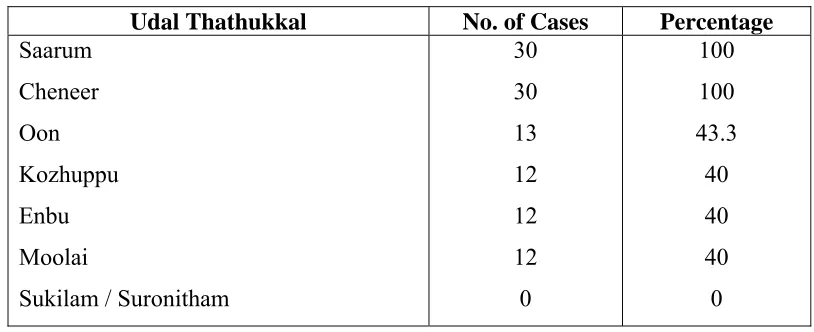
The human body is made of seven basic physical constituents. These
constituents should be in harmony and normality. Any variation in them will lead to their
The natural Characters of the Seven Physical Constituents
1. Saaram (Chyle) : This gives mental and physical
perseverance.
2. Cheneer (Blood) : Imparts colour to the body, nourishes the
body and is responsible for the ability
and intellect of an individual.
3. Oon (Muscle) : It gives shape to the body according to
the physical activity and covers the
bones.
4 Kozhuppu (Adipose tissue) : It lubricates the joints and other parts of
the body to function smoothly.
5. Enbu (Bone) : Supports the frame and responsible for
the postures and movements of the body.
6. Moolai (Bone Marrow) : It occupies the medulla of the bones and
gives strength and softness to them.
Features of deranged udal thathukal
S.No Udal kattukkal
Increased features Decreased features
1. 2. 3. 4. 5 6. 7. Saaram Chenneer Oon Kozhuppu Enbu Moolai Sukkilam (or) Suronitham
Loss of appetite, excessive salivation, diminished activity, heaviness, pallor,
cold, decreased physical constituents, dyspnoea,
flatulence, cough, excessive sleep.
Boils in different parts of the body, splenomegaly,
tumours, pricking pain, loss of appetite, haematuria, hypertension,
reddish eye and skin, leprosy, jaundice.
Tubercular adenitis, venereal diseases, extra
growth around neck, cheeks, abdomen, thigh,
genitalia.
Identical feature of increased oon, tiredness, dyspnoea on exertion, extra
musculature in gluteal, region, external genitalia,
chest, abdomen thighs.
Excessive ossification and dentition.
Heaviness of body and eye, swollen interphalangeal
joints, oligurai, non-healing ulcers.
Increased sexual activity, urinary calculi.
Dryness of skin, tiredness, loss of weight, lassitude, irritability while
hearing heavy noice.
Affinity to sour and cold food, nervous debility, dryness, pallor.
Lethargic sense organs, pain in the joints, muscle wasting in mandibular region, gluteal region,
penis, thighs.
Loin pain, splenomegaly, emaciation.
Joint pain, falling of teeth, falling and splitting of hairs and nails.
Osteoporosis, blurred vision.
Drippling of sukkilam/suronitham or chenner during coitus, pricking pain in the testis, inflamed and
MALAM(Excreta of the body)
The excreta of the body are stool (feces), urine and sweat.
Stool is a solid waste, urine the liquid waste excreted by the kindney and the
sweat is a liquid waste, excreted by the skin. Any derangement in the excretion causes
disease.
Malam (Stool)
If the stool is not evacuated properly it causes distension of abdomen, heaviness,
suppression of appetite. If the stools are passed in excess, a vaccum is formed and cause
colic pain.
Siruneer(Urine)
Urine in excess causes pricking pain in the urinary tract. An urge to pass urine
persists even after urination. Oliguria leads to dripping of urine and at times leads to
haematuria.
Viyarvai(Sweat)
Excess sweat lead to itching sensation and bad odour.
Decreased sweat causes fall of hair, goose skin and dermatological disorders.
In addition to the above excreta there are some other places like eyes, nose and
ears for excreting waste matters. In the above organs if there is an excess of excretion
there will be a feeling of heaviness. If the excretions are reduced it will make the organs
deviate from their normal functions.
UDAL VANMAI (The physique)
The human ability and good health is achieved by three features.
1. Iyyarkai vanmai(Natural or Congenital Physique).
2. Kaala vanmai(Chronicle Physique).
Iyyarkai vanmai: The physical ability of a person depends upon his ability at birth.
Kaala vanmai : The person’s physical ability is good at youth and middle age and he is
weak in childhood and in old age. The ability of an individual also varies according to
the seasons of the years.
Sayarkai vanmai: This is character based physique. Good food and moral activities
improve one’s physical ability. More over drugs and medicines also maintain one’s
physique for a happy and healthy living.
PATHINANGU VEGANGAL(Fourteen natural urges)
! “hkqeie<G!Ough<!OhIgt<!
! ! ! hgIf<kqmnux<jxg<!Ogtib<!
! ! uqkqk<kqMl<!uikf<!Kl<lz<!
! ! ! OlUfQI!lzr<ogim<!miuq!
! ! gkqk<kqM!hsqfQI!Oum<jg!
! ! ! gisOli!cjth<H!fqk<kqjv!
! ! lkqk<kqM!uif<kq!g{<{QI!
! ! ! utISg<zR<!Suis!liOl/”!
The following are the fourteen natural urges:
1. Flatus Air (Abanam) 8. Cough
2. Sneezing 9. Exhaustion
3. Urine 10. Sleep
4. Feces 11. Vomiting
5. Yawning 12. Tears
6. Hunger 13. Semen
The natural urges are the indications of our body functions and they should not be
obstructed forcibly.
1. Abanan (flatus air)
If one resists the flatus air completely or partially, he will be inflicted with the
diseases of the chest, flatulence, constipation, pricking sensation throughout the body,
vatha Gunmam (acute abdominal pain), kudal vatham, loss of appetite, constipation and
oliguria occur because of diminished digestive fire.
2. Sneezing
Kirugaran vayu which lodges with nose is responsible for sneezing. If one
controls sneezing, it causes head ache, pain in the sense organs, facial paralysis and back
ache.
3. Urine
If one do not pass urine regularly, it will cause obstruction in the urethral
passage, ulceration in the urinary tract, pain in the joints, and genitalia and distension of
the lower abdomen urinary tract infection with ulceration in the genitalia and purulent
discharge.
4. Feces
Abana Vayu (downward air) is responsible for defecation. If it is obstructed, its
increased quantum pushes the stools. It also causes head ache, pain in the thigh,
constipation, discomfort and inability.
5. Yawning
If Yawning is controlled, it leads to poor digestion, tiredness and wilt of face. It
6. Hunger and thirsty
If hunger and thirst are not quenched, they leads to impairment of the functions of
vital organs, and causes mental disorder, tiredness and joint pain.
Fasting leads to the destruction of all the seven physical constituents and loss of
weight and infectious diseases like tuberculosis.
8. Cough and tiredness (fatigue)
If cough is controlled it leads to violent cough, bad odour in the breath and angina
pectoris, abdominal pain and tiredness, patient becomes even unconscious.
10. Sleep
If one does not sleep well daily, he may get headache, redness of eyes, impaired
speech and hearing.
11. Vomiting
If vomiting is controlled forcibly it leads to urticarial rashes itching, pallor, eye
diseases, diseases of Pitham, dyspnoea, fever, cough etc., and toxic manifestations due to
deranged pitham.
12. Tears
Constraint of tears causes headache, eye diseases, sneezing, sinusitis, heart
disease etc. It will also cause abdominal gastric ulcer.
13. Semen
If semen is controlled, it leads to fever, oliguria, joint pain, urinary infection,
spermatorrhoea, leucorrhoea and chest pain.
14. Breathing
Constraint of proper breathing leads to dyspnoea, cough, distention of abdomen,
UDAL THEE (Four kinds of body fire)
There are four kinds of body fire. They are Samanakkinim, Vishamakkini,
Deeshaakkini and Manthakkini.
Samanakkini
The digestive fire is called as Samakkini. This is constituted by Samana Vayu,
Anala Pitham and Kilethaga Kapham. If they are in normal proportion then it is called as
Samanakkini.
Vishamakkini
Due to deranged and displaced Samana Vayu, it takes a long time for digestion of
normal food. The food thus digested become toxic.
Deeshaakkini
Due to increased Anala Pitham, food is digested faster. It also destroys chyle.
Manthakkini
Due to increased Kilethaga Kapham, food is poorly digested and leads to
abdominal pain, distention etc.
THINAI
Five fold divisions of thinai (the land)
1. Kurinchi - Mountain range
2. Mullai - Pastoral area of the forest
3. Marudham - The fertile river bed
4. Neidhal - The coastal region
Features of the five regions
1. Kurinchi
“GxqR<sq!uvfqzk<kqx<G!ogix<xL{<c!vk<kl<!
!!!!!!dxqR<sq!uVSvL!L{<mil<<!.!nxqRVjvg<nje!
!!!!!!jgbOl!kr<Gkvi<!kijluz<jz!Br<gkqg<Glm<<!
!!!!!!JbOl!kr<Gl<!nxq/”
- hkiIk<k!G{!sqf<kil{q!
Things, which grow in this kurinchi land, where diseases prevail, usually have
high potency and natural strength.
Many diseases like the one that affects the blood and the diseases of the Spleen
occur in this region. Kapha diseases also occur here.
2. Mullai
“Lz<jz!fqzk<kbOl!&iqfqjv!OluqElu<!
!!!!!!!ouz<jz!fqjzk<khqk<k!olr<GXr<gi{<!.!uz<jz!obeqe<!
!!!!!!!uikolipq!bikkEt<!le<E!ljuupqOfib<h<!!
!!!!!!!Ohkolipq!bikjxbh<!hqe<H”/!
.!hkiIk<k!G{!sqf<kil{q
Mullai, the pastoral land of forest is the birthplace of many pitha diseases and
diseases like abdominal colic and other Vatha diseases also occur.
3. Marudham
“lVkfqzl<!fe<eQI!utolie<jxg<!ogi{<Om!
!!!!!!!!!ohiVkeqz!likqbOfib<!Ohig<Gl<<!.!gVkfqzk<!
!!!!!!!!!kixqvkR<!S,p!nVf<Kuove<!xix<hq{qobz<!
!!!!!!!!!OzxqvkR<!S,p<Huqg<G!lqz<”/!
Marudham, the agricultural land, is fertile with very good water which will drive
out the diseases of all the three humors. The nourishing food with all the six tastes never
allow such diseases to occur.
4. Neidhal
“ofb<keqz<!OlZh<jh!fQr<gi!KxqElK!
!!!!!!!!!!!oub<keqz!Olkr<G!uQmiGl<<!.!ofb<kz<!
!!!!!!!!!!!lVr<Gmjz!lqg<gig<Gl<<!uz<ZXh<jhuQg<Gl<<!
!!!!!!!!!!!gVr<Gmjzg<!gQpqxg<Gr<!gi{</”
- hkiIk<k!G{!sqf<kil{q!
The coastal area the birthplace of salt is the place for predominant Vatha diseases.
It affects the liver and the intestines.
5. Paalai
“hijz!fqzl<Ohix<!hmjvh<!hqxh<hqg<g!
!!!!!!!!!!!!Olzfqz!lqbiK!uqiqk<kx<G@!–!Oujzfqz!
!!!!!!!!!!!!Lh<hq{qg<Gl<!-z<zl<!LjxOb!bux<xgzil/<!
!!!!!!!!!!!!wh<hq{qg<G!lqz<zl0!ok{</”
- hkiIk<k!G{!sqf<kil{q!
The arid land (the spoiled land of Kurinchi and Mullai) is the birth place of all the
diseases caused by the derangement of Vatham, Pitham and Kapham.
The poem quoted below reinforces the same concept.
“gix<hjmbie<!hizipqg<!g{<hjmbie<!hs<sqlE~I!
! gix<hjmbie<!OgioutqHe<!g{<{bOeiI!
us<sqvk<ke<!uisfzq!uit<li!kqmlif<kV!
! us<sqvk<ke<!uip<uVjl!uip<”
Another poem quoted below reinforces the same concept.
“dzgl<!lQtq!le<dui!lf<kqiq!
! dktiiqml<!dxOu!dl<hvieqml<!osie<&uI!
! dr<Gzi!oui{<{ikOk!djlbqmli!ljk!
! dR<osi{iK/”! ! ! ! !
.!OkjvbI!giqsz<!
KAALAM
Ancient Tamils had their own divisions of the year into different seasons
(Perumpozhudhu) and of the day (Sirupozhudhu).
Perumpozhudhu
The year is divided into six seasons. They are,
1. Kaarkalam (early rainy season ) in which Vatham gets vetrunilai valarchi and
Pitham gets thannilai valarchi.
2. Koothir (Latter rainy Season) in which Pitham gets vetrunilai valarchi and
Vatham comes to thannilai.
3. Munpani (early winter season) in which Pitham comes to thannilai.
4. Pin pani (latter winter season) in which Iyyam gets thannilai valarchi.
5. Illaveni (early summer season) in which Iyyam gets vetrunilai valarchi.
6. Mudhuvenil (Latter summer season) in which Vatham gets thannilai valarchi and
Iyyam comes to thannilai.
Sirupozhudhu
The day has been divided into six yamams of four hours each. They are maalai
(evening), Idaiyammam (Midnight), Vaikarai (Dawn), Kaalai (Morning), Nonepakal
MIND-BODY CONTINUUM
Siddha is a comprehensive system that places equal emphasis on the body,
mind and spirit and strives to restore the innate hormony of the individual. Treatment is
aimed at restoring balance to the mind-body system.
Siddha is the one system that assures a quality life ie; physical, mental, social
and spiritual.
“lXh<hKmz<!Ofib<!lVf<olez<!NGl<
!! ! !lXh<hK!dt!Ofib<!lVf<okez<!NGl<!
!! ! !lXh<hK!-eq!Ofib<!uvikqVg<g!
!! ! !lXh<hK!siju!lVf<okeziOl/”!
-kqVlf<kqvl<!
The structure of the human body is of two kinds. One is the description of the
anatomical structure of the body and the other is the description of latent, subtle nature of
the body that relates to the intellectual faculty (Sethanan). The former relates to the
pleasures of the flesh conjugal body or in other term it is also known as body made up of
with physical constituents (Annamaya Kosam). This is made up of bones muscles,
tissues, blood vessels, nerves, fibres etc.
The second one is subtle and obscure body or spiritual body. According to Indian
philosophy, this body is both objective and rational.
Man is known to be a microcosm, a compound of all the five elements, which is
also the constituents of metals, mineral plants, animals and all existing things.
Each and every organ in the human body are formed by a common force prevalent
in the entire universe.
The different planets influence the human organs as given below.
PLANETS ORGANS INFLUENCE
Solar Force Heart
Lunar force Brain
Mars Gall Bladder
Mercury Kidney
Venus Lungs
Jupiter Liver
Saturn Spleen
The human body is impregnated with the vital forces to be affected by the
astronomical bodies in the sky with the augmented spiritual force, a sage is able to
DIAGNOSTIC METHODOLOGY
The diagnostic methodology in siddha treatment is unique as it made purely on
the basis of the clinical acumen of the physician. The tongue, complexion, speech, eyes,
skin, urine and stools are examined. The diagnosis is then confirmed by the examination
of pulse. This approach is collectively known as “Eight types of examination.”
“okiGg<gZx<x!nm<muqkh<!hiqm<js!ke<je!
! ! ! Kzg<gLXl<!h{<ckOv!oktquig!
!! ! hGg<giqb!ficjb!fQ!hqck<KhiV!
! ! ! hgIgqe<x!uiIk<jkjb!hiI!fiju!hiV!
!! ! uGg<giqb!Okgole!okim<M!hiV!
! ! ! utlie!siQvk<kqe<!fqxk<jkhiV!
!! ! sgqg<giqb!lzk<jkhiV!szk<jkhiV!
! ! ! siIf<k!uqpqkjeh<!hiIk<K!oktquigg<!giO{/”!
!!!!!!!!!!!!!!!!!!!!!!!!!!!!!!!!!!!!!!.!!ngk<kqbI!uz<zikq!711!
!!!!!!!!!!!“olb<g<Gxq!fqxk<okieq!uqpqfiuqVlzl<!jgg<Gxq”!
!!!!!!!!!!!!!!!!!!!!!!!!!!!!!!!!!!!!!!.!!OkjvbI!
!!!!!!!!!!“ngk<KX!Ofijbg<!gvk<kil!zgl<Ohiz<!
! !!!!!hGk<kxquQI!fich<!hiqsl<!.!okiGk<kfqxl<!
! !!!!!gm<Mujgs<!osiz<olipqg{<g{<mlz!&k<kqvl<fi!
! !!!!!wm<Mujg!biZlxq!uQI/”!
Importance of diagnosing the disease
Though the physician knows about treatments, there is no use, if he does not
know about the etiology and the course of the disease. So every physician should have
detail knowledge about disease. This is quoted in Shikhicha rathna deepam,!
!!!!!!!!!!!!!!“lkqk<kqmx<gVjl!uib<f<k!
! ! !!!!!!!!li{<hiqgiv!olz<zif<!!
! ! !!!Kkqk<kqm!U{If<kiOeEf<!
! ! !!!!!!!Kgtxh<!hq{qbqe<xe<jl!
! ! !!!hkqk<kqm!U{vieigqx<!
! ! !!!!!!!!hbExiei!giziOe!
! ! !!!uqkqk<kqM!hq{qk<kqxk<jk!
! ! !!!!!!!!uqtl<HuK!Lkx<g{<le<Oei/”!
!!!!!!!!!!!!!!!!!!!!!!!!!!!!!!!!!!!!!!!!.!sqgqs<!sivk<ekQhl<!
To cure the disease, it is essential to remove the cause. Saint Tiruvalluvar quotes
this,
!!!!!!!!!!“Ofib<fic!Ofib<!Lkz<!fic!nKk{qg<Gl<!
!!!!!!!!!!!uib<!fic!uib<h<hs<!osbz</”!
!!!!!!!!!!!!!!!!!!!!!!!!!!!!!!!!! .!kqVg<Gxt<!!!!
ENN VAGAI THERVU
fich<!hiqm<js!
! “OlZjvk<k!ficobr<G!Oluqeiz<!de<hig!
! !&zl<!gv&z!&zOlz<!.!F~ztOu!
! !kQ{<cfqe<xiz<!uikhqk<k!sqOzm<Mlole!&e<xiGl<!
! !ki{<cfqe<xiz<!Ns<siqbf<!kie</”
There are 100 sathaga naadi songs which stated about the signs and symptoms,
sathiyam and asathiyam of disease. Normal mathirai alavu for Vatha, Pitham, Kabam
respectively 1, ½, ¼. Its alteration indicates disease.
!!!!!!! !
Okgh<!hiqm<js!
! “oul<jl!Gjxf<kiZ!lqGf<kiZ!uikhqk<kl<!
! kl<jl!fqjvfqjvbib<s<!six<XuiI!–!oul<jlbe<xq!
! sQkLl<nu<!uixigqz<!sqOzm<Ml!olie<Xokif<k!
! lQkLl<nu<!uixiGOlz</”!
!!!!!!!!!!!!!.!!!ngk<kqbI!juk<kqb!sqf<kil{q!
“ogit<tOu!uikk<kqe<!Ovgf<!kiEl<!
! ! GtqIf<KOl!sqXkqmk<Ok!B]<{!ligqk<!
! !!!okt<tOu!KcKck<Ok!bqVg<Gl<!hqk<kl<!
! ! Okgf<ki!ekqgU]<{!libq!Vg<Gl<!
!!!!!!!!okt<tOu!Osm<Mlk<kqe<!Oxgf<!kiEl<!
! ! sqg<oge<X!GtqIf<kqVg<Gf<!okif<k!Okgl<!
! !!!ht<tOu!hzuqkf<kie<!ohx<xq!Vg<Gl<!
! ! hiqf<Kokim<M!Okgk<jkh<!hiIk<Ks<!osiz<Oz/”!
!!!!!!!!!!!!!!!!!!!!!!!!!!!!!!!.!B,gq!juk<kqb!sqf<kil{q!
According to the above verse, the body temperature is warm for Vatha patients;
for Pitha patients the body temperature is hot; for Kapha patients the body temperature is
cool and the sweating is frequent. For those with combined afflictions, the condition will
be based on the dominant humor..
!
!
!
fih<!hiqm<js!
! “Lt<tib<!ouck<kg<!gXk<kie<Le<!hqe<!ouTk<Kk<!
! kt<tifQ!V{<OmiOsIf<!kiz<hsf<kiz<!.!wz<zil<!
! fMuil<!hzhzuil<!fx<se<eq!Le<Oeib<!
! YMfQIqz<!fioue<Oxi!K”
. ngk<kqbI!juk<kqb!sqf<kil{q!
“gVkqOb!uikOvi!gqg<G!fig<G!
! gXk<kqVg<G!Lt<TOhiz<!ouck<kq!Vg<Gl<!
! hVkqOb!hqk<kOvi!gqg<G!fig<G!
hs<ose<X!kieqVg<GR<!squf<kq!Vg<Gl<!
! ouVkqOb!Osm<MlOvi!gqg<G!fig<G!
ouTk<KOl!k{<{QV!{<mibq!Vg<Gl<!
! KiqkqOb!okif<kOvi!gqg<G!fig<G!
S,m<sikq!hzuI{!liGf<!kiOe/”!
!!!!!!!!!!!!!!!!!!!!!!!!!!.!B,gq!juk<kqb!sqf<kil{q!
According to the above verse, the tongue is black colour and fissured for Vatha
patients, yellow or reddish colour for Pitha patients, white colour to Kaba patients.
fqxh<!hiqm<js!
! “djvk<kgXh<!hie<uik!Ovigqhqk<k!Ovigq!
! njvk<klR<s!jtg<Gtqk<Okie<!Nuie<!.!-vk<kl<!
! Gtqk<kuE!liuie<!ogiMl<sqOzk<Kl!Ovigq!
! ouTk<kqMuie<!okif<kOvigq!Ob/”!
!!!!!!!!!!!!!!!!!!.!ngk<kqbI!juk<kqb!sqf<kil{q!
!!!!!!!
Okgk<kq!eqxf<kiER<!osh<hg<!OgtQI!!
! !Ohigk<kqe<!hqk<kfqx!lR<s!tiGl<!
! ! ohiVR<Osm<h!OvigqG!ouTh<H!liGl<!
! !!higk<kqe<!Okif<kOvi!gqg<G!kiEl<!
! ! hzhzu{<!{Lligqh<!hxf<K!fqx<Gl<!
! !ngk<kq!eqxl<hiIk<K!fic!hiIk<K!
! ! n]<muqkh<!hiqm<jsobz<zil<!muib<h<!hiOv/”!
!!!!!!!!!!!!!!!!!!!!!!!!!!!!!!!.!B,gq!juk<kqb!sqf<kil{q!
The complexion of a person with vatha diseases is black. Red or yellow colour
indicates Pitha disease and pale colour indicates Kapha disease.
olipqh<!hiqm<js!
! “hzOvigq!uiIk<jkh<!hzuqklil<!uikk<!
! kjzOvigq!uiIk<jks<!slliGl<!.!fqjzgmf<k!
! hqk<kOvi!gqg<GdbIf<k!Ohs<S{<mil<!sqOzm<Mlf<kie<!
! sk<kl<=!es<Svlil<!kie</”!!!!!!!!
!!!!!!!!!!!!!!!!!!!!!!! .!ngk<kqbI!juk<kqb!sqf<kil{q!!!
!!!!!“hiIuiki!Ovigqg<G!uiIk<jk!kiEl<<!!
! ! hg<Gulibs<!sm<mkli!bqVg<Gl<!
! OhIhqk<k!Ovigqg<G!uiIk<jk!kiEl<!
! ! OhsqcOzi!ohzk<KOl!Hvk<kq!Vg<Gl<!
! OsIOsm<!Ovigqg<GuiIk<jk!kiEl<!
! ! sqXk<KOl!bQeSv!libqVg<Gl<!
! OuIokir<g!Ovigqg<G!uiIk<jk!kiEl<!
! ! ouGuqkli!bqVg<Gole<Ox!uqiqk<kq!miOb/”!
!!!!!!!!!!!!!!!!!!!!!!!!!!!!!.!B,gq!juk<kqb!sqf<kil{q!
!!!!!!!!The voice of the vatha patient is normal; for the pitha patient it is louder and
!!! ! !
Ofk<kqvh<!hiqm<js!
! “g{<gXk<K!fQOvicz<!gizil<!fMuigqz<!
! g{<hsg<Gl<!osig<Gl<!gjmbigqz<!.g{<hQjt!
! sic!ouTg<GOl!se<equikl<!hqk<kLole<!
! Oxicbgi!lijz!hsg<Gl</”!
!!!!!!!!!!!!!!!!!!!!!!!.!ngk<kqbI!juk<kqb!sqf<kil{q!
! “uqiqk<kqm<m!uikole<x!Ovigqg<!Gk<kie<!
! ! lQxqOb!g{<gXk<Kk<k!{<{QI!hiBl<!
! hiqk<kqm<m!hbqk<kqbOvi!gqg<Gg<!kie<!
! ! hs<ose<X!squf<kqVg<GR<!Osm<h!Ovigq!
! hqiqk<kqm<m!hQjtsiVl<!ouTk<kq!Vg<Gl<!
! ! ohVR<se<eq!uikOvi!gqg<Gg<!g{<kie<!
! giqk<kqm<Ms<!squf<Khs<!ose<xqVg<Gl<!
! ! gilijz!Ovigqg<G!hSlR<s!tiOl/”
.!B,gq!juk<kqb!sqf<kil{q
The Vatha patients have black eyes, blurring with lacriminal secretion; Pitha
patients have either yellow or red coloured eyes; Kapha patients have white eye with
bright vision; Delirium patients have reddish yellow eyes. The patients afflicted with
jaundice have yellowish discolouration of eyes.!
!
!
lzh<!hiqm<js!
! “gXk<klz!hf<klzr<!giziGl<!hqk<kl<!
! sqXk<kLm<c{l<osl<jl!OsVl<!.!ohiXk<!okiVg<giz<!
sQklzf<!kqz<jzBlil<!OsIf<khz!Ovigqbil<!
! “lR<soze<x!uikOvigqg<G!lzf<!kiEl<!
! ! lzhf<k!ligqOb!gXk<kq!Vg<Gl<!
! hqR<soze<x!hqk<kOvi!gqg<Gk<!kiEl<!
! ! ohVgqOx!ous<ose<X!squf<kq!Vg<Gl<!
! kqR<soze<x!sm<MlOvi!gqg<Gk<!kiEl<!
! ! sqkxqlzl<!ouTk<Kol!sQk!liGl<!
! hR<soze<x!okif<kOvi!gqg<Gk<!kiEl<!
! ! hzuI{!libqVg<Gl<!h{<H!kiOe/”!
!!!!!!!!!!!!!!!!!!!!!!!!!!.!!B,gq!juk<kqb!sqf<kil{q!!!!
“gXk<klzl<!hf<klzr<!giziGl<!hqk<kR<!
sqXk<kL]<!{R<osl<jl!OsVl<!.!uVk<kLjx!
sQklzl<!ou{<jlbil<!OsIf<khz!ovigqbqe<!!
Wklz!olf<fqxL!Ol/!
!!!!!!lzlK!gm<c!LmcbibqMl<!uikk<kqx<G!
! lzlK!kl<hzl<Ohiz<!lR<stil<!hqk<kk<kqx<G!
! uzlxs<!sqg<gzig!ouTk<kqM!jlbk<kqx<G!
! lzlkqe<!zm<s{k<jk!uGk<keI!LequI!kiOl/”!
!!!!!!!!!!!!!!!!!!!!!!!!!!!!!!!!!.!Hzqh<hi{q!juk<kqbl<!
The derangement of three humors are identified by examining the nature of stools
as follows:
1. The black constipated stools indicate Vatha diseases.
2. The red or yellowish stool indicates Pitha diseases.
3. The whitish stool indicates Kapha diseases.
szh<!hiqm<js
! “uikOvi!gl<oktqf<kie<!lR<stqk<kie<!lx<jxbK!
! sQkEjvk<!kiIhzuil<!osif<kOfib<!.!Ogikgzi!
! &k<kqvk<kqe<!d{<jl!olipqf<Okil<!-eqs<!osiz<uil<!
! fik<kqvk<kqe<!dt<tujg!fil</”
.!ngk<kqbI!juk<kqb!sqf<kil{q!
“h{<hie!uikOvi!gqg<G!&k<kqvl<!
! hiiqk<Kk<!oktqf<kqVg<Gl<!ou{<jlbiGl<!
! l{<hie!hqk<kOvi!gqg<G!&k<vl<!
!!!!!liIg<glib<!lR<stqk<Kh<!hsk<kq!Vg<Gl<!
! kq{<hie!Osm<MlOvi!gqg<G!&k<vl<!
! OsXohix<!ohiVlqob!Fjvk<!kqVg<Gl<!
! g{<hie!okif<kOvi!gqg<G!&k<vl<!
! g{<mhz!fqxliGr<!gVkq!miOb/”
.!B,gq!juk<kqb!sqf<kil{q!
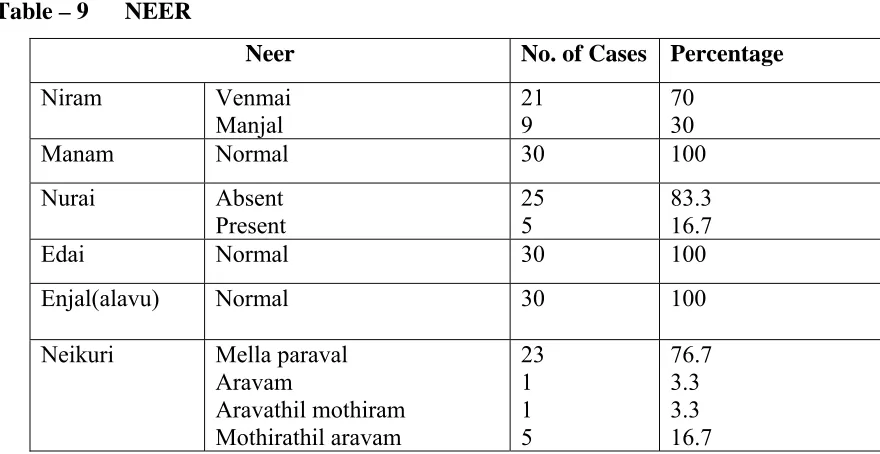
!General characters of urine,
“uf<k!fQIg<giqwjm!l{l<!Fjv!wR<soze<!
!!!!!jxf<kqbZtuju!bjxGK!LjxOb/”
! .!OkjvbI!
! Above poem quoted that there are 5 characters for urine ie; niram, edai, manam,
nurai, enjal. In niram, there are 5 major classifications. Each of this have sub
classifications. Venmai niram indicates Vatha disease, yellowish (gingely oil) colour
indicates Pitha disease, crystal colour urine with excess of foam and less edai indicates
Neikuri
It is a method to know saathiyam and asaathiyam of the diseases and some extent
to diagnose the disease, by adding one drop of gingely oil to the first early morning mid-
stream urine. The mode of spread of oil is noted. In Vatha disease it spreads like snake, in
Pitha disease it spreads like ring,. In Kapha disease it stay like pearl (there is no spread).
If the mode of spread is slow means, it indicates that disease will be curable. If the
mode of spread is fast means, it indicates that disease will not be curable.
MANIKADAINOOL
(Agathiya soodamanikayaru soothiram)!“ glzg<jgl{qg<jgbqz<!gbX!S,k<kqvl<
! uqlzOe!Ofig<gqOb!OumliLeq!
! kqlqzil<!hq{qbK!Osvs<!osh<hqOb!
! nlzeiLeqg<G!Le<eVtqs<!osb<kOk”!
! “-f<kLjx!Leqbqbbl<hqei!ovif<kEg<G!
! Sf<kvl<!sik<kqvk<kqz<!S,m<slil<!bqf<k!
! kv{qbqZt<OtiI!Ofib<!G{r<gt<!kiexqbou{<c!
! nvEjvk<k!oke<eOz!nxq”!
. hkqo{{<!sqk<kI!fic!F~z<!
According to the pathinen siddhar naadinool, manikadainool is also used for
diagnosis. There are twenty-seven different measurements of manikadai is quoted with
ALAVAI
The alavai or logic which is quoted in Sivagnana siddhar alavai nool is also
useful in diagnosis. The alavai is classified into 10 methods.
“ntju!gi{<mz<!gVkz<!djv!nhiul<!ohiVt<!yh<hioxe<hI!
!!!!!!ntju!OlZl<!ypqH{<jl!jbkqk<Okicbz<!ohe!fie<!
!!!!!!gtju!gi{<hI!njubqx<xqe<!OlZl<!njxuI!njuobz<zil<!
!!!!!!ntju!gi{<mz<!gVkz<!djv!we<xql<!&e<xqzmr<!gqMOl”!
. squRie!sqk<kI!ntju!
1. Kaandal (Observation)
2. Karuthal (Inference)
3. Urai (Testimony).
4. Inmai (Non-Existence)
5. Arunthapathi (Deduction)
6. Upamaanam (Analogy)
7. Ozhibu (Inference by exception)
8. Sambavam (Co – existence)
9. Aythigam (Tradition)
10. Iyyalbu (Natural Inference)
All these are included in the three Kaandal, Karuthal and Urai.
Kaandal is the direct and correct perception of things without doubt and mistake
and without the sense of differentiation.
By Karuthal we infer things hidden from certain data by knowledge of their
inseparable connection (by succession or co – existence or equality)
Urai alavai will guide us to the knowledge of things unattainable by the foregoing
AIM AND OBJECTIVE
Vali is one of the three humours of the body. The increased consumption of vali
diet and vali prone activities will raise the level of vali and produce vatha diseases. In
Siddha literature the Vali denotes pain and abnormal gas accumulation anywhere in the
body.
According to Yugi vaithiya sintamani, there are eighty types of vatha diseases.
Mahavatham is a disease in which the Vali humour is deranged extensively in which
abdominal pain and abdominal distension will occur.
PRIMARY AIM
1. To assess the diagnostic ability of siddha system for Mahavatham.
2. Diagnosis of Mahavatham through
a. Ennvagai thervu b. Manikkadai nool c. Nilam
d. Kalam e. Sothidam
3. To study the clinical course of disease with keen observation on noi iyal and
noi kurigal.
SECONDARY AIM
1. To establish that vali humour is deranged in Mahavatham.
2. To analyse the derangements of
a. Three humours – Vatham, Pitham, Kapham.
b. Seven physical constituents – Saram, Cheneer, Oon, Kozhuppu,
INTRODUCTION TO VATHAM
According to T.V. Sambasivam Pillai the Vatham is defined as one of the three
humours occupying the region below the naval. It is responsible for all movements in the
body. Spreads throughout the body and causes respiration, hunger, thirst etc. It is the
energy or power that prevails all over the body keeping the various tissues in good
condition.
Vatham is soft, fine and the temperature (coolness and hotness) could be felt by
touch. It is one of the uyir thathu. It is Atharam for three humours.
“Nlh<hi!&e<X!OhIg<Gl<!Nkivl<!uiBuiGl<
Wlh<hi!uiB!Osiqz<!w{<hqzl<!djmk<kib<!fqx<Gl</”
!!!!!!!!!!!!!!!.!ngk<kqbI!juk<kqb!giuqbl<!2611!
THE SITES OF VATHAM
“ oftqf<kqm<m!uiklhi!ek<jkh<!hx<xq
fqjxf<kqjmjbs<!OsIf<Kf<kqg<!gQOp!fqe<X!
Gtqf<kqm<m!&zlK~!omPf<K!gilg<!
Ogicbqjmjbh<!hx<xqobPr<!G{k<jkh<!hiOv"!
“G{lie!ouZl<jhOlx<!oxig<jg!fic!
fq{lie!ohiVk<kqmLl<!Ovilg<!giZl<!
fqjxuigq!lir<gqsolz<!zil<hvf<K!
giz<gim<c!uikolr<Gr<!gzg<Gf<!kiOe"”!
According to Vaidya sathakam, Vatham dwells in the following places:
umbilicus, rectum (Abanan), fecal matters, abdomen, anus, bones, hip-joints, skin, navel
plexes, joints, hair follicles and muscles.!
“nxqf<kqMl<!uik!lmr<G!lzk<kqeqz<”
! ! ! ! ! .!kqV&zI!
! “fiole<x!uikk<Kg<!gqVh<hqmOl!Ogtib<!
! fihqg<Gg<!gQope<X!fuqz!uiGl</”!
! ! ! ! ! .!b,gqLequI!
According to Saint Tirumoolar and Yugi Muni, the places of Vatham are the anus
and below the navel region.!
!!!!!!“nxqf<kqMl<!wz<zil<!ye<xib<!Nuqg<Gl<!nkqIuief<kie<!
! !osxqf<kqMl<!hqk<kl<!kiEl<!OsIf<kqM!fiuqOz!kie<!
!!!!!!Lxqf<kqM!ue<eqkiEl<!&cMl<!g{<{qOz!kie<!
! !hxqf<kqMl<!uib<U!kiEl<!hiqsqg<Gl<!wr<Gl<!hiOv/”!
!!!!!.!ngk<kqbI!juk<kqb!giuqbl<!
According to Agasthiyar vaithiya kaaviyam, the Vatham exists all over the body.!!
!!!!!!“nhieLk!Zf<kqujv!uikfqjz
! !df<kqbqe<!Olz<<!liIH!lm<Ml<!hqk<kfqjz/”!
! !!.!nEOhig!juk<kqb!hqvl!vgsqbl<!
According to Anupoga vaithiya brama ragasiyam, the Vatham exsists between the
PROPERTIES OF VATHAM
“Ypr<GmOe!kiOkp<!&s<Osir<gq!-br<g
! ! wPs<sqohx!wh<h{qBlix<x!–!wPf<kqiqb!
! !Ougl<!Hze<gTg<G!Olus<!SXSXh<H!
! ! uigtqg<Gl<!lif<kIg<G!uiB/”!
! ! ! ! ! ! .!lVk<Ku!keqh<!himz<!
The following are the natural properties of vatham.
1. To stimulate.
2. To respirate.
3. To activate the Body, Mind and the Intellect.
4. To expel the fourteen different kinds of natural reflexes.
5. To activate the seven physical constituents in junctional co-ordination.
6. To strengthen the five sense organs.
In the above processes Vatham plays a vital role to assist the body functions.
! “dx<xokiV!giiqbr<g{<!lx<xqz!oke<E!
! ! Lx<XtOkiI!okipqzigq!Bjvh<h!okz<zil<!
! !Oux<xouXl<!ohib<biG!olb<B!liG!
! ! ole<OlZ!fqk<kqjvjb!lqGf<K!Ou{<Ml<!
! !uqx<Hvu!lmfz<zib<!geU!ke<eqz<!
! ! uq{<[zgk<!Okkiuq!uQpg<!gi[l<!
! !sx<Xlgi!sQkr<gt<!uqVl<hi!kiGf<!
! ! kpz<uqVl<Hl<!uikG{R<!six<Xr<!giOz/”!
According to Parasasekaram the properties (Gunam) of Vali is increased sleep,
flying in dreams, hatredness on cold and likeness of hot.
!!!!!!“nxqbkql<!&e<xqeK!N{<jl!osie<eiI!ff<kq!
! !wxqb!fz<!uikl<!wxqg<Gl<!G{r<OgT!
! !Gxqbeg<!jggiz<!Gjts<S!uqzisf<K!
! !Hxqbe!ofif<Kmz<!hs<jsH{<!NGOl!
! !H{<{ib<!uzqg<Gl<!ohiVLr<!GmOzic!
! !K{<{i!lzk<jkk<kl<hqg<Gl<!Ohig<giK!
! !Y{<{ie!Nsel<!dxOu!SVg<gqMl<!
! !H{<{iI!GtqIsQkl<!hGk<kqMl<!uikOl.”!
!!!!!!!!!!!!!!!!!!!!!!!!!!.!kqVLzI!gVg<gjm!juk<kqbl<!711!
According to the Saint Tirumoolar, the properties of Vali are pain in both
extremities and flanks, generalized body pain, flatulence and constipation.!
“OgiZX!uik'hr<!Gxqk<kqcx<!Suisf<!kr<gq
! !OlZX!ouh<h!lx<h!Oluqb!sQk!lqg<gil<!
! !giZX!okipqOz!oke<eqx<!g{<gjtk<!kqxk<kz<!&mz<!
! !kiZX!ljsU!jggiz<!kiqk<kz<fqe<!Oximz<!fQm<mz<!
!!!!!!fQm<mZ!Lmg<g!Zl<hqe<!eQTX!Suisr<!gQp<Olx<!
! !gim<mZl<!hMk<k!ZRosix<!gMk<kZ!Luh<Hl<<!uQvl<!
! !%m<mZ!Lbx<sq!BR<osb<!ogiMlzR<!szl<uqf<!kig<jg!
! !uQm<mZ!olMk<k!Zr<jg!uqkieLr<!gizqe<!osb<jg/”!
!!!!!.!nr<gikq!hikl</!
According to the Angaathipatham the actions of Vali are blinking of eyes flexion
and extension of hands and legs, respiration, braveness, expulsion of stools, urine and
FUNCTIONS OF DERANGED VATHAM (Abnormal functions of vatham):
“uikOl!gkqk<k!OhiK!uibU!olPl<hq!lQTl<
! !uikOl!bqVl!zigqk<!okimIf<kqMR<!se<eq!uikl<!
! !OhkOl!osb<gq!vi{q!ohXubq!Xki!Oki]l<!
! !OhikOu!Okie<X!ole<X!ohiVf<kOu!LequI!osie<eiI/!
!!!!!!uikOl!Lkzi!fic!uikOl!Kiz!gibl<!
! !uikOl!ohzui!eiGl<!bpjz!Ou{<Ml<!
! !uikOl!lf<kl<!hx<Xl<!uikOl!sQk!gizl<!
! !uikOl!Bmx<G!tqIs<sq!uikOl!&zliOl/!
! !uikOl!uiB!uiGl<!uikOl!gizqx<!OsVl<!
! !uikOl!fe<eq!ObiM!lVuqcz<!uzqB!L{<mil<!
! !uikOl!uqcbh<!hk<K!uikOl!sibr<!gizl<!!
! !uikOl!Htqh<H!uir<Gl<!uikLf<!ktIs<sq!gizl</”!!
!!!!!!!!!!! .!hvvis!Osgvl<!
According to Pararasa sekaram the deranged Vali will produce cough, delirium,
diarrhoea and abdominal distension..
!!!!!!“uik!uQX!ne<e!lqxr<giK!gMh<H{<mil<!u{<{L{<mil<!
! !OliK!gm<M!Ovigl<!SvL{<mi!lqVlZli!Lxr<gioke<Xl<!
!!!!!!!!!!!!!!.!OkjvbI!uigml<!
According to the Saint Theraiyar, the deranged Vali produces reduced appetite,
fever, cough and insomnia.
“osb<bOu!uikk<kiz<!uVOfib<!osiz<Oue<
!!!!!!!!!!!sqg<gqlz!szr<gMk<k!Zjtkz<!Gk<kz<!
!!!!!!!!!jfbOu!g{<gXk<Kg<!g{<{QI!uQp<f<K!
!!!!!!!!!olb<kck<K!lqgOfikz<!ohiVlz<!ogit<tz<!
!!!!!!!!!!!uqf<Kuzq!kie<!Gjxf<K!lf<klikz<!
!!!!!!!!!jhbOu!GtqIf<kqVk<k!zie!ouz<zil<!
!!!!!!!!!!!!hzuigg<!g{<mxqf<K!sqf<kqh<hiOb/”
- nr<gikqhikl<!
!!!!!!!!!“hir<gie!uikf<kie<!lQXligqx<!
!!!!!!!!!!!hVubqX!SuisLme<!Gk<Kg<Ogijp!
!!!!!!!!!!fQr<gik!hqch<HjtU!uiB!okif<kl<!
!!!!!!!!!!!!fQIouck<Kh<!hib<kz<!lf<kl<!uqmlqh<hikz<!
!!!!!!!!!!Kir<Gse<eq!uikSv!lkeqx<!Okimf<!
!!!!!!!!!!!!okiGk<k!gqvi!{qg<gpqs<s!Zkv!Okiml<!
!!!!!!!!!!uir<Ghz!uzqGtqIs<sq!Ge<luik!
!!!!!!!!!!!!lzszr<gm<!cmz<uik!uf<kqh<hiOl/”
!!!!!!!!!!!.!nr<gikqhikl</!
!
According to Angaathipatham the deranged Vali produces constipation, scanty
micturition, increased lacrimation, blackness of eyes, fissures in tongue, dysarthria,
flatulence, abdominal distension, cough with expectoration, indigestion and diarrhoea.
“gi{h<hi!uiklQxqz<!giz<jggt<!ohiVf<K!OfiUl<!
! !!!!H,{h<hi!Gmz<Hvm<Ml<!lzszl<!ohiVlqg<!gm<Ml<!
!!!!!!!D{h<hi!GtqVr<!gib<s<sz<!dml<ohz<zil<!Gk<Kuib<U!
! !!!!uQ{h<hi!GklqXg<Gl<!uqbIjuBl<!OuIg<Gl<!kiOe/”!
. ngk<kqbI!juk<kqb!giuqbl<!2611!
According to Agathiyar vaithiya kaaviyam, the deranged Vali produces pain in the
joints of the hands and legs, flatulence, constipation, scanty micturition, fever with rigor,
generalized body pain, increased sweating.
“kg<g!uiB!Ogihqk<kz<!sf<K!Ujtf<K!kjzOfiui!
!!!!!!!!!lqg<g!&iq!ogim<miuq!uqm<mr<!ogiqB!lzr<gm<Ml<!
!!!!!!!!!yg<g!fvl<H!kie<Lmr<G!LzIf<K!uib<fQ!VxquVl<!
!!!!!!!!!lqg<g!GtqVl<!fMg<gLlil<!Oleq!Ge<xq!uVr<giO{/”!
!!!!!!!!!! .!OkjvbI!uigml<!
According to Theraiyar vagadam, the deranged Vali produces pain in the
joints, headache, constipation, increased salivation, fever with rigor, loss of normal
complexion. !
“Ngr<gXg<GOfi!bigf<!Kcg<Gl<!
!!!!!!!!!!Nxik<kQ!obe<eolb<!Obgr<!ogikqg<Gl<!
!!!!!!!!!!NVolb<!uqbIkqbqI!lQlf<kl<!uib<&s<S!
!!!!!!!!!!!NGOlbqK!uikOlzqeq/”!
! ! .!OkjvbI!giqsz<!
According to Theraiyar karisal, the deranged Vali produces blackish
discolouration of body, feverishness, increased sweating, indigestion, dypnoea.!
“OluqbuikR<!osb<Br<!G{f<kje!uqbl<hg<!Ogtib<!
!!!!!!!!kiuqOb!ubqX!lf<kR<!sf<Kgt<!ohiVf<K!OfiuiR<!
!!!!!!!!sQuqb!kiKfisR<!osXk<Kme<!sqXfQI!uQPr<!
!!!!!!!!giuqbr<!g{<{q!eiOt!lzlK!gVgq!uQPl</”!
!!!“uikk<<kqe<!G{Oloke<eqz<!ubqxK!ohiVlqg<ogit<Tf<!
!!!!!!!!kiKgTzIf<k!jggiz<!sf<Kgt<!gMh<Hk<!Okie<Xf<!
!!!!!!!!kQKx<xs<!sqXfQIkiER<!sqXk<Kme<!gMk<K!uQPl<!
!!!!!!!!OhiKx<x!uikole<X!He<xeI!LequI!kiOl/”
- ngk<kqbI!uik!giuqbl<!2111!
According to Agathiyar vatha kaaviyam, the deranged Vali produces abdominal
discomfort, pain in joints, oliguria, dysuria, constipation, flatulence.
According to Kanusamiyam, the own qualities of deranged Vatham are rough,
dryness, lightness, cold, unstable, subtle.
KINDS OF VATHAM
- 10
‘Ljxjlbil<!hqvi{Oei!mhiee<!uqbiee<!
! ! &Ig<gli!LkieoeiM!slie!eige<!
! kqxjlbir<!%IlOeiM!gqVg!ve<xie<!
! ! Okukk<k!oeiMkeR<!sbE!liGl</”!
! ! ! ! !.!b,gq!juk<kqb!sqf<kil{q!911!
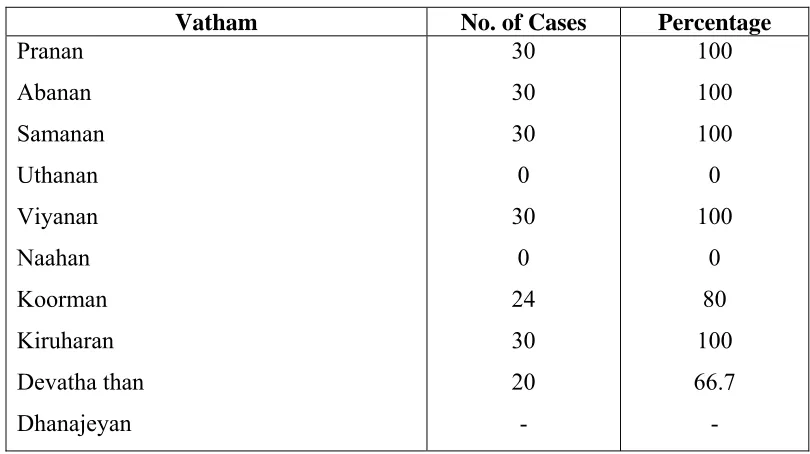
!!!!!!!Eventhough the Vatham seems to be the same, it has got ten different forms and
actions. The main vayus are
Pranan - Air of Life
Abaanan - Air with downward motion (Flatus Air) Vyanan - Air which spreads throughout
Udhanan - Air with upward motion
Samanan - Air with upward and downward motion Nagan
Koorman
1. Pranan (Air of life):
“hqxjlbi!lqke<hqiqU!hqvi{!uiB!
! ! ! ohV&zi!kivk<kqe<!gm<Omie<!xqk<kie<!
! ! dxjlbi!lsjuobE!lf<kq!vk<kiz<!
! ! ! Yr<giv!LkozPk<jk!Be<eqk<!kiOe/!
!!!!!!!!!!de<eqOb!OlozPf<K!heqv{<!mr<Gzl<!
! ! ! dbIf<koum<!mr<Gzf<kie<!lQt!uir<gq!
! ! fe<eqfi!zr<Gzf<kie<!hipqx<!hiBl<!
! ! ! fzlie!G{olz<zil<!hqvi{!uiB!
! ! he<eOu!fQzu{<{l<!okb<<ul<!sf<kqve<!!
! ! ! hzh<hzuil<!ohisqh<ohz<zil<!sQI{!liGl<!
! ! de<efi!pqjgLf<!F~x<!xXhK!Suisl<!
! ! ! dbIf<kfi!otie<Xg<G!&s<jsg<!OgOt/!
!!!!!!!!!!!fiotie<Xg<!gqVhk<Oki!vibqvk<!kXF~X!
! ! ! fzlie!Suisf<ki!oePf<kq!Vg<Gl<!
! ! OgiOtie<xqh<!hkqeizi!bqvk<K!fiE~X!
! ! ! Guqk<k&!zikivk<!Kt<oti!Mr<Gl<<!
! ! hiotie<xq!Obpibqvk<!kqVF~X!Suisl<!
! ! ! hipqeqx<!hib<f<kqMole<!xxqg<!hqe<je!
! ! Wotie<xq!bqkjeOb!Bm<s!kqk<kz<!
! ! ! wh<OhiKl<!hizivi!bqVg<g!ziOl"!
!!!!!!!!!!!!.!B,gq!juk<kqb!sqf<kil{q!
This is the first of the ten vital airs. According to yugi Muni, Pranan starts from
Moolatharam and comes through the nostril and does inspiration and expiration. The
inspiration and expiration is not uniform as the ratio is 8:12, thereby the process of
This is blue in colour and the Moon is its deity. For one nazhigai i.e. 24
minutes, there will be 360 inspirations. So there will be 21,600 inhalations for a day.
Out of this, 14,400 inspirations is utilized by the body and the rest will go waste.
2. Abaanan (Flatus air):
-Vg<gOu!bhiek<kq!eqbg<gr<!Ogtib<<!
! ! ! Wx<xSui!kqm<miek<!Kx<hk<kq!biGl<!
! ! lVg<gOu!gQp<Ofig<gq!lzszf<!kt<Tl<!
! ! ! uigig!fqxf<kiEl<!hs<js!biGl<!
! ! nVg<gOu!bisek<jks<!SVg<gq!jug<Gl<!
! ! ! ne<esi!vk<jkobziR<!Osv!jug<Gl<!
! ! kqVg<gOu!OkujkBl<!uvk!vi\e<!
! ! ! kqvlie!uqbieeqm!sqxh<jhg<!OgOt"!
!!!!!!!!.!B,gq!juk<kqb!sqf<kil{q!
Abaanan, the downward Air, starts from Swathittanam and descends down and is
responsible for excretion of urine and feces. This is green in colour. It contracts the
anus. It helps to take the essence of the digested food to the different parts of the body,
which requires food. The God attributed is Varadarajan.
3. Vyanan (Spreads all over the body):
“sqxh<hie!uqbieeK!Okizq!eqe<X!
! ! kqgopPhk<!kQvibqv!fvl<hqx<!ose<X!
! kXh<hie!svusvf<!keqOz!fqe<X!
! ! kieQm<mz!Lmg<gz<!h{<{qh<!hiqslxqBl<!
! nXh<hie!ue<esi!vf<ke<!jek<kie<!
! hxh<hie!kKhizqe<!u{<{!liGl<!
! ! hivkeqx<!oxb<uf<ki!Oel!eiOl”/!
!!!!!!!!!!!!.!B,gq!juk<kqb!sqf<kil{q!
Vyanan arises from the skin and go through all the 72,000 nerves and thus
activate voluntary and involuntary movements of the body and thus make them to extend
or flex. This appreciates the sense of touch; helps to take the essence of the food to the
strategic points of the body and guards the body. The colour of Vyanan is milky white,
and the Deity is Eman.
4. Udhanan (Upward air):
“Wlei!Lkieeqm!Oux<xr<!Ogtib<!
! ! Wpqzie!Ukvug<!gqeqob!Ph<hqh<!
! H,lei!le<esi!vf<k!jek<kie<!
! ! ohiVf<kOu!slQhk<K!fqXk<kq!jug<Gl<!
! gilei!obMh<hqk<Kl<!gzg<gq!juk<Kl<!
! ! gzg<gqOb!uVk<Kuqg<Gl<!ubh<h!liGl<!
! uQlei!lqe<eqeqm!u{<{!liGl<!
! ! uqtr<gqbOki!vg<gqeqkie<!okb<u!liOl”!
! .!B,gq!juk<kqb!sqf<kil{q!
!
! Udhanan starts from the umbilical region (Udarakkini) and takes the essence of
food and stagnate it at appropriate places. It helps in digestion and assimilation of food.
The colour of Udhanan is that of lighting, and the Deity is the God of fire.
5. Samanan (Balancing force):
“Nole<x!slieeqm!ui{<jl!Ogtib<!
! ! ofcfihq!hikir<gR<!sle<ogi{<!Omgq!
! uiole<x!uiBuqe<!lqR<osim<!milz<!
! ! lmg<gqOb!sle<osb<K!lVuh<!h{<[l<!
! kiole<x!nXSjujbk<!k{<{Q!ve<el<!
! ! sle<osb<K!siQvolziR<!sivh<!h{<[l<!
! uiole<x!u{<{lK!Hm<h!vigl<!
! ! lgk<kie!okb<uli!kqk<k!eiOl/”!
! .!B,gq!juk<kqb!sqf<kil{q!
Samanan starts from the umbilical cord and spread out up to the lower limb. This
is responsible for the balance of the other four Vatham. It equalizes the six tastes, water,
food etc., and helps in assimilation. Samanan is topaz coloured and the God is the Sun.
6. Nagan
“okb<uli!figeqm!sqxh<jhg<!Ogtib<!
! ! osbzie!sgzgjz!big<G!uqk<Kh<!
! hb<ulib<h!hiMuqg<Gl<!g{<uqpqg<Gl<!
! ! hir<gig!Ousqlqp<g<Gl<!Ovil!ljsg<Gl<!
! ohb<ulil<!ohie<eqeqm!u{<{liGl<!
! ! ohiqkie!okb<uf<ki!jef<k!eiGl</”!
! !!!!!!!!!!!.!B,gq!juk<kqb!sqf<kil{q!
Nagan is responsible for higher intellectual functions, hearing, thinking etc. It
7. Koorman
ogib<ulir<!%Ileqm!G{k<jkg<!Ogtib<!
! ! ogicb!lef<!keqeqe<X!fqjlogim<!Ml<Ol!
! fqjlogim<Mr<!ogim<miuq!kiEr<!ogit<Tl<!
! ! Ofvig!uib<&Ml<!hzE{<!mig<Gl<!
! gjlogim<Mr<!g{<uqpqg<Gl<!&mh<!h{<[l<!
! ! gim<sqobzir<!gi{<hqg<Gl<!uqpqfQ!OviMl<!
! -jl!ogim<Ml<!u{<{lK!ouTh<h!kiGl<!
! ! Olzie!okb<uf<kie<!uq{<M!uiGl<"!
! ! ! !!!!!!!!!!.!B,gq!juk<kqb!sqf<kil{q!
Koorman starts from the mind and causes twinking of the eyelieds, yawning and
colosure of mouth. It gives strength and helps to visualize things and causes lacriminal
secretion. The God is Vishnu and its colour is white.
8. Kirukaran
“gjlogim<Mr<!gqVgve<xe<!G{k<jkg<!Ogtib<!
! ! gsqfiU!fisqkeqx<!gsqU{<!miOl!
! gsqU{<mir<!gMl<hsqbqx<oge<lR<!osz<Zl<!
! ! g{<{qOb!bqVk<koziM!Ohik!ziGl<!
! KsqU{<mib<k<!Kl<lOzi!cVl!Z{<mil<!
! ! Sblie!u{<{lK!gXh<h!kiGl<!
! oksqU{<mif<!okb<ulK!sque<xi!eiGl<!
! ! kqOvikibqe<!%xie!kqxL!liGl<”
Kirukaran lies in the tongue and causes nasal and salivary secretions. It induces
hunger, it makes to concentrate on one thing, sneezing and cough are attributed to
Kirukaran. It is black in colour. The God is Siva.
9. Devadaththan
“GsqU{<mif<!Okukk<ke<!G{k<jk!Ogtib<!
! ! Gczlib<s<!Osil<hqLiqk<!kqMk!ziOl!
! Liqk<kqMkz<!uqpqg<Gl<Ohi!kbIs<sq!bigq!
! ! LGtqkblib<g<!g{<j{Obim<!MziU!uqk<Kg<!
! kiqk<kqMkz<!s{<jm!ogitz<!kIg<gl<!Ohsz<!
! ! s{<mit!!Ogihk<jk!B{<M!h{<{z<!
! Gxqk<kqMkz<!Gkr<Gb<bk<!kief<!ke<eqz<!
! ! %if<kokb<uf<!OkOuf<kqve<!hcg!u{<{l<"”
- B,gq!juk<kqb!sqf<kil{q!
! Laziness is attributed in Devadaththan. Occular movements and human passions
are attributed to this vatham. It stays either at the anus or at urinary orifice. The colour is
that of a Crystal and the God is Devendran.
10. Dhananjayan
“kiqk<kqMkz<!keR<sbjes<!six<xg<!Ogtib<!
! ! sir<glib<!&g<gqeqe<Xf<!kcg<Gf<!kiOe!
! kck<KOl!Bml<ohz<zil<!uQr<gh<!h{<[l<!
! ! kf<kqvlib<g<!ge<ek<kqx<!sLk<kqvl<!Ohiz<!
! Kck<KOl!Sf<kvlib<g<!Ogi]<!ligqk<!
! ! kqv{<MOl!KR<Sgi!zf<k!eqx<xie<!
! uck<KOl!uiBouz<zil<!Ohie!hqe<H!
! nck<KOl!kjzouck<kv!zh<hix<!OhiGl<!
! ! nke<u{<{fQzu{<{lxqf<Kogit<Ot!
! nxqf<KOl!okb<ulK!ke<uf<!kqiqbil<!
! ! Nguqf<k!uQjvf<K!likq!uiB/”
- B,gq!juk<kqb!sqf<kil{q!
Dhananjayan functions from the nose and it is responsible for the bloating of the
body after death and also for the foul smell.
utq!Ofib<!Okie<Xr<gizl<!
!!!!!!!!!“uikuIk<!kjeg<giz!OlOki!oue<eqz<!
!!!!!!!!!!!!lVUgqe<x!uieqgI!gmgliGl<!
!!!!!!!!!!Nkjuh<!hsqObiM!giIk<kqjg!ke<eqz<!
!!!!!!!!!!!!!nmVOl!lx<xli!kr<gt<!ke<eqz<!
!!!!!!!!!!OhikOu!slqg<Ggqe<x!giz!liGl<!
!!!!!!!!!!!!!!ohiVf<kqOb!-uI!okipqz<!kie<!g{<kqxk<kz<!
!!!!!!!!!!gikOu!g{<&mz<!jggiz!jsk<kz<!
!!!!!!!!!!!!!!!gcf<Okim<m!Lmg<goziM!fQm<m!oze<Oe/”!
!!!!!!!!!!!!!!!!!!!!!!!!!!.!B,gq!LequI!juk<kqb!sqf<kil{q!ohVFiz<!911!
Derangement of Vatham occurs in Mudhuvenir and Kaar kaalam. Vatham comes
to thannilai in Koothir kaalam.
CAUSES FOR VATHA DISEASE
“we<eOui!uikf<ki!oe{<h!kiGl<!
! ! ! lqgk<kqOz!leqkIgTg<!ogb<K!liX!
! ! hqe<eOu!ohie<kjeOb!OsivR<!osb<K! !
! ! ue<eOu!us<osik<kqx<!OsivR<!osb<K!
! ! ! likihqki!GVju!lxf<K!OhIg<Gl<!
! ! ge<eOu!Oukk<jk!fqf<jkosb<k!OhIg<Gr<!
! ! ! gibk<kqx<!gzf<kqMOl!uikf<!kiOe/”!
!!!!!!!!!!“kioee<x!gsh<OhiM!KuIh<H!jvh<H!
! ! ! sikglib<!lqR<SgqER<!sjlk<k!ue<el<!
! ! Noee<x!uixqeK!ohisqk<k!ziZl<!
! ! ! Ngibk<!OkxzK!Gck<k!ziZl<!
! ! hioee<x!hgZxg<g!lqviuq!pqh<H!
! ! ! hm<ceqOb!lqgUXkz<!hiv!olb<kz<!
! ! Okoee<x!olipqbix<!Olx<!sqf<jk!bigqz<!
! ! ! sQg<gqvlib<!uiklK!oseqg<Gf<!kiOe/”!
!
!!!!!!!!!!!“N{ie!uve<xjeOb!lkqbi!lif<kI!
! ! ! ngkqhv!OksqbIgm<!ge<e!lQbiI!
! ! Ogieie!GVolipqjb!lxf<k!OhIgt<!
! ! ! ogijzgtU!ohib<gilr<!Gxqk<k!OhIg<G!
! ! Deie!smf<ke<eqz<!uikl<!uf<K!
! ! ! dx<huqg<Gl<!Oukk<kq!E{<jl!kiOe/”!
!!!!!!!!!!!!!!!!!!!!!!!!!!!!!!.!B,gq!juk<kqb!sqf<kil{q!
According to Yugi vaithya sinthamani those who are wasting money, insulting the
elders, forgetting the parents, criticising the holy books, not respecting the divine gifts not
helping to the oustees, having wickedness in their mind and those who are sleeping at day
Increased intake of kaippu, thuvarppu, kaarppu taste, increased intake of water,
increased starvation, increased sexual desire will produce Vatha diseases.
!“okipqz<ohXjgh<Hg<giIk<!kz<KuIk<kz<!uqR<SgqER<OsiXl<! ! ! hjpbkil<!uvG!lx<jxh<!jhf<kqje!bVf<kq!eiZl<! ! ! wpqz<ohxh<!hgZ!xr<gq!-vuqeq!Zxr<gi!kiZl<! ! ! ljpfqgI!Gpzq!eiOt!uikr<Ogi!hqg<Gr<!giO{/! !
!!!!!!!!!!!gi{Ou!lqgU{<!miZr<!gVKhm<!cequqm<!miZl<! ! ! lieje!biIg{<!Olig!lxg<gqE!lqGk<kqm<miZl<! ! ! N{u!lzr<g!ml<jl!br<rOe!uqmik!kiZl<! ! ! uiEke<!lmfz<!ziOt!uikr<Ogi!hqg<Gr<!giO{/! !
! ! hiiqeqx<!hbh<hm<miZl<!hzVme<!Ogihqk<!kiZl<! ! ! gioveg<!gVgq!Obicg<!gPlvk<!Kvk<kq!{iZl<! ! ! WIohX!keK!ofR<sqe<!lqgk<Kg<g!ljmf<kqm<miZl<! ! ! hiiqbgix<xq!eiTl<!hmiqEl<!uikr<!gi[l</!
!
!!!!!!!!!!!gizr<g{<!lixq!B{<[r<!giiqbk<!kiZf<!k{<{QI! ! ! sizOu!bVf<kq!{ZR<!sf<kqbq!Zm<giIf<!kiZl<! ! ! Ogizlil<!Htqh<H!ofb<jbg<!Gjxux!uVf<kq!eiZl<! ! ! uizuiI!Ljzfz<!ziOtuikLx<!huqg<Gr<!giO{/! !
! ! dx<huqk<!okPlh<!OhiOk!BbIHxf<!Kcjbh<!hx<xqk<! ! ! okx<hxg<!Gjmf<K!OfiUR<!osb<KOlz!Ofig<G!ligqz<! ! ! uqx<ohizq!Fkzq!eiOt!OlzqMr<!G{r<g!ml<lqz<! ! ! osix<ohX!uikl<!uf<K!Okie<Xole<!xxqf<K!ogit<Ot/! !
!!!!!!!!!!!okiqf<KLe<!osie<e!u{<{R<!osb<bgi!zcjbh<!hx<xq! ! ! lif<kjeh<!Ohix<xq!lqIk<K!lx<XOlz<!Ofig<G!ligqz<! ! ! nve<xjek<!Kkqbi!lif<k!vEsiqg<!gqe<x!Ogibqz<! ! ! siqf<kqMr<!Gpzib<!uikr<!GcHGR<!six<Xr<!giOz/”!